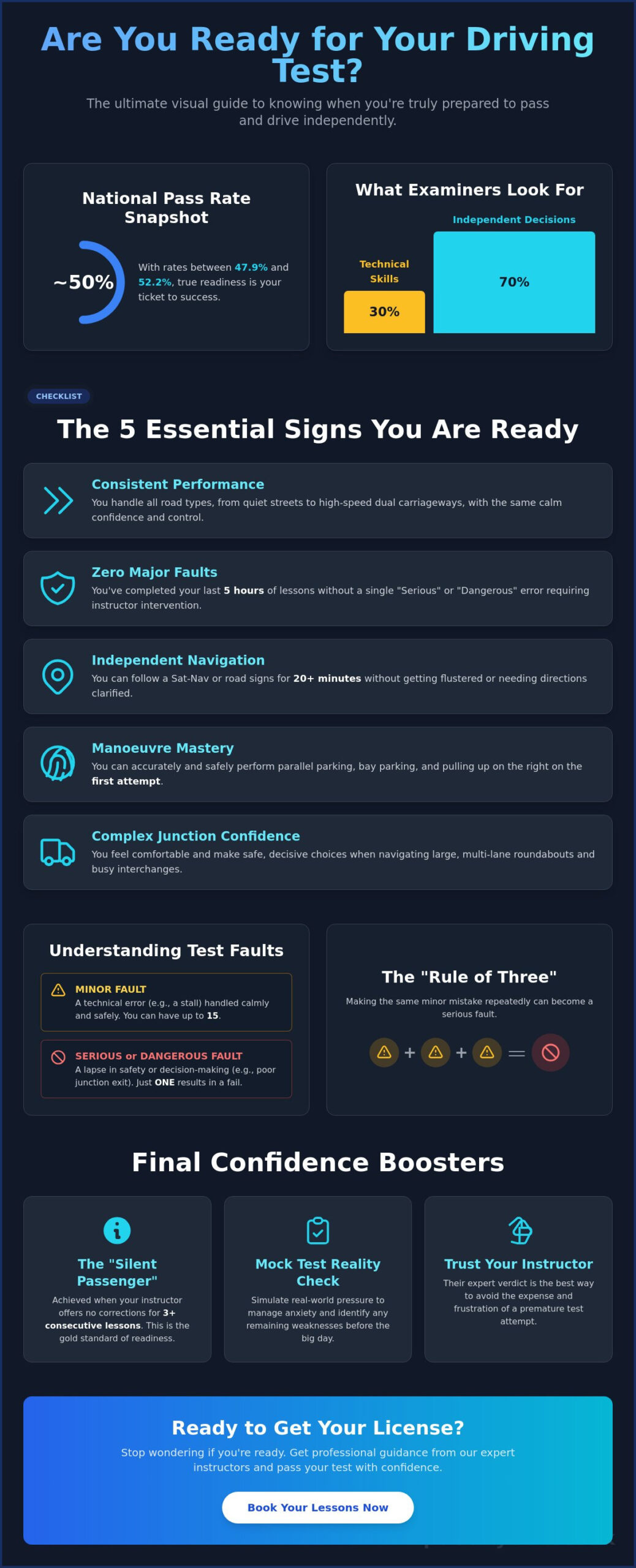
What if the secret to passing your driving test isn’t about being a perfect driver, but about how you handle the small mistakes you actually make? With national pass rates currently sitting between 47.9% and 52.2%, it is natural to feel anxious about whether you are truly prepared. You might be wondering how to tell if you’re ready for your driving test or if those “silly mistakes” on complex roundabouts mean you should wait. It is completely normal to feel a knot in your stomach when you think about the long wait for a retest or the frustration of a failed attempt.
We understand that you want the freedom of a license without the stress of uncertainty. This guide provides the definitive signs that you have moved from a learner who needs a safety net to an independent decision-maker who is ready for the road. You will discover exactly how to assess your own skills and avoid the cost of a retake. We will walk through the essential 2026 checklist, covering everything from junction confidence to the latest DVSA booking rules, so you can walk into the test center with total peace of mind.
Key Takeaways
- Learn why true test readiness is about making independent decisions without needing your instructor to step in.
- Discover how to tell if you’re ready for your driving test by achieving consistent, fault-free performance across all road types.
- Understand how professional mock tests simulate real-world pressure to help you manage anxiety and build genuine confidence.
- Identify the difference between simple nerves and serious safety gaps to ensure your “silly mistakes” don’t lead to a fail.
- Find out why trusting your instructor’s expert verdict is the best way to avoid the expense and frustration of a retake.
The Independence Shift: Moving Beyond Technical Driving Ability
Many learners believe that if they can steer, shift gears, and park, they are ready for the big day. However, technical control is only about 30% of what the examiner is looking for. The real test is your ability to drive independently. This means you can process complex hazards and make safe choices without any verbal or physical prompts from the person in the passenger seat. If you are wondering how to tell if you’re ready for your driving test, you need to look closely at how much thinking your instructor is still doing for you.
Independent driving is the ability to navigate the road while managing your own safety and the safety of others. It isn’t just about following a sat-nav or road signs during a specific part of the test. It is a mindset that covers every second you are behind the wheel. When you no longer look to your instructor for a nod of approval before pulling out at a junction, you have made the independence shift.
Identifying the “Silent Passenger” Milestone
There is a specific psychological shift that happens when your instructor stops “co-driving” and starts observing. During your early driving lessons, your instructor likely gave constant reminders about mirror checks or gear changes. You reach a major milestone when they become a silent observer. We call this the “Silent Passenger” phase. If your instructor hasn’t touched the dual controls or offered a verbal correction for at least three full lessons, you are entering the gold standard of readiness. An intervention-free lesson is the clearest sign that you are managing the car and the environment entirely on your own. Try tracking your next 60-minute session; if you finish the hour with zero physical or verbal interventions, your confidence should soar.
Technical Perfection vs. Safe Decision Making
It might surprise you to learn that a stalled engine is often better than a poorly timed junction exit. A stall is a technical error that is usually a minor fault if handled calmly. A poorly timed exit is a lapse in safety and decision-making that can result in a serious fail. You must distinguish between knowing how to perform a maneuver and knowing when it is safe to start one. To evaluate your own readiness, practice hazard perception in real-time. Don’t wait for your instructor to point out a pedestrian or a changing light. You should be the one reacting first every time. If you do make a minor error, don’t panic. The ability to self-correct safely without any input shows the maturity needed to pass. This level of awareness is a vital part of how to tell if you’re ready for your driving test and capable of driving alone.
The 5 Essential Signs You Are Ready for Your Practical Test
Knowing how to tell if you’re ready for your driving test involves looking for specific, repeatable patterns in your driving. It isn’t just about having a “good day” in the car. Real readiness shows up as a series of consistent habits that keep you and others safe, regardless of which route the examiner chooses. If you can check off these five milestones, you are likely prepared to trade your L-plates for a full license.
- Consistent performance: You handle every road type, from narrow residential streets to high-speed routes, with the same level of calm.
- Zero major faults: You have completed your last five hours of professional driving lessons without a single “Serious” or “Dangerous” error.
- Independent navigation: You can follow a Sat-Nav or road signs for 20 minutes without getting flustered or needing help to stay on course.
- Manoeuvre mastery: You can perform the parallel park, bay park, and pulling up on the right accurately on your very first attempt.
- Complex junction confidence: You feel comfortable navigating multi-lane systems, such as the dual carriageway networks found in busy urban areas.
Consistent Performance Without Serious Faults
A “serious” fault is defined by the DVSA as something that has the potential to become dangerous to you, the examiner, the public, or property. A “dangerous” fault is one where actual danger occurred. To pass, you must have zero of either. We often encourage students to use the “rule of three” as a guide. If you make the same minor mistake three times during a session, an examiner will likely mark it as a serious fault. Keeping a “fault log” over several weeks helps you track your consistency and proves you have moved past the stage of making repetitive errors.
Mastering Milton Keynes Roundabouts and H/V Roads
For those learning in specific areas like Milton Keynes, the grid system adds an extra layer of complexity. You must be an expert at lane discipline on large, multi-lane roundabouts where traffic moves quickly. Readiness means you can seamlessly handle the transition between 70mph grid roads and 30mph residential zones without hesitation. You shouldn’t just know the rules; you should feel the rhythm of the local traffic. Local road knowledge is the final layer of test-day confidence that ensures you aren’t surprised by a tricky lane merge or a hidden speed change.
Mock Driving Tests: The Ultimate Reality Check
A mock test is the most reliable way to answer the question of how to tell if you’re ready for your driving test. It moves you away from the comfort of a standard lesson and into a high-stakes simulation. By replicating the exact format of the DVSA exam, you can see if your skills hold up when the safety net is removed. It is an objective look at your progress that removes the guesswork from your preparation.
The process generally follows four simple steps. First, try to book your mock with an instructor you don’t know. This mimics the “stranger” factor of a real examiner and prevents you from relying on the familiar rapport you have with your regular teacher. Second, ensure you replicate every detail, including the “Show Me, Tell Me” vehicle safety questions at the start. Third, evaluate the result honestly. If you fail a mock, it isn’t a setback; it is valuable data. Finally, use the feedback to create a targeted “fix-it” list. This allows you to spend your final lessons focusing only on the specific areas that need improvement.
Why a Mock Test Feels Different
The most striking change during a mock session is the examiner’s silence. During a normal lesson, your instructor might offer small prompts or encouraging words. In a mock test, that silence can feel heavy and often leads to an internal monologue where you second-guess your decisions. You might find yourself braking harder or steering more tentatively because of the pressure. We strongly encourage learners to book a mock test in Milton Keynes to get used to these feelings on actual test routes. Learning to manage your physical reactions to stress is just as important as knowing the rules of the road.
Scoring Your Performance: The 15 Minor Fault Limit
The scoring system is straightforward but strict. You will fail if you record a single serious or dangerous fault. You will also fail if you accumulate 16 or more minor faults. Many learners find that they struggle with observation and mirror use when they are nervous. If your mock test shows you are close to the limit, it is a sign you need more practice. This data helps you decide whether you should proceed or change your book driving test date. Remember, the goal is to pass first time and avoid the cost and delay of a retake. With the national pass rate currently between 47.9% and 52.2%, being fully prepared is your best strategy for success.
Overcoming the “Silly Mistake” Myth and Managing Nerves
It is very common to hear a learner say, “I only failed because I was nervous; I’m actually a good driver.” While it feels true in the moment, examiners view this differently. They are looking for drivers whose safety habits are so deeply ingrained that they remain intact even under pressure. A “silly mistake” during a high-stakes moment suggests that a skill hasn’t quite become second nature yet. Understanding this distinction is a vital part of how to tell if you’re ready for your driving test.
When you are truly ready, you operate within a “safety bubble.” This means your primary goal isn’t just to pass a test or impress an examiner. Instead, you are driving to protect yourself, your passengers, and other road users. When your focus shifts from “not making a mistake” to “keeping everyone safe,” your anxiety often naturally decreases. You are no longer performing for a grade; you are demonstrating your competence as a responsible road user.
Why “Silly Mistakes” are Serious Red Flags
Examiners see a “silly mistake,” such as forgetting a blind spot check or hesitating at a clear junction, as a sign that your habits are still conscious actions. If you have to remind yourself to check your mirrors, that habit might fail you when you are stressed or distracted. You want to move from conscious effort to unconscious competence. This happens through repetition and high-quality instruction. Readiness is reached when safe driving requires zero conscious effort. If you find yourself performing safety checks automatically, you have reached the level of consistency required to succeed. Booking a few targeted driving lessons can help bridge this gap and turn those manual thoughts into automatic responses.
Practical Strategies for Test-Day Anxiety
If you feel your heart racing as you leave the test center, try “commentary driving.” This involves speaking your thoughts and observations out loud. By saying, “Slowing down for the pedestrian,” or “Checking my right mirror for the cyclist,” you keep your brain focused on the task and prevent your internal monologue from spiraling into worry. It also shows the examiner exactly what you are thinking. If you believe you have made a mistake, take a deep breath and reset. Many learners pass with several minor faults, so don’t let one small slip-up ruin the rest of your drive. A good night’s sleep and a calm warm-up lesson before the examiner arrives will also help you settle into the rhythm of the car. This mental preparation is just as important as your technical skill when deciding how to tell if you’re ready for your driving test.
Trusting the Experts: Why Your Instructor’s Verdict Matters
The final and most significant part of how to tell if you’re ready for your driving test is the professional opinion of your Approved Driving Instructor (ADI). Your instructor is more than just a teacher; they are a safety gatekeeper with a deep understanding of DVSA standards. They view your driving through the lens of professional liability and long-term safety. If an instructor suggests you aren’t ready, it is because they have seen a pattern that could lead to a dangerous situation. Pass4you Driving School instructors will not take their car to a test if they believe a student is unsafe, as their reputation and your safety are both on the line.
At Pass4you Driving School, our teaching method focuses on excellence and efficiency. We are proud to maintain a high first-time pass rate of 83.33%, which is a proof point of our commitment to saving you money and time. By ensuring you are truly prepared before you book, we help you avoid the cycle of failed tests and the long retest waiting lists that currently frustrate many learners. During your next driving lessons in Milton Keynes, have an honest “Ready to Pass” conversation. Ask your instructor for a specific breakdown of your independence and where you sit on the 2026 checklist.
Why Your Instructor Might Say “Not Yet”
It is natural to feel a sting of disappointment if you are told you aren’t ready. However, listening to this advice is a smart financial move. A weekday practical test costs £62. When you add the cost of car hire and the potential months of waiting for a new slot, the hidden cost of a failed test is high. Investing in a few extra lessons is almost always cheaper and less stressful than a retake. The team at Pass4you Driving School works with you to set a realistic “Pass Date” goal. This ensures you aren’t just hoping for a pass, but rather expecting one because your skills are undeniable.
The Pass4you Driving School Advantage: Excellence in Milton Keynes
We believe that the environment you learn in matters. That is why Pass4you Driving School uses modern Volkswagen tuition vehicles to provide maximum comfort and reliability during your training. Our first-class instructors know the Milton Keynes test routes intimately. They understand exactly how the examiner will use the grid roads and roundabouts to test your decision-making. This local expertise gives you a distinct advantage on test day. If you want a professional, objective look at your skills, book your assessment lesson with Pass4you Driving School today. We will help you determine exactly how to tell if you’re ready for your driving test and give you the confidence to succeed the first time.
Take the Wheel with Confidence
You have moved from mastering the technical basics to becoming a truly independent decision-maker on the road. By applying the 2026 checklist and observing your own habits during the “Silent Passenger” phase, you can now move forward with certainty. Understanding how to tell if you’re ready for your driving test is the key to avoiding the frustration of a retake and the long wait for a new slot. You have the mental tools and the practical criteria to judge your own progress objectively.
Pass4you Driving School is here to support that final step toward your license. With our elite instructors in Milton Keynes and our modern Volkswagen tuition vehicles, we maintain an 83.33% first-time pass rate that reflects our high standards. We don’t just teach you to pass; we prepare you for a lifetime of safe driving. Check your readiness with a Pass4you Driving School mock test in Milton Keynes and start your journey toward total independence today. Your new life on the road is waiting.
Frequently Asked Questions
How many driving lessons do I need before I am ready for my test?
There is no set number of hours required, as everyone learns at a different pace. However, the DVSA suggests that the average learner requires around 45 hours of professional instruction combined with 22 hours of private practice. When you are deciding how to tell if you’re ready for your driving test, focus on your ability to drive consistently without any help from your instructor rather than just the number of hours in your logbook.
Can I take my driving test in my own car if I feel ready?
Yes, you can use your own vehicle as long as it meets specific DVSA requirements. Your car must be fitted with L-plates, an extra rear-view mirror for the examiner, and be taxed and insured for a driving test. It is also vital to ensure the vehicle is in a roadworthy condition with no warning lights on the dashboard. Most students prefer using their instructor’s car because they are already comfortable with the controls and dimensions.
What happens if my driving instructor says I am not ready but I have already booked my test?
You should take your instructor’s advice seriously, as they have the right to refuse the use of their car for the test if they believe you are unsafe. It’s much better to postpone your appointment than to risk a dangerous fault. Since you can only change your booking a maximum of two times under the 2026 rules, it is best to wait until your instructor gives you the green light.
Is it normal to still make mistakes a week before my driving test?
It is completely normal to make minor errors due to pre-test nerves. The most important factor in how to tell if you’re ready for your driving test is how you react to those mistakes. If you can identify the error and correct it safely without any verbal or physical intervention from your instructor, you are likely ready. We focus on building your confidence so that these small slips don’t impact your overall safety bubble.
How do I know if I have “mastered” roundabouts for the Milton Keynes test?
Mastery means you can navigate any multi-lane roundabout on the grid system without hesitation or prompts. You should be able to select the correct lane, signal at the right time, and merge into 70mph traffic smoothly. If you can handle the transition between high-speed grid roads and residential zones while maintaining perfect lane discipline, you have the skills needed for the local test routes.
Does a high mock test score guarantee a pass on the real driving test?
A high score is a fantastic sign of readiness, but it doesn’t guarantee a pass. The real test involves a different person in the passenger seat and a unique level of pressure. However, performing well in a mock test proves that you have the technical skills and the mental focus required. It is an objective confirmation that you are capable of driving to the required DVSA standard under observation.
What is the most common reason for people failing their driving test in 2026?
Observation at junctions and the incorrect use of mirrors remain the most frequent reasons for failure. Many learners lose focus during the independent driving section and forget to check their blind spots or mirrors before changing speed or direction. This is why we emphasize making these checks an unconscious habit. When safety becomes automatic, you are far less likely to fail on these common “serious” faults.
Can I change my driving test date if I realize I am not ready?
Yes, you can change your date, but you must be aware of the strict DVSA regulations introduced in 2026. You are only allowed to change your practical test booking a maximum of two times. Additionally, if you choose to move your test, you can only select one of the three nearest test centres to your original booking. It’s always best to manage your booking yourself to ensure you stay within these legal limits.
Leave a Reply