Tag: driving lessons

  • How to Practise Driving Between Lessons: The 2026 Learner’s Guide

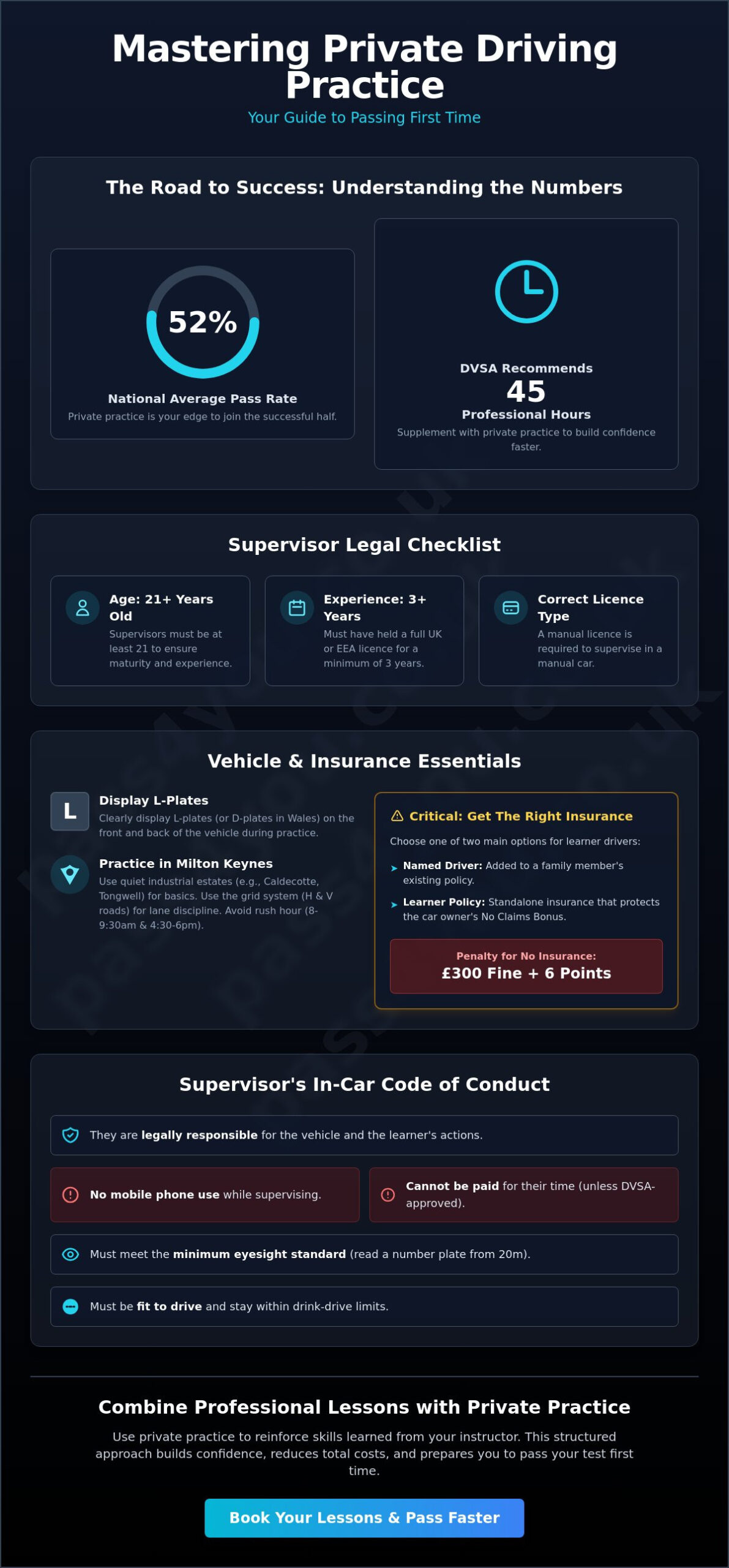
    Did you know that the national average pass rate for the practical driving test is currently around 52%? While the DVSA recommends about 45 hours of professional tuition, the secret to joining the successful half of learners often lies in what you do outside of those scheduled hours. Learning how to practice driving between lessons is the most effective way to bridge the gap between being a student and becoming a safe, independent driver. It’s natural to feel a bit of tension about driving with a parent or worry about picking up their old habits. However, with the right structure, these private sessions become your greatest asset.

    We understand that the thought of driving a non-tuition car can be daunting, but you are in safe, professional hands. You might feel anxious about different clutch points or confused by the 2026 insurance and supervisor regulations. This guide is designed to replace that uncertainty with a calm, step by step plan. You’ll learn how to master private practice to build your confidence, save money, and prepare yourself to pass first time. We’ll walk you through the essential legal rules, tips for a stress-free relationship with your supervisor, and the best local routes to help you feel completely at home behind the wheel.

    Key Takeaways

    • Confirm the 2026 legal essentials for your supervisor, including the requirement to be at least 21 years old with three years of driving experience.
    • Identify the most effective practice routes in Milton Keynes, using the unique grid system and quiet industrial areas to build your confidence.
    • Learn how to practice driving between lessons with a structured approach that focuses on refining a single skill from your last professional session.
    • Establish a calm and supportive atmosphere in the car by setting clear expectations and a “no shouting” agreement with your supervising driver.
    • Discover how private practice acts as a tactical supplement to professional lessons, helping you reach test-readiness faster while saving on total costs.

    Before you turn the ignition for your first private session, you must ensure your practice is legal and safe. It’s about more than just having a willing volunteer in the passenger seat; the law has very specific requirements for who can supervise a learner. Understanding these rules is the first step in learning how to practice driving between lessons without the stress of accidental legal slip-ups. To start, your supervisor must be at least 21 years old. This age limit ensures they have the maturity and road experience to guide you through tricky situations.

    The “3-year rule” is another non-negotiable part of UK driving licence regulations. Your supervisor must have held a full UK or EEA licence for at least 36 months. This duration matters because it guarantees your mentor has moved past the “new driver” phase and has a solid grasp of road safety. You should also check their licence type. If you are practicing in a manual car, your supervisor must hold a full manual licence. If they only have an automatic licence, they cannot legally supervise you in a manual vehicle, even if they have decades of experience.

    Visibility is your final legal hurdle. You must display L-plates (or D-plates in Wales) clearly on the front and back of the car. These plates should be removed or covered when a qualified driver is using the vehicle. It’s a simple step that keeps you on the right side of the law while alerting other road users to be patient as you build your skills.

    Insurance Requirements for Private Practice

    Driving without the correct insurance can lead to a fixed penalty of £300 and six points on your provisional licence. You generally have two options: being added as a named driver to a family member’s policy or taking out a standalone learner driver policy. Standalone policies are often more cost-effective because they protect the car owner’s No Claims Bonus if you have a minor bump. If you’ve bought your own car, look for “Owner-Supervised” policies which are specifically designed for learners who want to practice in their own vehicle before passing the test.

    The Supervising Driver’s Responsibilities

    Your supervisor is legally responsible for the vehicle. This means they must follow the same rules as if they were behind the wheel themselves. They cannot use a mobile phone, and they must stay within the legal drink-drive limits. They also need to meet the standard eyesight requirement, which involves being able to read a car number plate from a distance of 20 metres. Finally, remember that it’s illegal to pay a friend or family member for supervision. Only DVSA-approved instructors can charge for driving lessons; paying an amateur supervisor will void your insurance and could lead to prosecution.

    Choosing the Best Practice Routes in Milton Keynes

    Milton Keynes is a unique place to learn. Its famous grid system and high density of roundabouts can feel a bit overwhelming at first, but they offer an incredible training ground. When you are deciding how to practice driving between lessons, the key is to use the local geography to your advantage. The city is built on a series of H (horizontal) and V (vertical) roads. These provide long, straight stretches that are perfect for practicing lane discipline and maintaining a steady speed. By sticking to these grid roads during quiet hours, you can build a solid foundation before tackling more complex urban environments.

    For those just starting out, industrial estates are your best friend. Areas like Caldecotte or Tongwell are often deserted on Sunday afternoons. These locations offer wide roads and plenty of space to practice your clutch control or parking without the pressure of following traffic. Your supervisor might find it helpful to review the RAC’s guide on how to teach a learner driver to ensure your sessions stay productive and calm. Once you feel comfortable in these quiet zones, you can progressively increase the difficulty by moving toward busier residential areas and eventually Central Milton Keynes.

    Timing is everything. Even the most confident learner can feel rattled by the MK rush hour. Try to avoid the main V-roads between 8:00 am and 9:30 am, or 4:30 pm and 6:00 pm. Driving when the roads are clearer allows you to focus on your technique rather than worrying about aggressive commuters. While these private sessions are vital for building muscle memory, our professional driving lessons ensure you are applying these skills with the precision required for the test.

    Practicing Roundabouts the Milton Keynes Way

    You can’t drive in MK without mastering roundabouts. It’s best to start small. Head to residential areas like Monkston or Emerson Valley to practice mini roundabouts. These help you get used to looking right and choosing gaps. As you progress, move on to the larger, multi-lane roundabouts. Focus on early signalling and choosing the correct lane well in advance. Private practice is the perfect time to desensitise yourself to the city’s unique traffic flow, making the big roundabouts feel like second nature.

    Using Sat Nav vs. Road Signs

    The practical test requires you to drive independently for about 20 minutes. Most learners will be asked to follow a Sat Nav. During your private practice, try setting up a destination and following the verbal prompts. This helps you get used to the device’s timing and voice. Don’t worry if you take a wrong turn. In fact, practicing “lost” scenarios is incredibly helpful. It teaches you how to recover safely and find your way back to the route without panicking, which is exactly what an examiner looks for.

    How to Practise Driving Between Lessons: The 2026 Learner’s Guide

    Structured Practice: What to Actually Do Behind the Wheel

    Private practice is most effective when it follows a clear, logical plan. Aimless driving can actually reinforce mistakes or lead to a lack of focus. When you are learning how to practice driving between lessons, you should treat every session like a mini-tutorial. This structured approach helps you build muscle memory and ensures that the time you spend with a supervisor directly supports your professional training. It turns “just driving around” into a tactical bridge toward your full licence.

    Every session should begin with a 10-minute warm-up. This isn’t just about driving; it’s about getting settled in the vehicle. Start with your cockpit drills, ensuring your seat, mirrors, and headrest are perfectly adjusted. This is vital if you are switching between a tuition car and a family vehicle. Practice moving off and stopping several times in a quiet area. This brief period allows you to find the biting point and get a feel for the brakes before you head into busier traffic.

    Your professional instructor is your best guide for what to do next. Identify the “weak link” from your last lesson. If you struggled with lane discipline on the grid roads, make that your primary focus. Spend 20 minutes specifically working on that one skill. While you drive, focus on making the “mirror-signal-manoeuvre” routine second nature. High-quality observation is the foundation of safe driving. It’s often the difference between a pass and a fail, as examiners look for consistent, active awareness of your surroundings.

    Dedicated time for maneuvers is also essential. Use the quiet industrial areas we mentioned earlier to practice parallel parking or bay parking. Don’t rush these. Take your time to fix your position if it isn’t perfect. You are allowed to pass the test with up to 15 minor faults, but a serious error during a maneuver is an immediate fail. Frequent, calm repetition in private practice is the best way to ensure you stay composed during the real exam.

    Refining Your Clutch Control and Gears

    Different cars have different personalities. The biting point on a family hatchback might feel very different from your instructor’s diesel car. Use your private sessions to master hill starts and smooth braking in this new environment. You should also practice “block changing” your gears. This means going from 5th gear directly to 3rd, or 4th to 2nd, when appropriate. This modern technique improves fuel efficiency and is a key part of showing the examiner you have full control over the vehicle’s speed and momentum.

    The “Mock Test” Approach

    Once you feel confident, ask your supervisor to conduct a 20-minute independent driving segment. They can give you a series of directions or ask you to follow road signs to a specific destination. Use a checklist to track any faults. This helps you identify patterns in your driving that might need professional correction. Before your actual exam date, it’s a great idea to book a mock test in Milton Keynes with a professional. This gives you a realistic preview of the test environment and ensures you are truly ready to pass first time.

    Managing the Relationship with Your Supervising Driver

    Learning how to practice driving between lessons is often as much about communication as it is about car control. When you move from a professional tuition vehicle into a family car, the dynamic in the cabin changes significantly. Your supervisor is likely a parent or close friend, which can bring a different emotional weight to the session. To ensure these hours remain productive, you must manage this relationship with the same care you apply to your steering. A calm atmosphere is the foundation of a successful practice session.

    Start every drive with a quick pre-drive briefing. Agree on exactly how feedback will be given. For example, you might ask your supervisor to only speak up for safety-critical issues while you are moving, saving general advice for when the car is stationary. This helps maintain a calm, Pass4you-style environment where you can focus on your progress without feeling overwhelmed. A “No Shouting” pact is essential for both parties. If either person feels their stress levels rising, it’s best to pull over safely and take a five-minute break to reset.

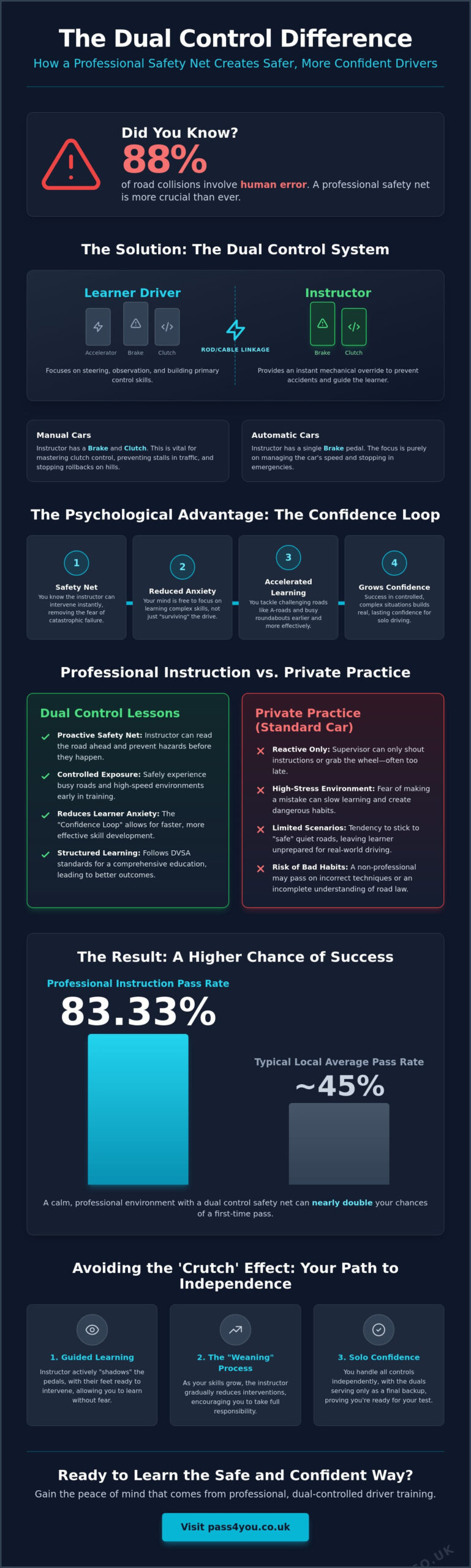
    It is also vital to remind your supervisor about “dual-control displacement.” In a professional lesson, the instructor has a brake pedal. In a private car, they don’t. This lack of physical control can make supervisors feel vulnerable, which sometimes leads them to give instructions too early or in a panicked tone. Acknowledging this helps the supervisor stay mindful of their reactions. Once the drive is finished, have a short debrief. Always discuss what went well before focusing on areas for improvement. This positive reinforcement builds the emotional stability needed to pass your test with confidence.

    Dealing with “Old School” Advice

    Road rules and driving techniques have evolved over the years. You might find your supervisor suggesting outdated habits like coasting in neutral or using hand-over-hand steering. While they mean well, these techniques can lead to faults on your practical test. Always treat your instructor’s guidance as the final word. If there is a disagreement about a specific technique, invite your supervisor to sit in the back during one of your professional driving lessons. This allows them to see modern instructional methods first-hand.

    Building Confidence vs. Overconfidence

    As you log more hours, you’ll eventually enter the “danger zone.” This is the point where you feel so comfortable on familiar local roads that you might stop observing as sharply as you should. Your supervisor should act as a second pair of eyes, helping you stay alert to hazards you might have missed. True confidence comes from consistent, high-quality observation, not just being able to operate the vehicle. Stay focused, stay calm, and remember that every mile you drive is a step toward your independence.

    Why Private Practice Should Complement Professional Lessons

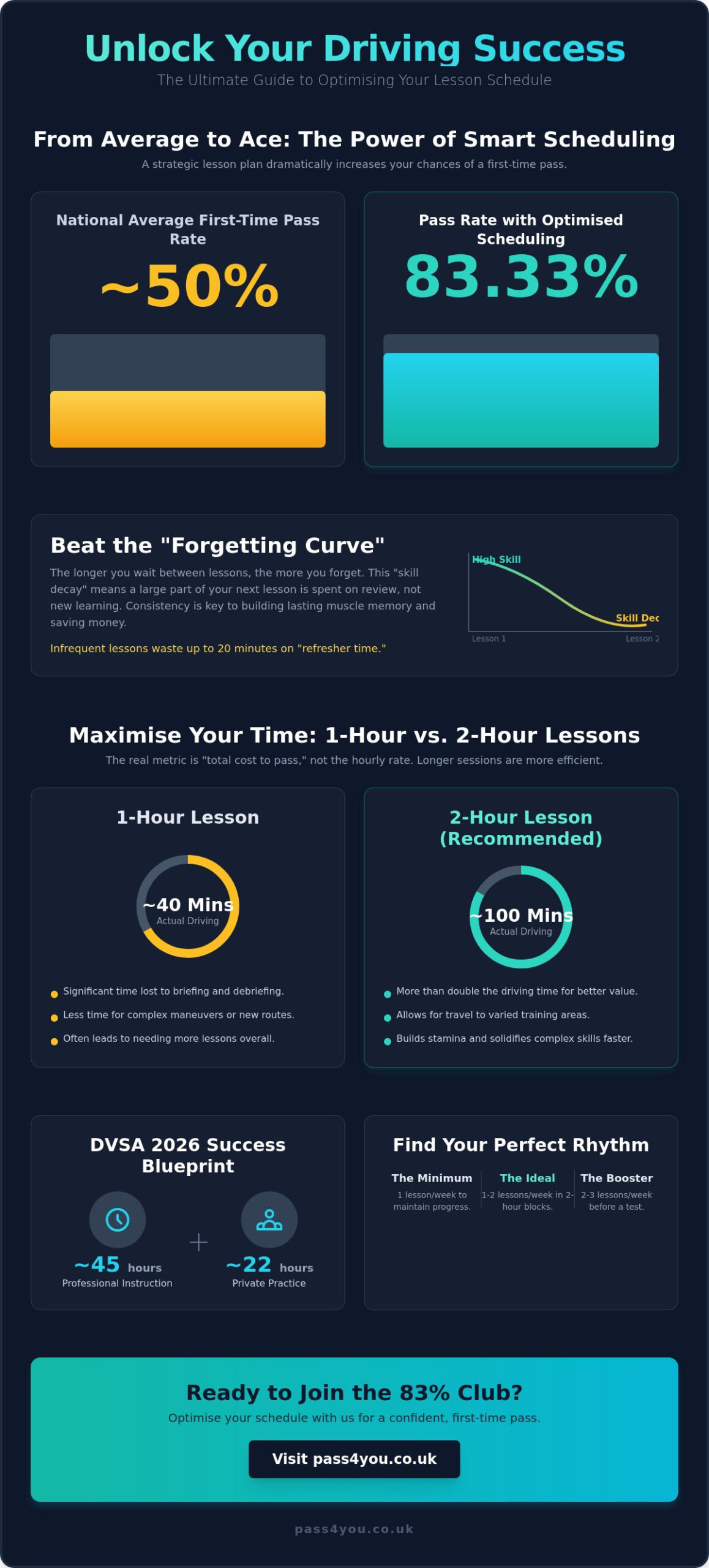
    Professional instruction provides the foundation of your success, but private practice is the catalyst that speeds up your progress. When you understand how to practice driving between lessons, you aren’t just putting in miles; you are refining the professional techniques introduced by your instructor. This combination is incredibly effective. Statistics show that students who balance professional tuition with structured private practice have a significantly higher chance of success. In fact, our specific teaching methods and commitment to excellence contribute to an impressive 83.33% pass rate for our students.

    One of the biggest benefits of this dual approach is the saving on time and money. Every two hours of focused private practice can “unlock” your next professional lesson faster. Instead of spending your paid tuition time on basic car control or simple junctions, you can use that time to tackle complex roundabouts or high-speed roads. You arrive at each lesson feeling more comfortable and prepared. This allows your instructor to move through the syllabus more efficiently, reducing the total number of professional lessons you might need to reach test-readiness.

    However, you must be wary of “Bad Habit Contagion.” If you practice for too long without a professional check-in, you might start to drift away from the strict standards required by the DVSA. This is why private practice must always be a supplement to, not a replacement for, professional driving lessons. In the final two to three weeks before your practical test, we recommend shifting your focus back entirely to the tuition vehicle. This ensures you are perfectly attuned to the specific biting point and dimensions of the car you will use for the exam, keeping your confidence high for the big day.

    The Pass4you Advantage

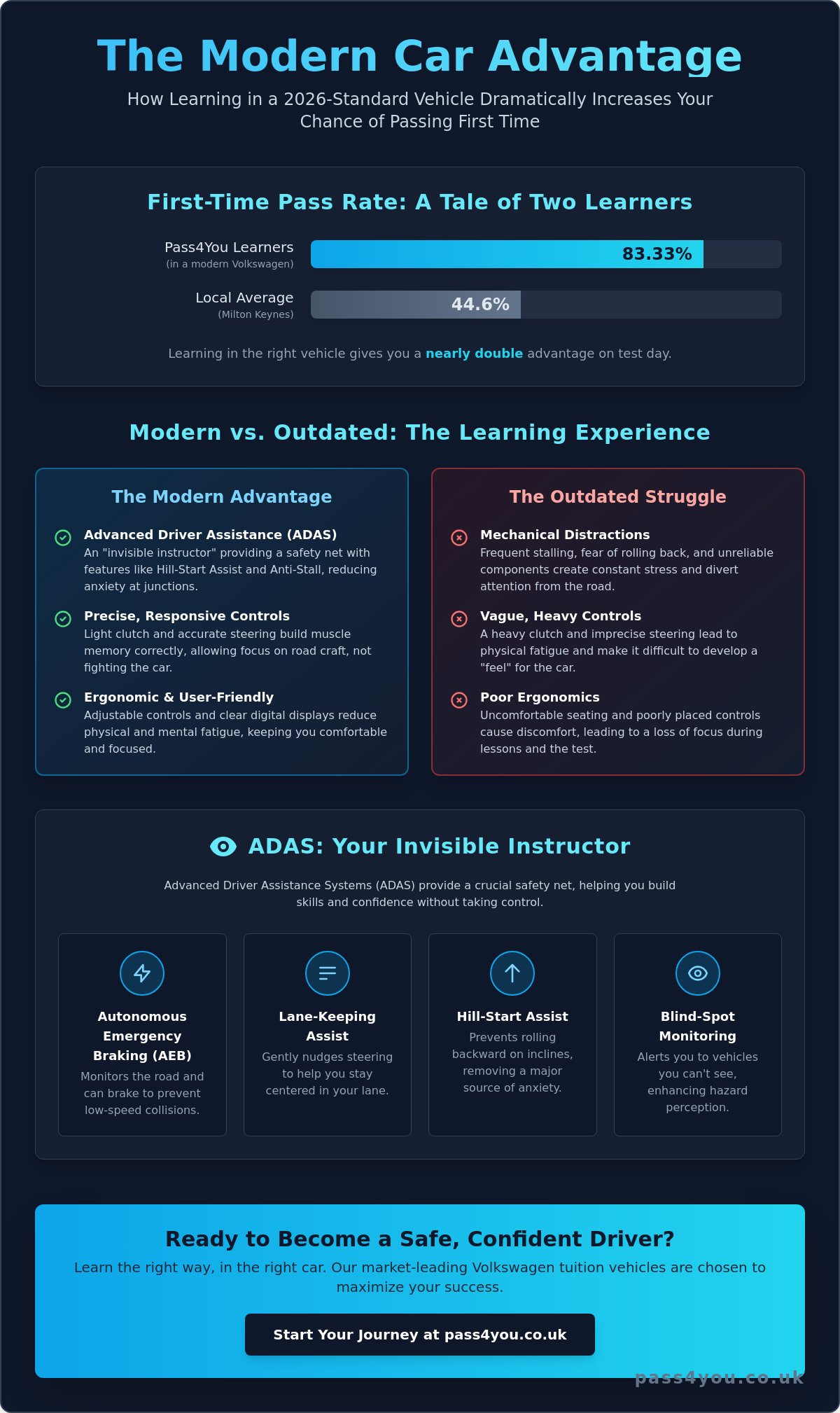
    Our first-class instructors in Milton Keynes are experts at integrating your private practice into our comprehensive syllabus. We encourage you to share what you’ve been working on at home so we can refine those skills with professional precision. Learning in our modern Volkswagen tuition vehicles provides a superior technical foundation. These cars are chosen for their reliability and ease of handling, giving you the best possible environment to develop your skills. Professional expertise ensures you aren’t just “driving around” but are actually building the high-precision habits needed for long-term safety.

    Next Steps: Booking Your Success

    To maximise the impact of your private sessions, schedule your professional lessons at regular intervals. This allows your instructor to set specific goals for your practice between meetings. Before you start, ensure you have your provisional licence uk ready and that all legal requirements are met. By combining your dedication with our proven methods, you’ll be well on your way to independence. We are here to support you every step of the way with patience and expertise.

    Start your journey with Pass4you and join our high-achieving students today!

    Take the Wheel with Confidence

    Mastering the art of private practice is about more than just getting extra miles. It’s about combining legal awareness with a structured, calm approach that supports your professional training. By choosing the right routes in Milton Keynes and maintaining a positive relationship with your supervisor, you turn every session into a step toward your full licence. These hours behind the wheel build the muscle memory and emotional stability needed to handle the road with ease.

    Understanding how to practice driving between lessons gives you the edge needed to join our successful students. At Pass4you, our patient, first-class instructors are here to guide you through this journey with expert mentorship. We use modern Volkswagen tuition vehicles to ensure you have a superior technical foundation. This focus on high-precision habits is why we maintain an impressive 83.33% first-time pass rate. We are dedicated to your long-term safety and proficiency.

    Ready to start? Book Your First Lesson with Milton Keynes’ Top-Rated Driving School and experience the difference that professional support makes. We are here to help you overcome anxiety and embrace the freedom of the open road. Your journey to becoming a safe, independent driver starts today.

    Frequently Asked Questions

    Can I practice driving on the motorway with a parent?

    No, you cannot practice on the motorway with a parent or friend. In 2026, the law remains that learners can only drive on motorways when accompanied by an Approved Driving Instructor in a car fitted with dual controls. This rule is in place to ensure your safety while you learn to handle higher speeds and complex slip roads in a professionally controlled environment.

    Do I need L-plates on both the front and back of the car?

    Yes, you must display L-plates on both the front and back of the vehicle. These plates must be clearly visible to other road users and meet the legal size requirements. It’s a good habit to remove or cover them when a qualified driver is using the car. This prevents any confusion for other motorists who might expect a learner to be at the controls.

    What happens if I get a speeding ticket while practicing with my dad?

    You are legally responsible for any motoring offences committed while you are behind the wheel. If you are caught speeding, you will receive the fine and points on your provisional licence. It’s also possible for your dad to face penalties if he is found to have failed in his duty to supervise you properly. This is why staying calm and focused is so important for both of you.

    Can a supervising driver sit in the back seat?

    No, your supervising driver must sit in the front passenger seat. They need to be in a position where they can see the road clearly and intervene if an emergency occurs. Sitting in the back prevents them from assisting with the steering or the handbrake. Their role is to keep you safe, which requires them to be right next to the controls.

    Is it better to practice in my own car or my instructor’s car?

    Both options offer unique advantages for your development. Practicing in your own car helps you adapt to different biting points and vehicle dimensions, which builds significant confidence. However, it’s essential to keep up with professional tuition. Learning how to practice driving between lessons in your own vehicle should always be balanced with regular time in your instructor’s modern Volkswagen to maintain the high standards required for the test.

    How many hours of private practice should I do between lessons?

    The DVSA suggests that learners should aim for about 20 hours of private practice alongside 45 hours of professional tuition. While everyone learns at a different pace, this specific balance is often the key to passing the test first time. Understanding how to practice driving between lessons in short, frequent bursts is usually more effective than doing long drives that might lead to fatigue and loss of focus.

    Can I use a Sat Nav while practicing privately?

    Yes, using a Sat Nav is a great way to prepare for the independent driving section of the practical test. About 80% of learners will be asked to follow directions from a Sat Nav during their exam. Practicing this privately helps you get used to listening to voice prompts while maintaining full control of the car. It’s an excellent way to build your independent driving skills.

    Does my supervising driver need to be insured on the car too?

    Yes, the car must be fully insured for everyone who drives it. If you are practicing in a parent’s car, they will already be insured, but you must be added as a named driver or have a standalone learner policy. Always double check that the policy specifically allows for learner supervision. This ensures you are fully protected in the event of an accident or a minor bump during your practice.

  • What to Do After Passing Your Theory Test in Milton Keynes: Your 2026 Roadmap

    You’ve just walked out of the test centre with your pass certificate in hand, but did you know the clock is already ticking on its two-year validity? It’s a fantastic achievement, yet many learners feel a sudden wave of uncertainty as they look at the 22-week average wait times for a slot at Bletchley. Knowing exactly what to do after passing your theory test milton keynes is the difference between getting your full licence this year or potentially having to retake your theory.

    It’s completely normal to feel a bit anxious about those famous Milton Keynes roundabouts or the pressure of securing a test date before your certificate expires. We understand how overwhelming the next steps can feel, especially with new DVSA rules limiting how many times you can change a booking. This roadmap is designed to replace that worry with a clear, calm plan of action. You’ll discover how to secure a practical test at a local centre, find a supportive instructor who knows the Bletchley routes inside out, and the exact steps you need to take to join the 49.83% of students who pass at our local centre.

    Key Takeaways

    • Your theory pass certificate is valid for exactly two years, so it is vital to start planning your practical test timeline immediately to avoid the stress of a retake.
    • Discover exactly what to do after passing your theory test milton keynes to navigate the DVSA booking portal and secure a slot at the Bletchley Test Centre.
    • Transitioning to a more structured driving lesson schedule after your theory success will help you build the specific skills needed for high-speed grid roads.
    • Mastering lane discipline and signaling on complex roundabouts is essential for passing first time in a city with such a unique road layout.
    • Learn how to prepare for the final hurdle by perfecting the “Show Me, Tell Me” questions and knowing exactly which documents to bring on your test day.

    Your Theory Test Certificate: Understanding the Two-Year Countdown

    Congratulations on passing your theory test. It’s a significant milestone that brings you one step closer to the freedom of the road. However, it’s vital to remember that this certificate isn’t a permanent qualification. It’s a two-year window of opportunity. If you don’t pass your practical driving test within exactly 24 months of your theory success, the certificate expires. This means you’d have to pay the fee and sit the theory exam all over again, which is a setback nobody wants.

    Understanding the UK driving test process helps you stay ahead of the game. Your theory pass is the mandatory prerequisite for booking your practical. Without that pass number, the DVSA booking system simply won’t let you see available dates. This is why deciding what to do after passing your theory test milton keynes as soon as you leave the test centre is the best way to stay on track. You’ve done the hard work of learning the Highway Code; now it’s time to put that knowledge into motion before the clock runs out.

    The Importance of the Theory Pass Number

    Your pass certificate isn’t just a piece of paper to celebrate with. It contains a unique 16-digit pass number that is essential for your future. You’ll need this number every single time you log into the official DVSA portal to book, cancel, or move your practical test. We always suggest taking a clear photo of the certificate and saving it to your phone immediately. If you happen to lose the physical copy, don’t panic. You can usually find the number on the original pass email sent by the DVSA, or you can contact them to retrieve it. We recommend keeping your provisional licence and the pass letter together in a safe folder. You’ll need to present both when you arrive at the Bletchley Test Centre for your practical exam.

    Setting a Realistic Driving Timeline for 2026

    With current waiting times for practical tests in Milton Keynes often stretching to 22 weeks, timing is everything. You don’t want to wait until the final months of your certificate’s life to think about booking. Instead, look at your current progress honestly. The DVSA suggests that most learners benefit from around 45 hours of professional driving lessons to reach a safe, confident standard.

    If you’re already midway through your training, now is the time to look at the calendar. Calculate a goal date by adding the current local wait times to the number of weeks it will take you to complete your remaining lessons. By balancing professional instruction with private practice, you can build the experience needed to pass first time. This proactive approach ensures you’re never rushing or feeling the pressure of an expiring certificate, keeping your journey to a full licence calm and focused.

    Booking Your Practical Driving Test in Milton Keynes

    Once you have your theory certificate, the next logical step in your journey is Booking Your Practical Driving Test. This process is straightforward but requires a few key items: your provisional driving licence, your 16-digit theory pass number, and a valid payment card. The official portal is the only place you should book to avoid inflated third-party fees. If you’re wondering exactly what to do after passing your theory test milton keynes, we recommend securing any available date at the Bletchley centre immediately. Even if the date is months away, having a booking in the system allows you to look for cancellations or move your slot later if you feel ready sooner.

    Bletchley (Milton Keynes) Test Centre Details

    The primary location for learners in our area is the Bletchley Test Centre, situated at Block 4, Government Buildings, Bletchley. It’s a busy site with specific parking arrangements; usually, you should only enter the car park about 10 minutes before your test to keep traffic flowing. Local knowledge is vital here. The routes often include the double mini-roundabouts in Bletchley or the high-speed sections of the V7 Saxon Street. Familiarizing yourself with these specific challenges during your driving lessons can significantly lower your anxiety on the big day.

    Dealing with Driving Test Waiting Times

    In 2026, the average wait time for a practical test in the South East remains around 22 weeks. This can feel discouraging, but there are ways to manage it. Many students find success by checking the DVSA website early on Monday mornings when new slots are often released. While legitimate cancellation apps can help, manually checking the portal a few times a day is often just as effective. We always advise booking the first available date you see. It’s much easier to move a test forward than it is to find a last-minute slot when your theory certificate is nearing its expiry date.

    The DVSA has strict rules to keep the system fair. You can only change your booking a maximum of two times before you have to cancel and start again. Additionally, you must give at least 10 working days’ notice if you need to cancel without losing your fee. This underscores the importance of working closely with your instructor to ensure you’re truly test-ready before your date arrives. Taking this professional approach ensures you don’t waste your booking or your hard-earned money.

    What to Do After Passing Your Theory Test in Milton Keynes: Your 2026 Roadmap

    Finding a Driving Instructor in Milton Keynes Post-Theory

    Now that you hold Your Theory Test Certificate, your focus must shift from digital screens to the driver’s seat. Many learners wonder about the most effective what to do after passing your theory test milton keynes strategy, and the answer is usually to increase your lesson frequency. While the theory test prepared you to spot hazards on a screen, real-world hazard management in Milton Keynes requires split-second decisions and physical control. Taking the right steps for what to do after passing your theory test milton keynes involves more than just booking a date; it’s about refining your practical technique through consistent, professional instruction.

    This is the ideal moment to switch to a more intensive schedule. Doing so ensures your practical skills keep pace with your theoretical knowledge before any of that information begins to fade. Learning in a modern, reliable vehicle makes a significant difference in your comfort and control. The Pass4you Driving School fleet of Volkswagen cars is chosen specifically for their ease of use and advanced safety features, creating a professional environment that helps build your confidence quickly. When you choose a school with a high-precision success metric, like the Pass4you Driving School 83.33% pass rate, you’re investing in long-term efficiency. A higher pass rate often means fewer lessons overall, which is better for your budget and helps you reach your goal of a full licence much faster.

    What to Look for in an MK Driving Instructor

    Your instructor should be an expert in the local area, especially the unique Bletchley test routes. They need to understand how the DVSA examiners evaluate your performance at those specific junctions. Beyond technical knowledge, look for a patient, confidence-building style. If you’ve had a negative experience with a hurried or aggressive instructor in the past, finding a calm mentor is essential for your progress. You can start by finding driving instructors near me who prioritize your emotional stability as much as your technical proficiency.

    Manual vs. Automatic Lessons in Milton Keynes

    Deciding between a manual or automatic car is a personal choice based on your future driving needs. Manual cars offer more control and the flexibility to drive any vehicle, while automatic lessons can be significantly less stressful in heavy Milton Keynes traffic. Pass4you Driving School offers both options in our modern fleet, allowing you to choose the path that feels most natural and comfortable for you. Whichever you pick, our instructors ensure you’re fully prepared for the specific challenges of the Bletchley test centre, from the narrow residential streets to the high-speed grid roads.

    Mastering Milton Keynes Roads: The Practical Challenge

    Milton Keynes presents a unique driving environment that differs significantly from traditional British towns. The city is famous for its grid system, composed of H (Horizontal) and V (Vertical) roads. While these roads are designed for efficiency, they can be intimidating for learners who are transitioning from theory to practice. A vital part of what to do after passing your theory test milton keynes is spending time with an instructor who can help you understand the rhythm of these high-speed links. You’ll need to master the art of merging safely and maintaining consistent speeds on the dual carriageways that connect our residential areas.

    The “Roundabout City” reputation is well-earned. With over 130 roundabouts, lane discipline and early signaling are the foundations of a successful practical test. Many learners find that while they knew the rules in theory, applying them at 40mph or 70mph requires a different level of confidence. We focus on building your emotional stability behind the wheel so you can handle these junctions calmly. Identifying common “fail spots,” such as the sudden speed limit changes near the Bletchley outskirts or complex multi-lane approaches, is a core part of our training method. By preparing for these specific challenges, you ensure you aren’t caught off guard on your test day.

    Mastering the Milton Keynes Roundabouts

    Approaching a large, multi-lane roundabout requires clear observation and decisive action. You must learn to read the road markings early to ensure you’re in the correct lane for your exit. This is where your theory knowledge of the Highway Code becomes your best friend. We spend significant time mastering the dual carriageway and its associated junctions. Observation remains the #1 skill for MK junctions; looking well ahead allows you to anticipate the flow of traffic and choose your gaps safely without hesitation.

    Bletchley Test Route Specifics

    The Bletchley test routes offer a diverse mix of driving conditions. You will likely spend time in quiet residential areas where low-speed maneuvers and pedestrian awareness are crucial. However, you will also be expected to transition smoothly onto high-speed grid roads. Tricky signage and hidden speed limit changes in Bletchley are frequent causes of minor faults that can quickly escalate. This is why mock tests are such an essential part of your preparation. They simulate the pressure of the real exam and highlight areas where you might need a little more reassurance. If you want to feel truly prepared for these local challenges, you can book your professional driving lessons with our experienced team today.

    The Final Countdown: Preparing for Test Day Success

    You have mastered the grid roads and found your rhythm on the roundabouts. Now, the final stage of your journey begins. Planning exactly what to do after passing your theory test milton keynes leads to this specific moment: the practical exam at Bletchley. This day is the culmination of your hard work, and being prepared for the logistics is just as important as your steering technique. Our instructors focus on building your emotional stability during these final hours so you can approach the test centre with a calm, focused mind.

    The “Show Me, Tell Me” questions are often a source of minor anxiety for learners. These aren’t just memory tests; they are practical safety checks. You will answer one “tell me” question before you even start the engine, such as explaining how you’d check the oil levels. The “show me” question happens while you are moving, like demonstrating how to wash the rear windscreen. We practice these throughout your driving lessons until they become second nature. The Pass4you Driving School advantage ensures you start your test with an easy win, boosting your confidence before you even leave the car park.

    The Week Before Your Test

    The seven days leading up to your appointment should be about refinement, not frantic learning. We use this time to polish your maneuvers, whether it’s a parallel park on a Bletchley side street or a reverse bay park at the centre itself. You must ensure your instructor’s car is booked and that you’ve had a final look at our practical driving test guide to refresh your memory on local requirements. Consistency is your best ally here. Avoid making major changes to your driving style; instead, trust the methods that have brought you this far.

    What Happens During the Practical Test?

    Your test begins with an eyesight check; you must be able to read a number plate from a distance of 20 metres. If you fail this, the test ends immediately. Once you pass the safety questions, you’ll head out for about 40 minutes of driving. This includes 20 minutes of independent driving where you’ll follow either a Sat Nav or traffic signs. Don’t worry if you take a wrong turn; as long as you drive safely, the examiner will help you get back on track.

    When you return to the Bletchley centre, the examiner will give you the result. If you pass, they’ll give you a certificate and ask if you want your full licence sent automatically. If you don’t pass this time, don’t be discouraged. The national pass rate is around 50%, and Pass4you Driving School will help you analyze the feedback to ensure success on your next attempt. Our goal is to see you join the many successful students who have gained their freedom through our supportive, results-driven instruction.

    Take the Wheel and Claim Your Freedom

    Passing your theory was the green light you needed. Now it’s about turning that knowledge into a life-long skill. As we’ve explored, the best strategy for what to do after passing your theory test milton keynes is to act decisively while your theory knowledge is fresh and the two-year clock is ticking. By focusing on the unique Bletchley routes and mastering the MK grid system, you’re not just preparing for a test; you’re preparing for the freedom of the open road.

    Pass4you Driving School is dedicated to making this transition as smooth as possible. With our modern Volkswagen tuition vehicles and a focus on emotional stability, we provide the calm mentorship needed to succeed. Our 83.33% first-time pass rate proves that a professional, patient approach works far better than hurried instruction. We’ve seen hundreds of students overcome their anxiety and secure their licences by following this exact roadmap.

    Book your first lesson with Pass4you Driving School and join our 83% first-time pass club!

    Your journey to becoming a confident, safe driver in Milton Keynes starts with a single step. We’re ready to help you cross the finish line and get you on the road with confidence.

    Frequently Asked Questions

    How long is my theory test certificate valid for in Milton Keynes?

    Your theory test pass certificate is valid for exactly two years from the date you passed the exam. There are no extensions to this period under any circumstances. If you don’t pass your practical driving test within this 24-month window, you’ll need to pay the fee and retake the theory test before you can book another practical attempt.

    Can I book my practical test before I pass my theory test?

    No, you cannot book a practical test until you’ve successfully passed your theory. The official DVSA booking system requires your unique 16-digit theory pass number to even view available dates. This is why knowing what to do after passing your theory test milton keynes is so important; you must secure that pass first to unlock the next stage of your journey.

    Which driving test centre is best for Milton Keynes residents?

    The Bletchley Driving Test Centre is the primary and most convenient option for residents in the Milton Keynes area. It’s located at Block 4, Government Buildings, Bletchley. Taking your test here allows you to practice on the specific grid roads and roundabouts you’ll encounter during the exam, which helps build your confidence and local road knowledge.

    How many driving lessons will I need after passing my theory?

    The DVSA recommends that most learners need around 45 hours of professional instruction, combined with private practice, to pass the practical test. However, everyone learns at a different pace. We focus on your individual progress and emotional stability to ensure you’re fully prepared, whether you need a few more hours to master the MK roundabouts or are ready to go sooner.

    What is the pass rate for the Bletchley Driving Test Centre?

    The pass rate for the Bletchley centre was 49.83% between 2022 and 2023, which is very close to the national average. While these statistics provide a general overview, your individual success depends on your preparation. We use refined teaching methods and modern vehicles to help our students achieve a much higher success rate than the local average.

    What happens if I lose my theory test pass certificate?

    You don’t need the physical certificate to book your practical test as long as you have your pass number. This number is usually sent to you in a confirmation email immediately after you pass your theory. If you’ve lost both the paper and the email, you can contact the DVSA directly to retrieve your details so you can proceed with your booking.

    Do I need to take my theory certificate to my practical test?

    You should bring your theory pass letter with you to the Bletchley Test Centre, but the most critical document is your provisional driving licence. If you don’t present a valid provisional licence, the examiner will cancel your test immediately and you’ll lose your fee. Keeping these documents together in a safe folder ensures you’re ready for the big day.

    How much does the practical driving test cost in 2026?

    As of June 2026, a standard weekday practical driving test costs £62. If you decide to book a test for an evening, weekend, or bank holiday, the price increases to £75. It’s best to book through the official GOV.UK website to ensure you pay the correct fee and avoid the inflated prices often found on third-party “black market” booking sites.

  • The Ultimate Driving Lesson Checklist for Learners in 2026

    Did you know that nearly 50% of learner drivers fail their practical test on the first attempt? It’s a statistic that can feel heavy, especially when you’re already worried about complex junctions or those famous Milton Keynes roundabouts. We understand that feeling of uncertainty. It’s completely normal to feel overwhelmed by the sheer volume of skills you need to master before you’re ready for the big day.

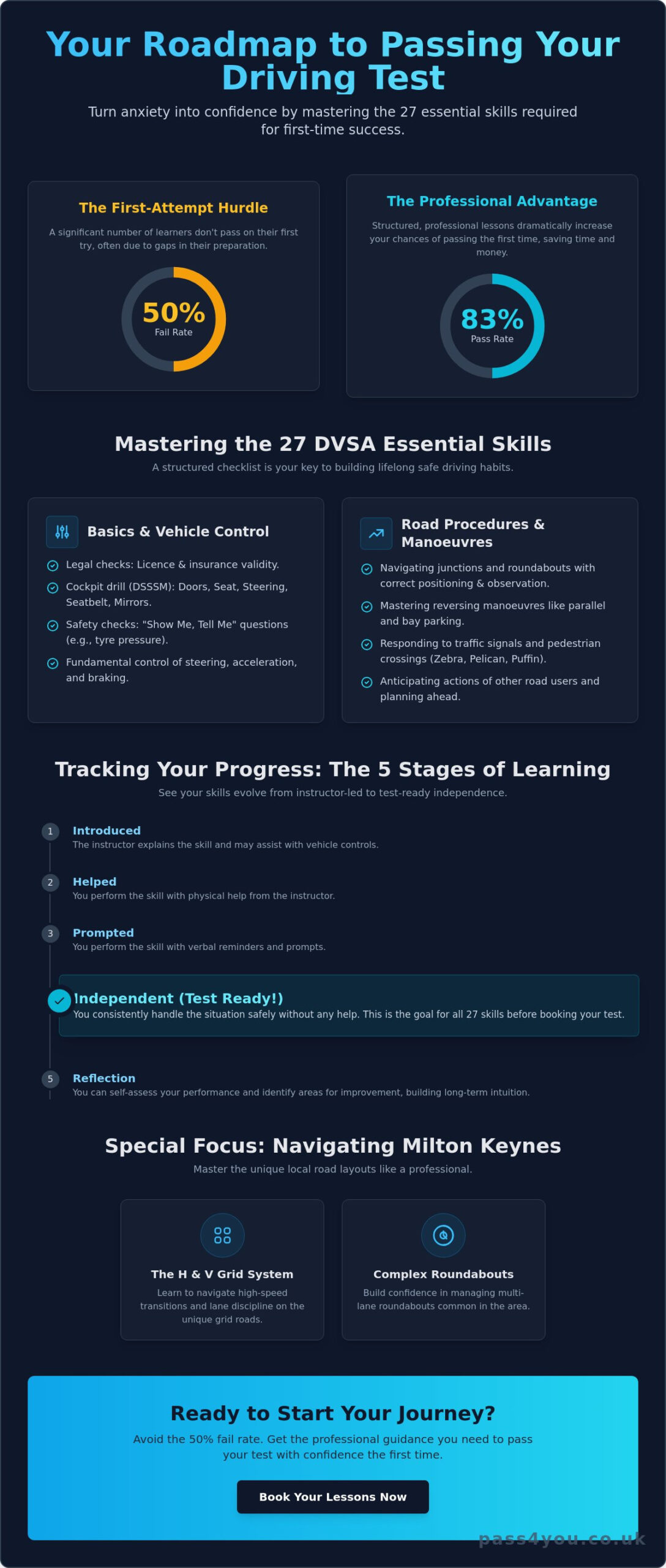
    Our comprehensive driving lesson checklist for learners is designed to turn that anxiety into quiet confidence. By following a structured path, you’ll master the 27 essential skills required by the DVSA and learn how to navigate local road layouts like a professional. We’ll show you exactly what to track so you aren’t left guessing about your progress. This structured approach helps you feel like you’re in safe, professional hands every step of the way.

    This guide previews the exact roadmap you need to pass your test the first time, helping you avoid the frustration and extra expense of retakes. We’ll cover everything from core maneuvers to the latest 2026 booking rules. You’ll see how to manage your learning journey effectively, ensuring you feel safe, prepared, and ready for the freedom of the open road.

    Key Takeaways

    • Explore the 27 core DVSA skills that form the essential foundation for every safe and successful driver.
    • Use a professional driving lesson checklist for learners to track your journey toward the “independent” proficiency level required for the test.
    • Prepare for the unique road layouts of Milton Keynes by mastering the H and V grid system and complex high-speed transitions.
    • Understand the legal essentials and mental readiness steps you must complete before even starting your modern tuition vehicle.
    • Learn why professional guidance leads to an 83.33% first-time pass rate, saving you significant time and money.

    Mastering the 27 Essential Driving Skills for 2026

    Starting your driving journey can feel like standing at the base of a mountain. The DVSA syllabus provides the 27 essential skills you need to reach the summit safely. Instead of looking at a giant list and feeling overwhelmed, we break these down into manageable steps. This structured approach is the core of our driving lesson checklist for learners. It ensures you aren’t just memorizing moves to pass a test; you’re building habits that keep you safe for a lifetime.

    Enrolling in a formal driver’s education program is the most efficient way to work through these categories. Our instructors use these 27 points to create a personalized plan that moves at your pace. If you feel nervous about a specific area, we spend more time there until you feel calm and capable. This method transforms a long list of requirements into a series of small, achievable victories.

    Basics and Vehicle Control

    Every journey begins with the fundamentals. Before you even turn the engine on, you must understand your legal responsibilities. This includes ensuring your provisional licence is valid and that the vehicle has the correct insurance coverage. Once inside, we teach you the “DSSSM” routine. This stands for Doors, Seat, Steering, Seatbelt, and Mirrors. It’s a simple sequence that ensures you are comfortable and have maximum visibility. We also cover basic safety checks, often called “Show Me, Tell Me” questions. Learning how to check your tyre pressure or identify the engine oil dipstick builds a sense of responsibility from day one.

    Road Procedures and Manoeuvres

    As your confidence grows, your driving lesson checklist for learners moves toward more complex road interactions. Junctions and roundabouts are often the biggest source of anxiety for new drivers. We focus on correct positioning, early observation, and clear signalling to make these transitions feel smooth. You’ll also master reversing manoeuvres, such as parallel parking and bay parking. These aren’t just test requirements; they are essential daily skills for any driver. Finally, we look at pedestrian crossings. Identifying the differences between Zebra, Pelican, and Puffin crossings is vital for keeping vulnerable road users safe. By categorising these skills, we help you transition from quiet backstreets to busier urban environments without feeling rushed or pressured.

    Tracking Your Progress: From First Lesson to Test Ready

    One of the most common questions learners ask is, “How much longer until I’m ready?” It’s a valid concern. Without a clear way to measure your growth, the journey can feel endless. Our driving lesson checklist for learners solves this by using a specific grading system. This doesn’t just track if you’ve “done” a skill; it tracks how well you can perform it under pressure. By understanding these levels, you’ll see your progress moving from hesitant beginnings to total independence.

    Your instructor uses these levels to build your confidence steadily. We don’t just want you to pass; we want you to feel entirely comfortable behind the wheel. This structured feedback loop ensures you always know where you stand. If you are looking for a supportive environment to start this journey, our professional driving lessons are designed to guide you through every stage with patience.

    The Five Stages of Learning

    The DVSA uses five specific levels to track your proficiency. First is Introduced. At this stage, you understand the theory, but your instructor might still help you with the pedals or steering. Next are Helped and Prompted. Here, you are doing the physical work, but you might need a verbal reminder to check a mirror or adjust your speed. The goal for every skill on your checklist is Independent. This means you handle the situation safely without any help at all. Finally, Reflection occurs when you can critique your own driving. This self-awareness is what builds long-term driving intuition and keeps you safe long after the test is over.

    When to Book Your Practical Test

    You are ready for the practical test when you are consistently “Independent” across all 27 essential skills. Consistency is the key word here. Doing a perfect parallel park once isn’t enough; you need to do it safely every time, even when you’re tired or the roads are busy. We use mock tests to simulate the actual exam environment. These sessions identify any small gaps remaining in your driving lesson checklist for learners. They take the “fear of the unknown” out of the equation. If you and your instructor agree that you’ve reached this threshold, you can follow our guide on how to book your driving test to secure your slot. Remember, booking only when you are truly ready saves you money and prevents the disappointment of a fail.

    The Ultimate Driving Lesson Checklist for Learners in 2026

    Many people think the driving lesson checklist for learners only starts when the engine turns over. In reality, your preparation begins long before you sit in our modern Volkswagen tuition vehicle. Mastering the car’s mechanics is only half the battle. You also need to ensure you are legally compliant and mentally prepared for the responsibility of the road. This proactive approach saves you time and reduces the stress of last-minute realisations that could delay your progress.

    Your mental state is just as important as your physical skills. Learning to drive is a significant life event, and it’s natural to feel a mix of excitement and apprehension. By ticking off the legal and mental boxes early, you create a calm environment where learning can happen naturally. This foundation of safety and responsibility is what makes you a professional driver in the making.

    Paperwork and Legal Essentials

    Before your first lesson, you must have your provisional licence. It isn’t just a piece of plastic; it’s your legal permission to be on the road. Ensure it is valid and that you have it with you for every single session. If you haven’t applied yet, our guide on provisional licence uk covers everything from the £34 online application fee to the documentation you’ll need.

    Your physical readiness is also vital. Every instructor will perform an eyesight check during your first lesson. You must be able to read a standard number plate from a distance of 20 metres. If you need glasses or contact lenses to do this, you must wear them every time you drive. Additionally, you cannot book your practical test until you have cleared the theory test. This £23 requirement is a major milestone on your checklist that confirms you understand the rules of the road and hazard perception.

    Building Driving Confidence

    Building a calm driving mindset is a vital part of your journey. Early-stage nerves are completely normal. You might feel a flutter in your stomach when approaching a busy junction or worry about stalling in traffic. A patient, supportive instructor makes all the difference here. We focus on turning that anxiety into a “Freedom of the Road” mindset. Instead of fearing mistakes, we focus on the opportunities that come with success. Think about the independence of driving yourself to work or visiting friends without relying on bus schedules. This positive visualization helps replace fear with motivation.

    Consistency is your best friend when it comes to mental readiness. The DVSA recommends approximately 45 hours of professional instruction before taking your test. Trying to “cram” lessons into a short period often leads to burnout and forgotten skills. Spreading your learning out allows your brain to process new information and build genuine intuition. When you approach your lessons with a steady, unhurried rhythm, you’ll find that your confidence grows naturally. This mental stability is what helps you stay calm during the actual test, ensuring you can demonstrate your skills effectively under pressure.

    Milton Keynes Checklist: Navigating the Grid and Roundabouts

    While the national DVSA syllabus covers the basics, Milton Keynes requires a specialized approach. This town is famous for its unique layout, and a standard driving lesson checklist for learners often misses the nuance of our local roads. You won’t just be driving on standard streets; you’ll be navigating a complex network of high-speed transitions and frequent intersections. We help you bridge the gap between basic vehicle control and the confidence needed for our fast-flowing traffic.

    Our instructors specialize in the specific challenges found here. We know that moving from a 30mph residential zone onto a 70mph grid road can feel daunting at first. We use a patient, step-by-step method to ensure you feel in control. This regional expertise is a core part of why our students feel so prepared on test day. If you’re ready to start, you can book your Milton Keynes driving lessons with our experienced team.

    Mastering the MK Roundabouts

    Milton Keynes is the roundabout capital of the UK for a reason. You will encounter a massive variety of junctions, from tiny mini-roundabouts in Bletchley to huge, multi-lane systems near the city centre. The secret to success is early preparation. We focus on three main areas to keep you calm:

    • Lane Choice: Identifying the correct lane using road markings and signs well before the junction.
    • Observation: Mastering the timing of your “look” to identify safe gaps without stopping unnecessarily.
    • Exit Signalling: Ensuring other drivers know exactly where you are going to prevent confusion.

    Many learners find the sheer volume of roundabouts exhausting. We practice these until the “mirrors, signal, manoeuvre” routine becomes second nature. This builds the mental stamina you need for a 40-minute driving test. For more help with high-speed junctions, read our guide on mastering the dual carriageway.

    The Grid System and High-Speed Roads

    The MK grid system is organized into H (Horizontal) and V (Vertical) roads. These are the arteries of the town, and they require a different mindset than traditional urban driving. You’ll need to master high-speed merging and maintain safe following distances in fast traffic. We’ll teach you how to read the road ahead to anticipate speed changes before they happen. This foresight is what separates a nervous learner from a safe, independent driver.

    We also spend time on the specific test route hotspots. Whether you are taking your test at the Bletchley or Milton Keynes centre, we know the tricky spots examiners prefer. We’ll guide you through the difficult lane changes and hidden junctions that often catch people out. By including these local details in your driving lesson checklist for learners, we turn “scary” roads into familiar territory. This familiarity is the ultimate tool for passing your test with confidence.

    Why Professional Instruction is Your Final Checklist Item

    Completing your driving lesson checklist for learners is a major achievement, but the quality of your training determines how safely you’ll use those skills. While practicing with family or friends is a great way to gain extra experience, it can’t replace the structured guidance of a professional. Informal practice often leads to “bad habits” that might go unnoticed until your test day. Professional instructors identify these small errors early, ensuring your technique remains precise and safe. This expert oversight is the final, essential piece of the puzzle that transforms a learner into a qualified driver.

    You’ll also benefit from our modern Volkswagen tuition vehicles. These cars are specifically chosen for their reliability and ease of use, making them the perfect environment for mastering complex manoeuvres. When you learn in a high-quality vehicle with a dual-control system, you can focus entirely on your progress. You’ll know you’re in safe, professional hands from the moment you adjust your seat.

    The Pass4you Method

    Our approach is built on patience and efficiency. We understand that every student learns differently, so our first-class instructors specialize in calming anxious learners. We don’t believe in dragging out the process. Instead, we focus on helping you reach the “Independent” level as quickly and safely as possible. This efficiency is reflected in our 83.33% first-time pass rate. By passing the first time, you save significant money on retakes and extra lessons. For more information on how we structure our training, explore our guide to driving lessons milton keynes.

    Ready to Start? Your Next Steps

    The final item on your checklist is the most exciting: booking your first session. We take the time to match you with the best instructor for your specific learning style. Whether you prefer a very quiet environment or need extra encouragement on high-speed roads, we’ve got you covered. This personalized matching process is why so many of our students feel like they’re driving with a trusted mentor rather than a stranger. It makes the entire journey feel supportive and achievable.

    Don’t let the number of skills to master hold you back. With the right support, you’ll find that each step on your checklist becomes a natural part of your driving ability. You’re closer to the freedom of the road than you think. Book your first lesson with Pass4you in Milton Keynes today and let’s start ticking off those 27 skills together.

    Take the Wheel with Confidence in 2026

    You now have the complete roadmap to your driving success. By following a structured driving lesson checklist for learners, you can transform from an anxious beginner into a safe, independent driver. Mastering the 27 essential skills isn’t just about passing a test; it’s about building the confidence to handle the Milton Keynes grid system and those famous roundabouts with ease. Your journey is about more than just mechanics. It’s about the freedom that comes with knowing you are truly ready for the road.

    We are here to support you every step of the way. Our expert local instructors use modern Volkswagen tuition vehicles to ensure you feel safe and comfortable during every lesson. We focus on efficiency and patience, helping you build genuine intuition behind the wheel. Don’t leave your success to chance or informal practice that might lead to bad habits. This professional guidance is why our students achieve such high levels of proficiency.

    Join the 83.33% who pass first time, book your MK lessons now. Your new life as a qualified driver is just a few lessons away. We can’t wait to help you achieve your goals and enjoy the freedom of the open road.

    Frequently Asked Questions

    What are the 27 skills I need to learn to pass my driving test?

    The 27 skills are part of the official DVSA syllabus, categorized to help you build confidence steadily. They cover everything from basic cockpit checks and vehicle control to complex road procedures like junctions and roundabouts. Our driving lesson checklist for learners ensures you master every single one, including safety checks and reversing manoeuvres. We track these stages carefully so you always feel in safe, professional hands while moving through your training.

    How many driving lessons does the average learner need in 2026?

    On average, the DVSA recommends approximately 45 hours of professional driving lessons. This is often supplemented by around 22 hours of private practice. However, everyone learns at their own pace. Some students might feel ready sooner, while others benefit from more time to build their intuition. We focus on your individual progress rather than rushing you, ensuring you are truly independent before booking your practical test.

    Do I need to carry my provisional licence for every driving lesson?

    Yes, you must carry your provisional licence for every single driving lesson. It is your legal permission to be on the road, and your instructor cannot take you out without it. It’s a good habit to keep it in your wallet or bag so you never forget it. This simple step is the very first item on your checklist and ensures you are legally compliant from day one.

    Can I practice with my parents instead of a driving instructor?

    You can certainly practice with parents, provided they meet the legal requirements for supervising a learner. However, we strongly recommend prioritizing professional instruction. Instructors have dual controls and the expertise to prevent “bad habits” from forming. Private practice is excellent for building experience, but a professional ensures you are learning the correct, safe techniques required to pass your test the first time.

    What happens if I fail one item on the driving test checklist?

    Failing one item during your training just means you need more practice in that specific area. Our driving lesson checklist for learners is designed to highlight these gaps before you reach the test centre. On the actual practical test, you can make up to 15 minor mistakes. However, any “serious” or “dangerous” fault on a single item will result in an immediate fail. We work hard to ensure you are consistent across all skills.

    How do I know when I am “Independent” enough for the test?

    You are “Independent” when you can handle road situations safely without any verbal or physical help from your instructor. This means you are making your own decisions about speed, positioning, and observations. We use mock tests to verify this level of proficiency. When you can complete a full lesson without a single prompt, you’ll know you have the confidence and skill level required for the real exam.

    Is the Milton Keynes driving test harder because of the roundabouts?

    The Milton Keynes test isn’t necessarily harder, but it is unique. The high volume of roundabouts and the grid system require specific local knowledge. Some learners find these layouts intimidating, but our instructors specialize in navigating them calmly. With the right training, you’ll find that these roads become familiar and predictable. We focus on building your confidence so that MK roundabouts feel like a natural part of your driving routine.

    What documents do I need to bring to my practical driving test?

    You must bring your provisional driving licence to your practical test. It’s also a very good idea to bring your theory test pass certificate, although the examiner can usually check this digitally. If you don’t have your physical licence, the examiner will cancel the test and you’ll lose your fee. Double-checking your documents the night before helps alleviate any last-minute anxiety, letting you focus entirely on your driving.

  • Is Learning to Drive in Milton Keynes Hard? The Truth for 2026 Learners

    What if the very things that scare you about Milton Keynes roads are actually the keys to making you a superior driver? Many local learners ask, is learning to drive in milton keynes hard, especially when faced with those high-speed dual carriageways and complex, multi-lane roundabouts. It’s perfectly natural to feel intimidated by the unique layout of our city. We understand that the thought of navigating the grid system or sitting your test at the Bletchley centre can feel like a massive hurdle. You aren’t alone in those feelings; your anxiety is simply a sign that you take your safety and responsibility seriously.

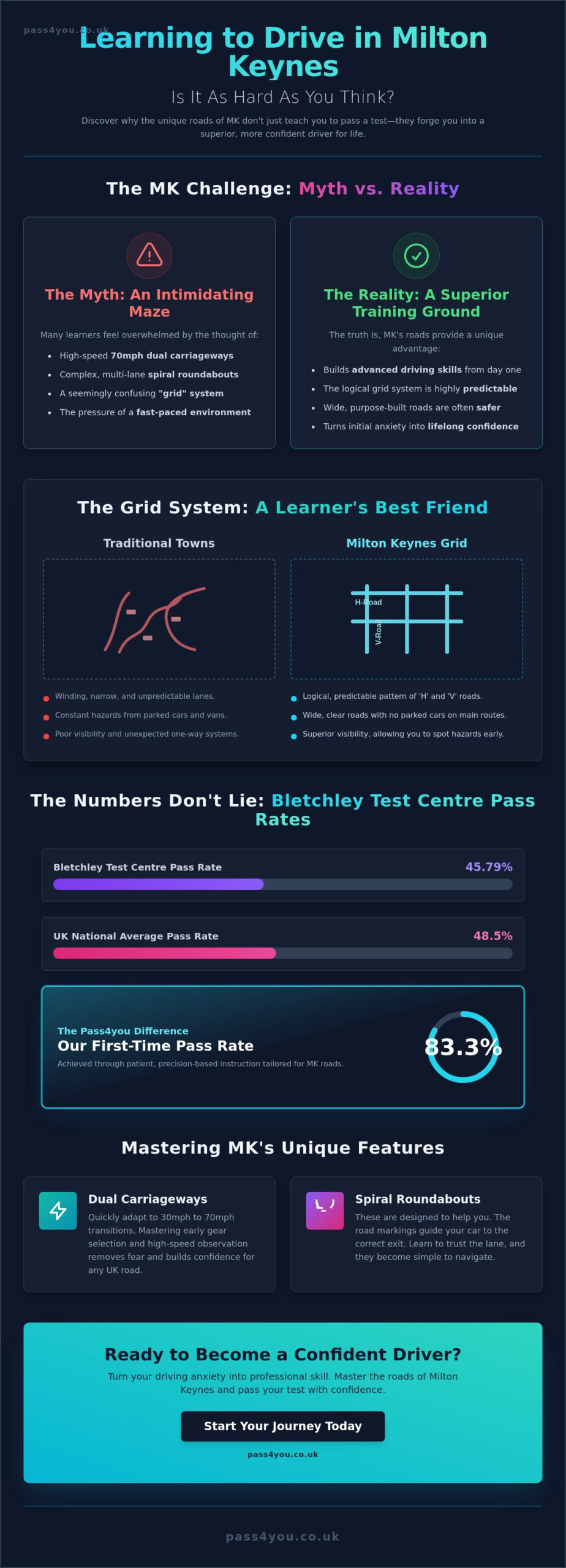
    This guide will show you that the grid system is actually your best friend. We’ll explain why the logical layout of Milton Keynes helps you develop advanced skills earlier, giving you a distinct advantage on test day. You’ll discover the truth about the Bletchley test centre, which saw a pass rate of 45.79 percent in recent data, and learn how a patient, professional approach can turn your fear into genuine confidence. We’re going to provide a clear, step-by-step path to passing your test first time and enjoying the freedom that comes with your full licence.

    Key Takeaways

    • Understand why the question “is learning to drive in milton keynes hard” is often met with a “no” once you master the city’s logical grid system.
    • Learn how to navigate multi-lane spiral roundabouts with ease by following clear lane discipline and consistent road markings.
    • Discover why the wide, purpose-built roads of Milton Keynes are often safer and more predictable for learners than the cramped streets of older towns.
    • Prepare for the Bletchley Practical Test Centre by identifying common local “fail spots” and knowing exactly what to expect on the day.
    • See how a supportive teaching style and a high 83.33% first-time pass rate can turn your driving anxiety into professional confidence.

    Is Learning to Drive in Milton Keynes Hard? The Reality for 2026

    Many new drivers look at a map of our city and feel a sense of dread. With its reputation as the “Roundabout Capital,” it is easy to see why someone might ask, is learning to drive in milton keynes hard? If you are used to quiet residential streets, the thought of merging onto a 70mph dual carriageway can feel overwhelming. However, the reality is quite different from the common myth. While the first five hours of your lessons might feel like a steep climb as you adjust to the pace, the subsequent twenty hours often feel much smoother than they would in a traditional town. You are learning advanced skills from day one, which builds a level of confidence that stays with you for life.

    There is also a significant psychological advantage to learning in this environment. Because you encounter dual carriageways early in your journey, you quickly lose the fear of speed that often plagues learners in other cities. You learn to read traffic flow and judge distances with high precision. By the time you reach your test, these “scary” features have become second nature. You aren’t just learning to pass a test; you are becoming a highly capable driver prepared for any UK road.

    The ‘Grid’ Myth: Why MK is Actually Predictable

    The Milton Keynes grid road system is actually a masterpiece of predictability. Unlike older UK towns with their winding, narrow lanes and unexpected one-way systems, our roads follow a clear and logical pattern. Horizontal roads are labelled ‘H’ and vertical roads are ‘V’. This makes navigation simple even for a beginner. One of the biggest safety benefits is the lack of parked cars on main routes. In places like London or Northampton, you are constantly dodging delivery vans or opening car doors. In MK, the roads are wide and visibility is superior, allowing you to see hazards long before they become a problem.

    Success Rates in Milton Keynes: What the Data Says

    When we look at the numbers, the picture becomes even clearer. Data from April 2024 to March 2025 shows that the Bletchley Practical Test Centre has a pass rate of 45.79 percent. While this is slightly below the national average of 48.5 percent, it often reflects learners who haven’t been taught to respect the grid properly. If you have been wondering is learning to drive in milton keynes hard, these statistics show that the right preparation makes all the difference. At Pass4you Driving School, our students benefit from a much higher success rate. We are proud of our 83.33 percent first-time pass rate, which we achieve through patient, precision-based instruction. If you want to dive deeper into the specifics of local testing, check out our Driving Lessons Milton Keynes: The Ultimate Guide.

    Mastering the MK Grid: Roundabouts and Dual Carriageways

    The layout of Milton Keynes is designed for high-speed efficiency. While this looks logical on a map, it’s often the main reason people ask, is learning to drive in milton keynes hard? One of the biggest shifts for a new learner is managing the sudden change in speed limits. You might pull out of a quiet 30mph residential estate and find yourself on a 60mph or 70mph grid road within seconds. Mastering this transition safely depends on early gear selection. By preparing your car before you even reach the junction, you free up your mental energy to focus entirely on the traffic flow. We don’t want you rushing your gear changes while trying to judge the gap in a fast-moving stream of cars.

    Spiral roundabouts are another local feature that can seem daunting at first. These junctions are actually designed to help you. The road markings are painted in a way that “pushes” your vehicle toward the correct exit as you travel around the circle. Instead of having to make sharp lane changes, you simply follow the lane you started in. Once you understand that the road is doing the hard work for you, your anxiety levels will drop significantly. It’s all about trusting the markings and keeping your eyes moving.

    Lane Discipline on the A5 and H-Roads

    The A5 is a major artery for the city and a common feature on local test routes. It can be a busy environment, especially during peak hours when commuters might seem impatient. The key to staying safe is maintaining a consistent pace and a solid following distance. You don’t need to be intimidated by faster traffic. Our driving lessons focus on building your confidence so you feel like you belong on these high-speed roads just as much as anyone else. If you’re feeling a bit nervous about the technical side of things, our guide on Mastering the Dual Carriageway provides a step-by-step breakdown of merging and lane changes.

    Roundabout Anxiety: Tips for Staying Calm

    Roundabouts are often where learners feel the most pressure. We use the simple “Clock Face” method to make lane selection easy. Think of the roundabout as a clock. If your exit is before 12 o’clock, you’ll typically stay in the left lane. If it’s after 12 o’clock, you’ll usually move to the right. This rule applies to most junctions you’ll encounter near the Bletchley Practical Test Centre. Remember that observation is always more important than speed. If you take a moment to process the road signs and markings before you enter the junction, everything becomes much more manageable. You’re in control of the car, and with a bit of practice, these complex junctions will become second nature.

    Is Learning to Drive in Milton Keynes Hard? The Truth for 2026 Learners

    MK vs. Traditional Towns: Why the Grid is a Learner’s Friend

    If you’ve ever tried to navigate the narrow, winding streets of an old market town, you know how stressful it can be. You’re constantly checking for delivery vans, dodging cyclists on one-way systems, and squinting at faded road signs. This is why when people ask, is learning to drive in milton keynes hard, the answer is often a surprising “no” compared to traditional urban centres. In Milton Keynes, the roads are designed with space and visibility in mind. You have wide lanes and clear, consistent markings that tell you exactly where you need to be. This predictability is a huge advantage. It allows you to focus on car control and observation rather than fighting for space on a cramped road.

    MK learners often develop superior car control at higher speeds earlier than their peers in other towns. Because you spend more time on 60mph and 70mph roads, you become comfortable with the physics of the car. You learn how to steer smoothly and brake gently at speed. If you’re wondering if learning to drive in milton keynes hard because of these speeds, remember that high visibility actually makes it safer. You can see hazards from much further away than you could on a cramped town street. In fact, many drivers who learn here find that transitioning to cities like London or Birmingham is much easier later on. They already have the confidence and the high-speed experience that others might lack.

    Navigational Logic: H-Roads and V-Roads Explained

    The grid system does more than just move traffic; it simplifies your thinking. During the independent driving part of your test, the logic of Horizontal (H) and Vertical (V) roads helps prevent that feeling of being lost. If you’re following signs for a specific district, the grid layout means you’re rarely more than a few turns away from a main artery. The 2026 signage updates have made this even easier. The signs are now positioned earlier, giving you plenty of time to process information without feeling rushed. This reduces your cognitive load, letting you focus on your mirrors and signals.

    Dealing with Rural Borders: Stony Stratford and Beyond

    While the grid is our primary classroom, we also take you beyond the wide roads. Towns like Stony Stratford provide a necessary contrast with their narrow streets and tighter corners. We include these rural routes in our driving lessons to ensure you aren’t just a “grid driver” but a competent motorist capable of handling any environment. You’ll learn to balance the fast pace of the dual carriageways with the cautious approach needed in 20mph residential estates. This variety is what makes our students so prepared. We guide you through these transitions with patience, ensuring you feel safe whether you’re on a wide grid road or a tiny country lane.

    Preparation for the Bletchley Practical Test Centre

    The Bletchley Practical Test Centre is where your journey toward independence truly comes together. While central Milton Keynes is famous for its wide, logical grid, the area surrounding the test centre offers a different kind of challenge. It features a blend of older residential streets, busy commercial zones, and fast access roads. Many students ask, is learning to drive in milton keynes hard when you have to start your test in such a varied environment? The truth is that this variety works in your favour. It ensures you are tested on a wide range of skills, making you a more rounded and capable driver.

    Preparation is the key to overcoming any nerves. We help you identify common “fail spots” near the centre, such as the tricky mini-roundabouts where lane discipline is absolutely vital. You will also practice the transition from the slower 30mph zones onto the high-speed H-roads that lead toward the city centre. When you are ready to take the next step, our guide on how to book your driving test provides all the logistical help you need to secure your date.

    During your test, you will also need to handle the “Show Me, Tell Me” safety questions. In our modern VW tuition vehicles, these controls are intuitive and easy to operate. Pass4you Driving School instructors spend time ensuring you know exactly where everything is, from the engine oil dipstick to the rear demister. This familiarity prevents any small technical questions from shaking your confidence before you even leave the car park. While some might worry that the variety of roads makes it tricky, the question of whether is learning to drive in milton keynes hard usually disappears once you understand the local test routes.

    Test Route Realities: From Bletchley to the City Centre

    Examiners frequently use routes that move between the residential heart of Bletchley and the sweeping grid roads. This tests your ability to adapt your speed and observation levels quickly. Pass4you Driving School uses a “Mock Test” strategy to simulate this experience. By driving these specific routes under exam conditions with your instructor, you learn to manage the pressure. You’ll become comfortable with the “super roundabouts” and the smaller, tighter junctions alike. This practice ensures that nothing on the day comes as a surprise.

    The Final Hour: Staying Confident Under Pressure

    The 40-minute practical exam is a test of your mindset just as much as your maneuvers. We focus on building your emotional resilience so you can stay calm and focused. If you make a small mistake, we teach you how to reset and continue driving safely. You can find more expert tips in our guide on mastering the practical driving test in 2026. If you want to build this level of confidence with a patient mentor, book your driving lessons with Pass4you Driving School today.

    Why Pass4you Driving School Makes Learning to Drive in MK Simple

    We believe the environment is only half the battle. While the city’s layout offers specific challenges, the real difference lies in who is sitting in the passenger seat. If you’ve been asking, is learning to drive in milton keynes hard, our goal is to show you that with the right support, it’s actually an empowering experience. Pass4you Driving School prioritises patience and reassurance above all else. This supportive approach has led to our impressive 83.33 percent first-time pass rate. By focusing on high-quality instruction rather than just rushing to the finish line, we ultimately save you time and money. You won’t just pass your test; you’ll become a safe driver for life.

    Our choice of vehicles is also a key part of your success. Pass4you Driving School uses modern Volkswagen cars because they are incredibly reliable and easy to drive. The light steering and clear displays help make the technical aspects of the grid feel much more manageable. When you have a car that responds perfectly to your touch, your focus can stay on the road ahead. This technical advantage, combined with a calm mentor, ensures that you feel in safe, professional hands from the moment you turn the key.

    Personalised Instruction for Anxious Learners

    Every student has a different “fear factor.” For some, it is the high speeds of the V-roads. For others, it is the complexity of the multi-lane roundabouts we explored earlier. Our lead instructor maintains high teaching standards by ensuring every lesson is tailored to your specific needs. We don’t believe in a one-size-fits-all curriculum. Instead, we build your skills at a pace that feels safe and comfortable. While some competitors might offer the “cheapest” rates, we focus on the long-term value of professional instruction. You can meet our team of first-class driving instructors near me to see how we can help you conquer your driving anxiety.

    Ready to Start? Your First Lesson in Milton Keynes

    Starting your journey is simpler than you might think. For your first lesson, you’ll just need to have your provisional licence check ready. We’ll handle the rest. We usually start in a quiet residential area to get you used to the car’s controls before we even think about the main grid roads. Our commitment is to get you on the road safely and quickly, providing a clear and honest path to your full licence. We directly address any concerns you have about whether is learning to drive in milton keynes hard by showing you the logic behind every road rule. If you’re ready to leave the nerves behind and start your journey toward freedom, book your first lesson with Pass4you Driving School today.

    Take the First Step Toward Driving Freedom in Milton Keynes

    The unique layout of our city isn’t a barrier to your success; it’s actually a blueprint for making you a safer and more capable driver. We’ve seen how the logical grid system and high-visibility roads provide a more predictable environment than the cramped streets of older towns. While many still wonder, is learning to drive in milton keynes hard, you now know that mastering these roads simply requires the right approach and a patient mentor. By practicing on Bletchley test routes and understanding the spiral roundabout markings, you’ll find that your confidence grows with every lesson.

    Our expert local instructors are dedicated to your safety and proficiency. We use modern Volkswagen tuition vehicles to ensure your learning experience is as smooth as possible. This commitment to quality is why we celebrate a high 83.33 percent first-time pass rate. You deserve to feel empowered behind the wheel. When you’re ready to gain your independence, we’re ready to help you achieve it.

    Start your journey with an 83.33% first-time pass rate; Book with Pass4you

    Frequently Asked Questions

    Is Milton Keynes harder than other towns for the driving test?

    Milton Keynes isn’t necessarily harder than other towns; it simply requires a different set of skills. While traditional towns focus on narrow streets and hazards like parked cars, Milton Keynes prioritises high-speed car control and lane discipline. Many learners find the logical grid system easier to navigate once they understand the pattern. It’s about being prepared for the specific environment rather than the environment being inherently more difficult.

    How many lessons on average do I need to pass in Milton Keynes?

    Most learners require approximately 45 hours of professional tuition combined with 22 hours of private practice to reach the required standard. However, this varies depending on your previous experience and how quickly you build confidence with the grid system. Professional instruction often streamlines this process. By focusing on quality over quantity, you can often reach a test-ready standard more efficiently than through informal practice alone.

    What is the pass rate at the Bletchley driving test centre?

    The Bletchley Practical Test Centre had a pass rate of 45.79 percent between April 2024 and March 2025. This figure is based on data from 9,783 tests conducted during that period. while this is slightly below the national average of 48.5 percent, it highlights the importance of receiving professional instruction. Our local expertise helps you prepare specifically for the unique test routes and high-speed junctions found around Bletchley.

    Can I learn to drive in an automatic car in Milton Keynes?

    Yes, you can certainly learn to drive in an automatic car in Milton Keynes. Automatic lessons are becoming increasingly popular because they allow you to focus more on the road and less on gear changes. This can be particularly helpful when navigating the city’s many roundabouts. At Pass4you, we offer professional instruction for both manual and automatic learners to suit your personal preference and learning style.

    Are the roundabouts in Milton Keynes safe for beginners?

    Roundabouts in Milton Keynes are very safe for beginners when approached with the correct training. The city uses a “spiral” marking system that guides your car toward the correct exit automatically. Once you learn to trust these markings and maintain good lane discipline, you’ll find these junctions much more predictable than the tight, unmarked roundabouts found in older UK towns. We help you master these with patience and reassurance.

    What happens if I fail my driving test in Milton Keynes?

    If you fail your test, you’ll receive a digital summary of your faults to review with your instructor. You must wait at least ten working days before taking another test. However, current waiting times in the South East are approximately 14 to 20 weeks. We recommend using this time to focus on the specific areas highlighted in your report to ensure a successful, confident outcome on your second attempt.

    Which driving school in Milton Keynes has the best pass rate?

    Pass4you is proud to maintain a high 83.33 percent first-time pass rate for our students. We achieve this through a patient, supportive teaching style that focuses on building genuine confidence rather than just memorising routes. By choosing a school with proven results, you’re investing in a more efficient path to your full licence. This approach prioritises your long-term safety and proficiency on the road.

    How do I deal with the high-speed dual carriageways in MK?

    Dealing with high-speed dual carriageways is a matter of early preparation and observation. You’ll learn to select the correct gear well before you reach the junction, which allows you to focus entirely on matching the speed of the traffic flow. Many learners ask, is learning to drive in milton keynes hard because of these 70mph roads, but our patient instructors help you build up to these speeds gradually until they feel completely natural.

  • How to Convince Your Parents to Pay for Driving Lessons in 2026

    What if the biggest obstacle to your driving license isn’t the theory test or a tricky parallel park, but a conversation at the kitchen table? We know that convincing parents to pay for driving lessons can feel more stressful than the actual driving test, especially when you are worried about the financial weight on your family. It is frustrating to feel stuck at home, particularly in areas like Milton Keynes where public transport often falls short of providing true freedom. You want your independence, but you also want to be responsible about the costs involved.

    The good news is that your parents want you to be safe and successful just as much as you do. This guide will show you how to turn a “maybe” into a definite “yes” by presenting professional instruction as a strategic investment in your future. You will learn how to create a clear success plan that highlights safety, explains the latest 2026 DVSA booking rules, and shows the value of choosing a school with a high first-time pass rate. We will walk you through how to prove your commitment and start your journey with a reputable instructor who puts your long-term safety first.

    Key Takeaways

    • Reframe the conversation by positioning driving as a vital life skill for your future employment and independence.
    • Understand why professional instruction in dual-controlled vehicles is significantly safer than learning solely through private practice.
    • Master the strategy for convincing parents to pay for driving lessons by presenting a structured “Success Plan” that emphasizes long-term value.
    • Learn how a high first-time pass rate, such as our 83.33% metric, reduces the risk of expensive re-tests and extra fees.
    • Discover the best timing and research methods to ensure your parents feel confident and supportive of your learning journey.

    The ‘Driving Dilemma’: Why Asking for Help is the First Step to Independence

    Asking for financial help can feel like a step backward when you are trying so hard to move forward. In 2026, the reality of the cost of living makes every financial request feel heavy. You might worry about being a burden or feel frustrated that you can’t yet fund your own milestones. It’s helpful to see this not as a handout, but as a necessary bridge to your future self-sufficiency. This is the “independence paradox”: you often need a little help to become truly self-sufficient.

    When you start the process of convincing parents to pay for driving lessons, you are actually starting a conversation about your career and safety. Your parents likely remember the excitement of their first car, but they also carry the weight of knowing how unpredictable the roads can be. They don’t just want you to be mobile; they want you to be safe. Validating their perspective by focusing on high-quality instruction shows that you are serious about responsibility, not just looking for a new way to hang out with friends.

    Reframing the Cost as an Investment

    Think of driving lessons as a professional qualification rather than a luxury expense. In competitive areas like Milton Keynes, many entry-level roles require a license because public transport doesn’t always align with shift patterns or office locations. By investing in formal driver’s education, you are ensuring that you don’t just pass a test, but develop the habits that keep your record clean from day one. Many students find that convincing parents to pay for driving lessons is much easier when they explain how a license expands their job search radius by miles.

    The Reality of Modern Mobility

    Relying on buses or trains can be a major hurdle for your personal and professional growth. Public transport often fails during emergencies or late-night shifts, leaving you stranded or dependent on others. Driving independence is the ability to manage one’s own career logistics. Beyond work, being a driver means you become a contributor to the family. You can help with errands, assist in emergencies, and eventually reduce the “taxi” burden on your parents. It is about being a prepared, capable adult who can handle whatever the day throws at them.

    Consider these practical benefits of professional driving skills:

    • Access to jobs that require travel or “on-call” availability.
    • Enhanced personal safety when traveling late at night.
    • The ability to respond quickly to family or medical emergencies.
    • Reduced long-term costs by learning efficient, fuel-saving driving techniques.

    The Safety Argument: Why Professional Instruction Outperforms ‘Private Practice’

    Many people on community forums suggest that learning with a parent is the easiest way to save money. While this advice is well-meaning, it often overlooks the complexities of teen driving safety and the rigorous standards of modern roads. Parents are often excellent drivers, but they’ve usually developed “shortcuts” over decades of driving that an examiner will mark as serious faults. When you are convincing parents to pay for driving lessons, it’s vital to explain that professional instructors teach to the current DVSA standards, not the standards of twenty years ago.

    The stress factor is another hidden hurdle that many families underestimate. Learning to drive is an intense experience that requires immense patience. When family members try to teach each other, the emotional bond can actually make things harder. Small mistakes can lead to heated arguments, which creates a negative learning environment and slows down your progress. Professional instructors are trained to remain calm and supportive. They help you build confidence rather than anxiety. This emotional stability is essential for mastering the practical driving test, especially with the 2026 rules that limit how many times you can change your booking appointment.

    The Benefit of Dual Controls and Expert Guidance

    Safety is the primary concern for any parent. Modern tuition vehicles are equipped with dual controls, which allow the instructor to intervene instantly if a situation becomes dangerous. This is a safety net that a standard family car simply doesn’t have. Our instructors also have deep knowledge of the specific test routes in Milton Keynes. They know exactly which roundabouts and junctions tend to trip students up. This local expertise ensures you aren’t just driving; you’re preparing for the exact environment where you will be tested. You can explore our driving lessons to see how we prioritize safety from the very first hour.

    Reducing the Risk of Costly Mistakes

    Failing a driving test isn’t just a blow to your confidence; it’s a significant financial burden. Between the £62 to £75 re-booking fee and the cost of additional lessons to fix mistakes, a single fail can quickly add up. Professional training is designed to get you ready for a “first-time pass” by eliminating bad habits early. An 83.33% pass rate reduces the total cost of becoming a driver by minimizing the need for expensive re-tests and remedial training. Furthermore, insurance companies often look favorably on those who have received professional training, as it demonstrates a commitment to recognized safety standards. Convincing parents to pay for driving lessons becomes a much easier task when you show them that professional help is actually the most cost-effective path to your license.

    How to Convince Your Parents to Pay for Driving Lessons in 2026

    Calculating the ROI: How Quality Lessons Save Money Long-Term

    When you are convincing parents to pay for driving lessons, the conversation often centers on the hourly price. However, the cheapest hourly rate rarely results in the lowest total bill. A “bargain” instructor might lack a structured syllabus, leading to a much higher number of lessons before you are actually test-ready. If you take sixty hours to reach the same standard that a professional school achieves in forty, those “cheap” lessons become incredibly expensive. Choosing a high-quality school is about efficiency and ensuring every minute behind the wheel adds value to your skills.

    The real financial drain isn’t the lessons themselves; it’s the cost of failing. In 2026, the DVSA has implemented stricter booking rules to manage the high demand for tests. If you fail, you aren’t just paying the £62 to £75 test fee again. You also have to pay for the instructor’s car hire on the day and several more weeks of remedial lessons to stay sharp. Research shows that failing a driving test can cost over £400 in total re-booking and training expenses. You can find more detail on how to avoid these pitfalls in our guide to driving lessons Milton Keynes.

    The ‘First-Time Pass’ Advantage

    Aiming for a first-time pass is the most frugal strategy you can adopt. Beyond the basic test fees, there is a significant psychological benefit to passing quickly. Success builds confidence and allows you to move into the next stage of your life without the “cloud” of an upcoming test hanging over you. A school with a high success rate, like our 83.33% first-time pass metric, is a safer financial bet for your parents. It shows them that their money is going toward a proven system that prioritizes getting you licensed safely and quickly.

    Future Savings on Insurance and Maintenance

    Professional instruction also teaches “mechanical sympathy.” This means you learn how to handle a car’s clutch, brakes, and gearbox in a way that minimizes wear and tear. These habits save thousands of pounds in repair costs once you own your first vehicle. Additionally, drivers who pass with a high standard of professional training are statistically less likely to be involved in accidents. This track record is essential for keeping your future insurance premiums manageable, which is often the biggest ongoing cost for new drivers.

    Expense Factor The ‘Cheap’ Instructor Path The ‘High-Success’ Path
    Average Lessons Needed 55 – 65 Hours 35 – 45 Hours
    Practical Test Attempts 2 – 3 Attempts 1 Attempt (Targeted)
    Hidden Fail Costs High (Fees + Extra Lessons) Minimal or None
    Long-Term Vehicle Wear Higher (Poor Habits) Lower (Mechanical Sympathy)

    Your Step-by-Step ‘Pitch’ to Parents: Negotiating Your Future

    Generic advice often suggests just “being nice” or doing extra chores to get what you want. However, convincing parents to pay for driving lessons in 2026 requires a more professional approach. You are asking for a significant financial commitment. You should treat the conversation like a business proposal. This shows your parents that you aren’t just looking for a shortcut to freedom; you are ready to handle the responsibility that comes with being a driver. Preparation is the key to turning a hesitant “maybe” into a confident “yes.”

    Start by doing your homework. Research local driving instructors near me to find those with high pass rates and positive reviews. When you present your plan, choose a time when your parents are relaxed and not distracted by work or chores. If they say no initially, don’t get defensive. Ask what their specific concerns are. Is it the cost, your safety, or your maturity? Once you know the real objection, you can address it with facts and a clear plan of action.

    Creating Your ‘Driving Success Plan’

    A “Success Plan” is a document that outlines exactly how you will reach your goal. It should include data on pass rates and the qualifications of the instructors you have found. Showing them that you already have your provisional license UK is a powerful way to prove you have already taken the first steps. Set clear milestones, such as a target date for passing your theory test. This level of organization gives your parents confidence that their investment won’t be wasted on aimless lessons. It proves you are thinking about the long-term outcome, not just the next hour behind the wheel.

    The ‘Skin in the Game’ Strategy

    Parents are much more likely to support you if they see you are willing to contribute. This is the “skin in the game” strategy. Even if you don’t have a full-time job, you can offer to contribute in other ways. You might pay for your own theory test or handle specific household responsibilities in exchange for your weekly lesson. You could even draft a simple “contract” that ties your driving progress to your school grades or other personal milestones. This transparency builds trust and makes convincing parents to pay for driving lessons a collaborative effort. If you are ready to show your parents a professional plan, you can book your first driving lesson with a school that prioritizes your success.

    Why Pass4you Driving School is the Solution Your Parents Will Support

    Choosing the right school is the final piece of the puzzle when convincing parents to pay for driving lessons. They need to know their money supports a service that prioritizes safety and results. At Pass4you Driving School, we don’t just teach you to pass a test; we mentor you to become a confident driver for life. Our approach is designed to remove the anxiety that often stalls progress, replacing it with a steady, structured path to independence.

    Safety is almost always a parent’s top priority. We use modern, high-specification Volkswagen tuition vehicles for every lesson. These cars are easy to handle and come equipped with the latest safety features and dual controls. This setup ensures you are always in safe hands, even during your first few hours on the road. Our instructors also have deep local knowledge. We provide specialized training for dual carriageway mastery, which is essential for navigating the fast-moving roads in and around Milton Keynes.

    Data-Driven Trust

    Parents value transparency and proven results. Our 83.33% first-time pass rate is a core proof point of our effectiveness. When you consider that the national average pass rate is approximately 48%, the value of our instructional method becomes clear. This success is built on a foundation of patience and professional mentorship at Pass4you Driving School. Our lead instructor is known for a calm, supportive teaching style that helps even the most nervous students feel at ease. This reputation for excellence gives parents the peace of mind they need to feel confident in their investment.

    The Next Steps

    The best way to show your parents you are serious is to suggest an assessment lesson. This gives you a chance to experience our teaching style and provides your parents with a clear view of your potential. Our booking process is simple and transparent, making it easy for busy parents to manage. Once they see your growing confidence and the professional standard of Pass4you Driving School, they will see that driving lessons are a strategic investment in your future. Show this to your parents and book your first lesson with Pass4you Driving School today to start your journey with a school that is genuinely invested in your success.

    Take the Wheel of Your Future Today

    Your journey toward independence is about more than just getting from A to B. It is about proving you are ready for the responsibilities of adulthood. By reframing your request as a strategic investment in safety and career mobility, you make convincing parents to pay for driving lessons much more straightforward. Professional instruction isn’t just an expense; it’s a way to ensure you develop the right habits in a safe, controlled environment from the very start.

    With our 83.33% first-time pass rate and modern Volkswagen tuition vehicles, Pass4you Driving School provides the data-driven results that give parents peace of mind. Our expert instructors in Milton Keynes are here to guide you through every roundabout and junction with patience and care. You have the tools, the plan, and the facts to make your case. Now is the time to take that first step toward your license and the freedom that comes with it.

    Ready to start? Book your first lesson with Pass4you Driving School and show your parents you mean business!

    We are excited to help you achieve the freedom you deserve while keeping you safe and confident on the road.

    Frequently Asked Questions

    Is it better to ask for a block of lessons or pay-as-you-go?

    Block lessons are usually the best choice because they provide a clear structure and often include a loyalty discount. This consistency helps you build skills much faster than taking occasional sessions. When convincing parents to pay for driving lessons, showing them a full schedule with Pass4you Driving School proves you have a serious plan to reach your goal. It also helps your parents budget for the total cost upfront.

    What if my parents say driving is too dangerous?

    It is natural for parents to worry about safety on modern roads. You can reassure them by explaining that tuition vehicles are fitted with dual controls, allowing the instructor to take over instantly if needed. Professional training focuses on defensive driving and hazard perception, which are the best tools for staying safe. Showing them that you are choosing a mentor who prioritizes safety over speed can help change their mind.

    How can I prove I’m responsible enough to start driving lessons?

    You can prove your maturity by taking the lead on all the administrative tasks. Apply for your provisional license and start your theory test revision before you even have your first conversation. Creating a written “Success Plan” that includes your researched school and target dates shows you are thinking like an adult. This proactive approach demonstrates you are ready for the responsibility of being behind the wheel.

    Should I offer to pay my parents back for the lessons later?

    Offering a repayment plan is a powerful way to show you respect their financial support. Even if they decline, the offer itself proves you aren’t taking their help for granted. You could suggest paying back a percentage once you start working or trading specific household chores for your weekly tuition. This turns convincing parents to pay for driving lessons into a fair exchange rather than a one-sided favor.

    What are the most common objections parents have about driving costs?

    The most frequent concerns involve the rising hourly rates and the fear of “open-ended” costs if you don’t pass quickly. Parents also worry about the hidden fees associated with failing a test, such as car hire and re-booking charges. You can address these by presenting a school with a high success rate. This data proves their money is going toward an efficient and effective learning process.

    How many lessons does the average person need to pass in 2026?

    The average learner needs about 45 hours of professional tuition to reach the required standard. This is often supplemented by private practice to help build confidence in different traffic conditions. By following a professional syllabus, you can often reach test-readiness more efficiently. Focusing on quality over quantity ensures you don’t spend more time or money than is absolutely necessary to become a safe driver.

    Can I learn with a parent while also taking professional lessons?

    Learning with a parent can be very helpful for building confidence between your professional lessons. However, it is vital to only practice skills your instructor has already taught you. This prevents you from picking up “bad habits” that could lead to a fail. Ask your instructor to give your parents a list of specific things to work on during your private practice sessions to keep your learning consistent.

    What happens if I fail my first test after my parents paid for it?

    If you don’t pass the first time, it’s important to stay calm and review the examiner’s feedback immediately. A professional school will help you create a short, targeted plan to fix the specific faults that caused the fail. Usually, only a few extra hours are needed to get back on track. Showing your parents you have a clear strategy for the next attempt proves your continued commitment to success.

  • How Driving Lessons Give You Independence: Your Roadmap to Freedom in 2026

    What if you never had to check a Milton Keynes bus timetable ever again? It’s a frustrating reality for many; waiting for a bus that’s running late or relying on family members who might pass on their own driving “bad habits.” You likely want the freedom to commute on your own terms, and understanding how driving lessons give you independence is the first step toward that goal. We know that navigating those famous local roundabouts or facing the practical test feels overwhelming, but learning to drive is about more than just operating a car; it’s about reclaiming your time and your life.

    You aren’t alone in feeling this way, and your desire for a faster, safer path to your licence is completely valid. This guide shows how professional instruction transforms you from a nervous passenger into a skilled driver who is ready for anything. You’ll discover how expert coaching helps you pass your test quickly to save money, even with the stricter 2026 booking regulations. We’re going to look at the journey from your first lesson to that moment of pure freedom when you finally drive away solo.

    Key Takeaways

    • Learn how professional instruction moves you from simply following orders to making your own executive decisions behind the wheel.
    • Discover how driving lessons give you independence by building the confidence to navigate the Milton Keynes grid system and roundabouts safely.
    • Avoid the common “bad habit” trap that comes with learning from friends or family. Professional lessons often save you money by reducing the total hours you’ll need to pass.
    • Master essential skills like hazard perception and sat-nav navigation to ensure you can travel spontaneously without feeling any panic.
    • Understand why a patient, supportive teaching style is the most effective way for nervous beginners to overcome anxiety and secure their long-term freedom.

    Defining Independence: More Than Just Holding a License

    Many people think that passing the practical test is the final destination. In reality, it’s just the beginning of a new way of living. True independence isn’t about the physical card in your wallet; it’s about the quiet confidence that comes from knowing you can handle a car entirely on your own. Understanding how driving lessons give you independence helps you see that this process is a mental transformation. You are moving away from being a passenger who simply observes the road to becoming an active driver who controls every aspect of the journey. Independence is a mindset. It’s about total control.

    This shift involves moving from “following orders” to “making executive decisions.” When you start, your instructor tells you when to change gear or check your mirrors. As you progress, those prompts disappear. You begin to anticipate hazards yourself without needing a nudge from the passenger seat. This is vital because your legal authorization to drive serves as a passport to new social and professional worlds. Whether it’s a job offer that requires a commute or a spontaneous weekend trip, your ability to drive opens doors that were previously locked by unreliable bus schedules or expensive taxi fares. Independence manifests in several ways:

    • Choosing your own routes without asking for directions.
    • Adjusting your speed safely based on road conditions, not just signs.
    • Reacting calmly to other drivers’ mistakes.
    • Feeling ready to handle unexpected road hazards without panic.

    The Transfer of Responsibility

    Professional driving lessons are designed to be a structured hand-off of control. We don’t just teach you to pass a test; we prepare you for the reality of solo driving. Your instructor will gradually “dial down” their verbal support as your skills improve. This ensures that when you finally take your test, you aren’t just performing for an examiner. You are demonstrating that you are ready for the responsibility of keeping yourself and others safe. This foundation is much stronger than what you might get from private practice alone. Professional guidance is the safest foundation. It builds genuine self-reliance and ensures you don’t pick up dangerous habits from well-meaning friends.

    From Passenger to Pilot

    Imagine your morning without the stress of an unreliable Milton Keynes bus. You could leave ten minutes later, enjoy your own music, and arrive at work feeling calm. We bridge the “anxiety gap” through patient, structured tuition. Using modern, easy-to-handle vehicles like our Volkswagens makes this transition much smoother. These cars are responsive and comfortable. They allow you to focus on the road ahead rather than struggling with the controls. By the time you reach your test, the car feels like an extension of yourself. You are ready to explore the city with total autonomy.

    The Core Skills That Build True Driving Autonomy

    True autonomy on the road isn’t something that happens by accident. It’s the result of mastering specific, high-level skills that allow you to move through traffic without second-guessing yourself. While basic car control is the starting point, understanding how driving lessons give you independence requires looking at how you process information. Professional training focuses heavily on hazard perception. This is the ability to spot potential dangers before they become actual problems. When you can identify a pedestrian stepping out or a car braking early, you aren’t just reacting; you’re planning. This foresight is what makes you a safe, independent driver.

    Technical proficiency also plays a massive role in your confidence. If you’re constantly worrying about stalling or finding the right gear, your brain has less “processing power” for the road around you. Smooth car control leads to calmer decision-making. Our instructors focus on making these physical actions second nature. This allows you to focus on the environment, which is how you truly build a solid foundation of safe driving habits that last a lifetime. Once the mechanics of driving are automatic, you can dedicate your full attention to the complex world outside your windscreen.

    Decision Making Under Pressure

    Being independent means you no longer wait for a “go” signal from the passenger seat. You’ll learn to judge gaps in traffic at busy junctions and roundabouts with precision. This mental stamina is essential for solo journeys. On your own, you’ll face roadworks, diversions, and changing weather without a safety net. We prepare you for these “unexpected” moments by gradually increasing the complexity of your lessons. This ensures you can handle the pressure of real-world driving without feeling overwhelmed. You’ll develop the grit needed to stay focused even when a journey doesn’t go exactly as planned.

    Navigating Without a Safety Net

    The 2026 practical test places a strong emphasis on independent driving sections. You’ll be asked to follow road signs or a sat-nav for a significant portion of the exam. Mastery of these tools is vital for your future freedom. If you take a wrong turn while driving solo, the goal isn’t to panic; it’s to find a safe way to get back on track. We integrate these scenarios into our sessions so they feel routine. If you want to see how this fits into the bigger picture, check out our ultimate guide to passing your test. To start building these skills today, consider booking driving lessons with a patient mentor who understands your goals.

    Finally, the mock test is your ultimate rehearsal for freedom. It isn’t just about checking boxes. It’s about proving to yourself that you can manage a car, navigate a route, and stay safe for 40 minutes without any help. Once you’ve aced a mock test with your instructor, that feeling of independence becomes very real. You’ll know that you aren’t just “test-ready,” but truly road-ready for whatever Milton Keynes throws your way.

    How Driving Lessons Give You Independence: Your Roadmap to Freedom in 2026

    Why Professional Lessons Outperform ‘Private Practice’ Alone

    It is often tempting to rely on a parent or friend to teach you the basics. While their intentions are good, this approach frequently leads to the “Bad Habit Trap.” Friends and family members often have years of experience, but they also have years of ingrained shortcuts that won’t pass a modern driving test. These informal sessions lack the structured syllabus required to ensure there are no “skill gaps” in your training. Professional instruction is designed to identify these gaps early. This is a primary reason why driving lessons give you independence more effectively than private practice alone; they build a foundation of precision rather than just “getting by.”

    Efficiency is another critical factor. The Driver and Vehicle Standards Agency (DVSA) recommends around 45 hours of professional driving lessons alongside 22 hours of private practice. By following a professional curriculum, you often reach test-readiness faster. This saves you money in the long run by reducing the total number of hours needed. Beyond cost, safety is the priority. Learning in a car equipped with dual controls provides a vital safety net during those high-risk early stages. It allows you to focus on developing safe driving habits without the fear of making a dangerous mistake that you can’t correct.

    Structured Learning vs. Informal Practice

    A syllabus-based approach ensures you cover every scenario, from emergency stops to complex junctions. Professional instructors are trained to spot anxiety triggers that a friend might miss. They know how to calm your nerves and explain “why” a certain action is necessary, not just “how” to do it. If you choose to supplement your lessons with private practice, doing so safely and effectively requires a clear plan. Your instructor can provide specific goals for your private sessions so you don’t accidentally undo the progress you’ve made during your professional tuition.

    The Pass4you Advantage

    Success is often a matter of preparation. We take pride in our 83.33% first-time pass rate, which stands as a clear benchmark for our teaching efficiency. This high-precision metric proves that our methods work. Because we focus specifically on the unique challenges of Milton Keynes roads, our students gain local independence much faster than those learning in unfamiliar areas. You can read more about how we help learners achieve these results in our high pass rate case study. Choosing a mentor who understands the local grid system means you’ll feel like an expert on your own streets before you even have your full licence.

    Milton Keynes is a city built for drivers. The unique grid system of Horizontal (H) and Vertical (V) roads is designed for efficiency, but it can feel like a maze to a new learner. Understanding how driving lessons give you independence means mastering this layout until it feels like second nature. When you can navigate from the H6 to the V8 without hesitation, the entire city opens up. You stop being a passenger following a route and start being an explorer who knows exactly where you’re going. This local knowledge is your greatest asset for long-term freedom. It allows you to plan your day around your own needs rather than a bus map.

    Professional instruction helps you bridge the gap between “learning to drive” and “knowing your town.” You’ll learn the timing of the lights, the flow of the grid, and how to safely hit 70mph on the dual carriageways. There is a specific thrill in that first time you merge onto a main road at speed with total control. It’s a clear signal that you’re no longer just a learner; you’re a driver. We focus on making these high-speed transitions feel calm and routine. This ensures you have the confidence to travel anywhere in the region without a second thought. You won’t just be passing a test; you’ll be gaining a lifetime of mobility.

    Conquering the MK Roundabouts

    The roundabout is the definitive Milton Keynes rite of passage. With hundreds of junctions across the city, gaining confidence here is essential for your autonomy. We provide step-by-step guidance on lane discipline, helping you understand which lane to choose long before you reach the junction. Learning locally means you won’t be intimidated by your own home. You can find more specific tips in our guide to mastering the dual carriageway.

    The Freedom of the Commute

    Independence in Milton Keynes translates directly into opportunity. Holding a licence means you can apply for jobs in expansion zones without worrying about transport. It also means your social life is no longer dictated by the bus timetable at CMK station. You can visit Bletchley, Stony Stratford, or head to the Xscape whenever you like. The car gives you spontaneity that public transport cannot match. If you’re ready to stop waiting in the rain, book your driving lessons with us today.

    Securing Your Future Freedom with Pass4you

    Real independence isn’t just about the day you pass your test. It’s about every day that follows. You’ve seen how driving lessons give you independence by providing the technical skills and mental stamina needed for the road. This isn’t a card you simply earn; it’s a lifelong skill you learn through patience and practice. Investing in quality instruction today means you won’t just be a licence holder. You’ll be a competent driver who can handle the pressure of solo travel with total ease. Quality tuition is an investment in your safety and your future mobility.

    Our approach is specifically designed for those who feel a bit nervous about getting behind the wheel. We don’t believe in rushed or aggressive teaching styles. Instead, we focus on building your confidence layer by layer. This supportive environment is why so many learners in Milton Keynes choose us. When you feel safe and understood, you learn more effectively. This efficiency is what allows our students to achieve such a high pass rate. It gets them on the road and into their new lives faster than they ever thought possible. You deserve a mentor who is as invested in your success as you are.

    Ready to Start Your Journey?

    Taking that first step might feel daunting, but we make it simple. Booking your first session is the beginning of a massive change in your daily routine. During your first hour, you won’t be thrown into the deep end. You’ll get to know the car, understand the controls, and move the vehicle for the first time in a quiet, safe area. It’s all about comfort and steady progress. If you’re still looking for the right fit, take a look at our guide on finding the best local instructors to see what makes a great mentor.

    Your Independence Awaits

    The roads of 2026 require a modern driver who is both skilled and responsible. With new regulations on test bookings and updated theory requirements, having a professional school in your corner is vital. We’re here to ensure you don’t just meet the standards; you exceed them. Your first lesson is truly the first step toward a life without bus timetables or relying on others for lifts. We’re ready when you are. You can book your driving lessons in Milton Keynes today and start your roadmap to freedom. Your new life as a confident driver is just around the corner.

    Your Future on the Open Road Starts Today

    The road to autonomy in Milton Keynes is closer than you think. You’ve seen how professional training moves you beyond basic car control to true navigational mastery. Understanding how driving lessons give you independence is about recognizing that you are building a life of spontaneous travel and professional growth. You are no longer just a passenger; you are the pilot of your own journey.

    With our 83.33% first-time pass rate and a modern Volkswagen tuition fleet, we provide the safest environment for you to grow. Our patient, first-class instructors are experts at turning anxiety into confidence. They’ll guide you through every grid road and roundabout until the car feels like an extension of yourself.

    Start your journey to independence – Book your MK driving lessons now

    Don’t let another rainy day at the bus stop hold you back. Your roadmap to freedom is ready and waiting. It’s time to take the wheel and embrace the life you deserve.

    Frequently Asked Questions

    How many driving lessons do I need to feel independent?

    The Driver and Vehicle Standards Agency (DVSA) recommends around 45 hours of professional tuition and 22 hours of private practice. Everyone learns at a different pace. Our goal is to ensure you feel confident and safe enough to handle any situation on your own before we send you for your test. We focus on quality instruction that builds your skills steadily until you no longer need prompts from the passenger seat.

    Can I learn to drive independently with just a family member?

    While private practice is helpful, relying solely on family members often leads to picking up “bad habits” that can cause a test failure. Professional instructors follow a structured syllabus that ensures you don’t have any skill gaps. Understanding how driving lessons give you independence involves realizing that an expert mentor teaches you the specific safety standards required for solo driving in modern traffic.

    What is the independent driving section of the UK driving test?

    This part of the practical test lasts about 20 minutes. You’ll be asked to follow directions from a sat-nav or road signs provided by the examiner. It isn’t a test of your geography; it’s a test of your ability to make safe decisions while navigating on your own. If you take a wrong turn, the examiner will help you get back on track without penalisng you, provided you stay safe.

    How does learning in Milton Keynes differ from other cities?

    Milton Keynes is unique because of its high-speed grid system and famous roundabouts. Unlike traditional cities with narrow, winding streets, MK requires you to be comfortable with lane discipline and merging at 70mph. This makes local experience vital for your confidence. We ensure you’re familiar with the specific H and V road layouts so you can navigate your hometown without any hesitation.

    Is it better to learn in a manual or automatic car for independence?

    Manual cars offer the most freedom because a manual licence allows you to drive both types of vehicles. Automatic cars are often easier to learn in because there is no clutch to manage, but you’ll be restricted to only driving automatics once you pass. Most learners choose manual to keep their future options open, especially when it comes to hiring cars or choosing a first vehicle.

    What happens if I fail my first test? Will I lose my independence?

    Failing a test is a temporary setback, not a loss of your future freedom. It simply means you need a little more time to refine your skills under pressure. We’ll work with you to address the specific areas that need improvement so you can return to the test centre with complete confidence. Your independence is a journey, and we’re here to support you until you reach the finish line.

    How much do driving lessons in Milton Keynes cost in 2026?

    Learning to drive is a significant investment in your long-term mobility. While prices across the UK vary based on fuel costs and vehicle maintenance, we focus on providing value through efficient teaching methods. We show you how driving lessons give you independence through structured sessions that help you pass faster. This approach reduces the total number of hours you’ll need to pay for before you’re ready for the road.

    Can I drive on the motorway as soon as I pass my test?

    Yes, you can drive on the motorway as soon as you have your full licence. While learners can only use motorways with a qualified instructor in a dual-controlled car, passing your test gives you the legal right to use them solo. If you feel nervous about high-speed driving, we can include motorway practice in your final lessons to ensure you’re ready for long-distance travel.

  • How to Tell if You’re Ready for Your Driving Test: The 2026 Checklist

    What if the secret to passing your driving test isn’t about being a perfect driver, but about how you handle the small mistakes you actually make? With national pass rates currently sitting between 47.9% and 52.2%, it is natural to feel anxious about whether you are truly prepared. You might be wondering how to tell if you’re ready for your driving test or if those “silly mistakes” on complex roundabouts mean you should wait. It is completely normal to feel a knot in your stomach when you think about the long wait for a retest or the frustration of a failed attempt.

    We understand that you want the freedom of a license without the stress of uncertainty. This guide provides the definitive signs that you have moved from a learner who needs a safety net to an independent decision-maker who is ready for the road. You will discover exactly how to assess your own skills and avoid the cost of a retake. We will walk through the essential 2026 checklist, covering everything from junction confidence to the latest DVSA booking rules, so you can walk into the test center with total peace of mind.

    Key Takeaways

    • Learn why true test readiness is about making independent decisions without needing your instructor to step in.
    • Discover how to tell if you’re ready for your driving test by achieving consistent, fault-free performance across all road types.
    • Understand how professional mock tests simulate real-world pressure to help you manage anxiety and build genuine confidence.
    • Identify the difference between simple nerves and serious safety gaps to ensure your “silly mistakes” don’t lead to a fail.
    • Find out why trusting your instructor’s expert verdict is the best way to avoid the expense and frustration of a retake.

    The Independence Shift: Moving Beyond Technical Driving Ability

    Many learners believe that if they can steer, shift gears, and park, they are ready for the big day. However, technical control is only about 30% of what the examiner is looking for. The real test is your ability to drive independently. This means you can process complex hazards and make safe choices without any verbal or physical prompts from the person in the passenger seat. If you are wondering how to tell if you’re ready for your driving test, you need to look closely at how much thinking your instructor is still doing for you.

    Independent driving is the ability to navigate the road while managing your own safety and the safety of others. It isn’t just about following a sat-nav or road signs during a specific part of the test. It is a mindset that covers every second you are behind the wheel. When you no longer look to your instructor for a nod of approval before pulling out at a junction, you have made the independence shift.

    Identifying the “Silent Passenger” Milestone

    There is a specific psychological shift that happens when your instructor stops “co-driving” and starts observing. During your early driving lessons, your instructor likely gave constant reminders about mirror checks or gear changes. You reach a major milestone when they become a silent observer. We call this the “Silent Passenger” phase. If your instructor hasn’t touched the dual controls or offered a verbal correction for at least three full lessons, you are entering the gold standard of readiness. An intervention-free lesson is the clearest sign that you are managing the car and the environment entirely on your own. Try tracking your next 60-minute session; if you finish the hour with zero physical or verbal interventions, your confidence should soar.

    Technical Perfection vs. Safe Decision Making

    It might surprise you to learn that a stalled engine is often better than a poorly timed junction exit. A stall is a technical error that is usually a minor fault if handled calmly. A poorly timed exit is a lapse in safety and decision-making that can result in a serious fail. You must distinguish between knowing how to perform a maneuver and knowing when it is safe to start one. To evaluate your own readiness, practice hazard perception in real-time. Don’t wait for your instructor to point out a pedestrian or a changing light. You should be the one reacting first every time. If you do make a minor error, don’t panic. The ability to self-correct safely without any input shows the maturity needed to pass. This level of awareness is a vital part of how to tell if you’re ready for your driving test and capable of driving alone.

    The 5 Essential Signs You Are Ready for Your Practical Test

    Knowing how to tell if you’re ready for your driving test involves looking for specific, repeatable patterns in your driving. It isn’t just about having a “good day” in the car. Real readiness shows up as a series of consistent habits that keep you and others safe, regardless of which route the examiner chooses. If you can check off these five milestones, you are likely prepared to trade your L-plates for a full license.

    • Consistent performance: You handle every road type, from narrow residential streets to high-speed routes, with the same level of calm.
    • Zero major faults: You have completed your last five hours of professional driving lessons without a single “Serious” or “Dangerous” error.
    • Independent navigation: You can follow a Sat-Nav or road signs for 20 minutes without getting flustered or needing help to stay on course.
    • Manoeuvre mastery: You can perform the parallel park, bay park, and pulling up on the right accurately on your very first attempt.
    • Complex junction confidence: You feel comfortable navigating multi-lane systems, such as the dual carriageway networks found in busy urban areas.

    Consistent Performance Without Serious Faults

    A “serious” fault is defined by the DVSA as something that has the potential to become dangerous to you, the examiner, the public, or property. A “dangerous” fault is one where actual danger occurred. To pass, you must have zero of either. We often encourage students to use the “rule of three” as a guide. If you make the same minor mistake three times during a session, an examiner will likely mark it as a serious fault. Keeping a “fault log” over several weeks helps you track your consistency and proves you have moved past the stage of making repetitive errors.

    Mastering Milton Keynes Roundabouts and H/V Roads

    For those learning in specific areas like Milton Keynes, the grid system adds an extra layer of complexity. You must be an expert at lane discipline on large, multi-lane roundabouts where traffic moves quickly. Readiness means you can seamlessly handle the transition between 70mph grid roads and 30mph residential zones without hesitation. You shouldn’t just know the rules; you should feel the rhythm of the local traffic. Local road knowledge is the final layer of test-day confidence that ensures you aren’t surprised by a tricky lane merge or a hidden speed change.

    How to Tell if You’re Ready for Your Driving Test: The 2026 Checklist

    Mock Driving Tests: The Ultimate Reality Check

    A mock test is the most reliable way to answer the question of how to tell if you’re ready for your driving test. It moves you away from the comfort of a standard lesson and into a high-stakes simulation. By replicating the exact format of the DVSA exam, you can see if your skills hold up when the safety net is removed. It is an objective look at your progress that removes the guesswork from your preparation.

    The process generally follows four simple steps. First, try to book your mock with an instructor you don’t know. This mimics the “stranger” factor of a real examiner and prevents you from relying on the familiar rapport you have with your regular teacher. Second, ensure you replicate every detail, including the “Show Me, Tell Me” vehicle safety questions at the start. Third, evaluate the result honestly. If you fail a mock, it isn’t a setback; it is valuable data. Finally, use the feedback to create a targeted “fix-it” list. This allows you to spend your final lessons focusing only on the specific areas that need improvement.

    Why a Mock Test Feels Different

    The most striking change during a mock session is the examiner’s silence. During a normal lesson, your instructor might offer small prompts or encouraging words. In a mock test, that silence can feel heavy and often leads to an internal monologue where you second-guess your decisions. You might find yourself braking harder or steering more tentatively because of the pressure. We strongly encourage learners to book a mock test in Milton Keynes to get used to these feelings on actual test routes. Learning to manage your physical reactions to stress is just as important as knowing the rules of the road.

    Scoring Your Performance: The 15 Minor Fault Limit

    The scoring system is straightforward but strict. You will fail if you record a single serious or dangerous fault. You will also fail if you accumulate 16 or more minor faults. Many learners find that they struggle with observation and mirror use when they are nervous. If your mock test shows you are close to the limit, it is a sign you need more practice. This data helps you decide whether you should proceed or change your book driving test date. Remember, the goal is to pass first time and avoid the cost and delay of a retake. With the national pass rate currently between 47.9% and 52.2%, being fully prepared is your best strategy for success.

    Overcoming the “Silly Mistake” Myth and Managing Nerves

    It is very common to hear a learner say, “I only failed because I was nervous; I’m actually a good driver.” While it feels true in the moment, examiners view this differently. They are looking for drivers whose safety habits are so deeply ingrained that they remain intact even under pressure. A “silly mistake” during a high-stakes moment suggests that a skill hasn’t quite become second nature yet. Understanding this distinction is a vital part of how to tell if you’re ready for your driving test.

    When you are truly ready, you operate within a “safety bubble.” This means your primary goal isn’t just to pass a test or impress an examiner. Instead, you are driving to protect yourself, your passengers, and other road users. When your focus shifts from “not making a mistake” to “keeping everyone safe,” your anxiety often naturally decreases. You are no longer performing for a grade; you are demonstrating your competence as a responsible road user.

    Why “Silly Mistakes” are Serious Red Flags

    Examiners see a “silly mistake,” such as forgetting a blind spot check or hesitating at a clear junction, as a sign that your habits are still conscious actions. If you have to remind yourself to check your mirrors, that habit might fail you when you are stressed or distracted. You want to move from conscious effort to unconscious competence. This happens through repetition and high-quality instruction. Readiness is reached when safe driving requires zero conscious effort. If you find yourself performing safety checks automatically, you have reached the level of consistency required to succeed. Booking a few targeted driving lessons can help bridge this gap and turn those manual thoughts into automatic responses.

    Practical Strategies for Test-Day Anxiety

    If you feel your heart racing as you leave the test center, try “commentary driving.” This involves speaking your thoughts and observations out loud. By saying, “Slowing down for the pedestrian,” or “Checking my right mirror for the cyclist,” you keep your brain focused on the task and prevent your internal monologue from spiraling into worry. It also shows the examiner exactly what you are thinking. If you believe you have made a mistake, take a deep breath and reset. Many learners pass with several minor faults, so don’t let one small slip-up ruin the rest of your drive. A good night’s sleep and a calm warm-up lesson before the examiner arrives will also help you settle into the rhythm of the car. This mental preparation is just as important as your technical skill when deciding how to tell if you’re ready for your driving test.

    Trusting the Experts: Why Your Instructor’s Verdict Matters

    The final and most significant part of how to tell if you’re ready for your driving test is the professional opinion of your Approved Driving Instructor (ADI). Your instructor is more than just a teacher; they are a safety gatekeeper with a deep understanding of DVSA standards. They view your driving through the lens of professional liability and long-term safety. If an instructor suggests you aren’t ready, it is because they have seen a pattern that could lead to a dangerous situation. Pass4you Driving School instructors will not take their car to a test if they believe a student is unsafe, as their reputation and your safety are both on the line.

    At Pass4you Driving School, our teaching method focuses on excellence and efficiency. We are proud to maintain a high first-time pass rate of 83.33%, which is a proof point of our commitment to saving you money and time. By ensuring you are truly prepared before you book, we help you avoid the cycle of failed tests and the long retest waiting lists that currently frustrate many learners. During your next driving lessons in Milton Keynes, have an honest “Ready to Pass” conversation. Ask your instructor for a specific breakdown of your independence and where you sit on the 2026 checklist.

    Why Your Instructor Might Say “Not Yet”

    It is natural to feel a sting of disappointment if you are told you aren’t ready. However, listening to this advice is a smart financial move. A weekday practical test costs £62. When you add the cost of car hire and the potential months of waiting for a new slot, the hidden cost of a failed test is high. Investing in a few extra lessons is almost always cheaper and less stressful than a retake. The team at Pass4you Driving School works with you to set a realistic “Pass Date” goal. This ensures you aren’t just hoping for a pass, but rather expecting one because your skills are undeniable.

    The Pass4you Driving School Advantage: Excellence in Milton Keynes

    We believe that the environment you learn in matters. That is why Pass4you Driving School uses modern Volkswagen tuition vehicles to provide maximum comfort and reliability during your training. Our first-class instructors know the Milton Keynes test routes intimately. They understand exactly how the examiner will use the grid roads and roundabouts to test your decision-making. This local expertise gives you a distinct advantage on test day. If you want a professional, objective look at your skills, book your assessment lesson with Pass4you Driving School today. We will help you determine exactly how to tell if you’re ready for your driving test and give you the confidence to succeed the first time.

    Take the Wheel with Confidence

    You have moved from mastering the technical basics to becoming a truly independent decision-maker on the road. By applying the 2026 checklist and observing your own habits during the “Silent Passenger” phase, you can now move forward with certainty. Understanding how to tell if you’re ready for your driving test is the key to avoiding the frustration of a retake and the long wait for a new slot. You have the mental tools and the practical criteria to judge your own progress objectively.

    Pass4you Driving School is here to support that final step toward your license. With our elite instructors in Milton Keynes and our modern Volkswagen tuition vehicles, we maintain an 83.33% first-time pass rate that reflects our high standards. We don’t just teach you to pass; we prepare you for a lifetime of safe driving. Check your readiness with a Pass4you Driving School mock test in Milton Keynes and start your journey toward total independence today. Your new life on the road is waiting.

    Frequently Asked Questions

    How many driving lessons do I need before I am ready for my test?

    There is no set number of hours required, as everyone learns at a different pace. However, the DVSA suggests that the average learner requires around 45 hours of professional instruction combined with 22 hours of private practice. When you are deciding how to tell if you’re ready for your driving test, focus on your ability to drive consistently without any help from your instructor rather than just the number of hours in your logbook.

    Can I take my driving test in my own car if I feel ready?

    Yes, you can use your own vehicle as long as it meets specific DVSA requirements. Your car must be fitted with L-plates, an extra rear-view mirror for the examiner, and be taxed and insured for a driving test. It is also vital to ensure the vehicle is in a roadworthy condition with no warning lights on the dashboard. Most students prefer using their instructor’s car because they are already comfortable with the controls and dimensions.

    What happens if my driving instructor says I am not ready but I have already booked my test?

    You should take your instructor’s advice seriously, as they have the right to refuse the use of their car for the test if they believe you are unsafe. It’s much better to postpone your appointment than to risk a dangerous fault. Since you can only change your booking a maximum of two times under the 2026 rules, it is best to wait until your instructor gives you the green light.

    Is it normal to still make mistakes a week before my driving test?

    It is completely normal to make minor errors due to pre-test nerves. The most important factor in how to tell if you’re ready for your driving test is how you react to those mistakes. If you can identify the error and correct it safely without any verbal or physical intervention from your instructor, you are likely ready. We focus on building your confidence so that these small slips don’t impact your overall safety bubble.

    How do I know if I have “mastered” roundabouts for the Milton Keynes test?

    Mastery means you can navigate any multi-lane roundabout on the grid system without hesitation or prompts. You should be able to select the correct lane, signal at the right time, and merge into 70mph traffic smoothly. If you can handle the transition between high-speed grid roads and residential zones while maintaining perfect lane discipline, you have the skills needed for the local test routes.

    Does a high mock test score guarantee a pass on the real driving test?

    A high score is a fantastic sign of readiness, but it doesn’t guarantee a pass. The real test involves a different person in the passenger seat and a unique level of pressure. However, performing well in a mock test proves that you have the technical skills and the mental focus required. It is an objective confirmation that you are capable of driving to the required DVSA standard under observation.

    What is the most common reason for people failing their driving test in 2026?

    Observation at junctions and the incorrect use of mirrors remain the most frequent reasons for failure. Many learners lose focus during the independent driving section and forget to check their blind spots or mirrors before changing speed or direction. This is why we emphasize making these checks an unconscious habit. When safety becomes automatic, you are far less likely to fail on these common “serious” faults.

    Can I change my driving test date if I realize I am not ready?

    Yes, you can change your date, but you must be aware of the strict DVSA regulations introduced in 2026. You are only allowed to change your practical test booking a maximum of two times. Additionally, if you choose to move your test, you can only select one of the three nearest test centres to your original booking. It’s always best to manage your booking yourself to ensure you stay within these legal limits.

  • Independent Driving Lesson Routes in Bletchley: The 2026 Learner’s Guide

    Imagine you’re approaching the Redmoor roundabout, the examiner has just gone quiet, and a Sat Nav screen is now your only guide. For many learners, this 20 minute independent driving section feels like the most daunting part of the entire practical test. It’s completely natural to feel a spike in anxiety when you’re asked to navigate Bletchley’s complex multi-lane junctions and high-speed dual carriageways on your own. You might worry about taking a wrong turn or getting lanes confused on Saxon Street, but you aren’t alone in those fears.

    We’re here to help you turn that uncertainty into focused confidence by exploring the common independent driving lesson routes bletchley examiners typically use. Mastering this section isn’t about memorizing every single turn; it’s about understanding the “Golden Triangle” of Watling Street, Saxon Street, and local landmarks. This guide provides the expert route insights and local knowledge you need to handle any instruction, whether it comes from a screen or a road sign. We will break down the essential roads you’ll encounter and share the practical strategies required to help you pass your test the first time.

    Key Takeaways

    • Understand the 20 minute independent driving section starting from Wilton Avenue to help calm your test day nerves.
    • Master the specific independent driving lesson routes bletchley examiners favor, including complex dual carriageways like Saxon Street and Watling Street.
    • Learn why 80% of candidates follow a Sat Nav and how to transition smoothly between digital prompts and physical road signs.
    • Gain the skills to navigate notorious trouble spots like the Redmoor Roundabout and narrow residential roads with total confidence.
    • Discover how professional guidance and tailored mock tests can help you join the 83.33% of our students who pass their test the first time.

    What is Independent Driving at Bletchley Test Centre?

    The Bletchley Test Centre, located at Wilton Avenue, serves as the primary starting point for your practical journey. Once you leave the gates, you’ll eventually reach the independent driving section. This part of the UK driving test lasts for approximately 20 minutes, which is roughly half of your total time on the road. It’s designed to see how you handle real-world conditions without constant prompts from the examiner. We want you to feel prepared for this, as it’s often the part where students feel the most pressure.

    Many learners worry about getting lost while exploring various independent driving lesson routes bletchley examiners use. However, it’s vital to remember that “independent” doesn’t mean “perfect navigation.” The examiner is looking for safe driving and sound judgment, not your ability to act like a human GPS. If you take a wrong turn but do so safely, you haven’t failed. You simply continue driving safely, and the examiner will help you get back on track. This mindset shift often helps our students feel much more relaxed behind the wheel.

    In 2026, most candidates will follow a Sat Nav provided by the examiner. Current data shows this happens in four out of every five tests. The remaining 20% of learners will be asked to follow traffic signs to a specific destination. Both methods test your ability to plan ahead and stay calm under pressure. Whether you’re following a digital screen or a physical sign, the goal remains the same: staying safe and keeping the car under control.

    The Purpose of the Independent Phase

    The independent drive is a test of unassisted safe decision-making. During this phase, the examiner wants to see if you can manage your speed and positioning without being told when to change lanes or where to turn. This is particularly important on Bletchley’s dual carriageways, where lane discipline is a major focus. They’re checking to see if you can identify road markings and exit junctions correctly while maintaining a safe distance from other vehicles. It’s about proving you’re ready to drive alone once you have your license.

    Sat Nav vs. Traffic Signs in Bletchley

    If you’re in the 80% following a Sat Nav, the examiner will set up a TomTom Start 52 unit for you. You don’t need to touch the device; you just follow the visual and verbal prompts. If you’re asked to follow signs, you’ll likely see directions for Milton Keynes Central, Fenny Stratford, or Buckingham. These routes often involve navigating the Bletchley “grid” system. If you miss a sign or the Sat Nav recalculates, stay calm. Focus on your mirrors and signals. Your safety is always more important than the destination.

    Key Roads and Landmarks on Bletchley Independent Routes

    Familiarity with the local landscape is your best tool for staying calm during the independent phase. As you drive through Bletchley, you’ll encounter a variety of road types that test different skills. For example, Bletchley Park is more than just a historic site; it acts as a primary landmark for sign-based navigation. If your examiner asks you to follow signs towards the park, you’ll need to stay alert for early directional cues while managing the surrounding traffic. Keeping an eye out for these visual markers helps you stay oriented even if you feel a little nervous.

    Many independent driving lesson routes bletchley candidates face include the A421 Buckingham Road. This stretch requires sharp attention to your speedometer. You’ll often find yourself transitioning from a 40mph urban setting into a 60mph rural environment. Anticipating these changes before you reach the new speed limit sign shows the examiner you’re thinking ahead. According to the official government guidance on the driving test, managing these speed transitions safely is a core part of your assessment. If you’re feeling unsure about these changes, booking professional driving lessons can help you practice these specific road types until they feel like second nature.

    Watling Street (V4) offers a unique challenge by blending residential streets with bustling commercial areas. You might be navigating past rows of parked cars one moment and entering a busy retail junction the next. This road tests your ability to adapt your observation levels quickly. It’s about being proactive and scanning the road far ahead to spot potential hazards before they become problems.

    Navigating the Brunel Shopping Centre Area

    The area around the Brunel Shopping Centre is a hub of activity. You’ll need to account for high pedestrian traffic and dedicated bus lanes. When navigating the one-way systems nearby, your mirror work must be impeccable. The examiner will watch how you check your blind spots before changing lanes or turning. Most independent drives starting near Wilton Avenue will pass through these high-intensity zones to test your composure and awareness.

    Saxon Street and the V-Road Grid

    Saxon Street (V7) is the backbone of the Bletchley grid. Mastering this dual carriageway involves confident use of slip roads. Merging safely at the correct speed is a skill that takes patience and practice. While following Sat Nav directions, it’s easy to get distracted by the screen. Remember to keep your eyes on the road and use the audio prompts as a guide. Maintaining a consistent speed and choosing the correct lane early are the secrets to success on the V-road system.

    Independent Driving Lesson Routes in Bletchley: The 2026 Learner’s Guide

    Sat Nav vs. Road Signs: A Strategy for Bletchley

    Success on your test isn’t just about knowing where to go; it’s about how you process information under pressure. In Bletchley, roughly 80% of learners will use a Sat Nav during their independent drive. The remaining 20% will follow road signs. This split often causes a bit of worry, but we’ve found that both methods are perfectly manageable once you have a strategy in place. Practising various independent driving lesson routes bletchley examiners use will give you the exposure you need to feel comfortable with either scenario. It’s completely normal to prefer one over the other, but being ready for both is the mark of a confident driver.

    The psychological shift between these two methods is significant. Following a Sat Nav feels like having a passenger give you directions, while following signs requires you to scan the environment actively. If you ever find a sign is obscured by overgrown hedges or a high sided vehicle, don’t stay silent. Simply verbalise your thoughts to the examiner. Explaining that you’re looking for a specific destination shows you’re proactive and safe. For more details on the mechanics of this phase, the DVSA provides a great guide for understanding the independent drive. We always encourage our students to use their voice to clarify what they see, as it helps the examiner understand your decision making process.

    Mastering the Sat Nav Interface

    When you’re using the examiner’s Sat Nav, avoid the temptation to stare at the screen. We teach the “glance technique,” especially for the busy Saxon Street junctions. You should take a quick half second look at the map, then bring your eyes back to the road immediately. Listen closely to the audio cues while managing heavy traffic on the H8 Standing Way. If the Sat Nav happens to lose signal near the Blue Lagoon or other wooded areas, stay calm. The examiner will step in and give you verbal directions until the device catches up. You won’t be penalised for technical glitches beyond your control.

    Scanning for Signs in Bletchley

    If you’re asked to follow signs, your observation needs to start much earlier. At the Denbigh North roundabouts, you should be looking for the large directional boards well before you reach the junction. This gives you time to move into the correct lane for Fenny Stratford or Central MK without rushing. In residential areas like Wilton Avenue, signs can sometimes be hidden behind parked cars or vans. Keep your speed low and keep your eyes moving. Finding these signs early is the secret to a smooth, stress free independent drive.

    Bletchley’s Toughest Independent Driving “Trouble Spots”

    Every test area has its notorious corners, and Bletchley is no exception. While we’ve discussed the general flow of the independent drive, certain “trouble spots” require a much higher level of focus. These areas often appear on independent driving lesson routes bletchley examiners choose because they test your ability to maintain lane discipline while processing navigation instructions. Knowing where these pressure points are will help you stay calm and collected during your big day.

    Conquering Redmoor Roundabout Independently

    The Redmoor Roundabout (A5) is perhaps the most famous challenge for local learners. During the independent phase, the prompt to follow signs for the A5 or Milton Keynes Central often comes just as you are approaching this major junction. This timing is deliberate. It tests whether you can listen to an instruction while simultaneously preparing for a complex, multi-lane roundabout. One of the most common mistakes here is forgetting the “Life Saver” glance. You must check your blind spot before moving into your exit lane, especially when heading toward the A5. Lane markings at Redmoor are your primary guide, so trust what you see on the tarmac rather than guessing your position based on other cars.

    Residential Estate Hazards

    While the dual carriageways are fast, the narrow estate roads around Wilton Avenue and Rickley Lane present a different kind of difficulty. When you are following a Sat Nav in these tight streets, it is easy to become so focused on the screen that you forget about your surroundings. You need to manage your clearance from parked cars carefully. If there isn’t enough room for two cars to pass, you must be the one to find a safe gap and wait. We also see many learners miss “Stop” signs on these routes because they are busy scanning for their next turn. On roads like Whaddon Way, meeting oncoming traffic requires quick thinking and a steady hand. You should always prioritise safety over the Sat Nav’s instructions.

    Another area to watch is the “Double Roundabout” system near Bletchley train station. These small, back-to-back junctions require excellent clutch control and rapid observation. Finally, stay alert for speed limit traps. It is very common to transition from a 60mph national speed limit zone directly into a 30mph residential area. If you don’t start braking early, you’ll be over the limit before you even see the houses. If you’re feeling nervous about these specific locations, our team is here to support you. You can build your confidence and master these tricky spots by booking professional driving lessons with us today.

    How Pass4you Prepares You for Bletchley Success

    Passing your test on the first attempt is a goal we take very seriously. While some learners try to rely on apps or generic maps, nothing replaces the expertise of a professional mentor who knows the local area. Pass4you proudly maintains an 83.33% first-time pass rate, which is significantly higher than the local average of 44.6%. We achieve this by focusing on more than just the basics. We spend time exploring the specific independent driving lesson routes bletchley examiners prefer, ensuring you feel comfortable with every turn and junction before the big day arrives.

    Our approach is centered on building your confidence through experience. We use modern Volkswagen tuition vehicles because they offer superior visibility and ease of handling. This makes a huge difference when you’re navigating tight residential streets or busy roundabouts. During our custom mock tests, we simulate the exact conditions of the independent drive. We want you to feel like you’re simply driving with a friend, rather than being under the microscope of an examiner. This calm, patient instruction is why so many of our students feel ready to drive alone the moment they pass.

    Beyond the Routes: Real-World Confidence

    We believe that being a safe driver goes beyond memorising a few roads. If you’re looking for broader context, our guide on driving lessons Milton Keynes provides a complete overview of the local testing landscape. In every lesson, we integrate the independent phase to make it a natural part of your driving routine. By the time your test date arrives, following a Sat Nav or road signs will feel like second nature. We address test nerves by providing a supportive environment where it’s okay to make mistakes and learn from them. This first-class instruction ensures you’re prepared for any situation the road throws at you.

    Your Test Day at Bletchley

    When the day finally comes, you’ll arrive at the Bletchley Test Centre at Block 4, Government Buildings, Wilton Hostel. It’s a familiar spot for our students, which helps keep those early morning jitters at bay. Before you start the engine, the examiner will ask you a “tell me” vehicle safety question at the start of the test. Once you’re out on the road, you’ll be asked a “show me” question while driving. We cover all these details in our lessons so there are no surprises. Are you ready to start your journey? Book your first Bletchley driving lesson with Pass4you and let’s get you on the road to success.

    Take the Wheel with Confidence in Bletchley

    You’ve now explored the mechanics of the 20 minute independent drive and identified the specific trouble spots that often catch learners off guard. Success on the independent driving lesson routes bletchley uses comes down to your ability to stay calm and make safe decisions under pressure. Whether you’re following a Sat Nav toward Central MK or scanning for signs near Bletchley Park, your focus should always remain on the road ahead rather than the destination. Taking a wrong turn is never a fail as long as you keep the car under control and maintain your observations.

    Our expert local instructors use modern Volkswagen tuition vehicles to provide superior visibility and a smooth learning experience. We take pride in our 83.33% first-time pass rate, which is a testament to our patient, mentor-led approach. We don’t just teach you how to pass; we teach you how to be a safe, confident driver for life. You have the insights and the strategy to handle the Bletchley grid; now it’s time to put that knowledge into practice.

    Join the 83.33% who pass first time, book your Bletchley lessons today. We’re ready to help you gain your independence and start your new life on the road.

    Frequently Asked Questions

    Where is the Bletchley Driving Test Centre located?

    The Bletchley Driving Test Centre is situated at Block 4, Government Buildings, Wilton Hostel, Wilton Avenue, Bletchley, MK3 6DH. This location serves as the starting and ending point for all practical tests in the area. It’s tucked away within a residential zone, so you’ll need to be mindful of parked cars and local traffic as soon as you leave the car park.

    How long is the independent driving section in the Bletchley test?

    The independent driving phase lasts for approximately 20 minutes. This accounts for roughly half of your total 40 minute practical test. During this time, you’ll be expected to navigate without step by step directions from the examiner, either by following a Sat Nav or looking for road signs to a specific destination.

    Do I have to use my own Sat Nav for the Bletchley driving test?

    No, you don’t need to provide your own device. The examiner will bring and set up a TomTom Start 52 unit for you to use if your test involves Sat Nav navigation. They’ll handle the programming and positioning, so you can focus entirely on your driving and the road ahead.

    What happens if I take a wrong turn during the independent driving phase?

    Taking a wrong turn is not an automatic fail and won’t result in a fault as long as you do it safely. If you realise you’ve gone the wrong way, stay calm and continue driving safely. The examiner will help you get back on the correct path, or the Sat Nav will automatically recalculate a new route for you.

    Are the independent driving routes in Bletchley the same every time?

    No, the examiners use a variety of different paths to ensure you can drive safely in various conditions. While independent driving lesson routes bletchley candidates encounter follow certain patterns, they can include anything from busy dual carriageways to quiet residential estates. Practising a wide range of roads with a professional instructor is the best way to prepare for these variations.

    Which roundabouts are most common on Bletchley test routes?

    The Redmoor Roundabout near the A5 is one of the most frequent and challenging junctions you’ll face. You’re also very likely to encounter the Denbigh North roundabouts and the mini roundabouts near the Bletchley train station. Mastering lane discipline at these specific spots is a major part of feeling ready for your test.

    Can I ask the examiner for help during the independent driving section?

    Yes, you can ask the examiner for clarification if you’re unsure about a direction or if a road sign is obscured. While they won’t give you step by step instructions, they’ll confirm the destination or repeat the instruction to help you stay on track. They want to see that you’re a safe, proactive driver who communicates well.

    What is the pass rate for the Bletchley Driving Test Centre?

    The pass rate for the Bletchley test centre was 45.79% between April 2024 and March 2025. This is very close to the national average of 45.9%. At Pass4you, we’re proud to support our students in achieving an 83.33% first time pass rate through patient, expert instruction that builds genuine confidence behind the wheel.

  • Learn to Drive in Great Linford: Your 2026 Guide to Passing First Time

    Did you know that while the national practical driving test pass rate sits at around 49%, students who train with Pass4you Driving School achieve an impressive 83.33% success rate? It’s a significant difference that highlights why your choice of mentor matters so much. We know that the thought of tackling the vast Milton Keynes grid system or merging onto the V6 Grafton Street can feel daunting. Many learners worry about failing their test and the high cost of extra lessons. You might also fear being stuck with an impatient instructor who doesn’t understand your nerves.

    When you choose to learn to drive in Great Linford with us, you aren’t just getting a lesson; you’re gaining a patient mentor dedicated to your success. In this 2026 guide, we’ll explore how to master local residential roads and navigate the specific challenges of the Bletchley test routes. We will also help you choose the right lesson format to ensure you pass the first time with total confidence. Your journey to independence starts here.

    Key Takeaways

    • Discover why Great Linford’s quiet residential streets provide the perfect, low-stress environment for your first few hours behind the wheel.
    • Master the transition from local zones to the V6 Grafton Street and learn the secrets to navigating the Great Linford Roundabout with complete confidence.
    • Understand why choosing a local mentor to learn to drive in Great Linford offers better value and deeper insight into Bletchley test routes than national franchises.
    • Learn how to navigate the 2026 DVSA booking system for the Bletchley Test Centre and use mock tests to eliminate test-day nerves.
    • Experience the “Pass4you Promise” of patient, expert instruction in modern, dual-controlled cars designed to build your skills at your own pace.

    Starting Your Driving Journey in Great Linford

    Starting your journey to independence is a big step. Choosing to learn to drive in Great Linford provides a distinct advantage. While Milton Keynes is famous for its fast grid roads, the MK14 area offers a gentle introduction. Before you even sit in the driver’s seat, you’ll need to ensure your provisional license uk is ready and valid. We start every student in a modern, dual-controlled Volkswagen. These cars are chosen specifically for their safety ratings and ease of use. They make your first experience behind the wheel feel secure and controlled.

    Great Linford is an ideal training ground. It balances quiet, wide residential streets with more complex junctions nearby. You can practice the basics away from heavy traffic. This allows your confidence to grow naturally. Whether you are near the historic village of Great Linford or the newer residential pockets, these local roads offer the perfect space to master car control. You won’t feel the pressure of the city’s busier arteries until you are truly ready.

    The layout of the MK14 postcode is particularly helpful for those just starting out. Unlike the rigid grid squares closer to the city centre, the streets here offer a variety of road widths and visibility levels. This variety helps you learn to judge distances and speed more effectively. By starting your journey here, you’re not just learning to move a car; you’re learning to read the road in a setting that feels manageable rather than menacing.

    The First Lesson: From Cockpit Drill to Moving Off

    Your first hour is all about getting comfortable. We use a simple routine called DSSSM to help you set up correctly every time. It stands for Doors, Seat, Steering, Seatbelt, and Mirrors. Once you’re safely tucked in, we’ll head to a quiet side street to practice moving off and stopping. You’ll learn how to find the “biting point” on the clutch. This is often the most nervous part for beginners. Stalling is a perfectly natural part of this process. It happens to everyone. Your instructor will be right there with a patient smile to help you restart and try again.

    Setting Realistic Goals for 2026

    Passing your test isn’t just about hours. It’s about building lasting habits. While every learner is unique, the DVSA suggests many students need around 45 hours of professional tuition combined with private practice. In Milton Keynes, consistency is your best friend. Booking weekly lessons helps your brain develop muscle memory. Car controls soon become second nature. To keep you motivated, we use a personalised progress log. This tool tracks your achievements. From mastering your first T-junction to handling the V6 Grafton Street, you’ll always know exactly how close you are to that first-time pass.

    Transitioning from the quiet cul-de-sacs of MK14 to the faster pace of the city’s grid system is a significant milestone. When you learn to drive in Great Linford, you’ll soon encounter the V6 Grafton Street. It’s a dual carriageway that requires a sharp focus on speed control and observation. While the official government guide to learning to drive provides the legal framework, local experience is what truly helps you navigate these shifts. You’ll need to stay calm as you adjust from a 20mph residential pace to 40mph or even 60mph on the grid roads. Managing these transitions smoothly is a skill we’ll practice until it feels natural.

    The Great Linford Roundabout is often a point of anxiety for new learners. It’s a busy junction where lane discipline is vital. We’ll spend time practicing how to approach this area, ensuring you select the correct lane early to avoid last-minute swerving. Along Marsh Drive, you’ll face different challenges, particularly during school run times. Parked cars and crossing pedestrians require constant vigilance and a “ready to stop” mindset. If you feel nervous about these busy spots, our driving lessons are designed to build your skills gradually until these routes feel like second nature.

    Conquering the Milton Keynes Grid System

    The MK grid is logic-based, using H roads (Horizontal/East-West) and V roads (Vertical/North-South). Understanding this layout makes navigation much simpler. When approaching dual carriageway roundabouts, always check your mirrors and signal your intentions well in advance. To determine the correct lane, treat the roundabout like a clock face where any exit after 12 o’clock typically requires the right-hand lane. This simple rule helps you stay in the correct position even when traffic is heavy.

    Residential Maneuvers in Great Linford

    Practice makes perfect, and Walsham Place is an excellent spot for honing your parallel parking and reversing skills. In the older parts of the village, you’ll encounter narrow passing points where meeting oncoming traffic requires patience and clear communication. Always keep a watchful eye for cyclists and walkers near the Grand Union Canal crossings. These areas often have hidden dips and blind spots that demand a slower, more cautious approach to ensure everyone’s safety. We’ll take these challenges one step at a time, ensuring you feel confident in every environment.

    Learn to Drive in Great Linford: Your 2026 Guide to Passing First Time

    Choosing the Right Lessons: Manual, Automatic, and Local Expertise

    Choosing how you learn is just as critical as where you start. When you learn to drive in Great Linford, you need a plan that respects your individual pace and learning style. Some schools push intensive “crash courses” that promise a licence in a single week. While a quick fix sounds tempting, these high-pressure environments often ignore the genuine anxiety many feel when rushing through complex junctions. The Pass4you Driving School “Patient Mentor” approach focuses on building a solid foundation of confidence before we ever look at a test date. We’ve found that weekly lessons offer superior value because they allow your skills to settle into muscle memory through consistent, manageable practice.

    We prioritize your emotional well-being as much as your technical ability. If you feel rushed, you’re more likely to make mistakes and lose heart. By choosing a mentor who understands the unique stresses of the MK grid system, you’re investing in a smoother, more enjoyable journey. This supportive environment ensures you don’t just learn to operate a vehicle; you learn to manage the road with a calm and focused mind.

    Manual vs. Automatic: Which is Best for Great Linford?

    Milton Keynes is a city of constant gear changes, making the choice between manual and automatic a significant decision. Manual lessons provide the long-term benefit of a full licence, giving you the flexibility to drive any car or hire vehicles abroad without restriction. However, the stop-start nature of local traffic can make automatic lessons a much more relaxing alternative for those who find the clutch and gear stick overwhelming. By removing the mechanical workload, you can focus your full attention on road positioning and mirror checks. Whichever path you take, our fleet of modern Volkswagens provides the perfect platform to apply The official Highway Code to real-world local scenarios.

    Why Local Knowledge Trumps National Brands

    Searching for driving instructors near me is about finding a mentor who understands the local landscape. Massive national schools often operate through anonymous call centres and use generic training routes that don’t account for the specific quirks of our area. A local instructor knows the “hidden” challenges of the Bletchley routes, such as the faded lane markings or specific pedestrian crossings that examiners frequently monitor. They offer the convenience of being picked up and dropped off at your Great Linford home, ensuring every minute of your lesson is spent on relevant roads. This personalized service is designed to be more efficient than the “one size fits all” approach used by large national franchises, ultimately saving you time and money.

    Preparing for the Driving Test Near Great Linford

    The transition from practice to the practical exam is a major milestone. When you learn to drive in Great Linford, your final destination is almost always the Bletchley Test Centre. This facility serves the MK area and requires a specific set of skills to navigate successfully. As of Spring 2026, the DVSA requires that you book driving test appointments yourself. This shift gives you more responsibility, so it’s vital to coordinate with your instructor to ensure the tuition car is available for your chosen slot. We recommend scheduling your test only once your mock test results show you are consistently meeting the required standard.

    Mock tests are the secret weapon in our training arsenal. They simulate the exact conditions of the Bletchley routes, including the pressure of being observed by a silent examiner. This process helps identify any lingering “test day nerves” before they can impact your real result. You’ll also need to master the “Show Me, Tell Me” safety questions. For 2026, these include checks for modern vehicle standards such as tyre pressure monitoring systems and electronic safety aids. We make sure you can answer these clearly while staying focused on the road ahead.

    Milton Keynes is unique because of its grid system. You are highly likely to encounter a dual carriageway during your practical exam. Examiners expect to see “Progress,” which means reaching the speed limit safely and maintaining it when conditions allow. Being too slow on a 60mph grid road can be just as problematic as going too fast. We will spend plenty of time merging and exiting these roads so you feel entirely at ease during the big day. If you want to ensure you are fully prepared, you can book your driving lessons with our expert team today.

    The Bletchley Test Centre Experience

    The typical route from Great Linford to Bletchley involves navigating several grid squares and busy roundabouts. During the independent driving section, you’ll be asked to follow either a Sat Nav or traffic signs. Examiners aren’t looking for perfect navigation; they’re looking for safe decisions. If you take a wrong turn safely, it won’t affect your result. The key is to maintain your lane discipline and observation throughout the journey. We’ll practice these specific routes until every junction feels familiar.

    Final Countdown: The Week Before Your Test

    The week leading up to your test should be about fine-tuning rather than learning new things. Use this checklist to stay organised:

    • Ensure you have your physical provisional licence.
    • Keep your theory test pass certificate handy.
    • Arrive with a positive, focused mindset.

    We always suggest a final “warm-up” lesson immediately before the test. It helps settle your nerves and gets you into the driving “zone.” Remember, our students benefit from an 83.33% pass rate, which acts as your statistical advantage. You’ve put in the work, and now it’s time to show the examiner what you can do.

    Why Pass4you is Great Linford’s Top-Rated Choice

    Choosing the right school is about more than just finding an instructor; it’s about securing your future on the road. Pass4you Driving School has established itself as the gold standard for driving lessons milton keynes by maintaining a consistent 83.33% first-time pass rate. While the local average in Bletchley often sits at 44.6%, our students are significantly more likely to succeed on their first attempt. This success isn’t down to luck. It’s the result of a refined curriculum that prepares you for the specific demands of the MK14 area junctions and high-speed grid roads.

    The “Pass4you Driving School Promise” ensures that every learner receives patient, first-class instruction tailored to their specific needs. We understand that the process can be stressful, so we prioritize a calm atmosphere that builds your confidence session by session. Our professional mentors are trained to handle high-anxiety situations, helping you master the roads without the pressure often found in national franchises. By choosing to learn to drive in great linford with us, you are placing your trust in a team that values your long-term safety as much as your test result.

    Efficiency is at the heart of what we do. We don’t believe in extending the learning process unnecessarily. Instead, we use targeted feedback and clear progress tracking to ensure you are always moving forward. This focus on high-quality instruction saves you both time and money, as our students often require fewer lessons than the national average to reach test-ready status. Local learners frequently share stories of how they transformed from nervous beginners into licensed drivers in a fraction of the time they originally expected.

    Expert Instructors, Modern Cars

    Our tuition vehicles are modern Volkswagens, selected for their exceptional safety ratings and ease of use. These cars are equipped with dual controls and the latest driver-assist technology, making them the ideal environment for your first few hours on the road. Every instructor at Pass4you Driving School is DVSA-approved and stays current with 2026 safety standards. This commitment to professional development means you are always learning the most up-to-date and safest driving techniques available today.

    Ready to Start? Your First Lesson Awaits

    Taking the first step toward your full UK licence is a simple process. We offer introductory assessment lessons that allow you to meet your instructor and experience our teaching style firsthand. It’s a no-pressure way to see why so many local residents choose us for their journey. Don’t let the fear of roundabouts or grid roads hold you back any longer. Your path to the freedom of the open road starts with a single, supportive lesson.

    Take the First Step Toward Your Full Licence

    You now have a clear roadmap to master the unique challenges of the Milton Keynes grid system. From navigating the Great Linford Roundabout to merging confidently onto the V6 Grafton Street, local knowledge is your greatest asset. We’ve explored how choosing a patient, expert mentor helps you avoid the stress often found with larger, impersonal franchises. By practicing on the actual Bletchley test routes and utilizing the modern safety features of our Volkswagen fleet, you’re setting yourself up for a successful first attempt.

    Deciding to learn to drive in Great Linford is about more than just passing a test; it’s about gaining the freedom to travel safely for the rest of your life. Our first-class, DVSA-approved instructors focus on your emotional stability to ensure you feel calm and capable behind the wheel. You’ve seen the data and the success stories from your neighbors. Now, it’s time to turn your own driving goals into a reality.

    Join the 83.33% who pass first time, book your Great Linford lessons today!

    We look forward to helping you gain your independence. Your journey to becoming a confident driver starts with a single lesson, and we’ll be right beside you until you reach the finish line.

    Frequently Asked Questions

    How much do driving lessons in Great Linford cost in 2026?

    Pricing for lessons depends on whether you choose individual hours or a block booking package. We focus on providing high-quality instruction that offers long-term value by helping you pass your test efficiently. By choosing an expert mentor, you often save money by needing fewer total hours to reach the required standard. Please contact us directly for our current rates and to find a plan that suits your budget.

    How many driving lessons will I need to pass my test in Milton Keynes?

    The number of lessons required varies for every individual, but the DVSA suggests an average of 45 hours of professional tuition. Because you will learn to drive in Great Linford on complex grid roads, we focus on consistent weekly sessions to build muscle memory. We use a personalized progress log to track your achievements, ensuring you only book your test when you are truly ready to succeed.

    Which is the nearest driving test centre to Great Linford?

    The Bletchley Driving Test Centre is the closest facility for residents in the MK14 area. This centre is where most local learners take their practical exam, and its routes include the challenging roundabouts and dual carriageways we practice during your lessons. Familiarity with these specific Bletchley routes is a key part of our training, helping to reduce nerves and improve your chances of a first-time pass.

    Do you offer automatic driving lessons in Great Linford?

    Yes, we provide both manual and automatic driving lessons in our modern, dual-controlled Volkswagen fleet. Automatic cars are an excellent choice for students who want to focus entirely on observation and steering without the added complexity of gear changes. This can be especially helpful when navigating the frequent stops and starts typical of the Milton Keynes grid system, allowing for a more relaxed learning experience.

    What is your current first-time pass rate for local students?

    Our current first-time pass rate is 83.33%, which is significantly higher than the local average of 44.6%. We maintain this high standard by ensuring our students are fully prepared through comprehensive mock tests and patient, expert instruction. This data-driven success rate reflects our commitment to safety and our ability to help learners master the unique challenges of the local roads with confidence.

    Can I be picked up from my house in Great Linford for my lessons?

    We offer a convenient door-to-door service for all students living or working in the Great Linford area. Your instructor can pick you up from your home, workplace, or local college and drop you off at a location that suits you. This flexibility ensures that you spend your full lesson time behind the wheel, practicing on the very roads you will use every day once you pass.

    Do you help with theory test preparation as part of the lessons?

    While we don’t sell separate theory courses, we integrate theory knowledge directly into your practical driving sessions. We discuss road signs, the Highway Code, and hazard perception in real-time as we encounter them on the road. This practical application helps you understand the rules of the road more deeply than reading alone, providing a solid foundation for both your theory and practical tests.

    What happens if I am a very nervous driver?

    We specialize in supporting nervous drivers through a calm, empathetic, and patient mentoring style. Our instructors understand that anxiety is a common part of the learning journey, especially when tackling high-speed roads for the first time. We never rush your progress and only move to more complex junctions when you feel safe and comfortable. Our goal is to build your confidence until driving feels like second nature.

  • Driving School in Bradwell MK: Pass First Time with Pass4you in 2026

    Did you know that while the local average first-time pass rate in Milton Keynes is just 44.6%, some learners are nearly doubling those odds? Finding the right driving school in bradwell mk is often the difference between stalling on a busy grid road and driving away with a license on your first attempt. We understand that the thought of MK roundabouts or high-speed dual carriageways can be intimidating. It’s natural to feel anxious about the complex routes around the Bletchley test centre, especially when you want to avoid the cost of multiple retakes.

    You don’t need to waste time and money on lessons that leave you feeling unprepared. Our patient, professional instructors at Pass4you Driving School focus on building your confidence through a calm mentoring style that has led to an 83.33% first-time pass rate. This article explains how we help Bradwell learners master the city’s unique road system in a modern, safe Volkswagen Polo. You’ll learn how our localized expertise and supportive approach prepare you for success in 2026, ensuring you feel safe and ready for the road ahead.

    Key Takeaways

    • Learn how to navigate the transition from Bradwell’s quiet village streets to Milton Keynes’ high-speed grid roads with total confidence.
    • Discover why choosing a specialized driving school in bradwell mk can help you achieve a first-time pass rate that far exceeds the local average.
    • Understand the advantages of learning in a modern, safe Volkswagen Polo and why our patient instructors prioritize your emotional comfort.
    • Prepare for success at the Bletchley test centre by mastering local landmarks and challenging junctions during your regular lessons.
    • Learn how professional, high-quality instruction saves you money by focusing on efficiency and reducing the need for costly retests.

    Finding a Reliable Driving School in Bradwell MK

    Choosing where to start your driving journey is a major milestone. A first-class driving school in the Milton Keynes area offers more than just a car and an instructor; it provides a structured roadmap to your future independence. It combines high-precision success metrics, such as our 83.33% first-time pass rate, with a deeply empathetic teaching style. For residents looking for a driving school in bradwell mk, reliability means having a mentor who understands that the first time you sit in the driver’s seat can be a vulnerable moment. We focus on your long-term safety and proficiency from the very first minute of your first lesson.

    Local knowledge of the MK13 area is vital for new learners. Bradwell presents a unique mix of tight, historic village lanes and immediate access to high-speed dual carriageways. Without a local expert, you might spend half your lesson just getting to a suitable practice area. We ensure every minute of your driving school in bradwell mk experience is productive by using the roads that match your current confidence level. Our goal at Pass4you Driving School is to move you from the quiet corners of the village to the busier junctions only when you feel truly ready.

    The Benefits of a Local MK13 Instructor

    Knowing the specific turnings and junctions in Bradwell Village saves valuable lesson time. We don’t wander aimlessly; we head straight to the spots that offer the best learning opportunities for your specific needs. We typically start your journey on quieter residential roads where traffic is light. This approach allows you to master steering and gear changes before you have to navigate the Milton Keynes grid road system. Local instructors also understand the specific quirks of the MK13 postcode, such as the busy roundabouts that connect the village to the wider city network.

    Overcoming Learner Anxiety in Milton Keynes

    It’s normal to feel a bit of “grid road anxiety” when you first start. Pass4you Driving School uses a calm, unhurried teaching style that prioritizes your peace of mind. We use modern Volkswagen vehicles that are incredibly forgiving for new drivers. These cars offer a smooth, stall-resistant experience, which helps you stay relaxed during your first few hours behind the wheel. A supportive environment is essential for nervous pupils. We ensure you never feel pressured or rushed, allowing your confidence to grow naturally at your own pace. By focusing on emotional stability, we help you overcome the fear of stalling or making mistakes in traffic.

    Mastering Bradwell’s Unique Road Layouts and Grid Systems

    Bradwell offers a training ground like no other in Milton Keynes. You have the historic charm of the Bradwell Windmill area with its narrow, winding streets that demand high levels of precision. Just a few hundred yards away, you’re faced with the expansive scale of the Milton Keynes grid. This contrast is exactly why specialized instruction from Pass4you Driving School is so valuable. We help you master the technical demands of low speed maneuvering before introducing the mental speed required for the faster roads. It’s about building a solid foundation in the village so you feel invincible on the dual carriageway.

    The transition from residential MK13 roads to high speed routes is a critical skill. Many learners feel a spike in anxiety when the speed limit signs change. Our instructors at Pass4you Driving School structure every lesson to build your confidence incrementally. We don’t just tell you what to do; we explain the “why” behind every decision. This mentor led approach ensures you aren’t just memorizing routes but actually learning how to read the road. By the time you reach the busier junctions, you’ll have the tools to handle them calmly.

    Navigating Bradwell Village and MK Grid Roads

    Dealing with the mini roundabouts inside Bradwell requires sharp eyes and smooth feet. These junctions are perfect for perfecting your observation skills and clutch control. When you eventually move onto the H3 Monks Way, the challenge shifts to speed management. You’ll learn how to accelerate decisively to match the flow of traffic without feeling rushed. We also spend significant time on the V6 Grafton Street. Lane discipline here is vital. Getting your positioning right early on these grid roads prevents the last minute lane changes that cause so much stress for new drivers.

    Practice Routes Near Bradwell and MK13

    We use specific practice routes that act as a bridge between beginner and intermediate levels. We might start in the quieter pockets of MK13 to build your muscle memory and basic car control. By avoiding high traffic hotspots during your initial hours, we keep your stress levels low and your focus high. We believe in introducing dual carriageway techniques early in your curriculum. Doing this safely under expert guidance builds a foundation of confidence that lasts a lifetime. Official UK road safety statistics highlight how professional tuition prepares drivers for the complexities of modern roads. If you want to master these roads with a calm mentor, starting your driving lessons with Pass4you Driving School is the best way to begin your journey at our driving school in bradwell mk.

    Driving School in Bradwell MK: Pass First Time with Pass4you in 2026

    Choosing the Right Lessons: Manual, Automatic, and Intensive

    Choosing how you learn is just as vital as picking the right driving school in bradwell mk. Milton Keynes presents a specific challenge with its constant stop-start nature and high-volume junctions. We find that many students are torn between the perceived ease of an automatic and the control of a manual. At Pass4you, we specialize in high-quality manual instruction. We believe this gives you the best foundation for navigating the local terrain while adhering to the National Standard for Driver and Rider Training. Our modern Volkswagen fleet is specifically chosen because these cars are incredibly user-friendly for those learning to master the gears.

    Before booking your first block, it helps to determine your specific learning style. Some people thrive when they are immersed in a subject, while others need time to reflect between sessions. We don’t believe in a one-size-fits-all approach. Instead, we act as mentors to help you decide which path leads to the most confidence behind the wheel. Your success depends on feeling comfortable with the pace of your progress.

    Manual vs. Automatic Tuition in Milton Keynes

    Manual cars offer distinct advantages on MK’s numerous roundabouts. Being able to select the correct gear early allows you to manage your speed and engine braking more effectively. This level of control often results in a smoother, more confident approach to busy intersections like the ones found near Bradwell. Beyond the technical benefits, a full manual UK driving licence gives you the freedom to drive any car in the future. It’s a long-term investment in your mobility. Our VW tuition vehicles are selected for their light clutches and smooth gearboxes, making the learning process much easier for beginners.

    Intensive Courses vs. Weekly Lessons

    Deciding between an intensive “crash course” and weekly sessions depends on your schedule and stress tolerance. Intensive courses are a great fit for Bradwell students who have a clear deadline, such as a new job or starting university. However, the “steady progress” model of weekly lessons usually leads to better long-term retention. Spreading your driving lessons milton keynes over several months gives your brain and muscles time to process each new skill. We tailor the frequency of your lessons to your individual needs, ensuring you always feel in control of your journey. This patient approach is why we are a preferred driving school in bradwell mk for those who want to pass the first time without the pressure of a rushed schedule.

    From Bradwell to the Test Centre: What to Expect

    Your journey with our driving school in bradwell mk isn’t just about learning to drive; it’s about being fully prepared for the day that counts. We guide you from those first quiet turns in Bradwell Village through to the high-stakes environment of the driving test. Most learners in this area will head to the Bletchley test centre, though Leighton Buzzard is a common alternative. We make sure you aren’t just familiar with the car, but also with the specific challenges these centres present. Our goal is to ensure you feel like a safe, competent driver long before you meet the examiner.

    A key part of the final assessment involves the “Show Me, Tell Me” questions. These check your knowledge of basic vehicle safety and maintenance. We integrate these questions into your regular lessons so they become second nature. You won’t be scrambling to remember how to check the engine oil or where the light switch is on test day. We’ve practiced it dozens of times in our modern Volkswagen tuition cars, so you can answer with confidence and move on to the driving part of the test.

    Preparing for the Bletchley Test Centre

    The Bletchley test centre is the primary destination for students from our driving school in bradwell mk. Test routes often weave through the outskirts of Bradwell and Stantonbury, meaning your local practice pays off. You’ll need to handle a variety of roundabout types, from small painted circles to large, multi-lane junctions. We recommend taking your practical driving test at a centre where you’ve spent significant time practicing. This familiarity reduces anxiety and allows you to focus on your driving rather than wondering where the next turn leads.

    Mock Tests and Final Preparations

    Before you face the examiner, we conduct rigorous mock tests. These sessions mirror the real DVSA experience exactly, including the sat-nav and independent driving sections. Your Pass4you instructor will provide detailed feedback, helping you polish maneuvers like parallel parking or emergency stops. It’s also vital to ensure your provisional license uk and theory certificate are valid and ready. Our high-precision success metrics are built on this thorough preparation. If you’re ready to start your journey towards a first-time pass, book your first lesson with Pass4you today and experience our patient, expert mentoring.

    Why Pass4you is the Best Choice for Bradwell Students

    Choosing a driving school in bradwell mk is about more than just finding a car. It’s about finding a mentor who is genuinely invested in your success. At Pass4you, we don’t just teach you to pass a test; we teach you to be a confident, responsible driver for life. Our approach is built on transparency and results. While some schools might offer vague promises of quality, we point directly to our 83.33% first-time pass rate as proof of our effectiveness. This isn’t just a random statistic. It represents hundreds of local students who felt ready, supported, and capable when they arrived at the test centre.

    We continue to invest in a modern Volkswagen fleet because your safety is our priority. These cars are not only easy to drive but are equipped with the latest safety features. This ensures your learning environment is as secure as possible. Our instructors follow a strict code of professionalism. We promise never to waste your time with unnecessary lessons or aimless driving. Every minute you spend with us is designed to bring you one step closer to your full licence. This focus on efficiency is what makes us a leading driving school in bradwell mk.

    Why Our 83.33% First-Time Pass Rate Matters

    A high pass rate is the most effective way to save money in the long run. When you pass the first time, you avoid the additional costs of booking new tests and the extra lessons required to keep your skills sharp during the wait. Our structured teaching methods ensure you meet the necessary standards efficiently. Our reputation as driving instructors near me is built on these tangible results and the positive experiences of our Bradwell students. We focus on high-precision success because we know how much that first-time pass means to your freedom and your budget.

    Book Your First Lesson in Bradwell Today

    Getting started is a straightforward process. Simply reach out to us to check our current instructor availability within the MK13 postcode. We’ll match you with a mentor who fits your schedule and understands your goals. For your very first lesson, please remember to bring your provisional driving licence and wear comfortable, flat-soled shoes. This helps you feel the pedals properly and stay in control. We are here to support you every step of the way. You can do this, and we’ll be right there beside you to ensure you succeed. We look forward to helping you achieve your independence on the road.

    Start Your Journey to Driving Independence Today

    Mastering the transition from the quiet streets of Bradwell Village to the high-speed Milton Keynes grid road system is a major achievement. Throughout this guide, we’ve explored how personalized mentoring and expert local knowledge help you navigate these unique challenges with ease. By choosing a specialized driving school in bradwell mk, you’re investing in a structured path toward success. Our 83.33% first-time pass rate and use of modern, safe Volkswagen tuition vehicles ensure you’re in professional hands from your very first hour behind the wheel.

    You don’t have to face the Bletchley test routes alone or feel overwhelmed by busy roundabouts. Our patient instructors are dedicated to building your confidence at a pace that feels right for you. If you’re ready to gain your freedom and master the roads of MK13, now is the perfect time to begin. You can Book Your First Driving Lesson in Bradwell with Pass4you and take the first step toward passing your test with confidence. We believe in your potential to become a safe, skilled driver, and we look forward to helping you achieve your goals in 2026.

    Frequently Asked Questions

    How much do driving lessons in Bradwell MK cost in 2026?

    Our lesson rates are designed to provide excellent value, with options for both individual hourly sessions and discounted block bookings. We believe in transparency and focus on teaching you efficiently so you require fewer lessons overall. Because rates can change, we recommend contacting us directly for our current 2026 pricing and any seasonal offers we may have available.

    Where is the nearest driving test centre for Bradwell residents?

    The Bletchley test centre is the primary location for most students at our driving school in bradwell mk. It is conveniently located for those living in the MK13 area, allowing us to practice on the specific routes and roundabouts you are likely to encounter during your exam. While Leighton Buzzard is another nearby option, Bletchley remains the most popular choice for our local learners.

    How many driving lessons will I need to pass my test in Milton Keynes?

    Most learner drivers require approximately 45 hours of professional tuition supplemented by around 22 hours of private practice to reach the required standard. Your individual journey may vary depending on your previous experience and how quickly you build your confidence. Your instructor will provide a personalized progress chart to help you track exactly how close you are to being test-ready.

    Do you offer automatic driving lessons in the Bradwell area?

    We currently specialize in manual driving lessons to provide our students with the most versatile driving licence and the best foundation for car control. Mastering a manual gearbox offers significant advantages when navigating the stop-start traffic and numerous roundabouts found throughout Milton Keynes. This focus allows us to maintain our high success metrics and ensure you’re prepared for any vehicle you drive in the future.

    Can I start my driving lessons in Bradwell before passing my theory test?

    Yes, you can start your practical lessons as soon as you have your provisional licence in your possession. We actually encourage starting your lessons early because it helps you see how the theory rules work in real-life situations on the road. Many students find that experiencing the road first-hand makes the official theory test much easier to understand and pass.

    What is the first-time pass rate for Pass4you driving school?

    Pass4you is proud to have a first-time pass rate of 83.33%, which is significantly higher than the local Milton Keynes average of 44.6%. We achieve this through a patient, mentor-led approach that focuses on emotional stability as much as technical skill. We don’t just teach you to pass; we ensure you feel calm and capable when you finally meet your examiner.

    Do you provide intensive driving courses in MK13?

    We offer flexible lesson frequencies at our driving school in bradwell mk, including intensive formats for students who need to pass by a specific deadline. Whether you prefer one lesson a week or several sessions packed into a shorter timeframe, we can tailor a schedule that fits your life. Our priority is always your long-term safety and ensuring you don’t feel rushed during the learning process.

    Which cars do Pass4you instructors use for lessons in Bradwell?

    Our instructors use modern Volkswagen Polo vehicles, which are chosen specifically for their safety, reliability, and ease of handling. These cars feature light controls and excellent all-around visibility, making them the perfect environment for nervous beginners to build their skills. Learning in a high-quality, modern vehicle ensures you can focus entirely on your driving without worrying about the car being difficult to manage.