Imagine you’re approaching the Redmoor roundabout, the examiner has just gone quiet, and a Sat Nav screen is now your only guide. For many learners, this 20 minute independent driving section feels like the most daunting part of the entire practical test. It’s completely natural to feel a spike in anxiety when you’re asked to navigate Bletchley’s complex multi-lane junctions and high-speed dual carriageways on your own. You might worry about taking a wrong turn or getting lanes confused on Saxon Street, but you aren’t alone in those fears.
We’re here to help you turn that uncertainty into focused confidence by exploring the common independent driving lesson routes bletchley examiners typically use. Mastering this section isn’t about memorizing every single turn; it’s about understanding the “Golden Triangle” of Watling Street, Saxon Street, and local landmarks. This guide provides the expert route insights and local knowledge you need to handle any instruction, whether it comes from a screen or a road sign. We will break down the essential roads you’ll encounter and share the practical strategies required to help you pass your test the first time.
Key Takeaways
- Understand the 20 minute independent driving section starting from Wilton Avenue to help calm your test day nerves.
- Master the specific independent driving lesson routes bletchley examiners favor, including complex dual carriageways like Saxon Street and Watling Street.
- Learn why 80% of candidates follow a Sat Nav and how to transition smoothly between digital prompts and physical road signs.
- Gain the skills to navigate notorious trouble spots like the Redmoor Roundabout and narrow residential roads with total confidence.
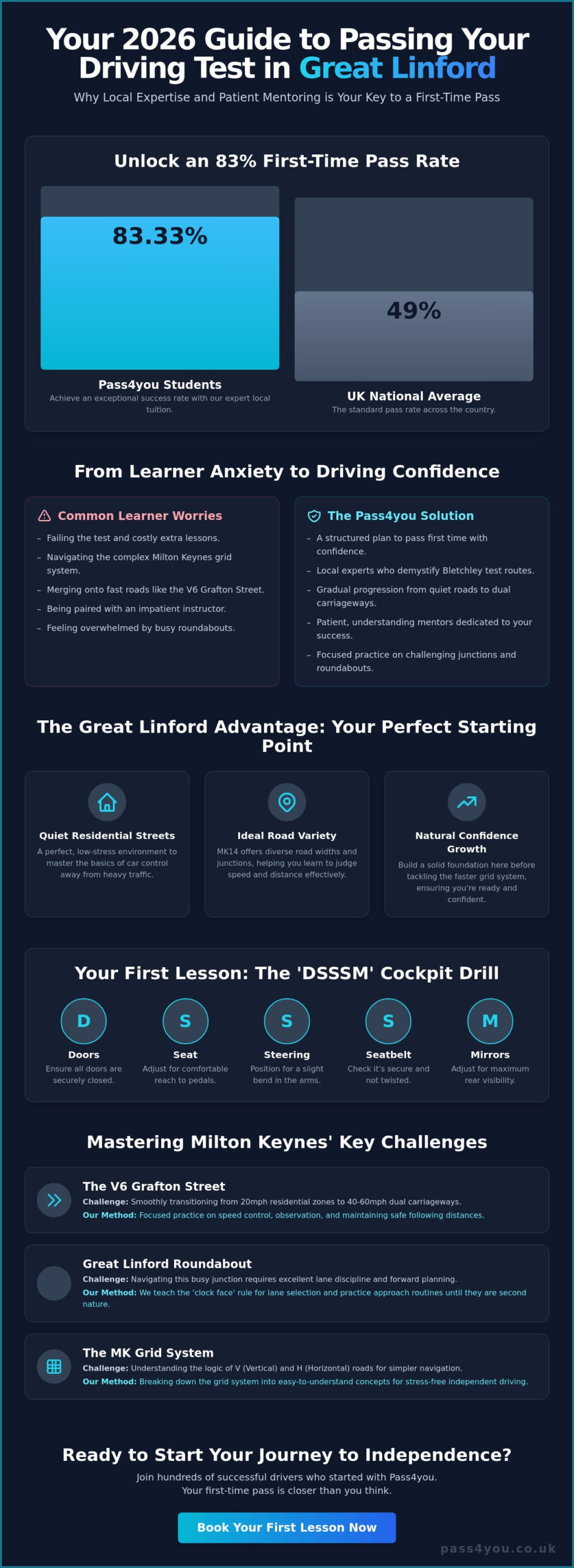
- Discover how professional guidance and tailored mock tests can help you join the 83.33% of our students who pass their test the first time.
What is Independent Driving at Bletchley Test Centre?
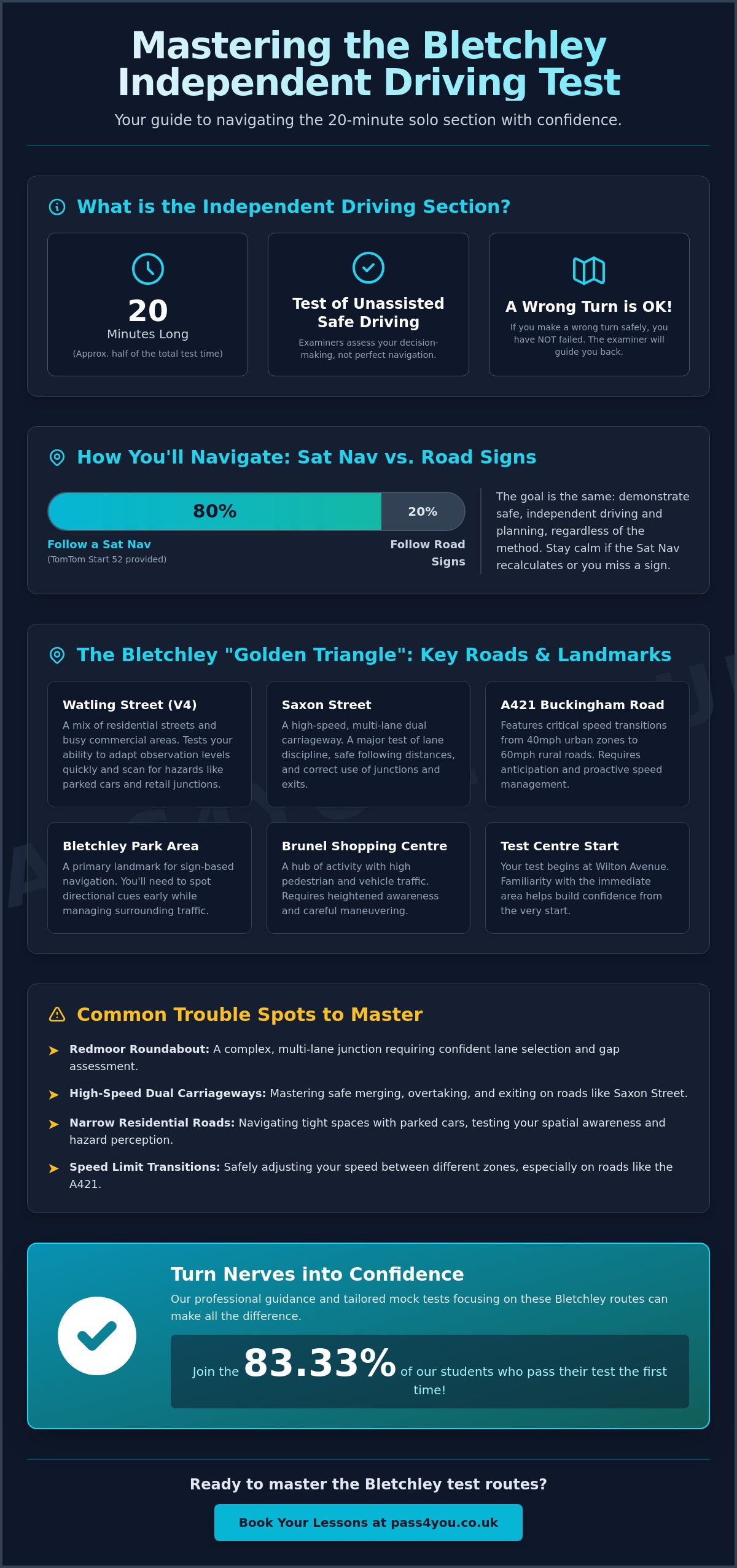
The Bletchley Test Centre, located at Wilton Avenue, serves as the primary starting point for your practical journey. Once you leave the gates, you’ll eventually reach the independent driving section. This part of the UK driving test lasts for approximately 20 minutes, which is roughly half of your total time on the road. It’s designed to see how you handle real-world conditions without constant prompts from the examiner. We want you to feel prepared for this, as it’s often the part where students feel the most pressure.
Many learners worry about getting lost while exploring various independent driving lesson routes bletchley examiners use. However, it’s vital to remember that “independent” doesn’t mean “perfect navigation.” The examiner is looking for safe driving and sound judgment, not your ability to act like a human GPS. If you take a wrong turn but do so safely, you haven’t failed. You simply continue driving safely, and the examiner will help you get back on track. This mindset shift often helps our students feel much more relaxed behind the wheel.
In 2026, most candidates will follow a Sat Nav provided by the examiner. Current data shows this happens in four out of every five tests. The remaining 20% of learners will be asked to follow traffic signs to a specific destination. Both methods test your ability to plan ahead and stay calm under pressure. Whether you’re following a digital screen or a physical sign, the goal remains the same: staying safe and keeping the car under control.
The Purpose of the Independent Phase
The independent drive is a test of unassisted safe decision-making. During this phase, the examiner wants to see if you can manage your speed and positioning without being told when to change lanes or where to turn. This is particularly important on Bletchley’s dual carriageways, where lane discipline is a major focus. They’re checking to see if you can identify road markings and exit junctions correctly while maintaining a safe distance from other vehicles. It’s about proving you’re ready to drive alone once you have your license.
Sat Nav vs. Traffic Signs in Bletchley
If you’re in the 80% following a Sat Nav, the examiner will set up a TomTom Start 52 unit for you. You don’t need to touch the device; you just follow the visual and verbal prompts. If you’re asked to follow signs, you’ll likely see directions for Milton Keynes Central, Fenny Stratford, or Buckingham. These routes often involve navigating the Bletchley “grid” system. If you miss a sign or the Sat Nav recalculates, stay calm. Focus on your mirrors and signals. Your safety is always more important than the destination.
Key Roads and Landmarks on Bletchley Independent Routes
Familiarity with the local landscape is your best tool for staying calm during the independent phase. As you drive through Bletchley, you’ll encounter a variety of road types that test different skills. For example, Bletchley Park is more than just a historic site; it acts as a primary landmark for sign-based navigation. If your examiner asks you to follow signs towards the park, you’ll need to stay alert for early directional cues while managing the surrounding traffic. Keeping an eye out for these visual markers helps you stay oriented even if you feel a little nervous.
Many independent driving lesson routes bletchley candidates face include the A421 Buckingham Road. This stretch requires sharp attention to your speedometer. You’ll often find yourself transitioning from a 40mph urban setting into a 60mph rural environment. Anticipating these changes before you reach the new speed limit sign shows the examiner you’re thinking ahead. According to the official government guidance on the driving test, managing these speed transitions safely is a core part of your assessment. If you’re feeling unsure about these changes, booking professional driving lessons can help you practice these specific road types until they feel like second nature.
Watling Street (V4) offers a unique challenge by blending residential streets with bustling commercial areas. You might be navigating past rows of parked cars one moment and entering a busy retail junction the next. This road tests your ability to adapt your observation levels quickly. It’s about being proactive and scanning the road far ahead to spot potential hazards before they become problems.
Navigating the Brunel Shopping Centre Area
The area around the Brunel Shopping Centre is a hub of activity. You’ll need to account for high pedestrian traffic and dedicated bus lanes. When navigating the one-way systems nearby, your mirror work must be impeccable. The examiner will watch how you check your blind spots before changing lanes or turning. Most independent drives starting near Wilton Avenue will pass through these high-intensity zones to test your composure and awareness.
Saxon Street and the V-Road Grid
Saxon Street (V7) is the backbone of the Bletchley grid. Mastering this dual carriageway involves confident use of slip roads. Merging safely at the correct speed is a skill that takes patience and practice. While following Sat Nav directions, it’s easy to get distracted by the screen. Remember to keep your eyes on the road and use the audio prompts as a guide. Maintaining a consistent speed and choosing the correct lane early are the secrets to success on the V-road system.
Sat Nav vs. Road Signs: A Strategy for Bletchley
Success on your test isn’t just about knowing where to go; it’s about how you process information under pressure. In Bletchley, roughly 80% of learners will use a Sat Nav during their independent drive. The remaining 20% will follow road signs. This split often causes a bit of worry, but we’ve found that both methods are perfectly manageable once you have a strategy in place. Practising various independent driving lesson routes bletchley examiners use will give you the exposure you need to feel comfortable with either scenario. It’s completely normal to prefer one over the other, but being ready for both is the mark of a confident driver.
The psychological shift between these two methods is significant. Following a Sat Nav feels like having a passenger give you directions, while following signs requires you to scan the environment actively. If you ever find a sign is obscured by overgrown hedges or a high sided vehicle, don’t stay silent. Simply verbalise your thoughts to the examiner. Explaining that you’re looking for a specific destination shows you’re proactive and safe. For more details on the mechanics of this phase, the DVSA provides a great guide for understanding the independent drive. We always encourage our students to use their voice to clarify what they see, as it helps the examiner understand your decision making process.
Mastering the Sat Nav Interface
When you’re using the examiner’s Sat Nav, avoid the temptation to stare at the screen. We teach the “glance technique,” especially for the busy Saxon Street junctions. You should take a quick half second look at the map, then bring your eyes back to the road immediately. Listen closely to the audio cues while managing heavy traffic on the H8 Standing Way. If the Sat Nav happens to lose signal near the Blue Lagoon or other wooded areas, stay calm. The examiner will step in and give you verbal directions until the device catches up. You won’t be penalised for technical glitches beyond your control.
Scanning for Signs in Bletchley
If you’re asked to follow signs, your observation needs to start much earlier. At the Denbigh North roundabouts, you should be looking for the large directional boards well before you reach the junction. This gives you time to move into the correct lane for Fenny Stratford or Central MK without rushing. In residential areas like Wilton Avenue, signs can sometimes be hidden behind parked cars or vans. Keep your speed low and keep your eyes moving. Finding these signs early is the secret to a smooth, stress free independent drive.
Bletchley’s Toughest Independent Driving “Trouble Spots”
Every test area has its notorious corners, and Bletchley is no exception. While we’ve discussed the general flow of the independent drive, certain “trouble spots” require a much higher level of focus. These areas often appear on independent driving lesson routes bletchley examiners choose because they test your ability to maintain lane discipline while processing navigation instructions. Knowing where these pressure points are will help you stay calm and collected during your big day.
Conquering Redmoor Roundabout Independently
The Redmoor Roundabout (A5) is perhaps the most famous challenge for local learners. During the independent phase, the prompt to follow signs for the A5 or Milton Keynes Central often comes just as you are approaching this major junction. This timing is deliberate. It tests whether you can listen to an instruction while simultaneously preparing for a complex, multi-lane roundabout. One of the most common mistakes here is forgetting the “Life Saver” glance. You must check your blind spot before moving into your exit lane, especially when heading toward the A5. Lane markings at Redmoor are your primary guide, so trust what you see on the tarmac rather than guessing your position based on other cars.
Residential Estate Hazards
While the dual carriageways are fast, the narrow estate roads around Wilton Avenue and Rickley Lane present a different kind of difficulty. When you are following a Sat Nav in these tight streets, it is easy to become so focused on the screen that you forget about your surroundings. You need to manage your clearance from parked cars carefully. If there isn’t enough room for two cars to pass, you must be the one to find a safe gap and wait. We also see many learners miss “Stop” signs on these routes because they are busy scanning for their next turn. On roads like Whaddon Way, meeting oncoming traffic requires quick thinking and a steady hand. You should always prioritise safety over the Sat Nav’s instructions.
Another area to watch is the “Double Roundabout” system near Bletchley train station. These small, back-to-back junctions require excellent clutch control and rapid observation. Finally, stay alert for speed limit traps. It is very common to transition from a 60mph national speed limit zone directly into a 30mph residential area. If you don’t start braking early, you’ll be over the limit before you even see the houses. If you’re feeling nervous about these specific locations, our team is here to support you. You can build your confidence and master these tricky spots by booking professional driving lessons with us today.
How Pass4you Prepares You for Bletchley Success
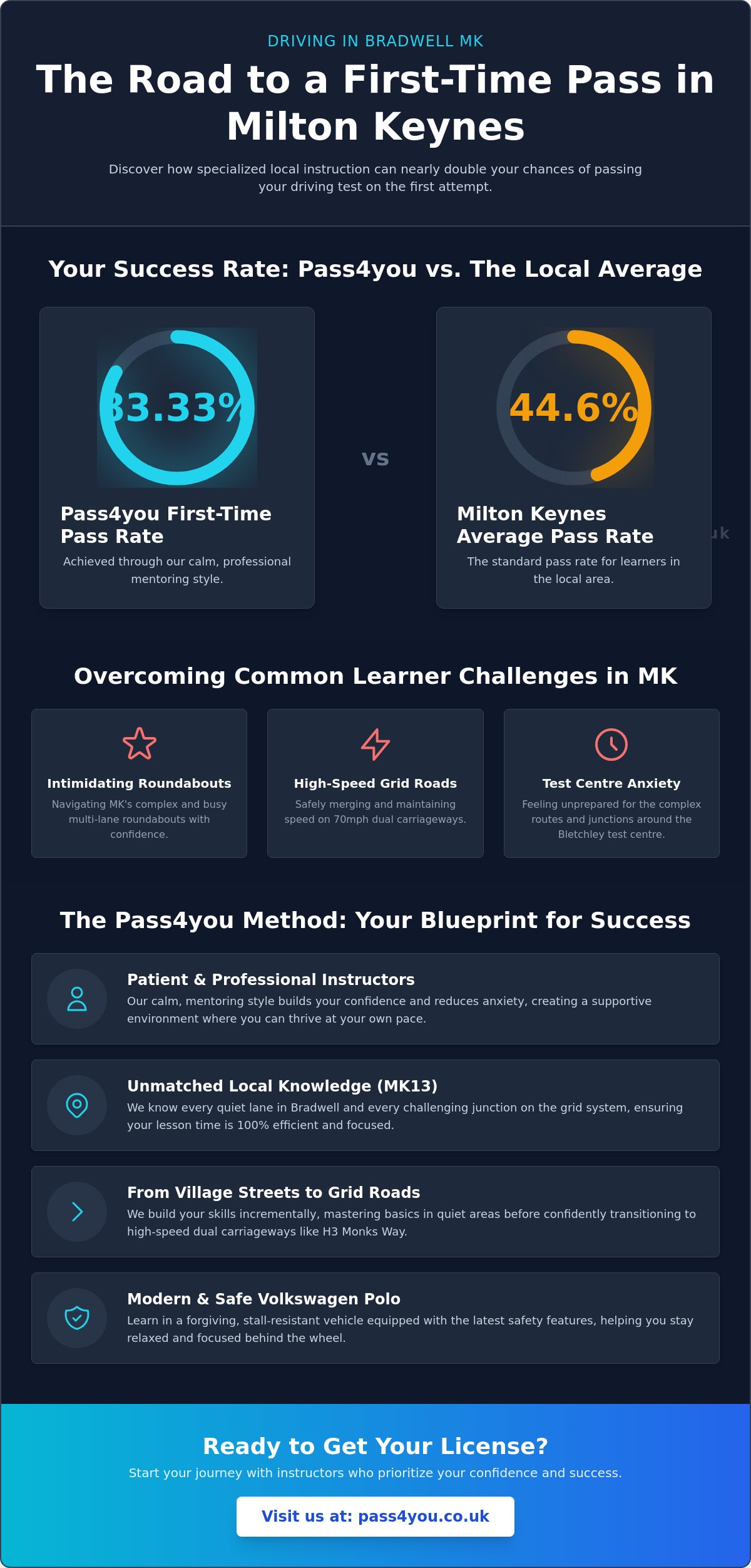
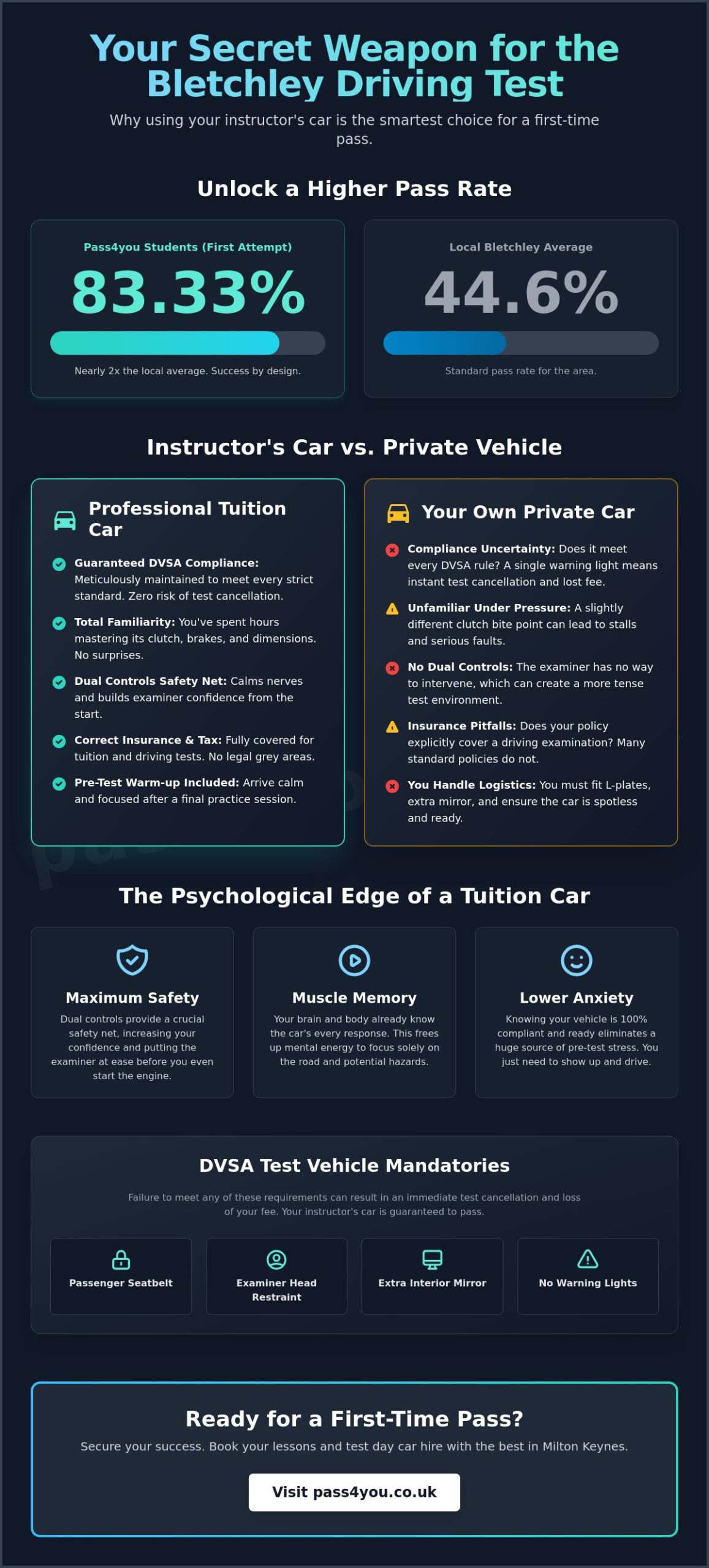
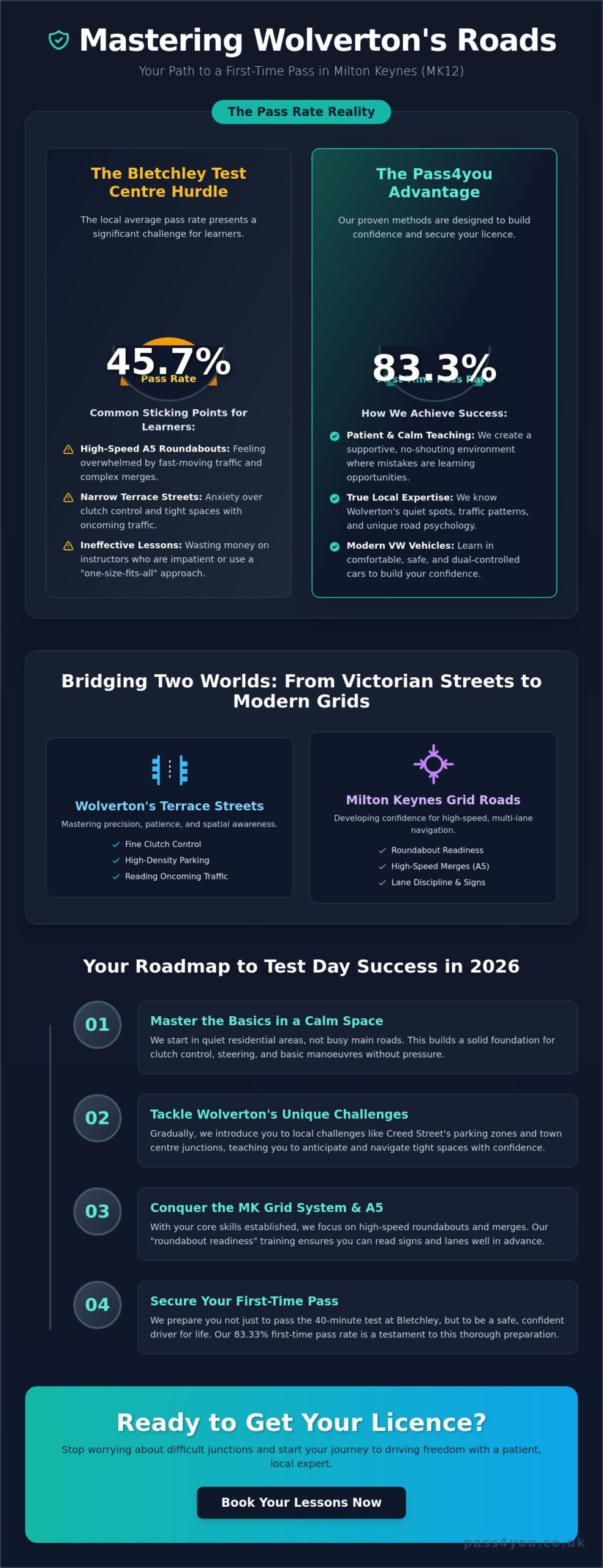
Passing your test on the first attempt is a goal we take very seriously. While some learners try to rely on apps or generic maps, nothing replaces the expertise of a professional mentor who knows the local area. Pass4you proudly maintains an 83.33% first-time pass rate, which is significantly higher than the local average of 44.6%. We achieve this by focusing on more than just the basics. We spend time exploring the specific independent driving lesson routes bletchley examiners prefer, ensuring you feel comfortable with every turn and junction before the big day arrives.
Our approach is centered on building your confidence through experience. We use modern Volkswagen tuition vehicles because they offer superior visibility and ease of handling. This makes a huge difference when you’re navigating tight residential streets or busy roundabouts. During our custom mock tests, we simulate the exact conditions of the independent drive. We want you to feel like you’re simply driving with a friend, rather than being under the microscope of an examiner. This calm, patient instruction is why so many of our students feel ready to drive alone the moment they pass.
Beyond the Routes: Real-World Confidence
We believe that being a safe driver goes beyond memorising a few roads. If you’re looking for broader context, our guide on driving lessons Milton Keynes provides a complete overview of the local testing landscape. In every lesson, we integrate the independent phase to make it a natural part of your driving routine. By the time your test date arrives, following a Sat Nav or road signs will feel like second nature. We address test nerves by providing a supportive environment where it’s okay to make mistakes and learn from them. This first-class instruction ensures you’re prepared for any situation the road throws at you.
Your Test Day at Bletchley
When the day finally comes, you’ll arrive at the Bletchley Test Centre at Block 4, Government Buildings, Wilton Hostel. It’s a familiar spot for our students, which helps keep those early morning jitters at bay. Before you start the engine, the examiner will ask you a “tell me” vehicle safety question at the start of the test. Once you’re out on the road, you’ll be asked a “show me” question while driving. We cover all these details in our lessons so there are no surprises. Are you ready to start your journey? Book your first Bletchley driving lesson with Pass4you and let’s get you on the road to success.
Take the Wheel with Confidence in Bletchley
You’ve now explored the mechanics of the 20 minute independent drive and identified the specific trouble spots that often catch learners off guard. Success on the independent driving lesson routes bletchley uses comes down to your ability to stay calm and make safe decisions under pressure. Whether you’re following a Sat Nav toward Central MK or scanning for signs near Bletchley Park, your focus should always remain on the road ahead rather than the destination. Taking a wrong turn is never a fail as long as you keep the car under control and maintain your observations.
Our expert local instructors use modern Volkswagen tuition vehicles to provide superior visibility and a smooth learning experience. We take pride in our 83.33% first-time pass rate, which is a testament to our patient, mentor-led approach. We don’t just teach you how to pass; we teach you how to be a safe, confident driver for life. You have the insights and the strategy to handle the Bletchley grid; now it’s time to put that knowledge into practice.
Join the 83.33% who pass first time, book your Bletchley lessons today. We’re ready to help you gain your independence and start your new life on the road.
Frequently Asked Questions
Where is the Bletchley Driving Test Centre located?
The Bletchley Driving Test Centre is situated at Block 4, Government Buildings, Wilton Hostel, Wilton Avenue, Bletchley, MK3 6DH. This location serves as the starting and ending point for all practical tests in the area. It’s tucked away within a residential zone, so you’ll need to be mindful of parked cars and local traffic as soon as you leave the car park.
How long is the independent driving section in the Bletchley test?
The independent driving phase lasts for approximately 20 minutes. This accounts for roughly half of your total 40 minute practical test. During this time, you’ll be expected to navigate without step by step directions from the examiner, either by following a Sat Nav or looking for road signs to a specific destination.
Do I have to use my own Sat Nav for the Bletchley driving test?
No, you don’t need to provide your own device. The examiner will bring and set up a TomTom Start 52 unit for you to use if your test involves Sat Nav navigation. They’ll handle the programming and positioning, so you can focus entirely on your driving and the road ahead.
What happens if I take a wrong turn during the independent driving phase?
Taking a wrong turn is not an automatic fail and won’t result in a fault as long as you do it safely. If you realise you’ve gone the wrong way, stay calm and continue driving safely. The examiner will help you get back on the correct path, or the Sat Nav will automatically recalculate a new route for you.
Are the independent driving routes in Bletchley the same every time?
No, the examiners use a variety of different paths to ensure you can drive safely in various conditions. While independent driving lesson routes bletchley candidates encounter follow certain patterns, they can include anything from busy dual carriageways to quiet residential estates. Practising a wide range of roads with a professional instructor is the best way to prepare for these variations.
Which roundabouts are most common on Bletchley test routes?
The Redmoor Roundabout near the A5 is one of the most frequent and challenging junctions you’ll face. You’re also very likely to encounter the Denbigh North roundabouts and the mini roundabouts near the Bletchley train station. Mastering lane discipline at these specific spots is a major part of feeling ready for your test.
Can I ask the examiner for help during the independent driving section?
Yes, you can ask the examiner for clarification if you’re unsure about a direction or if a road sign is obscured. While they won’t give you step by step instructions, they’ll confirm the destination or repeat the instruction to help you stay on track. They want to see that you’re a safe, proactive driver who communicates well.
What is the pass rate for the Bletchley Driving Test Centre?
The pass rate for the Bletchley test centre was 45.79% between April 2024 and March 2025. This is very close to the national average of 45.9%. At Pass4you, we’re proud to support our students in achieving an 83.33% first time pass rate through patient, expert instruction that builds genuine confidence behind the wheel.