Tag: dvsa

  • How to Tell if You’re Ready for Your Driving Test: The 2026 Checklist

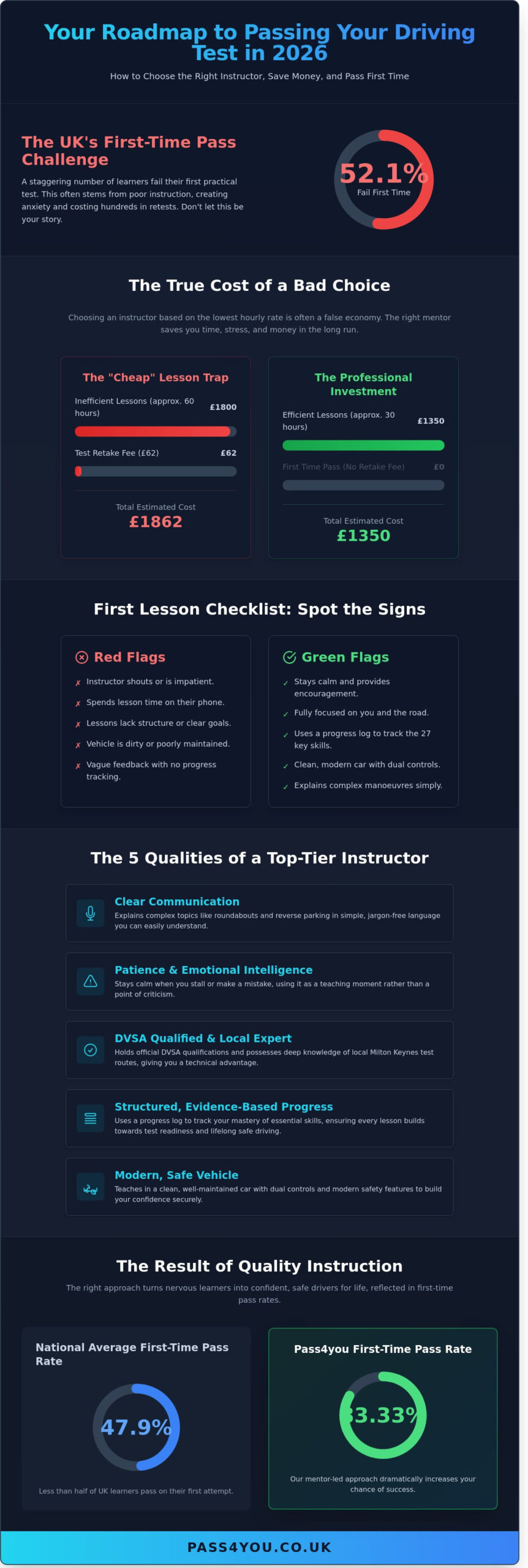
    What if the secret to passing your driving test isn’t about being a perfect driver, but about how you handle the small mistakes you actually make? With national pass rates currently sitting between 47.9% and 52.2%, it is natural to feel anxious about whether you are truly prepared. You might be wondering how to tell if you’re ready for your driving test or if those “silly mistakes” on complex roundabouts mean you should wait. It is completely normal to feel a knot in your stomach when you think about the long wait for a retest or the frustration of a failed attempt.

    We understand that you want the freedom of a license without the stress of uncertainty. This guide provides the definitive signs that you have moved from a learner who needs a safety net to an independent decision-maker who is ready for the road. You will discover exactly how to assess your own skills and avoid the cost of a retake. We will walk through the essential 2026 checklist, covering everything from junction confidence to the latest DVSA booking rules, so you can walk into the test center with total peace of mind.

    Key Takeaways

    • Learn why true test readiness is about making independent decisions without needing your instructor to step in.
    • Discover how to tell if you’re ready for your driving test by achieving consistent, fault-free performance across all road types.
    • Understand how professional mock tests simulate real-world pressure to help you manage anxiety and build genuine confidence.
    • Identify the difference between simple nerves and serious safety gaps to ensure your “silly mistakes” don’t lead to a fail.
    • Find out why trusting your instructor’s expert verdict is the best way to avoid the expense and frustration of a retake.

    The Independence Shift: Moving Beyond Technical Driving Ability

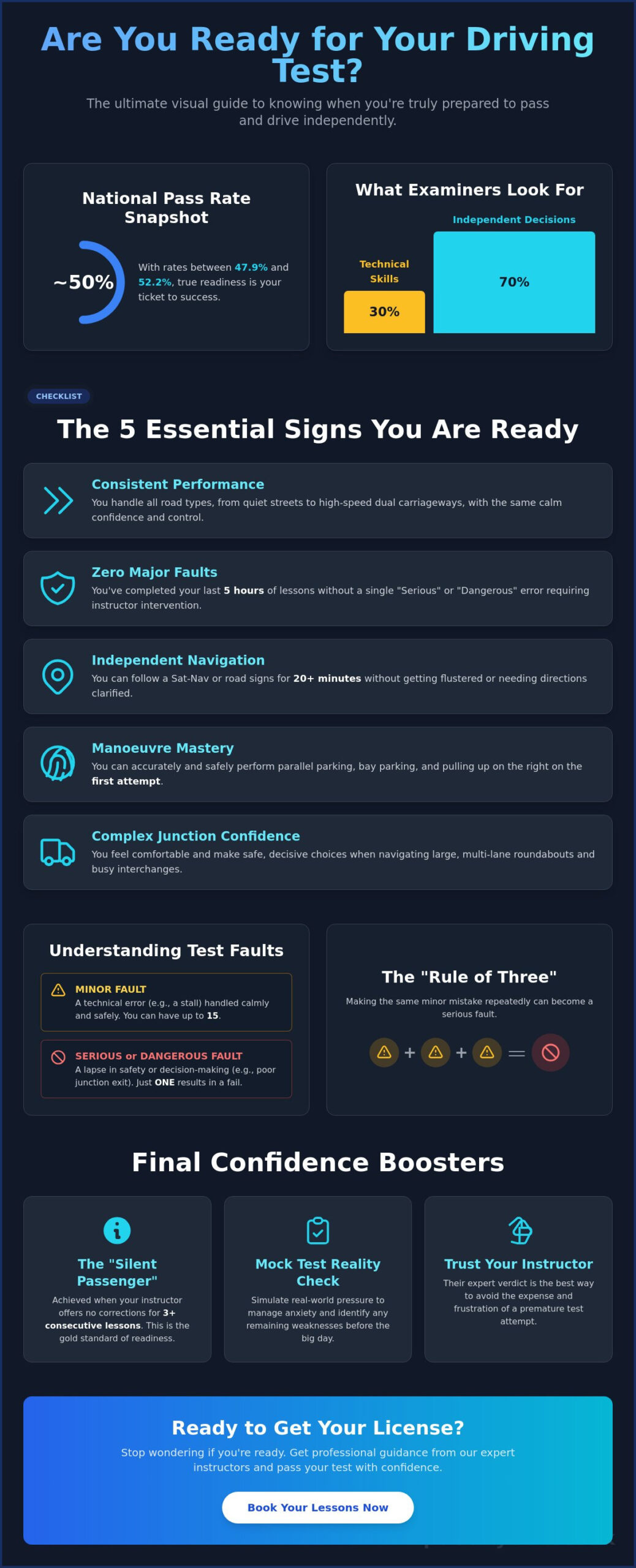
    Many learners believe that if they can steer, shift gears, and park, they are ready for the big day. However, technical control is only about 30% of what the examiner is looking for. The real test is your ability to drive independently. This means you can process complex hazards and make safe choices without any verbal or physical prompts from the person in the passenger seat. If you are wondering how to tell if you’re ready for your driving test, you need to look closely at how much thinking your instructor is still doing for you.

    Independent driving is the ability to navigate the road while managing your own safety and the safety of others. It isn’t just about following a sat-nav or road signs during a specific part of the test. It is a mindset that covers every second you are behind the wheel. When you no longer look to your instructor for a nod of approval before pulling out at a junction, you have made the independence shift.

    Identifying the “Silent Passenger” Milestone

    There is a specific psychological shift that happens when your instructor stops “co-driving” and starts observing. During your early driving lessons, your instructor likely gave constant reminders about mirror checks or gear changes. You reach a major milestone when they become a silent observer. We call this the “Silent Passenger” phase. If your instructor hasn’t touched the dual controls or offered a verbal correction for at least three full lessons, you are entering the gold standard of readiness. An intervention-free lesson is the clearest sign that you are managing the car and the environment entirely on your own. Try tracking your next 60-minute session; if you finish the hour with zero physical or verbal interventions, your confidence should soar.

    Technical Perfection vs. Safe Decision Making

    It might surprise you to learn that a stalled engine is often better than a poorly timed junction exit. A stall is a technical error that is usually a minor fault if handled calmly. A poorly timed exit is a lapse in safety and decision-making that can result in a serious fail. You must distinguish between knowing how to perform a maneuver and knowing when it is safe to start one. To evaluate your own readiness, practice hazard perception in real-time. Don’t wait for your instructor to point out a pedestrian or a changing light. You should be the one reacting first every time. If you do make a minor error, don’t panic. The ability to self-correct safely without any input shows the maturity needed to pass. This level of awareness is a vital part of how to tell if you’re ready for your driving test and capable of driving alone.

    The 5 Essential Signs You Are Ready for Your Practical Test

    Knowing how to tell if you’re ready for your driving test involves looking for specific, repeatable patterns in your driving. It isn’t just about having a “good day” in the car. Real readiness shows up as a series of consistent habits that keep you and others safe, regardless of which route the examiner chooses. If you can check off these five milestones, you are likely prepared to trade your L-plates for a full license.

    • Consistent performance: You handle every road type, from narrow residential streets to high-speed routes, with the same level of calm.
    • Zero major faults: You have completed your last five hours of professional driving lessons without a single “Serious” or “Dangerous” error.
    • Independent navigation: You can follow a Sat-Nav or road signs for 20 minutes without getting flustered or needing help to stay on course.
    • Manoeuvre mastery: You can perform the parallel park, bay park, and pulling up on the right accurately on your very first attempt.
    • Complex junction confidence: You feel comfortable navigating multi-lane systems, such as the dual carriageway networks found in busy urban areas.

    Consistent Performance Without Serious Faults

    A “serious” fault is defined by the DVSA as something that has the potential to become dangerous to you, the examiner, the public, or property. A “dangerous” fault is one where actual danger occurred. To pass, you must have zero of either. We often encourage students to use the “rule of three” as a guide. If you make the same minor mistake three times during a session, an examiner will likely mark it as a serious fault. Keeping a “fault log” over several weeks helps you track your consistency and proves you have moved past the stage of making repetitive errors.

    Mastering Milton Keynes Roundabouts and H/V Roads

    For those learning in specific areas like Milton Keynes, the grid system adds an extra layer of complexity. You must be an expert at lane discipline on large, multi-lane roundabouts where traffic moves quickly. Readiness means you can seamlessly handle the transition between 70mph grid roads and 30mph residential zones without hesitation. You shouldn’t just know the rules; you should feel the rhythm of the local traffic. Local road knowledge is the final layer of test-day confidence that ensures you aren’t surprised by a tricky lane merge or a hidden speed change.

    How to Tell if You’re Ready for Your Driving Test: The 2026 Checklist

    Mock Driving Tests: The Ultimate Reality Check

    A mock test is the most reliable way to answer the question of how to tell if you’re ready for your driving test. It moves you away from the comfort of a standard lesson and into a high-stakes simulation. By replicating the exact format of the DVSA exam, you can see if your skills hold up when the safety net is removed. It is an objective look at your progress that removes the guesswork from your preparation.

    The process generally follows four simple steps. First, try to book your mock with an instructor you don’t know. This mimics the “stranger” factor of a real examiner and prevents you from relying on the familiar rapport you have with your regular teacher. Second, ensure you replicate every detail, including the “Show Me, Tell Me” vehicle safety questions at the start. Third, evaluate the result honestly. If you fail a mock, it isn’t a setback; it is valuable data. Finally, use the feedback to create a targeted “fix-it” list. This allows you to spend your final lessons focusing only on the specific areas that need improvement.

    Why a Mock Test Feels Different

    The most striking change during a mock session is the examiner’s silence. During a normal lesson, your instructor might offer small prompts or encouraging words. In a mock test, that silence can feel heavy and often leads to an internal monologue where you second-guess your decisions. You might find yourself braking harder or steering more tentatively because of the pressure. We strongly encourage learners to book a mock test in Milton Keynes to get used to these feelings on actual test routes. Learning to manage your physical reactions to stress is just as important as knowing the rules of the road.

    Scoring Your Performance: The 15 Minor Fault Limit

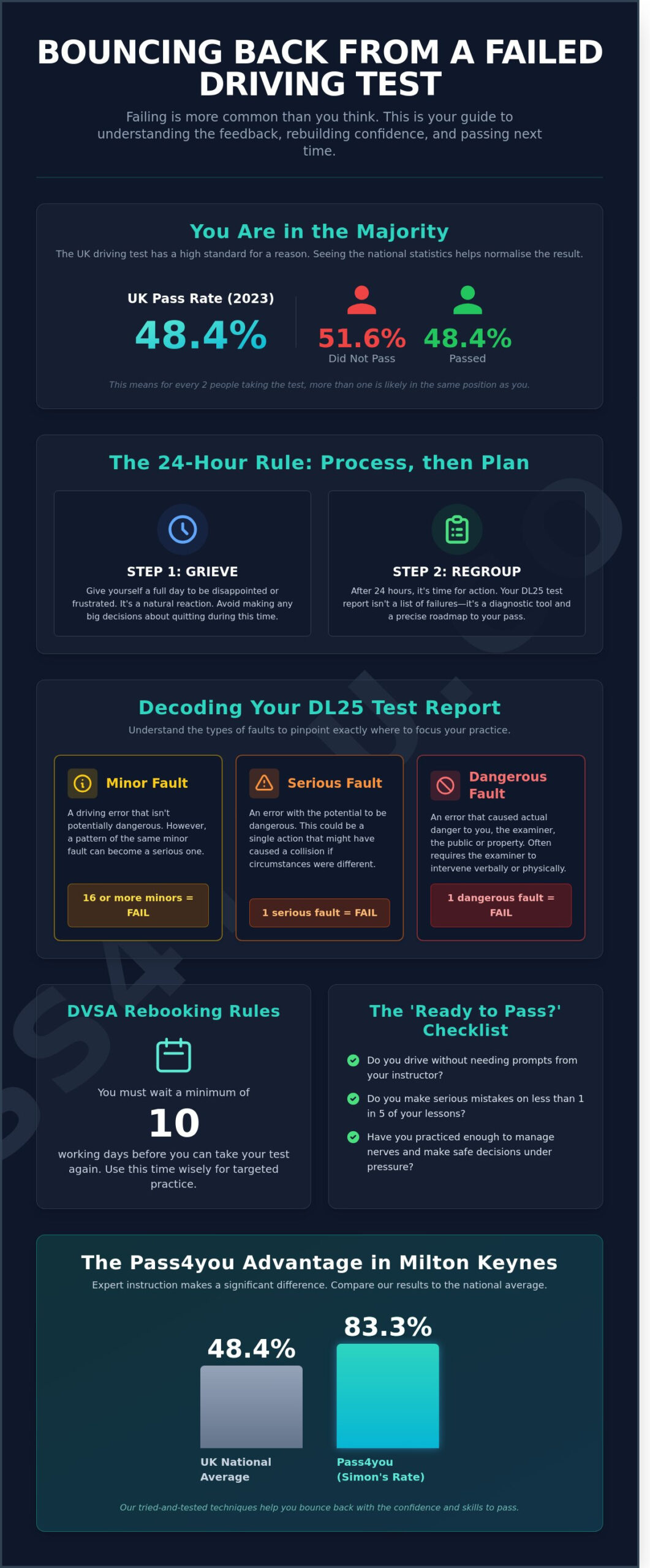
    The scoring system is straightforward but strict. You will fail if you record a single serious or dangerous fault. You will also fail if you accumulate 16 or more minor faults. Many learners find that they struggle with observation and mirror use when they are nervous. If your mock test shows you are close to the limit, it is a sign you need more practice. This data helps you decide whether you should proceed or change your book driving test date. Remember, the goal is to pass first time and avoid the cost and delay of a retake. With the national pass rate currently between 47.9% and 52.2%, being fully prepared is your best strategy for success.

    Overcoming the “Silly Mistake” Myth and Managing Nerves

    It is very common to hear a learner say, “I only failed because I was nervous; I’m actually a good driver.” While it feels true in the moment, examiners view this differently. They are looking for drivers whose safety habits are so deeply ingrained that they remain intact even under pressure. A “silly mistake” during a high-stakes moment suggests that a skill hasn’t quite become second nature yet. Understanding this distinction is a vital part of how to tell if you’re ready for your driving test.

    When you are truly ready, you operate within a “safety bubble.” This means your primary goal isn’t just to pass a test or impress an examiner. Instead, you are driving to protect yourself, your passengers, and other road users. When your focus shifts from “not making a mistake” to “keeping everyone safe,” your anxiety often naturally decreases. You are no longer performing for a grade; you are demonstrating your competence as a responsible road user.

    Why “Silly Mistakes” are Serious Red Flags

    Examiners see a “silly mistake,” such as forgetting a blind spot check or hesitating at a clear junction, as a sign that your habits are still conscious actions. If you have to remind yourself to check your mirrors, that habit might fail you when you are stressed or distracted. You want to move from conscious effort to unconscious competence. This happens through repetition and high-quality instruction. Readiness is reached when safe driving requires zero conscious effort. If you find yourself performing safety checks automatically, you have reached the level of consistency required to succeed. Booking a few targeted driving lessons can help bridge this gap and turn those manual thoughts into automatic responses.

    Practical Strategies for Test-Day Anxiety

    If you feel your heart racing as you leave the test center, try “commentary driving.” This involves speaking your thoughts and observations out loud. By saying, “Slowing down for the pedestrian,” or “Checking my right mirror for the cyclist,” you keep your brain focused on the task and prevent your internal monologue from spiraling into worry. It also shows the examiner exactly what you are thinking. If you believe you have made a mistake, take a deep breath and reset. Many learners pass with several minor faults, so don’t let one small slip-up ruin the rest of your drive. A good night’s sleep and a calm warm-up lesson before the examiner arrives will also help you settle into the rhythm of the car. This mental preparation is just as important as your technical skill when deciding how to tell if you’re ready for your driving test.

    Trusting the Experts: Why Your Instructor’s Verdict Matters

    The final and most significant part of how to tell if you’re ready for your driving test is the professional opinion of your Approved Driving Instructor (ADI). Your instructor is more than just a teacher; they are a safety gatekeeper with a deep understanding of DVSA standards. They view your driving through the lens of professional liability and long-term safety. If an instructor suggests you aren’t ready, it is because they have seen a pattern that could lead to a dangerous situation. Pass4you Driving School instructors will not take their car to a test if they believe a student is unsafe, as their reputation and your safety are both on the line.

    At Pass4you Driving School, our teaching method focuses on excellence and efficiency. We are proud to maintain a high first-time pass rate of 83.33%, which is a proof point of our commitment to saving you money and time. By ensuring you are truly prepared before you book, we help you avoid the cycle of failed tests and the long retest waiting lists that currently frustrate many learners. During your next driving lessons in Milton Keynes, have an honest “Ready to Pass” conversation. Ask your instructor for a specific breakdown of your independence and where you sit on the 2026 checklist.

    Why Your Instructor Might Say “Not Yet”

    It is natural to feel a sting of disappointment if you are told you aren’t ready. However, listening to this advice is a smart financial move. A weekday practical test costs £62. When you add the cost of car hire and the potential months of waiting for a new slot, the hidden cost of a failed test is high. Investing in a few extra lessons is almost always cheaper and less stressful than a retake. The team at Pass4you Driving School works with you to set a realistic “Pass Date” goal. This ensures you aren’t just hoping for a pass, but rather expecting one because your skills are undeniable.

    The Pass4you Driving School Advantage: Excellence in Milton Keynes

    We believe that the environment you learn in matters. That is why Pass4you Driving School uses modern Volkswagen tuition vehicles to provide maximum comfort and reliability during your training. Our first-class instructors know the Milton Keynes test routes intimately. They understand exactly how the examiner will use the grid roads and roundabouts to test your decision-making. This local expertise gives you a distinct advantage on test day. If you want a professional, objective look at your skills, book your assessment lesson with Pass4you Driving School today. We will help you determine exactly how to tell if you’re ready for your driving test and give you the confidence to succeed the first time.

    Take the Wheel with Confidence

    You have moved from mastering the technical basics to becoming a truly independent decision-maker on the road. By applying the 2026 checklist and observing your own habits during the “Silent Passenger” phase, you can now move forward with certainty. Understanding how to tell if you’re ready for your driving test is the key to avoiding the frustration of a retake and the long wait for a new slot. You have the mental tools and the practical criteria to judge your own progress objectively.

    Pass4you Driving School is here to support that final step toward your license. With our elite instructors in Milton Keynes and our modern Volkswagen tuition vehicles, we maintain an 83.33% first-time pass rate that reflects our high standards. We don’t just teach you to pass; we prepare you for a lifetime of safe driving. Check your readiness with a Pass4you Driving School mock test in Milton Keynes and start your journey toward total independence today. Your new life on the road is waiting.

    Frequently Asked Questions

    How many driving lessons do I need before I am ready for my test?

    There is no set number of hours required, as everyone learns at a different pace. However, the DVSA suggests that the average learner requires around 45 hours of professional instruction combined with 22 hours of private practice. When you are deciding how to tell if you’re ready for your driving test, focus on your ability to drive consistently without any help from your instructor rather than just the number of hours in your logbook.

    Can I take my driving test in my own car if I feel ready?

    Yes, you can use your own vehicle as long as it meets specific DVSA requirements. Your car must be fitted with L-plates, an extra rear-view mirror for the examiner, and be taxed and insured for a driving test. It is also vital to ensure the vehicle is in a roadworthy condition with no warning lights on the dashboard. Most students prefer using their instructor’s car because they are already comfortable with the controls and dimensions.

    What happens if my driving instructor says I am not ready but I have already booked my test?

    You should take your instructor’s advice seriously, as they have the right to refuse the use of their car for the test if they believe you are unsafe. It’s much better to postpone your appointment than to risk a dangerous fault. Since you can only change your booking a maximum of two times under the 2026 rules, it is best to wait until your instructor gives you the green light.

    Is it normal to still make mistakes a week before my driving test?

    It is completely normal to make minor errors due to pre-test nerves. The most important factor in how to tell if you’re ready for your driving test is how you react to those mistakes. If you can identify the error and correct it safely without any verbal or physical intervention from your instructor, you are likely ready. We focus on building your confidence so that these small slips don’t impact your overall safety bubble.

    How do I know if I have “mastered” roundabouts for the Milton Keynes test?

    Mastery means you can navigate any multi-lane roundabout on the grid system without hesitation or prompts. You should be able to select the correct lane, signal at the right time, and merge into 70mph traffic smoothly. If you can handle the transition between high-speed grid roads and residential zones while maintaining perfect lane discipline, you have the skills needed for the local test routes.

    Does a high mock test score guarantee a pass on the real driving test?

    A high score is a fantastic sign of readiness, but it doesn’t guarantee a pass. The real test involves a different person in the passenger seat and a unique level of pressure. However, performing well in a mock test proves that you have the technical skills and the mental focus required. It is an objective confirmation that you are capable of driving to the required DVSA standard under observation.

    What is the most common reason for people failing their driving test in 2026?

    Observation at junctions and the incorrect use of mirrors remain the most frequent reasons for failure. Many learners lose focus during the independent driving section and forget to check their blind spots or mirrors before changing speed or direction. This is why we emphasize making these checks an unconscious habit. When safety becomes automatic, you are far less likely to fail on these common “serious” faults.

    Can I change my driving test date if I realize I am not ready?

    Yes, you can change your date, but you must be aware of the strict DVSA regulations introduced in 2026. You are only allowed to change your practical test booking a maximum of two times. Additionally, if you choose to move your test, you can only select one of the three nearest test centres to your original booking. It’s always best to manage your booking yourself to ensure you stay within these legal limits.

  • What to Take to My Theory Test: The Essential 2026 Checklist

    Your theory test doesn’t start with the first multiple-choice question; it starts the moment you walk through the test centre doors with your documents in hand. With a national pass rate of less than 50%, the pressure is already high enough. It’s completely natural to feel a bit of a flutter in your stomach, but the last thing you want is to lose your £23 fee or have your session cancelled because you weren’t sure what to take to my theory test.

    We understand that the administrative side can feel just as daunting as the hazard perception clips. That’s why we’ve put together this essential 2026 checklist to help you arrive with total confidence. You’ll learn exactly which forms of ID are mandatory for your specific licence type, how to handle name changes, and what will happen to your phone and bag while you’re in the exam room. By the time you finish reading, you’ll have a clear plan to ensure your test goes off without a single administrative hitch. This preparation lets you focus on what really matters: passing your test and moving forward with your driving lessons.

    Key Takeaways

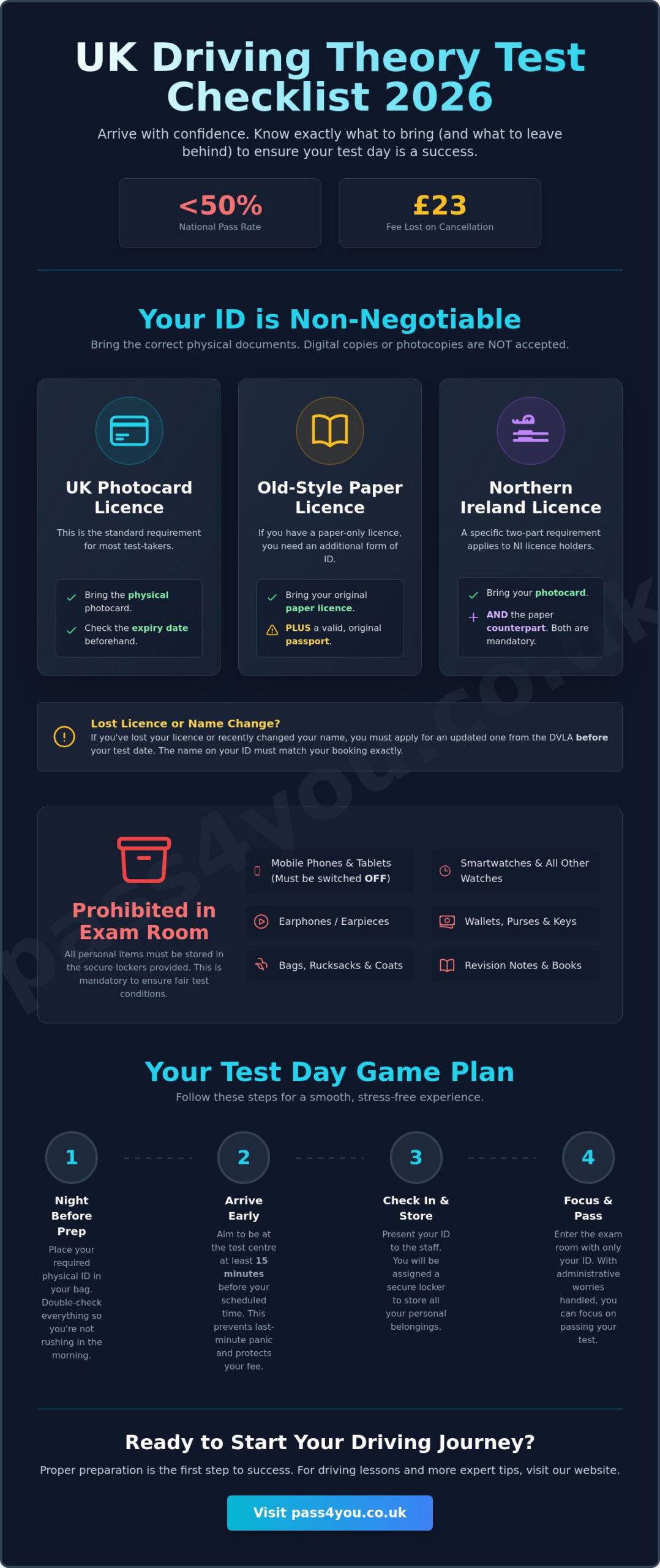
    • You’ll need your physical UK photocard driving licence, since the test centre won’t accept digital versions or photocopies.
    • Discover how the secure locker system works so you’re prepared to store your phone and bags before the exam starts.
    • Learn exactly what to take to my theory test if you’ve recently changed your name or need to replace a lost licence.
    • Find out why arriving 15 minutes early at the Milton Keynes centre protects your fee and helps you stay calm.
    • Build your confidence by combining a final Highway Code review with the right administrative preparation.

    The Non-Negotiable: Your UK Photocard Driving Licence

    The theory test is a big milestone. When you’re thinking about what to take to my theory test, your physical UK photocard driving licence sits at the very top of the list. It’s the only document the examiner will accept to prove you are who you say you are. This requirement is a foundational part of the United Kingdom driving test process, ensuring the integrity of the licensing system. Having this ready ensures you can walk into the centre feeling prepared and professional, rather than rushed or worried.

    When deciding what to take to my theory test, remember that DVSA staff are unable to accept digital copies under any circumstances. You might be used to showing a digital ID on your phone for other things, but the security rules here are very strict. Please don’t rely on a photo of your licence on your smartphone or a printed photocopy. If you arrive without your physical photocard, your test will be cancelled immediately. You’ll also lose your £23 booking fee. This is a frustrating way to start your journey, so we always recommend a “night before” bag check to give you peace of mind.

    While you’re looking at your licence, take a quick second to check the expiry date on the front. If the photocard has expired, it’s no longer a valid form of identification. If you notice it’s out of date, you’ll need to renew it through the DVLA before you can sit your test. It’s a small detail that can save you a lot of stress on the day. Many learners forget this step, but checking it early gives you time to react and reschedule if needed, keeping your progress toward your practical driving lessons on track.

    What if I still have an old-style paper licence?

    If you haven’t upgraded to a photocard yet and still hold a paper driving licence, you have an extra step to take. You must bring a valid, original passport along with your paper licence. A photocopy of your passport won’t work. It must be the original document and in good condition. If you don’t have a current passport, your best course of action is to apply for a photocard licence well in advance of your test date. This ensures you aren’t turned away at the door.

    Northern Ireland licence requirements

    Drivers with a licence issued in Northern Ireland have a specific requirement that differs from the rest of the UK. You must bring both your photocard and the paper counterpart to the test centre. This is one of the most common reasons students from NI face a cancelled test. Even as we move through 2026, this two-part requirement remains strictly in place. Making sure both pieces are tucked safely in your bag is a simple way to stay on track for your driving lessons and eventual success.

    Prohibited Items and the Test Centre Locker System

    Walking into a DVSA test centre can feel a little formal, but the security measures are there to create a fair, quiet environment for everyone. While you have already prepared the essentials for what to take to my theory test, it’s just as vital to understand what stays outside the exam room. To maintain the integrity of the results, the DVSA prohibits all personal belongings at your computer station. This shouldn’t cause you any worry. It’s a standard part of the process designed to help you focus entirely on your questions without any outside distractions.

    When you check in, the staff will assign you a small, secure locker. You’ll need to place everything except your driving licence inside. This includes your wallet, keys, and even small items like lip balm or loose change. To keep things moving smoothly, staff may perform a light search or ask you to turn out your pockets. This is a routine check and nothing to be anxious about. It is simply how they verify that the official government guidance is being followed. Please remember that failing to comply with these locker rules or attempting to take items into the room can lead to a cancelled test and a possible ban from booking future sessions.

    The “No-Go” list of electronics

    Modern technology is impressive, but it has no place in the exam room. All mobile phones and tablets must be switched off entirely before they are locked away. Simply putting your phone on silent isn’t enough. Smartwatches are now strictly prohibited, and many centres also ban traditional watches to prevent any confusion. Hidden Bluetooth earpieces are a specific area of concern for examiners, so your ears must be clear unless you are using centre-provided headphones for a voiceover. Keeping your tech stored away ensures you won’t be disturbed by an accidental notification during your hazard perception clips.

    Bags, coats, and revision notes

    Bulky items like winter coats and bags of any size must be left in your locker. If you’ve been doing some last-minute studying, make sure your revision books and printed notes are tucked away before you enter the testing area. You won’t be allowed to access these once your session begins. We suggest leaving high-value items at home if you can, as the lockers are intended for essentials only. Entering the room with only your licence and your locker key allows you to stay calm and collected. This level of calm preparation is exactly what we encourage during our driving lessons, as it sets the foundation for a successful, stress-free experience behind the wheel.

    What to Take to My Theory Test: The Essential 2026 Checklist

    Special Circumstances: Name Changes and Lost Licences

    Life can be unpredictable. You might have everything ready for your test, only to realize your licence has gone missing or your name has changed since you first applied. Don’t panic. These situations are common, and there are clear steps to follow. When you’re figuring out what to take to my theory test, knowing how to handle these administrative hurdles is just as important as knowing your road signs.

    What should you do if your licence is missing? You must apply for a replacement immediately through the DVLA. The fee for a replacement licence is £20 and it can take up to 15 days to arrive. This timeline is critical. If your test date is approaching and your new licence hasn’t arrived, you’ll need to reschedule. To keep your £23 fee, you must change your booking at least three clear working days before the test date. This doesn’t include the day of the test or the day you make the change. Acting quickly ensures you don’t lose money and keeps your focus on your future driving lessons.

    Documentation for name changes

    It’s wonderful when life milestones like marriage happen. If you’re unsure what to take to my theory test because of a recent name change, the original certificate is your most important piece of evidence. Original marriage certificates or deed poll documents are the standard proof required. You can find more details in the official government guidance. Digital images or photocopies won’t be accepted at the centre.

    What to do if your licence is stolen

    Having your wallet or purse stolen is a stressful experience. If your driving licence was among the stolen items, report the theft to the police to get a crime reference number. Then, contact the DVSA theory test enquiries line for specific advice. A crime reference number does not replace a physical licence at the test centre. You will still need to wait for your replacement photocard to arrive before you can sit the exam.

    Arriving at the Milton Keynes Theory Test Centre

    Navigating the unique grid system of Milton Keynes can be a little confusing if you’re in a hurry. When you’re planning your big day, we recommend aiming to arrive at the test centre at least 15 minutes before your scheduled slot. This extra time allows you to settle your nerves and complete the check-in process without feeling rushed. It is a strict rule that arriving late often results in being turned away. If this happens, you won’t receive a refund for your £23 fee, and you’ll have to wait for a new appointment to become available.

    The Milton Keynes Theory Test Centre is located on Midsummer Boulevard, right in the heart of the city centre. Because this area is a hub for shoppers and office workers, parking can be a challenge during peak hours. If you’re driving, plan your parking in advance. There are several pay-and-display bays nearby, but they fill up quickly. Giving yourself that 15-minute buffer ensures you won’t be circling the block while your test time approaches. Staying calm and collected is the best way to start your exam session.

    Finding the centre and checking in

    Once you find the building, head inside and have your provisional licence ready in your hand. The staff will be waiting to greet you and verify your identity. This is the moment where knowing exactly what to take to my theory test pays off. They’ll check your photocard and then provide you with a locker key for your belongings. While you wait for your name to be called, take a moment to read the rules displayed in the waiting area. It helps to reinforce the procedures we’ve discussed, ensuring you feel like you’re in safe, professional hands.

    Local transport tips for MK students

    If you prefer not to worry about city centre parking, the centre is within easy walking distance of Milton Keynes Central station. This makes it very accessible for those arriving by bus or train from surrounding areas. For those who enjoy active travel, the city’s famous redway system offers a safe and direct route if you’re cycling to your appointment. Just make sure you have a secure lock for your bike.

    We know that the environment around the test centre can feel unfamiliar. That’s why Pass4you Driving School helps students familiarise themselves with the local area during their practical lessons. Understanding the layout of the city can significantly reduce your anxiety on the day. If you want to feel truly prepared for every stage of your journey, you can book your driving lessons with us to build your confidence on these very roads.

    Beyond the Checklist: Mental Preparation for Success

    Mental preparation is the final piece of the puzzle. You’ve studied the questions and hazard clips, but arriving with a quiet, steady confidence makes all the difference. At Pass4you, we’ve seen that our 83.33% first-time pass rate comes from more than just memorising facts. It comes from students feeling like they are in safe, professional hands. When you are mentally prepared, you can approach the computer screen with a clear head, ready to demonstrate your knowledge. This emotional stability is just as important as the documents you carry.

    A quick, relaxed review of the Highway Code the night before your test keeps the most important rules at the front of your mind. Don’t try to cram new information at the last minute. Instead, focus on reinforcing what you already know. This builds the confidence needed to handle any tricky questions that might pop up during the multiple-choice section. We believe that thorough preparation is the best cure for test-day anxiety. It allows you to focus on the opportunities that come with success rather than the fear of the exam itself.

    The Night Before Checklist

    Success starts at home. To ensure a smooth morning and protect your £23 fee, follow these simple steps before you go to sleep:

    • Pack your photocard licence: Place it in your bag or wallet immediately so you don’t forget it in the morning rush.
    • Verify your appointment: Check your booking confirmation email for the exact time and location of the centre.
    • Rest your mind: Get a full night’s sleep to ensure peak concentration for those vital hazard perception clips.

    Knowing exactly what to take to my theory test and having it all ready to go allows you to sleep soundly. You’ve done the hard work; now you just need to show up and pass. This simple routine prevents the stress of a last-minute search for your ID.

    Transitioning from Theory to Practical

    Once you have that pass certificate in your hand, you’ve cleared a major hurdle. This is your green light to put all your focus into your driving lessons Milton Keynes. Passing the theory is just the beginning of your journey toward freedom and independence on the road. Professional instruction is the key to bridging the gap between theoretical rules and real-world driving skills. Our instructors are experts at helping you apply what you’ve learned in the classroom to the busy streets of Milton Keynes.

    As you prepare for the next stage, feel free to read our detailed guide on mastering the practical driving test. It will help you understand what to expect during your lessons and the final exam. We are here to support you every step of the way, from your first theory question to your final practical pass. Ready to get behind the wheel? Book your first lesson with Pass4you today and start your journey with a team that cares about your long-term safety and success.

    Take the Next Step Toward Your Driving Future

    You now have a complete roadmap for your big day. By double-checking your photocard licence and planning your arrival at the centre, you’ve cleared the biggest administrative hurdles. Knowing exactly what to take to my theory test is about more than just avoiding a cancelled session; it’s about starting your journey with a sense of calm and control. This preparation ensures you can focus entirely on your questions and hazard perception clips.

    Once you have that pass certificate in hand, the real excitement begins behind the wheel. Our team of local Milton Keynes specialists is ready to help you transition from theory to the open road. We provide a supportive, patient environment and use modern VW vehicles to ensure you feel safe from your very first mile. Our impressive 83.33% first-time pass rate shows what happens when students feel truly confident and well-prepared.

    Are you ready to turn your theory success into practical skill? Book your Milton Keynes driving lessons with our 83.33% pass rate experts and start your journey today. You’ve done the hard work to prepare, and we’re here to help you reach the finish line with confidence.

    Frequently Asked Questions

    Can I take a bottle of water into the theory test room?

    No, you cannot take a bottle of water or any other drinks into the actual exam room. The DVSA requires all personal items to be stored in the secure lockers provided at the test centre. This rule helps maintain a clean environment and prevents any accidental spills or distractions for other candidates. You’re welcome to have a drink in the waiting area before your session is called.

    What happens if I forget my provisional driving licence on the day?

    If you forget your physical photocard licence, the centre will cancel your test immediately. You won’t receive a refund for the £23 fee, and you’ll have to book and pay for a new appointment. This is the most critical item on the list of what to take to my theory test. We always suggest checking your bag twice before you leave home to avoid this disappointment.

    Do I need to bring my theory test booking confirmation letter?

    You don’t strictly need to bring a printed copy of your booking confirmation letter to the test centre. The staff use your driving licence to find your appointment details in their digital system. However, having the confirmation email ready on your phone can be helpful to verify the exact time and location if you feel a little nervous. Just remember to switch your phone off before locking it away.

    Can I use a passport as ID if I have a photocard licence?

    No, you must bring your physical photocard driving licence if you have one. A passport is only accepted as a valid form of photo identification for candidates who still hold the older style paper driving licence. If you have been issued a photocard but only bring your passport on the day, the centre staff won’t be able to let you take the test.

    Are smartwatches allowed in the theory test centre?

    You can bring a smartwatch to the centre, but it is strictly prohibited inside the exam room. All watches, whether smart or traditional, must be placed in your assigned locker before your test starts. This policy is part of the DVSA’s security measures to prevent any form of fraud. Storing your watch ensures you won’t be disturbed by any unexpected notifications while you concentrate.

    How early should I arrive at the Milton Keynes theory test centre?

    You should aim to arrive at the Milton Keynes centre on Midsummer Boulevard at least 15 minutes before your scheduled start time. This gives you plenty of time to check in, use the locker, and settle your nerves. Arriving late often results in being turned away without a refund. Setting off early ensures you arrive feeling calm and ready to succeed without any unnecessary rush.

    What should I do if I have lost my driving licence before the test?

    You must apply for a replacement licence through the DVLA immediately if yours is lost, stolen, or damaged. The replacement fee is £20 and it can take up to 15 days to arrive. If your test is coming up soon, you’ll need to reschedule. To protect your booking fee, make sure you change the date at least three clear working days before your original appointment.

    Can I take my car keys into the theory test exam room?

    No, car keys are considered personal belongings and must be stored in your secure locker. The exam room must be kept completely free of any items that could cause a noise or distraction for you or others. When planning what to take to my theory test, remember that the locker system is designed to keep all your valuables safe while you focus on passing.

  • Hazard Perception Test Tips: How to Pass First Time in 2026

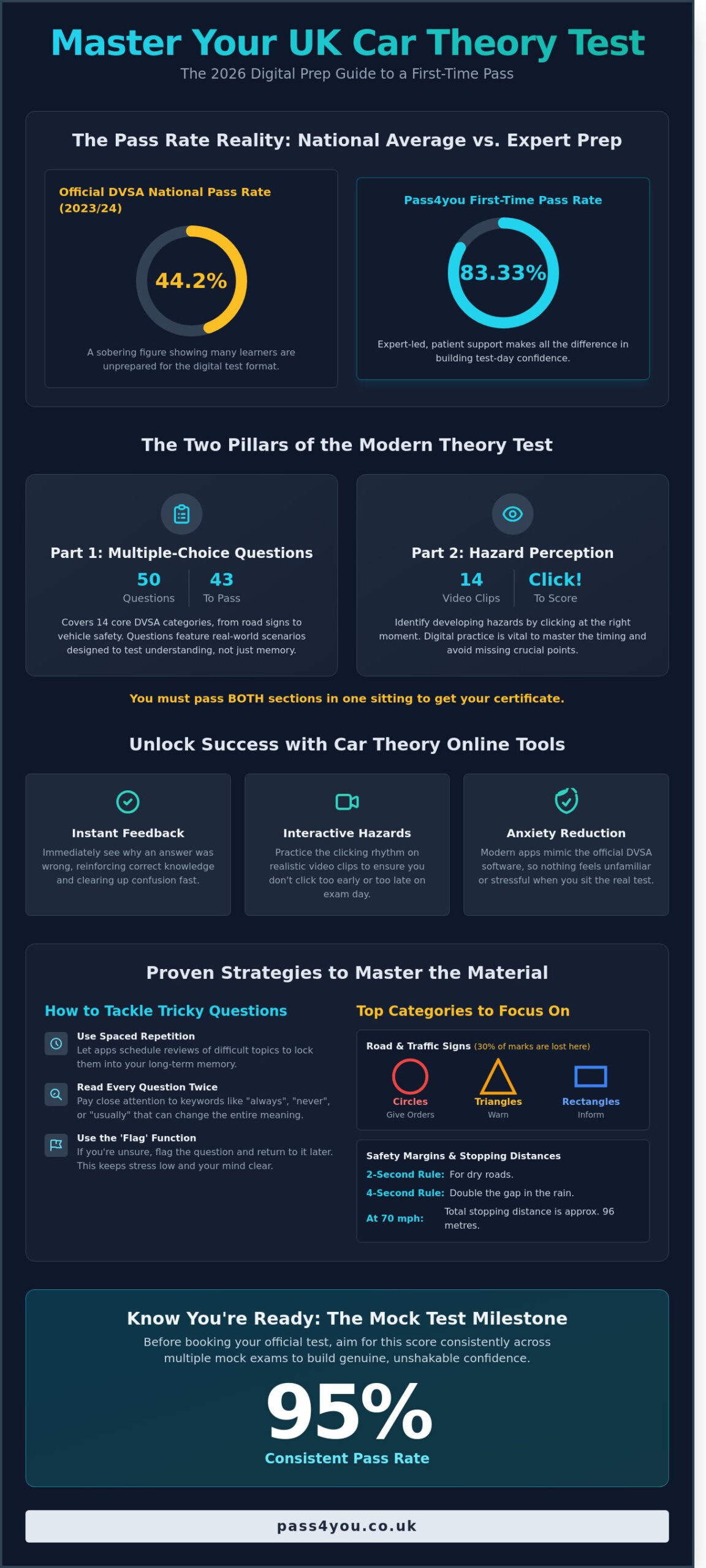
    Did you know that less than 50% of learners pass their theory test on the first attempt? It is a startling figure, but it often comes down to the pressure of the hazard perception section rather than a lack of knowledge. You might feel anxious about the CGI clips looking unrealistic or fear that clicking too soon will trigger a penalty and leave you with zero points. It’s frustrating to feel like you’re a safe driver in person but struggle to prove it on a screen.

    We understand these concerns and want to help you feel completely prepared. By mastering specific hazard perception test tips, you can learn to identify the exact moment a potential hazard becomes a developing one. This guide will teach you the professional “three-click” technique to ensure you hit the scoring window every time. We’ll also break down the rhythm of the 14 video clips so you can walk into the test center with confidence, pass first time, and save yourself the £23 retake fee.

    Key Takeaways

    • Learn how the latest CGI clips simulate real-world conditions to help you stay calm and focused during your test.
    • Discover the clicking patterns that trigger the DVSA “cheat” penalty and how to avoid being disqualified for a clip.
    • Master our expert hazard perception test tips, including the “Three-Click” technique to help you secure the highest score possible.
    • Identify the difference between potential and developing hazards using professional scanning methods like the “L-shaped” scan.
    • See how professional instruction prepares you for the specific challenges of the Milton Keynes grid system and roundabouts.

    Understanding the Hazard Perception Test in 2026

    Success on the road starts with awareness. The Hazard Perception Test is the vital second half of your UK driving theory test, and it’s where many learners feel the most pressure. In 2026, the test uses advanced CGI clips to simulate the unpredictable nature of real driving. These clips aren’t just basic animations. They recreate diverse weather conditions, from blinding sun glare to heavy rain, and varied lighting like the tricky shadows of dusk. This technology ensures you’re prepared for more than just a sunny day on a quiet road. It helps you build the skills needed for long-term safety and gives you the freedom to drive with total peace of mind.

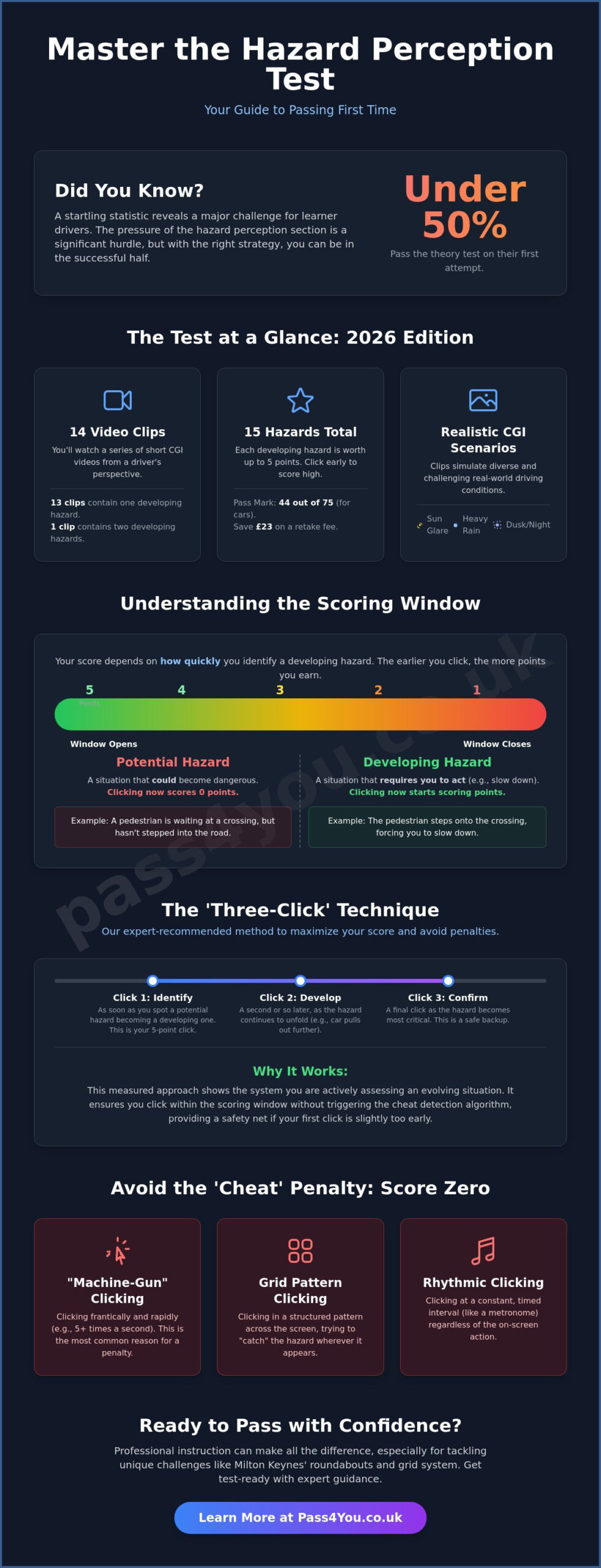
    During the test, you’ll watch 14 clips. Thirteen of these feature a single hazard, while one contains two, making a total of 15 hazards to spot. Each is worth up to 5 points. The goal is to identify the “developing hazard” as early as possible. A developing hazard is a situation that would require you to change your speed or direction. Using the right hazard perception test tips will help you find the rhythm of these clips and stay calm under pressure. We believe that with the right guidance and a patient approach, you can master this section with ease. It’s about training your eyes to scan the road effectively and reacting with confidence.

    Potential vs. Developing Hazards: The Critical Difference

    Many students struggle to know when to click. The difference lies in the transition from “potential” to “developing.” A potential hazard is something that could happen, like a car parked on the left. It only becomes a developing hazard the moment it starts to pull out. Understanding this distinction is the key to timing your clicks. You want to show you’ve seen the change, not just the environment.

    The Scoring Window Explained

    The scoring window is the period when you earn points. It opens the moment a hazard begins to develop. To secure all 5 points, you need to click right at the beginning of this window. If you click too early while the hazard is still just “potential,” you will score zero. Mastering these hazard perception test tips ensures you don’t hesitate and lose easy points.

    How the Scoring System Works (and Avoiding the ‘Cheat’ Penalty)

    Understanding the scoring mechanism is the best way to calm your nerves before the big day. The DVSA uses a highly sensitive algorithm to ensure the test remains fair and accurate. According to official government guidance, the system is specifically designed to detect “rapid, rhythmic, or repetitive” clicking. If you try to “beat the system” by clicking constantly across the screen, a red flag warning will appear. This results in an immediate score of zero for that specific video clip. With a 47% rise in recorded cheating incidents in the year leading up to September 2025, the software is more vigilant than ever, so it’s vital to play by the rules.

    You don’t need to worry about being penalised for a few extra clicks. The software understands that real drivers might react more than once as a situation evolves. You only trigger the penalty if your clicking looks like a machine or a pre-set pattern. There are “invisible” scoring zones on the screen that follow the hazard as it moves. As long as your clicks are genuine responses to what you see, you’re in safe hands. Incorporating professional hazard perception test tips into your practice will help you understand this boundary clearly.

    What Triggers the Cheat Detection?

    The system is looking for specific behaviours that suggest a candidate isn’t actually watching the road. These include:

    • Machine-gun clicking: Pressing the mouse button five or more times in a single second.
    • Grid patterns: Clicking in a structured way across the entire screen to try and “catch” the hazard.
    • Rhythmic clicking: Clicking at perfectly timed intervals, like a metronome, regardless of what is happening in the clip.

    Many learners believe the myth that you should only click once per hazard. This is actually risky. If you click a fraction of a second too early, you score zero. Clicking two or three times as the hazard develops is a much safer strategy. If you’re feeling unsure about your timing, the team at Pass4you Driving School can provide the reassurance and guidance you need to feel test-ready.

    Managing Your Nerves During the Test

    Anxiety often leads to “panic-clicking,” which is the fastest way to trigger a penalty. If you think you’ve missed a hazard, don’t try to compensate by clicking rapidly afterward. Just take a breath and focus on the next potential danger. We recommend using a “re-centre” technique between clips. Close your eyes for a second, relax your shoulders, and look at the centre of the screen before the next video starts. Staying calm helps you maintain the focus needed to apply your hazard perception test tips effectively and secure that first-time pass.

    Hazard Perception Test Tips: How to Pass First Time in 2026

    The ‘Three-Click’ Technique: Your Secret Weapon for Success

    Clicking at the perfect moment is often the most stressful part of the theory test. You might see a hazard starting to unfold, but if you react a fraction of a second too early, you score zero. If you wait too long to be “sure,” you might only get one or two points. The ‘Three-Click’ technique is a professional strategy we often share at Pass4you Driving School to help students navigate this uncertainty with confidence. It is a simple, rhythmic approach designed to “bracket” the scoring window. This means you aren’t just guessing; you are creating a safety net for your score.

    This method is highly effective because it accounts for the transition period between a potential hazard and a developing one. By spreading your reactions, you ensure that even if your first click is premature, your subsequent clicks will land squarely in the high-scoring zone. It is one of the most reliable hazard perception test tips for anyone worried about the sensitivity of the CGI clips. Instead of feeling anxious about a single “make or break” click, you can stay calm and follow a proven system that secures your pass while keeping you well away from the cheat detection software.

    Step-by-Step: Implementing the Three-Click Method

    To use this technique effectively, you need to identify the moment a situation begins to change. Let’s look at how to apply it during your test:

    • Click 1: Press the button the moment you see a potential hazard. This might be a pedestrian standing near a zebra crossing or a car indicating at a junction.
    • Click 2: Wait exactly one second, then click again. This is usually the moment the hazard starts to develop, such as the pedestrian stepping onto the road.
    • Click 3: Wait one more second and click a third time for safety. This covers you if the CGI animation has a slightly longer development phase than expected.

    This deliberate sequence ensures you capture the maximum points available without appearing erratic to the system. It mirrors the natural way a safe driver processes information on the road, making it a life-saving skill as much as a test-taking strategy.

    Why the One-Second Pause is Vital

    The pause between clicks is the most important part of this method. According to the official government guidance on the hazard perception test, you must react to the hazard as it develops. If you click too quickly in a “machine-gun” fashion, the anti-cheat algorithm will flag your behaviour and disqualify the clip. A one-second gap mimics natural human reaction time. It gives the software clear evidence that you are responding to visual changes on the screen. This rhythmic approach is one of our top hazard perception test tips because it balances the need for speed with the requirement for accuracy, ensuring you walk out of the test centre with a successful result.

    Identifying the 10 Most Common Developing Hazards

    Developing your scanning technique is about more than just watching a screen. It’s about training your brain to see what others miss. Many learners make the mistake of focusing on the “hood” of the car in the CGI clips. Instead, you should look deep into the horizon. We recommend using the “L-shaped” scan. This involves looking left, then right, and finally deep into the distance. By applying these hazard perception test tips, you’ll move from simply reacting to situations to anticipating them before they even happen.

    Anticipation gives you the freedom to drive without the stress of sudden surprises. It’s a skill that builds your confidence and keeps everyone safe. Whether you’re in a busy city or on a quiet country lane, the hazards you’ll encounter fall into predictable categories. Understanding these patterns is your best defense against missing a scoring window. If you want to practice these skills in a real car, our team at Pass4you Driving School is here to support you with professional driving lessons tailored to your needs.

    Urban Hazards: Pedestrians and Junctions

    In town centers, the environment is cluttered and moves quickly. You need to look for subtle clues. One of our favorite hazard perception test tips is to look for feet under parked cars. This often reveals a child about to run into the road before you can see their body. You should also watch for cyclists at junctions. They can be obscured by larger vehicles or move suddenly to avoid obstacles like potholes. Finally, always be wary of buses. A bus at a stop is a potential hazard, but it becomes a developing one the moment the indicator flashes or a pedestrian steps out from the front of it.

    Rural and High-Speed Hazards

    Country roads might seem quiet, but they require high-level scanning. Blind bends are a classic hazard. You should treat every sharp corner as if a large tractor or HGV is coming the other way. Look for hidden farm entrances where mud on the road might suggest a slow-moving vehicle has recently emerged. Animals are another major factor. In wooded areas, look for movement in the shadows that could indicate a deer or a loose farm animal about to cross your path.

    Weather and Lighting Challenges

    The 2026 test uses CGI to create very realistic environmental challenges. Sun glare is particularly tricky. It can make it nearly impossible to see brake lights or indicators if you aren’t focused. Rain also plays a role by reducing your visibility and increasing the distance you need to stop. During night-time clips, you’ll need to identify hazards by their silhouettes or the reflection of headlights on road signs. Staying calm and maintaining your rhythmic scan will help you spot these hazards even when conditions are less than perfect.

    From Theory to the Roads of Milton Keynes: Why Professional Instruction Matters

    Transitioning from a computer screen to the driver’s seat is an exciting milestone. While the CGI clips provide a solid foundation, applying hazard perception test tips in a real-world environment is where your skills truly come to life. In a city like Milton Keynes, the road network presents challenges you won’t find in a standard simulation. Our instructors at Pass4you ensure that every one of your driving lessons in Milton Keynes builds on what you’ve learned for your theory pass. We believe that seeing a hazard in person is the best way to reinforce the “three-click” rhythm you’ve practiced.

    The famous grid system and numerous roundabouts in our city require a high level of constant scanning. Unlike a video clip, real hazards don’t always have a clear “start” point. You have to manage 360-degree awareness while maintaining your speed and position. Professional instruction helps you spot these dangers faster than any app because a mentor can point out the subtle “tells” of other drivers in the moment. This hands-on experience turns the abstract scoring windows of the theory test into practical, life-saving habits.

    Mastering Milton Keynes Roundabouts

    Approaching a roundabout in Milton Keynes requires you to look for “early” hazards long before you reach the yield line. You aren’t just looking for cars already on the circle. You’re watching for lane-discipline errors from drivers who might be in the wrong lane for their exit. This is a classic developing hazard that requires a change in your speed or direction. We focus on active eye movement and frequent mirror checks to ensure you’re never caught off guard by a sudden lane change from another vehicle.

    Why Our 83.33% Pass Rate Matters for You

    We take great pride in our 83.33% pass rate because it reflects our commitment to your success. Our teaching methods focus on efficiency, which saves you both time and the cost of unnecessary retakes. We don’t just want you to pass a test; we want you to be a safe, confident driver for the rest of your life. Before you head to the test centre, you can book a mock test with us to see if you’re truly ready for the practical driving test. This extra layer of preparation helps alleviate any remaining anxiety.

    Next Steps: Booking Your Theory and Lessons

    Ready to get started? Make sure your provisional license uk is in order before you look for a test date. Once you have that, follow our how to book your driving test guide to secure your theory appointment. Using our hazard perception test tips alongside professional training is the most reliable way to secure your pass. The road to freedom is closer than you think. Contact Pass4you today to start your driving journey in Milton Keynes!

    Secure Your Success on the Road Today

    Passing your theory test is a major milestone on your path to independence. By mastering the hazard perception test tips we’ve shared, from the “three-click” technique to the “L-shaped” scan, you’re building a foundation for safe driving that lasts a lifetime. You now have the strategies to avoid common pitfalls like the cheat detection system and the confidence to identify hazards before they develop. This knowledge doesn’t just help you pass; it keeps you and others safe on every journey you take.

    Now it’s time to put that knowledge into practice. We’re proud of our 83.33% first-time pass rate and our team of patient, first-class instructors. You’ll learn in modern Volkswagen tuition vehicles, ensuring your experience is as comfortable and safe as possible. Start Your Journey with Milton Keynes’ Top-Rated Driving School and see how professional support makes all the difference. We’re here to help you every step of the way, and we can’t wait to see you succeed behind the wheel.

    Frequently Asked Questions

    How many hazards are in the hazard perception test?

    You will watch 14 video clips featuring 15 scorable hazards in total. Most clips contain one developing hazard, but one special clip features two. You won’t be told which clip has the extra hazard, so it’s important to stay alert until the very end of every video. This ensures you capture every possible point toward your final score.

    Can you fail the hazard perception test for clicking too much?

    Yes, the system will award zero points for a clip if it detects a pattern of rapid or repetitive clicking. This “cheat penalty” only applies to the specific video you are watching, not the entire test. By using the hazard perception test tips we’ve discussed, such as the “three-click” method, you can safely capture points without triggering this warning.

    What is the pass mark for the car hazard perception test in 2026?

    The pass mark for car and motorcycle learners is 44 out of a possible 75 points. Each of the 15 hazards is worth up to 5 points, depending on how quickly you react once it begins to develop. We focus on helping you hit those high-scoring windows consistently so you can walk into the test centre feeling calm and prepared.

    Is the hazard perception test harder than the multiple-choice theory part?

    Many learners find this section more challenging because it requires real-time awareness rather than just memorising facts. While the multiple-choice part tests your knowledge of the Highway Code, this section tests your practical reactions. Since the theory test pass rate is less than 50%, it’s clear that both parts require dedicated practice to pass first time.

    Can I retake the hazard perception test if I fail?

    You can retake the test, but you’ll need to book and pay for the entire theory test again. This includes both the multiple-choice questions and the hazard perception section. You must wait at least three working days before you can try again. This is why we emphasize efficiency and professional guidance to help you save time and money.

    How long is the hazard perception test scoring window?

    The scoring window opens the exact moment a hazard begins to develop and ends when the situation is no longer avoidable. This window usually lasts for just a few seconds. To score the maximum 5 points, you need to click right at the start. If you wait until the hazard is obvious, your score will drop significantly.

    Are the CGI clips in the test realistic?

    The CGI clips used in 2026 are highly realistic and designed to mimic modern driving conditions. They accurately simulate challenging environments such as heavy rain, blinding sun glare, and low-light night driving. These animations provide a safe way to test your reactions to dangerous situations without the risks of real-world driving, helping you build confidence.

    Do I need to use a mouse or a touch screen for the test?

    You will use a standard computer mouse to complete the test at the official DVSA centre. Touch screens are not used for the hazard perception section. We recommend practicing with a mouse at home so you feel comfortable with the physical clicking rhythm. This small detail helps reduce test-day anxiety and lets you focus entirely on the screen.

  • Booking Your Practical Driving Test in 2026: A Step-by-Step Guide

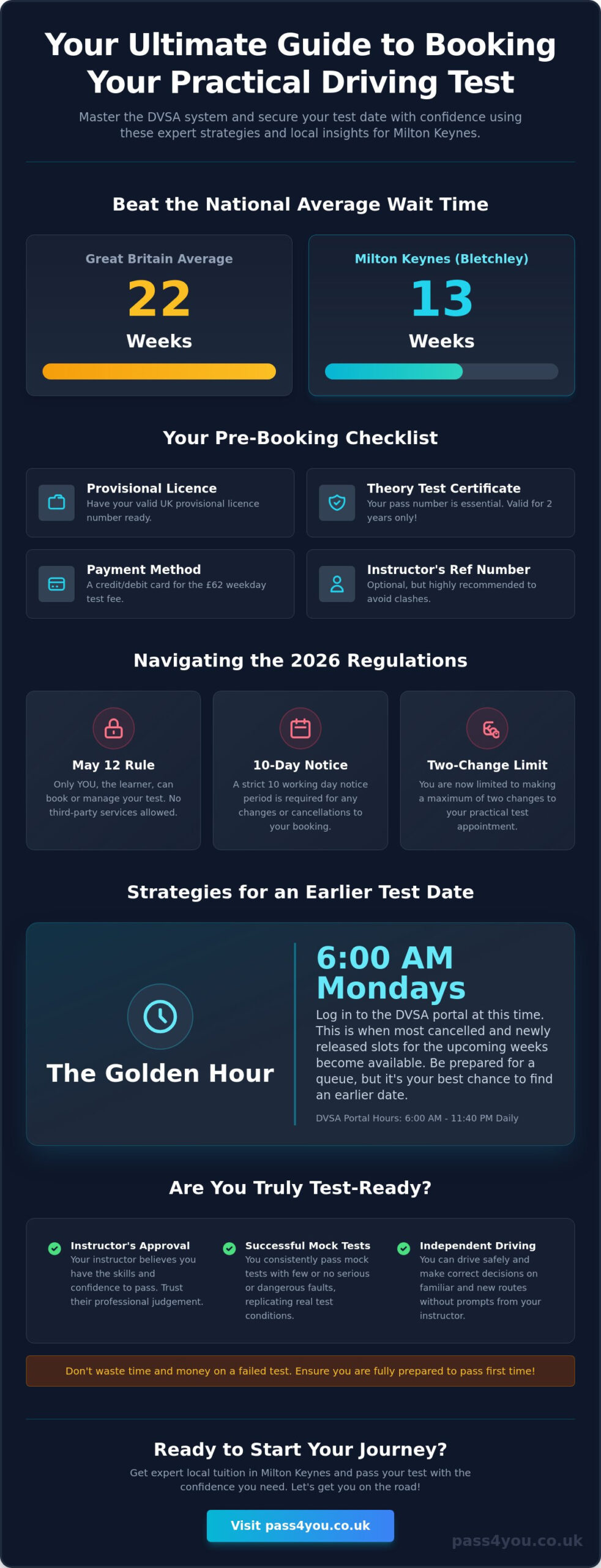
    Did you know that while the average learner in Great Britain waits 22 weeks for an appointment, learners in Milton Keynes can often secure a slot at the Bletchley test centre in just 13 weeks? Even with a shorter wait, the process of booking practical driving test dates can feel overwhelming with the new 2026 regulations now in full effect. We understand why you might feel anxious about the strict 10 working day notice period or the May 12 rule that prevents anyone but you from managing your booking. It’s a lot to keep track of when you just want to focus on being a safe, confident driver.

    Securing a date doesn’t have to be a source of stress. While national average waiting times reached 22 weeks in late 2025, there are several reliable ways to find a slot sooner without resorting to expensive or risky third-party services. Trusted experts like Wimbledon Driving School often emphasize that staying proactive with the official system is the most effective way to manage these delays. We understand how frustrating the wait can be. Our goal is to help you stay calm and focused while you navigate the system. When you are booking practical driving test appointments, knowing exactly how and when the system refreshes can save you months of waiting.

    You can take a deep breath because we’ve simplified everything to help you secure your date with total confidence. Our expert local guide will show you how to master the DVSA system and navigate the June 9 rule regarding nearby test centres. We will walk you through the official GOV.UK requirements, explain the latest cost changes, and share our proven strategy for finding cancellations so you can get on the road sooner.

    Key Takeaways

    • Prepare your provisional licence and theory test certificate number before you start to ensure a smooth, stress-free process.
    • Master the official DVSA portal to make booking practical driving test appointments straightforward while staying within the new two-change limit.
    • Learn why 6:00 am on Monday mornings is the “golden hour” for finding cancellations and securing an earlier slot at your preferred centre.
    • Gain a competitive edge at the Bletchley test centre by understanding how local expertise helps you navigate complex Milton Keynes roundabouts.
    • Use our “Test Ready” criteria and mock tests to build the confidence needed for a first-time pass, ensuring you don’t waste time or money.

    Essential Requirements Before Booking Your Practical Driving Test

    Getting ready for your test day is an exciting milestone on your journey to independence. Before you jump onto the official DVSA website, you need to gather a few specific items to ensure the process is smooth and stress-free. Having everything ready at your fingertips prevents the frustration of timed-out sessions or missing out on a prime slot because you had to search for a document. We want you to feel calm and prepared from the very first click.

    To begin the process of booking practical driving test appointments, you will need the following essentials:

    • Your valid UK provisional driving licence number.
    • A valid Theory Test pass certificate number.
    • A credit or debit card to pay the £62 fee for weekday tests.
    • Your driving instructor’s personal reference number, which helps coordinate car availability.

    The United Kingdom driving test is designed to ensure every new driver meets a high standard of safety, and these requirements are the first gatekeepers of that standard. Checking these details now saves you from unnecessary anxiety later.

    The Theory Test Prerequisite

    You cannot secure a practical date without first passing your theory test. It’s a firm rule that ensures you have the underlying knowledge to drive safely on your own. Keep in mind that your theory certificate is only valid for exactly two years from the date you passed. If you don’t pass your practical test within that window, you’ll need to retake the theory exam. If you are just starting out, our provisional licence guide explains how to get your documents in order before you even look at a theory book.

    Why Your Instructor’s Reference Number Matters

    While entering an instructor’s reference number is optional, we highly recommend it for all our students. When you use Simon’s specific reference number during the booking practical driving test process, it helps the system flag potential scheduling conflicts. There’s nothing more stressful than finding a perfect test date only to realise your instructor is already booked for another student’s exam at that exact time. By using this number, you ensure that Simon and the Pass4you car are actually available to support you. We always suggest a quick chat with your instructor to coordinate dates before you hit the final confirm button. This simple step protects your investment and keeps your path to a first-time pass clear and focused.

    Step-by-Step: How to Book Your Practical Driving Test Online

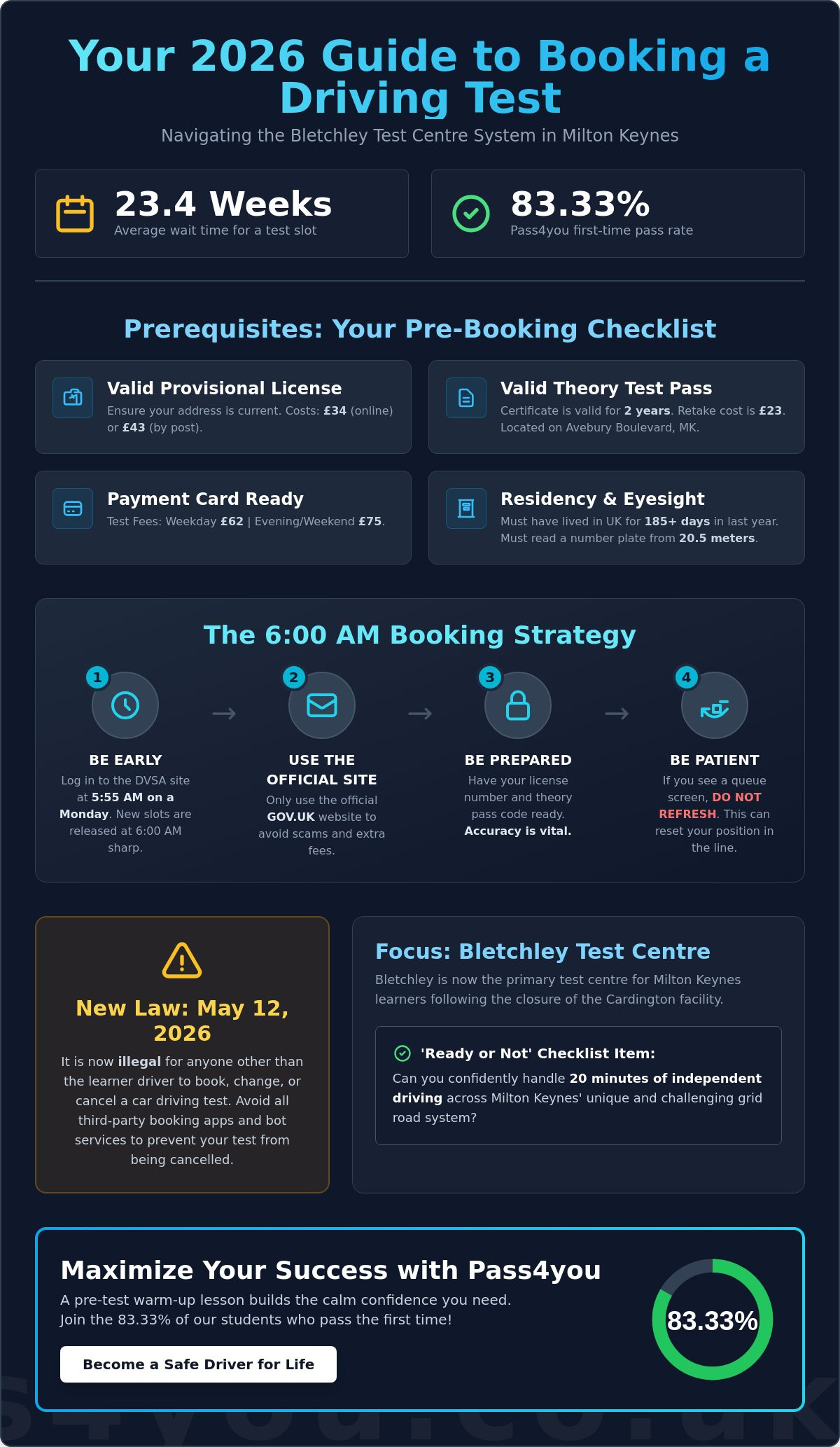
    Once you have your documents in order, the next step is to head to the computer. The process of booking practical driving test appointments is handled through the official DVSA practical driving test portal. This service is available daily from 6:00 am until 11:40 pm. While you can access it at any time during these hours, we recommend being ready right at the start of the day if you want the widest choice of dates. It’s a straightforward system, but it requires your full attention to ensure every detail is correct.

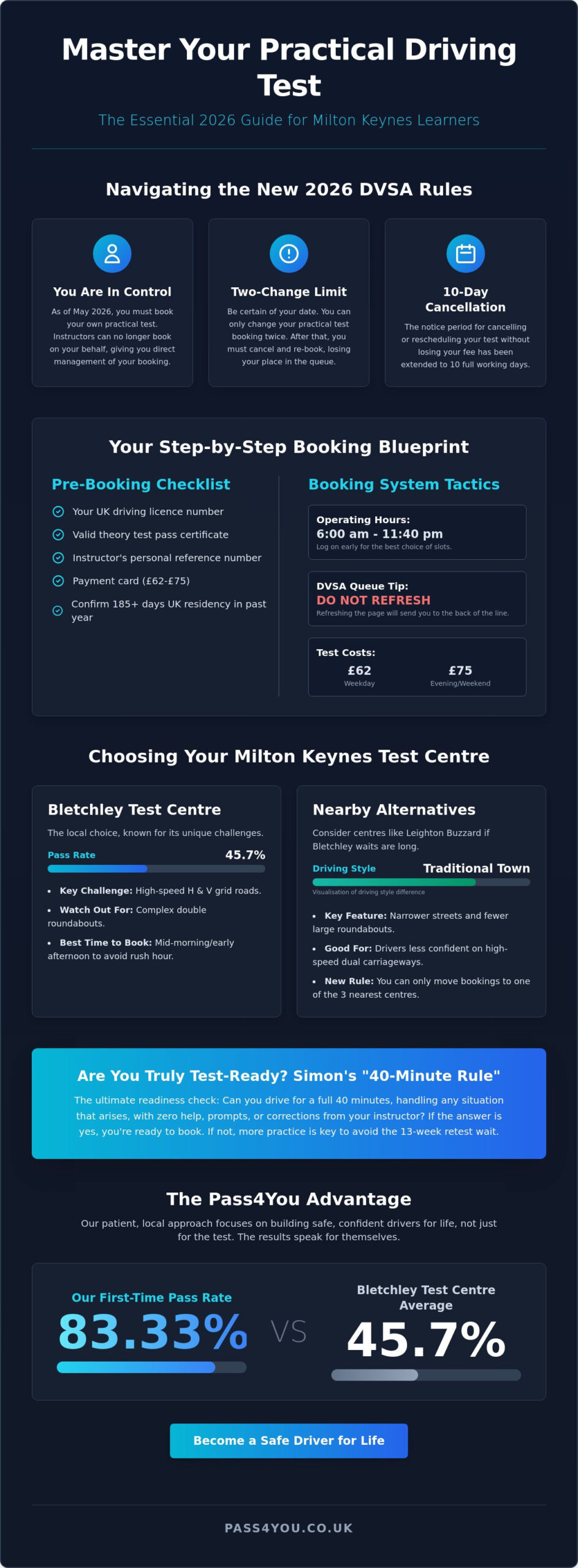
    The system will ask for your provisional licence number and your theory test pass certificate number. It’s also vital to remember that as of May 12, 2026, only the person taking the test is permitted to book or change the appointment. This rule was introduced to stop third parties from bulk-buying slots, ensuring that you have a fair chance at finding a date that works for you. Take your time, stay calm, and follow the prompts carefully.

    Navigating the DVSA Booking Portal

    If you log on at 6:00 am on a Monday morning, you will likely encounter a virtual queue. Don’t worry if you see a message saying there are thousands of people ahead of you. The queue moves steadily; just keep your browser window open and avoid refreshing the page. When it’s your turn, you’ll select “Car” as your vehicle type. You must also specify whether you’re taking the test in a manual or automatic vehicle. At this stage, enter Simon’s instructor code. This is a brilliant way to sync your booking with the Pass4you schedule, ensuring the car is ready and waiting for you on the big day.

    Choosing the Right Date and Time

    Selecting a time slot is about more than just convenience. In Milton Keynes, you should consider local traffic patterns. A slot at 8:00 am means you’ll be driving during the height of the morning rush, while a 3:00 pm slot might coincide with the school run near Bletchley. Some learners prefer these busier times because heavy traffic can actually mean you cover a shorter distance during the test. If you’re still feeling a bit nervous about handling these conditions, booking extra driving lessons can help build the confidence you need. Once you’ve picked a date, you’ll pay the fee of £62 for a weekday slot or £75 for weekends. Always wait for the confirmation email before closing your browser to be 100% sure your date is secured.

    Booking Your Practical Driving Test in 2026: A Step-by-Step Guide

    Securing a date doesn’t have to be a source of stress. While national average waiting times reached 22 weeks in late 2025, there are several reliable ways to find a slot sooner without resorting to expensive or risky third-party services. We understand how frustrating the wait can be. Our goal is to help you stay calm and focused while you navigate the system. When you are booking practical driving test appointments, knowing exactly how and when the system refreshes can save you months of waiting.

    Patience is your best tool here. The backlog is a reality, but it’s one you can manage with the right strategy. By staying persistent and using the official tools provided, you’ll find that dates do open up. We’ve seen many students successfully move their tests forward by several weeks just by being proactive.

    The 6:00 AM Booking Window

    Monday morning is the most important time for any learner looking to secure a date. The DVSA typically releases a fresh batch of test slots at 6:00 am every Monday. To make the most of this window, you should have your provisional licence and theory pass certificate details ready to go before you log on. Being prepared helps you avoid the anxiety of a timed-out session during the morning rush. A cancellation slot is a test date released by another learner who has decided they aren’t quite ready or have changed their plans. These slots appear instantly on the system, so being the first to see them is vital for success.

    Ethical Cancellation Hunting

    Once you have a date in the diary, you can use the “Change your test” tool on the official website to look for something sooner. You can Book your practical driving test and then check back regularly for these openings. We recommend checking a few times a day, but don’t overdo it. If you refresh the page too frequently, the system might temporarily block your IP address because it thinks you’re an automated bot. This is why a steady, patient approach works best.

    We strongly advise against using third-party cancellation apps or “booking bots.” The DVSA has actively cracked down on these services in 2026 to ensure the system remains fair for everyone. Some of these apps are unreliable, and there’s a real risk that the DVSA will cancel any booking made through them. Your personal data is also much safer when you stick to the official portal. At Pass4you, we help you stay “test ready” so that if a short-notice slot appears, you’ll have the confidence to grab it. Simon’s supportive teaching style ensures you’re prepared for any date, giving you the best chance at a first-time pass.

    Local Insight: Booking for the Milton Keynes Driving Test Centre

    Milton Keynes offers a unique advantage for those booking practical driving test dates. While the national average wait time is 22 weeks, the Bletchley test centre currently sits at 13 weeks. This shorter wait time is a relief, but it comes with a specific challenge. The local pass rate in Bletchley is 40.4%, which is lower than the national average. This tells us that while it’s easier to get a date, passing requires a deep understanding of our unique road network. You don’t just need to know how to drive; you need to know how to drive in Milton Keynes.

    We focus on building your confidence specifically for these roads. Our driving lessons in Milton Keynes are designed to familiarise you with every complex junction and multi-lane roundabout you might encounter. Simon has spent years helping students master these specific routes. He knows that the secret to success isn’t just about technical skill. It’s about feeling calm and prepared when you see a familiar landmark during your exam. We want you to feel like the test is just another drive with a friend.

    Milton Keynes Test Centre Specifics

    The local hub is located in Bletchley. It’s a busy area with a mix of residential streets and high-speed roads. When you arrive, you’ll find designated parking for test candidates. Simon always recommends arriving 10 minutes early to settle your nerves. The process of booking practical driving test slots at Bletchley is the same as elsewhere, but the preparation must be local. Simon often shares tips for this specific environment, such as being mindful of the speed limits that change quickly between residential blocks.

    Preparing for Local Road Types

    Your test will likely include a mix of dual carriageways and tight residential turns. We make sure to integrate plenty of dual carriageway practice into your sessions. Mastery of these high-speed roads is a core reason why Pass4you maintains an 83.33% first-time pass rate. We also use mock tests on actual Bletchley routes to ensure there are no surprises on the day. This tried and tested technique helps you feel like a safe driver for life, not just for the duration of the test. If you’re ready to start your journey with a patient mentor, you can book your driving lessons with Simon today.

    Are You Test Ready? Why Your Instructor’s Approval Matters

    It is natural to feel a rush of excitement once you have your theory certificate in hand. You might feel tempted to rush into booking practical driving test dates immediately to secure the earliest possible slot. However, taking the test before you are truly ready can be a costly mistake. Beyond the £62 booking fee, the emotional impact of a “fail” can set your confidence back significantly. We want your first experience at the test centre to be your only one, resulting in that coveted pink licence.

    The DVSA has strict rules regarding changes and rebooking. If you fail your test, you must wait at least 10 working days before you can take another one. With current wait times at the Bletchley centre sitting at 13 weeks, a single failed attempt could mean you don’t get another chance for months. This is why Simon’s professional assessment is so valuable. He doesn’t just teach you to pass; he ensures you are a safe driver who can handle any situation without prompts.

    The Value of the Mock Test

    One of the best ways to gauge your readiness is through a formal mock test. This session simulates the exact environment of the practical driving test, including the sat-nav or independent driving sections. During a mock test, Simon will identify whether your mistakes are “minor” driving faults or “serious” faults that would result in an immediate fail. Identifying these habits in a calm, supportive environment allows you to fix them before the examiner is sitting next to you. Our students find that these practice runs significantly reduce the anxiety often associated with the big day.

    Booking with Confidence

    At Pass4you, our “Safe Driver for Life” philosophy means we focus on quality over speed. While some learners try to save money by taking fewer lessons, this often leads to multiple failed tests and higher costs in the long run. By following a structured learning plan and listening to your instructor’s advice, you actually save money. You’ll arrive at the Bletchley centre feeling patient, focused, and fully prepared for those Milton Keynes roundabouts.

    Our impressive 83.33% first-time pass rate is a direct result of this honest, transparent approach. We won’t suggest booking practical driving test dates until we are both certain you can pass with flying colours. This partnership between learner and instructor is what makes our school stand out. If you are a nervous learner who has struggled with other instructors, you’ll find Simon’s calm and brilliant teaching style life-changing. When you feel ready to take that first step toward independence, book your first lesson with Pass4you and start your journey the right way.

    Take the Next Step Toward Your Driving Independence

    You now have the tools to navigate the DVSA system and secure your date. Remember that success depends on more than just booking practical driving test slots at the right time. It requires a solid foundation built on theory knowledge, local road mastery, and the calm guidance of a mentor who understands your anxiety. By focusing on being test ready rather than just test booked, you set yourself up for a lifetime of safe driving on the roads of Milton Keynes and beyond.

    We are here to support you every step of the way in our modern Volkswagen tuition vehicles. Simon’s patient approach has helped many nervous learners overcome their fears and achieve their goals. Join the 83.33% who pass first time and book with Pass4you today. You have worked incredibly hard to get this far; now it’s time to secure your date and enjoy the freedom that comes with your full UK licence.

    Frequently Asked Questions

    How much does it cost to book a practical driving test in 2026?

    A standard weekday practical test costs £62. If you choose to take your test during the evening, on a weekend, or during a bank holiday, the price increases to £75. These fees are paid directly to the DVSA through the official GOV.UK portal. Always ensure you’re using the legitimate government website to avoid extra administrative charges from unofficial booking services.

    Can I book my driving test before I pass my theory test?

    No, you cannot book your practical exam until you’ve successfully passed your theory test. The online system requires you to enter a valid theory test pass certificate number before it allows you to view any available dates. This ensures every learner has a basic understanding of road signs and safety before they attempt the final practical assessment.

    What is the earliest time I can book a driving test online?

    The official booking service opens at 6:00 am every morning and remains available until 11:40 pm. For the best chance of finding a slot, we recommend being online right at 6:00 am, especially on Monday mornings when new appointments are released. Staying patient while waiting in the virtual queue is the best way to manage the booking practical driving test process successfully.

    How long is the current wait for a driving test in Milton Keynes?

    As of May 2026, the average waiting time at the Bletchley driving test centre is 13 weeks. This is significantly shorter than the national average of 22 weeks, making Milton Keynes a great place to secure a date. While the wait is shorter, remember that the local pass rate is 40.4%, so being fully prepared for the local roundabouts is essential.

    Can I book a driving test without a driving instructor?

    Yes, you’re legally allowed to book and take your test without a professional instructor. However, you must provide a vehicle that meets all DVSA safety requirements, including extra mirrors and L-plates. Most of our students prefer using Simon’s modern Volkswagen because it’s familiar and reliable. Taking the test in a car you’ve used for your lessons helps you feel much more confident and calm.

    What happens if I need to change my driving test date?

    You can change your appointment through the GOV.UK website, but you must provide at least 10 working days’ notice to avoid losing your fee. This notice period was increased to help reduce the national backlog. If you’re feeling nervous and need more time to prepare, it’s better to reschedule early rather than rushing into a test you aren’t ready for.

    How many times can I reschedule my driving test for free?

    Under the new rules effective from March 31, 2026, you can only make a maximum of two changes to your booking practical driving test slot. If you need to change it a third time, you’ll have to cancel the appointment and pay for a new one. This policy encourages learners to only book when they’re truly confident in their ability to pass.

    What documents do I need to bring to the practical test?

    You must bring your UK photocard provisional driving licence to your appointment. If you have an old-style paper licence, you also need to bring a valid passport. While it isn’t strictly mandatory to bring your theory test pass certificate, it’s very helpful to have it with you just in case there are any issues with the digital records at the test centre.

  • How to Book a Driving Test in Milton Keynes: A Step-by-Step Guide for 2026

    What if the biggest hurdle to getting your pink license isn’t the Bletchley double roundabouts, but simply finding a slot on the DVSA calendar? With average waiting times now stretching to 23.4 weeks in some areas, knowing how to book a driving test in 2026 requires more than just a quick login; it requires a strategy. We know how discouraging it feels to see a “no appointments available” screen when you’re ready for your independence. It’s a common worry, but we’re here to provide a calm, supportive path through the chaos.

    At Pass4you, we believe booking your test should be a milestone to celebrate, not a source of stress. This guide will walk you through the 2026 regulation changes, including the new May 12 law regarding personal bookings and the strict limits on test transfers, so you can secure a date at the Bletchley centre. You’ll learn exactly which documents to bring and how to ensure you’re truly ready for Milton Keynes’ unique grid roads. We’ll help you master the booking process so you can focus on becoming a safe driver for life and joining the 83.33% of our students who pass the first time.

    Key Takeaways

    • Check your theory test expiry date to ensure it falls within the required two-year window before you begin the booking process.
    • Master the 6:00 AM strategy for how to book a driving test to successfully navigate the high demand at the Bletchley test centre.
    • Learn why the Bletchley centre is now the primary location for Milton Keynes learners following the closure of the Cardington facility.
    • Use our “Ready or Not” checklist to confirm you can handle 20 minutes of independent driving across MK’s unique grid roads.
    • Discover how a pre-test warm-up lesson with Simon builds the calm confidence needed to join our 83.33% first-time pass rate.

    Prerequisites: What You Need Before Booking Your Test

    Stepping up to the practical exam is an exciting milestone. It represents the freedom of the open road and the end of your “L” plate days. However, before you jump onto the DVSA website to learn how to book a driving test, you must ensure your administrative foundation is solid. This preparation prevents the frustration of finding a perfect slot only to realize your paperwork isn’t in order. We want you to feel calm and prepared, not rushed by a looming deadline.

    Your first essential is a valid provisional license UK. If you don’t have one yet, it costs £34 for an online application or £43 if you apply by post. You also need a debit or credit card to pay the DVSA booking fee. As of May 2026, a weekday test costs £62; evening or weekend slots are £75. Finally, we strongly recommend having Simon’s personal instructor reference number ready. Including this during your booking ensures that our schedules align. This means you can take your test in the familiar comfort of the Volkswagen you’ve used for all your lessons, which is a huge boost for your confidence.

    The Theory Test Foundation in Milton Keynes

    You cannot book a practical test without a valid theory test pass certificate number. The Milton Keynes Theory Test Centre is conveniently located on Avebury Boulevard, but remember that your pass is only valid for exactly two years. If that window closes before your practical test date, you’ll need to retake the theory exam at a cost of £23. If you’ve misplaced your certificate number, don’t panic. You can retrieve it through the official GOV.UK service by providing your license number and date of birth.

    Simon always advises students to wait for a “strong” theory pass before rushing to book. Understanding the rules of the road is about more than just passing a multiple-choice quiz. It’s about being a safe driver for life. When your theory knowledge feels like second nature, you’ll find the practical booking process much less intimidating.

    Document Checklist for 2026

    The United Kingdom driving test regulations are strict about residency and personal details. You must have lived in the UK for at least 185 days in the last year to be eligible for a test. Additionally, ensure the address on your provisional license matches your current residence. If you’ve moved house since March 2026, update your license details immediately to avoid complications on test day.

    Before you commit to a date, do a quick self-check of your eyesight. You must be able to read a standard UK number plate from a distance of 20.5 meters. If you need glasses or contact lenses to do this, you must wear them every time you drive. Being proactive with these checks means you can walk into the Bletchley centre with a calm mind, knowing everything is exactly as it should be.

    Step-by-Step: How to Book Your Driving Test Online

    Once you have your provisional license and theory pass ready, it is time to face the booking portal. Learning how to book a driving test in 2026 requires patience because the average UK waiting time is currently 14.8 weeks. To give yourself the best chance at securing a local date, you should head directly to the official GOV.UK website. It is the only secure place to book without facing unnecessary markups or potential fraud.

    Set your alarm for 5:55 AM. The DVSA releases new test appointments every Monday at 6:00 AM sharp. If you log in at 9:00 AM, you will likely find that the local Bletchley slots have already been snapped up for the season. Have your provisional license number and theory certificate pass code sitting right in front of you. Accuracy is vital here. If you mistype a single digit during the entry process, the system might reject your application; this could force you back to the very start of the virtual line while others take the available slots.

    Navigating the DVSA Queue System

    On Monday mornings, you will likely encounter a progress bar or a “queue” screen. Stay calm and do not refresh your browser. Refreshing can actually kick you out of the system and reset your position. You must also avoid third-party booking apps or “bot” services. As of May 12, 2026, it is against the law for anyone other than the learner driver to book, change, or cancel a car driving test. These unofficial sites often charge hidden fees and can now lead to your booking being flagged or cancelled by the DVSA. Once you successfully choose a date, wait for the confirmation email. If it doesn’t arrive within two hours, check your spam folder before you worry.

    Booking by Phone: An Alternative for 2026

    If the website is struggling under heavy traffic or you have specific accessibility requirements, you can try the DVSA support line on 0300 200 1122. The line is open from 8:00 AM to 7:00 PM, Monday to Friday. Calls are charged at local rates, but you should prepare for long hold times during peak booking seasons. While this method is generally slower than the online portal, it provides a helpful human touch if you’re feeling overwhelmed by the digital queue.

    Remember, securing the date is just the first step toward your independence. To ensure you feel truly confident navigating those complex Milton Keynes grid roads on the big day, consider booking a few driving lessons with an instructor who understands the local Bletchley test routes. We’re here to help you turn that booking into a first-time pass.

    How to Book a Driving Test in Milton Keynes: A Step-by-Step Guide for 2026

    Choosing Your Milton Keynes Test Centre: Bletchley vs. Cardington

    Choosing the right location for your practical exam is a strategic decision. While the Bletchley centre is the heart of Milton Keynes testing, some learners look toward Cardington in Bedford as a backup. Knowing how to book a driving test is only half the battle; the other half is ensuring you feel at home on the specific roads the examiner chooses. Simon strongly prefers training students on Bletchley routes because they prepare you for the reality of MK driving. When you Book your official DVSA driving test, you should feel a sense of excitement rather than dread.

    The Bletchley Test Centre, located on Wilton Avenue, requires a high level of confidence with the Milton Keynes grid system. You’ll definitely encounter large roundabouts and multi-lane junctions. These are the areas where many learners feel the most pressure. We spend significant time during our lessons mastering these layouts so they become second nature. Common “fail spots” often include poor lane discipline on the approach to the H8 Standing Way or hesitation at busy roundabouts. Our goal is to make these maneuvers feel routine. When you arrive at the MK site, remember the 10-minute rule. Arrive slightly early to find a parking space and take a few deep breaths. This small window of time helps you transition into a calm, focused mindset before the examiner greets you.

    Bletchley Test Centre Specifics

    Navigating the famous Milton Keynes roundabouts requires a patient approach. Examiners in Bletchley look for early recognition of signs and clear, confident signaling. You might also be guided toward the smaller, more compact streets of Bletchley town centre, where your observation skills are put to the test. Parking at the centre is reserved for test candidates, so don’t try to use it for practice in the days leading up to your booking. Stick to the surrounding industrial areas to get a feel for the local traffic flow.

    The Cardington Alternative

    The Cardington alternative in Bedford offers a different pace. Since the original Cardington site was relocated by March 2021, the routes now lean more toward traditional urban streets and rural stretches. Some students find this less intimidating than the MK roundabouts, but rural roads bring their own risks, such as hidden junctions and high-speed bends. We firmly believe that route familiarity is the most significant factor in our 83.33% first-time pass rate. Driving on roads you recognize reduces the mental load, allowing you to focus on your safety and observation. If you’re still debating which centre to choose, you can find driving instructors near me who can provide mock tests in both locations. Simon’s patient approach ensures that whether you’re in Bletchley or Bedford, you’ll have the skills to succeed.

    The ‘Ready or Not’ Checklist: Should You Book Yet?

    With waiting times at the Bletchley centre averaging 14.8 weeks, the temptation to rush your booking is high. However, knowing how to book a driving test is only one part of the journey; booking it at the right time is what saves you money and stress. Failing a test because you weren’t ready is a “false economy.” You lose your £62 fee, you have to pay for more lessons, and you face another long wait for a new slot. We want you to feel confident and calm when you finally sit in that examiner’s car.

    At Pass4you, we use a simple but effective checklist to help you decide. First, can you handle the 20-minute “Independent Driving” section without any prompts? In Milton Keynes, this often involves following a sat-nav through multiple grid junctions. Second, are you consistently performing maneuvers like the parallel park or pulling up on the right without Simon needing to intervene? If the answer is yes, and you’ve passed a full mock test under exam conditions, you’re likely ready. This disciplined approach is why we maintain an 83.33% first time pass rate.

    Mastering MK’s Unique Road Layouts

    Milton Keynes presents challenges that you won’t find in many other UK towns. You must be comfortable handling high-speed dual carriageways where merging safely at 70mph is essential. You’ll also face complex spiral roundabouts that require perfect lane discipline. We don’t just teach you to pass; we ensure you are a safe driver for life. If you still feel a flutter of panic when you see a “Reduced Speed Now” sign or a large roundabout, you might need a few more hours of practice to build that vital self-belief.

    Managing Your Booking: Changes and Cancellations

    If you’ve already booked but don’t feel ready, don’t worry. The DVSA allows you to change your appointment up to two times as of March 31, 2026. You must give at least three clear working days’ notice to move your date without losing your fee. You can use the official “Change your driving test” service on GOV.UK to look for earlier slots or “cancellations.” We strongly discourage using third-party cancellation apps that scrape data. These apps can be unreliable and often charge fees for information you can find yourself for free with a little patience. If you’re unsure where you stand, booking professional driving lessons is the best way to get an honest, expert assessment of your skills.

    Maximize Your Success: Preparing for Test Day with Pass4you

    Once you’ve navigated the DVSA portal and mastered how to book a driving test, the focus shifts from administration to execution. Securing a date at the Bletchley centre is a great first step, but walking into that appointment with a calm, confident mindset is what actually earns you the license. We know that test-day nerves are real. That’s why our approach is built on patience and reassurance, ensuring you feel like a capable driver rather than a nervous student. We’re here to guide you through those final miles until you’re holding your pass certificate.

    One of the biggest advantages you’ll have is Simon’s modern Volkswagen. While the DVSA allows you to use your own vehicle, driving a familiar, dual-controlled car that you’ve used for all your lessons provides a massive safety net. It’s a car you trust, with dimensions you understand perfectly for those tight Bletchley maneuvers. On the morning of your exam, we always include a pre-test “warm-up” lesson. This isn’t about learning new skills; it’s about shaking off the cobwebs and getting your eyes used to the Milton Keynes traffic flow. This hour of driving helps you settle into a steady rhythm before the examiner joins you.

    Understanding the practical driving test structure for 2026 is also vital. You’ll start with the “Show Me, Tell Me” safety questions before heading out for 40 minutes of driving. This includes 20 minutes of independent navigation, which is where your training on the MK grid system really pays off. We’ve spent hours practicing these specific routes, so you’ll recognize the junctions and roundabouts long before the sat-nav tells you to turn.

    The Pass4you Advantage

    Our impressive 83.33% first-time pass rate isn’t an accident. It’s the result of a tried and tested technique that prioritizes safety over shortcuts. By the time your test day arrives, you’ll have completed a mock test that simulates the exact style of a Bletchley examiner. This preparation saves you time and money in the long run. Instead of facing the 23.4-week wait for a retest in some areas, our students are much more likely to walk away with their license on the first attempt. We ensure you’ve mastered every safety question and every complex roundabout until they feel like second nature.

    Your Next Steps in Milton Keynes

    Before you finalize your booking, remember to coordinate with Simon’s availability. It’s essential that the car and your instructor are free for your chosen slot. You’re about to join hundreds of successful driving lessons Milton Keynes students who have found freedom on the road with our support. We don’t just want you to pass; we want you to be a safe driver for life. If you’re ready to turn your provisional license into a full one, Book your assessment lesson with Simon today and let’s get started on your journey to success.

    Your Path to Driving Independence Starts Now

    Securing your slot at the Bletchley centre is a huge win, but it’s only the first step toward your freedom. By following the 6:00 AM Monday booking strategy and staying ahead of the 2026 DVSA regulations, you’ve already put yourself in a strong position. Remember that learning how to book a driving test is most effective when you’re truly ready to handle the unique pressure of MK’s multi-lane roundabouts and high-speed dual carriageways. Avoid the frustration of a 23.4-week wait for a retest by ensuring you’ve passed your mock exams and feel confident behind the wheel.

    With our 83.33% first-time pass rate and modern Volkswagen tuition vehicles, we provide the calm, patient environment you need to succeed. Simon’s expert knowledge of the local Bletchley routes takes the guesswork out of your preparation. You don’t have to face the grid roads alone; we’re here to build your self-belief and make you a safe driver for life. Are you ready to trade your “L” plates for a full license? Start your journey to an 83.33% first-time pass rate with Simon. We can’t wait to help you reach the finish line.

    Frequently Asked Questions

    How much does a driving test cost in the UK in 2026?

    A standard weekday practical driving test costs £62. if you choose to book an appointment for an evening, weekend, or bank holiday, the fee increases to £75. These prices have been the standard DVSA rates for several years. Remember that this fee only covers the examiner’s time and the test itself; it doesn’t include the cost of using your instructor’s car or any pre-test lessons.

    Can I book a driving test before I pass my theory test?

    No, you cannot book a practical test until you’ve successfully passed your theory exam. The DVSA booking system requires your valid theory test pass certificate number before it allows you to view available dates. Since your theory pass is only valid for exactly two years, we recommend checking your expiry date before you begin the process to ensure your foundation is still current.

    What is the earliest time I can book a driving test online?

    The official DVSA booking portal opens for new appointments at 6:00 AM every morning. This is the best time to find fresh slots, especially on Monday mornings when the largest batch of weekly appointments is released. Logging in early helps you beat the digital queue and gives you the first pick of dates at the Bletchley test centre before they’re snapped up by other learners.

    How do I find a driving test cancellation in Milton Keynes?

    The safest way to find a cancellation is by using the “Change your driving test” service on the official GOV.UK website. To learn how to book a driving test slot that someone else has released, you should check the portal regularly throughout the day. Since May 12, 2026, it’s illegal for third-party services to book on your behalf, so personal persistence is now the most effective strategy.

    What documents do I need to bring to my Milton Keynes driving test?

    You must bring your UK provisional driving license to the Bletchley test centre. If you have an old-style paper license, you’re also required to bring a valid passport for identification. You don’t need to bring your theory pass certificate, though having the number saved on your phone can provide extra peace of mind. Without your physical license, the examiner will cancel your test and you’ll lose your fee.

    Can I use my own car for the driving test at Bletchley?

    Yes, you can use your own car if it meets the DVSA’s strict safety requirements. It must have a current MOT, be insured for a driving test, and be fitted with an extra rear-view mirror for the examiner. However, most of our students prefer using Simon’s Volkswagen. It’s a modern, reliable vehicle they’ve practiced in for hours, which helps them feel much more confident and calm during the exam.

    How long is the waiting list for a driving test in MK?

    The average waiting time for a practical test is currently 14.8 weeks, but this can reach 23.4 weeks in high-demand areas. Because these waits are so long, it’s vital to understand how to book a driving test the moment you and Simon agree you’re ready. We work closely with our Milton Keynes students to time their bookings so they don’t face unnecessary delays in starting their driving lives.

    What happens if I need to change my driving test date at the last minute?

    You must give at least three clear working days’ notice to change your date without losing your booking fee. As of March 31, 2026, the DVSA only allows learners to change their appointment a maximum of two times. If you have a sudden emergency within the three-day window, you’ll likely have to pay for a new test. We always encourage our students to stay in close contact so we can manage these changes together.

  • Practical Test Booking in Milton Keynes: A Complete Guide for 2026

    What if the biggest hurdle to getting your licence isn’t the double roundabouts of Milton Keynes, but actually securing a slot in the first place? It’s completely normal to feel anxious when you see a 13-week waiting list at the Bletchley test centre. We understand the frustration of managing the DVSA queue, especially with the May 2026 rule changes that require you to handle your own practical test booking rather than having an instructor do it for you. You want to start your life on the road, not spend months refreshing a website while fearing a failed attempt might mean another long wait.

    We’re here to help you stay calm and take control of the process. This guide will show you how to master the booking system and share the expert local advice we use to maintain our 83.33% first-time pass rate. We’ll walk you through the essential 2026 updates, including the £62 weekday fee and the strict two-change limit on bookings. You’ll learn how to ensure you’re “Milton Keynes Ready” before you even hit the “book” button, giving you the confidence to pass first time and become a safe driver for life.

    Key Takeaways

    • Learn how to navigate the DVSA system and secure your practical test booking during the daily operating hours of 6 am to 11:40 pm.
    • Compare local test centres like Bletchley and Leighton Buzzard to find the best environment for your specific driving strengths.
    • Master Simon’s “40-minute rule” to ensure you’re truly test-ready and avoid the frustration of a 13-week wait for a retest.
    • Stay informed on the latest 2026 regulations, including the two-change limit on bookings and the new 10-day cancellation notice period.
    • Discover how a patient, local approach leads to our 83.33% first-time pass rate, helping you become a safe driver for life.

    How to Book Your Practical Driving Test Online in 2026

    Securing your spot on the road shouldn’t feel like a battle. Since the rule change on May 12, 2026, the DVSA requires you to manage your own practical test booking directly. This means instructors can no longer book on your behalf; you are in total control of your journey from the start. The official booking service is available daily between 6 am and 11:40 pm. We always recommend logging on as early as possible, especially if you’re looking for a specific slot at the Bletchley centre. A standard weekday test currently costs £62, while evening, weekend, or bank holiday slots are £75.

    Before you begin the process, gather your documents. You’ll need your UK driving licence number and your theory test pass certificate. It’s also vital to have your instructor’s personal reference number. Entering this number ensures the system checks their availability, preventing a clash where you book a test but don’t have a car to drive. If you want to understand the broader context of these requirements, this UK driving test overview provides a helpful history of how these standards are maintained.

    Essential Requirements Before You Start

    Check your eligibility carefully to avoid losing your fee. You must have lived in the UK for at least 185 days in the last year to be eligible for a licence. Double-check your theory test expiry date before you select a date. Theory certificates expire after two years; if yours runs out before your test date, you’ll need to retake the theory exam first. Ensure your provisional licence is up to date with your current Milton Keynes address. Simple mistakes here can cause major delays later.

    Navigating the DVSA Queue System

    The digital queue is a common sight, particularly on Monday mornings when new slots are often released. If you find yourself in a queue, stay patient. Do not refresh your browser. Refreshing often resets your position and sends you to the back of the line. Keep your payment card within reach so you can finalize the booking within the time limit once you get through. Remember, as of March 31, 2026, you can only change your practical test booking twice before you’re forced to cancel and start again. Being prepared helps you get it right the first time.

    Choosing the Best Test Centre in Milton Keynes

    Selecting the right location for your practical test booking is about more than just finding the earliest available date. In Milton Keynes, your choice usually comes down to the Bletchley test centre or looking slightly further afield to nearby towns. Bletchley currently has a pass rate of 45.7%, which is slightly lower than the national average but reflects the unique challenges of our local roads. Before you head to the official portal to Book your practical test, you need to consider how comfortable you feel with the famous Milton Keynes grid system. The high-speed H and V roads require quick thinking and precise lane discipline, especially when approaching large roundabouts.

    Timing your test is just as critical as the location. Booking a slot during the morning rush hour (8:00 am to 9:30 am) or the school run means you’ll face heavier traffic on the V7 Saxon Street or the H8 Standing Way. While slower traffic might seem easier, it often leads to more opportunities for minor faults in meeting situations and clutch control. We recommend aiming for mid-morning or early afternoon slots when the roads are clearer. This allows you to focus on your driving rather than navigating gridlock. Don’t forget to factor in travel time for a warm-up lesson. Most of our successful students spend an hour driving near the centre before their test to settle their nerves and get into the right mindset.

    The Bletchley Test Centre Experience

    The Bletchley site is known for its mix of urban residential streets and high-speed dual carriageways. You’ll likely encounter the complex Denbigh North area, where lane markings can be tricky for the uninitiated. Examiners often use the “trap” areas around the double roundabouts to test your observation. The parking facilities at the centre are straightforward, but you should practice your bay parking there whenever the site is quiet to build your confidence.

    Alternative Centres Near Milton Keynes

    If the 13-week wait at Bletchley is too long, you might look at Leighton Buzzard or Northampton. Leighton Buzzard offers a more traditional town-style experience with narrower streets and fewer high-speed roundabouts. However, keep in mind that as of June 9, 2026, you can only move a booking to one of the three nearest centres. Having local knowledge from our driving lessons Milton Keynes is vital regardless of which centre you choose. If you’re feeling unsure about which location suits your style, you can always book your lessons with us to get Simon’s expert recommendation.

    Practical Test Booking in Milton Keynes: A Complete Guide for 2026

    Are You Truly Ready? Simon’s Checklist Before You Book

    With waiting lists currently sitting at 13 weeks in Bletchley, it’s tempting to rush your practical test booking the moment you pass your theory. But booking too early is a gamble that rarely pays off. Simon has a golden rule for all his students: you aren’t ready for the examiner until you can drive for a full 40 minutes without any verbal or physical intervention. If your instructor has to nudge your steering or mention a mirror check, you haven’t reached the level of independence required to pass. This mirrors the high standards found in the official guide on what happens during the test, where you’re expected to manage the vehicle entirely on your own.

    Consistency is the real secret to success. You should be able to perform all three manoeuvres, the parallel park, bay park, and pulling up on the right, every single time. It’s not enough to do them correctly “on a good day”; they must be second nature. You also need to feel completely at home on the complex dual carriageway roundabouts that define the Milton Keynes landscape. Finally, we always insist on passing at least one full mock test under real exam conditions. This highlights any lingering habits that could lead to a fault and ensures you’re prepared for the pressure of the big day.

    The Mental Readiness Factor

    Anxiety can often turn a skilled driver into a nervous one. We assess whether you’re making “silly” mistakes because of nerves or a genuine lack of skill. If you still feel a jolt of panic when directed toward an unfamiliar part of Milton Keynes, you might need more time. Readiness is the ability to make safe decisions independently without looking at your instructor for confirmation.

    Instructor Feedback vs. Learner Ambition

    Simon’s 83.33% first-time pass rate isn’t an accident. It’s the result of honest communication and booking tests at the exact right moment. Listen to your instructor’s advice if they suggest you aren’t quite there yet. The average cost of learning to drive in 2026 is between £2,400 and £2,800, and failing a test adds significantly to that burden. A few extra lessons are always cheaper than losing your £62 test fee and waiting months for a retest. We want you to be a safe driver for life, not just for the duration of the exam.

    Handling Cancellations and Changing Your Test Date

    Finding a slot in Milton Keynes can feel like winning the lottery, but don’t panic if your initial date is months away. Plans often change, and you might find you’re ready sooner than expected. However, you must be strategic with your practical test booking. As of March 31, 2026, the DVSA implemented a strict limit of only two changes per booking. If you try to move your date a third time, the system will require you to cancel the appointment entirely and start the process from scratch. This change was designed to stop people from “holding” slots they don’t intend to use, so make sure every move you make is a calculated one.

    If you need to cancel or postpone, timing is everything. The notice period to keep your £62 fee was extended to 10 working days in early 2026. If you miss this window, you’ll lose your money and have to pay again for a new slot. We recommend setting a reminder on your phone for 12 days before your test. This gives you a two-day buffer to speak with Simon and decide if you’re truly ready. While some learners look for “gold dust” cancellation slots, the most reliable tactical tip is to check the DVSA site at 6 am on Tuesday mornings when many new appointments and processed cancellations are released into the system.

    How to Secure an Earlier Slot

    Many Milton Keynes learners turn to automated cancellation apps to find sooner dates at Bletchley. While these can be helpful, they aren’t a magic fix. You still need to have your book driving test details saved and ready to go. Before you click “confirm” on a last-minute slot, you must ensure your instructor is available. There’s nothing more stressful than securing a “perfect” date only to find your instructor is already booked with another student. A quick text to Simon before you finalize the change will save you a lot of heartache.

    What to Do If You Need to Postpone

    Postponing isn’t a sign of failure; it’s a sign of a responsible driver. If you’re still making serious faults in your lessons, moving the date is the smartest financial decision you can make. Remember the 10-day rule to protect your booking fee. If you find yourself constantly pushing the date back, it might be time to re-evaluate your practice routine. We often find that a few intensive sessions can bridge the gap between “almost ready” and “confident.” If you’re struggling to find the right balance, you can always start your driving lessons with us to get back on track for a first-time pass.

    Why Pass4you Learners Succeed in Milton Keynes

    Passing your driving test in Milton Keynes requires more than just luck; it requires a mentor who understands the specific rhythm of our grid roads. While the average pass rate at the Bletchley centre currently sits at 45.7%, our students achieve an impressive 83.33% first-time pass rate. This success comes from a deep-rooted focus on quality over speed. We don’t just want you to rush your practical test booking; we want you to be so prepared that the examiner’s presence feels like a mere formality. By learning in our modern Volkswagen tuition vehicles, you’ll benefit from the latest safety features and a smooth driving experience that builds your confidence from day one.

    Simon’s approach is built on patience and reassurance. We know that many learners come to us feeling anxious after negative experiences with instructors who shout or rush them. Our goal is to create a calm environment where you can master the high-speed roundabouts and complex lane changes of Milton Keynes without feeling pressured. This isn’t just about passing a 40-minute exam. It’s about becoming a “safe driver for life.” When you feel safe and in control, the stress of the practical test booking process fades away, replaced by the genuine excitement of your upcoming freedom.

    The Pass4you Method for MK Success

    Our local expertise in Bletchley and the surrounding grid roads is what sets us apart. We know exactly where the tricky spots are and how to navigate them with ease. By ensuring you are truly practical driving test ready before you head to the centre, we save you significant time and money. Failing a test in 2026 means facing another 13-week wait and paying additional fees. Our method eliminates that risk by honing your skills until they are second nature, turning nervous beginners into confident, independent drivers who are ready for anything the MK roads can throw at them.

    Book Your Lessons with Simon Today

    Join the hundreds of successful Milton Keynes drivers who have already found their freedom through our supportive learning environment. We take pride in every first-time pass and every student who leaves us feeling like a capable, responsible driver. Don’t let the fear of the Bletchley roundabouts or long waiting lists hold you back any longer. With Simon’s expert guidance and a proven technique, you’ll find that driving is a skill you can master with ease. Start your journey to driving freedom with Pass4you today!

    Ready to Conquer the Milton Keynes Grid Roads?

    Mastering the local road system starts with a strategic approach to your practical test booking. You now have the tools to navigate the 2026 DVSA regulations, from handling your own digital queueing to respecting the strict two-change limit. Remember that passing isn’t just about finding a slot; it’s about reaching that level of independence where you can drive for 40 minutes without a single prompt from Simon. By choosing the right test centre and timing your booking around your genuine skill level, you protect your money and your confidence.

    We’re here to ensure you don’t just pass, but become a safe driver for life. With our 83.33% first-time pass rate and modern Volkswagen tuition vehicles, you’re in the best possible hands. Simon’s calm and patient instruction is designed to take the stress out of learning, even on the busiest Bletchley roundabouts. You’ve got the knowledge; now it’s time to take the next step toward your driving freedom. Book your first lesson in Milton Keynes with Simon today and start building the skills you need for a lifetime of safe travel. We can’t wait to see you behind the wheel.

    Frequently Asked Questions

    How much does it cost to book a practical driving test in 2026?

    A standard weekday practical driving test costs £62. If you choose a slot during the evening, on a weekend, or during a bank holiday, the fee increases to £75. These prices are the official DVSA rates for 2026. It’s important to have your payment card ready when you start your practical test booking to secure your preferred time before the session times out.

    Can I book my driving test before I pass my theory test?

    No, you cannot book a practical test until you have successfully passed your theory exam. The online booking system requires your theory test pass certificate number to proceed. Since theory certificates are valid for exactly two years, we recommend checking your expiry date to ensure it doesn’t lapse before your chosen practical date.

    What is the waiting time for a driving test in Milton Keynes?

    The current waiting time for the Bletchley test centre is 13 weeks as of April 21, 2026. This is slightly better than the UK national average of 14.8 weeks. Because slots are in high demand, we advise booking your test well in advance. This gives you plenty of time to refine your skills with Simon and reach our 83.33% first-time pass rate.

    How do I find a cancellation for the Bletchley test centre?

    The best way to find a cancellation is to log onto the DVSA website at 6 am on Tuesday mornings. This is when the system often refreshes with new slots and processed changes. Remember that as of March 31, 2026, you can only change your practical test booking twice. Be sure the new date works for both you and your instructor before confirming.

    What documents do I need to bring to my practical test?

    You must bring your UK photocard driving licence to your appointment. If you have an old-style paper licence, you also need to bring a valid passport. While you don’t strictly need your theory pass certificate, it’s a good idea to have it with you just in case there are issues with the digital records on the day.

    Can I use my own car for the driving test in Milton Keynes?

    Yes, you can use your own car if it meets all DVSA safety requirements. Your vehicle must have L-plates, an extra interior rear-view mirror for the examiner, and be properly insured for a driving test. Most of our students prefer using Simon’s modern Volkswagen. It’s already equipped with everything needed and provides a familiar, calm environment for the exam.

    What happens if I need to change my test date at the last minute?

    If you change your date with less than 10 working days’ notice, you will lose your full booking fee. This 10-day rule was implemented to encourage learners to only book when they are truly ready. If you need to postpone, try to do so as early as possible to protect your £62 or £75 investment and avoid the 13-week wait for a new slot.

    How many times can I fail my driving test before I have to stop?

    There is no legal limit on how many times you can take the driving test. However, you must wait at least 10 working days between each attempt. With the average cost of learning to drive reaching between £2,400 and £2,800 in 2026, we focus on helping you pass the first time. This saves you money and the frustration of long rebooking delays.

  • Signs of a Good Driving Instructor: The 2026 Checklist for Learner Drivers

    Signs of a Good Driving Instructor: The 2026 Checklist for Learner Drivers

    Did you know that 52.1% of learner drivers in the UK fail their practical test on the first attempt? It’s a daunting figure that often stems from poor preparation or a lack of rapport with a teacher. When you’re paying for lessons, the last thing you want is an instructor who shouts or makes you feel small. Understanding the signs of a good driving instructor is the first step toward avoiding wasted money and building the confidence you need to handle busy British roads.

    We know how stressful it feels to balance the cost of lessons with the pressure of high failure rates. You deserve a mentor who stays calm when you stall at a junction and who actually wants you to succeed as quickly as possible. This article reveals the essential qualities and red flags you should look for to ensure you pass your test safely. We’ll walk you through our 2026 checklist so you can find a patient professional who turns your driving anxiety into genuine skill behind the wheel.

    Key Takeaways

    • Understand why your choice of instructor is a vital financial investment that can save you significant time and money on your journey to the driving test.
    • Learn to identify the primary signs of a good driving instructor, including high emotional intelligence and the ability to explain complex manoeuvres in simple terms.
    • Discover how to decode DVSA qualifications and why specific local knowledge of Milton Keynes test routes provides a massive technical advantage.
    • Use our first-lesson checklist to spot critical red flags, such as instructor phone use, versus green flags like structured, confidence-building feedback.
    • See how a patient, mentor-led approach has helped Pass4you achieve an 83.33% first-time pass rate, turning nervous learners into safe drivers for life.

    Why Finding the Right Driving Instructor is Your Most Important Decision in 2026

    Choosing who sits in the passenger seat during your first few miles on the road is the most significant hurdle you’ll face this year. It isn’t just about booking a block of hours to get a licence; it’s about finding a mentor who understands your nerves and builds your confidence from the first turn of the key. Identifying the signs of a good driving instructor early can save you hundreds of pounds and months of frustration. A poor choice often leads to more than just a failed test. It can result in long-term driving anxiety that lasts for years. At Pass4you, we’ve seen how a patient, professional approach leads to our 83.33% first-time pass rate, proving that the right environment makes all the legal and emotional difference.

    A mentor does more than watch you drive. They actively manage your progress and adapt to your learning style. If you feel like a passenger in your own lesson, or if your instructor spends more time on their phone than observing your mirrors, you’re likely wasting your time. You need someone who takes the duties and responsibilities of a driving instructor seriously, ensuring every minute of your lesson is focused on safety and skill acquisition.

    The Hidden Costs of ‘Cheap’ Lessons

    It’s tempting to choose the instructor with the lowest hourly rate, but this is often a false economy. A cheaper rate of £30 per hour might seem attractive compared to a professional school, but if that instructor lacks the expertise to get you test-ready efficiently, you might end up needing 60 hours instead of 30. You also risk the £62 cost of a retest and the long wait times for new slots. We define value for money in driving tuition as the total cost to pass, not just the price of a single hour. Expert tuition focuses on “first-time pass” techniques that streamline your learning and get you on the road sooner.

    • Low hourly rates often mask a lack of structured lesson plans.
    • Experienced instructors use modern coaching methods to reduce the total number of lessons needed.
    • High-quality tuition reduces the risk of expensive test failures.

    Driving for Life vs. Driving for the Test

    In 2026, the standards for road safety are higher than ever. A good instructor doesn’t just teach you how to pass a 40-minute exam; they prepare you for a lifetime of independent travel. This means hazard perception is treated as a core skill from day one, not just a theory test exercise. You’ll learn to anticipate the actions of others and manage complex junctions with a calm mind. When you’re properly prepared, you’ll find that you’re ready for the practical driving test naturally because your everyday driving already meets the required standard. This holistic approach ensures you don’t just get your pink licence, but you keep it by staying safe on Britain’s busy roads.

    5 Essential Signs of a Professional and Patient Driving Instructor

    Choosing the person who’ll guide you through your driving journey is a big decision. You aren’t just paying for time in a car; you’re investing in a life skill that keeps you safe for years to come. One of the most telling signs of a good driving instructor is how they handle the inevitable mistakes every learner makes. Before you commit your budget, it is vital to check if your instructor is registered with the DVSA to ensure they meet the latest 2026 professional standards.

    • Emotional Intelligence: They stay calm when you stall at a busy junction or miss a turning, keeping the atmosphere relaxed and focused.
    • Jargon-Free Communication: They explain complex manoeuvres, such as reverse bay parking, using simple language instead of confusing technical terms.
    • Punctuality: They respect your schedule by arriving promptly and providing the full duration of the lesson you’ve paid for.
    • Evidence-Based Progress: They use a digital or physical progress log to track exactly which of the 27 essential driving skills you’ve mastered.
    • Modern Vehicle: You’ll learn in a clean, well-maintained car equipped with dual controls and the latest safety tech to ensure you feel secure.

    The Power of a Calm Tuition Environment

    A shouting instructor is a definitive sign of poor professionalism that can set your progress back by weeks. Research into driver education shows that high stress levels inhibit the brain’s ability to retain new information. If you’re one of the many nervous learners who’ve felt overwhelmed in the past, a patient approach is vital. A mentor like Simon focuses on being a confidence builder rather than a critic. By maintaining a quiet, supportive cabin even in heavy traffic, they help you process hazards more effectively. This supportive style is exactly why many students find they can build driving confidence much faster than they ever expected.

    Organisation and Lesson Planning

    In 2026, a professional instructor never just tells you to “drive around” for an hour without a goal. Every session should begin with a clear objective, such as mastering spiral roundabouts or perfecting hill starts. You should see a structured plan that follows a logical path toward your test date. This level of organisation is a key sign of a good driving instructor because it ensures you aren’t wasting money on aimless lessons. When every minute has a specific purpose, you’re far more likely to join the 83.33% of students who achieve a first-time pass through focused, goal-oriented tuition.

    Signs of a Good Driving Instructor: The 2026 Checklist for Learner Drivers

    Qualifications and Local Expertise: The Technical Green Flags

    When you start your search, you’ll quickly realise that not all instructors have the same level of training or experience. Identifying the technical signs of a good driving instructor starts with looking at the badge in their windscreen. This isn’t just a piece of plastic; it’s a legal requirement that tells you exactly where they are in their professional journey. You want someone who has invested time into their own education so they can provide you with the best possible start on the road.

    Green Badge vs. Pink Badge: What You Need to Know

    An Approved Driving Instructor (ADI) displays a green octagonal badge. This signifies they’ve passed all three stages of the DVSA qualifying process, including a rigorous test of their instructional ability. A Potential Driving Instructor (PDI) carries a pink triangular badge. While PDIs are often enthusiastic and have completed much of their training, they haven’t yet passed their final exams. Choosing an ADI gives you the peace of mind that your mentor has met the highest national standards for safety and teaching. All Pass4you instructors are first-class professionals who hold full qualifications to help you succeed.

    The Milton Keynes Factor: Navigating Local Challenges

    Milton Keynes presents a unique challenge for any learner driver. The famous grid system and the sheer volume of roundabouts require a specific set of skills that you won’t find in a standard textbook. One of the most reliable signs of a good driving instructor is their deep familiarity with local landmarks and traffic patterns. They should know exactly how to guide you through the V6 Grafton Street or the complex lane markings on the H6 Childs Way without causing you unnecessary stress.

    Effective driving lessons Milton Keynes students rely on are those that focus on the specific quirks of the Bletchley test centre. A local expert knows which roads the examiners prefer and where the most common “trap” spots are located. This expertise allows them to tailor your lessons to your current skill level, choosing quieter residential streets for your first few hours before moving on to high-speed dual carriageways when you’re ready.

    Modern Fleets and Data-Driven Success

    The car you learn in matters just as much as the person sitting next to you. A good instructor maintains a modern fleet of vehicles, such as the Volkswagen Polo or Golf. These cars are chosen for their reliability, excellent visibility, and smooth controls. Learning in a vehicle that’s less than three years old reduces the risk of mechanical issues and ensures you’re using the latest safety technology.

    Always look at the data before you book. A high first-time pass rate is a strong indicator of a calm and effective teaching style. For instance, our 83.33% first-time pass rate reflects a proven technique that builds genuine confidence. Check five-star reviews to see if previous students mention a patient atmosphere. If the data shows consistent success and the reviews highlight a supportive environment, you’ve likely found a professional who will help you become a safe driver for life.

    The Red Flag vs. Green Flag Checklist for Your First Lesson

    Your first lesson is about more than just finding the biting point. It’s an audition for the person sitting in the passenger seat. You need to know you’re in safe, professional hands from the moment you click your seatbelt. Recognising the signs of a good driving instructor early on will save you time, money, and unnecessary stress.

    • Red Flag: Mobile phone use. If your instructor checks texts or takes personal calls while you’re driving, it’s a major safety breach. It’s actually illegal for a supervising driver to use a handheld mobile phone. They should be focused entirely on your progress and the road ahead.
    • Green Flag: Constructive feedback. A great mentor doesn’t just tell you what you did wrong. They spend the final five minutes of your hour reviewing your performance and setting clear “next steps” for your following lesson.
    • Red Flag: Poor punctuality. Everyone is late occasionally, but consistent lateness or last-minute cancellations show a lack of respect for your schedule. If they’re 10 minutes late every week, you’re losing valuable road time you’ve paid for.
    • Green Flag: Highway Code integration. Instead of just telling you what to do, a patient instructor asks questions. They might ask who has priority at a junction or what a specific road sign means to ensure you’re actually absorbing the rules of the road.

    Professional Boundaries and Behaviour

    Professional conduct is non-negotiable. Your instructor should be calm, patient, and respectful at all times. If you ever feel shouted at or belittled, that’s a clear sign the teaching style isn’t right for you. You should never feel “guilty” for wanting to change instructors. Research suggests that 72% of learners who switch to a more compatible teacher feel a significant boost in their confidence within just two lessons. Your safety and comfort are the priority.

    How to Interview a Potential Instructor

    Don’t be afraid to ask questions before you hand over any money. A professional will be happy to provide transparent answers. Before booking a full block, ask these three essential questions:

    • “Do you have a modern car with fully functioning dual controls and specialist tuition insurance?”
    • “What is your current first-time pass rate for students in 2026?”
    • “Can I book a single introductory trial lesson before committing to a larger package?”

    It’s often helpful to look for driving instructors near me who specialise in nervous learners or offer trial sessions. This lets you test the “vibe” of the car and the teaching style without a huge financial commitment. If it’s a bad fit, it’s better to find out on day one than day twenty.

    Ready to start your journey with a patient, expert mentor? Book your first lesson with Pass4you today and build your confidence behind the wheel.

    Why Pass4you Sets the Standard for Instruction in Milton Keynes

    Choosing where to learn is a major decision that impacts your safety and your bank balance. At Pass4you, we’ve built our reputation on what students call “The Simon Effect.” This refers to our lead instructor’s unique ability to provide personalised, patient tuition that delivers consistent results. One of the most vital signs of a good driving instructor is their capacity to remain calm when things get tricky, and that’s exactly what we offer every student who sits in our cars.

    Our results speak for themselves. We maintain an impressive 83.33% first-time pass rate, which is significantly higher than the national average. This isn’t just a proud statistic; it’s a way for you to save money. By using proven techniques that help you learn faster and more effectively, we ensure you don’t spend more than necessary on extra lessons or repeated test fees. You’ll learn in modern Volkswagen vehicles, chosen specifically because they’re easy to handle, reliable, and packed with the latest safety features to protect you while you learn.

    We believe driving is about more than just getting a plastic card. While passing the test is the immediate goal, our focus remains firmly on “Safe Driving for Life.” We want you to feel confident on the M1 or navigating the complex grid system and roundabouts of Milton Keynes long after your L-plates are gone. We don’t just teach you to pass a 40-minute exam; we teach you how to handle a lifetime on the road.

    Our Tried and Tested Teaching Techniques

    We know that many people come to us after a bad experience elsewhere. If you’ve been shouted at or felt rushed in the past, you’ll find our approach refreshing. We adapt our style for every individual, especially nervous learners who might feel overwhelmed by busy junctions. Our five-star testimonials highlight how we turn anxiety into genuine confidence. This local reputation is why so many of our students are referred to us by friends and family who passed with us years ago. We’ve honed our techniques over many years to ensure they work for everyone, regardless of their starting point.

    Ready to Start Your Journey?

    Your first hour behind the wheel is all about getting comfortable and building a foundation. We won’t throw you into the deep end of heavy traffic. You’ll learn the basic controls in a quiet, safe area, helping you build a bond of trust with your instructor. It’s a simple, stress-free introduction to the road. If you’re looking for the signs of a good driving instructor in a real-world setting, you’ll find them from the very first moment you sit in the driver’s seat.

    Don’t leave your freedom to chance. Book your first lesson with Pass4you today and start your journey toward becoming a safe, independent driver for life.

    Take the First Step Towards Your Driving Independence

    Choosing your mentor is the single most important factor in how quickly you’ll trade your L-plates for a full UK driving licence. You now know the vital signs of a good driving instructor, from their calm, patient demeanour to their expert understanding of local Milton Keynes test routes. It’s about finding someone who builds your confidence rather than knocking it down. Learning to drive should be an exciting milestone, not a source of stress.

    At Pass4you, we’ve refined a teaching method that genuinely works. Our impressive 83.33% first-time pass rate is a result of our professional, supportive approach. We don’t just teach you to pass; we ensure you’re a safe driver for life. With dozens of 5-star student testimonials and unrivalled local knowledge of the Milton Keynes road network, you’re in the best possible hands. Don’t settle for an instructor who makes you nervous when you can learn with a mentor who truly cares about your success.

    Start your driving journey with a patient, professional Pass4you instructor today

    The road ahead is waiting for you. We can’t wait to help you get there.

    Frequently Asked Questions

    How do I check if my driving instructor is fully qualified?

    You can verify an instructor’s status by looking for a green octagonal badge displayed in their windscreen. This badge proves they are an Approved Driving Instructor (ADI) who has passed all three DVSA qualifying exams. If the badge is a pink triangle, they are a trainee who is still gaining experience. You can also use the GOV.UK “Find driving schools, lessons and instructors” service to check their official registration.

    Is it okay for a driving instructor to shout at me if I make a mistake?

    No, it is never acceptable for an instructor to shout or make you feel intimidated. One of the most important signs of a good driving instructor is their ability to remain calm and patient, even during stressful situations. A professional mentor focuses on building your confidence and providing clear, constructive feedback. If your instructor loses their temper, it’s a clear signal that their teaching style isn’t right for you.

    What should I do if I don’t get on with my driving instructor?

    You should look for a new instructor as soon as you realise the partnership isn’t working. Learning to drive is a significant financial investment, and you’ll progress much faster with someone who makes you feel safe and understood. Don’t worry about hurting their feelings; it’s a professional service and your success is the priority. Most learners find that a quick change to a more patient teacher makes a massive difference to their progress.

    Can I take driving lessons before I pass my theory test?

    Yes, you can start your practical driving lessons as soon as you have a valid provisional licence. Many students find that experiencing the road first-hand makes the theory topics much easier to understand and memorise. According to DVSA statistics from 2023, learners who combine practical experience with theory study often feel more prepared. Just remember that you can’t book your practical driving test until the theory certificate is secured.

    How many lessons does the average person need to pass in 2026?

    The Driver and Vehicle Standards Agency reports that the average learner needs 45 hours of professional tuition combined with 22 hours of private practice. While everyone learns at a different pace, choosing a high-quality instructor can often reduce this total. Our students benefit from a structured approach that has led to an 83.33% first-time pass rate. Focusing on consistent weekly sessions helps retain skills and reduces the need for refresher lessons.

    Should I choose a local independent instructor or a national driving school?

    Local independent instructors often provide a more personalised experience and a consistent point of contact. While national schools have large call centres, an independent professional relies on their local reputation and word-of-mouth recommendations. You’ll usually keep the same car and the same calm mentor for every lesson, which is vital for building trust. This consistency is often why local instructors can offer better value for money over the long term.

    What are the most common signs of a bad driving instructor?

    Frequent lateness, using a mobile phone during your lesson, and a lack of a clear progress log are major red flags. If an instructor spends more time talking about their personal life than your driving, you aren’t getting the tuition you’ve paid for. Recognising these issues early helps you find the signs of a good driving instructor instead. A poor teacher will leave you feeling nervous, while a great one will leave you feeling confident.

    Is a high pass rate the only thing that matters when choosing an instructor?

    No, while a high pass rate is a strong indicator of success, it shouldn’t be your only consideration. You also need to ensure their teaching style matches your personality, especially if you’re a nervous learner. An instructor might have great stats but a blunt manner that doesn’t suit everyone. Look for a balance of proven results and a supportive, patient environment to ensure you become a safe driver for life.

  • How to Get Over Failing Your Driving Test: A 2026 Guide to Bouncing Back

    How to Get Over Failing Your Driving Test: A 2026 Guide to Bouncing Back

    Imagine standing outside the Bletchley test centre on a rainy Tuesday morning, staring at a piece of paper that didn’t have the result you wanted. It’s a heavy feeling, especially when you think about the £62 test fee and the weeks of preparation you’ve already put in. You aren’t alone; in 2023, the UK driving test pass rate sat at just 48.4 per cent, meaning more than half of all learners are in exactly your position. Learning how to get over failing driving test setbacks is the first step toward becoming a safe, confident driver for life. It’s completely natural to worry about letting your family down or the mounting cost of extra lessons, but a single “fail” doesn’t define your ability.

    We understand that the disappointment can feel overwhelming, but we’ve helped hundreds of nervous learners in Milton Keynes turn those “minors” into a successful pass. This guide promises to help you process the initial shock, decode your DL25 feedback, and build a practical strategy to get back behind the wheel with total confidence. We will walk through the best ways to tackle local test routes and how to rebook your next attempt without the stress.

    Key Takeaways

    • Understand why failing is more common than you think and how to process the initial disappointment with a calm, positive mindset.
    • Learn how to decode your DL25 electronic report to pinpoint exactly where you need to improve before your next attempt.
    • Discover how to get over failing driving test anxiety by using the DVSA’s “Ready to Pass” checklist to ensure you are truly prepared.
    • Get up to speed with the latest 2026 DVSA booking rules, including the mandatory 10-day waiting period and new limits on moving your test date.
    • Explore how our “tried and tested” techniques and Simon’s exceptional 83.33% pass rate can help you bounce back with total confidence.

    Normalising the Result: Why Failing Your Driving Test is Not the End

    Opening your result and seeing the word “Unsuccessful” is a heavy moment. You’ve likely put in months of practice, spent a significant amount of money, and visualised the freedom of the open road. It’s natural to feel a sting of disappointment or even a bit of anger. At Pass4you, we’ve helped thousands of learners through this exact moment. We know that while it feels like a personal defeat, it’s actually just a part of the process for many. Feeling upset doesn’t mean you aren’t capable, and it certainly isn’t a reflection of your intelligence. It simply means that on that specific day, under those specific conditions, things didn’t go quite to plan.

    The 50% Club: You Are in Good Company

    If you’re wondering how to get over failing driving test results, start by looking at the numbers. In 2026, official DVSA statistics show that 50% of all UK driving tests end in a fail. This means that half of the people standing in the waiting room with you are in the same boat. You aren’t an outlier or a bad student; you’re part of a very large group of learners who are still perfecting their skills. Even the most confident and naturally gifted drivers often find they need a second or third attempt to meet the high safety standards required in the UK today.

    The criteria for passing are stricter than ever to ensure everyone stays safe on the road. By understanding test anxiety, you can begin to see that your performance might have been affected by nerves rather than a lack of ability. At our Milton Keynes centre, we often tell students to shift their focus. Instead of seeing the result as a “failure”, try to view it as a “not yet ready” status. The examiner isn’t saying you’ll never drive. They’re simply saying you need a little more time to become the safe driver for life that we want you to be.

    The Grieve then Group Strategy

    When you’re figuring out how to get over failing driving test nerves, we recommend a 24-hour rule. Give yourself a full day to be annoyed, vent to your friends, or just have a quiet evening. Don’t make any big decisions about quitting or selling your car during this window. The freedom that a full UK driving licence provides is far too valuable to give up on because of one bad hour in the examiner’s seat. Persistence is the most important skill you can develop right now.

    Once those first 24 hours have passed, it’s time to regroup and look at the feedback. Your examiner will have provided a digital or paper report detailing exactly where things went wrong. Treat this fail as a diagnostic tool for your next lesson. It’s a roadmap that tells you and your instructor exactly which areas need a bit of extra polish to guarantee a pass next time. Every mistake you made on that test is a lesson you’ve now learned in a real-world environment, making you a more experienced driver than you were yesterday.

    Analysing the DL25: Understanding Your Examiner’s Feedback

    Minutes after your engine stops, a digital report lands in your inbox. This is the DL25. It’s easy to delete it in a moment of frustration, but this document is actually your roadmap for success. Learning how to get over failing driving test results starts with a calm, objective look at what happened during those 40 minutes on the road. You can find a detailed breakdown of how these marks are categorised in the official DVSA test feedback guide. Instead of seeing it as a list of failures, view it as a professional diagnostic of your current driving standard.

    Serious vs. Dangerous vs. Minor Faults

    The DL25 divides mistakes into three distinct categories. A serious fault is defined as something that had the potential to cause danger, even if the road was clear at the time. A dangerous fault is more critical; it means actual danger occurred, often requiring the examiner to take control of the steering wheel or use the dual-control brakes. While these lead to an immediate fail, many students find they struggled with “the 16 rule.” If you accumulate 16 minor faults, you’ll fail the test even without a single serious mistake.

    In many cases, nerves lead to a “cluster” of minor faults in one specific category. For example, if you’re feeling anxious, you might forget to check your blind spot three or four times. On the report, this looks like a significant problem with observation, but it’s often just a symptom of test-day pressure. Recognising this pattern helps you understand that you don’t necessarily lack the ability to drive safely; you just need to refine your routine during the practical driving test environment.

    Talking it Through with Your Instructor

    Don’t try to decode the examiner’s shorthand in isolation. Simon or your local instructor has seen hundreds of these reports and can tell the difference between a “one-off” lapse in judgement and a fundamental skill gap. For instance, stalling once at a quiet junction might be a minor, but stalling because you haven’t mastered the bite point is a skill gap that needs dedicated practice. Your instructor will help you distinguish between these two scenarios so you don’t waste time practicing things you already know.

    Sit down with your instructor during your next lesson to create a “hit list” of priorities for your 2026 re-test. This list should focus on:

    • Specific manoeuvres that caused hesitation or a loss of control.
    • Road awareness issues, such as late observations when approaching roundabouts.
    • Specific road types, like high-speed dual carriageways or narrow rural lanes, where you felt less confident.

    By breaking the report down into these actionable steps, you turn a negative experience into a structured plan. If you’re feeling overwhelmed by the feedback, our calm and patient instructors are here to help you rebuild that confidence one mile at a time.

    How to Get Over Failing Your Driving Test: A 2026 Guide to Bouncing Back

    Managing Nerves and Anxiety for Your Next Attempt

    Statistics suggest that technical ability is rarely the sole reason for a failed result. Instead, driving test nerves often override a learner’s physical skills. When your heart is racing, it’s easy to make a simple mistake you would never dream of making during a normal lesson. Learning how to get over failing driving test starts with acknowledging this psychological barrier. The DVSA’s “Ready to Pass” checklist is a vital tool here. It helps you and your instructor objectively decide if you are truly prepared or if lingering anxiety is masking gaps in your confidence. Taking the test before you are mentally ready often leads to a cycle of disappointment.

    The Power of the Mock Test

    Desensitisation is the best cure for performance anxiety. In Milton Keynes, the complex roundabouts and high-speed dual carriageways require total focus. Taking a formal mock test is the most effective way to experience the pressure of the examiner’s silence before the big day. These sessions identify if you still rely on “prompts” or subtle cues from your instructor. If you can navigate the local area independently during a 40-minute mock, you’ll feel far more capable during the real thing. We highly recommend booking driving lessons in Milton Keynes specifically to familiarise yourself with the unique grid system and local test routes under simulated exam conditions.

    Mental Preparation and Routine

    Success begins the moment you wake up. On the morning of your test, prioritise a slow-release breakfast like porridge and stay hydrated. It’s best to avoid too much caffeine; you already have enough natural adrenaline in your system. During the drive, try the “commentary driving” technique. By speaking your observations and intentions aloud, you force your brain to stay in the present moment. It’s a practical method used to settle the mind, much like how one driver overcame anxiety after multiple attempts. Combine this with positive visualisation. Spend ten minutes the night before imagining yourself calmly navigating the V6 Grafton Street or the H8 Standing Way with total control.

    A patient, supportive instructor is the final piece of the puzzle. At Pass4you, we know that a calm environment is essential for nervous learners. Our approach has helped us maintain an impressive 83.33% first-time pass rate. Having a mentor like Simon, who focuses on building your confidence rather than rushing you, ensures you feel like a safe driver for life. Understanding how to get over failing driving test is ultimately about finding the right support and the right mindset to try again with confidence.

    The DVSA updated its regulations in early 2026 to create a fairer system for everyone. If you’re wondering how to get over failing driving test setbacks, understanding these practicalities is your first step toward a successful retest. You must now wait a mandatory 10 working days before you can sit another practical exam. This gap isn’t a punishment; it’s a dedicated window designed to help you polish your skills and regain your composure.

    You’re now limited to making only 2 changes to your appointment. If you attempt to swap your date a third time, the system will cancel your booking, and you’ll lose your fee. The DVSA also enforced the “3 nearest centres” rule to prevent “test centre shopping.” This means you can only book or move tests to the three locations closest to your registered home address. It keeps the system local and prevents learners from travelling to unfamiliar areas just to find a shorter queue.

    Protect your personal information by avoiding third-party cancellation apps. Many of these services harvest your data or use bots that violate DVSA terms of use. Using them puts you at risk of having your booking voided without a refund. Stick to the official channels to stay safe and keep your booking secure.

    The New Booking Landscape in 2026

    You can learn how to book driving test slots effectively by using the official portal under these new regulations. We always recommend that you only secure a date once your instructor agrees you’re 100% ready. In our local area, it’s vital to check availability in Milton Keynes versus nearby Leighton Buzzard. Both centres have different road types, so choosing the one where you feel most confident is key to a calm experience.

    Avoiding the “Quick Fix” Trap

    Intensive “crash courses” often seem like a fast solution, but they don’t always provide the emotional recovery time needed after a fail. We find that consistent, weekly practice is much better for building the muscle memory and confidence required for a first time pass on your next attempt. Rushing back into a test without fixing the root cause usually leads to a second fail. Taking a patient approach ensures you’re not just passing a test, but becoming a safe driver for life. Our 83.33% first-time pass rate is built on this foundation of steady, supportive coaching.

    Ready to get back on the road with a patient, professional mentor? Book your next lesson with Pass4you and let us help you build the confidence to succeed.

    Bouncing Back with Pass4you: The Milton Keynes Advantage

    Failing a driving test often feels like a dead end, but it is actually a vital part of the journey for many successful motorists. At Pass4you, we don’t just help you try again; we transform your approach to the road. Simon’s 83.33% first-time pass rate serves as a benchmark for the quality we provide. This figure isn’t a lucky accident. It is the result of a refined, professional coaching style that focuses on building genuine competence rather than just ticking boxes for an examiner.

    We use a tried and tested technique specifically designed for students who have faced disappointment with other schools. If you are struggling with how to get over failing driving test nerves, our method identifies the specific gaps in your skill set. We provide a comfortable, modern testing environment by using latest-model Volkswagen vehicles. These cars are chosen for their reliability and ease of handling, ensuring you feel in total control from the moment you click your seatbelt.

    Why a Local Milton Keynes Instructor Matters

    Milton Keynes presents a unique set of challenges that can easily trip up an unprepared learner. Between the 130 plus roundabouts and the high-speed dual carriageways, the grid system requires a specific type of spatial awareness. Our instructors have spent years mastering these local quirks. They know the specific favourite routes used by examiners at the local test centres, from the tricky lane markings at the Abbey Hill roundabout to the merging pressures of the V6 Saxon Street.

    Understanding these local nuances reduces the “fear of the unknown” during your second attempt. If you feel your previous training didn’t prepare you for the MK grid, you can find tailored support through our driving instructors near me page. Having a mentor who knows exactly where you are likely to be taken during those 40 minutes makes a massive difference to your confidence levels.

    The Pass4you Promise: Patience and Calm

    Our philosophy is simple. We aim to create safe drivers for life, not just people who can pass a short test. This distinction is crucial for nervous learners who may have had bad experiences with instructors who shout or rush through the syllabus. We pride ourselves on a calm, patient atmosphere where mistakes are treated as learning opportunities rather than failures.

    The feedback from our students often highlights this shift in perspective. One past student mentioned they nearly gave up entirely after multiple failures elsewhere, but Simon’s ability to remain steady and encouraging turned them into a confident, “passed” driver. We specialise in rebuilding that shattered self-belief. Learning how to get over failing driving test setbacks is much easier when you aren’t dreading your next lesson.

    We invite you to book a reassessment lesson with us. This is a no-pressure session where we can evaluate your driving, identify the “test-day gremlins,” and create a clear, actionable plan to get your full UK driving licence in 2026. You’ve already done the hard work of learning to drive; now let’s get you across the finish line.

    Take Control of Your Road to Success

    Failing your test feels heavy, but it’s really just a temporary pause on your journey to freedom. By studying your DL25 feedback and staying ahead of the 2026 DVSA booking regulations, you’ve already started the work. Understanding how to get over failing driving test comes down to one thing: replacing nerves with expert guidance. You don’t need to struggle through more stressful lessons with friends or family when professional, calm support is available right here in Milton Keynes.

    Simon at Pass4you specialises in helping nervous learners regain their composure and master the road. With an impressive 83.33% first-time pass rate and a 5-star rating from local students, his patient teaching style is designed to get you test-ready without the shouting or pressure. Whether you need to iron out a specific fault or rebuild your confidence from scratch, you’ll be in safe, experienced hands. It’s time to put that “L” plate behind you for good.

    Book a confidence-building assessment lesson with Simon today and see why so many Milton Keynes drivers trust Pass4you to help them succeed. You’ve got this, and we’re here to make sure you cross the finish line safely.

    Frequently Asked Questions

    How long do I have to wait to rebook my driving test after failing?

    You must wait at least 10 working days before you can take another practical driving test. This mandatory DVSA cooling-off period ensures you have enough time to practise the specific skills that caused the initial fail. At Pass4you, we use this 10-day gap to help you stay calm and rebuild your confidence through focused, patient tuition. It’s the perfect time to turn those nerves into a successful pass.

    Can I see exactly why I failed my driving test?

    Yes, your examiner will give you a digital summary of your results via email immediately after the test ends. This report, known as the driving test mark sheet, lists every minor and serious fault recorded during your drive. Reviewing this document with a professional instructor is a vital step in learning how to get over failing driving test errors and ensuring you’re safe for the road. We’ll help you understand every mark.

    Is it true that driving examiners have a “fail quota”?

    No, there’s no such thing as a fail quota for driving examiners in the UK. Every examiner follows strict DVSA criteria to assess whether you’re a safe, independent driver. If you meet the required standard, you’ll pass regardless of how many people passed earlier that day. We focus on helping you feel confident and prepared so that myths about quotas never cross your mind or affect your performance.

    Should I change my driving instructor if I fail my test?

    You should only change your instructor if you feel their teaching style doesn’t help you stay calm or if they’re impatient. Many students come to Pass4you because they need a supportive mentor like Simon to help them progress. If your current instructor shouts or makes you feel anxious, switching to someone who offers a patient, tried and tested technique can make all the difference to your next attempt.

    How many minor faults are allowed on the driving test in 2026?

    You’re allowed up to 15 minor faults, also known as driving faults, provided you don’t commit any serious or dangerous faults. If you receive 16 minor faults, or a single serious or dangerous fault, you’ll fail the test. Our goal is to keep your driving so consistent and safe that you stay well below this limit. We focus on building your skills so you feel totally prepared for any situation.

    Can I take my next test at a different test centre?

    Yes, you’re allowed to book your next appointment at any DVSA test centre in the UK. Some learners find that a different location helps them reset mentally after a difficult experience. However, it’s often better to stay at a centre where you’re familiar with the local junctions and roundabouts. This familiarity helps you remain confident during the practical exam and reduces the chance of making unexpected errors.

    What is the “3 nearest centres” rule introduced in 2026?

    The “3 nearest centres” rule requires candidates to prioritise bookings at the three test centres closest to their home postcode. The DVSA introduced this in 2026 to reduce “test centre shopping” and ensure local learners have better access to slots. This change means you’ll likely be tested on roads you’ve already practised on with your instructor, which is a great way to boost your success rate and feel comfortable.

    How much does it cost to rebook a driving test in 2026?

    A standard weekday driving test currently costs £62, while evening, weekend, and bank holiday slots cost £75. These are the official DVSA fees and must be paid each time you book a new attempt. Understanding these costs helps you plan your budget. We focus on efficient, high-quality lessons so you can master how to get over failing driving test hurdles and pass without the need for multiple expensive rebookings.

  • How to Ace Your Car Theory Online: The Ultimate 2026 Study Guide

    How to Ace Your Car Theory Online: The Ultimate 2026 Study Guide

    Did you know that according to official DVSA data for 2023/24, only 44.2% of learners successfully passed their theory test? It’s a sobering figure that shows how easily those tricky multiple-choice questions can trip you up when you’re studying your car theory online. We know it feels overwhelming to face the 307 pages of the Highway Code, and the fear of missing a hazard in the perception clips is enough to make anyone nervous. You might feel like the wording is designed to catch you out, but we’re here to help you see through the traps and feel completely prepared.

    At Pass4you, we believe every learner can become a safe driver for life with the right support. This guide will help you master the material using the same patient, expert-led approach that has helped us maintain an 83.33% first-time pass rate. We’ve simplified the study process so you can feel calm and ready before you even book your test. You’ll learn about the most effective 2026 study resources, proven strategies for the Hazard Perception section, and how to use mock tests to build genuine confidence for the road ahead.

    Key Takeaways

    • Understand the essential digital shift and how it helps you prepare for both the multiple-choice and hazard perception sections with ease.
    • Master the 14 core categories using car theory online tools that feature spaced repetition to build your long-term memory and confidence.
    • Explore the top-rated apps and official DVSA resources that provide the “gold standard” of study materials for 2026 learners.
    • Learn how to use mock tests effectively to reach a consistent 95% pass rate, ensuring you feel calm and ready for the real thing.
    • Discover why passing your theory early allows you to focus on car control and safe driving during your practical lessons in Milton Keynes.

    Understanding the Car Theory Online: Why Digital Prep is Essential

    Starting your journey toward a full driving licence should feel exciting, not stressful. Preparing for your car theory online is the most effective way to build the confidence you need before sitting in the exam room. Since the DVSA transitioned to a fully digital format, using traditional books often leaves learners feeling unprepared for the interactive nature of the actual test. Digital platforms provide a calm, structured environment where you can master the material at your own pace.

    We’ve seen that students who use digital mock tests are better equipped to handle the pressure. Our 83.33% first-time pass rate at Pass4you shows that the right preparation makes all the difference. By 2026, the DVSA question bank has evolved to include more real-world scenarios. This makes digital simulations vital for success. You aren’t just memorising facts; you’re learning to react like a professional.

    The Two Pillars of the Modern Theory Test

    The exam is split into two distinct sections. You’ll start with 50 multiple-choice questions. These cover 14 specific topics ranging from road signs to vehicle safety. You must correctly answer 43 out of 50 to pass this part. Immediately after, you’ll face the hazard perception test. This involves watching 14 high-definition video clips. You’ll need to identify developing hazards by clicking at the right moment. Because you must pass both sections in one sitting to get your certificate, consistent practice is key to avoiding a retake.

    Benefits of Studying for Your Theory Online

    Digital study tools offer advantages that a paper book simply can’t match. They allow you to track your progress and focus on the areas where you feel less confident. Here is why online prep works:

    • Instant Feedback: You’ll see exactly why an answer was wrong immediately after clicking. This helps reinforce the correct road sign knowledge and clears up confusion quickly.
    • Interactive Hazards: Practising the clicking rhythm on 14 video clips ensures you don’t click too early or too late during the real exam.
    • Anxiety Reduction: The interface of a car theory online platform mimics the DVSA test centre software. Nothing will feel unfamiliar on the day.

    Using these tools helps you become a safe driver for life. It’s about more than just a certificate; it’s about feeling calm and prepared behind the wheel. When you’re ready to move from the screen to the driver’s seat, that foundation of knowledge makes every lesson with your instructor more productive.

    Mastering the Multiple-Choice Section Using Online Tools

    Succeeding in your test requires a structured approach to the 14 core categories defined by the DVSA. These topics range from basic alertness to complex motorway rules. When you study for your car theory online, you shouldn’t just aim to pass; you should aim to understand. Modern apps now use spaced repetition algorithms. This method schedules reviews of difficult topics at specific intervals, ensuring the information sticks in your long-term memory. It’s a proven way to build the confidence you need before heading to the test centre.

    Don’t treat the practice questions as a simple memory test. The 2026 question bank is designed to catch out those who haven’t grasped the underlying principles. Open a digital copy of the Highway Code in a separate tab while you work. If you get a question wrong about vehicle handling, read the corresponding rule immediately. This creates a mental link between the theory and the practical application. If you find the technical jargon confusing, our patient instructors at Pass4you can help clarify these rules during your practical lessons.

    How to Tackle Tricky Wording

    The exam often uses specific phrasing to test your attention to detail. Words like “always,” “never,” or “usually” change the entire meaning of a sentence. For example, a question might ask what you should “usually” do in a certain weather condition. Read every question twice. If you’re unsure, use the “flag” function available in most online mock tests. This allows you to move on and return to the difficult 5% of questions at the end, keeping your stress levels low and your mind clear.

    Top Categories to Focus On

    • Road and traffic signs: Data shows that roughly 30% of marks are lost here. Don’t just learn the shapes; understand that circles give orders, triangles warn, and rectangles inform.
    • Safety margins and stopping distances: You must know the 2-second rule for dry roads and how this doubles to 4 seconds in the rain. At 70mph, your total stopping distance is approximately 96 metres.
    • Vulnerable road users: This category focuses on cyclists, pedestrians, and horse riders. It’s about empathy and safety. You’ll need to know the specific 1.5-metre clearance required when overtaking a cyclist at speeds under 30mph.

    By focusing on these high-impact areas, you’ll feel much more prepared. Remember that the goal is to become a safe driver for life, not just to get a certificate. Taking the time to master your car theory online properly will save you money and time in the long run by reducing the number of practical lessons you might need.

    How to Ace Your Car Theory Online: The Ultimate 2026 Study Guide

    Best Online Resources and Apps for 2026

    Preparing for your car theory online doesn’t have to be a source of stress. We’ve seen many learners feel overwhelmed by the sheer volume of apps available. To stay calm and focused, you need tools that are accurate for the 2026 test standards. The Official DVSA Learning Zone remains the gold standard because it uses the actual question bank and hazard perception clips you’ll face on test day. It’s a professional, web-based portal that helps you build a solid foundation of road knowledge.

    If you prefer studying on your phone, the Theory Test 4 in 1 App is a fantastic choice. It’s famous for its “Pass Guarantee,” which promises to refund your test fee if you fail after completing their study plan. This feature builds massive confidence. For those who want a deeper dive, the Safe Driving for Life website offers a comprehensive subscription service. It’s the official partner of the DVSA, ensuring every piece of advice is legally sound and up to date for 2026.

    You might wonder if you should stick to free resources. While free apps exist, they often contain outdated questions or intrusive adverts that break your concentration. Investing about £5 in a premium app is a smart move for your “first time pass” goal. Spending a small amount now is better value for money than paying the £23 retest fee because you studied the wrong material.

    Comparing the Top Theory Platforms

    The DVSA Official App is the most reliable tool for authentic hazard perception clips. If you enjoy tracking your progress, Theory Test Pro provides detailed analytics that show exactly which categories need more work. We find that students who use these reports feel much more prepared. For tricky road junctions, YouTube channels like Driving Test Success offer clear visual guides that make complex rules easy to understand.

    Choosing the Right Tool for Your Learning Style

    • Visual learners: You should prioritise platforms with high-quality video content and hazard perception simulators. Seeing the hazards develop helps you react faster.
    • Read/Write learners: Look for apps that include a digital version of the Highway Code. Deep-dive explanations help you memorise the “why” behind the rules.
    • Kinesthetic learners: Use interactive mock tests that mimic the real test centre interface. This familiarises you with the UI, so you don’t feel nervous on the day.

    Our goal is to help you become a safe driver for life. By choosing the right car theory online resources, you’re not just passing a test; you’re gaining the skills to stay confident on the road. We’ve helped 83.33% of our students pass their tests by focusing on these proven, patient study methods.

    The process of evaluating and choosing the right learning resources is a universal skill. Whether you’re mastering UK road rules or exploring other educational avenues, like finding an English course, the approach is similar. For example, guides like the one found at englishexplorer.com.sg also emphasize finding structured programs to ensure success.

    How to Know You Are Ready: The Mock Test Milestone

    You’ve spent hours revising your car theory online, but how do you know if you’re truly prepared? A common trap for many learners is “false confidence.” This happens when you repeat the same practice questions so often that you begin to recognise the answer’s position on the screen rather than understanding the underlying road rule. To ensure you’re actually learning, you should aim for a consistent 95% pass rate during your final week of practice.

    At Pass4you, we recommend following the “Three-Pass Rule.” This simple strategy requires you to pass three full-length mock tests in a row. If you fail the third one, your streak resets to zero. This discipline proves your knowledge is stable and not just a result of a lucky set of questions. It’s the best way to feel calm and in control when the real day arrives.

    To get the most out of your practice, you must simulate real test conditions at home. Don’t let yourself get distracted by your surroundings. Follow these steps for a true simulation:

    • Put your phone in another room or switch it to “Do Not Disturb.”
    • Clear your desk of all notes, Highway Code books, or revision apps.
    • Use a strict 57-minute timer to mirror the official exam duration.

    Analysing Your Mock Test Results

    Don’t just look at the final score; you need to dig into the data. Look for patterns in your mistakes. Are you consistently failing questions about vehicle loading or legal documents? These are your “blind spots.” You should also check your pace. Successful students usually finish the multiple-choice section with at least 15 minutes left. This extra time allows you to review any questions you flagged as “unsure” without feeling rushed or panicked.

    Mental Preparation for the Test Centre

    Simon always tells his students to treat the real exam like just another session of car theory online. Maintaining a patient, steady mindset is vital for the hazard perception part of the test. If you’re anxious, you might click too early or too often, which can lead to a zero score for that clip. Stay focused and breathe. When you head to the Milton Keynes Theory Test centre on Midsummer Boulevard, or your local office, remember to bring your provisional photocard licence. You cannot sit the test without it, and you’ll lose your booking fee.

    Our 83.33% first-time pass rate at Pass4you comes from this exact blend of rigorous practice and mental calmness. We believe in building your confidence so you feel like a pro before you even turn the key in the ignition.

    Ready to move from the screen to the driver’s seat? Book your driving lessons with Pass4you and start training with Milton Keynes’ most patient instructors.

    From Theory to Practice: Applying Your Knowledge in Milton Keynes

    Passing your theory test early transforms your experience in the driver’s seat. When you’ve mastered your car theory online before your first lesson, you aren’t just memorizing facts; you’re building a safety net for your brain. It allows you to dedicate your full attention to physical car control rather than wondering what a specific road marking means. You’ll find your lessons move much faster when you aren’t stopping to discuss basic rules.

    Simon at Pass4you explains: “A student who knows their theory is a student who stays calm.” This calmness is vital when you first navigate the busy grid system of Milton Keynes. If you understand the rules of the road, you won’t feel overwhelmed when you approach a complex roundabout or a busy junction. You’ve already done the hard work of learning the logic; now you just have to apply it. Bridging the gap between a screen and the steering wheel is the most exciting part of your journey toward independence in 2026.

    Theory in Action: Real-World Scenarios

    In Milton Keynes, applying “stopping distances” is critical when driving near the busy shopping centres or the Hub. You’ll quickly see why the gaps you learned about during your car theory online studies matter when a pedestrian steps out unexpectedly. On our high-speed dual carriageways, recognizing hazard patterns early allows you to change lanes safely before a situation becomes dangerous. This level of preparation saves you significant money. By coming to your first lesson with a strong knowledge base, you can reduce the total number of hours needed to reach test standard, often saving learners hundreds of pounds.

    Book Your Practical Lessons with Pass4you

    Our 83.33% first-time pass rate isn’t an accident. It’s built on a foundation of strong theory knowledge and patient, expert instruction. We don’t just teach you how to pass a test; we help you become a safe driver for life. If you’re ready to take what you’ve learned and get behind the wheel, we’re here to support you every step of the way. Our instructors specialize in building confidence in nervous learners through a calm and supportive environment.

    Ready to get behind the wheel? Book your first lesson in Milton Keynes today and join a driving school that values patience, safety, and your long-term success. We’ve helped thousands of local students find their freedom, and we’d love to help you do the same.

    Start Your Journey to Driving Freedom Today

    Mastering your car theory online is the first major milestone on your path to independence. By using the latest 2026 digital resources and consistently achieving a 90% score on your mock tests, you’ll build the essential foundation needed to be a safe driver for life. Digital tools provide the rules, but getting behind the wheel is where that knowledge truly comes to life.

    At Pass4you, we specialize in turning your study efforts into practical success on the roads of Milton Keynes. Our expert instructors provide calm and patient guidance in modern VW vehicles, ensuring you feel supported at every turn. We’re proud of our 83.33% first-time pass rate, a figure that reflects our commitment to high quality instruction rather than rushed sessions. You don’t have to face the stress of learning with instructors who shout or rush you. We’ve helped hundreds of local students become confident drivers through our tried and tested techniques.

    Master your driving skills with Pass4you – Book your lessons now

    We can’t wait to help you earn your license and enjoy the freedom of the open road.

    Frequently Asked Questions

    Can I take my car theory test online from home?

    No, you cannot take the official car theory test from home in 2026. While you can use a car theory online platform to practice your skills, the actual exam must be completed at one of the 160 DVSA-regulated test centres across the UK. This ensures the integrity of the test and provides a calm, controlled environment where you can focus entirely on your success without any home distractions.

    How much does the car theory test cost in 2026?

    The car theory test costs £23 in 2026. This fee covers both the multiple-choice questions and the hazard perception part of the exam in a single session. We recommend booking directly through the official GOV.UK website to avoid third-party booking sites that often charge an extra £10 to £15 in unnecessary administration fees. Investing this £23 wisely means preparing thoroughly so you pass the first time.

    What is the pass mark for the multiple-choice and hazard perception sections?

    You need to score at least 43 out of 50 in the multiple-choice section and 44 out of 75 in the hazard perception section. You must pass both parts during the same sitting to receive your certificate. Our students often find that consistent practice helps them reach these targets comfortably. Aiming for a mock score of 48 or higher during your revision ensures you feel confident on the big day.

    How long is the theory test certificate valid for?

    Your theory test certificate is valid for exactly 2 years from the date you pass the exam. If you don’t pass your practical driving test within this 730 day window; you’ll need to pay for and pass the theory test again. We help our students plan their lessons effectively so they’re ready for the practical exam well before this expiry date arrives, saving you time and money.

    Can I start driving lessons before I pass my theory test?

    Yes, you can absolutely start your professional driving lessons before passing your theory test. In fact, 75% of our learners find that seeing road signs and hazards in real time makes the car theory online study materials much easier to understand. Combining practical experience with your revision builds a deeper level of confidence. It helps you become a safe driver for life rather than just memorizing facts for a screen.

    What happens if I fail one part of the theory test but pass the other?

    If you fail either the multiple-choice or the hazard perception section, you’ll fail the entire test. You won’t get a partial pass, so you’ll need to book a new appointment and pay the £23 fee again. You must wait at least 3 working days before retaking the exam. This is why we focus on a balanced study plan to ensure both skills are equally sharp before you head to the centre.

    How many hazard perception clips are there in the car theory test?

    There are 14 CGI video clips in the hazard perception part of the test. 13 of these clips contain one developing hazard, while one clip features two distinct hazards. You can score up to 5 points for each hazard depending on how quickly you react. Practicing with official DVSA revision tools helps you identify the 15 total hazards accurately and without the stress of clicking too often or too early.

    Is the online theory test exactly the same as the one at the test centre?

    The official test at the centre uses the same format and software as high-quality car theory online mock tests. While the specific questions you see on exam day are kept secret, they cover the same 14 categories found in your revision bank. Using a realistic simulator ensures that the layout, timer, and navigation feel familiar. This familiarity helps reduce nerves and supports our 83.33% first-time pass rate.

  • How Many Driving Lessons to Pass Your Test in the UK? (2026 Guide)

    How Many Driving Lessons to Pass Your Test in the UK? (2026 Guide)

    The Driver and Vehicle Standards Agency (DVSA) reports that the average learner requires 45 hours of professional tuition plus 22 hours of private practice to reach the required standard. It’s completely normal to feel anxious about these figures or worry about wasting money on unnecessary sessions. You’ve likely heard conflicting stories from friends about passing in ten hours, but you want to ensure you’re actually a safe driver for life, not just someone who got lucky on the day.

    If you’re wondering exactly how many driving lessons to pass test uk in 2026, you’re in the right place to find a realistic answer. Here at Pass4you Driving School, we’ll help you understand the specific factors that influence your timeline and show you how a patient, structured approach can actually save you money by reducing the total number of hours required. This guide breaks down the costs, explains how to reach test-standard efficiency faster, and gives you the confidence to choose an instructor who puts your progress first.

    Key Takeaways

    • Understand the official DVSA benchmarks to learn how many driving lessons to pass test uk and why combining professional tuition with private practice is the most efficient route.
    • Discover how choosing the right lesson frequency and duration can prevent “lesson burnout” and help you master the road in fewer total sessions.
    • Compare the learning timelines for manual and automatic gearboxes to see which transmission type helps you reach your goals faster and more confidently.
    • Identify the specific skills you must master to be truly “test-ready,” from independent driving to perfecting every essential road manoeuvre.
    • Learn how a calm, patient approach can significantly improve your chances of joining the 83.33% of our students who achieve a first-time pass.

    The National Average: How Many Lessons Does the DVSA Recommend?

    Most people starting their driving journey want a straight answer to the question: how many driving lessons to pass test uk? While every learner is unique, the Driver and Vehicle Standards Agency (DVSA) provides a clear statistical starting point. Their data shows that the average successful candidate requires 45 hours of professional tuition to reach the required standard. This isn’t just about learning where the pedals are; it’s about developing the muscle memory and hazard perception needed to stay safe on modern, busy roads.

    In addition to professional lessons, the DVSA suggests that learners benefit from an extra 22 hours of private practice. This brings the total recommended experience to 67 hours before you head to the test centre. These figures serve as a helpful benchmark for budgeting your time and money. However, they aren’t strict rules. At Pass4you, we’ve seen students pass with fewer hours, while others prefer more time to feel truly calm and collected. The goal isn’t just to scrape through the exam; it’s to become a safe driver for life.

    There is a massive difference between “learning to move the car” and being “test-ready”. Most learners can master basic car control, like moving off and stopping, within the first five hours. Becoming test-ready is a higher bar. It requires you to handle complex junctions, unpredictable pedestrians, and high-speed dual carriageways without needing your instructor to intervene. For a detailed look at what the examiners are looking for, you can check this UK driving test overview to understand the full scope of the assessment.

    Professional Instruction vs. Private Practice

    Professional instruction from an Approved Driving Instructor (ADI) is the foundation of your success. Instructors like Simon are trained to spot small mistakes before they become dangerous habits. When you learn with a professional, you’re getting a structured syllabus designed to cover every possible scenario you might face during your test. We focus on building your confidence slowly and patiently, ensuring you never feel rushed or overwhelmed by the traffic around you.

    Relying solely on private practice with parents or friends can be risky. While their intentions are good, family members often pass on outdated techniques or “shortcuts” that lead to immediate faults on a modern driving test. It’s also common for these sessions to become stressful, leading to arguments that knock your confidence. The best approach is to use private practice as a way to reinforce the professional habits Simon teaches you. This balanced method helps you reach that 67-hour competency goal much faster and more effectively.

    The Legal Minimum: Is There One?

    Technically, there is no legal minimum number of hours you must complete before booking your test. You could, in theory, apply for your practical exam the day after receiving your provisional licence. However, doing this is almost always a false economy. Test waiting lists are currently long, and the cost of a failed test includes both the booking fee and the price of additional remedial lessons.

    Booking a test too early often results in a “fail” and a significant blow to your self-esteem. We take pride in our 83.33% first-time pass rate because we only encourage students to book when they are genuinely ready. Our patient, mentor-led approach ensures that when you do arrive at the test centre, you feel like a competent driver rather than a nervous student. It’s about value for money; fewer tests mean less money spent in the long run.

    The DVSA sets a benchmark of 45 hours of professional tuition as the standard for ensuring a learner is safe and competent on the road.

    5 Factors That Influence Your Learning Timeline

    Every learner starts from a different position. If you have spent years riding a moped or spent weekends practicing steering in a private field, you will likely shave 10 hours off your total tally. These students already understand the basics of road positioning and “the bite” of a clutch. When people ask how many driving lessons to pass test uk, they often forget that previous exposure to vehicle controls creates a massive head start. Your age plays a role too. Data suggests that 17-year-olds often develop the necessary muscle memory for gear changes faster than those in their 40s. However, older learners frequently bring better hazard perception skills from years of being a passenger or cyclist.

    The “Nervous Learner” factor is perhaps the most significant variable. Anxiety triggers a “fight or flight” response that makes it physically harder for the brain to retain complex instructions. This is where the quality of your mentor becomes vital. A shouting instructor will only increase your stress and extend your learning timeline. Simon at Pass4you focuses on a calm, patient atmosphere. This supportive environment is a key reason why our students achieve an 83.33% first time pass rate. A mentor who builds your confidence rather than knocking it down helps you master difficult manoeuvres in half the time.

    According to DVSA’s Ready to Pass? guidance, the average learner requires 45 hours of professional tuition combined with 22 hours of private practice. However, these figures aren’t set in stone. Your learning style and how you process physical tasks will ultimately dictate your personal journey. Some people are visual learners who benefit from diagrams, while others need to “feel” the car’s movements repeatedly before it clicks.

    The Importance of Lesson Consistency

    Consistency is the enemy of “skill fade.” If you leave a two-week gap between sessions, the first 20 minutes of your next lesson are usually spent retracing old ground. We recommend 1.5 to 2-hour sessions for maximum focus. This duration allows enough time to drive to various road types, such as dual carriageways or busy roundabouts, without feeling rushed. Block-booking your sessions ensures a steady progression through the syllabus and prevents you from losing your preferred time slot in Simon’s diary.

    Private Practice: The Secret Speed-Up

    Private practice is a fantastic way to reinforce what you have learned with an instructor. You should use a learner driver logbook to track your progress and show your supervisor exactly what needs work. Focus on “low-stakes” skills like clutch control in a quiet car park or basic observation on familiar local streets. Before you start, ensure the vehicle is properly insured for a learner and displays L-plates on the front and rear. If you want to see how a structured approach can reduce your total cost, you can book your first session with Simon today.

    Remember that private practice should complement, not replace, professional training. Friends and family might have “bad habits” that could lead to a fail on your practical test. Use your time with Simon to learn the correct, modern techniques, then use private sessions to build the “mileage” and confidence that only comes with time behind the wheel. Balancing these two types of practice is the fastest way to reach test-ready status.

    How Many Driving Lessons to Pass Your Test in the UK? (2026 Guide)

    Manual vs. Automatic: Does the Gearbox Affect the Count?

    Choosing between a manual or automatic car is one of the first decisions you’ll make. It significantly changes the answer to how many driving lessons to pass test uk. On average, learners opting for an automatic gearbox require 15 to 20 fewer hours of professional tuition than those in a manual. This gap exists because automatic learners don’t have to master the complex coordination of a clutch pedal and gear stick. While a manual learner might spend their first five to eight hours just trying not to stall, an automatic learner is often already practicing junctions and roundabouts by their second lesson.

    The manual transmission hurdle is a physical one. You have to find the “biting point” with your left foot while balancing the accelerator with your right. If you get it wrong at a busy junction, the car stalls. This can be incredibly stressful for a nervous driver. According to the RAC’s driving test guide, mastering car control is a vital foundation before you can tackle complex road layouts. By removing the gearbox from the equation, you simplify the learning process and often reach a test-ready standard much faster.

    Why Automatic is Faster

    Automatic cars eliminate the risk of stalling and gear-change errors. This allows you to keep both hands on the wheel and your eyes on the road. It’s an ideal choice if you find physical coordination overwhelming or if you want to pass your test in a shorter timeframe. With the UK moving toward electric vehicles (EVs), which are almost all automatic, an auto-only licence is becoming more practical. By 2030, the majority of cars on UK roads will likely be automatic, making the manual “advantage” less relevant for daily commuting.

    Learning in Milton Keynes: Roundabouts and Dual Carriageways

    Milton Keynes presents a unique challenge for any student. Our famous grid system and high-speed dual carriageways, such as the H6 Childs Way or the V8 Saxon Street, require high-level observation skills. Navigating dozens of roundabouts in a single hour is exhausting in a manual car. You’re constantly shifting from fourth gear down to second and back again. In an automatic, you can focus entirely on your lane positioning and exit signals.

    At Pass4you, we use modern, easy-to-drive Volkswagen vehicles that make the technical side of driving much simpler. Local knowledge of the Bletchley and Milton Keynes test centres is vital for success. Simon’s patient and calm teaching style ensures you don’t feel rushed when approaching these busy junctions. This supportive environment is why we maintain an 83.33% first-time pass rate. We focus on making you a safe driver for life, whether you choose the traditional manual route or the faster automatic path. When calculating how many driving lessons to pass test uk, remember that your choice of gearbox is the biggest factor in your total cost and timeline.

    While an automatic licence is quicker to obtain, you won’t be legally allowed to drive a manual car later. If you’re looking for the most versatile licence, manual is still the way to go. However, if your priority is building confidence and getting on the road quickly, the automatic option offers excellent value for money. You’ll likely need fewer than the 45-hour national average, saving you hundreds of pounds in lesson fees.

    The “Ready for Test” Checklist: Beyond the Hours

    While tracking your progress by the clock is a helpful starting point, your instructor looks for specific milestones before suggesting you book your practical exam. It isn’t just about how many driving lessons to pass test uk you’ve completed; it’s about your ability to handle the car safely without a safety net. At Pass4you, Simon ensures every student meets a rigorous internal standard that goes far beyond simply steering the car. We want you to feel calm and capable when you finally meet the examiner.

    Your instructor will assess your readiness based on several key performance indicators. You must be able to drive for a full lesson without any verbal prompts or physical intervention from the dual controls. If Simon has to remind you to check a blind spot or adjust your speed, you aren’t quite ready for the pressure of a test. You also need to master the four core manoeuvres: parallel parking, forward bay parking, reversing into a bay, and pulling up on the right side of the road before reversing two car lengths. These must be completed with 100% accuracy and, more importantly, constant all-round observations.

    • Independent Driving: You must follow a sat-nav or road signs for 20 minutes, which covers 50% of the modern UK driving test.
    • Show Me, Tell Me: You need to be confident with all 19 possible questions regarding vehicle safety and maintenance.
    • Emergency Stop: While this only occurs in 1 in 5 tests, you must be able to perform it instantly and safely.
    • Consistency: You should be able to drive through various road types, from narrow residential streets to busy dual carriageways, without making serious mistakes.

    The Role of the Mock Test

    The mock test is a vital tool we use to simulate the exact atmosphere of the DVSA exam. It helps you understand the weight of the situation without the risk of losing your £62 test fee. During these sessions, we look for “serious” or “dangerous” faults that would result in an immediate fail. By identifying these issues in a controlled environment, we can fix them before they become a problem on the big day. Mock tests are brilliant for alleviating nerves because they turn the unknown into a familiar routine. Students who pass a mock test with us often report feeling much more relaxed during the actual exam.

    Mental Readiness and Confidence

    Confidence is the bridge between being a learner and becoming a qualified driver. We focus on moving you from a mindset of “I hope the examiner is nice” to “I know I am a safe driver”. Test readiness is the ability to drive safely without any help. This mental shift is crucial because it allows you to handle small mistakes without letting them spiral into larger ones. If you stall the car, a ready driver stays calm, secures the vehicle, and restarts it safely without panic. Simon’s patient teaching style is designed to build this resilience, ensuring you don’t just pass the test but remain a safe driver for life. Our 83.33% first-time pass rate proves that when you feel confident, the results follow naturally.

    If you want to build the skills and confidence needed for a first-time pass, book your driving lessons with Simon today and start your journey toward independence.

    Pass4you: Why Quality Instruction Saves You Money

    When you’re researching how many driving lessons to pass test uk, the final number is often decided by the quality of instruction you receive. It’s tempting to pick the school with the lowest hourly rate, but this is a common trap that leads to lesson burnout and a mountain of hidden costs. At Pass4you, we focus on efficiency and confidence. Our 83.33% first-time pass rate is significantly higher than the national average of 48%. This isn’t just a statistic; it represents dozens of students who saved hundreds of pounds by avoiding repeated test fees and extra blocks of lessons.

    Simon provides a calm, patient atmosphere that is the direct opposite of the high-pressure environments that cause learners to stall in their progress. When you’re stressed, you don’t retain information. This leads to wasted hours repeating the same manoeuvres over and over. By maintaining a supportive environment, we ensure every minute of your lesson is productive. We also look beyond the 40-minute practical exam. Our goal is to make you a safe driver for life. We teach you how to anticipate hazards and manage real-world traffic, not just how to tick boxes for an examiner.

    Tried and Tested Techniques

    Our success comes from a structured yet flexible methodology. We’ve spent years honing a technique that works for nervous beginners and those looking to polish their skills. Each student receives a personalised lesson plan tailored to their specific strengths. If you’re a natural at clutch control but struggle with observations, we’ll pivot our focus to ensure you’re balanced and ready. We don’t believe in dragging out the process; we want you on the road as soon as you’re safely prepared.

    You’ll also benefit from learning in a modern, reliable Volkswagen tuition vehicle. These cars are chosen for their ease of use and excellent safety features, making them the perfect environment for building confidence. We hear from many Milton Keynes learners who switched to us after feeling stuck with other instructors. One learner recently passed with only three minor faults after just ten hours with Simon, despite failing twice with a different school previously. This shows that the right instructor can drastically reduce the total number of hours you need.

    Your Next Steps to Freedom

    The journey to independence shouldn’t be a source of anxiety. To get started, you simply need to reach out and book your introductory session. We highly recommend tackling your theory test as early as possible. Practical test slots in the UK are currently in high demand. If you pass your theory early, we can secure a practical date that aligns perfectly with your progress, avoiding frustrating delays that can cause your skills to fade.

    Don’t spend another month wondering how many driving lessons to pass test uk. Instead, choose the path that leads to a first-time pass and lifelong safety. Book your first lesson with Pass4you today and experience our patient approach. Your new life behind the wheel is closer than you think, and we’re here to help you reach it without the stress.

    Get Behind the Wheel with Confidence

    The DVSA suggests a national average of 45 hours of professional tuition, yet your individual journey depends on your personal pace and the support you receive. Whether you choose a manual or automatic gearbox, the goal remains the same. You want to feel safe and prepared for the road ahead without wasting money on endless, repetitive sessions. Understanding how many driving lessons to pass test uk students require often comes down to the quality of the instruction. You’ll progress much faster with a mentor who understands your nerves and tailors every session to your specific needs.

    Simon provides patient, calm instruction in modern Volkswagen tuition vehicles, ensuring you build the skills necessary to succeed. By focusing on excellence from day one, you reduce the total number of hours needed and save your hard-earned cash. It’s time to stop worrying about the numbers and start looking forward to the freedom of the open road. You’ve got the potential to be a safe driver for life; you just need the right environment to prove it.

    Join the 83.33% who pass first time-Book your lessons with Pass4you

    Frequently Asked Questions

    Is 20 driving lessons enough to pass the test in the UK?

    20 driving lessons is usually not enough for most learners to reach the required safety standard for the UK practical test. The Driver and Vehicle Standards Agency (DVSA) reports that the average learner needs 45 hours of professional tuition to pass. While some students with previous experience might manage with fewer sessions, we focus on making you a safe driver for life rather than just rushing to the finish line.

    Can I pass my driving test in 2 weeks with an intensive course?

    You can pass your test in 14 days with a structured intensive course, provided you have already passed your theory test. These fast-track programmes involve 4 to 6 hours of driving daily to build muscle memory quickly. Success depends on your ability to absorb information under pressure and the current 24-week average waiting time for practical test slots at most UK centres.

    How many hours of private practice should I do alongside my lessons?

    You should aim for approximately 22 hours of private practice to supplement your professional tuition. This extra time behind the wheel helps you familiarise yourself with local roads and builds confidence in a relaxed environment. Combining professional lessons with family practice is a proven way to reduce the total number of how many driving lessons to pass test uk you will eventually need.

    What is the average pass rate for first-time drivers in Milton Keynes?

    The average first-time pass rate at the Milton Keynes Bletchley test centre is 46.7% based on 2023/24 DVSA data. Our students at Pass4you reach a much higher 83.33% first-time pass rate because Simon uses a calm and patient approach. This professional guidance helps you feel confident on the road, rather than feeling rushed or pressured during your learning journey.

    Does the DVSA require a certificate of completed hours before the test?

    No, the DVSA does not require you to show a certificate or proof of completed hours when you arrive for your practical test. Your instructor will simply sign your photocard licence digitally or on paper to confirm you are ready. While there is no legal minimum, we only recommend booking your slot once you consistently meet the National Standard for driving without any help from your instructor.

    Why do some people need 60 or more hours to pass?

    Some learners require 60 hours or more due to factors like high anxiety, long gaps between lessons, or starting later in life. If you only take one hour a week, you often spend the first 20 minutes refreshing what you forgot in the previous session. We find that students who have had negative experiences with shouting instructors often need extra time to rebuild their confidence and unlearn bad habits.

    Can I take my driving test in my own car?

    You can use your own car for the practical test if it meets specific DVSA requirements, such as having an extra rear-view mirror for the examiner. The vehicle must be taxed, insured for a test, and have a valid MOT. Most of our students prefer using our tuition cars because they are fitted with dual controls; this provides an extra layer of safety and reassurance during the high-pressure environment of the test.

    How much do driving lessons cost in Milton Keynes for 2026?

    Standard driving lessons in Milton Keynes are expected to average £42 per hour by January 2026. We focus on providing value for money rather than just being the cheapest option available. By using our efficient teaching methods, you will likely need fewer sessions, which lowers the overall cost of how many driving lessons to pass test uk in the long run.