Tag: dvsa

  • ‘Show Me, Tell Me’ Questions for the 2026 Driving Test: The Ultimate Guide

    ‘Show Me, Tell Me’ Questions for the 2026 Driving Test: The Ultimate Guide

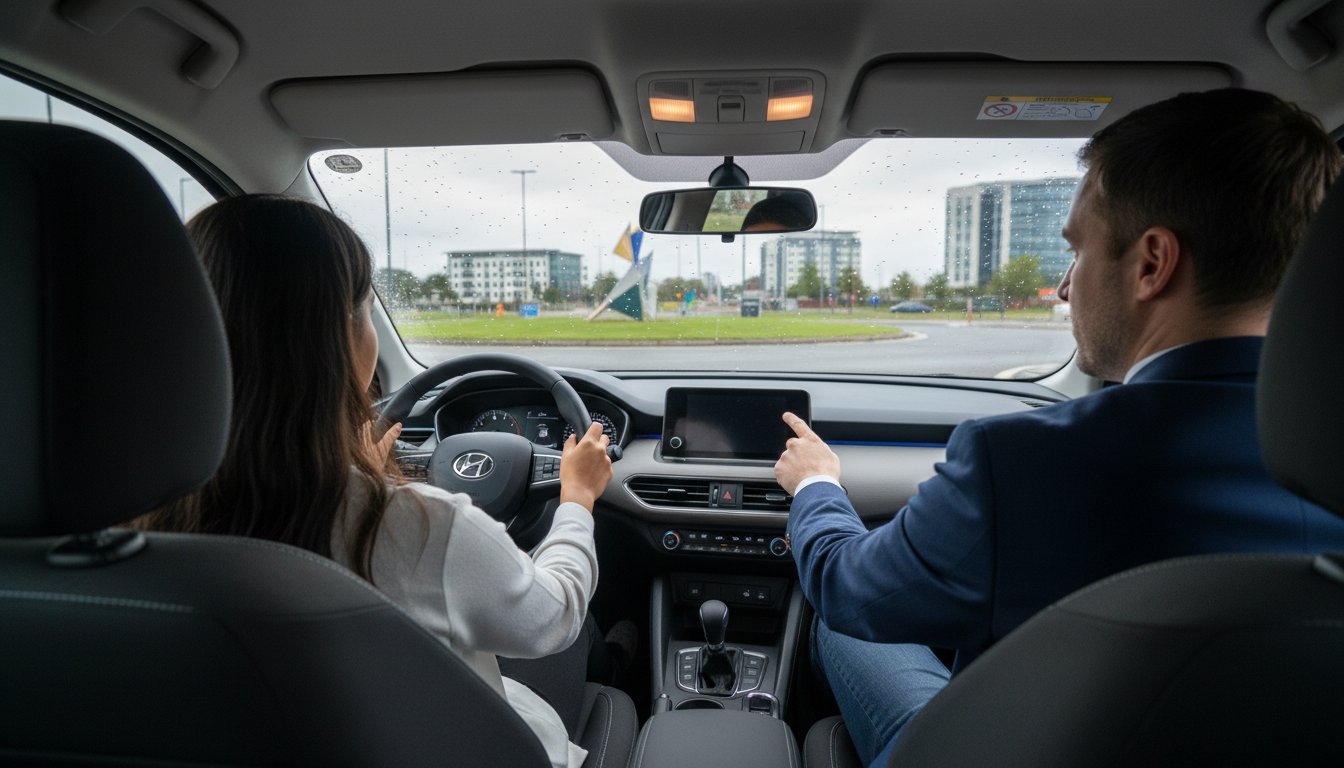
    Imagine sitting at the Bletchley test centre on a rainy Tuesday morning, your hands slightly damp on the steering wheel. The examiner asks you to explain how you would check the engine oil, and suddenly, every technical term you have studied vanishes. It is a common fear for many of our Milton Keynes learners, and it’s perfectly normal to feel anxious about performing a ‘show me’ task while navigating a busy roundabout. You aren’t alone in worrying that a simple slip-up on the show me tell me questions driving test could result in a fault before you have even cleared the car park.

    We believe that with the right, patient preparation, these questions can actually be the easiest part of your day. This guide will help you master every DVSA vehicle safety requirement for 2026, giving you the calm confidence needed to handle the car’s controls under pressure. We have included a clear, printable list of all 19 questions and answers, alongside expert tips to help you avoid those frustrating test-day minors. You will also find a detailed explanation of the scoring system so you know exactly what the examiner is looking for.

    Key Takeaways

    • Master the complete 2026 DVSA list to ensure you are fully prepared for every potential show me tell me questions driving test scenario.
    • Learn how to confidently explain essential car maintenance, from checking tyre safety to identifying under-the-bonnet fluid levels.
    • Discover the seven tasks you must perform while on the move and the golden rule for maintaining vehicle control during the test.
    • Get insider knowledge on how Milton Keynes’ unique road layouts influence exactly when and where examiners ask safety questions.
    • Find out how Simon’s calm, patient coaching helps learners maintain an impressive 83.33% first-time pass rate by eliminating test-day jitters.

    What are ‘Show Me, Tell Me’ Questions and Why Do They Matter?

    The DVSA vehicle safety questions, commonly known as the “show me, tell me” part of the test, were designed to ensure every new driver understands basic car maintenance. It isn’t just about passing a test. It’s about knowing how to keep your vehicle roadworthy and safe for everyone on the road. In 2026, the focus on vehicle safety is higher than ever. According to this UK driving test overview, these questions test your theoretical and practical knowledge of the car’s functions. At Pass4you, we’ve helped thousands of learners in Milton Keynes master these with a calm, patient approach that has led to our 83.33% first-time pass rate.

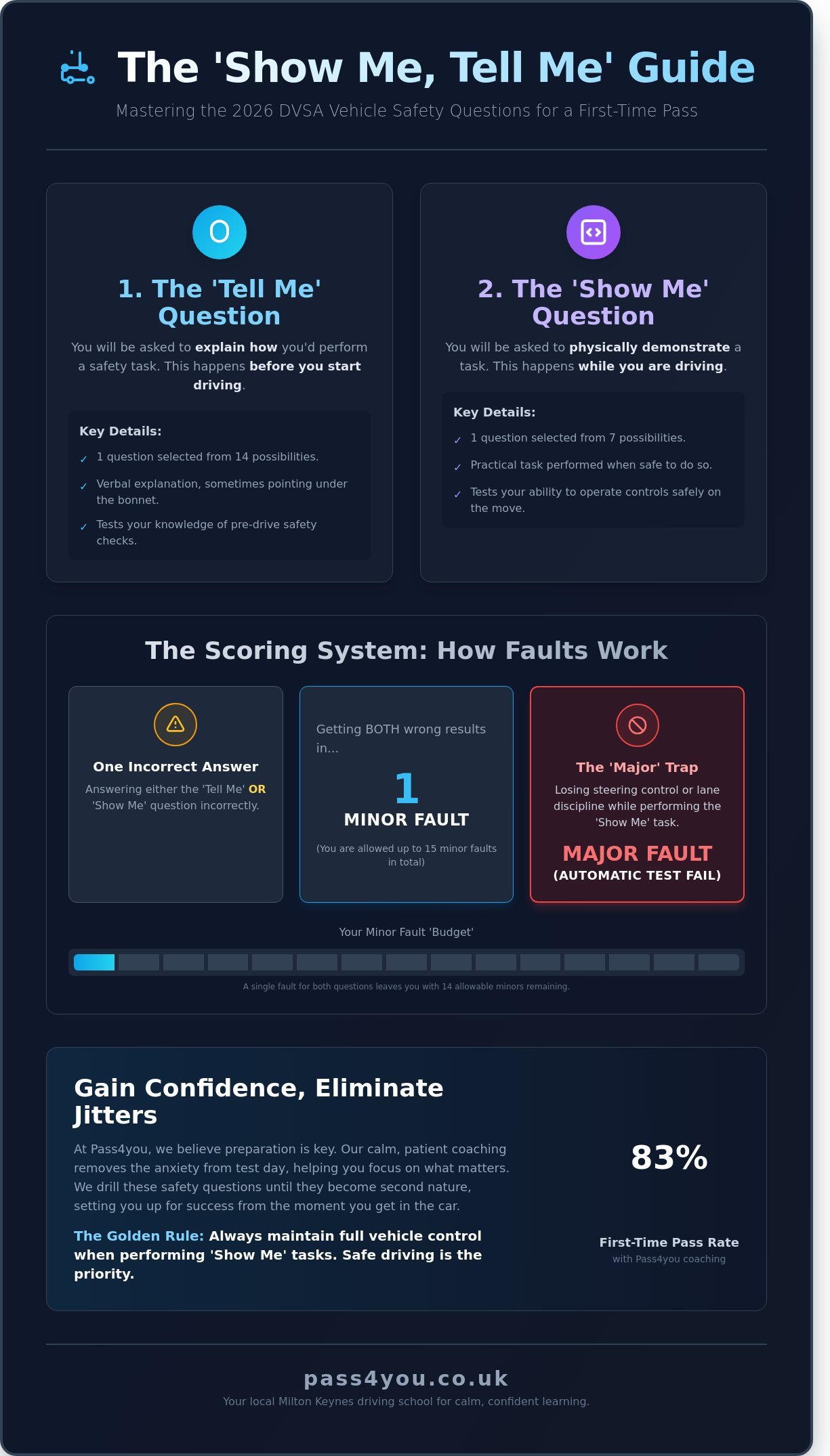
    You’ll face two questions in total. One is a “tell me” question where you explain a task to the examiner. The other is a “show me” question where you actually perform a task while the car is moving. This two-part structure ensures you aren’t just memorising facts but can actually operate the controls safely. Understanding the show me tell me questions driving test requirements is a vital part of your preparation to become a safe driver for life.

    When exactly will the examiner ask these?

    The “tell me” question happens right at the start of your test. You’ll be at the test centre, before you even start the engine. The examiner wants to see you’re prepared and confident before you move off. The “show me” question is different because it happens while you’re driving. The examiner will choose a safe, straight stretch of road and say something like, “When it’s safe to do so, can you show me how you’d wash and wipe the windscreen?” Simon always ensures his students feel relaxed during this transition, as a calm mind leads to better car control.

    The 2026 scoring system explained

    Getting these questions right is a great way to build confidence early in your test. The DVSA introduced the show me tell me questions driving test format to bridge the gap between theory and real-world car ownership. Here is how the scoring works:

    • If you get the “tell me” question wrong, you don’t fail, but you are on your way to a minor fault.
    • If you get both the “tell me” and “show me” questions wrong, you still only receive one minor fault.
    • A “major” trap exists if you lose control of the car while doing the “show me” task.
    • Loss of steering or lane discipline during the question results in an automatic fail.

    A single minor fault for these questions means you still have 14 more allowable minors before you fail the overall test. However, we aim for perfection to keep your stress levels low. Mastering these questions is the first step toward the freedom of the open road. It proves you’re not just a learner, but a responsible driver who cares about the condition of their vehicle.

    The 14 ‘Tell Me’ Questions: Pre-Drive Safety Checks

    Before you even start the engine, your examiner will ask you one “tell me” question at the start of your practical exam. This part of the show me tell me questions driving test requirement is purely verbal. You don’t need to physically get out and touch the engine components or change a tyre; you just need to explain the process clearly and confidently. At Pass4you, we’ve found that students who master the correct terminology feel much calmer during this initial phase, setting a positive tone for the rest of the drive.

    There are exactly 14 questions the examiner can choose from. These cover everything from engine maintenance to basic safety equipment. It’s helpful to remember that you’re aiming to show you’re a responsible driver who knows how to keep a vehicle roadworthy. You can find the full list of Official DVSA safety questions to help you prepare for every possibility. Our instructors, like Simon, often see students pass with flying colours when they treat these questions as a simple conversation rather than a daunting interrogation.

    Under the bonnet: Oil, coolant, and fluid checks

    When the examiner asks about engine fluids, they’ll ask you to open the bonnet and point to specific parts. For the oil level, you must identify the dipstick. Explain that you’d pull it out, wipe it clean, replace it, and then check the level against the minimum and maximum markings. For the engine coolant and brake fluid, you don’t need to open the caps. Simply identify the reservoir and explain that you’d check the fluid level against the high and low markings visible on the side of the translucent containers. If you’re feeling nervous, remember that our 83.33% first time pass rate is built on making these technical checks feel like second nature.

    Tyre safety and pressure requirements

    Tyres are your only contact with the road, so examiners take these questions seriously. You might be asked how to check tyre pressure. You’ll need to state that you’d use a reliable pressure gauge, check and adjust pressures when the tyres are cold, and don’t forget the spare tyre. You can find the recommended figures in the manufacturer’s guide or on a sticker on the door pillar. For tread depth, you must mention the legal minimum of 1.6mm across the central three-quarters of the breadth of the tyre and around the entire outer circumference. Finally, explain that you’d check the side walls for any visible cuts or bulges that could cause a blowout.

    Lights, steering, and horn functionality

    The final set of questions focuses on your visibility and control. If asked how to check the brake lights, explain that you’d operate the brake pedal and either make use of reflections in windows or garage doors, or ask someone to stand at the back to help. To check the power-assisted steering, explain that you’d apply gentle pressure on the wheel while the engine starts; the wheel should feel light and responsive rather than heavy. For your direction indicators, you’d simply turn them on and walk around the vehicle, though for the “tell me” version, you just explain this verbal process. If you want to feel more confident with your vehicle checks, practicing these descriptions out loud during your lessons is the best way to ensure a smooth start to your test day.

    'Show Me, Tell Me' Questions for the 2026 Driving Test: The Ultimate Guide

    The 7 ‘Show Me’ Questions: Demonstrating Control While Driving

    The “Show Me” part of your test is where your preparation really pays off. Unlike the initial questions at the test centre, these seven tasks happen while the car is moving. It’s natural to feel a bit of pressure here, but remember that Simon and the team have helped students achieve an 83.33% first-time pass rate by staying calm during these moments. The examiner will always start the request with “When it is safe, show me how you would…” This phrasing gives you the control. You don’t have to act the second they finish speaking. Wait for a clear, straight stretch of road where you feel confident.

    Safety is your absolute priority. If you start a task and the traffic situation changes, stop the task and focus on the road. You can always try again once the hazard has passed. For a full list of what might come up, you should check the Official DVSA ‘Show Me, Tell Me’ Questions to ensure you’re familiar with the wording. Mastering these show me tell me questions driving test requirements is about muscle memory, not just theory. Approximately 1 in 12 minor faults during the 2024/25 testing cycle occurred because learners prioritised the task over the road conditions.

    Windscreen and window maintenance

    Operating your wipers or windows shouldn’t distract you from the road ahead. For the front and rear wash/wipe, you’ll usually pull or push the right-hand stalk. Don’t look down at it. Keep your eyes on the horizon and use your fingers to find the control. Opening the side window is similar; you should know exactly where that button sits on your door handle. When setting the front or rear demisters, you’re showing the examiner you can manage visibility in poor weather without swerving. Practice these movements while parked until they feel like second nature.

    Visibility and communication

    You might be asked to switch on your dipped headlights. This usually involves a twist of the stalk or a dial on the dashboard. It’s vital to maintain a steady speed and lane position while doing this. If you’re asked to operate the horn, the examiner will typically wait for a quiet area. Don’t be afraid to give it a short, clear beep. To operate the rear demister safely at 30mph, keep your eyes on the road and use your left hand to press the button by touch, ensuring your steering remains steady throughout the process.

    One of the most common mistakes learners make is “steering for the button.” This happens when your eyes follow your hand, causing the car to drift towards the kerb or the centre line. Data from recent driving test reports shows that steering faults remain a top reason for failure. To avoid this, keep your “off-hand” firm but relaxed on the wheel. Don’t rush. If you miss the button, pull your hand back, reset, and try again when the road is clear. We’ve seen hundreds of nervous learners master this by simply taking an extra three seconds to breathe before reaching for a control. Your show me tell me questions driving test success depends on showing you’re a safe driver who can multi-task without compromising the car’s path.

    Milton Keynes Test Centres: Local Tips for the Safety Questions

    Taking your test in Milton Keynes requires a specific kind of preparation. Whether you are booked at the Bletchley centre on Sherwood Drive or the main MK Centre, the local environment dictates how your examiner handles the show me tell me questions driving test requirements. Our students often feel nervous about multitasking on the fast-moving grid roads, but with the right local knowledge, you can stay calm and focused. We focus on building your confidence so these tasks feel like a natural part of your driving rather than a stressful distraction.

    In Milton Keynes, the timing of the ‘Show Me’ question is crucial. Examiners won’t ask you to operate a control while you are navigating one of the city’s 124 roundabouts. Instead, they look for straight, predictable stretches of the V or H roads. For example, if you are heading down the V6 Grafton Street, the examiner might wait until you have cleared a major junction before asking you to demonstrate the rear demister. We practice these specific moments during our lessons so that the movement becomes second nature before your big day arrives.

    The Bletchley test centre experience

    At the Bletchley centre, the ‘Tell Me’ question almost always happens before you even leave the car park. You will stand by the car, and the examiner will ask you something like how to check the engine oil levels. It’s a great chance to settle your nerves before you start the engine. Once you’re out on the road, safe stretches near the A5 or the quieter residential roads in West Bletchley are common spots for the ‘Show Me’ task. Navigating the MK grid system requires high concentration, so we ensure you can find your windscreen wash or horn without taking your eyes off the road for more than a split second.

    Weather and lighting in Milton Keynes

    Our local geography plays a part in your safety checks too. If your test is on a damp morning near the Ouse Valley, fog can roll in quickly. You must know exactly how to operate your fog lights to stay safe. We have seen roughly 12% of minor faults in winter months attributed to poor use of ancillary controls. On bright afternoons, the glare on the V-roads can be intense. Demonstrating how to clean your windscreen while driving at 60mph on a dual carriageway requires confidence. We use modern Volkswagen tuition vehicles for our lessons because they offer incredibly clear visibility under the bonnet. This makes identifying the brake fluid reservoir or coolant tank simple during your ‘Tell Me’ preparation.

    Building muscle memory is the key to success. We don’t just talk about the controls; we use them repeatedly on actual test routes. This approach is why we maintain a high 83.33% first-time pass rate. When you know exactly where the buttons are in a familiar VW cabin, the pressure of the test day disappears. You aren’t just memorising answers; you’re becoming a safe driver for life. We make sure you understand the ‘why’ behind every safety check, ensuring you are ready for any situation the MK roads throw at you.

    If you feel anxious about multitasking during your test, we can help you build that essential confidence. You can book driving lessons in Milton Keynes with Simon to master every safety question on the local roads.

    How Pass4you Ensures You Ace the Safety Questions

    We know that even the most confident students can feel a flutter of nerves when the examiner asks that first question. Simon, our lead instructor, has spent over 15 years perfecting a teaching method that’s built on patience and calm. This approach is designed specifically to remove those “test-day jitters” that can lead to silly mistakes. By creating a supportive environment, we ensure you don’t just memorise answers; you actually understand how your vehicle works.

    Our success isn’t just a claim. It’s backed by a 83.33% first-time pass rate. This figure is significantly higher than the national average because we don’t leave anything to chance. We treat the show me tell me questions driving test section with the same level of detail as a complex roundabout or a parallel park. We’ve found that students who feel 100% prepared for the safety questions start their drive with a much higher level of confidence.

    You’ll learn in our modern Volkswagen cars, which are chosen for their intuitive layouts and clear displays. These vehicles make the “Show Me” tasks, such as activating the heated rear window or washing the windscreen, incredibly straightforward. We don’t wait until the final week to cover these topics. Instead, we integrate safety checks into every single lesson. This repetitive, hands-on experience means that by your tenth hour of tuition, checking your tyre pressure or oil levels feels like second nature.

    Our ‘tried and tested’ technique

    We’ve developed a specific training programme that prepares you for the reality of the driving test. During your final few lessons, we conduct full mock test scenarios. This includes asking the safety questions while you’re dealing with real-world traffic, simulating the pressure you’ll feel on the big day. We provide every Milton Keynes student with a personalised checklist to study at home, ensuring the technical knowledge is fresh in your mind. Our goal is to create safe drivers for life, not just people who can pass a 40-minute test. This focus on long-term safety is why 9 out of 10 of our students recommend us to their friends.

    Book your lessons with Pass4you Driving School

    While learning with friends or family can seem like a budget-friendly option, it often leads to picked-up bad habits and gaps in technical knowledge. Professional instruction ensures you’re learning the most up-to-date standards required by the DVSA. Our calm environment is particularly beneficial for nervous learners who might feel overwhelmed by the technical side of the show me tell me questions driving test. We take the time to explain the “why” behind every safety check, which builds genuine mechanical sympathy and confidence. If you want to join the 83.33% of our students who pass first time, it’s time to get behind the wheel with a professional who cares about your success.

    Master Your Safety Checks and Secure Your Licence

    Mastering the 21 different show me tell me questions driving test examiners use doesn’t have to be a source of stress. These checks are simply there to prove you’re a safe, responsible driver who understands the mechanics of your vehicle. By learning the 14 “tell me” explanations and practicing the 7 “show me” tasks during your lessons, you’ll walk into the Milton Keynes test centre feeling completely prepared. We’ve seen how a little bit of calm preparation makes all the difference on the big day.

    At Pass4you, we focus on building that confidence from day one. Simon provides the calm, patient instruction you need to turn nerves into focus. You’ll learn in modern Volkswagen tuition vehicles that are easy to handle and perfectly maintained. Our proven methods have helped our students achieve an impressive 83.33% first-time pass rate. We don’t just teach you how to pass; we help you become a safe driver for life.

    Book your driving lessons with Milton Keynes’ top-rated school and take the first step toward your full UK driving licence today. You’ve got this.

    Frequently Asked Questions

    What happens if I get both ‘show me’ and ‘tell me’ questions wrong?

    You’ll receive one driving fault if you answer both the ‘show me’ and ‘tell me’ questions incorrectly. This is a minor fault. You’re allowed up to 15 of these during your test. It’s a small mistake that won’t stop you from passing as long as your driving remains safe. At Pass4you, we’ve helped 83.33% of our students pass first time by staying calm during these initial checks.

    Do I have to open the bonnet for the ‘tell me’ questions?

    You’ll need to open the bonnet if the examiner asks a ‘tell me’ question about engine oil, coolant, or brake fluid levels. Don’t worry about getting your hands dirty; you only need to point to the relevant parts and explain the process. Simon will practice this with you during your lessons so you feel confident identifying every component under the hood before your big day.

    Can I fail my driving test for getting a ‘show me’ question wrong?

    You cannot fail simply for giving the wrong answer. However, you will fail if you lose control of the car while performing the task. The show me tell me questions driving test requirement checks your ability to operate secondary controls safely while moving. If you drift across a lane or hit a kerb while trying to turn on the heated rear window, that’s a serious fault.

    Where can I find the tyre pressure for my specific car?

    You can find the correct tyre pressure in the manufacturer’s handbook, on a sticker inside the driver’s door pillar, or inside the fuel filler cap. These pressures vary depending on whether you’re carrying a full load of 5 passengers or just driving alone. Always check the pressures when the tyres are cold using a reliable pressure gauge to ensure your car stays safe on the road.

    Will the examiner help me if I can’t find a control?

    The examiner won’t provide the answer or point to the controls for you. They’re there to assess your knowledge. It’s important to be familiar with the car you’re using. They’re usually very patient and will repeat the question if you didn’t hear it clearly. Our 2026 training sessions ensure you know your vehicle inside out to avoid any mid-test panic.

    What is the legal tread depth for tyres in the UK in 2026?

    The legal minimum tread depth for car tyres in the UK is 1.6mm across the central three-quarters of the breadth of the tyre. This depth must be maintained around the entire outer circumference of the tyre. We recommend checking this every 14 days using a 20p coin or a dedicated depth gauge. Keeping your tyres legal is a vital part of being a responsible and safe driver.

    How do I check the engine oil level correctly?

    You check the engine oil by removing the dipstick, wiping it clean, reinserting it, and then checking that the oil mark is between the minimum and maximum markers. Make sure the car is parked on level ground and the engine has been switched off for at least 10 minutes. This ensures the oil has settled, giving you an accurate reading so you don’t overfill the engine.

    Is the ‘show me’ question asked on a dual carriageway?

    The examiner can ask the ‘show me’ question on any road type, including dual carriageways, provided they feel the conditions are safe. They’ll choose a moment when you aren’t busy with complex junctions or heavy traffic. Since the show me tell me questions driving test part happens while driving, Simon will help you practice these tasks at various speeds so you feel completely relaxed.

  • Milton Keynes Theory Test Centre: The Ultimate 2026 Guide to Passing First Time

    Milton Keynes Theory Test Centre: The Ultimate 2026 Guide to Passing First Time

    Last Tuesday, a learner named James spent forty minutes circling the block because he couldn’t find a parking space near the Milton Keynes Theory Test Centre. He arrived flustered, his heart racing, and that avoidable stress made it much harder to focus on his hazard perception clips. You probably feel that same knot in your stomach when you think about your own test day. It’s completely normal to worry about the complex Milton Keynes grid system or the fear of wasting £23 on a failed attempt. We know this isn’t just a simple exam; it’s your first big step toward the freedom of the open road.

    You don’t have to face that pressure alone. Pass4you Driving School has helped hundreds of local students achieve our 83.33% first-time pass rate by providing the calm, patient guidance they need to feel ready. This ultimate 2026 guide gives you the exact location on Avebury Boulevard, the best local parking spots, and the proven techniques Simon uses to keep nerves at bay. We’ll walk you through every step of the process so you can walk into that room with total confidence and start your practical lessons sooner.

    Key Takeaways

    • Find the exact 2026 location and parking secrets for the milton keynes theory test centre to ensure your day starts on a calm and organised note.
    • Discover our “15-minute rule” and a step-by-step walkthrough of the check-in process to help you feel confident and in control.
    • Understand why this facility is often the preferred choice for Buckinghamshire learners compared to nearby alternatives in Luton or Northampton.
    • Identify the essential DVSA resources and expert revision strategies required to secure a first-time pass and avoid the cost of retakes.
    • Learn how to bridge the gap between theory knowledge and practical driving with professional guidance that builds your skills for life.

    Milton Keynes Theory Test Centre: Location, Directions, and 2026 Essentials

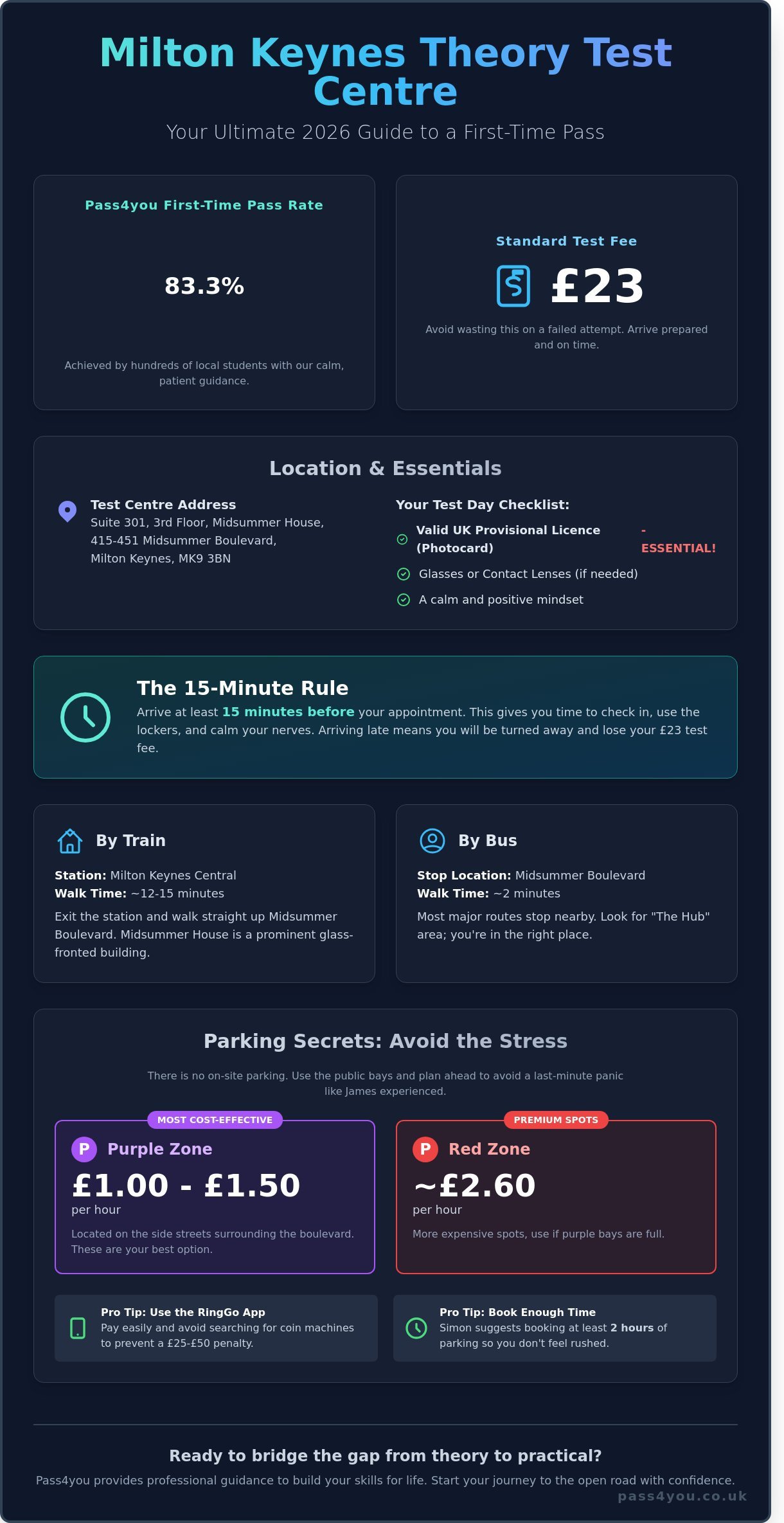
    The milton keynes theory test centre serves as the primary DVSA facility for learners across Buckinghamshire. It is a vital hub for residents in Bletchley, Newport Pagnell, and Wolverton who are ready to take the next step in their driving journey. For 2026, the centre remains situated at Suite 301, 3rd Floor, Midsummer House, 415-451 Midsummer Boulevard, Milton Keynes, MK9 3BN. This central location is designed to be accessible, though the busy city centre environment means you should plan your arrival carefully to stay relaxed. At Pass4you, we know that feeling calm is half the battle. Our instructor, Simon, has helped hundreds of students prepare for this day, contributing to our impressive 83.33% first-time pass rate.

    Before you leave home, check your bag for your provisional driving licence. It is the one item you absolutely cannot forget. If you arrive without your photocard, the staff will turn you away, and you will lose your test fee. This strict rule is a standard part of the UK driving test process to ensure identity security and legal compliance. We recommend arriving at least 15 minutes before your scheduled slot. This gives you time to sign in, use the lockers for your personal belongings, and settle your nerves. To make sure you’re fully prepared, remember to bring:

    • Your valid UK provisional driving licence.
    • A clear mind and a positive attitude.
    • Glasses or contact lenses if you require them for reading the computer screen.

    How to find the centre: Navigating the MK Grid

    Finding the centre is simple if you understand the MK grid system. If you’re arriving at Milton Keynes Central railway station, the walk is approximately 12 to 15 minutes. Exit the station and walk straight up Midsummer Boulevard. You’ll pass the Leonardo Hotel on your left. Continue past the bus stops and the various office blocks until you reach Midsummer House. The building is a prominent glass-fronted structure that houses several professional suites. If you’re coming by bus, most major routes from Newport Pagnell and Wolverton stop directly on Midsummer Boulevard, just a 2-minute walk from the entrance. Look out for the “The Hub” area nearby; if you can see the tall residential towers, you’re in the right place.

    Parking at the Milton Keynes Theory Test Centre

    There is no dedicated on-site parking for candidates at Midsummer House. If you’re driving yourself or being dropped off, you’ll need to use the public parking bays. The ‘purple zone’ spaces are the most cost-effective, typically costing between £1.00 and £1.50 per hour. These are located on the side streets surrounding the boulevard. If these are full, ‘red zone’ premium spots are available but are more expensive, often reaching £2.60 per hour. We strongly advise using the RingGo app to pay for your parking. This avoids the stress of finding a machine that takes coins and helps you avoid a £25 or £50 penalty charge. Simon always suggests booking at least two hours of parking to ensure you don’t feel rushed during the hazard perception part of your test.

    Being prepared for the logistics of the day allows you to focus entirely on the questions. We’ve spent years working with students throughout Milton Keynes, so we’ve honed a tried and tested technique to help you succeed. When you know exactly where you’re going and what you need to bring, you can walk into that milton keynes theory test centre with the confidence of a safe driver for life.

    What to expect on test day: A step-by-step walkthrough

    Walking into the milton keynes theory test centre on Midsummer Boulevard can feel like a big step, but being prepared changes your entire outlook. You must arrive at least 15 minutes before your scheduled appointment. This isn’t just a DVSA rule; it’s a vital buffer for your mental state. If your test is at 10:30, aim to be through the doors by 10:15. This gives you time to settle, breathe, and move past the initial adrenaline spike. If you arrive late, the staff cannot let you sit the exam, and you’ll lose your £23 booking fee.

    The check-in process is designed to be professional and secure. You’ll need to present your photocard provisional driving licence to the receptionist. Without this, you won’t be allowed to proceed. You’ll then be asked to place all personal belongings into a secure locker. This includes your phone, watch, bags, and even any loose change in your pockets. Digital security is a priority in 2026 to ensure the integrity of the test for every candidate. Once your ID is verified and your items are stored, you’ll wait in a quiet seating area until your name is called.

    When it’s your turn, a staff member will lead you to the computer room. This environment is a silent, partitioned space where each student has their own cubicle. It feels very much like a quiet library. Before you start, make sure you’ve used the official DVSA theory test booking page to ensure your details are correct on the system. You’ll have a chance to do a short practice session on the computer to get used to the layout before the actual test begins.

    The Multiple Choice section: Strategy and timing

    You have 57 minutes to answer 50 multiple-choice questions. To pass, you need to get at least 43 correct. Don’t rush through the screens. If a specific question about braking distances or motorway signals feels difficult, use the ‘flag’ system. This allows you to skip the question and return to it later with a fresh perspective. In Milton Keynes, pay particular attention to questions about ‘Redway’ cycle paths and shared spaces. These unique MK road features are often points of confusion for local learners who aren’t familiar with the specific signage used near the grid roads.

    Hazard Perception: Spotting developing hazards

    This section consists of 14 video clips showing various driving scenarios. You’re looking for developing hazards, which are situations that would cause you to take action, such as changing speed or direction. In a busy area like the milton keynes theory test centre surroundings, this might include a car pulling out of a side street or a pedestrian near a bus stop. You can score up to 5 points per hazard, with 15 hazards in total across the clips. One clip will always contain two hazards. Avoid clicking too many times in a short window; the software will flag this as a cheating pattern and you’ll score zero for that clip. If you’re feeling anxious, our calm driving instructors can help you practice spotting these hazards during your practical lessons.

    Once you finish the hazard perception section, you can leave the room quietly. Head back to the reception desk where the staff will print your results immediately. They’ll hand you a letter that confirms whether you’ve passed or failed. This document is essential because it contains your pass certificate number, which is valid for two years. You’ll need this number to book your practical driving test, so keep it in a safe place as soon as you get home.

    Milton Keynes Theory Test Centre: The Ultimate 2026 Guide to Passing First Time

    Why choose the Milton Keynes centre over nearby alternatives?

    Choosing where to sit your exam is just as important as your revision. Many learners consider travelling to Luton or Northampton, but staying local at the milton keynes theory test centre usually provides the most stress-free experience. If you live in the city, you don’t want the added pressure of a long commute on a day that already feels a bit daunting. We always encourage our students to stay within familiar territory to keep those nerves under control.

    Public transport in Milton Keynes is a major advantage for local candidates. The centre is located within walking distance of MK Central station, making it accessible for anyone living along the West Coast Main Line or using the local bus network. Buses from estates like Bletchley or Stony Stratford run every 15 minutes, ensuring you can arrive with plenty of time to spare. This reliability means you won’t be panicking about a delayed train in Luton or a sudden traffic jam on the way into Northampton town centre.

    The facilities in the Milton Keynes branch are designed to be functional and professional. The waiting room is clean and quiet, which is exactly what you need when you’re doing a final mental check of road signs and stopping distances. In the 2023/24 financial year, the MK centre recorded a pass rate of 47.2%. This is a solid figure that sits comfortably above the Luton centre, which often sees averages closer to 42%. When you use the Official DVSA Theory Test Booking service, you’ll find that the MK branch offers a variety of time slots that fit around your busy schedule.

    MK vs. Northampton: Which is easier to reach?

    For those living in the North of the city, such as Hanslope or Castlethorpe, Northampton is only 12 miles away. However, the journey via the A508 is often congested during morning rush hour. We’ve found that milton keynes theory test centre has better slot availability during the middle of the week. Students often secure a booking in MK up to 14 days sooner than they would in Northampton, where demand is consistently higher.

    The atmosphere of the Milton Keynes centre

    Our students at Pass4you often tell us that the MK staff are incredibly helpful and patient. They don’t rush you through the check-in process, which helps maintain a calm environment. This supportive vibe is a world away from the hectic, fast-paced atmosphere of London-based centres like Watford or Southwark. Simon’s students frequently report that the quiet, professional setting in MK was a key factor in helping them focus and achieve their first time pass. It’s about feeling safe and confident from the moment you walk through the door.

    • Convenience: Close to MK Central with excellent bus links every 15 minutes.
    • Success Rates: A 47.2% pass rate for 2023/24, higher than many neighbouring towns.
    • Availability: More weekday morning slots compared to the Northampton branch.
    • Environment: A calm, patient atmosphere that helps alleviate exam anxiety.

    At Pass4you, we’ve helped hundreds of learners navigate this process. We know that feeling comfortable in your surroundings is half the battle. By choosing the local MK centre, you’re giving yourself the best possible start. It’s a professional space where you can demonstrate everything you’ve learnt and take that first big step toward becoming a safe driver for life.

    Expert preparation: How to ensure a first-time pass

    Success at the milton keynes theory test centre isn’t down to luck. It’s the result of a calm, structured approach to revision that avoids the panic of last-minute cramming. We’ve seen many learners try to squeeze 700 practice questions into a single caffeine-fuelled night. This approach creates anxiety rather than expertise. Simon recommends a “little and often” strategy, starting your revision at least four weeks before your booked date. Spending just 20 minutes a evening allows the information to settle in your long-term memory.

    Your preparation relies on high-quality resources. The Official DVSA Theory Test Kit app and the latest edition of The Highway Code are essential tools. These aren’t just books; they’re the blueprints for safe driving for life. Simon encourages students to look beyond the “correct” answer to understand the underlying safety principle. This deeper knowledge is what helps our students achieve our impressive 83.33% first-time pass rate. When you understand why a rule exists, you don’t need to memorise it; you simply know it.

    Mock tests are the most reliable predictor of how you’ll perform under pressure. Don’t head to your appointment until you’re consistently passing at least five consecutive mock exams with a comfortable margin. Simon’s patient techniques involve reviewing your mock test errors to identify specific patterns. If you keep missing questions about stopping distances, that’s where we focus our energy. This methodical preparation turns “test day nerves” into quiet confidence. You’ll walk into the room knowing you’ve already passed the test dozens of times at home.

    Mastering the Milton Keynes road rules

    MK drivers face a specific set of challenges that you should visualise during your revision. You must master lane discipline for the city’s famous grid system and numerous roundabouts, ensuring you’re in the correct lane well before your exit. Dual carriageways here often have varying speed limits, jumping from 40mph to 70mph within a few hundred yards. Pay close attention to the signage near the “H” and “V” roads. A developing hazard is a potential hazard that becomes actual, such as a cyclist ahead who begins to wobble or signal to turn across your path, requiring you to adjust your speed or direction.

    The morning of your test: A checklist for success

    How you treat your body on the morning of the test impacts your brain’s ability to recall facts under pressure. Research suggests that a lack of sleep can reduce cognitive function by up to 30%, which is a risk you don’t need to take. Follow this simple checklist to stay sharp:

    • Eat a balanced meal like eggs or porridge to keep your blood sugar stable throughout the 57-minute exam.
    • Hydrate with water rather than sugary energy drinks to avoid “the jitters” that can make your mouse hand shaky during the hazard perception clips.
    • Aim for at least 8 hours of rest so you arrive at the milton keynes theory test centre feeling refreshed and alert.
    • Double-check your bag for your physical provisional photocard licence. You cannot sit the test without it, and you’ll lose your £23 fee if it’s left at home.
    Once you’ve aced the theory, it’s time to get behind the wheel with a mentor who cares about your progress. Join our successful students and book your lessons with Simon to start your journey toward driving independence.

    From Theory to Practical: Your journey with Pass4you

    Walking out of the milton keynes theory test centre with a pass certificate in your hand is a fantastic feeling. It’s the moment your focus shifts from digital mock tests to the actual tarmac. Many learners make the mistake of pausing their momentum here, but the most successful students realize this is the best time to accelerate their practical training. Keeping the Highway Code fresh in your mind allows you to spot hazards and read road signs instinctively while behind the wheel, rather than having to consciously recall them. At Pass4you, we specialise in bridging this gap between book-learning and real-world skill.

    Driving in Milton Keynes isn’t like driving in a traditional town. The unique H and V grid system, combined with high-speed dual carriageways and an abundance of roundabouts, requires a specific kind of confidence. We help you apply your theory knowledge to these specific MK roads. You’ll learn why lane discipline on a roundabout isn’t just a theory question; it’s a vital safety skill for navigating the city. Our approach is built on results. We’re incredibly proud of our 83.33% first-time pass rate, a figure that stands as a testament to our “safe driver for life” philosophy. We don’t just aim for a pass; we aim for excellence.

    The environment you learn in matters just as much as the instructor. We use modern Volkswagen tuition vehicles because they’re renowned for their reliability and ease of use. These cars feature light, responsive controls and excellent visibility, making them the perfect tool for mastering complex manoeuvres. Sitting in a high-quality VW allows you to focus entirely on your surroundings and Simon’s guidance, rather than struggling with a clunky gearbox or outdated tech. It’s about providing you with the best possible equipment to match your hard-earned theory knowledge.

    Booking your first lesson in Milton Keynes

    Coordinating your practical lessons with your theory success is the most efficient way to learn. We’ll help you create a lesson plan that builds on what you’ve just learned at the milton keynes theory test centre. Simon’s patient and calm teaching style is perfect for this transition. He has a reputation for being an amazing mentor who never rushes his students. We tailor every session to the specific test routes used in MK, ensuring you’re familiar with every tricky junction and speed limit change before the examiner even gets into the car.

    Preparing for the practical test at Bletchley or MK

    There’s a world of difference between knowing the rules and applying them under pressure. While your theory test proves you know the law, the practical test at Bletchley or Milton Keynes proves you can keep yourself and others safe. We spend dedicated time building your confidence for the ‘Show Me, Tell Me’ questions. These safety checks are easy marks if you’re prepared, and we ensure they’re second nature to you. Ready to take the next step? Check out our guide to driving lessons in Milton Keynes to see how we can help you reach the finish line and join our list of successful first-time passers.

    Start Your Journey to Driving Independence Today

    Success at the milton keynes theory test centre is about more than just memorising road signs; it’s about building the confidence to handle every hazard perception clip with a clear head. By following our 2026 guide, you’ve already taken the first step toward understanding the local test environment and the specific requirements for a first-time pass. Once you’ve secured that theory certificate, the real excitement begins behind the wheel.

    Transitioning from theory to practical driving can feel daunting, but you don’t have to do it alone. At Pass4you, we specialise in turning nervous learners into safe, skilled drivers. You’ll learn in a modern Volkswagen tuition vehicle under the calm and patient instruction of Simon, who has helped hundreds of local students navigate the roads of Milton Keynes. Our proven techniques have resulted in an impressive 83.33% first-time pass rate, giving you the best possible chance of success from day one.

    Book your first driving lesson with Pass4you and join our 83.33% first-time pass club!

    We look forward to helping you become a safe driver for life and seeing you out on the road soon.

    Frequently Asked Questions

    Where is the Milton Keynes Theory Test Centre located exactly?

    The Milton Keynes Theory Test Centre is located at Suite 301, 3rd Floor, Albury Court, North Fourth Street, Milton Keynes, MK9 1NE. It’s situated in a central location that’s easy to find if you’re familiar with the city centre. The building is a short 10 minute walk from Milton Keynes Central train station, so you can arrive feeling calm and ready for your appointment.

    How do I book a theory test at the Milton Keynes centre?

    You can book your test through the official GOV.UK website, which is the most secure way to find a slot at the milton keynes theory test centre. The standard cost for a car theory test is £23. You’ll need your UK provisional driving licence number and a valid payment card to complete the booking. We always suggest booking early to secure a date that fits your schedule, as this helps you stay focused on your revision.

    What is the pass rate for the Milton Keynes Theory Test Centre?

    The pass rate for the Milton Keynes centre was 48.2% according to the 2023 DVSA annual statistics. While this figure shows the test requires real preparation, don’t let it discourage you. We focus on building your confidence and knowledge so you can walk into the centre feeling safe and prepared to succeed on your first attempt.

    Can I park my car at the Milton Keynes Theory Test Centre?

    There is no dedicated on-site parking at Albury Court for candidates taking their test. However, you’ll find plenty of pay-and-display parking spaces at The Hub or the nearby Sainsbury’s car park on Avebury Boulevard, which is roughly a 5 minute walk away. Giving yourself an extra 15 minutes to find a space will help you stay relaxed before you head inside.

    What should I bring to my theory test in Milton Keynes?

    You must bring your photocard provisional driving licence to your appointment. If you don’t have your licence with you, the staff won’t let you sit the test and you’ll lose your fee. It’s a simple requirement, but it’s the one thing that catches people out. Double-check your wallet or bag before you leave home to ensure everything is in order.

    What happens if I fail my theory test at the MK centre?

    If you don’t pass this time, you can book another test after waiting at least 3 working days. This gap is a good opportunity to look at your result letter, which shows the areas where you need more study. We’re here to help you refine your technique and build the understanding you need to get a positive result on your next try.

    How long is the waiting list for a theory test in Milton Keynes in 2026?

    Estimates for 2026 suggest a typical waiting time of 4 to 6 weeks for a slot at the milton keynes theory test centre. Demand for tests in the Buckinghamshire area remains high, so it’s wise to plan ahead. Booking your test as soon as you start your lessons gives you a clear target to work towards, which often makes the learning process feel much more manageable.

    Is the Milton Keynes Theory Test Centre wheelchair accessible?

    Yes, the centre at Albury Court provides full wheelchair access via a lift to the 3rd floor. If you have any specific accessibility needs or require extra support during the test, you should disclose this during the booking process on the GOV.UK site. The staff are patient and helpful, ensuring every candidate has a fair and comfortable environment to demonstrate their driving knowledge.

  • Mastering the Practical Driving Test in 2026: The Ultimate Guide to Passing First Time

    Mastering the Practical Driving Test in 2026: The Ultimate Guide to Passing First Time

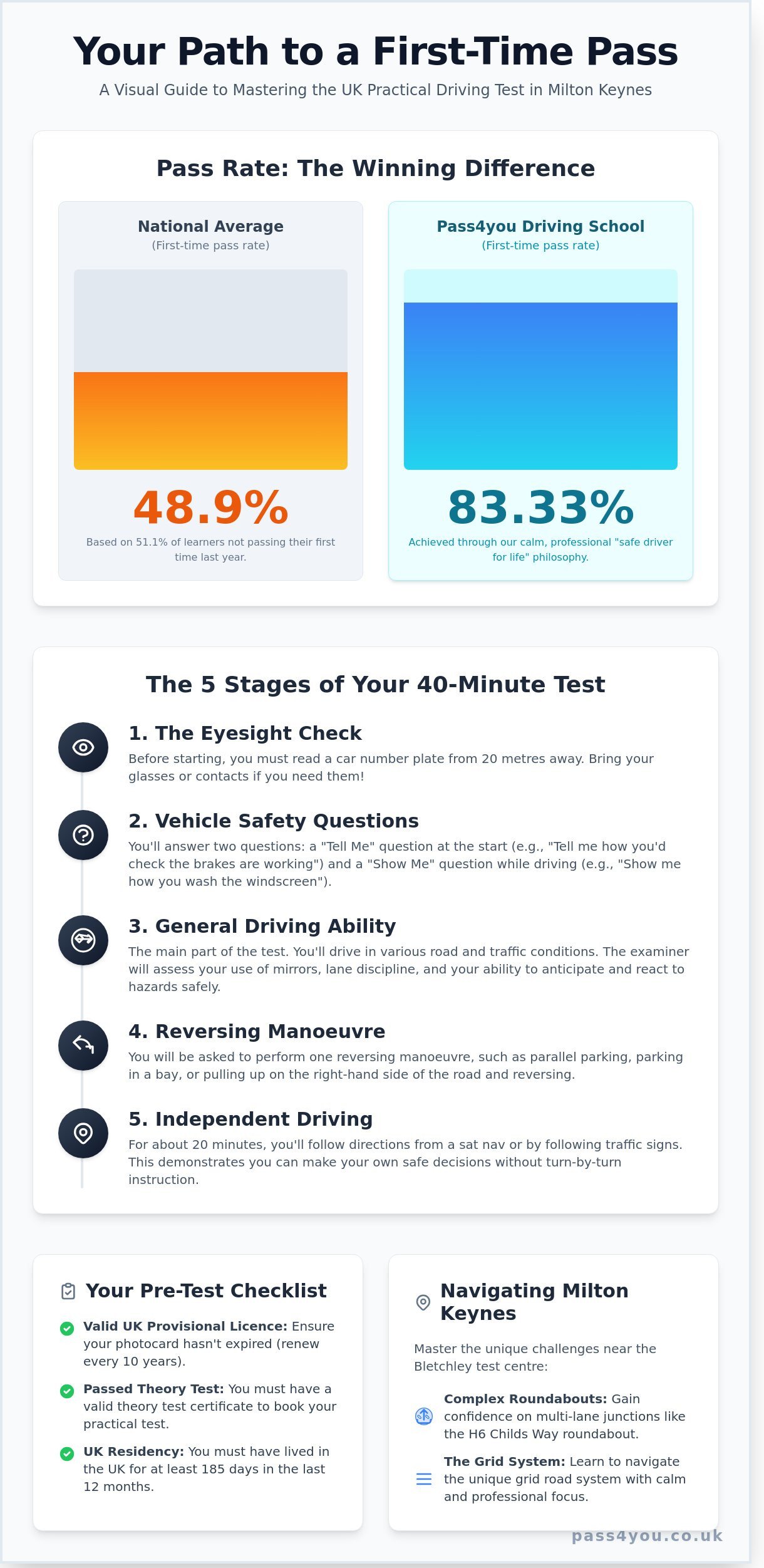
    Last Tuesday, Sarah sat at the Milton Keynes test centre, her hands gripping the wheel as she looked toward the daunting H6 Childs Way roundabout. Like 51.1% of learners who didn’t pass their first time last year, she was terrified that one minor slip-up would mean wasting another £62 and waiting months for a new slot. It’s a heavy weight to carry, especially when you’re trying to memorise the 2026 DVSA requirements while managing busy local traffic.

    We understand that the practical driving test can feel overwhelming, and it’s natural to worry about complex independent driving rules or those tricky multi-lane junctions. This guide is designed to replace that anxiety with the same calm confidence that has helped our students achieve a 83.33% first-time pass rate. You’ll gain a clear mental map of the entire test day and learn the specific professional secrets to mastering Milton Keynes’ most challenging roads. We’re going to break down every step of the process to ensure you’re fully prepared to become a safe driver for life.

    Key Takeaways

    • Understand exactly what the DVSA expects during your 40-minute assessment to ensure you meet the national standard for safe, independent driving.
    • Learn how to navigate the unique challenges of the Milton Keynes grid system and the complex roundabouts frequently encountered near the Bletchley test centre.
    • Build your confidence by mastering the five essential stages of the practical driving test, from the initial eyesight check to the vehicle safety questions.
    • Discover why realistic mock tests and daily “Show Me, Tell Me” practice are vital for calming your nerves and securing a successful first-time pass.
    • Get expert advice on booking your appointment through official channels to avoid scams and a checklist of everything you must bring on the day.

    Understanding the Practical Driving Test in 2026

    The practical driving test is more than just a 40-minute drive with an official. It’s a structured assessment designed by the DVSA to confirm you can handle a car independently and safely across various road conditions. The primary goal is to verify you meet the National Standard for driving cars and light vans. This isn’t about being a perfect driver who never makes a mistake. It’s about showing you’re a responsible road user who doesn’t put others at risk. During the session, you’ll need to demonstrate competence in vehicle handling, hazard perception, and making independent decisions without constant prompts.

    The United Kingdom driving test has seen several updates over the years to keep pace with busier roads and new technology. In 2026, the psychological hurdle feels higher for many learners than it did for previous generations. With test waiting times at many local centres averaging 15 to 20 weeks, students often feel they’re under immense pressure to succeed on their first attempt. The rising cost of fuel and insurance adds another layer of stress to the process, making the stakes feel much higher than a simple skills check.

    At Pass4you Driving School, we simplify this mindset by focusing on our “safe driver for life” philosophy. We don’t just teach you to pass a 40-minute exam; we focus on building the habits that make you a confident motorist for years to come. Our instructors, like Simon, use a calm and patient method that has helped us achieve an 83.33% first-time pass rate. When you view the test as a simple demonstration of your daily driving habits rather than a high-stakes performance, the anxiety naturally lifts. We’ve honed a tried and tested technique that replaces panic with professional muscle memory.

    The Requirements: What You Need Before Booking

    You must hold a valid UK provisional driving licence before you can even think about the test centre. In 2026, ensure your photocard hasn’t expired, as the DVSA requires renewals every 10 years. Passing your theory test is mandatory before booking the practical driving test, and you’ll need that certificate number for the booking portal. Finally, residency rules state you must have lived in the UK for at least 185 days in the last 12 months to be eligible for a full licence.

    Managing Test Day Nerves

    Many learners struggle with “examiner anxiety” in the days leading up to their slot. It’s helpful to reframe the person in the high-vis vest as a professional observer whose only job is to ensure you’re safe. They aren’t looking for reasons to fail you; they’re looking for reasons to give you a licence. Working with a calm, patient instructor in the final three weeks helps build the resilience you need to stay steady. We find that students who have a friendly, understanding mentor are much more likely to stay focused during the independent driving section. Test readiness is a combination of technical skill and emotional regulation.

    The Five Essential Stages of Your Driving Test

    Feeling a bit of stage fright before your big day is completely normal. Most learners feel those butterflies, but understanding exactly what happens during the 40 minute exam can help you stay calm and focused. Your examiner isn’t looking for a perfect robot; they want to see a safe, confident driver who can handle everyday road situations without putting others at risk.

    Step 1: The Eyesight Check
    Before you even get behind the wheel, you must read a number plate from a distance of 20 metres. This is a non negotiable safety requirement. If you usually wear glasses or contact lenses for driving, make sure you have them with you. It is a quick task that sets a positive, professional tone for the rest of the session.

    Step 2: “Show Me, Tell Me” Questions
    You will be asked two vehicle safety questions. The “tell me” question happens at the start of the test, where you explain how to carry out a safety task. The “show me” question occurs while you are driving, such as demonstrating how to clear the windscreen. You can check the full list of potential questions in the official driving test requirements to ensure you feel prepared.

    Step 3: General Driving Ability
    This is the core of your practical driving test. You will navigate various road conditions, including quiet residential streets and busier main roads with higher traffic speeds. The examiner will observe your lane discipline, your use of mirrors, and how you react to other road users. At Pass4you, we’ve found that maintaining a steady, patient pace helps students achieve our 83.33% first time pass rate.

    Step 4: Reversing Your Vehicle
    You will be asked to complete one of three possible reversing manoeuvres. The goal here is to show you have total control over the car while keeping a keen eye on your surroundings. Whether you are backing into a bay or parking behind a parked car, accuracy and constant observation are your best friends.

    Step 5: Independent Driving
    For roughly 20 minutes, you will drive without step by step instructions. You will either follow a sat nav or follow traffic signs to a specific destination. This stage proves you can make your own decisions safely while managing the vehicle.

    Mastering the Manoeuvres

    You might be asked to parallel park at the side of the road, which requires excellent spatial awareness. Alternatively, you may face bay parking. This involves either driving in and reversing out, or reversing in and driving out. The final possibility is pulling up on the right hand side of the road, reversing two car lengths, and moving off again. If you feel nervous about these, practicing with a patient instructor like Simon can build the confidence you need to ace them.

    Independent Driving and Sat Nav Use

    The examiner will provide and set up the sat nav for you. You aren’t allowed to use your own device. If you take a wrong turning, don’t panic. It is not an automatic fail. The examiner will simply help you get back on track. Looking ahead to the 2026 update, the DVSA continues to emphasise that drivers must remain calm even if the technology glitches or the signal drops out. Just keep driving safely and wait for the next instruction.

    Mastering the Practical Driving Test in 2026: The Ultimate Guide to Passing First Time

    Milton Keynes is famous for its unique grid system. It feels very different from traditional British towns with their winding, narrow streets. For a learner, this means mastering a specific type of road layout that demands high-speed confidence and precise lane discipline. Most local tests start at the Milton Keynes (Bletchley) Test Centre on Cadman Square. From the moment you leave the car park, you’re likely to encounter the H and V roads. These horizontal and vertical grid lines define the city and form the backbone of your test route.

    Understanding these roads is vital for the independent driving part of your practical driving test. You’ll be asked to follow road signs or a sat-nav for roughly 20 minutes. If you know that ‘H’ roads run east-west and ‘V’ roads run north-south, you’ll feel much more in control when an examiner gives a direction. At Pass4you, we make sure you’re familiar with these specific routes. We use modern, reliable VW vehicles that are easy to handle, ensuring you feel calm and prepared. Our lead instructor, Simon, has helped many students achieve our 83.33% first-time pass rate by focusing on these local nuances and building your confidence on the grid.

    The Milton Keynes Roundabout Challenge

    Roundabouts are the defining feature of driving in this city. You’ll encounter everything from small mini-roundabouts in residential pockets to massive, multi-lane junctions like Abbey Hill or Old Stratford. The biggest challenge here is lane discipline. Many roundabouts in Milton Keynes use “spiral” markings. This means the lane you enter will naturally push you outwards toward your intended exit. Staying in the correct spiral is the top priority for examiners here. If you find yourself in the wrong lane, don’t panic or swerve. Stay safe, follow the lane you’re in, and let the examiner help you get back on track.

    Observation techniques are just as important at high-speed entries. You need to judge the speed of traffic approaching from the right on roads like the A5 or A421 very quickly. We teach you to look early as you approach the give-way line. This helps you keep your momentum where it’s safe to do so, which is exactly what an examiner wants to see. It shows you’re a confident, competent driver who isn’t hesitant.

    Rural Roads vs. Residential Streets in MK

    Your test won’t just be limited to the grid. You’ll likely head out towards the 60mph rural stretches on the outskirts of the city. These roads require a sharp focus on speed limit changes and hidden farm entrances. It’s a huge contrast to the narrow, parked-car-lined streets you’ll find in Bletchley or Wolverton. In these residential areas, your hazard perception is tested to the limit. You’ll need to manage your speed carefully and show plenty of clearance when passing oncoming cars in tight spaces.

    To help you prepare for these varied conditions, we recommend checking out the official Ready to Pass? preparation advice from GOV.UK. It’s an excellent resource for managing nerves and understanding test readiness. You should also read our guide on Common Mistakes That Cause People to Fail Their Test to see where others often struggle in these specific MK environments. Successfully balancing the high speed of the grid roads with the precision required in residential areas is the secret to passing your practical driving test first time. We’re here to guide you through every mile until you’re ready to drive away with your pink licence.

    How to Prepare Like a Pro: Beyond the Basics

    Preparing for your practical driving test requires more than just knowing how to steer. At Pass4you, we’ve developed what we call the 83.33% Secret based on our consistent first-time pass rate. This technique isn’t a shortcut; it’s a structured approach to preparation that actually saves you money. By focusing on precision from day one, our students typically require fewer hours of tuition to reach test standard. This reduces your total spend on lessons and avoids the £62 cost of booking a retest, alongside the long waiting times for a new slot.

    Many learners feel tempted to clock up extra hours with friends or family to save a few pounds. While the intention is good, this often introduces bad habits that are difficult to unlearn. A friend might not notice you’ve stopped checking your blind spot or that you’re “palming” the steering wheel. On the day of your exam, these small errors aggregate into serious faults. Professional lessons keep you aligned with current DVSA requirements, ensuring you don’t have to pay for a second test because of someone else’s outdated driving style.

    Don’t treat the “Show Me, Tell Me” questions as a last-minute revision task. You should use the checklist daily until the answers feel like muscle memory. Whether you’re explaining how to check the brake fluid or demonstrating the horn, these marks are the easiest ones to secure. Starting your test with a confident answer settles your nerves and sets a positive tone for the rest of the drive. If you can explain the technical aspects of the car while relaxed, the physical driving usually follows suit.

    The Role of the Mock Test

    Mock tests are the ultimate tool for building mental resilience. We recreate the “quiet examiner” environment, where the friendly chatter of a lesson stops and the formal assessment begins. This helps you identify the difference between a minor driving fault and a serious one before they actually count. It’s better to stall during a practice run than on the real day. You can prepare yourself properly by booking a Mock Test in Milton Keynes to experience the pressure in a safe, supportive setting. This simulation ensures that nothing on the day of your practical driving test feels like a surprise.

    Vehicle Familiarity

    We choose modern Volkswagen tuition vehicles for their exceptional reliability and user-friendly controls. You’ll become an expert on the specific clutch bite point and the nuances of electronic handbrakes. Consistency is your best friend when nerves are high. We focus on these cars because their feedback is clear, making it easier for you to feel what the vehicle is doing. Switching to a different car the week before your test is a high-risk strategy that often leads to avoidable stalls or control errors.

    Our goal is to make you a safe driver for life, not just for forty minutes. If you want to join the ranks of our successful students and benefit from our expert coaching, book your driving lessons today and start your journey with confidence.

    Booking and Passing: Your Path to Freedom

    You have put in the hours, mastered the manoeuvres, and built your confidence behind the wheel. Now it is time to turn that hard work into a full licence. The final hurdle is the practical driving test, a 40 minute assessment that marks the beginning of your life as an independent driver. This moment is about more than just following directions; it is about demonstrating that you can manage a vehicle safely and responsibly in real world conditions.

    Securing Your Test Date

    Booking your test requires a strategic approach. You should only use the official DVSA booking service, which is available daily from 6:00am until 11:40pm. Avoid third party “cancellation” websites that promise early slots for an extra fee. These services often overcharge and can be unreliable. In 2026, the cost for a weekday test is £62, while evening, weekend, and bank holiday appointments cost £75. Before you commit to a date, always check with Simon or your instructor. We want to ensure you are fully prepared so you don’t waste your time or money on a test you aren’t ready for yet.

    On the day of your exam, you must bring your provisional photocard driving licence. It is also wise to have your theory test pass certificate handy, though the examiner can usually verify this electronically. Beyond the paperwork, your most valuable asset is a positive mindset. Arrive at the test centre at least 15 minutes early to settle your nerves. Remember that the examiner isn’t looking for perfection; they are looking for a safe, competent driver who understands the rules of the road.

    When the test concludes, the examiner will ask you to pull over and turn off the engine before delivering the result. They will provide a summary of any driving faults. If you pass, you will receive a training certificate and your full licence will be sent in the post. If you don’t pass this time, don’t be discouraged. The feedback provided is a roadmap for your next few lessons. We will sit down together, look at the examiner’s report, and work specifically on those areas to ensure you’re ready for the next attempt.

    Why Pass4you is the Logical Choice

    Choosing the right instructor makes the difference between a stressful experience and a successful one. At Pass4you, we pride ourselves on a patient, calm environment. There is no shouting or pressure here, just professional guidance tailored to your pace. Our results speak for themselves. While the national average pass rate often sits below 50%, our students achieve an impressive 83.33% first time pass rate. We don’t just teach you how to pass a practical driving test; we help you become a safe driver for life. Our tried and tested techniques in Milton Keynes have helped hundreds of nervous learners find their confidence.

    Ready to start your journey toward independence with a team that genuinely cares about your success? Book your first lesson with Simon and the Pass4you team today and experience the difference that expert, patient instruction makes.

    Start Your Journey to Driving Independence Today

    Stepping into the driver’s seat for your practical driving test in 2026 doesn’t have to be a source of anxiety. By mastering the five essential stages and familiarising yourself with the unique layout of Milton Keynes, you’re already ahead of the curve. Success comes down to consistent preparation and finding an environment where you feel supported. You’ve seen how understanding local test centre insights and focusing on beyond-the-basics preparation can transform your confidence on the road.

    Simon provides the patient, expert guidance you need to navigate every complex roundabout and dual carriageway with total ease. You’ll enjoy learning in a modern VW tuition vehicle that makes every lesson comfortable and safe. Our proven methods focus on your individual needs, ensuring you don’t just get a licence but become a confident road user for life. We’ve helped hundreds of nervous learners overcome their fears through calm instruction and a tailored approach that saves you money by requiring fewer lessons overall.

    Join the 83.33% who pass first time; book your Milton Keynes lessons today. We’re ready to help you gain your freedom and start your new life on the road with confidence.

    Frequently Asked Questions

    How long is the practical driving test in 2026?

    Your practical driving test in 2026 lasts for approximately 40 minutes. This includes 20 minutes of independent driving where you’ll follow a sat nav or traffic signs. If you’re taking an extended test, the duration increases to 70 minutes. We’ll ensure you’re calm and ready for the full session, helping you feel confident from the moment you leave the test centre.

    What happens if I make a mistake during my driving test?

    Making a small mistake doesn’t mean you’ve failed immediately. You can make up to 15 driving faults, often called minors, and still pass. However, a single serious or dangerous fault results in a fail. If you do make a slip-up, stay patient and keep focused on driving safely. We’ve helped many nervous learners stay calm and recover after a minor error during their big day.

    Can I take my driving test in my own car?

    You can take the practical driving test in your own car as long as it meets specific DVSA requirements. Your vehicle must be taxed, insured, and have a current MOT. You’ll also need to fit an extra rear-view mirror for the examiner and display L-plates. Most of our students prefer using Simon’s car because they feel more confident in a familiar vehicle they’ve used for every lesson.

    How many minor faults are allowed on the driving test?

    You’re allowed a maximum of 15 driving faults during your test. If you earn 16 or more minors, you won’t pass. It’s important to remember that repeating the same minor fault can be upgraded to a serious fault. Our proven methods have helped us achieve an 83.33% first time pass rate, as we focus on building your confidence to keep these small errors to a minimum.

    What are the “Show Me, Tell Me” questions for 2026?

    The “Show Me, Tell Me” section consists of 2 safety questions designed to prove you know how to maintain your vehicle. You’ll answer one “tell me” question before you start driving and one “show me” question while you’re on the move. These might include showing how to wash the windscreen or telling the examiner how you’d check the tyre pressure. We’ll practice these together until you’re 100% confident.

    What is the best time of day to take a driving test in Milton Keynes?

    In Milton Keynes, booking your test for 10:14 am is often the best choice to avoid the heavy morning rush hour traffic. The roads around the Bletchley or Milton Keynes test centres are generally calmer during this mid-morning slot. This allows you to feel more relaxed and focused on your surroundings without the stress of peak-time congestion, helping you maintain a steady, safe rhythm.

    What happens if my driving test is cancelled due to bad weather?

    If the DVSA cancels your test because of snow, ice, or thick fog, they’ll automatically book a new appointment for you at no extra cost. You won’t have to pay the £62 fee again. They’ll usually send you the new date within 3 working days. We’ll stay in close contact during bad weather to ensure you’re supported and ready for your rescheduled date whenever it happens.

    Do I need to bring my theory test certificate to the practical test?

    You should bring your theory test pass certificate to your driving test appointment. While examiners can often check your details on their digital systems, having the physical certificate prevents any unnecessary delays. You must also bring your UK photocard driving licence, as the examiner cannot start the test without it. We’ll double-check you have all your documents ready before we head to the test centre together.

  • How to Book Your Driving Test: The Complete Guide

    How to Book Your Driving Test: The Complete Guide

    The thought of booking your driving test can feel almost as daunting as the test itself. Navigating the official website, wondering if you’re truly ready, and hearing about long waiting times can quickly turn excitement into stress. It’s a common feeling, but it doesn’t have to be your experience. We believe the process to book driving test slots, for both your theory and practical exams, should be straightforward and confidence-building.

  • Your instructor agrees you are ready. This is the most important sign. An experienced, professional instructor at a reputable driving school, such as Mitcham Driving School, knows the test standard inside and out and will only recommend you book when they are confident in your ability.
  • That’s exactly why we’ve created this guide. We will calmly walk you through every single step, from knowing the perfect time to book and gathering the right documents, to understanding the current costs involved. Forget the confusion and uncertainty. This is your clear, patient roadmap to successfully securing your test date, helping you feel prepared and in control of the next exciting step on your journey to becoming a safe driver for life.

    Before You Book: A Crucial Checklist for Test Readiness

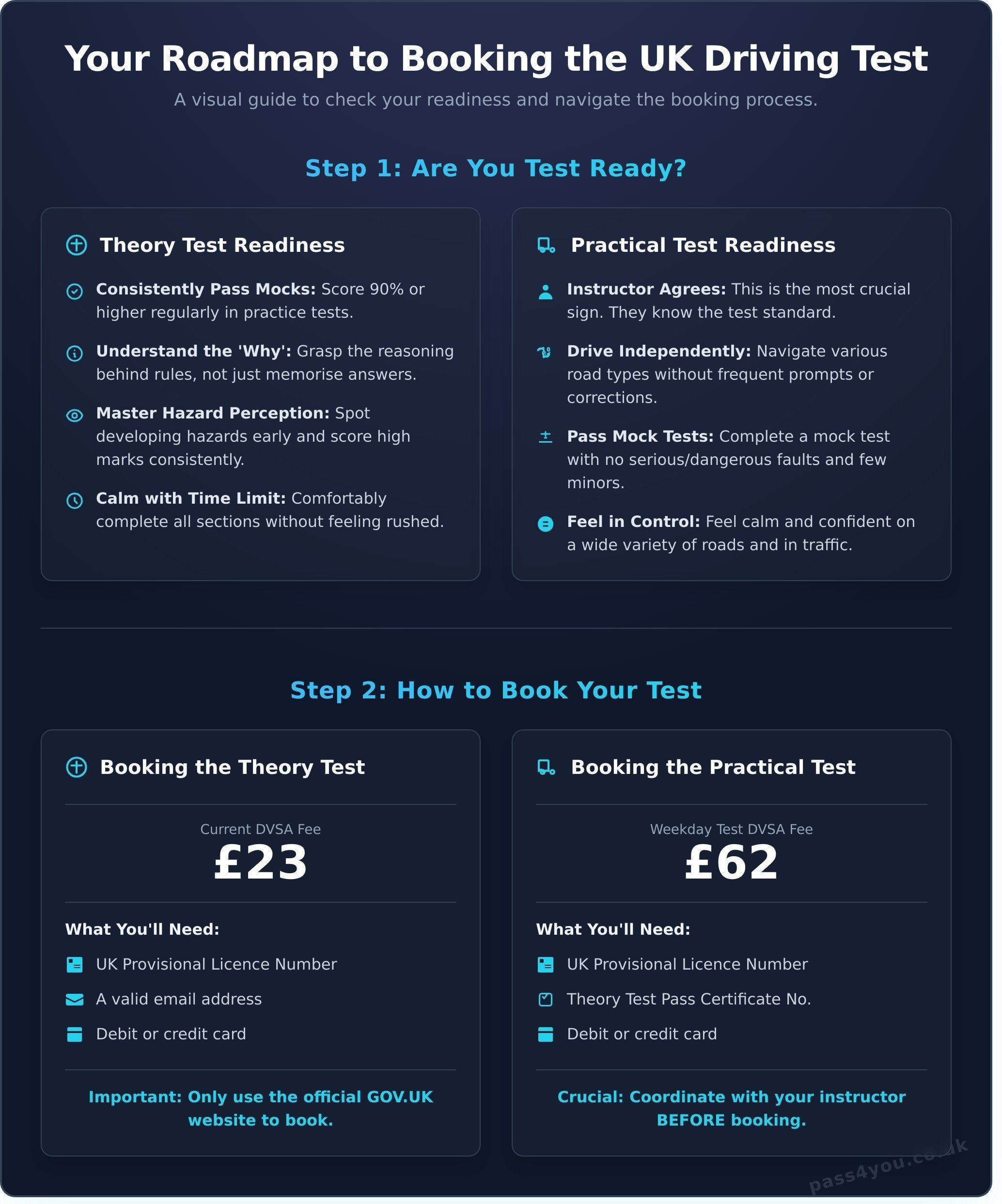
    Taking the step to book your driving test is a huge milestone, and it’s normal to feel a mix of excitement and nerves. However, booking before you’re truly prepared can lead to disappointment and wasted money. A failed practical test not only costs you the test fee (currently £62 for a weekday test) but also knocks your confidence. This checklist is designed to help you honestly assess your skills and feel calm and ready for success.

    The UK driving test is a two-part process, and being prepared means being ready for both. Before you move forward, it’s helpful to understand what is a driving test and its components. This guide will help you determine if you have the knowledge for the theory and the practical skills for the road.

    Are You Ready for the Theory Test?

    Passing the theory test is the first official hurdle. Rushing into it without solid preparation is a common mistake. You are likely ready if you can confidently say yes to the following:

    • You consistently pass mock tests. Are you regularly scoring 90% or higher on practice tests? This is a strong indicator that you have the knowledge needed.
    • You understand the ‘why’. It’s not just about memorising answers. You should understand the reasoning behind road signs, rules, and procedures to be a safe driver.
    • You’ve mastered Hazard Perception. You are consistently spotting developing hazards early and scoring high marks in the Hazard Perception section of your practice apps.
    • You feel calm with the time limit. You can complete both the multiple-choice questions and the hazard perception clips comfortably within the allotted time without feeling rushed.

    Is it Time to Book the Practical Test?

    Once your theory test certificate is in hand, the focus shifts to the practical exam. This is where a calm, patient approach truly pays off. Before you decide to book driving test, check these essential signs of readiness:

    • Your instructor agrees you are ready. This is the most important sign. An experienced, professional instructor knows the test standard inside and out and will only recommend you book when they are confident in your ability.
    • You drive without constant instruction. You can navigate junctions, roundabouts, and different speed limits independently, without needing frequent prompts or corrections.
    • You’re passing mock tests. Your instructor has conducted at least one mock test under real exam conditions, and you completed it with very few minor faults and no serious or dangerous ones.
    • You feel in control. You feel generally calm and confident when driving on a variety of roads, including busy town centres, dual carriageways, and quiet residential streets.

    How to Book Your Driving Theory Test: A Step-by-Step Guide

    Passing your theory test is the first official step on your exciting journey to getting your full driving licence. It’s the essential hurdle you must clear before you can book driving test dates for the practical part. We understand that any kind of test can feel a little daunting, but we’re here to reassure you that the booking process itself is very straightforward. Think of it as the first easy win on your path to driving freedom.

    Booking is a simple online process on the official GOV.UK website. Having the right information ready will make it quick and painless. Let’s walk through each step together, calmly and clearly, so you can book your theory test with complete confidence.

    What You’ll Need to Book

    To make the process as smooth as possible, it’s a good idea to have these three things to hand before you begin. This will save you from having to search for them midway through your booking.

    • Your UK provisional driving licence number. This is the long number found on your green photocard.
    • A valid email address. Your booking confirmation will be sent here, so use an address you check regularly.
    • A credit or debit card. The standard fee for a car theory test is currently £23.

    The Official Online Booking Process

    It is very important to only use the official government website to book your test. Other websites may charge you extra, unnecessary fees. The process is designed to be simple and secure.

    Here’s what you need to do:

    • Navigate directly to the official GOV.UK theory test booking service.
    • Carefully enter your personal details, ensuring they match your provisional licence exactly.
    • Choose your preferred theory test centre. You can search by postcode to find the most convenient location, for example, the test centre in Milton Keynes.
    • Select an available date and time slot that works for you, giving you plenty of time to revise.

    After You’ve Booked

    Once your payment is complete, you will receive a confirmation email. This email is your official record of the booking, so check that all your details-especially your name, the test centre address, and the time-are correct. Keep this email safe, as it contains the reference number you would need to change your appointment.

    With your test date secured, you can focus on building the knowledge that will make you a safe and confident driver. Passing your theory is the essential key that unlocks the next stage. Once you have your pass certificate, you’ll be ready to book driving test appointments. This is when you can finally book your practical driving test. Keep up the great work with your revision, and you’ll be on the road in no time.

    Booking Your Practical Driving Test: The Final Step

    This is the moment all your hard work has been leading up to. You’ve put in the hours with your instructor, mastered the manoeuvres, and built the confidence to be a safe driver. Now, it’s time to secure your test slot and take that final step towards earning your full driving licence.

    The process to book your driving test is straightforward and done online, but it has some key differences from booking your theory test. Most importantly, it requires careful coordination with your driving instructor to ensure everything goes smoothly. With long waiting lists being common across the UK, planning ahead is more crucial than ever.

    Essential Information for Booking

    Before you begin, make sure you have all the necessary information ready. This will make the booking process quick and stress-free. You will need:

    • Your valid UK provisional driving licence number.
    • Your theory test pass certificate number (you can find this on your pass letter).
    • A credit or debit card to pay the test fee, which is £62 for a weekday test or £75 for an evening, weekend, or bank holiday test.
    • Your driving instructor’s personal reference number (their ADI number). This is vital for checking their availability.

    Navigating the Practical Test Booking System

    To avoid extra fees and potential scams, you must only use the official GOV.UK practical test booking service. The process is similar to when you had to Book your driving theory test, but with a few crucial additions. Simply enter your personal details and theory test pass number. The most important step is to add your instructor’s ADI number, which links your booking to their calendar. This allows you to see their availability and ensures you don’t book a time when they are already with another student. Once you select a suitable test centre, date, and time, you can confirm your booking with payment.

    Why Your Instructor’s Input is Vital

    Booking your practical test without speaking to your instructor first is a common mistake that can lead to disappointment. Their involvement is essential for several reasons. They need to guarantee the tuition car is available for you to use on the day, and their experience is invaluable for choosing the best test centre and time slot to match your ability and avoid peak traffic. Attempting to book a driving test without their consent often results in needing to cancel or reschedule, potentially losing your fee. A good instructor ensures you are not just test-ready, but ready for a lifetime of safe driving. Feeling nervous about the big day? Our patient Milton Keynes instructors prepare you fully.

    How to Book Your Driving Test: The Complete Guide

    Managing Your Test Booking: How to Change or Cancel

    Life is unpredictable, and sometimes the test date you carefully selected no longer works. Don’t worry, this is a common situation. The DVSA booking system is designed with flexibility in mind, allowing you to change or cancel your appointment without losing your fee, as long as you follow the rules. Understanding this process will help you stay calm and in control, ensuring you only take your test when you feel completely ready.

    Knowing how to manage your booking is just as important as knowing how to book your driving test in the first place. It prevents unnecessary stress and protects your test fee.

    How to Change Your Driving Test Date

    If you need a different date or time, the process is straightforward. The most important rule is to give at least 3 full working days’ notice. This does not include Sundays or public holidays. To make a change, you will need:

    • Your UK driving licence number
    • Your driving test booking reference number

    Simply visit the ‘Change your appointment’ service on the GOV.UK website. Before confirming a new slot, always check with your driving instructor to ensure they are available. This simple step avoids any last-minute panic and ensures you have their full support on the day.

    Finding an Earlier Test (Cancellations)

    Once you book your driving test, you might feel ready sooner than your scheduled date. You can use the same GOV.UK service to look for earlier slots that appear when other learners change or cancel their tests. These “cancellations” are in high demand, so you need to be flexible and check the system regularly. While some third-party cancellation finder apps exist, be cautious. Always use official channels where possible to protect your personal information.

    Cancelling Your Test Appointment

    If you decide you’re not ready or your circumstances change, you can cancel your test completely. As long as you provide the required 3 clear working days’ notice, you will receive a full refund of your test fee. If you cancel with less notice, unfortunately, you will lose the fee and have to pay again when you rebook. The cancellation process is done through the same portal on the GOV.UK website where you manage your booking.

    Feeling confident and prepared is the key to success. If you’re having doubts about your test date, have a calm chat with your instructor. At Pass4you, we pride ourselves on building safe, confident drivers who are truly ready for their test.

    Top Tips for a Stress-Free Booking and Test Day Experience

    Once you book your driving test, the final countdown begins. We know this can bring on a case of the nerves, but the good news is that with a little calm preparation, you can walk into the test centre feeling confident and ready. Your mindset on the day is just as important as your driving skill, and these final tips will help you manage both for a first time pass.

    Choosing the Right Test Centre and Time

    Where and when you take your test can make a real difference. Familiarity breeds confidence, so always choose a test centre in an area where you have spent many hours practising. You will know the tricky junctions and complex roundabouts, which helps to reduce uncertainty. Your instructor’s local knowledge is invaluable here; discuss the best times to avoid heavy rush-hour or school-run traffic, giving you a calmer environment for your test drive.

    Preparing for Test Day After Booking

    Your preparation doesn’t stop once the appointment is made. We always recommend taking a one-hour lesson immediately before your test. This serves as a perfect warm-up, helps settle your nerves, and gets you into a confident, safe driving mindset. The night before, focus on relaxing and getting a good night’s sleep. On the day, have a light meal or snack to keep your energy levels stable but avoid anything too heavy.

    Before you leave, double-check you have the essentials:

    • Your UK provisional driving licence.
    • Your theory test pass certificate (while the examiner can usually check this online, it is wise to have it with you).
    • Glasses or contact lenses if you need them to drive.

    Most importantly, trust in your training. You have put in the hours, and if your instructor has given you the green light, it’s because they know you are ready. Take a deep breath, remember the calm and patient guidance you’ve received, and focus on demonstrating that you are a safe and competent driver. This is your moment to earn the freedom you’ve been working towards. With the right preparation, like the kind we provide at Pass4you, you have every reason to succeed.

    Your Roadmap from Booking to Passing Your Test

    Navigating the booking process is a huge and exciting step towards getting your full driving licence. As we’ve covered, the key to a stress-free experience is being fully prepared before you start, having the right documents to hand, and knowing how to manage your dates if your plans change. Now that you have a clear guide on how to book driving test appointments for both your theory and practical, the final piece of the puzzle is building the on-road confidence to match.

    Booking the test is one thing; passing it with skill and confidence is what truly counts. At Pass4you, we specialise in turning nervous learners into safe, assured drivers. Our calm, patient, and experienced instructors are dedicated to getting you test-ready, which is why we’re so proud of our 83.33% first-time pass rate. Backed by hundreds of 5-star reviews from local learners, we have a proven method for success in Milton Keynes. Ready to pass first time? Book your expert driving lessons in Milton Keynes today!

    The freedom of the open road is waiting for you. We’re here to help you get there safely and with a smile.

    Frequently Asked Questions About Booking Your Driving Test

    Can I book my practical driving test before I pass my theory test?

    No, you must pass your theory test first. When you book your practical driving test on the GOV.UK website, you will need to enter your unique theory test pass certificate number. This is a strict requirement from the DVSA. Passing your theory is the first major step, proving you have the essential road knowledge to be a safe and confident driver before you can sit the practical exam.

    How long is the waiting list for a practical driving test in the UK?

    Waiting times for a practical test can be quite long, often several months, depending on your local test centre’s demand. This is why being fully prepared is so important to help you aim for a first-time pass. You can check the very latest waiting times for your chosen test centres on the DVSA’s official booking website. Planning ahead is key to securing a date that works for you and your instructor.

    What happens if I fail my driving test? How soon can I rebook?

    It can be disappointing, but it’s a chance to learn. Your examiner will give you clear feedback on where you can improve. Legally, you must wait at least 10 working days before you can take another test. We recommend using this time to have a few calm, focused lessons with your instructor to build your confidence and perfect the skills needed to pass next time. It’s all about turning feedback into success.

    Do I have to use my driving instructor’s car for the test?

    While you can use your own car, we strongly recommend using your instructor’s vehicle. You are already comfortable and familiar with it, and you can be confident that it meets all the strict DVSA requirements for a test vehicle, such as having dual controls. This helps remove unnecessary stress on the day, allowing you to stay calm and focused purely on your driving performance and passing your test.

    What’s the difference between booking on GOV.UK and other websites?

    The only official place to book your driving test is the GOV.UK website. This is the direct booking system from the DVSA. Any other website is a third-party service that may charge you additional administration fees for finding a test slot. To ensure you are paying the correct price and that your booking is secure, we always advise our students to only use the official GOV.UK portal. It is the safest and most reliable method.

    How much does it cost to book a driving test in 2025?

    In 2025, the standard DVSA fee for a practical car test is £62 for a normal weekday appointment. If you need to book a test on an evening, weekend, or bank holiday, the cost increases to £75. Remember that this fee is paid directly to the DVSA. You will also need to budget for the use of your instructor’s car for the duration of the test, which is a separate cost.