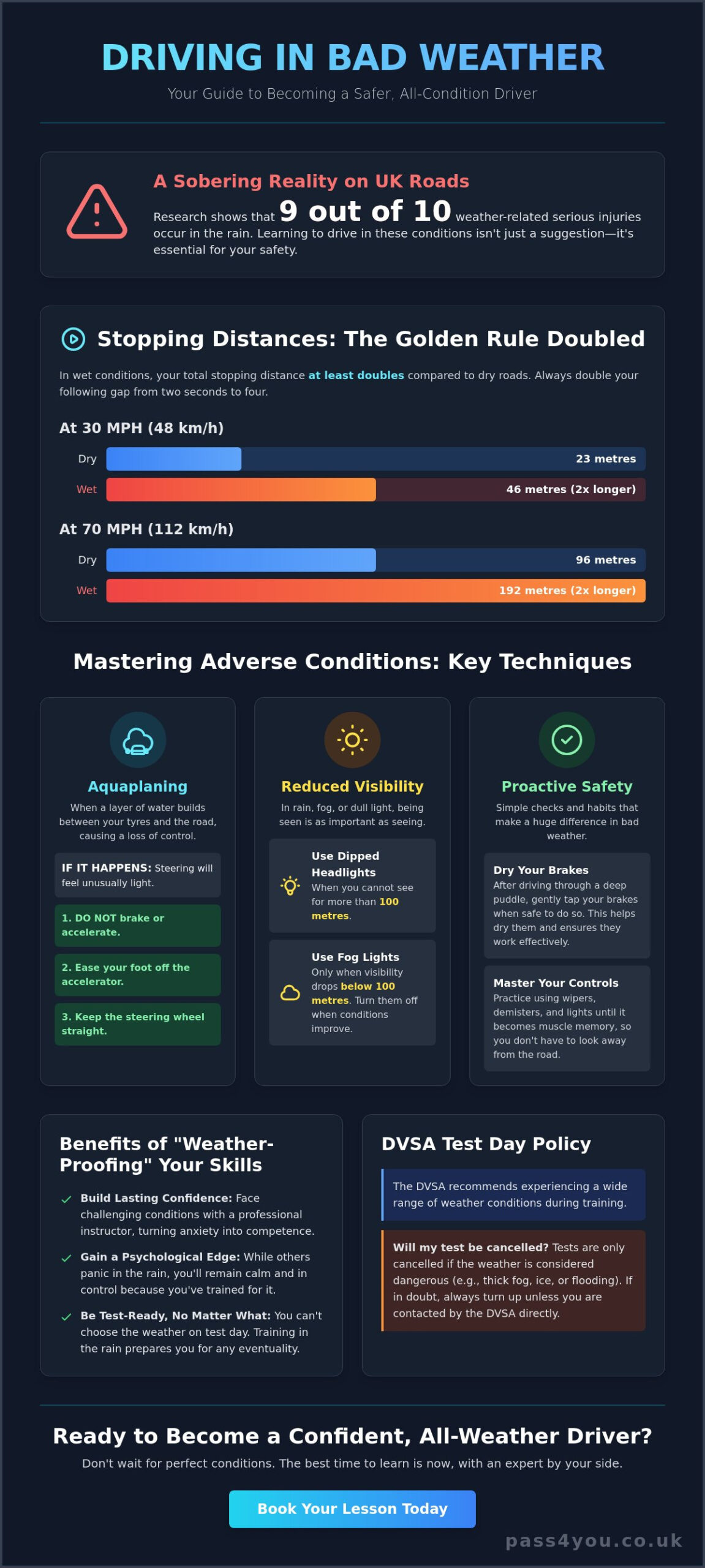
What if a heavy downpour is actually the most valuable part of your training? While it’s natural to feel a surge of anxiety when you see grey clouds before your session, taking driving lessons in bad weather uk is often the secret to becoming a truly competent driver. You aren’t alone if you worry about skidding on wet roads or losing visibility in thick fog. Most learners feel a bit of dread when the conditions aren’t perfect, especially since research shows that 9 out of 10 weather-related serious injuries on our roads happen in the rain.
We believe that facing these conditions with a calm, professional mentor by your side is the best way to build lasting confidence. This guide explains why adverse weather is your greatest training tool and how to handle a car safely when the British climate turns. You will discover how to manage stopping distances that can double in the wet, when to use your fog lights if visibility drops below 100 metres, and what the current DVSA rules are for test cancellations. By the end, you’ll feel ready to handle any season with ease and stay safe behind the wheel.
Key Takeaways
- Discover how “weather-proofing” your skills creates a safer, more resilient driver compared to those who only train in perfect conditions.
- Master essential techniques for handling aquaplaning and learn how to adjust your following distances during heavy rainfall.
- Understand the specific DVSA policies regarding cancellations so you know exactly what to do if it snows on your test day.
- Gain confidence by taking driving lessons in bad weather uk to practice vital safety checks and “Show Me, Tell Me” questions in a real-world environment.
- Learn how professional instructors help you navigate tricky Milton Keynes roundabouts when road surfaces are greasy and visibility is poor.
Should You Take Driving Lessons in Bad Weather?
When the clouds turn grey and the rain starts to lash against the window, your first instinct might be to call your instructor and reschedule. However, taking driving lessons in bad weather uk is one of the most effective ways to build your confidence and ensure you’re ready for the reality of British roads. It is easy to drive when the sun is shining and the tarmac is dry, but true skill is developed when conditions are less than perfect. Learning to manage wind, rain, and reduced visibility under professional guidance turns a potentially scary experience into a valuable teaching moment.
The DVSA explicitly recommends that learner drivers experience a wide range of weather conditions during their training. This proactive approach ensures you aren’t caught off guard after you pass your test and find yourself driving alone in a storm. Safety is always our primary concern, and it’s helpful to remember that professional instructor vehicles are equipped with dual controls. This provides a safety net that learning with a friend or parent cannot match. Your instructor is trained to stay calm and can intervene instantly if the car reacts unexpectedly to a large puddle or a sudden gust of wind, keeping you in safe, professional hands at all times.
The Benefits of Learning in Adverse Conditions
Driving in the rain or wind helps you build essential muscle memory that you simply won’t develop on a clear day. You will learn how to operate your windscreen wipers and demisters instinctively, without needing to take your eyes off the road to find the controls. Understanding how the car feels on a slippery surface while under expert supervision is a vital part of your development. It also gives you a significant psychological edge over other learners. While others might feel anxious when the weather turns, you will remain calm because you have already mastered these challenges. Learning these defensive driving techniques early on helps you anticipate hazards before they become dangerous situations.
Why Proactive Training Beats Avoiding the Rain
You cannot choose the weather on the day of your driving test. If you have spent all your lessons in the sun and it pours during your exam, your anxiety levels will naturally spike. Weather-proofing is the process of mastering vehicle control in non-ideal conditions. By facing the rain during your driving lessons in bad weather uk, you turn a potential obstacle into a tool for success. Professional instructors provide a structured environment where you can test your limits safely. They help you understand the physics of the road, such as how water affects your grip, ensuring you become a responsible and capable driver for life.
Navigating UK Rain, Fog, and High Winds as a Learner
Learning to handle the elements is a practical skill that sets you apart from drivers who only practice in the sun. When you take driving lessons in bad weather uk, you’ll learn that heavy rain requires more than just faster wipers. Aquaplaning occurs when a layer of water builds up between your tyres and the road, causing you to lose steering control. If you feel the steering become light, don’t panic. Simply ease your foot off the accelerator and keep the steering wheel straight until you feel the tyres grip the tarmac again. Facing these elements during your driving lessons in bad weather uk transforms you into a more observant and capable driver.
Stopping Distances: Dry vs. Wet Roads
Understanding the physics of a wet road is crucial for your safety. On a dry day, the “two-second rule” helps you maintain a safe gap from the car in front. However, in wet weather, your stopping distance at least doubles. This change is dramatic and requires immediate adjustment to your speed and positioning.
- At 30mph: You’ll need roughly 46 metres to stop in the wet, compared to just 23 metres on dry roads.
- At 70mph: That distance jumps from 96 metres to a staggering 192 metres.
Doubling the gap is the golden rule because it gives you the vital thinking time needed to react to hazards. After driving through a deep puddle, remember to tap your brake pedal lightly when it’s safe to do so. This simple action helps dry the brake discs and ensures they work effectively when you need them most.
Mastering Visibility and Lighting
Visibility can change in seconds. You are required to use headlights when you cannot see for more than 100 metres. While your driving lessons will teach you the location of every switch, knowing exactly when to use them is the real challenge. Use dipped headlights in heavy rain or dull light to ensure other road users can see you clearly. Only use fog lights when visibility is seriously reduced, and remember to switch them off once it improves to avoid dazzling others.
Managing interior condensation is just as important as cleaning the outside of the glass. Use your heater and air conditioning to demist the windows before you set off. This ensures you have a clear view of your surroundings at all times. Expert advice on Navigating UK Rain, Fog, and High Winds often emphasizes that being seen is just as important as being able to see.
Finally, be mindful of high winds. Strong gusts can push a small learner car off course, especially on open roads or bridges. When passing high-sided vehicles, expect a sudden buffeting effect as you move in and out of their windbreak. Keep a firm but relaxed grip on the wheel and allow extra room for cyclists or motorcyclists who may be blown sideways by the gale.
Will My Driving Test Be Cancelled? The DVSA Bad Weather Policy
Waking up to a storm on the morning of your driving test can feel like a setback, but understanding the DVSA Bad Weather Policy will help calm those nerves. The Driver and Vehicle Standards Agency (DVSA) prioritises safety above all else. They won’t conduct tests in truly dangerous conditions, such as icy roads, flooding, or thick fog. However, a bit of rain or wind won’t stop the exam. This is why driving lessons in bad weather uk are so beneficial. They ensure you’re prepared to perform your best, even if the clouds look threatening when you arrive at the test centre.
If the DVSA decides to cancel your test due to the weather, you don’t need to do anything to rebook. They will automatically find a new date for you. You’ll usually receive these new details within three working days, though it can take up to seven days during prolonged periods of winter weather. It’s important to know that you cannot claim out-of-pocket expenses, such as the cost of your instructor’s car hire, for cancellations caused by the weather. While this can be frustrating, it’s a standard policy across the UK.
How the DVSA Defines “Dangerous Conditions”
There is a clear difference between “wet” and “dangerous.” Standard rain is rarely a reason for cancellation. Examiners look for conditions that make it impossible to assess your driving safely. This includes standing water that could cause aquaplaning or ice that makes the road surface treacherous. Local test centres, such as Bletchley, have specific protocols for assessing nearby routes. The examiner makes the final safety call on the morning of the test. If you have concerns, call the phone number on your booking confirmation email. Do this on the day of your test, as staff won’t be able to give you a definitive answer the night before.
What to Do if Your Test is Cancelled
If you receive a cancellation notice, stay positive. Use the extra time to refine your skills. You can review our practical driving test guide to stay mentally sharp while you wait for your new date. If it’s safe to travel, we often recommend still having your scheduled pre-test lesson. Practising your driving lessons in bad weather uk with your instructor provides a safe environment to master the very conditions that caused the cancellation. This keeps your momentum going and ensures you feel even more confident when your new test date arrives.
Safety Checks and Preparation for Adverse Conditions
Becoming a confident driver starts before you even turn the key. When you take driving lessons in bad weather uk, your instructor will guide you through the vital safety checks that keep you and other road users safe. Preparation is the antidote to panic when the British weather turns unpredictable. A core part of this preparation involves mastering the “Show Me, Tell Me” questions. You might be asked how to check the brakes are working, how to operate the demister, or how to switch on your rear fog lights. Knowing these controls inside out ensures you stay focused on the road rather than fumbling for a switch when visibility suddenly drops.
One of the most critical safety factors in the rain is your tyres. The legal minimum tread depth in the UK is 1.6mm across the central three-quarters of the tyre. However, having more tread provides much better grip on wet surfaces. During your driving lessons in bad weather uk, you’ll learn how to check this depth and understand why it matters for your stopping distance. Proper preparation also extends to what you wear. Wet, slippery shoes can easily slide off the pedals, so choosing comfortable, flat footwear with good grip is essential for maintaining precise control of the car.
Pre-Drive Vehicle Checks
Before setting off in poor conditions, take a moment to ensure your vehicle is ready. Check that all your lights are clean and working correctly, as dirt and road salt can quickly obscure them. Your wiper blades should clear the screen effectively without smearing or making unusual noises. It’s also vital to verify your fluid levels. Ensure your screen wash is topped up and contains anti-freeze properties to prevent the jets from freezing or the liquid from turning into ice on your windscreen during a cold snap.
The Learner’s Mental Toolkit
Your mental state is just as important as the car’s condition. Driving in heavy traffic during a storm can feel overwhelming, but staying calm is key to making safe decisions. If you feel your anxiety rising, take a deep breath and remember that your instructor is there to support you. We encourage open communication; if the conditions feel too intense, tell your instructor immediately. They can help you break down the situation into manageable steps, ensuring you always feel in safe, professional hands. If you’re ready to build your skills with a patient mentor, book your driving lessons today and start your journey toward becoming a confident, all-weather driver.
Build Confidence with Professional Lessons in Milton Keynes
At Pass4you, we don’t just teach you to drive; we prepare you for the reality of the British roads. Taking driving lessons in bad weather uk with our team means you’ll never feel caught out by a sudden change in the forecast. Our instructors monitor local weather patterns closely. They tailor each session to ensure you’re learning the most relevant skills for the day’s conditions. You’ll train in modern, well-maintained Volkswagen vehicles. These cars offer excellent visibility and safety features, helping you feel secure even when the clouds are dark.
Milton Keynes features a unique road layout that requires specific techniques in the wet. Our instructors have deep local knowledge of the area’s roundabouts, which can become incredibly greasy and slippery after a light rain. We’ll show you how to adjust your approach speed and steering to stay safe. Learning these nuances under professional supervision ensures you’re always in safe, professional hands.
Local Expertise for Milton Keynes Learners
The H and V grid system can feel very different when visibility is low. We’ll help you navigate these roads with confidence, focusing on clear lane discipline and proactive hazard perception. If you’re practicing on a dual carriageway during high winds, we’ll teach you how to keep the car stable and react to sudden gusts. Our team also knows exactly which areas near the local test centres are prone to flooding. This insight allows us to guide you safely through the most challenging routes without unnecessary stress.
Join the Success Stories at Pass4you
We specialise in helping nervous learners find their feet. Our patient, calm teaching style is designed to build your self-belief, one lesson at a time. We’re incredibly proud of our 83.33% pass rate. This high success metric includes many students who faced rain, wind, or fog on their test day and came out with a pass. It shows that professional driving lessons in bad weather uk give you a massive advantage over those who only practice in the sun.
Don’t wait for the “perfect” day to start your journey. You can book your driving lessons in Milton Keynes today regardless of the season. Every session you complete in the rain or wind is a valuable step toward your pink license and a lifetime of safe, confident driving.
Ready to Master the Roads in Any Season?
Facing the elements might feel daunting at first, but it’s the quickest way to transform from a learner into a truly resilient driver. You now know how to manage aquaplaning, double your stopping distances, and navigate DVSA cancellation rules. This knowledge turns a rainy day into a powerful training opportunity. By choosing to take driving lessons in bad weather uk, you ensure that no forecast stands in the way of your freedom.
Our patient and first-class driving instructors support you with an approach that has helped us achieve an impressive 83.33% first-time pass rate. You’ll learn in modern, well-maintained Volkswagen tuition vehicles designed for safety and comfort. Whether you’re tackling a greasy roundabout or a windy dual carriageway, you’re always in safe, professional hands.
Don’t let a few clouds hold you back from achieving your goals. Book your Milton Keynes driving lessons with Pass4you today and start building the real-world confidence you need to succeed. You’re closer to that pink license than you think, and we’re with you every mile of the way.
Frequently Asked Questions
Do driving lessons get cancelled in rain?
Driving lessons rarely get cancelled just because of rain. In fact, we encourage you to keep your appointment as it’s the perfect time to practice using your wipers and adjusting your speed for wet tarmac. Your instructor will only postpone a session if conditions become truly dangerous, such as severe flooding that makes the roads impassable or unsafe for your current skill level.
What happens if it snows on my driving lesson day?
Your instructor will make a safety call based on the local road conditions on the morning of your session. If the snow is heavy or the roads are icy, we may reschedule your lesson to ensure you stay in safe, professional hands. We’ll contact you as early as possible to let you know if a change is needed, so you don’t have to worry about a dangerous drive.
Is it harder to pass a driving test in bad weather?
Passing your test in bad weather isn’t inherently harder if you’ve had the right training. Examiners look for how well you adapt your driving to the current environment. If you demonstrate that you can manage visibility and stopping distances effectively, you prove you’re a responsible driver. Taking driving lessons in bad weather uk ensures you have the skills to handle these variables with total confidence on your big day.
Can I cancel my driving lesson if I am scared of the wind?
We understand that high winds can feel intimidating for new drivers. However, we recommend going ahead with the lesson so your instructor can show you how to keep the car stable. Learning to handle gusts and buffeting from high-sided vehicles with a patient mentor is much safer than trying to figure it out alone after you pass. Please check our standard policy for notice requirements if you still wish to reschedule.
How do I use fog lights during a driving lesson?
You should only use your fog lights when visibility is seriously reduced, which the Highway Code defines as being unable to see for more than 100 metres. Your instructor will show you exactly where the switches are in our modern Volkswagen cars. It’s vital to remember to turn them off once the fog clears so you don’t dazzle other road users. This is a common “Show Me, Tell Me” topic.
What is the stopping distance on a wet road at 30mph?
At 30mph, your stopping distance on a wet road is approximately 46 metres. This is exactly double the 23 metres required on a dry surface. During your driving lessons in bad weather uk, we’ll help you visualise this gap so you can maintain a safe distance from the car in front. Understanding these physics is a core part of becoming a safe and proficient driver who can handle any UK road condition.
Will the examiner fail me if I drive too slowly in the rain?
You won’t fail for driving at a sensible speed that matches the conditions. Examiners actually expect you to slow down when visibility is poor or the road is slippery. However, you must still maintain safe progress where possible. If you drive excessively slowly on a clear road just because it’s slightly damp, it could be seen as a lack of confidence. Your instructor will help you find the right balance.
Does Pass4you provide winter driving tips for beginners?
Yes, we integrate practical winter driving tips into every lesson when the temperature drops. Our instructors will teach you how to clear your windows and mirrors properly before setting off and how to use higher gears to pull away on icy surfaces. We focus on building your real-world confidence so you feel prepared to drive safely through every season. Our goal is to ensure you feel in safe, professional hands at all times.
Leave a Reply