Tag: Driving Tips

  • Eco-Safe Driving Tips Milton Keynes: Pass Your Test & Save Fuel in 2026

    What if the secret to conquering the high-speed grid roads of Milton Keynes isn’t about driving faster, but driving smarter? Many learners feel a wave of anxiety when they see “eco-safe driving” on their assessment sheet, fearing that a small mistake might cost them their license. You might even worry that focusing on fuel efficiency will distract you from the complex roundabouts and 70mph stretches. However, mastering eco-safe driving tips milton keynes is actually your best tool for staying calm and in control during your practical test.

    We understand that the pressure of the test is high, especially when you’re trying to figure out exactly when to skip a gear or how to use engine braking without stalling. It’s completely normal to feel confused by these technical shifts while petrol prices in the city hover around 155.7p per litre. This guide will show you exactly how to impress your examiner by demonstrating smooth, efficient habits that prove you’re a safe and responsible road user. We’ll break down the specific techniques for our unique grid system, from planning ahead at roundabouts to managing your speed effectively, ensuring you feel confident and ready to pass first time in 2026.

    Key Takeaways

    • Understand that eco-safe driving is a feedback-only category in 2026, giving you a stress-free opportunity to demonstrate your professional road awareness.
    • Master specific eco-safe driving tips milton keynes like selective gear changing to show the examiner you have full control over the car’s efficiency.
    • Learn how to manage momentum on the unique 60mph grid roads to navigate roundabouts smoothly while keeping your fuel costs low.
    • Discover how simple maintenance checks, like monitoring tyre pressure, improve your car’s grip for emergency stops and enhance your overall safety.
    • Build the confidence needed to pass first time by learning how professional instruction targets the exact skills examiners look for on Milton Keynes roads.

    What is Eco-Safe Driving & How is it Assessed in 2026?

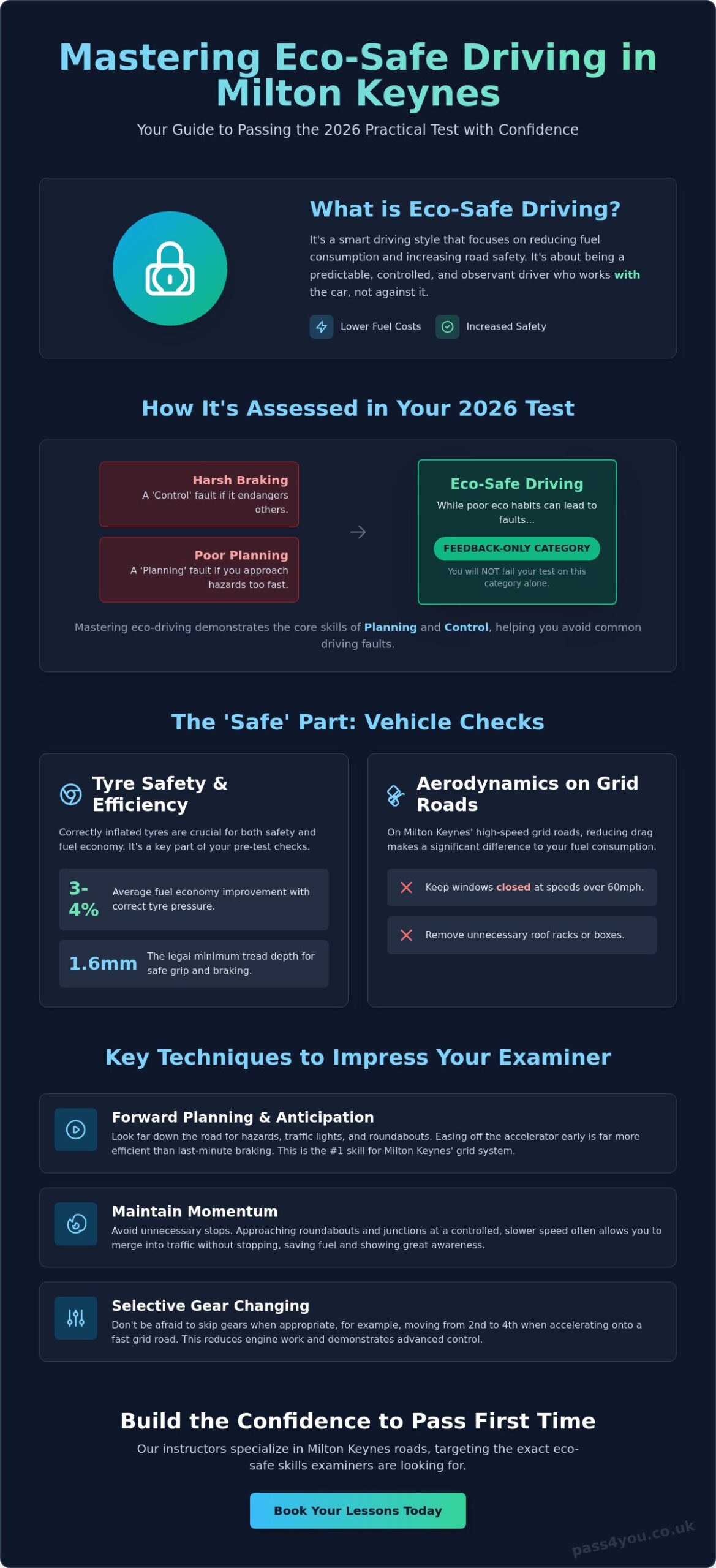
    Eco-safe driving is a specialized style of handling a vehicle that reduces fuel consumption and emissions while simultaneously increasing road safety. It isn’t just about being “green”; it’s about being a predictable, controlled, and observant driver. When you apply eco-safe driving tips milton keynes during your lessons, you’re learning to work with your car rather than against it. In 2026, the DVSA continues to emphasize these energy-efficient driving techniques because smooth drivers are statistically less likely to be involved in collisions. During your 40-minute practical test, the examiner will observe how you interact with the environment and your vehicle’s controls to assess your efficiency.

    The examiner records your performance using two specific categories: “Control” and “Planning.” They aren’t looking for perfection, but they want to see that you understand how to keep the car moving efficiently. They’ll watch how you pull away from junctions, whether you use the gears appropriately for the road speed, and how you manage your momentum as you approach hazards.

    Does Eco-Safe Driving Affect Your Pass or Fail?

    This is a common worry for learners. In 2026, eco-safe driving remains a feedback-only category on the practical test marking sheet. This means you won’t fail your test simply because you stayed in a lower gear for too long or didn’t skip a gear when accelerating. However, there’s a vital connection to remember. While the eco-driving box itself doesn’t trigger a fail, the actions that lead to poor efficiency often lead to safety faults. For example, while eco-driving is feedback-only, ‘harsh braking’ can be a serious fault if it puts other road users at risk. Poor planning might mean you arrive at a roundabout too fast, forcing a sudden stop that the examiner marks as a lack of control.

    The Core Pillars: Planning and Control

    The DVSA focuses on two main areas: forward planning and smooth control. Forward planning means looking far ahead so you can avoid unnecessary stops. If you see a red light in the distance, easing off the accelerator early is much more efficient than rushing toward it and braking hard. In Milton Keynes, anticipation is your most valuable skill. Our grid system requires constant awareness of upcoming roundabouts and speed limit changes. By mastering these eco-safe driving tips milton keynes learners can maintain a steady rhythm. This makes the car easier to handle, keeps your examiner relaxed, and makes your private practice much cheaper by saving fuel.

    • Planning: Assessing the road ahead to keep the car moving.
    • Control: Using the accelerator, brakes, and gears smoothly.
    • Awareness: Responding to traffic flow to avoid sudden changes in speed.

    Vehicle Maintenance: The ‘Safe’ Part of Eco-Safe

    Preparing for your test involves more than just mastering the clutch. A well-maintained vehicle is the foundation of the ‘safe’ part of eco-safe driving. When your car is in top condition, it responds predictably, which is exactly what you need when navigating the busy roundabouts of Central Milton Keynes. Applying eco-safe driving tips milton keynes during your private practice helps you build habits that examiners love to see. A healthy car is simply easier to drive, allowing you to focus on the road instead of worrying about mechanical noises or sluggish performance.

    Tyre Safety and Fuel Efficiency

    Tyres are your only contact with the road. If they’re under-inflated, your engine has to work harder, which significantly increases fuel consumption. Research indicates that properly inflated tyres can improve fuel economy by an average of 3-4%. Before your practical driving test, you should check that your pressure matches the manufacturer’s recommendation and that your tread depth is at least 1.6mm. This isn’t just about saving money; it’s about having the necessary grip for an emergency stop. You’ll likely face a ‘Tell Me’ question about checking tyre pressure, so knowing how to use a gauge and where to find the correct figures will give you an early boost of confidence.

    Aerodynamics and Fluid Levels

    Milton Keynes is famous for its high-speed grid roads. When you’re travelling at 60mph or 70mph on the V6 or H8, aerodynamics play a huge role in how much fuel you use. Keeping windows closed at high speeds and removing empty roof racks can make a noticeable difference. Following expert fuel economy tips helps you understand that wind resistance is a major drain on efficiency. Similarly, keeping your fluids topped up is essential for car longevity. Correct oil levels reduce engine friction and emissions, making the car run smoother and quieter. These eco-safe driving tips milton keynes ensure your vehicle is ready for the demands of the 40-minute test.

    Removing unnecessary weight is another simple way to stay eco-safe. A cluttered boot filled with heavy items makes the engine work harder during acceleration and increases your stopping distance. By keeping your car light and tidy, you’re making it safer and more efficient. If you’re feeling unsure about how to perform these checks yourself, booking professional driving lessons can help you gain the hands-on experience needed to feel fully prepared for the ‘Show Me, Tell Me’ questions.
    Eco-Safe Driving Tips Milton Keynes: Pass Your Test & Save Fuel in 2026

    Eco-Safe Driving in Milton Keynes: Mastering the Grid

    Milton Keynes is unlike any other city in the UK. Our unique grid system of H and V roads provides a fantastic environment for practicing eco-safe driving tips milton keynes. While the 60mph and 70mph speed limits on these roads might feel intimidating at first, they offer the perfect opportunity to master momentum. Instead of constant braking and accelerating, you can learn to use the car’s natural energy to flow between the grid squares. This isn’t just about saving fuel; it’s about becoming a calmer, more predictable driver who’s always one step ahead of the traffic.

    Anticipation is your greatest asset near our famous Redways. These shared paths often cross the grid roads at unexpected points. By looking far ahead, you can spot pedestrians or cyclists early and ease off the power. This reduces the need for sudden, heavy braking. When you drive this way, you improve your vehicle maintenance and emissions profile by preventing unnecessary wear on your brake pads and tyres. It’s a simple habit that examiners love to see during the practical test.

    The Roundabout Strategy: Vision over Braking

    MK is often called “Roundabout City” for a reason. To drive eco-safely here, you must prioritize vision over the brake pedal. As you approach a junction like the Northfield roundabout, try to look 10 seconds ahead. If you can see the traffic flow early, you can adjust your speed using engine braking rather than slamming on the brakes at the line. We teach the ‘block changing’ technique, where you might move smoothly from 5th gear directly down to 2nd. This reduces clutch wear and keeps the car balanced, showing the examiner you have expert control.

    Grid Road Discipline: Speed and Spacing

    Maintaining a steady speed is essential on long stretches of the V-roads. Fluctuating your speed by even a few miles per hour can waste significant amounts of fuel. The two-second rule is your best friend here. By keeping a safe distance from the car in front, you give yourself the “buffer” needed to react to changes without harsh braking. If you’re practicing on our faster routes, our dual carriageway guide offers more specific advice for high-speed efficiency. Mastering these eco-safe driving tips milton keynes will make your driving feel effortless and professional.

    • Look 10 seconds ahead to anticipate roundabout traffic.
    • Use engine braking to slow down gradually for Redway crossings.
    • Keep a consistent speed on H and V roads to avoid fuel-heavy acceleration.
    • Maintain a two-second gap to create a safety and efficiency buffer.

    Actionable Techniques for Your Practical Test

    Applying eco-safe driving tips milton keynes during your test isn’t about driving slowly. It’s about being efficient and deliberate with your actions. When you move off, aim to accelerate smoothly but firmly. Shifting up early is one of the easiest ways to show the examiner you’re an eco-conscious driver. For most petrol cars, shifting between 2,000 and 2,500 RPM is the ideal sweet spot. This prevents the engine from working too hard and keeps your fuel consumption low. Avoid ‘riding the clutch’ at junctions; it causes unnecessary wear and wastes energy that could be used for movement.

    Selective gear changing, or skipping gears, is a technique that really impresses examiners. If you’ve accelerated to 40mph in 3rd gear on a busy V-road, you don’t always need 4th gear. You can go straight to 5th. This shows you understand the car’s power and how to maintain momentum. Similarly, when you’re decelerating for a red light at the Kingston district centre, ‘block shifting’ from 4th gear directly to 2nd is perfectly acceptable and highly efficient. It demonstrates that you’re planning your approach rather than just reacting to the car in front at the last second.

    A common myth is that engine braking confuses the drivers behind you because your brake lights don’t come on. In reality, letting the engine slow you down is a standard and safe technique. As long as you’re planning ahead, the gradual decrease in speed is predictable. If you need to signal a more rapid stop, a light touch on the brake pedal will illuminate your lights and signal your intentions clearly. Remember the 30-second rule for long delays. If you’re waiting at a level crossing or a particularly long set of traffic lights, turning off the engine reduces emissions and saves fuel.

    Modern vehicles, like the Volkswagens we use for our driving lessons, often come equipped with gear-shift indicators and Start/Stop technology. Don’t be afraid to use these features during your test. The examiner wants to see that you can use the car’s tools to drive as efficiently as possible. Following the dashboard prompts shows you are observant and capable of handling a modern vehicle. These tools are there to support you and build your confidence as you work toward that first-time pass.

    Smart Acceleration and Gear Changes

    • Shift up early to keep RPMs between 2,000 and 2,500.
    • Use selective gear changing to reach cruising speeds efficiently.
    • Avoid resting your foot on the clutch pedal while driving to prevent wear.

    Deceleration and Stopping

    • Lift off the accelerator early to use the car’s natural momentum.
    • Use block shifting to find the right gear for your new speed without unnecessary steps.
    • Engage Start/Stop systems or turn off the engine during prolonged stationary periods.

    How Pass4you Instructors Build Your Confidence

    Learning to drive is about more than just passing a test; it’s about gaining the freedom to explore the world safely and responsibly. At Pass4you, we believe that true confidence comes from expert support and a relaxed environment. That’s why we integrate eco-safe driving tips milton keynes into your very first lesson. By making these habits second nature from day one, you won’t have to overthink them during your practical test. Our instructors act as calm mentors, guiding you through the complexities of the grid system with patience and clarity.

    Modern Cars for Modern Learners

    We take pride in our modern fleet of Volkswagen tuition vehicles. These cars are specifically chosen because they’re perfect for learning 21st-century driving skills. With highly efficient engines and clear, digital dashboard displays, you can easily monitor your gear shifts and fuel consumption in real-time. This modern technology makes the “eco” feedback portion of the test feel effortless. Instead of struggling with an older, less responsive car, you’ll be driving a vehicle that supports your progress. If you’re ready to start your journey, you can find more information about our driving lessons Milton Keynes and see how we help our students succeed.

    Expert Guidance from MK Specialists

    Our team has deep, local knowledge of the Bletchley and Milton Keynes test routes. We don’t just teach you how to drive; we teach you how to navigate our specific roads with precision. During your lessons, we conduct mock tests that include detailed feedback on your efficiency. This ensures you’re fully prepared for exactly what the examiner will be looking for. Our results-driven approach is proven by our impressive 83.33% first-time pass rate. We focus on building your emotional stability behind the wheel, helping you overcome any anxiety you might feel about high-speed grid roads or busy roundabouts.

    When you choose professional instruction, you’re investing in your long-term safety and financial savings. Learning these eco-safe driving tips milton keynes with a specialist ensures you’re not wasting time or resources on ineffective habits. We’re here to provide the supportive, one-on-one environment you need to become a confident driver. Book your first lesson with us today and take the first step toward earning your license with a school that truly cares about your success. Our instructors are ready to help you turn that anxiety into accomplishment.

    Start Your Journey to a First-Time Pass

    Mastering eco-safe driving tips milton keynes is about more than just checking a box on your test day; it’s about becoming a skilled driver who can handle the grid system with ease. You now understand that small changes, like selective gear shifting and forward planning at roundabouts, make your driving smoother and significantly reduce your fuel costs. These habits show the examiner that you’re in total control of your vehicle and ready for the responsibilities of the road.

    Our expert local instructors have over 20 years of experience helping learners navigate Bletchley and MK routes. We use modern Volkswagen tuition vehicles equipped with the latest technology to make your learning experience as stress-free as possible. With our impressive 83.33% first-time pass rate, you can feel confident that you’re in professional and supportive hands. Book your Milton Keynes driving lessons with Pass4you today and let us help you turn your driving goals into reality. We’re looking forward to seeing you succeed and enjoy the freedom that comes with your new license.

    Frequently Asked Questions

    Will I fail my driving test if I don’t drive eco-safely?

    You won’t fail your driving test specifically for eco-safe driving mistakes, as it’s currently a feedback-only section of the assessment. The examiner will provide advice at the end of the test if they feel your habits could be improved. However, you must be careful that poor efficiency doesn’t lead to safety errors. If you forget to plan ahead and have to brake harshly for a roundabout, that could result in a serious fault.

    What does the examiner actually look for in the eco-safe assessment?

    Examiners assess your ability to plan ahead and use the car’s controls smoothly. They want to see that you understand how to maintain momentum by observing traffic flow and reacting early. This involves choosing the right gear for the road speed and avoiding unnecessary acceleration. By following eco-safe driving tips milton keynes, you demonstrate that you’re a responsible driver who is ready for independent travel.

    Is engine braking better than using the foot brake for the environment?

    Engine braking is significantly better for the environment and your vehicle’s longevity. When you lift off the accelerator early, the engine’s natural resistance slows the car down without burning extra fuel. This reduces emissions and prevents your brake pads from wearing out prematurely. It’s a key technique for navigating the long approaches to Milton Keynes’ roundabouts, as it keeps the car balanced and ready for the next move.

    Should I skip gears on my driving test to be eco-safe?

    You should definitely skip gears when it’s safe and appropriate to do so. This is known as selective gear changing and it’s a great way to show the examiner you’re an efficient driver. For example, if you’ve accelerated to 40mph on a V-road, you might shift directly from 3rd to 5th. This reduces the time the engine spends in higher rev ranges, saving fuel and making your drive much smoother.

    How can I save fuel while practicing for my test in Milton Keynes?

    The best way to save fuel during private practice is to master the rhythm of the grid system. Try to avoid stop-start driving by looking far ahead and timing your arrival at junctions so you don’t have to come to a complete halt. Maintaining a steady speed on the H and V roads and ensuring your tyres are correctly inflated will also help you reduce costs while you refine your eco-safe driving tips milton keynes.

    What is ‘block changing’ and is it allowed on the test?

    Block changing is the process of skipping one or more gears when shifting up or down. It’s fully allowed on the driving test and is actually recommended for modern driving. Shifting from 5th gear directly to 2nd as you approach a junction is a perfect example. It reduces the number of gear changes you need to make, allowing you more time to focus on steering and observation.

    Does using the air conditioning affect my eco-safe driving score?

    While using air conditioning does increase fuel consumption, it doesn’t negatively affect your eco-safe driving score on the test. Examiners are primarily interested in your technical driving skills, such as how you accelerate and plan your route. If it’s a hot day, it’s better to stay comfortable and focused on your safety. Your score is based on your control of the vehicle rather than the use of internal systems.

    Is eco-safe driving different in an automatic car?

    The core principles of eco-safe driving remain the same in an automatic car, though the car manages the gear changes for you. You can still be an efficient driver by focusing on smooth acceleration and early anticipation. Since you don’t have to worry about the clutch, you can dedicate more attention to reading the road ahead and easing off the power early to use the car’s natural momentum.

  • How to Pass Your Driving Test First Time in Milton Keynes: The 2026 Expert Guide

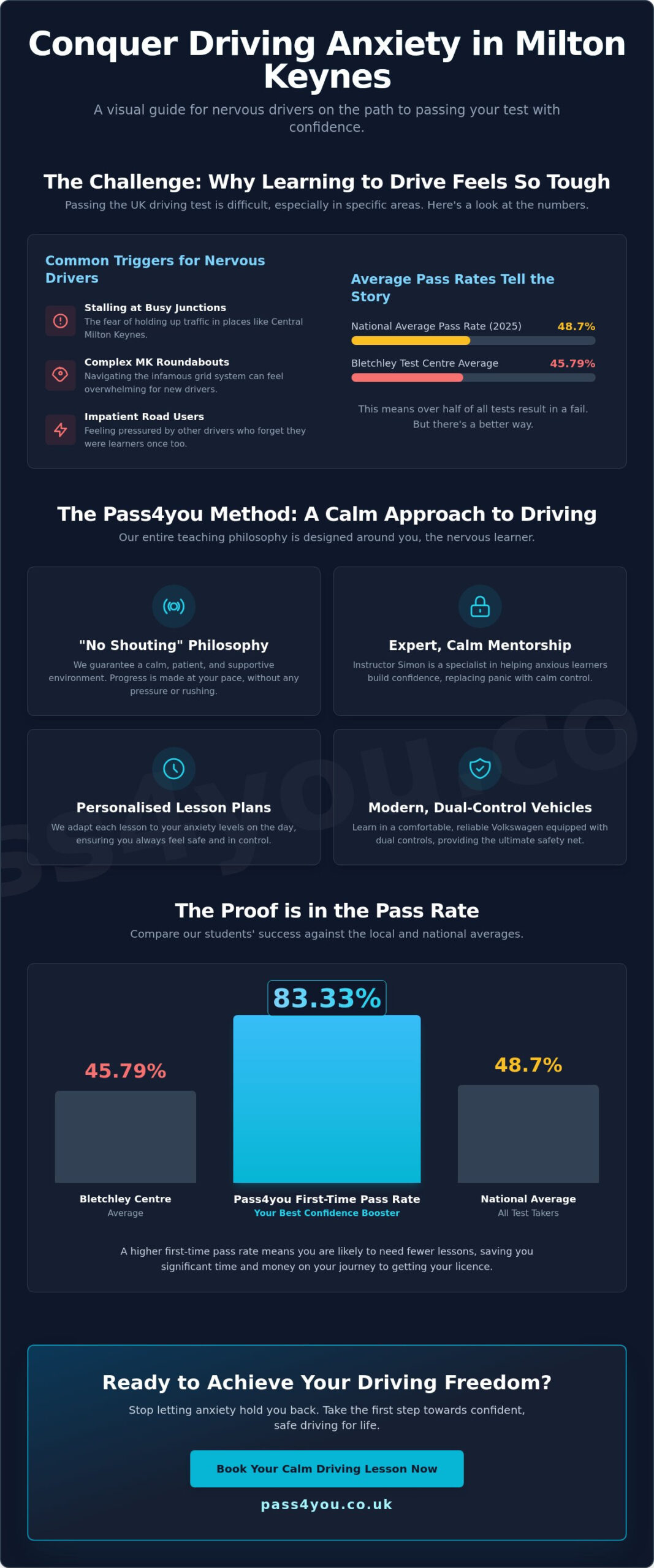
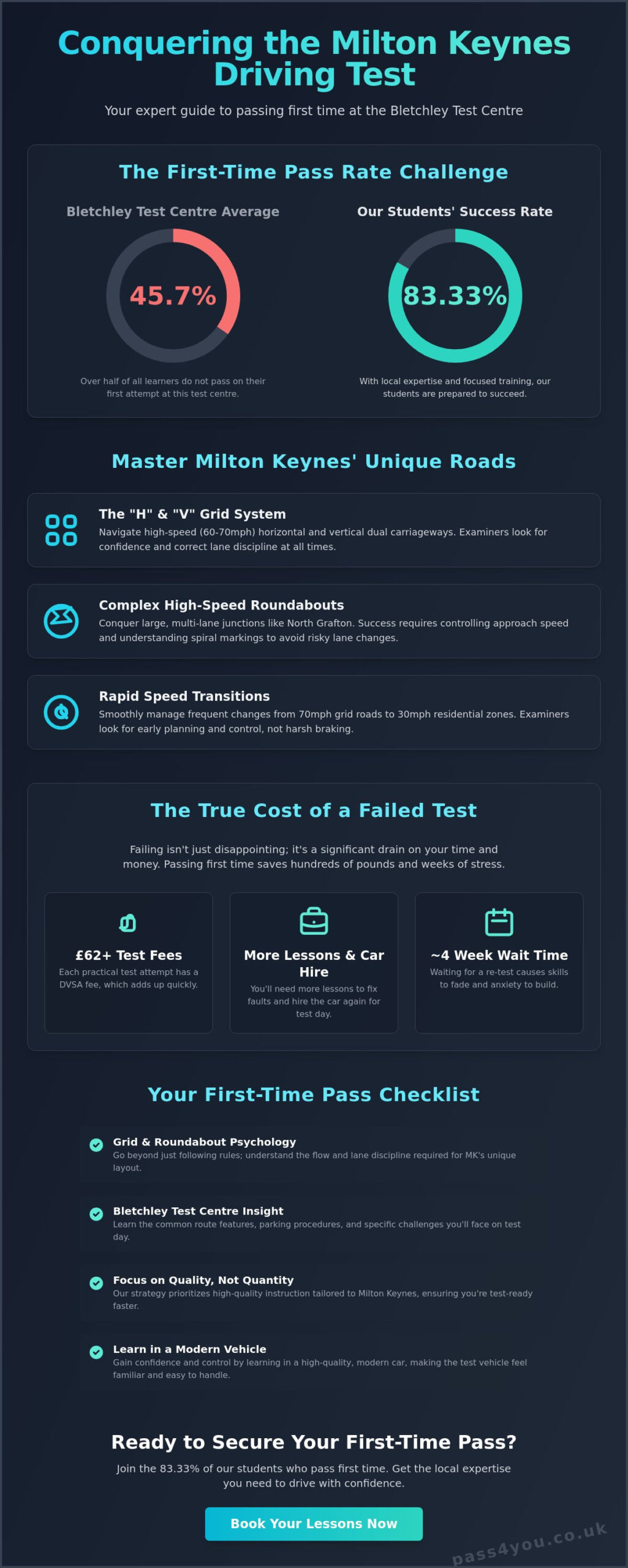
    Did you know that the current pass rate at the Bletchley Test Centre is just 45.7%? It is a sobering figure that explains why so many learners feel anxious about the city’s complex grid system and those infamous high-speed roundabouts. You aren’t alone if the thought of merging onto a dual carriageway or navigating a multi-lane junction makes your heart race. However, with the right preparation and local knowledge, you can absolutely pass driving test first time milton keynes and secure your freedom. While the local average is low, our students benefit from a refined approach that delivers a much higher 83.33% first-time success rate.

    We understand that the fear of failing and the high cost of re-tests can be overwhelming. That is why we’ve put together this expert guide to help you feel calm, capable, and completely in control. You will discover the specific local strategies needed to conquer the unique road layout of Milton Keynes without the stress. We will walk you through the latest 2026 booking regulations, explain how to master the Bletchley test routes, and provide the techniques you need to drive with confidence on every single trip.

    Key Takeaways

    • Master the “H” and “V” grid psychology and the specific lane discipline required for Milton Keynes’ complex roundabouts.
    • Gain an insider’s view of the Bletchley Test Centre, including parking procedures and common route features.
    • Follow our proven strategy to pass driving test first time milton keynes by focusing on quality instruction rather than just the number of lessons.
    • Prepare effectively with a dedicated countdown checklist that covers everything from mental rest to vehicle-specific safety questions.
    • Understand why learning in a high-quality, modern vehicle makes a significant difference in your confidence and control on test day.

    The Reality of Passing Your Driving Test First Time in Milton Keynes

    Understanding the current UK driving test structure is the first step toward your full licence. In 2026, the DVSA maintains a rigorous standard to ensure every new driver is safe and competent. To pass driving test first time milton keynes, you must navigate a 40-minute practical exam with no serious or dangerous faults. You are allowed a maximum of 15 minor driving faults, but the goal is always a clean sheet. While the national average pass rate usually hovers between 48% and 50%, the Bletchley Test Centre presents a slightly more difficult environment. Local data shows a pass rate of approximately 45.7%, which means more than half of learners don’t succeed on their first try. This isn’t because the examiners are stricter; it’s because the local road system is uniquely demanding.

    Why Milton Keynes is Different from Other UK Cities

    Milton Keynes was designed with a specific grid layout that sets it apart from almost any other city in the country. Instead of the narrow, congested streets found in older towns, you’ll encounter a series of “H” (Horizontal) and “V” (Vertical) roads. These are often high-speed dual carriageways with 60mph or 70mph limits. The sheer frequency of roundabouts is another major factor. You might face dozens of them during a single test. Mastering these junctions requires precise lane discipline and the ability to judge high-speed traffic gaps quickly. If you want to understand how to handle these specific local challenges, our guide to Driving Lessons Milton Keynes provides the deeper context you need.

    The True Cost of Failing: Why First Time Matters

    Failing your test is expensive and emotionally draining. A weekday practical test costs £62, but that is only the beginning. You also have to consider the cost of car hire for the test day and the price of additional lessons to fix the mistakes that led to the fail. In 2026, wait times at the Bletchley centre are roughly 4 weeks. This delay often leads to “wait time anxiety,” where learners worry about losing their edge before they can try again. Passing first time saves you hundreds of pounds and weeks of stress. Our approach at Pass4you Driving School results in an 83.33% first-time pass rate. By focusing on quality instruction and deep local knowledge, we help you avoid the hidden costs of multiple attempts while building your confidence as a safe driver.

    Mastering Milton Keynes’ Unique Road Layout: The Grid and Roundabouts

    Navigating Milton Keynes requires a specific mental shift compared to driving in traditional UK towns. While the grid’s design was touched upon previously, mastering the flow between Horizontal (H) and Vertical (V) roads is essential for your practical exam. These grid roads allow for high-speed travel, but they frequently terminate at complex junctions. A common challenge for learners is the transition from a 70mph V-road into a 30mph residential zone. To pass driving test first time milton keynes, you must demonstrate that you can manage these speed drops smoothly without harsh braking or losing control of your road positioning.

    Lane discipline is where many candidates struggle during their 40-minute drive. When you’re approaching a multi-lane junction at speed, the road markings can seem like a blur if you haven’t practiced. However, the official DVSA test guide emphasizes that examiners look for early planning and clear intentions. You don’t need to be a perfect driver, but you must show that you understand which lane leads to your destination. Drifting across white lines is a frequent reason for a serious fault, so staying centered in your chosen lane is vital for a successful outcome.

    Conquering the MK Roundabouts

    Large junctions like North Grafton and Oldbrook are famous for their size and traffic volume. The secret to success here is your approaching speed. If you arrive too quickly, you won’t have time to process the signs or traffic signals effectively. Many of these roundabouts use spiral markings to help traffic flow. A spiral roundabout features lane markings that lead you from the inner lanes to the correct exit without requiring risky lane changes. If you follow these lines accurately, the road does the work for you. Our patient instructors at Pass4you Driving School spend significant time practicing these specific junctions so they feel routine rather than intimidating.

    High-Speed Confidence on Grid Roads

    Merging onto a fast-moving dual carriageway is a high-pressure moment that requires precise timing. You shouldn’t hesitate on the slip road; instead, use its length to match the speed of the traffic already on the grid road. Finding a safe gap requires excellent mirror work and a calm temperament. Once you’ve joined the flow, maintaining a safe following distance is your priority. At 70mph, the gap between you and the car in front should be at least two seconds in dry conditions. At Pass4you Driving School, we introduce these high-speed environments early in your training. This exposure helps you build the mental stamina needed for the longer stretches of the practical test. If you want to refine these skills, our tailored driving lessons can help you build the confidence needed for test day.

    How to Pass Your Driving Test First Time in Milton Keynes: The 2026 Expert Guide

    The physical environment of the Bletchley Test Centre presents its own set of challenges before you even turn the key. Located in a busy area, the centre requires you to be alert from the moment you enter the car park. Arrival procedures are strict; you should aim to be in the candidate parking area about 10 minutes before your appointment. Arriving too early can cause congestion, while being late might result in a cancelled test. When you look at the official driving test pass rates, it becomes clear that the local geography demands a higher level of situational awareness. To pass driving test first time milton keynes, you must prove you can handle the immediate transition from the quiet test centre car park to the bustling urban traffic of Bletchley.

    During the independent driving portion of the exam, which lasts roughly 20 minutes, you’ll likely follow a sat-nav or road signs. While we’ve discussed the grid system’s layout, the independent section tests your ability to process that information without prompts. The signage in Milton Keynes is generally excellent, but the high frequency of turnings can lead to late decisions if you aren’t looking far enough ahead. If you’re still in the planning stages of your journey, make sure to check our guide on How to Book Your Driving Test to stay updated on the 2026 DVSA requirements. Being organized with your booking allows you to focus your energy on mastering the local routes.

    Common Fail Points in the Bletchley Area

    The Fenny Stratford junction is a notorious spot that requires exceptional observation. It often catches out learners who are too focused on their own lane and fail to anticipate the movement of others. Another tricky zone is the area surrounding Stadium MK. Speed limits here can be deceptive, often dropping from 40mph to 30mph with very little warning. Furthermore, Milton Keynes is famous for its “Redway” system. These shared paths for cyclists and pedestrians intersect with the road at numerous points. Failing to give way or show adequate anticipation at a Redway crossing is a common reason for a serious fault. To pass driving test first time milton keynes, you need to treat these crossings with the same respect as a zebra crossing.

    The Mock Test: Your Secret Weapon

    We believe that the best way to overcome test-day nerves is to remove the element of surprise. A professional mock test replicates the exact conditions and pressure you’ll face with a DVSA examiner. During these sessions, your instructor will use the official marking criteria to identify serious and minor faults. This process helps you understand exactly where your weaknesses lie while there is still time to correct them. At Pass4you Driving School, we consider mock tests an essential part of our curriculum. They are the primary reason our students feel so prepared when they finally arrive at the Bletchley centre. By the time your real test begins, you’ll feel like you’ve already completed the route dozens of times.

    Your First-Time Pass Checklist: Practical and Mental Preparation

    The final two days before your exam are about refinement and rest. To pass driving test first time milton keynes, you don’t need to learn new skills in the last 48 hours; you need to consolidate what you already know. Review your instructor’s feedback and focus on your mental state. A tired mind makes slow decisions at high-speed roundabouts. We recommend a “Lesson Before the Test” strategy. This hour-long session right before your appointment helps you adjust to the current traffic conditions in Bletchley. It acts as a warm-up, ensuring your clutch control and observation are sharp before the examiner even sits in the car.

    Preparation isn’t just about the drive itself. It’s about knowing your vehicle inside and out. When you feel prepared, your anxiety levels naturally drop. Taking the time to visualize the Bletchley roads and your responses to common hazards can make a significant difference. This mental rehearsal helps you stay focused on the task at hand rather than worrying about the outcome.

    2026 ‘Show Me, Tell Me’ for Milton Keynes Learners

    Safety questions are the first hurdle on test day. At the Bletchley centre, examiners often ask about engine oil, coolant, or brake fluid levels. Our modern Volkswagen fleet makes these checks straightforward. Your instructor will show you exactly where the dipstick and reservoirs are located in our specific VW models. One common question involves checking your tyres for safety. To check the tyre tread depth, you must ensure there is a minimum of 1.6mm across the central three-quarters of the breadth of the tyre and around its entire outer circumference. Being able to answer these with confidence sets a positive tone for the rest of the drive.

    Managing Performance Anxiety

    Nerves are a natural part of the process, but they don’t have to control you. If you make a small mistake, like stalling at a junction or missing a signal, the “don’t dwell” rule is your best defense. Many learners fail because they spend five minutes worrying about a minor error and then commit a serious one. Take a deep breath and focus entirely on the road ahead. Our instructors use a patient, calm mentor style to prepare you for this. We practice scenarios where things go slightly wrong so you know how to recover without panic. This mental resilience is often what separates those who pass driving test first time milton keynes from those who have to rebook. If you’re feeling anxious about your upcoming test, you can book your driving lessons with us to build the confidence you need.

    Why Local Expertise Matters: The Pass4you 83.33% Success Strategy

    Success on the road isn’t just about hours spent behind the wheel. It’s about the quality of those hours and the expertise of the person sitting next to you. At Pass4you, we don’t believe in the corporate “one size fits all” approach. We focus on a high-precision strategy that has resulted in a verified 83.33% first-time pass rate. This figure is nearly double the local average for the Bletchley area. When you choose to learn with us, you aren’t just another number in a database. You’re a student receiving a personalized education designed to help you pass driving test first time milton keynes and become a safe, lifelong driver.

    Our modern fleet of Volkswagen vehicles plays a significant role in this success. We’ve chosen these cars because they are reliable, easy to handle, and equipped with the latest safety features. Learning in a first-class vehicle reduces the mechanical stress of driving, allowing you to focus entirely on your observation and road positioning. Whether you’re navigating a quiet residential street or a busy dual carriageway, you’ll feel supported by the car’s responsive controls and comfortable interior. This reliability is a cornerstone of our commitment to your progress.

    Expert Instructors Who Know Every MK Corner

    Our instructors aren’t just qualified; they are local experts who live and drive in Milton Keynes every day. They know every quirk of the North Grafton roundabout and every speed limit change near Stadium MK. This deep local knowledge is invaluable when you’re preparing for the specific challenges of the Bletchley routes. We use a patient mentor approach that is specifically designed to help nervous learners overcome their anxiety. By building your confidence in a supportive environment, we ensure you’re ready for the examiner’s presence. For more detailed advice on the 2026 standards, you can read our guide on Mastering the Practical Driving Test.

    Save Time and Money with Efficient Learning

    It’s easy to be tempted by “cheap” driving lessons, but these often become a trap. If an instructor lacks the specific local expertise needed for this city, you may end up needing twice as many hours. Worse still, failing your test because of poor preparation leads to the high costs of re-tests and car hire. Our strategy focuses on efficiency. We move at your pace, ensuring you master each skill before moving to the next. This methodical approach is the best value for your investment because it prioritizes a successful outcome on your very first attempt. If you’re ready to gain your freedom and pass driving test first time milton keynes, you can start your driving journey with Pass4you Milton Keynes today. We’re here to guide you every step of the way with patience, professionalism, and proven results.

    Take the Wheel with Confidence in Milton Keynes

    You now have the roadmap to navigate the complex grid system and the tactical knowledge to handle the Bletchley test routes. By mastering the spiral roundabouts and preparing your mind for the challenge, you’re already ahead of the average learner. Success isn’t just about avoiding faults. It’s about feeling in total control of a modern, reliable vehicle while receiving guidance from a mentor who truly knows the local roads. We’ve shown you that the right preparation can turn anxiety into genuine confidence.

    Our unique strategy is built on patience and high-precision results. With our modern Volkswagen tuition vehicles and a team of first-class local instructors, we provide the supportive environment you need to pass driving test first time milton keynes. We focus on quality instruction that saves you time and money by getting it right from the very start. Ready to take the first step toward your full licence? Book your first lesson with Pass4you and join our 83.33% first-time pass club. We’re excited to help you achieve your driving freedom with safety and ease.

    Frequently Asked Questions

    What is the current driving test pass rate in Milton Keynes for 2026?

    The current pass rate at the Bletchley Test Centre is approximately 45.7% as of 2026. This figure is slightly lower than the national average of 48.7%. These statistics highlight why specific local road knowledge is so important for success. While the general pass rate is challenging, students who train with a local expert often achieve much higher results through tailored preparation.

    How many driving lessons do I need to pass first time in MK?

    The DVSA suggests that most learners need around 44 hours of professional tuition combined with 22 hours of private practice. However, every student is unique and learns at their own pace. Our primary focus is to ensure you have the confidence and skill to pass driving test first time milton keynes, whether that takes you slightly more or fewer hours than the average.

    Is Bletchley the only driving test centre in Milton Keynes?

    Yes, Bletchley is currently the only practical driving test centre located within Milton Keynes. It serves the entire city and surrounding areas like Newport Pagnell and Stony Stratford. Because it is the sole centre for the region, it is vital to spend your lesson time practicing on the specific urban and grid road routes that the Bletchley examiners typically use.

    Can I use my own car for the driving test in Milton Keynes?

    You are permitted to use your own car if it meets the DVSA requirements for safety and equipment. Your vehicle must have an additional rear-view mirror for the examiner, L-plates, and a valid MOT. Most of our students find it much more reassuring to use our modern Volkswagen tuition vehicles because they are already comfortable with the controls and the specific “show me, tell me” procedures for those cars.

    What are the most common reasons for failing a driving test in MK?

    Incorrect lane discipline on roundabouts and poor observation at junctions are the most frequent reasons for failure in this area. Examiners also look closely at how you manage speed transitions between the 70mph grid roads and 30mph residential zones. Understanding these common pitfalls allows you to focus your training on the specific skills that examiners in Bletchley prioritize.

    How do I deal with the large roundabouts in Milton Keynes during my test?

    The secret to handling large roundabouts is early observation and a controlled approach speed. You must look for road markings and signs well before you reach the junction to ensure you choose the correct lane. Many local junctions use spiral markings to guide you naturally toward your exit. Staying calm and following these lines is a proven way to pass driving test first time milton keynes.

    Should I take my driving test in a manual or automatic car in MK?

    This depends on your personal preference and whether you want the freedom to drive any vehicle. A manual licence allows you to drive both manual and automatic cars, while an automatic licence limits you to automatics only. Many learners find automatic cars easier for navigating Milton Keynes’ frequent roundabouts, but manual remains a popular choice for those wanting maximum flexibility in the future.

    What happens if I make a small mistake during my driving test?

    A small mistake, or “minor fault,” does not result in an automatic fail. You are allowed to make up to 15 minor faults during your test as long as none of them are serious or dangerous. If you feel you have made an error, it is important to stay calm and keep your focus on the road ahead. Examiners are looking for safe, safe driving rather than absolute perfection.

  • How Driving Lessons Give You Independence: Your Roadmap to Freedom in 2026

    What if you never had to check a Milton Keynes bus timetable ever again? It’s a frustrating reality for many; waiting for a bus that’s running late or relying on family members who might pass on their own driving “bad habits.” You likely want the freedom to commute on your own terms, and understanding how driving lessons give you independence is the first step toward that goal. We know that navigating those famous local roundabouts or facing the practical test feels overwhelming, but learning to drive is about more than just operating a car; it’s about reclaiming your time and your life.

    You aren’t alone in feeling this way, and your desire for a faster, safer path to your licence is completely valid. This guide shows how professional instruction transforms you from a nervous passenger into a skilled driver who is ready for anything. You’ll discover how expert coaching helps you pass your test quickly to save money, even with the stricter 2026 booking regulations. We’re going to look at the journey from your first lesson to that moment of pure freedom when you finally drive away solo.

    Key Takeaways

    • Learn how professional instruction moves you from simply following orders to making your own executive decisions behind the wheel.
    • Discover how driving lessons give you independence by building the confidence to navigate the Milton Keynes grid system and roundabouts safely.
    • Avoid the common “bad habit” trap that comes with learning from friends or family. Professional lessons often save you money by reducing the total hours you’ll need to pass.
    • Master essential skills like hazard perception and sat-nav navigation to ensure you can travel spontaneously without feeling any panic.
    • Understand why a patient, supportive teaching style is the most effective way for nervous beginners to overcome anxiety and secure their long-term freedom.

    Defining Independence: More Than Just Holding a License

    Many people think that passing the practical test is the final destination. In reality, it’s just the beginning of a new way of living. True independence isn’t about the physical card in your wallet; it’s about the quiet confidence that comes from knowing you can handle a car entirely on your own. Understanding how driving lessons give you independence helps you see that this process is a mental transformation. You are moving away from being a passenger who simply observes the road to becoming an active driver who controls every aspect of the journey. Independence is a mindset. It’s about total control.

    This shift involves moving from “following orders” to “making executive decisions.” When you start, your instructor tells you when to change gear or check your mirrors. As you progress, those prompts disappear. You begin to anticipate hazards yourself without needing a nudge from the passenger seat. This is vital because your legal authorization to drive serves as a passport to new social and professional worlds. Whether it’s a job offer that requires a commute or a spontaneous weekend trip, your ability to drive opens doors that were previously locked by unreliable bus schedules or expensive taxi fares. Independence manifests in several ways:

    • Choosing your own routes without asking for directions.
    • Adjusting your speed safely based on road conditions, not just signs.
    • Reacting calmly to other drivers’ mistakes.
    • Feeling ready to handle unexpected road hazards without panic.

    The Transfer of Responsibility

    Professional driving lessons are designed to be a structured hand-off of control. We don’t just teach you to pass a test; we prepare you for the reality of solo driving. Your instructor will gradually “dial down” their verbal support as your skills improve. This ensures that when you finally take your test, you aren’t just performing for an examiner. You are demonstrating that you are ready for the responsibility of keeping yourself and others safe. This foundation is much stronger than what you might get from private practice alone. Professional guidance is the safest foundation. It builds genuine self-reliance and ensures you don’t pick up dangerous habits from well-meaning friends.

    From Passenger to Pilot

    Imagine your morning without the stress of an unreliable Milton Keynes bus. You could leave ten minutes later, enjoy your own music, and arrive at work feeling calm. We bridge the “anxiety gap” through patient, structured tuition. Using modern, easy-to-handle vehicles like our Volkswagens makes this transition much smoother. These cars are responsive and comfortable. They allow you to focus on the road ahead rather than struggling with the controls. By the time you reach your test, the car feels like an extension of yourself. You are ready to explore the city with total autonomy.

    The Core Skills That Build True Driving Autonomy

    True autonomy on the road isn’t something that happens by accident. It’s the result of mastering specific, high-level skills that allow you to move through traffic without second-guessing yourself. While basic car control is the starting point, understanding how driving lessons give you independence requires looking at how you process information. Professional training focuses heavily on hazard perception. This is the ability to spot potential dangers before they become actual problems. When you can identify a pedestrian stepping out or a car braking early, you aren’t just reacting; you’re planning. This foresight is what makes you a safe, independent driver.

    Technical proficiency also plays a massive role in your confidence. If you’re constantly worrying about stalling or finding the right gear, your brain has less “processing power” for the road around you. Smooth car control leads to calmer decision-making. Our instructors focus on making these physical actions second nature. This allows you to focus on the environment, which is how you truly build a solid foundation of safe driving habits that last a lifetime. Once the mechanics of driving are automatic, you can dedicate your full attention to the complex world outside your windscreen.

    Decision Making Under Pressure

    Being independent means you no longer wait for a “go” signal from the passenger seat. You’ll learn to judge gaps in traffic at busy junctions and roundabouts with precision. This mental stamina is essential for solo journeys. On your own, you’ll face roadworks, diversions, and changing weather without a safety net. We prepare you for these “unexpected” moments by gradually increasing the complexity of your lessons. This ensures you can handle the pressure of real-world driving without feeling overwhelmed. You’ll develop the grit needed to stay focused even when a journey doesn’t go exactly as planned.

    Navigating Without a Safety Net

    The 2026 practical test places a strong emphasis on independent driving sections. You’ll be asked to follow road signs or a sat-nav for a significant portion of the exam. Mastery of these tools is vital for your future freedom. If you take a wrong turn while driving solo, the goal isn’t to panic; it’s to find a safe way to get back on track. We integrate these scenarios into our sessions so they feel routine. If you want to see how this fits into the bigger picture, check out our ultimate guide to passing your test. To start building these skills today, consider booking driving lessons with a patient mentor who understands your goals.

    Finally, the mock test is your ultimate rehearsal for freedom. It isn’t just about checking boxes. It’s about proving to yourself that you can manage a car, navigate a route, and stay safe for 40 minutes without any help. Once you’ve aced a mock test with your instructor, that feeling of independence becomes very real. You’ll know that you aren’t just “test-ready,” but truly road-ready for whatever Milton Keynes throws your way.

    How Driving Lessons Give You Independence: Your Roadmap to Freedom in 2026

    Why Professional Lessons Outperform ‘Private Practice’ Alone

    It is often tempting to rely on a parent or friend to teach you the basics. While their intentions are good, this approach frequently leads to the “Bad Habit Trap.” Friends and family members often have years of experience, but they also have years of ingrained shortcuts that won’t pass a modern driving test. These informal sessions lack the structured syllabus required to ensure there are no “skill gaps” in your training. Professional instruction is designed to identify these gaps early. This is a primary reason why driving lessons give you independence more effectively than private practice alone; they build a foundation of precision rather than just “getting by.”

    Efficiency is another critical factor. The Driver and Vehicle Standards Agency (DVSA) recommends around 45 hours of professional driving lessons alongside 22 hours of private practice. By following a professional curriculum, you often reach test-readiness faster. This saves you money in the long run by reducing the total number of hours needed. Beyond cost, safety is the priority. Learning in a car equipped with dual controls provides a vital safety net during those high-risk early stages. It allows you to focus on developing safe driving habits without the fear of making a dangerous mistake that you can’t correct.

    Structured Learning vs. Informal Practice

    A syllabus-based approach ensures you cover every scenario, from emergency stops to complex junctions. Professional instructors are trained to spot anxiety triggers that a friend might miss. They know how to calm your nerves and explain “why” a certain action is necessary, not just “how” to do it. If you choose to supplement your lessons with private practice, doing so safely and effectively requires a clear plan. Your instructor can provide specific goals for your private sessions so you don’t accidentally undo the progress you’ve made during your professional tuition.

    The Pass4you Advantage

    Success is often a matter of preparation. We take pride in our 83.33% first-time pass rate, which stands as a clear benchmark for our teaching efficiency. This high-precision metric proves that our methods work. Because we focus specifically on the unique challenges of Milton Keynes roads, our students gain local independence much faster than those learning in unfamiliar areas. You can read more about how we help learners achieve these results in our high pass rate case study. Choosing a mentor who understands the local grid system means you’ll feel like an expert on your own streets before you even have your full licence.

    Milton Keynes is a city built for drivers. The unique grid system of Horizontal (H) and Vertical (V) roads is designed for efficiency, but it can feel like a maze to a new learner. Understanding how driving lessons give you independence means mastering this layout until it feels like second nature. When you can navigate from the H6 to the V8 without hesitation, the entire city opens up. You stop being a passenger following a route and start being an explorer who knows exactly where you’re going. This local knowledge is your greatest asset for long-term freedom. It allows you to plan your day around your own needs rather than a bus map.

    Professional instruction helps you bridge the gap between “learning to drive” and “knowing your town.” You’ll learn the timing of the lights, the flow of the grid, and how to safely hit 70mph on the dual carriageways. There is a specific thrill in that first time you merge onto a main road at speed with total control. It’s a clear signal that you’re no longer just a learner; you’re a driver. We focus on making these high-speed transitions feel calm and routine. This ensures you have the confidence to travel anywhere in the region without a second thought. You won’t just be passing a test; you’ll be gaining a lifetime of mobility.

    Conquering the MK Roundabouts

    The roundabout is the definitive Milton Keynes rite of passage. With hundreds of junctions across the city, gaining confidence here is essential for your autonomy. We provide step-by-step guidance on lane discipline, helping you understand which lane to choose long before you reach the junction. Learning locally means you won’t be intimidated by your own home. You can find more specific tips in our guide to mastering the dual carriageway.

    The Freedom of the Commute

    Independence in Milton Keynes translates directly into opportunity. Holding a licence means you can apply for jobs in expansion zones without worrying about transport. It also means your social life is no longer dictated by the bus timetable at CMK station. You can visit Bletchley, Stony Stratford, or head to the Xscape whenever you like. The car gives you spontaneity that public transport cannot match. If you’re ready to stop waiting in the rain, book your driving lessons with us today.

    Securing Your Future Freedom with Pass4you

    Real independence isn’t just about the day you pass your test. It’s about every day that follows. You’ve seen how driving lessons give you independence by providing the technical skills and mental stamina needed for the road. This isn’t a card you simply earn; it’s a lifelong skill you learn through patience and practice. Investing in quality instruction today means you won’t just be a licence holder. You’ll be a competent driver who can handle the pressure of solo travel with total ease. Quality tuition is an investment in your safety and your future mobility.

    Our approach is specifically designed for those who feel a bit nervous about getting behind the wheel. We don’t believe in rushed or aggressive teaching styles. Instead, we focus on building your confidence layer by layer. This supportive environment is why so many learners in Milton Keynes choose us. When you feel safe and understood, you learn more effectively. This efficiency is what allows our students to achieve such a high pass rate. It gets them on the road and into their new lives faster than they ever thought possible. You deserve a mentor who is as invested in your success as you are.

    Ready to Start Your Journey?

    Taking that first step might feel daunting, but we make it simple. Booking your first session is the beginning of a massive change in your daily routine. During your first hour, you won’t be thrown into the deep end. You’ll get to know the car, understand the controls, and move the vehicle for the first time in a quiet, safe area. It’s all about comfort and steady progress. If you’re still looking for the right fit, take a look at our guide on finding the best local instructors to see what makes a great mentor.

    Your Independence Awaits

    The roads of 2026 require a modern driver who is both skilled and responsible. With new regulations on test bookings and updated theory requirements, having a professional school in your corner is vital. We’re here to ensure you don’t just meet the standards; you exceed them. Your first lesson is truly the first step toward a life without bus timetables or relying on others for lifts. We’re ready when you are. You can book your driving lessons in Milton Keynes today and start your roadmap to freedom. Your new life as a confident driver is just around the corner.

    Your Future on the Open Road Starts Today

    The road to autonomy in Milton Keynes is closer than you think. You’ve seen how professional training moves you beyond basic car control to true navigational mastery. Understanding how driving lessons give you independence is about recognizing that you are building a life of spontaneous travel and professional growth. You are no longer just a passenger; you are the pilot of your own journey.

    With our 83.33% first-time pass rate and a modern Volkswagen tuition fleet, we provide the safest environment for you to grow. Our patient, first-class instructors are experts at turning anxiety into confidence. They’ll guide you through every grid road and roundabout until the car feels like an extension of yourself.

    Start your journey to independence – Book your MK driving lessons now

    Don’t let another rainy day at the bus stop hold you back. Your roadmap to freedom is ready and waiting. It’s time to take the wheel and embrace the life you deserve.

    Frequently Asked Questions

    How many driving lessons do I need to feel independent?

    The Driver and Vehicle Standards Agency (DVSA) recommends around 45 hours of professional tuition and 22 hours of private practice. Everyone learns at a different pace. Our goal is to ensure you feel confident and safe enough to handle any situation on your own before we send you for your test. We focus on quality instruction that builds your skills steadily until you no longer need prompts from the passenger seat.

    Can I learn to drive independently with just a family member?

    While private practice is helpful, relying solely on family members often leads to picking up “bad habits” that can cause a test failure. Professional instructors follow a structured syllabus that ensures you don’t have any skill gaps. Understanding how driving lessons give you independence involves realizing that an expert mentor teaches you the specific safety standards required for solo driving in modern traffic.

    What is the independent driving section of the UK driving test?

    This part of the practical test lasts about 20 minutes. You’ll be asked to follow directions from a sat-nav or road signs provided by the examiner. It isn’t a test of your geography; it’s a test of your ability to make safe decisions while navigating on your own. If you take a wrong turn, the examiner will help you get back on track without penalisng you, provided you stay safe.

    How does learning in Milton Keynes differ from other cities?

    Milton Keynes is unique because of its high-speed grid system and famous roundabouts. Unlike traditional cities with narrow, winding streets, MK requires you to be comfortable with lane discipline and merging at 70mph. This makes local experience vital for your confidence. We ensure you’re familiar with the specific H and V road layouts so you can navigate your hometown without any hesitation.

    Is it better to learn in a manual or automatic car for independence?

    Manual cars offer the most freedom because a manual licence allows you to drive both types of vehicles. Automatic cars are often easier to learn in because there is no clutch to manage, but you’ll be restricted to only driving automatics once you pass. Most learners choose manual to keep their future options open, especially when it comes to hiring cars or choosing a first vehicle.

    What happens if I fail my first test? Will I lose my independence?

    Failing a test is a temporary setback, not a loss of your future freedom. It simply means you need a little more time to refine your skills under pressure. We’ll work with you to address the specific areas that need improvement so you can return to the test centre with complete confidence. Your independence is a journey, and we’re here to support you until you reach the finish line.

    How much do driving lessons in Milton Keynes cost in 2026?

    Learning to drive is a significant investment in your long-term mobility. While prices across the UK vary based on fuel costs and vehicle maintenance, we focus on providing value through efficient teaching methods. We show you how driving lessons give you independence through structured sessions that help you pass faster. This approach reduces the total number of hours you’ll need to pay for before you’re ready for the road.

    Can I drive on the motorway as soon as I pass my test?

    Yes, you can drive on the motorway as soon as you have your full licence. While learners can only use motorways with a qualified instructor in a dual-controlled car, passing your test gives you the legal right to use them solo. If you feel nervous about high-speed driving, we can include motorway practice in your final lessons to ensure you’re ready for long-distance travel.

  • Driving Test Day Nerves Tips: How to Stay Calm and Pass in 2026

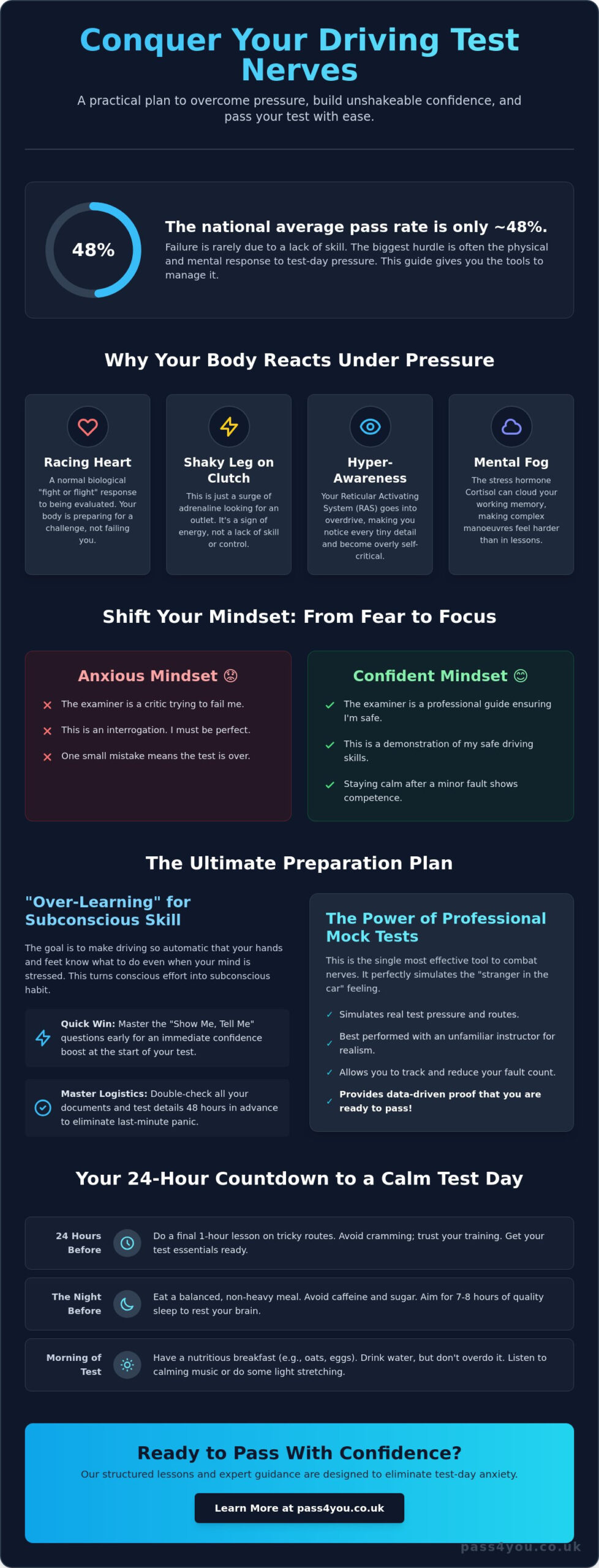
    Did you know that the national average pass rate for the practical driving test is currently around 48%? It is rarely a lack of technical skill that causes a fail; instead, it is often the physical response to pressure that catches learners off guard. You might already be worried about your legs shaking on the clutch or the stress of the 2026 booking rules that make retesting a long, difficult process. It is completely normal to feel this weight on your shoulders, but these driving test day nerves tips will help you regain your calm and focus.

    We understand that the pressure from friends and family can make the test feel like a mountain to climb. We promise to provide you with a structured plan and professional techniques to ensure your anxiety doesn’t stand in the way of your freedom. This guide explores how to use “Mock Test Habituation” and specific mental reframing to view your examiner as a helpful guide rather than a critic. You will discover practical tools to stop physical shaking and a 24 hour ritual that puts you firmly in control of your big day.

    Key Takeaways

    • Understand the biological roots of anxiety and how your brain’s “reticular activating system” impacts your performance during the test.
    • Learn why “over-learning” and mock tests are the most powerful tools for turning conscious driving into a calm, subconscious habit.
    • Follow a practical 24-hour countdown that uses rest and nutrition to settle your body and prevent physical shakes on the clutch.
    • Master driving test day nerves tips like the “Safe Mistake” mindset to ensure a small error doesn’t lead to a fail.
    • Discover how a calm, professional mentor helps you navigate specific local test routes far more effectively than informal practice ever could.

    Understanding Driving Test Day Nerves: Why Your Body Reacts This Way

    Feeling your heart race as you pull into the test centre is not a sign that you are a bad driver. It is a standard biological response to being evaluated. By Understanding Driving Test Day Nerves, you can begin to see these physical sensations for what they really are: your body preparing you for a challenge. This reaction is even more common in 2026. With current test backlogs and the new limit of just two booking changes, the “must-pass” pressure feels heavier than ever. We want you to know that this extra layer of anxiety is something we see every day, and it is entirely manageable.

    Have you ever noticed how you suddenly spot every tiny crack in the road or a slightly late signal when you are stressed? That is your reticular activating system (RAS) going into overdrive. It heightens your awareness, which is meant to keep you safe, but it can make you feel hyper-critical of your own performance. Similarly, that “shaky leg” on the clutch is just a surge of adrenaline. It is not a lack of skill; it is just energy looking for a way out. These driving test day nerves tips are designed to help you channel that energy back into safe, controlled driving.

    The Science of Test Anxiety

    When you feel under threat, your body releases cortisol. This hormone can sometimes cloud your working memory, making complex manoeuvres like a reverse bay park feel harder than they did in your lessons. It is helpful to remember that examiners are not looking for a “nerveless” robot. They are trained professionals who expect a certain level of tension. They are looking for safe, competent decisions, even if your hands are a little damp on the wheel. Learning to distinguish between “helpful excitement”, which keeps you sharp, and “debilitating dread” is the first step toward a successful result.

    Reframing the “Fail” Fear

    Many learners believe that a single mistake means the test is over. This misconception is one of the biggest drivers of anxiety. Think of your test as a “driving demonstration” rather than an interrogation. You are simply showing a friendly professional that you can handle a car safely on your own. If you make a minor mistake, don’t let it spiral. You can check our guide on the practical driving test to see exactly what counts as a fail and what is just a minor fault. Staying calm after a small error is often what separates those who pass from those who don’t. Using these driving test day nerves tips will ensure you keep your focus where it belongs: on the road ahead.

    Building a Foundation of Confidence Before the Big Day

    Preparation is the most effective way to quiet a noisy mind. When you reach a stage of “over-learning,” your car control becomes subconscious. This means that even if your brain feels foggy due to pressure, your hands and feet still know exactly what to do. You want to move beyond being “lesson ready” and ensure you meet the full DVSA standards for safety and independence. Mastering the “Show Me, Tell Me” questions early is a great way to start. Getting these right as soon as you meet the examiner provides an immediate confidence win that sets a positive tone for the rest of the drive.

    It is vital to understand that the examiner is looking for a safe, competent driver, not a perfect one. By focusing on your progress during every lesson, you build a mental library of successful moments to draw upon when you feel anxious. These driving test day nerves tips are not just about the day itself; they are about the weeks of consistent effort you have already put in. Trusting your training is the key to staying calm when the pressure mounts.

    The Power of Professional Mock Tests

    While practicing with a friend or family member is helpful, nothing beats a professional mock test. It simulates the specific “stranger in the car” feeling that often triggers anxiety. We recommend doing this with a different instructor to make the experience feel as real as possible. In Milton Keynes, this is especially valuable for navigating the complex H and V road grid system and the various roundabouts in Bletchley. By recording your mock test results, you can see a tangible reduction in your fault count over time. This data-driven proof of your progress is one of the best driving test day nerves tips because it shows you that you are truly ready.

    Mastering the Logistics

    A lot of test day stress comes from worrying about the small details. You can eliminate this by double-checking your essentials 48 hours before the big day. Ensure your provisional license uk and your theory certificate are in a safe, easy-to-find place. Confirm whether your test is at the Bletchley or Milton Keynes centre and verify the exact time. Preparing a “Test Day Kit” is another great way to feel in control. This should include:

    • Comfortable shoes that you have worn during your lessons.
    • Your glasses or contact lenses if you need them for the eyesight check.
    • Your test appointment letter or email confirmation.

    Being organised allows you to focus entirely on your driving. If you feel you need a little more practice on specific local routes, booking a few extra driving lessons can provide that final boost of certainty. When you know the logistics are handled, your mind is free to focus on the road.

    Driving Test Day Nerves Tips: How to Stay Calm and Pass in 2026

    The 24-Hour Countdown: A Practical Ritual for Calm

    Success on your test day starts long before you turn the ignition key. Establishing a clear, chronological ritual helps you feel in control when your environment feels unpredictable. One of the most effective driving test day nerves tips is to observe a “No-Drive Zone” exactly 24 hours before your appointment. While it is tempting to cram in last-minute practice, your brain needs time to rest and process what you have already learned. Over-practicing at this stage often leads to fatigue and silly mistakes that only serve to dent your confidence.

    The Night Before Strategy

    Your mental environment is just as important as your physical one. Social media is often full of “test horror stories” that can trigger unnecessary dread. We suggest curating your feed or staying off social apps entirely the evening before. Instead, spend 10 minutes on a visualisation exercise. Close your eyes and imagine yourself confidently merging onto a dual carriageway; see yourself checking your mirrors, matching your speed, and joining the flow of traffic with ease. Finally, plan a post-test treat. Whether it is a favourite meal or a cinema trip, having something to look forward to regardless of the result lowers the psychological stakes.

    Fueling for Focus

    What you put into your body directly affects your ability to stay sharp. About 12 hours before your test, opt for a high-protein dinner to keep your energy levels stable. It is crucial to skip caffeine in the evening; you want your heart rate to remain steady, not spiked by stimulants. On the morning of the test, many learners swear by the “banana myth.” It is actually rooted in science, as potassium helps regulate your heart rate and can prevent those shaky leg jitters. Balance this with careful hydration. You need to be sharp and alert, but you don’t want to be distracted by needing a mid-test break. Another helpful rule is “No News is Good News.” By not telling every friend and family member your exact test date, you remove the external pressure of having to report back to a crowd.

    On the day itself, use the final two hours wisely. A warm-up lesson with your instructor is perfect for settling into the car and getting your “driving brain” into gear. This is a time for gentle familiarisation, not for trying to learn new techniques. Aim to arrive at the test centre about 30 minutes before your slot. This gives you enough time to use the facilities and practice some calm breathing without sitting in the waiting room long enough to “stew” in your own thoughts. Following these driving test day nerves tips ensures you walk into that centre feeling like the capable driver you are.

    Real-Time Strategies to Stay Calm During the Practical Test

    Once you are in the driver’s seat, the dynamic shifts from preparation to performance. It is time to put your driving test day nerves tips into active use. One of the most effective mental shifts is the “Sat Nav” Reframe. Instead of seeing an authority figure judging your every move, view the examiner as a human GPS. Their job is simply to tell you where to go. They want you to see that you are a safe driver because safe drivers make the roads better for everyone. When you view them as a helpful guide rather than a critic, the pressure begins to lift.

    Mistakes happen, even to the most experienced motorists. The “Safe Mistake” Mindset is your best defence against a panic spiral during the drive. If you stall the engine, remember that it is just a stall. It is not an automatic fail. Take a second to breathe, reset the car, perform your 360-degree observations, and move off safely. The examiner is looking for how you handle the situation. A calm, safe recovery actually demonstrates high-level control and a responsible attitude toward road safety.

    You might also find that “commentary driving” helps you stay grounded. By quietly verbalising your thoughts, such as “I am checking my mirrors for that cyclist” or “I see the speed limit change ahead,” you keep your brain focused on the immediate task. This leaves less room for anxious thoughts to creep in. Use your hands as physical anchors too. Keeping them firmly at the 10 and 2 positions gives you a sense of stability and prevents nervous fidgeting or finger-tapping on the wheel.

    Mental Grounding Techniques

    Box breathing is a simple but powerful tool you can use whenever the car is stationary, such as at red lights. Inhale for four seconds, hold for four, exhale for four, and hold for four. If you feel your focus slipping, try the “Five Things” game. Mentally name five things you see on the road right now. This pulls your attention back to the present moment. It also helps to replace negative “what-if” thoughts with positive affirmations. Instead of thinking “I hope I don’t fail,” tell yourself “I am a safe and capable driver.”

    Handling the “Silent Car” Dynamic

    The silence in the car during a test can feel heavy, but it is actually for your benefit. The examiner stays quiet so you can concentrate fully on your driving decisions. You don’t need to feel pressured to fill the silence with small talk. It is perfectly okay to say a polite hello at the start, but your main focus should be the “Next Five Seconds.” Don’t dwell on a roundabout you left behind two minutes ago. Focus entirely on the road immediately in front of you. If you want to build this level of real-time confidence, booking professional driving lessons is the best way to prepare for the unique environment of the practical test.

    How Pass4you Driving School Eliminates Test Day Anxiety

    While the driving test day nerves tips we have shared are vital for your personal preparation, the person sitting next to you during your lessons has the biggest impact on your confidence. At Pass4you Driving School, we don’t just teach you how to operate a vehicle. We provide a supportive, patient environment that helps you manage your specific anxieties. Our instructors are experienced mentors who understand that every learner is different. This personalized approach is why we report an 83.33% first-time pass rate. When you compare this to the national average of around 48%, it is clear that professional instruction makes a massive difference to your success.

    Our fleet consists of modern Volkswagen tuition vehicles. These cars are chosen for their reliability and ease of use. When you are on your test, the last thing you want to worry about is the car itself. Our Volkswagens offer smooth controls and clear visibility, which helps you feel in safe, professional hands from the moment you move off. Finding the right driving instructors near me is about more than just proximity. It is about finding a team at Pass4you Driving School that prioritizes your emotional stability, safety, and long-term savings through effective teaching methods.

    Local Knowledge, Local Success

    Milton Keynes has a unique road layout that can be intimidating for new drivers. The H and V grid system, combined with high-speed roundabouts, requires a specific kind of focus. Our instructors have deep local knowledge of the Bletchley and Milton Keynes test routes. We simulate exact test conditions in the weeks leading up to your date, so there are no surprises. This removes the “fear of the unknown” that often triggers a panic response. We have helped countless students who previously suffered from severe anxiety pass their tests by replacing their fear with genuine local expertise. Our calm teaching style ensures you feel ready for every junction and roundabout in the area.

    Your Journey to Freedom Starts Here

    Our goal at Pass4you Driving School is to help you pass as efficiently as possible. With the 2026 test booking limits in place, getting it right the first time is more important than ever. You can only make a maximum of two changes to your test booking, so you need to be certain of your skills before you head to the centre. We invite you to book a Test Readiness Assessment. This session gives you an honest, transparent look at your skills and shows exactly what is needed to reach the DVSA standard. Don’t let nerves hold you back from the freedom and opportunities that come with a full licence. Book your first lesson with Pass4you Driving School and build your confidence today. We are here to guide you every step of the way.

    Your Path to a Full Licence in 2026

    Mastering your anxiety is the final step toward earning your freedom on the road. By understanding your body’s natural response and sticking to a structured 24-hour ritual, you can approach the test centre with genuine confidence. These driving test day nerves tips are designed to help you stay calm and focused when it matters most. You’ve already put in the hard work; now it’s just about demonstrating those skills to your examiner.

    Success is much easier when you have the right support system in place. We offer first-class Milton Keynes instructors and modern Volkswagen tuition vehicles to ensure you feel comfortable and prepared. Our proven methods have helped thousands of learners overcome their fears and build lasting confidence. Don’t let the pressure of the 2026 backlogs hold you back from your goals. Join the 83.33% who pass first time; Book your Milton Keynes driving lessons now. We believe in your ability to become a safe, independent driver. Your new life behind the wheel is just one calm drive away.

    Frequently Asked Questions

    How can I stop my legs from shaking during the driving test?

    Rest your left heel firmly on the floor to provide a stable pivot point for the clutch pedal. If you feel a shake starting, consciously press your heel down to ground yourself. This physical connection to the car helps counteract the adrenaline surge. You can also try tensing and releasing your calf muscles while waiting in the test centre to burn off some of that restless energy before you get into the vehicle.

    Is it true that eating a banana helps with driving test nerves?

    Yes, bananas are a natural source of potassium and vitamin B6, which help regulate your heart rate and keep your nervous system steady. Many learners find that eating one about 30 minutes before their appointment provides a calm energy boost without the jitters of caffeine. It is one of the most popular driving test day nerves tips because it is a simple, healthy way to settle your stomach and your mind.

    What happens if I make a mistake during my driving test?

    If you make a mistake, the best thing you can do is assume it is only a minor fault and keep driving safely. You can pass your test with up to 15 minor faults, so a single slip-up doesn’t mean you have failed. The examiner is looking for a safe recovery. If you stall or take a wrong turn, stay calm, reset, and show them that you can handle the situation professionally.

    Should I tell my friends and family when my driving test is?

    Keeping your test date to yourself is often the best way to reduce the weight of external expectations. When fewer people know, you don’t feel the “must-pass” pressure of having to report back to a large group. This allows you to focus entirely on your own performance. You can always surprise everyone with the good news once you have that pass certificate in your hand.

    How do I deal with a “grumpy” or silent driving examiner?

    Try to view the examiner’s silence as a professional tool designed to help you concentrate. They aren’t being rude; they are focusing intensely on the road and your safety. If they seem distant, treat their voice like a sat-nav and focus on the instructions they give you. Their job is to ensure you are safe, and their quiet nature allows you the space to make your own driving decisions.

    Can I take a rescue remedy or herbal calmers before my test?

    You should always speak with a pharmacist before using any herbal remedies to ensure they won’t make you drowsy. If you decide to try a rescue remedy, use it during a regular lesson first to see how your body reacts. It is never a good idea to try something new on the actual day of your test. You want to feel sharp, alert, and exactly like your usual self behind the wheel.

    What is the best way to breathe if I start to feel a panic attack coming on?

    Use the “4-7-8” technique to quickly reset your nervous system. Inhale quietly through your nose for four seconds, hold your breath for seven seconds, and exhale forcefully through your mouth for eight seconds. If you are moving, focus on making your exhales longer than your inhales. This simple change in your breathing pattern signals to your brain that there is no immediate danger, helping you regain your focus on the road.

    How do mock tests help with actual test day anxiety?

    Mock tests are the most effective way to desensitise yourself to the formal environment of the exam. They help you get used to the “stranger in the car” dynamic and the specific way instructions are delivered. By practicing under these conditions, you learn how to apply driving test day nerves tips in a realistic setting. This ensures that when the real day arrives, the process feels familiar rather than frightening.

  • Emergency Stop Procedure UK Driving Test: The 2026 Learner’s Guide

    Did you know that the emergency stop is now only requested in about 1 in 7 UK driving tests? While the DVSA reduced the frequency to roughly 14% of tests in late 2025, the pressure to get it right hasn’t changed. It’s completely natural to feel a flutter of “brake panic” when you think about the examiner suddenly calling out for you to stop. You might worry about skidding, losing control, or the common confusion of exactly when to use the clutch. We understand those nerves, and we’re here to help you turn that anxiety into quiet confidence.

    This guide will help you master the emergency stop procedure uk driving test by breaking down exactly what the examiner expects in 2026. You’ll learn the precise footwork needed for manual cars, how modern technology like ABS keeps you safe, and how to react instantly to the examiner’s signal. We’ll walk you through the process step by step, from the moment you hear the command to the final safety checks before moving off again. By the time you finish reading, you’ll have a clear roadmap to performing this maneuver smoothly, ensuring you feel prepared and professional on your test day.

    Key Takeaways

    • Understand the specific criteria DVSA examiners use to grade your performance, ensuring you meet the highest safety standards for 2026.
    • Master the correct footwork for the emergency stop procedure uk driving test, including the vital timing of the clutch and brake pedals.
    • Learn how to maintain a straight path and avoid common control issues that often cause anxiety for learner drivers.
    • Gain peace of mind by knowing exactly what happens after the stop, including the essential safety observations needed before you continue your drive.
    • Discover how expert guidance during your driving lessons can build the muscle memory required to handle sudden stops with complete confidence.

    What is the Emergency Stop Procedure in the 2026 Driving Test?

    The emergency stop is often the one part of the test that makes learner drivers feel most anxious. It’s a controlled maneuver designed to bring your car to a complete halt as quickly and safely as possible. While it might sound intimidating, it’s a vital skill that ensures you can handle unexpected hazards on the road. In the current UK driving test procedure, examiners use this exercise to assess two main things: how fast you react and how well you keep the car under control during heavy braking. We focus on helping you feel calm so that your feet do exactly what they’ve been trained to do without hesitation.

    You might have heard from friends or older relatives that you’re almost certain to perform this during your test. However, as of late 2025, the DVSA updated the frequency of this exercise to better reflect modern road conditions. In 2026, you actually only have a 1 in 7 chance of being asked to perform an emergency stop. This means it happens in roughly 14% of practical tests, a significant drop from the old 1 in 3 frequency. Even though it’s less common, your instructor will still make sure you’ve mastered the emergency stop procedure uk driving test. It’s always conducted on a safe, straight stretch of road where there’s minimal risk to other road users.

    When and How the Examiner Will Signal

    Before the exercise begins, the examiner will ask you to pull over to the side of the road. They’ll explain exactly what’s about to happen so there are no surprises. They’ll tell you that they’ll give a specific signal and that you should stop the car as if an emergency has occurred. They’ll also specify that you shouldn’t check your mirrors before braking, as in a real emergency, every millisecond counts.

    Once you move off and are driving normally, usually at a speed of 20 to 30mph, the examiner will look over their shoulder to ensure it’s safe behind you. Then, they’ll suddenly raise their hand and shout “STOP!” clearly. Your only job is to react immediately. You’ll need to apply the brakes firmly and progressively. During your driving lessons, we practice this until it becomes second nature, so you won’t feel startled when the shout finally comes.

    Why Safety is the Priority

    The main goal is to stop the car in the shortest distance possible while keeping it stable. This maneuver mimics a real-life situation, like a child stepping into the road or a car pulling out unexpectedly. If you take too long to hit the brakes or let the car veer toward the curb, it shows a lack of control. By using a firm, steady pressure, you allow the car’s safety systems to work effectively. The emergency stop is a test of your ability to provide a prompt, controlled reaction to a sudden hazard.

    Step-by-Step: How to Perform a Test-Standard Emergency Stop

    When the examiner gives the signal, your first priority is speed of reaction. You must move your right foot from the accelerator to the brake pedal instantly. Do not look in your mirrors. While this feels counterintuitive to everything you have learned in your driving lessons so far, a split second spent looking at the glass is a split second where the car is still moving at speed. Your goal is to stop the vehicle as quickly as possible while keeping it under full control.

    The way you apply the brake is just as vital as how fast you reach it. You should apply firm, progressive pressure. This means you don’t “stab” or “slam” the brake suddenly, which can cause the car to pitch forward violently or lose grip. Instead, push the pedal hard and keep that pressure steady until the car has stopped. Modern braking systems are designed to handle this force, and your car will respond best to a deliberate, strong input. Practicing this during your driving lessons with a supportive instructor will help you find the right balance of strength and smoothness.

    As the car slows down, you need to manage the clutch. If you’re driving a manual car, depress the clutch pedal fully just before the car comes to a complete standstill. This prevents the engine from stalling while ensuring you benefit from engine braking for as long as possible. If you press the clutch too early, the car might “coast,” which reduces your control. If you press it too late, the car might shudder or stall. Don’t worry if you do stall during the test; as long as the stop was safe and controlled, a stall is usually considered a minor fault rather than a fail.

    The “No Mirror Rule” Explained

    In almost every other driving situation, The Highway Code emphasizes the importance of checking your mirrors before changing speed or direction. However, the emergency stop procedure uk driving test is the one big exception. The examiner has already checked the road behind you to ensure it is clear and safe before giving the signal. In a real-world emergency, taking the time to check your mirrors could be the difference between a near-miss and a collision. Trust that the area is clear and focus entirely on stopping the car.

    Post-Stop Safety Checks

    Once the car has reached a total halt, keep your feet firmly on the pedals. Your first task is to secure the car by applying the handbrake and selecting neutral. This is a great moment to take a deep breath and settle your heart rate. The examiner will usually say, “Thank you, move off when you’re ready.” Before you put the car back into gear, you must perform a thorough, 360-degree observation. Check both blind spots and all mirrors. You are looking for pedestrians, cyclists, or other vehicles that may have approached while you were stopped. Only move off when you are 100% certain it is safe to rejoin the flow of traffic.

    Emergency Stop Procedure UK Driving Test: The 2026 Learner’s Guide

    Modern Car Tech: ABS and Stopping Distances in 2026

    Modern cars are equipped with sophisticated systems that take much of the guesswork out of sudden braking. In 2026, almost every tuition vehicle, including the modern Volkswagens we use for our driving lessons, comes fitted with an Anti-lock Braking System (ABS). This technology is a game changer for learner drivers. It works by monitoring the speed of each wheel and automatically releasing the brakes for a fraction of a second if it detects a wheel is about to lock up. This prevents the car from skidding and allows you to maintain steering control even under maximum braking pressure.

    One of the most important things to prepare for is the physical feedback from the car. When you perform the emergency stop procedure uk driving test in an ABS-equipped vehicle, you might feel the brake pedal vibrate or pulse under your foot. You might also hear a mechanical grinding or thumping sound. Don’t let this alarm you. It’s simply the system working at high speed to keep you safe. Many students instinctively lift their foot when they feel this vibration, but you must keep the pressure firm and steady until the car has stopped completely.

    Understanding your environment is just as critical as knowing the car’s tech. The Official Highway Code Emergency Stop Procedure highlights that stopping distances are heavily influenced by the road surface. In dry conditions, we follow the 2-second rule to maintain a safe gap from the vehicle in front. However, once the weather turns, those distances change dramatically. ABS is a safety aid that helps you maintain control, but it isn’t a replacement for good tires or sensible speed for the conditions.

    How ABS Changes Your Reaction

    Years ago, drivers were taught to “pump” the brakes to prevent a skid. With modern ABS, this is no longer necessary and can actually be dangerous. You should push the brake pedal hard and hold it there. The car’s computer will handle the “pumping” much faster than any human could. This technology also means that if a hazard moves, you can still steer the car while the brakes are fully applied, which is a life-saving advantage in real-world emergencies.

    Weather Conditions and Stopping Distances

    Rain doubles your stopping distance because the water reduces the friction between your tires and the road. If there’s ice, that distance can increase by up to ten times. Your examiner is trained to prioritize safety above all else. They won’t ask you to perform an emergency stop if the road is dangerously slippery or if visibility is too poor to conduct the exercise safely. We always teach our students to respect these limits, ensuring you’re a responsible driver long after you’ve passed your test.

    Common Mistakes That Can Lead to a Test Fail

    Even with the best preparation, the high pressure of a test environment can sometimes lead to simple errors. We want you to feel as relaxed as possible, so understanding where others often trip up is a great way to stay focused. One frequent issue is a delayed reaction time. If you hesitate even for a moment after the examiner gives the signal, it suggests you might not be ready for a real-world hazard. The emergency stop procedure uk driving test requires an immediate response to ensure the shortest possible stopping distance.

    Vehicle control is another area where learners sometimes struggle. It’s common for students to accidentally pull the steering wheel toward the curb while they are braking hard. You must keep the car traveling in a straight line. Excessive skidding can also be a concern, although modern ABS technology makes this much less likely than it used to be. Another technical slip-up involves clutch timing. If you depress the clutch too early, you lose the benefit of engine braking, which is known as coasting. If you press it too late, you might stall the engine.

    The mistake that surprises many learners happens after the car has actually stopped. Once you’ve successfully brought the car to a halt, the relief can be overwhelming. However, you must not forget your safety observations. Moving off without a full 360-degree blind-spot check is one of the most common reasons for a major fault during this exercise. If you want to refine these skills with a mentor who understands your nerves, you can book your driving lessons with our experienced team today.

    Minor vs. Major Faults

    It’s helpful to know that not every mistake results in an immediate fail. A slight stall, for instance, is often recorded as a minor fault if you handle it calmly and restart the car safely. However, failing to look around properly before moving off is almost always a major fault because it creates a direct safety risk. Similarly, if your braking is so harsh or poorly timed that you lose significant control of the car’s direction, the examiner may mark it as a major fault.

    How to Recover from a Stall

    If the car stalls during your emergency stop, don’t panic. Keep your feet firmly on the pedals and apply the handbrake immediately to secure the vehicle. Take a second to compose yourself, then restart the engine calmly. Examiners actually value your ability to stay composed and fix a problem without getting flustered. For more expert advice on navigating your big day, take a look at our guide on Mastering the Practical Driving Test in 2026. Staying calm is the best way to show you’re a safe, capable driver.

    Mastering the Emergency Stop with Pass4you Milton Keynes

    Learning to handle a vehicle during a sudden stop is about more than just fast feet. It’s about having the mental space to stay calm under pressure. The instructors at Pass4you Driving School specialize in this exact area, helping you build the confidence needed for high-pressure maneuvers. We use modern Volkswagen vehicles equipped with top-tier safety features, ensuring you feel secure while practicing. By training on local Milton Keynes roads, we prepare you for the specific conditions you’ll face during your actual test. This focused approach is a major reason why we maintain a high-precision success metric of an 83.33% first-time pass rate.

    We believe every learner deserves a supportive environment. The emergency stop procedure uk driving test is a test of your reflexes, but those reflexes work best when you aren’t overwhelmed by anxiety. Our team at Pass4you Driving School is dedicated to turning your test nerves into a professional mindset. We focus on the small details, like the feel of the brake pedal and the timing of the clutch, until they become second nature. This level of preparation means that when the examiner finally gives the signal, you won’t be surprised. You’ll simply react with the skill we’ve helped you develop through consistent, patient practice.

    Patient Instruction for Anxious Learners

    We never rush the learning process. We move at your pace, ensuring you’re comfortable with the car before we ever simulate the maneuver at speed. Our mock tests always include the emergency stop to help desensitize you to the signal. This practice turns a scary moment into a routine reaction. Relying on informal practice with friends can sometimes lead to missed details that result in test failures. Our structured driving lessons provide the professional edge you need to master the emergency stop procedure uk driving test. For a deeper look at how we support our students, check out our Driving Lessons Milton Keynes: The Ultimate Guide.

    Ready to Pass First Time?

    Investing in professional instruction is the most effective way to save time and money in the long run. While it’s tempting to look for the cheapest option, the value of effective, high-quality coaching from Pass4you Driving School cannot be overstated. We focus on the precision and calm required to pass on your first attempt, helping you avoid the cost of retakes. Join the hundreds of successful drivers in Milton Keynes who’ve already gained their freedom with our help. We’re ready to help you reach your goals and drive safely for life. Book your first lesson with Pass4you Driving School today and take the first step toward your license.

    Take the Next Step Toward Your Driving Freedom

    You’ve now seen that the emergency stop isn’t something to fear; it’s a controlled response that keeps everyone safe. By understanding the mechanical feedback of your car and the importance of those final safety checks, you’re already ahead of the curve. Mastering the emergency stop procedure uk driving test is about more than just passing a single exercise. It’s about developing the instincts that will make you a safer driver for years to come.

    We’re here to ensure those instincts become second nature in a calm, stress-free environment. Our Milton Keynes instructors are experts at helping you translate this knowledge into smooth, confident action on the road. Don’t let a single maneuver stand between you and your independence. Start your journey to a first-time pass with Pass4you Driving School and join our community of successful, confident drivers. Your full license is closer than you think, and we’re excited to help you get there.

    Frequently Asked Questions

    Do I need to check my mirrors during the emergency stop?

    No, you should not check your mirrors before performing the stop. The examiner has already looked behind to ensure it is safe before giving the signal. Your priority is to react immediately to the command. Taking time to check mirrors in a real emergency would increase your stopping distance, so focusing entirely on the road ahead is the safest approach.

    Will I fail my driving test if I stall during an emergency stop?

    Stalling the engine isn’t an automatic fail. If you manage the stop safely and then restart the car calmly, the examiner will likely record it as a minor fault. The key is to stay composed, secure the car with the handbrake, and perform your safety checks before moving off again. Showing that you can handle a small mistake with confidence is a great way to impress.

    How many times will the examiner ask me to do an emergency stop?

    The examiner will only ask you to perform the emergency stop once during your test. It’s important to remember that as of late 2025, this exercise only occurs in 1 out of 7 tests. While you might not even be asked to do it, your driving lessons will ensure you’re fully prepared just in case it is your turn.

    What happens if the car skids during the maneuver?

    If the car skids, keep your feet firmly on the pedals and maintain a straight steering path. Most modern cars have ABS to prevent this, but if you do feel a loss of grip, don’t pump the brakes. Just keep the pressure steady and the car pointed forward. Your instructor will help you practice this until the emergency stop procedure uk driving test feels like second nature.

    Is the emergency stop procedure different in an automatic car?

    The procedure is simpler in an automatic car because there is no clutch pedal to manage. You simply use your right foot to apply firm, progressive pressure to the brake until the car stops. Since you don’t have to worry about stalling, you can focus entirely on your reaction time and keeping the steering wheel straight.

    Can I use the footbrake and handbrake together to stop faster?

    No, you should only use the footbrake to stop the car. Using the handbrake while the car is moving can cause the rear wheels to lock up and result in a dangerous skid. The handbrake should only be applied once the vehicle has come to a complete standstill to secure it safely and prevent it from rolling.

    How do I know if the road is safe to practice an emergency stop in Milton Keynes?

    When practicing in Milton Keynes, look for quiet, straight residential roads with clear visibility and no parked cars nearby. Your instructor will guide you to the best locations that mimic the areas used by examiners. Always ensure there are no pedestrians or other road users close by who might be startled by a sudden stop.

    What is the most common reason for failing the emergency stop?

    The most common reason for failing the emergency stop procedure uk driving test is failing to check blind spots before moving off. After the stop is finished, many learners feel so relieved that they forget to look around. You must perform a full 360-degree check to ensure it is safe to rejoin the traffic, as neglecting this is usually marked as a major fault.

  • How to Avoid Stalling a Manual Car: A Learner’s Guide to Smooth Starts in 2026

    What if the silence of a stalled engine isn’t a sign that you’re a bad driver, but simply a case of miscommunication between you and your car? You know that sinking feeling when the light turns green and the car jolts to a halt while a queue of traffic grows behind you. It’s frustrating and embarrassing, especially when you’re worried about holding up others or failing your test. Understanding how to avoid stalling a manual car is about more than just memorizing foot movements; it’s about listening to the vehicle’s sensory feedback.

    We’re here to help you turn that anxiety into calm, professional control. In this guide, you’ll master the art of clutch control and learn exactly how to recover with confidence if your engine cuts out. We’ll walk you through the “biting point” secret, show you how to handle steep hills without rolling, and explain the best ways to prepare for your practical test under the latest 2026 standards. You’ll soon have the skills to move off smoothly every time, whether you’re at a busy roundabout or a quiet junction.

    Key Takeaways

    • Understand the simple mechanics of engine resistance to learn exactly how to avoid stalling a manual car with every start.
    • Master the biting point by recognizing sensory cues like the engine’s changing pitch and the subtle movement of the car’s bonnet.
    • Build the skills to handle high-pressure situations, such as steep hills and busy roundabouts, using reliable handbrake techniques.
    • Learn a calm, five-step recovery routine that helps you safely restart and move off quickly if your engine ever cuts out.
    • See why personalized, patient instruction is the most effective way to build long-term confidence and eliminate anxiety behind the wheel.

    What is Stalling and Why Does it Happen to Every Learner?

    Stalling is a rite of passage for every learner driver. It feels like a loud, public declaration that you don’t know what you’re doing, but that isn’t true at all. In reality, stalling is simply a physical reaction to a lack of balance. An internal combustion engine is a machine that needs to keep spinning to stay alive. If the rotation speed drops too low because the wheels are providing too much resistance, the engine simply gives up. Learning how to avoid stalling a manual car starts with understanding this delicate relationship between power and resistance.

    Think of stalling as a built-in safety feature. If the engine didn’t cut out when things went wrong, the immense pressure could damage your manual transmission or snap expensive internal components. It’s the car’s way of protecting itself. Even the most experienced drivers stall on occasion. Perhaps they are wearing new shoes with thicker soles, or they are driving an unfamiliar vehicle for the first time. It isn’t a sign of a bad driver; it’s just a momentary lapse in sensory communication.

    The Mechanics of a Stall

    Inside your car, a heavy spinning disc called a flywheel is connected to the engine. When you press the clutch pedal down, you separate this disc from the rest of the car’s wheels. As you lift the pedal, a friction plate begins to touch that spinning flywheel. This is the biting point. If you bring these two parts together too quickly without enough engine power, the weight of the car acts like a giant brake. It stops the flywheel from spinning, which kills the engine instantly.

    Common Culprits: Clutch, Gas, and Gear Selection

    Most stalls happen because of three specific mistakes that every learner makes at least once:

    • The Spring-Back Trap: You find the biting point and the car starts to move, but you release the clutch pedal too quickly. You must hold the clutch steady for a second or two to let the car gain momentum.
    • Under-Accelerating: Your engine needs help to move 1.5 tonnes of metal. If you don’t give it enough gas (revs) as you lift the clutch, the resistance will win the battle every time.
    • The 3rd Gear Mistake: Trying to move off in the wrong gear is a guaranteed stall. Because 3rd gear is built for speed rather than raw power, it cannot provide the torque needed to get the car rolling from a standstill.

    By staying calm and focusing on these three areas, you’ll quickly discover how to avoid stalling a manual car and begin to feel the rhythm of the engine. It’s all about patience and practice.

    Mastering the Biting Point: The Secret to Smooth Starts

    Mastering the biting point is the single most important skill you’ll develop as a new driver. It’s the bridge between a stationary car and a moving one. Instead of guessing where that point is, you can learn to recognize the car’s natural signals. Learning how to avoid stalling a manual car is much easier when you stop treating the pedals like switches and start treating them like a conversation. Your car tells you exactly when it’s ready to move; you just need to know what to look, listen, and feel for.

    There are three primary sensory cues that indicate you’ve reached the biting point. First is the “Dip.” As the clutch plates begin to meet, you’ll see the front of the car slightly rise or the bonnet dip as the engine takes the strain. Second is the “Hum.” The engine’s pitch will change, becoming slightly deeper or lower as it works against the weight of the car. Finally, there’s the “Vibration.” You’ll feel a gentle shudder through the clutch pedal under your left foot. Preparation is key when Dealing with High-Pressure Stalling Scenarios, and these sensory cues provide the data you need to stay in control.

    The “Pause” technique is the secret weapon for smooth starts. Many learners make the mistake of lifting their foot all the way up as soon as the car begins to crawl. This often leads to a sudden jolt and a stall. Instead, when you feel the biting point, hold your foot perfectly still for two seconds. This gives the engine time to synchronize with the wheels. Once the car is moving at a walking pace, you can then release the rest of the pedal slowly and smoothly.

    Finding the Biting Point in a Modern VW

    Modern diesel and petrol engines, such as those found in Pass4you’s tuition vehicles, are designed to be forgiving. They provide clear feedback through the rev counter (RPM). You’ll notice the needle dip slightly when you hit the sweet spot. Every car is different; some have a “high” biting point near the top of the pedal’s travel, while others are “low.” Practicing in a consistent, modern vehicle helps you calibrate your senses quickly.

    The ‘Feet in Harmony’ Drill

    Think of your feet like a see-saw. As one goes down, the other comes up. To build muscle memory, try the “Car Park Crawl.” In a flat, quiet area, try to move the car using only the clutch, without touching the gas pedal at all. This forces you to find the biting point purely by feel. Wearing thin-soled shoes can also make a massive difference, as they allow you to “feel” the vibrations more accurately. If you find yourself struggling with foot coordination, taking professional driving lessons can help you refine this balance in a supportive environment.

    By focusing on these physical cues, you’ll soon find that how to avoid stalling a manual car becomes second nature. It’s about building a partnership with the machine rather than fighting against it.

    How to Avoid Stalling a Manual Car: A Learner’s Guide to Smooth Starts in 2026

    Dealing with High-Pressure Stalling Scenarios

    High-pressure environments like the Milton Keynes grid system can feel intimidating for any learner. Roads such as the H6 Childs Way or V8 Marlborough Street are famous for their fast-paced roundabouts and constant junctions. The pressure of a busy road often causes learners to rush their footwork, which is why so many people search for how to avoid stalling a manual car in these specific moments. When you feel rushed, you lose the sensory connection with the biting point that we explored earlier. Slowing down your mind is the first step to speeding up your progress.

    The “Psychology of the Honk” is a hurdle every new driver must clear. If an impatient driver behind you sounds their horn, it’s easy to panic. Remember that the honk is just noise; it doesn’t change the mechanics of your car. Take a deep breath. Your priority is to secure the vehicle and restart safely. Rushing to please a stranger usually leads to a second stall, which only increases the stress. Stay in your bubble and focus on your controls.

    It’s also a common myth that stalling means an instant fail on your big day. On your practical driving test, the examiner is looking for how you handle the situation. If you stall but recover quickly, safely, and without rolling back, it might only result in a minor fault. Demonstrating a calm recovery shows that you’re a responsible and capable driver who can manage mistakes under pressure.

    Mastering the Hill Start Without Rolling Back

    The handbrake is a tool for success, not a sign of weakness. To start on a hill, apply the gas and lift the clutch until you hear a low “groan” from the engine. This is the car telling you it’s ready to climb. Once you have that biting point, release the handbrake and hold your feet perfectly still. Don’t “ride the clutch” by keeping it at the biting point for too long while moving, as this causes unnecessary wear. Simply hold it until the car has enough momentum to fully release.

    Junction Anxiety: Moving Off Under Pressure

    Preparation is the best cure for junction anxiety. When you’re waiting for a gap at a busy MK roundabout, get the car ready early. Find your biting point while you’re still waiting. This “Look-Tell-Do” routine ensures that when the gap appears, you only need to release the handbrake and go. Rushing is the number one cause of stalling at junctions. By preparing your feet ahead of time, you remove the need for speed and replace it with precision. This is the most reliable way to understand how to avoid stalling a manual car when the traffic is heavy.

    A 5-Step Recovery Plan: What to Do When You Stall

    Even when you’ve studied exactly how to avoid stalling a manual car, the engine might still cut out during a moment of distraction. It happens to everyone. The difference between a flustered learner and a confident driver is the recovery. Instead of rushing to restart while the car is still rolling, you need a structured plan to regain control. This five-step routine ensures you stay safe and keep your composure, even in the middle of a busy junction.

    • Step 1: Secure the vehicle. Immediately pull the handbrake up and put both feet down (clutch and brake). This stops the car from rolling and tells your brain that the situation is under control.
    • Step 2: Reset the controls. Keep the clutch pedal down and move the gear lever into neutral. If you’re very quick, you can stay in first gear, but neutral is safer for a full reset.
    • Step 3: Restart the engine. Turn the key or press the “Start” button. On many modern cars, you must have the clutch fully depressed for the engine to fire up.
    • Step 4: The 360-degree observation. This is the most important step. Before you move, check all your mirrors and your blind spots. The road situation may have changed while you were restarting.
    • Step 5: Breathe and reset. Take three seconds to settle your nerves. Find your biting point using the sensory cues we discussed earlier, and move off when it’s safe.

    Modern Car Features: Auto-Restart and Electronic Handbrakes

    Many cars in 2026 come equipped with “Stop-Start” technology. In these vehicles, if you stall, the engine might automatically restart the moment you push the clutch pedal back to the floor. You don’t even need to turn the key. If your car has an electronic handbrake, it might engage automatically the moment the engine dies. Always check the dashboard light to see if it’s on. Some cars also have a “Hold” function that keeps the brakes applied until you find the biting point, which is a fantastic aid for preventing roll-backs during a recovery.

    Recovering During the Driving Test

    During your practical test, the examiner isn’t looking for perfection; they’re looking for safety. Stalling isn’t an automatic fail. However, a panicked restart without looking around is a serious fault. If you stall, stay calm. You can even use a “verbal reset” by saying something like, “Oops, let me just reset and check my surroundings.” This tells the examiner you’re in control of your emotions. By taking that extra second to perform a 360-degree check, you prove that you’re a responsible driver who prioritizes safety over speed. If you want to practice these recovery steps in a supportive environment, book your driving lessons with our patient team today.

    Mastering this recovery plan is just as important as learning how to avoid stalling a manual car in the first place. It gives you the “safety net” you need to drive with true confidence.

    Building Confidence with Patient Instruction in Milton Keynes

    Learning how to avoid stalling a manual car is much easier when you have an expert mentor by your side. While practicing with friends or family can be helpful, professional driving instructors are the fastest way to cure persistent stalling issues. Experts can identify the tiny errors in your footwork or timing that you might not even notice yourself. At Pass4you, we’ve refined our teaching methods to prioritize calm, patient coaching that completely eliminates “clutch fear” from the very first lesson.

    Our impressive 83.33% first-time pass rate is built on a simple, effective philosophy: you must master the basics before moving into complex traffic. We use modern VW tuition vehicles because they are designed to be intuitive and forgiving. These cars provide clear sensory feedback, making it much easier to understand how to avoid stalling a manual car while you’re still building your confidence. Instead of fighting with an old, heavy clutch, you can focus on the rhythm of the engine and the road ahead.

    Personalised Lessons for Anxious Learners

    We believe in moving at your own pace. We won’t rush you into busy Milton Keynes traffic or onto fast grid roads until you feel completely ready. This supportive approach helps you build a solid foundation of muscle memory without the stress of holding up other drivers. We also conduct mock tests in the exact areas of Milton Keynes where you’ll take your practical exam. By practicing your recovery routine in these high-pressure spots, you’ll feel prepared to book driving test dates with total peace of mind.

    Your Journey to a Full License Starts Here

    Holding a manual license offers a level of freedom that remains incredibly valuable in 2026. It gives you the flexibility to drive almost any vehicle and often leads to lower insurance costs. We’ve seen many learners who started as “serial stallers” transform into smooth, confident drivers through our specialized instruction. Don’t let the fear of a stalled engine hold you back from the opportunities that come with a full license. You have the ability to master this skill, and we’re here to support you every step of the way. You’ve got this, and your journey to independence starts today.

    Step Into the Driver’s Seat with Confidence

    Mastering your vehicle is about building a partnership with the machine through sensory feedback and steady practice. You’ve learned how to recognize the biting point through sight, sound, and touch; you also have a reliable five-step plan to recover if the engine ever cuts out. Understanding how to avoid stalling a manual car takes the fear out of junctions and roundabouts, allowing you to focus on the road ahead with a clear mind.

    Our team is dedicated to supporting you through every step of this process. We use modern Volkswagen tuition vehicles that are intuitive to drive, and our calm, patient instructors are experts at building your confidence. With an 83.33% first-time pass rate, we know exactly how to help you master the basics and achieve your goals. You don’t have to face the Milton Keynes grid system alone or feel overwhelmed by the learning process.

    Ready to master the manual? Book your first lesson with Pass4you in Milton Keynes today!

    Driving is a skill that opens up a world of freedom and opportunity. With the right guidance and a bit of patience, you’ll be moving off smoothly and safely in no time. We can’t wait to see you succeed on the road.

    Frequently Asked Questions

    Is stalling a manual car bad for the engine or gearbox?

    Stalling your car occasionally won’t cause any lasting damage to the engine or gearbox. It’s actually a safety measure that cuts power to prevent internal components from snapping under too much resistance. While frequent stalling over a long period can put extra strain on the battery and starter motor, it’s a normal part of the learning process. You don’t need to worry about breaking the vehicle while you practice your starts.

    Will I fail my driving test if I stall the car?

    Stalling is not an automatic fail on your practical driving test. It only becomes a serious issue if it happens in a dangerous place or if you fail to perform safety checks before moving off again. If you handle the situation calmly and follow the recovery steps we discussed earlier, the examiner will likely record it as a minor fault. They want to see that you can stay composed and keep the road safe.

    Why does my car stall when I’m braking to a stop?

    Your car stalls while braking because the engine speed has dropped too low to stay running. As the wheels slow down, they pull the engine’s rotation down with them. To prevent this, you should press the clutch pedal down once your speed reaches about 10 or 15 mph. This separates the engine from the wheels and allows it to idle peacefully while the car comes to a stop. It’s a common mistake for new learners.

    Can you stall a modern automatic car?

    Stalling a modern automatic car is almost impossible under normal driving conditions. These vehicles use a torque converter or a computer-controlled clutch to manage the connection between the engine and the wheels automatically. If an automatic car does stall, it’s usually a sign of a mechanical fault, such as a failing sensor or a problem with the fuel supply. It isn’t something a driver can cause through poor footwork or timing errors.

    How many times can I stall in a driving test before failing?

    There is no specific limit on how many times you can stall, but consistency and safety are the main factors. One or two stalls handled safely usually result in minor faults. However, if you stall repeatedly in the same type of situation, the examiner may decide you lack control of the vehicle. When learning how to avoid stalling a manual car, the focus should always be on safe, controlled recovery rather than counting your mistakes.

    Why is my car stalling even when the clutch is fully down?

    A car that stalls with the clutch fully down usually has an underlying mechanical problem. Driver error typically causes stalls when the clutch is at the biting point, but a stall with the pedal down suggests the engine cannot maintain its idle. This could be due to a blocked fuel filter, faulty spark plugs, or an issue with the battery. It’s best to have a qualified mechanic investigate the vehicle to ensure it’s safe.

    Is it easier to stall a petrol car compared to a diesel?

    Petrol cars are generally easier to stall than diesels because they produce less power at low engine speeds. Diesel engines have more torque, which helps them pull away even with very little gas. When practicing how to avoid stalling a manual car with a petrol engine, you’ll find that giving the car a few more revs at the biting point makes the start much smoother. This extra power helps the engine overcome the car’s weight.

    What should I do if the car stalls and won’t restart immediately?

    If your car won’t restart immediately, ensure the gear lever is in neutral and the clutch pedal is pressed firmly to the floor. Many modern cars have a safety switch that prevents the engine from firing unless the clutch is fully depressed. If the engine still refuses to start after a few attempts, turn on your hazard lights to alert other drivers. Stay calm and call for professional assistance if the vehicle remains unresponsive.

  • How to Deal with Aggressive Drivers When Learning: A Learner’s Guide to Staying Calm

    Did you know that a staggering 81% of learner drivers have experienced intimidation or abuse from other road users? It’s a frustrating reality that seeing those red L-plates can sometimes bring out the worst in others. You’re trying to focus on your clutch control, yet a driver behind you is tailgating or beeping their horn. It’s completely normal to feel your heart race or your confidence dip when you face that kind of pressure. Learning how to deal with aggressive drivers when learning is just as important as mastering your observations or road positioning.

    We believe that learning to drive should be a positive, life-changing experience, not a source of anxiety. This guide will show you how to protect your safety and keep your composure, ensuring that one impatient driver doesn’t ruin your progress. We’ll walk through practical safety steps, mental strategies to block out the bullies, and ways to maintain the confidence you need to continue your journey toward passing your test. You’re in safe hands, and with the right mindset, you can handle any situation the road throws at you.

    Key Takeaways

    • Understand why certain drivers react poorly to L-plates and why their impatience is never a reflection of your actual skills.
    • Master the “Observe and Proceed” framework to learn how to deal with aggressive drivers when learning while keeping your vehicle safe and predictable.
    • Build a psychological “mental shield” to stay calm and reframe aggressive behavior as a simple hazard rather than a personal attack.
    • Discover how professional driving lessons and dual controls provide a supportive safety net while you’re tackling the unique challenges of Milton Keynes’ grid system.

    Why Learner Drivers Face Road Aggression (and Why It’s Not Your Fault)

    It often feels like those red L-plates act as a magnet for impatience. You might notice drivers behind you leaning on their horns or trying to squeeze past in gaps that aren’t quite safe. This phenomenon is frequently called the “L-Plate Effect.” Some drivers see a learner and immediately assume they will be delayed, regardless of how well you are actually driving. It is vital to remember that road aggression is a projection of a driver’s external stress onto you; it’s rarely a reflection of your technical ability. Understanding this shift in perspective is the first step in mastering how to deal with aggressive drivers when learning.

    Legally, you have exactly the same right to be on the road as a driver with thirty years of experience. The road is a shared space. While veterans might have more “muscle memory,” they are still bound by the same Highway Code that you are studying so hard to follow. Their poor time management or personal stress doesn’t grant them priority over your safety. When someone behaves poorly toward you, they are the ones failing the standards of the road, not you.

    The Psychology of the Impatient Driver

    Why do people become so frustrated? Many drivers experience a sense of “deindividuation” when they get behind the wheel. The car acts as a metal shell that makes them feel anonymous, which can embolden people to act like bullies in ways they never would face-to-face. To get a broader perspective on these behaviors, it helps to look at what is road rage? and how it manifests in modern traffic. Most of these drivers have simply forgotten what it felt like to be a beginner. They view their journey as a race against the clock, but their rush is never your emergency. Learning how to deal with aggressive drivers when learning involves recognizing that their behavior is a “them problem,” not a “you problem.”

    Common Triggers for Aggression Toward Learners

    Certain situations tend to provoke impatient reactions more than others. Recognizing these triggers can help you prepare mentally so you don’t feel caught off guard. Common triggers include:

    • Stalling at junctions: This is the most frequent trigger. The few seconds it takes to restart the engine can feel like an eternity when a car is waiting behind you.
    • Strictly following speed limits: In Milton Keynes, many residential areas now have 20mph limits. While you are doing the right thing by sticking to the law, some drivers will feel “held up” by your responsible pace.
    • Complex roundabouts: Taking an extra second to ensure a gap is safe at a busy Milton Keynes roundabout is a sign of a good driver, yet it often draws frustration from those behind who want to “go-go-go.”

    By identifying these moments in advance, you can keep your focus on your controls rather than the person in your rearview mirror. Your job is to stay safe; their job is to wait.

    Identifying Common Aggressive Behaviours and Immediate Safety Steps

    Recognizing the specific ways other drivers show frustration is the first step toward staying safe. When you know what to expect, the behavior becomes less of a personal attack and more of a predictable road hazard. For instance, a 2022 survey by Marmalade found that 68% of learners faced tailgating, while 59% dealt with unnecessary beeping. By categorizing these actions, you can apply a structured response rather than reacting out of fear. Understanding how to deal with aggressive drivers when learning starts with identifying these common “tantrums” and choosing safety over an emotional response.

    You might encounter drivers who flash their headlights or honk their horns. It’s important to distinguish between a genuine warning and a display of impatience. If you’ve stalled, a beep is likely just a sign of the other driver’s frustration. However, if you’re driving safely and following the limit, these signals are often just noise. Similarly, if someone overtakes you aggressively, resist the urge to speed up to “help” them or get out of the way. Maintain your steady pace and predictable road position. This allows them to pass safely without you being forced into a mistake. Following expert tips to avoid aggressive driving can help you keep your cool when others lose theirs.

    Dealing with Tailgaters Safely

    Tailgating is perhaps the most intimidating behavior you’ll face. When a car is glued to your rear bumper, your natural instinct might be to speed up. Instead, apply the “Double the Gap” rule. By increasing the following distance between you and the car in front, you give yourself more time to brake gently. This prevents the tailgater from having to slam on their brakes if you need to slow down. Keep an eye on your mirrors, but don’t become obsessed with the driver behind. Focus on your own path. If the pressure feels like too much, taking professional driving lessons can help you build the resilience needed to manage these high-pressure moments with ease.

    What to Do if You Are Being Shouted At

    Verbal abuse or aggressive hand gestures can be deeply upsetting. If this happens, keep your windows up and your eyes firmly on the road ahead. Avoiding eye contact is a powerful way to de-escalate the situation; bullies often lose interest if they don’t get a reaction. Remember that your L-plates are a legal sign that you’re still practicing. Most people understand this, and those who don’t are simply showing their own lack of patience. Your priority is the car’s controls and the safety of your passengers. By keeping a “blinkered” focus, you ensure that another person’s bad day doesn’t become your bad driving experience. Learning how to deal with aggressive drivers when learning is a skill that will serve you well long after you’ve passed your test.

    How to Deal with Aggressive Drivers When Learning: A Learner’s Guide to Staying Calm

    The “Observe and Proceed” Framework: Practical On-Road Responses

    Once you identify that a driver is being aggressive, your primary duty is to keep your vehicle under control. It is easy to get distracted by someone else’s bad behavior, but your priority must remain your own steering, gears, and observations. This is the heart of how to deal with aggressive drivers when learning. You are the one in the driver’s seat. The person behind you cannot force you to move faster or make a decision that compromises your safety. The “Observe and Proceed” framework helps you acknowledge the aggressive driver as a hazard, similar to a pothole or a stray animal, and then move forward with your own safe driving plan.

    If you are with a professional instructor, they act as your protective buffer. They have an extra set of eyes and an extra set of controls. They can handle any external communication, like explaining a situation to another road user, while you focus on the road ahead. This support allows you to maintain a calm environment inside the car, regardless of the chaos outside. Your instructor is there to manage the “big picture” so you can master the specific skills of your lesson. You don’t have to face the pressure alone.

    Maintaining Your Speed and Position

    Sticking to the speed limit is your legal shield. If you are in a 20mph zone in Milton Keynes, stay at 20mph. Speeding up under pressure makes you more likely to miss a hazard or lose control. A common mistake is “gutter driving,” where learners pull too far to the left to let people pass. This actually invites dangerous, narrow overtakes that put you at risk. Stay in your normal, safe road position. Being predictable is the best way to discourage others from taking risks around you.

    The Safe Pull-Over Technique

    Sometimes the best way to handle a stressful situation is to remove yourself from it entirely. If you feel your heart rate rising or your hands shaking, look for a safe, legal, and convenient place to stop. This isn’t giving up; it’s a professional management of a road hazard. Once you have parked safely, turn off the engine and take a few minutes to reset. Talk to your instructor about the incident. A five-minute break can be the difference between a lesson that feels like a failure and one that ends with a breakthrough in confidence. Mastering how to deal with aggressive drivers when learning involves knowing when to take that pause. It’s a sign of a mature, responsible driver.

    Building Psychological Resilience: The Learner’s Mental Shield

    Mastering the physical controls of a car is only half the battle. The other half takes place in your mind. When you are on the road, it is helpful to use the “Bubble” visualization. Imagine a thick, transparent shield surrounding your car. This shield lets you see everything around you for safety, but it blocks out the noise, the gestures, and the negative energy of others. By creating this mental barrier, you ensure that your cabin remains a calm space for learning. Understanding how to deal with aggressive drivers when learning involves recognizing that you don’t have to let their stress inside your vehicle.

    Reframing the situation is equally powerful. Instead of seeing an angry person, see a “moving hazard.” You wouldn’t take it personally if a traffic light turned red or a pedestrian stepped out; you would simply manage the hazard. Treat an aggressive driver the same way. Your only responsibility is to the practical driving test standards, not the driver behind. If you are meeting those standards, you are doing your job perfectly. You might even find it helpful to repeat a simple phrase to yourself, such as “I am safe, I am in control, and I am learning.”

    Processing the Event Mid-Lesson

    If a specific incident, like a stall or a missed turning, triggers a reaction from someone else, you need a quick way to reset. Try the “Box Breathing” technique. Inhale for four seconds, hold for four, exhale for four, and hold for four. This physically lowers your heart rate and clears your head. It is also vital that you don’t apologize to the bully. A wave of apology often validates their rage and makes you feel “wrong” when you are simply practicing a new skill. Focus entirely on the next 100 yards of road. What happened in the last 100 yards is over and cannot be changed.

    Post-Lesson De-briefing

    Once the lesson ends, take time to talk through the encounter with your instructor. They can help you see that your response was safe and professional. You should even record these moments in your progress log as a “Hazard Management” success. Learning how to deal with aggressive drivers when learning is a key milestone. Successfully navigating a situation with a road bully proves you are becoming a competent driver who can handle real-world pressure. If you want to build this resilience in a supportive environment, our patient instructors are here to help. You can start your journey by booking your next set of driving lessons today.

    How Professional Instruction in Milton Keynes Neutralises Driving Anxiety

    Professional instruction is the final piece of the puzzle when figuring out how to deal with aggressive drivers when learning. While mental shields and breathing techniques are vital, having an expert by your side provides a physical safety net that no amount of theory can replace. At Pass4you, our instructors are trained to act as a protective barrier between you and the occasionally hostile road environment. We don’t just teach you to drive; we help you develop the calm, methodical mindset that contributes to our 83.33% high-precision success rate. This focus on emotional stability ensures you feel like you’re in safe, professional hands from your very first lesson.

    A calm mentor makes a world of difference. When you’re faced with road rage, your instructor’s steady voice can prevent a minor incident from becoming a total loss of confidence. They’ve seen it all before and know exactly how to de-escalate a situation before it affects your steering. This support allows you to focus on your progress rather than the behavior of others. You’re not just learning to pass a test; you’re learning to remain a composed, responsible driver for life.

    The Role of the Dual-Control Vehicle

    One of the biggest advantages of professional driving lessons is the dual-control system. If an aggressive driver performs a dangerous maneuver, your instructor can intervene instantly to keep you safe. You are never truly out of control. This makes professional lessons significantly safer than private practice, especially in high-stress urban areas. The “Tuition” sign on our vehicles also serves as a legal notice to others. It warns them to expect the unexpected, shifting the legal and social responsibility onto them to maintain a safe distance. It acts as a shield, giving you the space you need to practice without constant harassment.

    Mastering Milton Keynes Roundabouts with Confidence

    Milton Keynes is famous for its unique grid system and high-speed roundabouts. These can be intimidating for anyone, especially when a driver behind is revving their engine or creeping forward at a junction. Our instructors specialize in these specific local challenges. We teach you how to time your entries perfectly so you don’t feel forced into a gap that isn’t there. You’ll learn the confidence to hold your lane and ignore the pressure from behind. Knowing exactly how to deal with aggressive drivers when learning on the MK grid makes the eventual practical test feel much more manageable. You’ll move from feeling intimidated to feeling completely in command of your journey, ready to enjoy the freedom that comes with your pink license.

    Drive Forward with Confidence and Calm

    You now have the tools to protect your safety and your peace of mind. By using the mental shield and the “Observe and Proceed” framework, you can ensure that other people’s impatience never dictates your actions. Your journey is about steady progress, not meeting the demands of a driver in a rush. Learning how to deal with aggressive drivers when learning is a vital skill that transforms you into a resilient, capable road user ready for any situation. These moments of pressure are simply hazards to manage, and every time you stay calm, you’re proving you’re ready for the road.

    At Pass4you, we provide a supportive environment designed to help you succeed without the stress. Our first-class, patient instructors in Milton Keynes guide you through every challenge in modern Volkswagen tuition vehicles equipped with dual controls for your total peace of mind. This supportive approach is a key reason why we maintain an impressive 83.33% first-time pass rate. Don’t let road bullies hold you back from the freedom and opportunities that come with your license. Book your first lesson with a patient Pass4you instructor today. You have the right to feel safe and confident every time you get behind the wheel, and we are here to make sure you do.

    Frequently Asked Questions

    Is it illegal for drivers to be aggressive toward learners?

    Yes, aggressive driving can be prosecuted as “careless and inconsiderate driving” or even “dangerous driving” under the Road Traffic Act. Intimidation, tailgating, and verbal abuse are all serious offenses that the police can investigate. You have a legal right to be on the road, and other drivers are required by the Highway Code to show extra patience toward those with L-plates.

    Should I pull over if someone is tailgating me?

    You should only pull over if you can find a safe, legal, and convenient place to do so. If the pressure from a tailgater is making you feel anxious or distracted, finding a quiet side road or a parking bay to reset is a smart move. Never feel forced to pull over in a dangerous spot or onto a soft verge just to let an impatient driver pass.

    What should I do if I stall and someone starts honking their horn?

    Focus entirely on your restart procedure and block out the noise. Take a deep breath, apply your handbrake, and go through your “prepare, observe, move” routine at your own pace. The driver behind is simply showing their own lack of composure. Your only priority is to secure the car and move off safely when you are ready.

    Does having a “Learner Driver” sign actually make people more aggressive?

    Statistics suggest that L-plates can unfortunately trigger impatience in a small minority of drivers. A 2022 survey found that 81% of learners experienced some form of intimidation. Learning how to deal with aggressive drivers when learning involves accepting that while the plates are a legal necessity, the reaction of others is a reflection of their stress, not your driving ability.

    How can I stop my legs from shaking after a scary encounter on the road?

    The best way to stop the shaking is to pull over safely and practice deep, rhythmic breathing. This shaking is a natural adrenaline response to a stressful situation. Take five minutes to turn off the engine, have a drink of water, and talk to your instructor about what happened. This physical reset helps your nervous system return to a calm state before you continue your lesson.

    Can I fail my driving test if someone else is aggressive toward me?

    You will not fail your test because of another person’s bad behavior. Examiners are highly experienced and can easily spot when another driver is being unreasonable. As long as you react calmly, maintain your safe road position, and don’t let their aggression force you into making a mistake, your result will be based solely on your own performance.

    What is the best way to ignore a driver who is shouting at me?

    Keep your windows firmly closed and avoid making any eye contact. Bullies often look for a reaction to fuel their anger, so refusing to look at them is a powerful way to de-escalate the situation. Keep your eyes on the road ahead and continue your observations as normal. Your silence and focus are your best defenses against verbal abuse.

    How do Pass4you instructors help with nervous learners?

    Our instructors use a reassuring and patient approach specifically designed to alleviate anxiety. We use modern, dual-controlled vehicles to ensure you always have a safety net while you practice. By teaching you how to deal with aggressive drivers when learning, we help you build the mental resilience and technical skills needed to join our many successful students who pass their tests with confidence.

  • Driving Lessons in Bad Weather UK: A Guide to Building Real-World Confidence

    What if a heavy downpour is actually the most valuable part of your training? While it’s natural to feel a surge of anxiety when you see grey clouds before your session, taking driving lessons in bad weather uk is often the secret to becoming a truly competent driver. You aren’t alone if you worry about skidding on wet roads or losing visibility in thick fog. Most learners feel a bit of dread when the conditions aren’t perfect, especially since research shows that 9 out of 10 weather-related serious injuries on our roads happen in the rain.

    We believe that facing these conditions with a calm, professional mentor by your side is the best way to build lasting confidence. This guide explains why adverse weather is your greatest training tool and how to handle a car safely when the British climate turns. You will discover how to manage stopping distances that can double in the wet, when to use your fog lights if visibility drops below 100 metres, and what the current DVSA rules are for test cancellations. By the end, you’ll feel ready to handle any season with ease and stay safe behind the wheel.

    Key Takeaways

    • Discover how “weather-proofing” your skills creates a safer, more resilient driver compared to those who only train in perfect conditions.
    • Master essential techniques for handling aquaplaning and learn how to adjust your following distances during heavy rainfall.
    • Understand the specific DVSA policies regarding cancellations so you know exactly what to do if it snows on your test day.
    • Gain confidence by taking driving lessons in bad weather uk to practice vital safety checks and “Show Me, Tell Me” questions in a real-world environment.
    • Learn how professional instructors help you navigate tricky Milton Keynes roundabouts when road surfaces are greasy and visibility is poor.

    Should You Take Driving Lessons in Bad Weather?

    When the clouds turn grey and the rain starts to lash against the window, your first instinct might be to call your instructor and reschedule. However, taking driving lessons in bad weather uk is one of the most effective ways to build your confidence and ensure you’re ready for the reality of British roads. It is easy to drive when the sun is shining and the tarmac is dry, but true skill is developed when conditions are less than perfect. Learning to manage wind, rain, and reduced visibility under professional guidance turns a potentially scary experience into a valuable teaching moment.

    The DVSA explicitly recommends that learner drivers experience a wide range of weather conditions during their training. This proactive approach ensures you aren’t caught off guard after you pass your test and find yourself driving alone in a storm. Safety is always our primary concern, and it’s helpful to remember that professional instructor vehicles are equipped with dual controls. This provides a safety net that learning with a friend or parent cannot match. Your instructor is trained to stay calm and can intervene instantly if the car reacts unexpectedly to a large puddle or a sudden gust of wind, keeping you in safe, professional hands at all times.

    The Benefits of Learning in Adverse Conditions

    Driving in the rain or wind helps you build essential muscle memory that you simply won’t develop on a clear day. You will learn how to operate your windscreen wipers and demisters instinctively, without needing to take your eyes off the road to find the controls. Understanding how the car feels on a slippery surface while under expert supervision is a vital part of your development. It also gives you a significant psychological edge over other learners. While others might feel anxious when the weather turns, you will remain calm because you have already mastered these challenges. Learning these defensive driving techniques early on helps you anticipate hazards before they become dangerous situations.

    Why Proactive Training Beats Avoiding the Rain

    You cannot choose the weather on the day of your driving test. If you have spent all your lessons in the sun and it pours during your exam, your anxiety levels will naturally spike. Weather-proofing is the process of mastering vehicle control in non-ideal conditions. By facing the rain during your driving lessons in bad weather uk, you turn a potential obstacle into a tool for success. Professional instructors provide a structured environment where you can test your limits safely. They help you understand the physics of the road, such as how water affects your grip, ensuring you become a responsible and capable driver for life.

    Learning to handle the elements is a practical skill that sets you apart from drivers who only practice in the sun. When you take driving lessons in bad weather uk, you’ll learn that heavy rain requires more than just faster wipers. Aquaplaning occurs when a layer of water builds up between your tyres and the road, causing you to lose steering control. If you feel the steering become light, don’t panic. Simply ease your foot off the accelerator and keep the steering wheel straight until you feel the tyres grip the tarmac again. Facing these elements during your driving lessons in bad weather uk transforms you into a more observant and capable driver.

    Stopping Distances: Dry vs. Wet Roads

    Understanding the physics of a wet road is crucial for your safety. On a dry day, the “two-second rule” helps you maintain a safe gap from the car in front. However, in wet weather, your stopping distance at least doubles. This change is dramatic and requires immediate adjustment to your speed and positioning.

    • At 30mph: You’ll need roughly 46 metres to stop in the wet, compared to just 23 metres on dry roads.
    • At 70mph: That distance jumps from 96 metres to a staggering 192 metres.

    Doubling the gap is the golden rule because it gives you the vital thinking time needed to react to hazards. After driving through a deep puddle, remember to tap your brake pedal lightly when it’s safe to do so. This simple action helps dry the brake discs and ensures they work effectively when you need them most.

    Mastering Visibility and Lighting

    Visibility can change in seconds. You are required to use headlights when you cannot see for more than 100 metres. While your driving lessons will teach you the location of every switch, knowing exactly when to use them is the real challenge. Use dipped headlights in heavy rain or dull light to ensure other road users can see you clearly. Only use fog lights when visibility is seriously reduced, and remember to switch them off once it improves to avoid dazzling others.

    Managing interior condensation is just as important as cleaning the outside of the glass. Use your heater and air conditioning to demist the windows before you set off. This ensures you have a clear view of your surroundings at all times. Expert advice on Navigating UK Rain, Fog, and High Winds often emphasizes that being seen is just as important as being able to see.

    Finally, be mindful of high winds. Strong gusts can push a small learner car off course, especially on open roads or bridges. When passing high-sided vehicles, expect a sudden buffeting effect as you move in and out of their windbreak. Keep a firm but relaxed grip on the wheel and allow extra room for cyclists or motorcyclists who may be blown sideways by the gale.

    Driving Lessons in Bad Weather UK: A Guide to Building Real-World Confidence

    Will My Driving Test Be Cancelled? The DVSA Bad Weather Policy

    Waking up to a storm on the morning of your driving test can feel like a setback, but understanding the DVSA Bad Weather Policy will help calm those nerves. The Driver and Vehicle Standards Agency (DVSA) prioritises safety above all else. They won’t conduct tests in truly dangerous conditions, such as icy roads, flooding, or thick fog. However, a bit of rain or wind won’t stop the exam. This is why driving lessons in bad weather uk are so beneficial. They ensure you’re prepared to perform your best, even if the clouds look threatening when you arrive at the test centre.

    If the DVSA decides to cancel your test due to the weather, you don’t need to do anything to rebook. They will automatically find a new date for you. You’ll usually receive these new details within three working days, though it can take up to seven days during prolonged periods of winter weather. It’s important to know that you cannot claim out-of-pocket expenses, such as the cost of your instructor’s car hire, for cancellations caused by the weather. While this can be frustrating, it’s a standard policy across the UK.

    How the DVSA Defines “Dangerous Conditions”

    There is a clear difference between “wet” and “dangerous.” Standard rain is rarely a reason for cancellation. Examiners look for conditions that make it impossible to assess your driving safely. This includes standing water that could cause aquaplaning or ice that makes the road surface treacherous. Local test centres, such as Bletchley, have specific protocols for assessing nearby routes. The examiner makes the final safety call on the morning of the test. If you have concerns, call the phone number on your booking confirmation email. Do this on the day of your test, as staff won’t be able to give you a definitive answer the night before.

    What to Do if Your Test is Cancelled

    If you receive a cancellation notice, stay positive. Use the extra time to refine your skills. You can review our practical driving test guide to stay mentally sharp while you wait for your new date. If it’s safe to travel, we often recommend still having your scheduled pre-test lesson. Practising your driving lessons in bad weather uk with your instructor provides a safe environment to master the very conditions that caused the cancellation. This keeps your momentum going and ensures you feel even more confident when your new test date arrives.

    Safety Checks and Preparation for Adverse Conditions

    Becoming a confident driver starts before you even turn the key. When you take driving lessons in bad weather uk, your instructor will guide you through the vital safety checks that keep you and other road users safe. Preparation is the antidote to panic when the British weather turns unpredictable. A core part of this preparation involves mastering the “Show Me, Tell Me” questions. You might be asked how to check the brakes are working, how to operate the demister, or how to switch on your rear fog lights. Knowing these controls inside out ensures you stay focused on the road rather than fumbling for a switch when visibility suddenly drops.

    One of the most critical safety factors in the rain is your tyres. The legal minimum tread depth in the UK is 1.6mm across the central three-quarters of the tyre. However, having more tread provides much better grip on wet surfaces. During your driving lessons in bad weather uk, you’ll learn how to check this depth and understand why it matters for your stopping distance. Proper preparation also extends to what you wear. Wet, slippery shoes can easily slide off the pedals, so choosing comfortable, flat footwear with good grip is essential for maintaining precise control of the car.

    Pre-Drive Vehicle Checks

    Before setting off in poor conditions, take a moment to ensure your vehicle is ready. Check that all your lights are clean and working correctly, as dirt and road salt can quickly obscure them. Your wiper blades should clear the screen effectively without smearing or making unusual noises. It’s also vital to verify your fluid levels. Ensure your screen wash is topped up and contains anti-freeze properties to prevent the jets from freezing or the liquid from turning into ice on your windscreen during a cold snap.

    The Learner’s Mental Toolkit

    Your mental state is just as important as the car’s condition. Driving in heavy traffic during a storm can feel overwhelming, but staying calm is key to making safe decisions. If you feel your anxiety rising, take a deep breath and remember that your instructor is there to support you. We encourage open communication; if the conditions feel too intense, tell your instructor immediately. They can help you break down the situation into manageable steps, ensuring you always feel in safe, professional hands. If you’re ready to build your skills with a patient mentor, book your driving lessons today and start your journey toward becoming a confident, all-weather driver.

    Build Confidence with Professional Lessons in Milton Keynes

    At Pass4you, we don’t just teach you to drive; we prepare you for the reality of the British roads. Taking driving lessons in bad weather uk with our team means you’ll never feel caught out by a sudden change in the forecast. Our instructors monitor local weather patterns closely. They tailor each session to ensure you’re learning the most relevant skills for the day’s conditions. You’ll train in modern, well-maintained Volkswagen vehicles. These cars offer excellent visibility and safety features, helping you feel secure even when the clouds are dark.

    Milton Keynes features a unique road layout that requires specific techniques in the wet. Our instructors have deep local knowledge of the area’s roundabouts, which can become incredibly greasy and slippery after a light rain. We’ll show you how to adjust your approach speed and steering to stay safe. Learning these nuances under professional supervision ensures you’re always in safe, professional hands.

    Local Expertise for Milton Keynes Learners

    The H and V grid system can feel very different when visibility is low. We’ll help you navigate these roads with confidence, focusing on clear lane discipline and proactive hazard perception. If you’re practicing on a dual carriageway during high winds, we’ll teach you how to keep the car stable and react to sudden gusts. Our team also knows exactly which areas near the local test centres are prone to flooding. This insight allows us to guide you safely through the most challenging routes without unnecessary stress.

    Join the Success Stories at Pass4you

    We specialise in helping nervous learners find their feet. Our patient, calm teaching style is designed to build your self-belief, one lesson at a time. We’re incredibly proud of our 83.33% pass rate. This high success metric includes many students who faced rain, wind, or fog on their test day and came out with a pass. It shows that professional driving lessons in bad weather uk give you a massive advantage over those who only practice in the sun.

    Don’t wait for the “perfect” day to start your journey. You can book your driving lessons in Milton Keynes today regardless of the season. Every session you complete in the rain or wind is a valuable step toward your pink license and a lifetime of safe, confident driving.

    Ready to Master the Roads in Any Season?

    Facing the elements might feel daunting at first, but it’s the quickest way to transform from a learner into a truly resilient driver. You now know how to manage aquaplaning, double your stopping distances, and navigate DVSA cancellation rules. This knowledge turns a rainy day into a powerful training opportunity. By choosing to take driving lessons in bad weather uk, you ensure that no forecast stands in the way of your freedom.

    Our patient and first-class driving instructors support you with an approach that has helped us achieve an impressive 83.33% first-time pass rate. You’ll learn in modern, well-maintained Volkswagen tuition vehicles designed for safety and comfort. Whether you’re tackling a greasy roundabout or a windy dual carriageway, you’re always in safe, professional hands.

    Don’t let a few clouds hold you back from achieving your goals. Book your Milton Keynes driving lessons with Pass4you today and start building the real-world confidence you need to succeed. You’re closer to that pink license than you think, and we’re with you every mile of the way.

    Frequently Asked Questions

    Do driving lessons get cancelled in rain?

    Driving lessons rarely get cancelled just because of rain. In fact, we encourage you to keep your appointment as it’s the perfect time to practice using your wipers and adjusting your speed for wet tarmac. Your instructor will only postpone a session if conditions become truly dangerous, such as severe flooding that makes the roads impassable or unsafe for your current skill level.

    What happens if it snows on my driving lesson day?

    Your instructor will make a safety call based on the local road conditions on the morning of your session. If the snow is heavy or the roads are icy, we may reschedule your lesson to ensure you stay in safe, professional hands. We’ll contact you as early as possible to let you know if a change is needed, so you don’t have to worry about a dangerous drive.

    Is it harder to pass a driving test in bad weather?

    Passing your test in bad weather isn’t inherently harder if you’ve had the right training. Examiners look for how well you adapt your driving to the current environment. If you demonstrate that you can manage visibility and stopping distances effectively, you prove you’re a responsible driver. Taking driving lessons in bad weather uk ensures you have the skills to handle these variables with total confidence on your big day.

    Can I cancel my driving lesson if I am scared of the wind?

    We understand that high winds can feel intimidating for new drivers. However, we recommend going ahead with the lesson so your instructor can show you how to keep the car stable. Learning to handle gusts and buffeting from high-sided vehicles with a patient mentor is much safer than trying to figure it out alone after you pass. Please check our standard policy for notice requirements if you still wish to reschedule.

    How do I use fog lights during a driving lesson?

    You should only use your fog lights when visibility is seriously reduced, which the Highway Code defines as being unable to see for more than 100 metres. Your instructor will show you exactly where the switches are in our modern Volkswagen cars. It’s vital to remember to turn them off once the fog clears so you don’t dazzle other road users. This is a common “Show Me, Tell Me” topic.

    What is the stopping distance on a wet road at 30mph?

    At 30mph, your stopping distance on a wet road is approximately 46 metres. This is exactly double the 23 metres required on a dry surface. During your driving lessons in bad weather uk, we’ll help you visualise this gap so you can maintain a safe distance from the car in front. Understanding these physics is a core part of becoming a safe and proficient driver who can handle any UK road condition.

    Will the examiner fail me if I drive too slowly in the rain?

    You won’t fail for driving at a sensible speed that matches the conditions. Examiners actually expect you to slow down when visibility is poor or the road is slippery. However, you must still maintain safe progress where possible. If you drive excessively slowly on a clear road just because it’s slightly damp, it could be seen as a lack of confidence. Your instructor will help you find the right balance.

    Does Pass4you provide winter driving tips for beginners?

    Yes, we integrate practical winter driving tips into every lesson when the temperature drops. Our instructors will teach you how to clear your windows and mirrors properly before setting off and how to use higher gears to pull away on icy surfaces. We focus on building your real-world confidence so you feel prepared to drive safely through every season. Our goal is to ensure you feel in safe, professional hands at all times.

  • How Many Driving Lessons Before Theory Test? Milton Keynes Guide 2026

    What if the most effective way to study for your theory test isn’t staring at a smartphone app, but actually sitting in the driver’s seat? Many local learners ask exactly how many driving lessons before theory test milton keynes is the “magic number” to ensure a pass. While the DVSA doesn’t require a set amount of professional instruction before you sit the test, waiting until you’ve passed the theory to start your practical lessons is often a mistake that leads to more stress.

    We know that the Highway Code can feel overwhelming, and the hazard perception section often triggers real anxiety about clicking at the wrong time. It’s natural to worry about wasting your £23 fee on a retake or feeling like you’re drowning in textbooks. However, seeing a road sign in a book is very different from reacting to one in real time on the Bletchley roads. Starting your lessons early is the secret to passing your theory first time.

    This guide explains how practical experience turns abstract rules into second nature, helping you join the many students who contribute to our 83.33% first time pass rate. You’ll discover how to gain real-world confidence, save money by needing fewer total hours, and become a safe driver for life.

    Key Takeaways

    • You don’t need to pass your theory test before starting practical lessons; getting behind the wheel early is actually the best way to build your confidence.
    • Discover how many driving lessons before theory test milton keynes experts recommend to provide a solid foundation for your first-time pass.
    • Learn why navigating Milton Keynes’ unique grid system and roundabouts offers better revision for the hazard perception section than any textbook.
    • Find out how a calm, 20-minute daily revision plan combined with professional instruction can eliminate the stress of the 2026 theory test updates.
    • Get essential local details about the Milton Keynes Theory Test Centre to ensure your arrival and test day run perfectly.

    How Many Driving Lessons Before Theory Test? The 2026 Reality

    You can get behind the wheel of a car the very day you turn 17. Legally, there’s no rule in the UK that requires you to pass your theory test before you start practical instruction. If you’re wondering how many driving lessons before theory test milton keynes learners typically need, the answer isn’t found in a law book, but in a strategy for success. While you could technically take forty hours of lessons without ever touching a theory book, we don’t recommend it. Conversely, waiting until you’ve passed the theory to start driving often makes the written exam feel much harder than it needs to be.

    At Pass4you Driving School, we’ve seen that most successful students find a “sweet spot” by taking between 5 and 10 practical lessons before they sit their theory exam. This approach bridges the gap between reading about road safety and actually practicing it. When you see a “no entry” sign or a pedestrian crossing in real life, the information sticks. Practical experience turns abstract rules into muscle memory; this makes the multiple choice questions feel like common sense rather than a memory test. Understanding the broader UK driving test process helps you see that these two halves of your education are designed to work together, not in isolation.

    The Legal Requirements for 2026

    To begin your journey, you must be at least 17 years old, or 16 if you receive certain disability benefits. Before any on-road instruction can take place, you must hold a valid provisional licence uk. Your instructor will ask for a “check code” before your very first lesson in Milton Keynes. This allows them to verify your licence details online, ensuring you’re legally cleared to drive and that there are no hidden disqualifications. It’s a quick, standard procedure that keeps everyone safe and professional from the start.

    Why 5-10 Lessons is the “Sweet Spot”

    Your initial lessons focus on basic vehicle controls like the clutch, gears, and steering. This hands-on time directly prepares you for “Vehicle Handling” and “Safety Margins” questions in the theory test. Instead of memorising what a car does, you’ll already know because you’ve done it. Milton Keynes is famous for its unique grid system and countless roundabouts; navigating these early on makes “Road Signs” and “Rules of the Road” questions feel completely intuitive. Building a rapport with a patient instructor like Simon also helps settle your nerves. When you feel confident in the car, that calm mindset carries over into the exam room, helping you focus and pass the first time.

    Why Starting Lessons Early Boosts Your Theory Success

    Starting your journey on the road before you sit your exam turns the official government guide to the car theory test from a dry list of rules into a lived experience. When you’re deciding how many driving lessons before theory test milton keynes is right for you, consider the benefit of seeing the V and H roads in person. Instead of memorising signs from a screen, you’ll see them at every grid junction. This real-time exposure is far more effective than any textbook because it attaches a memory to every rule.

    Simon’s calm and patient teaching style ensures that you don’t just learn the rules; you understand the “why” behind them. For example, the “Safety Margins” section of the theory test can be tricky for many learners. However, once you’ve felt the clutch bite and practiced smooth braking with an instructor, questions about stopping distances and vehicle mechanics become simple. You’re no longer guessing. You’re recalling a physical sensation from your time in the car.

    Visualising the Highway Code

    The Highway Code comes to life when you’re actually navigating traffic. Mastering a dual carriageway is the perfect way to understand lane discipline and national speed limits. You’ll also encounter “Vulnerable Road Users” like cyclists and pedestrians at busy MK roundabouts. Seeing how they move and where they are most at risk makes those theory questions about safety feel like second nature. Even the “Show Me, Tell Me” questions, which often cause anxiety, become a natural part of your pre-drive routine during your lessons.

    Mastering Hazard Perception Behind the Wheel

    Scanning for potential dangers is a core skill we focus on from day one. In the exam, you’ll face CGI clips where you must identify “Developing Hazards”. On the road, you’re doing this every second. Your ability to spot a pedestrian stepping off a kerb or a car pulling out of a driveway in Bletchley translates directly to high scores in the test. Real-world scanning experience helps you click at the exact moment a potential hazard becomes a developing one in the CGI clips.

    By practicing these observations in a safe environment with a supportive mentor, you develop a “sixth sense” for the road. Many instructors observe that students who take practical lessons first tend to perform better on the hazard perception section because they’ve trained their eyes to look for real-world cues. If you’re ready to start building that confidence, you can book your first lesson today and see the difference it makes.

    How Many Driving Lessons Before Theory Test? Milton Keynes Guide 2026

    Understanding the layout of the exam is the first step toward feeling confident on the day. The car theory test is split into two distinct parts, and you must pass both in the same sitting to get your certificate. First, you’ll face the multiple-choice section. This consists of 50 questions that you need to complete within 57 minutes. To pass this part, you’ll need to get at least 43 right. When you’re deciding how many driving lessons before theory test milton keynes is best for your schedule, remember that the practical experience helps these 50 questions feel less like a memory test and more like a conversation about your daily driving habits.

    The second half of the session is the hazard perception test. This part features 14 CGI video clips that simulate real-world driving scenarios. In 2026, these clips have been updated to reflect modern road conditions, including more interactions with cyclists and electric scooters. One of these clips will contain two developing hazards, while the others contain one. You’ll need to score at least 44 out of 75 points here. If you fail one section but pass the other, you’ll unfortunately have to pay the £23 fee and retake both parts again. This is why we encourage a balanced approach of study and practical lessons to ensure a first-time pass.

    The 2026 Multiple-Choice Update

    The 2026 version of the test has evolved to include vital new topics. You’ll now find questions regarding electric vehicles (EVs), specifically focusing on their silent running at low speeds and specific charging safety. There’s also a heavier emphasis on first aid knowledge, including the use of CPR and defibrillators at the scene of an accident. Rules for “Smart Motorways” remain a key focus; you must understand exactly what a Red X lane closure means for safety. Our modern Volkswagen tuition vehicles are equipped with much of the safety tech mentioned in the official DVSA revision materials, allowing you to see these systems in action during your lessons.

    The “Developing Hazard” Window

    Success in the hazard perception section depends on your timing. The test uses a 5-point scoring system; the earlier you spot a hazard as it begins to develop, the higher your score for that clip. A “potential hazard” is something you should be aware of, like a car parked on the side of the road. It becomes a “developing hazard” the moment it starts to move or indicates. You must click when you see the change. Be careful, though. If you use a “machine-gun clicking” technique, the computer will detect the pattern and award you zero points for that video. Simon’s patient guidance during your how many driving lessons before theory test milton keynes training will help you develop the calm, steady eye needed to spot these windows without panic.

    Simon’s Guide to a Stress-Free Theory Revision Plan

    We believe that learning to drive should be a positive, life-changing experience, not a source of constant stress. To achieve this, we apply our “calm and patient” philosophy to your theory revision just as we do to our practical instruction. When considering how many driving lessons before theory test milton keynes students should take, remember that each hour in the car is also an hour of active revision. Instead of forcing yourself through a four-hour cram session the night before your exam, try dedicated 20-minute bursts every day. This consistent approach helps your brain move information into long-term memory, making it much easier to recall when you’re sitting at the test centre.

    Your time in the car is the perfect opportunity to clear up any confusion. If you encounter a road sign or a complex junction during your driving lessons milton keynes that doesn’t make sense in your textbook, ask Simon to explain it. Seeing the rule applied in real-time on the roads of Bletchley or Central Milton Keynes makes the logic behind the law click into place. We also recommend taking mock tests in a quiet, distraction-free environment at home. This replicates the atmosphere of the actual test centre and helps you manage your 57-minute time limit effectively.

    Revision Resources for 2026

    • The Highway Code (2026 Edition): This is your primary source of truth. It contains all the updated rules on electric vehicles and smart motorways that we’ve discussed.
    • Official DVSA Theory Test Kit App: This is a fantastic tool for practicing multiple-choice questions and using CGI hazard perception simulators to perfect your click timing.
    • “Theory Test for Car Drivers” Books: These are excellent for learners who want to understand the “Why” behind the rules rather than just memorising answers.

    Overcoming Test Day Nerves

    Nervousness is completely normal, but it shouldn’t hold you back. Try using visualisation techniques; imagine yourself sitting in Simon’s tuition car, calmly identifying hazards as you drive through the city. This mental rehearsal builds confidence and bridges the gap between the car and the exam room. A good night’s sleep and a healthy breakfast are also essential to keep your focus sharp during the 14 CGI clips. If you feel your mind go blank during a multiple-choice question, take a slow breath, skip the question for now, and return to it later with fresh eyes. You can start your journey with a patient mentor today and build the confidence you need to pass first time.

    Taking Your Test at the Milton Keynes Theory Test Centre

    When you feel ready to turn your study into a qualification, you’ll head to the Milton Keynes Theory Test Centre. It is located at 4th Floor, 500 Avebury Boulevard. This central location is easy to find, but we recommend visiting the area once before your test day just to settle any nerves. Even if you’ve already completed your preferred number of how many driving lessons before theory test milton keynes, the final logistics are what ensure a smooth experience. You must arrive at least 15 minutes before your scheduled start time. If you’re late, the staff may not allow you to sit the test, and you’ll lose your £23 fee.

    The most important item to remember is your provisional photocard licence. We’ve seen prepared students turned away because they left their plastic photocard at home. Without it, you cannot sit the exam, and you won’t receive a refund. Think of this day as a professional milestone. By following the same calm, patient approach you use in your lessons with Simon, you’ll find the process much less intimidating. Passing this stage is a huge achievement that moves you one step closer to your practical driving test.

    What to Expect on the Day

    Once you check in, you’ll be asked to store all your personal belongings, including your phone, watch, and bags, in a secure locker. You can’t take anything into the testing room except your licence. The computer room is a quiet, focused space where you’ll be assigned a desk. You’ll have a set of headphones for the hazard perception section to help you concentrate on the CGI clips. When you finish, you simply leave the room and return to the reception desk. They will hand you your score sheet immediately, so you’ll know if you’ve passed before you even leave the building.

    Next Steps: Booking Your Practical Test

    Your theory pass certificate is valid for exactly two years. If you don’t pass your practical exam within that window, you’ll have to sit the theory test again. We usually suggest aiming to pass your practical within 6 to 12 months while your theoretical knowledge is still fresh. Once you have that certificate number, you can book driving test dates at either the Bletchley or Milton Keynes practical centres. Both locations have their own unique challenges, but your time on the road during your initial lessons will have already prepared you for the local grid roads and roundabouts.

    Ready to start your journey and build the confidence you need to pass? Book your first lesson with Simon at Pass4you today!

    Start Your Journey to a First-Time Pass Today

    Learning to drive is about more than just passing a test; it’s about becoming a safe driver for life. As we’ve explored, the question of how many driving lessons before theory test milton keynes learners should take is best answered by focusing on your personal confidence. Taking 5 to 10 lessons before your exam provides a solid foundation, turning the Highway Code into a real-world skill that actually sticks with you.

    With Simon’s calm and patient instruction, you’ll find that the anxieties of the hazard perception section melt away as you practice in our modern Volkswagen tuition vehicles. We’re proud of our 83.33% first-time pass rate. This success comes from our tried and tested techniques that prioritise your comfort and understanding above all else. We don’t just teach you to pass; we teach you to feel safe behind the wheel.

    Don’t let test day nerves or complex road signs hold you back from the freedom of the open road. You can Join the 83.33% who pass first time; book your Milton Keynes lessons today! We can’t wait to help you gain the confidence you need to succeed and get you moving on the road to success.

    Frequently Asked Questions

    How many questions are on the 2026 driving theory test?

    There are 50 multiple-choice questions on the car theory test, and you have 57 minutes to complete them. The questions cover a wide range of topics from road signs to vehicle safety. You’ll also have a practice session of up to 15 minutes before the real test starts to help you get comfortable with the touch screen and layout.

    What is the pass mark for the theory test in 2026?

    To pass the multiple-choice section, you must answer at least 43 out of 50 questions correctly. For the hazard perception part, you need to score at least 44 out of a possible 75 points. You must pass both sections during the same visit to receive your certificate. If you fail one part, you’ll need to retake the entire test.

    Can I take driving lessons before I pass my theory test?

    Yes, you can absolutely start your practical lessons as soon as you have your provisional licence. Many of our students find that taking around 5 to 10 lessons helps them understand the theory much faster. When deciding how many driving lessons before theory test milton keynes you should book, remember that real-world experience makes the Highway Code much easier to remember.

    Where is the Milton Keynes Theory Test Centre located?

    The Milton Keynes Theory Test Centre is located at 4th Floor, 500 Avebury Boulevard, Milton Keynes, MK9 2BE. It is situated in the city centre, making it easy to reach by public transport or car. We recommend arriving 15 minutes early to check in and store your personal belongings in the provided lockers before entering the exam room.

    How much does the driving theory test cost in 2026?

    The car theory test costs £23 in 2026. This fee is set by the DVSA and is the same whether you book for a weekday, weekend, or bank holiday. If you need to retake the test because you didn’t pass or missed your slot, the cost remains £23 for each subsequent attempt. You must pay this fee at the time of booking.

    How long is the theory test certificate valid for?

    Your theory test pass certificate is valid for exactly two years from the date you passed the test. You must pass your practical driving test within this timeframe. If your certificate expires before you pass the practical test, the DVSA requires you to take and pass the theory test again before you can book another practical exam date.

    What happens if I fail my theory test?

    If you don’t pass, don’t be discouraged; it’s a common part of the learning process. You must wait at least three working days before you can take the test again, and you’ll need to pay the £23 fee for the new booking. Use your score sheet to identify which areas need more work and ask Simon for help with those specific topics during your next lesson.

    Is the hazard perception test harder in 2026?

    The hazard perception test has evolved to include 14 high-quality CGI clips that reflect modern road scenarios. While the core mechanics remain the same, the 2026 clips include more diverse hazards like electric scooters and silent-running electric vehicles. Taking how many driving lessons before theory test milton keynes you need to feel comfortable on the road will give you the scanning skills needed to score highly.

  • Driving Lessons for Nervous Drivers in Milton Keynes: Build Your Confidence in 2026

    Imagine approaching one of Milton Keynes’ infamous roundabouts without that familiar knot of dread tightening in your stomach. For many, the thought of merging into fast-moving traffic or tackling the complex grid system feels overwhelming. You might worry about being judged for a stalled engine or feel pressured by an instructor who doesn’t understand your pace. If you’ve been searching for driving lessons for nervous drivers milton keynes, you know that the right environment makes all the difference between giving up and getting your licence.

    It’s completely normal to feel anxious behind the wheel, especially when the national average pass rate for 2025 is just 48.7%. We believe that anxiety isn’t a barrier to driving; it’s simply a sign that you need a calm, experienced mentor who prioritises patience over speed. Our goal is to help you feel safe and supported from your very first lesson until the moment you pass.

    In this guide, you’ll discover how a supportive teaching style can help you beat the 45.79% Bletchley test centre average and join our 83.33% first-time pass rate success stories. We’ll show you how to master the MK roads with confidence, find an instructor who truly listens, and finally achieve the freedom that comes with being a safe driver for life in 2026.

    Key Takeaways

    • Understand that driving anxiety is a common physical response that can be successfully managed with the right expert validation and support.
    • Discover how our “no shouting” philosophy and modern tuition vehicles create the perfect environment for driving lessons for nervous drivers milton keynes.
    • Learn the logic behind the Milton Keynes H and V grid system to demystify complex junctions and build your roundabout confidence.
    • Find out how simple preparation and visualization techniques can help you stay calm and focused before you even turn the key for your first lesson.
    • See why choosing an instructor with a high first-time pass rate provides better value for money by helping you become test-ready in fewer lessons.

    Understanding Driving Anxiety: Why You Are Not Alone

    Feeling a flutter in your stomach before a lesson isn’t just “nerves”; for many, it’s a recognized condition. Understanding Driving Anxiety, or amaxophobia, is the first step toward overcoming it. You might experience sweaty palms, a racing heart, or even a complete mental block when you think about merging onto a dual carriageway. These physical symptoms are your body’s natural way of reacting to a perceived threat. It’s important to remember that many people who now drive with total ease once felt exactly like you. They weren’t born with “natural” driving skills; they simply learned in an environment that felt safe and supportive.

    Milton Keynes presents a unique challenge for learners. The grid system, while efficient for traffic flow, can feel like a maze of high-speed junctions and endless roundabouts to someone just starting out. This is why specialized driving lessons for nervous drivers milton keynes are so vital. You aren’t just learning to operate a vehicle; you’re learning to manage your spatial awareness on some of the most distinctive roads in the UK. We understand that the H and V road system requires a different level of focus, and we’re here to help you navigate it calmly.

    Common Triggers for Learner Nerves

    Many students tell us their biggest fear is stalling at a busy junction, such as those near the Hub or Central Milton Keynes (CMK). The thought of a queue of cars behind you can be paralyzing. You might also feel intimidated by impatient road users who seem to forget they were once learners too. While we highlight our 83.33% first-time pass rate, don’t let that number feel like a burden. Instead, view it as a safety net. It proves that our patient method works for people exactly like you, even if you feel like you’ll never be ready for the road.

    Why a Patient Instructor is the Solution

    A standard lesson often focuses purely on technical maneuvers, but a confidence-building lesson prioritizes your emotional state. We use dual controls as a literal safety net. This means I can step in at any second to keep us safe, so you can never truly “fail” during a session. Simon has spent years honing a tried and tested technique specifically for students who have been shouted at or rushed by other instructors in the past. This approach ensures you never feel pressured to move on to a new skill until you feel 100% ready. We move at your pace, ensuring every lesson is a positive step forward.

    The Pass4you Driving School Method: Patient Instruction for Milton Keynes Learners

    At Pass4you Driving School, our philosophy is built on the belief that learning to drive should be an empowering experience, not a source of stress. This is why we promise an environment of no shouting and no rushing during your sessions. We focus on steady, manageable progress that respects your personal boundaries. To help you feel as relaxed as possible, we use modern Volkswagen tuition vehicles. These cars are chosen for their comfort and reliability, providing a calm space where you can focus entirely on your road skills without worrying about the vehicle’s performance.

    We know that anxiety isn’t a constant state. Some days you might feel ready for anything, while other days the thought of a busy junction feels overwhelming. Our lesson plans are entirely personalized to adapt to your “anxiety peaks” each day. If you’re having a difficult morning, we’ll stick to quieter residential streets to rebuild your flow. For those who worry about how their mental health affects their legal standing, it’s useful to check the DVLA requirements for anxiety to stay informed about your responsibilities as a driver.

    Simon: A Specialist in Nervous Learners

    Choosing the right driving lessons for nervous drivers milton keynes often comes down to the person sitting in the passenger seat. Simon has earned a reputation across the city for being exceptionally “brilliant” and “understanding.” He acts as a mentor rather than just a teacher. Having his calm, steady voice beside you is the best way to prevent “panic-steering” when traffic feels heavy. Because we provide consistent 1-on-1 instruction, you’ll build a deep bond of trust that makes the entire learning process feel much lighter.

    Tracking Progress Without the Pressure

    We avoid using rigid checklists or deadlines that can make you feel like you’re failing. Instead, we use structured feedback to highlight exactly how much you’ve improved since your very first hour. We make it a point to celebrate every small win. Whether it’s a perfect parallel park or navigating your first mini-roundabout, these milestones are vital for building your confidence. As you become more comfortable, we will begin preparing for the practical driving test at a pace that feels right for you. If you’re ready to start building your skills in a stress-free environment, you can book your first lesson with Simon to experience our supportive approach firsthand.

    Driving Lessons for Nervous Drivers in Milton Keynes: Build Your Confidence in 2026

    Conquering Milton Keynes: Navigating Roundabouts and the Grid System

    Milton Keynes is famous for its unique layout, but for a learner, the grid can feel like a high speed puzzle. We often hear students talk about “Grid Anxiety.” This is the specific fear of the fast paced H (Horizontal) and V (Vertical) road system. Understanding the logic behind these roads is the key to staying calm. For instance, maintaining safe lane discipline on the V6 (Grafton St) or the V7 (Saxon St) becomes much easier once you realize how the lanes feed into the next junction. We don’t just tell you which lane to be in; we explain the “why” so you can anticipate the road ahead.

    We never throw you into the deep end. Your first few driving lessons for nervous drivers milton keynes will likely take place in quiet, predictable residential areas. Places like Loughton or the leafy loops of Shenley provide the perfect backdrop to practice your steering and clutch control without the pressure of heavy traffic. Once you feel steady, we gradually introduce the dual carriageways. By the time we hit the 60mph stretches, you’ll already have the foundational skills to handle the car with confidence. We move at your pace, ensuring you feel in control every second of the lesson.

    Roundabout Mastery for the Anxious

    The “spiral” roundabouts in MK are often the biggest hurdle for nervous learners. We break these down using simple visual aids and clear diagrams. You’ll learn exactly how the road markings guide you from the entry point to your exit without the need for sudden lane changes. We also use “Show Me, Tell Me” techniques during the drive to reinforce your understanding. You might be surprised to find that dual carriageway practice is actually one of the most relaxing parts of a lesson because the traffic flow is so consistent.

    Local Knowledge, Local Confidence

    Success at the Bletchley test centre, which saw a 45.79% pass rate between 2024 and 2025, requires more than just basic driving skills. It requires local “street smarts.” We focus on the specific quirks of the Milton Keynes test routes, identifying the tricky spots that often catch people out. This might include the short slip roads or the hidden signs that are easy to miss when you’re feeling stressed. Because our driving lessons in Milton Keynes are built on years of local experience, we can give you the exact strategy needed to pass first time in 2026.

    How to Prepare for Your First Lesson as a Nervous Driver

    The lead-up to your first hour behind the wheel is often the most stressful part of the journey. When you book driving lessons for nervous drivers milton keynes, you aren’t expected to be a pro from the first minute. Reducing administrative stress is a great way to clear your mind. Make sure your paperwork is ready. You should have already paid the £34 online fee for your licence and have it in hand. Visualising the car interior can also help. Imagine where the indicators and pedals are before you even sit down. This mental rehearsal makes the actual controls feel much more familiar.

    Honesty is your best tool for success. Tell Simon exactly what scares you. Whether it’s the fear of stalling or the speed of the grid roads, knowing your triggers helps him tailor the lesson to your needs. Set realistic goals for day one. If you only feel comfortable learning the controls while parked, that’s a win. There is no pressure to hit the main roads until you feel 100% ready. We move at a pace that keeps you feeling safe and in control.

    The Night Before Your Lesson

    Focus on your physical well-being. Good sleep and proper hydration are underrated tools for concentration. Double check your provisional license uk details to ensure everything is valid. This avoids last minute panic. Your choice of shoes matters too. Wear flat, thin-soled shoes. This helps you feel the “bite point” of the clutch much better than heavy boots or heels would. Being physically comfortable is a huge step toward being mentally calm.

    During the First Hour

    We start with the “Cockpit Drill.” This is where you get comfortable with your seat, mirrors, and steering wheel. We also establish a “stop” signal. If you feel overwhelmed at any point, just say the word. We will pull over safely and take a breather. Simon will likely drive you to a quiet area away from the busy Hub or CMK junctions. This ensures your first experience of moving the car happens on a peaceful street with zero pressure from other drivers. These specialized driving lessons for nervous drivers milton keynes are designed to build trust before we ever tackle a roundabout. If you’re ready to start your journey in a supportive environment, you can book your first lesson today and see how patient instruction changes everything.

    Why Our 83.33% Pass Rate is Your Best Confidence Booster

    Numbers tell a powerful story. While the national average pass rate sits at 48.7% in 2025, our students consistently achieve a first-time pass rate of 83.33%. This isn’t a coincidence. It’s the direct result of providing driving lessons for nervous drivers milton keynes that prioritize mental well-being alongside technical skill. When you compare our results to the Bletchley test centre’s local average of 45.79%, it’s clear that a specialized, patient approach makes a significant impact on your chances of success. We don’t just teach you to pass; we teach you to feel in control.

    We focus on true value for money. It’s often tempting to look for the cheapest hourly rate available. However, the total cost of learning to drive in 2026 can range between £1,500 and £2,800. By using our tried and tested techniques, many nervous students find they actually need fewer hours overall. Simon’s calm instruction ensures you don’t just “get through” a lesson. You master the skills. This efficiency saves you money in the long run and prevents the emotional and financial drain of failing multiple tests. We’ve helped many learners who were on the verge of giving up finally get their licence on the first try.

    Beyond the Test: Long-Term Driving Confidence

    Passing your test is a massive milestone, but it’s really just the start of your journey. Our ultimate goal is to help you become a safe driver for life. This means building the resilience to handle the busy MK grid system solo, without a mentor in the passenger seat. When you’re searching for driving instructors near me, choose someone who focuses on your long-term safety and confidence. We want you to feel calm when you’re commuting to work or driving to the shops alone for the first time.

    Ready to Start? Your Journey to Freedom

    A driving licence changes your life. It opens up the entirety of Buckinghamshire, giving you the freedom to travel whenever and wherever you want. We’ve made our booking process as simple as possible to avoid any unnecessary administrative stress. You’ve already done the hard part by deciding to face your anxiety. Now, let us help you turn that fear into road-ready confidence. You can book your first lesson with Simon today and start your journey to confidence. We’ll be with you every step of the way until you reach the finish line.

    Take the Wheel with Confidence in 2026

    Learning to drive shouldn’t feel like a battle against your own nerves. We’ve explored how understanding the logic of the Milton Keynes grid system and choosing an instructor who prioritizes patience can transform your experience. By focusing on your emotional safety and moving at a pace that suits you, those once intimidating roundabouts will soon become second nature. Our modern VW tuition vehicles come equipped with dual controls, providing a constant safety net while you build your skills.

    With our impressive 83.33% first-time pass rate and a library of 5-star reviews from formerly anxious students, we have the proven experience to help you succeed. You don’t have to face the roads alone or feel judged for your nerves. If you’re ready to start driving lessons for nervous drivers milton keynes, we’re here to guide you every step of the way. The freedom of the open road is closer than you think.

    Join the 83.33% who pass first time, book your calm MK driving lessons today!

    Frequently Asked Questions

    Will my instructor shout at me if I make a mistake?

    No, we have a strict “no shouting” policy because we know it only creates more anxiety. Simon is known for his calm and patient approach. Mistakes are a natural part of learning. We use them as teaching moments rather than reasons for frustration. You’ll always feel supported and safe in the car, which is why our first time pass rate remains high at 83.33%.

    What happens if I have a panic attack during a driving lesson?

    We will immediately pull over to a safe location and take as much time as you need to recover. Your safety and mental health are our absolute priorities. Simon is experienced in supporting nervous learners and understands how to handle these situations calmly. We won’t start driving again until you feel 100% ready. There is never any pressure to continue if you don’t feel up to it.

    Can I choose my driving instructor in Milton Keynes?

    Yes, you will be learning directly with Simon, who specializes in helping anxious students. Unlike large schools where you might be assigned a random person, we offer a personalized, one on one service. This consistency is vital for building trust. Knowing exactly who will be in the passenger seat helps reduce pre lesson nerves. It allows you to develop a mentor relationship that feels safe and professional.

    How many lessons do nervous drivers usually need to pass?

    Every student is different, but we focus on quality instruction that helps you become test ready efficiently. While the average learner might take 45 hours of professional tuition, our patient methods often help nervous drivers reach that 83.33% first time pass rate sooner. We track your progress carefully to ensure you aren’t spending money on unnecessary lessons. Our goal is to make you a confident driver for life.

    Are automatic driving lessons better for nervous drivers?

    Automatic cars can be a great choice for driving lessons for nervous drivers milton keynes because they remove the stress of gear changes and stalling. Without a clutch to worry about, you can focus more on the road and Milton Keynes’ complex roundabouts. However, we also offer manual lessons for those who want a full licence. We’ll discuss your specific fears and help you decide which transmission type builds your confidence best.

    Can I take a friend or parent along on my first lesson?

    We generally recommend learning one on one with Simon to minimize distractions and pressure. Having a third person in the car can sometimes increase performance anxiety for the learner. Our modern Volkswagen tuition vehicles are designed for a focused, calm environment. If you feel very strongly about it, we can discuss it, but our experience shows that building a direct bond with your instructor is the fastest way to build confidence.

    Do you offer mock driving tests to help with exam nerves?

    Yes, we conduct realistic mock tests to help you prepare for the 45.79% pass rate environment at the Bletchley test centre. These sessions mimic the actual test conditions without the high stakes. It’s a great way to identify tricky spots on local routes while you still have Simon’s support. This practice desensitizes you to the exam atmosphere, making the real thing feel much more manageable and less intimidating for you.

    What is the best time of day for a nervous driver to have a lesson in MK?

    Mid morning or early afternoon is often best for driving lessons for nervous drivers milton keynes to avoid the rush hour traffic. Between 10:00 AM and 2:00 PM, the grid roads and roundabouts are generally quieter. This allows you to practice lane discipline on the V6 or V7 without feeling rushed by commuters. We can schedule your sessions during these calmer windows to help you build your foundational skills in a lower stress environment.