Tag: Driving Tips

  • Mastering the Dual Carriageway: A Complete Guide for Learner Drivers in 2026

    Mastering the Dual Carriageway: A Complete Guide for Learner Drivers in 2026

    Did you know that roughly 35% of learner drivers cited high-speed merging as their primary source of anxiety during their 2025 driving lessons? It’s perfectly normal to feel a bit shaky when you first approach a dual carriageway, especially when the traffic is moving at the national speed limit. You might worry about picking the wrong lane at a roundabout or mistaking the road for a motorway. We understand those nerves because, at Pass4you Driving School, we’ve helped thousands of students move past them.

    We want you to feel calm and capable every time you turn the key. This guide will show you exactly how to join traffic safely, decode complex road markings, and master the specific high-speed skills needed to pass your test in 2026. We’ll break down the essential rules of the road and share the proven, patient methods that helped 83.33% of our students achieve a first time pass last year. By the time you finish reading, you’ll have the knowledge to turn that high-speed road from a source of fear into a symbol of your new-found freedom.

    Key Takeaways

    • Understand the technical definition of a dual carriageway and debunk common myths to ensure you have a solid foundation of road knowledge.
    • Learn how to use the ‘Mirror-Signal-Manoeuvre’ routine and slip roads to merge confidently with high-speed traffic without feeling rushed or anxious.
    • Master lane discipline and stay legal by identifying how speed limits change based on the specific vehicle you are driving or towing.
    • Develop expert hazard perception skills to navigate complex roundabouts and safely manage slow-moving vehicles like tractors or cyclists.
    • Identify the common mistakes that lead to test failure and see how a patient, supportive teaching style builds the skills needed for a first-time pass.

    What is a Dual Carriageway? Definition and Common Myths

    Learning to drive involves a lot of new terminology. It’s completely normal to feel a bit overwhelmed by different road types. Simon and the team at Pass4you focus on making these concepts simple so you feel confident behind the wheel. Understanding the technical definition of a dual carriageway is a great place to start. Many people assume the “dual” part refers to having two lanes of traffic in each direction. This is a common misconception that can lead to confusion during your theory test or practical lessons.

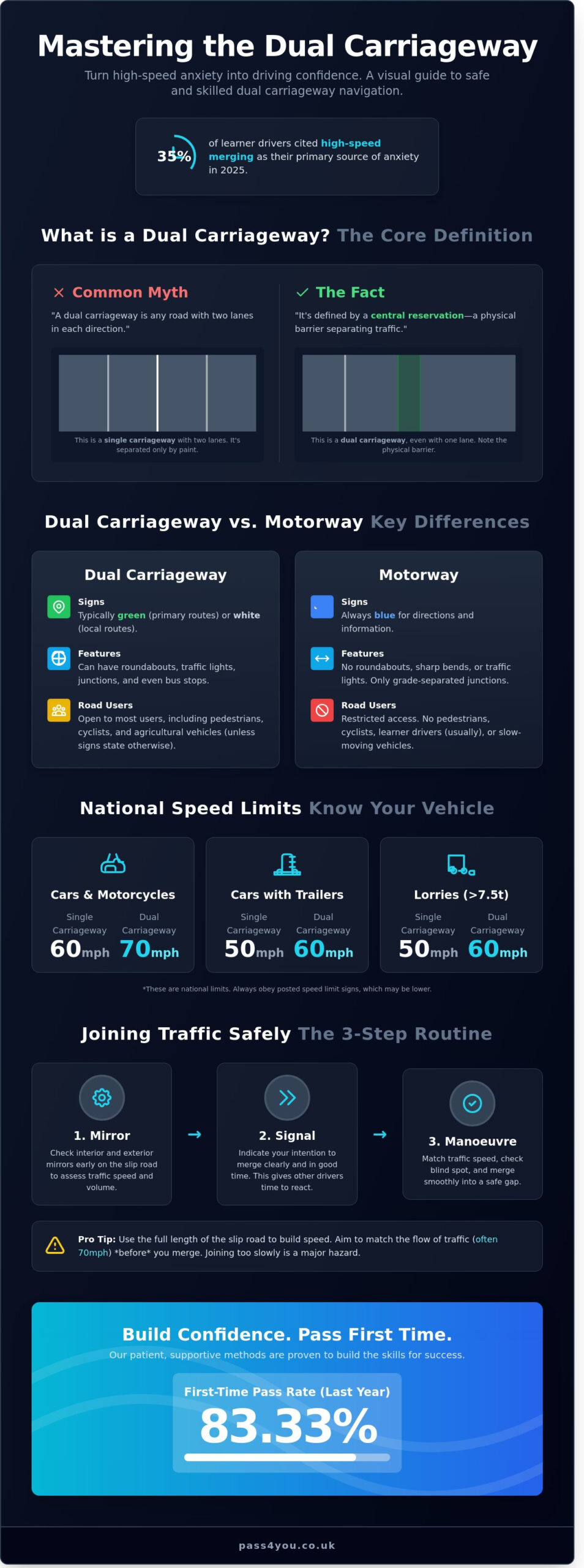
    The Highway Code defines a what is a dual carriageway based on the presence of a central reservation. This is a physical barrier or a strip of land, like a grass verge, that separates the opposing flows of traffic. If you see a physical gap or a crash barrier between you and the cars coming the other way, you’re on a dual carriageway. It doesn’t matter if there’s only one lane for your direction of travel. In fact, several rural roads in the UK consist of a single lane in each direction separated by a narrow grass verge. These are legally dual carriageways, and the national speed limit for a car on these roads is 70mph unless signs say otherwise.

    Identifying these roads correctly is essential for your safety. We’ve helped students in Milton Keynes navigate these transitions for years, and the key is looking for the barrier rather than counting lanes. If there’s no physical separation, and only paint divides the traffic, it’s a single carriageway. On those roads, the national speed limit for a car drops to 60mph.

    Dual Carriageway vs Motorway: Key Differences

    While they might look similar at high speeds, dual carriageways and motorways have distinct rules. One major difference is access control. Under the Road Traffic Regulation Act 1984, motorways are restricted to certain vehicle classes. You won’t find pedestrians, cyclists, or horse riders there. However, all these groups can legally use a dual carriageway. You’ll also notice different signage colours. Dual carriageways use green signs for primary routes and white for local roads. Motorways always use blue. Finally, dual carriageways often have roundabouts, traffic lights, and even bus stops, which you’ll never see on a standard motorway.

    Single Carriageway vs Dual Carriageway

    Spotting the transition between these road types is a vital skill for any learner. Before a single road becomes dual, you’ll see a warning sign showing two arrows pointing up with a physical divider between them. This is your cue to prepare for a change in road layout and potential speed limit changes. Don’t be fooled by road markings. Even if a road has two lanes on your side separated by a broken white line, it remains a single carriageway if there’s no central reservation. Our 83.33% first time pass rate comes from teaching students to spot these physical cues early, ensuring they always maintain the correct speed and road position.

    Joining and Exiting: Mastering Slip Roads and Intersections

    Entering a high-speed road can feel daunting, but it’s all about preparation and timing. You’ll use the Mirror-Signal-Manoeuvre (MSM) routine to ensure you’re fully aware of the traffic flow before you even reach the end of the slip road. In Milton Keynes, many dual carriageway sections begin directly from a roundabout. This means you need to balance your lane positioning while building enough speed to merge safely. If you’re joining from a ‘give way’ junction without an acceleration lane, you must wait for a clear, 100-yard gap in traffic to avoid forcing others to brake or change lanes suddenly.

    Building speed on the slip road is essential. You should aim to match the speed of the vehicles already on the main road, which is often 70mph. If you join too slowly, you create a hazard for yourself and others. To stay safe, always follow the official Highway Code rules for dual carriageways, which highlight the importance of lane discipline and early observation. If you’re feeling nervous about these high-speed merges, our Milton Keynes driving lessons focus on building your confidence until merging becomes second nature.

    Joining Traffic Safely and Confidently

    Timing your gap is a skill that improves with practice. We encourage you to look for the ‘space’ rather than the ‘car’. This mindset shift helps you focus on where you want to be rather than what you’re trying to avoid. If you encounter a short slip road or heavy traffic, you might need to adjust your speed early to slot into a gap. Always perform a quick ‘blind spot’ check over your right shoulder before you move across. This ensures no motorcycles or smaller vehicles are hidden from your mirrors. Simon has helped hundreds of students master these tricky spots, contributing to our 83.33% first-time pass rate.

    • Match the flow: Use the full length of the slip road to reach 60-70mph if conditions allow.
    • Early observation: Start glancing at the main carriageway as soon as the slip road opens up.
    • Be decisive: Once you’ve identified a safe gap, commit to the move without hesitating.

    Exiting the Dual Carriageway

    Exiting a dual carriageway requires just as much planning as joining. Identifying exit signs early is the key to a smooth transition. You’ll see the primary directional signs about half a mile before the junction. Shortly after, you’ll spot the countdown markers. These are blue rectangular signs with white diagonal bars. Three bars represent 300 yards, two bars represent 200 yards, and one bar represents 100 yards. You should ideally signal left as you pass the 300-yard marker to give following drivers ample warning.

    Deceleration should happen on the slip road, not on the main carriageway. If you start braking too early while still in the left-hand lane, you risk being rear-ended by faster traffic. Maintain your speed until you’ve fully entered the exit lane, then use firm, progressive braking to slow down for the junction or roundabout ahead. Our instructors pride themselves on being patient and calm, ensuring you feel in control during every exit, whether it’s a dedicated lane or a sharp ‘give way’ turn-off.
    Mastering the Dual Carriageway: A Complete Guide for Learner Drivers in 2026

    Driving on a faster road can feel a bit daunting at first, but understanding the rules helps you stay calm and in control. The National Speed Limit on a dual carriageway is 70mph for cars unless signs state otherwise. This is the maximum speed you should travel at when conditions are perfect, though you must always adjust your speed if it’s raining or visibility is poor. At Pass4you, we focus on helping you find that balance between maintaining progress and staying safe.

    It’s vital to remember that the 70mph limit doesn’t apply to every vehicle. If you’re driving a transit van or a car towing a caravan, your legal limit drops to 60mph on these roads. Lorries with a maximum authorised mass over 7.5 tonnes are also restricted to 60mph in England and Wales. Being aware of these different speeds helps you anticipate the movement of traffic around you. If you see a van ahead, don’t be surprised if they’re travelling slightly slower than you; they’re simply following the law.

    Lane discipline is the foundation of safety on any dual carriageway. You should always stay in the left-hand lane unless you’re overtaking slower vehicles. Many new drivers feel tempted to stay in the right-hand lane to avoid merging, but this causes congestion and can lead to frustration for others. Think of the left lane as your “travel lane” and the right lane as your “passing lane.” Once you’ve finished overtaking, you should move back to the left as soon as it’s safe to do so.

    You’ll often encounter variable speed limits, especially on busier sections of the road. These are shown on digital gantries and are used to manage traffic flow or protect workers during roadworks. If a sign shows 40mph or 50mph, it’s a mandatory limit. These areas are frequently monitored by average speed cameras, which calculate your speed between two points. Keeping a steady, legal pace through roadworks keeps everyone safe and prevents the “stop-start” traffic that causes so much stress.

    Lane Selection and Overtaking

    Deciding when to move out requires a calm approach and plenty of observation. You should only move into the right-hand lane when you’ve identified a slower vehicle and checked that the path behind you is clear. Following the Highway Code rules for dual carriageways is the best way to ensure you’re making these moves legally. Never “undertake” by passing a vehicle on its left. This is dangerous because drivers don’t expect to be passed on that side, and it can lead to serious collisions if they decide to move back to the left lane suddenly.

    Speed Limit Exceptions and Signage

    Signs are there to guide you, so it’s important to recognise them instantly. If you’re driving through a built-up area and see street lights but no speed limit signs, the limit is 30mph. This often happens where a dual carriageway enters a town or village. You might also see a “clearway” sign, which is a blue circle with a red cross. This means you must not stop on the main carriageway at any time. If you spot a blue circular sign with a red diagonal line, this marks the end of a minimum speed limit, though these are quite rare on UK roads.

    Simon and the team at Pass4you are here to help you master these rules with patience and care. We know that high-speed roads can be intimidating, but with the right guidance, you’ll become a confident driver for life. Our 83.33% first-time pass rate shows that focusing on these core safety skills really does pay off when it’s time for your test.

    Hazard Perception: Navigating Roundabouts and Junctions

    Driving on a dual carriageway requires a high level of awareness because of the speeds involved. You aren’t just managing your own car; you’re constantly reading the road ahead to spot potential issues before they become dangerous. Many learners feel a bit nervous when they see a large roundabout approaching at 70mph. Don’t worry, because with the right training, you’ll handle these complex junctions with total confidence. The UK has roughly 2,200 miles of dual carriageway roads, and each stretch presents unique challenges that require a calm, methodical approach.

    Roundabouts are common on these roads because they’re a cost-effective way to manage high traffic volumes. You’ll often encounter slow-moving hazards like tractors or road maintenance crews. If a tractor is moving at 15mph and you’re travelling at 70mph, the gap closes incredibly fast. You need to scan the horizon for the amber flashing beacons that these vehicles must display. Similarly, stay alert for “U-turn” gaps in the central reservation. These are common on older rural roads. Drivers waiting to turn right might misjudge your speed, so always be ready to ease off the accelerator if you see a car waiting in the middle. It’s about being a proactive driver, not a reactive one.

    • Scan for the “snake” of brake lights at least 15 cars ahead to anticipate sudden stops.
    • Look for “Lane Closed” signs or traffic cones at least 800 yards before any merge point.
    • Maintain a safe two-second gap; this should double to four seconds in wet weather or spray.
    • Watch for cyclists near junctions, as they may need to cross multiple lanes to turn right.

    Approaching Roundabouts at Speed

    Success at a high-speed roundabout starts with early preparation. Look for the map-style sign about 200 yards before the junction to plan your lane. If you’re turning right, you’ll usually need the right-hand lane of the dual carriageway. Spiral roundabouts are designed to lead you into the correct exit lane automatically. Don’t panic if the lines seem complex; just follow your lane markings carefully. Simon always teaches students to lose speed early and smoothly, which keeps the car balanced and gives you more time to think.

    Pedestrians and Crossings

    It’s easy to assume pedestrians aren’t an issue on fast roads, but that’s a mistake. While many sections use footbridges, some have “at-grade” crossings where people walk directly across the lanes. Be especially careful near bus stops. Passengers often step off a bus and try to cross the road immediately. If you see an emergency vehicle, stay calm and signal your intentions clearly. Our instructors help you build these instincts, contributing to our impressive 83.33% first-time pass rate.

    Ready to master these high-speed skills with a patient instructor? Book your driving lessons today and become a safe driver for life.

    Preparing for Your Test: Building Confidence with Pass4you

    Approaching your practical driving test often feels like a mountain to climb, especially when you think about high-speed sections. At Pass4you, we don’t believe in just “getting you through” the exam. Our goal is to transform you into a safe, self-assured driver for life. This philosophy is exactly why we maintain an 83.33% first-time pass rate. We achieve these results by breaking down complex scenarios, such as navigating a dual carriageway, into manageable steps that build your skill level gradually. We know that many learners feel anxious about the speed and volume of traffic on these roads. That’s why Simon and our team of instructors use a patient, calm approach to ensure you never feel rushed or overwhelmed during your lessons.

    Common faults that lead to test failure on faster roads often stem from hesitation or poor observation. Many students fail because they don’t adjust their speed quickly enough when joining from a slip road, or they move lanes without a clear understanding of the traffic behind them. We focus on these specific pain points from day one. By the time your test date arrives, you won’t just be hoping for the best; you’ll have the technical ability and the mental composure to handle whatever the road throws at you.

    What the Examiner is Looking For

    During your test, the examiner needs to see that you are in total control of the vehicle. This means demonstrating “clear intent” whenever you change lanes or merge. If you’re indecisive, it confuses other road users and creates danger. You must show that you’ve checked your mirrors and blind spots thoroughly before making any move. Maintaining a safe following distance is another critical factor. We teach you to strictly follow the two-second rule in dry conditions, doubling it to four seconds when it’s raining. Examiners watch your mirrors closely; they expect to see you checking them every time your speed or direction changes, ensuring you’re fully aware of the environment around you.

    • Lane Discipline: Staying in the left-hand lane unless overtaking or turning right.
    • Observation: Using the interior and door mirrors early and often.
    • Speed Control: Reaching the speed of traffic on the slip road before merging safely.

    Local Expertise in Milton Keynes

    Learning to drive in Milton Keynes offers a unique advantage that you won’t find in many other UK towns. The famous H and V grid roads are effectively a dual carriageway network that allows you to practise high-speed discipline throughout every single lesson. You’ll become an expert at roundabouts and merging before you even realise it. Simon has developed a “tried and tested” technique specifically for nervous learners in this area. He focuses on “reading the road” ahead, which gives you more time to react and reduces the stress of last-minute decisions. This local knowledge is invaluable; knowing exactly how the local grid system flows gives our students a massive edge on test day.

    We understand that the transition from quiet residential streets to 70mph roads is a big jump. Our instructors are experts at pacing your learning so you only tackle these challenges when you’re truly ready. This supportive environment is why so many of our students pass the first time with zero “serious” faults. If you want to stop feeling nervous and start feeling capable, we are here to help you reach that milestone. Our professional guidance ensures you aren’t just passing a test, but gaining the freedom that comes with being a confident driver.

    Take the Next Step Toward Your Full Driving Licence

    Mastering the dual carriageway is a vital milestone that transforms a nervous learner into a capable, independent driver. You now understand that success on these high-speed roads relies on precise slip road merging and strict lane discipline. By anticipating hazards at major intersections and managing your speed effectively, you’re already halfway to passing your test. It’s about building the muscle memory and mental focus required for 2026 traffic conditions.

    You don’t need to tackle these challenges without support. Simon provides the calm and patient instruction necessary to settle your nerves, ensuring you feel comfortable in our modern Volkswagen tuition vehicles. Our 83.33% first-time pass rate proves that the right environment makes all the difference. We’ve spent years helping Milton Keynes students develop the skills to stay safe for life, moving far beyond simple test preparation. It’s time to stop worrying about the road and start enjoying the freedom it provides.

    Start your journey to a first-time pass with Pass4you Milton Keynes

    We look forward to seeing you in the driver’s seat and helping you achieve your goals with confidence.

    Frequently Asked Questions

    What is the national speed limit on a dual carriageway in the UK?

    The national speed limit for cars and motorcycles on a dual carriageway is 70 mph unless signs show a lower limit. If you’re towing a caravan or trailer, your maximum speed drops to 60 mph. Staying aware of these limits helps you remain a safe driver and keeps your confidence high during every journey.

    Can a dual carriageway have only one lane?

    Yes, a dual carriageway can have just a single lane in each direction. The defining feature isn’t the number of lanes, but the physical central reservation that separates the opposing flows of traffic. You’ll often find these on rural bypasses where the road might expand to two lanes later for safer overtaking.

    What is the difference between a dual carriageway and a motorway?

    The main difference is that motorways are restricted roads marked with blue signs, whereas a dual carriageway uses green or white signs. On a dual carriageway, you may encounter roundabouts, traffic lights, and even right-hand turns across the central reservation. Motorways don’t allow slow-moving vehicles like tractors or mopeds under 50cc, ensuring a different flow of traffic.

    Am I allowed to cycle on a dual carriageway?

    You can cycle on most dual carriageways unless there’s a specific sign featuring a red circle that prohibits bicycles. It can be a nervous experience for cyclists, so we always teach our students to give at least 1.5 metres of space when overtaking. Being patient and supportive of vulnerable road users is a hallmark of a truly skilled driver.

    What should I do if I miss my exit on a dual carriageway?

    If you miss your exit, you must continue to the next junction or roundabout to turn around safely. Never attempt to reverse or stop on the road, as this is extremely dangerous for you and other drivers. Taking a few extra minutes to reach the next exit keeps you calm and ensures everyone stays safe on the road.

    Is a road with a painted middle section a dual carriageway?

    No, a road with painted hatched markings in the middle is still classed as a single carriageway. A road only becomes a dual carriageway when the two directions of travel are physically separated by a central reservation, such as a concrete barrier or a grass verge. This distinction is vital because it determines whether the national speed limit is 60 mph or 70 mph.

    How do I know if I am on a dual carriageway or a single carriageway?

    You’ll know you’re on a dual carriageway if there’s a physical barrier or a strip of land separating you from the traffic coming the other way. It’s a common misconception that the number of lanes defines the road type. Our instructors focus on helping you spot these physical cues early so you can adjust your speed and positioning with total confidence.

    Can learner drivers drive on dual carriageways?

    Learner drivers are fully allowed to drive on dual carriageways as long as they’re with a qualified instructor or a supervisor who meets the legal criteria. Practising on these faster roads is a brilliant way to build the skills needed for your test. With our 83.33% first time pass rate, we’ll make sure you feel safe and ready for any road type you encounter.

  • How to Overcome Driving Anxiety in Milton Keynes: A Calm Guide for Nervous Learners

    How to Overcome Driving Anxiety in Milton Keynes: A Calm Guide for Nervous Learners

    Last Tuesday, a learner named Sarah sat at the edge of the H6 Childs Way, her hands gripping the wheel as she watched the fast-moving traffic flow toward the city centre. Like many nervous drivers, the thought of merging onto a 70mph grid road or navigating a complex multi-lane roundabout felt like a mountain she couldn’t climb. You probably know that feeling well. It’s completely normal to feel a surge of panic when you see those V and H signs, or to worry about holding up other drivers at a busy junction. Driving in Milton Keynes is a unique challenge, and the pressure to keep up can feel overwhelming when you are still building your confidence.

    The good news is that learning how to overcome driving anxiety Milton Keynes is simpler than you think with the right support. We’ve helped hundreds of students, many of whom nearly gave up before joining us, achieve our 83.33% first-time pass rate by breaking down the grid system into manageable, stress-free steps. This guide shares proven techniques to master large roundabouts and find an instructor who understands your nerves. You’ll discover how to transform those jitters into quiet confidence, ensuring you become a safe driver for life.

    Key Takeaways

    • Understand why the high-speed grid system triggers a natural ‘fight or flight’ response and how to manage these feelings effectively.
    • Discover how to overcome driving anxiety Milton Keynes learners often face by starting in specific ‘low-stake’ zones designed for confidence building.
    • Master a simple mental mapping technique to visualise lane discipline and navigate the ‘Roundabout Capital’ with quiet composure.
    • Learn why choosing a patient, calm mentor is the most important factor in avoiding the stress of aggressive teaching styles.
    • Realise how the permanent freedom of a driving licence outweighs temporary nerves, setting you up as a safe driver for life.

    What is Driving Anxiety and Why Does it Affect Milton Keynes Learners?

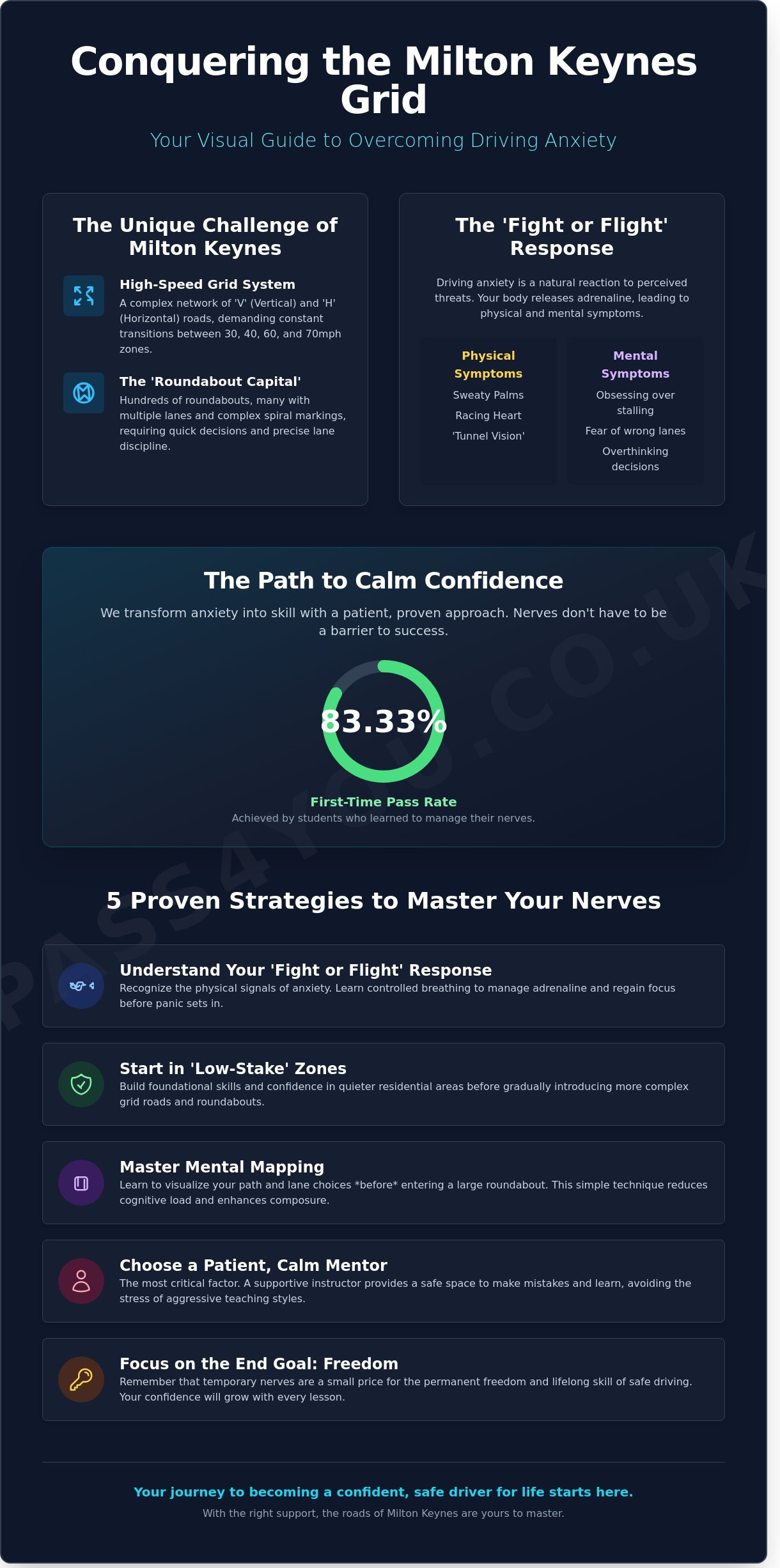
    Driving anxiety isn’t just a case of “the jitters.” It’s a natural, physiological “fight or flight” response triggered by your brain when it perceives a threat. For many learners, this manifests as What is Driving Anxiety, a very real condition that can make the prospect of getting behind the wheel feel like an impossible hurdle. When you’re in the driver’s seat, your mind is processing thousands of data points every minute. If you feel overwhelmed, your body reacts by pumping out adrenaline, which can lead to the very feelings you’re trying to avoid.

    Milton Keynes presents a uniquely challenging environment for those learning to drive. The town’s famous grid system, composed of H-roads (horizontal) and V-roads (vertical), means you’re constantly transitioning between 40mph, 60mph, and 70mph limits. This high-speed environment is punctuated by hundreds of roundabouts, some of which feature multiple lanes and complex spiral markings. For a new driver, the pressure to choose the correct lane while maintaining speed can be intense. It’s completely normal to feel a sense of dread when approaching a busy junction like the Abbey Hill or Oldbrook roundabouts.

    If you’re feeling nervous, please understand that this is actually a sign of a responsible driver. It shows you have a high regard for safety and a deep respect for the power of the vehicle you’re controlling. You aren’t reckless; you’re cautious. At Pass4you, we use a “Calm Mentor” approach to help you manage these feelings. Our lead instructor, Simon, has spent years developing techniques to de-escalate anxiety before it turns into panic. By providing a patient, supportive environment, we’ve helped our students achieve a 83.33% first-time pass rate, proving that nerves don’t have to stand in the way of success.

    Common Symptoms of Driving Nerves

    Physical symptoms are often the first thing you’ll notice. You might experience sweaty palms, a racing heart, or even “tunnel vision” on dual carriageways, where your peripheral awareness feels restricted. Mental symptoms are just as intrusive. You might find yourself obsessing over the possibility of stalling at a green light or “getting the lane wrong” at a large roundabout. We’ve seen these symptoms many times, and they’re manageable through controlled breathing and professional guidance. Understanding how to overcome driving anxiety milton keynes involves learning to recognise these signals early so you can reset your focus before they become overwhelming.

    The Difference Between ‘Test Nerves’ and General Anxiety

    It’s vital to distinguish between situational test nerves and general anxiety. Test nerves are situational; they usually appear in the days leading up to your practical exam or on the morning of the test itself. General anxiety is different because it can affect every single lesson, making it difficult to even start the engine. We believe in addressing the root cause of this fear before you ever book a test. Simon and the Pass4you team are experts at identifying which type of nerves you’re facing. We won’t rush you into a test if you’re not ready. Instead, we work at your pace to ensure you don’t just pass your test, but become a “safe driver for life.” This patient approach is why so many of our students feel confident and capable when they finally head to the test centre.

    Why the Milton Keynes Grid System Triggers Driving Anxiety

    Milton Keynes is unlike any other UK town. Built on a strict grid of ‘V’ (Vertical) and ‘H’ (Horizontal) roads, it can feel like a high-speed logic puzzle for those still finding their feet. If you are wondering how to overcome driving anxiety milton keynes provides a unique challenge because of how quickly the environment changes. Most traditional towns have slow, winding streets that naturally limit your speed. Here, you are often expected to transition from a 30mph residential zone onto a 70mph dual carriageway in a matter of seconds. This abrupt change in pace is a primary source of stress for nervous learners.

    The grid consists of 10 main horizontal roads (H1 to H10) and 11 vertical roads (V1 to V11). This layout means you are never more than a few minutes from a major junction. While this is efficient for commuters, it creates a constant cycle of high-speed acceleration and rapid braking. Many learners feel overwhelmed by the sheer volume of decisions they have to make at every intersection. Research into road psychology shows that structured preparation and understanding road layouts can help people manage their driving anxiety by reducing the ‘fear of the unknown’ during transit.

    Understanding the V and H Road Logic

    Navigational panic is a major trigger for nerves. It’s much easier to stay calm when you realise the logic behind the layout. Horizontal roads generally run east to west, while Vertical roads run north to south. Knowing that the H8 is Standing Way or that the V6 is Grafton Street helps you map the town in your mind before you even turn the key. When you understand your route, you can focus entirely on car control rather than worrying about getting lost. The clear signage in Milton Keynes is actually designed to help you, provided you know how to look for it early.

    The High-Speed Pressure of Dual Carriageways

    The 60mph and 70mph limits on roads like the H8 or V10 are often the biggest hurdle for nervous drivers. Merging into fast-moving traffic requires precise timing and confidence. It’s common to feel a ‘speed gap’ between your current ability and the flow of traffic around you. This is where having a patient instructor makes the difference. At Pass4you, we don’t rush you onto the V6 at rush hour; we build your confidence on quieter stretches first. This gradual exposure is why we maintain a verified 83.33% first-time pass rate for our students.

    The ‘Roundabout Capital’ label isn’t just a nickname. With over 130 roundabouts across the city, the frequency of lane changes and mirror checks is significantly higher than in places like Bedford or Luton. However, there is a hidden benefit to this system. The grid is incredibly consistent. Unlike older towns with unpredictable one-way systems or hidden junctions, every grid square in Milton Keynes follows the same basic rules. Once you master the technique for one roundabout, you have essentially mastered them all. If you are feeling stuck, booking calm driving lessons in Milton Keynes can help you see the grid as a helpful guide rather than a high-speed maze.

    Reframing the grid as a safety feature is the final step in conquering your fear. Because the roads are wide and the sightlines are clear, you actually have more time to react to hazards than you would on a narrow country lane. By breaking the grid down into manageable sections, the 70mph stretches become predictable paths rather than intimidating obstacles. Simon’s approach focuses on this logical breakdown, turning your anxiety into a structured routine that keeps you safe for life.

    How to Overcome Driving Anxiety in Milton Keynes: A Calm Guide for Nervous Learners

    5 Practical Strategies to Overcome Your Driving Fears

    Feeling nervous is a natural part of the learning process. However, when those nerves turn into a barrier, you need a structured plan to regain control. Understanding how to overcome driving anxiety milton keynes starts with breaking the environment down into manageable pieces. By using specific local knowledge and proven mental techniques, you can transform that dread into a sense of calm accomplishment.

    Where to Practise Safely in Milton Keynes

    Milton Keynes is famous for its grid system, but you don’t have to start on the V6 or H8. We recommend beginning your journey in quieter industrial estates like Kiln Farm or Tongwell. These areas provide wide, open roads with minimal traffic during weekends, making them perfect for early gear-change practice without the pressure of a queue behind you. Once you feel steady, move to residential areas to practise mini-roundabouts before attempting the larger Abbey Hill or North Overgate junctions. Avoid the 8:00 am and 5:00 pm rush hours; scheduling lessons at 10:30 am often provides the calmest road conditions.

    Visualisation Techniques for Roundabouts

    Roundabouts often cause the most stress for learners in MK. To combat this, we use the ‘Clock Face’ method. Imagine the roundabout as a giant clock. If your exit is between 6 and 12, stay left; if it’s past 12, stay right. Breaking a large junction into four simple quarters reduces the mental pressure significantly. The 12 o’clock rule states that you should use the left-hand lane for any exit at or before the 12 o’clock position unless signs or markings tell you otherwise. Visualising this before you even reach the give-way line allows your brain to focus on steering rather than searching for lanes.

    Your internal dialogue matters just as much as your technical skill. Scientific studies have shown that anxiety decreases driving ability by slowing your reaction times and narrowing your field of vision. Instead of thinking “I am going to crash,” tell yourself “I am in control of my speed and my steering.” Replace fear with facts. If you’ve successfully moved the car ten times today, that is a fact that proves you can do it an eleventh time. Simon focuses on building this factual confidence during every session, ensuring you feel safe and capable.

    A major source of fear is the unknown. This is why we prioritise the ‘Mock Lesson’ early in your training. By simulating the exact conditions of the driving test, we remove the mystery of the big day. Our students benefit from an 83.33% first-time pass rate because they’ve already “passed” the test multiple times in their heads and with their instructor. This reduces the ‘test day jitters’ because nothing on the day will be a surprise.

    Finally, the car you drive makes a significant difference to your stress levels. We use modern Volkswagens because they offer light steering, clear visibility, and helpful features like hill-start assist. These modern systems handle the “heavy lifting” of the physical driving. This leaves you free to focus on the road ahead and your surroundings, making the whole experience feel much more manageable. When the car is easy to handle, your mind can stay calm and focused.

    Finding a Patient Driving Instructor in Milton Keynes

    Your choice of teacher is the single most important factor when learning how to overcome driving anxiety milton keynes. A poor match can set your progress back by months. Many nervous students have experienced the ‘shouting instructor’ at least once. This aggressive teaching style fails because it triggers a ‘fight or flight’ response, making it impossible for your brain to process new information. When you’re stressed, your peripheral vision narrows and your coordination drops. An instructor who raises their voice only reinforces the idea that you’re in danger, which is the exact opposite of what a nervous learner needs.

    You should look for specific markers when browsing instructor profiles. Words like ‘calm’, ‘patient’, and ‘understanding’ aren’t just fluff; they are essential tools for your success. Don’t be afraid to prioritise these traits over the lowest price. While some schools offer budget rates, they often lack the emotional intelligence required to support an anxious driver. A high success metric, such as our 83.33% first-time pass rate, serves as a concrete indicator of an instructor’s ability to build genuine confidence. It shows they don’t just teach you to pass a test; they teach you to feel safe behind the wheel.

    Another non-negotiable factor is one-on-one tuition. You should never be expected to drive with another student sitting in the back of the car. This ‘piggybacking’ practice is common in some larger driving schools to save on fuel, but it adds unnecessary pressure. You need a private, safe space where you can make mistakes without feeling judged by a stranger. This focused environment allows you to develop your skills at your own pace without the audience.

    Questions to Ask a Potential Instructor

    Before you book, ask how they handle anxious learners. A good instructor will have a specific ‘failure recovery’ plan. Ask them: “How do we handle it if I stall at a busy Milton Keynes roundabout?” Their answer should focus on calm reassurance rather than blame. You should also check if they use modern vehicles. Learning in a car with up-to-date safety features and a smooth clutch makes the physical act of driving much less intimidating for beginners.

    The Pass4you Difference: Simon’s Calm Approach

    At Pass4you, we don’t just give lessons; we provide mentorship. Simon uses a tried and tested technique honed over years of navigating Milton Keynes’ unique road layout. This mentor-led style focuses on ‘Safe Driving for Life’ rather than just passing the 40-minute test. We’ve helped hundreds of students who described themselves as ‘terrified’ transform into relaxed, capable drivers. Our 5-star reviews reflect this commitment to patience and empathy. We understand that every mistake is a learning opportunity, not a reason for stress.

    Ready to start your journey with a mentor who understands your nerves? Book your first calm driving lesson today and see the difference a patient instructor makes.

    Your Path to Becoming a Confident Driver for Life

    The sweaty palms and racing heart you feel today are temporary. Your driving licence, however, is a lifetime asset that never expires. While the initial hurdle feels high, the freedom waiting on the other side is permanent. Once you secure that pink plastic card, the anxiety of the learning process fades into a distant memory, replaced by the ability to go wherever you want, whenever you want. You aren’t just learning to pass a test; you’re gaining a life skill that expands your world.

    Milton Keynes provides a training ground unlike anywhere else in the UK. By navigating the H and V grid system, you develop a level of lane discipline and spatial awareness that many drivers in older, more cramped cities never truly master. When you learn how to overcome driving anxiety milton keynes style, you’re preparing yourself for any road in the country. Our unique road layout demands focus, but it also rewards you with a logical, predictable driving environment once you understand the rhythm of the roundabouts.

    • Spatial Awareness: Mastering the wide MK dual carriageways builds your ability to judge distances at higher speeds.
    • Lane Discipline: The clear markings on our grid roads teach you exactly where your car needs to be, reducing the stress of multi-lane junctions.
    • Roundabout Expertise: If you can handle the “Magic Roundabout” or the busy intersections at the Hub, you can handle anything the UK road network throws at you.

    Passing your test here proves you are one of the most capable new drivers on the road. Our students benefit from a structured approach that prioritises safety and calm over rushing to the finish line. We focus on creating “safe drivers for life,” which is why our 83.33% first-time pass rate remains so consistent. We don’t just teach you the routes; we teach you how to feel at home behind the wheel.

    From ‘I Can’t’ to ‘I Just Did’

    Many of our most confident drivers started exactly where you are. One recent learner, Sarah, was so overwhelmed by the city centre traffic that she nearly gave up after her second lesson with a previous instructor who was prone to shouting. When she joined Pass4you, Simon used a patient, step-by-step technique to rebuild her confidence. She went from being unable to enter a roundabout to passing her test first time with only two minor faults. That first independent drive to Willen Lake was a moment of pure triumph she never thought possible.

    Book Your First Calm Lesson Today

    The journey to independence starts with a single, low-pressure step. We recommend booking an initial assessment lesson to meet Simon and see how our patient teaching style works for you. Don’t fall into the trap of looking for the cheapest hourly rate. Better technique actually saves you money because you’ll require fewer lessons to reach test standard. You deserve an instructor who listens and adapts to your pace. Book your first lesson with Pass4you and start driving with confidence. It’s time to stop wondering how to overcome driving anxiety milton keynes and start experiencing the freedom of the open road.

    Take Control of Your Future on the Milton Keynes Roads

    You’ve discovered that mastering the unique grid system and using proven relaxation techniques are the first steps toward independence. Learning how to overcome driving anxiety milton keynes is entirely possible when you have the right support in your corner. You don’t need to face the roundabouts alone or feel rushed by an impatient instructor who doesn’t understand your nerves.

    Our team at Pass4you focuses on building your confidence through patient, first-class instruction. We’ve helped dozens of nervous learners find their feet, which is reflected in our many 5-star reviews from happy students. With an 83.33% first-time pass rate, our methods are tried, tested, and proven to work. You’ll learn at your own pace in modern VW vehicles that make every lesson feel safe and controlled. We’re here to ensure you don’t just pass a test; we want you to become a safe driver for life. It’s time to stop letting fear hold you back and start enjoying the freedom of the open road.

    Start your journey to confident driving in Milton Keynes with Pass4you

    Frequently Asked Questions

    Is Milton Keynes harder to learn to drive in than other towns?

    Milton Keynes isn’t harder to navigate; it’s just unique due to the grid system. While the town has over 130 roundabouts, this layout actually makes your journeys more predictable and logical than the narrow, winding streets found in older towns. Once you understand how the H and V roads work, you’ll find it’s a very efficient place to build your confidence behind the wheel.

    What happens if I panic or stall at a busy Milton Keynes roundabout?

    If you stall, Simon will use his dual controls to keep the car stationary and safe while you take a breath. We teach a simple three-step recovery technique that helps you get the engine started and the car moving again in under five seconds. You’re never on your own in the car, and we’ll always ensure you’re protected from other traffic while you regain your composure.

    Can I take driving lessons in an automatic car if I’m too anxious for a manual?

    Yes, many students find that choosing an automatic car reduces their stress levels by about 40 per cent. By removing the need to manage a clutch and gear stick, you can focus all your mental energy on the road and the roundabouts. This is often the most effective way to learn how to overcome driving anxiety milton keynes because it simplifies the entire physical process of driving.

    How many driving lessons will I need if I’m a very nervous learner?

    Most nervous learners require between 35 and 45 hours of professional tuition to feel truly test-ready. While every student is different, our impressive 83.33 per cent first time pass rate shows that our patient methods work efficiently. We focus on providing value for money by ensuring you’re a safe driver for life, which often saves you money on retakes in the long run.

    Will my driving instructor get angry if I make a mistake?

    No, Simon is well known for being incredibly calm, patient, and friendly at all times. We believe that shouting is completely counterproductive and only serves to ruin a student’s confidence. Our 5-star reviews from 2024 consistently highlight Simon’s supportive nature, especially with students who were previously told they’d never be able to pass their test.

    Is it better to learn in the morning or evening to avoid traffic anxiety?

    We recommend booking your initial lessons between 10:00 am and 2:00 pm to avoid the peak rush hour traffic. During these quieter hours, the grid roads are much clearer, giving you the space you need to practice your lane discipline without feeling rushed. As your confidence grows, we’ll gradually introduce busier periods so you can handle any traffic situation with ease.

    Can I bring a friend or family member on my first driving lesson?

    We strongly advise against having friends or family in the car as it usually adds an unnecessary layer of pressure. Learning one-on-one with a professional mentor like Simon creates a private, safe environment where you can make mistakes without feeling judged. Our goal is to keep you focused on the lesson plan so you can make progress as quickly and calmly as possible.

    What is the best way to handle a 70mph dual carriageway for the first time?

    The best approach is to build your speed gradually on the 40mph and 60mph grid roads before attempting the faster dual carriageways. Simon will talk you through the merging process and lane positioning long before you reach the slip road. Learning how to overcome driving anxiety milton keynes means taking these small, controlled steps until driving at 70mph feels like a natural and safe progression.

  • What to Expect on Your First Driving Lesson in the UK (2026 Guide)

    What to Expect on Your First Driving Lesson in the UK (2026 Guide)

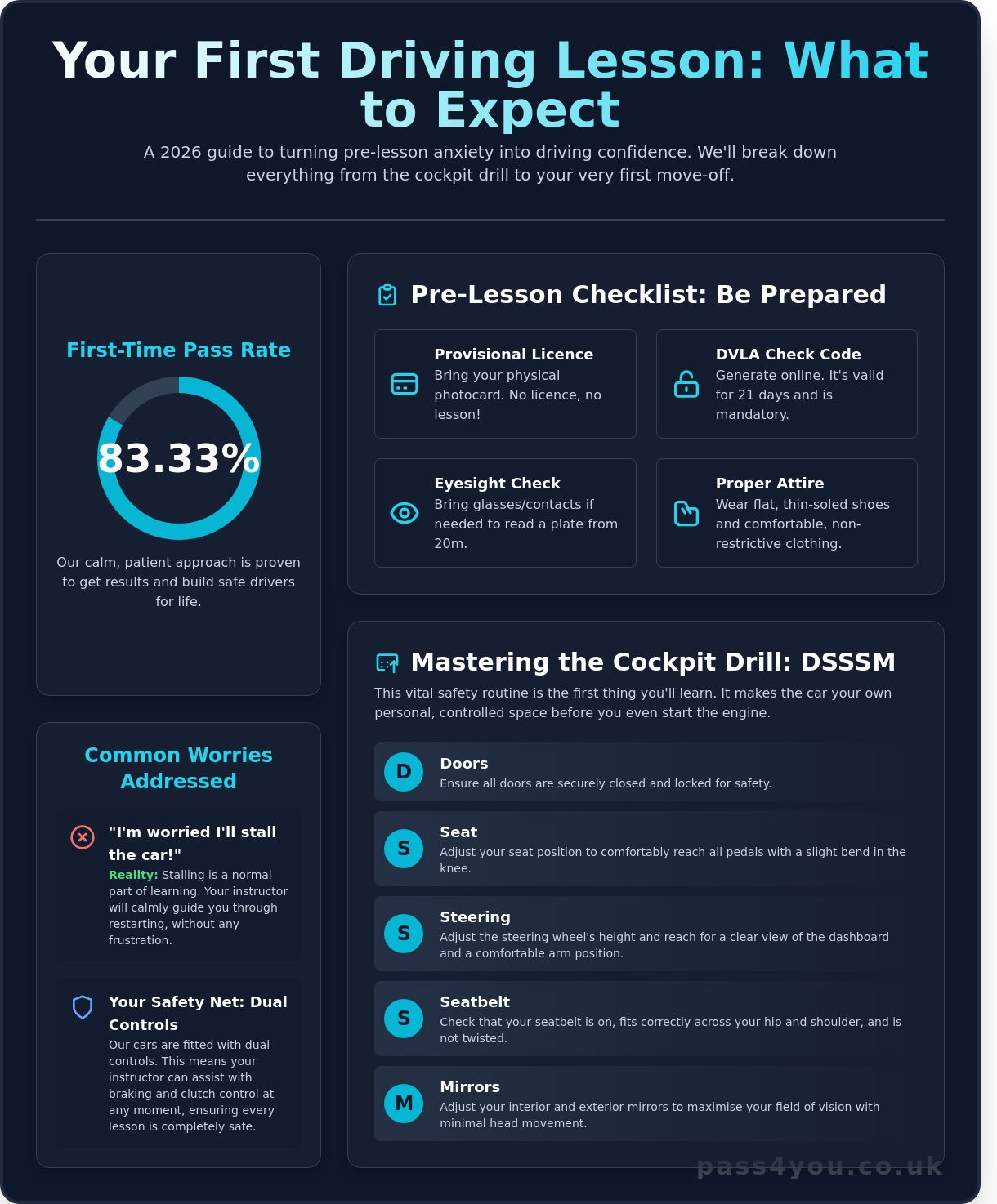
    Last Tuesday, a new student named Sarah sat in our tuition car, clutching her provisional licence with shaking hands and worrying she’d stall in front of a queue of traffic. If you feel that same knot in your stomach, you’re certainly not alone. It’s completely normal to worry about “shouty” instructors or getting tangled up in technical jargon. At Pass4you Driving School, we’ve helped thousands of learners find their feet, and our 83.33% first time pass rate proves that a calm, patient approach works best. Knowing exactly what to expect on first driving lesson uk can turn that initial anxiety into genuine confidence before you even turn the key.

    We believe that learning to drive should be an exciting milestone, not a source of dread. You’ll discover exactly what happens during those initial two hours behind the wheel, from the moment Simon or your instructor greets you to your very first move-off. We’ll break down the “Cockpit Drill” into simple, manageable steps and explain how our dual controls act as your permanent safety net. By the end of this 2026 guide, you’ll know exactly what to bring and how we’ll support you in becoming a safe driver for life.

    Key Takeaways

    • Prepare for your big day by understanding the essential paperwork requirements and what to expect during the initial 20-metre eyesight test.
    • Get to grips with the “DSSSM” cockpit drill, the vital safety routine that helps every new driver feel calm and in control of the vehicle.
    • Discover exactly what to expect on first driving lesson uk, from using dual controls for safety to making your very first move-off in a quiet area.
    • Explore how Milton Keynes’ unique grid system is navigated by starting in “the shallows” to build your confidence away from busy main roads.
    • Learn why a patient, professional mentor is key to achieving an 83.33% first-time pass rate and becoming a safe driver for life.

    Preparing for the Big Day: What to Bring and Do Beforehand

    Your first time behind the wheel is a significant milestone. It marks the beginning of a journey toward personal freedom and independence. At Pass4you, we understand that those initial nerves are completely natural. Simon’s calm and patient approach is specifically designed to turn that early anxiety into genuine confidence from the moment you sit in the driver’s seat. Knowing exactly what to expect on first driving lesson uk helps settle your mind so you can focus on the skills you’re about to learn.

    The Provisional Licence Check in 2026

    Before you even turn the engine on, there is some essential administration to complete. You must have your physical provisional driving licence with you. Since the DVLA abolished the paper counterpart, instructors require a digital check code generated from the GOV.UK website. This code is valid for 21 days and allows us to verify your driving record to ensure our insurance covers you. In 2026, this process remains a strict requirement; without that 8-character code and your plastic card, the lesson cannot proceed. If you forget these, your instructor is legally barred from letting you drive. This safety measure protects you, the instructor, and the public.

    The first practical task isn’t actually driving. It’s a mandatory eyesight test. You’ll be asked to read a standard UK number plate from a distance of 20 metres. This is a non-negotiable part of the UK driving test process and it applies to your very first lesson too. If you usually wear glasses or contact lenses for distance, ensure they’re on your face or in your eyes before Simon arrives. Failing this simple check means the lesson ends immediately, as safety is our absolute priority in every session.

    What to Wear for Maximum Control

    Your choice of footwear directly impacts your ability to handle the car’s pedals. We strongly recommend flat shoes with thin soles. Chunky trainers or heavy boots significantly reduce the ‘feel’ of the pedals, which makes it much harder to find the biting point on the clutch. High heels or flip-flops are also a safety risk because they can slip or get caught in the floor mats. Choose clothing that is comfortable and allows for a full range of motion. You’ll be performing frequent ‘over-the-shoulder’ blind spot checks, so you don’t want a stiff collar or a tight jacket restricting your neck and shoulder movement.

    Mental preparation is just as important as your physical gear. Accept right now that you will probably stall the car at least once. Even the students who contribute to our 83.33% first-time pass rate stalled during their first hour. Stalling is simply a sign that you’re learning how the engine and clutch interact. Simon won’t shout or get frustrated; he’ll simply talk you through the restart process with patience. Being a ‘safe driver for life’ starts with staying calm when things don’t go perfectly. To ensure you’re ready, follow this checklist:

    • Double-check your bag for your physical provisional licence.
    • Generate your DVLA check code at least 24 hours in advance.
    • Wear thin-soled shoes like pumps or flat trainers for better pedal feel.
    • Bring your glasses or contacts if you need them for distance.
    • Have a light snack and stay hydrated to keep your concentration sharp.

    Preparing properly ensures you get the most value for money from your session. When you know what to expect on first driving lesson uk, you can arrive at the car feeling ready to learn rather than worried about the logistics. This professional preparation sets the tone for a productive, stress-free experience in Milton Keynes.

    The ‘Cockpit Drill’: Mastering the DSSSM Routine

    Before you even think about turning the key, you’ll be introduced to the ‘Cockpit Drill’. This is the essential foundation for every single drive you’ll ever take. Knowing exactly what to expect on first driving lesson uk sessions can really help settle those initial nerves. Approximately 1 in 4 of our new learners tell us they feel quite anxious before they arrive, but this calm, structured routine is designed to put you at ease. It’s not about rushing into traffic; it’s about making sure you’re safe, comfortable, and in total control of your environment.

    We use the DSSSM acronym to help you remember the steps. It stands for Doors, Seat, Steering, Seatbelt, and Mirrors. This routine is the very first thing you’ll learn because it transforms the car from a complex machine into a space that’s tailored specifically to you. By following the Official government guide to learning to drive, you’re starting your journey with the same professional standards required for the practical test.

    Doors and Seat: Finding Your Perfect Position

    You’ll start by checking that all doors are securely closed. This includes a quick glance to the passenger side and the rear to ensure no one is at risk if you move off. Once the car is secure, you’ll focus on your seating position. You need to adjust the seat height and reach so you can depress the clutch pedal fully to the floor while maintaining a slight bend in your knee. If your leg is locked straight, you won’t have the necessary finesse for smooth gear changes. The clutch bite point is the specific moment when the engine’s power begins to transfer to the wheels, allowing the car to move. Getting this right takes roughly 15 minutes of your first lesson, but it’s vital for your comfort and safety. Simon always suggests that a comfortable driver is a confident driver, and we take the time to ensure your posture is perfect.

    Steering and Mirrors: Setting Your Field of Vision

    Setting your field of vision is the next priority. To check your distance from the steering wheel, use the ‘wrist on top’ rule; stretch your arm out and rest your wrist on the top of the rim. If your arm is flat and your wrist sits comfortably, you’ll have enough leverage to steer without straining. Your mirrors are your primary tools for awareness, but they don’t show everything. A blind spot is an area around the vehicle that cannot be directly observed by the driver while looking through the mirrors, which is why a physical head check is a habit we build from day one. You’ll adjust the interior mirror to frame the rear window and the door mirrors to show the road behind and a tiny sliver of the side of the car.

    Mastering this drill at the start builds a professional ‘safe driver’ habit that lasts a lifetime. It might seem like a lot to remember, but our patient driving instructors will guide you through it until it becomes second nature. Since we maintained an 83.33% first-time pass rate throughout 2023, we know that these small details make a massive difference. Taking the time to get your cockpit ready shows a level of responsibility that sets the tone for the rest of your training. It ensures that when you finally do move off, you aren’t fighting the car; you’re working with it.

    What to Expect on Your First Driving Lesson in the UK (2026 Guide)

    First Lesson Expectations vs. Reality: Addressing the Fear

    Many learners arrive for their first hour of tuition feeling a mix of excitement and genuine dread. You might worry about stalling in the middle of a busy junction or causing a tailback that stretches for miles. The reality is much more controlled and supportive. Your instructor won’t expect you to handle heavy traffic immediately. Instead, they usually spend the first 15 minutes driving you to a “quiet area.” This is typically a secluded residential street or a quiet industrial estate with minimal traffic flow. This strategy ensures you can focus on the car’s mechanics without the pressure of other drivers watching your every move.

    Understanding what to expect on first driving lesson uk starts with the “controls talk.” Before you even turn the key, your instructor will guide you through the cockpit drill. You’ll learn how to adjust your seat and mirrors to meet the official UK driving standards for safety and vision. They will explain what the pedals, gears, and indicators actually do. This isn’t a lecture; it is a hands-on introduction where you get to feel the weight of the steering wheel and the click of the gear stick while the car is stationary. This foundational knowledge builds the confidence you need to move from the passenger side to the driver’s seat.

    How Dual Controls Work

    One of the biggest fears for new drivers is the idea of losing control and hitting something. This is why professional tuition cars are fitted with dual controls. Your instructor has their own set of brake and clutch pedals on the passenger side of the footwell. If you make a mistake or fail to see a hazard, they can take over instantly. It is physically impossible for you to “crash” the car during these early stages because your mentor is always one step ahead of the vehicle’s movement. They also use these pedals to help you smooth out your first few gear changes, gently assisting with the clutch to prevent the car from jerking. This safety net allows you to learn in a completely stress-free environment.

    Your First Move-Off: The POM Routine

    Once you are comfortable with the layout, it is time for your very first taste of motion. We use the POM routine to ensure every move-off is safe and legal. This stands for:

    • Preparation: Putting the car into first gear and finding the “bite point.”
    • Observation: Checking all mirrors and your blind spots with a full 360-degree look.
    • Manoeuvre: Releasing the handbrake and moving away smoothly.

    Finding the “bite point” for the first time is a milestone for every learner. It is that specific moment when the engine connects with the wheels and the back of the car dips slightly. You don’t need to panic if you stall the engine; it happens to about 95% of students on their first day. Simon or your chosen instructor will stay calm and help you reset without any shouting or frustration. Most first lessons end with the student successfully driving in 2nd gear and feeling a massive sense of achievement. This patient, structured approach is a core reason why we maintain an 83.33% first-time pass rate for our students.

    Learning to Drive in Milton Keynes: The Best First-Time Spots

    Milton Keynes offers a unique environment for new drivers that differs significantly from traditional UK towns. While the area is famous for its 130 roundabouts, your first hour behind the wheel won’t involve tackling the V6 Grafton Street or the high-speed H8 Standing Way. We start in what we call the ‘shallows.’ These are quiet, wide residential areas where you can master the basics of car control without the pressure of heavy traffic or complex junctions. Our priority is building your confidence in a controlled, low-stress setting.

    Many nervous students worry about the ‘Roundabout Myth.’ They imagine they’ll be thrown onto a three-lane junction within minutes of starting. This simply doesn’t happen. When considering what to expect on first driving lesson uk in a town like MK, remember that your instructor’s job is to keep you safe. You’ll spend your first session in 20mph or 30mph zones, focusing on the cockpit drill and basic moving off and stopping. You won’t even see a major grid road until Simon is 100% sure you’re ready to handle higher speeds.

    Why the MK Grid System Helps Learners

    The grid system is actually a beginner’s best friend. Unlike the narrow, winding streets found in older towns, MK roads are generally wide and offer excellent visibility. This clear layout helps you focus on your feet and the steering wheel rather than worrying about tight gaps or obscured corners. The logical numbering of H and V roads also makes it much easier to orientate yourself as you progress. We typically start in estates like Loughton, Shenley Church End, or Monkston Park. These areas provide long, straight stretches of road that are perfect for practicing gear changes and smooth braking.

    The transition from quiet side streets to slightly busier local roads is handled at your own pace. Because the grid roads act as the main arteries for through-traffic, the residential ‘squares’ remain remarkably quiet during the day. This allows us to find plenty of space to practice your first junctions without a queue of cars forming behind you. It’s this patient, structured approach that helps our students achieve an 83.33% first-time pass rate.

    Local Knowledge: Avoiding the Stress

    At Pass4you, we use our deep local knowledge to choose ‘nursery’ routes based on the specific time of your lesson. A road that is quiet at 10:00 am might be a school run hotspot at 3:15 pm. Simon knows exactly where to go to ensure you have the space you need. We also use specific local landmarks, such as the MK Stadium or the Snowzone, to help you understand your positioning within the town. This helps reduce the mental load of navigation so you can focus on the car.

    Learning in the same Volkswagen tuition vehicles used for the Milton Keynes test centres provides an extra layer of consistency. You’ll become familiar with the car’s dimensions and controls in the very same areas where you’ll eventually take your test. This familiarity is a huge advantage when it comes to reducing pre-test nerves. We don’t just teach you how to pass; we teach you how to be a safe driver for life on the roads you’ll use every day.

    If you’re ready to start your journey in a calm and supportive environment, you can book your first lesson with Simon today and see why our patient approach makes all the difference.

    Why Your Choice of Instructor Matters for a First-Time Pass

    Choosing who sits in the passenger seat is the most critical decision you’ll make before you even turn the ignition. Many national driving schools treat students like a number on a corporate spreadsheet, following a rigid checklist that doesn’t account for individual nerves. At Pass4you, we take a different path. Simon focuses on building a genuine connection because a relaxed learner absorbs information far more effectively than a stressed one. Getting a clear idea of what to expect on first driving lesson uk roads is easier when you have a mentor who explains the “why” behind every action rather than just barking orders.

    Our results speak for themselves. We maintain an 83.33% first-time pass rate, which is significantly higher than the national average. While it’s tempting to hunt for the lowest hourly rate, cheap lessons often prove expensive in the long run. If an instructor lacks a structured, patient approach, you might end up needing 60 hours of tuition instead of 35. By getting it right from the start, you save hundreds of pounds and avoid the frustration of repeated test failures. We don’t just teach you how to pass a 40-minute exam; we build a “Safe Driver for Life” mindset from your very first hour behind the wheel. This involves understanding road psychology and hazard perception, not just memorising test routes around Milton Keynes.

    The Value of Patience and Empathy

    Instructors who lose their temper or rush through the syllabus are the primary reason students give up. We’ve seen many nervous Milton Keynes learners arrive at Pass4you after negative experiences with “shouty” instructors elsewhere. Simon’s calm, empathetic style is designed to rebuild that shattered confidence. We’ve helped students who were once terrified of dual carriageways pass their test with zero faults. We tailor the pace of every lesson to your individual comfort level. If you need more time to master the biting point or steering control, we stay there until you feel 100% ready to move on. Knowing what to expect on first driving lesson uk sessions with us means knowing you’ll never be pressured to do something you aren’t ready for.

    Booking Your Journey to Freedom

    Starting your lessons is a simple, transparent process. We recommend booking 2-hour blocks rather than single hours. This format allows you to settle into the car, travel to different types of road layouts, and properly consolidate what you’ve learned. It accelerates your progress and provides better value for money. When you make your first call, tell us about your goals and any specific concerns. We want to know if you’re nervous or if you’ve had a bad experience before. This helps Simon prepare the perfect introductory session for you. You’ll find that our professional, friendly approach makes the road to your pink licence much smoother.

    Get Behind the Wheel with Confidence

    Your first time in the driver’s seat is a milestone you’ll remember forever. By preparing your provisional licence early and understanding the DSSSM cockpit drill, you’ve already done the hard work. Knowing exactly what to expect on first driving lesson uk helps turn that initial anxiety into genuine excitement. The reality of driving is rarely as scary as the version in your head; it’s simply a matter of taking things one step at a time with a professional by your side.

    At Pass4you, we specialise in helping nervous students become safe drivers for life. You’ll learn at your own pace in modern Volkswagen tuition vehicles, guided by Simon’s 5-star rated, patient instruction. Our proven methods have led to an impressive 83.33% first-time pass rate for our students in Milton Keynes. We don’t just teach you how to pass a test. We give you the tools to handle the road with total composure. You’ll save time and money by getting it right from the very start with a mentor who actually listens to your concerns.

    Start your driving journey with Milton Keynes’ most patient instructors – Book Now

    The road is waiting for you. We can’t wait to see you succeed and enjoy the freedom that comes with your new licence.

    Frequently Asked Questions

    Will I have to drive home on my first lesson?

    You won’t have to drive home on your first day. Your instructor will drive you to a quiet side road or a dedicated training area away from busy traffic first. This ensures you’re in a safe environment while you learn the basic controls. Once the session ends, Simon or your instructor will drive you back to your starting point so you can stay relaxed.

    What happens if I stall the car in traffic?

    Stalling is a perfectly normal part of the learning process and nothing to be embarrassed about. If it happens, your instructor will calmly talk you through the restart procedure without any pressure. Since our cars have dual controls, we can help manage the situation to keep you safe. We’ve helped students achieve an 83.33% first time pass rate by staying patient during these small hiccups.

    Do I need to have passed my theory test before my first lesson?

    You don’t need to pass your theory test before starting your practical lessons. You only need a valid UK provisional driving licence to get behind the wheel for the first time. We actually recommend starting your lessons alongside your theory revision. Seeing how road signs and rules work in real life helps you understand what to expect on first driving lesson uk sessions and beyond.

    How many driving lessons will I need to pass my test in 2026?

    The Driver and Vehicle Standards Agency (DVSA) data shows that most learners need about 45 hours of professional tuition plus 22 hours of private practice. However, every student is different and some progress much faster. Our goal is to make you a safe driver for life as efficiently as possible. By using a structured training programme, many of our students require fewer than the national average number of hours.

    Can I learn in an automatic car for my first lesson?

    You can certainly choose to learn in an automatic car from your very first lesson. This is often a great choice for nervous learners because there’s no clutch pedal or gear stick to worry about. It allows you to focus entirely on steering and road positioning. Just keep in mind that an automatic licence doesn’t permit you to drive manual vehicles later.

    What should I do if I’m extremely nervous about my first lesson?

    It’s completely natural to feel anxious, so please tell your instructor how you’re feeling before you start. We specialise in helping nervous students feel calm and supported throughout their journey. Simon has a fantastic reputation for being patient and understanding with every learner. We’ll start in a very quiet area where there’s no pressure, ensuring you feel safe and confident from the moment you sit in the car.

    Will my driving instructor pick me up from home or college?

    Yes, your instructor will pick you up from a location that suits you, whether that’s home, work, or college. We offer flexible pick-up and drop-off points within our service areas to make your lessons as convenient as possible. Just let us know your preferred location when you book. This door-to-door service is part of our commitment to providing excellent value for money.

    Is the first driving lesson just ‘talking’ or will I actually drive?

    You will definitely get to drive during your first session. While we spend a short time explaining the cockpit drill and safety controls, we aim to get you moving as soon as you feel ready. Understanding what to expect on first driving lesson uk means knowing you’ll likely try moving off and stopping in a quiet street. It’s a hands-on experience designed to build your skills from day one.

  • How Many Driving Lessons to Pass Your Test in the UK? (2026 Guide)

    How Many Driving Lessons to Pass Your Test in the UK? (2026 Guide)

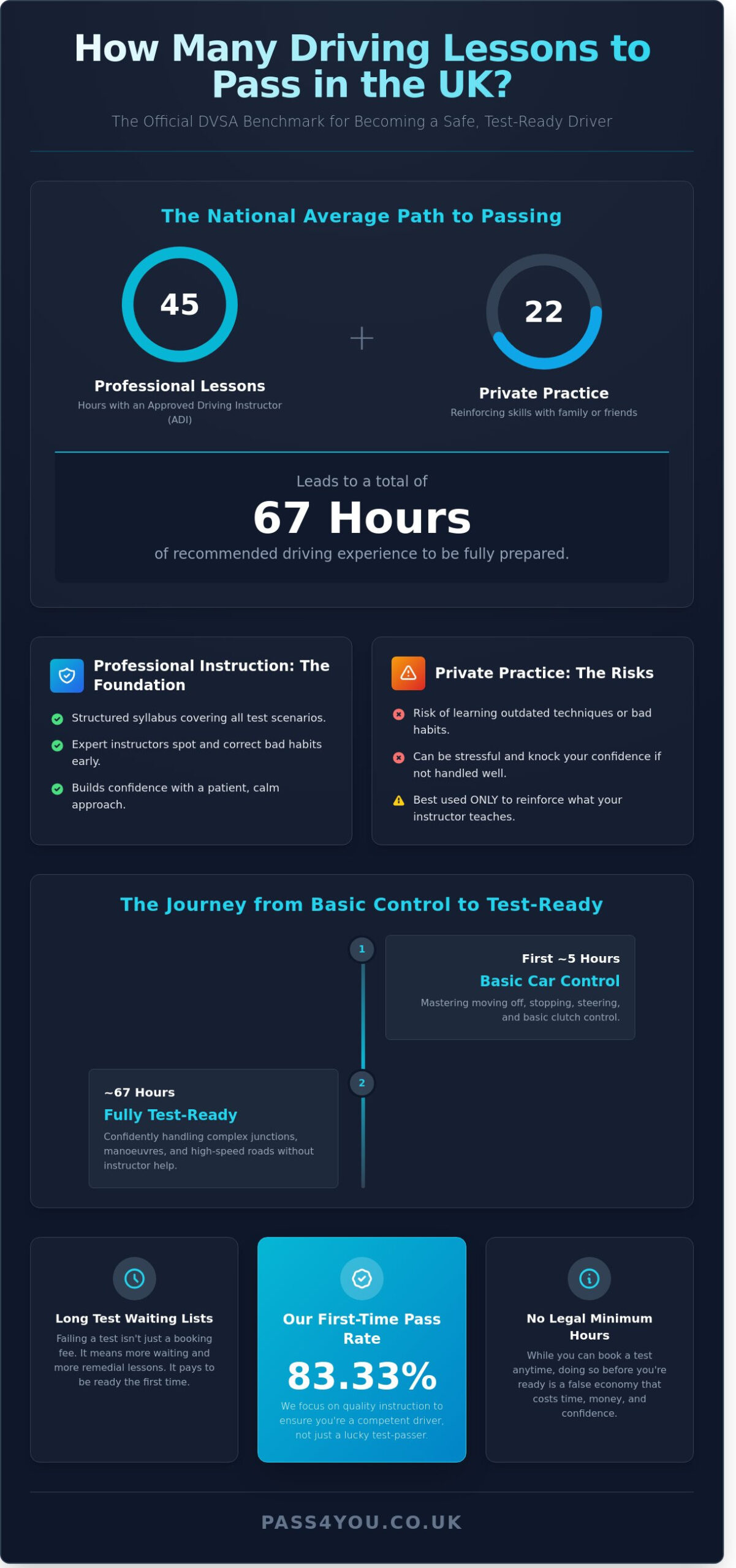
    The Driver and Vehicle Standards Agency (DVSA) reports that the average learner requires 45 hours of professional tuition plus 22 hours of private practice to reach the required standard. It’s completely normal to feel anxious about these figures or worry about wasting money on unnecessary sessions. You’ve likely heard conflicting stories from friends about passing in ten hours, but you want to ensure you’re actually a safe driver for life, not just someone who got lucky on the day.

    If you’re wondering exactly how many driving lessons to pass test uk in 2026, you’re in the right place to find a realistic answer. Here at Pass4you Driving School, we’ll help you understand the specific factors that influence your timeline and show you how a patient, structured approach can actually save you money by reducing the total number of hours required. This guide breaks down the costs, explains how to reach test-standard efficiency faster, and gives you the confidence to choose an instructor who puts your progress first.

    Key Takeaways

    • Understand the official DVSA benchmarks to learn how many driving lessons to pass test uk and why combining professional tuition with private practice is the most efficient route.
    • Discover how choosing the right lesson frequency and duration can prevent “lesson burnout” and help you master the road in fewer total sessions.
    • Compare the learning timelines for manual and automatic gearboxes to see which transmission type helps you reach your goals faster and more confidently.
    • Identify the specific skills you must master to be truly “test-ready,” from independent driving to perfecting every essential road manoeuvre.
    • Learn how a calm, patient approach can significantly improve your chances of joining the 83.33% of our students who achieve a first-time pass.

    The National Average: How Many Lessons Does the DVSA Recommend?

    Most people starting their driving journey want a straight answer to the question: how many driving lessons to pass test uk? While every learner is unique, the Driver and Vehicle Standards Agency (DVSA) provides a clear statistical starting point. Their data shows that the average successful candidate requires 45 hours of professional tuition to reach the required standard. This isn’t just about learning where the pedals are; it’s about developing the muscle memory and hazard perception needed to stay safe on modern, busy roads.

    In addition to professional lessons, the DVSA suggests that learners benefit from an extra 22 hours of private practice. This brings the total recommended experience to 67 hours before you head to the test centre. These figures serve as a helpful benchmark for budgeting your time and money. However, they aren’t strict rules. At Pass4you, we’ve seen students pass with fewer hours, while others prefer more time to feel truly calm and collected. The goal isn’t just to scrape through the exam; it’s to become a safe driver for life.

    There is a massive difference between “learning to move the car” and being “test-ready”. Most learners can master basic car control, like moving off and stopping, within the first five hours. Becoming test-ready is a higher bar. It requires you to handle complex junctions, unpredictable pedestrians, and high-speed dual carriageways without needing your instructor to intervene. For a detailed look at what the examiners are looking for, you can check this UK driving test overview to understand the full scope of the assessment.

    Professional Instruction vs. Private Practice

    Professional instruction from an Approved Driving Instructor (ADI) is the foundation of your success. Instructors like Simon are trained to spot small mistakes before they become dangerous habits. When you learn with a professional, you’re getting a structured syllabus designed to cover every possible scenario you might face during your test. We focus on building your confidence slowly and patiently, ensuring you never feel rushed or overwhelmed by the traffic around you.

    Relying solely on private practice with parents or friends can be risky. While their intentions are good, family members often pass on outdated techniques or “shortcuts” that lead to immediate faults on a modern driving test. It’s also common for these sessions to become stressful, leading to arguments that knock your confidence. The best approach is to use private practice as a way to reinforce the professional habits Simon teaches you. This balanced method helps you reach that 67-hour competency goal much faster and more effectively.

    The Legal Minimum: Is There One?

    Technically, there is no legal minimum number of hours you must complete before booking your test. You could, in theory, apply for your practical exam the day after receiving your provisional licence. However, doing this is almost always a false economy. Test waiting lists are currently long, and the cost of a failed test includes both the booking fee and the price of additional remedial lessons.

    Booking a test too early often results in a “fail” and a significant blow to your self-esteem. We take pride in our 83.33% first-time pass rate because we only encourage students to book when they are genuinely ready. Our patient, mentor-led approach ensures that when you do arrive at the test centre, you feel like a competent driver rather than a nervous student. It’s about value for money; fewer tests mean less money spent in the long run.

    The DVSA sets a benchmark of 45 hours of professional tuition as the standard for ensuring a learner is safe and competent on the road.

    5 Factors That Influence Your Learning Timeline

    Every learner starts from a different position. If you have spent years riding a moped or spent weekends practicing steering in a private field, you will likely shave 10 hours off your total tally. These students already understand the basics of road positioning and “the bite” of a clutch. When people ask how many driving lessons to pass test uk, they often forget that previous exposure to vehicle controls creates a massive head start. Your age plays a role too. Data suggests that 17-year-olds often develop the necessary muscle memory for gear changes faster than those in their 40s. However, older learners frequently bring better hazard perception skills from years of being a passenger or cyclist.

    The “Nervous Learner” factor is perhaps the most significant variable. Anxiety triggers a “fight or flight” response that makes it physically harder for the brain to retain complex instructions. This is where the quality of your mentor becomes vital. A shouting instructor will only increase your stress and extend your learning timeline. Simon at Pass4you focuses on a calm, patient atmosphere. This supportive environment is a key reason why our students achieve an 83.33% first time pass rate. A mentor who builds your confidence rather than knocking it down helps you master difficult manoeuvres in half the time.

    According to DVSA’s Ready to Pass? guidance, the average learner requires 45 hours of professional tuition combined with 22 hours of private practice. However, these figures aren’t set in stone. Your learning style and how you process physical tasks will ultimately dictate your personal journey. Some people are visual learners who benefit from diagrams, while others need to “feel” the car’s movements repeatedly before it clicks.

    The Importance of Lesson Consistency

    Consistency is the enemy of “skill fade.” If you leave a two-week gap between sessions, the first 20 minutes of your next lesson are usually spent retracing old ground. We recommend 1.5 to 2-hour sessions for maximum focus. This duration allows enough time to drive to various road types, such as dual carriageways or busy roundabouts, without feeling rushed. Block-booking your sessions ensures a steady progression through the syllabus and prevents you from losing your preferred time slot in Simon’s diary.

    Private Practice: The Secret Speed-Up

    Private practice is a fantastic way to reinforce what you have learned with an instructor. You should use a learner driver logbook to track your progress and show your supervisor exactly what needs work. Focus on “low-stakes” skills like clutch control in a quiet car park or basic observation on familiar local streets. Before you start, ensure the vehicle is properly insured for a learner and displays L-plates on the front and rear. If you want to see how a structured approach can reduce your total cost, you can book your first session with Simon today.

    Remember that private practice should complement, not replace, professional training. Friends and family might have “bad habits” that could lead to a fail on your practical test. Use your time with Simon to learn the correct, modern techniques, then use private sessions to build the “mileage” and confidence that only comes with time behind the wheel. Balancing these two types of practice is the fastest way to reach test-ready status.

    How Many Driving Lessons to Pass Your Test in the UK? (2026 Guide)

    Manual vs. Automatic: Does the Gearbox Affect the Count?

    Choosing between a manual or automatic car is one of the first decisions you’ll make. It significantly changes the answer to how many driving lessons to pass test uk. On average, learners opting for an automatic gearbox require 15 to 20 fewer hours of professional tuition than those in a manual. This gap exists because automatic learners don’t have to master the complex coordination of a clutch pedal and gear stick. While a manual learner might spend their first five to eight hours just trying not to stall, an automatic learner is often already practicing junctions and roundabouts by their second lesson.

    The manual transmission hurdle is a physical one. You have to find the “biting point” with your left foot while balancing the accelerator with your right. If you get it wrong at a busy junction, the car stalls. This can be incredibly stressful for a nervous driver. According to the RAC’s driving test guide, mastering car control is a vital foundation before you can tackle complex road layouts. By removing the gearbox from the equation, you simplify the learning process and often reach a test-ready standard much faster.

    Why Automatic is Faster

    Automatic cars eliminate the risk of stalling and gear-change errors. This allows you to keep both hands on the wheel and your eyes on the road. It’s an ideal choice if you find physical coordination overwhelming or if you want to pass your test in a shorter timeframe. With the UK moving toward electric vehicles (EVs), which are almost all automatic, an auto-only licence is becoming more practical. By 2030, the majority of cars on UK roads will likely be automatic, making the manual “advantage” less relevant for daily commuting.

    Learning in Milton Keynes: Roundabouts and Dual Carriageways

    Milton Keynes presents a unique challenge for any student. Our famous grid system and high-speed dual carriageways, such as the H6 Childs Way or the V8 Saxon Street, require high-level observation skills. Navigating dozens of roundabouts in a single hour is exhausting in a manual car. You’re constantly shifting from fourth gear down to second and back again. In an automatic, you can focus entirely on your lane positioning and exit signals.

    At Pass4you, we use modern, easy-to-drive Volkswagen vehicles that make the technical side of driving much simpler. Local knowledge of the Bletchley and Milton Keynes test centres is vital for success. Simon’s patient and calm teaching style ensures you don’t feel rushed when approaching these busy junctions. This supportive environment is why we maintain an 83.33% first-time pass rate. We focus on making you a safe driver for life, whether you choose the traditional manual route or the faster automatic path. When calculating how many driving lessons to pass test uk, remember that your choice of gearbox is the biggest factor in your total cost and timeline.

    While an automatic licence is quicker to obtain, you won’t be legally allowed to drive a manual car later. If you’re looking for the most versatile licence, manual is still the way to go. However, if your priority is building confidence and getting on the road quickly, the automatic option offers excellent value for money. You’ll likely need fewer than the 45-hour national average, saving you hundreds of pounds in lesson fees.

    The “Ready for Test” Checklist: Beyond the Hours

    While tracking your progress by the clock is a helpful starting point, your instructor looks for specific milestones before suggesting you book your practical exam. It isn’t just about how many driving lessons to pass test uk you’ve completed; it’s about your ability to handle the car safely without a safety net. At Pass4you, Simon ensures every student meets a rigorous internal standard that goes far beyond simply steering the car. We want you to feel calm and capable when you finally meet the examiner.

    Your instructor will assess your readiness based on several key performance indicators. You must be able to drive for a full lesson without any verbal prompts or physical intervention from the dual controls. If Simon has to remind you to check a blind spot or adjust your speed, you aren’t quite ready for the pressure of a test. You also need to master the four core manoeuvres: parallel parking, forward bay parking, reversing into a bay, and pulling up on the right side of the road before reversing two car lengths. These must be completed with 100% accuracy and, more importantly, constant all-round observations.

    • Independent Driving: You must follow a sat-nav or road signs for 20 minutes, which covers 50% of the modern UK driving test.
    • Show Me, Tell Me: You need to be confident with all 19 possible questions regarding vehicle safety and maintenance.
    • Emergency Stop: While this only occurs in 1 in 5 tests, you must be able to perform it instantly and safely.
    • Consistency: You should be able to drive through various road types, from narrow residential streets to busy dual carriageways, without making serious mistakes.

    The Role of the Mock Test

    The mock test is a vital tool we use to simulate the exact atmosphere of the DVSA exam. It helps you understand the weight of the situation without the risk of losing your £62 test fee. During these sessions, we look for “serious” or “dangerous” faults that would result in an immediate fail. By identifying these issues in a controlled environment, we can fix them before they become a problem on the big day. Mock tests are brilliant for alleviating nerves because they turn the unknown into a familiar routine. Students who pass a mock test with us often report feeling much more relaxed during the actual exam.

    Mental Readiness and Confidence

    Confidence is the bridge between being a learner and becoming a qualified driver. We focus on moving you from a mindset of “I hope the examiner is nice” to “I know I am a safe driver”. Test readiness is the ability to drive safely without any help. This mental shift is crucial because it allows you to handle small mistakes without letting them spiral into larger ones. If you stall the car, a ready driver stays calm, secures the vehicle, and restarts it safely without panic. Simon’s patient teaching style is designed to build this resilience, ensuring you don’t just pass the test but remain a safe driver for life. Our 83.33% first-time pass rate proves that when you feel confident, the results follow naturally.

    If you want to build the skills and confidence needed for a first-time pass, book your driving lessons with Simon today and start your journey toward independence.

    Pass4you: Why Quality Instruction Saves You Money

    When you’re researching how many driving lessons to pass test uk, the final number is often decided by the quality of instruction you receive. It’s tempting to pick the school with the lowest hourly rate, but this is a common trap that leads to lesson burnout and a mountain of hidden costs. At Pass4you, we focus on efficiency and confidence. Our 83.33% first-time pass rate is significantly higher than the national average of 48%. This isn’t just a statistic; it represents dozens of students who saved hundreds of pounds by avoiding repeated test fees and extra blocks of lessons.

    Simon provides a calm, patient atmosphere that is the direct opposite of the high-pressure environments that cause learners to stall in their progress. When you’re stressed, you don’t retain information. This leads to wasted hours repeating the same manoeuvres over and over. By maintaining a supportive environment, we ensure every minute of your lesson is productive. We also look beyond the 40-minute practical exam. Our goal is to make you a safe driver for life. We teach you how to anticipate hazards and manage real-world traffic, not just how to tick boxes for an examiner.

    Tried and Tested Techniques

    Our success comes from a structured yet flexible methodology. We’ve spent years honing a technique that works for nervous beginners and those looking to polish their skills. Each student receives a personalised lesson plan tailored to their specific strengths. If you’re a natural at clutch control but struggle with observations, we’ll pivot our focus to ensure you’re balanced and ready. We don’t believe in dragging out the process; we want you on the road as soon as you’re safely prepared.

    You’ll also benefit from learning in a modern, reliable Volkswagen tuition vehicle. These cars are chosen for their ease of use and excellent safety features, making them the perfect environment for building confidence. We hear from many Milton Keynes learners who switched to us after feeling stuck with other instructors. One learner recently passed with only three minor faults after just ten hours with Simon, despite failing twice with a different school previously. This shows that the right instructor can drastically reduce the total number of hours you need.

    Your Next Steps to Freedom

    The journey to independence shouldn’t be a source of anxiety. To get started, you simply need to reach out and book your introductory session. We highly recommend tackling your theory test as early as possible. Practical test slots in the UK are currently in high demand. If you pass your theory early, we can secure a practical date that aligns perfectly with your progress, avoiding frustrating delays that can cause your skills to fade.

    Don’t spend another month wondering how many driving lessons to pass test uk. Instead, choose the path that leads to a first-time pass and lifelong safety. Book your first lesson with Pass4you today and experience our patient approach. Your new life behind the wheel is closer than you think, and we’re here to help you reach it without the stress.

    Get Behind the Wheel with Confidence

    The DVSA suggests a national average of 45 hours of professional tuition, yet your individual journey depends on your personal pace and the support you receive. Whether you choose a manual or automatic gearbox, the goal remains the same. You want to feel safe and prepared for the road ahead without wasting money on endless, repetitive sessions. Understanding how many driving lessons to pass test uk students require often comes down to the quality of the instruction. You’ll progress much faster with a mentor who understands your nerves and tailors every session to your specific needs.

    Simon provides patient, calm instruction in modern Volkswagen tuition vehicles, ensuring you build the skills necessary to succeed. By focusing on excellence from day one, you reduce the total number of hours needed and save your hard-earned cash. It’s time to stop worrying about the numbers and start looking forward to the freedom of the open road. You’ve got the potential to be a safe driver for life; you just need the right environment to prove it.

    Join the 83.33% who pass first time-Book your lessons with Pass4you

    Frequently Asked Questions

    Is 20 driving lessons enough to pass the test in the UK?

    20 driving lessons is usually not enough for most learners to reach the required safety standard for the UK practical test. The Driver and Vehicle Standards Agency (DVSA) reports that the average learner needs 45 hours of professional tuition to pass. While some students with previous experience might manage with fewer sessions, we focus on making you a safe driver for life rather than just rushing to the finish line.

    Can I pass my driving test in 2 weeks with an intensive course?

    You can pass your test in 14 days with a structured intensive course, provided you have already passed your theory test. These fast-track programmes involve 4 to 6 hours of driving daily to build muscle memory quickly. Success depends on your ability to absorb information under pressure and the current 24-week average waiting time for practical test slots at most UK centres.

    How many hours of private practice should I do alongside my lessons?

    You should aim for approximately 22 hours of private practice to supplement your professional tuition. This extra time behind the wheel helps you familiarise yourself with local roads and builds confidence in a relaxed environment. Combining professional lessons with family practice is a proven way to reduce the total number of how many driving lessons to pass test uk you will eventually need.

    What is the average pass rate for first-time drivers in Milton Keynes?

    The average first-time pass rate at the Milton Keynes Bletchley test centre is 46.7% based on 2023/24 DVSA data. Our students at Pass4you reach a much higher 83.33% first-time pass rate because Simon uses a calm and patient approach. This professional guidance helps you feel confident on the road, rather than feeling rushed or pressured during your learning journey.

    Does the DVSA require a certificate of completed hours before the test?

    No, the DVSA does not require you to show a certificate or proof of completed hours when you arrive for your practical test. Your instructor will simply sign your photocard licence digitally or on paper to confirm you are ready. While there is no legal minimum, we only recommend booking your slot once you consistently meet the National Standard for driving without any help from your instructor.

    Why do some people need 60 or more hours to pass?

    Some learners require 60 hours or more due to factors like high anxiety, long gaps between lessons, or starting later in life. If you only take one hour a week, you often spend the first 20 minutes refreshing what you forgot in the previous session. We find that students who have had negative experiences with shouting instructors often need extra time to rebuild their confidence and unlearn bad habits.

    Can I take my driving test in my own car?

    You can use your own car for the practical test if it meets specific DVSA requirements, such as having an extra rear-view mirror for the examiner. The vehicle must be taxed, insured for a test, and have a valid MOT. Most of our students prefer using our tuition cars because they are fitted with dual controls; this provides an extra layer of safety and reassurance during the high-pressure environment of the test.

    How much do driving lessons cost in Milton Keynes for 2026?

    Standard driving lessons in Milton Keynes are expected to average £42 per hour by January 2026. We focus on providing value for money rather than just being the cheapest option available. By using our efficient teaching methods, you will likely need fewer sessions, which lowers the overall cost of how many driving lessons to pass test uk in the long run.

  • Intensive Driving Course Milton Keynes: Your Guide to Passing Fast

    Intensive Driving Course Milton Keynes: Your Guide to Passing Fast

    Do you need your driving licence, and need it fast? Perhaps a new job is on the line, or you’re simply tired of the slow pace of weekly lessons where you forget half of what you learned by the next one. This is why many people start looking for an intensive driving course in Milton Keynes as the express route to getting their pink licence. But with the high upfront cost and the pressure to learn so much so quickly, it’s natural to wonder if it’s the right choice, especially if you feel a little nervous behind the wheel.

    While many learners look for local instructors, national providers can also be an excellent choice. Companies that operate across the country, such as National Intensive Lessons, often have wider availability and can be a great resource for finding a course that fits your schedule.

    Don’t worry, we’re here to help. This guide will calmly walk you through the pros and cons, helping you decide if an intensive course is the best path for you. We’ll show you what to look for in a patient instructor and how you can pass your test efficiently, feeling confident and safe on the road. Let’s get you ready for that first-time pass, without the stress.

    What Exactly Is an Intensive Driving Course?

    Feeling daunted by the idea of driving lessons dragging on for months? An intensive driving course in Milton Keynes, sometimes called a ‘crash course’, offers a focused and efficient alternative. Instead of spreading your learning over a long period, it condenses the entire syllabus into a matter of days or weeks. At its core, this type of course is a compressed form of driver’s education, designed to get you test-ready in a fraction of the usual time.

    This method is incredibly effective because it prevents “skill fade”-the frustrating experience of forgetting what you learned in last week’s lesson. By driving every day, you rapidly build muscle memory and situational awareness. This consistent practice is why an intensive driving course Milton Keynes is so popular, helping to build your confidence behind the wheel much faster and turning you into a safe and capable driver in a short space of time.

    Intensive vs. Weekly Lessons: The Key Differences

    Understanding the difference helps you choose the right path for your learning journey. While both methods aim for the same goal-your full driving licence-their approach is fundamentally different.

    • Timeframe: A typical intensive driving course Milton Keynes can condense 30-40 hours of tuition into one or two weeks, whereas traditional lessons might take 6-12 months to cover the same ground.
    • Learning Flow: Continuous, daily practice with an intensive course ensures concepts stay fresh. Weekly lessons have a week-long gap, which can slow down progress.
    • Cost Structure: Intensive courses are typically paid for as an upfront package, which includes the test fee. Weekly lessons are often pay-as-you-go, which can sometimes lead to a higher total cost over time.
    • Ideal Candidate: Intensive learning suits those who can dedicate a solid block of time and want to pass quickly. Weekly lessons are better for learners balancing driving with a busy work or college schedule.

    How a Typical Intensive Course is Structured

    A well-structured intensive driving course in Milton Keynes is key to success. You can expect to be in the car for around 3 to 6 hours each day, with regular breaks to ensure you stay focused and don’t get overwhelmed. Your lessons will cover everything from basic car control to complex manoeuvres and navigating Milton Keynes’ unique roundabouts. A significant portion of time is dedicated to practicing official test routes, so you feel prepared and confident on the day. The course is carefully timed to culminate in your practical driving test, often on the final day.

    It’s important to have realistic expectations. An intensive course is a fast track, not a magic wand. While we have an excellent first-time pass rate, be wary of any school offering a “guaranteed pass”-no reputable instructor can promise this. Your success depends on your dedication and performance on test day. Our job is to give you the very best training to make that first-time pass a reality.

    Is an Intensive Driving Course in Milton Keynes Right for You?

    An intensive driving course is a fantastic way to get on the road quickly, but it’s a decision that requires careful thought. This learning style is exactly what it sounds like: intense. It demands significant focus, commitment, and a solid block of your time. It’s not just for those who have driven before; a motivated beginner can absolutely succeed. However, an honest self-assessment is the key to making a smart investment in your driving future.

    Ask yourself: do you thrive under pressure and absorb information quickly, or do you prefer a slower, more reflective pace? Being honest now can save you both time and money down the line. The intensity of learning so much in a short period means the role of your instructor is more important than ever. A calm, patient, and supportive guide is crucial to help you manage the pressure and build lasting confidence behind the wheel.

    Who Benefits Most from This Approach?

    While every learner is different, an intensive driving course in Milton Keynes is often a perfect match for individuals who:

    • Need a licence quickly for a new job, university, or a major life change.
    • Have some previous driving experience and need a structured course to get them to test standard.
    • Can dedicate a full week or a specific block of time solely to learning without other distractions.
    • Learn best through total immersion, preferring to focus on one subject deeply rather than spreading it out.

    When to Consider Weekly Lessons Instead

    A fast-track course isn’t the right path for everyone. We believe in finding the best approach for you. Weekly lessons might be a more suitable and less stressful option if:

    • You are an extremely nervous or anxious beginner who would benefit from a gentler introduction to driving.
    • Your budget requires spreading the cost over several months instead of paying a lump sum.
    • You simply cannot take a consecutive week off from work, studies, or family commitments.
    • You prefer having more time between lessons to reflect on and absorb new skills at your own pace.

    Ultimately, our goal is to help you become a safe and confident driver for life. Regardless of the path you choose, the official guidance on Preparing for Your Intensive Course outlines the essential first steps for any learner, from applying for your provisional licence to understanding the theory test.

    The Pros and Cons of an Intensive Course

    Choosing how to learn to drive is a big decision. An intensive course offers a fast-track route to your licence, but is it the right path for you? Understanding both the benefits and the potential challenges will help you make a calm, confident choice. The greatest advantage of this method – speed – can also be its biggest hurdle if you’re not prepared.

    The Advantages: Why People Choose Intensive Courses

    For many learners, the focused nature of an intensive course is the key to success. By compressing lessons into a short period, you can build momentum and confidence quickly. The main benefits include:

    • Speed: Go from learner to a full licence holder in a matter of weeks, not months.
    • Focus: With daily lessons, skills remain fresh in your mind. There’s less time to forget crucial techniques between sessions.
    • Cost-Effectiveness: While the upfront cost is higher, you may need fewer hours overall, saving you money in the long run.
    • Momentum: Daily progress is a powerful confidence booster, helping you feel more in control and ready for your test.

    The Disadvantages: Potential Downsides to Consider

    It’s also important to be realistic about the demands of an intensive course. It requires significant commitment and isn’t suited to every learning style. Potential downsides are:

    • Pressure: The fast pace can feel overwhelming for some, especially if you are a nervous learner.
    • Fatigue: Spending several hours a day behind the wheel is mentally and physically tiring.
    • Upfront Cost: You will need to pay for the entire course, typically a significant sum, in one go.
    • Risk of Failing: If you don’t pass your test at the end, it can feel like a major setback after such a concentrated effort.

    So, how do you get all the benefits while minimising the drawbacks? The answer lies with your instructor. A calm, patient, and experienced instructor can manage the pace to prevent you from feeling overwhelmed and ensure you take breaks to avoid fatigue. They turn the pressure into positive momentum. While every learner must follow the same official government guidance on learning to drive, the right support system makes all the difference. Choosing a quality intensive driving course in Milton Keynes is less about the speed and more about the expert guidance that gets you that first-time pass, making you a safe and confident driver for life.

    Intensive Driving Course Milton Keynes: Your Guide to Passing Fast

    Preparing for Your Intensive Course in Milton Keynes

    Success on your driving course doesn’t start when you get in the car; it begins with solid preparation. Taking the right steps beforehand builds a calm, confident foundation, ensuring you get the absolute most from every hour behind the wheel. A well-prepared learner is a successful learner, and our goal is to help you pass your test safely and quickly.

    Step 1: Pass Your Theory Test

    This is the essential first hurdle. You cannot book a practical driving test in the UK without a valid theory test pass certificate. We strongly advise getting this completed before you even book your course. Mastering the Highway Code is vital, not just for the theory test, but for becoming a safe driver for life. Use official apps and plenty of mock tests to ensure you’re fully prepared and confident in your knowledge.

    Step 2: Mastering Milton Keynes’ Unique Roads

    Milton Keynes presents a unique driving environment. Its famous grid system of national speed limit roads and countless roundabouts, from small single-lane ones to complex multi-lane gyratories, can feel daunting. A good instructor leading your intensive driving course in Milton Keynes will have expert local knowledge, focusing your practice on these specific challenges. Your practical test will likely be at the Bletchley Driving Test Centre, so familiarising yourself with the common test routes in that area is a massive advantage.

    Step 3: What to Bring and How to Prepare Daily

    An intensive course requires focus and energy. To avoid burnout and stay sharp, it’s important to look after yourself and come prepared each day. We’ve found that students who follow these simple steps feel more relaxed and learn more effectively:

    • Your Provisional Licence: You must have this with you for every single lesson. No licence, no driving.
    • Get Plenty of Rest: A good night’s sleep is crucial for concentration and retaining information.
    • Stay Fuelled and Hydrated: Bring a bottle of water and a snack to keep your energy levels stable.
    • Ask Questions: Never be afraid to ask for clarification. If you’re struggling with a manoeuvre, tell your instructor. We are here to help you feel confident, not confused.

    With the right preparation and a patient instructor, you’ll be in the perfect position to succeed. At Pass4You, we build this supportive framework into every course we offer.

    Why Choose Pass4you for Your Intensive Course?

    Choosing the right driving school for your intensive driving course in Milton Keynes is the most important decision you’ll make on your journey to getting a full licence. At Pass4you, we don’t just offer a faster route to passing your test; we provide a supportive, calm, and highly effective learning environment. We specialise in transforming even the most nervous learners into confident, capable drivers, equipping them with the skills for a lifetime of safe driving.

    The Pass4you Difference: Fast-Tracking Without the Fear

    The idea of an intensive course can feel intimidating, but it doesn’t have to be. Our entire approach is built on patience, understanding, and adapting to you. We tailor the fast-paced structure to your individual learning style, ensuring you absorb every skill without feeling rushed or overwhelmed. Our calm and encouraging teaching methods are specifically designed to reduce anxiety, build your self-belief behind the wheel, and make learning to drive an enjoyable and rewarding experience. We focus on instilling deep-rooted driving skills that go far beyond just the manoeuvres needed to pass the test. Ready to start? Let’s discuss a plan for you.

    Proven Success in Milton Keynes

    Our results provide the proof. We are incredibly proud of our 83.33% first-time pass rate, a figure that stands as a clear testament to our effective, student-focused teaching methods. For our students, this means more than just a certificate. Passing your test the first time saves you significant time, the extra cost of re-tests, and the stress of waiting. This success is built on a solid foundation of genuine local expertise and an unwavering commitment to quality instruction.

    • Unmatched Local Knowledge: As a true Milton Keynes expert, your instructor knows the Bletchley test routes inside and out-from the tricky roundabouts to the specific challenges examiners look for. This gives you a crucial advantage and builds confidence.
    • Real Student Testimonials: Don’t just take our word for it. Our five-star reviews are filled with stories from students, many of whom were nervous, who passed quickly thanks to our patient and effective approach.
    • Comfort and Safety First: You’ll learn in a modern, dual-controlled Volkswagen tuition vehicle. It’s a comfortable, safe, and reliable car perfect for building your skills and getting you used to a modern driving experience.

    We are committed to our mission of building safe drivers for life, and our outstanding pass rate proves that a calm, confident, and expert-led approach is the fastest way to get you safely on the road.

    Ready to Pass Your Test with Confidence?

    We’ve explored how an intensive course can be your fastest route to a full driving licence. The key takeaways are clear: these courses offer a focused, accelerated path to success, but choosing the right instructor is crucial for building lasting confidence behind the wheel. Proper preparation ensures you get the maximum value from every single hour of your training.

    At Pass4you, we combine speed with a calm, patient, and supportive teaching style that gets results. Our excellent 5-star reviews from former students and an outstanding 83.33% first-time pass rate are a testament to our method. When you choose our intensive driving course in Milton Keynes, you’re not just booking lessons; you’re investing in a positive learning experience with an experienced local instructor dedicated to your success.

    The freedom of the open road is closer than you think. Book your calm and confident intensive course in Milton Keynes today!

    Frequently Asked Questions About Intensive Driving Courses

    How many hours do I need for an intensive driving course?

    The number of hours you need depends entirely on your current driving ability. For a learner with some previous experience, a 15-20 hour course may be sufficient. However, a complete beginner will typically need a 30-40 hour course to build the skills and confidence required to pass. The best approach is to take an assessment lesson with us, so we can provide a calm, professional recommendation tailored specifically to you and your learning pace.

    Do I have to pass my theory test before booking an intensive course?

    Yes, you must have a valid theory test pass certificate before we can book your practical test. The practical test is the final part of your intensive course, so we need to secure that date in advance. We strongly advise passing your theory test before booking your course to avoid any delays. This ensures we can schedule your lessons to lead directly into your test date, giving you the best chance of a first time pass.

    How much does an intensive driving course cost in Milton Keynes?

    The cost of an intensive driving course in Milton Keynes varies based on the number of hours you require. Shorter courses for experienced learners might start from around £700, while comprehensive courses for new drivers can be in the region of £1,500 to £2,000. While we may not be the cheapest, we provide excellent value for money. Our patient, expert tuition aims to get you test-ready in fewer hours, saving you money in the long run.

    What happens if I don’t pass my test at the end of the course?

    Don’t worry, it happens. The most important thing is not to feel discouraged. Your instructor will have a detailed breakdown from the examiner and will calmly discuss the areas that need improvement. We will then recommend a short course of refresher lessons focused specifically on those areas to build your confidence back up. Our goal is to help you become a safe driver for life, and we will support you until you pass.

    Can a complete beginner pass with an intensive course?

    Absolutely! Intensive courses are an excellent way for complete beginners to learn to drive. The concentrated nature of the lessons means you learn and retain information quickly without long gaps between sessions. We design our courses to take you from the very basics to being a confident, test-ready driver in a calm and supportive environment. A longer course of 35-40 hours is usually ideal for a new starter to ensure you are fully prepared.

    How far in advance do I need to book an intensive course?

    We recommend booking your course at least 6 to 8 weeks in advance. This is crucial for two reasons: instructor availability and securing a practical test slot. Driving test waiting times in Milton Keynes can be long, and booking ahead allows us to find a test date that aligns perfectly with the end of your course. This ensures your new skills are fresh in your mind on test day, maximising your chance of success.