What if the silence of a stalled engine isn’t a sign that you’re a bad driver, but simply a case of miscommunication between you and your car? You know that sinking feeling when the light turns green and the car jolts to a halt while a queue of traffic grows behind you. It’s frustrating and embarrassing, especially when you’re worried about holding up others or failing your test. Understanding how to avoid stalling a manual car is about more than just memorizing foot movements; it’s about listening to the vehicle’s sensory feedback.
We’re here to help you turn that anxiety into calm, professional control. In this guide, you’ll master the art of clutch control and learn exactly how to recover with confidence if your engine cuts out. We’ll walk you through the “biting point” secret, show you how to handle steep hills without rolling, and explain the best ways to prepare for your practical test under the latest 2026 standards. You’ll soon have the skills to move off smoothly every time, whether you’re at a busy roundabout or a quiet junction.
Key Takeaways
- Understand the simple mechanics of engine resistance to learn exactly how to avoid stalling a manual car with every start.
- Master the biting point by recognizing sensory cues like the engine’s changing pitch and the subtle movement of the car’s bonnet.
- Build the skills to handle high-pressure situations, such as steep hills and busy roundabouts, using reliable handbrake techniques.
- Learn a calm, five-step recovery routine that helps you safely restart and move off quickly if your engine ever cuts out.
- See why personalized, patient instruction is the most effective way to build long-term confidence and eliminate anxiety behind the wheel.
What is Stalling and Why Does it Happen to Every Learner?
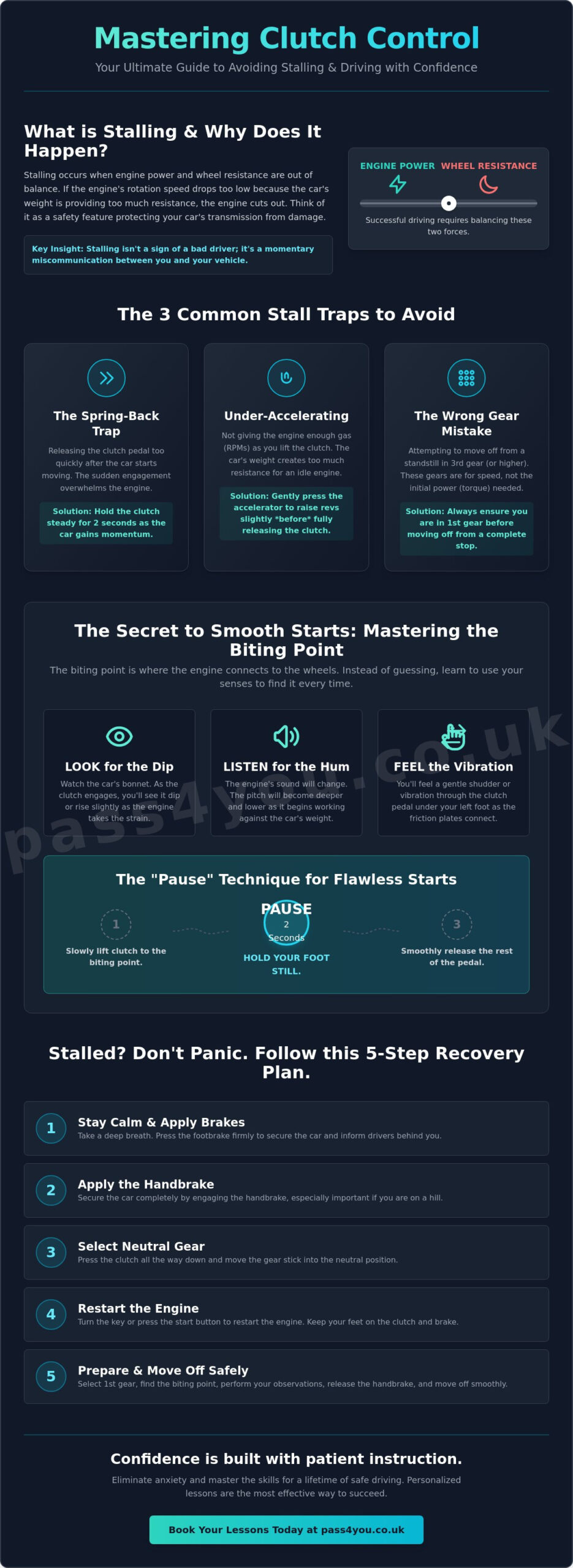
Stalling is a rite of passage for every learner driver. It feels like a loud, public declaration that you don’t know what you’re doing, but that isn’t true at all. In reality, stalling is simply a physical reaction to a lack of balance. An internal combustion engine is a machine that needs to keep spinning to stay alive. If the rotation speed drops too low because the wheels are providing too much resistance, the engine simply gives up. Learning how to avoid stalling a manual car starts with understanding this delicate relationship between power and resistance.
Think of stalling as a built-in safety feature. If the engine didn’t cut out when things went wrong, the immense pressure could damage your manual transmission or snap expensive internal components. It’s the car’s way of protecting itself. Even the most experienced drivers stall on occasion. Perhaps they are wearing new shoes with thicker soles, or they are driving an unfamiliar vehicle for the first time. It isn’t a sign of a bad driver; it’s just a momentary lapse in sensory communication.
The Mechanics of a Stall
Inside your car, a heavy spinning disc called a flywheel is connected to the engine. When you press the clutch pedal down, you separate this disc from the rest of the car’s wheels. As you lift the pedal, a friction plate begins to touch that spinning flywheel. This is the biting point. If you bring these two parts together too quickly without enough engine power, the weight of the car acts like a giant brake. It stops the flywheel from spinning, which kills the engine instantly.
Common Culprits: Clutch, Gas, and Gear Selection
Most stalls happen because of three specific mistakes that every learner makes at least once:
- The Spring-Back Trap: You find the biting point and the car starts to move, but you release the clutch pedal too quickly. You must hold the clutch steady for a second or two to let the car gain momentum.
- Under-Accelerating: Your engine needs help to move 1.5 tonnes of metal. If you don’t give it enough gas (revs) as you lift the clutch, the resistance will win the battle every time.
- The 3rd Gear Mistake: Trying to move off in the wrong gear is a guaranteed stall. Because 3rd gear is built for speed rather than raw power, it cannot provide the torque needed to get the car rolling from a standstill.
By staying calm and focusing on these three areas, you’ll quickly discover how to avoid stalling a manual car and begin to feel the rhythm of the engine. It’s all about patience and practice.
Mastering the Biting Point: The Secret to Smooth Starts
Mastering the biting point is the single most important skill you’ll develop as a new driver. It’s the bridge between a stationary car and a moving one. Instead of guessing where that point is, you can learn to recognize the car’s natural signals. Learning how to avoid stalling a manual car is much easier when you stop treating the pedals like switches and start treating them like a conversation. Your car tells you exactly when it’s ready to move; you just need to know what to look, listen, and feel for.
There are three primary sensory cues that indicate you’ve reached the biting point. First is the “Dip.” As the clutch plates begin to meet, you’ll see the front of the car slightly rise or the bonnet dip as the engine takes the strain. Second is the “Hum.” The engine’s pitch will change, becoming slightly deeper or lower as it works against the weight of the car. Finally, there’s the “Vibration.” You’ll feel a gentle shudder through the clutch pedal under your left foot. Preparation is key when Dealing with High-Pressure Stalling Scenarios, and these sensory cues provide the data you need to stay in control.
The “Pause” technique is the secret weapon for smooth starts. Many learners make the mistake of lifting their foot all the way up as soon as the car begins to crawl. This often leads to a sudden jolt and a stall. Instead, when you feel the biting point, hold your foot perfectly still for two seconds. This gives the engine time to synchronize with the wheels. Once the car is moving at a walking pace, you can then release the rest of the pedal slowly and smoothly.
Finding the Biting Point in a Modern VW
Modern diesel and petrol engines, such as those found in Pass4you’s tuition vehicles, are designed to be forgiving. They provide clear feedback through the rev counter (RPM). You’ll notice the needle dip slightly when you hit the sweet spot. Every car is different; some have a “high” biting point near the top of the pedal’s travel, while others are “low.” Practicing in a consistent, modern vehicle helps you calibrate your senses quickly.
The ‘Feet in Harmony’ Drill
Think of your feet like a see-saw. As one goes down, the other comes up. To build muscle memory, try the “Car Park Crawl.” In a flat, quiet area, try to move the car using only the clutch, without touching the gas pedal at all. This forces you to find the biting point purely by feel. Wearing thin-soled shoes can also make a massive difference, as they allow you to “feel” the vibrations more accurately. If you find yourself struggling with foot coordination, taking professional driving lessons can help you refine this balance in a supportive environment.
By focusing on these physical cues, you’ll soon find that how to avoid stalling a manual car becomes second nature. It’s about building a partnership with the machine rather than fighting against it.
Dealing with High-Pressure Stalling Scenarios
High-pressure environments like the Milton Keynes grid system can feel intimidating for any learner. Roads such as the H6 Childs Way or V8 Marlborough Street are famous for their fast-paced roundabouts and constant junctions. The pressure of a busy road often causes learners to rush their footwork, which is why so many people search for how to avoid stalling a manual car in these specific moments. When you feel rushed, you lose the sensory connection with the biting point that we explored earlier. Slowing down your mind is the first step to speeding up your progress.
The “Psychology of the Honk” is a hurdle every new driver must clear. If an impatient driver behind you sounds their horn, it’s easy to panic. Remember that the honk is just noise; it doesn’t change the mechanics of your car. Take a deep breath. Your priority is to secure the vehicle and restart safely. Rushing to please a stranger usually leads to a second stall, which only increases the stress. Stay in your bubble and focus on your controls.
It’s also a common myth that stalling means an instant fail on your big day. On your practical driving test, the examiner is looking for how you handle the situation. If you stall but recover quickly, safely, and without rolling back, it might only result in a minor fault. Demonstrating a calm recovery shows that you’re a responsible and capable driver who can manage mistakes under pressure.
Mastering the Hill Start Without Rolling Back
The handbrake is a tool for success, not a sign of weakness. To start on a hill, apply the gas and lift the clutch until you hear a low “groan” from the engine. This is the car telling you it’s ready to climb. Once you have that biting point, release the handbrake and hold your feet perfectly still. Don’t “ride the clutch” by keeping it at the biting point for too long while moving, as this causes unnecessary wear. Simply hold it until the car has enough momentum to fully release.
Junction Anxiety: Moving Off Under Pressure
Preparation is the best cure for junction anxiety. When you’re waiting for a gap at a busy MK roundabout, get the car ready early. Find your biting point while you’re still waiting. This “Look-Tell-Do” routine ensures that when the gap appears, you only need to release the handbrake and go. Rushing is the number one cause of stalling at junctions. By preparing your feet ahead of time, you remove the need for speed and replace it with precision. This is the most reliable way to understand how to avoid stalling a manual car when the traffic is heavy.
A 5-Step Recovery Plan: What to Do When You Stall
Even when you’ve studied exactly how to avoid stalling a manual car, the engine might still cut out during a moment of distraction. It happens to everyone. The difference between a flustered learner and a confident driver is the recovery. Instead of rushing to restart while the car is still rolling, you need a structured plan to regain control. This five-step routine ensures you stay safe and keep your composure, even in the middle of a busy junction.
- Step 1: Secure the vehicle. Immediately pull the handbrake up and put both feet down (clutch and brake). This stops the car from rolling and tells your brain that the situation is under control.
- Step 2: Reset the controls. Keep the clutch pedal down and move the gear lever into neutral. If you’re very quick, you can stay in first gear, but neutral is safer for a full reset.
- Step 3: Restart the engine. Turn the key or press the “Start” button. On many modern cars, you must have the clutch fully depressed for the engine to fire up.
- Step 4: The 360-degree observation. This is the most important step. Before you move, check all your mirrors and your blind spots. The road situation may have changed while you were restarting.
- Step 5: Breathe and reset. Take three seconds to settle your nerves. Find your biting point using the sensory cues we discussed earlier, and move off when it’s safe.
Modern Car Features: Auto-Restart and Electronic Handbrakes
Many cars in 2026 come equipped with “Stop-Start” technology. In these vehicles, if you stall, the engine might automatically restart the moment you push the clutch pedal back to the floor. You don’t even need to turn the key. If your car has an electronic handbrake, it might engage automatically the moment the engine dies. Always check the dashboard light to see if it’s on. Some cars also have a “Hold” function that keeps the brakes applied until you find the biting point, which is a fantastic aid for preventing roll-backs during a recovery.
Recovering During the Driving Test
During your practical test, the examiner isn’t looking for perfection; they’re looking for safety. Stalling isn’t an automatic fail. However, a panicked restart without looking around is a serious fault. If you stall, stay calm. You can even use a “verbal reset” by saying something like, “Oops, let me just reset and check my surroundings.” This tells the examiner you’re in control of your emotions. By taking that extra second to perform a 360-degree check, you prove that you’re a responsible driver who prioritizes safety over speed. If you want to practice these recovery steps in a supportive environment, book your driving lessons with our patient team today.
Mastering this recovery plan is just as important as learning how to avoid stalling a manual car in the first place. It gives you the “safety net” you need to drive with true confidence.
Building Confidence with Patient Instruction in Milton Keynes
Learning how to avoid stalling a manual car is much easier when you have an expert mentor by your side. While practicing with friends or family can be helpful, professional driving instructors are the fastest way to cure persistent stalling issues. Experts can identify the tiny errors in your footwork or timing that you might not even notice yourself. At Pass4you, we’ve refined our teaching methods to prioritize calm, patient coaching that completely eliminates “clutch fear” from the very first lesson.
Our impressive 83.33% first-time pass rate is built on a simple, effective philosophy: you must master the basics before moving into complex traffic. We use modern VW tuition vehicles because they are designed to be intuitive and forgiving. These cars provide clear sensory feedback, making it much easier to understand how to avoid stalling a manual car while you’re still building your confidence. Instead of fighting with an old, heavy clutch, you can focus on the rhythm of the engine and the road ahead.
Personalised Lessons for Anxious Learners
We believe in moving at your own pace. We won’t rush you into busy Milton Keynes traffic or onto fast grid roads until you feel completely ready. This supportive approach helps you build a solid foundation of muscle memory without the stress of holding up other drivers. We also conduct mock tests in the exact areas of Milton Keynes where you’ll take your practical exam. By practicing your recovery routine in these high-pressure spots, you’ll feel prepared to book driving test dates with total peace of mind.
Your Journey to a Full License Starts Here
Holding a manual license offers a level of freedom that remains incredibly valuable in 2026. It gives you the flexibility to drive almost any vehicle and often leads to lower insurance costs. We’ve seen many learners who started as “serial stallers” transform into smooth, confident drivers through our specialized instruction. Don’t let the fear of a stalled engine hold you back from the opportunities that come with a full license. You have the ability to master this skill, and we’re here to support you every step of the way. You’ve got this, and your journey to independence starts today.
Step Into the Driver’s Seat with Confidence
Mastering your vehicle is about building a partnership with the machine through sensory feedback and steady practice. You’ve learned how to recognize the biting point through sight, sound, and touch; you also have a reliable five-step plan to recover if the engine ever cuts out. Understanding how to avoid stalling a manual car takes the fear out of junctions and roundabouts, allowing you to focus on the road ahead with a clear mind.
Our team is dedicated to supporting you through every step of this process. We use modern Volkswagen tuition vehicles that are intuitive to drive, and our calm, patient instructors are experts at building your confidence. With an 83.33% first-time pass rate, we know exactly how to help you master the basics and achieve your goals. You don’t have to face the Milton Keynes grid system alone or feel overwhelmed by the learning process.
Ready to master the manual? Book your first lesson with Pass4you in Milton Keynes today!
Driving is a skill that opens up a world of freedom and opportunity. With the right guidance and a bit of patience, you’ll be moving off smoothly and safely in no time. We can’t wait to see you succeed on the road.
Frequently Asked Questions
Is stalling a manual car bad for the engine or gearbox?
Stalling your car occasionally won’t cause any lasting damage to the engine or gearbox. It’s actually a safety measure that cuts power to prevent internal components from snapping under too much resistance. While frequent stalling over a long period can put extra strain on the battery and starter motor, it’s a normal part of the learning process. You don’t need to worry about breaking the vehicle while you practice your starts.
Will I fail my driving test if I stall the car?
Stalling is not an automatic fail on your practical driving test. It only becomes a serious issue if it happens in a dangerous place or if you fail to perform safety checks before moving off again. If you handle the situation calmly and follow the recovery steps we discussed earlier, the examiner will likely record it as a minor fault. They want to see that you can stay composed and keep the road safe.
Why does my car stall when I’m braking to a stop?
Your car stalls while braking because the engine speed has dropped too low to stay running. As the wheels slow down, they pull the engine’s rotation down with them. To prevent this, you should press the clutch pedal down once your speed reaches about 10 or 15 mph. This separates the engine from the wheels and allows it to idle peacefully while the car comes to a stop. It’s a common mistake for new learners.
Can you stall a modern automatic car?
Stalling a modern automatic car is almost impossible under normal driving conditions. These vehicles use a torque converter or a computer-controlled clutch to manage the connection between the engine and the wheels automatically. If an automatic car does stall, it’s usually a sign of a mechanical fault, such as a failing sensor or a problem with the fuel supply. It isn’t something a driver can cause through poor footwork or timing errors.
How many times can I stall in a driving test before failing?
There is no specific limit on how many times you can stall, but consistency and safety are the main factors. One or two stalls handled safely usually result in minor faults. However, if you stall repeatedly in the same type of situation, the examiner may decide you lack control of the vehicle. When learning how to avoid stalling a manual car, the focus should always be on safe, controlled recovery rather than counting your mistakes.
Why is my car stalling even when the clutch is fully down?
A car that stalls with the clutch fully down usually has an underlying mechanical problem. Driver error typically causes stalls when the clutch is at the biting point, but a stall with the pedal down suggests the engine cannot maintain its idle. This could be due to a blocked fuel filter, faulty spark plugs, or an issue with the battery. It’s best to have a qualified mechanic investigate the vehicle to ensure it’s safe.
Is it easier to stall a petrol car compared to a diesel?
Petrol cars are generally easier to stall than diesels because they produce less power at low engine speeds. Diesel engines have more torque, which helps them pull away even with very little gas. When practicing how to avoid stalling a manual car with a petrol engine, you’ll find that giving the car a few more revs at the biting point makes the start much smoother. This extra power helps the engine overcome the car’s weight.
What should I do if the car stalls and won’t restart immediately?
If your car won’t restart immediately, ensure the gear lever is in neutral and the clutch pedal is pressed firmly to the floor. Many modern cars have a safety switch that prevents the engine from firing unless the clutch is fully depressed. If the engine still refuses to start after a few attempts, turn on your hazard lights to alert other drivers. Stay calm and call for professional assistance if the vehicle remains unresponsive.
Leave a Reply