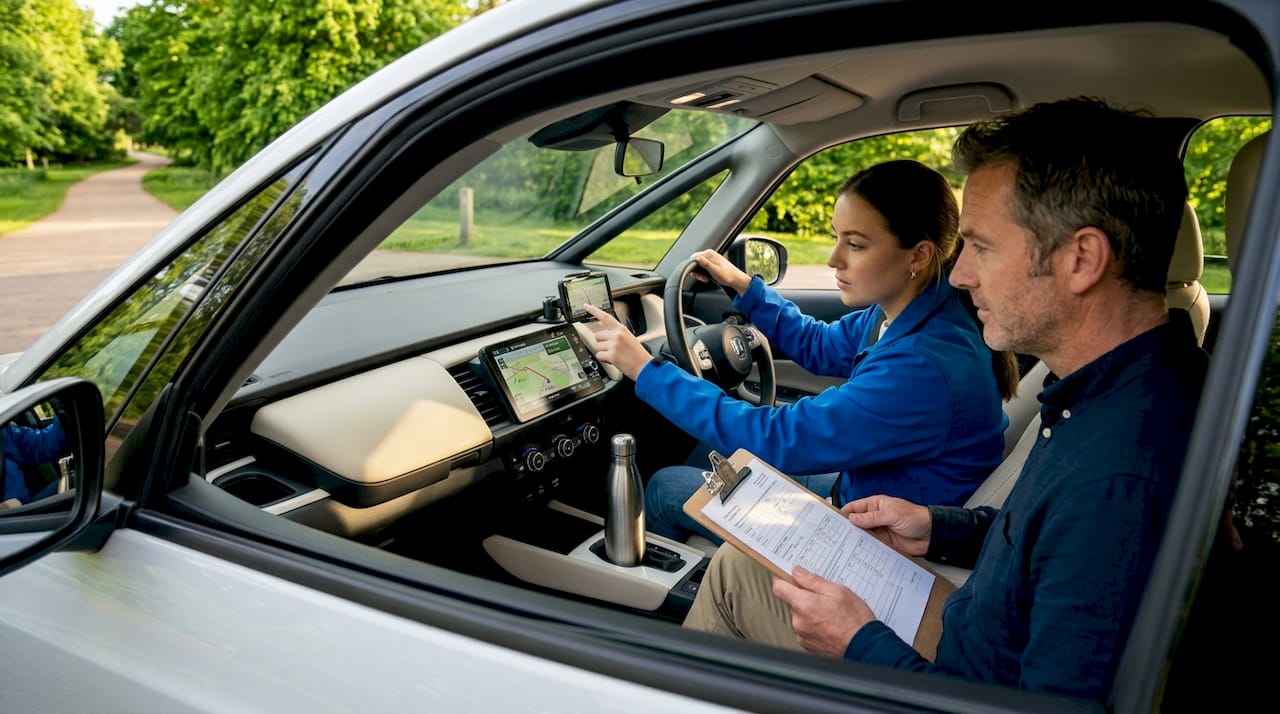
Most learner drivers walk into their practical test thinking the independent driving section is a sat nav challenge. It is not. The independent driving test is a 20-minute assessment of how safely you make decisions when no one is guiding your every move. Navigation is just the backdrop. What examiners are actually watching is your observation, your speed control, your lane discipline, and how calmly you respond when things do not go to plan. This article covers exactly what the section involves, what you are being marked on, and how to prepare for it properly.
Table of Contents
- Key takeaways
- What is the independent driving test section?
- What examiners actually assess
- How to prepare for independent driving
- Common challenges and how to overcome them
- Sat nav vs. road sign navigation
- My honest take on the independent section
- Ready to master the independent driving section?
- FAQ
Key takeaways
| Point | Details |
|---|---|
| Navigation is not the focus | Examiners assess safe driving behaviour, not whether you follow every direction perfectly. |
| The section lasts 20 minutes | Independent driving accounts for nearly half of your total practical test time. |
| Wrong turns are not automatic failures | The sat nav recalculates and testing continues, as long as your driving stays safe. |
| Sat nav is used in 4 out of 5 tests | The examiner sets up the device; you cannot use your own. |
| Preparation requires real practice | Practise following audio instructions and traffic signs while maintaining your full driving routine. |
What is the independent driving test section?
The independent driving portion of your practical test was extended from 10 to 20 minutes in 2017, and it now accounts for nearly half of your total test time. That alone tells you how seriously the DVSA takes this section. It is not a bolt-on extra. It is a core part of the assessment.
During this section, the examiner stops giving you turn-by-turn instructions. Instead, you follow either a sat nav or road signs, depending on which method your test uses. The critical thing to understand is that the section is called “independent driving” for a reason. It is designed to reflect real-world conditions, where you are making your own driving decisions without a commentary from a passenger.
Here is a breakdown of the key format details:
| Feature | Detail |
|---|---|
| Duration | Approximately 20 minutes |
| Navigation method | Sat nav (4 in 5 tests) or road signs (1 in 5 tests) |
| Sat nav device | Typically a TomTom Start 52, set up by the examiner |
| Can you use your own device? | No |
| What if you make a wrong turn? | The sat nav recalculates; testing continues |
A few things trip learners up before they even start. The examiner provides and sets up the sat nav before the section begins. You do not need to mount it, programme it, or touch it. Your job is simply to drive, listen, and react safely. The device is positioned to remain within your eyeline without forcing you to look away from the road.
The other common misconception is that following directions perfectly is the goal. It is not. Recent changes to the test have also introduced routes through higher-risk areas to better reflect the kind of driving you will do once you pass. The routes are intentionally more demanding than they used to be.
What examiners actually assess
Understanding the independent driving assessment properly means separating navigation from driving. The examiner is not scoring you on whether you reach the correct roundabout exit. They are watching how you handle the road while you are dealing with the additional mental load of following directions.
The core focus is safe driving standards: observation at junctions, appropriate speed for conditions, correct lane positioning, and hazard awareness. These are the same things assessed throughout your entire test. The independent section simply tests them under slightly more demanding conditions, because your attention is split.
Specifically, examiners are looking at:
- Observation. Are you checking mirrors before changing speed or direction, even when you are thinking about the next instruction?
- Speed management. Are you maintaining appropriate speed, or slowing down unnecessarily because you are uncertain about the route?
- Lane discipline. Are you positioning yourself correctly on the approach to junctions, or drifting because you are distracted?
- Hazard responses. Are you reacting to pedestrians, cyclists, and other vehicles as you normally would?
- Composure. Are you staying calm and in control, or becoming flustered when directions feel unclear?
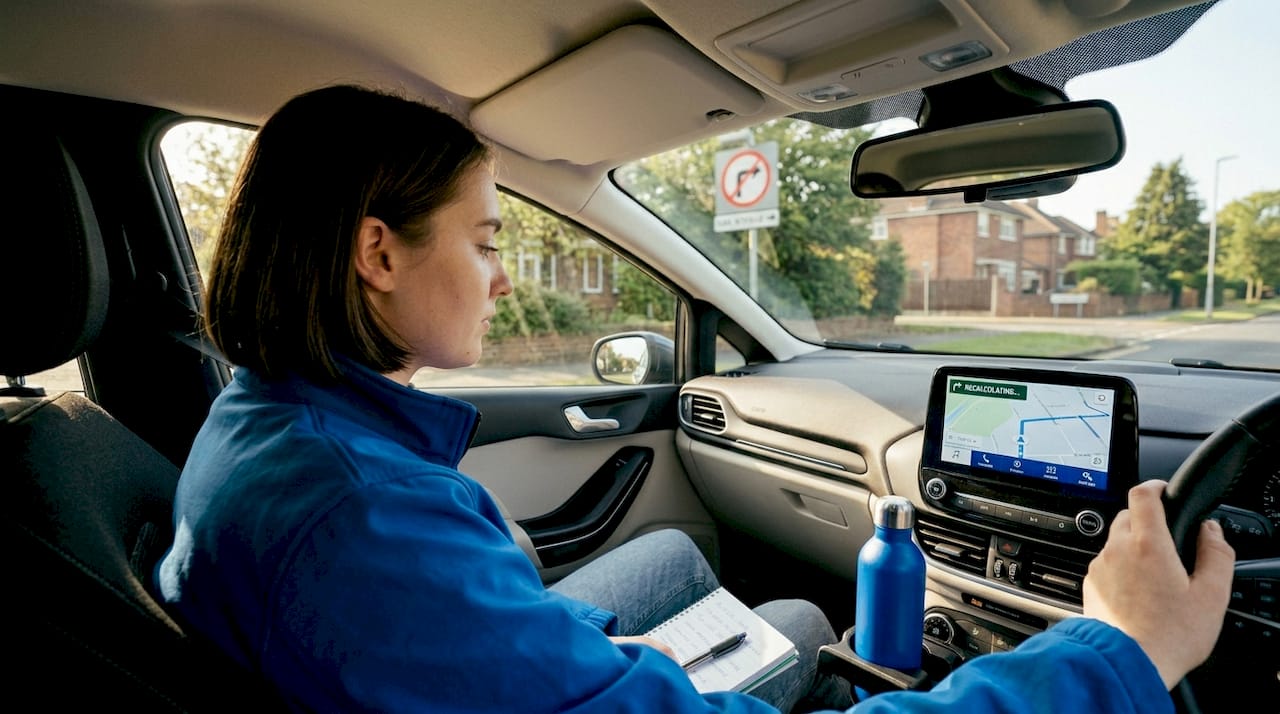
What happens when you take a wrong turn? Nothing catastrophic. A wrong turn does not cause an automatic fault. The sat nav recalculates and the test continues exactly as before. The examiner will not intervene unless your driving becomes unsafe. So if you miss a turning, do not brake sharply or make an erratic correction. Signal, check mirrors, and deal with it calmly. That composed response is actually what examiners want to see.
Pro Tip: If the sat nav instruction conflicts with a road sign or traffic condition, always follow the road. Traffic lights, give-way lines, and lane markings take priority over any sat nav instruction. Examiners know this happens and will not penalise you for following the road correctly.
How to prepare for independent driving
Preparation for the independent driving section is not just about getting comfortable with a sat nav. It is about developing the ability to drive to a high standard while managing extra information at the same time. That is a skill, and it takes deliberate practice.
Here are the steps that make a genuine difference:
-
Practise with a sat nav in lessons. Ask your instructor to use a sat nav during lessons so you get used to processing audio instructions while driving. The goal is to hear the instruction, acknowledge it, and continue driving without any change in your behaviour.
-
Build your mirror-signal-manoeuvre habit until it is automatic. When your MSM routine is second nature, it does not require conscious effort. That frees up mental capacity to process navigation at the same time.
-
Follow road signs on familiar and unfamiliar routes. One in five tests uses road sign navigation rather than a sat nav. Practise identifying and responding to direction signs during lessons, particularly on routes you do not know well.
-
Practise recovering from wrong turns calmly. Have your instructor deliberately give you a direction that leads to a wrong turn, then practise correcting it safely. The recovery matters more than the mistake.
-
Work towards Level 4 independent driving. Your instructor should be logging your progress on Skill 27, the DVSA’s readiness metric for independent driving. Level 4 means smooth, safe driving with good observation and calm responses to errors. Do not book your test until you are consistently reaching that standard.
Pro Tip: Use the audio instructions from the sat nav rather than glancing at the screen. A brief visual check to confirm an upcoming junction is fine, but the audio cue should be your primary source of information. This keeps your eyes on the road where they belong.
Common challenges and how to overcome them
Even well-prepared learners hit specific stumbling blocks during the independent section. Knowing what those are in advance takes away a lot of their power.
-
Test nerves amplified by navigation pressure. Many learners feel more anxious during the independent section because they fear making a navigation error. The antidote is to remind yourself, before the test and during it, that wrong turns do not fail you. Safe driving keeps you on track for a pass.
-
Over-focusing on the sat nav screen. This is one of the most common errors. When learners stare at the screen trying to anticipate the route, they stop scanning the road properly. Rely on the audio. Glance at the screen briefly at safe moments, not while approaching junctions.
-
Rushing a turn after a late instruction. If the sat nav tells you to turn and you are already at the junction, do not force it. Missing the turn is far safer than cutting across traffic. The examiner will guide you back on route and your test continues.
-
Losing composure after a mistake. One wrong turn can unravel a learner’s entire drive if they let it affect their confidence. Treat each mistake as a separate event. Correct it calmly, reset, and continue. Examiners are not looking for perfection. They are looking for safe, composed driving.
-
Underestimating the mental load. The real-world multitasking demands of independent driving catch some learners off guard. Build up to it gradually in lessons. Do not save independent driving practice for the final few lessons before your test.
Sat nav vs. road sign navigation
Understanding both navigation methods helps you feel prepared regardless of which one your test uses.
| Feature | Sat nav | Road sign following |
|---|---|---|
| How common is it? | 4 out of 5 tests | 1 in 5 tests |
| How do you receive instructions? | Audio and visual prompts from the device | Verbal direction from examiner plus your own sign reading |
| Can you ask for a repeat? | No, but the device repeats automatically | Yes, once per instruction |
| What if you get lost? | Sat nav recalculates automatically | Examiner will assist if needed |
| Key learner tip | Trust the audio; avoid screen fixation | Scan ahead for signs early; read them in good time |
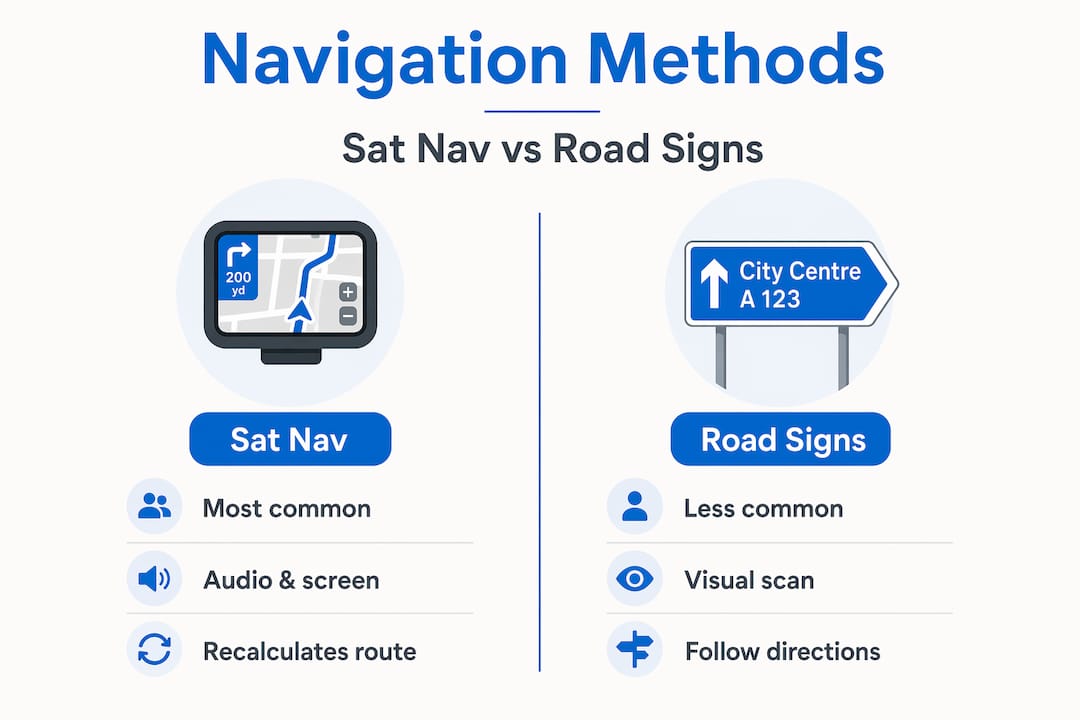
The sat nav method catches learners out because it can feel passive. You might assume the device will always give you enough warning. In reality, instructions sometimes come later than you would like, particularly on fast roads. Practising with a sat nav in lessons, on routes that include dual carriageways and busy roundabouts, removes that surprise on test day.
Road sign navigation asks more of your visual attention. You need to scan ahead actively, identify direction signs early, and process them quickly enough to position your vehicle correctly. The good news is that you can ask the examiner to repeat instructions once if you did not catch them clearly.
My honest take on the independent section
I have seen a lot of learners arrive at their test well prepared technically, only to let the independent section affect their confidence more than it should. The shift in mindset that makes the biggest difference is this: stop thinking about it as a navigation test and start thinking about it as a safe driving demonstration that happens to involve directions.
In my experience, the learners who handle this section best are the ones who have genuinely internalised their MSM routine. When safe driving is a habit rather than a checklist, the extra cognitive load of following a sat nav does not throw them. The driving just continues.
I have also seen the opposite. Learners with technically sound skills who fixate on the route, tense up at the first unexpected instruction, and then carry that tension into the rest of their drive. The wrong turn itself was never the problem. Their reaction to it was.
My advice is to practise recoveries as deliberately as you practise any other skill. If your instructor has not yet simulated a wrong turn in a lesson, ask them to. Knowing from experience that you can correct a mistake calmly and continue driving well is far more reassuring than being told it will be fine.
— Simon
Ready to master the independent driving section?
Knowing what the independent driving test involves is a strong start. The next step is getting the right practice behind you before test day arrives.
At Pass4you, our instructors build independent driving skills into lessons from an early stage, not just in the final few weeks before your test. We cover sat nav practice, sign-following routes, and calm recovery from errors, all on real local roads around Milton Keynes and Bletchley. Our learner driver courses are designed to get you to Level 4 independent driving with the confidence to match. If you want to progress faster, our intensive driving courses compress that preparation without cutting corners. Take a look at what Pass4you offers and give yourself the best possible chance of passing first time.
FAQ
What is the independent driving test section?
The independent driving section is a 20-minute part of the practical driving test where you follow either a sat nav or road signs without instruction from the examiner. It assesses safe driving behaviour, not navigation accuracy.
Does a wrong turn fail the independent driving test?
No. A wrong turn does not cause an automatic fault. The sat nav recalculates and testing continues as normal, provided your driving remains safe.
Can I use my own sat nav during the test?
No. The examiner provides and sets up a sat nav device, typically a TomTom Start 52, before the independent section begins. You cannot use your own device.
How do I prepare for independent driving?
Practise following audio sat nav instructions during lessons while maintaining your full driving routine. Work with your instructor until you reach Level 4 readiness, which means smooth, safe driving with calm responses to any errors.
What if my test uses road signs instead of a sat nav?
One in five driving tests uses road sign navigation. You follow verbal directions from the examiner and read signs yourself. You can ask the examiner to repeat an instruction once if you missed it.
Leave a Reply