Tag: DVSA Test

  • Eco-Safe Driving Tips Milton Keynes: Pass Your Test & Save Fuel in 2026

    What if the secret to conquering the high-speed grid roads of Milton Keynes isn’t about driving faster, but driving smarter? Many learners feel a wave of anxiety when they see “eco-safe driving” on their assessment sheet, fearing that a small mistake might cost them their license. You might even worry that focusing on fuel efficiency will distract you from the complex roundabouts and 70mph stretches. However, mastering eco-safe driving tips milton keynes is actually your best tool for staying calm and in control during your practical test.

    We understand that the pressure of the test is high, especially when you’re trying to figure out exactly when to skip a gear or how to use engine braking without stalling. It’s completely normal to feel confused by these technical shifts while petrol prices in the city hover around 155.7p per litre. This guide will show you exactly how to impress your examiner by demonstrating smooth, efficient habits that prove you’re a safe and responsible road user. We’ll break down the specific techniques for our unique grid system, from planning ahead at roundabouts to managing your speed effectively, ensuring you feel confident and ready to pass first time in 2026.

    Key Takeaways

    • Understand that eco-safe driving is a feedback-only category in 2026, giving you a stress-free opportunity to demonstrate your professional road awareness.
    • Master specific eco-safe driving tips milton keynes like selective gear changing to show the examiner you have full control over the car’s efficiency.
    • Learn how to manage momentum on the unique 60mph grid roads to navigate roundabouts smoothly while keeping your fuel costs low.
    • Discover how simple maintenance checks, like monitoring tyre pressure, improve your car’s grip for emergency stops and enhance your overall safety.
    • Build the confidence needed to pass first time by learning how professional instruction targets the exact skills examiners look for on Milton Keynes roads.

    What is Eco-Safe Driving & How is it Assessed in 2026?

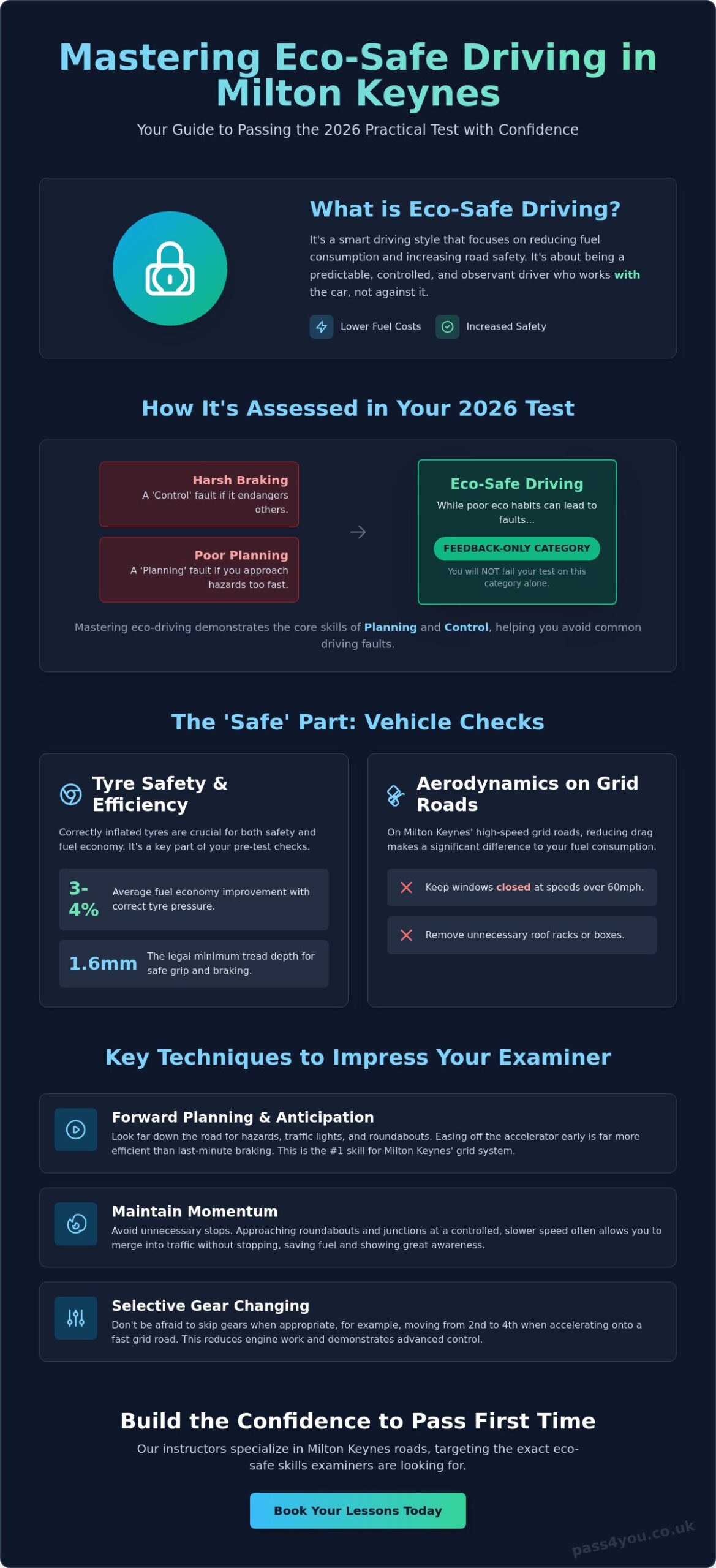
    Eco-safe driving is a specialized style of handling a vehicle that reduces fuel consumption and emissions while simultaneously increasing road safety. It isn’t just about being “green”; it’s about being a predictable, controlled, and observant driver. When you apply eco-safe driving tips milton keynes during your lessons, you’re learning to work with your car rather than against it. In 2026, the DVSA continues to emphasize these energy-efficient driving techniques because smooth drivers are statistically less likely to be involved in collisions. During your 40-minute practical test, the examiner will observe how you interact with the environment and your vehicle’s controls to assess your efficiency.

    The examiner records your performance using two specific categories: “Control” and “Planning.” They aren’t looking for perfection, but they want to see that you understand how to keep the car moving efficiently. They’ll watch how you pull away from junctions, whether you use the gears appropriately for the road speed, and how you manage your momentum as you approach hazards.

    Does Eco-Safe Driving Affect Your Pass or Fail?

    This is a common worry for learners. In 2026, eco-safe driving remains a feedback-only category on the practical test marking sheet. This means you won’t fail your test simply because you stayed in a lower gear for too long or didn’t skip a gear when accelerating. However, there’s a vital connection to remember. While the eco-driving box itself doesn’t trigger a fail, the actions that lead to poor efficiency often lead to safety faults. For example, while eco-driving is feedback-only, ‘harsh braking’ can be a serious fault if it puts other road users at risk. Poor planning might mean you arrive at a roundabout too fast, forcing a sudden stop that the examiner marks as a lack of control.

    The Core Pillars: Planning and Control

    The DVSA focuses on two main areas: forward planning and smooth control. Forward planning means looking far ahead so you can avoid unnecessary stops. If you see a red light in the distance, easing off the accelerator early is much more efficient than rushing toward it and braking hard. In Milton Keynes, anticipation is your most valuable skill. Our grid system requires constant awareness of upcoming roundabouts and speed limit changes. By mastering these eco-safe driving tips milton keynes learners can maintain a steady rhythm. This makes the car easier to handle, keeps your examiner relaxed, and makes your private practice much cheaper by saving fuel.

    • Planning: Assessing the road ahead to keep the car moving.
    • Control: Using the accelerator, brakes, and gears smoothly.
    • Awareness: Responding to traffic flow to avoid sudden changes in speed.

    Vehicle Maintenance: The ‘Safe’ Part of Eco-Safe

    Preparing for your test involves more than just mastering the clutch. A well-maintained vehicle is the foundation of the ‘safe’ part of eco-safe driving. When your car is in top condition, it responds predictably, which is exactly what you need when navigating the busy roundabouts of Central Milton Keynes. Applying eco-safe driving tips milton keynes during your private practice helps you build habits that examiners love to see. A healthy car is simply easier to drive, allowing you to focus on the road instead of worrying about mechanical noises or sluggish performance.

    Tyre Safety and Fuel Efficiency

    Tyres are your only contact with the road. If they’re under-inflated, your engine has to work harder, which significantly increases fuel consumption. Research indicates that properly inflated tyres can improve fuel economy by an average of 3-4%. Before your practical driving test, you should check that your pressure matches the manufacturer’s recommendation and that your tread depth is at least 1.6mm. This isn’t just about saving money; it’s about having the necessary grip for an emergency stop. You’ll likely face a ‘Tell Me’ question about checking tyre pressure, so knowing how to use a gauge and where to find the correct figures will give you an early boost of confidence.

    Aerodynamics and Fluid Levels

    Milton Keynes is famous for its high-speed grid roads. When you’re travelling at 60mph or 70mph on the V6 or H8, aerodynamics play a huge role in how much fuel you use. Keeping windows closed at high speeds and removing empty roof racks can make a noticeable difference. Following expert fuel economy tips helps you understand that wind resistance is a major drain on efficiency. Similarly, keeping your fluids topped up is essential for car longevity. Correct oil levels reduce engine friction and emissions, making the car run smoother and quieter. These eco-safe driving tips milton keynes ensure your vehicle is ready for the demands of the 40-minute test.

    Removing unnecessary weight is another simple way to stay eco-safe. A cluttered boot filled with heavy items makes the engine work harder during acceleration and increases your stopping distance. By keeping your car light and tidy, you’re making it safer and more efficient. If you’re feeling unsure about how to perform these checks yourself, booking professional driving lessons can help you gain the hands-on experience needed to feel fully prepared for the ‘Show Me, Tell Me’ questions.
    Eco-Safe Driving Tips Milton Keynes: Pass Your Test & Save Fuel in 2026

    Eco-Safe Driving in Milton Keynes: Mastering the Grid

    Milton Keynes is unlike any other city in the UK. Our unique grid system of H and V roads provides a fantastic environment for practicing eco-safe driving tips milton keynes. While the 60mph and 70mph speed limits on these roads might feel intimidating at first, they offer the perfect opportunity to master momentum. Instead of constant braking and accelerating, you can learn to use the car’s natural energy to flow between the grid squares. This isn’t just about saving fuel; it’s about becoming a calmer, more predictable driver who’s always one step ahead of the traffic.

    Anticipation is your greatest asset near our famous Redways. These shared paths often cross the grid roads at unexpected points. By looking far ahead, you can spot pedestrians or cyclists early and ease off the power. This reduces the need for sudden, heavy braking. When you drive this way, you improve your vehicle maintenance and emissions profile by preventing unnecessary wear on your brake pads and tyres. It’s a simple habit that examiners love to see during the practical test.

    The Roundabout Strategy: Vision over Braking

    MK is often called “Roundabout City” for a reason. To drive eco-safely here, you must prioritize vision over the brake pedal. As you approach a junction like the Northfield roundabout, try to look 10 seconds ahead. If you can see the traffic flow early, you can adjust your speed using engine braking rather than slamming on the brakes at the line. We teach the ‘block changing’ technique, where you might move smoothly from 5th gear directly down to 2nd. This reduces clutch wear and keeps the car balanced, showing the examiner you have expert control.

    Grid Road Discipline: Speed and Spacing

    Maintaining a steady speed is essential on long stretches of the V-roads. Fluctuating your speed by even a few miles per hour can waste significant amounts of fuel. The two-second rule is your best friend here. By keeping a safe distance from the car in front, you give yourself the “buffer” needed to react to changes without harsh braking. If you’re practicing on our faster routes, our dual carriageway guide offers more specific advice for high-speed efficiency. Mastering these eco-safe driving tips milton keynes will make your driving feel effortless and professional.

    • Look 10 seconds ahead to anticipate roundabout traffic.
    • Use engine braking to slow down gradually for Redway crossings.
    • Keep a consistent speed on H and V roads to avoid fuel-heavy acceleration.
    • Maintain a two-second gap to create a safety and efficiency buffer.

    Actionable Techniques for Your Practical Test

    Applying eco-safe driving tips milton keynes during your test isn’t about driving slowly. It’s about being efficient and deliberate with your actions. When you move off, aim to accelerate smoothly but firmly. Shifting up early is one of the easiest ways to show the examiner you’re an eco-conscious driver. For most petrol cars, shifting between 2,000 and 2,500 RPM is the ideal sweet spot. This prevents the engine from working too hard and keeps your fuel consumption low. Avoid ‘riding the clutch’ at junctions; it causes unnecessary wear and wastes energy that could be used for movement.

    Selective gear changing, or skipping gears, is a technique that really impresses examiners. If you’ve accelerated to 40mph in 3rd gear on a busy V-road, you don’t always need 4th gear. You can go straight to 5th. This shows you understand the car’s power and how to maintain momentum. Similarly, when you’re decelerating for a red light at the Kingston district centre, ‘block shifting’ from 4th gear directly to 2nd is perfectly acceptable and highly efficient. It demonstrates that you’re planning your approach rather than just reacting to the car in front at the last second.

    A common myth is that engine braking confuses the drivers behind you because your brake lights don’t come on. In reality, letting the engine slow you down is a standard and safe technique. As long as you’re planning ahead, the gradual decrease in speed is predictable. If you need to signal a more rapid stop, a light touch on the brake pedal will illuminate your lights and signal your intentions clearly. Remember the 30-second rule for long delays. If you’re waiting at a level crossing or a particularly long set of traffic lights, turning off the engine reduces emissions and saves fuel.

    Modern vehicles, like the Volkswagens we use for our driving lessons, often come equipped with gear-shift indicators and Start/Stop technology. Don’t be afraid to use these features during your test. The examiner wants to see that you can use the car’s tools to drive as efficiently as possible. Following the dashboard prompts shows you are observant and capable of handling a modern vehicle. These tools are there to support you and build your confidence as you work toward that first-time pass.

    Smart Acceleration and Gear Changes

    • Shift up early to keep RPMs between 2,000 and 2,500.
    • Use selective gear changing to reach cruising speeds efficiently.
    • Avoid resting your foot on the clutch pedal while driving to prevent wear.

    Deceleration and Stopping

    • Lift off the accelerator early to use the car’s natural momentum.
    • Use block shifting to find the right gear for your new speed without unnecessary steps.
    • Engage Start/Stop systems or turn off the engine during prolonged stationary periods.

    How Pass4you Instructors Build Your Confidence

    Learning to drive is about more than just passing a test; it’s about gaining the freedom to explore the world safely and responsibly. At Pass4you, we believe that true confidence comes from expert support and a relaxed environment. That’s why we integrate eco-safe driving tips milton keynes into your very first lesson. By making these habits second nature from day one, you won’t have to overthink them during your practical test. Our instructors act as calm mentors, guiding you through the complexities of the grid system with patience and clarity.

    Modern Cars for Modern Learners

    We take pride in our modern fleet of Volkswagen tuition vehicles. These cars are specifically chosen because they’re perfect for learning 21st-century driving skills. With highly efficient engines and clear, digital dashboard displays, you can easily monitor your gear shifts and fuel consumption in real-time. This modern technology makes the “eco” feedback portion of the test feel effortless. Instead of struggling with an older, less responsive car, you’ll be driving a vehicle that supports your progress. If you’re ready to start your journey, you can find more information about our driving lessons Milton Keynes and see how we help our students succeed.

    Expert Guidance from MK Specialists

    Our team has deep, local knowledge of the Bletchley and Milton Keynes test routes. We don’t just teach you how to drive; we teach you how to navigate our specific roads with precision. During your lessons, we conduct mock tests that include detailed feedback on your efficiency. This ensures you’re fully prepared for exactly what the examiner will be looking for. Our results-driven approach is proven by our impressive 83.33% first-time pass rate. We focus on building your emotional stability behind the wheel, helping you overcome any anxiety you might feel about high-speed grid roads or busy roundabouts.

    When you choose professional instruction, you’re investing in your long-term safety and financial savings. Learning these eco-safe driving tips milton keynes with a specialist ensures you’re not wasting time or resources on ineffective habits. We’re here to provide the supportive, one-on-one environment you need to become a confident driver. Book your first lesson with us today and take the first step toward earning your license with a school that truly cares about your success. Our instructors are ready to help you turn that anxiety into accomplishment.

    Start Your Journey to a First-Time Pass

    Mastering eco-safe driving tips milton keynes is about more than just checking a box on your test day; it’s about becoming a skilled driver who can handle the grid system with ease. You now understand that small changes, like selective gear shifting and forward planning at roundabouts, make your driving smoother and significantly reduce your fuel costs. These habits show the examiner that you’re in total control of your vehicle and ready for the responsibilities of the road.

    Our expert local instructors have over 20 years of experience helping learners navigate Bletchley and MK routes. We use modern Volkswagen tuition vehicles equipped with the latest technology to make your learning experience as stress-free as possible. With our impressive 83.33% first-time pass rate, you can feel confident that you’re in professional and supportive hands. Book your Milton Keynes driving lessons with Pass4you today and let us help you turn your driving goals into reality. We’re looking forward to seeing you succeed and enjoy the freedom that comes with your new license.

    Frequently Asked Questions

    Will I fail my driving test if I don’t drive eco-safely?

    You won’t fail your driving test specifically for eco-safe driving mistakes, as it’s currently a feedback-only section of the assessment. The examiner will provide advice at the end of the test if they feel your habits could be improved. However, you must be careful that poor efficiency doesn’t lead to safety errors. If you forget to plan ahead and have to brake harshly for a roundabout, that could result in a serious fault.

    What does the examiner actually look for in the eco-safe assessment?

    Examiners assess your ability to plan ahead and use the car’s controls smoothly. They want to see that you understand how to maintain momentum by observing traffic flow and reacting early. This involves choosing the right gear for the road speed and avoiding unnecessary acceleration. By following eco-safe driving tips milton keynes, you demonstrate that you’re a responsible driver who is ready for independent travel.

    Is engine braking better than using the foot brake for the environment?

    Engine braking is significantly better for the environment and your vehicle’s longevity. When you lift off the accelerator early, the engine’s natural resistance slows the car down without burning extra fuel. This reduces emissions and prevents your brake pads from wearing out prematurely. It’s a key technique for navigating the long approaches to Milton Keynes’ roundabouts, as it keeps the car balanced and ready for the next move.

    Should I skip gears on my driving test to be eco-safe?

    You should definitely skip gears when it’s safe and appropriate to do so. This is known as selective gear changing and it’s a great way to show the examiner you’re an efficient driver. For example, if you’ve accelerated to 40mph on a V-road, you might shift directly from 3rd to 5th. This reduces the time the engine spends in higher rev ranges, saving fuel and making your drive much smoother.

    How can I save fuel while practicing for my test in Milton Keynes?

    The best way to save fuel during private practice is to master the rhythm of the grid system. Try to avoid stop-start driving by looking far ahead and timing your arrival at junctions so you don’t have to come to a complete halt. Maintaining a steady speed on the H and V roads and ensuring your tyres are correctly inflated will also help you reduce costs while you refine your eco-safe driving tips milton keynes.

    What is ‘block changing’ and is it allowed on the test?

    Block changing is the process of skipping one or more gears when shifting up or down. It’s fully allowed on the driving test and is actually recommended for modern driving. Shifting from 5th gear directly to 2nd as you approach a junction is a perfect example. It reduces the number of gear changes you need to make, allowing you more time to focus on steering and observation.

    Does using the air conditioning affect my eco-safe driving score?

    While using air conditioning does increase fuel consumption, it doesn’t negatively affect your eco-safe driving score on the test. Examiners are primarily interested in your technical driving skills, such as how you accelerate and plan your route. If it’s a hot day, it’s better to stay comfortable and focused on your safety. Your score is based on your control of the vehicle rather than the use of internal systems.

    Is eco-safe driving different in an automatic car?

    The core principles of eco-safe driving remain the same in an automatic car, though the car manages the gear changes for you. You can still be an efficient driver by focusing on smooth acceleration and early anticipation. Since you don’t have to worry about the clutch, you can dedicate more attention to reading the road ahead and easing off the power early to use the car’s natural momentum.
  • Emergency Stop Procedure UK Driving Test: The 2026 Learner’s Guide

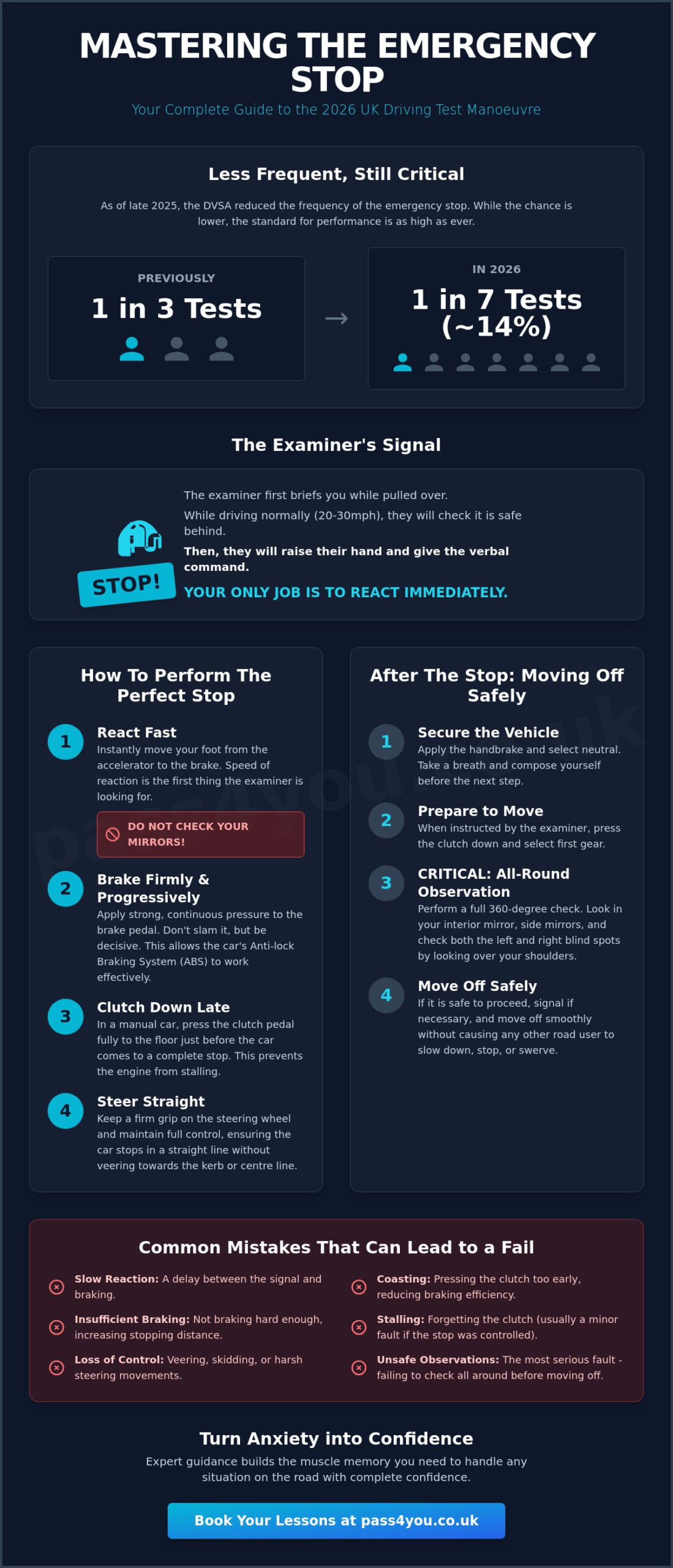
    Did you know that the emergency stop is now only requested in about 1 in 7 UK driving tests? While the DVSA reduced the frequency to roughly 14% of tests in late 2025, the pressure to get it right hasn’t changed. It’s completely natural to feel a flutter of “brake panic” when you think about the examiner suddenly calling out for you to stop. You might worry about skidding, losing control, or the common confusion of exactly when to use the clutch. We understand those nerves, and we’re here to help you turn that anxiety into quiet confidence.

    This guide will help you master the emergency stop procedure uk driving test by breaking down exactly what the examiner expects in 2026. You’ll learn the precise footwork needed for manual cars, how modern technology like ABS keeps you safe, and how to react instantly to the examiner’s signal. We’ll walk you through the process step by step, from the moment you hear the command to the final safety checks before moving off again. By the time you finish reading, you’ll have a clear roadmap to performing this maneuver smoothly, ensuring you feel prepared and professional on your test day.

    Key Takeaways

    • Understand the specific criteria DVSA examiners use to grade your performance, ensuring you meet the highest safety standards for 2026.
    • Master the correct footwork for the emergency stop procedure uk driving test, including the vital timing of the clutch and brake pedals.
    • Learn how to maintain a straight path and avoid common control issues that often cause anxiety for learner drivers.
    • Gain peace of mind by knowing exactly what happens after the stop, including the essential safety observations needed before you continue your drive.
    • Discover how expert guidance during your driving lessons can build the muscle memory required to handle sudden stops with complete confidence.

    What is the Emergency Stop Procedure in the 2026 Driving Test?

    The emergency stop is often the one part of the test that makes learner drivers feel most anxious. It’s a controlled maneuver designed to bring your car to a complete halt as quickly and safely as possible. While it might sound intimidating, it’s a vital skill that ensures you can handle unexpected hazards on the road. In the current UK driving test procedure, examiners use this exercise to assess two main things: how fast you react and how well you keep the car under control during heavy braking. We focus on helping you feel calm so that your feet do exactly what they’ve been trained to do without hesitation.

    You might have heard from friends or older relatives that you’re almost certain to perform this during your test. However, as of late 2025, the DVSA updated the frequency of this exercise to better reflect modern road conditions. In 2026, you actually only have a 1 in 7 chance of being asked to perform an emergency stop. This means it happens in roughly 14% of practical tests, a significant drop from the old 1 in 3 frequency. Even though it’s less common, your instructor will still make sure you’ve mastered the emergency stop procedure uk driving test. It’s always conducted on a safe, straight stretch of road where there’s minimal risk to other road users.

    When and How the Examiner Will Signal

    Before the exercise begins, the examiner will ask you to pull over to the side of the road. They’ll explain exactly what’s about to happen so there are no surprises. They’ll tell you that they’ll give a specific signal and that you should stop the car as if an emergency has occurred. They’ll also specify that you shouldn’t check your mirrors before braking, as in a real emergency, every millisecond counts.

    Once you move off and are driving normally, usually at a speed of 20 to 30mph, the examiner will look over their shoulder to ensure it’s safe behind you. Then, they’ll suddenly raise their hand and shout “STOP!” clearly. Your only job is to react immediately. You’ll need to apply the brakes firmly and progressively. During your driving lessons, we practice this until it becomes second nature, so you won’t feel startled when the shout finally comes.

    Why Safety is the Priority

    The main goal is to stop the car in the shortest distance possible while keeping it stable. This maneuver mimics a real-life situation, like a child stepping into the road or a car pulling out unexpectedly. If you take too long to hit the brakes or let the car veer toward the curb, it shows a lack of control. By using a firm, steady pressure, you allow the car’s safety systems to work effectively. The emergency stop is a test of your ability to provide a prompt, controlled reaction to a sudden hazard.

    Step-by-Step: How to Perform a Test-Standard Emergency Stop

    When the examiner gives the signal, your first priority is speed of reaction. You must move your right foot from the accelerator to the brake pedal instantly. Do not look in your mirrors. While this feels counterintuitive to everything you have learned in your driving lessons so far, a split second spent looking at the glass is a split second where the car is still moving at speed. Your goal is to stop the vehicle as quickly as possible while keeping it under full control.

    The way you apply the brake is just as vital as how fast you reach it. You should apply firm, progressive pressure. This means you don’t “stab” or “slam” the brake suddenly, which can cause the car to pitch forward violently or lose grip. Instead, push the pedal hard and keep that pressure steady until the car has stopped. Modern braking systems are designed to handle this force, and your car will respond best to a deliberate, strong input. Practicing this during your driving lessons with a supportive instructor will help you find the right balance of strength and smoothness.

    As the car slows down, you need to manage the clutch. If you’re driving a manual car, depress the clutch pedal fully just before the car comes to a complete standstill. This prevents the engine from stalling while ensuring you benefit from engine braking for as long as possible. If you press the clutch too early, the car might “coast,” which reduces your control. If you press it too late, the car might shudder or stall. Don’t worry if you do stall during the test; as long as the stop was safe and controlled, a stall is usually considered a minor fault rather than a fail.

    The “No Mirror Rule” Explained

    In almost every other driving situation, The Highway Code emphasizes the importance of checking your mirrors before changing speed or direction. However, the emergency stop procedure uk driving test is the one big exception. The examiner has already checked the road behind you to ensure it is clear and safe before giving the signal. In a real-world emergency, taking the time to check your mirrors could be the difference between a near-miss and a collision. Trust that the area is clear and focus entirely on stopping the car.

    Post-Stop Safety Checks

    Once the car has reached a total halt, keep your feet firmly on the pedals. Your first task is to secure the car by applying the handbrake and selecting neutral. This is a great moment to take a deep breath and settle your heart rate. The examiner will usually say, “Thank you, move off when you’re ready.” Before you put the car back into gear, you must perform a thorough, 360-degree observation. Check both blind spots and all mirrors. You are looking for pedestrians, cyclists, or other vehicles that may have approached while you were stopped. Only move off when you are 100% certain it is safe to rejoin the flow of traffic.

    Emergency Stop Procedure UK Driving Test: The 2026 Learner’s Guide

    Modern Car Tech: ABS and Stopping Distances in 2026

    Modern cars are equipped with sophisticated systems that take much of the guesswork out of sudden braking. In 2026, almost every tuition vehicle, including the modern Volkswagens we use for our driving lessons, comes fitted with an Anti-lock Braking System (ABS). This technology is a game changer for learner drivers. It works by monitoring the speed of each wheel and automatically releasing the brakes for a fraction of a second if it detects a wheel is about to lock up. This prevents the car from skidding and allows you to maintain steering control even under maximum braking pressure.

    One of the most important things to prepare for is the physical feedback from the car. When you perform the emergency stop procedure uk driving test in an ABS-equipped vehicle, you might feel the brake pedal vibrate or pulse under your foot. You might also hear a mechanical grinding or thumping sound. Don’t let this alarm you. It’s simply the system working at high speed to keep you safe. Many students instinctively lift their foot when they feel this vibration, but you must keep the pressure firm and steady until the car has stopped completely.

    Understanding your environment is just as critical as knowing the car’s tech. The Official Highway Code Emergency Stop Procedure highlights that stopping distances are heavily influenced by the road surface. In dry conditions, we follow the 2-second rule to maintain a safe gap from the vehicle in front. However, once the weather turns, those distances change dramatically. ABS is a safety aid that helps you maintain control, but it isn’t a replacement for good tires or sensible speed for the conditions.

    How ABS Changes Your Reaction

    Years ago, drivers were taught to “pump” the brakes to prevent a skid. With modern ABS, this is no longer necessary and can actually be dangerous. You should push the brake pedal hard and hold it there. The car’s computer will handle the “pumping” much faster than any human could. This technology also means that if a hazard moves, you can still steer the car while the brakes are fully applied, which is a life-saving advantage in real-world emergencies.

    Weather Conditions and Stopping Distances

    Rain doubles your stopping distance because the water reduces the friction between your tires and the road. If there’s ice, that distance can increase by up to ten times. Your examiner is trained to prioritize safety above all else. They won’t ask you to perform an emergency stop if the road is dangerously slippery or if visibility is too poor to conduct the exercise safely. We always teach our students to respect these limits, ensuring you’re a responsible driver long after you’ve passed your test.

    Common Mistakes That Can Lead to a Test Fail

    Even with the best preparation, the high pressure of a test environment can sometimes lead to simple errors. We want you to feel as relaxed as possible, so understanding where others often trip up is a great way to stay focused. One frequent issue is a delayed reaction time. If you hesitate even for a moment after the examiner gives the signal, it suggests you might not be ready for a real-world hazard. The emergency stop procedure uk driving test requires an immediate response to ensure the shortest possible stopping distance.

    Vehicle control is another area where learners sometimes struggle. It’s common for students to accidentally pull the steering wheel toward the curb while they are braking hard. You must keep the car traveling in a straight line. Excessive skidding can also be a concern, although modern ABS technology makes this much less likely than it used to be. Another technical slip-up involves clutch timing. If you depress the clutch too early, you lose the benefit of engine braking, which is known as coasting. If you press it too late, you might stall the engine.

    The mistake that surprises many learners happens after the car has actually stopped. Once you’ve successfully brought the car to a halt, the relief can be overwhelming. However, you must not forget your safety observations. Moving off without a full 360-degree blind-spot check is one of the most common reasons for a major fault during this exercise. If you want to refine these skills with a mentor who understands your nerves, you can book your driving lessons with our experienced team today.

    Minor vs. Major Faults

    It’s helpful to know that not every mistake results in an immediate fail. A slight stall, for instance, is often recorded as a minor fault if you handle it calmly and restart the car safely. However, failing to look around properly before moving off is almost always a major fault because it creates a direct safety risk. Similarly, if your braking is so harsh or poorly timed that you lose significant control of the car’s direction, the examiner may mark it as a major fault.

    How to Recover from a Stall

    If the car stalls during your emergency stop, don’t panic. Keep your feet firmly on the pedals and apply the handbrake immediately to secure the vehicle. Take a second to compose yourself, then restart the engine calmly. Examiners actually value your ability to stay composed and fix a problem without getting flustered. For more expert advice on navigating your big day, take a look at our guide on Mastering the Practical Driving Test in 2026. Staying calm is the best way to show you’re a safe, capable driver.

    Mastering the Emergency Stop with Pass4you Milton Keynes

    Learning to handle a vehicle during a sudden stop is about more than just fast feet. It’s about having the mental space to stay calm under pressure. The instructors at Pass4you Driving School specialize in this exact area, helping you build the confidence needed for high-pressure maneuvers. We use modern Volkswagen vehicles equipped with top-tier safety features, ensuring you feel secure while practicing. By training on local Milton Keynes roads, we prepare you for the specific conditions you’ll face during your actual test. This focused approach is a major reason why we maintain a high-precision success metric of an 83.33% first-time pass rate.

    We believe every learner deserves a supportive environment. The emergency stop procedure uk driving test is a test of your reflexes, but those reflexes work best when you aren’t overwhelmed by anxiety. Our team at Pass4you Driving School is dedicated to turning your test nerves into a professional mindset. We focus on the small details, like the feel of the brake pedal and the timing of the clutch, until they become second nature. This level of preparation means that when the examiner finally gives the signal, you won’t be surprised. You’ll simply react with the skill we’ve helped you develop through consistent, patient practice.

    Patient Instruction for Anxious Learners

    We never rush the learning process. We move at your pace, ensuring you’re comfortable with the car before we ever simulate the maneuver at speed. Our mock tests always include the emergency stop to help desensitize you to the signal. This practice turns a scary moment into a routine reaction. Relying on informal practice with friends can sometimes lead to missed details that result in test failures. Our structured driving lessons provide the professional edge you need to master the emergency stop procedure uk driving test. For a deeper look at how we support our students, check out our Driving Lessons Milton Keynes: The Ultimate Guide.

    Ready to Pass First Time?

    Investing in professional instruction is the most effective way to save time and money in the long run. While it’s tempting to look for the cheapest option, the value of effective, high-quality coaching from Pass4you Driving School cannot be overstated. We focus on the precision and calm required to pass on your first attempt, helping you avoid the cost of retakes. Join the hundreds of successful drivers in Milton Keynes who’ve already gained their freedom with our help. We’re ready to help you reach your goals and drive safely for life. Book your first lesson with Pass4you Driving School today and take the first step toward your license.

    Take the Next Step Toward Your Driving Freedom

    You’ve now seen that the emergency stop isn’t something to fear; it’s a controlled response that keeps everyone safe. By understanding the mechanical feedback of your car and the importance of those final safety checks, you’re already ahead of the curve. Mastering the emergency stop procedure uk driving test is about more than just passing a single exercise. It’s about developing the instincts that will make you a safer driver for years to come.

    We’re here to ensure those instincts become second nature in a calm, stress-free environment. Our Milton Keynes instructors are experts at helping you translate this knowledge into smooth, confident action on the road. Don’t let a single maneuver stand between you and your independence. Start your journey to a first-time pass with Pass4you Driving School and join our community of successful, confident drivers. Your full license is closer than you think, and we’re excited to help you get there.

    Frequently Asked Questions

    Do I need to check my mirrors during the emergency stop?

    No, you should not check your mirrors before performing the stop. The examiner has already looked behind to ensure it is safe before giving the signal. Your priority is to react immediately to the command. Taking time to check mirrors in a real emergency would increase your stopping distance, so focusing entirely on the road ahead is the safest approach.

    Will I fail my driving test if I stall during an emergency stop?

    Stalling the engine isn’t an automatic fail. If you manage the stop safely and then restart the car calmly, the examiner will likely record it as a minor fault. The key is to stay composed, secure the car with the handbrake, and perform your safety checks before moving off again. Showing that you can handle a small mistake with confidence is a great way to impress.

    How many times will the examiner ask me to do an emergency stop?

    The examiner will only ask you to perform the emergency stop once during your test. It’s important to remember that as of late 2025, this exercise only occurs in 1 out of 7 tests. While you might not even be asked to do it, your driving lessons will ensure you’re fully prepared just in case it is your turn.

    What happens if the car skids during the maneuver?

    If the car skids, keep your feet firmly on the pedals and maintain a straight steering path. Most modern cars have ABS to prevent this, but if you do feel a loss of grip, don’t pump the brakes. Just keep the pressure steady and the car pointed forward. Your instructor will help you practice this until the emergency stop procedure uk driving test feels like second nature.

    Is the emergency stop procedure different in an automatic car?

    The procedure is simpler in an automatic car because there is no clutch pedal to manage. You simply use your right foot to apply firm, progressive pressure to the brake until the car stops. Since you don’t have to worry about stalling, you can focus entirely on your reaction time and keeping the steering wheel straight.

    Can I use the footbrake and handbrake together to stop faster?

    No, you should only use the footbrake to stop the car. Using the handbrake while the car is moving can cause the rear wheels to lock up and result in a dangerous skid. The handbrake should only be applied once the vehicle has come to a complete standstill to secure it safely and prevent it from rolling.

    How do I know if the road is safe to practice an emergency stop in Milton Keynes?

    When practicing in Milton Keynes, look for quiet, straight residential roads with clear visibility and no parked cars nearby. Your instructor will guide you to the best locations that mimic the areas used by examiners. Always ensure there are no pedestrians or other road users close by who might be startled by a sudden stop.

    What is the most common reason for failing the emergency stop?

    The most common reason for failing the emergency stop procedure uk driving test is failing to check blind spots before moving off. After the stop is finished, many learners feel so relieved that they forget to look around. You must perform a full 360-degree check to ensure it is safe to rejoin the traffic, as neglecting this is usually marked as a major fault.

  • Driving Lessons in Bad Weather UK: A Guide to Building Real-World Confidence

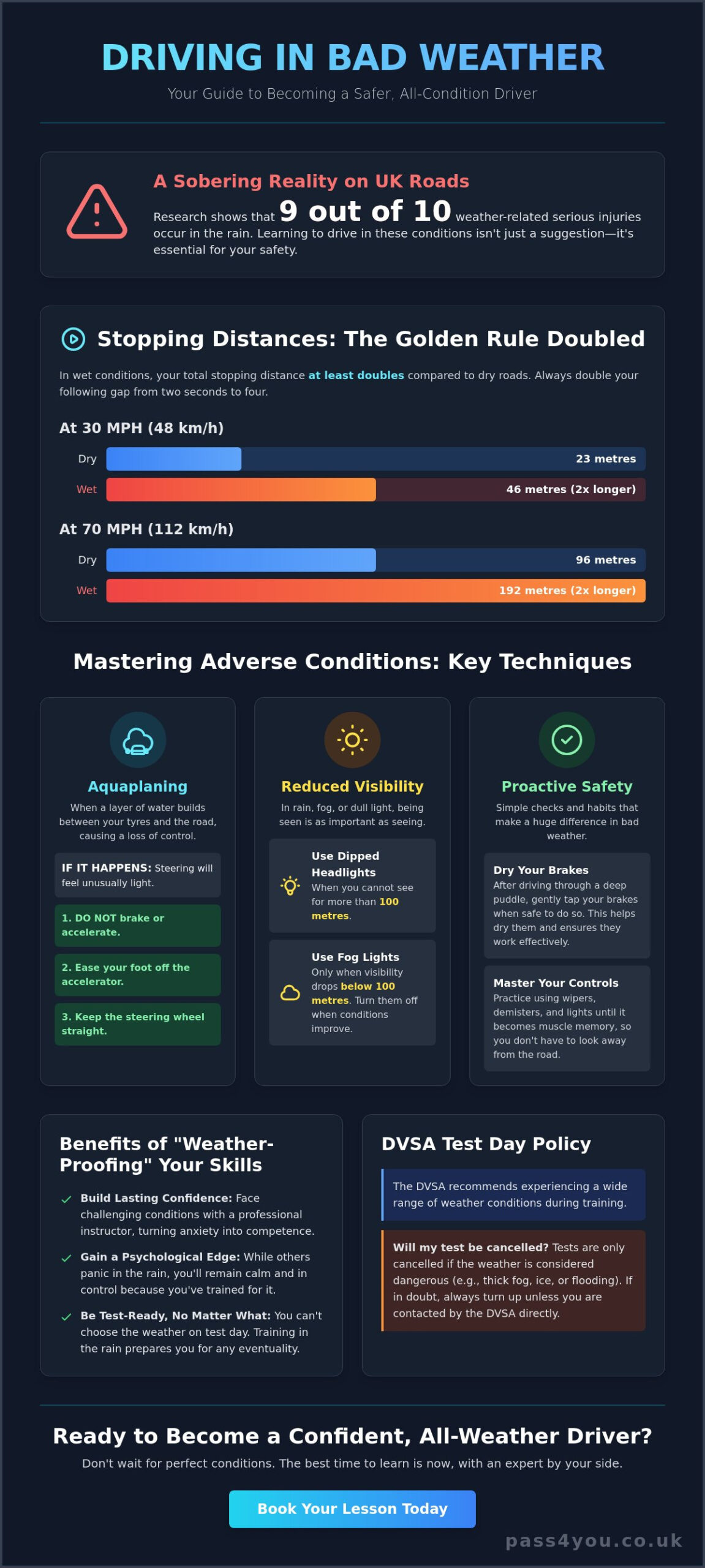
    What if a heavy downpour is actually the most valuable part of your training? While it’s natural to feel a surge of anxiety when you see grey clouds before your session, taking driving lessons in bad weather uk is often the secret to becoming a truly competent driver. You aren’t alone if you worry about skidding on wet roads or losing visibility in thick fog. Most learners feel a bit of dread when the conditions aren’t perfect, especially since research shows that 9 out of 10 weather-related serious injuries on our roads happen in the rain.

    We believe that facing these conditions with a calm, professional mentor by your side is the best way to build lasting confidence. This guide explains why adverse weather is your greatest training tool and how to handle a car safely when the British climate turns. You will discover how to manage stopping distances that can double in the wet, when to use your fog lights if visibility drops below 100 metres, and what the current DVSA rules are for test cancellations. By the end, you’ll feel ready to handle any season with ease and stay safe behind the wheel.

    Key Takeaways

    • Discover how “weather-proofing” your skills creates a safer, more resilient driver compared to those who only train in perfect conditions.
    • Master essential techniques for handling aquaplaning and learn how to adjust your following distances during heavy rainfall.
    • Understand the specific DVSA policies regarding cancellations so you know exactly what to do if it snows on your test day.
    • Gain confidence by taking driving lessons in bad weather uk to practice vital safety checks and “Show Me, Tell Me” questions in a real-world environment.
    • Learn how professional instructors help you navigate tricky Milton Keynes roundabouts when road surfaces are greasy and visibility is poor.

    Should You Take Driving Lessons in Bad Weather?

    When the clouds turn grey and the rain starts to lash against the window, your first instinct might be to call your instructor and reschedule. However, taking driving lessons in bad weather uk is one of the most effective ways to build your confidence and ensure you’re ready for the reality of British roads. It is easy to drive when the sun is shining and the tarmac is dry, but true skill is developed when conditions are less than perfect. Learning to manage wind, rain, and reduced visibility under professional guidance turns a potentially scary experience into a valuable teaching moment.

    The DVSA explicitly recommends that learner drivers experience a wide range of weather conditions during their training. This proactive approach ensures you aren’t caught off guard after you pass your test and find yourself driving alone in a storm. Safety is always our primary concern, and it’s helpful to remember that professional instructor vehicles are equipped with dual controls. This provides a safety net that learning with a friend or parent cannot match. Your instructor is trained to stay calm and can intervene instantly if the car reacts unexpectedly to a large puddle or a sudden gust of wind, keeping you in safe, professional hands at all times.

    The Benefits of Learning in Adverse Conditions

    Driving in the rain or wind helps you build essential muscle memory that you simply won’t develop on a clear day. You will learn how to operate your windscreen wipers and demisters instinctively, without needing to take your eyes off the road to find the controls. Understanding how the car feels on a slippery surface while under expert supervision is a vital part of your development. It also gives you a significant psychological edge over other learners. While others might feel anxious when the weather turns, you will remain calm because you have already mastered these challenges. Learning these defensive driving techniques early on helps you anticipate hazards before they become dangerous situations.

    Why Proactive Training Beats Avoiding the Rain

    You cannot choose the weather on the day of your driving test. If you have spent all your lessons in the sun and it pours during your exam, your anxiety levels will naturally spike. Weather-proofing is the process of mastering vehicle control in non-ideal conditions. By facing the rain during your driving lessons in bad weather uk, you turn a potential obstacle into a tool for success. Professional instructors provide a structured environment where you can test your limits safely. They help you understand the physics of the road, such as how water affects your grip, ensuring you become a responsible and capable driver for life.

    Learning to handle the elements is a practical skill that sets you apart from drivers who only practice in the sun. When you take driving lessons in bad weather uk, you’ll learn that heavy rain requires more than just faster wipers. Aquaplaning occurs when a layer of water builds up between your tyres and the road, causing you to lose steering control. If you feel the steering become light, don’t panic. Simply ease your foot off the accelerator and keep the steering wheel straight until you feel the tyres grip the tarmac again. Facing these elements during your driving lessons in bad weather uk transforms you into a more observant and capable driver.

    Stopping Distances: Dry vs. Wet Roads

    Understanding the physics of a wet road is crucial for your safety. On a dry day, the “two-second rule” helps you maintain a safe gap from the car in front. However, in wet weather, your stopping distance at least doubles. This change is dramatic and requires immediate adjustment to your speed and positioning.

    • At 30mph: You’ll need roughly 46 metres to stop in the wet, compared to just 23 metres on dry roads.
    • At 70mph: That distance jumps from 96 metres to a staggering 192 metres.

    Doubling the gap is the golden rule because it gives you the vital thinking time needed to react to hazards. After driving through a deep puddle, remember to tap your brake pedal lightly when it’s safe to do so. This simple action helps dry the brake discs and ensures they work effectively when you need them most.

    Mastering Visibility and Lighting

    Visibility can change in seconds. You are required to use headlights when you cannot see for more than 100 metres. While your driving lessons will teach you the location of every switch, knowing exactly when to use them is the real challenge. Use dipped headlights in heavy rain or dull light to ensure other road users can see you clearly. Only use fog lights when visibility is seriously reduced, and remember to switch them off once it improves to avoid dazzling others.

    Managing interior condensation is just as important as cleaning the outside of the glass. Use your heater and air conditioning to demist the windows before you set off. This ensures you have a clear view of your surroundings at all times. Expert advice on Navigating UK Rain, Fog, and High Winds often emphasizes that being seen is just as important as being able to see.

    Finally, be mindful of high winds. Strong gusts can push a small learner car off course, especially on open roads or bridges. When passing high-sided vehicles, expect a sudden buffeting effect as you move in and out of their windbreak. Keep a firm but relaxed grip on the wheel and allow extra room for cyclists or motorcyclists who may be blown sideways by the gale.

    Driving Lessons in Bad Weather UK: A Guide to Building Real-World Confidence

    Will My Driving Test Be Cancelled? The DVSA Bad Weather Policy

    Waking up to a storm on the morning of your driving test can feel like a setback, but understanding the DVSA Bad Weather Policy will help calm those nerves. The Driver and Vehicle Standards Agency (DVSA) prioritises safety above all else. They won’t conduct tests in truly dangerous conditions, such as icy roads, flooding, or thick fog. However, a bit of rain or wind won’t stop the exam. This is why driving lessons in bad weather uk are so beneficial. They ensure you’re prepared to perform your best, even if the clouds look threatening when you arrive at the test centre.

    If the DVSA decides to cancel your test due to the weather, you don’t need to do anything to rebook. They will automatically find a new date for you. You’ll usually receive these new details within three working days, though it can take up to seven days during prolonged periods of winter weather. It’s important to know that you cannot claim out-of-pocket expenses, such as the cost of your instructor’s car hire, for cancellations caused by the weather. While this can be frustrating, it’s a standard policy across the UK.

    How the DVSA Defines “Dangerous Conditions”

    There is a clear difference between “wet” and “dangerous.” Standard rain is rarely a reason for cancellation. Examiners look for conditions that make it impossible to assess your driving safely. This includes standing water that could cause aquaplaning or ice that makes the road surface treacherous. Local test centres, such as Bletchley, have specific protocols for assessing nearby routes. The examiner makes the final safety call on the morning of the test. If you have concerns, call the phone number on your booking confirmation email. Do this on the day of your test, as staff won’t be able to give you a definitive answer the night before.

    What to Do if Your Test is Cancelled

    If you receive a cancellation notice, stay positive. Use the extra time to refine your skills. You can review our practical driving test guide to stay mentally sharp while you wait for your new date. If it’s safe to travel, we often recommend still having your scheduled pre-test lesson. Practising your driving lessons in bad weather uk with your instructor provides a safe environment to master the very conditions that caused the cancellation. This keeps your momentum going and ensures you feel even more confident when your new test date arrives.

    Safety Checks and Preparation for Adverse Conditions

    Becoming a confident driver starts before you even turn the key. When you take driving lessons in bad weather uk, your instructor will guide you through the vital safety checks that keep you and other road users safe. Preparation is the antidote to panic when the British weather turns unpredictable. A core part of this preparation involves mastering the “Show Me, Tell Me” questions. You might be asked how to check the brakes are working, how to operate the demister, or how to switch on your rear fog lights. Knowing these controls inside out ensures you stay focused on the road rather than fumbling for a switch when visibility suddenly drops.

    One of the most critical safety factors in the rain is your tyres. The legal minimum tread depth in the UK is 1.6mm across the central three-quarters of the tyre. However, having more tread provides much better grip on wet surfaces. During your driving lessons in bad weather uk, you’ll learn how to check this depth and understand why it matters for your stopping distance. Proper preparation also extends to what you wear. Wet, slippery shoes can easily slide off the pedals, so choosing comfortable, flat footwear with good grip is essential for maintaining precise control of the car.

    Pre-Drive Vehicle Checks

    Before setting off in poor conditions, take a moment to ensure your vehicle is ready. Check that all your lights are clean and working correctly, as dirt and road salt can quickly obscure them. Your wiper blades should clear the screen effectively without smearing or making unusual noises. It’s also vital to verify your fluid levels. Ensure your screen wash is topped up and contains anti-freeze properties to prevent the jets from freezing or the liquid from turning into ice on your windscreen during a cold snap.

    The Learner’s Mental Toolkit

    Your mental state is just as important as the car’s condition. Driving in heavy traffic during a storm can feel overwhelming, but staying calm is key to making safe decisions. If you feel your anxiety rising, take a deep breath and remember that your instructor is there to support you. We encourage open communication; if the conditions feel too intense, tell your instructor immediately. They can help you break down the situation into manageable steps, ensuring you always feel in safe, professional hands. If you’re ready to build your skills with a patient mentor, book your driving lessons today and start your journey toward becoming a confident, all-weather driver.

    Build Confidence with Professional Lessons in Milton Keynes

    At Pass4you, we don’t just teach you to drive; we prepare you for the reality of the British roads. Taking driving lessons in bad weather uk with our team means you’ll never feel caught out by a sudden change in the forecast. Our instructors monitor local weather patterns closely. They tailor each session to ensure you’re learning the most relevant skills for the day’s conditions. You’ll train in modern, well-maintained Volkswagen vehicles. These cars offer excellent visibility and safety features, helping you feel secure even when the clouds are dark.

    Milton Keynes features a unique road layout that requires specific techniques in the wet. Our instructors have deep local knowledge of the area’s roundabouts, which can become incredibly greasy and slippery after a light rain. We’ll show you how to adjust your approach speed and steering to stay safe. Learning these nuances under professional supervision ensures you’re always in safe, professional hands.

    Local Expertise for Milton Keynes Learners

    The H and V grid system can feel very different when visibility is low. We’ll help you navigate these roads with confidence, focusing on clear lane discipline and proactive hazard perception. If you’re practicing on a dual carriageway during high winds, we’ll teach you how to keep the car stable and react to sudden gusts. Our team also knows exactly which areas near the local test centres are prone to flooding. This insight allows us to guide you safely through the most challenging routes without unnecessary stress.

    Join the Success Stories at Pass4you

    We specialise in helping nervous learners find their feet. Our patient, calm teaching style is designed to build your self-belief, one lesson at a time. We’re incredibly proud of our 83.33% pass rate. This high success metric includes many students who faced rain, wind, or fog on their test day and came out with a pass. It shows that professional driving lessons in bad weather uk give you a massive advantage over those who only practice in the sun.

    Don’t wait for the “perfect” day to start your journey. You can book your driving lessons in Milton Keynes today regardless of the season. Every session you complete in the rain or wind is a valuable step toward your pink license and a lifetime of safe, confident driving.

    Ready to Master the Roads in Any Season?

    Facing the elements might feel daunting at first, but it’s the quickest way to transform from a learner into a truly resilient driver. You now know how to manage aquaplaning, double your stopping distances, and navigate DVSA cancellation rules. This knowledge turns a rainy day into a powerful training opportunity. By choosing to take driving lessons in bad weather uk, you ensure that no forecast stands in the way of your freedom.

    Our patient and first-class driving instructors support you with an approach that has helped us achieve an impressive 83.33% first-time pass rate. You’ll learn in modern, well-maintained Volkswagen tuition vehicles designed for safety and comfort. Whether you’re tackling a greasy roundabout or a windy dual carriageway, you’re always in safe, professional hands.

    Don’t let a few clouds hold you back from achieving your goals. Book your Milton Keynes driving lessons with Pass4you today and start building the real-world confidence you need to succeed. You’re closer to that pink license than you think, and we’re with you every mile of the way.

    Frequently Asked Questions

    Do driving lessons get cancelled in rain?

    Driving lessons rarely get cancelled just because of rain. In fact, we encourage you to keep your appointment as it’s the perfect time to practice using your wipers and adjusting your speed for wet tarmac. Your instructor will only postpone a session if conditions become truly dangerous, such as severe flooding that makes the roads impassable or unsafe for your current skill level.

    What happens if it snows on my driving lesson day?

    Your instructor will make a safety call based on the local road conditions on the morning of your session. If the snow is heavy or the roads are icy, we may reschedule your lesson to ensure you stay in safe, professional hands. We’ll contact you as early as possible to let you know if a change is needed, so you don’t have to worry about a dangerous drive.

    Is it harder to pass a driving test in bad weather?

    Passing your test in bad weather isn’t inherently harder if you’ve had the right training. Examiners look for how well you adapt your driving to the current environment. If you demonstrate that you can manage visibility and stopping distances effectively, you prove you’re a responsible driver. Taking driving lessons in bad weather uk ensures you have the skills to handle these variables with total confidence on your big day.

    Can I cancel my driving lesson if I am scared of the wind?

    We understand that high winds can feel intimidating for new drivers. However, we recommend going ahead with the lesson so your instructor can show you how to keep the car stable. Learning to handle gusts and buffeting from high-sided vehicles with a patient mentor is much safer than trying to figure it out alone after you pass. Please check our standard policy for notice requirements if you still wish to reschedule.

    How do I use fog lights during a driving lesson?

    You should only use your fog lights when visibility is seriously reduced, which the Highway Code defines as being unable to see for more than 100 metres. Your instructor will show you exactly where the switches are in our modern Volkswagen cars. It’s vital to remember to turn them off once the fog clears so you don’t dazzle other road users. This is a common “Show Me, Tell Me” topic.

    What is the stopping distance on a wet road at 30mph?

    At 30mph, your stopping distance on a wet road is approximately 46 metres. This is exactly double the 23 metres required on a dry surface. During your driving lessons in bad weather uk, we’ll help you visualise this gap so you can maintain a safe distance from the car in front. Understanding these physics is a core part of becoming a safe and proficient driver who can handle any UK road condition.

    Will the examiner fail me if I drive too slowly in the rain?

    You won’t fail for driving at a sensible speed that matches the conditions. Examiners actually expect you to slow down when visibility is poor or the road is slippery. However, you must still maintain safe progress where possible. If you drive excessively slowly on a clear road just because it’s slightly damp, it could be seen as a lack of confidence. Your instructor will help you find the right balance.

    Does Pass4you provide winter driving tips for beginners?

    Yes, we integrate practical winter driving tips into every lesson when the temperature drops. Our instructors will teach you how to clear your windows and mirrors properly before setting off and how to use higher gears to pull away on icy surfaces. We focus on building your real-world confidence so you feel prepared to drive safely through every season. Our goal is to ensure you feel in safe, professional hands at all times.

  • Using Your Instructor’s Car for Your Driving Test in Milton Keynes: A Strategic Guide

    What if the secret to conquering the Bletchley test centre isn’t just your road knowledge, but the very seat you’re sitting in? It’s a common question for learners throughout Buckinghamshire. When you choose to use instructor car for driving test milton keynes, you aren’t just booking a ride; you’re securing a familiar, calibrated tool that eliminates technical friction on your big day.

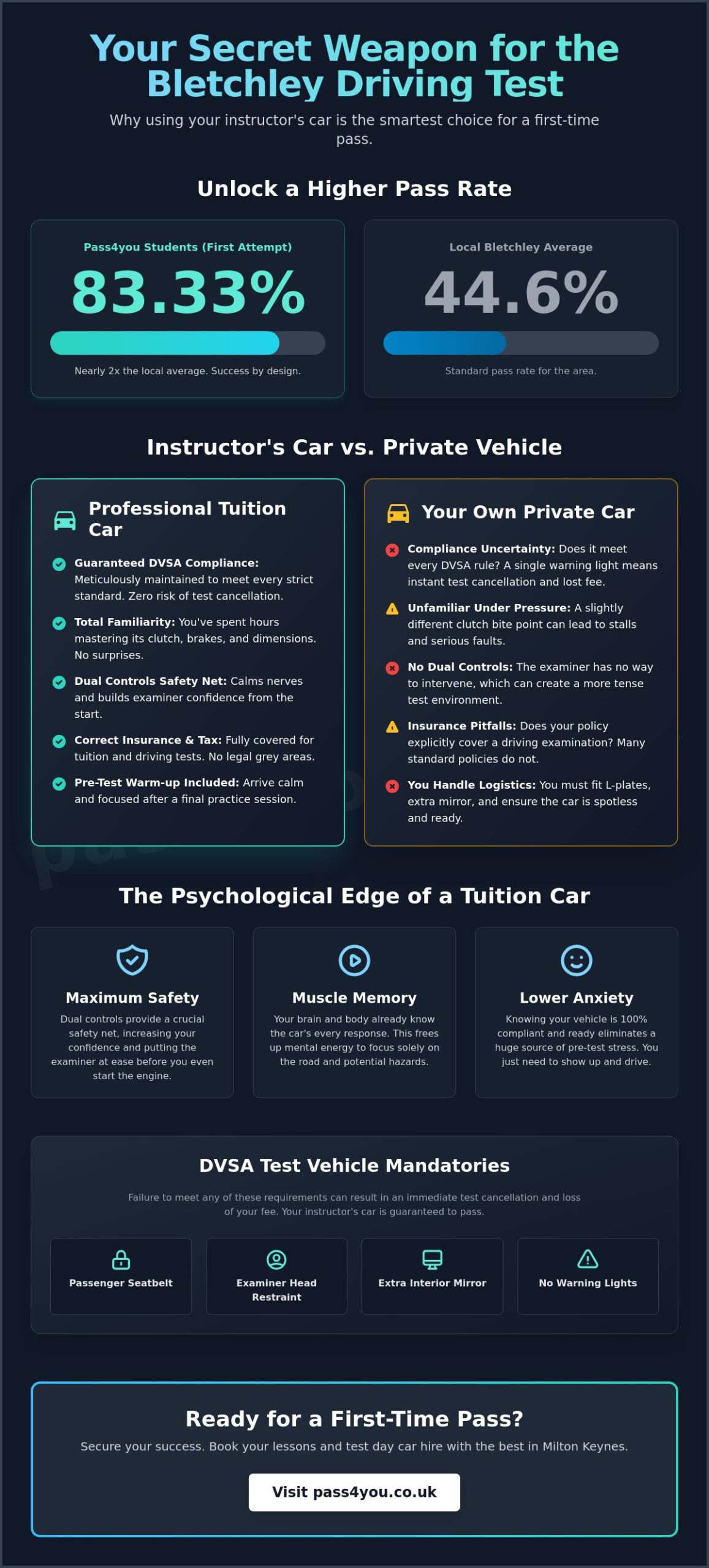
    We understand that test day nerves are real. It’s stressful enough worrying about complex roundabouts without the added fear of a warning light appearing or struggling with an unfamiliar clutch bite point. You want to feel calm, supported, and certain that your vehicle meets every strict DVSA requirement for 2026. This guide explains why your instructor’s car is your greatest asset for a first-time pass and how to coordinate the logistics under the latest booking regulations. You’ll discover how to leverage professional equipment to boost your confidence, ensure safety compliance, and join the 83.33% of our students who succeed on their first attempt, far exceeding the local average of 44.6%.

    Key Takeaways

    • Understand why the DVSA requires you to provide your own vehicle and why a professional tuition car is the most reliable way to meet these strict standards.
    • Learn how dual controls and superior visibility in modern vehicles act as a mental safety net, helping you stay calm while building examiner confidence.
    • Master the “golden rule” of coordination to ensure you can use instructor car for driving test milton keynes without facing scheduling conflicts at the Bletchley centre.
    • Compare the hidden insurance risks and technical requirements of private vehicles against the streamlined value of a professional driving school car.
    • Discover how choosing a vehicle you’ve already mastered during your driving lessons leads to higher success rates and long-term savings.

    Can You Use Your Instructor’s Car for Your Driving Test?

    Yes, you absolutely can. In fact, choosing to use instructor car for driving test milton keynes is the most common path for learners in the region. Many people are surprised to learn that the DVSA does not provide vehicles for examinations. It’s your responsibility to bring a car that is safe, roadworthy, and fully compliant with current regulations. When you take your United Kingdom driving test, your instructor’s car is often the most reliable tool at your disposal. This arrangement is typically called “Test Day Hire.” It isn’t just about the 40 minutes of the exam; it usually includes a final warm-up lesson right before your appointment to help settle your nerves and sharpen your focus.

    DVSA Requirements for Test Vehicles

    The DVSA has a strict checklist for any vehicle used during a test. If the car doesn’t meet these standards, the examiner can cancel your test on the spot, and you’ll lose your fee. The vehicle must have a passenger seatbelt and a head restraint for the examiner. It also needs an extra interior rear-view mirror so they can monitor traffic behind you. Your instructor ensures the car is fitted with L-plates on the front and rear and that no warning lights are visible on the dashboard. While dual controls aren’t a legal requirement, they are highly preferred because they provide a safety net that helps the examiner feel more secure. Every tuition vehicle we use is maintained to these high standards, ensuring you never have to worry about technical rejections.

    Why Familiarity Matters in Milton Keynes

    Milton Keynes is famous for its unique grid system and its high density of roundabouts. Navigating the Bletchley area requires precise control and plenty of confidence. When you stay in the car you’ve used for your driving lessons, you benefit from deep muscle memory. You already know exactly how the steering feels and how the brakes respond. You don’t have to guess where the clutch “bite point” is when you’re pulling away at a busy junction. This technical familiarity is vital for preventing stalls and maintaining a smooth flow of traffic.

    Struggling with unfamiliar controls in a private car can quickly lead to minor mistakes that escalate into serious faults. You’ve spent hours mastering the dimensions of your instructor’s car, which makes maneuvers like parallel parking or reversing into a bay much more intuitive. In 2026, using your tuition vehicle provides a “home field advantage” that transforms a high-stakes exam into a predictable task in a comfortable environment. It allows you to stop worrying about the machine and start focusing entirely on the road ahead.

    The Benefits of Using a Professional Tuition Car at Bletchley

    Choosing the right vehicle for your big day is a strategic decision that goes far beyond simple transport. When you decide to use instructor car for driving test milton keynes, you’re investing in a setup specifically designed for success. One of the most immediate benefits is the presence of dual controls. While you hopefully won’t need them, they provide a vital safety net. This presence often boosts the examiner’s confidence from the moment they step into the cabin. A relaxed examiner creates a more positive atmosphere, which helps you perform at your best.

    The fleet at Pass4you Driving School consists of modern Volkswagens selected for ease of handling and superior visibility. These cars are kept in peak condition, ensuring they meet all DVSA car requirements without any last-minute surprises. On the morning of your test, your instructor takes care of the logistics. They ensure the car is clean, maintained, and positioned perfectly in the Bletchley test centre bays. This means you don’t have to worry about finding a space or parking correctly before the examiner even arrives.

    Psychological Edge and Confidence

    Success on test day is as much about your mindset as it is about your skills. Using the exact same seat, mirror setup, and dashboard layout you’ve practiced with during your Pass4you Driving School lessons significantly reduces your cognitive load. Your brain doesn’t have to waste energy searching for a switch or adjusting to a different view. Everything is exactly where it should be. This familiarity helps manage those inevitable test-day nerves. The hour before your test is also crucial. Your instructor uses this time for a final warm-up, helping you settle into a rhythm and addressing any last-minute questions. This supportive environment ensures you enter the Bletchley centre feeling prepared and capable.

    Technical Reliability

    Private vehicles often carry hidden risks that can derail your plans. A minor defect, like a small nick in a tyre or a blown bulb, can lead to an instant cancellation. Tuition cars undergo much more frequent servicing than standard vehicles to handle the rigors of daily instruction. This proactive maintenance typically includes:

    • Regular tyre tread and pressure checks
    • Frequent bulb and signal inspections
    • Brake system calibration for maximum responsiveness

    There is also a practical advantage during the “Show Me, Tell Me” portion of the test. Since you’ve been practicing in this car, you know exactly where the brake fluid reservoir is and how to operate the rear demister without looking. This technical certainty prevents early mistakes that could shake your confidence. If you’re ready to start your journey in a vehicle built for success, our driving lessons provide the perfect foundation for a first-time pass.

    Using Your Instructor's Car for Your Driving Test in Milton Keynes: A Strategic Guide

    Instructor’s Car vs. Private Vehicle: A Comparison

    Deciding whether to drive your own vehicle or to use instructor car for driving test milton keynes often comes down to a balance of cost and comfort. While using a personal car might seem like a way to save money, the long-term financial risks are high. If your vehicle fails to meet the official government car requirements on the morning of your exam, the examiner will cancel the test immediately. You’ll lose your £62 or £75 fee, and you’ll likely face a long wait to rebook due to the current high demand for slots at Bletchley.

    Insurance is another significant hurdle that many learners overlook. Most standard learner driver policies cover private practice with a supervisor, but they often exclude the actual driving test itself. You’d need to verify this with your provider and bring proof to the centre. In contrast, a tuition vehicle is already fully insured for the exam, removing a massive layer of stress. Visibility also plays a role; professional cars are chosen for their clear sightlines, whereas many modern private cars have thick pillars or small rear windows that make maneuvers much harder for a nervous student.

    Examiners are human, and their comfort level matters. When they see a dual-controlled car, they know they have a way to intervene if a dangerous situation arises. This safety net allows them to feel more at ease, which can lead to a more relaxed atmosphere during your drive. It’s about presenting yourself as a prepared, serious candidate who has chosen the best tools for the job.

    Hidden Risks of Using a Private Car

    Many private-car users are caught out by the “extra mirror” rule. You must provide an additional interior rear-view mirror for the examiner to use. Without it, the test won’t go ahead. There are also specific rules about headrests; some integrated or aftermarket headrests are deemed unsuitable for the examiner’s view. Managing these technical details alone on such a high-pressure day adds unnecessary “cognitive load.” Instead of focusing on your mirrors and signals, you’re worrying about whether your tyres have exactly enough tread or if a dashboard light might flicker.

    The Value of the ‘Warm-Up’ Hour

    The hour before your test is perhaps the most important hour of your entire learning journey. Taking driving lessons in Milton Keynes right before your appointment allows you to calibrate your brain to that day’s specific traffic conditions. You can practice a few roundabouts, check the weather’s impact on your braking distances, and settle into the car’s rhythm. This “home field advantage” is a key reason why choosing a driving school in Milton Keynes that provides a familiar vehicle is such a strategic move. It ensures that by the time the examiner greets you, you’ve already been driving successfully for sixty minutes.

    Booking the Car for Your Milton Keynes Driving Test

    The most important step in your test preparation happens before you even log onto the GOV.UK website. There is a golden rule every learner must follow: never book your practical exam without first confirming your instructor’s availability. Under the 2026 regulations, you’re responsible for managing your own booking, and since you can only change a test date twice before losing your fee, coordination is vital. To use instructor car for driving test milton keynes, you need to ensure the vehicle isn’t already committed to another student’s exam or a long-distance lesson.

    When you arrange to take your instructor’s car, you’re typically booking a “Test Day Package.” This isn’t just a simple car swap. It generally includes a one-hour warm-up lesson, the use of the vehicle for the duration of the test, and the drive back home afterward. It’s a comprehensive service designed to keep you in a focused, “test-ready” mindset. However, remember that your instructor has a professional responsibility to ensure safety. If they feel you haven’t yet reached a standard where you can safely control the vehicle under exam conditions, they may decline the use of the car. This is never meant to be discouraging; it’s a protective measure to save you from a negative experience and the cost of a failed attempt.

    Bletchley Test Centre Specifics

    The Bletchley Test Centre has specific logistical quirks that can catch out the unprepared. When you arrive, your instructor will help you park in the designated bays. These spaces are often tight, and knowing exactly how your tuition car fits into these lines is a huge advantage. You should aim to arrive no more than 10 minutes before your slot. Arriving too early can cause congestion in the car park, while being even a minute late can result in the examiner refusing to start the test. As you pull out of the centre, you’ll immediately encounter the Milton Keynes Redway system. These paths for cyclists and pedestrians often intersect with the road at unexpected points, so having a familiar car with great visibility is essential for those early observations.

    What to Bring on the Day

    While your instructor ensures the vehicle is prepped with L-plates, extra mirrors, and a clean interior, the administrative side is down to you. You must bring your provisional driving license and your theory test pass certificate. Without these, the test cannot proceed. For a detailed breakdown of the administrative steps required, you can refer to our complete guide to booking your test. Making sure your paperwork is in order allows you to stay calm and focus on the road. If you’re ready to secure your spot and start refining your skills, the best first step is to book your next driving lesson with a mentor who knows the Bletchley routes inside out.

    Why Pass4you Driving School is the Preferred Choice for MK Learners

    Choosing who to learn with is the most significant decision you’ll make before your test. At Pass4you Driving School, we don’t just provide a vehicle; we provide a proven path to independence. Our students achieve an 83.33% first-time pass rate, which is nearly double the local Milton Keynes average of 44.6%. This success isn’t an accident. It’s the result of our patient, supportive approach and our commitment to using high-quality equipment. When you choose to use instructor car for driving test milton keynes through our school, you’re stepping into a modern Volkswagen that’s been specifically chosen for its light controls and excellent all-round visibility.

    We focus on value over low cost. By using efficient, modern vehicles and refined teaching methods, we help you become test-ready faster. This saves you money in the long run by reducing the total number of lessons needed and minimizing the risk of expensive retests. Our instructors are consistently praised for their calm and professional nature; they create a learning environment where you can thrive without feeling rushed or pressured. We believe that a relaxed student is a successful student, and our team works tirelessly to build that emotional stability before you head to Bletchley.

    Expert Guidance for Bletchley Routes

    Our instructors are more than just teachers; they’re experts on the Bletchley area. They understand exactly where learners often struggle, from the complex roundabouts to the hidden speed changes near the test centre. We use tailored mock tests to replicate the practical driving test experience as closely as possible. These sessions help you build the calm confidence needed to handle the real thing without being overwhelmed by nerves. By identifying and fixing small errors in a low-pressure environment, we ensure you’re truly ready before you ever arrive at the test centre gates. This high-precision training is why so many local families trust Pass4you Driving School with their teenagers’ safety.

    Ready to Secure Your Test Success?

    Secure your success by planning ahead. Because of the high demand for our first-class instruction, we encourage you to speak with your mentor as soon as you have a test date in mind. This ensures your preferred vehicle is reserved just for you. The relationship you build with your instructor is the secret ingredient for test day. Having a familiar, reassuring face by your side during that final warm-up hour can make all the difference.

    You’ve worked hard to get this far. Don’t leave your success to chance by using an unfamiliar car or an untested method. Join the hundreds of successful Milton Keynes drivers who have trusted Pass4you Driving School to get them across the finish line safely. If you’re ready to take the next step, you can book your next set of driving lessons today and start your journey toward that first-time pass.

    Step Into Your Future with Confidence

    Navigating the final steps toward your full license is about more than just driving skill; it’s about choosing the right environment for success. By deciding to use instructor car for driving test milton keynes, you remove the technical and administrative hurdles that often trip up private candidates. You’ve seen how a familiar seat, calibrated controls, and expert local knowledge come together to create the ideal conditions for a first-time pass at Bletchley.

    Our team is here to ensure that when you arrive at the test centre, you feel like a prepared professional rather than a nervous learner. With the support of our experienced mentors and a vehicle maintained to the highest standards, you can focus entirely on the road ahead. Book your Milton Keynes driving lessons and test-day car with Pass4you Driving School today. The freedom of the road is waiting for you, and we can’t wait to help you reach it.

    Frequently Asked Questions

    Can I use my own car for the driving test in Milton Keynes?

    Yes, you can use your own vehicle as long as it satisfies all current DVSA safety standards. The car must be taxed, insured for a driving test, and have a valid MOT if it is over three years old. You are also responsible for fitting an extra rear-view mirror for the examiner and displaying L-plates correctly. Many learners find this preparation stressful and prefer to use instructor car for driving test milton keynes to ensure every technical requirement is met.

    How much does it cost to use an instructor’s car for the test?

    Most driving schools charge for the total time the vehicle is in use on your test day. This typically covers a two to three-hour period, which includes your final warm-up lesson, the duration of the exam, and the journey back home. While we don’t list specific fees here, you should budget for the equivalent of a standard block of lessons. This investment ensures you have a familiar, reliable vehicle that is perfectly prepped for the Bletchley routes.

    Do I need special insurance if I use my instructor’s car?

    No, you do not need to arrange any additional insurance when using a professional tuition vehicle. The instructor’s specialized policy is designed to cover learner drivers during both their lessons and the practical exam itself. This is a significant advantage over using a private car. Standard learner policies often exclude the actual test, requiring you to purchase a specific add-on or a separate short-term policy for the day.

    What happens if my instructor’s car breaks down before my test?

    Professional driving schools prioritize vehicle maintenance to ensure their cars are always roadworthy and reliable. In the rare event of a mechanical failure, your instructor will do their best to provide a similar replacement vehicle so your test can proceed. If a breakdown occurs at the last minute, they will guide you through the process of contacting the DVSA. Having an experienced mentor handle these rare logistical issues helps keep your focus entirely on your driving.

    Will the examiner drive the car at any point?

    No, the examiner will not drive the car during your appointment. Their role is strictly to observe your driving and ensure you meet the required safety standards for a full license. You will be in total control of the vehicle from the moment you leave the Bletchley Test Centre until you return. The only time an examiner might use the dual controls is in an emergency situation to ensure the safety of everyone on the road.

    Can my instructor sit in the back during the test at Bletchley?

    Yes, you are allowed to have your instructor sit in the back of the car as a silent observer. They are not permitted to offer any guidance, gestures, or signals during the drive. Some students find their presence reassuring, while others prefer to be alone with the examiner to minimize distractions. You can make this decision on the morning of your test. Your instructor can also listen to the examiner’s feedback at the end of the session.

    Is a dual-control car mandatory for the UK driving test?

    Dual controls are not a legal requirement, but they are highly recommended by driving professionals. Most examiners feel more at ease in a car fitted with them because it provides an essential safety net. While you can use a private car without these controls, choosing to use instructor car for driving test milton keynes provides a professional environment. This technical setup helps the examiner stay relaxed, which often contributes to a more positive atmosphere during your exam.

    What if I book my test for a time my instructor is busy?

    If you book a test slot without checking your instructor’s diary, they may not be able to provide the vehicle. Under the 2026 regulations, you must manage your own booking, so clear communication is vital. If a scheduling clash occurs, you might be forced to find an alternative vehicle or change your test date. To avoid this, always discuss your preferred dates with your instructor before you finalize any booking on the official GOV.UK website.

  • International License to UK Driving Lessons: Your 2026 Guide to Getting a UK Licence

    International License to UK Driving Lessons: Your 2026 Guide to Getting a UK Licence

    Last October, Sarah realized her 12-month legal window to drive on her overseas permit was closing in just twenty-one days. Like many expats, she felt a sudden wave of anxiety about complex roundabouts and the strict standards of the DVSA examiner. You likely feel the same pressure to secure your freedom before that one-year deadline hits. It’s completely normal to worry about breaking old habits or accidentally drifting to the wrong side of the road. We know that choosing the right international license to uk driving lessons is the most important step in staying legal and safe on British roads.

    We’re here to help you trade that temporary permit for a permanent UK licence with total confidence. Our patient approach has helped many international drivers maintain their independence while achieving an 83.33% first-time pass rate. This guide explains the latest 2026 driving regulations, helps you master British road culture, and shows you how professional coaching saves you time and money. You’ll learn exactly how to handle the UK testing system so you can drive safely and legally for life.

    Key Takeaways

    • Understand the 12-month legal grace period for international drivers and how your home country’s “designated” status affects your path to a UK licence.
    • Bridge the gap between overseas experience and British road standards by enrolling in targeted international license to uk driving lessons that focus on left-hand driving and local signage.
    • Follow a clear, step-by-step roadmap to securing your UK provisional licence and mastering the modern Theory and Hazard Perception exams.
    • Learn why professional refresher lessons are essential for identifying subtle “dangerous” habits that often cause experienced international drivers to fail the UK test.
    • Discover how calm, patient instruction in Milton Keynes can build your confidence and help you join our 83.33% first-time pass rate success stories.

    Understanding the 12-Month Rule for International Drivers in 2026

    Moving to the UK is a big step, and getting behind the wheel shouldn’t be a source of stress. If you’ve arrived with a valid licence from your home country, you generally have a 12-month window to drive legally on British roads. This grace period is designed to help you settle into your new life without worrying about immediate transport issues. It’s vital to understand that Driving licence regulations in the UK set a hard limit on this privilege.

    The 12-month countdown begins the very day you become a resident in the UK. For most people, this is the date you enter the country to live here permanently. It isn’t based on when you first buy a car or start a job. If you continue to drive on your international permit after these 365 days have passed, you’re effectively driving without a valid licence. The consequences are serious. You could face heavy fines, six penalty points on your future UK record, and your car insurance will likely be voided if you’re involved in an accident.

    Designated Countries: Can You Simply Exchange Your Licence?

    Some countries have reciprocal agreements with the UK, making the transition much easier for newcomers. If you’re from a “designated country,” you can often exchange your original licence for a British one without having to take a new driving test. This list includes nations like Australia, Canada, Hong Kong, New Zealand, Singapore, South Africa, and Switzerland, along with most EU and EEA member states. It’s a supportive system that recognises your existing experience.

    The administrative process involves sending your original physical licence, a completed D1 application form, and a fee of £43 (based on 2025 DVLA rates) to the DVLA. You must surrender your old licence to receive the UK version. It’s best to start this process around the six-month mark of your residency. This ensures you aren’t left without a valid licence if there are any postal or processing delays at the DVLA.

    Non-Designated Countries: Why You Must Pass a UK Test

    If your licence was issued in a country like the USA, India, Pakistan, or Nigeria, the rules are stricter. While you can drive for your first 12 months, you must pass the UK’s theory and practical driving tests to continue driving after that year expires. The first step in this process is applying for a provisional licence UK. This allows you to book your tests and take professional instruction.

    Many experienced drivers find that UK roads, with their unique roundabouts and narrow lanes, require a different set of skills. Booking international license to uk driving lessons is a great way to build confidence and learn the specific “UK way” of driving. Once your initial 12 months expire, you cannot drive independently as a full licence holder. You’ll be treated as a learner, which means you must display “L” plates and be supervised by a qualified driver at all times until you pass your practical exam. Taking international license to uk driving lessons early helps you avoid this loss of independence and ensures you’re a safe driver for life.

    Adapting to UK Roads: Key Challenges for Overseas Licence Holders

    The transition to British roads involves more than just swapping sides. It’s a mental reset. When you switch to the left-hand side, your entire field of vision changes. You have to learn to look right, then left, then right again at every junction. This can feel overwhelming at first. Professional international license to uk driving lessons provide the calm environment you need to build this new muscle memory. Before you start, it’s a good idea to check the official government guidance on driving with a non-GB licence to understand your legal standing during your first 12 months in the country.

    UK road signs use symbols that might differ significantly from your home country. You’ll also encounter a unique “driver language.” For instance, a quick flash of headlights usually means another driver is giving way to you. However, you shouldn’t always rely on this; you must always ensure it’s safe to move yourself. Experienced drivers often fail the UK test because of “observation.” You might be a safe driver, but if you don’t physically move your head to check mirrors, the examiner won’t see it. We focus on these specific requirements to help maintain our 83.33% first-time pass rate.

    Mastering the Milton Keynes Roundabout System

    Milton Keynes is unique because of its high-speed grid system. The roundabouts here are frequent and often have multiple lanes. International drivers often find themselves in the wrong lane, which leads to panic or sudden lane changes. Our driving lessons Milton Keynes focus heavily on these local test routes. We teach you exactly which lane to choose and when to signal, so you feel confident on test day. We’ve helped many students navigate these junctions with our tried and tested techniques.

    Unlearning Old Habits: Manual vs. Automatic

    If you’re used to driving an automatic, the UK’s traditional preference for manual gearboxes can be a shock. While automatic cars are more common in 2026, many learners still prefer a manual licence for flexibility. We help you correct habits like “coasting,” which is letting the car roll while the clutch is depressed. This is a major fault in the UK. We also help you adapt your braking style. British urban streets are often narrow with cars parked on both sides. This requires a much higher level of spatial awareness and speed control than wide international highways. If you want to refine these skills, speaking with a patient instructor about a refresher session can save you time and money.

    International License to UK Driving Lessons: Your 2026 Guide to Getting a UK Licence

    Step-by-Step: From International Permit to Full UK Driving Licence

    Moving from an international permit to a British driving licence doesn’t have to be a stressful experience. At Pass4you, we believe that with a calm and structured approach, you’ll feel confident behind the wheel in no time. The process involves four main stages, each designed to ensure you’re a safe driver for life on the UK’s unique road network. Our instructors are experts at helping you adapt your existing skills to meet the high standards required by the DVSA.

    Applying for Your UK Provisional Licence

    Your first legal requirement is obtaining a provisional licence. You can apply through the DVLA online portal, which is the fastest method in 2026, often seeing a turnaround of just 10 working days. You’ll need your Biometric Residence Permit (BRP) or a valid passport, along with proof of residency. If you’re from a “designated” country, you might consider exchanging your foreign licence for a UK one directly. However, many drivers from non-reciprocal countries will start with a provisional to begin their international license to uk driving lessons. You can generally keep your current physical licence during the application, but you must ensure your residency status is correctly documented to avoid delays.

    Conquering the Theory and Hazard Perception Tests

    Many experienced drivers are surprised by the difficulty of the UK Theory Test. It’s not just about road signs; it’s about understanding the specific Highway Code rules that might differ significantly from your home country. The Hazard Perception part is often the biggest hurdle for those used to different traffic flows. You’ll need to spot “developing hazards” early, such as a pedestrian stepping toward a kerb or a car door opening in the distance. We recommend using the official DVSA revision apps, as they provide practice clips that mirror the 2026 exam format. Our instructors find that a few hours of dedicated study on these apps leads to a much higher first-time pass rate.

    Once you’ve cleared the theory stage, you can focus on the final practical requirements:

    • Booking the Test: You’ll need to book and prepare for the practical driving test. This is where your international license to uk driving lessons really pay off, as your instructor will help you iron out any old habits that could lead to a fault.
    • Receiving Your Licence: After you pass, the examiner will take your provisional and send your details to the DVLA. Your full pink licence usually arrives by post within 21 days.
    • New Driver Rules: Remember that for the first two years, you’re under the New Drivers Act. If you get six or more penalty points within this period, your licence is revoked automatically and you’ll have to start the whole process again.

    Our goal is to make this transition feel like a natural progression rather than a hurdle. We focus on building your confidence so you aren’t just passing a test, but becoming a truly responsible member of the UK driving community. By taking it one step at a time, you’ll find that the freedom of the British roads is well within your reach.

    Refresher Lessons vs. Full Instruction: What Do You Actually Need?

    If you have driven for years in another country, you don’t need to learn how to use a clutch or steer. You need to learn how to satisfy a UK examiner. There is a massive difference between being a competent driver and being a “test-ready” driver in the eyes of the DVSA. Most people moving from an international license to uk driving lessons find that they have developed “natural” habits that are classified as serious faults in Britain.

    Professional instructors are trained to spot these dangerous habits quickly. You might not notice that you’re “coasting” with the clutch down or failing to check your blind spot every single time you move off. In a UK driving test, these aren’t just minor points; they can lead to an immediate fail. Investing in 5 to 10 hours of refresher lessons is a smart financial move. A weekday practical test costs £62, and weekend slots are £75. When you factor in the long waiting lists for re-tests in 2026, passing the first time saves you hundreds of pounds and months of frustration.

    You also need to master the “Show Me, Tell Me” vehicle safety questions. The examiner will ask you two questions about car maintenance and safety. You might need to explain how to check the engine oil or demonstrate how to wash the rear windscreen while driving. If you aren’t prepared for these, you’ll start your test feeling nervous and unsettled.

    Assessing Your Current Skill Level with a Professional

    At Pass4you, we start with a calm assessment lesson. We don’t believe in making you pay for things you already know. Your instructor will watch how you handle junctions, roundabouts, and dual carriageways, then create a tailored plan that focuses only on your weak areas. It’s why we suggest looking for driving instructors near me who know the specific local test routes. Every test centre has a “tricky” corner or a confusing spiral roundabout that catches out experienced drivers who aren’t local.

    The Value of Mock Tests for Experienced Drivers

    The UK practical exam lasts about 40 minutes and includes 20 minutes of independent driving. It’s a high-pressure situation that can make even a veteran driver feel like a beginner. We use mock tests to simulate this environment perfectly. You will see exactly how the marking sheet works, distinguishing between “minors” (driving faults) and “majors” (serious or dangerous faults). Understanding this balance is key to our impressive 83.33% first-time pass rate. A mock test builds the confidence you need to drive safely and calmly when the real examiner is sitting next to you with their clipboard.

    Don’t leave your UK licence to chance. Book your professional assessment with Pass4you and take the first step toward driving legally and safely in the UK.

    Pass4you: Expert Support for International Drivers in Milton Keynes

    Transitioning from an overseas license to a UK one can feel daunting. At Pass4you, we specialise in making this process smooth and stress-free. We don’t treat you like a teenager who has never seen a steering wheel. Instead, we focus on your specific needs as an experienced driver who is new to British roads. You’ll learn in our modern, safe Volkswagen tuition vehicles, which are chosen for their reliability and ease of use. Our impressive 83.33% first-time pass rate reflects our commitment to excellence. We’ve helped hundreds of students in Milton Keynes secure their freedom on the road without wasting money on unnecessary lessons.

    Calm, Patient Instruction with Simon

    Simon’s approach is built on mentorship rather than traditional schooling. If you’ve driven for years in another country, you don’t need a lecture; you need a guide. Many international students tell us they felt anxious about Milton Keynes’ famous roundabouts and complex junctions. Simon creates a stress-free environment where you can master these challenges at your own pace. One former student, who moved from India, shared that Simon’s calm nature was the reason they passed so quickly. They felt confident because Simon didn’t just teach them to pass a test; he taught them how to be a safe driver for life. This mentor-led style respects your existing experience while ensuring you meet the high standards required by UK examiners.

    Saving Time and Money with Our Efficient Techniques

    We know you want your full UK licence as quickly as possible. Our international license to uk driving lessons focus on honing your existing skills while correcting habits that might not meet DVSA standards. This efficiency is why our students often require fewer hours than the national average. We also help you prepare for the book driving test stage, ensuring you’re ready for every requirement. By choosing a mentor-led path, you avoid the trap of starting from zero. We focus on the areas that actually matter for your success:

    • Mastering UK-specific road markings and signage that differ from your home country.
    • Adapting to driving on the left side of the road with confidence and precision.
    • Perfecting the specific observation techniques required for an 83.33% first-time pass rate.
    • Navigating the unique grid system and high-speed dual carriageways of Milton Keynes.

    Investing in quality instruction now means you won’t pay for multiple retakes later. It’s the most cost-effective way to get on the road in 2026. We take pride in being transparent about your progress, so you never feel like you’re taking more lessons than you truly need. Once Simon is confident in your abilities, you’ll be ready to take those final steps toward becoming a fully licensed UK driver.

    Take the Next Step Toward Your UK Driving Freedom

    Navigating the transition from an international license to uk driving lessons is a smart move for any experienced driver looking to stay mobile in 2026. The 12-month rule for overseas permits is strict. Acting early ensures you don’t lose your independence on the road. Whether you need to master Milton Keynes roundabouts or simply want to polish your existing skills, professional guidance makes a huge difference. You don’t need to start from scratch; you just need to understand the specific standards expected by UK examiners.

    At Pass4you, we provide first-class instructors who specialize in a calm and patient teaching style. We’ve helped countless drivers from around the world adapt to British roads with ease. Our impressive 83.33% first-time pass rate proves that our methods work for experienced motorists. We focus on building your confidence and ensuring you feel supported throughout every mile. Don’t leave your licence to chance or wait until the last minute to book your training.

    Book your assessment lesson with Pass4you today and secure your UK licence

    We’re ready to help you get behind the wheel with total confidence. You already have the experience. Now let’s make sure you have the official UK licence to match.

    Frequently Asked Questions

    Can I drive in the UK with an international licence after 12 months?

    No, you cannot legally drive on a non-exchangeable international licence once you’ve been a UK resident for longer than 12 months. After this one-year period, the DVLA requires you to hold a UK provisional licence and pass both the theory and practical tests. Driving beyond this 12-month limit without the correct UK documentation is a serious legal offence that can result in heavy fines and points on your future record.

    Do I need to take a theory test to exchange my international licence?

    It depends entirely on the country that issued your original licence. Drivers from “designated countries,” such as Australia, Canada, or Japan, can usually exchange their licence for a £43 fee without taking any UK tests. If your country isn’t on that specific list, you must pass the UK theory test. Our instructors provide a calm and supportive environment to help you master the Highway Code and hazard perception before your exam.

    How many driving lessons does an experienced international driver usually need?

    Most experienced international drivers require between 10 and 15 hours of professional instruction to reach the DVSA’s required standard. While you already know how to operate a vehicle, the UK test focuses heavily on specific observations and lane discipline. Our international license to uk driving lessons are designed to iron out old habits. This tailored approach helps us maintain a high 83.33% first-time pass rate for our students.

    What happens if I fail my UK driving test on an international licence?

    You can continue to drive on your valid international licence until your first 12 months of UK residency expires, even if you fail a practical test. However, once that 12-month window closes, you must stop driving immediately until you pass. We understand that failing is disappointing, but our patient mentors will help you analyze the examiner’s feedback. We’ll work together to build your confidence and ensure you’re a safe driver for life.

    Can I drive on the motorway with my international licence before I get a UK one?

    Yes, you’re legally allowed to drive on UK motorways during your first 12 months of residency if you hold a full, valid international licence. This differs from UK learners, who must be with an instructor in a dual-controlled car. We often suggest a few professional motorway sessions first. UK motorways are fast and complex, so feeling confident with high-speed merging and gantry signs is vital for your safety and peace of mind.

    Is an International Driving Permit (IDP) required to take lessons in the UK?

    An International Driving Permit is not legally required for lessons, but you must show your original valid national licence to your instructor. The IDP acts only as a translation of your existing licence. If your original document isn’t in English, having an IDP or a certified translation is very helpful. We’ll check your documents during your first lesson to ensure everything is in order, keeping the process professional and straightforward for you.

    How long does it take to get a UK driving licence for an international driver?

    The entire process generally takes between 3 and 6 months from your first application to the final test date. You’ll spend about 3 weeks waiting for your provisional licence to arrive from the DVLA. After that, the timeline depends on how quickly you pass your theory test and the current waiting lists at your local test centre. Booking international license to uk driving lessons early ensures you’re ready as soon as a test slot becomes available.

    What is the best way to prepare for the UK practical test if I already drive?

    The best preparation is taking a series of professional lessons to learn the specific “test routes” and marking criteria used by UK examiners. Many experienced drivers fail because they neglect blind spot checks or use improper steering techniques. Our instructors provide honest feedback in a reassuring way. We focus on the tricky junctions and roundabouts you’ll face in 2026, ensuring you feel calm and prepared to pass on your first attempt.