Tag: new drivers

  • The Ultimate Driving Lesson Checklist for Learners in 2026

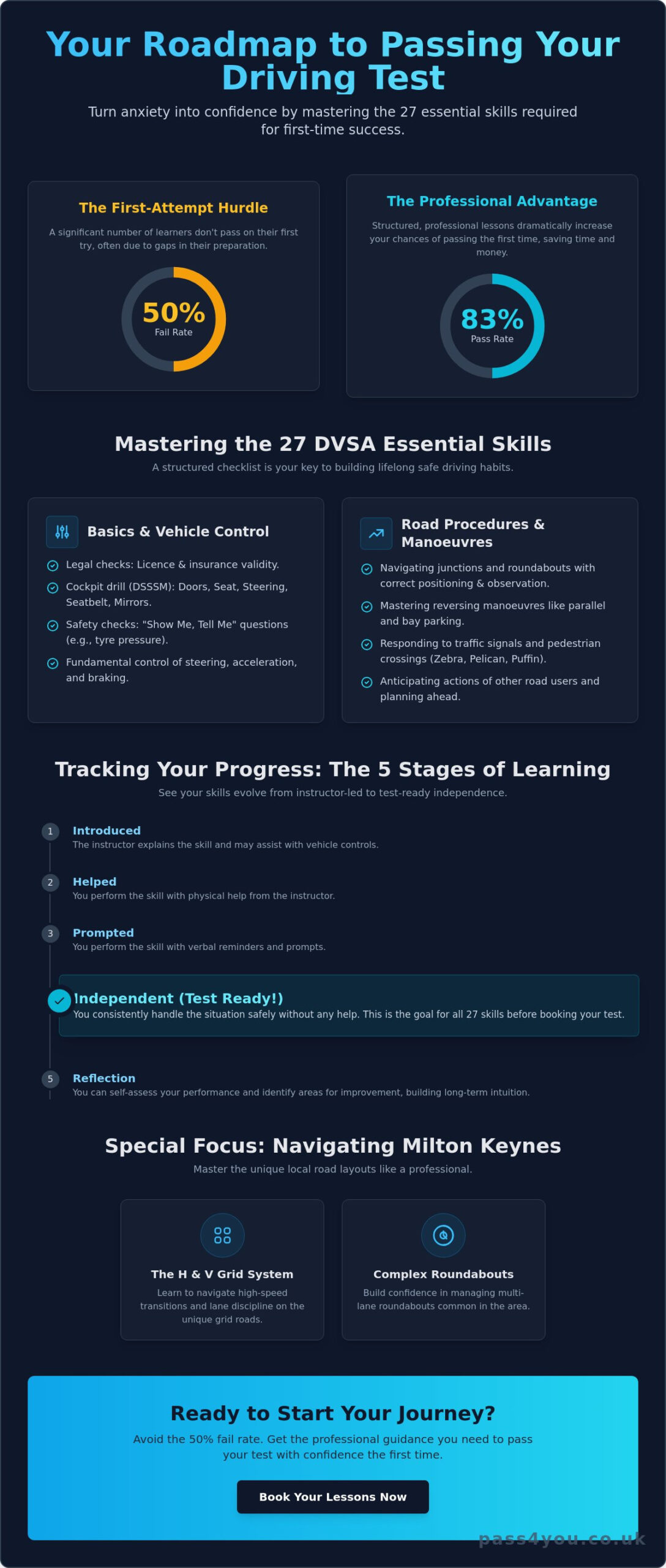
    Did you know that nearly 50% of learner drivers fail their practical test on the first attempt? It’s a statistic that can feel heavy, especially when you’re already worried about complex junctions or those famous Milton Keynes roundabouts. We understand that feeling of uncertainty. It’s completely normal to feel overwhelmed by the sheer volume of skills you need to master before you’re ready for the big day.

    Our comprehensive driving lesson checklist for learners is designed to turn that anxiety into quiet confidence. By following a structured path, you’ll master the 27 essential skills required by the DVSA and learn how to navigate local road layouts like a professional. We’ll show you exactly what to track so you aren’t left guessing about your progress. This structured approach helps you feel like you’re in safe, professional hands every step of the way.

    This guide previews the exact roadmap you need to pass your test the first time, helping you avoid the frustration and extra expense of retakes. We’ll cover everything from core maneuvers to the latest 2026 booking rules. You’ll see how to manage your learning journey effectively, ensuring you feel safe, prepared, and ready for the freedom of the open road.

    Key Takeaways

    • Explore the 27 core DVSA skills that form the essential foundation for every safe and successful driver.
    • Use a professional driving lesson checklist for learners to track your journey toward the “independent” proficiency level required for the test.
    • Prepare for the unique road layouts of Milton Keynes by mastering the H and V grid system and complex high-speed transitions.
    • Understand the legal essentials and mental readiness steps you must complete before even starting your modern tuition vehicle.
    • Learn why professional guidance leads to an 83.33% first-time pass rate, saving you significant time and money.

    Mastering the 27 Essential Driving Skills for 2026

    Starting your driving journey can feel like standing at the base of a mountain. The DVSA syllabus provides the 27 essential skills you need to reach the summit safely. Instead of looking at a giant list and feeling overwhelmed, we break these down into manageable steps. This structured approach is the core of our driving lesson checklist for learners. It ensures you aren’t just memorizing moves to pass a test; you’re building habits that keep you safe for a lifetime.

    Enrolling in a formal driver’s education program is the most efficient way to work through these categories. Our instructors use these 27 points to create a personalized plan that moves at your pace. If you feel nervous about a specific area, we spend more time there until you feel calm and capable. This method transforms a long list of requirements into a series of small, achievable victories.

    Basics and Vehicle Control

    Every journey begins with the fundamentals. Before you even turn the engine on, you must understand your legal responsibilities. This includes ensuring your provisional licence is valid and that the vehicle has the correct insurance coverage. Once inside, we teach you the “DSSSM” routine. This stands for Doors, Seat, Steering, Seatbelt, and Mirrors. It’s a simple sequence that ensures you are comfortable and have maximum visibility. We also cover basic safety checks, often called “Show Me, Tell Me” questions. Learning how to check your tyre pressure or identify the engine oil dipstick builds a sense of responsibility from day one.

    Road Procedures and Manoeuvres

    As your confidence grows, your driving lesson checklist for learners moves toward more complex road interactions. Junctions and roundabouts are often the biggest source of anxiety for new drivers. We focus on correct positioning, early observation, and clear signalling to make these transitions feel smooth. You’ll also master reversing manoeuvres, such as parallel parking and bay parking. These aren’t just test requirements; they are essential daily skills for any driver. Finally, we look at pedestrian crossings. Identifying the differences between Zebra, Pelican, and Puffin crossings is vital for keeping vulnerable road users safe. By categorising these skills, we help you transition from quiet backstreets to busier urban environments without feeling rushed or pressured.

    Tracking Your Progress: From First Lesson to Test Ready

    One of the most common questions learners ask is, “How much longer until I’m ready?” It’s a valid concern. Without a clear way to measure your growth, the journey can feel endless. Our driving lesson checklist for learners solves this by using a specific grading system. This doesn’t just track if you’ve “done” a skill; it tracks how well you can perform it under pressure. By understanding these levels, you’ll see your progress moving from hesitant beginnings to total independence.

    Your instructor uses these levels to build your confidence steadily. We don’t just want you to pass; we want you to feel entirely comfortable behind the wheel. This structured feedback loop ensures you always know where you stand. If you are looking for a supportive environment to start this journey, our professional driving lessons are designed to guide you through every stage with patience.

    The Five Stages of Learning

    The DVSA uses five specific levels to track your proficiency. First is Introduced. At this stage, you understand the theory, but your instructor might still help you with the pedals or steering. Next are Helped and Prompted. Here, you are doing the physical work, but you might need a verbal reminder to check a mirror or adjust your speed. The goal for every skill on your checklist is Independent. This means you handle the situation safely without any help at all. Finally, Reflection occurs when you can critique your own driving. This self-awareness is what builds long-term driving intuition and keeps you safe long after the test is over.

    When to Book Your Practical Test

    You are ready for the practical test when you are consistently “Independent” across all 27 essential skills. Consistency is the key word here. Doing a perfect parallel park once isn’t enough; you need to do it safely every time, even when you’re tired or the roads are busy. We use mock tests to simulate the actual exam environment. These sessions identify any small gaps remaining in your driving lesson checklist for learners. They take the “fear of the unknown” out of the equation. If you and your instructor agree that you’ve reached this threshold, you can follow our guide on how to book your driving test to secure your slot. Remember, booking only when you are truly ready saves you money and prevents the disappointment of a fail.
    The Ultimate Driving Lesson Checklist for Learners in 2026

    Many people think the driving lesson checklist for learners only starts when the engine turns over. In reality, your preparation begins long before you sit in our modern Volkswagen tuition vehicle. Mastering the car’s mechanics is only half the battle. You also need to ensure you are legally compliant and mentally prepared for the responsibility of the road. This proactive approach saves you time and reduces the stress of last-minute realisations that could delay your progress.

    Your mental state is just as important as your physical skills. Learning to drive is a significant life event, and it’s natural to feel a mix of excitement and apprehension. By ticking off the legal and mental boxes early, you create a calm environment where learning can happen naturally. This foundation of safety and responsibility is what makes you a professional driver in the making.

    Paperwork and Legal Essentials

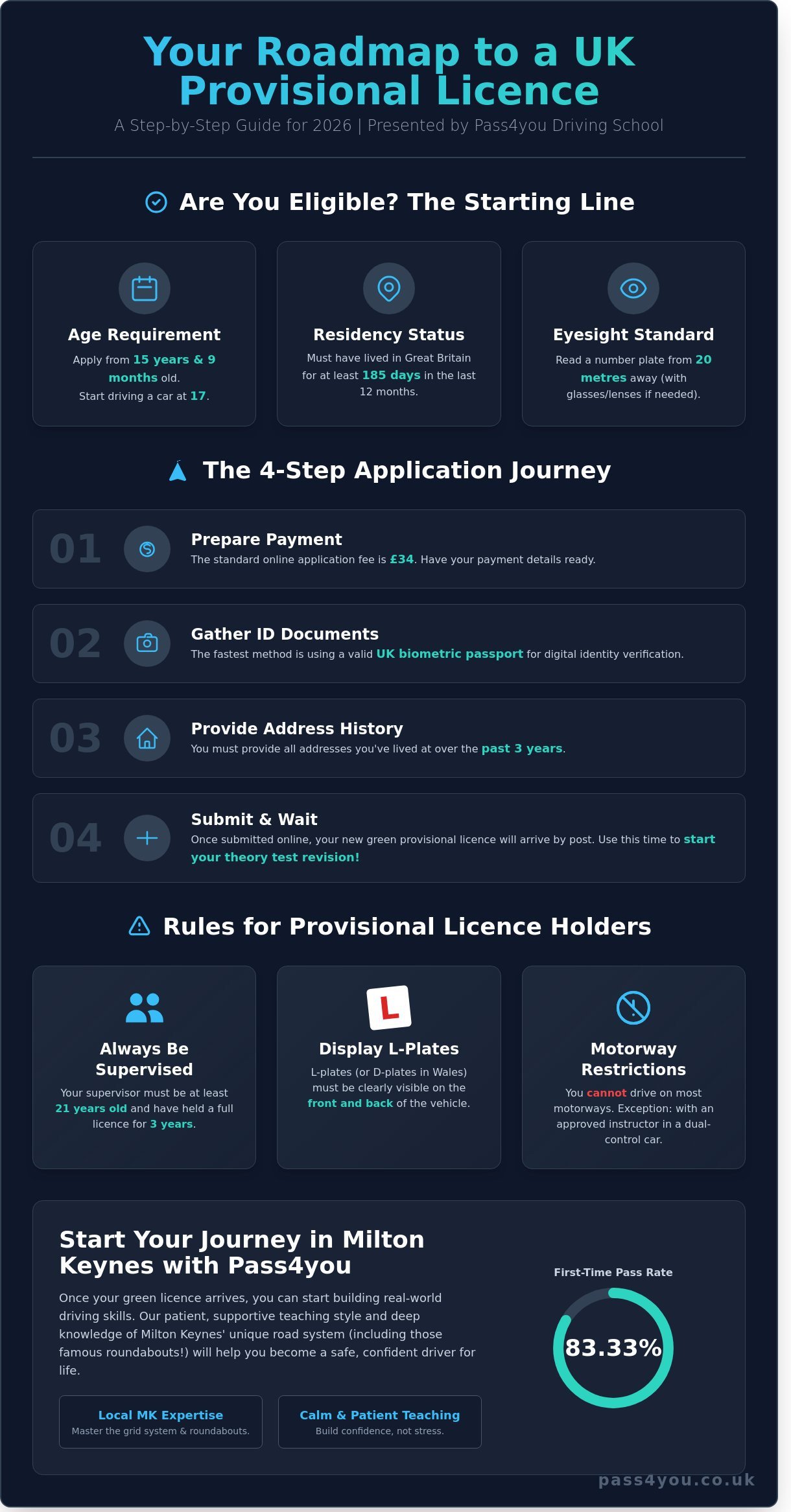
    Before your first lesson, you must have your provisional licence. It isn’t just a piece of plastic; it’s your legal permission to be on the road. Ensure it is valid and that you have it with you for every single session. If you haven’t applied yet, our guide on provisional licence uk covers everything from the £34 online application fee to the documentation you’ll need.

    Your physical readiness is also vital. Every instructor will perform an eyesight check during your first lesson. You must be able to read a standard number plate from a distance of 20 metres. If you need glasses or contact lenses to do this, you must wear them every time you drive. Additionally, you cannot book your practical test until you have cleared the theory test. This £23 requirement is a major milestone on your checklist that confirms you understand the rules of the road and hazard perception.

    Building Driving Confidence

    Building a calm driving mindset is a vital part of your journey. Early-stage nerves are completely normal. You might feel a flutter in your stomach when approaching a busy junction or worry about stalling in traffic. A patient, supportive instructor makes all the difference here. We focus on turning that anxiety into a “Freedom of the Road” mindset. Instead of fearing mistakes, we focus on the opportunities that come with success. Think about the independence of driving yourself to work or visiting friends without relying on bus schedules. This positive visualization helps replace fear with motivation.

    Consistency is your best friend when it comes to mental readiness. The DVSA recommends approximately 45 hours of professional instruction before taking your test. Trying to “cram” lessons into a short period often leads to burnout and forgotten skills. Spreading your learning out allows your brain to process new information and build genuine intuition. When you approach your lessons with a steady, unhurried rhythm, you’ll find that your confidence grows naturally. This mental stability is what helps you stay calm during the actual test, ensuring you can demonstrate your skills effectively under pressure.

    Milton Keynes Checklist: Navigating the Grid and Roundabouts

    While the national DVSA syllabus covers the basics, Milton Keynes requires a specialized approach. This town is famous for its unique layout, and a standard driving lesson checklist for learners often misses the nuance of our local roads. You won’t just be driving on standard streets; you’ll be navigating a complex network of high-speed transitions and frequent intersections. We help you bridge the gap between basic vehicle control and the confidence needed for our fast-flowing traffic.

    Our instructors specialize in the specific challenges found here. We know that moving from a 30mph residential zone onto a 70mph grid road can feel daunting at first. We use a patient, step-by-step method to ensure you feel in control. This regional expertise is a core part of why our students feel so prepared on test day. If you’re ready to start, you can book your Milton Keynes driving lessons with our experienced team.

    Mastering the MK Roundabouts

    Milton Keynes is the roundabout capital of the UK for a reason. You will encounter a massive variety of junctions, from tiny mini-roundabouts in Bletchley to huge, multi-lane systems near the city centre. The secret to success is early preparation. We focus on three main areas to keep you calm:

    • Lane Choice: Identifying the correct lane using road markings and signs well before the junction.
    • Observation: Mastering the timing of your “look” to identify safe gaps without stopping unnecessarily.
    • Exit Signalling: Ensuring other drivers know exactly where you are going to prevent confusion.

    Many learners find the sheer volume of roundabouts exhausting. We practice these until the “mirrors, signal, manoeuvre” routine becomes second nature. This builds the mental stamina you need for a 40-minute driving test. For more help with high-speed junctions, read our guide on mastering the dual carriageway.

    The Grid System and High-Speed Roads

    The MK grid system is organized into H (Horizontal) and V (Vertical) roads. These are the arteries of the town, and they require a different mindset than traditional urban driving. You’ll need to master high-speed merging and maintain safe following distances in fast traffic. We’ll teach you how to read the road ahead to anticipate speed changes before they happen. This foresight is what separates a nervous learner from a safe, independent driver.

    We also spend time on the specific test route hotspots. Whether you are taking your test at the Bletchley or Milton Keynes centre, we know the tricky spots examiners prefer. We’ll guide you through the difficult lane changes and hidden junctions that often catch people out. By including these local details in your driving lesson checklist for learners, we turn “scary” roads into familiar territory. This familiarity is the ultimate tool for passing your test with confidence.

    Why Professional Instruction is Your Final Checklist Item

    Completing your driving lesson checklist for learners is a major achievement, but the quality of your training determines how safely you’ll use those skills. While practicing with family or friends is a great way to gain extra experience, it can’t replace the structured guidance of a professional. Informal practice often leads to “bad habits” that might go unnoticed until your test day. Professional instructors identify these small errors early, ensuring your technique remains precise and safe. This expert oversight is the final, essential piece of the puzzle that transforms a learner into a qualified driver.

    You’ll also benefit from our modern Volkswagen tuition vehicles. These cars are specifically chosen for their reliability and ease of use, making them the perfect environment for mastering complex manoeuvres. When you learn in a high-quality vehicle with a dual-control system, you can focus entirely on your progress. You’ll know you’re in safe, professional hands from the moment you adjust your seat.

    The Pass4you Method

    Our approach is built on patience and efficiency. We understand that every student learns differently, so our first-class instructors specialize in calming anxious learners. We don’t believe in dragging out the process. Instead, we focus on helping you reach the “Independent” level as quickly and safely as possible. This efficiency is reflected in our 83.33% first-time pass rate. By passing the first time, you save significant money on retakes and extra lessons. For more information on how we structure our training, explore our guide to driving lessons milton keynes.

    Ready to Start? Your Next Steps

    The final item on your checklist is the most exciting: booking your first session. We take the time to match you with the best instructor for your specific learning style. Whether you prefer a very quiet environment or need extra encouragement on high-speed roads, we’ve got you covered. This personalized matching process is why so many of our students feel like they’re driving with a trusted mentor rather than a stranger. It makes the entire journey feel supportive and achievable.

    Don’t let the number of skills to master hold you back. With the right support, you’ll find that each step on your checklist becomes a natural part of your driving ability. You’re closer to the freedom of the road than you think. Book your first lesson with Pass4you in Milton Keynes today and let’s start ticking off those 27 skills together.

    Take the Wheel with Confidence in 2026

    You now have the complete roadmap to your driving success. By following a structured driving lesson checklist for learners, you can transform from an anxious beginner into a safe, independent driver. Mastering the 27 essential skills isn’t just about passing a test; it’s about building the confidence to handle the Milton Keynes grid system and those famous roundabouts with ease. Your journey is about more than just mechanics. It’s about the freedom that comes with knowing you are truly ready for the road.

    We are here to support you every step of the way. Our expert local instructors use modern Volkswagen tuition vehicles to ensure you feel safe and comfortable during every lesson. We focus on efficiency and patience, helping you build genuine intuition behind the wheel. Don’t leave your success to chance or informal practice that might lead to bad habits. This professional guidance is why our students achieve such high levels of proficiency.

    Join the 83.33% who pass first time, book your MK lessons now. Your new life as a qualified driver is just a few lessons away. We can’t wait to help you achieve your goals and enjoy the freedom of the open road.

    Frequently Asked Questions

    What are the 27 skills I need to learn to pass my driving test?

    The 27 skills are part of the official DVSA syllabus, categorized to help you build confidence steadily. They cover everything from basic cockpit checks and vehicle control to complex road procedures like junctions and roundabouts. Our driving lesson checklist for learners ensures you master every single one, including safety checks and reversing manoeuvres. We track these stages carefully so you always feel in safe, professional hands while moving through your training.

    How many driving lessons does the average learner need in 2026?

    On average, the DVSA recommends approximately 45 hours of professional driving lessons. This is often supplemented by around 22 hours of private practice. However, everyone learns at their own pace. Some students might feel ready sooner, while others benefit from more time to build their intuition. We focus on your individual progress rather than rushing you, ensuring you are truly independent before booking your practical test.

    Do I need to carry my provisional licence for every driving lesson?

    Yes, you must carry your provisional licence for every single driving lesson. It is your legal permission to be on the road, and your instructor cannot take you out without it. It’s a good habit to keep it in your wallet or bag so you never forget it. This simple step is the very first item on your checklist and ensures you are legally compliant from day one.

    Can I practice with my parents instead of a driving instructor?

    You can certainly practice with parents, provided they meet the legal requirements for supervising a learner. However, we strongly recommend prioritizing professional instruction. Instructors have dual controls and the expertise to prevent “bad habits” from forming. Private practice is excellent for building experience, but a professional ensures you are learning the correct, safe techniques required to pass your test the first time.

    What happens if I fail one item on the driving test checklist?

    Failing one item during your training just means you need more practice in that specific area. Our driving lesson checklist for learners is designed to highlight these gaps before you reach the test centre. On the actual practical test, you can make up to 15 minor mistakes. However, any “serious” or “dangerous” fault on a single item will result in an immediate fail. We work hard to ensure you are consistent across all skills.

    How do I know when I am “Independent” enough for the test?

    You are “Independent” when you can handle road situations safely without any verbal or physical help from your instructor. This means you are making your own decisions about speed, positioning, and observations. We use mock tests to verify this level of proficiency. When you can complete a full lesson without a single prompt, you’ll know you have the confidence and skill level required for the real exam.

    Is the Milton Keynes driving test harder because of the roundabouts?

    The Milton Keynes test isn’t necessarily harder, but it is unique. The high volume of roundabouts and the grid system require specific local knowledge. Some learners find these layouts intimidating, but our instructors specialize in navigating them calmly. With the right training, you’ll find that these roads become familiar and predictable. We focus on building your confidence so that MK roundabouts feel like a natural part of your driving routine.

    What documents do I need to bring to my practical driving test?

    You must bring your provisional driving licence to your practical test. It’s also a very good idea to bring your theory test pass certificate, although the examiner can usually check this digitally. If you don’t have your physical licence, the examiner will cancel the test and you’ll lose your fee. Double-checking your documents the night before helps alleviate any last-minute anxiety, letting you focus entirely on your driving.
  • Driving Lessons in Bad Weather UK: A Guide to Building Real-World Confidence

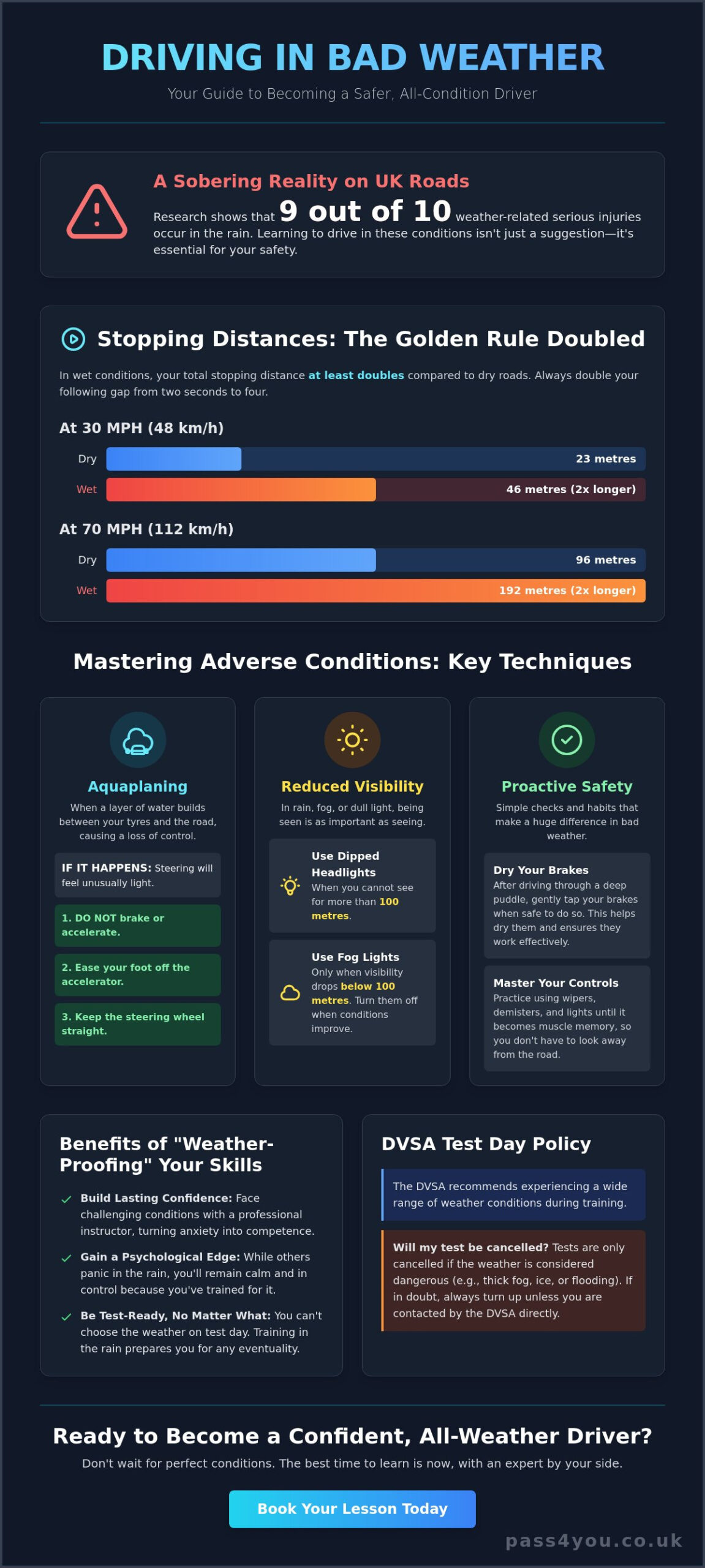
    What if a heavy downpour is actually the most valuable part of your training? While it’s natural to feel a surge of anxiety when you see grey clouds before your session, taking driving lessons in bad weather uk is often the secret to becoming a truly competent driver. You aren’t alone if you worry about skidding on wet roads or losing visibility in thick fog. Most learners feel a bit of dread when the conditions aren’t perfect, especially since research shows that 9 out of 10 weather-related serious injuries on our roads happen in the rain.

    We believe that facing these conditions with a calm, professional mentor by your side is the best way to build lasting confidence. This guide explains why adverse weather is your greatest training tool and how to handle a car safely when the British climate turns. You will discover how to manage stopping distances that can double in the wet, when to use your fog lights if visibility drops below 100 metres, and what the current DVSA rules are for test cancellations. By the end, you’ll feel ready to handle any season with ease and stay safe behind the wheel.

    Key Takeaways

    • Discover how “weather-proofing” your skills creates a safer, more resilient driver compared to those who only train in perfect conditions.
    • Master essential techniques for handling aquaplaning and learn how to adjust your following distances during heavy rainfall.
    • Understand the specific DVSA policies regarding cancellations so you know exactly what to do if it snows on your test day.
    • Gain confidence by taking driving lessons in bad weather uk to practice vital safety checks and “Show Me, Tell Me” questions in a real-world environment.
    • Learn how professional instructors help you navigate tricky Milton Keynes roundabouts when road surfaces are greasy and visibility is poor.

    Should You Take Driving Lessons in Bad Weather?

    When the clouds turn grey and the rain starts to lash against the window, your first instinct might be to call your instructor and reschedule. However, taking driving lessons in bad weather uk is one of the most effective ways to build your confidence and ensure you’re ready for the reality of British roads. It is easy to drive when the sun is shining and the tarmac is dry, but true skill is developed when conditions are less than perfect. Learning to manage wind, rain, and reduced visibility under professional guidance turns a potentially scary experience into a valuable teaching moment.

    The DVSA explicitly recommends that learner drivers experience a wide range of weather conditions during their training. This proactive approach ensures you aren’t caught off guard after you pass your test and find yourself driving alone in a storm. Safety is always our primary concern, and it’s helpful to remember that professional instructor vehicles are equipped with dual controls. This provides a safety net that learning with a friend or parent cannot match. Your instructor is trained to stay calm and can intervene instantly if the car reacts unexpectedly to a large puddle or a sudden gust of wind, keeping you in safe, professional hands at all times.

    The Benefits of Learning in Adverse Conditions

    Driving in the rain or wind helps you build essential muscle memory that you simply won’t develop on a clear day. You will learn how to operate your windscreen wipers and demisters instinctively, without needing to take your eyes off the road to find the controls. Understanding how the car feels on a slippery surface while under expert supervision is a vital part of your development. It also gives you a significant psychological edge over other learners. While others might feel anxious when the weather turns, you will remain calm because you have already mastered these challenges. Learning these defensive driving techniques early on helps you anticipate hazards before they become dangerous situations.

    Why Proactive Training Beats Avoiding the Rain

    You cannot choose the weather on the day of your driving test. If you have spent all your lessons in the sun and it pours during your exam, your anxiety levels will naturally spike. Weather-proofing is the process of mastering vehicle control in non-ideal conditions. By facing the rain during your driving lessons in bad weather uk, you turn a potential obstacle into a tool for success. Professional instructors provide a structured environment where you can test your limits safely. They help you understand the physics of the road, such as how water affects your grip, ensuring you become a responsible and capable driver for life.

    Learning to handle the elements is a practical skill that sets you apart from drivers who only practice in the sun. When you take driving lessons in bad weather uk, you’ll learn that heavy rain requires more than just faster wipers. Aquaplaning occurs when a layer of water builds up between your tyres and the road, causing you to lose steering control. If you feel the steering become light, don’t panic. Simply ease your foot off the accelerator and keep the steering wheel straight until you feel the tyres grip the tarmac again. Facing these elements during your driving lessons in bad weather uk transforms you into a more observant and capable driver.

    Stopping Distances: Dry vs. Wet Roads

    Understanding the physics of a wet road is crucial for your safety. On a dry day, the “two-second rule” helps you maintain a safe gap from the car in front. However, in wet weather, your stopping distance at least doubles. This change is dramatic and requires immediate adjustment to your speed and positioning.

    • At 30mph: You’ll need roughly 46 metres to stop in the wet, compared to just 23 metres on dry roads.
    • At 70mph: That distance jumps from 96 metres to a staggering 192 metres.

    Doubling the gap is the golden rule because it gives you the vital thinking time needed to react to hazards. After driving through a deep puddle, remember to tap your brake pedal lightly when it’s safe to do so. This simple action helps dry the brake discs and ensures they work effectively when you need them most.

    Mastering Visibility and Lighting

    Visibility can change in seconds. You are required to use headlights when you cannot see for more than 100 metres. While your driving lessons will teach you the location of every switch, knowing exactly when to use them is the real challenge. Use dipped headlights in heavy rain or dull light to ensure other road users can see you clearly. Only use fog lights when visibility is seriously reduced, and remember to switch them off once it improves to avoid dazzling others.

    Managing interior condensation is just as important as cleaning the outside of the glass. Use your heater and air conditioning to demist the windows before you set off. This ensures you have a clear view of your surroundings at all times. Expert advice on Navigating UK Rain, Fog, and High Winds often emphasizes that being seen is just as important as being able to see.

    Finally, be mindful of high winds. Strong gusts can push a small learner car off course, especially on open roads or bridges. When passing high-sided vehicles, expect a sudden buffeting effect as you move in and out of their windbreak. Keep a firm but relaxed grip on the wheel and allow extra room for cyclists or motorcyclists who may be blown sideways by the gale.

    Driving Lessons in Bad Weather UK: A Guide to Building Real-World Confidence

    Will My Driving Test Be Cancelled? The DVSA Bad Weather Policy

    Waking up to a storm on the morning of your driving test can feel like a setback, but understanding the DVSA Bad Weather Policy will help calm those nerves. The Driver and Vehicle Standards Agency (DVSA) prioritises safety above all else. They won’t conduct tests in truly dangerous conditions, such as icy roads, flooding, or thick fog. However, a bit of rain or wind won’t stop the exam. This is why driving lessons in bad weather uk are so beneficial. They ensure you’re prepared to perform your best, even if the clouds look threatening when you arrive at the test centre.

    If the DVSA decides to cancel your test due to the weather, you don’t need to do anything to rebook. They will automatically find a new date for you. You’ll usually receive these new details within three working days, though it can take up to seven days during prolonged periods of winter weather. It’s important to know that you cannot claim out-of-pocket expenses, such as the cost of your instructor’s car hire, for cancellations caused by the weather. While this can be frustrating, it’s a standard policy across the UK.

    How the DVSA Defines “Dangerous Conditions”

    There is a clear difference between “wet” and “dangerous.” Standard rain is rarely a reason for cancellation. Examiners look for conditions that make it impossible to assess your driving safely. This includes standing water that could cause aquaplaning or ice that makes the road surface treacherous. Local test centres, such as Bletchley, have specific protocols for assessing nearby routes. The examiner makes the final safety call on the morning of the test. If you have concerns, call the phone number on your booking confirmation email. Do this on the day of your test, as staff won’t be able to give you a definitive answer the night before.

    What to Do if Your Test is Cancelled

    If you receive a cancellation notice, stay positive. Use the extra time to refine your skills. You can review our practical driving test guide to stay mentally sharp while you wait for your new date. If it’s safe to travel, we often recommend still having your scheduled pre-test lesson. Practising your driving lessons in bad weather uk with your instructor provides a safe environment to master the very conditions that caused the cancellation. This keeps your momentum going and ensures you feel even more confident when your new test date arrives.

    Safety Checks and Preparation for Adverse Conditions

    Becoming a confident driver starts before you even turn the key. When you take driving lessons in bad weather uk, your instructor will guide you through the vital safety checks that keep you and other road users safe. Preparation is the antidote to panic when the British weather turns unpredictable. A core part of this preparation involves mastering the “Show Me, Tell Me” questions. You might be asked how to check the brakes are working, how to operate the demister, or how to switch on your rear fog lights. Knowing these controls inside out ensures you stay focused on the road rather than fumbling for a switch when visibility suddenly drops.

    One of the most critical safety factors in the rain is your tyres. The legal minimum tread depth in the UK is 1.6mm across the central three-quarters of the tyre. However, having more tread provides much better grip on wet surfaces. During your driving lessons in bad weather uk, you’ll learn how to check this depth and understand why it matters for your stopping distance. Proper preparation also extends to what you wear. Wet, slippery shoes can easily slide off the pedals, so choosing comfortable, flat footwear with good grip is essential for maintaining precise control of the car.

    Pre-Drive Vehicle Checks

    Before setting off in poor conditions, take a moment to ensure your vehicle is ready. Check that all your lights are clean and working correctly, as dirt and road salt can quickly obscure them. Your wiper blades should clear the screen effectively without smearing or making unusual noises. It’s also vital to verify your fluid levels. Ensure your screen wash is topped up and contains anti-freeze properties to prevent the jets from freezing or the liquid from turning into ice on your windscreen during a cold snap.

    The Learner’s Mental Toolkit

    Your mental state is just as important as the car’s condition. Driving in heavy traffic during a storm can feel overwhelming, but staying calm is key to making safe decisions. If you feel your anxiety rising, take a deep breath and remember that your instructor is there to support you. We encourage open communication; if the conditions feel too intense, tell your instructor immediately. They can help you break down the situation into manageable steps, ensuring you always feel in safe, professional hands. If you’re ready to build your skills with a patient mentor, book your driving lessons today and start your journey toward becoming a confident, all-weather driver.

    Build Confidence with Professional Lessons in Milton Keynes

    At Pass4you, we don’t just teach you to drive; we prepare you for the reality of the British roads. Taking driving lessons in bad weather uk with our team means you’ll never feel caught out by a sudden change in the forecast. Our instructors monitor local weather patterns closely. They tailor each session to ensure you’re learning the most relevant skills for the day’s conditions. You’ll train in modern, well-maintained Volkswagen vehicles. These cars offer excellent visibility and safety features, helping you feel secure even when the clouds are dark.

    Milton Keynes features a unique road layout that requires specific techniques in the wet. Our instructors have deep local knowledge of the area’s roundabouts, which can become incredibly greasy and slippery after a light rain. We’ll show you how to adjust your approach speed and steering to stay safe. Learning these nuances under professional supervision ensures you’re always in safe, professional hands.

    Local Expertise for Milton Keynes Learners

    The H and V grid system can feel very different when visibility is low. We’ll help you navigate these roads with confidence, focusing on clear lane discipline and proactive hazard perception. If you’re practicing on a dual carriageway during high winds, we’ll teach you how to keep the car stable and react to sudden gusts. Our team also knows exactly which areas near the local test centres are prone to flooding. This insight allows us to guide you safely through the most challenging routes without unnecessary stress.

    Join the Success Stories at Pass4you

    We specialise in helping nervous learners find their feet. Our patient, calm teaching style is designed to build your self-belief, one lesson at a time. We’re incredibly proud of our 83.33% pass rate. This high success metric includes many students who faced rain, wind, or fog on their test day and came out with a pass. It shows that professional driving lessons in bad weather uk give you a massive advantage over those who only practice in the sun.

    Don’t wait for the “perfect” day to start your journey. You can book your driving lessons in Milton Keynes today regardless of the season. Every session you complete in the rain or wind is a valuable step toward your pink license and a lifetime of safe, confident driving.

    Ready to Master the Roads in Any Season?

    Facing the elements might feel daunting at first, but it’s the quickest way to transform from a learner into a truly resilient driver. You now know how to manage aquaplaning, double your stopping distances, and navigate DVSA cancellation rules. This knowledge turns a rainy day into a powerful training opportunity. By choosing to take driving lessons in bad weather uk, you ensure that no forecast stands in the way of your freedom.

    Our patient and first-class driving instructors support you with an approach that has helped us achieve an impressive 83.33% first-time pass rate. You’ll learn in modern, well-maintained Volkswagen tuition vehicles designed for safety and comfort. Whether you’re tackling a greasy roundabout or a windy dual carriageway, you’re always in safe, professional hands.

    Don’t let a few clouds hold you back from achieving your goals. Book your Milton Keynes driving lessons with Pass4you today and start building the real-world confidence you need to succeed. You’re closer to that pink license than you think, and we’re with you every mile of the way.

    Frequently Asked Questions

    Do driving lessons get cancelled in rain?

    Driving lessons rarely get cancelled just because of rain. In fact, we encourage you to keep your appointment as it’s the perfect time to practice using your wipers and adjusting your speed for wet tarmac. Your instructor will only postpone a session if conditions become truly dangerous, such as severe flooding that makes the roads impassable or unsafe for your current skill level.

    What happens if it snows on my driving lesson day?

    Your instructor will make a safety call based on the local road conditions on the morning of your session. If the snow is heavy or the roads are icy, we may reschedule your lesson to ensure you stay in safe, professional hands. We’ll contact you as early as possible to let you know if a change is needed, so you don’t have to worry about a dangerous drive.

    Is it harder to pass a driving test in bad weather?

    Passing your test in bad weather isn’t inherently harder if you’ve had the right training. Examiners look for how well you adapt your driving to the current environment. If you demonstrate that you can manage visibility and stopping distances effectively, you prove you’re a responsible driver. Taking driving lessons in bad weather uk ensures you have the skills to handle these variables with total confidence on your big day.

    Can I cancel my driving lesson if I am scared of the wind?

    We understand that high winds can feel intimidating for new drivers. However, we recommend going ahead with the lesson so your instructor can show you how to keep the car stable. Learning to handle gusts and buffeting from high-sided vehicles with a patient mentor is much safer than trying to figure it out alone after you pass. Please check our standard policy for notice requirements if you still wish to reschedule.

    How do I use fog lights during a driving lesson?

    You should only use your fog lights when visibility is seriously reduced, which the Highway Code defines as being unable to see for more than 100 metres. Your instructor will show you exactly where the switches are in our modern Volkswagen cars. It’s vital to remember to turn them off once the fog clears so you don’t dazzle other road users. This is a common “Show Me, Tell Me” topic.

    What is the stopping distance on a wet road at 30mph?

    At 30mph, your stopping distance on a wet road is approximately 46 metres. This is exactly double the 23 metres required on a dry surface. During your driving lessons in bad weather uk, we’ll help you visualise this gap so you can maintain a safe distance from the car in front. Understanding these physics is a core part of becoming a safe and proficient driver who can handle any UK road condition.

    Will the examiner fail me if I drive too slowly in the rain?

    You won’t fail for driving at a sensible speed that matches the conditions. Examiners actually expect you to slow down when visibility is poor or the road is slippery. However, you must still maintain safe progress where possible. If you drive excessively slowly on a clear road just because it’s slightly damp, it could be seen as a lack of confidence. Your instructor will help you find the right balance.

    Does Pass4you provide winter driving tips for beginners?

    Yes, we integrate practical winter driving tips into every lesson when the temperature drops. Our instructors will teach you how to clear your windows and mirrors properly before setting off and how to use higher gears to pull away on icy surfaces. We focus on building your real-world confidence so you feel prepared to drive safely through every season. Our goal is to ensure you feel in safe, professional hands at all times.

  • Black Box Insurance Explained for New Drivers in Milton Keynes (2026 Guide)

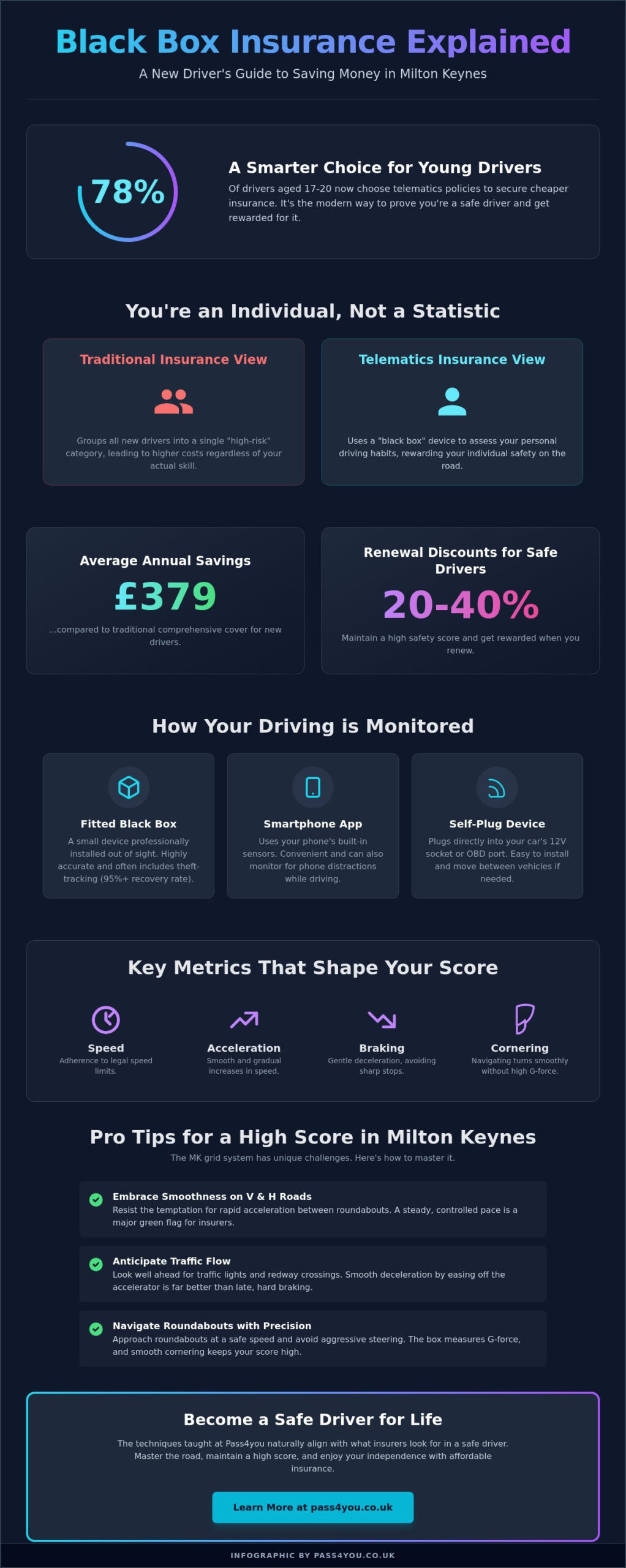
    Did you know that 78% of drivers aged 17 to 20 now secure cheaper insurance quotes by choosing a telematics policy? Getting black box insurance explained for new drivers is the first step toward saving an average of £379 a year. As of March 2026, young drivers using these devices pay an average of £1,313, which is significantly lower than traditional comprehensive cover. It’s completely normal to feel anxious about being “watched” or restricted while you’re navigating the Milton Keynes grid system. You’ve worked hard to earn your license, and you want to enjoy your new independence without the fear of technical confusion or exorbitant costs.

    We’re here to show you how telematics can actually be your best friend on the road. This guide breaks down how to maintain a high driving score on the H and V roads and explains the 20 to 40% renewal discounts available for safe road users. You’ll learn how to master your policy, understand the 2026 mileage rules, and gain the confidence to drive safely for life while keeping your hard-earned money in your pocket.

    Key Takeaways

    • Learn how telematics technology treats you as an individual driver rather than a risky statistic, rewarding your personal safety on the road.
    • Discover how navigating the Milton Keynes grid system with smooth acceleration and anticipation can protect your driving score and your wallet.
    • We have black box insurance explained for new drivers so you can confidently weigh significant premium savings against common concerns about being monitored.
    • Find out how the “safe driver for life” techniques taught at Pass4you naturally align with the data insurers use to lower your annual costs.
    • Master the specific habits that lead to impressive renewal discounts, helping you maintain affordable independence long after you pass your test.

    What is Black Box Insurance? A Simple Guide for Milton Keynes New Drivers

    Passing your driving test is a massive milestone. It’s the moment you finally trade your L-plates for total independence. But for many new drivers in Milton Keynes, that joy is often dampened by the reality of high insurance costs. This is why having black box insurance explained for new drivers is so important. It’s a practical, modern solution that helps you get on the road without breaking the bank while you’re still building your experience.

    At its heart, black box insurance uses GPS technology to monitor how you handle your car. Most traditional insurance companies look at you as a “high-risk” statistic simply because you’re young or newly qualified. Telematics changes that perspective. It treats you as an individual rather than a number. By opting for Usage-based insurance, you’re choosing a policy where your premium is adjusted based on real-world data. As of 2026, drivers who maintain a high safety score can expect renewal discounts between 20% and 40%. It’s a fair way to prove you’re a safe driver for life.

    How Telematics Technology Works in 2026

    The technology behind these policies has become incredibly sophisticated. You aren’t just limited to one type of device anymore. Most insurers now offer three main ways to track your driving habits. First, there are physical black boxes. These are small devices professionally fitted behind your dashboard where they stay out of sight. They’re excellent for accuracy and often include theft-tracking features, which helps recover over 95% of stolen vehicles equipped with them.

    Second, you might choose a smartphone app. These use your phone’s built-in sensors to detect movement, speed, and even phone distraction. Finally, there are self-plug devices. These units are designed to fit directly into your car’s 12V socket or OBD port. Whichever method you choose, the goal is the same. The device records your speed, how hard you brake, and how smoothly you take corners. This data is then used to calculate a safety score that directly impacts what you pay.

    Why Milton Keynes Drivers Benefit Most

    Driving in Milton Keynes presents specific challenges. Our unique grid system and high volume of roundabouts mean you’re constantly accelerating and braking. Because of the traffic levels on roads like the V8 or H6, local insurance premiums can be higher than in more rural areas. Having black box insurance explained for new drivers as a gateway to cheaper motoring gives you the chance to prove you’ve mastered these roads safely.

    Telematics acts as a tool for personalised risk assessment in 2026, allowing you to show insurers that you can navigate the MK grid with care. When you show you can handle the roundabouts with the same calm and patient approach you learned during your lessons, you’re rewarded with lower costs. It bridges the gap between passing your test and enjoying affordable car ownership. You get to keep your freedom while keeping your hard-earned money in your pocket.

    How Telematics Tracks Your Driving on the MK Grid System

    Milton Keynes presents a unique environment for any new driver. The grid system is efficient, but the constant cycle of accelerating to 60mph or 70mph and then slowing for a roundabout can be tricky for a telematics device to interpret. Having black box insurance explained for new drivers means understanding how every action on a V-road or H-road affects your profile. Insurers aren’t just looking at where you go; they’re looking at how you get there. They want to see that you’ve moved past the “learner” phase and are now a predictable, steady part of the traffic flow.

    Smoothness is the goal. When you’re driving on the V8 (Marlborough Street) or H9 (Groveway), the temptation to reach the speed limit quickly is high. However, rapid acceleration is a major red flag for telematics. Similarly, your braking needs to be controlled. Insurers prefer smooth deceleration rather than sharp, emergency stops. This is why the safe driving techniques we teach are so valuable. They help you anticipate traffic lights and redway crossings long before you need to hit the brakes, keeping your score high and your driving calm.

    Navigating MK Roundabouts Without Penalties

    Roundabouts like North Grafton or Oldbrook require precision. Your black box measures “G-force,” which is the physical force exerted on the car during a turn. If you take a roundabout too fast or steer aggressively, the box flags it as high-risk behavior. It’s best to maintain a steady speed through the exit and avoid “darting” between lanes in heavy traffic. A patient approach not only keeps you safe but ensures your black box car insurance provider sees you as a low-risk driver.

    Mileage and Night Driving in Buckinghamshire

    Many policies also track when and how much you drive. If you’re a commuter heading to the city centre, you might choose a “pay-as-you-go” mileage limit. Exceeding your agreed miles can result in extra charges, typically between 10p and 20p per mile. Time of day is another factor. Statistically, the window between 11 pm and 5 am is the most dangerous for new drivers. Some policies may apply a penalty or “curfew” during these hours. Balancing your social mileage with essential trips is key. By sticking to the speed limit, especially in 20mph residential zones like Fishermead, you prove you’re a responsible road user. This data-driven approach is exactly how 78% of young drivers manage to find cheaper quotes.

    Black Box Insurance Explained for New Drivers in Milton Keynes (2026 Guide)

    The Real Costs, Pros, and Cons of Black Box Policies in 2026

    Choosing your first insurance policy is often the most stressful part of passing your test. You’ve just gained your freedom, but the price tag can feel like a heavy weight. Having black box insurance explained for new drivers helps you see that these policies are essentially a financial reward for the safe habits you’ve already built. In March 2026, the average cost for a young driver with a black box is £1,313, compared to £1,561 without one. That’s a significant saving that makes car ownership much more accessible for everyone in Milton Keynes.

    Beyond the lower price, there’s the added security of theft tracking. If your car is stolen, telematics devices help insurers achieve a recovery rate of over 95%. It’s natural to have concerns about privacy; you might feel like someone is constantly looking over your shoulder. In reality, insurers only care about your driving data, like speed and braking force. They don’t track your personal life or listen to your conversations. They just want to ensure you’re maintaining the “safe driver for life” standard we promote at Pass4you.

    Telematics vs. Standard Car Insurance

    Standard insurance often treats every new driver the same, regardless of how careful they actually are. Telematics is different because it offers a “Safe Driver” bonus. If you consistently drive well, you can expect renewal discounts of 20% to 40% after your first year. In 2026, new drivers aged 17 to 20 save an average of £379 per year by opting for a telematics policy. This flexibility means your premium reflects your actual skill on the road rather than just your age or postcode. Getting black box insurance explained for new drivers shows that your good habits directly lead to better value for money.

    Common Black Box Myths Debunked

    Many people worry about strict penalties, but most of what you hear is just a myth. You won’t be fined for accidentally going one mile per hour over the limit once. Insurers look for patterns of behavior. If you consistently speed, you’ll likely receive a warning email or a “red flag” on your digital dashboard. Another common fear is that the box will cut your engine off if you drive after midnight. This isn’t true. While some policies have curfews that might lower your score for night driving, they will never disable your vehicle or leave you stranded. It’s all about providing a calm, transparent way to manage your costs while you gain experience on the road.

    How to Maintain a High Driver Score: Tips from Your MK Instructor

    Building a great driving score doesn’t happen by accident; it starts with the very first lesson you take. At Pass4you, we’ve helped hundreds of students achieve our 83.33% first-time pass rate by focusing on calm, patient techniques. When we provide black box insurance explained for new drivers, we always remind our students that the habits they learn in our Volkswagen tuition cars are exactly what telematics algorithms look for. Insurers love the defensive driving style we teach because telematics users have 20% to 30% fewer accidents in their first year on the road.

    Anticipation is your most valuable skill when navigating Milton Keynes. Instead of reacting to what’s happening directly in front of your bumper, you should look several junctions ahead. This allows you to ease off the accelerator early rather than braking sharply at a red light or a busy roundabout. Consistency is what builds a high score over time. One perfect trip won’t lower your premium, but weeks of steady, predictable driving will. Using the cruise control features in our modern tuition vehicles is a fantastic way to master speed management before you even have a black box installed.

    Mastering “Smoothness” on the Road

    We often use the “glass of water” analogy to help students understand smoothness. Imagine a full glass of water sitting on your dashboard. Your goal is to drive in a way that doesn’t spill a single drop. This means gentle pressure on the pedals and steady steering. During your lessons, we’ll practice lane discipline on the A5 to ensure your GPS tracking remains steady and professional. These safe habits ensure that when you finally get your own car, your book your first lesson experience translates directly into insurance savings.

    Using the App to Your Advantage

    Most 2026 telematics policies come with a smartphone app that acts as a digital coach. You should check your dashboard regularly to identify “weak spots” like cornering too quickly or harsh braking. If the GPS misinterprets a road layout, don’t be afraid to challenge a “false flag” with your insurer. Staying proactive helps you maintain your 20% to 40% renewal discount. You can also set up alerts to help you stay within your agreed mileage limits. Remember, exceeding your limit can result in extra charges of 10p to 20p per mile, so keeping a close eye on your app is a smart financial move.

    From Passing Your Test to Affordable Insurance in Milton Keynes

    Passing your driving test is a brilliant achievement. It’s the start of your journey as an independent driver on the MK grid. But staying safe on the road is what keeps your insurance costs low year after year. We’ve seen that students who learn in a calm, supportive environment are far more likely to maintain a high telematics score. When we have black box insurance explained for new drivers, we emphasize that the first year is critical. Our 83.33% first-time pass rate isn’t just about getting you through the test. It’s about ensuring you have the confidence and skill to handle your car without triggering “harsh event” alerts on your insurance app.

    Local knowledge of Milton Keynes test routes helps you avoid high-risk errors early on. We teach you how to handle the specific flow of the V-roads and H-roads so that your driving remains predictable to other road users and your black box. A calm learning environment leads directly to a calm telematics score. You’ll spend less on extra lessons and more time enjoying the freedom of your own vehicle. It’s a value-for-money approach that treats you as a responsible individual from day one.

    Why Pass4you Prepares You for the Black Box

    Simon’s patient teaching style is designed to eliminate the jerky driving habits that telematics boxes dislike. By mastering practical driving tests with a focus on smoothness, you’re setting yourself up for those 40% renewal discounts. Our modern Volkswagen tuition cars are equipped with the same advanced driver-assistance systems (ADAS) that insurers now analyze to determine your risk level. Learning with us means you’re already familiar with the technology that will be tracking your safety. You won’t feel intimidated by a device in your car because you’ve already mastered the skills it rewards.

    Ready to Start Your Journey in Milton Keynes?

    Getting black box insurance explained for new drivers is just the first step. The real work happens behind the wheel. Booking your first lesson with us allows you to build the foundational skills that save you money in the long run. We don’t just want you to pass; we want you to be a safe driver for life. This mindset is what keeps your premiums affordable and your driving record clean. You’ll have the confidence to navigate any roundabout or dual carriageway in Buckinghamshire with total ease. Book your driving lessons in Milton Keynes with Pass4you today!

    Take the Next Step Toward Your Driving Freedom

    You’ve seen how telematics isn’t about being restricted; it’s about being rewarded for the safe, calm habits you develop from your very first lesson. By having black box insurance explained for new drivers, you can take control of your costs and prove you’re a responsible road user on the MK grid. Remember that smooth braking and careful anticipation aren’t just for the test. They’re the secret to maintaining those 20% to 40% renewal discounts year after year.

    At Pass4you, we’re dedicated to helping you reach that goal. Our 83.33% first-time pass rate shows that our tried and tested methods work. Simon provides the patient, supportive environment you need to feel confident behind the wheel of our modern Volkswagen tuition vehicles. You won’t just learn to pass; you’ll learn to drive safely for life. Start your driving journey with Milton Keynes’ patient experts today and build the skills that keep your insurance affordable. Your independence is just around the corner, and we’re here to help you every step of the way.

    Frequently Asked Questions

    Is black box insurance cheaper for new drivers in 2026?

    Yes, it is typically much more affordable than standard policies. Data from March 2026 shows that 78% of drivers aged 17 to 20 receive a lower quote when choosing a telematics policy. On average, new drivers save £379 per year compared to traditional cover. This makes black box insurance explained for new drivers a vital topic for anyone looking to manage their budget while gaining independence.

    Will a black box record who is driving the car?

    No, the device does not identify the specific person behind the wheel. It uses GPS and sensors to track the car’s movement rather than the driver’s identity. If you have named drivers on your policy, their driving habits will also contribute to your overall score. It’s important to ensure everyone using the car follows the calm and safe techniques you learned during your lessons.

    What happens if I drive badly with a black box?

    You won’t be penalized for a single mistake. Insurers look for consistent patterns of risky behavior like speeding or harsh braking. If your score drops, you’ll usually receive a warning email or a red flag on your app. Persistent poor driving can lead to higher premiums or even policy cancellation. Staying patient and maintaining the habits taught by your instructor will keep your score high.

    Can I drive at night with black box insurance in Milton Keynes?

    Yes, you are free to drive at night. Most modern policies in 2026 have moved away from strict curfews that disable the vehicle. However, statistics show that driving between 11 pm and 5 am is higher risk. While you won’t be stopped from driving, your safety score might be slightly lower for trips made during these late hours. It’s all about balancing your essential trips with your score.

    Do black boxes drain your car battery?

    No, these devices do not drain your battery. They are designed to use a minimal amount of electricity, similar to your car’s digital clock. If your car is in regular use and the battery is healthy, you won’t experience any issues. If you’re using a smartphone app version, it will use your phone’s battery instead; keeping a charger in the car is a smart move for any new driver.

    How long does it take to get a black box fitted?

    A professional fitting usually takes between 45 and 60 minutes. An engineer will discreetly install the device behind your dashboard at a time that suits you. Many insurers now also offer self-plug units or app-based versions. These can be set up in under five minutes, allowing you to start your black box insurance explained for new drivers journey almost immediately after your policy begins.

    Can I get black box insurance on a provisional licence?

    Yes, you can absolutely get a telematics policy while you’re still a learner. Many providers offer specific products for those on a provisional license. It’s a fantastic way to prove you’re a safe driver before you even pass your test. Starting early can help you build a positive history that leads to even bigger discounts once you qualify and get your full license.

    Does a black box track my location at all times?

    Yes, the device uses GPS to monitor the vehicle’s location at all times. Insurers use this data to understand the types of roads you use and to provide theft recovery services. In fact, vehicles with telematics have a recovery rate of over 95%. Your data is protected by strict privacy laws and is only used to assess your driving safety or provide help if the car is stolen.

  • Cheapest Cars for New Drivers to Insure in Milton Keynes: 2026 Guide

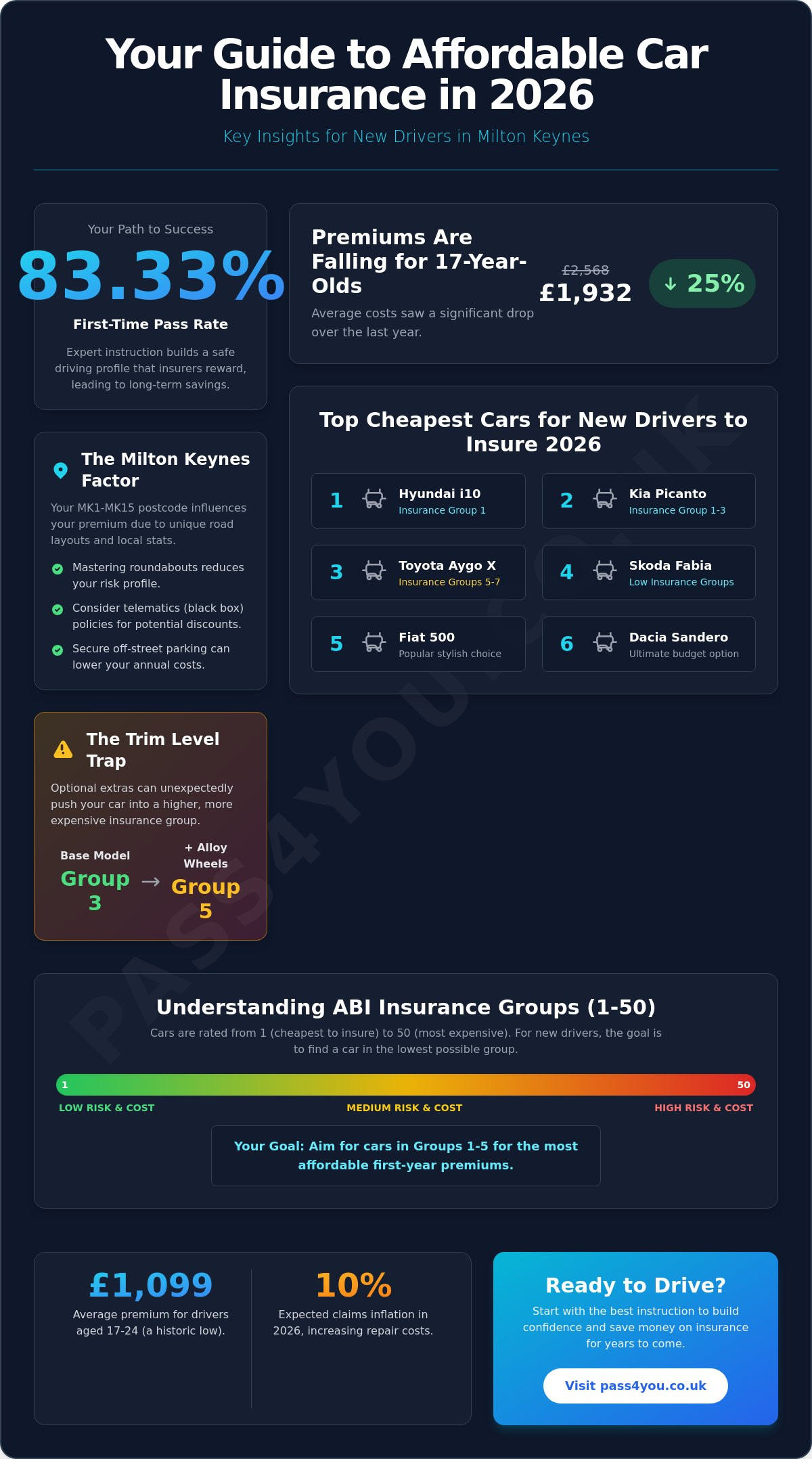
    Did you know that the average insurance premium for 17-year-old drivers plummeted by 25% over the last year, dropping from £2,568 to £1,932? While this is a huge step in the right direction, seeing a four-figure quote still feels like a massive hurdle when you just want the freedom of the open road. Finding the cheapest cars for new drivers to insure 2026 doesn’t have to be a guessing game that ends in confusion or a £2,000 bill. We understand that after the excitement of passing your test with our 83.33% first-time pass rate, the last thing you want is the anxiety of choosing a car that’s “uninsurable” for a beginner.

    You deserve to feel confident in your first big purchase without worrying about hidden costs. We promise to clear up the confusion surrounding the new vehicle risk ratings and insurance groups. This guide will help you identify the top 10 most affordable models for 2026, from the Hyundai i10 to the Dacia Sandero. We also share practical Milton Keynes tips to lower your premiums, showing you how the calm, safe habits you learned during your lessons can lead to real savings on your annual policy.

    Key Takeaways

    • Understand how your specific Milton Keynes postcode, from MK1 to MK15, influences your initial quotes and base insurance costs.
    • Identify the cheapest cars for new drivers to insure 2026, featuring models like the Hyundai i10 and Kia Picanto that keep premiums manageable.
    • Learn to avoid the “Trim Level Trap” where optional extras like alloy wheels can unexpectedly bump your car into a higher insurance group.
    • Get local advice on whether telematics and specific parking choices in Milton Keynes estates can help lower your annual policy price.
    • Discover how expert instruction builds a safe driving profile that helps you secure better insurance rates long after you pass your test.

    Why Car Insurance Costs are Rising for Milton Keynes Learners in 2026

    The UK insurance market in early 2026 feels like a bit of a rollercoaster. While average premiums for young drivers aged 17 to 24 have actually dropped to £1,099, which is a historic low compared to the peak of 2024, the underlying costs of repairs are climbing. Claims inflation is expected to hit 10% this year. This creates a confusing environment for learners. You might find a great deal on the cheapest cars for new drivers to insure 2026, but then see that quote jump because of a specific postcode or a minor vehicle modification. We see many students feel overwhelmed by these numbers. It’s why we focus on more than just passing the test. We want you to feel calm and prepared for the financial side of driving too. Understanding the history of car insurance in the UK helps explain why these rules exist. It’s all about managing risk.

    The psychological impact of seeing a high quote can be discouraging. We’ve spoken to learners who nearly gave up because they feared they’d never afford to get on the road. We don’t want that to happen to you. At Pass4you, we help you understand these costs early on. We believe that a high-quality education is the best investment. Our 83.33% first-time pass rate doesn’t just save you money on lessons; it sets you up as a responsible driver that insurers eventually want to reward. When you’re confident behind the wheel, you’re less likely to make the small mistakes that lead to expensive claims.

    Postcodes and Premiums: The MK Factor

    In Milton Keynes, your address plays a huge role in your monthly bill. Insurers look at the MK1 to MK15 postcodes differently than they do for our neighbors in Bedford or Northampton. Our unique grid system and the sheer number of roundabouts mean that local accident statistics can be higher for minor bumps and scrapes. This often makes insurers more cautious when they see an MK address. However, being a “safe driver” in a city built on roundabouts is a badge of honor. By learning with a patient mentor like Simon, you build the specific skills needed to navigate these junctions safely. This reduces your risk profile from day one and helps you feel more in control of your future costs.

    The Role of the Association of British Insurers (ABI)

    The ABI uses a rating system from 1 to 50 to categorize every car on the road. For a new driver, finding a car in Group 1 is the goal. These are typically the cheapest cars for new drivers to insure 2026 because they’re cheaper to repair and have smaller engines. In 2026, the new Vehicle Risk Rating (VRR) model also looks at safety tech. While things like Advanced Driver Assistance Systems (ADAS) make cars safer, they also make them more expensive to fix if you have a nudge. This is why a simple, sturdy car often remains the most budget-friendly choice for your first year on the road.

    The Top 10 Cheapest Cars for New Drivers to Insure in 2026

    Choosing your first car is an exciting milestone, but it’s often clouded by the worry of high insurance costs. We want to help you make this decision with a sense of calm and clarity. By focusing on vehicles in the lowest insurance groups, you can keep your premiums manageable from the very start. The cheapest cars for new drivers to insure 2026 are those that combine safety, low repair costs, and modest engine sizes. Starting your journey with one of these models ensures you’re making a choice that is both practical and budget-friendly.

    The Hyundai i10 continues to be the reigning champion of affordability for 2026. Most models sit comfortably in Insurance Group 1, making it a fantastic entry point for beginners. Close behind is the Kia Picanto. Many Milton Keynes families choose the Picanto because of its famous 7-year warranty, which provides extra peace of mind alongside low insurance rates. For those who prefer a slightly more rugged look, the Toyota Aygo X offers crossover styling without the expensive crossover premiums. It typically falls into groups 5 to 7. Meanwhile, the Skoda Fabia remains a solid, practical choice that balances interior space with a low-group rating, perfect for navigating the MK grid roads with confidence.

    The Best of the Rest: Positions 6-10

    If the top four don’t quite fit your style, there are several other excellent options available in 2026. The Fiat 500 remains a popular choice, especially with its hybrid and electric variants that appeal to eco-conscious city drivers. The Dacia Sandero is widely regarded as the ultimate budget-conscious choice for local commuters. It offers a lot of car for a very small price tag. Other reliable options include the Renault Clio, which is packed with safety features that insurers love, and the SEAT Arona for those who want a small SUV feel. While the Volkswagen Up! is now primarily a used market option, it remains a brilliant, low-insurance choice for new drivers in Milton Keynes.

    Why the Volkswagen Polo is an MK Favourite

    The Volkswagen Polo holds a special place in our hearts because it’s the car we trust for our students. Visibility is a critical factor when you’re tackling the many roundabouts of Milton Keynes. The Polo offers a clear view of your surroundings, making lane changes and exits feel much less stressful. Its build quality and reliability are second to none, which is why we use modern VW vehicles for our tuition. If you want to get a feel for how a Polo handles before you buy one, you can book driving lessons Milton Keynes with us to gain hands-on experience in a safe, supportive environment.

    Beyond choosing the right car, you can further lower your costs by looking into the Pass Plus scheme. This additional training shows insurers that you’re committed to being a safe driver for life. When you combine a Group 1 vehicle with expert instruction and advanced certifications, you’ll find that the cheapest cars for new drivers to insure 2026 become even more affordable. We’re here to help you every step of the way, ensuring you feel confident and prepared for your life on the road.

    Cheapest Cars for New Drivers to Insure in Milton Keynes: 2026 Guide

    Understanding Insurance Groups: How to Save Money Before You Buy

    Have you ever wondered why two cars that look almost identical can have completely different insurance costs? It’s all down to the insurance group system. In 2026, every vehicle in the UK is assigned a group from 1 to 50 by the Association of British Insurers. The lower the number, the lower the risk for the insurer. We want you to feel confident when you start browsing showrooms, so remember that Group 1 is the “Holy Grail” for your wallet. While looking for the Top 10 Cheapest Cars to Insure, you’ll see that even small choices can have a big impact on your final quote.

    One of the biggest mistakes we see is the “Trim Level Trap.” You might find a base model Hyundai i10 in Group 1, but if you choose a higher trim with fancy alloy wheels or a sunroof, you could jump to Group 5 or higher. Insurers see those extras as more expensive to replace if you have an accident. Engine technology has also shifted significantly in 2026. Many small cars now use turbochargers to get more power from a tiny engine. While this is great for fuel efficiency, insurers often view that extra power as a higher risk. Always check the exact insurance group of the specific car you’re looking at, not just the model name, to find the cheapest cars for new drivers to insure 2026.

    Safety Tech that Lowers Premiums

    By 2026, Autonomous Emergency Braking (AEB) has become a standard requirement for cars to achieve low insurance ratings. This technology is a lifesaver on Milton Keynes roundabouts, where low-speed bumps are common. Insurers also give better rates for cars equipped with lane-keep assist, which helps you stay safe on our fast-moving V-roads. We always recommend looking for cars with factory-fitted immobilisers and alarms. These security features show you’re taking a responsible approach to protecting your vehicle, which gives insurers more peace of mind and leads to lower premiums for you.

    New vs. Used: The 2026 Insurance Debate

    It’s a common myth that an old, cheap car is always the cheapest to insure. In 2026, a brand new car might actually cost less to cover than a model from 2018. Newer cars are built with better safety standards and more efficient repair methods. However, repair costs for modern sensors have risen by 10% this year, so insurers weigh this up carefully. When you’re looking at used cars in areas like Bletchley or Wolverton, check the service history and parts availability. A car that’s easy to fix will always be among the cheapest cars for new drivers to insure 2026. Taking the time to research these details now will help you feel much more relaxed when it’s time to pay your first premium.

    Milton Keynes Specific Tips for Reducing Your New Driver Premiums

    Living in Milton Keynes offers a unique driving experience that insurers watch closely. While picking one of the cheapest cars for new drivers to insure 2026 is a brilliant start, your habits and local choices can drive those costs even lower. One effective method is adding an experienced named driver, like a parent, to your policy. This often reduces the premium because the insurer assumes the more experienced person will spend some time behind the wheel. However, you must be honest. If the new driver is the main user but you claim the experienced person is, that’s “fronting.” It’s illegal and will void your insurance instantly. We want you to start your driving life on the right side of the law, feeling confident and secure.

    Your annual mileage estimate also plays a role. Since Milton Keynes is a major commuter hub, it’s easy to over-calculate how much you’ll actually drive. Be realistic. If you only use your car for short trips to the Centre:MK or local college runs, tell your insurer. Lower mileage usually means a lower risk of accidents, which can lead to a more affordable quote for even the most popular 2026 models.

    Optimising Your MK Parking

    Where you leave your car at night matters. In newer Milton Keynes developments like Oakgrove or the western expansion areas, many homes come with dedicated driveways or carports. Insurers generally prefer this over street parking in older estates like Shenley Lodge. If you have a garage, use it. Simply telling an insurer the car is garaged can shave a percentage off your bill. For those who have to park in busy areas or the town centre, consider adding a dashcam or a visible steering lock. These small security additions show you’re a responsible owner, which helps when you’re looking for the cheapest cars for new drivers to insure 2026.

    The Black Box and the MK Grid

    Telematics, or “black box” insurance, is a popular choice for our students. It monitors your driving style and rewards safe habits with lower costs. In Milton Keynes, this is particularly relevant because of our 60mph grid roads. The box tracks how you handle these speeds and, more importantly, how you approach the thousands of roundabouts connecting the H and V roads. Smooth braking and staying within the limit are essential. If you’re aggressive on the brakes every time you hit a roundabout, your “safety score” will drop.

    Mastering these unique road layouts early on is the best way to keep your telematics score high. If you’re still at the beginning of your journey, finding driving instructors near me who understand the MK grid can make a huge difference. By learning to navigate these roads calmly and safely, you’re not just passing a test; you’re proving to insurers that you’re a low-risk driver. If you want to build this level of skill and save money in the long run, book your first lesson with Pass4you today.

    How Passing Your Test with Pass4you Leads to Long-Term Savings

    Choosing one of the cheapest cars for new drivers to insure 2026 is only half the battle. The other half is ensuring you have the skills to keep that insurance low for years to come. At Pass4you, we’re proud of our 83.33% first-time pass rate. This isn’t just a statistic we like to share; it’s a direct financial benefit for you. Passing your test the first time means you aren’t spending extra money on repeated test fees or additional “top-up” lessons. We focus on getting you ready efficiently, so you can move your budget from driving lessons to your first car’s fuel tank.

    Simon’s approach to mentoring goes beyond the basic requirements of the DVSA. He acts as a calm and patient guide, helping you build the confidence needed to handle the pressure of solo driving. Most “new driver” insurance claims happen within the first six months of passing. By teaching you to anticipate hazards rather than just reacting to them, we help you avoid those initial bumps that cause premiums to skyrocket. When you start your driving career with a clean record, you’re on the fastest path to building a No Claims Bonus, which is the most effective way to lower your costs over time.

    Beyond the Test: Insurance-Friendly Driving Habits

    Insurers love defensive drivers. The techniques we teach, such as maintaining safe following distances and early speed adjustment for junctions, are exactly what telematics boxes look for. Learning in our modern, safe VW vehicles gives you a head start. These cars are equipped with the latest safety technology, helping you understand how features like hill-start assist and parking sensors work in the real world. Milton Keynes learners trust our method because we don’t just teach you how to pass; we teach you how to be a safe driver for life. This reputation for safety is a powerful asset when you’re looking for the cheapest cars for new drivers to insure 2026.

    Book Your First Lesson in Milton Keynes

    Your journey to freedom starts with a single, positive step. We know that the MK grid system can feel intimidating at first, with its fast V-roads and complex roundabouts. That’s why we specialise in preparing you for these specific local challenges. Simon’s patient teaching style ensures you never feel rushed or shouted at, even when the traffic gets busy. We want you to feel empowered every time you get behind the wheel. If you’re ready to transition from car research to the driver’s seat, we’re here to help you succeed. Book your driving lessons with Pass4you today and start building the skills that save you money and keep you safe.

    Take the Wheel with Confidence and Savings

    Finding the cheapest cars for new drivers to insure 2026 is the first step toward your independence. By choosing a Group 1 vehicle like the Hyundai i10 and understanding how your Milton Keynes postcode affects your premiums, you can significantly reduce your initial costs. Your driving habits on the grid roads are just as important as the car you pick. Using telematics and mastering our local roundabouts safely will keep your insurance affordable for years to come.

    We’re here to make sure you start that journey with the best possible foundation. Our expert local knowledge of the MK grid system combined with our modern Volkswagen tuition vehicles ensures you feel calm and prepared. We take pride in our 83.33% first-time pass rate because it saves our students time and money. When you learn with a patient mentor like Simon, you aren’t just passing a test; you’re becoming a safe driver for life. Are you ready to start your journey? Join the 83.33% who pass first time, book your MK lessons now! You have a bright future on the road ahead of you.

    Frequently Asked Questions

    What is the cheapest car for a 17-year-old to insure in 2026?

    The Hyundai i10 is currently the most affordable option for 17-year-olds. Most entry-level models sit in Insurance Group 1, which helps keep premiums as low as possible. Because it has a small engine and high safety ratings, it’s consistently ranked among the cheapest cars for new drivers to insure 2026. Other strong contenders include the Kia Picanto and the Dacia Sandero, which also offer low-group ratings for beginners.

    Does Milton Keynes have higher insurance rates than other UK cities?

    Milton Keynes often sees higher premiums than nearby towns like Bedford or Northampton. Insurers look closely at our unique grid system and the high volume of roundabouts, which can lead to more frequent minor collisions. While the South West of England enjoys the lowest UK average of £471, drivers in MK postcodes often pay more due to these local risk factors. Learning to navigate these roads safely with a patient instructor is the best way to prove you’re a low-risk driver.

    Is black box insurance mandatory for new drivers in MK?

    No, telematics or “black box” insurance isn’t a legal requirement in Milton Keynes. However, many young drivers find it’s the only way to get a quote that doesn’t feel sky-high. By letting a device monitor your speed on the 60mph grid roads and your braking at roundabouts, you can often save hundreds of pounds. It’s a great way to build your confidence and show insurers that you’re a responsible person behind the wheel.

    Can I lower my insurance by taking more driving lessons?

    Taking professional lessons definitely helps lower your long-term costs. While the number of lessons doesn’t change your quote instantly, the quality of instruction reduces your risk of having an accident in your first year. Insurers value drivers who have been trained to a high standard. Completing additional training like the Pass Plus scheme after your test can also lead to significant discounts with many major UK insurance providers.

    What insurance group is a Volkswagen Polo for a new driver?

    A Volkswagen Polo typically falls between Insurance Groups 3 and 10. The exact group depends on the specific engine size and trim level you choose. We use modern Polos for our tuition because they’re safe and reliable, but we always advise checking the exact registration before you buy. Avoiding the “Trim Level Trap” with fancy extras will help ensure your Polo stays among the cheapest cars for new drivers to insure 2026.

    How much does car insurance usually cost for a first-time driver in 2026?

    The average premium for drivers aged 17 to 24 has settled at £1,099 in early 2026. If you’re exactly 17, you should expect to see higher quotes, with the average currently sitting at £1,932. This is actually a 25% decrease from the previous year. You can often beat these averages by choosing a Group 1 car and maintaining a clean driving record from the day you pass your test.

    Does passing my test first time with Pass4you help with insurance?

    Yes, passing the first time is a huge advantage for your wallet. Our 83.33% first-time pass rate means you save money on extra test fees and additional lessons. More importantly, the calm and defensive driving habits Simon teaches help you avoid the “new driver” claims that make insurance expensive. Starting your driving life with the confidence of a first-time pass sets you up for a lifetime of lower premiums.

    Are electric cars cheaper to insure for beginners in 2026?

    Electric vehicles are actually about 25% more expensive to insure than petrol or diesel cars in 2026. This is mainly due to the higher cost of specialist repairs and battery replacements. While they’re great for the environment and local MK commuting, a small petrol car like a 1.0L engine remains the most budget-friendly choice for a beginner’s insurance policy. We recommend sticking to traditional low-group cars for your first year on the road.

  • Feeling Confident Driving Alone for the First Time in Milton Keynes (2026 Guide)

    You’re sitting at the edge of a busy Brooklands roundabout on a wet Tuesday morning, and for the first time, the passenger seat is empty. There are no dual controls to save you if you stall, and the familiar H and V grid roads suddenly feel like a complex maze rather than a simple map. If your heart is racing, you aren’t alone. Many of the 1.6 million people who pass their driving test in the UK each year feel exactly the same way. We understand that feeling confident driving alone for the first time is often a bigger challenge than the driving test itself.

    It’s completely natural to worry about making a mistake or getting lost on your way to the MK Hub. You’ve spent your lessons with a calm mentor by your side, and now you’re responsible for every single decision. This guide is designed to help you bridge that gap and move from being a nervous test-passer to a truly independent driver. We’ll share practical, local strategies to help you navigate Milton Keynes with ease, ensuring you can finally enjoy the freedom your new license provides. From mastering those famous roundabouts to planning your first solo commute, here is your roadmap to stress-free driving in 2026.

    Key Takeaways

    • Understand the “Safety Net Syndrome” and why your initial nerves are actually a sign that you are a responsible, safe driver.
    • Learn how to plan your first solo routes in Milton Keynes to avoid peak-time traffic while you familiarise yourself with your own car’s controls.
    • Discover the 5-mile radius rule, a proven strategy for feeling confident driving alone for the first time by gradually expanding your territory.
    • Prepare for the transition from a quiet tuition environment to the real-world challenges of solo night driving and managing distractions.
    • Find out how a “Safe Driver for Life” approach and an 83.33% first-time pass rate translate into genuine readiness for the road.

    The Psychology of the First Solo Drive: Why You Feel Nervous

    Passing your driving test is a massive achievement, but sitting in the driver’s seat without an instructor for the first time feels very different. You might experience what experts call “Safety Net Syndrome.” For your lessons, you had Simon and his dual controls to step in if things got tricky. Now, that physical backup is gone. This shift can trigger The Psychology of the First Solo Drive, where the brain suddenly realises every single decision rests on your shoulders.

    Feeling anxious is actually a positive sign. It shows you’re a responsible driver who understands the weight of operating a vehicle on Milton Keynes’ busy grid roads. In 2026, with increased traffic and evolving smart infrastructure, staying alert is your best tool for feeling confident driving alone for the first time. You aren’t just “passing a test” anymore; you’re navigating real life, which requires a different type of mental stamina.

    During your training, your brain often relied on guided instruction to filter hazards. When you’re solo, your prefrontal cortex works harder to process navigation and road safety simultaneously. This transition is a natural phase of your development. You’ve been taught to be a safe driver for life, and these initial nerves are simply your mind’s way of ensuring you stay focused and cautious.

    The “Silent Passenger” Technique

    One of the best ways to bridge the gap between lessons and solo trips is “commentary driving.” This involves speaking your thoughts out loud as you drive. Tell yourself when you’re checking mirrors or approaching a roundabout. Visualising Simon’s calm guidance when approaching a busy MK junction helps maintain your focus. We define “Internalised Instruction” as the bridge to solo confidence, where your instructor’s expert advice becomes your own inner voice. It keeps your mind from wandering into “what if” scenarios and keeps you grounded in the present moment.

    Managing Performance Anxiety on the Grid

    Many new drivers suffer from “imposter syndrome” after getting their pink licence. You might feel like you aren’t truly ready, but your 83.33% first time pass rate foundation means you are objectively prepared. If you feel overwhelmed, remember the physiological benefits of deep breathing. Taking slow, controlled breaths for 60 seconds before you turn the key lowers your heart rate and clears your head. You’ve already proven your skills to an examiner; now you’re just building the habit of being the sole captain of your car on the MK grid.

    Differences Between Tuition and Driving Alone in 2026

    The transition from the passenger seat to the driver’s side without an instructor is a significant milestone that requires a shift in mindset. During your lessons, you have the safety net of dual controls. If you misjudge a braking distance on the V6 Grafton Street, your instructor is there to intervene. When you’re solo, you take 100% responsibility for every centimetre of that stopping gap. This shift is the biggest hurdle to feeling confident driving alone for the first time, but it’s one you’re fully prepared to handle.

    By 2026, the tech gap between tuition vehicles and first cars has widened. You likely learned in a modern VW with lane assist and regenerative braking, but your first personal car might have a different clutch bite point or older sensors. Adapting to these mechanical differences takes patience. You aren’t just learning the road anymore; you’re learning the unique personality of your own vehicle. Our 83.33% first-time pass rate is built on teaching you to handle any car with a calm, methodical approach.

    Environmental Changes: From Learner to Road User

    Removing the “Learner” roof sign changes how the MK driving community interacts with you. Without that visual cue, other drivers expect you to react with the speed of a veteran. They might follow closer or pull out more aggressively at junctions. Using “P” plates for at least the first 12 weeks is a smart way to communicate that you’re still gaining experience. It encourages others to give you the space you need while you manage new distractions like Sat-Nav prompts or a radio playlist. Keeping the cabin quiet during your first few solo trips helps maintain the focus you had during your lessons.

    The Responsibility of Independent Decision Making

    Decision making feels different when there’s no one to give a subtle “yes” at a busy roundabout. You’ll need to judge gaps on the H5 Portway entirely on your own. If you take a wrong turn, there’s no immediate correction from the passenger seat. You must stay calm, continue driving, and find a safe place to reroute. This is where your training truly kicks in. “A safe driver doesn’t just manage their own vehicle; they anticipate the unpredictable choices of every other road user to create a permanent bubble of safety.”

    This independent stage is where you move from being a student to a “safe driver for life.” If you ever feel your nerves getting the better of you, remember the calm and patient techniques we practiced to help you regain your composure. Every solo trip you complete builds the muscle memory needed for long-term success on the road.

    Feeling Confident Driving Alone for the First Time in Milton Keynes (2026 Guide)

    Preparing for Your First Solo Journey in Milton Keynes

    Your first trip alone shouldn’t be a stressful dash to the Centre:MK during the Saturday afternoon rush. Success starts with a calm environment. Feeling confident driving alone for the first time is much easier when you aren’t fighting for space in heavy traffic. Before you even turn the key, spend ten minutes sitting in your car to get familiar with the controls. If you’ve moved from your instructor’s car to your own vehicle, the biting point and brake sensitivity will feel different. Practice finding the biting point on your driveway or a quiet side street until it feels like second nature.

    Preparation also means setting up your “Solo Kit” to reduce distractions. Keeping these essentials in your car provides a safety net that settles your nerves:

    • A fully charged phone: Keep it in a secure cradle, not your pocket.
    • Physical breakdown details: Have your membership number and the phone number written down.
    • Water and a snack: Low blood sugar can make you feel more anxious.
    • The 2026 Digital Setup: Modern Sat-Navs are helpful, but they can be distracting. Input your destination before you leave and turn on “Do Not Disturb” mode for your phone.

    Mastering the MK Grid System Solo

    Milton Keynes is famous for its H (Horizontal) and V (Vertical) roads. While this grid is logical, it can feel overwhelming when you’re the only person in the car. The right-hand lane at MK roundabouts is a common source of fear for new drivers. If you find yourself in the wrong lane on the V6 or H5, don’t try to make a sudden, risky move. Take the wrong exit instead. The beauty of the MK grid is that you can easily find an “escape route” by going around the next block. It’s better to take a five-minute detour than to make a pressured decision in traffic.

    Choosing the Right Time and Conditions

    Timing is everything. A Sunday morning at 8:00 AM is the golden hour for new drivers in Milton Keynes. The roads are quiet, the light is usually clear, and you have the space to make mistakes without consequence. Avoid the high-speed challenges of the A5 or the M1 until you’ve spent at least a week driving locally. If you feel like you need a little more support before heading out alone, you can check our Driving Lessons Milton Keynes guide for refresher tips. Simon and the team have helped hundreds of students reach an 83.33% first-time pass rate by focusing on this exact kind of local preparation. You’ve got the skills; you just need the right environment to let them shine.

    Actionable Steps to Build Long-Term Driving Confidence

    Passing your test is a massive achievement, but feeling confident driving alone for the first time is a process that continues long after you’ve received your certificate. We’ve seen many students transition from nervous learners to calm, independent drivers by following a structured plan. Start with the 5-mile radius rule. For the first seven days, stay within five miles of your home. This familiar territory allows you to focus on car control without the stress of navigating unfamiliar road layouts.

    Milton Keynes presents unique challenges with its high-speed grid system. You’ll eventually need to tackle the “Big Roundabouts” like the A6 and A421 junctions or the busy MK Hub. Approach these during quiet times first, such as Sunday mornings. If you’re feeling anxious, try a “No-Radio” week. Turning off the music lets you hear the engine and feel the gear changes, which builds a stronger mechanical connection with your vehicle. Night driving also requires specific mental prep. The lack of streetlights on some rural MK fringes changes your depth perception. Plan your first solo night trip on a route you’ve already driven at least three times during the day.

    Expanding Your Horizons Safely

    Set a weekly driving goal to keep your progress steady. This could be a solo trip to the Sainsbury’s in Central MK or visiting a friend in Bletchley. If you stall or make a mistake in traffic, take a deep breath. Other drivers have been there too. For those ready to step up their speed, our Mastering the Dual Carriageway guide offers specific tips for merging safely onto the V-roads at 60mph or 70mph.

    The Role of Continued Learning

    Even after passing, some drivers benefit from a “Post-Pass” lesson. This is especially helpful for motorway entry, which isn’t covered in the standard test. Many of our successful students found that doing a mock solo run during their final practical driving test preparation helped them feel less isolated once the examiner was gone. After every trip, spend two minutes evaluating what went well. Did you stay calm at the roundabout? Was your lane discipline better? Recognising these small wins is how you end up feeling confident driving alone for the first time and every time after that.

    Ready to take the next step in your driving journey? Book your confidence-building lessons with Pass4you today.

    How Pass4you Prepares You for Solo Success

    At Pass4you, we believe there’s a massive difference between being “test-ready” and being “road-ready.” Our “Safe Driver for Life” philosophy ensures you aren’t just memorizing maneuvers to please an examiner. We prepare you for the decades of driving that follow your practical test. This approach is why so many of our students report feeling confident driving alone for the first time immediately after getting their license. You won’t feel like a beginner who got lucky; you’ll feel like a competent motorist who belongs on the road.

    Our 83.33% first-time pass rate isn’t just a statistic we like to show off. It serves as proof that our methods work. We don’t rush you or cut corners. By the time you head to the test center, you’ve developed the genuine solo readiness required to navigate busy UK roads safely. This success is rooted in the Simon Method. This teaching style focuses on building calm, logical thinkers. Instead of reacting with stress when a situation changes, you’ll learn to analyze the road and make proactive decisions. It’s about understanding the “why” behind every action.

    Because we focus specifically on Milton Keynes, you become a local expert before you even pass. We spend time on the specific grid roads and roundabouts that define our town. You’ll know exactly which lane to be in at the Abbey Hill roundabout or how to merge safely on the V6. This local knowledge removes the guesswork from your first solo trips, allowing you to focus on the drive itself rather than worrying about getting lost or being in the wrong lane.

    Expert Instruction that Sticks

    We provide all our lessons in modern, safe VW vehicles. These cars are reliable and easy to control, which helps build your physical confidence behind the wheel. Our patient approach is specifically designed to prevent “solo-shock.” This is the common feeling of panic new drivers get when they realize there are no dual controls to save them. We gradually reduce our input during your final lessons so that feeling confident driving alone for the first time becomes a natural transition rather than a scary leap. Our testimonials from MK students frequently mention how they felt supported and empowered from their very first hour with us.

    Start Your Journey with Confidence

    If you’re nervous about starting or have had a bad experience with a shouting instructor in the past, we invite you to experience the Pass4you difference. We specialize in turning anxious learners into safe, independent drivers. You can find more details on how we help you succeed by visiting our Driving Instructors Near Me resource. This guide helps you find the best local lessons in 2026. You have the ability to master the road; we’re just here to help you find it. Trust your training, take a deep breath, and enjoy the freedom that comes with your new license.

    Take the Wheel with Total Peace of Mind

    Transitioning from a learner to an independent driver in Milton Keynes is a massive milestone. It’s natural to feel a bit of pressure when those L-plates finally come off, but your training has prepared you for this exact moment. By understanding the psychology of your first solo trip and focusing on familiar routes, you’ll find that feeling confident driving alone for the first time becomes second nature much faster than you expect. You’ve already mastered the city’s complex roundabouts; now it’s just about trusting the skills you’ve built.

    At Pass4you, we don’t just help you get a licence. We focus on creating safe drivers for life. Simon provides patient, calm instruction in modern Volkswagen tuition vehicles to ensure you feel supported during every lesson. Our approach works, as shown by our 83.33% first-time pass rate. We give you the tools and the mindset to handle the 2026 roads with ease and certainty.

    Ready to become a safe, confident driver for life? Book your Milton Keynes driving lessons with Pass4you today.

    The freedom of the open road is waiting for you, and we’re excited to help you claim it with confidence.

    Frequently Asked Questions

    Is it normal to be terrified of driving alone for the first time?

    It is completely normal to feel nervous or even terrified about your first solo trip. A 2024 survey of new UK drivers showed that 70% of participants felt a significant spike in anxiety during their first week without an instructor. You’ve spent many hours with a patient instructor like Simon building your skills, so you already have the tools to stay safe. Start with short, familiar routes to build that initial spark of confidence and remember that your nerves will settle with practice.

    Should I use “P” plates when driving alone in Milton Keynes?

    Using “P” plates is a brilliant way to alert other MK drivers that you’re still gaining experience. While they aren’t a legal requirement, they encourage 85% of surrounding motorists to give you more space and patience. This extra room is especially helpful when navigating the high-speed H and V roads. It takes the pressure off while you’re still feeling confident driving alone for the first time, allowing you to focus on your lane discipline.

    What should I do if I get lost on the Milton Keynes grid system?

    If you lose your way on the grid system, find a safe place to pull over, such as a local estate or a designated parking bay. Milton Keynes is designed with clear H and V signage at every major junction, so it’s easy to reset your route once you’ve stopped. Don’t try to fix your Sat Nav or check a map while the car is moving. Take a breath, check your position, and remember that the grid layout means you’re never more than a few minutes from a main link road.

    How long does it take to feel fully confident driving on my own?

    Most new drivers report feeling fully relaxed after about 3 to 6 months of regular solo driving. Data from road safety groups suggests that confidence grows significantly after the first 1,000 miles on the road. Everyone moves at their own pace, so don’t rush yourself. Consistent practice on familiar routes like the A5 or local grid roads will help you feel more at home behind the wheel as you work toward feeling confident driving alone for the first time.

    Can I take a passenger on my first solo drive?

    You can legally take passengers as soon as you pass your test, but going solo for your first few trips is often better for your focus. Passengers can be a major distraction, especially if they’re talkative friends or family members. Many of our successful students find that driving alone for the first 50 miles helps them concentrate on their own decision-making. If you do decide to take someone, choose a calm person who will support you rather than someone who might make you feel more pressured.

    What is the best time of day for a first solo drive in MK?

    The best time for your first solo drive in Milton Keynes is between 10:00 am and 2:00 pm on a weekday. During these hours, traffic volume on the grid roads is roughly 40% lower than during the morning peak. Sunday mornings are also a fantastic choice because the roads are much quieter. Avoiding the 5:00 pm rush hour helps you focus on your surroundings without the pressure of heavy traffic or aggressive commuters.

    What if I stall my car at a busy Milton Keynes roundabout?

    If you stall at one of the 130+ roundabouts in Milton Keynes, stay calm and follow the steady routine you learned in your lessons. Put your handbrake on, restart the engine, and perform your safety checks before moving off again. Other drivers might beep, but they were once in your shoes too. Focus entirely on your own car rather than the people behind you. Taking a deep breath helps you regain control and continue your journey safely and professionally.

    How can I practice driving on the M1 if I am still nervous?

    If you’re nervous about the M1, consider booking a single motorway confidence lesson with a professional mentor. We help many drivers tackle the transition from grid roads to three-lane motorways using a patient, step-by-step approach. If you decide to go alone, try a short trip between Junction 14 and Junction 13 during off-peak hours. This 4-mile stretch is a great way to practice merging and maintaining high-speed safety in a controlled way.

  • Provisional Licence UK: The Ultimate Guide to Starting Your Driving Journey in 2026

    Provisional Licence UK: The Ultimate Guide to Starting Your Driving Journey in 2026

    Last Tuesday, Chloe sat at her kitchen table in Milton Keynes, staring at a pile of identity documents and feeling completely overwhelmed. She wanted the freedom of the open road, but the process of obtaining her UK provisional driving licence felt like a mountain to climb. If you feel that same knot of anxiety about confusing ID rules or the eye test, you aren’t alone. It is perfectly normal to feel nervous before you even turn the ignition for the first time.

    This comprehensive guide, brought to you by Pass4you Driving School, is here to replace that stress with calm, professional advice. We’ll break down exactly how to apply for your licence in 2026, from the £34 online fee to the specific 20-metre eye test requirements. You’ll learn the exact date you can legally start your lessons and how to find a patient, supportive instructor who builds your confidence from day one. We are going to cover everything from your initial application to your very first mile behind the wheel, ensuring you feel safe and prepared for the journey ahead.

    Key Takeaways

    • Master the simple step-by-step application process for your provisional license uk and learn which identity documents you need to get started.
    • Understand the essential legal requirements for learners, including the specific rules for supervision and the mandatory use of L-plates on the road.
    • Discover how to maximise your time by starting theory test revision early while waiting for your new licence to arrive in the post.
    • Learn how specialist local knowledge of Milton Keynes’ unique grid system and roundabouts can help you feel calm and prepared for your test.
    • Find out how a patient, supportive teaching style contributes to a high 83.33% first-time pass rate, helping you become a safe driver for life.

    What is a UK Provisional Licence and Why Do You Need One?

    Your journey toward becoming a safe and confident driver begins with a single piece of plastic. The provisional licence is the essential legal document that allows you to start learning on public roads. Without it, you cannot legally sit behind the wheel of a car to practice, even if you’re with a professional instructor. It acts as your training permit, proving to the authorities that you’ve met the basic health and age requirements to begin your education. While it’s most famous for allowing you to drive with “L” plates, it also serves a vital administrative role. It is your primary form of identification when you attend both your theory test and your practical driving exam. If you turn up to a test centre without it, the examiner will cancel your appointment immediately, and you’ll lose your fee.

    There’s a clear distinction between this document and the one you’ll earn after passing your test. A Driving licence in the United Kingdom is categorised by the level of experience the driver holds. Your provisional licence is green, whereas a full licence is pink. The green licence comes with strict conditions; you must always be supervised by someone who is at least 21 years old and has held a full licence for three years. You’re also prohibited from driving on most motorways unless you’re with a dual-controlled car and a qualified instructor. Obtaining your provisional license uk is the formal starting line for every learner, and it marks the moment you transition from a passenger to a student of the road.

    At Pass4you Driving School, we’ve seen how getting this licence changes a student’s outlook. It isn’t just a permit; it’s a commitment to your future safety. We’ve helped many learners in Milton Keynes who felt anxious about starting, but having that licence in hand often builds the initial spark of confidence needed to book that first lesson. It represents the first step toward a lifetime of safe driving habits.

    The Freedom of the Road Starts Here

    Driving completely transforms your lifestyle, especially in busy hubs like Milton Keynes where public transport doesn’t always align with your schedule. Being able to drive means you can accept job offers further afield, visit friends without checking train times, and enjoy the simple independence of a late-night supermarket run. We believe that starting this journey with a calm and patient mindset is just as vital as the paperwork itself. A provisional licence is the essential legal gateway that allows you to start your journey as a learner driver on roads across the United Kingdom.

    Who is Eligible to Apply?

    Before you fill out your application for a provisional license uk, you must meet three specific criteria set by the DVLA. First, you need to meet the age requirement. You can apply when you’re 15 years and 9 months old, though you generally have to wait until your 17th birthday to actually drive a car on the road. Second, you must satisfy residency rules by having lived in Great Britain for at least 185 days in the last 12 months. Finally, your eyesight must meet the legal standard. This means you must be able to read a car number plate from a distance of 20 metres, using glasses or contact lenses if you usually wear them. Meeting these standards ensures everyone on the road stays safe while you’re gaining your new skills.

    Our instructor, Simon, often reminds students that the 83.33% first time pass rate we at Pass4you Driving School maintain starts with these basics. When you have your eligibility confirmed and your licence ready, you can focus entirely on developing the “tried and tested” techniques that lead to success. We’re here to make sure that once you have that green licence, you’re on the fastest, safest path to swapping it for a pink one.

    How to Apply for Your Provisional Driving Licence in 2026

    Taking the first step toward your independence is an exciting moment. It marks the beginning of a journey that leads to freedom on the road. At Pass4you, we understand that the paperwork can feel a little daunting, but we’re here to help you stay calm and focused. Getting your provisional license uk is a straightforward process when you have the right checklist in front of you.

    Step 1: Gather your identity documents. The most efficient way to apply is by using a valid UK biometric passport. If you have one of these, the DVLA can verify your identity digitally using your passport photo and signature already on file. This saves you the trouble of sending physical documents through the post.

    Step 2: Provide your address history. You must provide details of every address you’ve lived at over the last three years. This is a standard security measure to prevent identity fraud. If you’ve moved house frequently, it’s a good idea to check your old utility bills or bank statements to ensure the dates you provide are 100% accurate.

    Step 3: Pay the application fee. In 2026, the cost remains tiered based on how you apply. Applying online costs £34, while the postal method is more expensive at £43. You can pay securely using most major debit or credit cards. This fee covers the processing of your application and the production of your photocard.

    Step 4: Enter your National Insurance number. While this step is technically optional, providing your NI number allows the DVLA to verify your details much faster. You can find this on a payslip, a P60, or your National Insurance card. Including it often reduces the processing time by several days.

    Step 5: Submit and wait. Once you’ve double-checked your details, hit submit. Your green provisional photocard will arrive at your door. Most learners receive theirs within one to three weeks, though it can take longer if the DVLA needs to perform additional checks.

    Online vs. Postal Applications

    We always recommend using the online service because it’s the fastest and most cost-effective route. You can Apply for your first provisional driving licence through the official GOV.UK website in about ten minutes. Data from 2025 shows that 92% of applicants now choose the digital route because it significantly reduces the chance of manual errors. You only really need to use the D1 paper form, available at most Post Offices, if you don’t have a biometric passport or have specific medical conditions to declare. A common mistake to avoid is signing outside the designated white box on the paper form; this small error accounts for nearly 12% of application delays.

    Proving Your Identity Without a Passport

    Don’t worry if you don’t have a passport. You can still apply by providing alternative documents like an original birth certificate, a P45, or a P60. If you use these, you’ll need someone to countersign your passport-sized photo to confirm your identity. This person must be a “person of standing” in the community, such as a teacher, a solicitor, or a civil servant, and they must have known you personally for at least two years. It’s vital that your photo meets the strict DVLA standards: it must be clear, taken against a plain cream or light grey background, and show a neutral expression. A rejected photo is the number one reason for a “provisional license uk” application being sent back.

    Once your licence arrives, you’ll be ready to start your lessons. Our instructor Simon is known for being incredibly patient and helping nervous students become safe drivers for life. With our 83.33% first time pass rate, you can feel confident that you’re in the best possible hands from day one.

    Provisional Licence UK: The Ultimate Guide to Starting Your Driving Journey in 2026

    The Rules of the Road for Provisional Holders

    Once that green card arrives, the real journey begins. It represents freedom, but it also carries strict legal weight. Before you jump behind the wheel, you must understand the specific rules that keep you and other road users safe. If you haven’t done so yet, you should Apply for your provisional licence through the official channels to ensure your details are correct from the start. Holding a provisional license uk means you are legally a learner, and the DVSA expects you to follow every regulation to the letter. This period is about building confidence, not just passing a test. It’s a time to develop the habits that will keep you safe for decades. We believe in a supportive approach that takes the anxiety out of these rules, turning legal requirements into simple, manageable steps for every new driver.

    Supervision: Who Can Sit Beside You?

    The law is very clear about who can help you practise. Your supervisor must be at least 21 years old and have held a full British driving licence for three years. They must be qualified to drive the vehicle type you are using. While practising with family is common, it often passes down “bad habits”. Simon provides a calm, patient environment that family members often struggle to maintain. This professional guidance is why we achieve an 83.33% first time pass rate.

    Vehicle Requirements for Learners

    Your car must display L-plates (or D-plates in Wales) on the front and rear. These must meet these strict criteria:

    • Size: Exactly 178mm by 178mm.
    • Colour: A solid red letter on a plain white background.
    • Visibility: They must be clearly visible to other road users and removed when a learner is not driving.

    Incorrect plates can result in a £1,000 fine and six penalty points. Our modern Volkswagen tuition vehicles are fully insured and fitted with dual controls, providing a safe and stress-free environment.

    Where and How You Can Practice

    Learners can drive on most roads, but motorways are only permitted with an Approved Driving Instructor in a dual-controlled car. This rule changed on June 4, 2018, to improve road safety and driver readiness. You can carry passengers, but your supervisor must always sit in the front passenger seat. We suggest starting on quiet residential streets to build your basic car control before moving into busier town centres or complex roundabouts.

    Understanding these boundaries is the first step toward becoming a “safe driver for life”. It is easy to feel overwhelmed by the technicalities of L-plate sizes or supervisor ages, but these rules exist to protect you during your most vulnerable stage of learning. By choosing a professional school, you ensure that every mile you drive with your provisional license uk is productive. We take pride in our transparent, honest approach, helping you handle these requirements without the stress. Our goal is to make you feel in safe, professional hands from the moment you first turn the key in our Volkswagen cars until the day you earn your full pink licence.

    Preparing for Your First Lesson While You Wait

    Applying for your provisional license uk is the first major hurdle, but the real work begins while you wait for the postman. Online applications typically arrive within seven days, giving you a perfect window to lay the groundwork. Instead of waiting for the plastic card to land on your mat, use this week to jumpstart your progress. Early preparation separates those who pass quickly from those who struggle for months. You don’t need the physical licence in your hand to start reading the rules of the road.

    Choosing the right driving school is a decision that affects your safety and your bank balance. Don’t just look for the cheapest hourly rate. Look for a school that matches your personality. At Pass4you, our philosophy centres on a calm, patient atmosphere. We’ve seen too many students come to us after being shouted at by other instructors. We know that stress blocks learning. A supportive environment helps you retain information faster, which ultimately means you’ll need fewer lessons to reach test standard.

    Mastering the Theory Test

    Success starts with the 2026 Highway Code. Download the latest hazard perception apps and start practicing the 100+ official clips immediately. Passing your theory test early is a massive advantage because it allows you to focus entirely on your practical car control once you’re behind the wheel. In Milton Keynes, understanding theory is vital for navigating our unique road layouts. When you know the rules for multi-lane roundabouts before your first lesson, you won’t feel overwhelmed when we approach the H6 or V8 for the first time.

    Overcoming Driving Anxiety

    It’s completely normal to feel a knot in your stomach before your first lesson. We specialise in building confidence from the very first minute you sit in the driver’s seat. Our 83.33% first-time pass rate is built on a foundation of empathy and steady progress. We don’t throw you into heavy traffic straight away; we start in quiet areas to get you comfortable with the pedals and steering. This gradual exposure helps desensitise the stress of the road.

    We use “mock” scenarios throughout your training to prepare you for the reality of the DVSA exam. These sessions mimic the exact conditions of the test, including the sat-nav and independent driving sections. The Pass4you tried and tested technique uses positive reinforcement and clear, jargon-free instructions to ensure you feel in control of the vehicle at all times. This method reduces learner stress by replacing fear of the unknown with proven, repeatable skills.

    While you wait for your provisional license uk to arrive, you can already start your journey toward becoming a safe driver for life. Use this time to familiarise yourself with the vehicle controls and the local Milton Keynes test routes. Being proactive now means you’ll be ready to hit the ground running the moment your licence arrives in the post. If you want to learn in an environment where your progress is the priority, it’s time to book your first lesson with Simon and experience a calmer way to pass.

    Starting Your Journey in Milton Keynes with Pass4you

    Once your provisional license uk arrives in the post, the real excitement begins. However, learning to drive in Milton Keynes presents a unique set of challenges that you won’t find in traditional English market towns. Our city is famous for its rigid grid system, comprised of horizontal (H) and vertical (V) roads, and a higher density of roundabouts than almost anywhere else in the country. Navigating these requires more than just basic car control; it demands high-level hazard perception and lane discipline. At Pass4you, we specialise in this local environment, ensuring you feel as comfortable on the V8 Saxon Street as you do in a quiet residential cul-de-sac.

    We don’t believe in just teaching you how to pass a test. Our goal is to transform you into a safe driver for life. This philosophy is why we maintain an 83.33% first-time pass rate, which is significantly higher than the national average. Passing the first time isn’t just a matter of pride; it’s a huge financial benefit. When you pass on your first attempt, you avoid the £62 cost of a retest and the price of additional “top-up” lessons. We focus on precision from your very first hour, which means you’re less likely to develop bad habits that lead to test-day failures.

    The secret to our success is Simon, our lead instructor. He’s built a reputation across Milton Keynes as a patient, first-class mentor who specialises in helping nervous learners. Many of our students previously felt rushed or intimidated by other instructors. Simon’s calm and supportive style creates a relaxed atmosphere where you can learn at your own pace. He understands that everyone processes information differently. Whether you’re a student at Milton Keynes College or a busy professional, Simon adapts his teaching methods to suit your specific learning style.

    We often hear from people looking for the “cheapest” lessons available. While a low hourly rate might look attractive, it’s often a false economy. Cheap instructors might lack the local expertise or the structured lesson plans needed to get you ready quickly. If you pay £5 less per hour but need twenty more lessons to reach test standard, you’ve spent more money overall. We provide genuine value for money by delivering high-quality, focused instruction. Our students typically require fewer hours behind the wheel because every minute of a Pass4you lesson is spent actively learning and improving.

    Why Milton Keynes Learners Choose Us

    Our deep familiarity with the Bletchley and Milton Keynes test centres gives our students a competitive edge. We know the common routes examiners use, including the tricky junctions near the Stadium MK and the fast-paced dual carriageways. We offer flexible scheduling to fit around your school, college, or work commitments, ensuring your lessons don’t clash with your busy life. We’re committed to your safety, teaching you to anticipate the mistakes of others so you remain confident long after your L-plates are gone.

    Book Your First Lesson Today

    You can get in touch with us as soon as you have your provisional license uk in hand. During your first hour, Simon will introduce you to the cockpit drill, explain the primary controls, and get you moving and stopping safely in a quiet area. There’s no pressure and no shouting; just a steady, encouraging start to your driving career. Ready to start? Book your first lesson in Milton Keynes with Pass4you and take the first step toward your independence today.

    Start Your Journey to Independence Today

    Applying for your provisional license uk marks the official start of an exciting new chapter. You’ve now learned how to navigate the 2026 application process and understood the vital rules that keep everyone safe on the road. While you wait for your plastic photocard to arrive, you can already begin preparing by studying the Highway Code or familiarising yourself with car controls.

    Learning to drive shouldn’t be a source of stress. We focus on building your confidence through Simon’s calm and patient teaching style. You’ll train in a modern Volkswagen tuition vehicle designed for comfort and safety. Our approach works; we currently maintain an 83.33% first-time pass rate for our students in Milton Keynes. By choosing expert instruction from day one, you’ll develop the skills to become a safe driver for life while potentially saving money on extra lessons.

    Book your driving lessons in Milton Keynes with our 83.33% pass rate experts and start your journey with a team that truly cares about your success. We look forward to seeing you on the road.

    Frequently Asked Questions

    Can I apply for a provisional licence if I am 15?

    Yes, you can apply for your provisional licence when you’re 15 years and 9 months old. This allows you to have the document ready so you can start learning as soon as you turn 17. It’s a great way to feel prepared and calm before you even sit in the driver’s seat. You just need to wait until your 17th birthday to drive a car on public roads.

    How much does a provisional driving licence cost in 2026?

    A provisional license uk costs £34 when you apply online via the official GOV.UK website. If you choose to apply by post using a D1 form, the price is £43. These rates are the set fees for 2026 and offer excellent value for money. Applying online is the fastest way to start your journey toward a first time pass with a patient instructor.

    How long does it take for my provisional licence to arrive?

    Your licence will usually arrive within one week if you apply online. Postal applications take longer and can take up to three weeks to reach your door. If your document hasn’t arrived after 10 working days, you can check its status on the DVLA website. We recommend getting your application in early so you’re ready to start your lessons without any stress or delays.

    Can I start driving lessons before my provisional licence arrives?

    No, you can’t start driving lessons on public roads until your physical licence has arrived. Your instructor is legally required to check your photocard and a DVLA check code before your first session. This ensures everyone stays safe and follows the law. Use the waiting time to look at our 83.33% first time pass rate and feel confident about your future success.

    Do I need a provisional licence to take my theory test?

    Yes, you must have a valid provisional license uk to take your theory test. You’ll need to show your photocard to the staff at the test centre before you’re allowed to start. If you don’t have it with you, the staff will cancel your test and you won’t get your money back. Being organised with your documents is the first step to becoming a safe driver for life.

    What happens if I lose my provisional driving licence?

    You should apply for a replacement immediately through the DVLA if you lose your licence. A replacement photocard costs £20 and you can apply online or by phone. It’s a simple process that helps get you back on track quickly. Don’t worry if this happens; Simon and the team are here to support you through every stage of your driving journey.

    Can I drive a moped with a car provisional licence?

    Yes, you can ride a moped up to 50cc at age 16 if you have a provisional licence and a CBT certificate. This Compulsory Basic Training certificate stays valid for two years. Many of our students find this experience helpful for building road confidence before they start car lessons. It’s a brilliant way to learn how to handle traffic in a safe and controlled manner.

    How do I update the address on my provisional licence if I move?

    You can update your address for free on the GOV.UK website or by post. It’s a legal requirement to keep your details current, and you could be fined £1,000 if your licence shows an old address. The new document usually arrives within one week of your request. Keeping your records updated ensures you’re always ready for your test and helps you stay responsible on the road.

  • The London Congestion Charge: A Complete Guide for New Drivers in 2026

    The London Congestion Charge: A Complete Guide for New Drivers in 2026

    Last Tuesday, a new driver named Chloe found herself circling Old Street, gripped by the fear that she’d accidentally crossed a line she couldn’t see. She isn’t alone; Transport for London issued over 1.5 million penalty charge notices in 2023, often to drivers who simply didn’t understand how the congestion charge works. It’s a common worry that can turn a simple trip into a stressful ordeal, especially when you’re still building your confidence on the road.

    We know that navigating the capital’s busy junctions is hard enough without worrying about a £180 fine landing on your doorstep. You deserve to feel calm and in control behind the wheel, rather than scanning every signpost in a panic. This guide will help you master the zone boundaries, current costs, and the best “set and forget” payment methods for 2026. You’ll learn exactly how to distinguish this fee from the ULEZ and where the cameras start. We’ve simplified everything so you can focus on the road and enjoy the freedom of city driving without the fear of a hidden cost.

    Key Takeaways

    • Gain the confidence to navigate central London by understanding exactly where and when the daily fee applies.
    • Master the 2026 congestion charge pricing, including how to pay the standard £18 fee and avoid increased late payment penalties.
    • Clear up the common confusion between the ULEZ and central London’s specific zones to ensure you stay safe and compliant.
    • Discover stress-free payment methods like Auto Pay to keep your journeys calm and ensure you never face a fine.
    • Learn Pass4you Driving School’s expert tips for driving into the capital from Milton Keynes, helping you plan a professional, anxiety-free route.

    What is the London Congestion Charge and Where Does it Apply?

    Driving into central London can feel like a big step for any learner or newly qualified driver. It’s a busy environment, but staying calm and prepared makes all the difference. The congestion charge is a daily fee of £15 that applies to most vehicles driving within the central London zone. This isn’t a 24-hour charge; it applies between 07:00 and 18:00 Monday to Friday, and 12:00 to 18:00 on Saturdays, Sundays, and bank holidays. There is no charge between Christmas Day and New Year’s Day bank holiday inclusive.

    The history of the London Congestion Charge started on 17 February 2003. Its primary goal was to tackle the heavy gridlock that once paralysed the city’s heart. By charging a fee, Transport for London (TfL) successfully reduced traffic volume by approximately 15% in the first year alone. Beyond just clearing the roads, the scheme aims to improve air quality and encourage people to use London’s extensive public transport network. For you as a driver, this means fewer cars on the road, which can help you feel more confident and less rushed during your journey.

    For new drivers, the congestion charge matters because it requires forward thinking. Missing a payment or accidentally entering the zone can lead to a Penalty Charge Notice (PCN) of £160, though this is halved if you pay within 14 days. Avoiding the zone entirely often requires advanced route planning. We always suggest our students take a moment to look at their route before setting off. Being proactive helps you stay in control and keeps your driving experience positive and stress-free.

    Mapping the Congestion Charge Zone Boundaries

    The zone covers a specific 21-square-kilometre area within the London Inner Ring Road. This includes major hubs like the City of London and the West End. You’ll find that key landmarks such as King’s Cross station, Marylebone, and Vauxhall sit just outside the boundary line. If you’re worried about drifting into the zone, modern technology is a fantastic safety net. GPS apps like Waze or Google Maps have settings to specifically ‘avoid toll roads’. Turning this on before you start the engine ensures your sat-nav guides you around the perimeter rather than through the middle. It’s a simple way to maintain your peace of mind while navigating unfamiliar streets.

    Recognising the Signs and Road Markings

    You don’t need to memorise every street corner to know when you’re entering the charging area. The most important visual guide is a large red circle with a white letter ‘C’ inside. This symbol is used consistently across London. You’ll typically see advance warning signs 300 to 500 yards before you reach the boundary, giving you plenty of time to change your route if you need to. As you cross the line, look down at the tarmac. Large ‘C’ symbols are painted directly onto the road surface as a final notification. There are over 650 cameras monitoring these entry points, so the system is very efficient. By keeping your eyes moving and staying observant, you’ll spot these markers easily and remain a safe, informed driver.

    Congestion Charge Rules for 2026: Costs and Operating Hours

    Driving into central London should not be a source of anxiety for any motorist. If you have been practicing your skills with a patient driving instructor, you already possess the focus and confidence needed to handle busy city environments. Understanding the 2026 pricing structure ensures you can plan your journey without any unexpected financial surprises. The standard daily charge for entering the zone is £18, provided you pay in advance or on the day of your travel. This fee is a necessary part of London’s strategy to reduce traffic volume and improve air quality for everyone.

    The operating hours are strictly enforced to manage peak travel times effectively. From Monday to Friday, the congestion charge is active between 07:00 and 18:00. On Saturdays, Sundays, and bank holidays, the hours change to 12:00 until 18:00. It is helpful to remember that the zone is not active 365 days a year. There is a specific grace period during the festive season where no charges are applied. This break runs from Christmas Day, 25 December, through to the New Year’s Day bank holiday inclusive, allowing families to visit the capital more easily during the holidays.

    Managing your payments is straightforward if you stay organised. You can check the official Congestion Charge costs and payment portal to see if your vehicle is registered for any specific discounts or to settle your balance online. If you miss the initial deadline, the cost increases. Paying by midnight on the third day after your journey results in a late payment fee of £21. Staying on top of these deadlines helps you remain a responsible and stress-free driver.

    Understanding the Multi-Day Payment Window

    The Three-Day Rule acts as a safety net for those who might forget to pay immediately. Transport for London (TfL) introduced this window to reduce the number of Penalty Charge Notices (PCNs) issued for simple forgetfulness, though the £3 increase from the standard rate serves as a firm reminder to pay promptly. You only need to pay once per day, regardless of how many times you cross the boundary. The congestion charge is a flat daily fee that allows you to drive within the zone as many times as you need without extra costs. This flexibility is vital for those who need to make multiple deliveries or appointments within the city centre throughout a single afternoon.

    Exemptions and Discounts in 2026

    Specific groups of drivers can access significant savings, provided they register their vehicles correctly. Blue Badge holders are eligible for a 100% discount on the daily charge. To secure this, you must register with TfL and pay a small administrative fee, which was set at £10 in previous years to cover processing costs. Residents living within the zone also benefit from a 90% discount, ensuring that those who call central London home aren’t unfairly penalised for essential local trips. It is important to check your eligibility annually to ensure your discount remains active.

    The rules regarding the Cleaner Vehicle Discount have changed significantly as London moves toward its 2030 climate goals. By 2026, the vast majority of petrol and diesel cars no longer qualify for any discounts, as the scheme now focuses exclusively on zero-emission technology. Even many older hybrid models that previously enjoyed exemptions are now subject to the full £18 daily fee. This shift reflects a 25% increase in the stringency of emissions standards over the last five years, encouraging drivers to consider the most environmentally friendly transport options available.

    The London Congestion Charge: A Complete Guide for New Drivers in 2026

    Congestion Charge vs. ULEZ: What is the Difference?

    Many learners and experienced drivers from Milton Keynes feel a bit anxious when heading into the capital for the first time. It’s easy to see why. You might hear people use these terms interchangeably, but they are separate schemes with very different goals. While both require a payment to enter certain parts of the city, they don’t cover the same ground or look for the same things in your vehicle.

    The primary difference lies in why the charge exists. The congestion charge is a traffic management tool designed to reduce the sheer volume of cars in the busiest streets. It’s about space and time. On the other hand, the Ultra Low Emission Zone (ULEZ) is an environmental initiative. It focuses on air quality and the age of your engine. Since 29 August 2023, the ULEZ expanded to cover all 32 London boroughs, making it a much larger area than the original central zone. If you drive a non-compliant car anywhere inside the M25, you’re likely in the ULEZ. The Transport for London website shows that the Congestion Charge zone remains limited to the very centre of the city, including areas like Marylebone, Vauxhall, and the City of London.

    ULEZ: The Ultra Low Emission Zone Explained

    The ULEZ operates 24 hours a day, every day of the year, with the single exception of Christmas Day. If your vehicle doesn’t meet specific Euro emissions standards, you’ll need to pay a £12.50 daily fee. Generally, this affects petrol cars registered before 2006 and diesel cars registered before September 2015. It’s a significant cost for those who haven’t upgraded their vehicles. Before you set off from Milton Keynes, it’s a smart idea to use the TfL vehicle checker. This tool tells you exactly where your car stands so you aren’t surprised by a letter in the post. We always teach our students that being prepared is the best way to stay calm and confident behind the wheel.

    Do I Have to Pay Both Charges?

    You might find yourself facing the “Double Charge” if your journey takes you into the very heart of the city. This happens because the Congestion Charge zone sits directly inside the ULEZ. If you drive into Soho or the City between 07:00 and 18:00 on a weekday, or 12:00 and 18:00 on weekends, you could be liable for both. For a driver in an older, non-compliant diesel car, this means paying £12.50 for the ULEZ and £18 for the daily Congestion Charge. That’s a total of £30.50 just for one day of driving. It’s a steep price that makes public transport or a newer car look much more attractive.

    To help you stay on top of these costs, follow this simple checklist before you start your engine:

    • Check ULEZ status: Enter your registration on the TfL website to see if your car meets the emissions standards.
    • Check the ‘C’ zone: Look at your destination on a map to see if it falls within the small central London boundary.
    • Check the time: Remember that the Congestion Charge has specific operating hours, while ULEZ is almost always active.

    Modern tuition vehicles, like our Volkswagens, are usually ULEZ compliant. Understanding these rules helps you become a safe driver for life, capable of handling complex city regulations without the stress. We want you to feel in control of your journey, whether you’re driving around Milton Keynes or heading into the heart of London.

    How to Pay the Congestion Charge and Avoid Fines

    Driving through the heart of the capital doesn’t have to be a stressful experience if you have a clear plan. Staying calm and focused on the road is much easier when you aren’t worrying about missed payments or hidden fees. By setting up the right systems before you hit the M25, you can ensure your journey remains smooth and professional. Being prepared is a hallmark of a confident driver, and managing the congestion charge is simply another part of your pre-trip checklist.

    The Benefits of TfL Auto Pay

    Setting up Auto Pay is the most reliable way to handle your payments without any manual effort. Once you register your vehicle and payment card on the official Transport for London (TfL) website, cameras read your number plate every time you enter the zone. You’ll be billed automatically at the end of each month for only the days you actually drove. We recommend this for any driver who visits London even just a few times a year. It provides total peace of mind because you can’t accidentally forget to pay. You won’t face the £21 late payment fees because the system always ensures you are charged the lowest daily rate available for your vehicle type.

    For those who prefer to manage things manually, the ‘TfL Pay to Drive in London’ mobile app is a fantastic tool for quick updates on the move. It allows you to check if a postcode sits within the charging zone and pay for your journey in seconds. You can also pay online via the official TfL portal. Be extremely careful to avoid unofficial third-party ‘copycat’ websites. These sites often appear at the top of search results and charge extra service fees for no reason. Always check that the URL ends in ‘.gov.uk’ or is the official ‘tfl.gov.uk’ domain to keep your money safe.

    Dealing with a Penalty Charge Notice (PCN)

    Missing a payment happens to the best of us, but it is important to act quickly to keep costs down. If you drive within the zone during charging hours and fail to pay by midnight on the third day after travel, you’ll likely receive a Penalty Charge Notice (PCN). Currently, the standard PCN cost is £180. However, if you pay within 14 days of the notice being issued, the fine is reduced by 50 percent to £90. This significant reduction is why you should check your post regularly after a trip to the city.

    One common mistake that leads to escalating fines is failing to update your logbook (V5C) address with the DVLA. If you’ve moved house and haven’t updated your records, the PCN will be sent to your old address. You might only find out about the fine when it has reached hundreds of pounds or moved to debt collection. If you do receive a fine that you believe is unfair, you have the right to appeal. Valid reasons for challenging a fine include your vehicle being cloned, the vehicle being sold before the date of the alleged offence, or a genuine medical emergency. Building your skills behind the wheel is about more than just steering; it’s about being a safe and responsible driver for life who understands the rules of the road.

    Remember that the congestion charge operates between 07:00 and 18:00 on weekdays, and 12:00 to 18:00 on weekends and bank holidays. There is no charge between Christmas Day and New Year’s Day inclusive. By keeping these times in mind and using Auto Pay, you can focus entirely on your driving and enjoy the freedom that comes with being a licensed driver in the UK.

    Driving from Milton Keynes to the heart of the capital is a significant milestone for any new driver. The journey typically involves a 50-mile stint down the M1, followed by the A41. This transition from three lanes of motorway to the busy streets of North West London can feel overwhelming if you aren’t prepared. However, with a bit of planning and a calm mindset, it becomes just another road to master. You’ve already got the skills; now it’s about applying them in a denser environment.

    Simon often shares a crucial tip with his students: focus on the road, not the paperwork. It’s easy to get distracted looking for places to pay the congestion charge the moment you see the boundary signs. Remember that London uses an Automatic Number Plate Recognition (ANPR) system. The cameras will catch your plate regardless. You don’t need to stop or find a kiosk immediately. You have until midnight on the third day after your journey to pay the £15 fee online. Prioritise your lane positioning and your mirrors; the payment can be handled from the comfort of your sofa later.

    New drivers often struggle with ‘information overload’ in London. The sheer volume of signs for bus lanes, red routes, and low emission zones can be dizzying. The trick is to filter the noise. Focus on the road markings and your immediate surroundings. If you miss a turn because you were checking a sign, don’t swerve. London’s road network is interconnected. Simply follow the flow of traffic and let your sat-nav recalculate. Staying calm is your best tool for safety.

    Practical Tips for Your First Trip to Central London

    Choose your entry point carefully to reduce stress. Major junctions like Marylebone Road have large, clear ‘C’ symbols painted on the tarmac, making the boundary impossible to miss. If you have a passenger, turn them into a co-pilot. Ask them to watch for zone entry signs and navigate, leaving you free to manage the steering and pedals. For the ultimate low-stress introduction, time your first visit for a Sunday morning. Since the congestion charge doesn’t start until 12:00 on weekends, you can enjoy quieter streets and gain confidence before the midday rush begins.

    Safe Driving for Life with Pass4you

    Our approach at Pass4you is built on patience. We know that the leap from quiet Milton Keynes estates to the city centre feels huge. That’s why we don’t just teach you to pass a test; we prepare you for the reality of UK driving. Our instructors use a supportive, non-shouting method that helps you stay relaxed even when traffic gets heavy. With our impressive 83.33% first-time pass rate, we’ve helped hundreds of learners become capable, independent drivers who don’t fear the city.

    Building your skills in complex environments is the best way to ensure you stay safe on the road for years to come. Whether it’s tackling multi-lane roundabouts or navigating urban toll zones, we provide the expert guidance you need to succeed. Book a lesson with Pass4you to build your confidence on all road types and start your journey toward becoming a truly versatile driver. We don’t just aim for a pass; we aim for your long-term safety and confidence behind the wheel.

    Take Control of Your Future on the Road

    Mastering the congestion charge rules is just one part of becoming a capable road user in 2026. You’ll stay ahead of the game by remembering the £15 daily rate and the 07:00 to 18:00 weekday operating times. Avoiding the £180 fines is simple once you’ve built the habit of checking your route and payment deadlines. These details might feel overwhelming now, but they quickly become second nature with the right professional support.

    At Pass4you, we focus on building your skills through calm and patient instruction in modern VWs. We understand that learning to drive can be nerve-wracking, which is why we’ve developed a supportive approach that leads to our impressive 83.33% first-time pass rate. Our expert local knowledge of Milton Keynes and the surrounding areas ensures you’re prepared for any road layout or traffic condition. We don’t just teach you to pass a test; we help you become a safe driver for life. You’ll soon find that the freedom of the open road is worth every moment of practice.

    Start your journey to becoming a confident driver with Pass4you

    We’re ready to help you get behind the wheel and start your new chapter with total confidence.

    Frequently Asked Questions

    Is there a Congestion Charge on weekends in 2026?

    Yes, you’ll need to pay the daily £15 charge if you drive within the zone between 12:00 and 18:00 on Saturdays, Sundays, and bank holidays. These specific weekend hours were made permanent in February 2022 and continue to apply throughout 2026. Planning your trip outside these times helps you stay calm and avoid unnecessary costs. It’s a simple way to keep your journey stress-free while you gain confidence on busier London roads.

    Can I pay the Congestion Charge after I have driven in the zone?

    You can pay the charge up to three days after your journey, but the price increases if you don’t pay on the day. While the standard daily rate is £15, paying in the three-day window after travel raises the fee to £17. We always recommend setting up Auto Pay to avoid any missed payments. This small step ensures you’re always a safe and responsible driver without the worry of unexpected bills arriving in the post later.

    Do electric cars have to pay the Congestion Charge?

    Yes, from 25 December 2025, all electric vehicle owners must pay the full daily congestion charge just like petrol or diesel drivers. The previous 100% discount for cleaner vehicles has been phased out to help manage traffic levels in central London. Even if you’re driving a zero-emission car, you’ll need to budget for the £15 fee. This change ensures every road user contributes to reducing traffic in our busy capital.

    What is the fine for not paying the London Congestion Charge?

    If you forget to pay, you’ll receive a Penalty Charge Notice for £180. You can reduce this fine to £90 if you pay it within 14 days of the issue date. If you don’t pay within 28 days, the cost increases to £270. We want you to feel confident and prepared for every trip, so checking the zone boundaries before you set off is a brilliant habit to form. It keeps your driving experience positive and affordable.

    Is the Congestion Charge the same as ULEZ?

    No, these are two separate schemes with different goals and boundaries. The congestion charge is a £15 daily fee designed to reduce traffic volume in central London during peak hours. In contrast, the Ultra Low Emission Zone (ULEZ) operates 24 hours a day across all London boroughs to improve air quality. Depending on your vehicle’s emissions, you might need to pay both charges if you enter the very centre of the city. Understanding these rules helps you feel in safe, professional hands.

    How do I know if my hotel is inside the Congestion Charge zone?

    You should check your hotel’s postcode on the Transport for London website to see if it falls within the boundary. You’ll also see large red circles with a white ‘C’ on road signs as you enter the zone. If your hotel is inside the perimeter, you’ll be liable for the charge every day you move your car. Many hotels just outside the zone offer safer, more affordable parking options for visitors who want to avoid the fee.

    Do learner drivers have to pay the Congestion Charge during a lesson?

    Yes, learner drivers must pay the daily fee if their lesson takes place within the zone during operating hours. There are no exemptions for driving schools or students. At Pass4you, we often plan routes that help you build experience in various conditions while being mindful of your budget. Learning to navigate these zones correctly is a fantastic way to become a more capable and prepared driver for life. It builds the real-world skills you need for success.

    Is there a discount for disabled drivers or Blue Badge holders?

    Blue Badge holders can receive a 100% discount on the charge after registering their vehicle with TfL. You’ll need to pay a one-off £10 registration fee to set this up, which then lasts as long as your badge is valid. This helpful discount ensures that those with mobility needs can still access central London safely and conveniently. It’s an important part of making the city’s roads accessible for everyone who needs them.