What if the secret to conquering the high-speed grid roads of Milton Keynes isn’t about driving faster, but driving smarter? Many learners feel a wave of anxiety when they see “eco-safe driving” on their assessment sheet, fearing that a small mistake might cost them their license. You might even worry that focusing on fuel efficiency will distract you from the complex roundabouts and 70mph stretches. However, mastering eco-safe driving tips milton keynes is actually your best tool for staying calm and in control during your practical test.
We understand that the pressure of the test is high, especially when you’re trying to figure out exactly when to skip a gear or how to use engine braking without stalling. It’s completely normal to feel confused by these technical shifts while petrol prices in the city hover around 155.7p per litre. This guide will show you exactly how to impress your examiner by demonstrating smooth, efficient habits that prove you’re a safe and responsible road user. We’ll break down the specific techniques for our unique grid system, from planning ahead at roundabouts to managing your speed effectively, ensuring you feel confident and ready to pass first time in 2026.
Key Takeaways
- Understand that eco-safe driving is a feedback-only category in 2026, giving you a stress-free opportunity to demonstrate your professional road awareness.
- Master specific eco-safe driving tips milton keynes like selective gear changing to show the examiner you have full control over the car’s efficiency.
- Learn how to manage momentum on the unique 60mph grid roads to navigate roundabouts smoothly while keeping your fuel costs low.
- Discover how simple maintenance checks, like monitoring tyre pressure, improve your car’s grip for emergency stops and enhance your overall safety.
- Build the confidence needed to pass first time by learning how professional instruction targets the exact skills examiners look for on Milton Keynes roads.
What is Eco-Safe Driving & How is it Assessed in 2026?
Eco-safe driving is a specialized style of handling a vehicle that reduces fuel consumption and emissions while simultaneously increasing road safety. It isn’t just about being “green”; it’s about being a predictable, controlled, and observant driver. When you apply eco-safe driving tips milton keynes during your lessons, you’re learning to work with your car rather than against it. In 2026, the DVSA continues to emphasize these energy-efficient driving techniques because smooth drivers are statistically less likely to be involved in collisions. During your 40-minute practical test, the examiner will observe how you interact with the environment and your vehicle’s controls to assess your efficiency.
The examiner records your performance using two specific categories: “Control” and “Planning.” They aren’t looking for perfection, but they want to see that you understand how to keep the car moving efficiently. They’ll watch how you pull away from junctions, whether you use the gears appropriately for the road speed, and how you manage your momentum as you approach hazards.
Does Eco-Safe Driving Affect Your Pass or Fail?
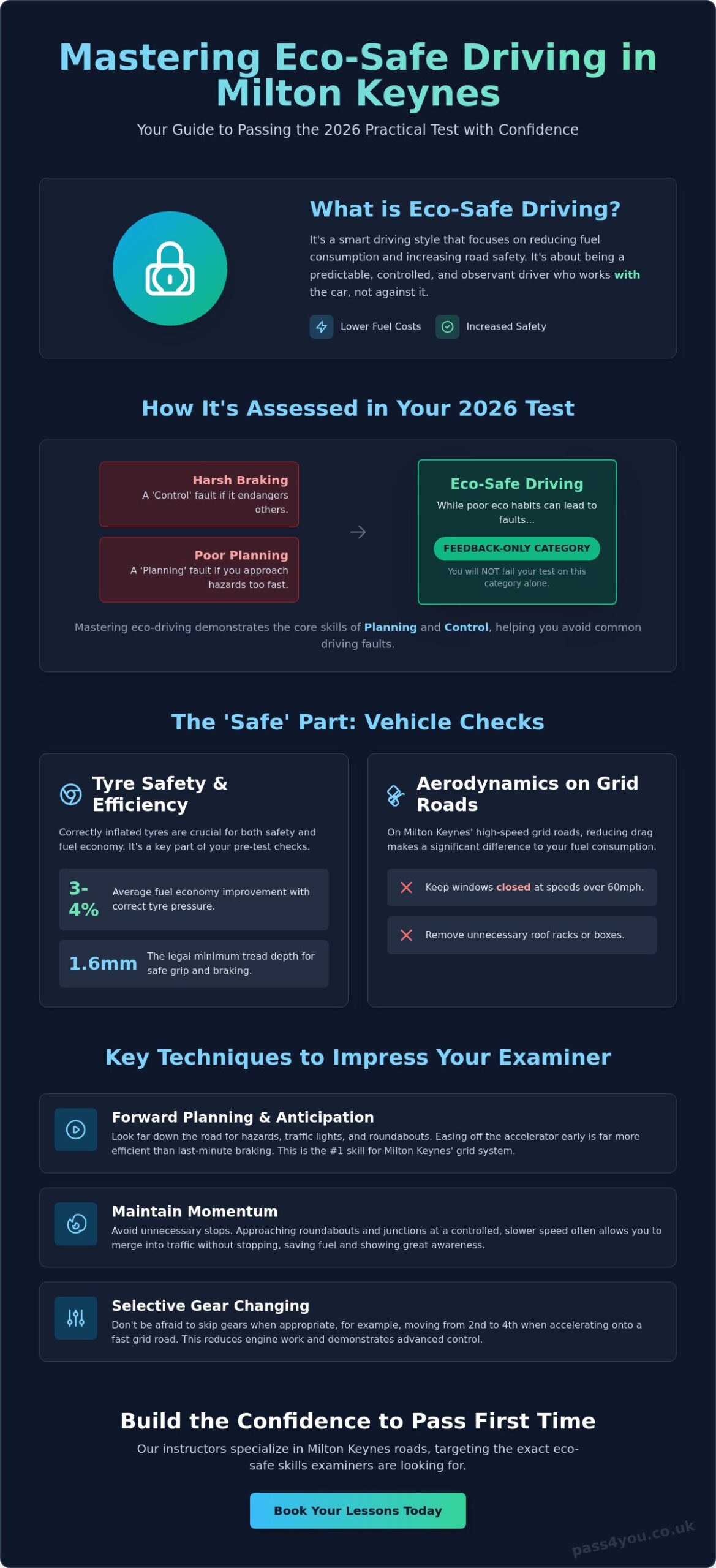
This is a common worry for learners. In 2026, eco-safe driving remains a feedback-only category on the practical test marking sheet. This means you won’t fail your test simply because you stayed in a lower gear for too long or didn’t skip a gear when accelerating. However, there’s a vital connection to remember. While the eco-driving box itself doesn’t trigger a fail, the actions that lead to poor efficiency often lead to safety faults. For example, while eco-driving is feedback-only, ‘harsh braking’ can be a serious fault if it puts other road users at risk. Poor planning might mean you arrive at a roundabout too fast, forcing a sudden stop that the examiner marks as a lack of control.
The Core Pillars: Planning and Control
The DVSA focuses on two main areas: forward planning and smooth control. Forward planning means looking far ahead so you can avoid unnecessary stops. If you see a red light in the distance, easing off the accelerator early is much more efficient than rushing toward it and braking hard. In Milton Keynes, anticipation is your most valuable skill. Our grid system requires constant awareness of upcoming roundabouts and speed limit changes. By mastering these eco-safe driving tips milton keynes learners can maintain a steady rhythm. This makes the car easier to handle, keeps your examiner relaxed, and makes your private practice much cheaper by saving fuel.
- Planning: Assessing the road ahead to keep the car moving.
- Control: Using the accelerator, brakes, and gears smoothly.
- Awareness: Responding to traffic flow to avoid sudden changes in speed.
Vehicle Maintenance: The ‘Safe’ Part of Eco-Safe
Preparing for your test involves more than just mastering the clutch. A well-maintained vehicle is the foundation of the ‘safe’ part of eco-safe driving. When your car is in top condition, it responds predictably, which is exactly what you need when navigating the busy roundabouts of Central Milton Keynes. Applying eco-safe driving tips milton keynes during your private practice helps you build habits that examiners love to see. A healthy car is simply easier to drive, allowing you to focus on the road instead of worrying about mechanical noises or sluggish performance.
Tyre Safety and Fuel Efficiency
Tyres are your only contact with the road. If they’re under-inflated, your engine has to work harder, which significantly increases fuel consumption. Research indicates that properly inflated tyres can improve fuel economy by an average of 3-4%. Before your practical driving test, you should check that your pressure matches the manufacturer’s recommendation and that your tread depth is at least 1.6mm. This isn’t just about saving money; it’s about having the necessary grip for an emergency stop. You’ll likely face a ‘Tell Me’ question about checking tyre pressure, so knowing how to use a gauge and where to find the correct figures will give you an early boost of confidence.
Aerodynamics and Fluid Levels
Milton Keynes is famous for its high-speed grid roads. When you’re travelling at 60mph or 70mph on the V6 or H8, aerodynamics play a huge role in how much fuel you use. Keeping windows closed at high speeds and removing empty roof racks can make a noticeable difference. Following expert fuel economy tips helps you understand that wind resistance is a major drain on efficiency. Similarly, keeping your fluids topped up is essential for car longevity. Correct oil levels reduce engine friction and emissions, making the car run smoother and quieter. These eco-safe driving tips milton keynes ensure your vehicle is ready for the demands of the 40-minute test.
Removing unnecessary weight is another simple way to stay eco-safe. A cluttered boot filled with heavy items makes the engine work harder during acceleration and increases your stopping distance. By keeping your car light and tidy, you’re making it safer and more efficient. If you’re feeling unsure about how to perform these checks yourself, booking professional driving lessons can help you gain the hands-on experience needed to feel fully prepared for the ‘Show Me, Tell Me’ questions.
Eco-Safe Driving in Milton Keynes: Mastering the Grid
Milton Keynes is unlike any other city in the UK. Our unique grid system of H and V roads provides a fantastic environment for practicing eco-safe driving tips milton keynes. While the 60mph and 70mph speed limits on these roads might feel intimidating at first, they offer the perfect opportunity to master momentum. Instead of constant braking and accelerating, you can learn to use the car’s natural energy to flow between the grid squares. This isn’t just about saving fuel; it’s about becoming a calmer, more predictable driver who’s always one step ahead of the traffic.
Anticipation is your greatest asset near our famous Redways. These shared paths often cross the grid roads at unexpected points. By looking far ahead, you can spot pedestrians or cyclists early and ease off the power. This reduces the need for sudden, heavy braking. When you drive this way, you improve your vehicle maintenance and emissions profile by preventing unnecessary wear on your brake pads and tyres. It’s a simple habit that examiners love to see during the practical test.
The Roundabout Strategy: Vision over Braking
MK is often called “Roundabout City” for a reason. To drive eco-safely here, you must prioritize vision over the brake pedal. As you approach a junction like the Northfield roundabout, try to look 10 seconds ahead. If you can see the traffic flow early, you can adjust your speed using engine braking rather than slamming on the brakes at the line. We teach the ‘block changing’ technique, where you might move smoothly from 5th gear directly down to 2nd. This reduces clutch wear and keeps the car balanced, showing the examiner you have expert control.
Grid Road Discipline: Speed and Spacing
Maintaining a steady speed is essential on long stretches of the V-roads. Fluctuating your speed by even a few miles per hour can waste significant amounts of fuel. The two-second rule is your best friend here. By keeping a safe distance from the car in front, you give yourself the “buffer” needed to react to changes without harsh braking. If you’re practicing on our faster routes, our dual carriageway guide offers more specific advice for high-speed efficiency. Mastering these eco-safe driving tips milton keynes will make your driving feel effortless and professional.
- Look 10 seconds ahead to anticipate roundabout traffic.
- Use engine braking to slow down gradually for Redway crossings.
- Keep a consistent speed on H and V roads to avoid fuel-heavy acceleration.
- Maintain a two-second gap to create a safety and efficiency buffer.
Actionable Techniques for Your Practical Test
Applying eco-safe driving tips milton keynes during your test isn’t about driving slowly. It’s about being efficient and deliberate with your actions. When you move off, aim to accelerate smoothly but firmly. Shifting up early is one of the easiest ways to show the examiner you’re an eco-conscious driver. For most petrol cars, shifting between 2,000 and 2,500 RPM is the ideal sweet spot. This prevents the engine from working too hard and keeps your fuel consumption low. Avoid ‘riding the clutch’ at junctions; it causes unnecessary wear and wastes energy that could be used for movement.
Selective gear changing, or skipping gears, is a technique that really impresses examiners. If you’ve accelerated to 40mph in 3rd gear on a busy V-road, you don’t always need 4th gear. You can go straight to 5th. This shows you understand the car’s power and how to maintain momentum. Similarly, when you’re decelerating for a red light at the Kingston district centre, ‘block shifting’ from 4th gear directly to 2nd is perfectly acceptable and highly efficient. It demonstrates that you’re planning your approach rather than just reacting to the car in front at the last second.
A common myth is that engine braking confuses the drivers behind you because your brake lights don’t come on. In reality, letting the engine slow you down is a standard and safe technique. As long as you’re planning ahead, the gradual decrease in speed is predictable. If you need to signal a more rapid stop, a light touch on the brake pedal will illuminate your lights and signal your intentions clearly. Remember the 30-second rule for long delays. If you’re waiting at a level crossing or a particularly long set of traffic lights, turning off the engine reduces emissions and saves fuel.
Modern vehicles, like the Volkswagens we use for our driving lessons, often come equipped with gear-shift indicators and Start/Stop technology. Don’t be afraid to use these features during your test. The examiner wants to see that you can use the car’s tools to drive as efficiently as possible. Following the dashboard prompts shows you are observant and capable of handling a modern vehicle. These tools are there to support you and build your confidence as you work toward that first-time pass.
Smart Acceleration and Gear Changes
- Shift up early to keep RPMs between 2,000 and 2,500.
- Use selective gear changing to reach cruising speeds efficiently.
- Avoid resting your foot on the clutch pedal while driving to prevent wear.
Deceleration and Stopping
- Lift off the accelerator early to use the car’s natural momentum.
- Use block shifting to find the right gear for your new speed without unnecessary steps.
- Engage Start/Stop systems or turn off the engine during prolonged stationary periods.
How Pass4you Instructors Build Your Confidence
Learning to drive is about more than just passing a test; it’s about gaining the freedom to explore the world safely and responsibly. At Pass4you, we believe that true confidence comes from expert support and a relaxed environment. That’s why we integrate eco-safe driving tips milton keynes into your very first lesson. By making these habits second nature from day one, you won’t have to overthink them during your practical test. Our instructors act as calm mentors, guiding you through the complexities of the grid system with patience and clarity.
Modern Cars for Modern Learners
We take pride in our modern fleet of Volkswagen tuition vehicles. These cars are specifically chosen because they’re perfect for learning 21st-century driving skills. With highly efficient engines and clear, digital dashboard displays, you can easily monitor your gear shifts and fuel consumption in real-time. This modern technology makes the “eco” feedback portion of the test feel effortless. Instead of struggling with an older, less responsive car, you’ll be driving a vehicle that supports your progress. If you’re ready to start your journey, you can find more information about our driving lessons Milton Keynes and see how we help our students succeed.
Expert Guidance from MK Specialists
Our team has deep, local knowledge of the Bletchley and Milton Keynes test routes. We don’t just teach you how to drive; we teach you how to navigate our specific roads with precision. During your lessons, we conduct mock tests that include detailed feedback on your efficiency. This ensures you’re fully prepared for exactly what the examiner will be looking for. Our results-driven approach is proven by our impressive 83.33% first-time pass rate. We focus on building your emotional stability behind the wheel, helping you overcome any anxiety you might feel about high-speed grid roads or busy roundabouts.
When you choose professional instruction, you’re investing in your long-term safety and financial savings. Learning these eco-safe driving tips milton keynes with a specialist ensures you’re not wasting time or resources on ineffective habits. We’re here to provide the supportive, one-on-one environment you need to become a confident driver. Book your first lesson with us today and take the first step toward earning your license with a school that truly cares about your success. Our instructors are ready to help you turn that anxiety into accomplishment.
Start Your Journey to a First-Time Pass
Mastering eco-safe driving tips milton keynes is about more than just checking a box on your test day; it’s about becoming a skilled driver who can handle the grid system with ease. You now understand that small changes, like selective gear shifting and forward planning at roundabouts, make your driving smoother and significantly reduce your fuel costs. These habits show the examiner that you’re in total control of your vehicle and ready for the responsibilities of the road.
Our expert local instructors have over 20 years of experience helping learners navigate Bletchley and MK routes. We use modern Volkswagen tuition vehicles equipped with the latest technology to make your learning experience as stress-free as possible. With our impressive 83.33% first-time pass rate, you can feel confident that you’re in professional and supportive hands. Book your Milton Keynes driving lessons with Pass4you today and let us help you turn your driving goals into reality. We’re looking forward to seeing you succeed and enjoy the freedom that comes with your new license.
Frequently Asked Questions
Will I fail my driving test if I don’t drive eco-safely?
You won’t fail your driving test specifically for eco-safe driving mistakes, as it’s currently a feedback-only section of the assessment. The examiner will provide advice at the end of the test if they feel your habits could be improved. However, you must be careful that poor efficiency doesn’t lead to safety errors. If you forget to plan ahead and have to brake harshly for a roundabout, that could result in a serious fault.
What does the examiner actually look for in the eco-safe assessment?
Examiners assess your ability to plan ahead and use the car’s controls smoothly. They want to see that you understand how to maintain momentum by observing traffic flow and reacting early. This involves choosing the right gear for the road speed and avoiding unnecessary acceleration. By following eco-safe driving tips milton keynes, you demonstrate that you’re a responsible driver who is ready for independent travel.
Is engine braking better than using the foot brake for the environment?
Engine braking is significantly better for the environment and your vehicle’s longevity. When you lift off the accelerator early, the engine’s natural resistance slows the car down without burning extra fuel. This reduces emissions and prevents your brake pads from wearing out prematurely. It’s a key technique for navigating the long approaches to Milton Keynes’ roundabouts, as it keeps the car balanced and ready for the next move.
Should I skip gears on my driving test to be eco-safe?
You should definitely skip gears when it’s safe and appropriate to do so. This is known as selective gear changing and it’s a great way to show the examiner you’re an efficient driver. For example, if you’ve accelerated to 40mph on a V-road, you might shift directly from 3rd to 5th. This reduces the time the engine spends in higher rev ranges, saving fuel and making your drive much smoother.
How can I save fuel while practicing for my test in Milton Keynes?
The best way to save fuel during private practice is to master the rhythm of the grid system. Try to avoid stop-start driving by looking far ahead and timing your arrival at junctions so you don’t have to come to a complete halt. Maintaining a steady speed on the H and V roads and ensuring your tyres are correctly inflated will also help you reduce costs while you refine your eco-safe driving tips milton keynes.
What is ‘block changing’ and is it allowed on the test?
Block changing is the process of skipping one or more gears when shifting up or down. It’s fully allowed on the driving test and is actually recommended for modern driving. Shifting from 5th gear directly to 2nd as you approach a junction is a perfect example. It reduces the number of gear changes you need to make, allowing you more time to focus on steering and observation.
Does using the air conditioning affect my eco-safe driving score?
While using air conditioning does increase fuel consumption, it doesn’t negatively affect your eco-safe driving score on the test. Examiners are primarily interested in your technical driving skills, such as how you accelerate and plan your route. If it’s a hot day, it’s better to stay comfortable and focused on your safety. Your score is based on your control of the vehicle rather than the use of internal systems.
Is eco-safe driving different in an automatic car?
The core principles of eco-safe driving remain the same in an automatic car, though the car manages the gear changes for you. You can still be an efficient driver by focusing on smooth acceleration and early anticipation. Since you don’t have to worry about the clutch, you can dedicate more attention to reading the road ahead and easing off the power early to use the car’s natural momentum.
Leave a Reply