Tag: grid roads

  • Eco-Safe Driving Tips Milton Keynes: Pass Your Test & Save Fuel in 2026

    What if the secret to conquering the high-speed grid roads of Milton Keynes isn’t about driving faster, but driving smarter? Many learners feel a wave of anxiety when they see “eco-safe driving” on their assessment sheet, fearing that a small mistake might cost them their license. You might even worry that focusing on fuel efficiency will distract you from the complex roundabouts and 70mph stretches. However, mastering eco-safe driving tips milton keynes is actually your best tool for staying calm and in control during your practical test.

    We understand that the pressure of the test is high, especially when you’re trying to figure out exactly when to skip a gear or how to use engine braking without stalling. It’s completely normal to feel confused by these technical shifts while petrol prices in the city hover around 155.7p per litre. This guide will show you exactly how to impress your examiner by demonstrating smooth, efficient habits that prove you’re a safe and responsible road user. We’ll break down the specific techniques for our unique grid system, from planning ahead at roundabouts to managing your speed effectively, ensuring you feel confident and ready to pass first time in 2026.

    Key Takeaways

    • Understand that eco-safe driving is a feedback-only category in 2026, giving you a stress-free opportunity to demonstrate your professional road awareness.
    • Master specific eco-safe driving tips milton keynes like selective gear changing to show the examiner you have full control over the car’s efficiency.
    • Learn how to manage momentum on the unique 60mph grid roads to navigate roundabouts smoothly while keeping your fuel costs low.
    • Discover how simple maintenance checks, like monitoring tyre pressure, improve your car’s grip for emergency stops and enhance your overall safety.
    • Build the confidence needed to pass first time by learning how professional instruction targets the exact skills examiners look for on Milton Keynes roads.

    What is Eco-Safe Driving & How is it Assessed in 2026?

    Eco-safe driving is a specialized style of handling a vehicle that reduces fuel consumption and emissions while simultaneously increasing road safety. It isn’t just about being “green”; it’s about being a predictable, controlled, and observant driver. When you apply eco-safe driving tips milton keynes during your lessons, you’re learning to work with your car rather than against it. In 2026, the DVSA continues to emphasize these energy-efficient driving techniques because smooth drivers are statistically less likely to be involved in collisions. During your 40-minute practical test, the examiner will observe how you interact with the environment and your vehicle’s controls to assess your efficiency.

    The examiner records your performance using two specific categories: “Control” and “Planning.” They aren’t looking for perfection, but they want to see that you understand how to keep the car moving efficiently. They’ll watch how you pull away from junctions, whether you use the gears appropriately for the road speed, and how you manage your momentum as you approach hazards.

    Does Eco-Safe Driving Affect Your Pass or Fail?

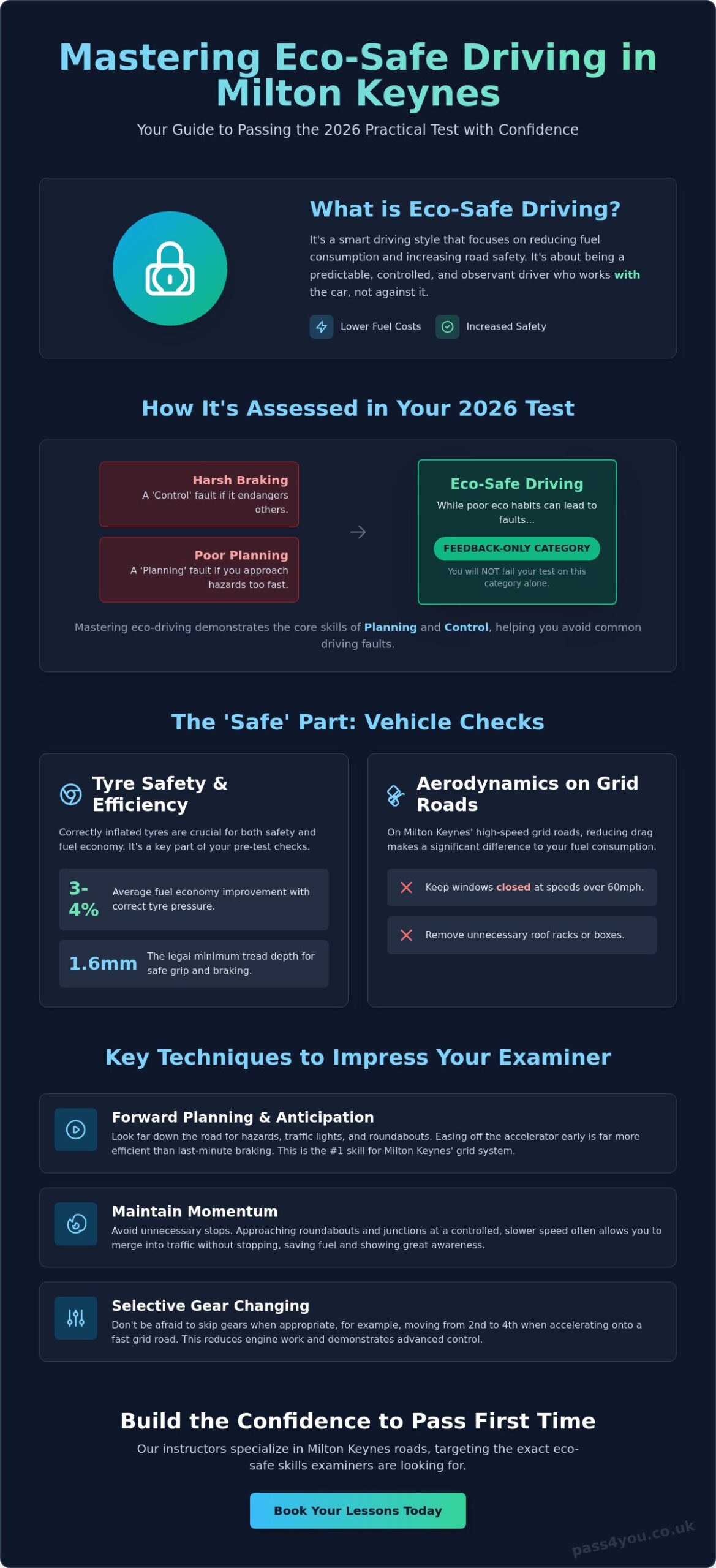
    This is a common worry for learners. In 2026, eco-safe driving remains a feedback-only category on the practical test marking sheet. This means you won’t fail your test simply because you stayed in a lower gear for too long or didn’t skip a gear when accelerating. However, there’s a vital connection to remember. While the eco-driving box itself doesn’t trigger a fail, the actions that lead to poor efficiency often lead to safety faults. For example, while eco-driving is feedback-only, ‘harsh braking’ can be a serious fault if it puts other road users at risk. Poor planning might mean you arrive at a roundabout too fast, forcing a sudden stop that the examiner marks as a lack of control.

    The Core Pillars: Planning and Control

    The DVSA focuses on two main areas: forward planning and smooth control. Forward planning means looking far ahead so you can avoid unnecessary stops. If you see a red light in the distance, easing off the accelerator early is much more efficient than rushing toward it and braking hard. In Milton Keynes, anticipation is your most valuable skill. Our grid system requires constant awareness of upcoming roundabouts and speed limit changes. By mastering these eco-safe driving tips milton keynes learners can maintain a steady rhythm. This makes the car easier to handle, keeps your examiner relaxed, and makes your private practice much cheaper by saving fuel.

    • Planning: Assessing the road ahead to keep the car moving.
    • Control: Using the accelerator, brakes, and gears smoothly.
    • Awareness: Responding to traffic flow to avoid sudden changes in speed.

    Vehicle Maintenance: The ‘Safe’ Part of Eco-Safe

    Preparing for your test involves more than just mastering the clutch. A well-maintained vehicle is the foundation of the ‘safe’ part of eco-safe driving. When your car is in top condition, it responds predictably, which is exactly what you need when navigating the busy roundabouts of Central Milton Keynes. Applying eco-safe driving tips milton keynes during your private practice helps you build habits that examiners love to see. A healthy car is simply easier to drive, allowing you to focus on the road instead of worrying about mechanical noises or sluggish performance.

    Tyre Safety and Fuel Efficiency

    Tyres are your only contact with the road. If they’re under-inflated, your engine has to work harder, which significantly increases fuel consumption. Research indicates that properly inflated tyres can improve fuel economy by an average of 3-4%. Before your practical driving test, you should check that your pressure matches the manufacturer’s recommendation and that your tread depth is at least 1.6mm. This isn’t just about saving money; it’s about having the necessary grip for an emergency stop. You’ll likely face a ‘Tell Me’ question about checking tyre pressure, so knowing how to use a gauge and where to find the correct figures will give you an early boost of confidence.

    Aerodynamics and Fluid Levels

    Milton Keynes is famous for its high-speed grid roads. When you’re travelling at 60mph or 70mph on the V6 or H8, aerodynamics play a huge role in how much fuel you use. Keeping windows closed at high speeds and removing empty roof racks can make a noticeable difference. Following expert fuel economy tips helps you understand that wind resistance is a major drain on efficiency. Similarly, keeping your fluids topped up is essential for car longevity. Correct oil levels reduce engine friction and emissions, making the car run smoother and quieter. These eco-safe driving tips milton keynes ensure your vehicle is ready for the demands of the 40-minute test.

    Removing unnecessary weight is another simple way to stay eco-safe. A cluttered boot filled with heavy items makes the engine work harder during acceleration and increases your stopping distance. By keeping your car light and tidy, you’re making it safer and more efficient. If you’re feeling unsure about how to perform these checks yourself, booking professional driving lessons can help you gain the hands-on experience needed to feel fully prepared for the ‘Show Me, Tell Me’ questions.
    Eco-Safe Driving Tips Milton Keynes: Pass Your Test & Save Fuel in 2026

    Eco-Safe Driving in Milton Keynes: Mastering the Grid

    Milton Keynes is unlike any other city in the UK. Our unique grid system of H and V roads provides a fantastic environment for practicing eco-safe driving tips milton keynes. While the 60mph and 70mph speed limits on these roads might feel intimidating at first, they offer the perfect opportunity to master momentum. Instead of constant braking and accelerating, you can learn to use the car’s natural energy to flow between the grid squares. This isn’t just about saving fuel; it’s about becoming a calmer, more predictable driver who’s always one step ahead of the traffic.

    Anticipation is your greatest asset near our famous Redways. These shared paths often cross the grid roads at unexpected points. By looking far ahead, you can spot pedestrians or cyclists early and ease off the power. This reduces the need for sudden, heavy braking. When you drive this way, you improve your vehicle maintenance and emissions profile by preventing unnecessary wear on your brake pads and tyres. It’s a simple habit that examiners love to see during the practical test.

    The Roundabout Strategy: Vision over Braking

    MK is often called “Roundabout City” for a reason. To drive eco-safely here, you must prioritize vision over the brake pedal. As you approach a junction like the Northfield roundabout, try to look 10 seconds ahead. If you can see the traffic flow early, you can adjust your speed using engine braking rather than slamming on the brakes at the line. We teach the ‘block changing’ technique, where you might move smoothly from 5th gear directly down to 2nd. This reduces clutch wear and keeps the car balanced, showing the examiner you have expert control.

    Grid Road Discipline: Speed and Spacing

    Maintaining a steady speed is essential on long stretches of the V-roads. Fluctuating your speed by even a few miles per hour can waste significant amounts of fuel. The two-second rule is your best friend here. By keeping a safe distance from the car in front, you give yourself the “buffer” needed to react to changes without harsh braking. If you’re practicing on our faster routes, our dual carriageway guide offers more specific advice for high-speed efficiency. Mastering these eco-safe driving tips milton keynes will make your driving feel effortless and professional.

    • Look 10 seconds ahead to anticipate roundabout traffic.
    • Use engine braking to slow down gradually for Redway crossings.
    • Keep a consistent speed on H and V roads to avoid fuel-heavy acceleration.
    • Maintain a two-second gap to create a safety and efficiency buffer.

    Actionable Techniques for Your Practical Test

    Applying eco-safe driving tips milton keynes during your test isn’t about driving slowly. It’s about being efficient and deliberate with your actions. When you move off, aim to accelerate smoothly but firmly. Shifting up early is one of the easiest ways to show the examiner you’re an eco-conscious driver. For most petrol cars, shifting between 2,000 and 2,500 RPM is the ideal sweet spot. This prevents the engine from working too hard and keeps your fuel consumption low. Avoid ‘riding the clutch’ at junctions; it causes unnecessary wear and wastes energy that could be used for movement.

    Selective gear changing, or skipping gears, is a technique that really impresses examiners. If you’ve accelerated to 40mph in 3rd gear on a busy V-road, you don’t always need 4th gear. You can go straight to 5th. This shows you understand the car’s power and how to maintain momentum. Similarly, when you’re decelerating for a red light at the Kingston district centre, ‘block shifting’ from 4th gear directly to 2nd is perfectly acceptable and highly efficient. It demonstrates that you’re planning your approach rather than just reacting to the car in front at the last second.

    A common myth is that engine braking confuses the drivers behind you because your brake lights don’t come on. In reality, letting the engine slow you down is a standard and safe technique. As long as you’re planning ahead, the gradual decrease in speed is predictable. If you need to signal a more rapid stop, a light touch on the brake pedal will illuminate your lights and signal your intentions clearly. Remember the 30-second rule for long delays. If you’re waiting at a level crossing or a particularly long set of traffic lights, turning off the engine reduces emissions and saves fuel.

    Modern vehicles, like the Volkswagens we use for our driving lessons, often come equipped with gear-shift indicators and Start/Stop technology. Don’t be afraid to use these features during your test. The examiner wants to see that you can use the car’s tools to drive as efficiently as possible. Following the dashboard prompts shows you are observant and capable of handling a modern vehicle. These tools are there to support you and build your confidence as you work toward that first-time pass.

    Smart Acceleration and Gear Changes

    • Shift up early to keep RPMs between 2,000 and 2,500.
    • Use selective gear changing to reach cruising speeds efficiently.
    • Avoid resting your foot on the clutch pedal while driving to prevent wear.

    Deceleration and Stopping

    • Lift off the accelerator early to use the car’s natural momentum.
    • Use block shifting to find the right gear for your new speed without unnecessary steps.
    • Engage Start/Stop systems or turn off the engine during prolonged stationary periods.

    How Pass4you Instructors Build Your Confidence

    Learning to drive is about more than just passing a test; it’s about gaining the freedom to explore the world safely and responsibly. At Pass4you, we believe that true confidence comes from expert support and a relaxed environment. That’s why we integrate eco-safe driving tips milton keynes into your very first lesson. By making these habits second nature from day one, you won’t have to overthink them during your practical test. Our instructors act as calm mentors, guiding you through the complexities of the grid system with patience and clarity.

    Modern Cars for Modern Learners

    We take pride in our modern fleet of Volkswagen tuition vehicles. These cars are specifically chosen because they’re perfect for learning 21st-century driving skills. With highly efficient engines and clear, digital dashboard displays, you can easily monitor your gear shifts and fuel consumption in real-time. This modern technology makes the “eco” feedback portion of the test feel effortless. Instead of struggling with an older, less responsive car, you’ll be driving a vehicle that supports your progress. If you’re ready to start your journey, you can find more information about our driving lessons Milton Keynes and see how we help our students succeed.

    Expert Guidance from MK Specialists

    Our team has deep, local knowledge of the Bletchley and Milton Keynes test routes. We don’t just teach you how to drive; we teach you how to navigate our specific roads with precision. During your lessons, we conduct mock tests that include detailed feedback on your efficiency. This ensures you’re fully prepared for exactly what the examiner will be looking for. Our results-driven approach is proven by our impressive 83.33% first-time pass rate. We focus on building your emotional stability behind the wheel, helping you overcome any anxiety you might feel about high-speed grid roads or busy roundabouts.

    When you choose professional instruction, you’re investing in your long-term safety and financial savings. Learning these eco-safe driving tips milton keynes with a specialist ensures you’re not wasting time or resources on ineffective habits. We’re here to provide the supportive, one-on-one environment you need to become a confident driver. Book your first lesson with us today and take the first step toward earning your license with a school that truly cares about your success. Our instructors are ready to help you turn that anxiety into accomplishment.

    Start Your Journey to a First-Time Pass

    Mastering eco-safe driving tips milton keynes is about more than just checking a box on your test day; it’s about becoming a skilled driver who can handle the grid system with ease. You now understand that small changes, like selective gear shifting and forward planning at roundabouts, make your driving smoother and significantly reduce your fuel costs. These habits show the examiner that you’re in total control of your vehicle and ready for the responsibilities of the road.

    Our expert local instructors have over 20 years of experience helping learners navigate Bletchley and MK routes. We use modern Volkswagen tuition vehicles equipped with the latest technology to make your learning experience as stress-free as possible. With our impressive 83.33% first-time pass rate, you can feel confident that you’re in professional and supportive hands. Book your Milton Keynes driving lessons with Pass4you today and let us help you turn your driving goals into reality. We’re looking forward to seeing you succeed and enjoy the freedom that comes with your new license.

    Frequently Asked Questions

    Will I fail my driving test if I don’t drive eco-safely?

    You won’t fail your driving test specifically for eco-safe driving mistakes, as it’s currently a feedback-only section of the assessment. The examiner will provide advice at the end of the test if they feel your habits could be improved. However, you must be careful that poor efficiency doesn’t lead to safety errors. If you forget to plan ahead and have to brake harshly for a roundabout, that could result in a serious fault.

    What does the examiner actually look for in the eco-safe assessment?

    Examiners assess your ability to plan ahead and use the car’s controls smoothly. They want to see that you understand how to maintain momentum by observing traffic flow and reacting early. This involves choosing the right gear for the road speed and avoiding unnecessary acceleration. By following eco-safe driving tips milton keynes, you demonstrate that you’re a responsible driver who is ready for independent travel.

    Is engine braking better than using the foot brake for the environment?

    Engine braking is significantly better for the environment and your vehicle’s longevity. When you lift off the accelerator early, the engine’s natural resistance slows the car down without burning extra fuel. This reduces emissions and prevents your brake pads from wearing out prematurely. It’s a key technique for navigating the long approaches to Milton Keynes’ roundabouts, as it keeps the car balanced and ready for the next move.

    Should I skip gears on my driving test to be eco-safe?

    You should definitely skip gears when it’s safe and appropriate to do so. This is known as selective gear changing and it’s a great way to show the examiner you’re an efficient driver. For example, if you’ve accelerated to 40mph on a V-road, you might shift directly from 3rd to 5th. This reduces the time the engine spends in higher rev ranges, saving fuel and making your drive much smoother.

    How can I save fuel while practicing for my test in Milton Keynes?

    The best way to save fuel during private practice is to master the rhythm of the grid system. Try to avoid stop-start driving by looking far ahead and timing your arrival at junctions so you don’t have to come to a complete halt. Maintaining a steady speed on the H and V roads and ensuring your tyres are correctly inflated will also help you reduce costs while you refine your eco-safe driving tips milton keynes.

    What is ‘block changing’ and is it allowed on the test?

    Block changing is the process of skipping one or more gears when shifting up or down. It’s fully allowed on the driving test and is actually recommended for modern driving. Shifting from 5th gear directly to 2nd as you approach a junction is a perfect example. It reduces the number of gear changes you need to make, allowing you more time to focus on steering and observation.

    Does using the air conditioning affect my eco-safe driving score?

    While using air conditioning does increase fuel consumption, it doesn’t negatively affect your eco-safe driving score on the test. Examiners are primarily interested in your technical driving skills, such as how you accelerate and plan your route. If it’s a hot day, it’s better to stay comfortable and focused on your safety. Your score is based on your control of the vehicle rather than the use of internal systems.

    Is eco-safe driving different in an automatic car?

    The core principles of eco-safe driving remain the same in an automatic car, though the car manages the gear changes for you. You can still be an efficient driver by focusing on smooth acceleration and early anticipation. Since you don’t have to worry about the clutch, you can dedicate more attention to reading the road ahead and easing off the power early to use the car’s natural momentum.

  • How to Book Your Practical Driving Test in 2026: The Ultimate Guide for Milton Keynes Learners

    How to Book Your Practical Driving Test in 2026: The Ultimate Guide for Milton Keynes Learners

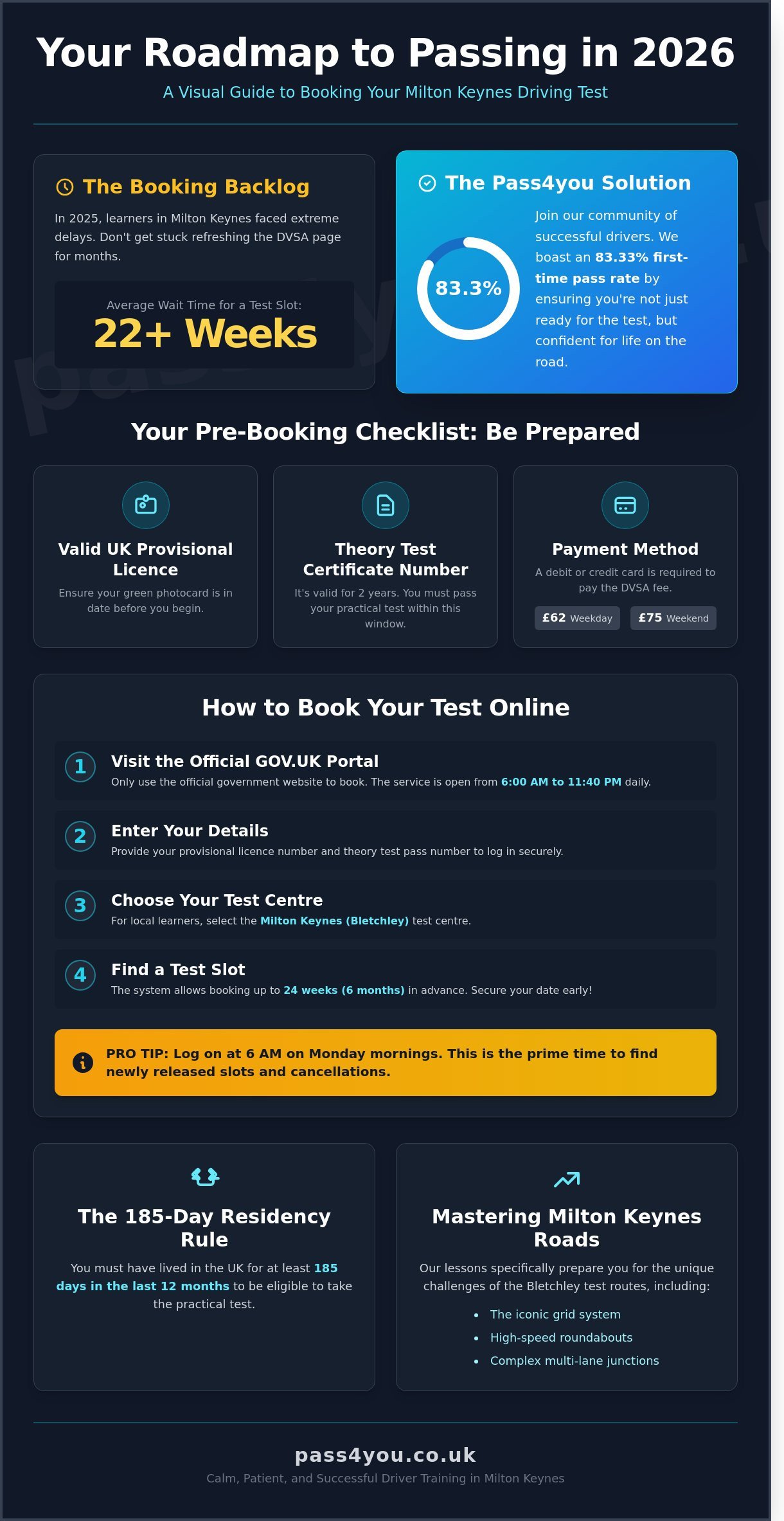
    Did you know that in 2025, some Milton Keynes learners waited over 22 weeks just to find a slot at the local test centres? It’s incredibly stressful when you’re ready to start your life on the road but feel blocked by a computer screen. You’ve likely spent hours refreshing the DVSA website to book practical driving test appointments, worried that a single mistake will mean another £62 fee and months of further waiting. We understand that anxiety; we’re here to help you stay calm and focused.

    This guide shows you exactly how to navigate the 2026 booking system without the usual headache. We’ll ensure you don’t just get a date, but that you’re actually ready to pass first time, joining the 83.33% of students from Pass4you Driving School who succeed on their first attempt. You’ll learn the best times to find cancellations, how to handle the unique challenges of Milton Keynes grid roads, and the step-by-step process to secure your freedom behind the wheel.

    Key Takeaways

    • Understand the 2026 DVSA booking window to help you secure your test slot up to 24 weeks in advance.
    • Follow our simple, step-by-step guide to book practical driving test appointments through the official GOV.UK portal with confidence.
    • Learn how to evaluate your skills against the National Standard to ensure you are truly ready for the independent driving phase of the exam.
    • Master the unique challenges of the Milton Keynes (Bletchley) Test Centre, including the iconic grid system and high-speed roundabouts.
    • Discover how Simon’s calm and patient coaching style can build your confidence and help you join our successful first-time pass community.

    The practical driving test represents the final hurdle between you and the freedom of the open road. It is a moment of transition where you move from being a learner to a qualified driver. In 2026, the process remains digital and streamlined, though it requires a bit of forward planning. You can book practical driving test appointments through the official DVSA portal, which serves as the central hub for all candidates in England, Scotland, and Wales. For those unfamiliar with the specific requirements and structure of the exam, this UK driving test overview provides a helpful foundation for what to expect on the day.

    Currently, the booking window allows you to schedule your test up to 24 weeks in advance. This six-month lead time is a response to the sustained high demand for testing slots across the country. The online service operates daily from 6:00 am until 11:40 pm. We often suggest that our students log on early in the morning, as this is when the system updates and new cancellations or slots often become visible. Simon always emphasizes that securing your date early is a vital part of your preparation. It gives you a clear goal to work towards during your lessons, helping to build that steady, quiet confidence we value at Pass4you.

    If you are learning to drive in the Buckinghamshire region, especially around Milton Keynes, booking early is not just a suggestion; it is a necessity. Local test centres frequently see their calendars fill up within minutes of new dates being released. Our school maintains an 83.33% first time pass rate because we ensure our students are not just ready for the test, but ready for the specific challenges of local roads. By securing your slot early, you allow us to tailor your final intensive sessions to the exact date of your exam, ensuring your skills are at their peak when it matters most.

    Eligibility: What You Need Before Clicking Start

    Before you head to the GOV.UK website to book practical driving test sessions, you must have three specific items ready. Having these to hand prevents the system from timing out while you search for paperwork. You will need:

    • A valid UK provisional driving licence: Check the expiry date on your photocard to ensure it is currently in date.
    • Your Theory Test pass certificate number: This number is valid for exactly two years from the date you passed your theory exam.
    • A payment method: The DVSA fee in 2026 stands at £62 for weekday tests and £75 for weekend or bank holiday slots.

    We find that many nervous learners feel more at ease once the administrative side is settled. Our patient approach ensures that you don’t feel rushed through this process. If your theory certificate is nearing its two-year expiry, you must pass your practical test before that date, or you will be required to sit the theory exam again.

    The 185-Day Rule for UK Residents

    The residency requirement is a point of confusion for many international students or people who have recently relocated to Milton Keynes. The DVSA requires that you are a legal resident of the United Kingdom before you can attempt the practical exam. This is generally defined by the amount of time you have spent in the country over the last year. It is designed to ensure that the licence is issued to those who genuinely live and work or study here.

    To qualify for a driving test in 2026, you must have lived in England, Wales, or Scotland for at least 185 days in the last 12 months. This rule applies regardless of whether you are an international student on a long-term visa or a professional who has recently moved for work. If you have not yet reached this 185-day milestone, you should use that time to hone your skills with a calm and experienced mentor. We pride ourselves on being a supportive partner during this waiting period, helping you become a safe driver for life rather than just someone who can pass a test.

    Step-by-Step: How to Book Your Practical Driving Test Online

    Ready to take the final step toward your independence? Booking your test is a significant milestone that transforms your practice sessions into a focused mission. It’s the moment your hard work starts to feel real. To begin the process, you must use the official government portal. When you book your practical driving test, ensure you have your provisional driving licence and your theory test pass certificate within reach. You’ll need the 16-character licence number and the certificate ID to log into the system securely.

    Once you’ve entered your details, the system will ask you to select a test centre. For the majority of our students, the Milton Keynes (Bletchley) centre is the most convenient and familiar choice. If slots there are currently full, don’t worry. You can check neighbouring centres like Leighton Buzzard or Northampton. The online calendar displays available dates in blue. It’s often wise to pick a time when you feel most alert. Many of our learners find that mid-morning slots, typically after 10:00 am when the local school run traffic has dissipated, provide a more relaxed environment for the exam.

    The final stage is the payment. As of early 2024, the standard fee for a weekday test is £62, while evening, weekend, or bank holiday slots cost £75. You’ll need a valid debit or credit card to complete the transaction. After the payment is processed, you’ll receive a confirmation email. It’s vital to keep this safe. This email contains your unique booking reference number, which you’ll need if you ever want to change your appointment or check your details later. We’ve helped hundreds of students through this process, maintaining an 83.33% first-time pass rate by ensuring every detail is handled with care.

    Using Your Instructor’s Personal Reference Number

    Before you hit the final confirm button, please ask Simon for his Approved Driving Instructor (ADI) personal reference number. Entering this specific code is a brilliant way to keep your test day organised. It links your booking to our driving school’s schedule. This simple step prevents the tuition vehicle from being double-booked for another student’s lesson or a different test while you’re out on the road. We want your big day to be entirely stress-free. By coordinating with Simon first, you ensure the car you’ve spent hours mastering is ready and waiting for you. It’s all about creating the calmest possible atmosphere for your success.

    Dealing with the Queue: Tips for 2026 Learners

    The DVSA booking system frequently experiences high demand. You might see a ‘holding page’ or a digital queue, particularly on Monday mornings. Don’t let this rattle your nerves. While there’s a common myth that the ‘6:00 am refresh’ is the only time to find slots, new appointments and cancellations actually appear at various intervals throughout the week. If you find yourself in a digital queue, stay patient and keep your browser window open. If you’re struggling to find a slot that fits your current progress, talk to us about your lesson plan so we can adjust your training schedule accordingly. The system may feel slow, but a patient approach now sets the perfect tone for your future as a safe, confident driver.

    How to Book Your Practical Driving Test in 2026: The Ultimate Guide for Milton Keynes Learners

    The Readiness Reality Check: Should You Book Yet?

    The #1 mistake many learners make is rushing to book practical driving test dates before they’ve reached the independent driving stage. It’s a tempting trap. You see a rare slot available on the DVSA website and grab it, hoping you’ll be ready by the time the date arrives. However, the National Standard for driving cars requires far more than just knowing how to move the vehicle. You must demonstrate that you can make safe, legal decisions on the road without a single prompt or hint from your instructor.

    Failing a test is an expensive setback. The standard DVSA fee is £62, but that’s only the beginning of the cost. You also have to factor in the car hire for the test day and the price of additional lessons to fix the faults that led to the fail. With average wait times currently sitting at 24 weeks in many UK test centres as of early 2024, a single fail could delay your full licence by six months. This long wait often leads to a massive drop in confidence and momentum.

    The RAC guide to booking your test provides excellent logistical advice, but your instructor provides the essential reality check. At Pass4you, Simon uses a tried and tested technique to assess your progress. We don’t just look at your ability to perform manoeuvres; we look at your consistency over several hours of varied driving. Simon’s assessment involves a rigorous checklist based on the DVSA’s own marking criteria. We look for ‘natural’ driving, where you check your blind spots and adjust your speed instinctively. If you can drive for forty minutes without Simon intervening or giving a verbal hint, you’ve reached the threshold to book practical driving test sessions with confidence.

    The ‘Safe Driver for Life’ vs. ‘Just Passing’ Debate

    Simon focuses on creating safe drivers for life, not just students who can scrape through a short exam. Taking a gamble on a test when you’re only 70% ready is a false economy. Our 83.33% first-time pass rate proves that being 100% prepared is the cheapest way to learn in the long run. It saves you the emotional stress of failure and the financial burden of re-tests. We value your safety and your bank balance equally, ensuring you’re truly ready for the road.

    Managing Test-Day Nerves and Anxiety

    Nervous learners often suffer from physical symptoms like shaking hands, a racing heart, or ‘brain fog’ before they even reach the test centre. These feelings can lead to simple mistakes that you wouldn’t normally make during a standard lesson. A calm and patient instructor changes your entire perception of the day. Simon’s supportive approach helps you view the examiner as a passenger rather than a judge. Mock tests provide a realistic simulation of exam pressure which helps students build the vital mental resilience needed to stay focused during the actual assessment. This preparation ensures you feel confident instead of terrified when the examiner greets you.

    Local Insight: Taking Your Test at the Milton Keynes Centre

    The Milton Keynes (Bletchley) Test Centre, located at Unit 9, Enigma Mansion on Eaton Avenue, serves as the starting point for your journey toward independence. When you finally book practical driving test dates at this centre, you’re committing to a 40-minute examination that covers some of the most unique infrastructure in the United Kingdom. This isn’t a standard town drive. The route often transitions quickly from the industrial bustle of Bletchley to the residential complexities of Westcroft or the historic, narrower streets of Fenny Stratford. Understanding these local nuances is what transforms a nervous learner into a confident driver.

    Simon has spent years documenting the specific quirks of the Bletchley routes. He knows exactly where the examiners might take you to test your observations, such as the tricky pedestrian crossings near local shops or the sudden speed limit changes on the approach to the A421. Having this local insight is your secret weapon. It removes the element of surprise, allowing you to focus on your car control rather than wondering which lane you should be in. Our 83.33% first-time pass rate is a direct result of this focused, local preparation.

    Mastering the Milton Keynes Roundabouts

    The MK grid system is world-famous, but it can be intimidating for those who haven’t practiced the correct approach. You’ll encounter multi-lane roundabouts that require precise lane discipline and early signalling. Simon’s teaching method focuses heavily on the transitions between Vertical (V) and Horizontal (H) roads. He uses a patient, step-by-step approach to help you identify the correct exit lane long before you reach the hazard. We don’t just teach you to pass; we ensure you feel calm and safe when merging into fast-moving traffic on the V7 Saxon Street or the H8 Standing Way. This mastery of the grid is essential for a successful result.

    Dual Carriageways and Rural Roads in MK

    Your test will almost certainly include high-speed sections on dual carriageways like the A5 or the A421. Joining these roads requires confidence and a clear understanding of gap selection. Simon ensures you’re comfortable reaching 70mph safely while maintaining a solid following distance. You’ll also learn to adapt quickly when the route moves into rural or residential areas where limits can drop to 30mph or 20mph without much warning. We use modern, easy-to-drive Volkswagen tuition cars for all lessons. These vehicles make the ‘Show Me, Tell Me’ portion of the test straightforward, as the controls are intuitive and reliable. Whether you’re checking tyre pressures or demonstrating the demister, you’ll feel completely at home in the driver’s seat.

    Don’t leave your success to chance on the day of your exam. If you’re ready to book practical driving test appointments but feel those big roundabouts are still a hurdle, Simon’s patient coaching will build the skills you need. We focus on creating safe drivers for life, not just for the duration of the test. Our proven techniques save you money in the long run by ensuring you’re fully prepared the first time around.

    Ready to start your journey with a calm and experienced mentor? Book your local Milton Keynes driving lessons with Simon today and join our list of successful first-time passes.

    Maximise Your Success with Pass4you Driving School

    Choosing the right instructor is just as vital as knowing how to book practical driving test appointments. At Pass4you, we don’t just teach you to pass; we help you become a confident, safe driver for life. You’ll work directly with Simon, a first-class instructor in Milton Keynes who understands that every learner is unique. Whether you’re a complete beginner or someone who’s had a bad experience elsewhere, Simon provides a calm and patient environment. We use modern, easy-to-drive Volkswagen vehicles that make mastering clutch control and complex manoeuvres much simpler. These cars are kept in peak condition to ensure your comfort and safety during every lesson and on the day of your exam.

    Our results speak for themselves. While the national average for first-time passes often hovers around 47% according to recent DVSA data, Pass4you boasts an impressive 83.33% first-time pass rate. This isn’t just a lucky number; it represents hundreds of students who felt ready, capable, and relaxed when they sat in the driver’s seat for their evaluation. We focus on building a solid foundation of skills so that the test feels like just another drive with a friend.

    Why a Local Milton Keynes Instructor Makes the Difference

    Local knowledge is your secret weapon when you head to the Bletchley test centre. Simon knows the specific ‘traps’ of the local routes, from the tricky double roundabouts to the narrow residential streets that often catch out the unprepared. Instead of rushing you through a generic syllabus, he provides tailored feedback that builds your confidence layer by layer. This personalised approach ensures you aren’t just memorising turns but actually understanding how to react to real-world hazards. High-quality, professional instruction offers genuine value for money. You might find cheaper lessons elsewhere, but if you need twice as many sessions or fail multiple times, the total cost skyrockets. Investing in Simon’s expertise means you’re more likely to pass sooner, saving you the £62 fee for rebooking tests and the stress of long waiting lists.

    Book Your First Lesson and Start Your Journey

    You don’t need to wait until you book practical driving test slots to start your training. In fact, starting early with Pass4you gives you a massive advantage. We recommend getting behind the wheel as soon as you have your provisional licence. This allows you to build muscle memory and road awareness while you’re still studying for your theory. A full driving licence opens doors to new job opportunities, spontaneous road trips, and the simple freedom of not relying on bus timetables. It’s a life-changing milestone that stays with you forever.

    Simon’s approach is specifically designed to support nervous learners who might feel overwhelmed by the thought of driving in heavy traffic. He breaks down complex skills into manageable steps, ensuring you never feel out of your depth. Every lesson is an investment in your safety and independence. Ready to become a safe driver? Book your first lesson with Pass4you today!

    Take the Wheel with Confidence in Milton Keynes

    Navigating the DVSA portal in 2026 requires a steady hand and a clear plan. You now understand how to secure your slot at the local centre and why waiting until you’re truly ready is the smartest way to protect your budget. Don’t rush into a date just because it’s available. It’s vital to master the specific Milton Keynes roundabouts and high-speed junctions that often challenge new drivers before you commit. When you’re prepared to book practical driving test appointments, you deserve to feel completely certain of your success.

    Simon at Pass4you specialises in helping nervous learners find their feet through patient, calm instruction. You’ll learn in a modern Volkswagen tuition vehicle, benefiting from a teaching style that has led to an impressive 83.33% first-time pass rate. This isn’t just about ticking a box; it’s about becoming a safe, skilled driver for the long term. Start your journey to a first-time pass with Simon at Pass4you today. Your new life of freedom on the road is closer than you think.

    Frequently Asked Questions

    How much does it cost to book a practical driving test in 2026?

    A practical driving test in 2026 currently costs £62 for weekday appointments and £75 for evenings, weekends, or bank holidays. While the DVSA hasn’t announced specific price increases for 2026 yet, these standard rates provide a reliable baseline for your budget. Booking a weekday slot is a simple way to save £13 on your journey toward becoming a safe, independent driver. We always recommend using the official GOV.UK website to avoid extra admin fees from third-party sites.

    Can I book my practical test before I have passed my theory test?

    You can’t book your practical test until you’ve successfully passed your theory test and received your pass certificate number. The online booking system requires this 16-digit number to validate your application before it lets you see any available dates. It’s best to focus on your theory first so you can approach your practical lessons with a calm and confident understanding of road signs and regulations. Once that’s out of the way, you’re free to secure your practical date.

    How long is the waiting list for a driving test in Milton Keynes?

    The current waiting time for a driving test at the Milton Keynes (Bletchley) test centre is approximately 18 weeks. Demand for slots is high, so we suggest checking the booking system at 6:00 am on Mondays when new appointments are typically released. Our students find that being patient and prepared pays off, especially since our 83.33% first time pass rate means you’re far less likely to need a second booking or face another long wait.

    What documents do I need to take to my practical driving test?

    You must bring your UK photocard provisional driving licence to your appointment or your test will be cancelled without a refund. If you still have an old-style paper licence, you’ll also need to bring a valid passport for identification purposes. You don’t strictly need your theory pass certificate, but it’s helpful to have it with you just in case there’s a technical glitch with the examiner’s records. Showing up prepared helps keep your nerves steady so you can focus on driving.

    Can I change my driving test date once it is booked?

    You can change your driving test appointment up to six times using the official online service. You must provide at least three clear working days’ notice to move your slot without losing your fee. This flexibility is useful if Simon feels you need a few more lessons to reach that “test-ready” standard. We want you to feel completely confident before you head to the test centre, as rushing into a test before you’re ready can be a blow to your confidence.

    What happens if I need to cancel my driving test?

    You’ll receive a full refund of your £62 or £75 fee if you cancel your test at least three clear working days before your appointment. If you cancel with less notice than this, you’ll lose your money unless you have a valid medical reason or a bereavement. We always encourage our learners to talk to us as soon as possible if they’re feeling anxious. We’re here to provide a supportive, patient environment to help you stay on track for your goal.

    How many driving lessons do I need before I should book my test?

    The DVSA reports that learners who pass have an average of 45 hours of professional tuition and 22 hours of private practice. However, our focused teaching methods often help students reach a safe standard more efficiently than the national average. We’ll give you honest, transparent feedback after every lesson so you know exactly when it’s the right time to book practical driving test dates. Our goal is to make you a safe driver for life, not just for the test day.

    Is it better to take my driving test in a manual or automatic car?

    Choosing a manual car is often better because it gives you the freedom to drive both manual and automatic vehicles once you pass. If you pass in an automatic, your licence restricts you to that transmission only, which can limit your choices when buying or renting a car. Many of our Milton Keynes students find that with Simon’s patient and calm teaching style, mastering the gears is much easier than they first feared. However, automatic is a fantastic option if you want to focus entirely on the road.