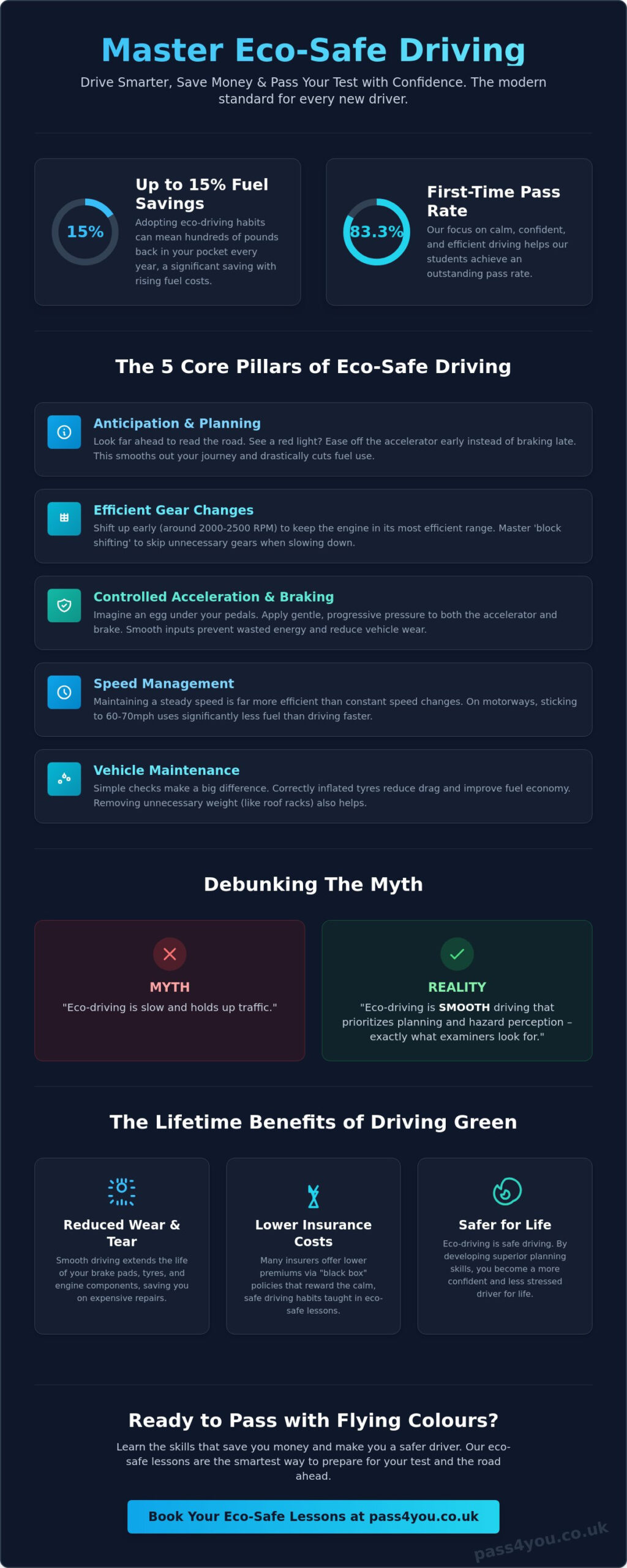
Did you know that mastering a few simple efficiency techniques could cut your fuel bills by up to 14%? With petrol prices averaging 135.67p per litre and the 5p fuel duty cut set to end in September 2026, every penny counts. At Pass4you Driving School, we believe that eco-safe driving lessons milton keynes are the smartest way to prepare for the modern road. It’s a common myth that driving green means moving at a snail’s pace. In reality, it’s about smooth planning and hazard perception; these are exactly the skills the DVSA examiner is looking for during your practical test.
We understand that the pressure of the driving test can be overwhelming, especially when you’re worried about technicalities or the rising costs of getting on the road. You want to feel confident behind the wheel, not stressed about your bank balance. This guide will show you how to master eco-safe driving to protect the environment and secure that 83.33% first time pass rate we’re so proud of. We’ll explore how to handle Milton Keynes’ unique road layouts while saving money and staying safe for life.
Key Takeaways
- Understand the 2026 standard for eco-safe driving, which combines hazard perception with technical car control to create a smoother, safer journey.
- Discover how our eco-safe driving lessons milton keynes teach you to navigate the city’s roundabouts and grid system with maximum efficiency.
- Master the art of anticipation and block shifting to stop the “stop-start” cycle; this saves you money on fuel and reduces vehicle wear.
- Learn why eco-driving isn’t about speed, but about the calm, professional control that helps our students achieve an 83.33% first-time pass rate.
- Get practical tips on how to manage rising fuel costs and meet stricter emissions standards while becoming a confident, safe driver for life.
What is Eco-Safe Driving? Defining the 2026 Standard
Eco-safe driving is a modern approach to being behind the wheel that balances safety with environmental and economic efficiency. It isn’t just about saving the planet; it’s about becoming a more thoughtful, observant driver. When you start energy-efficient driving techniques during your eco-safe driving lessons milton keynes, you’re learning to read the road ahead with much greater clarity. This style of driving relies on two main pillars: planning and awareness, and technical car control. By mastering these, you reduce the stress on your vehicle and your bank balance.
The DVSA monitors these habits during the UK practical test because smooth driving is safer driving. A driver who plans ahead is less likely to perform emergency stops or aggressive manoeuvres. This calmness leads to a significant reduction in vehicle wear and tear. Constant heavy braking wears down your pads quickly, and aggressive acceleration puts unnecessary strain on your engine and tyres. By adopting a greener style, you’re essentially extending the life of your car while keeping everyone on the road safer.
The DVSA Assessment: Will you fail for poor eco-driving?
You won’t fail your driving test purely because you didn’t drive in an eco-safe manner. However, the examiner will record your performance on the DL25 driving test report under the “Eco-safe driving” section. They look at two specific categories: “Planning” and “Control”. If you consistently use the wrong gear or fail to anticipate a red light, it might influence the examiner’s view of your overall “smoothness” score. Frequently, poor eco-driving habits are linked to “Progress” or “Planning” faults. If your lack of planning causes a safety issue, that will lead to a failed test.
Economic benefits for new drivers in 2026
Adopting these habits can lead to an average fuel saving of approximately 15% for most drivers. In 2026, with fuel prices remaining a major concern for young people, this saving can mean an extra few hundred pounds in your pocket every year. Beyond the petrol pump, eco-driving extends the life of tyres and brake pads, which are expensive components for a new driver to replace. Many insurance companies now offer “black box” telematics policies that reward smooth, calm driving with lower premiums. By proving you aren’t an aggressive driver, you can significantly lower your annual insurance costs from the very first day you pass.
Our eco-safe driving lessons milton keynes focus on building these habits early. We want you to be a confident driver who understands that being “fast” isn’t the same as being “efficient”. When you learn with us, you’re investing in a lifetime of cheaper, safer, and greener motoring.
The 5 Core Pillars of Eco-Safe Driving Techniques
Learning to drive is about more than just moving the car. It’s about developing a mindset that keeps you safe and saves you money. During your eco-safe driving lessons milton keynes, we focus on five core pillars that transform you from a nervous learner into a confident, efficient driver. These techniques are the secret behind our high pass rate and help you follow official fuel-saving tips that experienced drivers use every day.
- Anticipation and Planning: This is the most important skill. By looking far ahead, you can stop the tiring ‘stop-start’ cycle. If you see a red light in the distance, ease off the gas early rather than braking at the last second.
- Efficient Gear Changes: Modern engines don’t need to be revved high. We’ll show you how to use ‘block shifting’ to skip unnecessary gears when it’s safe to do so.
- Controlled Acceleration and Braking: Imagine there’s a fragile egg under your pedals. You want to press them gently enough to keep the egg from breaking. Smooth inputs lead to better fuel economy and a much calmer ride.
- Speed Management: Driving at a steady, legal speed is far more efficient than constantly accelerating and braking to weave through traffic.
- Vehicle Maintenance: Simple things like checking your tyre pressure can reduce drag. Under-inflated tyres make the engine work harder, which burns more fuel.
Mastering Gear Changes and Engine Braking
Getting your gear changes right is a huge part of being an eco-safe driver. As a general rule, you should look to shift up at around 2,000 RPM for diesel cars and 2,500 RPM for petrol engines. This keeps the engine in its most efficient range. We also teach the benefits of block shifting. For example, when you’re approaching a junction in 5th gear, you can often shift directly into 2nd once your speed has dropped. This reduces wear on the clutch and gearbox. Additionally, using engine braking; taking your foot off the accelerator while staying in gear; actually reduces your fuel consumption to zero during deceleration.
The Art of Momentum Management
Momentum is your best friend when trying to drive greener. If you’re approaching traffic lights, slow down early. If you can keep the car rolling at 5mph until the light turns green, you’ll use much less fuel than if you had to pull away from a total stop. On descents, you can gain speed safely by using the car’s weight, as long as you stay in full control. Always maintain at least a 2-second gap from the car in front. This extra space gives you time to make gradual speed adjustments without constantly hitting the brakes. If you’re feeling nervous about these techniques, Simon provides patient driving tuition to help you master them at your own pace.
Eco-Safe vs. Traditional Driving: Debunking the Myths
Many learners feel anxious when they hear the term “eco-safe.” There’s a common worry that driving for the environment means crawling along at 15mph or holding up traffic. This couldn’t be further from the truth. During our eco-safe driving lessons milton keynes, we focus on debunking these myths so you can drive with confidence. Eco-driving is about efficiency and planning; it’s a sophisticated way to handle a car that actually makes you a smoother, safer driver.
- Myth 1: “Eco-safe driving means driving slowly.” Reality: It’s about maintaining a steady speed and avoiding unnecessary braking. You should still drive at the speed limit when it’s safe to do so.
- Myth 2: “You can’t eco-drive in a manual car.” Reality: Modern manual gearboxes have optimized ratios that allow for early upshifting. Manual drivers often have more control over their efficiency than those in older automatics.
- Myth 3: “It’s only for electric vehicles (EVs).” Reality: While EVs are great, internal combustion engine (ICE) cars benefit the most from these techniques. You can see the biggest drop in fuel costs by changing how you handle a petrol or diesel engine.
- Myth 4: “Examiners will mark you down for being too cautious.” Reality: Examiners look for a balance. They want to see you making progress while using eco-safe techniques like engine braking and sensible acceleration.
Eco-Driving and the Undue Hesitation Trap
One of the biggest fears for students is getting a fault for “Undue Hesitation.” There is a clear difference between planned coasting and stalling the flow of traffic. If you’re approaching a 30mph zone from a 40mph road, easing off the accelerator early is smart planning. However, if you’re waiting at a clear roundabout because you’re trying to save fuel, that’s a mistake. Making progress is a vital part of your practical driving test. We’ll teach you how to maintain the speed limit while still being kind to your engine and the environment.
Manual vs. Automatic: Eco-Safe Differences
By 2026, most automatic gearboxes come with a dedicated “Eco-Mode” that handles gear shifts for you. However, manual drivers still have a unique advantage. You have direct control over the clutch and can use “Stop-Start” technology more effectively in traffic. Our modern Volkswagen tuition vehicles are equipped with this tech, which automatically cuts the engine when you’re stationary and in neutral. This saves a significant amount of fuel in Milton Keynes’ urban areas. Simon will patiently show you how to use these features without feeling rushed, ensuring you’re a confident master of whichever gearbox you choose.
Applying Eco-Safe Skills to Milton Keynes Roads
Milton Keynes isn’t like other towns. Its unique grid system and high density of roundabouts require a specific approach to efficiency. While generic advice might work in a standard town centre, eco-safe driving lessons milton keynes focus on the specific challenges of our local roads. We’ll show you how to use the city’s design to your advantage. By mastering the flow of the grid, you’ll find that driving becomes much less stressful and far more affordable.
Our city is built on a series of horizontal (H) and vertical (V) roads. These stretches are perfect for practicing steady speed control. Between the major junctions, there are often pedestrian crossings and Redway exits. Early hazard perception here is vital. If you spot a cyclist approaching a crossing from a distance, easing off the accelerator early is much more efficient than staying at 40mph and slamming on the brakes at the last second. This calm approach keeps your momentum high and your fuel consumption low.
The Milton Keynes Roundabout Challenge
Roundabouts are the biggest fuel consumers for new drivers in MK. The secret to mastering them is early observation. As you approach a roundabout on the V6 or H8, look through the gaps in traffic well before you arrive. If you can see the junction is clear, you can adjust your speed to keep the car rolling. This prevents an unnecessary total stop. Selecting the right lane early is also crucial; it prevents the heavy braking and sudden re-acceleration often caused by last minute lane changes. When you’re ready to join a faster flow, use the dual carriageway slip roads to build your speed gradually and smoothly.
Grid Road Efficiency: H1 to H10 and V1 to V11
The grid system is designed for flow. By maintaining a steady, legal speed between junctions, you’re more likely to hit the ‘green waves’ at traffic lights. This is especially true when heading towards Central Milton Keynes or out towards Bletchley. Identifying these local landmarks early helps you plan your route without second-guessing your turns. Because of these high-speed links, driving lessons in Milton Keynes require unique eco-safe strategies that you won’t find in traditional, congested towns. We focus on teaching you how to maintain progress while being as kind as possible to your engine and the environment.
Ready to master the MK grid with a calm, experienced mentor? Book your eco-safe driving lessons with Simon and start saving money on every mile.
Pass Your Test with Pass4you: The Calm Path to Eco-Success
Success on test day comes down to confidence and control. At Pass4you, our 83.33% first-time pass rate isn’t an accident. It’s built on a foundation of smooth, calm, and eco-safe habits. When you choose eco-safe driving lessons milton keynes, you’re learning to handle a car with the precision that DVSA examiners look for. We use modern, fuel-efficient Volkswagen tuition vehicles. These cars are perfect for learning because they feature the latest technology, like stop-start systems, which help you master efficiency from your very first hour behind the wheel.
We believe that a stressed learner is a distracted learner. That’s why our “Calm Mentor” approach is so effective. Instead of shouting or rushing you through complex junctions, we provide a supportive space where you can ask questions and make mistakes safely. This patience is exactly what helps our students become safe drivers for life. We focus on the long-term value of your tuition. While some schools might offer lower hourly rates, our method often requires fewer lessons overall because we build your confidence correctly from the start.
Personalised Instruction with Simon
Simon has spent years helping students navigate the unique MK road system with ease. He understands the anxiety that comes with learning to drive and tailors every session to your specific needs. Whether you’re struggling with the speed of the V-roads or the complexity of the roundabouts, his coaching is always patient and encouraging. This personalized support extends to the ‘Show Me, Tell Me’ questions. We’ll walk you through every maintenance check, from explaining how correct tyre pressure reduces drag to identifying engine components. You’ll go into your test feeling completely prepared for every technicality.
Ready to Start Your Journey?
Master the art of greener driving and you’ll reap the rewards for years to come. Eco-safe driving is more than a test requirement; it’s a way to keep your future running costs low and your safety levels high. You deserve an instructor who is as invested in your success as you are. Don’t waste time and money with instructors who make you feel nervous or unprepared. Experience the difference that professional, calm, and expert tuition makes to your progress. Book your driving lessons in Milton Keynes today and join the many successful drivers who passed first time with Simon.
Master the MK Grid with Confidence and Efficiency
Adopting a greener driving style is one of the best investments you can make for your future on the road. By mastering eco-safe driving lessons milton keynes, you aren’t just preparing to pass a test; you’re gaining skills that can save you up to 15% on fuel costs annually. Whether you’re navigating the busy H-roads or practicing your roundabout approaches, these techniques ensure you remain a calm and steady presence behind the wheel. You’ve seen how planning ahead and using smooth gear changes can transform your driving experience into something much more relaxed and affordable.
You don’t have to face the nerves of the driving test alone. Our patient instructor, Simon, is here to guide you through every step of the process in our modern, fuel-efficient Volkswagen tuition fleet. We’re incredibly proud of our 83.33% first-time pass rate, which proves that our supportive, confidence-building methods really work. It’s time to stop worrying about the rising costs of fuel or the technicalities of the practical test. Join the 83.33% who pass first time; Book your Milton Keynes lessons now! We look forward to helping you become a safe, confident driver for life.
Frequently Asked Questions
Is eco-safe driving part of the UK driving test?
Yes, examiners have assessed eco-safe driving as part of the practical test since 2008. During your test, the examiner will look at how well you plan your approach to hazards and how efficiently you use the gears. While they record your performance on the DL25 marking sheet, it is used more for feedback than as a primary reason for failing. Mastering these skills during your eco-safe driving lessons milton keynes shows you are a responsible driver.
Can I fail my driving test for not driving eco-safely?
You won’t fail your test solely for poor eco-driving habits. The examiner will only fail you if your driving becomes a safety risk. However, poor eco-habits often overlap with other marking categories. For example, failing to anticipate a red light might lead to a fault for “Planning” or “Harsh Braking.” If your lack of awareness causes a safety issue for another road user, that will result in a failed test.
Does eco-driving damage the engine or gearbox?
No, eco-driving actually reduces the wear and tear on your vehicle. By shifting gears early and avoiding high engine revs, you reduce the heat and friction that cause parts to fail. Techniques like block shifting also mean you use the clutch less frequently, which extends its lifespan. It is a much gentler way to treat your car compared to traditional, aggressive driving styles that put constant strain on the engine.
How much money can eco-safe driving actually save me in 2026?
Drivers who use efficiency techniques typically see a 14% improvement in their fuel consumption. With petrol prices averaging 135.67p per litre in early 2026, these savings add up to hundreds of pounds over a year of driving. Beyond the fuel pump, you will also save money by replacing tyres and brake pads less often. Many insurance companies also offer lower premiums for drivers who demonstrate this calm, smooth style via telematics.
What is the best gear for eco-driving at 30mph?
Most modern cars are most efficient in 4th gear when traveling at 30mph on a flat road. Some vehicles with six-speed gearboxes can even manage 5th gear at this speed without the engine labouring. The key is to keep the engine at a low RPM while ensuring the car still responds smoothly to the accelerator. We will help you listen to the engine and find the most efficient gear for every road during your lessons.
Do I need a special car to learn eco-safe driving?
You don’t need a specific type of vehicle to practice these skills. While our modern Volkswagen tuition fleet includes helpful features like stop-start technology, the core principles of planning and anticipation apply to every car. Whether you eventually drive a small petrol hatchback or a large diesel van, eco-safe driving lessons milton keynes give you the universal skills needed to maximize your mileage and keep your running costs as low as possible.
How does tyre pressure affect my eco-safe driving score?
Under-inflated tyres increase the rolling resistance of your vehicle, which forces the engine to work harder and burn more fuel. Even a small drop in pressure can reduce your fuel efficiency by approximately 3%. During your “Show Me, Tell Me” training, we will show you how to check and adjust your pressures. Keeping your tyres at the correct level is one of the simplest ways to maintain a high eco-safe standard.
Is eco-safe driving the same as defensive driving?
These two styles are very closely linked because they both rely on excellent anticipation. Defensive driving is primarily about staying safe by spotting hazards early and keeping a large space around your car. Eco-safe driving uses those same observations to avoid unnecessary stopping and starting. When you learn to drive defensively, you naturally become a more efficient driver because you are making gradual speed adjustments instead of reacting suddenly to the traffic.
Leave a Reply