Tag: safe driving

  • Eco-Safe Driving Lessons Milton Keynes: The 2026 Guide to Greener Driving

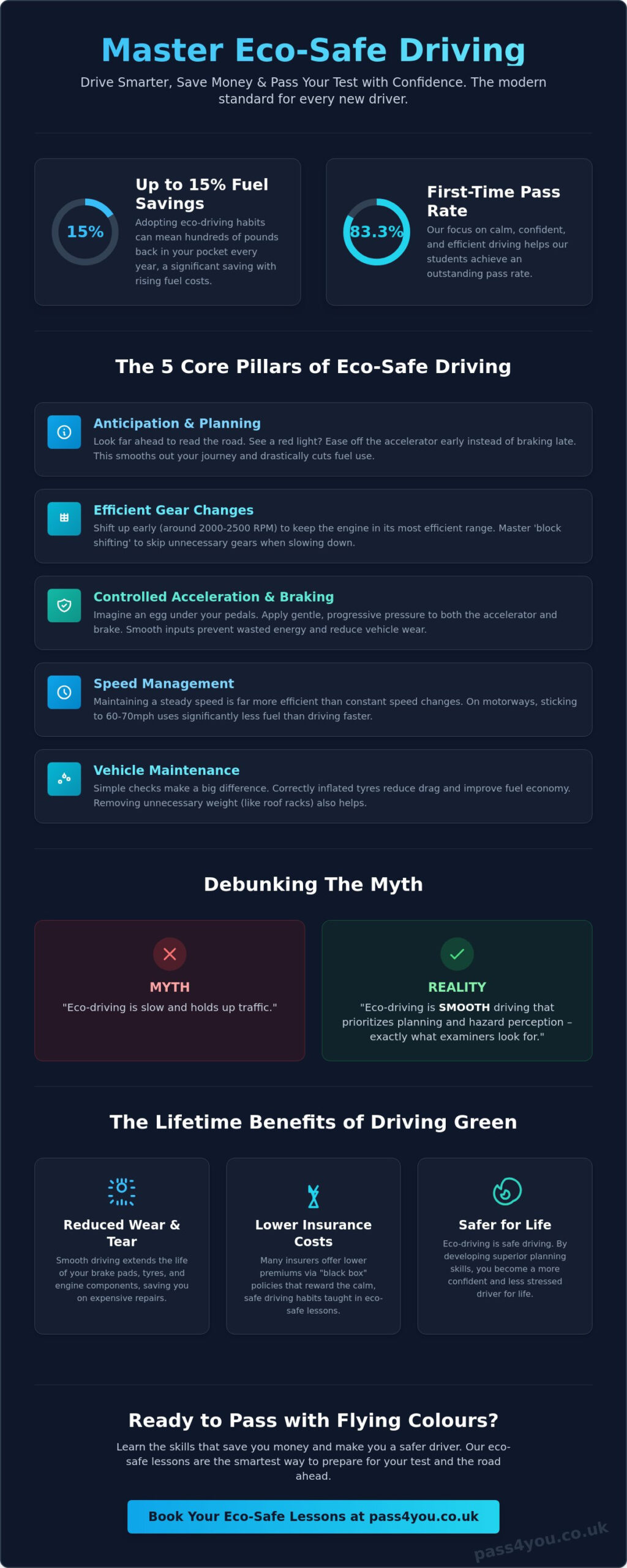
    Did you know that mastering a few simple efficiency techniques could cut your fuel bills by up to 14%? With petrol prices averaging 135.67p per litre and the 5p fuel duty cut set to end in September 2026, every penny counts. At Pass4you Driving School, we believe that eco-safe driving lessons milton keynes are the smartest way to prepare for the modern road. It’s a common myth that driving green means moving at a snail’s pace. In reality, it’s about smooth planning and hazard perception; these are exactly the skills the DVSA examiner is looking for during your practical test.

    We understand that the pressure of the driving test can be overwhelming, especially when you’re worried about technicalities or the rising costs of getting on the road. You want to feel confident behind the wheel, not stressed about your bank balance. This guide will show you how to master eco-safe driving to protect the environment and secure that 83.33% first time pass rate we’re so proud of. We’ll explore how to handle Milton Keynes’ unique road layouts while saving money and staying safe for life.

    Key Takeaways

    • Understand the 2026 standard for eco-safe driving, which combines hazard perception with technical car control to create a smoother, safer journey.
    • Discover how our eco-safe driving lessons milton keynes teach you to navigate the city’s roundabouts and grid system with maximum efficiency.
    • Master the art of anticipation and block shifting to stop the “stop-start” cycle; this saves you money on fuel and reduces vehicle wear.
    • Learn why eco-driving isn’t about speed, but about the calm, professional control that helps our students achieve an 83.33% first-time pass rate.
    • Get practical tips on how to manage rising fuel costs and meet stricter emissions standards while becoming a confident, safe driver for life.

    What is Eco-Safe Driving? Defining the 2026 Standard

    Eco-safe driving is a modern approach to being behind the wheel that balances safety with environmental and economic efficiency. It isn’t just about saving the planet; it’s about becoming a more thoughtful, observant driver. When you start energy-efficient driving techniques during your eco-safe driving lessons milton keynes, you’re learning to read the road ahead with much greater clarity. This style of driving relies on two main pillars: planning and awareness, and technical car control. By mastering these, you reduce the stress on your vehicle and your bank balance.

    The DVSA monitors these habits during the UK practical test because smooth driving is safer driving. A driver who plans ahead is less likely to perform emergency stops or aggressive manoeuvres. This calmness leads to a significant reduction in vehicle wear and tear. Constant heavy braking wears down your pads quickly, and aggressive acceleration puts unnecessary strain on your engine and tyres. By adopting a greener style, you’re essentially extending the life of your car while keeping everyone on the road safer.

    The DVSA Assessment: Will you fail for poor eco-driving?

    You won’t fail your driving test purely because you didn’t drive in an eco-safe manner. However, the examiner will record your performance on the DL25 driving test report under the “Eco-safe driving” section. They look at two specific categories: “Planning” and “Control”. If you consistently use the wrong gear or fail to anticipate a red light, it might influence the examiner’s view of your overall “smoothness” score. Frequently, poor eco-driving habits are linked to “Progress” or “Planning” faults. If your lack of planning causes a safety issue, that will lead to a failed test.

    Economic benefits for new drivers in 2026

    Adopting these habits can lead to an average fuel saving of approximately 15% for most drivers. In 2026, with fuel prices remaining a major concern for young people, this saving can mean an extra few hundred pounds in your pocket every year. Beyond the petrol pump, eco-driving extends the life of tyres and brake pads, which are expensive components for a new driver to replace. Many insurance companies now offer “black box” telematics policies that reward smooth, calm driving with lower premiums. By proving you aren’t an aggressive driver, you can significantly lower your annual insurance costs from the very first day you pass.

    Our eco-safe driving lessons milton keynes focus on building these habits early. We want you to be a confident driver who understands that being “fast” isn’t the same as being “efficient”. When you learn with us, you’re investing in a lifetime of cheaper, safer, and greener motoring.

    The 5 Core Pillars of Eco-Safe Driving Techniques

    Learning to drive is about more than just moving the car. It’s about developing a mindset that keeps you safe and saves you money. During your eco-safe driving lessons milton keynes, we focus on five core pillars that transform you from a nervous learner into a confident, efficient driver. These techniques are the secret behind our high pass rate and help you follow official fuel-saving tips that experienced drivers use every day.

    • Anticipation and Planning: This is the most important skill. By looking far ahead, you can stop the tiring ‘stop-start’ cycle. If you see a red light in the distance, ease off the gas early rather than braking at the last second.
    • Efficient Gear Changes: Modern engines don’t need to be revved high. We’ll show you how to use ‘block shifting’ to skip unnecessary gears when it’s safe to do so.
    • Controlled Acceleration and Braking: Imagine there’s a fragile egg under your pedals. You want to press them gently enough to keep the egg from breaking. Smooth inputs lead to better fuel economy and a much calmer ride.
    • Speed Management: Driving at a steady, legal speed is far more efficient than constantly accelerating and braking to weave through traffic.
    • Vehicle Maintenance: Simple things like checking your tyre pressure can reduce drag. Under-inflated tyres make the engine work harder, which burns more fuel.

    Mastering Gear Changes and Engine Braking

    Getting your gear changes right is a huge part of being an eco-safe driver. As a general rule, you should look to shift up at around 2,000 RPM for diesel cars and 2,500 RPM for petrol engines. This keeps the engine in its most efficient range. We also teach the benefits of block shifting. For example, when you’re approaching a junction in 5th gear, you can often shift directly into 2nd once your speed has dropped. This reduces wear on the clutch and gearbox. Additionally, using engine braking; taking your foot off the accelerator while staying in gear; actually reduces your fuel consumption to zero during deceleration.

    The Art of Momentum Management

    Momentum is your best friend when trying to drive greener. If you’re approaching traffic lights, slow down early. If you can keep the car rolling at 5mph until the light turns green, you’ll use much less fuel than if you had to pull away from a total stop. On descents, you can gain speed safely by using the car’s weight, as long as you stay in full control. Always maintain at least a 2-second gap from the car in front. This extra space gives you time to make gradual speed adjustments without constantly hitting the brakes. If you’re feeling nervous about these techniques, Simon provides patient driving tuition to help you master them at your own pace.
    Eco-Safe Driving Lessons Milton Keynes: The 2026 Guide to Greener Driving

    Eco-Safe vs. Traditional Driving: Debunking the Myths

    Many learners feel anxious when they hear the term “eco-safe.” There’s a common worry that driving for the environment means crawling along at 15mph or holding up traffic. This couldn’t be further from the truth. During our eco-safe driving lessons milton keynes, we focus on debunking these myths so you can drive with confidence. Eco-driving is about efficiency and planning; it’s a sophisticated way to handle a car that actually makes you a smoother, safer driver.

    • Myth 1: “Eco-safe driving means driving slowly.” Reality: It’s about maintaining a steady speed and avoiding unnecessary braking. You should still drive at the speed limit when it’s safe to do so.
    • Myth 2: “You can’t eco-drive in a manual car.” Reality: Modern manual gearboxes have optimized ratios that allow for early upshifting. Manual drivers often have more control over their efficiency than those in older automatics.
    • Myth 3: “It’s only for electric vehicles (EVs).” Reality: While EVs are great, internal combustion engine (ICE) cars benefit the most from these techniques. You can see the biggest drop in fuel costs by changing how you handle a petrol or diesel engine.
    • Myth 4: “Examiners will mark you down for being too cautious.” Reality: Examiners look for a balance. They want to see you making progress while using eco-safe techniques like engine braking and sensible acceleration.

    Eco-Driving and the Undue Hesitation Trap

    One of the biggest fears for students is getting a fault for “Undue Hesitation.” There is a clear difference between planned coasting and stalling the flow of traffic. If you’re approaching a 30mph zone from a 40mph road, easing off the accelerator early is smart planning. However, if you’re waiting at a clear roundabout because you’re trying to save fuel, that’s a mistake. Making progress is a vital part of your practical driving test. We’ll teach you how to maintain the speed limit while still being kind to your engine and the environment.

    Manual vs. Automatic: Eco-Safe Differences

    By 2026, most automatic gearboxes come with a dedicated “Eco-Mode” that handles gear shifts for you. However, manual drivers still have a unique advantage. You have direct control over the clutch and can use “Stop-Start” technology more effectively in traffic. Our modern Volkswagen tuition vehicles are equipped with this tech, which automatically cuts the engine when you’re stationary and in neutral. This saves a significant amount of fuel in Milton Keynes’ urban areas. Simon will patiently show you how to use these features without feeling rushed, ensuring you’re a confident master of whichever gearbox you choose.

    Applying Eco-Safe Skills to Milton Keynes Roads

    Milton Keynes isn’t like other towns. Its unique grid system and high density of roundabouts require a specific approach to efficiency. While generic advice might work in a standard town centre, eco-safe driving lessons milton keynes focus on the specific challenges of our local roads. We’ll show you how to use the city’s design to your advantage. By mastering the flow of the grid, you’ll find that driving becomes much less stressful and far more affordable.

    Our city is built on a series of horizontal (H) and vertical (V) roads. These stretches are perfect for practicing steady speed control. Between the major junctions, there are often pedestrian crossings and Redway exits. Early hazard perception here is vital. If you spot a cyclist approaching a crossing from a distance, easing off the accelerator early is much more efficient than staying at 40mph and slamming on the brakes at the last second. This calm approach keeps your momentum high and your fuel consumption low.

    The Milton Keynes Roundabout Challenge

    Roundabouts are the biggest fuel consumers for new drivers in MK. The secret to mastering them is early observation. As you approach a roundabout on the V6 or H8, look through the gaps in traffic well before you arrive. If you can see the junction is clear, you can adjust your speed to keep the car rolling. This prevents an unnecessary total stop. Selecting the right lane early is also crucial; it prevents the heavy braking and sudden re-acceleration often caused by last minute lane changes. When you’re ready to join a faster flow, use the dual carriageway slip roads to build your speed gradually and smoothly.

    Grid Road Efficiency: H1 to H10 and V1 to V11

    The grid system is designed for flow. By maintaining a steady, legal speed between junctions, you’re more likely to hit the ‘green waves’ at traffic lights. This is especially true when heading towards Central Milton Keynes or out towards Bletchley. Identifying these local landmarks early helps you plan your route without second-guessing your turns. Because of these high-speed links, driving lessons in Milton Keynes require unique eco-safe strategies that you won’t find in traditional, congested towns. We focus on teaching you how to maintain progress while being as kind as possible to your engine and the environment.

    Ready to master the MK grid with a calm, experienced mentor? Book your eco-safe driving lessons with Simon and start saving money on every mile.

    Pass Your Test with Pass4you: The Calm Path to Eco-Success

    Success on test day comes down to confidence and control. At Pass4you, our 83.33% first-time pass rate isn’t an accident. It’s built on a foundation of smooth, calm, and eco-safe habits. When you choose eco-safe driving lessons milton keynes, you’re learning to handle a car with the precision that DVSA examiners look for. We use modern, fuel-efficient Volkswagen tuition vehicles. These cars are perfect for learning because they feature the latest technology, like stop-start systems, which help you master efficiency from your very first hour behind the wheel.

    We believe that a stressed learner is a distracted learner. That’s why our “Calm Mentor” approach is so effective. Instead of shouting or rushing you through complex junctions, we provide a supportive space where you can ask questions and make mistakes safely. This patience is exactly what helps our students become safe drivers for life. We focus on the long-term value of your tuition. While some schools might offer lower hourly rates, our method often requires fewer lessons overall because we build your confidence correctly from the start.

    Personalised Instruction with Simon

    Simon has spent years helping students navigate the unique MK road system with ease. He understands the anxiety that comes with learning to drive and tailors every session to your specific needs. Whether you’re struggling with the speed of the V-roads or the complexity of the roundabouts, his coaching is always patient and encouraging. This personalized support extends to the ‘Show Me, Tell Me’ questions. We’ll walk you through every maintenance check, from explaining how correct tyre pressure reduces drag to identifying engine components. You’ll go into your test feeling completely prepared for every technicality.

    Ready to Start Your Journey?

    Master the art of greener driving and you’ll reap the rewards for years to come. Eco-safe driving is more than a test requirement; it’s a way to keep your future running costs low and your safety levels high. You deserve an instructor who is as invested in your success as you are. Don’t waste time and money with instructors who make you feel nervous or unprepared. Experience the difference that professional, calm, and expert tuition makes to your progress. Book your driving lessons in Milton Keynes today and join the many successful drivers who passed first time with Simon.

    Master the MK Grid with Confidence and Efficiency

    Adopting a greener driving style is one of the best investments you can make for your future on the road. By mastering eco-safe driving lessons milton keynes, you aren’t just preparing to pass a test; you’re gaining skills that can save you up to 15% on fuel costs annually. Whether you’re navigating the busy H-roads or practicing your roundabout approaches, these techniques ensure you remain a calm and steady presence behind the wheel. You’ve seen how planning ahead and using smooth gear changes can transform your driving experience into something much more relaxed and affordable.

    You don’t have to face the nerves of the driving test alone. Our patient instructor, Simon, is here to guide you through every step of the process in our modern, fuel-efficient Volkswagen tuition fleet. We’re incredibly proud of our 83.33% first-time pass rate, which proves that our supportive, confidence-building methods really work. It’s time to stop worrying about the rising costs of fuel or the technicalities of the practical test. Join the 83.33% who pass first time; Book your Milton Keynes lessons now! We look forward to helping you become a safe, confident driver for life.

    Frequently Asked Questions

    Is eco-safe driving part of the UK driving test?

    Yes, examiners have assessed eco-safe driving as part of the practical test since 2008. During your test, the examiner will look at how well you plan your approach to hazards and how efficiently you use the gears. While they record your performance on the DL25 marking sheet, it is used more for feedback than as a primary reason for failing. Mastering these skills during your eco-safe driving lessons milton keynes shows you are a responsible driver.

    Can I fail my driving test for not driving eco-safely?

    You won’t fail your test solely for poor eco-driving habits. The examiner will only fail you if your driving becomes a safety risk. However, poor eco-habits often overlap with other marking categories. For example, failing to anticipate a red light might lead to a fault for “Planning” or “Harsh Braking.” If your lack of awareness causes a safety issue for another road user, that will result in a failed test.

    Does eco-driving damage the engine or gearbox?

    No, eco-driving actually reduces the wear and tear on your vehicle. By shifting gears early and avoiding high engine revs, you reduce the heat and friction that cause parts to fail. Techniques like block shifting also mean you use the clutch less frequently, which extends its lifespan. It is a much gentler way to treat your car compared to traditional, aggressive driving styles that put constant strain on the engine.

    How much money can eco-safe driving actually save me in 2026?

    Drivers who use efficiency techniques typically see a 14% improvement in their fuel consumption. With petrol prices averaging 135.67p per litre in early 2026, these savings add up to hundreds of pounds over a year of driving. Beyond the fuel pump, you will also save money by replacing tyres and brake pads less often. Many insurance companies also offer lower premiums for drivers who demonstrate this calm, smooth style via telematics.

    What is the best gear for eco-driving at 30mph?

    Most modern cars are most efficient in 4th gear when traveling at 30mph on a flat road. Some vehicles with six-speed gearboxes can even manage 5th gear at this speed without the engine labouring. The key is to keep the engine at a low RPM while ensuring the car still responds smoothly to the accelerator. We will help you listen to the engine and find the most efficient gear for every road during your lessons.

    Do I need a special car to learn eco-safe driving?

    You don’t need a specific type of vehicle to practice these skills. While our modern Volkswagen tuition fleet includes helpful features like stop-start technology, the core principles of planning and anticipation apply to every car. Whether you eventually drive a small petrol hatchback or a large diesel van, eco-safe driving lessons milton keynes give you the universal skills needed to maximize your mileage and keep your running costs as low as possible.

    How does tyre pressure affect my eco-safe driving score?

    Under-inflated tyres increase the rolling resistance of your vehicle, which forces the engine to work harder and burn more fuel. Even a small drop in pressure can reduce your fuel efficiency by approximately 3%. During your “Show Me, Tell Me” training, we will show you how to check and adjust your pressures. Keeping your tyres at the correct level is one of the simplest ways to maintain a high eco-safe standard.

    Is eco-safe driving the same as defensive driving?

    These two styles are very closely linked because they both rely on excellent anticipation. Defensive driving is primarily about staying safe by spotting hazards early and keeping a large space around your car. Eco-safe driving uses those same observations to avoid unnecessary stopping and starting. When you learn to drive defensively, you naturally become a more efficient driver because you are making gradual speed adjustments instead of reacting suddenly to the traffic.
  • How to Build Confidence Driving After Passing Your Test: A Complete 2026 Guide

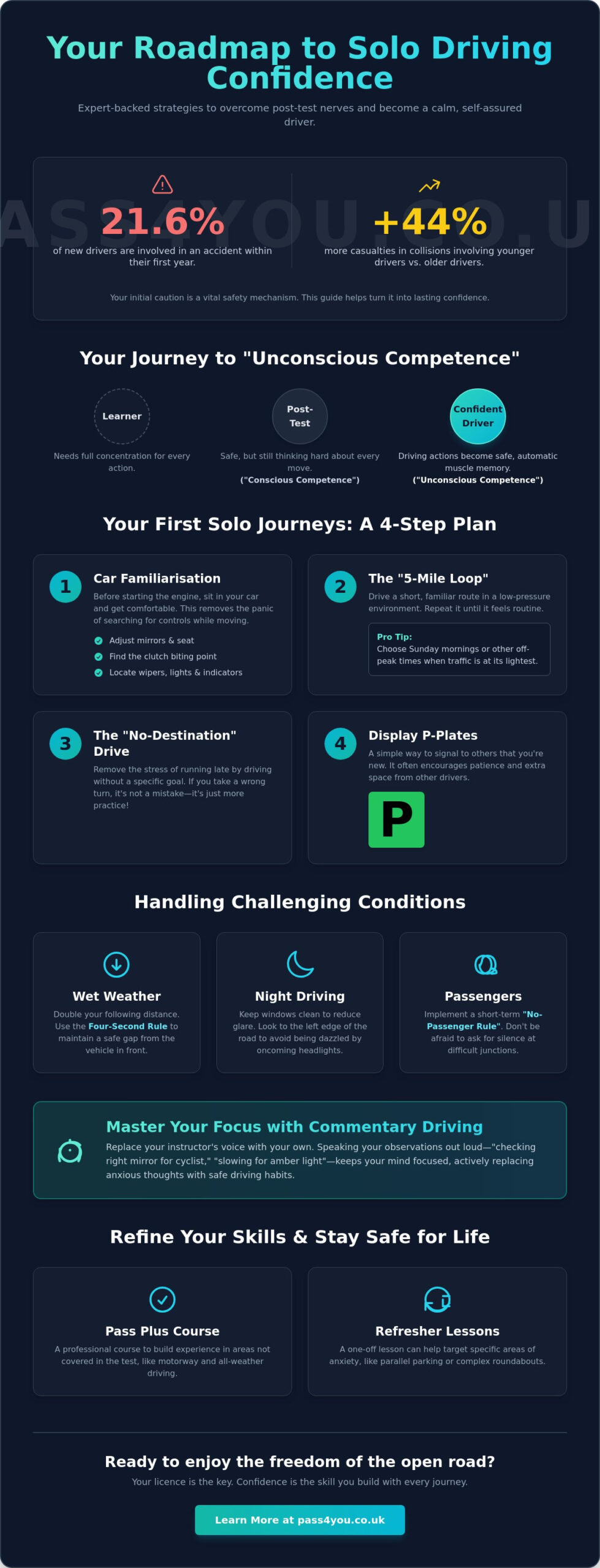
    Did you know that 21.6% of new drivers are involved in an accident within their first year on the road? This sobering statistic explains why the initial excitement of passing can quickly turn into a knot of anxiety the moment you realise there is no dual-control brake to save you. Without a patient mentor like Simon by your side, the pressure from aggressive drivers or the fear of stalling in traffic can feel overwhelming. You aren’t alone in wondering how to build confidence driving after passing test; in fact, most new drivers feel exactly the same way.

    We believe that confidence isn’t a gift from your examiner, but a skill you build through intentional, low-stakes solo experience. This guide provides you with practical, expert-backed strategies to move past your post-test nerves and become a calm, self-assured driver. We’ll explore how to manage your first independent trips to the shops and how 2026 trends like telematics insurance can help you stay safe. By the end of this article, you’ll have a clear roadmap to enjoying the freedom and independence your licence was meant to provide.

    Key Takeaways

    • Learn how to bridge the gap between learning and solo driving by using a car familiarisation session and a simple 5-mile loop.
    • Discover the most effective methods for how to build confidence driving after passing test, helping you transition into a calm and self-assured driver.
    • Gain practical tips for handling difficult conditions, including the four-second rule for wet weather and managing glare during night journeys.
    • Protect your concentration by implementing a short-term no-passenger rule and learning how to ask for silence at difficult junctions.
    • Explore how professional support like Pass Plus or a refresher lesson can build your maturity and ensure you remain a safe driver for life.

    Understanding the Post-Test Jitters: Why Solo Driving Feels Different

    It is completely normal to feel a wave of nerves the first time you sit in the driver’s seat alone. We call this “Post-Test Anxiety,” and it is a natural psychological response to losing the safety net of dual-control brakes and a professional instructor. For months, you had a calm mentor like Simon to catch your mistakes. Now, that responsibility sits entirely on your shoulders. Understanding how to build confidence driving after passing test begins with accepting that your brain is adjusting to a massive shift in responsibility.

    During your lessons, you likely reached a stage called “conscious competence.” This means you can drive safely, but you still have to think very hard about every gear change and mirror check. The goal now is to move toward “unconscious competence,” where these actions become muscle memory. Remember that passing your test proves you are a safe driver, but it does not mean you are a finished product. According to 2024 road safety statistics, collisions involving younger drivers resulted in 44% more casualties than those involving older drivers; this is why that initial “healthy caution” you feel is actually a vital safety mechanism.

    The biggest hurdle for many is the fear of being “watched” or judged by other road users. You might worry about stalling at a green light or taking too long to park. It’s helpful to remember that every driver on the road was once in your position. Most people are far more concerned with their own journey than they are with yours.

    The Psychology of the Empty Passenger Seat

    When you drive with an instructor, they manage a significant portion of your “cognitive load.” They scan the road ahead and anticipate hazards, allowing you to focus on car control. Without that second pair of eyes, your brain can feel “noisier” as it tries to process every bit of information solo. To manage this, we recommend “commentary driving.” By speaking your observations out loud, such as “I’m slowing down for the amber light” or “checking my right mirror for that cyclist,” you replace the instructor’s voice with your own. This keeps you focused and prevents your mind from wandering into anxious thoughts.

    Normalising the “Imposter Syndrome”

    Many of our students, even those who achieve a first time pass, report feeling like an “imposter” during their first week of solo driving. You aren’t a fake driver; you’ve simply moved into a new phase of your education. The practical driving test is a baseline for safety, but your real-world experience starts now. By integrating Defensive driving techniques into your daily routine, you can turn that nervousness into a professional level of alertness. Differentiating between a healthy respect for the road and a debilitating fear is the first step toward becoming a confident, safe driver for life.

    Practical Strategies for Your First Solo Journeys

    The transition from a dual-controlled car to your own vehicle is a significant milestone. To manage this shift, start with a “car familiarisation” session right in your driveway. Sit in the driver’s seat without the engine running. Adjust your mirrors, find the biting point of the clutch, and locate the controls for the wipers and lights. This simple exercise removes the panic of searching for a button while moving. It’s a calm way to begin learning how to build confidence driving after passing test without any external pressure.

    Once you’re comfortable with the controls, plan “The 5-Mile Loop.” Choose a route you know well from your lessons and drive it during Sunday morning lulls when traffic is at its thinnest. We also suggest a “No-Destination” drive. By driving without a specific appointment or arrival time, you remove the stress of running late. If you take a wrong turn, it doesn’t matter; you’re just gaining experience. Many new drivers find that displaying green “P-Plates” acts as a helpful signal to others. It often encourages more experienced drivers to give you extra space and patience at junctions.

    Mastering Milton Keynes Roundabouts Solo

    For those living in Milton Keynes, the grid system and its famous roundabouts can feel daunting without an instructor. Tackle these during off-peak hours, such as 10:00 AM on a weekday. Use your lane discipline as a primary “shield” against more aggressive road users. If you’re in the correct lane early, you’ve already won half the battle. Remember that your driving lessons in Milton Keynes specifically prepared you for these layouts. You’ve handled them before with Simon, and you have the skills to handle them now.

    The “Baby Steps” Schedule for Week One

    Building a routine helps turn anxiety into habit. Following a structured plan can make the first week feel much more manageable:

    • Day 1: Sit in the car alone for 10 minutes. Adjust everything to your liking. Take a 2-minute drive around your immediate block and park again.
    • Day 3: Drive to a local petrol station. Handling the pumps and paying can be a source of “hidden” anxiety for new drivers. Doing this when you aren’t in a rush builds vital confidence.
    • Day 7: Try a short commute to the shops or work during light traffic. This starts to build the routine you’ll need for daily life.

    Taking things at your own pace is the best way to ensure you remain a safe driver for life. If you ever feel you need a bit more support, you can always book a friendly chat with us to discuss your progress.

    How to Build Confidence Driving After Passing Your Test: A Complete 2026 Guide

    Conquering Challenging Conditions: Night, Weather, and Motorways

    Once you have mastered your local routes, the next step in learning how to build confidence driving after passing test involves tackling more complex environments. Driving at night presents unique challenges, particularly the glare from LED headlights which have become increasingly bright in 2026. If you feel dazzled, slightly reduce your speed and avoid looking directly at the oncoming lights. Focus on the left-hand verge to stay on track. Remember that visibility is significantly reduced after dark, so giving yourself extra time to react is a sign of a mature, safe driver.

    Wet weather requires a similar adjustment in mindset. The “two-second rule” you learned for dry roads should be doubled to a “four-second rule” in the rain. Your car feels different when the road is slick; steering can feel lighter and braking distances increase. If you feel the car beginning to aquaplane, stay calm. Ease off the accelerator and keep the steering wheel straight until you feel the tyres regain their grip. Another common stressor is parking. We suggest parking at the far end of the supermarket car park where there are fewer cars. This removes the “audience pressure” of other drivers waiting for your spot and gives you plenty of room to practice your bay parking without fear of a scrape.

    The First Time on the Dual Carriageway Alone

    Joining a high-speed road is often the biggest hurdle for new solo drivers. The key is using the slip road to match the speed of the traffic already on the main carriageway. If you join too slowly, you force others to brake, which creates a hazard. Always perform a “Life-Saver” check over your right shoulder before merging; this ensures no one is hiding in your blind spot. For a technical refresher on lane discipline and merging safely, you can revisit our guide on mastering the dual carriageway. You have the skills to handle 70mph; it’s just a matter of trusting your training.

    Dealing with Adverse Weather and Visibility

    In 2026, modern cars come equipped with various sensors, but you must still know how to use your fog lights and demisters manually. If fog rolls in, don’t rely on automatic “daytime running lights” as they often don’t activate the rear lamps. A helpful psychological trick is “following a safe leader.” Find a vehicle ahead that is driving at a sensible speed and maintain a generous following distance. This provides a visual guide for the road’s path. If the conditions ever feel truly overwhelming, there’s no shame in finding a safe place to stop, such as a petrol station or lay-by, until the weather clears. Taking a five-minute break is always better than driving while panicked.

    Managing Passengers and Internal Distractions

    Many new drivers are surprised to find that a car full of friends is far more challenging than the driving test itself. While you might be eager to share your new freedom, we strongly recommend a “No-Passenger Rule” for at least your first 50 miles of solo driving. Having passengers introduces a social obligation to hold a conversation, which pulls your focus away from the road. Learning how to build confidence driving after passing test is much easier when you can listen to the car’s feedback without the pressure of entertaining others.

    If you do take passengers later in your first month, be honest about your needs. It is perfectly okay to say, “I need silence for this junction.” A true friend will respect your safety. You also need to be wary of the “Sat-Nav Stare.” With modern 2026 car displays becoming larger and more detailed, it’s easy to look at the screen for too long. Rely on the audio cues instead. If you miss a turn, stay calm and let the device reroute you; never make a sudden manoeuvre just to follow a digital map. Your safety is more important than a two-minute detour.

    Managing a “backseat driver” is another vital skill. Well-meaning family members might offer advice that contradicts your recent training. Since you’ve been taught the most up-to-date safety methods, it’s important to trust your own judgment. Politely remind them that you need to follow the routines that helped you pass your test to stay calm and focused.

    Setting Ground Rules for Your Passengers

    Professional pilots use a “sterile cockpit” rule, where only essential talk happens during the most difficult parts of a flight. You can do the same. Tell your passengers that you need a quiet environment for the first few weeks. This reduces your “cognitive load” and allows you to process hazards more effectively. If someone becomes too distracting, don’t be afraid to pull over in a safe place and explain that you need to focus. Setting these boundaries early helps you remain a safe driver for life.

    The Digital Distraction: Music and Tech

    Loud music can be just as distracting as a talkative friend. It can mask the sound of the engine, making it harder to judge when to change gears, and can even drown out sirens from emergency vehicles. To keep your environment under control, try these steps:

    • Pre-set your tech: Enter your destination and start your music before you move the car. Never touch your phone or screen while the engine is running.
    • The “Glovebox Phone” rule: Place your phone in the glovebox. Even seeing a notification light on the dashboard can break your concentration for several vital seconds.
    • Volume control: Keep your music at a level where you can still hear the wind, the tyres, and the engine.

    By taking control of your internal environment, you give yourself the best chance to drive with confidence. If you feel you would benefit from practicing these real-world scenarios with a professional, you can book a driving lesson to build your skills in a supportive environment.

    Beyond the Test: Refining Your Skills with Professional Support

    Passing your practical test is a fantastic achievement, but it’s really just the baseline for your driving career. The true learning begins when you start navigating the world without a dual-control brake. Many new drivers feel a sense of “test-ready” confidence that fades once they’re solo. This is why the long-term goal isn’t just to hold a licence, but to transition into being a safe driver for life. Professional support doesn’t have to end at the test centre; in fact, the most mature drivers are often those who seek a little extra guidance as they find their feet.

    There’s a common myth that booking a “refresher lesson” is a sign of failure or that you weren’t ready to pass. This couldn’t be further from the truth. In any other high-skill environment, like aviation or medicine, ongoing coaching is a mark of professional maturity. If you feel your pulse race at the thought of a specific multi-lane junction or a tight parking spot, asking for a helping hand is the smartest move you can make. Simon and the Pass4you team regularly work with full licence holders to help them regain their calm and refine their technique in their own cars.

    Is Pass Plus Worth It in 2026?

    Pass Plus remains one of the most effective ways to bridge the gap between being a “learner” and a “confident motorist.” It’s a structured refining course that consists of at least 6 hours of professional tuition. Because the standard test doesn’t always cover high-speed motorways, complex rural lanes, or extreme weather conditions in depth, Pass Plus fills those vital gaps. Many insurance providers in 2026 still recognize the value of this course, potentially helping you manage the high costs often associated with first-year premiums. When searching for driving instructors near me, look for those who specialize in this post-test coaching. It provides a safe environment to face your fears with a patient expert by your side.

    Booking a Confidence Booster Session

    Sometimes you don’t need a full course, just a single session to tackle a specific trigger. Maybe it’s parallel parking in the busy Milton Keynes town centre or merging onto a fast-moving dual carriageway during rush hour. We often use a “mock solo” drive during these sessions. This is where the instructor sits in the back and says absolutely nothing, allowing you to make all the decisions. It’s a powerful way to prove to yourself that you have the skills to handle the road alone. If you’re struggling with how to build confidence driving after passing test, remember that we’re here to help you stay safe and calm. You can contact Pass4you to book a calm, patient confidence session today and take the final step toward true independence.

    Take the Wheel with Total Confidence

    Becoming a confident driver doesn’t happen overnight; it is a process of gradual exposure and steady practice. By starting with simple local loops, setting firm boundaries with your passengers, and slowly mastering challenging conditions like night driving, you’ll soon feel in complete control of your vehicle. Understanding how to build confidence driving after passing test is simply about giving yourself the patience you deserve while you adjust to life without an instructor by your side.

    If you ever feel overwhelmed by a specific junction or a high-speed road, remember that you don’t have to navigate this transition alone. With an impressive 83.33% first-time pass rate and a reputation for calm, patient instruction, Simon is here to help you bridge the gap. Whether you want to practice motorway merging or master tight parking in our first-class Volkswagen tuition vehicles, we’re ready to support your journey. Book a patient, confidence-boosting session with Pass4you Milton Keynes to secure your skills for the future. You’ve earned your freedom; now it is time to enjoy it safely and with total peace of mind.

    Frequently Asked Questions

    Is it normal to be scared to drive after passing my test?

    It is completely normal to feel nervous or even scared during your first few solo journeys. Most new drivers experience a psychological shift when they no longer have a patient instructor to rely on for safety. This healthy caution is actually a sign that you are a responsible driver who understands the risks of the road.

    How many miles should I drive solo before I feel confident?

    Most drivers report a significant boost in comfort after completing their first 100 miles of solo driving. Instead of focusing only on the odometer, try to drive for at least 15 minutes every day. Consistency is the most effective way to build confidence driving after passing test and turning conscious effort into muscle memory.

    Should I use P-plates on my car as a new driver?

    While they aren’t legally required, green P-plates are a fantastic tool for reducing road pressure. They let other drivers know you are still gaining experience. This often results in people giving you more space at roundabouts or being more patient if you take a moment longer to complete a manoeuvre.

    What should I do if I stall my car in the middle of a busy junction?

    The first thing you must do is stay calm and ignore any impatient drivers behind you. Apply the handbrake, restart the car, and perform your full observations before moving off again. Stalling is a common occurrence; it is a minor event that every driver has experienced at some point.

    Can I take motorway lessons after I have passed my driving test?

    You can certainly book professional driving lessons to focus on motorway driving after you have passed. Many of our students find that a two-hour session on the M1 with a mentor like Simon makes a world of difference. It allows you to practice high-speed lane changes and slip roads without the stress of being alone.

    What happens if I have an accident as a newly qualified driver?

    If you are involved in a collision, you must stop and exchange details as required by law. Under the New Drivers Act, your licence will be revoked if you get six or more penalty points within two years of passing. This makes it especially important to continue applying the safe, defensive techniques you learned during your tuition.

    How do I handle aggressive drivers who tail me?

    Never speed up or feel pressured to drive beyond your comfort level just because someone is tailgating you. Keep a steady pace and increase the gap between you and the car in front. This gives you more time to react and prevents you from having to brake sharply, which keeps you and the aggressive driver safer.

    Is it better to drive a manual or automatic car to gain confidence?

    Driving an automatic can build confidence quickly because it removes the fear of stalling and the complexity of gear changes. However, if you passed in a manual car, staying with a manual will help you maintain the full range of your skills. The best car for you is the one that makes you feel the most calm and in control.