Imagine it’s a rainy Tuesday evening in November 2026, and you’re approaching the sprawling Portway roundabout without your instructor’s dual controls for the very first time. Your palms are slightly damp, and the rush hour traffic feels much faster than it did during your lessons. It’s a feeling almost every new driver knows well. While passing your test is a massive achievement, the real learning often starts when you’re solo. Finding the right tips for new drivers uk is a great first step, but those tips need to work for our unique grid system and the specific challenges of Milton Keynes.
We know that the transition to independent driving brings a lot of anxiety, especially when you’re worried about making a mistake at a busy junction or keeping up with new 2026 road safety laws. At Pass4you, we’ve helped hundreds of local learners achieve an 83.33% first-time pass rate by focusing on calm, patient mentorship. This guide will help you master the MK roads with confidence, from navigating complex roundabouts in bad weather to basic car maintenance. We’re going to walk you through 15 expert strategies to ensure you stay safe and feel completely in control of your first car.
Key Takeaways
- Build your confidence for that first solo drive and learn why green P-plates are a vital tool for staying calm on busy routes like the A421.
- Master the Milton Keynes H and V grid system with practical tips for new drivers uk to help you navigate major roundabouts safely and accurately.
- Gain the skills needed for driving beyond the test, from merging onto the M1 at Junction 14 to handling unlit rural roads near Olney in 2026 weather conditions.
- Protect yourself with the latest 2026 car tech and simple maintenance routines that keep your vehicle safe and roadworthy for years to come.
- Learn how the Pass Plus scheme can boost your road awareness and help reduce insurance costs, making you a more experienced and responsible driver.
Surviving Your First Week: Solo Driving Confidence in Milton Keynes
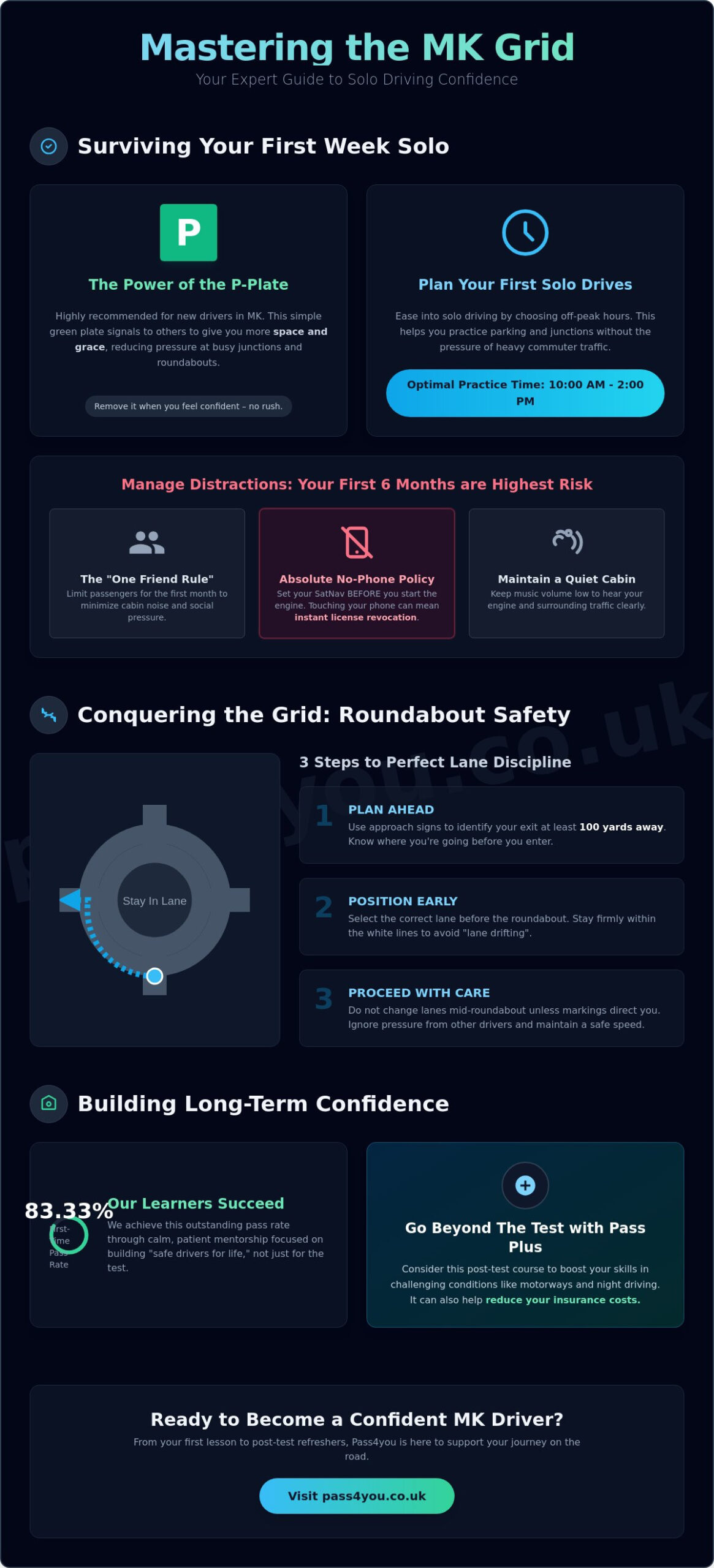
Passing your driving test is a massive achievement, but that first solo trip from the Brooklands or Bletchley test centre feels very different without an instructor by your side. It’s a psychological milestone because you’re now the sole decision-maker. You’re responsible for every gear change and every exit on the Milton Keynes grid system. At Pass4you, we’ve seen how this transition can be nerve-wracking, but it’s also the moment you truly start becoming a “safe driver for life.” To make this week easier, you should plan your first few solo routes during off-peak hours. Driving through Stony Stratford or Bletchley between 10:00 am and 2:00 pm allows you to practice parking and junction management without the pressure of heavy commuter traffic.
The Psychology of the P-Plate
Green P-plates are voluntary, but we highly recommend them for nervous Milton Keynes beginners. When you’re merging onto the busy A421 or navigating the H6 Childs Way, these plates signal to experienced drivers to give you more “space and grace.” It’s a simple way to reduce the pressure you feel at roundabouts. Most drivers are patient when they see a P-plate, as it reminds them that they were once in your position too. You can decide to remove them whenever your confidence feels stable. For some, this takes two weeks; for others, it might be two months. There’s no rush; it’s about your comfort level on the road.
Managing Distractions and Passengers
Statistics from UK road safety organisations indicate that the first 6 months of solo driving carry the highest risk for accidents. One of the most important tips for new drivers uk wide is to strictly manage who you allow in your car during this period. We suggest a “one friend rule” for at least your first month of solo driving. A car full of passengers creates significant cabin noise and social pressure, which can easily distract you from the road ahead.
Your “no-phone” policy must be absolute. Even when you’re using a SatNav to navigate the MK grid, you must set your destination before you start the engine. Touching a mobile phone while driving is a serious offence under The Highway Code, and for new drivers, it can lead to an immediate license revocation. Keeping your cabin quiet and your eyes on the road is the best way to maintain the high standards you achieved during your lessons. Following these tips for new drivers uk will help you build the calm, patient habits that lead to years of safe motoring.
- Set your SatNav before you pull away from the kerb.
- Keep music at a low volume so you can hear your engine and surrounding traffic.
- Ask passengers to remain quiet when you’re approaching complex MK roundabouts.
Conquering the Grid: Navigating Milton Keynes Roundabouts Safely
Driving alone for the first time in Milton Keynes feels very different than having an instructor by your side. The city’s unique grid system, composed of H (Horizontal) and V (Vertical) roads, is designed for efficiency, but it can be intimidating when you’re making split-second decisions at 60mph or 70mph. One of the most important tips for new drivers uk is to remember that the grid is your friend, provided you stay calm and plan your lane positioning early. Without the safety net of an instructor, the responsibility to read the road signs accurately falls entirely on you.
Lane Discipline on Multi-Lane Roundabouts
At major junctions like Northfield or Pineham, lane discipline is the most common challenge for new motorists. You might feel pressured by experienced local drivers to speed up, but rushing often leads to “lane drifting.” This happens when a driver fails to follow the spiral markings and accidentally cuts into another car’s path. To stay safe, follow these steps:
- Identify your exit on the approach sign at least 100 yards away.
- Select your lane early and stay within the white lines throughout the turn.
- Avoid changing lanes mid-roundabout unless the road markings specifically direct you to do so.
If you feel your confidence wobbling after passing your test, booking driving lessons Milton Keynes for a post-test refresher can help you master these complex layouts. At Pass4you, we focus on building that specific “roundabout resilience” that MK drivers need every day.
The Redway Interface
Milton Keynes is famous for its redways, which are used by thousands of cyclists and e-scooter riders daily. Under the 2026 Highway Code updates, drivers have a clear duty of care to give way to pedestrians and cyclists waiting to cross at junctions. You must use the “look twice” rule. Always check your left-hand blind spot before turning across a redway entrance, as e-scooters can approach much faster than you might expect. You should also review the official safety code for new drivers to ensure you understand your legal responsibilities regarding vulnerable road users.
If you take the wrong exit on a dual carriageway, don’t panic or brake suddenly. It’s a common mistake that even experienced drivers make. Never try to reverse or cross the chevron markings to get back on track. It’s much safer to continue to the next roundabout and come back. This might add three minutes to your journey, but it prevents a high-speed collision. These practical tips for new drivers uk are designed to keep you and your car in one piece during those first few months of independent travel. If you ever feel overwhelmed by the MK grid, remember that a calm refresher session with Simon can help you regain your focus and drive with total confidence.
Beyond the Test: Motorways, Night Driving, and 2026 Weather
Passing your test is a massive achievement, but it’s only the start of your journey as a motorist. One of the most vital tips for new drivers uk is to remain patient as you face scenarios your lessons might not have fully covered. Real-world experience builds confidence, but you should take things at your own pace during those first few months on the road.
Motorway Induction for New Drivers
Junction 14 of the M1 is a busy gateway for Milton Keynes drivers. You might find it intimidating at first because motorway driving was likely only a small portion of your practical driving test. When you’re joining, use the slip road to match the speed of the traffic already on the motorway. It’s much safer to merge at 60mph than to try and join at 40mph.
Once you’re out there, keep scanning the horizon. This helps you spot smart motorway signals or lane closures hundreds of metres ahead. In 2026, the M1 uses advanced digital signage to manage traffic flow; never ignore a red “X” on the overhead gantry. It means the lane is closed for a breakdown or an accident, and driving in it is both illegal and dangerous.
Mastering the Dark and the Damp
Driving out towards Olney at night requires a different mindset compared to the well-lit city centre. These unlit rural roads are narrow and winding. Use your full-beam headlights when it’s safe, but switch to dipped beams the moment you see oncoming traffic. Modern LED headlights in 2026 are significantly brighter than older halogen models. If you feel dazzled by a car behind you, use the anti-glare switch on your rearview mirror or look slightly towards the left-hand kerb to avoid the direct glare of oncoming lights.
The A5 is another fast road where the two-second rule is your best friend. It gives you the space needed to react if the car in front stops suddenly. However, 2026 has seen more “extreme” weather patterns, including sudden, heavy downpours that cause standing water on MK grid roads. In these conditions, you must double that gap to a four-second rule. Rain reduces your visibility and increases your braking distance by at least 100%. Giving yourself that extra space ensures you stay a safe driver for life.
- Stay calm: If you miss your exit at Junction 14, just go to the next one and turn around.
- Check your tyres: Ensure you have at least 1.6mm of tread, though 3mm is recommended for 2026’s wetter winters.
- Dim the dash: If your dashboard lights are too bright at night, they can reduce your vision of the road ahead.
2026 Car Tech and Maintenance for New Owners
Driving in Milton Keynes during 2026 involves more than just mastering the roundabouts; it requires a smart approach to the technology inside your vehicle. A high-quality dashcam is the best £100 investment you can make as a new driver. In a city with high-speed grid roads and complex junctions, having a digital witness provides peace of mind. It protects your insurance premium in the event of a non-fault accident and allows you to review your driving habits in a calm environment. Following these tips for new drivers uk will help you transition from a learner to a confident road user.
Modern 2026 vehicles are equipped with Advanced Driver Assistance Systems (ADAS) like lane assist and autonomous emergency braking. These tools are designed to keep you safe, but they aren’t a substitute for your own observation. Lane assist can sometimes feel intrusive on narrower country lanes surrounding MK, so it is vital to understand how your specific car reacts. Similarly, many new drivers now use telematics or “black box” insurance. Rather than viewing this as a restriction, use the data provided by the app to refine your braking and acceleration. This feedback loop is a powerful way to maintain the high standards you learned during your lessons.
The Modern Drivers Tech Stack
While integrated car systems like Apple CarPlay or Android Auto are standard in 2026, don’t rely 100% on them. Integrated sat-navs are helpful, but smartphone apps often provide faster real-time updates for Milton Keynes traffic levels. Never let a screen distract you from your blind spots. Even with 360-degree cameras, a physical shoulder check is essential before changing lanes on the V6 or H5. If you are currently practicing on a provisional licence UK, take the time to learn the dashboard layout of your practice car before you turn the engine on. Being familiar with where your hazard lights and demisters are located reduces anxiety when you eventually drive alone.
Monthly Maintenance Checklist
The “Show Me, Tell Me” questions you mastered for your driving test aren’t just for the examiner; they are essential tips for new drivers uk to avoid breaking down. Modern cars like a Volkswagen Golf or Polo have sensors for almost everything, but manual checks are still the gold standard for safety.
- Tyre Tread: Check your tread depth monthly. The legal minimum is 1.6mm, but for MK’s rainy winters, 3mm is safer. Use a 20p coin; if you can see the outer band of the coin, your tyres are too low.
- Fluid Levels: Open the bonnet every four weeks to check your coolant and oil levels. Ensure you use high-quality screen wash to keep your windscreen clear of salt and grime.
- Lighting: Walk around the car at night to ensure all LEDs and indicators are functioning. A blown bulb is an easy fix that prevents an unnecessary police stop.
Maintaining your car properly ensures you remain a safe driver for life. If you want to build the confidence needed to handle modern car tech and MK roads, book your driving lessons with Pass4you today and join the many students who benefit from our 83.33% first time pass rate.
Building Long-Term Confidence with Pass4you
Passing your driving test is a massive milestone, but it’s really just the beginning of your journey on the road. Even with our 83.33% first-time pass rate, we know that the real world feels different once you’re alone in the car without an instructor by your side. It’s common for new drivers to return to Simon for a “top-up” session after they’ve had their licence for a few weeks. These sessions often focus on specific challenges like motorway driving or navigating Milton Keynes at night. It’s about building that extra layer of calm that only comes with experience.
Simon’s philosophy has always been about more than just passing a 40-minute exam. He focuses on helping you become a safe driver for life. This means developing the habits that keep you out of trouble long after the L-plates are gone. Following expert tips for new drivers uk includes knowing when to ask for a bit more help. If you feel hesitant about a particular route or a specific type of weather, booking a single hour of post-test support can make a world of difference to your long-term confidence. You can contact Pass4you through our website or call Simon directly to arrange a bespoke session tailored to your needs.
Is Pass Plus Worth It in 2026?
The Pass Plus scheme is a formal way to advance your skills without the pressure of another test. It consists of six modules: town driving, all-weather driving, rural roads, night driving, dual carriageways, and motorways. For Milton Keynes drivers, the rural and motorway modules are vital. Learning to handle the M1 or the fast, unlit country lanes toward Olney with a professional beside you is invaluable. Beyond the safety benefits, many UK insurance providers offer discounts to drivers who have completed Pass Plus, potentially saving you hundreds of pounds in your first year.
Ongoing Mentorship and Advice
Confidence isn’t always a straight line. Sometimes a “near miss” at a busy MK roundabout or a stressful journey in heavy rain can knock your spirit. If you feel your confidence dipping, don’t ignore it. Reaching out for a chat or a quick refresher lesson is a sign of a responsible driver. If you’re looking for professional driving instructors near me to help sharpen those advanced skills, we are always here to help.
Our commitment to your safety doesn’t end when you get your certificate. We want you to enjoy the freedom that driving brings while staying completely secure on the road. Remember, every experienced driver was once in your shoes. You’ve got this, and we’re still here if you need us.
Take Control of Your Driving Journey
Mastering the unique grid system and the 130 plus roundabouts across Milton Keynes is a major milestone for any new driver. These tips for new drivers uk help you transition from passing your test to becoming a safe driver for life. You’ve learned how to handle 2026 car technology and stay prepared for unpredictable weather, but building true road confidence takes time and practice. It’s about more than just passing; it’s about feeling calm when you merge onto a busy motorway or head out for your first night drive.
Simon brings over 15 years of local Milton Keynes expertise to every lesson, helping students achieve an impressive 83.33% first-time pass rate. You’ll learn in a modern VW vehicle with a patient mentor who understands exactly how to settle those post-test nerves. Whether you’re navigating complex junctions or just want to feel more secure behind the wheel, professional support makes all the difference.
Ready to level up your skills? Book a confidence-boosting motorway or night driving session with Simon today and start your journey toward total independence on the road. We’re here to help you stay safe and confident every time you turn the key.
Frequently Asked Questions
Do I legally have to use P-plates as a new driver in the UK?
You don’t legally have to use P-plates after passing your test in the UK. They are entirely voluntary. Many of our students choose to display them because they signal to other motorists that you’re still building your confidence. It often encourages more patient behavior from surrounding traffic, which helps you stay calm during those first few months of independent driving.
How many passengers can a new driver carry in 2026?
There are currently no legal restrictions on the number of passengers a new driver can carry, as long as you don’t exceed your vehicle’s seating capacity. However, carrying multiple passengers is a major distraction for beginners. Research from road safety charities shows that 1 in 5 new drivers crash within their first year. Staying focused on the road is your most important job, but being prepared for any roadside emergency with training from JPF First Aid is a wise addition to your safety toolkit.
What happens if I get 6 penalty points within my first two years of driving?
Your driving license will be revoked automatically if you build up 6 or more penalty points within 24 months of passing your test. This rule is part of the Road Traffic (New Drivers) Act 1995. You’ll have to apply and pay for a new provisional license and then pass both the theory and practical tests again. It’s a tough lesson designed to ensure everyone stays safe.
Are roundabouts in Milton Keynes different from the rest of the UK?
Milton Keynes roundabouts are unique because they function as high-speed connectors within a specific grid system. Most have multiple lanes and very specific signage that requires your full attention. We’ve spent years helping students master these junctions with a calm and patient approach. Learning to navigate these safely is one of the most vital tips for new drivers uk wide.
Should I take a motorway driving lesson after passing my test?
You should definitely consider a professional motorway lesson to build your confidence at higher speeds. While motorways are statistically the safest roads in Britain, the 70mph limit can feel intimidating at first. Our instructors provide supportive, friendly guidance to help you master lane changes and slip roads. This extra training ensures you remain a safe driver for life on any road type.
How do I handle a “near miss” that has knocked my driving confidence?
If a near miss has made you feel nervous, the best thing you can do is talk it through with an experienced mentor. We’ve helped many learners who nearly gave up after a scary moment. Taking one or two “confidence” lessons can help you understand what went wrong and how to prevent it. It’s about turning that experience into a way to become a more helpful and observant driver.
Is it better to learn in a manual or automatic car for MK driving?
Choosing between manual or automatic depends on your goals, but many find automatic cars easier for managing Milton Keynes’ constant roundabouts. You won’t have to worry about gear changes while focusing on lane discipline. However, a manual license gives you more freedom to drive any vehicle. We maintain an 83.33% first time pass rate across both types by using a tried and tested technique.
What is the most common reason new drivers have accidents in Milton Keynes?
Failing to look properly at junctions and roundabouts is the leading cause of accidents for new drivers in the area. Department for Transport data shows that “failed to look properly” is a factor in 37% of all reported road incidents. Staying alert and maintaining a safe following distance are essential tips for new drivers uk to remember. Our lessons focus on these observations to keep you safe.
Leave a Reply