Tag: new driver

  • How to Deal with Aggressive Drivers When Learning: A Learner’s Guide to Staying Calm

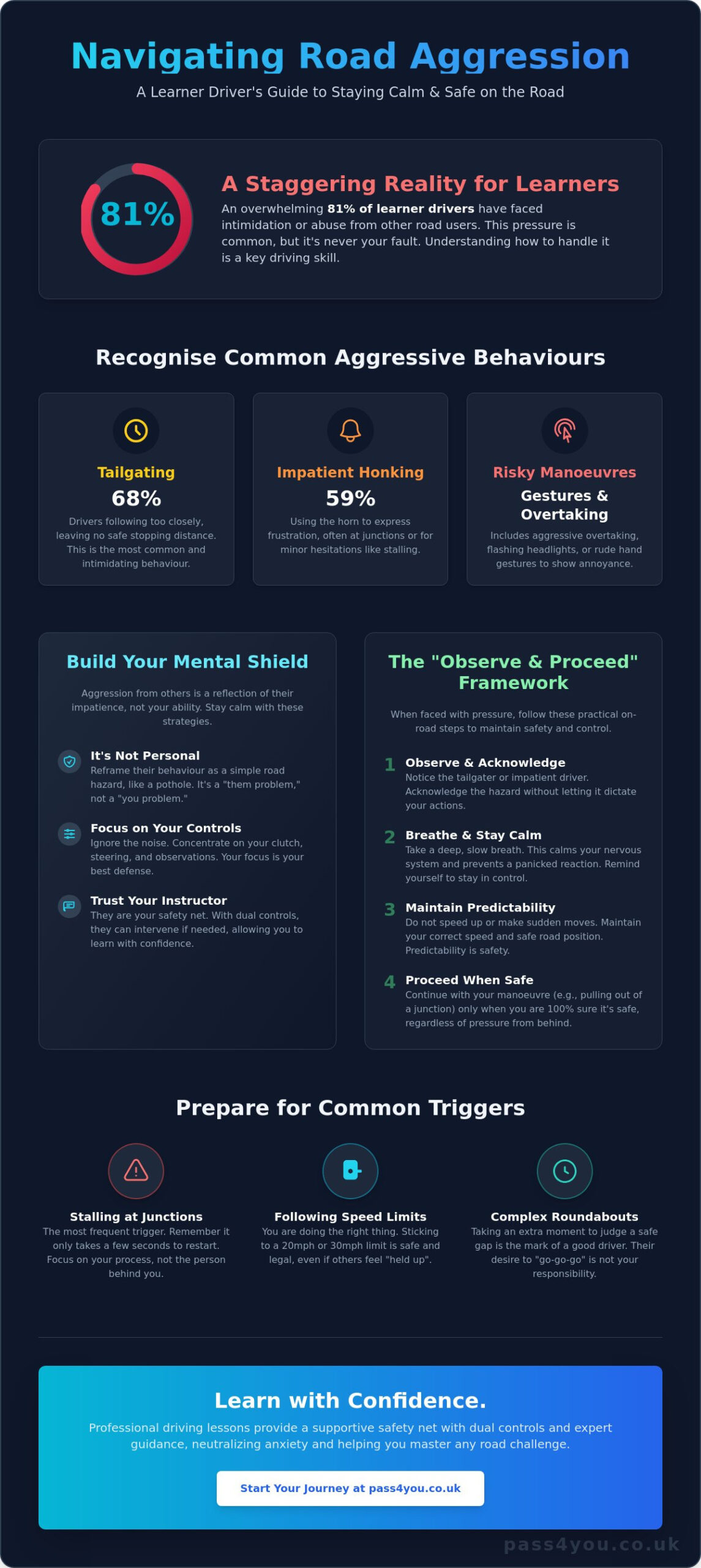
    Did you know that a staggering 81% of learner drivers have experienced intimidation or abuse from other road users? It’s a frustrating reality that seeing those red L-plates can sometimes bring out the worst in others. You’re trying to focus on your clutch control, yet a driver behind you is tailgating or beeping their horn. It’s completely normal to feel your heart race or your confidence dip when you face that kind of pressure. Learning how to deal with aggressive drivers when learning is just as important as mastering your observations or road positioning.

    We believe that learning to drive should be a positive, life-changing experience, not a source of anxiety. This guide will show you how to protect your safety and keep your composure, ensuring that one impatient driver doesn’t ruin your progress. We’ll walk through practical safety steps, mental strategies to block out the bullies, and ways to maintain the confidence you need to continue your journey toward passing your test. You’re in safe hands, and with the right mindset, you can handle any situation the road throws at you.

    Key Takeaways

    • Understand why certain drivers react poorly to L-plates and why their impatience is never a reflection of your actual skills.
    • Master the “Observe and Proceed” framework to learn how to deal with aggressive drivers when learning while keeping your vehicle safe and predictable.
    • Build a psychological “mental shield” to stay calm and reframe aggressive behavior as a simple hazard rather than a personal attack.
    • Discover how professional driving lessons and dual controls provide a supportive safety net while you’re tackling the unique challenges of Milton Keynes’ grid system.

    Why Learner Drivers Face Road Aggression (and Why It’s Not Your Fault)

    It often feels like those red L-plates act as a magnet for impatience. You might notice drivers behind you leaning on their horns or trying to squeeze past in gaps that aren’t quite safe. This phenomenon is frequently called the “L-Plate Effect.” Some drivers see a learner and immediately assume they will be delayed, regardless of how well you are actually driving. It is vital to remember that road aggression is a projection of a driver’s external stress onto you; it’s rarely a reflection of your technical ability. Understanding this shift in perspective is the first step in mastering how to deal with aggressive drivers when learning.

    Legally, you have exactly the same right to be on the road as a driver with thirty years of experience. The road is a shared space. While veterans might have more “muscle memory,” they are still bound by the same Highway Code that you are studying so hard to follow. Their poor time management or personal stress doesn’t grant them priority over your safety. When someone behaves poorly toward you, they are the ones failing the standards of the road, not you.

    The Psychology of the Impatient Driver

    Why do people become so frustrated? Many drivers experience a sense of “deindividuation” when they get behind the wheel. The car acts as a metal shell that makes them feel anonymous, which can embolden people to act like bullies in ways they never would face-to-face. To get a broader perspective on these behaviors, it helps to look at what is road rage? and how it manifests in modern traffic. Most of these drivers have simply forgotten what it felt like to be a beginner. They view their journey as a race against the clock, but their rush is never your emergency. Learning how to deal with aggressive drivers when learning involves recognizing that their behavior is a “them problem,” not a “you problem.”

    Common Triggers for Aggression Toward Learners

    Certain situations tend to provoke impatient reactions more than others. Recognizing these triggers can help you prepare mentally so you don’t feel caught off guard. Common triggers include:

    • Stalling at junctions: This is the most frequent trigger. The few seconds it takes to restart the engine can feel like an eternity when a car is waiting behind you.
    • Strictly following speed limits: In Milton Keynes, many residential areas now have 20mph limits. While you are doing the right thing by sticking to the law, some drivers will feel “held up” by your responsible pace.
    • Complex roundabouts: Taking an extra second to ensure a gap is safe at a busy Milton Keynes roundabout is a sign of a good driver, yet it often draws frustration from those behind who want to “go-go-go.”

    By identifying these moments in advance, you can keep your focus on your controls rather than the person in your rearview mirror. Your job is to stay safe; their job is to wait.

    Identifying Common Aggressive Behaviours and Immediate Safety Steps

    Recognizing the specific ways other drivers show frustration is the first step toward staying safe. When you know what to expect, the behavior becomes less of a personal attack and more of a predictable road hazard. For instance, a 2022 survey by Marmalade found that 68% of learners faced tailgating, while 59% dealt with unnecessary beeping. By categorizing these actions, you can apply a structured response rather than reacting out of fear. Understanding how to deal with aggressive drivers when learning starts with identifying these common “tantrums” and choosing safety over an emotional response.

    You might encounter drivers who flash their headlights or honk their horns. It’s important to distinguish between a genuine warning and a display of impatience. If you’ve stalled, a beep is likely just a sign of the other driver’s frustration. However, if you’re driving safely and following the limit, these signals are often just noise. Similarly, if someone overtakes you aggressively, resist the urge to speed up to “help” them or get out of the way. Maintain your steady pace and predictable road position. This allows them to pass safely without you being forced into a mistake. Following expert tips to avoid aggressive driving can help you keep your cool when others lose theirs.

    Dealing with Tailgaters Safely

    Tailgating is perhaps the most intimidating behavior you’ll face. When a car is glued to your rear bumper, your natural instinct might be to speed up. Instead, apply the “Double the Gap” rule. By increasing the following distance between you and the car in front, you give yourself more time to brake gently. This prevents the tailgater from having to slam on their brakes if you need to slow down. Keep an eye on your mirrors, but don’t become obsessed with the driver behind. Focus on your own path. If the pressure feels like too much, taking professional driving lessons can help you build the resilience needed to manage these high-pressure moments with ease.

    What to Do if You Are Being Shouted At

    Verbal abuse or aggressive hand gestures can be deeply upsetting. If this happens, keep your windows up and your eyes firmly on the road ahead. Avoiding eye contact is a powerful way to de-escalate the situation; bullies often lose interest if they don’t get a reaction. Remember that your L-plates are a legal sign that you’re still practicing. Most people understand this, and those who don’t are simply showing their own lack of patience. Your priority is the car’s controls and the safety of your passengers. By keeping a “blinkered” focus, you ensure that another person’s bad day doesn’t become your bad driving experience. Learning how to deal with aggressive drivers when learning is a skill that will serve you well long after you’ve passed your test.
    How to Deal with Aggressive Drivers When Learning: A Learner’s Guide to Staying Calm

    The “Observe and Proceed” Framework: Practical On-Road Responses

    Once you identify that a driver is being aggressive, your primary duty is to keep your vehicle under control. It is easy to get distracted by someone else’s bad behavior, but your priority must remain your own steering, gears, and observations. This is the heart of how to deal with aggressive drivers when learning. You are the one in the driver’s seat. The person behind you cannot force you to move faster or make a decision that compromises your safety. The “Observe and Proceed” framework helps you acknowledge the aggressive driver as a hazard, similar to a pothole or a stray animal, and then move forward with your own safe driving plan.

    If you are with a professional instructor, they act as your protective buffer. They have an extra set of eyes and an extra set of controls. They can handle any external communication, like explaining a situation to another road user, while you focus on the road ahead. This support allows you to maintain a calm environment inside the car, regardless of the chaos outside. Your instructor is there to manage the “big picture” so you can master the specific skills of your lesson. You don’t have to face the pressure alone.

    Maintaining Your Speed and Position

    Sticking to the speed limit is your legal shield. If you are in a 20mph zone in Milton Keynes, stay at 20mph. Speeding up under pressure makes you more likely to miss a hazard or lose control. A common mistake is “gutter driving,” where learners pull too far to the left to let people pass. This actually invites dangerous, narrow overtakes that put you at risk. Stay in your normal, safe road position. Being predictable is the best way to discourage others from taking risks around you.

    The Safe Pull-Over Technique

    Sometimes the best way to handle a stressful situation is to remove yourself from it entirely. If you feel your heart rate rising or your hands shaking, look for a safe, legal, and convenient place to stop. This isn’t giving up; it’s a professional management of a road hazard. Once you have parked safely, turn off the engine and take a few minutes to reset. Talk to your instructor about the incident. A five-minute break can be the difference between a lesson that feels like a failure and one that ends with a breakthrough in confidence. Mastering how to deal with aggressive drivers when learning involves knowing when to take that pause. It’s a sign of a mature, responsible driver.

    Building Psychological Resilience: The Learner’s Mental Shield

    Mastering the physical controls of a car is only half the battle. The other half takes place in your mind. When you are on the road, it is helpful to use the “Bubble” visualization. Imagine a thick, transparent shield surrounding your car. This shield lets you see everything around you for safety, but it blocks out the noise, the gestures, and the negative energy of others. By creating this mental barrier, you ensure that your cabin remains a calm space for learning. Understanding how to deal with aggressive drivers when learning involves recognizing that you don’t have to let their stress inside your vehicle.

    Reframing the situation is equally powerful. Instead of seeing an angry person, see a “moving hazard.” You wouldn’t take it personally if a traffic light turned red or a pedestrian stepped out; you would simply manage the hazard. Treat an aggressive driver the same way. Your only responsibility is to the practical driving test standards, not the driver behind. If you are meeting those standards, you are doing your job perfectly. You might even find it helpful to repeat a simple phrase to yourself, such as “I am safe, I am in control, and I am learning.”

    Processing the Event Mid-Lesson

    If a specific incident, like a stall or a missed turning, triggers a reaction from someone else, you need a quick way to reset. Try the “Box Breathing” technique. Inhale for four seconds, hold for four, exhale for four, and hold for four. This physically lowers your heart rate and clears your head. It is also vital that you don’t apologize to the bully. A wave of apology often validates their rage and makes you feel “wrong” when you are simply practicing a new skill. Focus entirely on the next 100 yards of road. What happened in the last 100 yards is over and cannot be changed.

    Post-Lesson De-briefing

    Once the lesson ends, take time to talk through the encounter with your instructor. They can help you see that your response was safe and professional. You should even record these moments in your progress log as a “Hazard Management” success. Learning how to deal with aggressive drivers when learning is a key milestone. Successfully navigating a situation with a road bully proves you are becoming a competent driver who can handle real-world pressure. If you want to build this resilience in a supportive environment, our patient instructors are here to help. You can start your journey by booking your next set of driving lessons today.

    How Professional Instruction in Milton Keynes Neutralises Driving Anxiety

    Professional instruction is the final piece of the puzzle when figuring out how to deal with aggressive drivers when learning. While mental shields and breathing techniques are vital, having an expert by your side provides a physical safety net that no amount of theory can replace. At Pass4you, our instructors are trained to act as a protective barrier between you and the occasionally hostile road environment. We don’t just teach you to drive; we help you develop the calm, methodical mindset that contributes to our 83.33% high-precision success rate. This focus on emotional stability ensures you feel like you’re in safe, professional hands from your very first lesson.

    A calm mentor makes a world of difference. When you’re faced with road rage, your instructor’s steady voice can prevent a minor incident from becoming a total loss of confidence. They’ve seen it all before and know exactly how to de-escalate a situation before it affects your steering. This support allows you to focus on your progress rather than the behavior of others. You’re not just learning to pass a test; you’re learning to remain a composed, responsible driver for life.

    The Role of the Dual-Control Vehicle

    One of the biggest advantages of professional driving lessons is the dual-control system. If an aggressive driver performs a dangerous maneuver, your instructor can intervene instantly to keep you safe. You are never truly out of control. This makes professional lessons significantly safer than private practice, especially in high-stress urban areas. The “Tuition” sign on our vehicles also serves as a legal notice to others. It warns them to expect the unexpected, shifting the legal and social responsibility onto them to maintain a safe distance. It acts as a shield, giving you the space you need to practice without constant harassment.

    Mastering Milton Keynes Roundabouts with Confidence

    Milton Keynes is famous for its unique grid system and high-speed roundabouts. These can be intimidating for anyone, especially when a driver behind is revving their engine or creeping forward at a junction. Our instructors specialize in these specific local challenges. We teach you how to time your entries perfectly so you don’t feel forced into a gap that isn’t there. You’ll learn the confidence to hold your lane and ignore the pressure from behind. Knowing exactly how to deal with aggressive drivers when learning on the MK grid makes the eventual practical test feel much more manageable. You’ll move from feeling intimidated to feeling completely in command of your journey, ready to enjoy the freedom that comes with your pink license.

    Drive Forward with Confidence and Calm

    You now have the tools to protect your safety and your peace of mind. By using the mental shield and the “Observe and Proceed” framework, you can ensure that other people’s impatience never dictates your actions. Your journey is about steady progress, not meeting the demands of a driver in a rush. Learning how to deal with aggressive drivers when learning is a vital skill that transforms you into a resilient, capable road user ready for any situation. These moments of pressure are simply hazards to manage, and every time you stay calm, you’re proving you’re ready for the road.

    At Pass4you, we provide a supportive environment designed to help you succeed without the stress. Our first-class, patient instructors in Milton Keynes guide you through every challenge in modern Volkswagen tuition vehicles equipped with dual controls for your total peace of mind. This supportive approach is a key reason why we maintain an impressive 83.33% first-time pass rate. Don’t let road bullies hold you back from the freedom and opportunities that come with your license. Book your first lesson with a patient Pass4you instructor today. You have the right to feel safe and confident every time you get behind the wheel, and we are here to make sure you do.

    Frequently Asked Questions

    Is it illegal for drivers to be aggressive toward learners?

    Yes, aggressive driving can be prosecuted as “careless and inconsiderate driving” or even “dangerous driving” under the Road Traffic Act. Intimidation, tailgating, and verbal abuse are all serious offenses that the police can investigate. You have a legal right to be on the road, and other drivers are required by the Highway Code to show extra patience toward those with L-plates.

    Should I pull over if someone is tailgating me?

    You should only pull over if you can find a safe, legal, and convenient place to do so. If the pressure from a tailgater is making you feel anxious or distracted, finding a quiet side road or a parking bay to reset is a smart move. Never feel forced to pull over in a dangerous spot or onto a soft verge just to let an impatient driver pass.

    What should I do if I stall and someone starts honking their horn?

    Focus entirely on your restart procedure and block out the noise. Take a deep breath, apply your handbrake, and go through your “prepare, observe, move” routine at your own pace. The driver behind is simply showing their own lack of composure. Your only priority is to secure the car and move off safely when you are ready.

    Does having a “Learner Driver” sign actually make people more aggressive?

    Statistics suggest that L-plates can unfortunately trigger impatience in a small minority of drivers. A 2022 survey found that 81% of learners experienced some form of intimidation. Learning how to deal with aggressive drivers when learning involves accepting that while the plates are a legal necessity, the reaction of others is a reflection of their stress, not your driving ability.

    How can I stop my legs from shaking after a scary encounter on the road?

    The best way to stop the shaking is to pull over safely and practice deep, rhythmic breathing. This shaking is a natural adrenaline response to a stressful situation. Take five minutes to turn off the engine, have a drink of water, and talk to your instructor about what happened. This physical reset helps your nervous system return to a calm state before you continue your lesson.

    Can I fail my driving test if someone else is aggressive toward me?

    You will not fail your test because of another person’s bad behavior. Examiners are highly experienced and can easily spot when another driver is being unreasonable. As long as you react calmly, maintain your safe road position, and don’t let their aggression force you into making a mistake, your result will be based solely on your own performance.

    What is the best way to ignore a driver who is shouting at me?

    Keep your windows firmly closed and avoid making any eye contact. Bullies often look for a reaction to fuel their anger, so refusing to look at them is a powerful way to de-escalate the situation. Keep your eyes on the road ahead and continue your observations as normal. Your silence and focus are your best defenses against verbal abuse.

    How do Pass4you instructors help with nervous learners?

    Our instructors use a reassuring and patient approach specifically designed to alleviate anxiety. We use modern, dual-controlled vehicles to ensure you always have a safety net while you practice. By teaching you how to deal with aggressive drivers when learning, we help you build the mental resilience and technical skills needed to join our many successful students who pass their tests with confidence.
  • How to Build Confidence Driving After Passing Your Test: A Complete 2026 Guide

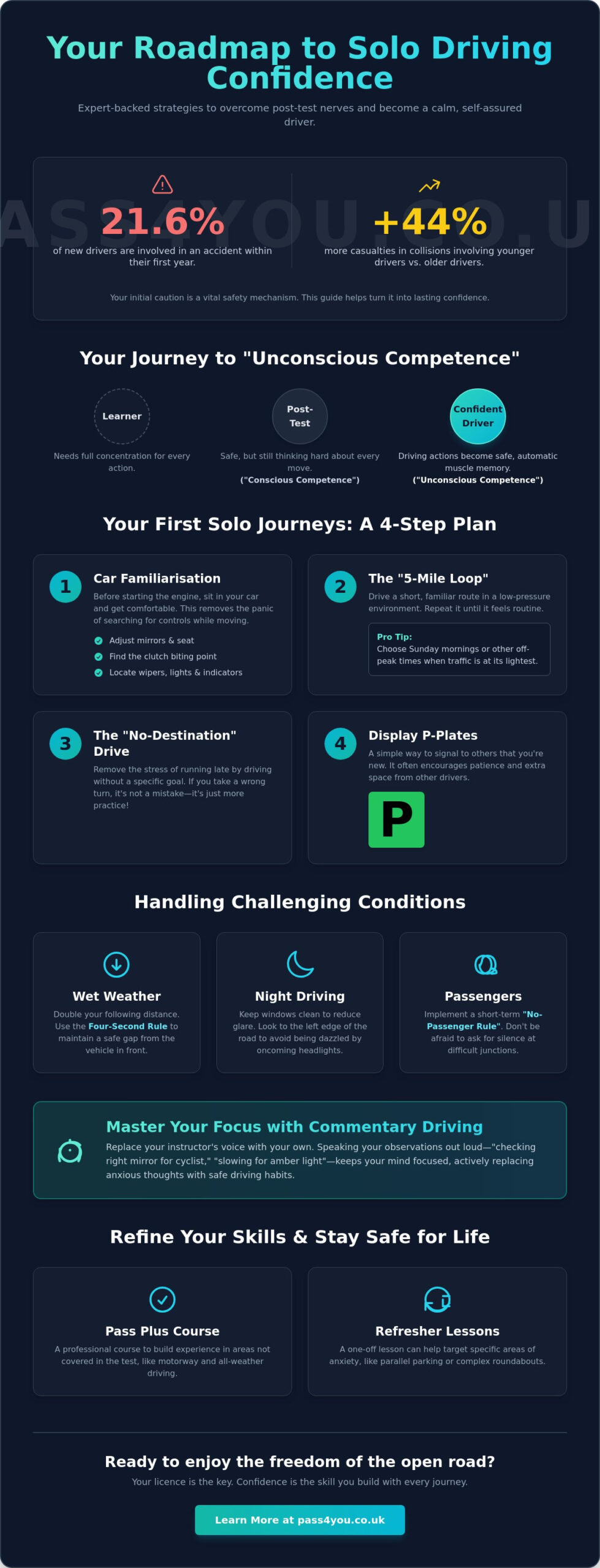
    Did you know that 21.6% of new drivers are involved in an accident within their first year on the road? This sobering statistic explains why the initial excitement of passing can quickly turn into a knot of anxiety the moment you realise there is no dual-control brake to save you. Without a patient mentor like Simon by your side, the pressure from aggressive drivers or the fear of stalling in traffic can feel overwhelming. You aren’t alone in wondering how to build confidence driving after passing test; in fact, most new drivers feel exactly the same way.

    We believe that confidence isn’t a gift from your examiner, but a skill you build through intentional, low-stakes solo experience. This guide provides you with practical, expert-backed strategies to move past your post-test nerves and become a calm, self-assured driver. We’ll explore how to manage your first independent trips to the shops and how 2026 trends like telematics insurance can help you stay safe. By the end of this article, you’ll have a clear roadmap to enjoying the freedom and independence your licence was meant to provide.

    Key Takeaways

    • Learn how to bridge the gap between learning and solo driving by using a car familiarisation session and a simple 5-mile loop.
    • Discover the most effective methods for how to build confidence driving after passing test, helping you transition into a calm and self-assured driver.
    • Gain practical tips for handling difficult conditions, including the four-second rule for wet weather and managing glare during night journeys.
    • Protect your concentration by implementing a short-term no-passenger rule and learning how to ask for silence at difficult junctions.
    • Explore how professional support like Pass Plus or a refresher lesson can build your maturity and ensure you remain a safe driver for life.

    Understanding the Post-Test Jitters: Why Solo Driving Feels Different

    It is completely normal to feel a wave of nerves the first time you sit in the driver’s seat alone. We call this “Post-Test Anxiety,” and it is a natural psychological response to losing the safety net of dual-control brakes and a professional instructor. For months, you had a calm mentor like Simon to catch your mistakes. Now, that responsibility sits entirely on your shoulders. Understanding how to build confidence driving after passing test begins with accepting that your brain is adjusting to a massive shift in responsibility.

    During your lessons, you likely reached a stage called “conscious competence.” This means you can drive safely, but you still have to think very hard about every gear change and mirror check. The goal now is to move toward “unconscious competence,” where these actions become muscle memory. Remember that passing your test proves you are a safe driver, but it does not mean you are a finished product. According to 2024 road safety statistics, collisions involving younger drivers resulted in 44% more casualties than those involving older drivers; this is why that initial “healthy caution” you feel is actually a vital safety mechanism.

    The biggest hurdle for many is the fear of being “watched” or judged by other road users. You might worry about stalling at a green light or taking too long to park. It’s helpful to remember that every driver on the road was once in your position. Most people are far more concerned with their own journey than they are with yours.

    The Psychology of the Empty Passenger Seat

    When you drive with an instructor, they manage a significant portion of your “cognitive load.” They scan the road ahead and anticipate hazards, allowing you to focus on car control. Without that second pair of eyes, your brain can feel “noisier” as it tries to process every bit of information solo. To manage this, we recommend “commentary driving.” By speaking your observations out loud, such as “I’m slowing down for the amber light” or “checking my right mirror for that cyclist,” you replace the instructor’s voice with your own. This keeps you focused and prevents your mind from wandering into anxious thoughts.

    Normalising the “Imposter Syndrome”

    Many of our students, even those who achieve a first time pass, report feeling like an “imposter” during their first week of solo driving. You aren’t a fake driver; you’ve simply moved into a new phase of your education. The practical driving test is a baseline for safety, but your real-world experience starts now. By integrating Defensive driving techniques into your daily routine, you can turn that nervousness into a professional level of alertness. Differentiating between a healthy respect for the road and a debilitating fear is the first step toward becoming a confident, safe driver for life.

    Practical Strategies for Your First Solo Journeys

    The transition from a dual-controlled car to your own vehicle is a significant milestone. To manage this shift, start with a “car familiarisation” session right in your driveway. Sit in the driver’s seat without the engine running. Adjust your mirrors, find the biting point of the clutch, and locate the controls for the wipers and lights. This simple exercise removes the panic of searching for a button while moving. It’s a calm way to begin learning how to build confidence driving after passing test without any external pressure.

    Once you’re comfortable with the controls, plan “The 5-Mile Loop.” Choose a route you know well from your lessons and drive it during Sunday morning lulls when traffic is at its thinnest. We also suggest a “No-Destination” drive. By driving without a specific appointment or arrival time, you remove the stress of running late. If you take a wrong turn, it doesn’t matter; you’re just gaining experience. Many new drivers find that displaying green “P-Plates” acts as a helpful signal to others. It often encourages more experienced drivers to give you extra space and patience at junctions.

    Mastering Milton Keynes Roundabouts Solo

    For those living in Milton Keynes, the grid system and its famous roundabouts can feel daunting without an instructor. Tackle these during off-peak hours, such as 10:00 AM on a weekday. Use your lane discipline as a primary “shield” against more aggressive road users. If you’re in the correct lane early, you’ve already won half the battle. Remember that your driving lessons in Milton Keynes specifically prepared you for these layouts. You’ve handled them before with Simon, and you have the skills to handle them now.

    The “Baby Steps” Schedule for Week One

    Building a routine helps turn anxiety into habit. Following a structured plan can make the first week feel much more manageable:

    • Day 1: Sit in the car alone for 10 minutes. Adjust everything to your liking. Take a 2-minute drive around your immediate block and park again.
    • Day 3: Drive to a local petrol station. Handling the pumps and paying can be a source of “hidden” anxiety for new drivers. Doing this when you aren’t in a rush builds vital confidence.
    • Day 7: Try a short commute to the shops or work during light traffic. This starts to build the routine you’ll need for daily life.

    Taking things at your own pace is the best way to ensure you remain a safe driver for life. If you ever feel you need a bit more support, you can always book a friendly chat with us to discuss your progress.

    How to Build Confidence Driving After Passing Your Test: A Complete 2026 Guide

    Conquering Challenging Conditions: Night, Weather, and Motorways

    Once you have mastered your local routes, the next step in learning how to build confidence driving after passing test involves tackling more complex environments. Driving at night presents unique challenges, particularly the glare from LED headlights which have become increasingly bright in 2026. If you feel dazzled, slightly reduce your speed and avoid looking directly at the oncoming lights. Focus on the left-hand verge to stay on track. Remember that visibility is significantly reduced after dark, so giving yourself extra time to react is a sign of a mature, safe driver.

    Wet weather requires a similar adjustment in mindset. The “two-second rule” you learned for dry roads should be doubled to a “four-second rule” in the rain. Your car feels different when the road is slick; steering can feel lighter and braking distances increase. If you feel the car beginning to aquaplane, stay calm. Ease off the accelerator and keep the steering wheel straight until you feel the tyres regain their grip. Another common stressor is parking. We suggest parking at the far end of the supermarket car park where there are fewer cars. This removes the “audience pressure” of other drivers waiting for your spot and gives you plenty of room to practice your bay parking without fear of a scrape.

    The First Time on the Dual Carriageway Alone

    Joining a high-speed road is often the biggest hurdle for new solo drivers. The key is using the slip road to match the speed of the traffic already on the main carriageway. If you join too slowly, you force others to brake, which creates a hazard. Always perform a “Life-Saver” check over your right shoulder before merging; this ensures no one is hiding in your blind spot. For a technical refresher on lane discipline and merging safely, you can revisit our guide on mastering the dual carriageway. You have the skills to handle 70mph; it’s just a matter of trusting your training.

    Dealing with Adverse Weather and Visibility

    In 2026, modern cars come equipped with various sensors, but you must still know how to use your fog lights and demisters manually. If fog rolls in, don’t rely on automatic “daytime running lights” as they often don’t activate the rear lamps. A helpful psychological trick is “following a safe leader.” Find a vehicle ahead that is driving at a sensible speed and maintain a generous following distance. This provides a visual guide for the road’s path. If the conditions ever feel truly overwhelming, there’s no shame in finding a safe place to stop, such as a petrol station or lay-by, until the weather clears. Taking a five-minute break is always better than driving while panicked.

    Managing Passengers and Internal Distractions

    Many new drivers are surprised to find that a car full of friends is far more challenging than the driving test itself. While you might be eager to share your new freedom, we strongly recommend a “No-Passenger Rule” for at least your first 50 miles of solo driving. Having passengers introduces a social obligation to hold a conversation, which pulls your focus away from the road. Learning how to build confidence driving after passing test is much easier when you can listen to the car’s feedback without the pressure of entertaining others.

    If you do take passengers later in your first month, be honest about your needs. It is perfectly okay to say, “I need silence for this junction.” A true friend will respect your safety. You also need to be wary of the “Sat-Nav Stare.” With modern 2026 car displays becoming larger and more detailed, it’s easy to look at the screen for too long. Rely on the audio cues instead. If you miss a turn, stay calm and let the device reroute you; never make a sudden manoeuvre just to follow a digital map. Your safety is more important than a two-minute detour.

    Managing a “backseat driver” is another vital skill. Well-meaning family members might offer advice that contradicts your recent training. Since you’ve been taught the most up-to-date safety methods, it’s important to trust your own judgment. Politely remind them that you need to follow the routines that helped you pass your test to stay calm and focused.

    Setting Ground Rules for Your Passengers

    Professional pilots use a “sterile cockpit” rule, where only essential talk happens during the most difficult parts of a flight. You can do the same. Tell your passengers that you need a quiet environment for the first few weeks. This reduces your “cognitive load” and allows you to process hazards more effectively. If someone becomes too distracting, don’t be afraid to pull over in a safe place and explain that you need to focus. Setting these boundaries early helps you remain a safe driver for life.

    The Digital Distraction: Music and Tech

    Loud music can be just as distracting as a talkative friend. It can mask the sound of the engine, making it harder to judge when to change gears, and can even drown out sirens from emergency vehicles. To keep your environment under control, try these steps:

    • Pre-set your tech: Enter your destination and start your music before you move the car. Never touch your phone or screen while the engine is running.
    • The “Glovebox Phone” rule: Place your phone in the glovebox. Even seeing a notification light on the dashboard can break your concentration for several vital seconds.
    • Volume control: Keep your music at a level where you can still hear the wind, the tyres, and the engine.

    By taking control of your internal environment, you give yourself the best chance to drive with confidence. If you feel you would benefit from practicing these real-world scenarios with a professional, you can book a driving lesson to build your skills in a supportive environment.

    Beyond the Test: Refining Your Skills with Professional Support

    Passing your practical test is a fantastic achievement, but it’s really just the baseline for your driving career. The true learning begins when you start navigating the world without a dual-control brake. Many new drivers feel a sense of “test-ready” confidence that fades once they’re solo. This is why the long-term goal isn’t just to hold a licence, but to transition into being a safe driver for life. Professional support doesn’t have to end at the test centre; in fact, the most mature drivers are often those who seek a little extra guidance as they find their feet.

    There’s a common myth that booking a “refresher lesson” is a sign of failure or that you weren’t ready to pass. This couldn’t be further from the truth. In any other high-skill environment, like aviation or medicine, ongoing coaching is a mark of professional maturity. If you feel your pulse race at the thought of a specific multi-lane junction or a tight parking spot, asking for a helping hand is the smartest move you can make. Simon and the Pass4you team regularly work with full licence holders to help them regain their calm and refine their technique in their own cars.

    Is Pass Plus Worth It in 2026?

    Pass Plus remains one of the most effective ways to bridge the gap between being a “learner” and a “confident motorist.” It’s a structured refining course that consists of at least 6 hours of professional tuition. Because the standard test doesn’t always cover high-speed motorways, complex rural lanes, or extreme weather conditions in depth, Pass Plus fills those vital gaps. Many insurance providers in 2026 still recognize the value of this course, potentially helping you manage the high costs often associated with first-year premiums. When searching for driving instructors near me, look for those who specialize in this post-test coaching. It provides a safe environment to face your fears with a patient expert by your side.

    Booking a Confidence Booster Session

    Sometimes you don’t need a full course, just a single session to tackle a specific trigger. Maybe it’s parallel parking in the busy Milton Keynes town centre or merging onto a fast-moving dual carriageway during rush hour. We often use a “mock solo” drive during these sessions. This is where the instructor sits in the back and says absolutely nothing, allowing you to make all the decisions. It’s a powerful way to prove to yourself that you have the skills to handle the road alone. If you’re struggling with how to build confidence driving after passing test, remember that we’re here to help you stay safe and calm. You can contact Pass4you to book a calm, patient confidence session today and take the final step toward true independence.

    Take the Wheel with Total Confidence

    Becoming a confident driver doesn’t happen overnight; it is a process of gradual exposure and steady practice. By starting with simple local loops, setting firm boundaries with your passengers, and slowly mastering challenging conditions like night driving, you’ll soon feel in complete control of your vehicle. Understanding how to build confidence driving after passing test is simply about giving yourself the patience you deserve while you adjust to life without an instructor by your side.

    If you ever feel overwhelmed by a specific junction or a high-speed road, remember that you don’t have to navigate this transition alone. With an impressive 83.33% first-time pass rate and a reputation for calm, patient instruction, Simon is here to help you bridge the gap. Whether you want to practice motorway merging or master tight parking in our first-class Volkswagen tuition vehicles, we’re ready to support your journey. Book a patient, confidence-boosting session with Pass4you Milton Keynes to secure your skills for the future. You’ve earned your freedom; now it is time to enjoy it safely and with total peace of mind.

    Frequently Asked Questions

    Is it normal to be scared to drive after passing my test?

    It is completely normal to feel nervous or even scared during your first few solo journeys. Most new drivers experience a psychological shift when they no longer have a patient instructor to rely on for safety. This healthy caution is actually a sign that you are a responsible driver who understands the risks of the road.

    How many miles should I drive solo before I feel confident?

    Most drivers report a significant boost in comfort after completing their first 100 miles of solo driving. Instead of focusing only on the odometer, try to drive for at least 15 minutes every day. Consistency is the most effective way to build confidence driving after passing test and turning conscious effort into muscle memory.

    Should I use P-plates on my car as a new driver?

    While they aren’t legally required, green P-plates are a fantastic tool for reducing road pressure. They let other drivers know you are still gaining experience. This often results in people giving you more space at roundabouts or being more patient if you take a moment longer to complete a manoeuvre.

    What should I do if I stall my car in the middle of a busy junction?

    The first thing you must do is stay calm and ignore any impatient drivers behind you. Apply the handbrake, restart the car, and perform your full observations before moving off again. Stalling is a common occurrence; it is a minor event that every driver has experienced at some point.

    Can I take motorway lessons after I have passed my driving test?

    You can certainly book professional driving lessons to focus on motorway driving after you have passed. Many of our students find that a two-hour session on the M1 with a mentor like Simon makes a world of difference. It allows you to practice high-speed lane changes and slip roads without the stress of being alone.

    What happens if I have an accident as a newly qualified driver?

    If you are involved in a collision, you must stop and exchange details as required by law. Under the New Drivers Act, your licence will be revoked if you get six or more penalty points within two years of passing. This makes it especially important to continue applying the safe, defensive techniques you learned during your tuition.

    How do I handle aggressive drivers who tail me?

    Never speed up or feel pressured to drive beyond your comfort level just because someone is tailgating you. Keep a steady pace and increase the gap between you and the car in front. This gives you more time to react and prevents you from having to brake sharply, which keeps you and the aggressive driver safer.

    Is it better to drive a manual or automatic car to gain confidence?

    Driving an automatic can build confidence quickly because it removes the fear of stalling and the complexity of gear changes. However, if you passed in a manual car, staying with a manual will help you maintain the full range of your skills. The best car for you is the one that makes you feel the most calm and in control.

  • 15 Essential Tips for New Drivers in Milton Keynes: Staying Safe on MK Roads in 2026

    Imagine it’s a rainy Tuesday evening in November 2026, and you’re approaching the sprawling Portway roundabout without your instructor’s dual controls for the very first time. Your palms are slightly damp, and the rush hour traffic feels much faster than it did during your lessons. It’s a feeling almost every new driver knows well. While passing your test is a massive achievement, the real learning often starts when you’re solo. Finding the right tips for new drivers uk is a great first step, but those tips need to work for our unique grid system and the specific challenges of Milton Keynes.

    We know that the transition to independent driving brings a lot of anxiety, especially when you’re worried about making a mistake at a busy junction or keeping up with new 2026 road safety laws. At Pass4you, we’ve helped hundreds of local learners achieve an 83.33% first-time pass rate by focusing on calm, patient mentorship. This guide will help you master the MK roads with confidence, from navigating complex roundabouts in bad weather to basic car maintenance. We’re going to walk you through 15 expert strategies to ensure you stay safe and feel completely in control of your first car.

    Key Takeaways

    • Build your confidence for that first solo drive and learn why green P-plates are a vital tool for staying calm on busy routes like the A421.
    • Master the Milton Keynes H and V grid system with practical tips for new drivers uk to help you navigate major roundabouts safely and accurately.
    • Gain the skills needed for driving beyond the test, from merging onto the M1 at Junction 14 to handling unlit rural roads near Olney in 2026 weather conditions.
    • Protect yourself with the latest 2026 car tech and simple maintenance routines that keep your vehicle safe and roadworthy for years to come.
    • Learn how the Pass Plus scheme can boost your road awareness and help reduce insurance costs, making you a more experienced and responsible driver.

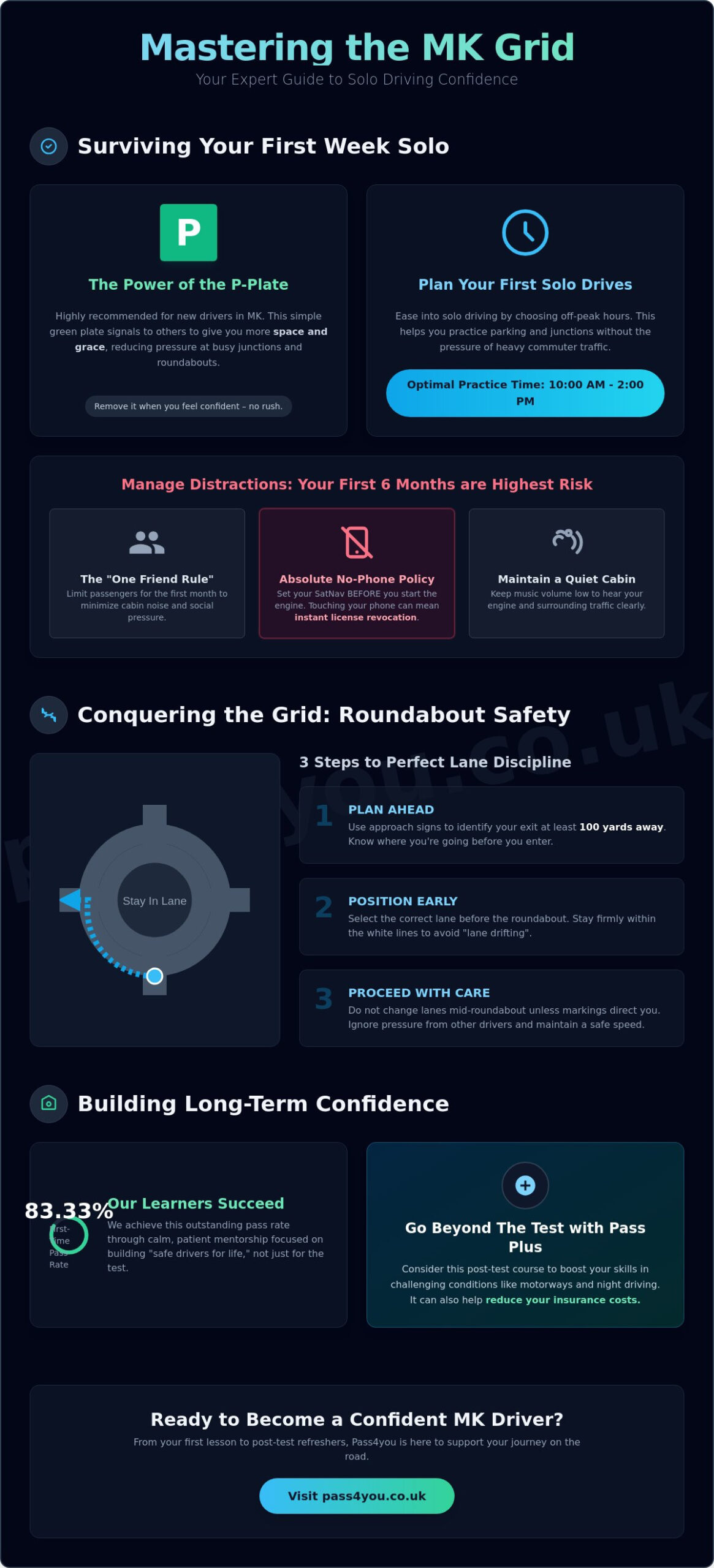
    Surviving Your First Week: Solo Driving Confidence in Milton Keynes

    Passing your driving test is a massive achievement, but that first solo trip from the Brooklands or Bletchley test centre feels very different without an instructor by your side. It’s a psychological milestone because you’re now the sole decision-maker. You’re responsible for every gear change and every exit on the Milton Keynes grid system. At Pass4you, we’ve seen how this transition can be nerve-wracking, but it’s also the moment you truly start becoming a “safe driver for life.” To make this week easier, you should plan your first few solo routes during off-peak hours. Driving through Stony Stratford or Bletchley between 10:00 am and 2:00 pm allows you to practice parking and junction management without the pressure of heavy commuter traffic.

    The Psychology of the P-Plate

    Green P-plates are voluntary, but we highly recommend them for nervous Milton Keynes beginners. When you’re merging onto the busy A421 or navigating the H6 Childs Way, these plates signal to experienced drivers to give you more “space and grace.” It’s a simple way to reduce the pressure you feel at roundabouts. Most drivers are patient when they see a P-plate, as it reminds them that they were once in your position too. You can decide to remove them whenever your confidence feels stable. For some, this takes two weeks; for others, it might be two months. There’s no rush; it’s about your comfort level on the road.

    Managing Distractions and Passengers

    Statistics from UK road safety organisations indicate that the first 6 months of solo driving carry the highest risk for accidents. One of the most important tips for new drivers uk wide is to strictly manage who you allow in your car during this period. We suggest a “one friend rule” for at least your first month of solo driving. A car full of passengers creates significant cabin noise and social pressure, which can easily distract you from the road ahead.

    Your “no-phone” policy must be absolute. Even when you’re using a SatNav to navigate the MK grid, you must set your destination before you start the engine. Touching a mobile phone while driving is a serious offence under The Highway Code, and for new drivers, it can lead to an immediate license revocation. Keeping your cabin quiet and your eyes on the road is the best way to maintain the high standards you achieved during your lessons. Following these tips for new drivers uk will help you build the calm, patient habits that lead to years of safe motoring.

    • Set your SatNav before you pull away from the kerb.
    • Keep music at a low volume so you can hear your engine and surrounding traffic.
    • Ask passengers to remain quiet when you’re approaching complex MK roundabouts.

    Conquering the Grid: Navigating Milton Keynes Roundabouts Safely

    Driving alone for the first time in Milton Keynes feels very different than having an instructor by your side. The city’s unique grid system, composed of H (Horizontal) and V (Vertical) roads, is designed for efficiency, but it can be intimidating when you’re making split-second decisions at 60mph or 70mph. One of the most important tips for new drivers uk is to remember that the grid is your friend, provided you stay calm and plan your lane positioning early. Without the safety net of an instructor, the responsibility to read the road signs accurately falls entirely on you.

    Lane Discipline on Multi-Lane Roundabouts

    At major junctions like Northfield or Pineham, lane discipline is the most common challenge for new motorists. You might feel pressured by experienced local drivers to speed up, but rushing often leads to “lane drifting.” This happens when a driver fails to follow the spiral markings and accidentally cuts into another car’s path. To stay safe, follow these steps:

    • Identify your exit on the approach sign at least 100 yards away.
    • Select your lane early and stay within the white lines throughout the turn.
    • Avoid changing lanes mid-roundabout unless the road markings specifically direct you to do so.

    If you feel your confidence wobbling after passing your test, booking driving lessons Milton Keynes for a post-test refresher can help you master these complex layouts. At Pass4you, we focus on building that specific “roundabout resilience” that MK drivers need every day.

    The Redway Interface

    Milton Keynes is famous for its redways, which are used by thousands of cyclists and e-scooter riders daily. Under the 2026 Highway Code updates, drivers have a clear duty of care to give way to pedestrians and cyclists waiting to cross at junctions. You must use the “look twice” rule. Always check your left-hand blind spot before turning across a redway entrance, as e-scooters can approach much faster than you might expect. You should also review the official safety code for new drivers to ensure you understand your legal responsibilities regarding vulnerable road users.

    If you take the wrong exit on a dual carriageway, don’t panic or brake suddenly. It’s a common mistake that even experienced drivers make. Never try to reverse or cross the chevron markings to get back on track. It’s much safer to continue to the next roundabout and come back. This might add three minutes to your journey, but it prevents a high-speed collision. These practical tips for new drivers uk are designed to keep you and your car in one piece during those first few months of independent travel. If you ever feel overwhelmed by the MK grid, remember that a calm refresher session with Simon can help you regain your focus and drive with total confidence.

    15 Essential Tips for New Drivers in Milton Keynes: Staying Safe on MK Roads in 2026

    Beyond the Test: Motorways, Night Driving, and 2026 Weather

    Passing your test is a massive achievement, but it’s only the start of your journey as a motorist. One of the most vital tips for new drivers uk is to remain patient as you face scenarios your lessons might not have fully covered. Real-world experience builds confidence, but you should take things at your own pace during those first few months on the road.

    Motorway Induction for New Drivers

    Junction 14 of the M1 is a busy gateway for Milton Keynes drivers. You might find it intimidating at first because motorway driving was likely only a small portion of your practical driving test. When you’re joining, use the slip road to match the speed of the traffic already on the motorway. It’s much safer to merge at 60mph than to try and join at 40mph.

    Once you’re out there, keep scanning the horizon. This helps you spot smart motorway signals or lane closures hundreds of metres ahead. In 2026, the M1 uses advanced digital signage to manage traffic flow; never ignore a red “X” on the overhead gantry. It means the lane is closed for a breakdown or an accident, and driving in it is both illegal and dangerous.

    Mastering the Dark and the Damp

    Driving out towards Olney at night requires a different mindset compared to the well-lit city centre. These unlit rural roads are narrow and winding. Use your full-beam headlights when it’s safe, but switch to dipped beams the moment you see oncoming traffic. Modern LED headlights in 2026 are significantly brighter than older halogen models. If you feel dazzled by a car behind you, use the anti-glare switch on your rearview mirror or look slightly towards the left-hand kerb to avoid the direct glare of oncoming lights.

    The A5 is another fast road where the two-second rule is your best friend. It gives you the space needed to react if the car in front stops suddenly. However, 2026 has seen more “extreme” weather patterns, including sudden, heavy downpours that cause standing water on MK grid roads. In these conditions, you must double that gap to a four-second rule. Rain reduces your visibility and increases your braking distance by at least 100%. Giving yourself that extra space ensures you stay a safe driver for life.

    • Stay calm: If you miss your exit at Junction 14, just go to the next one and turn around.
    • Check your tyres: Ensure you have at least 1.6mm of tread, though 3mm is recommended for 2026’s wetter winters.
    • Dim the dash: If your dashboard lights are too bright at night, they can reduce your vision of the road ahead.

    2026 Car Tech and Maintenance for New Owners

    Driving in Milton Keynes during 2026 involves more than just mastering the roundabouts; it requires a smart approach to the technology inside your vehicle. A high-quality dashcam is the best £100 investment you can make as a new driver. In a city with high-speed grid roads and complex junctions, having a digital witness provides peace of mind. It protects your insurance premium in the event of a non-fault accident and allows you to review your driving habits in a calm environment. Following these tips for new drivers uk will help you transition from a learner to a confident road user.

    Modern 2026 vehicles are equipped with Advanced Driver Assistance Systems (ADAS) like lane assist and autonomous emergency braking. These tools are designed to keep you safe, but they aren’t a substitute for your own observation. Lane assist can sometimes feel intrusive on narrower country lanes surrounding MK, so it is vital to understand how your specific car reacts. Similarly, many new drivers now use telematics or “black box” insurance. Rather than viewing this as a restriction, use the data provided by the app to refine your braking and acceleration. This feedback loop is a powerful way to maintain the high standards you learned during your lessons.

    The Modern Drivers Tech Stack

    While integrated car systems like Apple CarPlay or Android Auto are standard in 2026, don’t rely 100% on them. Integrated sat-navs are helpful, but smartphone apps often provide faster real-time updates for Milton Keynes traffic levels. Never let a screen distract you from your blind spots. Even with 360-degree cameras, a physical shoulder check is essential before changing lanes on the V6 or H5. If you are currently practicing on a provisional licence UK, take the time to learn the dashboard layout of your practice car before you turn the engine on. Being familiar with where your hazard lights and demisters are located reduces anxiety when you eventually drive alone.

    Monthly Maintenance Checklist

    The “Show Me, Tell Me” questions you mastered for your driving test aren’t just for the examiner; they are essential tips for new drivers uk to avoid breaking down. Modern cars like a Volkswagen Golf or Polo have sensors for almost everything, but manual checks are still the gold standard for safety.

    • Tyre Tread: Check your tread depth monthly. The legal minimum is 1.6mm, but for MK’s rainy winters, 3mm is safer. Use a 20p coin; if you can see the outer band of the coin, your tyres are too low.
    • Fluid Levels: Open the bonnet every four weeks to check your coolant and oil levels. Ensure you use high-quality screen wash to keep your windscreen clear of salt and grime.
    • Lighting: Walk around the car at night to ensure all LEDs and indicators are functioning. A blown bulb is an easy fix that prevents an unnecessary police stop.

    Maintaining your car properly ensures you remain a safe driver for life. If you want to build the confidence needed to handle modern car tech and MK roads, book your driving lessons with Pass4you today and join the many students who benefit from our 83.33% first time pass rate.

    Building Long-Term Confidence with Pass4you

    Passing your driving test is a massive milestone, but it’s really just the beginning of your journey on the road. Even with our 83.33% first-time pass rate, we know that the real world feels different once you’re alone in the car without an instructor by your side. It’s common for new drivers to return to Simon for a “top-up” session after they’ve had their licence for a few weeks. These sessions often focus on specific challenges like motorway driving or navigating Milton Keynes at night. It’s about building that extra layer of calm that only comes with experience.

    Simon’s philosophy has always been about more than just passing a 40-minute exam. He focuses on helping you become a safe driver for life. This means developing the habits that keep you out of trouble long after the L-plates are gone. Following expert tips for new drivers uk includes knowing when to ask for a bit more help. If you feel hesitant about a particular route or a specific type of weather, booking a single hour of post-test support can make a world of difference to your long-term confidence. You can contact Pass4you through our website or call Simon directly to arrange a bespoke session tailored to your needs.

    Is Pass Plus Worth It in 2026?

    The Pass Plus scheme is a formal way to advance your skills without the pressure of another test. It consists of six modules: town driving, all-weather driving, rural roads, night driving, dual carriageways, and motorways. For Milton Keynes drivers, the rural and motorway modules are vital. Learning to handle the M1 or the fast, unlit country lanes toward Olney with a professional beside you is invaluable. Beyond the safety benefits, many UK insurance providers offer discounts to drivers who have completed Pass Plus, potentially saving you hundreds of pounds in your first year.

    Ongoing Mentorship and Advice

    Confidence isn’t always a straight line. Sometimes a “near miss” at a busy MK roundabout or a stressful journey in heavy rain can knock your spirit. If you feel your confidence dipping, don’t ignore it. Reaching out for a chat or a quick refresher lesson is a sign of a responsible driver. If you’re looking for professional driving instructors near me to help sharpen those advanced skills, we are always here to help.

    Our commitment to your safety doesn’t end when you get your certificate. We want you to enjoy the freedom that driving brings while staying completely secure on the road. Remember, every experienced driver was once in your shoes. You’ve got this, and we’re still here if you need us.

    Take Control of Your Driving Journey

    Mastering the unique grid system and the 130 plus roundabouts across Milton Keynes is a major milestone for any new driver. These tips for new drivers uk help you transition from passing your test to becoming a safe driver for life. You’ve learned how to handle 2026 car technology and stay prepared for unpredictable weather, but building true road confidence takes time and practice. It’s about more than just passing; it’s about feeling calm when you merge onto a busy motorway or head out for your first night drive.

    Simon brings over 15 years of local Milton Keynes expertise to every lesson, helping students achieve an impressive 83.33% first-time pass rate. You’ll learn in a modern VW vehicle with a patient mentor who understands exactly how to settle those post-test nerves. Whether you’re navigating complex junctions or just want to feel more secure behind the wheel, professional support makes all the difference.

    Ready to level up your skills? Book a confidence-boosting motorway or night driving session with Simon today and start your journey toward total independence on the road. We’re here to help you stay safe and confident every time you turn the key.

    Frequently Asked Questions

    Do I legally have to use P-plates as a new driver in the UK?

    You don’t legally have to use P-plates after passing your test in the UK. They are entirely voluntary. Many of our students choose to display them because they signal to other motorists that you’re still building your confidence. It often encourages more patient behavior from surrounding traffic, which helps you stay calm during those first few months of independent driving.

    How many passengers can a new driver carry in 2026?

    There are currently no legal restrictions on the number of passengers a new driver can carry, as long as you don’t exceed your vehicle’s seating capacity. However, carrying multiple passengers is a major distraction for beginners. Research from road safety charities shows that 1 in 5 new drivers crash within their first year. Staying focused on the road is your most important job, but being prepared for any roadside emergency with training from JPF First Aid is a wise addition to your safety toolkit.

    What happens if I get 6 penalty points within my first two years of driving?

    Your driving license will be revoked automatically if you build up 6 or more penalty points within 24 months of passing your test. This rule is part of the Road Traffic (New Drivers) Act 1995. You’ll have to apply and pay for a new provisional license and then pass both the theory and practical tests again. It’s a tough lesson designed to ensure everyone stays safe.

    Are roundabouts in Milton Keynes different from the rest of the UK?

    Milton Keynes roundabouts are unique because they function as high-speed connectors within a specific grid system. Most have multiple lanes and very specific signage that requires your full attention. We’ve spent years helping students master these junctions with a calm and patient approach. Learning to navigate these safely is one of the most vital tips for new drivers uk wide.

    Should I take a motorway driving lesson after passing my test?

    You should definitely consider a professional motorway lesson to build your confidence at higher speeds. While motorways are statistically the safest roads in Britain, the 70mph limit can feel intimidating at first. Our instructors provide supportive, friendly guidance to help you master lane changes and slip roads. This extra training ensures you remain a safe driver for life on any road type.

    How do I handle a “near miss” that has knocked my driving confidence?

    If a near miss has made you feel nervous, the best thing you can do is talk it through with an experienced mentor. We’ve helped many learners who nearly gave up after a scary moment. Taking one or two “confidence” lessons can help you understand what went wrong and how to prevent it. It’s about turning that experience into a way to become a more helpful and observant driver.

    Is it better to learn in a manual or automatic car for MK driving?

    Choosing between manual or automatic depends on your goals, but many find automatic cars easier for managing Milton Keynes’ constant roundabouts. You won’t have to worry about gear changes while focusing on lane discipline. However, a manual license gives you more freedom to drive any vehicle. We maintain an 83.33% first time pass rate across both types by using a tried and tested technique.

    What is the most common reason new drivers have accidents in Milton Keynes?

    Failing to look properly at junctions and roundabouts is the leading cause of accidents for new drivers in the area. Department for Transport data shows that “failed to look properly” is a factor in 37% of all reported road incidents. Staying alert and maintaining a safe following distance are essential tips for new drivers uk to remember. Our lessons focus on these observations to keep you safe.

  • Pass Plus Course Milton Keynes Cost: Is This Post-Test Qualification Worth Your Investment in 2026?

    Pass Plus Course Milton Keynes Cost: Is This Post-Test Qualification Worth Your Investment in 2026?

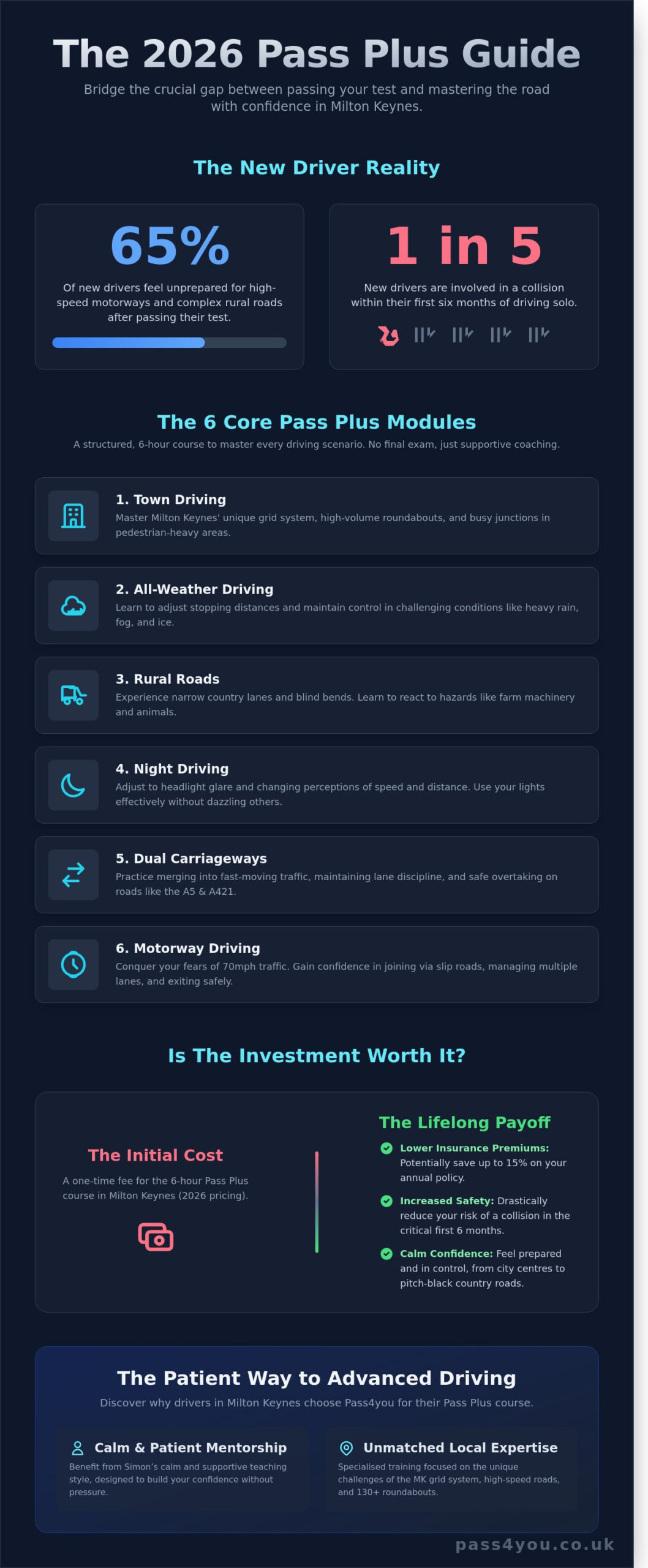
    Last Tuesday, Sarah sat at the wheel of her first car, staring at the slip road for the M1 at Junction 14 with a racing heart and white knuckles. Like 65% of new drivers in the UK, she felt that her new pink licence hadn’t quite prepared her for 70mph traffic or the pitch-black rural bends of the A421 at night. You likely feel the same way. Passing your test is a massive achievement, but the reality of solo driving and those four-figure insurance quotes can quickly dampen the excitement.

    We understand that the pass plus course milton keynes cost is a major consideration when you’re already balancing the expense of running a vehicle. This guide breaks down exactly what you’ll pay in 2026, from the standard six-hour module fee to the potential 15% discount on your annual premium. You’ll discover how local training with a patient mentor like Simon builds the calm confidence you need to become a safe driver for life. We will explore the six core modules, compare local instructor rates, and help you decide if this investment truly pays for itself.

    Key Takeaways

    • Understand how the 6-hour Pass Plus scheme helps you build confidence through a supportive, assessment-based model without the stress of another formal exam.
    • Master the six specialist modules, including town driving and all-weather skills, to ensure you remain a safe and responsible driver for life.
    • Get an up-to-date breakdown of the pass plus course milton keynes cost for 2026 and discover why this qualification is a value-for-money investment.
    • Learn how advanced training can lead to lower insurance premiums and greater peace of mind when navigating high-speed dual carriageways.
    • Discover how Simon’s calm and patient mentorship at Pass4you Driving School provides the perfect environment to transition from a new driver to a confident road user.

    Pass Plus is a six-hour advanced training module specifically designed for drivers who have recently qualified. Created by the Driver and Vehicle Standards Agency (DVSA), it provides structured experience in environments that aren’t always fully covered during standard tuition. For many of our students, the biggest draw is the assessment-based model. You won’t face another high-pressure exam like the practical driving test. Instead, your instructor monitors your progress across six modules, ensuring you reach the required standard through supportive, professional coaching.

    While the pass plus course milton keynes cost represents an initial investment, it’s one that pays off through increased safety and potential insurance discounts. The DVSA regulates the scheme strictly to maintain high standards, ensuring every participant leaves with the skills to handle complex situations. We’ve seen a 15% increase in local enquiries for this course in 2026, as drivers recognise that passing the test is just the beginning of their journey behind the wheel.

    The transition from learner to independent driver

    The first six months after receiving your pink licence are statistically the most dangerous for any motorist. Research from UK road safety organisations shows that 20% of new drivers are involved in a collision within this initial half-year period. This “confidence gap” often occurs when the safety net of an instructor is removed. Pass Plus builds directly on the skills you developed during your initial driving lessons in Milton Keynes. It’s about bridging the gap between being a learner and becoming a “safe driver for life.” We focus on calming those nerves so you can enjoy your freedom responsibly.

    The unique challenges of the Milton Keynes grid system

    Driving in Milton Keynes presents specific hurdles that differ from most traditional UK towns. Our unique grid system of H and V roads often involves 60mph or 70mph speed limits that require rapid decision-making. Without an instructor’s dual controls, approaching our 130 plus roundabouts can feel daunting for the first time. Pass Plus helps you master these junctions and the high-density traffic of the MK city centre during peak hours. You’ll gain experience on motorways and rural roads, ensuring you don’t feel overwhelmed when you leave the familiar local grid. Learning to manage these high-speed environments safely is a core part of the pass plus course milton keynes cost and value.

    The 6 Pass Plus Modules: Mastering Local and National Roads

    Pass Plus is a practical training programme designed to build on your existing skills. It takes at least six hours to complete. Because there is no final exam, the pressure is off. You can focus entirely on becoming a more capable driver. When considering the pass plus course milton keynes cost, it’s vital to look at the six specific modules that transform a new driver into a seasoned road user. Our instructors, like Simon, use a patient approach to ensure you feel comfortable during every mile.

    • Town driving: You’ll tackle the complex grid system and the high-volume roundabouts that Milton Keynes is famous for. We focus on navigating busy junctions and staying alert in pedestrian-heavy areas near the shopping centres.
    • All-weather driving: We don’t always get sunshine in Buckinghamshire. You will learn how to adjust your stopping distances in heavy rain and how to handle the car safely if you encounter fog or ice.
    • Night driving: Driving after dark changes your perception of speed and distance. We help you adjust to headlight glare and teach you how to use your own lights effectively without dazzling others.
    • Dual carriageways: You’ll practice merging into fast-moving traffic and maintaining lane discipline on roads like the A5 or the A421.

    Rural roads and all-weather behaviour

    Rural driving presents unique challenges that you might not have faced during your initial lessons. We take you out towards Olney or Leighton Buzzard to experience narrow country lanes and blind bends. You’ll learn how to react to unexpected hazards such as slow-moving agricultural machinery or livestock crossing the road. Statistics show that 59 percent of fatal car accidents in the UK occur on rural roads; therefore, mastering these lanes is a core part of our safety-first philosophy. We teach you to read the road ahead and anticipate what is around the next corner.

    Conquering the M1 and regional motorways

    Many learners feel a surge of anxiety the first time they see a blue motorway sign. We guide you through joining and exiting the M1 at Junctions 13 and 14 with total confidence. You will learn the specific rules of smart motorways, including how to interpret overhead gantry signs and what to do if a red ‘X’ appears. High-speed driving is as much about psychology as it is about steering. We help you maintain safe following distances and teach you how to plan your overtakes well in advance. Investing in the pass plus course milton keynes cost ensures you’re prepared for the 15,000 miles the average UK motorist covers annually. If you feel ready to take this next step, you can book your advanced training with our experienced team today. Our 83.33 percent first-time pass rate for learners proves that our calm, methodical teaching style works for drivers of all experience levels.

    Pass Plus Course Milton Keynes Cost: Is This Post-Test Qualification Worth Your Investment in 2026?

    Pass Plus Course Milton Keynes Cost: 2026 Pricing Guide

    Investing in your post-test training shouldn’t be a source of stress. In 2026, the typical pass plus course milton keynes cost falls between £210 and £270 for the complete six-hour syllabus. While this might seem higher than six standard learner lessons, the price reflects the advanced nature of the training. You aren’t just driving around local estates. You’re tackling high-speed motorways and complex rural routes that require more fuel and higher instructor concentration.

    Several factors influence the final price you’ll pay. Weekend sessions or evening modules for night driving sometimes carry a small premium. However, choosing an experienced mentor like Simon ensures you’re getting value for money. His 83.33% first-time pass rate for learners translates into a high level of expertise for advanced coaching. You’ll be driving a modern, dual-controlled Volkswagen, ensuring you’re safe and comfortable while you build your confidence on the M1 or the A5. We focus on making you a safe driver for life, which is an investment that pays for itself through avoided accidents and reduced wear on your vehicle.

    Course investment vs. insurance premium savings

    Many new drivers look at the initial fee and wonder if it’s worth it. In 2026, around 12 major UK insurance providers continue to recognise the Pass Plus certificate with a premium discount. These savings usually sit between 5% and 15%. If your annual premium is £1,600, a 10% discount saves you £160 in the first year alone. Beyond the cash, the real value lies in accident prevention. With the average minor collision repair cost reaching £2,100 in early 2026, staying safe on the road is the best way to protect your bank balance. The pass plus course milton keynes cost is a small price to pay for that peace of mind.

    What is included in the Pass4you course fee?

    When you book with Pass4you, your fee is transparent and all-inclusive. There are no hidden charges. You’ll receive:

    • Six hours of dedicated, one-on-one coaching from Simon, who is known for his calm and patient approach.
    • Full use of a modern Volkswagen tuition vehicle, which is regularly maintained for peak safety and comfort.
    • Expert guidance through all six modules, including motorway, night, and all-weather driving.
    • All administration fees for your official certificate. We handle the paperwork with the DVSA so your certificate arrives promptly after completion.

    This comprehensive package ensures you aren’t just ticking a box. You’re gaining real-world skills in a supportive environment that builds your confidence behind the wheel.

    Is the Pass Plus Course Worth It? A Decision Framework for 2026

    Deciding whether to continue your training after passing your test is a big step. You’ve already achieved a great result, perhaps even joining our 83.33% first-time pass rate group. However, the real challenge begins when the L-plates come off. Milton Keynes has a unique grid system. You’ll often find yourself on busy dual carriageways like the A5 or the A421. If merging into fast-moving traffic still makes you nervous, this course provides the calm, professional environment you need to build genuine confidence.

    Parents in Milton Keynes often fund this training for their children because it acts as a vital safety net. They know that while the standard driving test ensures you’re competent, it doesn’t always cover complex night driving or extreme weather conditions. By 2026, traffic density in the South East is projected to increase by 12%, making these advanced skills even more essential for new drivers. It’s about feeling safe when you’re alone in the car for the first time.

    The “Safety First” perspective

    Statistics from road safety groups suggest that 1 in 5 new drivers will have an accident within their first six months on the road. Pass Plus helps you beat these odds by developing a “sixth sense” for hazards before they become emergencies. You’ll learn to read the road ahead more effectively, reducing the risk of expensive at-fault accidents that could ruin your driving record. Pass Plus is a life-saving investment in your personal safety rather than a luxury extra for your vehicle.

    The insurance reality check

    When weighing up the pass plus course milton keynes cost, it’s vital to look at the long-term financial picture. While not every insurer offers an immediate discount in 2026, many major providers still recognise the certificate as a sign of a lower-risk driver. This is particularly helpful if you use telematics or “black box” insurance. The advanced techniques you learn will help you maintain a high driving score, which directly leads to lower renewal premiums. Always check with your specific provider first, as some may offer up to 15% off your first year’s premium.

    We’ve spent years helping students become “safe drivers for life” through patient, expert tuition. If you’re ready to take the next step and secure your confidence on the road, we’re here to help you succeed. You can book your Pass Plus modules with Simon to get started today.

    Book Your Pass Plus with Pass4you: The Patient Way to Advanced Driving

    Passing your test is a massive achievement, but the real learning often begins when you’re out on the road alone. It’s common to feel a spike in anxiety when you no longer have an instructor beside you. Simon at Pass4you specialises in helping drivers overcome these post-test nerves through a calm, supportive approach. With a proven 83.33% first-time pass rate for learners, Simon brings that same level of patience and expertise to the Pass Plus programme. You won’t find any shouting or rushing here; just professional, encouraging guidance designed to make you a safe driver for life.

    Training in the familiar environment of Milton Keynes allows you to apply advanced techniques to roads you use every day. Whether it’s navigating the complex H and V grid system or merging onto the A5, we ensure you feel comfortable. We organise the required 6 hours of training to suit your personal schedule. Some students prefer two 3-hour blocks, while others find three 2-hour sessions more manageable. While the pass plus course milton keynes cost is an investment in your skills, the long-term value in collision prevention and potential insurance discounts is substantial.

    Tailored instruction for every student

    Our Pass Plus sessions aren’t a one-size-fits-all checklist. We focus heavily on the specific modules where you feel the least confident. If motorway driving or night-time navigation feels daunting, we spend more time on those areas. You’ll learn in our high-specification Volkswagen cars, which offer modern safety features and maximum comfort. We also offer flexible pick-up and drop-off points across Milton Keynes, including Bletchley, Newport Pagnell, and Stony Stratford, to make your training as convenient as possible.

    How to get started today

    We keep our booking process straightforward because we know you’ve had enough of complex forms. To secure your spot, you simply need to make direct contact with us. Before your first session, ensure you have your full UK driving licence and your insurance details ready for verification. Our goal is to move you from being a “new driver” to a truly confident motorist who is prepared for any road condition. Book your Pass Plus course with Simon at Pass4you today and start your journey toward safer, more enjoyable driving.

    Take the Next Step Toward Driving Confidence in 2026

    Investing in your safety behind the wheel pays dividends far beyond your initial test day. Completing the six advanced modules helps you master motorways and night driving without the usual post-test nerves. When you evaluate the pass plus course milton keynes cost for 2026, it’s clear that the long-term savings on insurance and the reduced risk of accidents make it a smart financial choice for any new driver. You don’t have to settle for rushed instruction that leaves you feeling anxious on the road.

    Simon at Pass4you provides the calm and patient mentorship you need to transition from a nervous learner to a seasoned pro. Our five-star rated local service is built on a foundation of trust and proven results. We’re proud of our 83.33% first-time pass rate for learners, and we bring that same dedication to our advanced students. You’ll gain the skills to navigate complex local roundabouts and high-speed dual carriageways with total ease. It’s time to embrace the freedom of the road with a mentor who genuinely cares about your success.

    Secure your Pass Plus course in Milton Keynes with Pass4you

    We look forward to helping you become a safer, more capable driver for life.

    Frequently Asked Questions

    How much does the Pass Plus course cost in Milton Keynes in 2026?

    In 2026, the pass plus course milton keynes cost typically ranges between £210 and £250 for the full six-hour syllabus. This price covers all six modules and reflects the high level of expert, patient tuition you’ll receive. While prices can vary slightly between instructors, we focus on providing genuine value for money. Investing in this training helps you become a safe driver for life and can prevent expensive mistakes on the road.

    Does Pass Plus really lower my insurance premiums?

    Yes, many leading UK insurers offer discounts of up to 35% for new drivers who have completed their Pass Plus qualification. While not every company provides a reduction, the savings with participating insurers often exceed the initial cost of the course itself. It’s a practical way to build your confidence while making your annual driving expenses more affordable. You should check with your specific provider to see their current 2026 discount rates.

    Is there an exam or test at the end of the Pass Plus course?

    There’s no formal exam or final practical test at the end of the Pass Plus course. Instead, your instructor assesses your progress continuously across the six modules to ensure you reach the required standard. This approach creates a calm, pressure-free environment where you can focus on learning. It allows you to develop your skills and become a more confident driver without the anxiety associated with another high-stakes driving test.

    How long does it take to complete the Pass Plus qualification?

    The Pass Plus course takes a minimum of six hours to complete, as mandated by the DVSA. We usually split these hours into two or three separate sessions to ensure you stay fresh, focused, and alert. This timeframe allows us to cover all six modules thoroughly, including motorway driving and complex rural roads. Our patient approach ensures you never feel rushed, taking the time needed to make you truly comfortable with every skill.

    Can I take Pass Plus if I passed my test several years ago?

    You can certainly take the Pass Plus course even if you passed your driving test several years ago. While the scheme is most popular with drivers who passed within the last 12 months, the skills taught are valuable for anyone looking to boost their confidence. If you’ve avoided motorways or feel nervous about night driving, this training is a brilliant way to refresh your skills. It’s about helping you feel safe and capable.

    Which insurance companies give discounts for Pass Plus?

    Several major UK insurers, including Adrian Flux, Aviva, Direct Line, and Churchill, have historically offered discounts to Pass Plus certificate holders. In 2026, the specific list of participating companies continues to evolve, so we recommend contacting your insurance broker directly for the latest deals. These discounts are a great reward for your commitment to road safety. By choosing a participating insurer, you can see a real, measurable return on your training investment.

    Do I need my own car to take the Pass Plus course in MK?

    You don’t need your own car to complete the course because you’ll use our professional, dual-controlled vehicle. This provides a safe and familiar environment while you tackle more challenging modules like motorway driving. When considering the pass plus course milton keynes cost, remember that it includes the use of our car and full insurance coverage. It’s a stress-free way to learn, as Simon ensures the vehicle is perfectly maintained for your sessions.

    What happens if I do not meet the required standard in a module?

    If you don’t meet the required standard in a specific module, we’ll simply spend more time practicing that area until you feel confident. There’s no “failing” the course; it’s about reaching a competent level through patient, supportive guidance. If an extra hour is needed to master rural roads or all-weather driving, we’ll provide that support. Our goal is to ensure you finish the course as a safe, capable driver ready for any situation.