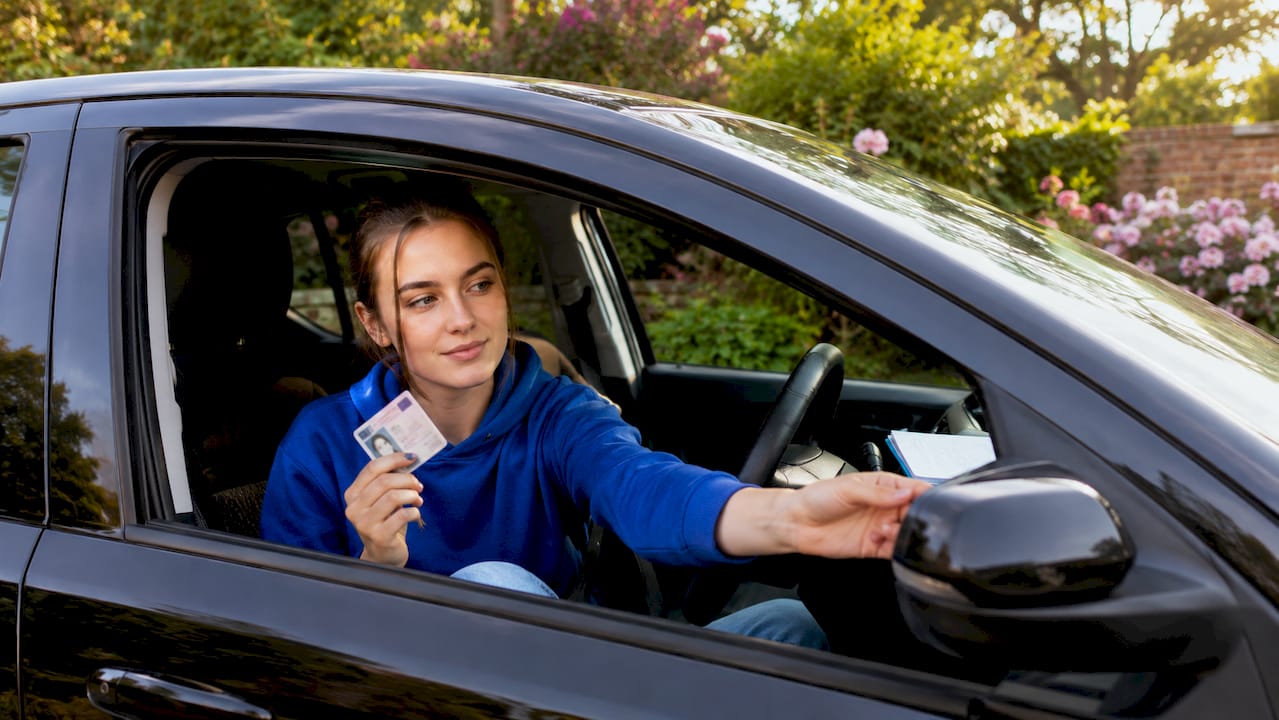
Restarting your driving lessons is defined as resuming structured driver training after a break, a test failure, or a prolonged period off the road. This guide covers exactly what you need to do: check your legal requirements, assess your current skill level, choose the right training format, and book your test strategically. Whether you paused lessons six months ago or failed your practical test last week, the approach is the same. You do not start from zero. You start from where you actually are, with a plan built around your specific gaps.
What you need before you start driving lessons over again
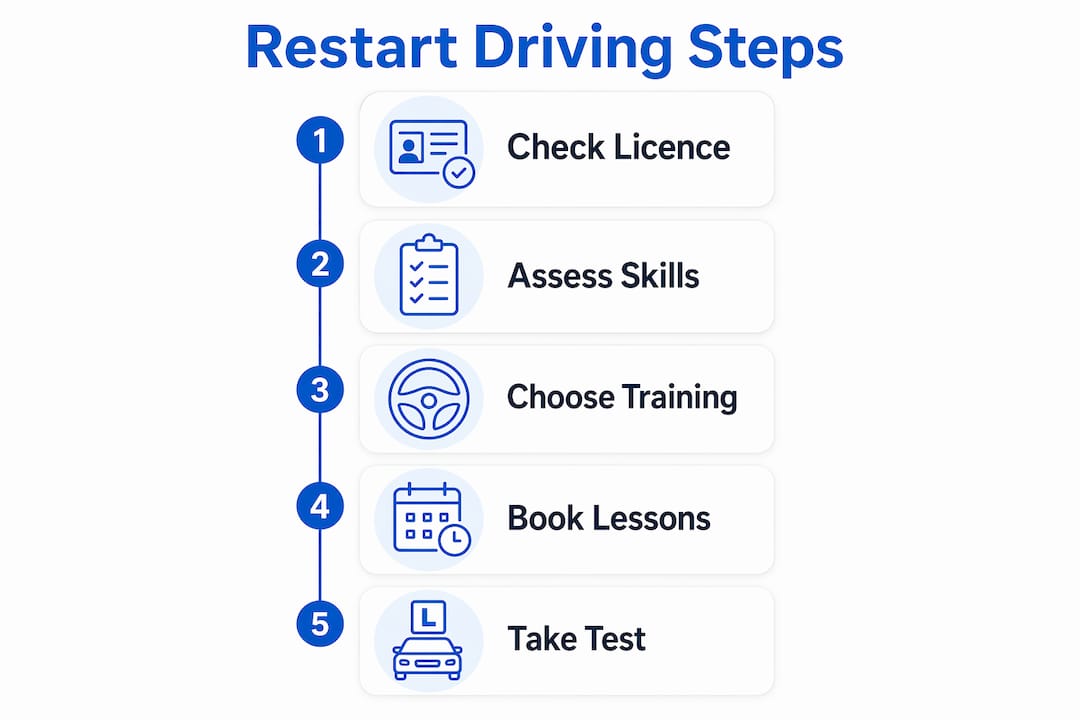
Before you book a single lesson, confirm your paperwork is in order. The requirements differ slightly depending on whether you are a learner returning to training or a full licence holder seeking a driving instruction refresh.
Learners returning to training must hold a valid UK provisional licence. If yours has expired, you will need to renew it through the DVLA before any instructor can legally take you out. Full licence holders returning after a long break do not need to reapply for anything. Refresher lessons are voluntary and aimed at licence holders seeking skill updates rather than retaking the test.

If you plan to practise between lessons with a family member or friend, the legal requirements are strict. The supervising driver must be over 21, hold a full UK driving licence, and have held it for at least three years. L-plates must be displayed front and rear at all times during supervised practice. The vehicle must also be covered by appropriate insurance that includes learner drivers. Check the policy wording carefully, as many standard policies exclude learners by default.
| Requirement | Detail |
|---|---|
| Provisional licence | Must be valid and current before lessons begin |
| Supervisor eligibility | Over 21, full UK licence held for 3+ years |
| Insurance | Must explicitly cover learner drivers on the policy |
| L-plates | Displayed front and rear during all supervised practice |
| DVSA test booking | Check current availability and rescheduling rules before planning |
Pro Tip: Check the DVSA website directly for current test centre availability in your area before committing to an intensive course timeline. Waiting times vary significantly by region and can affect your overall plan.
How to assess your driving skills before restarting lessons
The single biggest mistake returning drivers make is assuming they know exactly what they need to work on. A structured diagnostic approach to identifying regression areas, such as clutch control, mirror routines, or motorway anxiety, is critical for restart planning. Self-assessment alone is rarely accurate enough.
Start with honest self-reflection. Rate your confidence on a scale of one to ten across specific skill areas: clutch control and gear changes, observation and mirror use, roundabouts and junctions, manoeuvres such as parallel parking and bay parking, and dual carriageway or motorway driving. Write it down. This list becomes the brief you hand to your instructor on day one.
Book a professional in-car assessment as your first lesson back. A qualified instructor will identify habits you have developed without realising it, such as late mirror checks, incorrect positioning, or hesitation at junctions. These are the kinds of faults that feel invisible from the driver’s seat but are immediately obvious to a trained observer. A controlled, tailored refresher approach that starts with basic skills and gradually adds complex scenarios consistently delivers better results than jumping straight into test-route practice.
Do not overlook the psychological dimension. Anxiety after a test failure or a long break is real and affects performance. Addressing your mental comfort alongside your technical skills is not optional. Instructors who understand this will build your confidence through progressive challenge rather than throwing you into difficult situations too early.
Pro Tip: Ask your instructor to give you a written or verbal summary of your assessment findings after the first lesson. This gives you a concrete reference point and helps you track progress across subsequent sessions.
What training options suit different restart situations?
The format of your training matters as much as the content. Three main options exist for drivers returning to lessons, and the right choice depends on how long you have been away and what your goals are.
Refresher lessons suit drivers who hold a full licence and want to rebuild confidence after a break. Most drivers require between 2 and 10 hours of refresher tuition depending on the length of the break and the areas needing attention. These lessons are flexible, typically booked one or two at a time, and focus on the specific weaknesses identified in your assessment.
Intensive driving courses compress learning and testing into a short window. A typical intensive course runs 7 to 10 days with 20 to 40 hours of tuition, and includes a pre-booked DVSA practical test at the end. This format suits learners who need to pass quickly, have a reasonable baseline of skills, and can commit fully for a week or two. Pass4you offers intensive course options in Milton Keynes for learners in exactly this position.
Targeted practice combined with professional lessons is the most effective long-term approach for most returners. Use your instructor sessions to tackle the specific weaknesses from your assessment. Use supervised private practice to build repetition and fluency on skills you have already covered. The two reinforce each other.
| Format | Best suited for | Typical duration |
|---|---|---|
| Refresher lessons | Full licence holders rebuilding confidence | 2 to 10 hours total |
| Intensive course | Learners needing fast test preparation | 20 to 40 hours over 7 to 10 days |
| Targeted lessons plus private practice | Most returning learners with specific gaps | Varies by individual need |
- Choose refresher lessons if you passed your test previously and simply need to update your skills.
- Choose an intensive course if you need to pass within a specific timeframe and have a solid foundation.
- Combine professional lessons with supervised practice for the most efficient skill restoration.
- Avoid booking more hours than your assessment recommends. Over-training on areas you already handle well wastes time and money.
How to rebook your driving test after a break or failure
Rebooking your DVSA practical test after a failure follows a specific set of rules that directly affect your planning. You must wait at least 10 working days before retaking the practical test after a failure. This period excludes weekends and bank holidays, so factor that into your timeline carefully.
The 10-day wait is not a penalty. It is an opportunity. Use it as follows:
- Review your examiner’s feedback form immediately after your test. Every fault is recorded with a category and a count. This is the most precise skill gap analysis you will ever receive.
- Book at least two or three targeted lessons within the waiting period, focused exclusively on the faults listed. Focused practice on examiner feedback areas using mock tests is more effective than general lessons for improving retake success.
- Run at least one full mock test with your instructor before rebooking. Simulate test conditions as closely as possible, including the debrief at the end.
- Rebook only when your instructor confirms you are consistently performing at test standard, not when you feel emotionally ready to try again.
DVSA rules also limit how many times you can change your test date or location. You can only change your test date twice before the allowance resets. Cancelling and rebooking from scratch resets this limit, but also puts you back in the queue for availability. Plan your test date with realistic timelines in mind, not optimistic ones.
Common mistakes to avoid when restarting driving lessons
Returning drivers consistently make the same errors. Knowing them in advance saves you time, money, and frustration.
- Repeating what you already know. General lessons that cover the same ground you handled competently before your break are a poor use of lesson time. Your assessment findings should drive every session.
- Rebooking tests emotionally. Booking a test because you feel ready, rather than because your instructor confirms you are ready, is the most common reason for repeat failures. Rational planning beats optimism every time.
- Choosing the wrong supervisor for private practice. A nervous or over-cautious supervising driver can reinforce bad habits or create new anxiety. Choose someone calm, experienced, and familiar with current road rules.
- Underestimating the mental load of intensive courses. Twenty to forty hours of driving in a week is physically and cognitively demanding. Arrive rested, eat properly, and build in recovery time each evening.
“Many drivers mistakenly treat refresher lessons as general repeats rather than tailored fixes to current problems.” This distinction is the difference between lessons that move you forward and lessons that simply pass the time.
Building pressure tolerance through mock tests is particularly important for nervous drivers returning after a failure. Mock tests replicate the emotional conditions of the real test, not just the technical ones. Run them regularly in the weeks before your test date.
Key takeaways
Restarting driving lessons successfully requires a targeted plan built on a professional skill assessment, the right training format, and strategic test rebooking rather than emotional guesswork.
| Point | Details |
|---|---|
| Confirm legal requirements first | Check your provisional licence, insurance, and L-plate rules before booking anything. |
| Start with a professional assessment | An in-car diagnostic session identifies real skill gaps more accurately than self-reflection alone. |
| Match training format to your situation | Refresher lessons suit full licence holders; intensive courses suit learners needing fast test preparation. |
| Use the 10-day wait productively | Focus every lesson in the waiting period on the specific faults from your examiner’s feedback form. |
| Rebook tests rationally, not emotionally | Only rebook when your instructor confirms consistent test-standard performance. |
Why the first lesson back matters more than any other
I have seen hundreds of drivers return to lessons after a break, and the pattern is almost always the same. The ones who progress quickly are not the ones with the most natural ability. They are the ones who arrive at that first lesson with a clear brief and an open mind.
The temptation is to walk in and say “I just need a bit of a refresher.” That phrase is almost always a defence mechanism. What it usually means is “I am not sure how much I have forgotten and I am hoping it is not much.” A good instructor will not let you get away with that. They will put you on the road and find out exactly where you are, which is the only honest starting point.
What I would tell anyone restarting is this: the psychological work is as important as the technical work. If you failed your test, the anxiety of that experience does not disappear just because time has passed. It needs to be addressed directly, through progressive challenge and mock test exposure, not ignored until test day arrives again.
The planning around DVSA booking rules is also something most drivers underestimate. Booking constraints, waiting periods, and limited date changes mean that rushing back to a test without a proper plan can leave you stuck in a cycle of fails and rewaits. A realistic timeline, built with your instructor, is worth more than any amount of optimism.
— Simon
Restart your lessons with Pass4you in Milton Keynes
Pass4you supports drivers at every stage of the restart process, from first assessment through to test day. Whether you need a focused driving instruction refresh after a long break or a structured learner course to rebuild from a solid foundation, Pass4you’s patient, experienced instructors work around your schedule and your specific needs.
Pass4you’s learner driving courses in Milton Keynes are designed for exactly this situation: flexible scheduling, modern dual-control Volkswagen vehicles, and an 83.33% first-time pass rate that speaks for itself. Lessons are tailored to your assessment findings from the very first session. Book by phone or email and get back on the road with a plan that actually works.
FAQ
How many lessons do I need when restarting driving lessons?
Most returning drivers need between 2 and 10 hours of tuition depending on how long they have been away and which skills need attention. A professional in-car assessment after your first lesson will give you a much more accurate estimate than any general guideline.
Can I take driving lessons again after failing my test?
Yes. After a practical test failure, you must wait a minimum of 10 working days before retaking, excluding weekends and bank holidays. Use that period for targeted lessons focused on the faults recorded on your examiner’s feedback form.
Do I need a new provisional licence to restart driving lessons?
You only need to renew your provisional licence if it has expired. If it is still valid, you can book lessons immediately without any additional paperwork from the DVLA.
What is the difference between refresher lessons and an intensive course?
Refresher lessons are aimed at full licence holders who want to update their skills and are typically booked in small blocks. Intensive courses compress 20 to 40 hours of tuition into 7 to 10 days and include a pre-booked DVSA practical test, making them better suited to learners who need to pass within a specific timeframe.
Can a family member supervise my practice when I restart lessons?
Yes, provided they are over 21, have held a full UK driving licence for at least three years, and the vehicle is covered by insurance that explicitly includes learner drivers. L-plates must be displayed front and rear during all supervised practice sessions.
Leave a Reply