
Learning to drive is stressful enough without an instructor who sighs every time you stall. If you are a nervous learner in Milton Keynes, the decision to choose a patient driving instructor is one of the most important choices you will make before you ever sit a test. The right person in that passenger seat can transform your confidence, reduce your lesson count, and dramatically improve your chances of passing first time. This guide walks you through every practical step, from checking credentials to auditing teaching style, so you end up with someone who genuinely helps you improve.
Table of Contents
- How to choose a patient driving instructor the right way
- Shortlisting instructors based on your personal needs
- Evaluating instructor claims and pass rates realistically
- Confirming continuity and commitment with trainee instructors
- Testing compatibility: the first lessons as a patient instructor audit
- Our honest view on what most learners get wrong
- Ready to find your ideal instructor in Milton Keynes?
- Frequently asked questions
Key Takeaways
| Point | Details |
|---|---|
| Verify instructor credentials | Check for green (ADI) or pink (PDI) badges and confirm registration on the DVSA register. |
| Focus on teaching style | Prioritise calm, patient instructors who build your confidence and explain improvements clearly. |
| Beware of pass rate claims | Don’t rely on advertised pass rates or guarantees; ask how progress is tracked instead. |
| Confirm trainee continuity | If choosing a trainee (pink badge), ensure they will be available for your full learning period. |
| Test compatibility early | Use the first few lessons to assess whether the instructor’s style suits you before committing fully. |
How to choose a patient driving instructor the right way
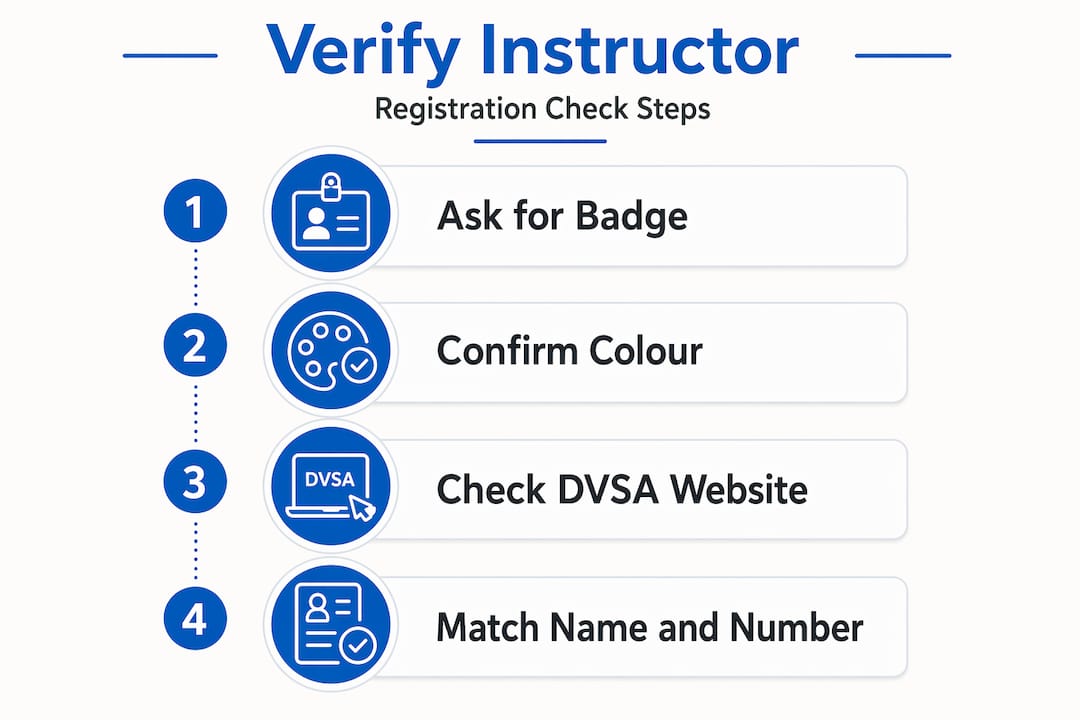
Before you book a single lesson, you need to understand what separates a qualified instructor from someone who is simply available. In the UK, driving instructor qualifications are regulated by the Driver and Vehicle Standards Agency (DVSA), and the badge displayed in the instructor’s windscreen tells you everything you need to know at a glance.
There are two types of badge to look for:
- Green badge: This means the instructor is a fully qualified Approved Driving Instructor (ADI). They have passed three separate DVSA tests covering theory, driving ability, and instructional technique. They can teach independently without supervision.
- Pink badge: This means the instructor is a Potential Driving Instructor (PDI), still working through their training. They are permitted to teach paying pupils, but only under a licence that lasts a maximum of six months.
Anyone you pay to teach you must hold one of these two badges. If they cannot show you one, the lesson is illegal and your insurance may be void.
| Badge colour | Instructor status | Can teach independently? | Licence duration |
|---|---|---|---|
| Green | Approved Driving Instructor (ADI) | Yes | Ongoing |
| Pink | Potential Driving Instructor (PDI) | Under licence only | Up to 6 months |
You can verify any instructor’s registration directly on the DVSA website using their name or licence number. This takes two minutes and removes any doubt. Also confirm that the lesson car has dual controls fitted. A qualified instructor without dual controls is a safety risk, not a minor inconvenience.
Shortlisting instructors based on your personal needs
With a clear understanding of credentials, you can now focus on narrowing your choices by personal needs and teaching style.
Start with the basics. Do you want to learn in a manual or automatic car? If you pass in an automatic, your licence will restrict you to automatics only. For most learners in Milton Keynes who want full flexibility on the road, manual is the better long-term choice. However, if anxiety is making manual gearchanges feel overwhelming, an automatic lesson environment can help you build core road skills first.
Next, consider availability. A patient instructor who is fully booked for six weeks is not going to help you build momentum. Consistent weekly lessons, ideally at the same time each week, produce faster progress than sporadic sessions. Look at learner courses in Milton Keynes to understand what structured lesson programmes look like before you start comparing instructors.
Once you have a shortlist of two or three candidates, the most important step is meeting them before committing. Shortlist two or three instructors then assess their calm, supportive teaching style in person or over the phone. Here is what to look for when you make contact:
- Do they ask about your experience level and any anxieties before discussing price?
- Do they explain how they structure lessons and track your progress?
- Do they speak calmly and clearly, or do they rush through the conversation?
- Do they welcome questions, or do they seem impatient when you ask for detail?
When it comes to choosing supportive instructors, the phone call or initial meeting is itself a preview of how they will behave in the car. Trust that instinct.
Pro Tip: Ask each shortlisted instructor directly: “How do you handle it when a learner makes the same mistake repeatedly?” Their answer will tell you more about their patience than any review online.

Evaluating instructor claims and pass rates realistically
After shortlisting patient instructors, it is important to look beyond marketing claims to find genuine teaching quality.
Pass rates are one of the most misused statistics in the driving school industry. Here is the uncomfortable truth: DVSA does not publish pass rates clearly, which means any figure an instructor quotes is self-reported and essentially unverifiable. An instructor who only takes pupils who are already near test standard will naturally show a higher pass rate than one who works with genuinely nervous beginners. Neither figure tells you much about teaching quality.
Watch out for these warning signs when assessing driving instructor claims:
- “Guaranteed first-time pass”: No instructor can guarantee this. The test is administered independently by the DVSA. Anyone making this promise is either misleading you or cherry-picking their pupils.
- Vague progress tracking: A good instructor should be able to explain exactly how they measure your development between lessons, using the DVSA’s own marking categories as a framework.
- Pressure to book a block of lessons upfront: Legitimate instructors are confident enough in their teaching to let you pay as you go, at least initially.
Instead of chasing pass rate numbers, ask these questions:
- How do you record my progress between lessons?
- What happens if I feel I am not improving fast enough?
- Do you use the DVSA’s fault categories to give me structured feedback?
An instructor who answers these questions clearly and without defensiveness is demonstrating the kind of methodical coaching that actually produces results. A high pass rate figure with no explanation behind it is just a number.
Pro Tip: Look for instructors with verified reviews on independent platforms such as Trustpilot or Google. A pattern of comments mentioning patience and clear explanations is far more useful than a claimed pass rate percentage.
Confirming continuity and commitment with trainee instructors
Understanding how to critically evaluate instructor claims leads naturally to confirming whether trainee instructors can provide reliable, continuous tuition.
Trainee instructors often charge lower rates, which makes them appealing. But the pink badge lasts six months only, and if the trainee does not pass their final qualifying test within that window, they must stop teaching immediately. For you as a learner, that means finding a new instructor mid-course, potentially losing momentum at a critical point.
Here is how to protect yourself if you do choose a trainee instructor:
- Ask how far through their training they are and when they expect to sit their final test.
- Confirm what happens to your lessons if they do not pass in time.
- Ask whether a fully qualified ADI from the same school will take over your lessons if needed.
- Check whether your lesson records and progress notes will transfer to a new instructor seamlessly.
| Consideration | Trainee instructor (PDI) | Qualified instructor (ADI) |
|---|---|---|
| Cost | Often lower | Standard market rate |
| Continuity risk | Higher (six-month badge limit) | Low |
| Teaching experience | Limited | Fully assessed |
| Supervision required | Yes, under licence | No |
For learners who are already anxious, building a relationship with one calm, patient instructor matters enormously. Disruption mid-course can set progress back by weeks. If continuity with trainee instructors is a concern for you, a fully qualified ADI is the safer choice, even if it costs slightly more per lesson.
Testing compatibility: the first lessons as a patient instructor audit
Having ensured lesson continuity, you can now move on to verifying the instructor’s teaching style is a good fit before committing fully.
Think of your first one or two lessons as an interview, not a commitment. You are assessing whether this person can genuinely help you improve, not just whether they know how to drive. The first lessons are a chance to audit the instructor’s calm coaching and supportive debriefs before you hand over a block booking fee.
During those first lessons, pay attention to these specific behaviours:
- When you make a mistake: Does the instructor stay calm and explain what happened, or do they react with frustration, sharp intakes of breath, or raised voices? Even subtle sighing can spike anxiety in a nervous learner.
- During the lesson: Do they give you instructions clearly and with enough notice, or do they bark directions at the last second and then seem irritated when you cannot react in time?
- At the end of the lesson: Do they give you a structured debrief that explains what went well and what to focus on next time? Or do they just say “good effort” and take your money?
A calm, patient instructor will make you feel that mistakes are a normal part of learning, not a personal failing. That shift in mindset is what separates learners who pass in 30 hours from those who need 60.
If after two lessons something feels off, change. Do not talk yourself into staying with an instructor who makes you more anxious. Finding intensive courses with patient instructors is always an option if you want to reset and accelerate progress with someone better suited to your needs.
Pro Tip: After your first lesson, sit quietly for five minutes and ask yourself honestly: did I feel more or less confident than before I got in the car? The answer should always be more.
Our honest view on what most learners get wrong
Most learners in Milton Keynes spend more time researching which phone to buy than they spend choosing their driving instructor. That is a mistake that costs real money and real time.
Here is what 15 years of watching learners succeed and struggle has taught us: the benefits of a patient driving instructor go far beyond a nicer lesson experience. Anxiety in the car is not just unpleasant, it is a direct cause of test failures. When a learner is stressed, their working memory narrows. They miss hazards. They second-guess decisions they have made correctly dozens of times. A calm instructor actively reduces that cognitive load, which means better driving, not just a better mood.
The other thing most people underestimate is the compounding effect of consistency. A learner who has 30 lessons with the same patient instructor, building on a shared understanding of their specific weaknesses, will almost always outperform a learner who has 40 lessons spread across two or three instructors. The best patient driving instructors are not just calm in the moment. They remember that you struggled with roundabouts three weeks ago and they build that into today’s lesson without you having to ask.
Tips for choosing an instructor often focus on credentials and price. Those matter. But the single biggest predictor of first-time pass success is whether you feel genuinely supported in that car. Do not settle for someone who is merely qualified. Find someone who makes you better.
Ready to find your ideal instructor in Milton Keynes?
Choosing the right instructor is the first step. Taking that step with a school that has already done the hard work of vetting for patience, qualifications, and results makes it considerably easier.
At Pass4you, our instructors are fully qualified ADIs who teach in modern, dual-control Volkswagen vehicles and know the Bletchley test routes in detail. Our first-time pass rate sits at 83.33%, well above the local Milton Keynes average, and every lesson is built around your pace, not a fixed schedule. Verified Trustpilot reviews from real learners back up what we say. Whether you want weekly lessons or an intensive course, get in touch by phone or email and we will match you with the right instructor from the start.
Frequently asked questions
How can I tell if a driving instructor is fully qualified?
Check the coloured badge in the windscreen: green means fully qualified ADI, pink means trainee. You can also verify their registration directly on the DVSA website using their name or licence number.
Are high pass rate claims by instructors reliable?
No. DVSA does not publish pass rates clearly, so any figure quoted is self-reported. Treat extremely high or guaranteed pass rate claims with caution unless the instructor explains exactly how they measure progress.
Why is patience important in a driving instructor?
Patient teaching reduces learner stress and directly improves driving performance. Anxiety narrows focus and causes errors, so a calm instructor is not just nicer to be around, they actively help you drive better.
Should I consider a trainee instructor for my lessons?
You can, but confirm their timeline carefully. A pink badge lasts six months only, and if the trainee does not pass their final qualifying test in time, they must stop teaching, which could disrupt your progress at a critical stage.
Leave a Reply