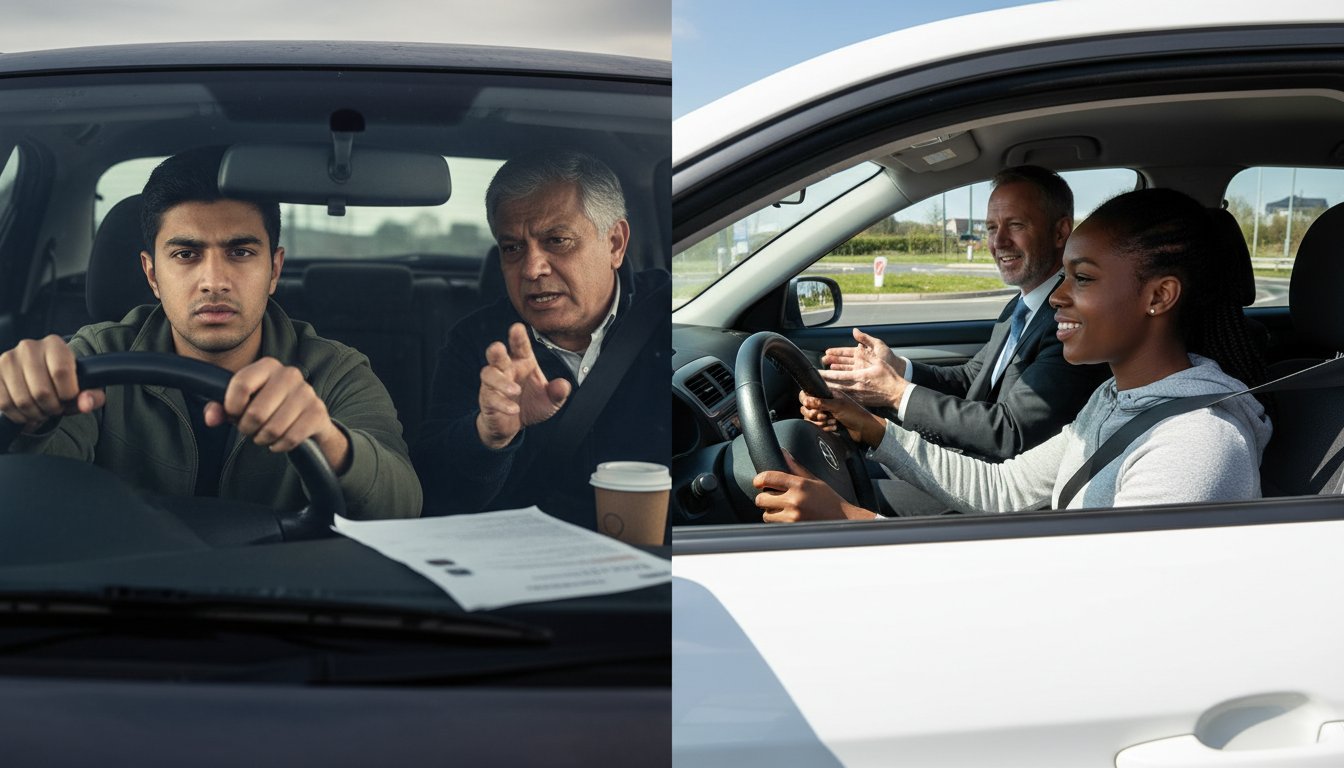
Could your parents’ well-meaning advice actually be the reason you fail your driving test in 2026? With the average cost of professional lessons continuing to rise this year, it’s tempting to rely solely on private practice to save money. However, when you look at learning to drive with parents vs instructor, the “bad habits” passed down from family members often lead to avoidable failures. We understand the tension that builds up during those quiet Sunday drives. We also know the fear that you aren’t making enough progress.
You deserve a calm, patient environment where you can build confidence without the arguments. Our instructor, Simon, focuses on a supportive technique that has led to an 83.33% first time pass rate at Pass4you. This article explores the honest pros and cons of professional tuition versus private practice to help you pass your test faster and more affordably. We will compare the costs, the stress levels, and the latest DVSA recommendations to find the perfect balance for your journey to becoming a safe driver for life.
Key Takeaways
- Discover the “Hybrid Model” that combines professional safety standards with private practice to get you on the road as quickly as possible.
- Learn how to manage the psychology of driving, replacing high-pressure family dynamics with the calm, patient guidance of an experienced mentor.
- Understand the true financial impact of learning to drive with parents vs instructor, from insurance premiums to the hidden costs of a lower pass rate.
- Identify the specific skills you should never attempt to learn without professional help to ensure you build safe, lifelong habits from day one.
- Explore how our 83.33% first-time pass rate and modern tuition vehicles provide the reliable foundation you need to pass with confidence.
The Real Difference Between Professional Lessons and Private Practice
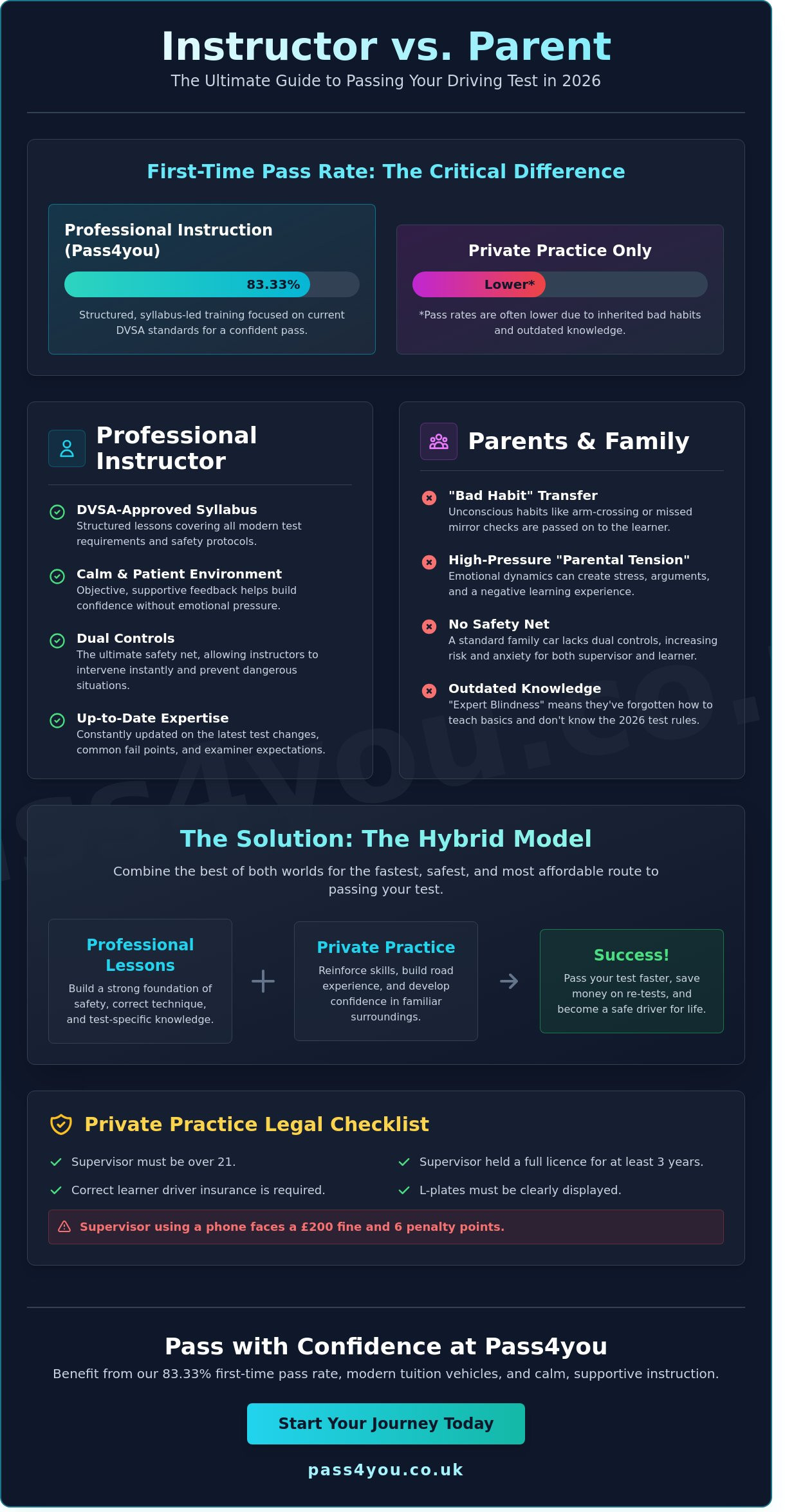
Choosing how to start your journey behind the wheel is a big decision for any new driver. When looking at learning to drive with parents vs instructor, it helps to see these as two distinct but complementary paths. Professional instruction follows a strict DVSA-approved syllabus. This ensures you learn modern safety standards and the specific skills required to pass in 2026. Private practice, on the other hand, is a way to build experience by supplementing those lessons with a qualified supervisor, usually a parent or relative who is over 21 and has held their license for at least three years.
Many experienced drivers fall into the “bad habit” trap. Even the most careful parents might cross their arms while steering or skip mirror checks that a modern examiner expects to see. The 2026 test is very different from the one your parents took. It focuses heavily on independent driving and digital navigation. Relying solely on a parent can lead to frustration when you realize their advice contradicts the current practical driving test requirements. Our goal is to make you a safe driver for life, not just someone who can pass a test.
Legal Requirements for Learning with Parents
If you choose to practice in the family car, you must follow strict legal criteria. The supervisor must be at least 21 years old and have held a full UK or EU driving license for at least three years. They must also be qualified to drive the type of vehicle you are using, whether it is manual or automatic. It is a common mistake to overlook the mobile phone law. In 2026, supervisors face the same penalties as the driver if they use a handheld device, which includes a £200 fine and 6 penalty points. You also need specific learner driver insurance to ensure you are covered on the family policy.
What Professional Instructors Bring to the Table
Professional instructors provide a level of safety and structure that parents cannot match. The most obvious benefit is dual controls. This safety net allows the instructor to intervene if a situation becomes dangerous, which builds your confidence much faster than a standard car would. We use a syllabus-led approach that moves you logically through the basics before tackling complex tasks like dual carriageway mastery.
An instructor stays updated on the latest DVSA changes, including the ‘Show Me, Tell Me’ questions and the exact thresholds for minor faults. This expertise is why we maintain an 83.33% first time pass rate. While learning to drive with parents vs instructor is a common debate, professional guidance ensures you don’t waste time or money on lessons that reinforce the wrong habits. We provide a calm, patient environment where you can focus on becoming a confident road user.
The Psychology of Learning: Patience vs. Pressure
Deciding between learning to drive with parents vs instructor often comes down to the atmosphere inside the car. Family dynamics change the moment you sit in the driver’s seat. A parent isn’t just a teacher; they’re a protector and a critic. This emotional weight often creates “Parental Tension.” It’s incredibly difficult to focus on a complex junction when your passenger is clutching the door handle or gasping at every minor braking adjustment. This pressure can turn a simple lesson into a stressful confrontation.
Professional instructors like Simon at Pass4you approach these situations with a different mindset. He specializes in helping nervous learners because he understands that mistakes are a vital part of the learning curve. While a parent might view a stalled engine as a dangerous error, Simon sees it as a quiet teaching moment. This calm, supportive environment is a primary reason why Pass4you maintains an impressive 83.33% first-time pass rate. You move away from simply “surviving” a drive and begin truly controlling the vehicle.
- Objective Feedback: An instructor critiques your road positioning, not your character.
- Safety Controls: Dual controls allow an instructor to stay calm, knowing they can intervene if necessary.
- Confidence Building: Lessons are structured to build success, rather than throwing you into the deep end of rush-hour traffic.
Why Parents Struggle to Teach
Most parents have been driving for decades, often covering over 200,000 miles since they passed their own tests. This leads to “Expert Blindness.” They’ve forgotten how difficult it is to coordinate feet and hands because the process is now subconscious muscle memory. They also tend to use vague terminology like “just pull out” instead of clear, instructional language. Their emotional investment means they panic more easily, and that panic is contagious for a beginner.
The Instructor’s Role as a Mentor
An instructor acts as a mentor who creates a steady environment for better information retention. Simon tailors his teaching style to how you learn best, whether you need visual aids or practical repetition. By maintaining professional detachment, he ensures there are no emotional “flare-ups” during a lesson. This steady rhythm helps you become a safe driver for life rather than just someone who can pass a test. Many students find that starting with a patient driving instructor actually saves them money by preventing the development of expensive bad habits early on.
Analysing the Costs: Is Learning with Parents Actually Cheaper?
Many families assume that private practice is the most budget-friendly way to get a license. It seems simple; you just pay for fuel and a set of L-plates. However, learning to drive with parents vs instructor often reveals a hidden “false economy” that ends up costing more in the long run. Professional instructors use dual-control cars to keep you safe and prevent the mechanical strain that beginners often put on a gearbox or clutch. When you use a family car, you must pay for specific learner insurance premiums. These costs are often high because insurance companies know that amateur supervision lacks the safety net of dual controls.
Beyond the car itself, you have to consider the value of your time. If you learn exclusively with a parent, you might pick up “legacy” habits that were acceptable decades ago but cause an immediate fail today. This leads to a cycle of failing and rebooking that quickly drains your bank account. Our goal is to make you a confident, safe driver from your very first lesson, ensuring your money is spent on progress rather than repeating mistakes. We focus on value for money by teaching you correctly the first time.
The Cost of Failing the Test
A driving test currently costs £62 for a weekday slot. If you fail, you don’t just lose that money. You also face the frustration of long waiting lists. In Milton Keynes, wait times for a test can often stretch for 15 to 20 weeks. During this gap, you’ll need to keep practicing to stay “test-ready,” which means more fuel and more insurance payments. Professional instruction is about efficiency. It’s much cheaper to pay for 30 hours of expert tuition than to pay for 60 hours of amateur practice followed by three failed tests. We focus on “un-learning” those bad habits early so you don’t have to pay the price on test day.
Long-Term Savings of Professional Instruction
The financial benefits of professional lessons extend far beyond the day you pass. Proper instruction helps you avoid the £1,000 fine and six penalty points that come from improper supervision during private practice. More importantly, we teach “safe driving for life” skills. These techniques help you avoid the minor bumps and scrapes that cause insurance premiums to skyrocket once you’re on your own. Choosing a provider with an 83.33% first-time pass rate significantly reduces the total investment in driving lessons in Milton Keynes by ensuring you don’t waste money on repeated test fees.
By working with a patient mentor like Simon, you’re not just buying a lesson; you’re buying a proven system. Our 83.33% first-time pass rate is a testament to how effective, professional guidance saves you money. You’ll enter the test centre feeling calm and prepared, rather than nervous about the gaps in your knowledge.
The Hybrid Model: The Fastest Way to Pass in 2026
Deciding on learning to drive with parents vs instructor doesn’t have to be a choice between one or the other. The most efficient way to get your licence in 2026 is the hybrid model. This method uses a professional instructor to introduce new, complex skills and parents to provide the hours of repetition needed to make those skills second nature. It’s about combining professional expertise with the freedom of extra “mileage” on the road.
You should never start your very first lesson with a parent. The first 10 hours of your driving journey are the most critical for safety. Professional instructors have dual controls and the experience to handle early-stage panic. More importantly, they teach the modern standards required by examiners today. Parents often pass on “legacy habits,” such as coasting or incorrect hand positions, which can be incredibly difficult to unlearn later. Start with a pro to build a safe foundation, then bring in the family car once you’re confident with the basics.
Communication makes this partnership work. Don’t just “go for a drive” with a parent. Tell them exactly what your instructor wants you to work on, whether it’s gear synchronization or checking blind spots. Using a professional to conduct a “Mock Test” acts as a vital bridge. It verifies that your private practice sessions are helping rather than hindering your progress before you commit to a real test date.
How to Organise Your Private Practice
Keep your private sessions focused on building road awareness and general “mileage” rather than complex manoeuvres. The goal is to get comfortable with the flow of traffic. Use a simple practice log to track how many hours you’ve done and any specific issues you encountered, like stalling at a specific roundabout. To keep the atmosphere supportive, set ground rules before the engine starts. Agree that if either of you feels stressed, you’ll find a safe place to pull over and take a two-minute break. This keeps the experience positive and builds your confidence.
When to Transition Fully to an Instructor
In the final six weeks before your test, you should transition back to primarily professional lessons. This period is for fine-tuning your skills for the specific Milton Keynes test routes and addressing high-level requirements like eco-driving or advanced observations. You need to ensure your driving meets the exacting standards expected by driving instructors near me. At Pass4you, we focus on these details to maintain our 83.33% first-time pass rate, ensuring you aren’t just “good enough” but truly test-ready.
Ready to start your journey with a patient, professional mentor? Book your first lesson with Pass4you today and let’s get you on the road safely.
Why Pass4you is Your Best Partner for Success
Choosing the right path for your driving education is a big decision. When you compare learning to drive with parents vs instructor, the professional expertise we offer provides a level of safety and technical precision that is hard to replicate at home. Our 83.33% first-time pass rate is a figure we are incredibly proud of. It isn’t just a number; it represents hundreds of local students who felt confident enough to succeed on their very first attempt. This success rate is significantly higher than the national average, proving that our structured, professional approach works for all kinds of learners.
Learning in a safe, reliable environment is vital for building confidence. You’ll spend your lessons behind the wheel of a modern Volkswagen, a vehicle chosen specifically for its ease of handling and top-tier safety features. It’s a car that feels intuitive; this makes those early sessions much less intimidating for nervous beginners. We ensure our vehicles are maintained to the highest standards so you can focus entirely on your skills without worrying about the car.
Simon brings a unique “Simon difference” to every lesson. He knows that shouting or rushing a student only leads to more mistakes and increased anxiety. Instead, he uses a calm, patient method that focuses on your individual pace. If you’re feeling anxious about a specific maneuver or a busy junction, Simon will talk you through it until you feel ready. This empathetic mentorship turns fearful learners into capable, independent drivers. Deciding between learning to drive with parents vs instructor often comes down to who can provide this level of focused, stress-free guidance.
Tailored Lessons for Milton Keynes Residents
We’ve spent years mastering every corner and roundabout in Milton Keynes. From the busy H-roads to the complex junctions in Bletchley and Central MK, we know exactly what you’ll face on your test. We don’t just teach you to pass; we teach you to be a safe driver for life. Our lessons fit around your busy life, offering flexible scheduling for students and workers alike. We use proven techniques refined over years of local teaching to ensure you’re prepared for any situation on the road.
Ready to Start Your Journey?
Starting is easy. Our booking process is straightforward, designed to get you on the road without any fuss. In your introductory session, we’ll assess your current skill level, discuss your goals, and start building your confidence immediately. There’s no pressure, just professional guidance tailored to you. You don’t have to face the stress of the road alone. Book your first lesson with Pass4you today and experience our patient, professional approach.
Take the Wheel with Confidence
Deciding on the best path forward doesn’t have to be a stressful choice. While family practice adds valuable hours behind the wheel, professional guidance ensures you don’t pick up bad habits that lead to test failure. When you weigh up learning to drive with parents vs instructor, the hybrid model consistently proves to be the fastest route to success in 2026. At Pass4you, we provide a calm environment in modern Volkswagen tuition cars, which is a world away from the high-pressure atmosphere often found in a parent’s vehicle.
Our 83.33% first-time pass rate shows that our patient, expert mentoring works. We focus on building your confidence through a tried and tested technique that has earned us hundreds of 5-star student testimonials. You’ll find that Simon’s supportive approach helps you become a safe driver for life, not just someone who can pass a test. Choosing professional lessons saves you money by reducing the total number of hours needed and avoiding the cost of retakes. You’re almost there. We’re ready to help you gain your independence and enjoy the freedom of the open road.
Start your driving journey with a 83.33% pass rate school today
Frequently Asked Questions
Can I pass my driving test without any professional lessons?
You can legally take your test without professional help, but DVSA statistics show that most successful candidates have some professional instruction. While private practice is great for building confidence, Simon provides the expert guidance needed to meet the strict 2026 test standards. Our 83.33% first time pass rate shows that professional lessons are the most reliable way to become a safe driver for life.
How many hours of private practice do I need alongside my instructor?
The Driver and Vehicle Standards Agency (DVSA) recommends about 22 hours of private practice to supplement 47 hours of professional lessons. This balance is key when learning to drive with parents vs instructor, as it lets you practice basic car control in a familiar environment. This extra time behind the wheel helps you feel calm and prepared for your practical test day.
Is it legal for my parents to teach me to drive in the UK?
It’s legal if your parent is over 21 years old and has held a full UK driving licence for at least 3 years. The car must also be fitted with L plates and be roadworthy for the 2026 standards. We find that students who combine private practice with Simon’s professional lessons often feel more confident because they get to experience a wider variety of road conditions.
Will learning with my parents give me bad habits?
Parents often pass on driving shortcuts that they’ve developed over decades, which can lead to a fail on your modern driving test. When learning to drive with parents vs instructor, you’ll notice that Simon focuses on the specific 27 skills required by the DVSA. Professional instruction ensures you don’t pick up common errors like crossing your arms or failing to check mirrors in the correct sequence.
Do I need special insurance to practice with my parents?
You must have specific learner driver insurance before you start practicing in a private vehicle. You can either be added to your parent’s existing policy or buy a standalone learner policy for a specific timeframe. Driving without the correct insurance is a serious offence that can lead to an unlimited fine and 6 penalty points on your provisional licence before you even start.
What is the best age for a parent to start supervising a learner?
A parent can start supervising you as soon as you turn 17 and have your provisional licence in hand. However, we suggest having at least 10 hours of professional lessons with Simon before starting private practice. This ensures you have the core car control skills needed to keep you and your parent safe. Our patient approach builds the foundation you need for a stress free experience.
How do I tell my parents they are making me nervous while driving?
It’s best to be direct and explain that their feedback style is making it harder for you to focus on the road. You could suggest using a specific checklist provided by Simon so everyone stays on the same page. If the environment stays stressful, it’s often better to stick to professional lessons. We pride ourselves on being friendly and patient to help you build confidence without the shouting.
Why do instructors have a higher pass rate than parents?
Instructors use dual controls for safety and follow a proven, structured syllabus that covers every aspect of the 2026 driving test. While a parent teaches you how they drive, Simon teaches you how to pass the test and stay safe for life. Our 83.33% first time pass rate reflects our commitment to high standards, helping you save money in the long run by requiring fewer attempts.
Leave a Reply