The Milton Keynes grid road system isn’t a concrete maze designed to confuse you; it is actually one of the most logical and predictable networks in the country once you have the key to unlock it. It’s completely normal to feel your heart rate rise when you see those high-speed dual carriageways or a complex roundabout on the horizon. Many learners find that understanding milton keynes grid road system is the biggest hurdle to feeling safe behind the wheel. We’ve helped many students move past the fear of getting lost in a sea of H and V signs or ending up in the wrong lane at a busy junction.
We’re here to help you turn that anxiety into expert-level confidence. You’ll learn to read the roads like a professional and approach your driving test with total composure. This guide breaks down the simple science behind the horizontal and vertical labels. We’ll also give you the practical tools you need to master every roundabout without a hint of panic, even as speed limits and layouts evolve. You will soon see that these roads are designed to help you, not hinder you, on your journey to becoming a safe and skilled driver.
Key Takeaways
- Learn the logic behind Horizontal (H) and Vertical (V) roads to navigate the city with clarity and ease.
- Master the numbering system to pinpoint your location, making understanding milton keynes grid road system second nature for any learner.
- Gain practical techniques for managing transitions from high-speed dual carriageways to roundabouts, ensuring you always stay in control.
- Discover how to interpret unique “map” signs early so you can choose the correct lane and exit without last-minute stress.
- See how a patient, step-by-step approach can build your confidence, taking you from quiet residential streets to mastering the faster grid roads.
What is the Milton Keynes Grid Road System?
Many learners feel a bit overwhelmed when they first look at a map of our city. It looks like a giant chessboard, and that can be intimidating if you’re used to traditional, winding British streets. For many new drivers, understanding milton keynes grid road system starts with realizing it was built for flow and safety. The Milton Keynes grid road system is a unique network of high-capacity roads designed to move traffic efficiently from one side of the city to the other. Instead of forcing cars through narrow high streets, the grid keeps through-traffic on dedicated routes. Roundabouts act as the primary junctions, allowing you to move between different parts of the city without facing a constant barrage of traffic lights.
H Roads vs. V Roads: The Compass Logic
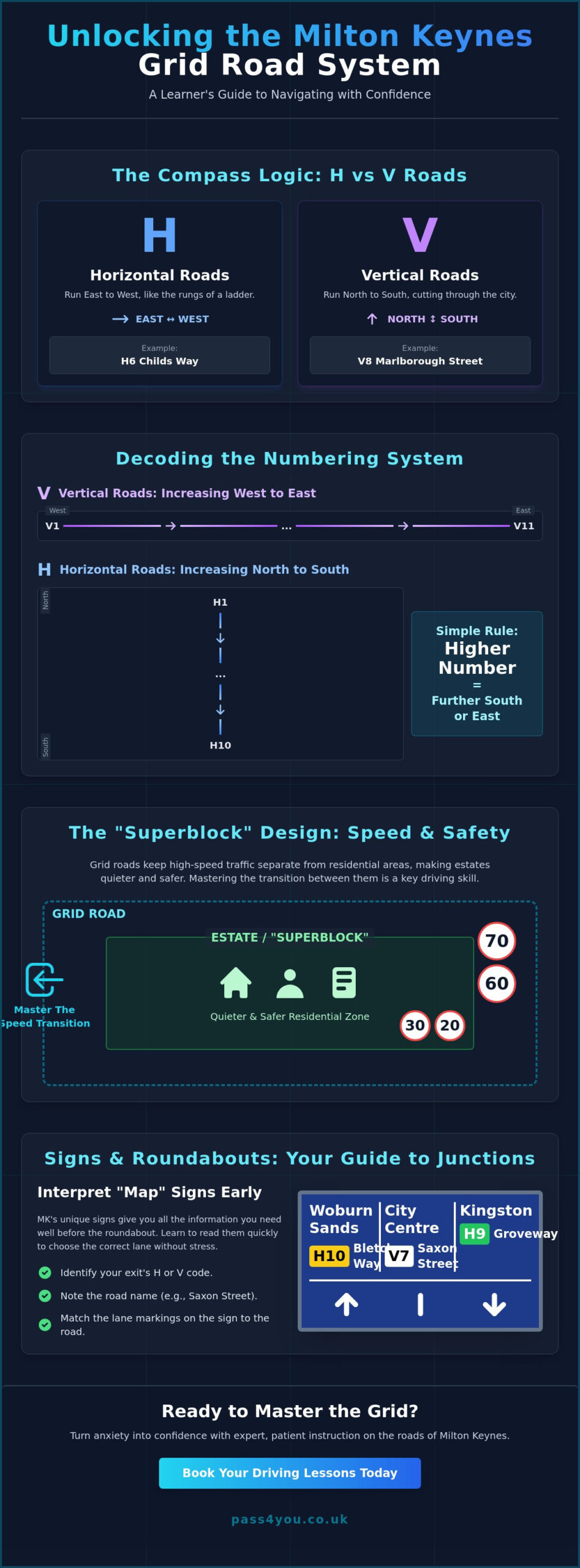
If you can remember just two letters, you can find your way almost anywhere in Milton Keynes. The grid relies on a simple coordinate system: H roads and V roads. H roads are “Horizontal” and run East to West across the city. Think of them like the rungs of a ladder. V roads are “Vertical” and run North to South. For example, H6 Childs Way stretches across the city, while V8 Marlborough Street cuts through it vertically. This logic is a fantastic tool for orienting yourself. If you know you need to travel North, you’ll be looking for a V road. It takes the guesswork out of navigation and helps you feel much more in control of your journey. You aren’t just following road names; you’re following a logical map that makes sense the moment you’re behind the wheel.
The “Superblock” Concept for Learners
One of the most striking things you’ll notice is that you won’t see houses, shops, or schools directly on a grid road. These are all tucked away inside “superblocks” or estates. The grid roads act as a protective border around these residential areas. This design is intentional. It keeps the heavy, fast-moving traffic away from where people live, making the estates much quieter and safer for pedestrians.
As a learner, this means you’ll experience a significant shift in driving style. You’ll often be cruising at 60mph or 70mph on a dual carriageway grid road, only to slow down to 20mph or 30mph as you turn into an estate. Mastering this transition is a key part of understanding milton keynes grid road system. You’ll learn to anticipate these changes early, ensuring you aren’t carrying too much speed into the calmer residential zones. It’s about balancing the freedom of the open grid with the responsibility of driving safely in the neighborhoods where people live and play. Our instructors will help you practice these speed changes until they feel completely natural.
Decoding the Naming and Numbering Logic
Once you grasp the compass logic of H and V roads, the next step in understanding milton keynes grid road system is mastering the numbers. It’s like having a built-in GPS in your head. The numbers aren’t just random labels; they’re a sequence that tells you exactly where you are in relation to the city centre. When you see a road sign, it isn’t just a name. It’s a coordinate. This predictability is designed to lower your stress levels and help you focus on your lane discipline and speed control.
The Numbering Sequence Explained
The grid follows a very strict mathematical progression. If you’re driving on a Vertical road, the numbers increase as you move from West to East. V1 (Watling Street) is on the far Western edge, while V11 (Tongwell Street) sits on the Eastern side. Similarly, Horizontal roads increase as you travel from North to South. H1 (Ridgeway) is at the top of the map, and H10 (Bletcham Way) is at the bottom.
This logical progression was a core part of the original master plan for the new town. It ensures that even if you’re slightly lost, you can find your way back just by looking at the numbers. A simple trick to remember is that higher numbers always mean you’re heading further South or further East. If you’re on H5 and you see a sign for H6, you know you’re moving South through the city.
Road Names and Their Grid Equivalents
You’ll also notice that every grid road has a traditional name alongside its H or V code. For example, H6 is famously known as Childs Way, and V7 is Saxon Street. This can be a bit confusing for learners because sat-navs usually use the names, while the physical road signs on the grid prioritize the codes. You might hear your GPS tell you to “turn left onto Portway,” but the sign at the roundabout will prominently display “H5.”
Many of our students find that practicing these routes during driving lessons for learner drivers helps bridge the gap between what the sat-nav says and what the road signs show. Knowing both the H/V codes and the traditional road names is vital because your examiner might use either during your independent driving section. Using the signs to predict the next grid square allows you to plan your lane changes much earlier. Instead of reacting to a junction at the last second, you’ll be prepared for it half a mile in advance. This foresight is the secret to understanding milton keynes grid road system and passing your test with ease.
Navigating Roundabouts and National Speed Limits
The most exhilarating part of learning to drive in our city is the speed. On the grid, you’ll often move from a standstill to 60mph or 70mph in a matter of seconds. For many, this is where the real work of understanding milton keynes grid road system happens. You aren’t just steering; you’re managing momentum. While the Milton Keynes grid road system was originally designed for high-speed flow, recent changes in 2024 and 2025 have seen some sections reduced to 40mph or 50mph. Always check the signs. If you see the white circle with a black diagonal stripe, it means National Speed Limit applies. On the dual carriageway sections, this is 70mph.
It’s common to encounter aggressive drivers who seem to know every inch of the grid. They might zoom past or follow too closely. Don’t let them rattle you. Your priority is your own safety and following the rules of the road. If you stay calm and predictable, you’ll find that the grid is actually a very safe environment. Our instructors specialize in helping you build the emotional stability needed to handle these faster stretches without feeling pressured by other road users.
Mastering the 60mph Grid Stretches
Keeping a safe distance is your best defense against anxiety. At 60mph, you need a much larger gap between you and the car in front than you do on estate roads. If someone is tailgating you, don’t speed up. Stay steady and maintain your space. When you need to join the grid from a slip road, look for “the gap” early. You should accelerate firmly to match the speed of the traffic already on the road. For more detailed tips, check out our guide on Mastering the Dual Carriageway. It’s a great companion to your practical lessons and helps you feel prepared for the faster V and H roads.
Roundabout Approach and Lane Discipline
The transition from 70mph to a roundabout is where most learners struggle. The secret is a technique called “braking for the bend.” Start slowing down much earlier than you think you need to. You want to be in the correct gear, usually second, before you even reach the give-way line. This gives you plenty of time to look for a gap in the traffic.
At most MK roundabouts, we teach the “12 o’clock” rule to help you choose the right lane. If your exit is before 12 o’clock on the sign, stay in the left lane. If it’s after, use the right. Reading the road markings early is essential to avoid last-minute lane changes that can cause panic. Before you exit, always check your interior and right-hand door mirror. This ensures no one is trying to squeeze past you as you leave the junction. Mastering these mirror checks will make you feel like a pro and help you ace your driving test.
Essential Signage and Lane Discipline for New Drivers
Visual cues are your best friend when you’re behind the wheel. In many UK towns, you might struggle with faded paint or hidden signs, but Milton Keynes is different. The city uses a very specific style of signage that tells a story if you know how to read it. Mastering these visual prompts is a massive part of understanding milton keynes grid road system. It allows you to make decisions hundreds of yards before you reach a junction, which is the key to staying calm and keeping your instructor happy.
Reading the Map-Style Advance Signs
As you approach a roundabout on the grid, you’ll see large green or white “map-style” signs. Pay close attention to the thickness of the lines. A thick line represents the main grid road, while a thinner line usually points toward a local estate or a smaller side road. This helps you instantly identify which exit keeps you on the high-speed network.
You’ll also see the H or V code clearly labeled next to the exit arm on the sign. At 60mph, you only have a few seconds to process this. We recommend using the “clock face” method. Look at the sign and imagine it’s a clock. If your exit is at 3 o’clock, you know you’ll need the right-hand lane. If it’s at 9 o’clock, stay left. Spotting these codes early means you won’t have to guess which way to go when you’re actually entering the roundabout.
Maintaining Lane Integrity
One of the most common reasons for a test fail in Milton Keynes is drifting between lanes. This often happens on the dual carriageway sections or on the large, “spiral” roundabouts found in the city centre. A spiral roundabout is designed to lead you naturally toward your exit, but you must follow the white lines strictly. If you cross a solid line or drift into another lane without checking, it can be dangerous.
Staying in your lane isn’t just about steering; it’s about observation. For more tips on what examiners look for, read our guide on Mastering the Practical Driving Test. When lanes merge after an exit, always perform a “Life Saver” glance over your shoulder. This quick check ensures no one is in your blind spot before you move over. If you do find yourself in the wrong lane, don’t panic or try to swerve. Simply follow the lane where it goes safely. Your examiner would much rather see you take a wrong turn safely than make a risky maneuver to stay on route.
If the thought of these busy junctions makes you nervous, our patient instructors can help. We offer tailored driving lessons for learner drivers that focus on building your confidence at these complex city centre roundabouts. With the right support, understanding milton keynes grid road system becomes a rewarding challenge rather than a source of stress.
Mastering the Grid with Pass4you Driving School
Reading about the grid is a great first step, but nothing beats the feeling of actually mastering these roads behind the wheel. We know that the transition from a quiet residential street to a 70mph dual carriageway can feel daunting. That’s why our approach is built on patience and steady progress. Understanding milton keynes grid road system isn’t just a theoretical exercise; it’s a practical skill that we help you develop at your own pace. We don’t believe in rushing you into situations you aren’t ready for. Instead, we provide a supportive environment where you can build your skills without the pressure of aggressive or hurried instruction.
Our teaching method is specifically designed for the unique layout of Milton Keynes. We typically start our lessons in quiet residential estates where you can practice your steering and gear changes at low speeds. Once you’re comfortable, we gradually introduce you to the faster H and V roads. This step-by-step process ensures that by the time you reach the national speed limit sections, you have the technical control and emotional stability to handle them with ease. This precision-focused training is why we’re so proud of our results. While the Bletchley Driving Test Centre has an overall pass rate of 45.7%, Pass4you has achieved a first-time pass rate of 83.33%. This difference comes from our commitment to making sure you’re truly “grid-ready” before your test day.
A Reassuring Approach to High-Speed Roads
We want you to feel as safe and comfortable as possible while you learn. Our instructors use modern VW vehicles that are equipped with the latest safety features. These cars are easy to handle, which helps reduce the anxiety often associated with understanding milton keynes grid road system at higher speeds. We focus on repetitive, calm practice on the specific H and V roads that frequently appear on local test routes. One of our recent students came to us with a deep fear of fast junctions. After just two dedicated lessons on the V6 Grafton Street, they were navigating complex roundabouts with total composure. We love seeing that spark of confidence when a learner realizes they’re in total control of the car.
Book Your Milton Keynes Lessons Today
Professional instruction is the most efficient way to gain your license and your freedom. While it might be tempting to practice with friends or family, our expert mentors ensure you don’t pick up bad habits that could lead to a test fail. We teach you the refined methods needed to navigate the grid like a professional driver from day one. This high-standard training actually saves you money in the long run by preparing you to pass your test sooner and keeping you safe for years to come.
If you’re looking for more local advice, our Driving Lessons Milton Keynes guide offers even more insights into passing your test in the city. You don’t have to face the grid alone. We’re here to guide you through every roundabout and dual carriageway merge with patience and care. Are you ready to conquer the roads and gain your independence? Book your first lesson with Pass4you today and let’s get you started on the path to success.
Your Journey to Becoming a Confident Driver
You now have the tools to turn the city’s complex map into a simple, predictable guide. By mastering the H and V numbering logic and learning to read the unique advance signs, you’ve already taken the first step toward understanding milton keynes grid road system. Driving here doesn’t have to be a source of stress. It can be an experience that offers you unmatched freedom once you know how to handle the transitions between high-speed grid roads and quiet estates.
We’re ready to help you put this knowledge into practice. Our patient, calm instructors specialize in these specific roads, using modern VW tuition vehicles to keep you safe and comfortable. With our 83.33% first-time pass rate, we have a proven track record of helping learners like you succeed. Take the next step and master the MK grid and pass first time with Pass4you. You’ve got this, and we’ll be right there beside you until you’re ready to drive away with your license.
Frequently Asked Questions
Is the Milton Keynes grid road system difficult for beginners?
The grid system is actually very beginner-friendly because it’s so logical and predictable. Unlike traditional towns with narrow, winding streets and confusing one-way systems, the grid offers plenty of space and very clear signage. While the higher speeds can feel a bit intimidating at first, the consistent layout helps you build confidence quickly. We specialize in helping you move from quiet estates to these faster roads at a pace that feels comfortable for you.
What is the speed limit on Milton Keynes grid roads?
Speed limits vary across the network, so you must always stay alert to the roadside signs. While many dual carriageway sections are set at 70mph, recent traffic orders from 2024 and 2025 have reduced several stretches to 40mph or 50mph. You’ll also encounter 20mph zones as you move into residential estates. Our instructors will help you practice identifying these changes early so you can adjust your speed smoothly and stay safe on every journey.
How do I know the difference between an H road and a V road?
You can tell the difference by looking at the road’s direction and its prefix. H roads are “Horizontal” and run East to West across the city, while V roads are “Vertical” and run North to South. This simple compass logic is the foundation of understanding milton keynes grid road system. The numbering also helps you orient yourself; higher numbers mean you’re heading further South or East. It’s a brilliant design that makes navigating the city much simpler.
Are there many roundabouts in Milton Keynes?
Yes, roundabouts are the primary junctions that connect the grid roads. They were chosen instead of traffic lights to keep the city’s traffic flowing freely and safely. While they can seem busy for a new driver, they’re very efficient once you master your lane discipline and observation skills. We spend plenty of time practicing these junctions during your lessons. You’ll learn to approach them with the calm precision needed to handle any exit with total confidence.
Do I need to drive on the grid during my driving test?
You will almost certainly drive on the grid roads during your practical test. The Bletchley test centre uses routes that feature various V and H roads to assess how well you manage higher speeds and large roundabouts. Part of understanding milton keynes grid road system is being prepared for these specific routes. We make sure you’re familiar with the roads likely to appear on your test, ensuring there are no surprises and helping you stay relaxed.
What happens if I take the wrong exit on a grid road roundabout?
If you take the wrong exit, the most important thing is to stay calm and continue driving safely. Your examiner isn’t testing your ability to follow a map perfectly; they’re testing your safety and control. Swerving or braking suddenly to “fix” a mistake is a serious fault, but taking a wrong turn safely is perfectly fine. Just keep going, and the examiner will help you get back on track. We’ll teach you how to handle these moments calmly.
Why are there no houses on the main Milton Keynes grid roads?
The city was designed with “superblocks” to keep heavy through-traffic away from residential areas. This means houses, schools, and shops are tucked away inside the estates rather than sitting directly on the fast grid roads. This layout makes the estates much quieter and safer for families. As a learner, you’ll practice the transition between these calm 20mph zones and the faster grid roads, which is a key skill for any driver in the city.
Can I learn to drive on the grid in an automatic car?
Absolutely, you can learn to navigate the grid in either a manual or an automatic car. The logic of the road system remains exactly the same regardless of the vehicle you choose. Many learners find that automatic cars make the grid feel even simpler because you don’t have to worry about gear changes at busy roundabouts. We provide patient, professional instruction in modern vehicles to suit your specific needs, helping you become a safe and skilled driver.
Leave a Reply