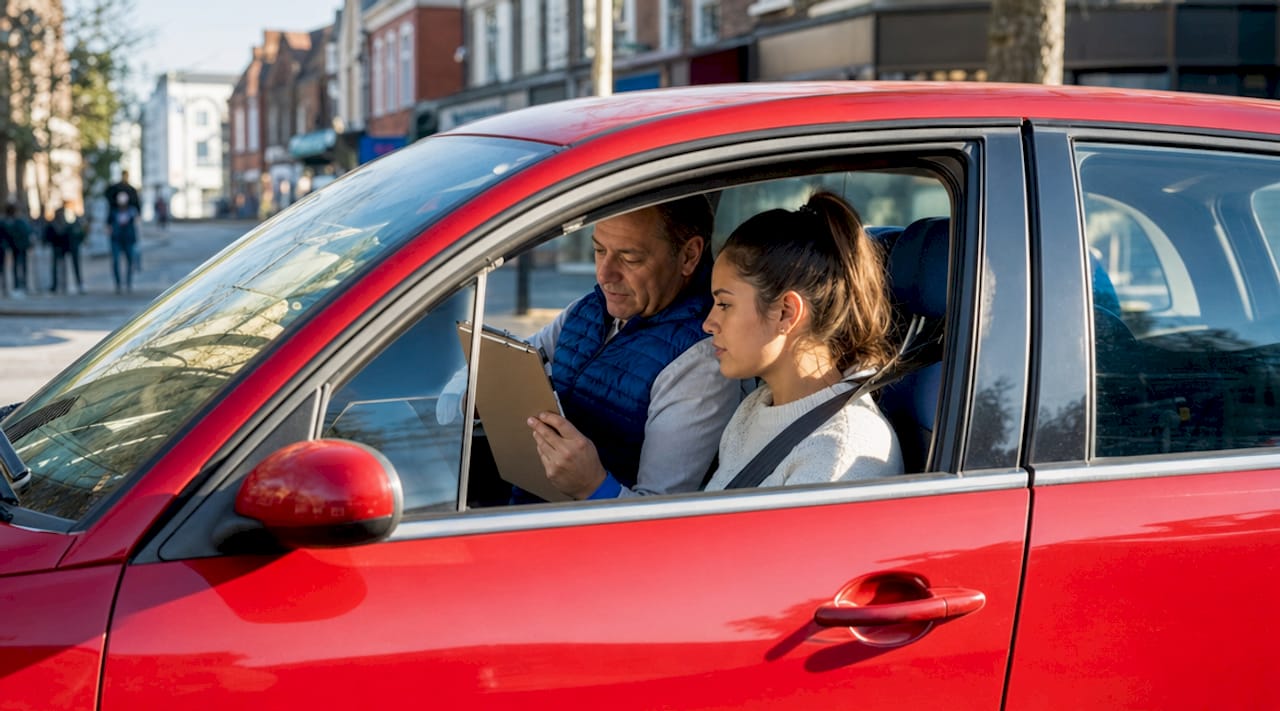
Pay-as-you-go lessons are a pricing model where learners pay for each driving session individually, with no upfront bulk purchase and no long-term contract required. Known formally as a PAYG model, this approach is built on paying for actual usage rather than committing to a fixed package. For learner drivers in the UK, it means booking one lesson at a time, paying at or just before each session, and retaining full control over your schedule and spending. Pass4you, based in Milton Keynes, offers this flexible structure alongside its standard courses, recognising that not every learner fits the same mould.
What is pay as you go lessons and how does the model work?
Pay-as-you-go driving lessons operate on a simple principle: you book a lesson, you attend it, and you pay for it. There is no requirement to purchase five, ten, or twenty hours in advance. Each lesson stands alone as a transaction, which means your financial commitment never extends beyond the next session you have booked.
Booking a PAYG lesson typically involves contacting your instructor or school directly, selecting a date and time, and confirming payment online or in person on the day. Most schools accept bank transfer, card payment, or cash. The process is deliberately straightforward, removing the administrative friction that sometimes accompanies block-booking packages.

Lesson durations are usually one or two hours, and UK lesson prices currently sit between £36 and £40 per hour for most learners, though regional variation and instructor experience affect the final figure. That pricing range reflects rising operational costs for instructors, including fuel, insurance, and vehicle maintenance, which have pushed rates upward in recent years.
What you gain in flexibility, you also gain in customisation. Because each lesson is booked individually, you and your instructor can adjust the focus of every session based on your progress. One week might concentrate on roundabouts; the next on motorway driving or manoeuvres. There is no rigid programme to follow simply because you purchased a set number of hours.
- Book one lesson at a time with no advance commitment
- Pay at or before each lesson via card, transfer, or cash
- Adjust lesson content to match your current skill level
- Reschedule or pause lessons without losing money already spent
- Test a new instructor before committing to a longer arrangement
Pro Tip: Before your first PAYG lesson, ask the instructor for a clear cancellation policy in writing. Most schools require 24 to 48 hours’ notice to avoid a charge, and knowing this upfront prevents any surprises.
What are the benefits and drawbacks of pay-as-you-go driving lessons?
The clearest benefit of PAYG driving lessons is financial control. You spend only what you can afford, when you can afford it. For learners balancing part-time work, university fees, or other living costs, this matters enormously. Rising lesson costs have made it harder for many people to commit large sums upfront, and PAYG removes that barrier entirely.
Flexibility in scheduling is the second major advantage. Life changes quickly. A new shift pattern at work, a family commitment, or an unexpected expense can make a pre-paid block of lessons feel like a liability rather than an asset. With PAYG, you book when it suits you and pause when it does not. Learners with irregular schedules consistently cite this as the primary reason they choose PAYG over packages.
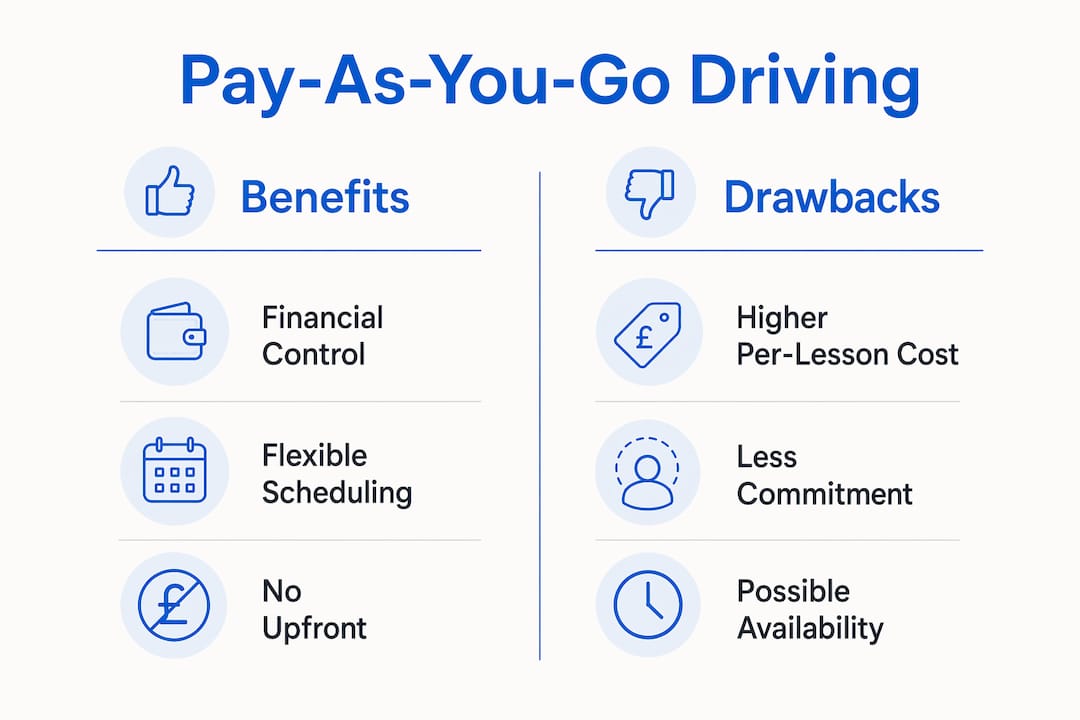
The model also reduces the risk of being locked into a poor fit. If your first lesson with an instructor does not go well, you are free to try someone else without losing money. This is a genuine advantage that block bookings cannot match.
The drawbacks are real, though. The per-lesson cost under PAYG is almost always higher than the equivalent rate within a block booking, where schools typically offer a reduced hourly rate in exchange for upfront commitment. If you are certain about your instructor and your schedule, a block booking will cost you less overall.
“Learners who space out their lessons too much under a pay-as-you-go arrangement often take longer to pass, because skills learned in one session begin to fade before the next one reinforces them. Consistency matters more than the payment model you choose.”
A second drawback is the temptation to delay lessons when money is tight. This can extend your overall learning period and, paradoxically, increase the total cost of reaching test standard. The freedom PAYG offers requires a degree of self-discipline to use effectively.
- Financial control — spend only what you have available, lesson by lesson
- Schedule flexibility — book, pause, or reschedule without financial penalty
- Instructor freedom — switch instructors after any lesson without losing prepaid funds
- Personalised pacing — adjust lesson frequency to match your progress and confidence
- Higher per-lesson cost — expect to pay more per hour than block-booking rates
- Risk of slow progress — infrequent lessons can slow skill retention and extend learning time
How does pay-as-you-go compare to block bookings?
Block bookings require you to pay for multiple lessons upfront, typically five to ten hours at a time, in exchange for a reduced hourly rate. Block bookings offer discounts but demand financial commitment and offer less scheduling flexibility than PAYG. The trade-off is straightforward: you save money per hour, but you surrender control over your calendar and your choice of instructor.
The right model depends entirely on your circumstances. A learner with a stable weekly routine, a trusted instructor, and the funds available to pay upfront will almost certainly save money with a block booking. A learner with variable availability, limited savings, or uncertainty about their instructor is better served by PAYG.
| Feature | Pay-as-you-go | Block booking |
|---|---|---|
| Upfront cost | None | Medium to high |
| Per-lesson rate | Standard or higher | Reduced (discounted) |
| Schedule flexibility | High | Lower |
| Instructor commitment | None required | Usually tied to one school |
| Risk if plans change | Minimal | Potential loss of prepaid funds |
| Best for | Irregular schedules, new learners | Committed learners, stable routines |
Intensive driving courses represent a third option, where learners complete a concentrated block of hours over days or weeks. Pass4you offers intensive course options for learners who want to reach test standard quickly, though these require the highest upfront commitment of all three models.
Pro Tip: If you are unsure which model suits you, start with two or three PAYG lessons to assess your progress rate and your instructor’s teaching style. You can always switch to a block booking once you have confidence in both.
How to find and choose pay-as-you-go driving lessons near you
Searching for PAYG driving lessons starts with knowing what to look for. Not every driving school advertises PAYG prominently, so it is worth asking directly when you make contact. The question to ask is simple: “Do you offer individual lessons with no upfront package requirement?”
When evaluating a school or instructor, check the following:
- DVSA approval — confirm the instructor holds a current ADI (Approved Driving Instructor) badge
- Verified reviews — look for Trustpilot or Google reviews from recent learners, not just testimonials on the school’s own website
- Pricing transparency — the hourly rate, cancellation policy, and any additional fees should be stated clearly before you book
- Vehicle condition — modern dual-control vehicles are the standard for safe tuition; ask what car is used
- Local test route knowledge — an instructor familiar with your local test centre routes offers a practical advantage
Pass4you operates in Milton Keynes and surrounding areas, with instructors who know the Bletchley test routes in detail. Their learner driving courses page sets out what is included and how lessons are structured, which makes it straightforward to compare against other local options.
Hidden costs are worth watching for. Some schools charge a booking fee, a fuel surcharge, or a cancellation fee that is not mentioned in the headline rate. Ask for the full cost breakdown before your first lesson, not after.
Pay-as-you-go tutoring platforms in other fields, such as academic tutoring, have demonstrated that removing subscription lock-in increases learner satisfaction and reduces dropout rates. The same logic applies to driving lessons. When learners feel in control of their spending, they engage more consistently with the learning process.
Why flexibility in driving lessons is more valuable than most learners realise
From my experience working with learner drivers, the biggest mistake people make is treating the payment model as a secondary consideration. It is not. How you pay shapes how you learn.
Learners who feel financially pressured tend to rush. They push for test bookings before they are ready because they have already spent the money and want to see a return. PAYG removes that pressure almost entirely. You are not chasing a return on a lump sum. You are simply deciding, week by week, whether you are ready for the next session.
I have also seen the opposite problem: learners who use PAYG as an excuse to take lessons once a month and then wonder why they are not progressing. The model gives you freedom, but freedom without structure produces slow results. The learners who do best with PAYG are those who set a personal target, perhaps one lesson per week, and treat it as a standing commitment rather than an optional extra.
The other thing worth saying is that PAYG suits the modern reality of learning to drive. Lesson costs have risen sharply, and not everyone has £400 to spend on a block booking before they have even confirmed they enjoy driving. Starting with individual lessons lets you test the experience before you invest heavily in it. That is not a compromise. It is sensible financial behaviour.
— Simon
Start learning with Pass4you’s flexible lesson options
Pass4you offers driving lessons in Milton Keynes with no requirement to purchase a block package before you begin. Whether you want to start with a single session or work towards a structured plan, the school’s approach is built around your schedule and your pace.
Pass4you’s instructors use modern Volkswagen tuition vehicles with dual controls, and the school’s 83.33% first-time pass rate reflects a teaching method that prioritises genuine readiness over lesson volume. If you are exploring flexible driving lessons in Milton Keynes, Pass4you provides the transparency and local expertise to make your first booking a confident one. Contact the team by phone or email to discuss your options and book your first lesson without any upfront commitment.
FAQ
What is pay as you go for driving lessons?
Pay-as-you-go driving lessons are a model where you pay for each lesson individually, with no upfront package or long-term contract. You book one session at a time and pay at or before each lesson.
Are pay-as-you-go lessons more expensive than block bookings?
The per-lesson rate for PAYG is typically higher than the discounted rate offered within a block booking. However, PAYG carries no financial risk if your plans change or you need to pause lessons.
How do I pay for pay-as-you-go driving lessons?
Most instructors accept payment by bank transfer, card, or cash at or just before the lesson. Booking and payment processes vary by school, but PAYG is designed to be direct and immediate.
How much do pay-as-you-go driving lessons cost in the UK?
UK driving lesson prices typically range from £36 to £40 per hour, with variation based on region, instructor experience, and vehicle type. Prices have risen in recent years due to increased instructor operating costs.
Can I switch instructors if I use pay-as-you-go lessons?
Yes. Because PAYG involves no prepaid commitment, you can change instructors after any lesson without losing money. This is one of the model’s most practical advantages for learners who are still finding the right fit.
Key takeaways
Pay-as-you-go driving lessons give learners full financial control and scheduling freedom, making them the most practical option for anyone with variable availability or limited upfront funds.
| Point | Details |
|---|---|
| Definition of PAYG lessons | Learners pay per individual session with no upfront package or contract required. |
| Typical UK lesson cost | Most lessons are priced between £36 and £40 per hour, with regional variation. |
| Key benefit over block bookings | PAYG carries no financial risk if schedules change or lessons need to pause. |
| Main drawback to consider | Per-lesson rates are higher than discounted block-booking rates for the same instructor. |
| Best learner profile for PAYG | Learners with irregular schedules, limited savings, or uncertainty about their instructor. |
Leave a Reply