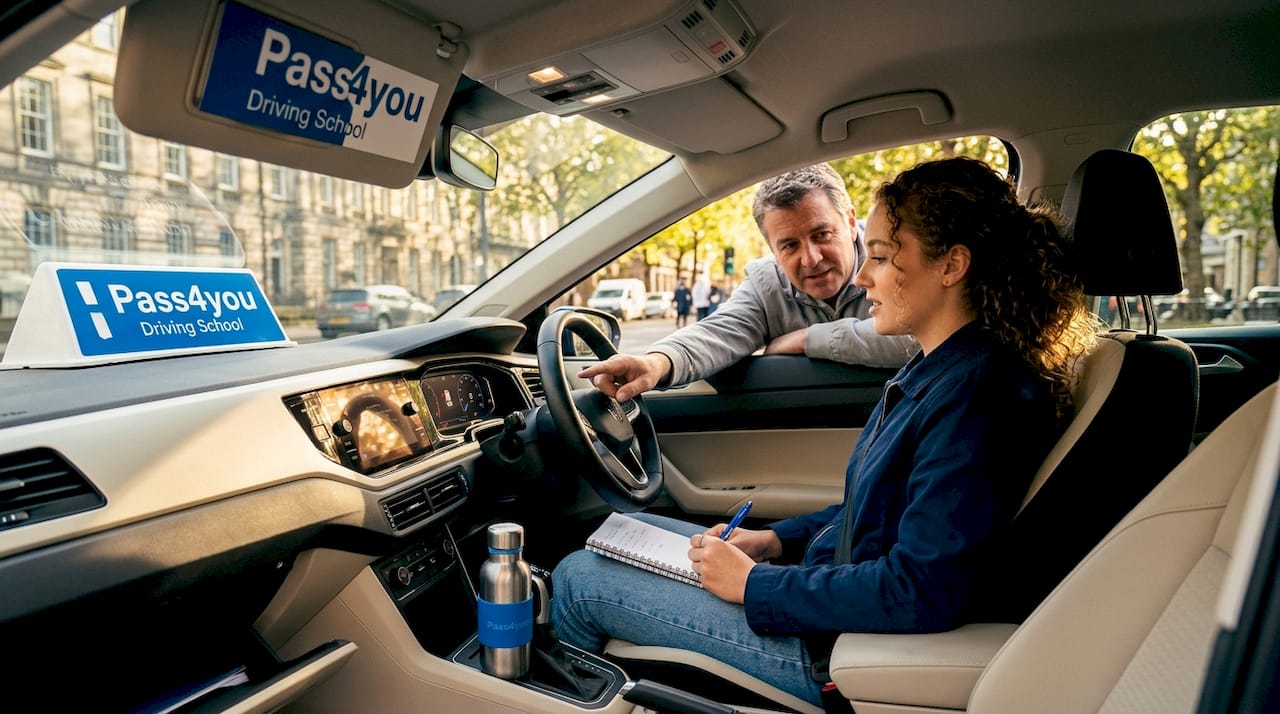
Feedback during driving lessons does more than point out mistakes. It shapes how your brain stores new skills, builds safe habits, and determines how quickly you progress from nervous beginner to confident driver. Yet most learner drivers treat feedback as a score card rather than a learning tool, and most parents have no idea how much influence they have over the process. Understanding why lesson feedback improves driving is the difference between a learner who passes quickly and one who stalls at test after test. Here is what the research actually shows, and what you can do about it today.
Table of Contents
- Key takeaways
- Why lesson feedback improves driving
- What the research actually shows
- Why parent involvement changes everything
- Innovative feedback methods worth knowing about
- Making feedback work for you
- My honest take on feedback in driving lessons
- How Pass4you supports learner drivers with feedback
- FAQ
Key takeaways
| Point | Details |
|---|---|
| Feedback accelerates skill-building | Immediate, specific feedback links your actions to outcomes before the memory fades, speeding up motor learning. |
| Parent involvement multiplies results | Combined feedback and parent communication training reduces risky driving events more than feedback alone. |
| Encouragement beats fault-finding | Coaching that highlights progress makes learners more receptive and produces lasting behavioural change. |
| Technology closes the feedback gap | Real-time in-vehicle alerts and app-based monitoring catch mistakes that verbal feedback misses between lessons. |
| Specific goals outperform general advice | Targeting a small set of behaviours like speeding or braking produces measurable and sustained improvement. |
Why lesson feedback improves driving
Driving is a motor skill, the same category as learning to play an instrument or throw a ball accurately. Your brain needs precise, timely information to wire the correct movements into long-term memory. When feedback arrives too late or stays too vague, the brain has already begun reinforcing the wrong pattern.
This is not just theory. Real-time feedback enhances motor learning and motivation in youth, with researchers finding that instant correction improves accuracy and performance retention far beyond traditional coaching methods. The same principle applies directly behind the wheel.
The feedback impact on driving works through three channels. First, it interrupts a bad habit before it solidifies. Second, it confirms good decisions, which reinforces confidence. Third, it gives the learner a clear, concrete behaviour to repeat or avoid on the very next attempt.
Common forms of feedback in driving lessons
How feedback enhances driving depends heavily on the form it takes. Here are the most common types learner drivers encounter:
- Verbal instructor comments given immediately during or after a manoeuvre
- In-vehicle alerts from telematics devices that flag speeding, harsh braking, or sharp steering
- Smartphone apps that record a drive and produce a behaviour score with specific tips
- Written lesson reports summarising key areas to work on before the next session
- Dashcam footage review allowing learners to watch their own decisions in real time
- Parent observation notes taken during practice drives outside formal lessons
Pro Tip: Ask your instructor to explain the reason behind every piece of feedback, not just what went wrong. Knowing why you braked too sharply helps you correct it. Knowing only that you did it wrong gives you very little to work with.
What the research actually shows
The evidence for feedback in driving is now strong enough that dismissing it as a nice-to-have is no longer credible. Two studies in particular set a clear picture.

The ProjectDRIVE trial found that combined feedback and parent training produced an adjusted incidence rate ratio of 0.68 for risky driving events, meaning teenagers in the combined group had significantly fewer incidents than those receiving feedback alone. In-vehicle smartphone feedback without parent involvement did reduce speeding, but it did not significantly reduce overall risky behaviour.
A Penn Medicine study of an insurance-based feedback programme found equally striking results. Drivers who received weekly text messages with behaviour scores and targeted tips saw speeding reduced by up to 13% and hard braking and rapid acceleration cut by up to 25%. Critically, these improvements persisted after the incentives ended, suggesting that the feedback had genuinely shifted driving habits rather than just temporarily suppressing risky behaviour.
The UK Department for Transport recognised the scale of this issue and recruited over 28,000 learners aged 17 to 24 across its Driver 2020 evaluation, testing a range of interventions including telematics and mentoring programmes to identify what actually moves the needle on young driver safety.
| Study | Intervention | Key outcome |
|---|---|---|
| ProjectDRIVE (JAMA Network Open) | In-vehicle feedback plus parent communication training | 32% reduction in risky driving events (IRR 0.68) |
| Penn Medicine insurance programme | Weekly text feedback with behaviour scores | Speeding down 13%, hard braking down 25% |
| UK Driver 2020 (DfT) | Telematics and mentoring for learners aged 17–24 | Identified effective support methods at large scale |
| AR motor learning study (Frontiers) | Real-time augmented reality performance feedback | Higher accuracy and motivation vs traditional coaching |
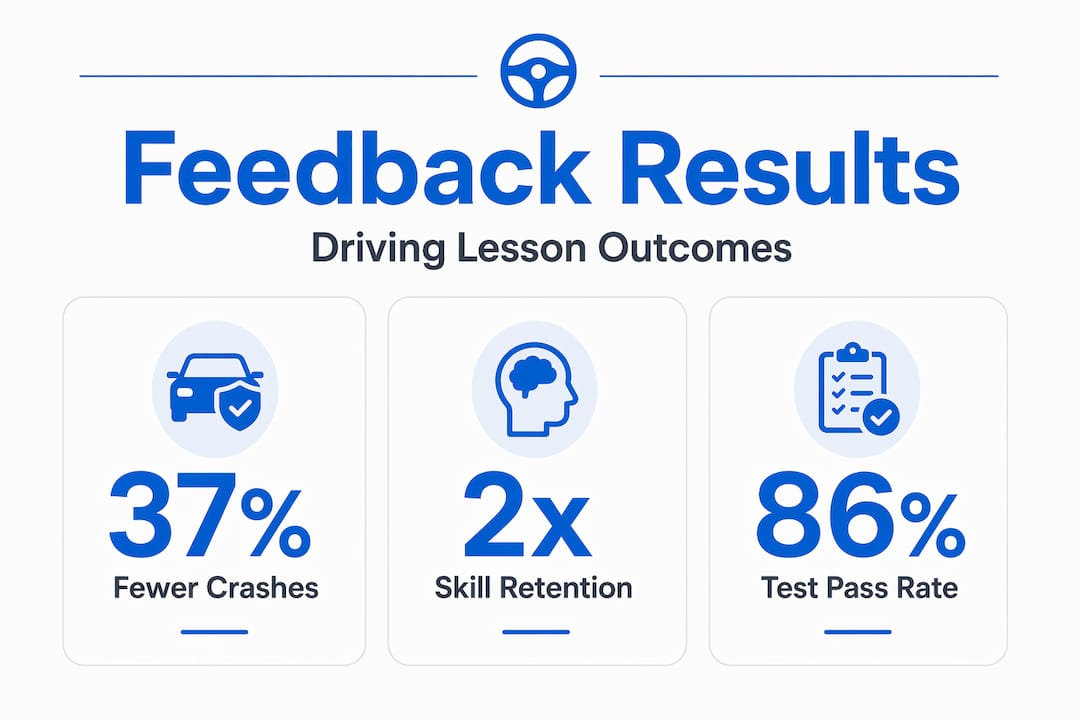
The pattern across all four is consistent. Targeted, frequent, behaviour-specific feedback produces real change. Occasional, vague feedback does not.
Why parent involvement changes everything
Here is the finding that surprises most parents: feedback given during a lesson often fades before the learner’s next practice drive. Parents are the bridge between structured instruction and the 30 or 40 hours of private practice most learners do with family members.
Parental involvement is a crucial multiplier for feedback effectiveness because parents help translate information into consistent real-world behaviour. When a parent understands what the instructor flagged and reinforces the same message calmly during a Sunday afternoon drive, the learning sticks.
The ProjectDRIVE data made this explicit. Parent communication training alongside in-vehicle feedback produced significantly better outcomes than either approach alone. The training taught parents how to have constructive conversations about driving reports rather than reacting emotionally to a low score.
Here is how parents can put this into practice:
- Read the lesson feedback report before discussing it. Reacting to a number without reading the context sets up unhelpful conversations.
- Pick one or two behaviours to focus on per practice drive. Trying to address everything at once overwhelms a learner and dilutes attention.
- Ask questions rather than give instructions. “What would you do differently at that junction?” teaches self-reflection better than “You should have slowed sooner.”
- Acknowledge progress out loud. If your learner’s braking scores improved this week, say so. Positive reinforcement from a parent carries real weight.
- Keep your own composure. A tense parent in the passenger seat raises a learner’s anxiety and actually reduces their ability to apply feedback correctly.
Pro Tip: Review any app or telematics report together with your learner before the next lesson, then share your notes with the instructor. That three-way loop of learner, parent, and instructor is where the fastest progress happens.
Innovative feedback methods worth knowing about
The importance of lesson feedback has driven real investment in technology that goes beyond the instructor’s spoken word. Real-time in-vehicle monitoring is now common enough to appear in insurance products, driving school programmes, and dedicated learner apps.
The most compelling evidence for real-time feedback comes from motor learning research. Augmented reality feedback given during skill practice produces greater improvements in accuracy and intrinsic motivation than traditional coaching. Learners who receive instant visual and auditory performance data process corrections faster and stay more engaged because they can see the effect of their adjustment immediately.
For driving specifically, this translates to:
- In-vehicle beep alerts when speed exceeds a set threshold
- Smartphone telematics apps that score each journey across multiple risk categories
- Phone dashcam technology with AI-based detection that flags harsh events and produces reviewable footage
- Post-drive journey reports with colour-coded breakdowns by behaviour type
Motivation matters here too. Effective driver coaching builds on encouragement and progress recognition rather than fault cataloguing. A learner who opens an app and sees their smoothness score improved by eight points this week is far more likely to keep engaging with the feedback than one who sees a list of errors with no context about what they are doing right.
The comparison between phone dashcam and dedicated dashcam options is worth exploring if you want to set up consistent recording for practice drives, as footage gives both learner and parent something concrete to review rather than relying on memory alone.
Making feedback work for you
Understanding the benefits of driving feedback is one thing. Using it consistently is another. Here are the practical habits that convert feedback into genuine skill improvement:
- Write down the main feedback point from every lesson before you get out of the car. Memory degrades fast and specific details vanish within hours.
- Set one behavioural goal per week based on your most recent feedback. Improving your following distance this week is a real goal. Becoming a better driver is not.
- Track your telematics scores over time rather than obsessing over a single bad session. Trends tell the true story.
- Ask your instructor to demonstrate the correct behaviour, not just describe it. Watching and then immediately replicating is significantly more effective than listening alone.
- Celebrate small wins deliberately. Progress at improving driving skills through feedback is non-linear. A week where your speed management score improves by 10% matters even if your junction observations were shaky.
Pro Tip: If feedback from your instructor ever feels confusing, ask them to frame it as a next action. “Next time, check your mirror at the 12-second point before braking” is far more useful than “Your mirror checks need work.”
Good driving tips and resources can help you build these habits between lessons, particularly if you want to research specific manoeuvres or test procedures in more depth.
My honest take on feedback in driving lessons
I have watched a lot of learner drivers go through the process, and the pattern is almost always the same. The ones who pass quickly are not necessarily the most naturally talented. They are the ones who treat every lesson debrief as useful information rather than a judgement on their ability.
What I find genuinely underappreciated is how destructive the wrong kind of feedback can be. A learner who hears a catalogue of faults every session without any acknowledgement of what they are doing right will eventually stop listening. Not out of laziness. Out of self-protection. The brain tunes out information that only feels threatening.
The research backs this up. Supportive coaching that highlights progress produces better learner receptiveness than fault-focused critique. I have seen this in practice time and again. A calm, specific, encouraging debrief after a difficult lesson does more for long-term skill development than a perfectly accurate but demoralising list of errors.
My honest view is that feedback without context is almost useless. Telling someone they braked too late is neutral information. Telling them they braked too late because they were not scanning far enough ahead is something they can actually work with. That distinction matters enormously.
Parents: please resist the urge to turn every practice drive into a performance review. The goal is to reinforce what the instructor is building, not to add a second layer of pressure. The most effective parent I have ever seen in this process was one who asked more questions than she gave instructions. Her daughter passed first time.
— Simon
How Pass4you supports learner drivers with feedback
If everything you have read here resonates, the next question is whether your current lessons actually deliver this kind of structured, constructive feedback. At Pass4you, it is built into how every lesson works.
Pass4you’s learner driver courses in Milton Keynes are designed around exactly this model. Calm, patient instructors provide detailed feedback after every lesson, focused on specific behaviours rather than general impressions. Parents are encouraged to stay informed and involved throughout. The result is Pass4you’s 83.33% first-time pass rate, well above the local average, and the kind of learner confidence that holds up under test conditions.
For those who want to progress faster, intensive driving courses concentrate that feedback loop into a shorter timeframe, giving learners the benefit of high-frequency, high-quality coaching across consecutive days. Whether you are starting out or approaching your test, feedback-led instruction at Pass4you is what moves you forward.
FAQ
What is lesson feedback in driving and why does it matter?
Lesson feedback is specific information given to a learner driver about their performance during or after a drive. It matters because timely, accurate feedback helps the brain correct errors quickly and build safe habits before poor techniques become ingrained.
Does parent involvement really affect how well feedback works?
Yes, significantly. Research from the ProjectDRIVE trial found that combining in-vehicle feedback with parent communication training reduced risky driving events by 32% compared to feedback alone, showing that parental reinforcement is a key part of translating lesson learning into real-world behaviour.
How often should learner drivers receive feedback?
Continuous and frequent feedback produces better outcomes than occasional comments. Ideally, learners should receive verbal feedback during every lesson and review any telematics or app-based data from practice drives before their next session with their instructor.
Is technology-based feedback better than verbal instructor feedback?
Neither replaces the other. Real-time alerts and telematics apps catch patterns across multiple drives that a single lesson cannot reveal, while a skilled instructor provides contextual explanation and demonstration that technology alone cannot deliver. The two work best in combination.
How can feedback help learner drivers pass their test sooner?
Short, focused feedback programmes targeting specific risky behaviours produce lasting improvements. By addressing a small set of clear goals each week, learners build consistent safe habits faster than those who receive only generic advice, reducing the number of lessons needed to reach test standard.
Leave a Reply