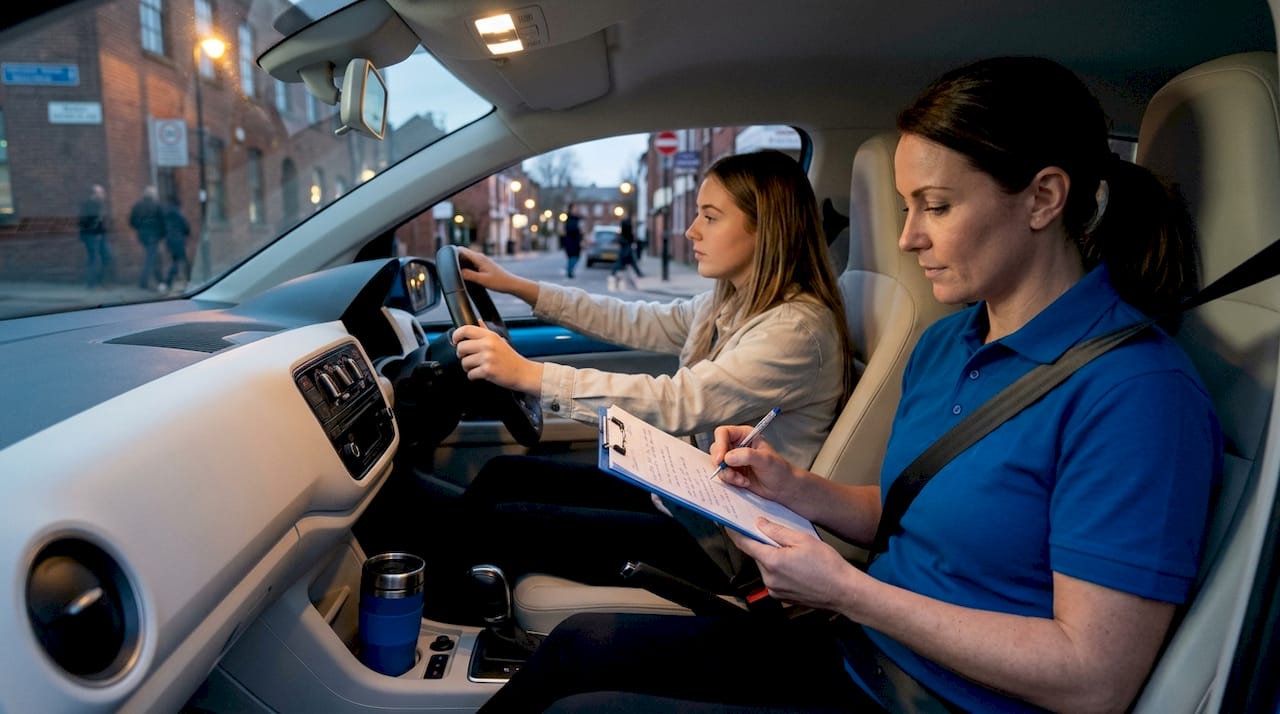
Most learner drivers assume that night driving is simply daytime driving with the lights on. That misconception gets people into trouble. What does a night driving lesson involve in practice? Far more than flicking on your headlights and hoping for the best. Night driving accounts for a disproportionate share of serious road casualties, with reduced visibility, glare from oncoming traffic, and fatigue all compounding the risks in ways that daylight simply does not. This guide explains exactly what instructors focus on, what skills you will build, and how to prepare yourself before you ever pull out of a junction after dark.
Table of Contents
- Key takeaways
- What night driving lessons actually cover
- Safety challenges and how lessons tackle them
- What to expect during a typical night lesson
- Night driving tips and mistakes to avoid
- The real benefits of night driving practice
- My take on night driving lessons
- Ready to build your night driving confidence?
- FAQ
Key takeaways
| Point | Details |
|---|---|
| Lessons start with vehicle checks | Instructors begin with lighting checks and headlight aim before any road time begins. |
| Speed must match sight distance | Dipped beams show only 30-40m ahead, so night driving demands lower speeds than most learners expect. |
| Glare management is a taught skill | You learn to look toward the road edge, not at oncoming lights, to protect your night vision. |
| Fatigue is a real lesson topic | Recognising drowsiness signs and planning rest are covered as part of safe night driving practice. |
| Confidence builds gradually | Lessons progress from quiet roads to busier, more complex night scenarios as your skills develop. |
What night driving lessons actually cover
The first thing to understand about a night driving lesson is that it is structured around a set of challenges that simply do not exist in daylight. Instructors at Pass4you treat these sessions as a distinct discipline, not an add-on to a standard daytime lesson.
The lesson almost always opens with a vehicle check. This is not a formality. Your instructor will walk through headlight function, confirm the beam aim is correct, check that all lights are clean, and look at the windscreen for smearing that creates glare. Dirty lights and a smeared windscreen actively worsen visibility and increase glare from oncoming traffic, so this step has direct consequences for what happens on the road.
From there, the focus shifts to understanding what your headlights can and cannot do. Dipped headlights illuminate approximately 30 to 40 metres ahead, yet at 60 mph your stopping distance is considerably further than that. This creates the single most important principle of night driving: you must only travel at a speed that allows you to stop within the distance you can clearly see. Instructors drill this idea until it becomes instinct.
Key areas covered in the core lesson include:
- Correct headlight use. Knowing when to use full beam, when to dip, and how to transition smoothly without blinding other drivers.
- Scanning technique. Looking further ahead and wider across the road to compensate for reduced peripheral information.
- Speed adaptation. Reducing speed on unlit roads and increasing following distance to give yourself more reaction time.
- Glare management. Identifying where to look when oncoming headlights are bright and how to recover your night vision quickly.
Pro Tip: Do not wait until your test is booked before requesting night lessons. The skills take time to become natural, and practising them under pressure produces worse results than building them gradually.
Safety challenges and how lessons tackle them
Night driving introduces hazards that most learners have not considered until an instructor points them out. Understanding them is the first step to managing them.
Glare from oncoming headlights is one of the most disorienting experiences for new drivers. Modern vehicles with high-intensity LED headlights, combined with taller SUVs that shine directly into the mirrors of lower cars, make this problem significantly worse than it was a decade ago. Brighter headlight technology and taller vehicles have increased glare hazards noticeably in recent years. The taught technique is to look toward the left edge of the road rather than directly at the oncoming lights. Avoiding a direct gaze at headlights significantly reduces the temporary vision impairment that glare causes.
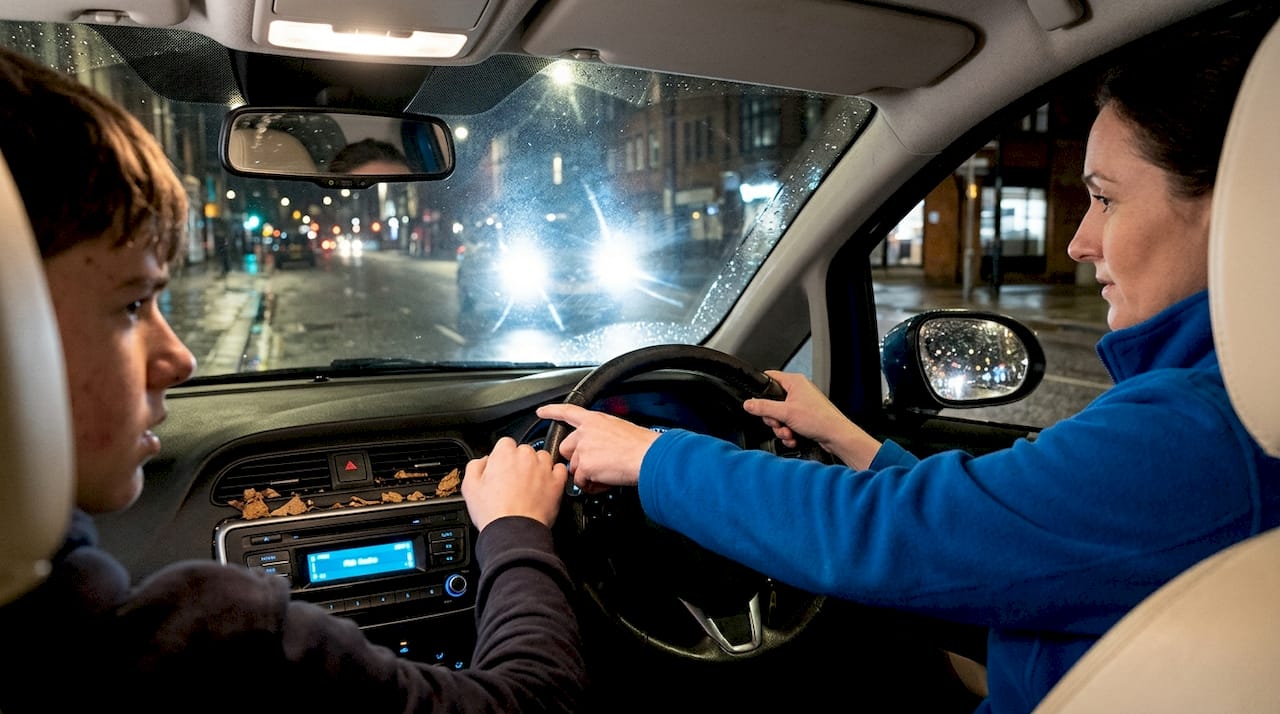
Pedestrian detection is the second major challenge. At night, drivers rely heavily on contrast to spot people near the road. Dark clothing against a poorly lit background offers very little contrast, meaning a pedestrian can be almost invisible until they are close. Pedestrian detection at night depends on contrast far more than most learners realise, which is why instructors teach active scanning rather than passive watching.
Here is the progression most instructors follow for handling specific night hazards:
- Recognise fatigue signs early. Yawning frequently, drifting slightly in the lane, and losing track of the last few minutes of driving are all warning signs that must not be ignored.
- Plan rest stops before you need them. Fatigue management starts before the journey, not when you already feel tired. Drowsy-driving accidents peak between midnight and 6 a.m., making rest planning a genuine safety strategy.
- Increase your following distance. Your reaction time at night is not slower, but your ability to detect hazards is. More space compensates for reduced visual information.
- Scan for animals and cyclists. Animals near rural roads and cyclists without adequate lighting are two hazards that catch night drivers off guard more than almost anything else.
Pro Tip: If you notice signs of drowsiness building during a night lesson, tell your instructor immediately. Practising how to recognise and respond to fatigue is part of the lesson, not a sign of weakness.
What to expect during a typical night lesson
Understanding what to expect in a night driving session helps you arrive prepared rather than anxious. The structure is deliberate and progressive, not a case of heading straight onto a busy dual carriageway after dark.
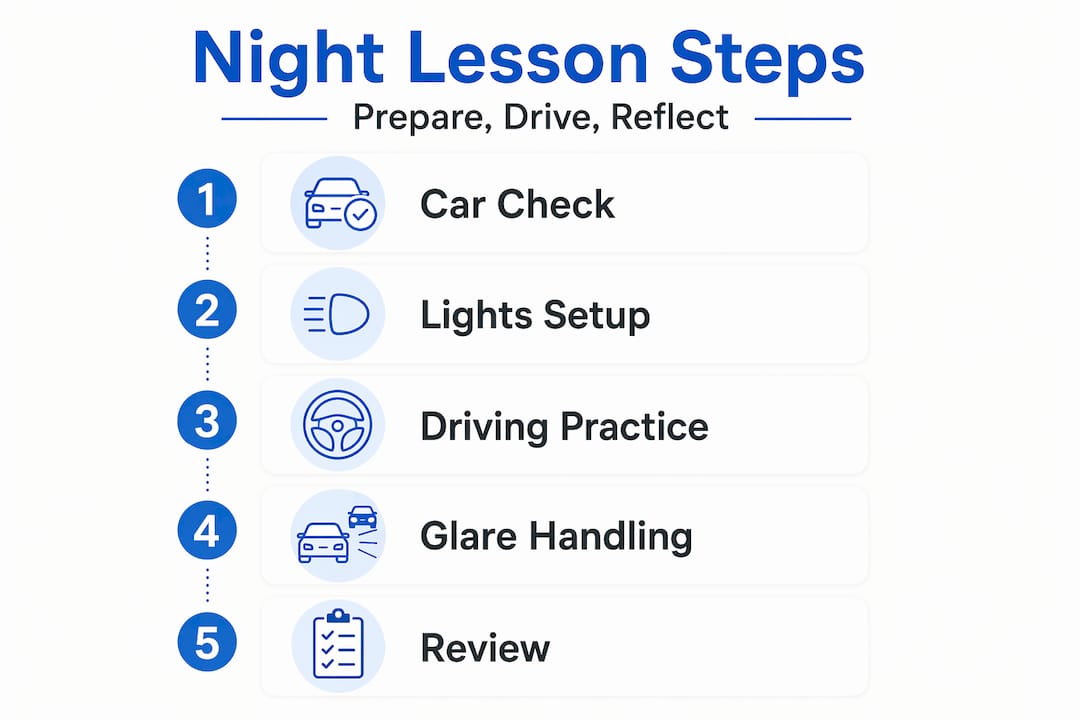
The table below outlines how a typical session develops from start to finish:
| Stage | Focus | Environment |
|---|---|---|
| Pre-drive checks | Lighting, windscreen, mirror position | Car park or quiet side street |
| Early road time | Basic headlight use, lane position | Quiet residential roads |
| Intermediate practice | Glare response, speed adjustment, scanning | Mixed urban streets |
| Advanced scenarios | Unlit roads, complex junctions, night traffic | Rural roads and town centres |
Once you are on the road, the lesson activities become increasingly practical. You will practice switching between dipped and full beam on unlit stretches, identifying where the safe stopping distance lies at different speeds, and responding calmly when oncoming headlights are particularly bright. Instructors choose routes that offer a genuine variety of conditions rather than sticking to familiar daytime roads.
What learners consistently find is that the busiest parts of a night lesson are not necessarily the hardest. Unlit rural roads with no street lighting often feel more demanding than urban streets, because you are entirely dependent on your own headlights and there are far fewer visual reference points.
- Lessons use dual-control vehicles, so your instructor can intervene safely if needed.
- Route selection is based on your current skill level, not a fixed syllabus.
- The debrief at the end of a night lesson is as informative as the drive itself.
Night driving tips and mistakes to avoid
Arriving at a night lesson prepared makes a real difference to what you get from it. There are specific errors that learners make repeatedly, and knowing them in advance puts you ahead.
Before you drive, check the following:
- All exterior lights are working, including indicators and brake lights.
- Headlights are aimed correctly and not pointing upward into oncoming drivers’ eyes.
- The windscreen is clean inside and out. Interior smearing is easy to miss in daylight but creates severe glare at night.
- Mirrors are adjusted for night position if your car has an anti-glare rearview setting.
The most common mistake learners make is overdriving their headlights. This means travelling at a speed where, if a hazard appeared at the edge of your lit range, you would not have enough distance to stop. The drive within sight distance principle sounds obvious but feels counterintuitive when a road appears clear ahead.
The second most common error is misusing full beam. Some learners switch it on and forget to dip it, blinding oncoming drivers and pedestrians. Others are so cautious about blinding people that they never use full beam at all, even on genuinely unlit roads where it is both legal and safer to do so.
Pro Tip: Active changes to your behaviour are far more effective than simply “being careful”. Increasing following distance and reducing speed on unlit roads are specific actions that reduce risk. Vague caution is not a driving strategy.
The real benefits of night driving practice
There is a tendency among learners to view night driving lessons as something to tick off rather than a genuine development opportunity. That attitude misses the point entirely.
Structured night driving practice builds confidence by gradually increasing your exposure to low-light and complex conditions in a controlled environment. The skills you develop are not night-specific. Better hazard scanning, more careful speed judgement, and disciplined glare management all transfer directly to your daytime driving as well.
There is also a practical dimension. Once you pass your test, you will encounter night driving immediately. Whether it is driving home from work in winter, visiting friends after dark, or handling an unexpected late journey, the ability to feel calm and competent at night is not optional. Learners who complete structured night driving practice before their test arrive at that first solo night journey with genuine experience behind them, not just theory.
“Familiarity breeds competence. The more varied conditions you practise in before your test, the less likely you are to be caught out by them afterwards.”
Reduced anxiety is perhaps the most underrated benefit. Night driving feels threatening precisely because it is unfamiliar. A few well-structured lessons remove that unfamiliarity and replace it with practical skill. You cannot think your way out of anxiety. You have to drive your way out of it.
My take on night driving lessons
I have worked with a lot of learners who arrive at their first night lesson with one of two attitudes. Either they are convinced it will be easy because they have already driven confidently in the day, or they are convinced it will be terrifying for exactly the same reason. Neither group is right.
In my experience, the learners who make the fastest progress are those who treat night driving as a different skill set that needs deliberate practice, not a variation of what they already know. The ones who struggle are usually trying to apply daytime habits directly, particularly with speed and following distance.
What I find most valuable in these sessions is the vehicle check at the start. Not because it is exciting, but because it forces learners to take ownership of the car before driving it. That habit, built during night lessons, carries into every drive they do afterwards.
The single piece of advice I would give every learner driver: do not leave night driving practice until the last few lessons before your test. Build it in early, treat it seriously, and you will become a measurably safer driver in all conditions, not just after dark. The Pass4you blog covers a wide range of practical topics like this if you want to keep developing your knowledge between lessons.
— Simon
Ready to build your night driving confidence?
If reading this has made you realise how much there is to night driving that you have not yet covered, that is a good sign. Awareness is where progress starts.

At Pass4you, based in Milton Keynes, our instructors cover all aspects of nighttime driving as part of a structured, personalised training programme. From vehicle checks and glare management to unlit roads and fatigue awareness, every lesson is built around what you actually need, not a generic syllabus. Our learner driver courses are designed to build real-world competence alongside test-readiness. If you prefer a faster route to your licence, our intensive driving courses include night driving practice as standard. Call or email us to discuss how we can fit the right lessons around your schedule.
FAQ
What does a night driving lesson typically involve?
A night driving lesson covers vehicle lighting checks, headlight use, glare management, speed adaptation to reduced visibility, and scanning techniques for detecting pedestrians and hazards in low-light conditions. Lessons progress from quiet roads to more complex night environments as your confidence builds.
When should I start night driving lessons?
Start night lessons well before your test rather than leaving them until the end of your training. Building night driving skills gradually under instructor supervision produces far better results than cramming them in at the last minute.
How does glare from other vehicles affect night driving?
Glare from oncoming headlights causes temporary vision impairment and has worsened with modern high-intensity lights. Instructors teach you to look toward the left road edge rather than directly at oncoming lights to minimise the effect.
Is fatigue covered in night driving lessons?
Yes. Drowsiness signs such as yawning, lane drifting, and memory lapses are recognised warning signs covered during lessons. Instructors teach learners how to plan journeys and recognise when it is unsafe to continue driving.
Can night driving practice improve my overall driving skills?
Absolutely. The scanning habits, speed discipline, and hazard awareness developed during night practice transfer directly to daytime driving, making you a more attentive and capable driver in all conditions.
Leave a Reply