
Instructor availability is defined as the consistent, scheduled access a learner driver has to a qualified driving instructor throughout their training. This directly shapes lesson quality, skill retention, and how quickly you progress toward your test. Research shows that consistent instructor presence explains up to 56% of learner satisfaction variance, with a correlation of r=0.67 between availability and learner performance. That figure tells you something important: who teaches you matters far less than how reliably they show up. For learner drivers in Milton Keynes, where test routes around Bletchley carry their own complexity, the role of instructor availability explained here is not abstract theory. It is the practical difference between passing first time and repeating your test.
How does instructor availability affect learner confidence and success?
Consistent instructor access is the single strongest predictor of learner driver progress. When you book lessons with the same instructor at regular intervals, you build a working relationship that accelerates feedback loops. Your instructor learns your weak points, you learn their teaching style, and lessons become progressively more targeted.
The correlation between availability and performance (r=0.67) is not a marginal finding. It places instructor access in the same category of influence as prior knowledge or natural aptitude. Learners who see their instructor weekly retain manoeuvres, hazard perception habits, and road positioning far better than those who fit lessons in sporadically.
Instructor presence also functions as what researchers at Advance HE describe as an “infrastructure for equity”, supporting learner motivation and resilience. In practical driving terms, this means a nervous learner in Milton Keynes rush-hour traffic is far more likely to stay composed when they have a familiar, dependable instructor beside them.
Key benefits of consistent instructor access include:
- Faster skill retention because each lesson builds directly on the last
- Reduced anxiety through familiarity with your instructor’s cues and corrections
- More targeted feedback as your instructor tracks your specific progress over time
- Better test readiness because your instructor can time your mock tests accurately
Pro Tip: Book your lessons on the same day and time each week. Predictable scheduling removes the mental overhead of rearranging your diary and keeps your driving momentum steady.
Learner drivers who align schedules with instructor availability consistently experience smoother progress and higher pass rates. Alignment is not a luxury. It is a structural advantage.

What scheduling models optimise instructor availability?
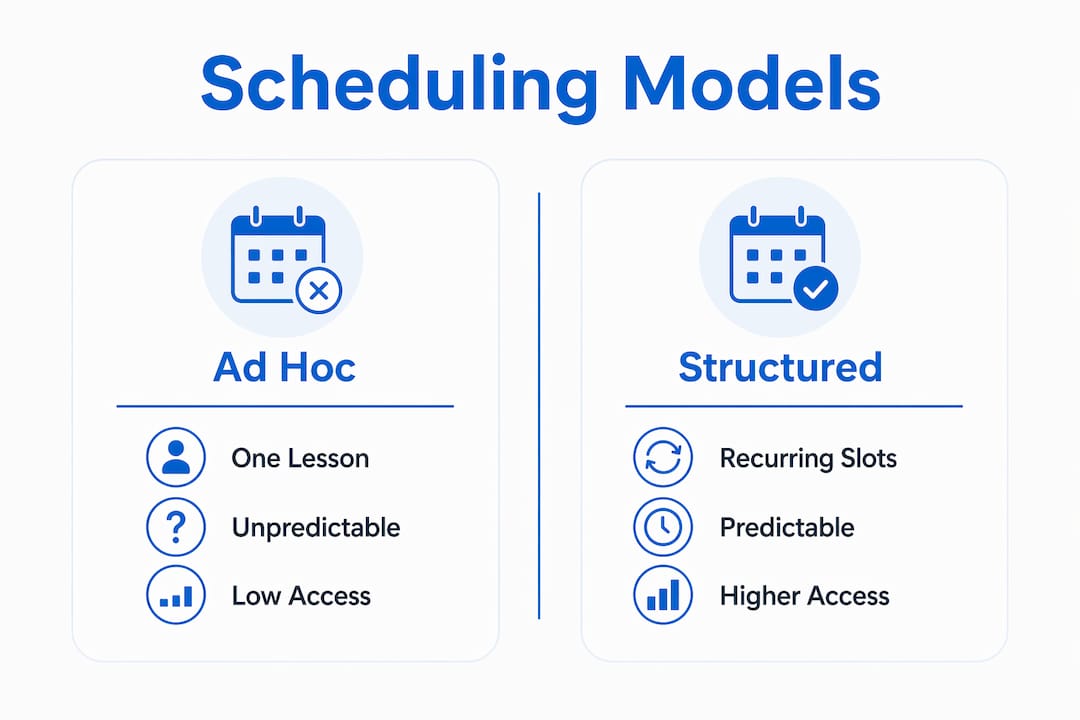
The way lessons are booked determines how much of an instructor’s available time actually reaches learners. Three models dominate driving instruction scheduling, and they produce very different outcomes.
| Scheduling Model | How It Works | Impact on Learner Access |
|---|---|---|
| Ad hoc / informal | Lessons booked via text or phone call as needed | High friction, gaps in learning, slots fill quickly |
| Fixed recurring slots | Same day and time each week, pre-booked | Consistent access, steady progress, lower cancellation risk |
| Hybrid model | Fixed weekly lessons plus occasional flexible support slots | Best balance of routine and adaptability |
| Real-time automated booking | Online platform showing live instructor availability | Reduces unused slots by up to 40–60% |
The ad hoc approach is the most common mistake new learners make. Booking lessons one at a time, when you remember to, creates fragmented learning. Fragmented scheduling raises total learning time by 20–30% compared to fixed weekly slots. That translates directly into more money spent and a longer wait before your test.
Real-time automated booking platforms remove the friction of informal communication. They show you exactly when your instructor is free, allow you to lock in recurring slots, and send reminders. The hybrid scheduling approach, combining fixed lesson times with occasional flexible support, delivers the best balance. It protects your instructor’s focus while giving you a safety net for extra practice before your test.
Pro Tip: When you first contact a driving school, ask specifically whether you can book a recurring weekly slot rather than individual lessons. Schools that offer this upfront are structured for learner progress, not just filling gaps in a diary.
A well-managed instructor workload is designed to maximise cognitive energy and patience across the working day. That directly benefits you as a learner, because a focused instructor gives sharper feedback.
Why does advanced booking matter and how does workload affect availability?
Instructor workload is a genuine constraint, not an excuse. Professional driving instructors typically limit themselves to a maximum of two sessions daily to preserve teaching quality and avoid fatigue. Instructor calendars are often managed with automation enforcing session limits of 6–8 hours per day to maintain alertness. When an instructor is fully booked, there is simply no available slot to claim, regardless of how urgently you need a lesson.
Here is why advanced booking protects your progress:
- Secure your preferred time slot. Popular times, particularly weekend mornings and weekday evenings, fill weeks in advance. Booking ahead means you choose your slot rather than accepting whatever remains.
- Avoid fragmented learning. Last-minute lessons, squeezed between other learners, rarely follow on logically from your previous session. Your instructor has less time to review your notes and tailor the lesson.
- Reduce cancellation risk. Last-minute cancellations affect roughly 10–15% of bookings, and freed slots are claimed quickly. If you are not already in the diary, you will not hear about them.
- Build a lesson arc. A sequence of pre-booked lessons allows your instructor to plan a structured progression, moving from basic control through to independent driving and mock tests.
- Protect your test date. If you have a test booked, working backwards from that date with pre-planned lessons gives you a clear preparation timeline. Ad hoc booking makes this almost impossible.
Poor alignment of instructor and learner schedules is one of the most common failure points in driver training. Understanding your instructor’s workload policies before you start lessons removes this obstacle entirely.
How does instructor availability specifically affect learning to drive in milton keynes?
Milton Keynes presents a specific set of challenges that make reliable instructor access more important than in many other areas. The road network includes a grid system of dual carriageways, roundabouts at nearly every junction, and the Bletchley test centre routes that require confident, independent decision-making. Mastering these conditions takes repetition, and repetition requires consistent lessons.
Reliable instructor availability in Milton Keynes is directly linked to learner confidence on local Bletchley test routes and in complex traffic conditions. An instructor who knows the area can introduce you to test-relevant roads progressively, building familiarity before your actual test day.
Practical considerations for Milton Keynes learners include:
- Weekend lesson demand is high. Milton Keynes has a large commuter population, which means weekend slots with experienced instructors are booked quickly. Securing a recurring Saturday or Sunday slot requires planning weeks ahead.
- Dual carriageway exposure needs scheduling. Instructors must deliberately plan lessons that include the H and V roads. This only happens reliably when lessons are pre-booked and structured.
- Bletchley test route familiarity takes multiple sessions. You cannot cram this. Spreading lessons across the actual test area over several weeks builds the spatial memory you need.
- Traffic patterns vary by time of day. Your instructor can only teach you rush-hour driving if lessons are booked at rush-hour times. Flexible, last-minute booking rarely achieves this.
Pass4you operates specifically in Milton Keynes and holds an 83.33% first-time pass rate, significantly above the local average. That figure reflects what structured, consistent instructor access produces when applied to local road conditions.
Key takeaways
Instructor availability is the most controllable factor in how quickly and confidently a learner driver progresses, and booking recurring weekly slots with a locally experienced instructor is the single most effective action you can take.
| Point | Details |
|---|---|
| Availability drives outcomes | Consistent instructor presence explains up to 56% of learner satisfaction variance. |
| Fixed slots outperform ad hoc booking | Fragmented scheduling increases total learning time by 20–30% compared to weekly recurring lessons. |
| Workload limits are real | Instructors cap daily sessions to preserve teaching quality, so popular slots fill fast. |
| Local knowledge matters | In Milton Keynes, structured lessons covering Bletchley routes build test-relevant confidence over time. |
| Advanced booking protects progress | Last-minute cancellations affect 10–15% of bookings; pre-booked learners are first to benefit. |
What i have learned about scheduling after years in driver training
The most consistent mistake I see learner drivers make is treating lesson booking as an afterthought. They pass their theory test, feel motivated, and then try to book lessons at short notice, only to find their preferred instructor is unavailable for three weeks. That gap kills momentum faster than any bad lesson ever could.
The learners who progress quickest are almost always the ones who treat their lesson schedule like a standing appointment. They book six or eight weeks ahead, they keep the same time slot, and they arrive having thought about what they struggled with last time. Their instructors can plan accordingly. The lessons feel purposeful rather than reactive.
I have also noticed that learners who switch instructors frequently, often chasing slightly cheaper rates or more convenient one-off slots, consistently take longer to pass. The rapport you build with a single, dependable instructor is genuinely worth more than the occasional discount. Your instructor’s familiarity with your specific habits and hesitations is something no new instructor can replicate in a single session.
The uncomfortable truth is that instructor availability is partly your responsibility. You cannot control how busy an instructor is, but you can control how far ahead you book and how consistently you show up. Those two habits, more than any natural talent behind the wheel, determine how quickly you reach test standard.
— Simon
Ready to book structured lessons in milton keynes?
Pass4you provides learner drivers in Milton Keynes with transparent, structured lesson scheduling and access to experienced local instructors who know the Bletchley test routes inside out.

Pass4you’s learner courses are designed around recurring weekly slots, giving you the consistent instructor access the research clearly supports. With an 83.33% first-time pass rate and modern Volkswagen dual-control vehicles, the school is built for learners who want to pass efficiently, not just eventually. Visit the Pass4you website to check availability and book your first lesson today.
FAQ
What does instructor availability mean for learner drivers?
Instructor availability refers to the consistent, scheduled access a learner has to a qualified driving instructor. It directly affects lesson continuity, skill retention, and how quickly a learner reaches test standard.
How much does instructor availability affect my chances of passing?
Research shows that consistent instructor presence explains up to 56% of learner satisfaction variance, with a strong correlation (r=0.67) between availability and performance. Regular, reliable lessons are one of the strongest predictors of first-time pass success.
How far in advance should i book driving lessons in milton keynes?
Booking four to six weeks ahead is advisable, particularly for weekend and evening slots in Milton Keynes, which fill quickly. Last-minute cancellations affect 10–15% of bookings, and freed slots are claimed fast by learners already in the system.
Why is a recurring weekly lesson slot better than booking one at a time?
Stable, recurring weekly slots promote skill retention and reduce total learning time by up to 30% compared to fragmented, ad hoc scheduling. Each lesson builds directly on the last, which accelerates progress and reduces the overall cost of learning.
Does instructor availability matter more in milton keynes than elsewhere?
Milton Keynes has a complex road network including grid dual carriageways and roundabout-heavy junctions, plus the specific demands of the Bletchley test routes. Consistent lesson scheduling is the only reliable way to build familiarity with these conditions before your test day.
Leave a Reply