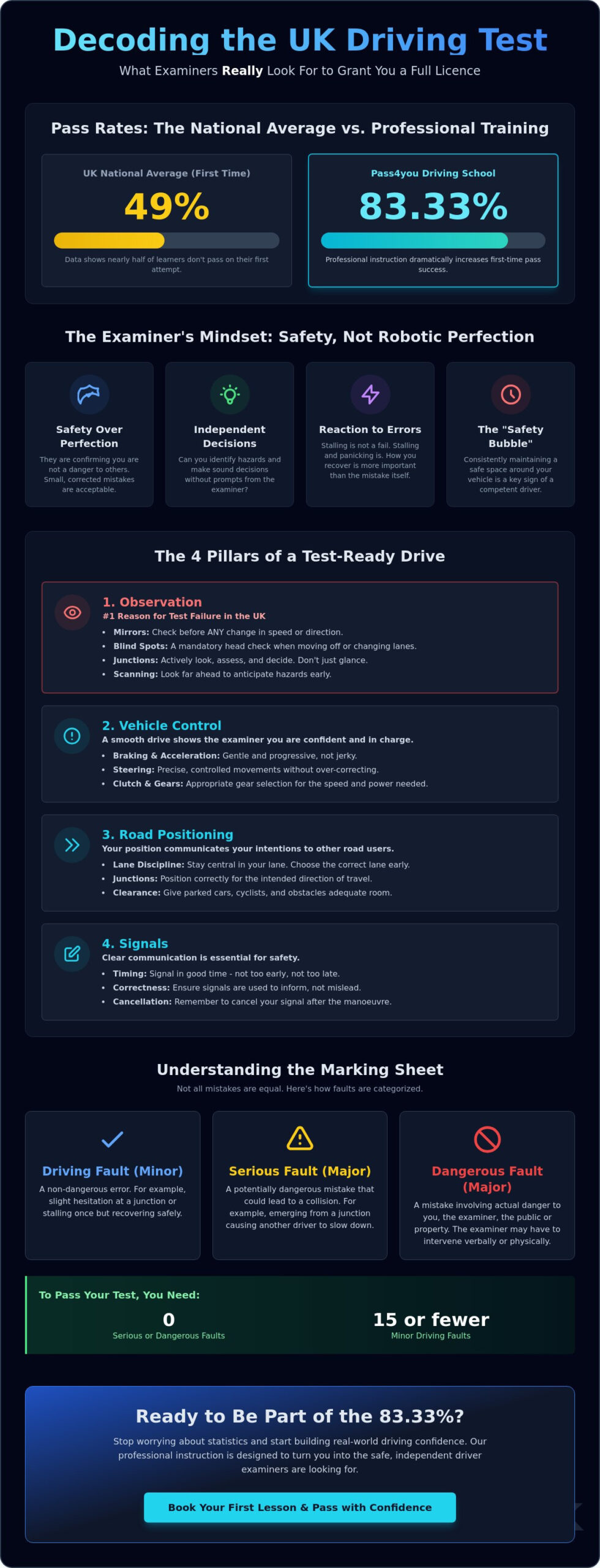
With a first-time pass rate of approximately 49% in the UK, it’s easy to feel like the odds are stacked against you. You might find yourself lying awake wondering exactly what examiners look for in a driving test or worrying that a tiny technicality will end your journey before it’s truly begun. It’s a common fear, but the reality is much more encouraging than the statistics suggest. Examiners aren’t looking for a perfect, robotic performance; they are simply looking for a safe, independent driver who can make sound decisions without making others change their speed or direction.
We understand that the distinction between a minor fault and a serious one can feel confusing when you’re behind the wheel. This guide will show you the specific safety behaviours and technical skills that examiners prioritise, helping you replace that anxiety with genuine confidence. You’ll learn the core criteria used in 2026, from junction observations to the new rules on booking your own test, so you can walk into the test centre ready to secure your full licence on the very first try. Let’s take the mystery out of the marking sheet together.
Key Takeaways
- Understand that examiners prioritise safety and sensible decision-making over a robotically perfect performance.
- Learn exactly what examiners look for in a driving test, including the critical observation skills needed to avoid the UK’s most common fail reasons.
- Gain clarity on how the DL25 digital marking sheet works and the threshold between minor driving faults and serious errors.
- Discover how to navigate specific local challenges like the Milton Keynes grid system and complex multi-lane roundabouts.
- See how professional instruction from Pass4you Driving School contributes to a significantly higher 83.33% first-time pass rate.
The Examiner’s Mindset: Safety Over Perfection
The person sitting next to you during your practical exam isn’t searching for a tiny reason to fail you. Instead, their primary goal is to ensure you aren’t a danger to yourself or other road users. When people ask what examiners look for in a driving test, they often imagine a hunt for perfection. In reality, examiners expect you to make small mistakes. What truly matters is how you react to those slips. If you stall but restart safely and calmly without blocking traffic, you’ve shown you can handle pressure. This is much more valuable to an examiner than a driver who never stalls but lacks awareness of their surroundings.
Understanding this context is easier when you look at a UK driving test overview, which highlights that the assessment is designed to test your ability to drive safely in different road and traffic conditions. One helpful way to visualise your goal is the “Safety Bubble” concept. This means keeping a clear space around your vehicle at all times. Whether it’s leaving a two-second gap behind the car in front or giving plenty of room to a parked vehicle, maintaining this bubble shows the examiner you prioritize safety over speed. When considering what examiners look for in a driving test, remember they distinguish between a simple slip-up, like a slightly wide turn, and a lack of competence, such as failing to check a blind spot before moving off.
What “Safe and Independent” Actually Means
Being an independent driver means you can make your own decisions without needing a prompt from the passenger seat. You should identify hazards early, like a ball rolling into the road or a pedestrian approaching a crossing, and respond smoothly. Examiners look for genuine consideration for vulnerable road users. If you slow down and give extra space to a cyclist, you’re demonstrating the high level of responsibility they want to see. It’s about showing you can navigate the world without a tutor’s help.
The Psychology of the Driving Examiner
Examiners are human too. They want to feel relaxed and safe in the car with you. You can build their confidence quickly through smooth braking and steady acceleration. Jerky movements make an examiner tense, while a controlled drive makes them feel you’re in charge of the vehicle. Even your “Show Me, Tell Me” answers at the start set the tone. Answering these questions clearly and confidently shows you’ve prepared well and understand your vehicle’s safety features, which helps settle both your nerves and theirs from the very first minute.
The 4 Key Pillars of the Practical Driving Test
While the examiner’s mindset is focused on safety, they use a specific framework to measure your performance. You can simplify what examiners look for in a driving test into four essential pillars: observation, control, positioning, and signals. Mastering these areas doesn’t just help you pass. It ensures you’re a responsible driver for life.
Observation remains the most critical pillar. National statistics show that ineffective observation at junctions is the #1 reason for test failure in the UK. It isn’t enough to just glance. You must show the examiner that you’re actively processing everything happening around your vehicle. This builds the trust they need to see before they hand over a licence.
Observation: Beyond Just Looking
Effective observation starts with your mirrors. You should check them before every change of speed or direction. If you’re slowing down for a hazard or preparing to turn, your mirrors tell you how the traffic behind will react. Don’t forget the blind spot check. A quick look over your shoulder is vital during manoeuvres or when moving off from the side of the road. Finally, practice scanning the horizon. Looking far ahead allows you to spot potential hazards, such as a bus pulling out or a change in road surface, before they become immediate problems.
Vehicle Control and Road Positioning
Control and positioning are about how you and the car work together as a team. Examiners want to see you handling the vehicle smoothly. This includes gentle braking, controlled acceleration, and precise steering. Your positioning on the road shows your discipline. You should stay in the center of your lane and avoid drifting, especially on multi-lane roads or complex roundabouts. Choosing the correct position early when approaching junctions communicates your intentions to other drivers clearly.
- Lane Discipline: Stay in the correct lane for your intended route. If you find yourself in the wrong lane, stay there safely rather than making a dangerous move.
- Speed Management: Drive at a speed appropriate for the road type and weather conditions. Going too slow can be just as confusing for others as going too fast.
- Junction Precision: Position your car so you don’t cut corners or swing too wide when turning.
Communicating your intentions through signals is the final piece of the puzzle. Give your signals in good time so others can react. If you’re struggling to balance these four pillars during your practice, booking driving lessons with an experienced instructor can help you polish these skills until they become second nature. This professional support often makes the difference between a nervous “fail” and a confident “pass.”
Understanding the Marking Sheet: Minors, Majors, and Serious Faults
During your test, you’ll notice the examiner using a tablet to record your progress. This digital marking sheet is known as the DL25. It isn’t a list of traps designed to catch you out. Instead, it’s a structured way for the examiner to track what examiners look for in a driving test across different categories. Understanding how this sheet works can significantly reduce your anxiety. It helps you realise that you don’t need to be a perfect driver to earn your licence. You just need to be a safe one.
The DL25 categorises mistakes into three distinct levels. A “Driving Fault,” often called a minor, is a mistake that isn’t potentially dangerous. You can accumulate up to 15 of these and still pass, though a 16th minor will result in a fail. A “Serious Fault” is a mistake that could have been dangerous. Finally, a “Dangerous Fault” involves actual danger to you, the examiner, the public, or property. A single serious or dangerous fault results in an immediate fail. If this happens, you must wait at least 10 working days before you can book another attempt.
When do Minors become a Major?
While you have a generous allowance of 15 driving faults, they can add up in a way that leads to a fail. If you make the same minor mistake repeatedly, the examiner may see it as a “habitual” error. This suggests a fundamental lack of understanding rather than a one-off slip-up. Usually, if you commit the same minor fault three or four times, the examiner will classify it as a single serious fault. Most successful candidates don’t push the limit. They typically pass with fewer than 5 minors by staying focused on the core skills we discussed earlier.
Common Serious Faults to Avoid
Knowing the most frequent fail points helps you prioritise your focus. According to national data, the most common reason for failing is ineffective observation at junctions. This is followed closely by failing to use mirrors correctly when changing direction or speed. To stay on the right side of the marking sheet, pay close attention to these areas:
- Junctions: Always look multiple times and ensure it’s truly safe before pulling out.
- Signals: Ensure your indicators don’t mislead others. For example, don’t signal left if you’re actually pulling up just past a junction.
- Road Signs: Missing a “No Entry” sign or failing to stop fully at a “Stop” sign are automatic serious faults.
We see many students who worry about stalling. Stalling is usually just a minor fault if you handle it calmly. It only becomes serious if it happens in a dangerous place, like a busy roundabout, or if you fail to perform your safety checks before restarting. Stay calm, take a breath, and remember that the examiner is looking for your ability to recover safely.
Navigating Milton Keynes: Local Features Examiners Watch
Milton Keynes presents a unique environment for any learner driver. While the marking criteria are the same across the UK, the specific challenges of the local grid system heavily influence what examiners look for in a driving test here. You’ll need to demonstrate that you can transition smoothly between the high-speed V (Vertical) and H (Horizontal) roads and the complex junctions that connect them. Maintaining the correct speed on these grid roads is vital; driving too slowly can be just as problematic as speeding, as it disrupts the natural flow of traffic.
Central Milton Keynes is also a high-footfall area. Examiners will be watching your alertness near pedestrian crossings and busy shopping areas. It’s essential to scan for people who might step out unexpectedly. Showing this level of awareness proves you’re ready to handle the responsibilities of a full licence in a busy urban setting.
Conquering the MK Roundabouts
Roundabouts are the backbone of Milton Keynes. Whether you’re navigating the large multi-lane junctions at Bletchley or the Old Stratford roundabouts, your lane discipline must be impeccable. You should choose your lane early and stay within the markings until you’re ready to exit. Examiners also pay close attention to your “exit signal.” Giving a clear signal after passing the penultimate exit helps other drivers maintain their speed. For those nervous about the faster sections of the grid, our guide on Mastering the Dual Carriageway provides essential tips for joining and exiting high-speed roads at the correct pace.
Residential Areas and Narrow Streets
Away from the main grid, you’ll likely spend time in residential estates. These streets can be narrow, especially when cars are parked on both sides. Here, what examiners look for in a driving test is your ability to meet oncoming traffic safely. You should maintain a “door’s width” gap when passing parked vehicles to account for a door opening suddenly. During the “pull up on the right” manoeuvre, your observations are the priority. You must show you’ve checked all mirrors and blind spots before moving across the road and again before reversing or pulling away.
- Meeting Traffic: Be prepared to wait in a safe gap if the road ahead is too narrow for two cars.
- Positioning: Don’t hug the curb too tightly in estates, as this limits your view of driveways.
- Speed: Keep your speed low in narrow streets to give yourself time to react to hazards.
If you’re feeling overwhelmed by the unique layout of the local area, our professional driving lessons are specifically designed to help you master these Milton Keynes routes with total confidence.
How Professional Instruction Guarantees a “Pass” Standard
While understanding the theory is a great start, applying those skills under pressure is where the real challenge lies. The national pass rate hovers around 49%, but students at Pass4you Driving School benefit from a significantly higher 83.33% first-time pass rate. This isn’t just a lucky number. It represents a more efficient use of your time and budget. By learning to drive correctly from your very first hour, you avoid the costly cycle of failing and rebooking tests that many informal learners face.
One of the most effective ways we bridge the gap between lessons and the actual exam is through structured mock tests. Taking a mock test with an experienced driving instructor in Milton Keynes allows you to experience the exact format of the day without the risk. It helps you get used to the silence of the examiner and the specific phrasing they use. We also provide modern, reliable tuition vehicles like the Volkswagen Golf. These cars are chosen because they offer excellent visibility and intuitive controls. This makes the technical aspects of the practical driving test much more manageable for a nervous learner.
The Pass4you Driving School Method: Reassuring and Patient
Every student is different. Some might struggle with the complex roundabouts we discussed earlier, while others feel anxious about the 20-minute independent driving section. Our method focuses on your specific needs. We don’t just tell you what to do; we explain the ‘why’ behind every action. This builds a deeper level of understanding that stays with you long after you’ve passed. Structured, professional feedback ensures you always know exactly where you stand and what you need to polish to meet the standards of what examiners look for in a driving test.
Your Next Steps to Success
Success on test day is built on consistency. Regular lessons leading up to your booking keep your skills sharp and your confidence high. Before you head to the test centre, make sure your provisional license uk is valid and that you have all your documents ready. Preparing for the test shouldn’t be a source of stress. It should be an exciting transition toward the freedom of the road. If you’re ready to start your journey with a team that truly cares about your success, book your assessment lesson with Pass4you Driving School today and let’s get you ready for that first-time pass.
Secure Your Full Licence with Confidence
You now have a clear roadmap of what examiners look for in a driving test, moving beyond the common myths and focusing on the core safety behaviours that lead to success. Transitioning from a learner to an independent driver is about more than just passing a forty-minute assessment; it is about gaining the freedom to navigate the world on your own terms. By focusing on the pillars of observation and control we have discussed, you are already ahead of the curve.
Our first-class instructors at Pass4you Driving School are dedicated to helping you reach this milestone with patience and expertise. We provide the modern Volkswagen tuition vehicles and the supportive environment you need to transform test-day nerves into focused skill. Join the 83.33% who pass first time; book your Milton Keynes driving lessons now. Your journey toward independence starts with a single, confident turn of the key. We are ready to help you cross the finish line.
Frequently Asked Questions
How many minor faults can I have in my driving test?
You can have up to 15 minor faults, which are officially called driving faults, and still pass your test. However, if you commit a 16th minor fault, you will unfortunately fail. It’s also important to remember that repeating the same minor mistake multiple times can lead the examiner to classify it as a single serious fault. This usually happens if the same error occurs three or four times, resulting in an automatic fail.
What happens if I make a mistake during the independent driving section?
Making a wrong turn during the independent driving section is not a fail as long as you continue to drive safely. If you realize you’ve missed a turning or taken the wrong exit at a roundabout, don’t panic or make a sudden, dangerous move. The examiner will simply help you get back onto the correct route. They are testing your ability to drive safely while following directions, not your memory of a specific map.
Do examiners have a “quota” for how many people they can pass?
No, driving examiners do not have a quota for how many people they can pass or fail in a day or month. Every candidate is assessed solely on their individual performance against the set safety standards. If you demonstrate the skills and safety behaviours what examiners look for in a driving test, you will pass. It doesn’t matter how many other people have been successful at that test centre earlier in the day.
Will I fail if I stall the car during my test?
Stalling the car is usually recorded as a minor driving fault, provided you restart the engine safely and don’t block other road users. It only becomes a serious fault if it happens in a dangerous situation, such as in the middle of a busy junction, or if you fail to perform your safety checks before moving off again. Staying calm and following your restart procedure is exactly what the examiner wants to see from a competent driver.
What are the most common reasons for failing a driving test in Milton Keynes?
Ineffective observation at junctions and roundabouts remains the most frequent reason for failure in the local area. Because of the unique grid system, examiners also pay close attention to lane discipline and speed management on the V and H roads. Ensuring you check your mirrors and blind spots before every change of direction will help you avoid these common pitfalls. Consistent practice on local routes is the best way to prepare.
Can I use my own car for the practical driving test?
You can use your own car for the test, but it must meet specific DVSA requirements to be accepted. The vehicle needs to be taxed, insured for a driving test, and have a current MOT. It must also be fitted with L-plates, an extra interior rear-view mirror for the examiner, and be clear of any warning lights on the dashboard. Most students find it much easier to use their instructor’s car because they are already comfortable with its specific controls.
What should I do if I feel extremely nervous before my test?
Feeling nervous is a completely natural part of the process, and examiners are very used to seeing shaky hands. The best way to reduce anxiety is through thorough preparation and taking mock tests with your instructor to familiarise yourself with the pressure. Focus on your breathing and remember that the examiner wants you to succeed. They are simply there to ensure you can keep yourself and others safe on the road.
How long does the practical driving test last in 2026?
The practical driving test in 2026 lasts approximately 40 minutes from start to finish. This timeframe includes the initial eyesight check, the “show me, tell me” safety questions, and about 20 minutes of independent driving using a sat-nav or road signs. Throughout the entire drive, the focus remains on what examiners look for in a driving test: consistent safety, awareness of other road users, and smooth car control.
Leave a Reply