Tag: driving test faults

  • What Examiners Look for in a Driving Test: A 2026 Guide to Passing First Time

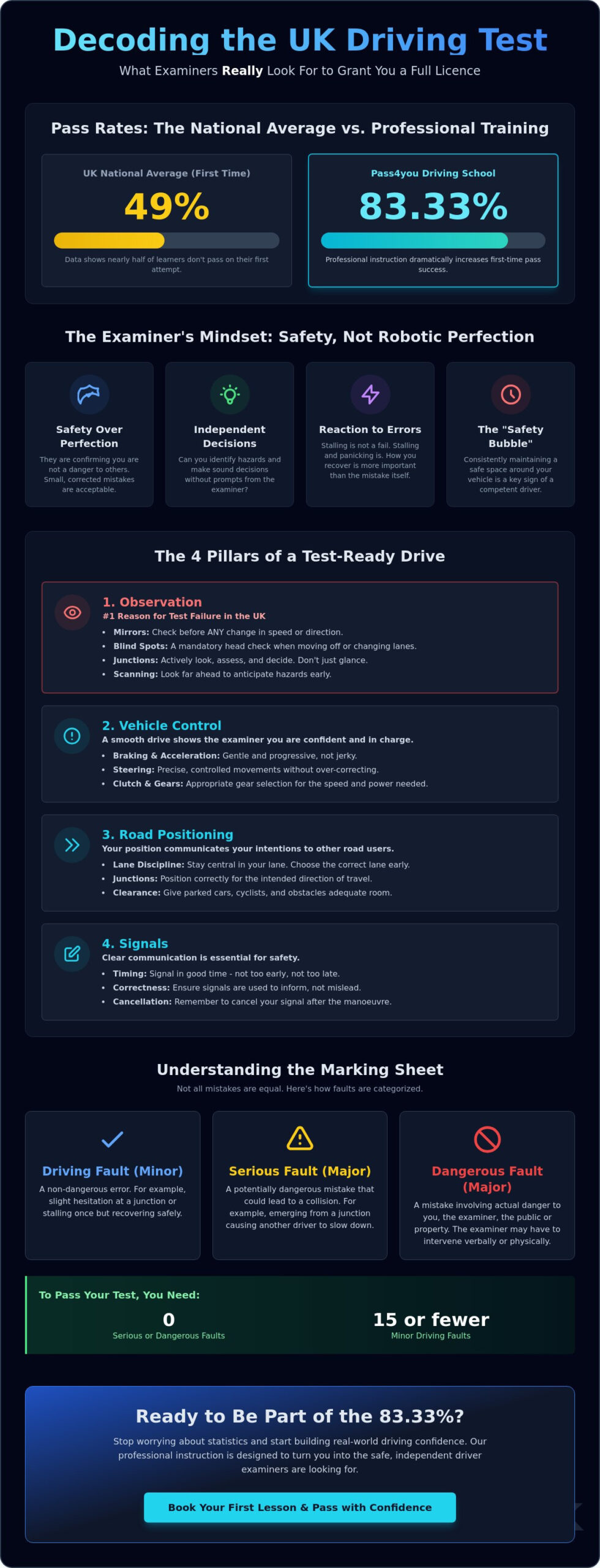
    With a first-time pass rate of approximately 49% in the UK, it’s easy to feel like the odds are stacked against you. You might find yourself lying awake wondering exactly what examiners look for in a driving test or worrying that a tiny technicality will end your journey before it’s truly begun. It’s a common fear, but the reality is much more encouraging than the statistics suggest. Examiners aren’t looking for a perfect, robotic performance; they are simply looking for a safe, independent driver who can make sound decisions without making others change their speed or direction.

    We understand that the distinction between a minor fault and a serious one can feel confusing when you’re behind the wheel. This guide will show you the specific safety behaviours and technical skills that examiners prioritise, helping you replace that anxiety with genuine confidence. You’ll learn the core criteria used in 2026, from junction observations to the new rules on booking your own test, so you can walk into the test centre ready to secure your full licence on the very first try. Let’s take the mystery out of the marking sheet together.

    Key Takeaways

    • Understand that examiners prioritise safety and sensible decision-making over a robotically perfect performance.
    • Learn exactly what examiners look for in a driving test, including the critical observation skills needed to avoid the UK’s most common fail reasons.
    • Gain clarity on how the DL25 digital marking sheet works and the threshold between minor driving faults and serious errors.
    • Discover how to navigate specific local challenges like the Milton Keynes grid system and complex multi-lane roundabouts.
    • See how professional instruction from Pass4you Driving School contributes to a significantly higher 83.33% first-time pass rate.

    The Examiner’s Mindset: Safety Over Perfection

    The person sitting next to you during your practical exam isn’t searching for a tiny reason to fail you. Instead, their primary goal is to ensure you aren’t a danger to yourself or other road users. When people ask what examiners look for in a driving test, they often imagine a hunt for perfection. In reality, examiners expect you to make small mistakes. What truly matters is how you react to those slips. If you stall but restart safely and calmly without blocking traffic, you’ve shown you can handle pressure. This is much more valuable to an examiner than a driver who never stalls but lacks awareness of their surroundings.

    Understanding this context is easier when you look at a UK driving test overview, which highlights that the assessment is designed to test your ability to drive safely in different road and traffic conditions. One helpful way to visualise your goal is the “Safety Bubble” concept. This means keeping a clear space around your vehicle at all times. Whether it’s leaving a two-second gap behind the car in front or giving plenty of room to a parked vehicle, maintaining this bubble shows the examiner you prioritize safety over speed. When considering what examiners look for in a driving test, remember they distinguish between a simple slip-up, like a slightly wide turn, and a lack of competence, such as failing to check a blind spot before moving off.

    What “Safe and Independent” Actually Means

    Being an independent driver means you can make your own decisions without needing a prompt from the passenger seat. You should identify hazards early, like a ball rolling into the road or a pedestrian approaching a crossing, and respond smoothly. Examiners look for genuine consideration for vulnerable road users. If you slow down and give extra space to a cyclist, you’re demonstrating the high level of responsibility they want to see. It’s about showing you can navigate the world without a tutor’s help.

    The Psychology of the Driving Examiner

    Examiners are human too. They want to feel relaxed and safe in the car with you. You can build their confidence quickly through smooth braking and steady acceleration. Jerky movements make an examiner tense, while a controlled drive makes them feel you’re in charge of the vehicle. Even your “Show Me, Tell Me” answers at the start set the tone. Answering these questions clearly and confidently shows you’ve prepared well and understand your vehicle’s safety features, which helps settle both your nerves and theirs from the very first minute.

    The 4 Key Pillars of the Practical Driving Test

    While the examiner’s mindset is focused on safety, they use a specific framework to measure your performance. You can simplify what examiners look for in a driving test into four essential pillars: observation, control, positioning, and signals. Mastering these areas doesn’t just help you pass. It ensures you’re a responsible driver for life.

    Observation remains the most critical pillar. National statistics show that ineffective observation at junctions is the #1 reason for test failure in the UK. It isn’t enough to just glance. You must show the examiner that you’re actively processing everything happening around your vehicle. This builds the trust they need to see before they hand over a licence.

    Observation: Beyond Just Looking

    Effective observation starts with your mirrors. You should check them before every change of speed or direction. If you’re slowing down for a hazard or preparing to turn, your mirrors tell you how the traffic behind will react. Don’t forget the blind spot check. A quick look over your shoulder is vital during manoeuvres or when moving off from the side of the road. Finally, practice scanning the horizon. Looking far ahead allows you to spot potential hazards, such as a bus pulling out or a change in road surface, before they become immediate problems.

    Vehicle Control and Road Positioning

    Control and positioning are about how you and the car work together as a team. Examiners want to see you handling the vehicle smoothly. This includes gentle braking, controlled acceleration, and precise steering. Your positioning on the road shows your discipline. You should stay in the center of your lane and avoid drifting, especially on multi-lane roads or complex roundabouts. Choosing the correct position early when approaching junctions communicates your intentions to other drivers clearly.

    • Lane Discipline: Stay in the correct lane for your intended route. If you find yourself in the wrong lane, stay there safely rather than making a dangerous move.
    • Speed Management: Drive at a speed appropriate for the road type and weather conditions. Going too slow can be just as confusing for others as going too fast.
    • Junction Precision: Position your car so you don’t cut corners or swing too wide when turning.

    Communicating your intentions through signals is the final piece of the puzzle. Give your signals in good time so others can react. If you’re struggling to balance these four pillars during your practice, booking driving lessons with an experienced instructor can help you polish these skills until they become second nature. This professional support often makes the difference between a nervous “fail” and a confident “pass.”
    What Examiners Look for in a Driving Test: A 2026 Guide to Passing First Time

    Understanding the Marking Sheet: Minors, Majors, and Serious Faults

    During your test, you’ll notice the examiner using a tablet to record your progress. This digital marking sheet is known as the DL25. It isn’t a list of traps designed to catch you out. Instead, it’s a structured way for the examiner to track what examiners look for in a driving test across different categories. Understanding how this sheet works can significantly reduce your anxiety. It helps you realise that you don’t need to be a perfect driver to earn your licence. You just need to be a safe one.

    The DL25 categorises mistakes into three distinct levels. A “Driving Fault,” often called a minor, is a mistake that isn’t potentially dangerous. You can accumulate up to 15 of these and still pass, though a 16th minor will result in a fail. A “Serious Fault” is a mistake that could have been dangerous. Finally, a “Dangerous Fault” involves actual danger to you, the examiner, the public, or property. A single serious or dangerous fault results in an immediate fail. If this happens, you must wait at least 10 working days before you can book another attempt.

    When do Minors become a Major?

    While you have a generous allowance of 15 driving faults, they can add up in a way that leads to a fail. If you make the same minor mistake repeatedly, the examiner may see it as a “habitual” error. This suggests a fundamental lack of understanding rather than a one-off slip-up. Usually, if you commit the same minor fault three or four times, the examiner will classify it as a single serious fault. Most successful candidates don’t push the limit. They typically pass with fewer than 5 minors by staying focused on the core skills we discussed earlier.

    Common Serious Faults to Avoid

    Knowing the most frequent fail points helps you prioritise your focus. According to national data, the most common reason for failing is ineffective observation at junctions. This is followed closely by failing to use mirrors correctly when changing direction or speed. To stay on the right side of the marking sheet, pay close attention to these areas:

    • Junctions: Always look multiple times and ensure it’s truly safe before pulling out.
    • Signals: Ensure your indicators don’t mislead others. For example, don’t signal left if you’re actually pulling up just past a junction.
    • Road Signs: Missing a “No Entry” sign or failing to stop fully at a “Stop” sign are automatic serious faults.

    We see many students who worry about stalling. Stalling is usually just a minor fault if you handle it calmly. It only becomes serious if it happens in a dangerous place, like a busy roundabout, or if you fail to perform your safety checks before restarting. Stay calm, take a breath, and remember that the examiner is looking for your ability to recover safely.

    Milton Keynes presents a unique environment for any learner driver. While the marking criteria are the same across the UK, the specific challenges of the local grid system heavily influence what examiners look for in a driving test here. You’ll need to demonstrate that you can transition smoothly between the high-speed V (Vertical) and H (Horizontal) roads and the complex junctions that connect them. Maintaining the correct speed on these grid roads is vital; driving too slowly can be just as problematic as speeding, as it disrupts the natural flow of traffic.

    Central Milton Keynes is also a high-footfall area. Examiners will be watching your alertness near pedestrian crossings and busy shopping areas. It’s essential to scan for people who might step out unexpectedly. Showing this level of awareness proves you’re ready to handle the responsibilities of a full licence in a busy urban setting.

    Conquering the MK Roundabouts

    Roundabouts are the backbone of Milton Keynes. Whether you’re navigating the large multi-lane junctions at Bletchley or the Old Stratford roundabouts, your lane discipline must be impeccable. You should choose your lane early and stay within the markings until you’re ready to exit. Examiners also pay close attention to your “exit signal.” Giving a clear signal after passing the penultimate exit helps other drivers maintain their speed. For those nervous about the faster sections of the grid, our guide on Mastering the Dual Carriageway provides essential tips for joining and exiting high-speed roads at the correct pace.

    Residential Areas and Narrow Streets

    Away from the main grid, you’ll likely spend time in residential estates. These streets can be narrow, especially when cars are parked on both sides. Here, what examiners look for in a driving test is your ability to meet oncoming traffic safely. You should maintain a “door’s width” gap when passing parked vehicles to account for a door opening suddenly. During the “pull up on the right” manoeuvre, your observations are the priority. You must show you’ve checked all mirrors and blind spots before moving across the road and again before reversing or pulling away.

    • Meeting Traffic: Be prepared to wait in a safe gap if the road ahead is too narrow for two cars.
    • Positioning: Don’t hug the curb too tightly in estates, as this limits your view of driveways.
    • Speed: Keep your speed low in narrow streets to give yourself time to react to hazards.

    If you’re feeling overwhelmed by the unique layout of the local area, our professional driving lessons are specifically designed to help you master these Milton Keynes routes with total confidence.

    How Professional Instruction Guarantees a “Pass” Standard

    While understanding the theory is a great start, applying those skills under pressure is where the real challenge lies. The national pass rate hovers around 49%, but students at Pass4you Driving School benefit from a significantly higher 83.33% first-time pass rate. This isn’t just a lucky number. It represents a more efficient use of your time and budget. By learning to drive correctly from your very first hour, you avoid the costly cycle of failing and rebooking tests that many informal learners face.

    One of the most effective ways we bridge the gap between lessons and the actual exam is through structured mock tests. Taking a mock test with an experienced driving instructor in Milton Keynes allows you to experience the exact format of the day without the risk. It helps you get used to the silence of the examiner and the specific phrasing they use. We also provide modern, reliable tuition vehicles like the Volkswagen Golf. These cars are chosen because they offer excellent visibility and intuitive controls. This makes the technical aspects of the practical driving test much more manageable for a nervous learner.

    The Pass4you Driving School Method: Reassuring and Patient

    Every student is different. Some might struggle with the complex roundabouts we discussed earlier, while others feel anxious about the 20-minute independent driving section. Our method focuses on your specific needs. We don’t just tell you what to do; we explain the ‘why’ behind every action. This builds a deeper level of understanding that stays with you long after you’ve passed. Structured, professional feedback ensures you always know exactly where you stand and what you need to polish to meet the standards of what examiners look for in a driving test.

    Your Next Steps to Success

    Success on test day is built on consistency. Regular lessons leading up to your booking keep your skills sharp and your confidence high. Before you head to the test centre, make sure your provisional license uk is valid and that you have all your documents ready. Preparing for the test shouldn’t be a source of stress. It should be an exciting transition toward the freedom of the road. If you’re ready to start your journey with a team that truly cares about your success, book your assessment lesson with Pass4you Driving School today and let’s get you ready for that first-time pass.

    Secure Your Full Licence with Confidence

    You now have a clear roadmap of what examiners look for in a driving test, moving beyond the common myths and focusing on the core safety behaviours that lead to success. Transitioning from a learner to an independent driver is about more than just passing a forty-minute assessment; it is about gaining the freedom to navigate the world on your own terms. By focusing on the pillars of observation and control we have discussed, you are already ahead of the curve.

    Our first-class instructors at Pass4you Driving School are dedicated to helping you reach this milestone with patience and expertise. We provide the modern Volkswagen tuition vehicles and the supportive environment you need to transform test-day nerves into focused skill. Join the 83.33% who pass first time; book your Milton Keynes driving lessons now. Your journey toward independence starts with a single, confident turn of the key. We are ready to help you cross the finish line.

    Frequently Asked Questions

    How many minor faults can I have in my driving test?

    You can have up to 15 minor faults, which are officially called driving faults, and still pass your test. However, if you commit a 16th minor fault, you will unfortunately fail. It’s also important to remember that repeating the same minor mistake multiple times can lead the examiner to classify it as a single serious fault. This usually happens if the same error occurs three or four times, resulting in an automatic fail.

    What happens if I make a mistake during the independent driving section?

    Making a wrong turn during the independent driving section is not a fail as long as you continue to drive safely. If you realize you’ve missed a turning or taken the wrong exit at a roundabout, don’t panic or make a sudden, dangerous move. The examiner will simply help you get back onto the correct route. They are testing your ability to drive safely while following directions, not your memory of a specific map.

    Do examiners have a “quota” for how many people they can pass?

    No, driving examiners do not have a quota for how many people they can pass or fail in a day or month. Every candidate is assessed solely on their individual performance against the set safety standards. If you demonstrate the skills and safety behaviours what examiners look for in a driving test, you will pass. It doesn’t matter how many other people have been successful at that test centre earlier in the day.

    Will I fail if I stall the car during my test?

    Stalling the car is usually recorded as a minor driving fault, provided you restart the engine safely and don’t block other road users. It only becomes a serious fault if it happens in a dangerous situation, such as in the middle of a busy junction, or if you fail to perform your safety checks before moving off again. Staying calm and following your restart procedure is exactly what the examiner wants to see from a competent driver.

    What are the most common reasons for failing a driving test in Milton Keynes?

    Ineffective observation at junctions and roundabouts remains the most frequent reason for failure in the local area. Because of the unique grid system, examiners also pay close attention to lane discipline and speed management on the V and H roads. Ensuring you check your mirrors and blind spots before every change of direction will help you avoid these common pitfalls. Consistent practice on local routes is the best way to prepare.

    Can I use my own car for the practical driving test?

    You can use your own car for the test, but it must meet specific DVSA requirements to be accepted. The vehicle needs to be taxed, insured for a driving test, and have a current MOT. It must also be fitted with L-plates, an extra interior rear-view mirror for the examiner, and be clear of any warning lights on the dashboard. Most students find it much easier to use their instructor’s car because they are already comfortable with its specific controls.

    What should I do if I feel extremely nervous before my test?

    Feeling nervous is a completely natural part of the process, and examiners are very used to seeing shaky hands. The best way to reduce anxiety is through thorough preparation and taking mock tests with your instructor to familiarise yourself with the pressure. Focus on your breathing and remember that the examiner wants you to succeed. They are simply there to ensure you can keep yourself and others safe on the road.

    How long does the practical driving test last in 2026?

    The practical driving test in 2026 lasts approximately 40 minutes from start to finish. This timeframe includes the initial eyesight check, the “show me, tell me” safety questions, and about 20 minutes of independent driving using a sat-nav or road signs. Throughout the entire drive, the focus remains on what examiners look for in a driving test: consistent safety, awareness of other road users, and smooth car control.

  • How to Get Over Failing Your Driving Test: A 2026 Guide to Bouncing Back

    How to Get Over Failing Your Driving Test: A 2026 Guide to Bouncing Back

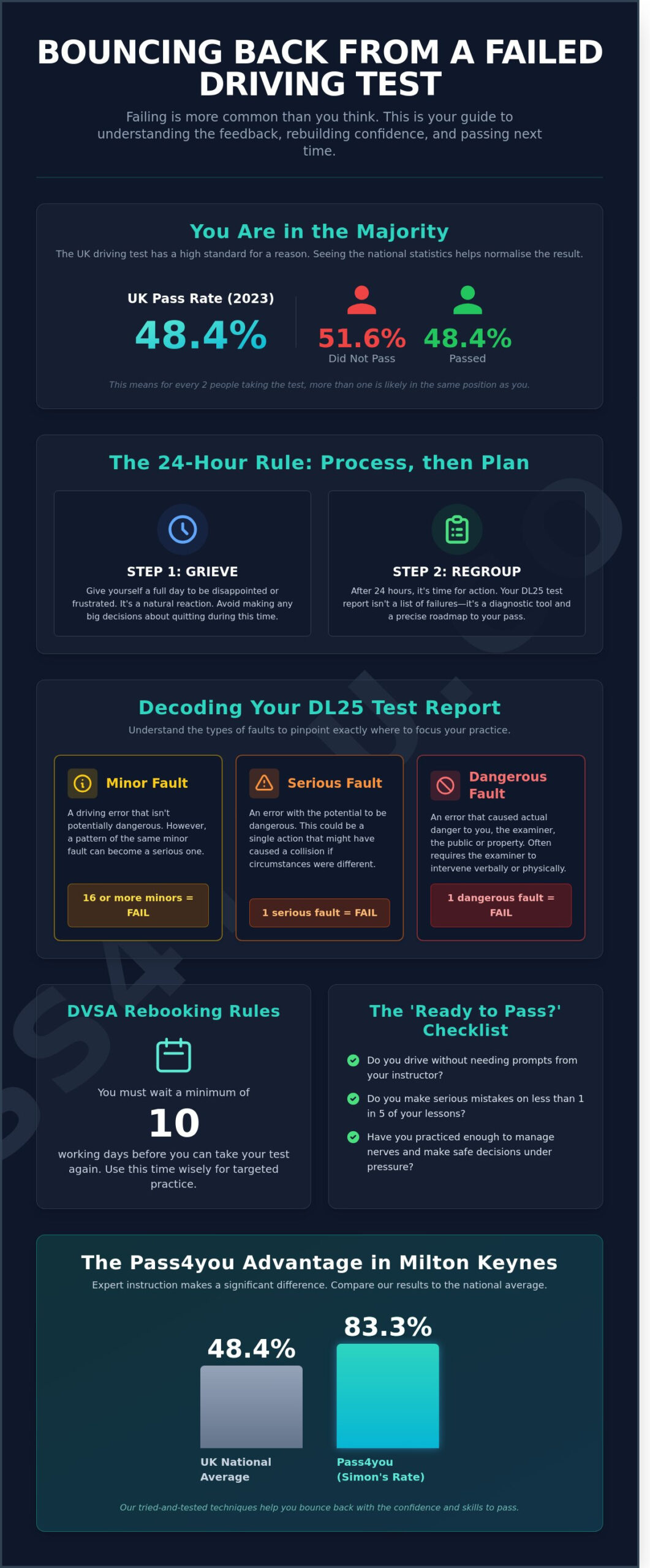
    Imagine standing outside the Bletchley test centre on a rainy Tuesday morning, staring at a piece of paper that didn’t have the result you wanted. It’s a heavy feeling, especially when you think about the £62 test fee and the weeks of preparation you’ve already put in. You aren’t alone; in 2023, the UK driving test pass rate sat at just 48.4 per cent, meaning more than half of all learners are in exactly your position. Learning how to get over failing driving test setbacks is the first step toward becoming a safe, confident driver for life. It’s completely natural to worry about letting your family down or the mounting cost of extra lessons, but a single “fail” doesn’t define your ability.

    We understand that the disappointment can feel overwhelming, but we’ve helped hundreds of nervous learners in Milton Keynes turn those “minors” into a successful pass. This guide promises to help you process the initial shock, decode your DL25 feedback, and build a practical strategy to get back behind the wheel with total confidence. We will walk through the best ways to tackle local test routes and how to rebook your next attempt without the stress.

    Key Takeaways

    • Understand why failing is more common than you think and how to process the initial disappointment with a calm, positive mindset.
    • Learn how to decode your DL25 electronic report to pinpoint exactly where you need to improve before your next attempt.
    • Discover how to get over failing driving test anxiety by using the DVSA’s “Ready to Pass” checklist to ensure you are truly prepared.
    • Get up to speed with the latest 2026 DVSA booking rules, including the mandatory 10-day waiting period and new limits on moving your test date.
    • Explore how our “tried and tested” techniques and Simon’s exceptional 83.33% pass rate can help you bounce back with total confidence.

    Normalising the Result: Why Failing Your Driving Test is Not the End

    Opening your result and seeing the word “Unsuccessful” is a heavy moment. You’ve likely put in months of practice, spent a significant amount of money, and visualised the freedom of the open road. It’s natural to feel a sting of disappointment or even a bit of anger. At Pass4you, we’ve helped thousands of learners through this exact moment. We know that while it feels like a personal defeat, it’s actually just a part of the process for many. Feeling upset doesn’t mean you aren’t capable, and it certainly isn’t a reflection of your intelligence. It simply means that on that specific day, under those specific conditions, things didn’t go quite to plan.

    The 50% Club: You Are in Good Company

    If you’re wondering how to get over failing driving test results, start by looking at the numbers. In 2026, official DVSA statistics show that 50% of all UK driving tests end in a fail. This means that half of the people standing in the waiting room with you are in the same boat. You aren’t an outlier or a bad student; you’re part of a very large group of learners who are still perfecting their skills. Even the most confident and naturally gifted drivers often find they need a second or third attempt to meet the high safety standards required in the UK today.

    The criteria for passing are stricter than ever to ensure everyone stays safe on the road. By understanding test anxiety, you can begin to see that your performance might have been affected by nerves rather than a lack of ability. At our Milton Keynes centre, we often tell students to shift their focus. Instead of seeing the result as a “failure”, try to view it as a “not yet ready” status. The examiner isn’t saying you’ll never drive. They’re simply saying you need a little more time to become the safe driver for life that we want you to be.

    The Grieve then Group Strategy

    When you’re figuring out how to get over failing driving test nerves, we recommend a 24-hour rule. Give yourself a full day to be annoyed, vent to your friends, or just have a quiet evening. Don’t make any big decisions about quitting or selling your car during this window. The freedom that a full UK driving licence provides is far too valuable to give up on because of one bad hour in the examiner’s seat. Persistence is the most important skill you can develop right now.

    Once those first 24 hours have passed, it’s time to regroup and look at the feedback. Your examiner will have provided a digital or paper report detailing exactly where things went wrong. Treat this fail as a diagnostic tool for your next lesson. It’s a roadmap that tells you and your instructor exactly which areas need a bit of extra polish to guarantee a pass next time. Every mistake you made on that test is a lesson you’ve now learned in a real-world environment, making you a more experienced driver than you were yesterday.

    Analysing the DL25: Understanding Your Examiner’s Feedback

    Minutes after your engine stops, a digital report lands in your inbox. This is the DL25. It’s easy to delete it in a moment of frustration, but this document is actually your roadmap for success. Learning how to get over failing driving test results starts with a calm, objective look at what happened during those 40 minutes on the road. You can find a detailed breakdown of how these marks are categorised in the official DVSA test feedback guide. Instead of seeing it as a list of failures, view it as a professional diagnostic of your current driving standard.

    Serious vs. Dangerous vs. Minor Faults

    The DL25 divides mistakes into three distinct categories. A serious fault is defined as something that had the potential to cause danger, even if the road was clear at the time. A dangerous fault is more critical; it means actual danger occurred, often requiring the examiner to take control of the steering wheel or use the dual-control brakes. While these lead to an immediate fail, many students find they struggled with “the 16 rule.” If you accumulate 16 minor faults, you’ll fail the test even without a single serious mistake.

    In many cases, nerves lead to a “cluster” of minor faults in one specific category. For example, if you’re feeling anxious, you might forget to check your blind spot three or four times. On the report, this looks like a significant problem with observation, but it’s often just a symptom of test-day pressure. Recognising this pattern helps you understand that you don’t necessarily lack the ability to drive safely; you just need to refine your routine during the practical driving test environment.

    Talking it Through with Your Instructor

    Don’t try to decode the examiner’s shorthand in isolation. Simon or your local instructor has seen hundreds of these reports and can tell the difference between a “one-off” lapse in judgement and a fundamental skill gap. For instance, stalling once at a quiet junction might be a minor, but stalling because you haven’t mastered the bite point is a skill gap that needs dedicated practice. Your instructor will help you distinguish between these two scenarios so you don’t waste time practicing things you already know.

    Sit down with your instructor during your next lesson to create a “hit list” of priorities for your 2026 re-test. This list should focus on:

    • Specific manoeuvres that caused hesitation or a loss of control.
    • Road awareness issues, such as late observations when approaching roundabouts.
    • Specific road types, like high-speed dual carriageways or narrow rural lanes, where you felt less confident.

    By breaking the report down into these actionable steps, you turn a negative experience into a structured plan. If you’re feeling overwhelmed by the feedback, our calm and patient instructors are here to help you rebuild that confidence one mile at a time.

    How to Get Over Failing Your Driving Test: A 2026 Guide to Bouncing Back

    Managing Nerves and Anxiety for Your Next Attempt

    Statistics suggest that technical ability is rarely the sole reason for a failed result. Instead, driving test nerves often override a learner’s physical skills. When your heart is racing, it’s easy to make a simple mistake you would never dream of making during a normal lesson. Learning how to get over failing driving test starts with acknowledging this psychological barrier. The DVSA’s “Ready to Pass” checklist is a vital tool here. It helps you and your instructor objectively decide if you are truly prepared or if lingering anxiety is masking gaps in your confidence. Taking the test before you are mentally ready often leads to a cycle of disappointment.

    The Power of the Mock Test

    Desensitisation is the best cure for performance anxiety. In Milton Keynes, the complex roundabouts and high-speed dual carriageways require total focus. Taking a formal mock test is the most effective way to experience the pressure of the examiner’s silence before the big day. These sessions identify if you still rely on “prompts” or subtle cues from your instructor. If you can navigate the local area independently during a 40-minute mock, you’ll feel far more capable during the real thing. We highly recommend booking driving lessons in Milton Keynes specifically to familiarise yourself with the unique grid system and local test routes under simulated exam conditions.

    Mental Preparation and Routine

    Success begins the moment you wake up. On the morning of your test, prioritise a slow-release breakfast like porridge and stay hydrated. It’s best to avoid too much caffeine; you already have enough natural adrenaline in your system. During the drive, try the “commentary driving” technique. By speaking your observations and intentions aloud, you force your brain to stay in the present moment. It’s a practical method used to settle the mind, much like how one driver overcame anxiety after multiple attempts. Combine this with positive visualisation. Spend ten minutes the night before imagining yourself calmly navigating the V6 Grafton Street or the H8 Standing Way with total control.

    A patient, supportive instructor is the final piece of the puzzle. At Pass4you, we know that a calm environment is essential for nervous learners. Our approach has helped us maintain an impressive 83.33% first-time pass rate. Having a mentor like Simon, who focuses on building your confidence rather than rushing you, ensures you feel like a safe driver for life. Understanding how to get over failing driving test is ultimately about finding the right support and the right mindset to try again with confidence.

    The DVSA updated its regulations in early 2026 to create a fairer system for everyone. If you’re wondering how to get over failing driving test setbacks, understanding these practicalities is your first step toward a successful retest. You must now wait a mandatory 10 working days before you can sit another practical exam. This gap isn’t a punishment; it’s a dedicated window designed to help you polish your skills and regain your composure.

    You’re now limited to making only 2 changes to your appointment. If you attempt to swap your date a third time, the system will cancel your booking, and you’ll lose your fee. The DVSA also enforced the “3 nearest centres” rule to prevent “test centre shopping.” This means you can only book or move tests to the three locations closest to your registered home address. It keeps the system local and prevents learners from travelling to unfamiliar areas just to find a shorter queue.

    Protect your personal information by avoiding third-party cancellation apps. Many of these services harvest your data or use bots that violate DVSA terms of use. Using them puts you at risk of having your booking voided without a refund. Stick to the official channels to stay safe and keep your booking secure.

    The New Booking Landscape in 2026

    You can learn how to book driving test slots effectively by using the official portal under these new regulations. We always recommend that you only secure a date once your instructor agrees you’re 100% ready. In our local area, it’s vital to check availability in Milton Keynes versus nearby Leighton Buzzard. Both centres have different road types, so choosing the one where you feel most confident is key to a calm experience.

    Avoiding the “Quick Fix” Trap

    Intensive “crash courses” often seem like a fast solution, but they don’t always provide the emotional recovery time needed after a fail. We find that consistent, weekly practice is much better for building the muscle memory and confidence required for a first time pass on your next attempt. Rushing back into a test without fixing the root cause usually leads to a second fail. Taking a patient approach ensures you’re not just passing a test, but becoming a safe driver for life. Our 83.33% first-time pass rate is built on this foundation of steady, supportive coaching.

    Ready to get back on the road with a patient, professional mentor? Book your next lesson with Pass4you and let us help you build the confidence to succeed.

    Bouncing Back with Pass4you: The Milton Keynes Advantage

    Failing a driving test often feels like a dead end, but it is actually a vital part of the journey for many successful motorists. At Pass4you, we don’t just help you try again; we transform your approach to the road. Simon’s 83.33% first-time pass rate serves as a benchmark for the quality we provide. This figure isn’t a lucky accident. It is the result of a refined, professional coaching style that focuses on building genuine competence rather than just ticking boxes for an examiner.

    We use a tried and tested technique specifically designed for students who have faced disappointment with other schools. If you are struggling with how to get over failing driving test nerves, our method identifies the specific gaps in your skill set. We provide a comfortable, modern testing environment by using latest-model Volkswagen vehicles. These cars are chosen for their reliability and ease of handling, ensuring you feel in total control from the moment you click your seatbelt.

    Why a Local Milton Keynes Instructor Matters

    Milton Keynes presents a unique set of challenges that can easily trip up an unprepared learner. Between the 130 plus roundabouts and the high-speed dual carriageways, the grid system requires a specific type of spatial awareness. Our instructors have spent years mastering these local quirks. They know the specific favourite routes used by examiners at the local test centres, from the tricky lane markings at the Abbey Hill roundabout to the merging pressures of the V6 Saxon Street.

    Understanding these local nuances reduces the “fear of the unknown” during your second attempt. If you feel your previous training didn’t prepare you for the MK grid, you can find tailored support through our driving instructors near me page. Having a mentor who knows exactly where you are likely to be taken during those 40 minutes makes a massive difference to your confidence levels.

    The Pass4you Promise: Patience and Calm

    Our philosophy is simple. We aim to create safe drivers for life, not just people who can pass a short test. This distinction is crucial for nervous learners who may have had bad experiences with instructors who shout or rush through the syllabus. We pride ourselves on a calm, patient atmosphere where mistakes are treated as learning opportunities rather than failures.

    The feedback from our students often highlights this shift in perspective. One past student mentioned they nearly gave up entirely after multiple failures elsewhere, but Simon’s ability to remain steady and encouraging turned them into a confident, “passed” driver. We specialise in rebuilding that shattered self-belief. Learning how to get over failing driving test setbacks is much easier when you aren’t dreading your next lesson.

    We invite you to book a reassessment lesson with us. This is a no-pressure session where we can evaluate your driving, identify the “test-day gremlins,” and create a clear, actionable plan to get your full UK driving licence in 2026. You’ve already done the hard work of learning to drive; now let’s get you across the finish line.

    Take Control of Your Road to Success

    Failing your test feels heavy, but it’s really just a temporary pause on your journey to freedom. By studying your DL25 feedback and staying ahead of the 2026 DVSA booking regulations, you’ve already started the work. Understanding how to get over failing driving test comes down to one thing: replacing nerves with expert guidance. You don’t need to struggle through more stressful lessons with friends or family when professional, calm support is available right here in Milton Keynes.

    Simon at Pass4you specialises in helping nervous learners regain their composure and master the road. With an impressive 83.33% first-time pass rate and a 5-star rating from local students, his patient teaching style is designed to get you test-ready without the shouting or pressure. Whether you need to iron out a specific fault or rebuild your confidence from scratch, you’ll be in safe, experienced hands. It’s time to put that “L” plate behind you for good.

    Book a confidence-building assessment lesson with Simon today and see why so many Milton Keynes drivers trust Pass4you to help them succeed. You’ve got this, and we’re here to make sure you cross the finish line safely.

    Frequently Asked Questions

    How long do I have to wait to rebook my driving test after failing?

    You must wait at least 10 working days before you can take another practical driving test. This mandatory DVSA cooling-off period ensures you have enough time to practise the specific skills that caused the initial fail. At Pass4you, we use this 10-day gap to help you stay calm and rebuild your confidence through focused, patient tuition. It’s the perfect time to turn those nerves into a successful pass.

    Can I see exactly why I failed my driving test?

    Yes, your examiner will give you a digital summary of your results via email immediately after the test ends. This report, known as the driving test mark sheet, lists every minor and serious fault recorded during your drive. Reviewing this document with a professional instructor is a vital step in learning how to get over failing driving test errors and ensuring you’re safe for the road. We’ll help you understand every mark.

    Is it true that driving examiners have a “fail quota”?

    No, there’s no such thing as a fail quota for driving examiners in the UK. Every examiner follows strict DVSA criteria to assess whether you’re a safe, independent driver. If you meet the required standard, you’ll pass regardless of how many people passed earlier that day. We focus on helping you feel confident and prepared so that myths about quotas never cross your mind or affect your performance.

    Should I change my driving instructor if I fail my test?

    You should only change your instructor if you feel their teaching style doesn’t help you stay calm or if they’re impatient. Many students come to Pass4you because they need a supportive mentor like Simon to help them progress. If your current instructor shouts or makes you feel anxious, switching to someone who offers a patient, tried and tested technique can make all the difference to your next attempt.

    How many minor faults are allowed on the driving test in 2026?

    You’re allowed up to 15 minor faults, also known as driving faults, provided you don’t commit any serious or dangerous faults. If you receive 16 minor faults, or a single serious or dangerous fault, you’ll fail the test. Our goal is to keep your driving so consistent and safe that you stay well below this limit. We focus on building your skills so you feel totally prepared for any situation.

    Can I take my next test at a different test centre?

    Yes, you’re allowed to book your next appointment at any DVSA test centre in the UK. Some learners find that a different location helps them reset mentally after a difficult experience. However, it’s often better to stay at a centre where you’re familiar with the local junctions and roundabouts. This familiarity helps you remain confident during the practical exam and reduces the chance of making unexpected errors.

    What is the “3 nearest centres” rule introduced in 2026?

    The “3 nearest centres” rule requires candidates to prioritise bookings at the three test centres closest to their home postcode. The DVSA introduced this in 2026 to reduce “test centre shopping” and ensure local learners have better access to slots. This change means you’ll likely be tested on roads you’ve already practised on with your instructor, which is a great way to boost your success rate and feel comfortable.

    How much does it cost to rebook a driving test in 2026?

    A standard weekday driving test currently costs £62, while evening, weekend, and bank holiday slots cost £75. These are the official DVSA fees and must be paid each time you book a new attempt. Understanding these costs helps you plan your budget. We focus on efficient, high-quality lessons so you can master how to get over failing driving test hurdles and pass without the need for multiple expensive rebookings.