
Becoming a driving instructor is one of those career moves that looks straightforward from the outside but reveals real complexity once you start digging. The driving instructor ADI qualification steps are structured, sequential, and strictly regulated by the DVSA. Miss a requirement or underestimate a test stage and you could face costly delays or even have to restart entirely. This article walks you through every stage of the process, from checking your eligibility to receiving your green badge, with the kind of detail that helps you prepare properly rather than learn the hard way.
Table of Contents
- Key takeaways
- 1. Understanding the driving instructor ADI qualification steps
- 2. Checking your eligibility before you begin
- 3. ADI Part 1: the theory test
- 4. ADI Part 2: the advanced driving ability test
- 5. The trainee licence: what the pink badge actually means
- 6. ADI Part 3: the instructional ability test
- 7. Registering as a full ADI and what comes next
- My honest take on the ADI qualification journey
- Start your ADI journey with the right support
- FAQ
Key takeaways
| Point | Details |
|---|---|
| Three-part qualification | The ADI process has three distinct tests: theory, advanced driving, and instructional ability. |
| Eligibility comes first | You must be 21 or over, hold a full licence for 3 years, and pass a DBS check before anything else. |
| Part 3 is a teaching test | The final exam assesses your ability to teach, not just drive, across 17 specific competencies. |
| Failing Part 3 three times | If you fail Part 3 three times, you must restart from Part 1, making preparation critical. |
| Trainee licence is optional | The pink badge lets you teach for payment while training, but it comes with strict conditions. |
1. Understanding the driving instructor ADI qualification steps
Before you book any tests or spend money on training, you need a clear picture of the full route. The ADI qualification is not a single exam. It is a three-part process administered by the DVSA, and each part must be passed in order. You cannot skip ahead, and there are strict limits on how many attempts you get.
The three stages are: Part 1 (theory test), Part 2 (advanced driving ability test), and Part 3 (instructional ability test). Between Part 2 and Part 3, you have the option of applying for a trainee licence, which allows you to teach pupils for payment while completing your training. Understanding this sequence from the start is what separates candidates who qualify efficiently from those who spend far more time and money than necessary.
DVSA qualification fees range from £608.40 to £748.40 depending on whether you use a trainee licence. That figure covers test fees alone, not the cost of training.
2. Checking your eligibility before you begin
The ADI driving instructor requirements are non-negotiable. Meeting them is your first task, and it is worth verifying each one carefully before you invest any time or money in the process.
The DVSA requires all candidates to meet the following criteria:
- Age: You must be at least 21 years old.
- Driving licence: You must hold a full UK or EU driving licence and have done so for at least 3 years.
- Penalty points: You must have no more than 6 penalty points on your licence.
- DBS check: You must pass an enhanced Disclosure and Barring Service check.
- Fit and proper: The DVSA must be satisfied that you are a fit and proper person to instruct learners.
The fit and proper standard is broader than many candidates expect. It covers not just criminal history but also conduct and character. If you have any concerns about your record, it is worth seeking advice before applying.
Pro Tip: The DBS check is processed through the DVSA when you register as a Potential Driving Instructor (PDI). It typically takes a few weeks, so factor this into your timeline. The cost is included in your initial application fee.
3. ADI Part 1: the theory test
The Part 1 theory test is the first formal hurdle in the driving instructor training process. It is more demanding than the standard learner theory test, covering a broader range of topics and requiring a higher standard of knowledge.
The test has two components, both taken in the same sitting:
- Multiple-choice section: 100 questions drawn from subject areas including road procedure, traffic signs, vehicle control, driving law, and instructional techniques.
- Hazard perception section: A series of video clips in which you must identify developing hazards.
Passing Part 1 requires a score of at least 85 out of 100 on the multiple-choice section and at least 57 out of 75 on the hazard perception clips. Both must be passed in the same sitting. If you pass one but fail the other, you retake the whole test.
The instructional techniques element is what catches many candidates off guard. You are not just being tested on how to drive. You are being tested on how to teach driving, which requires a different kind of study. Use the official DVSA study materials as your foundation, and supplement with resources from the Pass4you blog for additional preparation insights.
Pro Tip: Do not try to rush Part 1 preparation. Candidates who spend at least 6 to 8 weeks studying consistently tend to perform significantly better than those who cram. The instructional methods topics in particular require time to absorb.
4. ADI Part 2: the advanced driving ability test
Once you have passed Part 1, you move on to the advanced driving test. This is where many candidates get a surprise. The standard expected is not the same as a standard driving test. You are expected to drive at the level of a professional instructor, not a competent learner.
The test lasts approximately one hour and includes:
- An eyesight check at the start.
- “Show me, tell me” vehicle safety questions.
- General driving across a variety of road types and conditions.
- Manoeuvres such as reversing and turning in the road.
- An independent driving section using a sat nav or road signs.
- An emergency stop.
Passing Part 2 requires zero serious or dangerous faults. Minor faults are permitted but must remain within a manageable threshold. The examiner is assessing whether your driving reflects the standard you will eventually be teaching to others.
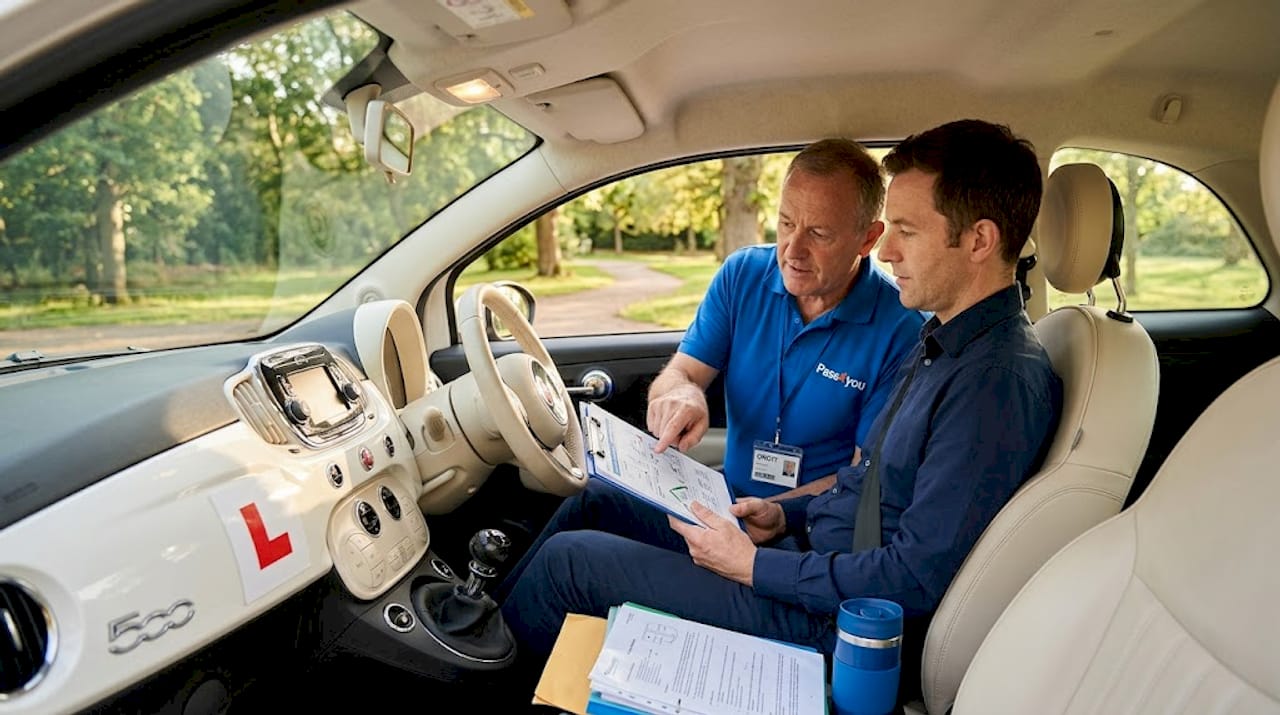
The most effective way to prepare is to work with an ORDIT-registered trainer. ORDIT is the Official Register of Driving Instructor Trainers, and working with a registered trainer gives you access to structured, professional preparation rather than informal coaching from a well-meaning friend.
5. The trainee licence: what the pink badge actually means
After passing Part 2, you have the option to apply for a trainee licence before completing Part 3. This is the stage that causes the most confusion among candidates, so it is worth being precise about what it involves.
The trainee licence (often called the pink badge) allows you to charge pupils for lessons while you are still completing your Part 3 training. It is not a shortcut. It is a supervised teaching opportunity with clear conditions attached.
Key facts about the trainee licence:
- You must have completed at least 40 hours of Part 3 training before applying.
- The licence is valid for 6 months.
- You must complete a further 20 hours of additional training during that 6-month period.
- You must be sponsored by a driving school that takes responsibility for your supervision.
- At least 25% of your lessons must be supervised by your sponsor.
Pro Tip: The trainee licence is genuinely valuable if you use it properly. Teaching real pupils accelerates your development in ways that no amount of role-play training can replicate. Choose your sponsoring school carefully. A good sponsor will give you structured feedback, not just a badge.
The DVSA registers candidates as PDIs (Potential Driving Instructors) once initial clearances and application requirements are met. PDI status is what allows you to apply for the trainee licence.
6. ADI Part 3: the instructional ability test
This is the most demanding stage of the ADI qualification guide, and the one that most candidates underestimate. Part 3 is not a driving test. It is a teaching test, and that distinction matters enormously.
The test lasts one hour and involves conducting a lesson with a real learner pupil while an examiner observes. You are assessed across 17 specific competencies that span three broad areas:
- Lesson planning: Did you identify the pupil’s needs? Did you set appropriate goals? Did you structure the lesson logically?
- Risk management: Did you maintain safety throughout? Did you intervene appropriately? Did you manage dual controls correctly?
- Teaching and learning strategies: Did you adapt your explanations? Did you give effective feedback? Did you encourage the pupil to think rather than just follow instructions?
“The ADI Part 3 test is primarily a teaching skills test, not just a driving test. The focus is on lesson planning, learning maximisation, safety, and adapting teaching to pupil needs.” — ADINJC
Many candidates arrive at Part 3 having focused heavily on their own driving ability and very little on pupil-centred learning. The examiner is not watching you drive. They are watching how you help someone else learn.
If you fail Part 3 three times, you must restart the entire qualification from Part 1. That consequence alone should motivate serious preparation. Work with an ORDIT-registered trainer who can observe your teaching, give structured feedback, and help you understand the competency framework before you sit the test.
The 17 competencies break down into detailed subcriteria. Identifying pupil needs, adapting lesson content, managing risk without taking over, and giving feedback that promotes independent thinking are all assessed separately. You cannot wing this test.
7. Registering as a full ADI and what comes next
Once you have passed all three parts, you can apply to join the ADI register. You must submit your application within one year of passing Part 3, or you will need to requalify.
The registration process involves:
- Paying the registration fee to the DVSA.
- Submitting your application with evidence of your test passes.
- Receiving your green badge, which you must display in your vehicle when teaching.
- Renewing your DBS check every 4 years.
- Undergoing a standards check every 4 years to remain on the register.
The standards check is essentially a repeat of the Part 3 format. An examiner observes one of your real lessons and scores you against the same competency framework. Maintaining your registration requires ongoing professional development, not just an initial qualification.
Your first year as a qualified ADI tends to involve a steep learning curve around the business side of instructing. Building a pupil base, managing your diary, and handling the administrative side of running lessons are skills the qualification does not teach you. Many new ADIs benefit from remaining with a driving school for the first year rather than going fully independent immediately.
My honest take on the ADI qualification journey
I’ve seen a lot of candidates approach the ADI qualification with the assumption that because they are good drivers, the hard part is behind them. It is not. In my experience, the candidates who struggle most at Part 3 are often the strongest drivers. They have spent years developing instinctive driving habits and find it genuinely difficult to slow down, explain their thinking, and let a pupil make mistakes in a controlled way.
What I’ve learned from watching people go through this process is that structured training from an ORDIT-registered trainer is not optional. It is the difference between understanding the competency framework intellectually and being able to demonstrate it under exam pressure.
The trainee licence stage is undervalued. Yes, it costs money and comes with conditions. But the experience of teaching real pupils, with real nerves and real mistakes, builds the kind of teaching instinct that no role-play session can replicate. I would always encourage candidates to use it.
My honest advice: treat Part 3 as a completely separate qualification from Parts 1 and 2. Study the 17 competencies until you can recite them in your sleep. Then practise teaching, get feedback, and practise again. The candidates who pass first time are rarely the best drivers. They are the best prepared teachers.
— Simon
Start your ADI journey with the right support
Qualifying as a driving instructor is a serious commitment, and the quality of your training makes a measurable difference to your results. Pass4you is a Milton Keynes-based driving school with an 83.33% first-time pass rate, professional instructors, and a genuine understanding of what it takes to prepare pupils and trainee instructors effectively.
Whether you are at the research stage or ready to begin structured preparation, Pass4you offers learner courses designed to support every stage of the driving education process. If you want to understand the standard your future pupils will be working towards, spending time with experienced instructors is one of the most practical things you can do before you sit Part 3. You can also explore intensive course options for more focused preparation. Visit Pass4you to find out more about what is available and how to get started.
FAQ
What are the ADI qualification steps in order?
The ADI qualification has three stages: Part 1 (theory test), Part 2 (advanced driving test), and Part 3 (instructional ability test). You must pass each in sequence, and there is an optional trainee licence stage between Parts 2 and 3.
How many attempts do you get at each ADI test?
You get three attempts at each part. If you fail Part 3 three times, you must restart the entire qualification from Part 1, which makes thorough preparation critical before each attempt.
What is the pass mark for ADI Part 1?
You need at least 85 out of 100 on the multiple-choice section and at least 57 out of 75 on the hazard perception section, with both passed in the same sitting.
What does the ADI Part 3 test actually assess?
Part 3 assesses your ability to teach a learner pupil effectively across 17 competencies covering lesson planning, risk management, and teaching strategies. It is a teaching test, not a driving test.
How long does it take to qualify as a driving instructor?
Most candidates take between 6 months and 2 years to complete all three parts, depending on preparation time, test availability, and whether they use the trainee licence stage.
Leave a Reply