Tag: UK Driving

  • The Real Cost of Learning to Drive in the UK: 2026 Budget Guide

    The Real Cost of Learning to Drive in the UK: 2026 Budget Guide

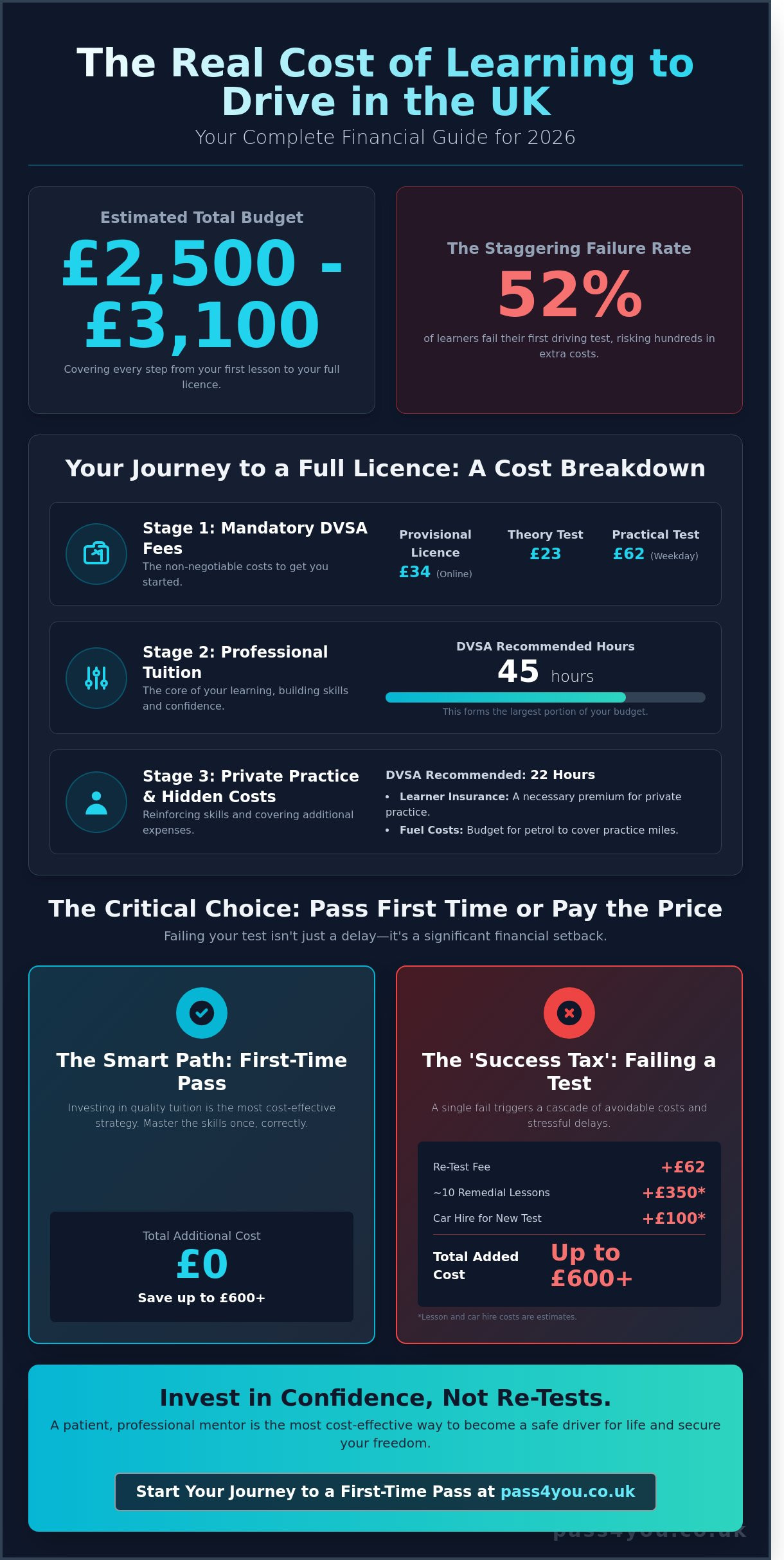
    Did you know that 52% of learners currently fail their driving test, which often doubles the total cost of learning to drive uk 2026 in a single afternoon? When you consider that a second attempt usually requires an extra ten hours of remedial lessons and a new £62 test fee, the financial stakes feel incredibly high. It’s completely natural to feel anxious about rising hourly rates and the confusing world of learner insurance. You want to start your journey behind the wheel, but you don’t want to see your savings disappear into a cycle of “cheap” lessons that don’t actually prepare you for the road.

    We believe that learning to drive should be a calm, confidence-building experience, not a source of financial stress. In this guide, we’ll provide a complete breakdown of every expense you’ll face this year. We’ll help you set a realistic savings goal and explain why investing in quality instruction is the most effective way to secure a first-time pass. From the initial £34 online provisional licence fee to the hidden costs of private practice, you’ll discover exactly how to budget for success and become a safe driver for life.

    Key Takeaways

    • Understand why the total cost of learning to drive uk 2026 now ranges between £2,500 and £3,100, helping you plan your finances with confidence.
    • Get a clear breakdown of mandatory DVSA fees and current professional tuition rates to ensure you aren’t caught off guard by rising prices.
    • Identify the “hidden” expenses of learning to drive, from learner insurance premiums to the fuel costs required for effective private practice.
    • Discover the “Maths of Mastery” and how passing your test the first time can save you up to £600 in avoidable re-test fees and extra lessons.
    • Learn why investing in a patient, professional mentor is the most cost-effective way to become a safe driver for life and secure your freedom.

    Breaking Down the Total Cost of Learning to Drive in 2026

    Learning to drive is one of the most rewarding investments you’ll ever make. It opens up doors to new career paths, social freedom, and personal independence. However, the cost of learning to drive uk 2026 has evolved, and being prepared helps you stay calm throughout the process. For a typical learner in 2026, the estimated total budget ranges from £2,500 to £3,100. This figure isn’t just a random guess; it covers every essential step from your initial provisional license application to the final practical pass.

    The journey starts with understanding the UK driving test process, which requires passing both a theory and a practical exam. Between these two milestones, you’ll spend the bulk of your budget on professional tuition. We understand that seeing a four-figure number can feel overwhelming, but breaking it down into manageable steps makes the goal achievable. Our focus is always on helping you become a safe driver for life, rather than just getting you through a test as quickly as possible.

    The 2026 Price Reality: Why Budgets Have Increased

    Several economic factors have pushed driving costs higher over the last few years. Inflation has impacted vehicle maintenance and insurance premiums for driving schools significantly. With petrol prices averaging around 136p per litre, the daily running costs for instructors have climbed. We choose to use modern, high-spec Volkswagens for our lessons because they provide a stable and comfortable environment for nervous learners. While these vehicles are more expensive to maintain and insure than older models, they offer the safety features and reliability you need to feel confident behind the wheel. The Total Cost of Success is the only metric that matters.

    National Averages vs. Reality

    The DVSA suggests an average of 45 hours of professional tuition, combined with 22 hours of private practice, to reach test standard. Many learners are tempted by “quick fix” intensive courses that promise a license in a week, but these often lead to gaps in knowledge and higher anxiety. Rushing the process frequently results in a failed test, which triggers what we call the “Success Tax.” Failing your test just once can easily add £300 or more to your total bill when you account for the £62 re-test fee, car hire for the exam, and the extra lessons needed to keep your skills sharp while you wait for a new slot.

    Choosing a patient, experienced mentor helps you avoid these unnecessary costs. If you’re starting your journey in Buckinghamshire, our driving lessons Milton Keynes are designed to get you to that first-time pass safely and efficiently. We focus on building your confidence steadily, ensuring you’re fully prepared before you even book your exam. This measured approach saves you money in the long run by reducing the risk of expensive re-tests and additional training sessions.

    Mandatory Fees: DVSA Test and Licence Costs

    Before you even sit in the driver’s seat, you’ll encounter fixed expenses set by the DVSA. Understanding the cost of learning to drive uk 2026 starts with these non-negotiable fees. These prices are regulated across the country, so you won’t find a “cheaper” version of a driving test. It’s best to budget for these early so you can focus your energy on developing your skills with a patient instructor. Being prepared financially helps reduce the stress of the process.

    The Provisional Licence Investment

    Your journey begins with your provisional licence. You can apply for this up to three months before your 17th birthday, though you can’t start lessons until you’re 17. Applying online costs £34, which is significantly better value than the £43 fee for postal applications. You must have the physical card in your possession before any professional lesson begins. For a step-by-step walkthrough of the application, check out our provisional licence uk guide. Having this ready ensures your training starts without delays.

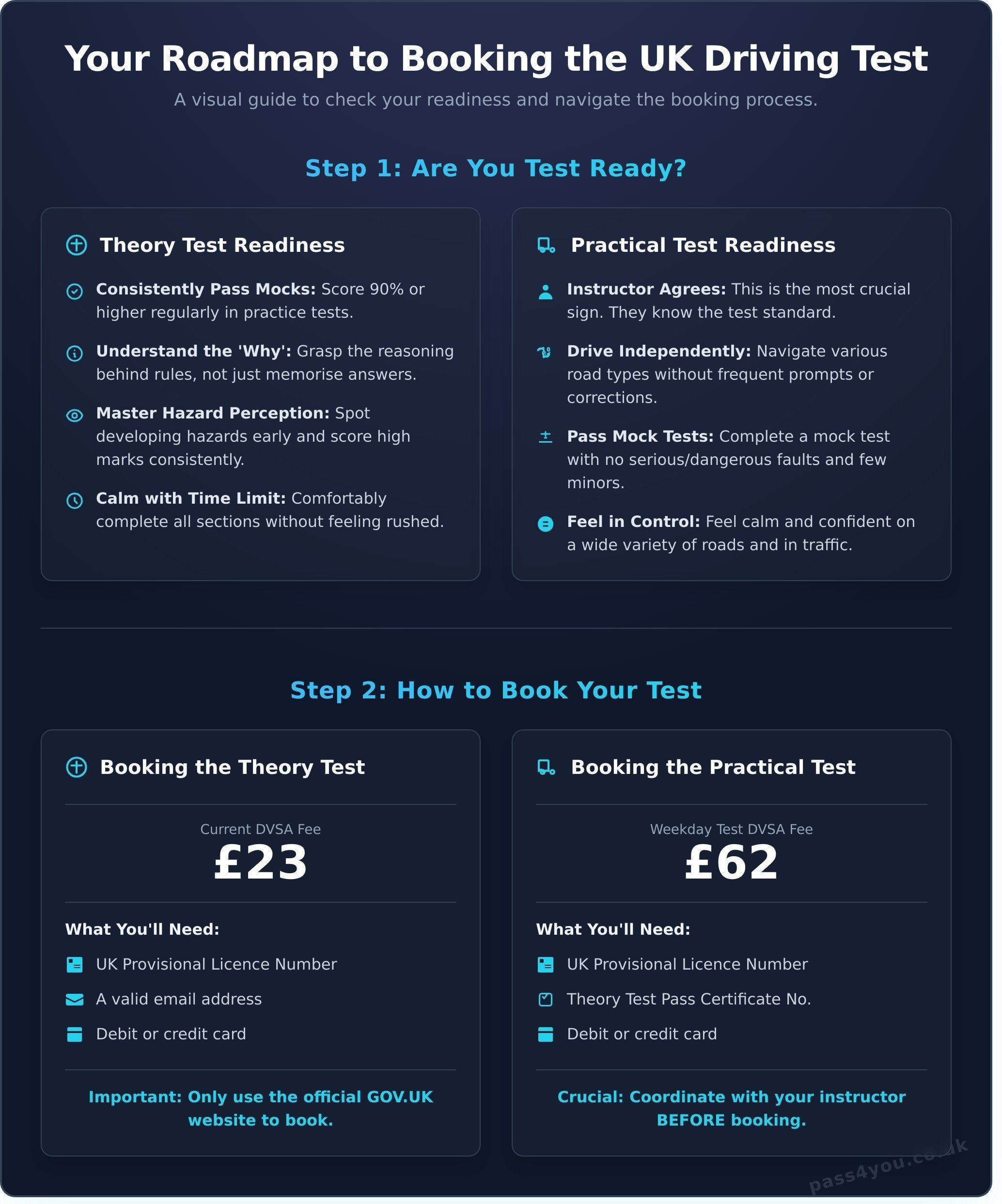
    Once you have your licence, the next milestones are your tests. According to the official government test fees, the theory test is fixed at £23 per attempt. While this seems modest, failing repeatedly adds up quickly. Passing the first time is a financial must. The practical test is slightly more complex. You’ll pay £62 for a weekday slot, while evenings, weekends, and bank holidays cost £75. These fees go directly to the DVSA to cover the examiner’s time and administration.

    Booking and Re-booking Fees

    Demand for tests remains high in 2026. You should always use the official DVSA site to avoid “booking bot” scams that inflate prices by charging “finder fees”. If you need to change your date, you can do so for free if you give at least three clear working days’ notice. However, if you fail, there’s a mandatory 28-day wait before you can take another practical test. This delay often results in needing extra refresher lessons to keep your skills sharp. You can find more details in our guide on how to book your driving test.

    Many learners forget the “hidden” test day cost. You aren’t just paying the DVSA fee; you also need to hire your instructor’s car for the duration of the test. Most instructors charge for a two-hour block. This covers a warm-up lesson beforehand and the time spent at the test centre. It’s a standard industry practice that ensures you’re driving a car you feel confident and safe in. We focus on building that confidence so you’re ready to succeed. We take pride in our 83.33% first-time pass rate, which helps our students avoid the cost of re-tests. If you’re ready to start, booking your first lesson is the first step toward freedom.
    The Real Cost of Learning to Drive in the UK: 2026 Budget Guide

    Professional Tuition: Calculating Your Lesson Budget

    The cost of learning to drive uk 2026 has evolved to reflect the professional standards required on modern roads. Currently, average lesson prices across the country range between £40 and £50 per hour. If you’re learning in Milton Keynes, you’ll likely see rates at the higher end of that bracket. Urban areas demand more from instructors, including navigating complex roundabouts and dealing with heavier traffic, which requires a higher level of expertise and vehicle maintenance.

    Most learners find that block booking is the smartest way to manage their budget. Paying for 10 or 20 hours upfront typically secures a discount of 5% to 10%. This doesn’t just save you money; it shows a commitment to your progress that helps you stay focused. It’s much easier to plan your finances when you’ve already secured a chunk of your training at a fixed, lower rate.

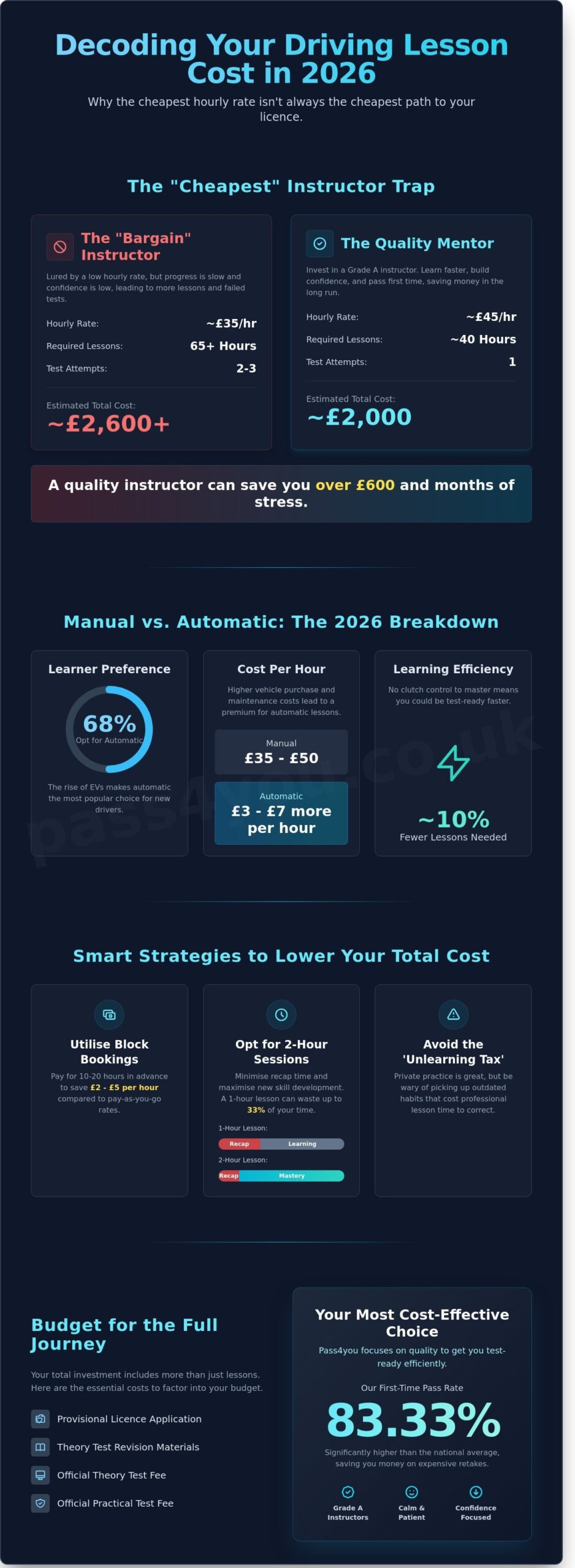
    It’s easy to be swayed by a trainee instructor offering a rate of £35 per hour. We call this the “Cheap Instructor Trap.” While the initial saving looks good on paper, a novice instructor often lacks the refined coaching methods that a veteran professional possesses. You might find yourself stuck on basic maneuvers for weeks. In the long run, paying for 60 hours with a trainee is significantly more expensive than completing your training in 30 hours with a specialist.

    Manual vs. Automatic Lesson Costs

    Deciding which gearbox to use will impact your budget. Automatic lessons generally carry a £2 to £5 premium per hour compared to manual ones. This higher cost covers the increased purchase price of automatic cars and their maintenance. However, there’s a trade-off. Many students find they need fewer hours to reach test standard in an automatic because they don’t have to struggle with the clutch or gear timing. To see how these prices compare in your specific postcode, you can look for driving instructors near me to get an accurate local quote.

    Why Instruction Quality Dictates Your Final Bill

    The fastest way to reduce your total spend is to choose an instructor who knows how to teach efficiently. At Pass4you, we’ve spent years honing a tried and tested technique that builds your confidence and skills at an accelerated pace. Simon creates a calm, patient environment that is essential for progress. Stress is the biggest barrier to learning. When you’re nervous, you make mistakes that require more lessons to fix. A supportive mentor prevents these “stress-learning” plateaus from happening. Ultimately, 30 hours of high-quality instruction with a pro is much cheaper than 60 hours with a novice who can’t explain complex junctions clearly. Investing in expertise ensures you become a safe driver for life without wasting money on unnecessary retakes.

    The “Hidden” Expenses: Insurance, Fuel, and Practice

    When you’re calculating the cost of learning to drive uk 2026, it’s easy to focus only on the price of your weekly lessons. However, several additional expenses often catch learners by surprise. We want you to feel prepared and confident throughout your journey, so it’s vital to budget for the costs that occur outside of the instructor’s car. Being aware of these figures early on helps reduce anxiety and keeps you focused on your progress.

    Learner Driver Insurance Explained

    Insurance is often the most significant “hidden” cost. For learners aged 17 to 24 in 2026, average premiums have reached approximately £1,121. You generally have two choices: an annual policy or “pay-as-you-go” temporary cover. Temporary cover is excellent for short bursts of practice, while annual policies suit those practicing daily in a family car.

    • Avoid Fronting: Never let a parent claim to be the main driver if you’re the one using the car most. This is insurance fraud and can lead to a cancelled policy or a criminal record.
    • Telematics: Choosing a “black box” policy can help keep premiums lower by proving you’re a safe, responsible driver.
    • Comparison: Always shop around. Prices vary wildly between providers based on your postcode and the car’s insurance group.

    Private Practice: Is It Actually Free?

    Many learners assume practicing with a parent is free, but the costs add up quickly. The DVSA recommends around 22 hours of private practice to supplement your professional lessons. With fuel prices averaging 136p per litre in 2026, you could spend over £100 just on petrol for these extra sessions. It’s also important to consider the risk of picking up “bad habits.”

    If a supervisor isn’t up to date with modern standards, they might accidentally teach you techniques that lead to a fail on your practical driving test. A failed test results in more than just disappointment; it means paying for a re-test and further lessons to fix those habits. We find that a calm, professional approach is the best way to ensure your private practice remains productive and safe.

    Safety Essentials and Opportunity Cost

    Before you hit the road for practice, you’ll need a few physical items. A set of magnetic L-plates, an extra rear-view mirror for your supervisor, and a copy of the Highway Code will cost roughly £30. These are non-negotiable for safety and legal compliance.

    Don’t overlook the “opportunity cost” of your time. If you’re taking time off work or school for lessons and tests, that’s time you aren’t earning or studying. In 2026, where every hour counts, planning your lessons around your existing commitments is the smartest way to manage the total cost of learning to drive uk 2026 without feeling the pinch.

    Ready to start your journey with a patient, experienced instructor? Book your first lesson with Pass4you today and let’s get you on the road to success.

    The Pass4you Strategy: Saving Money by Passing First Time

    While the national average pass rate in the UK typically sits between 48% and 50%, our students at Pass4you achieve a much higher success rate. We are proud of our 83.33% first-time pass rate. This figure is more than just a statistic; it represents a significant reduction in the total cost of learning to drive uk 2026 for our learners. When you choose an instructor who prioritizes patience and a calm environment, you aren’t just buying a lesson. You’re investing in a result that saves you money in the long run.

    We call this the “Maths of Mastery.” Failing a driving test is an expensive setback. Between the £62 DVSA booking fee, the cost of car hire for the test day, and the necessary top-up lessons to stay “test-ready” while waiting for a new slot, a single fail can easily cost hundreds of pounds. By focusing on quality over quantity and passing first time, our students often save up to £600 compared to those who cycle through multiple attempts. Our philosophy is built on “Safe Driving for Life.” We don’t believe in rushing through maneuvers or “teaching to the test.” We want you to feel confident on every road, from quiet estates to the busiest Milton Keynes dual carriageways.

    Investing in Excellence

    Many students come to us after feeling stressed or rushed by previous instructors who shouted or lost patience. Simon’s approach is different. By creating a supportive atmosphere, he helps you retain information faster, which actually reduces the total number of lessons you need. Look at the typical breakdown of costs:

    • The Pass4you Way: 1 Test + 35 Lessons = Success.
    • The Rushed Way: 3 Tests + 50 Lessons + Stress = High Costs.

    One student recently shared that they nearly gave up after a bad experience elsewhere. After switching to Simon’s calm teaching style, they passed their test first time and saved a fortune on potential re-test fees. Choosing the right instructor is the most effective way to manage the cost of learning to drive uk 2026.

    Next Steps for Milton Keynes Learners

    Your journey to independence shouldn’t be a source of anxiety. Learning to drive is a permanent investment in your freedom, and we’re here to ensure that investment is handled professionally. We encourage you to browse our local Milton Keynes reviews and view our gallery of successful students. These stories are proof that a patient, expert environment leads to better results and lower overall costs. Are you ready to get started? The best way to plan your budget is to see where you stand. Book an initial assessment lesson today, and let’s get you on the road safely and confidently.

    Secure Your Freedom Behind the Wheel

    Understanding the cost of learning to drive uk 2026 is the first step toward gaining your independence. While DVSA fees and insurance costs are fixed parts of the budget, your choice of instructor is the biggest variable in your final bill. Choosing professional tuition saves you money in the long run by reducing the total number of lessons you’ll need. At Pass4you, we focus on efficiency and confidence. Our 83.33% first-time pass rate proves that a calm, patient approach works better than rushing through the basics. You’ll learn in modern, reliable Volkswagens with local Milton Keynes expertise that has earned us consistent 5-star reviews. Simon’s supportive teaching style is designed to eliminate nerves and ensure you aren’t just passing a test, but becoming a safe driver for life. Don’t waste time and money on a trial-and-error approach with family. Start your journey with a Milton Keynes instructor you can trust. Book your first lesson with Pass4you today! It’s time to stop worrying about the budget and start looking forward to the open road.

    Frequently Asked Questions

    How much should I save for driving lessons in 2026?

    You should aim to save between £1,800 and £2,500 to cover the total cost of learning to drive uk 2026. This budget accounts for approximately 45 hours of professional tuition at current market rates plus the costs for your theory and practical tests. We focus on providing value for money by helping you pass efficiently. Our 83.33% first time pass rate means you’re less likely to spend extra on retests and additional lessons.

    Is it cheaper to learn in a manual or automatic car?

    Manual lessons are usually cheaper per hour, often costing £5 to £10 less than automatic sessions. However, many students find they need fewer lessons in an automatic car because they don’t have to master clutch control or gear changes. If you’re a nervous learner, an automatic can build your confidence much faster. We’ll help you decide which option is most cost-effective for your specific learning style and needs.

    How many driving lessons do I actually need to pass?

    The Driver and Vehicle Standards Agency (DVSA) reports that the average learner requires 45 hours of professional lessons and 22 hours of private practice. Every student is different, so we provide a patient and steady environment that moves at your pace. Simon’s experienced mentoring ensures you become a safe driver for life. We don’t believe in rushing, but our proven techniques aim to get you test-ready as quickly as possible.

    Can I save money by booking my driving test in the evening?

    No, booking an evening, weekend, or bank holiday test is actually more expensive. The DVSA charges £75 for these premium slots, while a standard weekday test costs £62. While these times might be more convenient for your schedule, they don’t offer a financial saving. We recommend choosing a time when you feel most calm and alert. Most of our students find that weekday mornings provide a steady environment for their first time pass attempt.

    What happens to my money if I fail my driving test?

    If you fail your test, the fee paid to the DVSA is non-refundable and you’ll have to pay the full amount again to book a new slot. You’ll also need to pay for extra lessons to fix any mistakes and the hire of your instructor’s car for the next test. We work hard to ensure you’re fully prepared and confident before you head to the test centre. Our high success rate helps our students avoid the stress and expense of multiple attempts.

    Do I have to pay for my instructors car during the test?

    Yes, you’ll typically pay for a two-hour lesson block to cover the warm-up session and the duration of the practical exam. This is a standard part of the cost of learning to drive uk 2026 because it covers the instructor’s time and the insurance for the vehicle. We’re always honest and transparent about these costs from the very beginning. This ensures you can budget accurately for your big day without any hidden surprises.

    Are intensive driving courses cheaper than weekly lessons?

    Intensive courses can be cheaper in the long run if they help you retain information better and reduce the total number of hours needed. While the upfront cost is higher, often exceeding £1,200 for a full week, you might pass your test much sooner. However, these fast-paced courses don’t suit every personality. We provide a supportive atmosphere where we can assess whether an intensive route or a more patient, weekly approach is best for your success.

    How can I reduce the cost of learner driver insurance?

    You can lower your insurance premiums by adding an experienced, claim-free driver to your policy as a named driver. Choosing a car in insurance group 1, like a 1.0-litre hatchback, also significantly reduces the price. Many providers now offer “pay-as-you-go” policies that allow you to pay only for the hours you’re actually practicing. This is a brilliant way to get that essential 22 hours of private practice without a massive financial burden.
  • Driving Lessons in the Rain for Learners: A Complete Guide to Wet Weather Confidence

    Driving Lessons in the Rain for Learners: A Complete Guide to Wet Weather Confidence

    What if a heavy downpour during your driving lesson is actually the best thing that could happen to your chances of passing? It’s completely natural to feel a bit of dread when you look out the window and see grey skies. You might worry about skidding on slick roads or struggle to see clearly through a blurred windscreen. It often feels like the weather is making your journey to a driving licence much harder than it needs to be.

    We understand that taking driving lessons in the rain for learners can feel intimidating at first. However, we’re here to help you master the skills needed to handle wet British roads safely and with total confidence. By the end of this guide, you’ll know how to turn a rainy day into your secret advantage, helping you join the 83.33% of our students who pass their test first time. We’ll cover everything from adjusting your braking distances to mastering your car’s wipers and demisters so you can stay calm behind the wheel.

    Key Takeaways

    • Learn why rainy weather is actually a secret advantage that helps you prove your competence to DVSA examiners.
    • Master the essential “Rain Routine” to manage visibility and prepare your vehicle for safe travel before starting your engine.
    • Use driving lessons in the rain for learners to adapt your car control and understand why the two-second rule must double on wet roads.
    • Develop the observation skills needed to anticipate common hazards like heavy spray and reduced grip on dual carriageways.
    • Find out how a calm, professional mentor can help you maintain our 83.33% first-time pass rate even in the most challenging British weather.

    Why Driving Lessons in the Rain are Your Secret Advantage

    Many students feel a dip in their stomach when they see grey clouds on the morning of a lesson. You might be tempted to reach for your phone and reschedule. Don’t do it. Taking driving lessons in the rain for learners is actually a massive shortcut to becoming a safe driver for life. While fair-weather students only know how to handle dry tarmac, you’ll be building a toolkit of skills that others simply don’t have. Rain provides a unique classroom where you learn grip, visibility, and patience in real-time.

    Cancelling a rainy session doesn’t just stall your momentum; it’s a financial drain. If you avoid the rain now, you’ll likely need extra hours later to catch up when the seasons change. Since we maintain an 83.33% first time pass rate at Pass4you, we know that consistency is what gets you that pink licence. Every wet mile you drive with Simon is an investment in your confidence. It’s much better to experience your first skid or heavy downpour with a professional instructor beside you than to face it alone after you’ve passed.

    The DVSA Perspective: Rain on Your Driving Test

    The DVSA doesn’t stop tests just because it’s drizzling. Examiners specifically look for your ability to use wipers and lights without being prompted. In 2026, “driving for the conditions” remains a core competency that can make or break your result. You’ll need to show you understand that stopping distances double on wet roads. Interestingly, DVSA data suggests that candidates who have practiced in varied weather are less likely to commit serious faults related to speed or following distances. You’ll prove you’re competent by adjusting your gap to the car in front, showing the examiner you’re a responsible, thinking driver.

    Building Resilience and Confidence

    Facing poor weather early on helps you move past the nervous learner phase quickly. Simon at Pass4you uses these days to sharpen your hazard perception skills during driving lessons in the rain for learners. You’ll learn how to spot deep puddles and understand what is hydroplaning, which is the dangerous moment your tyres lose contact with the road surface. This isn’t about being scared; it’s about developing professional behaviour. By the time your test date arrives, a bit of rain won’t rattle you. You’ll stay calm and patient, knowing you’ve handled these conditions many times before. This proactive approach transforms anxiety into the quiet confidence needed for a successful result.

    The Rain Routine: Preparing Your Vehicle and Managing Visibility

    Visibility is your first line of defence during driving lessons in the rain for learners. Before you pull away from the kerb, you must establish a solid “Rain Routine” to ensure your surroundings are clear. This preparation reduces the anxiety of wet weather driving by putting you in control of your environment from the second you sit in the driver’s seat. It’s much easier to manage a downpour when you aren’t struggling to see through a foggy windscreen.

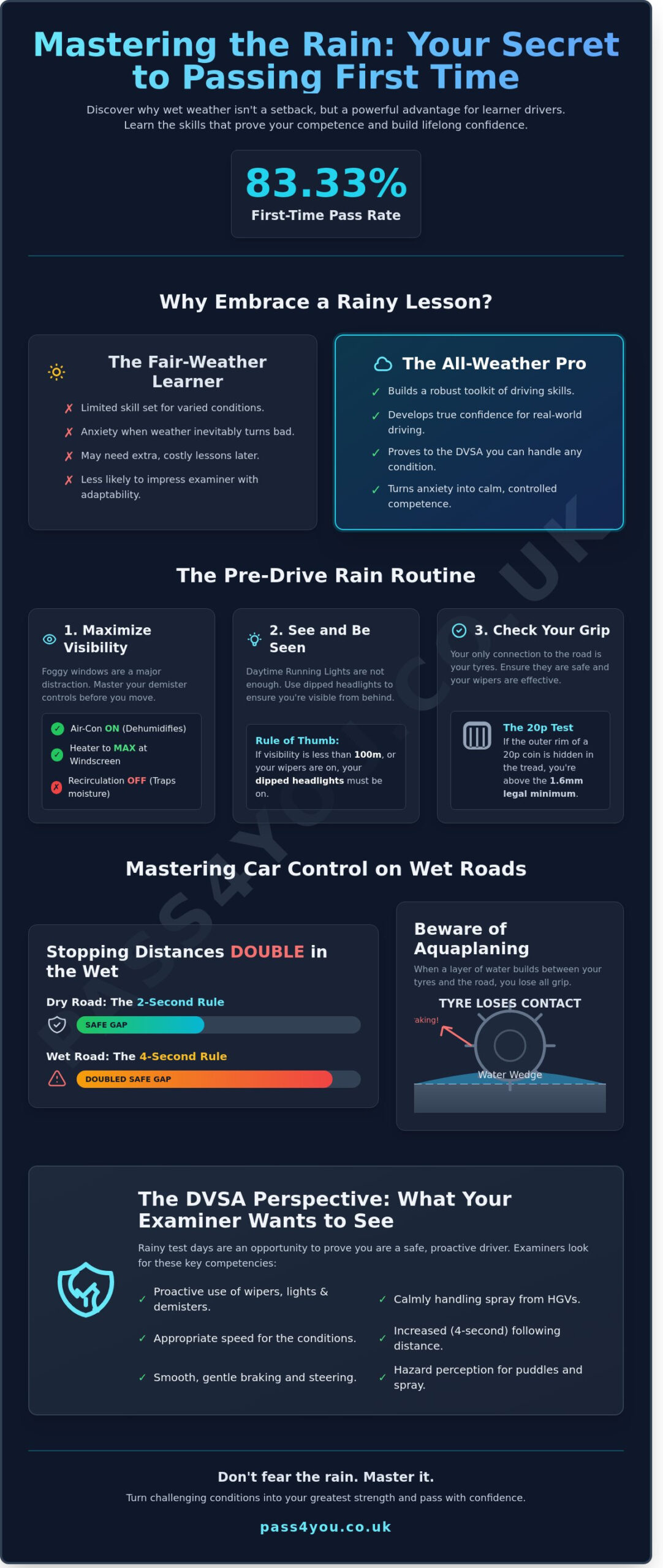
    Start by checking your lights. UK law requires you to use dipped headlights when visibility is reduced to less than 100 metres. Don’t rely on daytime running lights; they often don’t illuminate your rear bulbs, making you nearly invisible to drivers behind you. Only use fog lights if visibility drops significantly below that 100-metre mark, as they can dazzle others when the road surface is reflective. If the rain is heavy enough that you’ve turned your wipers on, your dipped headlights should be on too.

    Mastering the Demister: Keeping Windows Clear

    Windows fog up because your warm breath meets the cold glass, causing condensation. It’s a common distraction that can lead to panic if you don’t know how to fix it. To clear it quickly, turn your heater to its highest setting and point the vents at the windscreen. If your car has air conditioning, turn it on. It acts as a dehumidifier, pulling moisture out of the cabin far faster than heat alone. A frequent mistake learners make is hitting the “recirculation” button. This traps the damp air inside, making the fog worse. Always keep it set to “fresh air” to maintain clarity during your driving lessons in the rain for learners.

    Exterior Checks: Wipers and Tyres

    Your tyres are the only thing connecting you to the road. You can check your tread depth easily with the “20p test”. Insert a 20p coin into the main tread grooves; if the outer rim of the coin is hidden, your tyres have more than the 1.6mm legal minimum. For better safety, AAA’s tips for driving in the rain suggest regular inspections of your wiper blades too. If they leave streaks or make a juddering sound, the rubber has likely perished and needs replacing. Perished blades are a major hazard during a sudden storm.

    Match your wiper speed to the rainfall intensity. Use the intermittent setting for light drizzle and move to higher speeds as the downpour increases. Finally, take a moment to wipe your side windows and mirrors with a cloth before you start the engine. Rain droplets can distort your view of hazards, so starting with clean glass is essential for safe observations. If you’re feeling nervous about these checks, our calm and patient instructors can walk you through the process step-by-step until you feel fully prepared.

    Driving Lessons in the Rain for Learners: A Complete Guide to Wet Weather Confidence

    Mastering Car Control: Physics and Braking on Wet Roads

    When you take driving lessons in the rain for learners, you’ll quickly notice that the car feels different. Rain creates a thin layer of lubrication between your tyres and the road surface, which significantly reduces friction. In our Volkswagen tuition vehicles, which we maintain to the highest safety standards, this change in physics means your steering might feel slightly lighter and your brakes won’t feel quite as “bitey” as they do on a warm July afternoon.

    On a dry day, Simon will teach you the two-second rule to maintain a safe gap from the car in front. When the clouds open over Milton Keynes, you must double this. The “Four-Second Rule” is your best friend in wet weather. This extra time allows for the fact that a car travelling at 30mph needs about 23 metres to stop on a dry road, but this distance can extend to 46 metres or more when the tarmac is soaked. According to 2023 data from the Department for Transport, “slippery road due to weather” remains a top contributing factor in road accidents, which is why we focus so heavily on these adjustments.

    Smoothness is the secret to maintaining traction. Any sudden jerks on the steering wheel or aggressive stabs at the pedals can break the delicate grip your tyres have on the road. We’ll help you develop a “silk-smooth” technique, ensuring your Volkswagen stays balanced and predictable even when the weather is anything but.

    Stopping Distances and Braking Technique

    The Highway Code is clear that stopping distances are at least double in wet weather. To manage this safely, we’ll practice the progressive braking technique. You don’t just “stomp” on the pedal. Instead, you apply light pressure initially to clear the film of water from the brake discs, then increase pressure steadily as you feel the car slow, and finally ease off slightly as you come to a halt. This early planning is vital when navigating busy Milton Keynes routes like the H6 Childs Way, where traffic flow can change in a heartbeat.

    Understanding and Avoiding Hydroplaning

    Hydroplaning, or aquaplaning, occurs when your tyres lose contact with the road and begin to “surf” on a layer of water. You’ll know it’s happening if the steering suddenly feels feather-light or the engine noise increases because the wheels are spinning freely. If this happens during your driving lessons in the rain for learners, don’t panic. Stay calm and follow these steps:

    • Ease your foot off the accelerator slowly.
    • Do not hit the brakes, as this can cause a skid.
    • Keep the steering wheel straight and steady.
    • Wait for the tyres to regain their grip on the tarmac.

    Our instructors are experts at helping you identify these situations before they become stressful. We’ll show you how to look for standing water and “shiny” patches on the road, giving you the confidence to handle any downpour with ease.

    Rainy conditions change the way you need to observe the road. It isn’t just about looking for other cars; it’s about anticipating how the water affects everyone’s behaviour. During your driving lessons in the rain for learners, we’ll help you develop a wider scanning pattern to spot hazards earlier. You’ll learn to look for reflections on the tarmac and watch the “rooster tail” of spray from vehicles ahead to judge road dampness.

    Managing spray is a vital skill, especially on faster roads. A large heavy goods vehicle can displace up to 50 litres of water every second in heavy downpours. This creates a thick mist that can temporarily block your view. We teach you to increase your following distance to at least four seconds. This simple change keeps you out of the worst of the spray and gives you a much clearer view of the road ahead.

    Standing water is another significant risk. In 2023, local authorities across England and Wales filled 1.4 million potholes, but many remain hidden beneath puddles. If you drive through a deep puddle, you risk aquaplaning or damaging the car’s suspension. We’ll show you how to safely navigate these areas by slowing down and keeping your steering steady.

    Your “Show Me, Tell Me” knowledge needs to adapt too. You should be ready to demonstrate how to use the demister controls or operate the windscreen wipers without taking your eyes off the road. Simon will guide you through these controls until they feel like second nature, ensuring you stay focused on the drive.

    Milton Keynes Specifics: Roundabouts and Dual Carriageways

    Milton Keynes presents unique challenges during wet weather due to our grid system. When rain first hits, the V and H roads become incredibly greasy as oil and rubber dust rise to the surface. We’ll practice gentle steering and progressive braking at busy junctions like the Northfield or Brinklow roundabouts. You’ll learn to manage lane changes on the V8 or H6 with confidence, even when visibility is low and spray is high.

    Vulnerable Road Users: Pedestrians and Cyclists

    Rain makes people hurry, which often leads to unpredictable choices. A pedestrian might suddenly dash across the road to reach a bus shelter or shop doorway. You must stay alert for these sudden movements. Cyclists also face extra hurdles, such as slippery drain covers and deep puddles that can knock them off balance. Always give them at least 1.5 metres of space when overtaking.

    It’s also important to remember your legal responsibilities. Splashing a pedestrian is considered “driving without reasonable consideration” under Section 3 of the Road Traffic Act 1988. This can result in a fine of up to £5,000 and three penalty points on your licence. We’ll help you develop the patience to slow down and avoid puddles near pavements.

    Ready to build your confidence behind the wheel regardless of the weather? Book your driving lessons in Milton Keynes with Pass4you today and become a safe driver for life.

    Turning Rain into Confidence with Pass4you

    Learning to drive in the UK means you’ll eventually face a downpour. At Pass4you, we don’t see a wet forecast as a reason to cancel. Instead, we see it as a vital opportunity to build real-world skills. Our calm and patient approach is specifically designed to handle the toughest weather conditions. Simon has spent years helping nervous learners find their feet, and his supportive nature ensures you stay relaxed even when the wipers are on full speed. This dedicated environment is exactly how we maintain our impressive 83.33% first-time pass rate, regardless of the British clouds.

    Simon is the favourite instructor for nervous learners in Milton Keynes because he understands that anxiety doesn’t just come from the car, but from the environment around it. By focusing on steady, incremental progress, he transforms driving lessons in the rain for learners from a source of stress into a badge of confidence. You won’t just learn to operate a vehicle; you’ll learn to read the road and stay composed when conditions are less than perfect. Ready to become a safe driver for life? Book your first lesson today and start your journey with a team that cares about your success.

    Expert Instruction in Modern Vehicles

    Our Volkswagen tuition cars are selected for their top-tier safety ratings and driver-assist technology. These vehicles feature advanced anti-lock braking systems (ABS) and electronic stability control, which are essential for maintaining grip on slick MK roads. We tailor your lesson plan to the current weather forecast, ensuring you get practical experience with rain sensors and demisting controls when they matter most. If you want to master the local roundabouts and dual carriageways, you can learn more about driving lessons in Milton Keynes through our comprehensive guide.

    The Pass4you Method: Value and Success

    We believe in providing genuine value for money. Learning in all weather conditions actually saves you money in the long run because it prevents the need for extra “top-up” lessons later in your driving career. Our training is designed to be realistic, fully preparing you for your practical driving test by exposing you to the exact scenarios you might face on the day. We’ve helped hundreds of local students pass first time, and we’re ready to help you do the same. By choosing driving lessons in the rain for learners with Pass4you, you’re investing in a lifetime of safe, confident motoring.

    Master the Roads Whatever the Weather

    Mastering wet weather physics and keeping your visibility clear transforms a rainy day from a potential hazard into a massive learning advantage. You’ve now seen how managing your braking distances and preparing your vehicle can make all the difference. Taking driving lessons in the rain for learners isn’t just about getting through a difficult hour; it’s about building the deep confidence you need to become a safe driver for life. At Pass4you, we specialise in turning nervous students into capable motorists through calm, patient, and expert instruction.

    Our 83.33% first-time pass rate is a result of our proven techniques and the comfort of our modern Volkswagen tuition vehicles. Whether the sun is shining or the clouds have burst over Milton Keynes, Simon provides a supportive environment where you can learn at your own pace without any pressure. You don’t have to face the elements alone when you have a mentor who’s dedicated to your success. Book your first lesson with Milton Keynes’ top-rated school today. We’re ready to help you trade those L-plates for a full licence with total confidence.

    Frequently Asked Questions

    Is it harder to pass your driving test in the rain?

    Passing your driving test in the rain isn’t more difficult if you stay calm and adjust your driving to the conditions. Examiners look for your ability to drive safely, so using your wipers correctly and increasing your following distance shows you’re a responsible driver. In fact, driving slightly slower due to the weather can give you more time to think. Our 83.33% first-time pass rate proves that our students succeed regardless of the British weather.

    Do driving lessons get cancelled if it is raining?

    Driving lessons rarely get cancelled because of rain unless the conditions are officially deemed dangerous by the Met Office, such as severe flooding. Taking driving lessons in the rain for learners is actually a fantastic opportunity to build confidence under the guidance of a patient instructor like Simon. Learning to handle wet roads now ensures you’re prepared for real-world driving. We only postpone lessons if visibility falls below 100 metres or if there’s a risk of aquaplaning.

    What should I wear for a driving lesson in the rain?

    You should wear flat, thin-soled shoes that provide a good grip on the pedals, as wet soles can easily slip. Avoid heavy boots or wellies that reduce your “feel” for the clutch and brake. It’s also wise to wear a light, breathable jacket rather than a bulky coat that restricts your movement when checking mirrors. If you’re damp from the walk to the car, your instructor will show you how to use the heater to stay comfortable and focused.

    How much do I need to slow down when the road is wet?

    You should generally reduce your speed by at least 10% to 20% on wet roads to maintain full control of the vehicle. If the speed limit is 60mph, dropping to 50mph provides the extra time needed to react to hazards. Stopping distances double on wet tarmac, increasing from 23 metres to 46 metres at 30mph. Staying within these safe margins helps you remain a calm and confident driver, which is exactly what we teach at Pass4you.

    Can I use my fog lights during heavy rain?

    You should only use your rear fog lights if visibility drops below 100 metres, as specified in Rule 226 of the Highway Code. Using them in normal rain can dazzle drivers behind you and mask your brake lights, which creates a safety risk. For most driving lessons in the rain for learners, simply using dipped headlights is the correct way to stay visible. Your instructor will help you identify exactly when the conditions require that extra level of lighting.

    What happens if I splash a pedestrian during my driving lesson?

    Splashing a pedestrian is a motoring offence under Section 3 of the Road Traffic Act 1988, which covers driving without reasonable consideration for others. If caught, you could face a fixed penalty notice of £100 and 3 points on your licence, though fines can rise to £5,000 in court. During your lessons, Simon will teach you to spot puddles early and slow down or move out safely. This ensures you protect vulnerable road users while building your reputation as a safe driver.

    How do I stop my windows from steaming up while driving?

    You can stop your windows from steaming up by turning on the air conditioning and directing the airflow toward the windscreen. The aircon acts as a dehumidifier, removing moisture from the cabin in seconds. If the car doesn’t have aircon, turn the heater up and crack a window slightly to equalise the temperature. Keeping the glass clear is vital for safety, and your instructor will guide you through these controls before you even set off.

    What is the four-second rule in rainy weather?

    The four-second rule is the minimum time gap you should maintain between your car and the vehicle ahead when roads are wet. While the standard gap is two seconds in dry conditions, rain reduces tyre grip and increases your stopping distance by 100%. To measure this, pick a stationary object like a lamp post; once the car ahead passes it, you should be able to count to four before you reach the same spot. This simple habit keeps you safe.

  • What to Expect on Your First Driving Lesson in the UK (2026 Guide)

    What to Expect on Your First Driving Lesson in the UK (2026 Guide)

    Last Tuesday, a new student named Sarah sat in our tuition car, clutching her provisional licence with shaking hands and worrying she’d stall in front of a queue of traffic. If you feel that same knot in your stomach, you’re certainly not alone. It’s completely normal to worry about “shouty” instructors or getting tangled up in technical jargon. At Pass4you Driving School, we’ve helped thousands of learners find their feet, and our 83.33% first time pass rate proves that a calm, patient approach works best. Knowing exactly what to expect on first driving lesson uk can turn that initial anxiety into genuine confidence before you even turn the key.

    We believe that learning to drive should be an exciting milestone, not a source of dread. You’ll discover exactly what happens during those initial two hours behind the wheel, from the moment Simon or your instructor greets you to your very first move-off. We’ll break down the “Cockpit Drill” into simple, manageable steps and explain how our dual controls act as your permanent safety net. By the end of this 2026 guide, you’ll know exactly what to bring and how we’ll support you in becoming a safe driver for life.

    Key Takeaways

    • Prepare for your big day by understanding the essential paperwork requirements and what to expect during the initial 20-metre eyesight test.
    • Get to grips with the “DSSSM” cockpit drill, the vital safety routine that helps every new driver feel calm and in control of the vehicle.
    • Discover exactly what to expect on first driving lesson uk, from using dual controls for safety to making your very first move-off in a quiet area.
    • Explore how Milton Keynes’ unique grid system is navigated by starting in “the shallows” to build your confidence away from busy main roads.
    • Learn why a patient, professional mentor is key to achieving an 83.33% first-time pass rate and becoming a safe driver for life.

    Preparing for the Big Day: What to Bring and Do Beforehand

    Your first time behind the wheel is a significant milestone. It marks the beginning of a journey toward personal freedom and independence. At Pass4you, we understand that those initial nerves are completely natural. Simon’s calm and patient approach is specifically designed to turn that early anxiety into genuine confidence from the moment you sit in the driver’s seat. Knowing exactly what to expect on first driving lesson uk helps settle your mind so you can focus on the skills you’re about to learn.

    The Provisional Licence Check in 2026

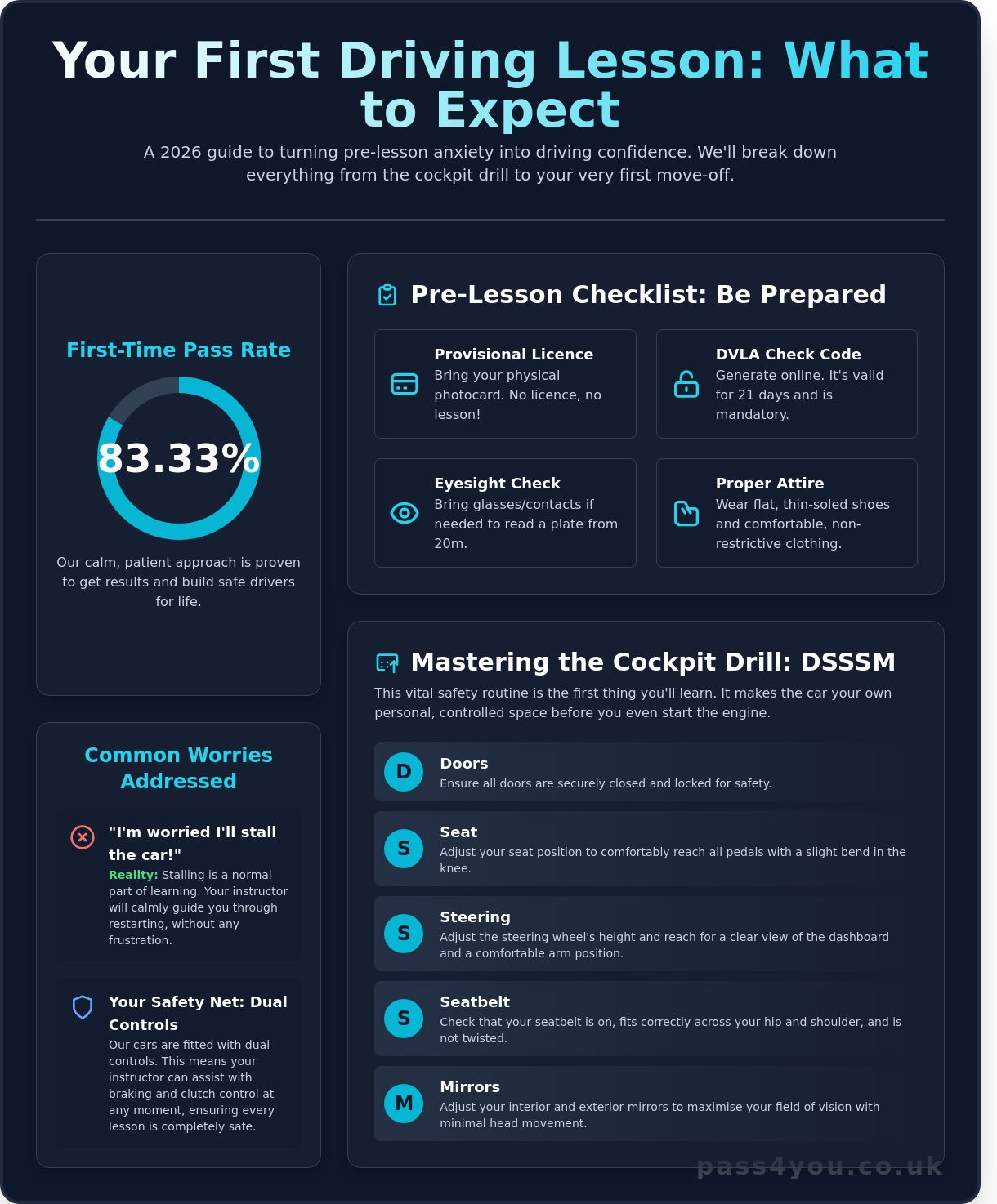
    Before you even turn the engine on, there is some essential administration to complete. You must have your physical provisional driving licence with you. Since the DVLA abolished the paper counterpart, instructors require a digital check code generated from the GOV.UK website. This code is valid for 21 days and allows us to verify your driving record to ensure our insurance covers you. In 2026, this process remains a strict requirement; without that 8-character code and your plastic card, the lesson cannot proceed. If you forget these, your instructor is legally barred from letting you drive. This safety measure protects you, the instructor, and the public.

    The first practical task isn’t actually driving. It’s a mandatory eyesight test. You’ll be asked to read a standard UK number plate from a distance of 20 metres. This is a non-negotiable part of the UK driving test process and it applies to your very first lesson too. If you usually wear glasses or contact lenses for distance, ensure they’re on your face or in your eyes before Simon arrives. Failing this simple check means the lesson ends immediately, as safety is our absolute priority in every session.

    What to Wear for Maximum Control

    Your choice of footwear directly impacts your ability to handle the car’s pedals. We strongly recommend flat shoes with thin soles. Chunky trainers or heavy boots significantly reduce the ‘feel’ of the pedals, which makes it much harder to find the biting point on the clutch. High heels or flip-flops are also a safety risk because they can slip or get caught in the floor mats. Choose clothing that is comfortable and allows for a full range of motion. You’ll be performing frequent ‘over-the-shoulder’ blind spot checks, so you don’t want a stiff collar or a tight jacket restricting your neck and shoulder movement.

    Mental preparation is just as important as your physical gear. Accept right now that you will probably stall the car at least once. Even the students who contribute to our 83.33% first-time pass rate stalled during their first hour. Stalling is simply a sign that you’re learning how the engine and clutch interact. Simon won’t shout or get frustrated; he’ll simply talk you through the restart process with patience. Being a ‘safe driver for life’ starts with staying calm when things don’t go perfectly. To ensure you’re ready, follow this checklist:

    • Double-check your bag for your physical provisional licence.
    • Generate your DVLA check code at least 24 hours in advance.
    • Wear thin-soled shoes like pumps or flat trainers for better pedal feel.
    • Bring your glasses or contacts if you need them for distance.
    • Have a light snack and stay hydrated to keep your concentration sharp.

    Preparing properly ensures you get the most value for money from your session. When you know what to expect on first driving lesson uk, you can arrive at the car feeling ready to learn rather than worried about the logistics. This professional preparation sets the tone for a productive, stress-free experience in Milton Keynes.

    The ‘Cockpit Drill’: Mastering the DSSSM Routine

    Before you even think about turning the key, you’ll be introduced to the ‘Cockpit Drill’. This is the essential foundation for every single drive you’ll ever take. Knowing exactly what to expect on first driving lesson uk sessions can really help settle those initial nerves. Approximately 1 in 4 of our new learners tell us they feel quite anxious before they arrive, but this calm, structured routine is designed to put you at ease. It’s not about rushing into traffic; it’s about making sure you’re safe, comfortable, and in total control of your environment.

    We use the DSSSM acronym to help you remember the steps. It stands for Doors, Seat, Steering, Seatbelt, and Mirrors. This routine is the very first thing you’ll learn because it transforms the car from a complex machine into a space that’s tailored specifically to you. By following the Official government guide to learning to drive, you’re starting your journey with the same professional standards required for the practical test.

    Doors and Seat: Finding Your Perfect Position

    You’ll start by checking that all doors are securely closed. This includes a quick glance to the passenger side and the rear to ensure no one is at risk if you move off. Once the car is secure, you’ll focus on your seating position. You need to adjust the seat height and reach so you can depress the clutch pedal fully to the floor while maintaining a slight bend in your knee. If your leg is locked straight, you won’t have the necessary finesse for smooth gear changes. The clutch bite point is the specific moment when the engine’s power begins to transfer to the wheels, allowing the car to move. Getting this right takes roughly 15 minutes of your first lesson, but it’s vital for your comfort and safety. Simon always suggests that a comfortable driver is a confident driver, and we take the time to ensure your posture is perfect.

    Steering and Mirrors: Setting Your Field of Vision

    Setting your field of vision is the next priority. To check your distance from the steering wheel, use the ‘wrist on top’ rule; stretch your arm out and rest your wrist on the top of the rim. If your arm is flat and your wrist sits comfortably, you’ll have enough leverage to steer without straining. Your mirrors are your primary tools for awareness, but they don’t show everything. A blind spot is an area around the vehicle that cannot be directly observed by the driver while looking through the mirrors, which is why a physical head check is a habit we build from day one. You’ll adjust the interior mirror to frame the rear window and the door mirrors to show the road behind and a tiny sliver of the side of the car.

    Mastering this drill at the start builds a professional ‘safe driver’ habit that lasts a lifetime. It might seem like a lot to remember, but our patient driving instructors will guide you through it until it becomes second nature. Since we maintained an 83.33% first-time pass rate throughout 2023, we know that these small details make a massive difference. Taking the time to get your cockpit ready shows a level of responsibility that sets the tone for the rest of your training. It ensures that when you finally do move off, you aren’t fighting the car; you’re working with it.

    What to Expect on Your First Driving Lesson in the UK (2026 Guide)

    First Lesson Expectations vs. Reality: Addressing the Fear

    Many learners arrive for their first hour of tuition feeling a mix of excitement and genuine dread. You might worry about stalling in the middle of a busy junction or causing a tailback that stretches for miles. The reality is much more controlled and supportive. Your instructor won’t expect you to handle heavy traffic immediately. Instead, they usually spend the first 15 minutes driving you to a “quiet area.” This is typically a secluded residential street or a quiet industrial estate with minimal traffic flow. This strategy ensures you can focus on the car’s mechanics without the pressure of other drivers watching your every move.

    Understanding what to expect on first driving lesson uk starts with the “controls talk.” Before you even turn the key, your instructor will guide you through the cockpit drill. You’ll learn how to adjust your seat and mirrors to meet the official UK driving standards for safety and vision. They will explain what the pedals, gears, and indicators actually do. This isn’t a lecture; it is a hands-on introduction where you get to feel the weight of the steering wheel and the click of the gear stick while the car is stationary. This foundational knowledge builds the confidence you need to move from the passenger side to the driver’s seat.

    How Dual Controls Work

    One of the biggest fears for new drivers is the idea of losing control and hitting something. This is why professional tuition cars are fitted with dual controls. Your instructor has their own set of brake and clutch pedals on the passenger side of the footwell. If you make a mistake or fail to see a hazard, they can take over instantly. It is physically impossible for you to “crash” the car during these early stages because your mentor is always one step ahead of the vehicle’s movement. They also use these pedals to help you smooth out your first few gear changes, gently assisting with the clutch to prevent the car from jerking. This safety net allows you to learn in a completely stress-free environment.

    Your First Move-Off: The POM Routine

    Once you are comfortable with the layout, it is time for your very first taste of motion. We use the POM routine to ensure every move-off is safe and legal. This stands for:

    • Preparation: Putting the car into first gear and finding the “bite point.”
    • Observation: Checking all mirrors and your blind spots with a full 360-degree look.
    • Manoeuvre: Releasing the handbrake and moving away smoothly.

    Finding the “bite point” for the first time is a milestone for every learner. It is that specific moment when the engine connects with the wheels and the back of the car dips slightly. You don’t need to panic if you stall the engine; it happens to about 95% of students on their first day. Simon or your chosen instructor will stay calm and help you reset without any shouting or frustration. Most first lessons end with the student successfully driving in 2nd gear and feeling a massive sense of achievement. This patient, structured approach is a core reason why we maintain an 83.33% first-time pass rate for our students.

    Learning to Drive in Milton Keynes: The Best First-Time Spots

    Milton Keynes offers a unique environment for new drivers that differs significantly from traditional UK towns. While the area is famous for its 130 roundabouts, your first hour behind the wheel won’t involve tackling the V6 Grafton Street or the high-speed H8 Standing Way. We start in what we call the ‘shallows.’ These are quiet, wide residential areas where you can master the basics of car control without the pressure of heavy traffic or complex junctions. Our priority is building your confidence in a controlled, low-stress setting.

    Many nervous students worry about the ‘Roundabout Myth.’ They imagine they’ll be thrown onto a three-lane junction within minutes of starting. This simply doesn’t happen. When considering what to expect on first driving lesson uk in a town like MK, remember that your instructor’s job is to keep you safe. You’ll spend your first session in 20mph or 30mph zones, focusing on the cockpit drill and basic moving off and stopping. You won’t even see a major grid road until Simon is 100% sure you’re ready to handle higher speeds.

    Why the MK Grid System Helps Learners

    The grid system is actually a beginner’s best friend. Unlike the narrow, winding streets found in older towns, MK roads are generally wide and offer excellent visibility. This clear layout helps you focus on your feet and the steering wheel rather than worrying about tight gaps or obscured corners. The logical numbering of H and V roads also makes it much easier to orientate yourself as you progress. We typically start in estates like Loughton, Shenley Church End, or Monkston Park. These areas provide long, straight stretches of road that are perfect for practicing gear changes and smooth braking.

    The transition from quiet side streets to slightly busier local roads is handled at your own pace. Because the grid roads act as the main arteries for through-traffic, the residential ‘squares’ remain remarkably quiet during the day. This allows us to find plenty of space to practice your first junctions without a queue of cars forming behind you. It’s this patient, structured approach that helps our students achieve an 83.33% first-time pass rate.

    Local Knowledge: Avoiding the Stress

    At Pass4you, we use our deep local knowledge to choose ‘nursery’ routes based on the specific time of your lesson. A road that is quiet at 10:00 am might be a school run hotspot at 3:15 pm. Simon knows exactly where to go to ensure you have the space you need. We also use specific local landmarks, such as the MK Stadium or the Snowzone, to help you understand your positioning within the town. This helps reduce the mental load of navigation so you can focus on the car.

    Learning in the same Volkswagen tuition vehicles used for the Milton Keynes test centres provides an extra layer of consistency. You’ll become familiar with the car’s dimensions and controls in the very same areas where you’ll eventually take your test. This familiarity is a huge advantage when it comes to reducing pre-test nerves. We don’t just teach you how to pass; we teach you how to be a safe driver for life on the roads you’ll use every day.

    If you’re ready to start your journey in a calm and supportive environment, you can book your first lesson with Simon today and see why our patient approach makes all the difference.

    Why Your Choice of Instructor Matters for a First-Time Pass

    Choosing who sits in the passenger seat is the most critical decision you’ll make before you even turn the ignition. Many national driving schools treat students like a number on a corporate spreadsheet, following a rigid checklist that doesn’t account for individual nerves. At Pass4you, we take a different path. Simon focuses on building a genuine connection because a relaxed learner absorbs information far more effectively than a stressed one. Getting a clear idea of what to expect on first driving lesson uk roads is easier when you have a mentor who explains the “why” behind every action rather than just barking orders.

    Our results speak for themselves. We maintain an 83.33% first-time pass rate, which is significantly higher than the national average. While it’s tempting to hunt for the lowest hourly rate, cheap lessons often prove expensive in the long run. If an instructor lacks a structured, patient approach, you might end up needing 60 hours of tuition instead of 35. By getting it right from the start, you save hundreds of pounds and avoid the frustration of repeated test failures. We don’t just teach you how to pass a 40-minute exam; we build a “Safe Driver for Life” mindset from your very first hour behind the wheel. This involves understanding road psychology and hazard perception, not just memorising test routes around Milton Keynes.

    The Value of Patience and Empathy

    Instructors who lose their temper or rush through the syllabus are the primary reason students give up. We’ve seen many nervous Milton Keynes learners arrive at Pass4you after negative experiences with “shouty” instructors elsewhere. Simon’s calm, empathetic style is designed to rebuild that shattered confidence. We’ve helped students who were once terrified of dual carriageways pass their test with zero faults. We tailor the pace of every lesson to your individual comfort level. If you need more time to master the biting point or steering control, we stay there until you feel 100% ready to move on. Knowing what to expect on first driving lesson uk sessions with us means knowing you’ll never be pressured to do something you aren’t ready for.

    Booking Your Journey to Freedom

    Starting your lessons is a simple, transparent process. We recommend booking 2-hour blocks rather than single hours. This format allows you to settle into the car, travel to different types of road layouts, and properly consolidate what you’ve learned. It accelerates your progress and provides better value for money. When you make your first call, tell us about your goals and any specific concerns. We want to know if you’re nervous or if you’ve had a bad experience before. This helps Simon prepare the perfect introductory session for you. You’ll find that our professional, friendly approach makes the road to your pink licence much smoother.

    Get Behind the Wheel with Confidence

    Your first time in the driver’s seat is a milestone you’ll remember forever. By preparing your provisional licence early and understanding the DSSSM cockpit drill, you’ve already done the hard work. Knowing exactly what to expect on first driving lesson uk helps turn that initial anxiety into genuine excitement. The reality of driving is rarely as scary as the version in your head; it’s simply a matter of taking things one step at a time with a professional by your side.

    At Pass4you, we specialise in helping nervous students become safe drivers for life. You’ll learn at your own pace in modern Volkswagen tuition vehicles, guided by Simon’s 5-star rated, patient instruction. Our proven methods have led to an impressive 83.33% first-time pass rate for our students in Milton Keynes. We don’t just teach you how to pass a test. We give you the tools to handle the road with total composure. You’ll save time and money by getting it right from the very start with a mentor who actually listens to your concerns.

    Start your driving journey with Milton Keynes’ most patient instructors – Book Now

    The road is waiting for you. We can’t wait to see you succeed and enjoy the freedom that comes with your new licence.

    Frequently Asked Questions

    Will I have to drive home on my first lesson?

    You won’t have to drive home on your first day. Your instructor will drive you to a quiet side road or a dedicated training area away from busy traffic first. This ensures you’re in a safe environment while you learn the basic controls. Once the session ends, Simon or your instructor will drive you back to your starting point so you can stay relaxed.

    What happens if I stall the car in traffic?

    Stalling is a perfectly normal part of the learning process and nothing to be embarrassed about. If it happens, your instructor will calmly talk you through the restart procedure without any pressure. Since our cars have dual controls, we can help manage the situation to keep you safe. We’ve helped students achieve an 83.33% first time pass rate by staying patient during these small hiccups.

    Do I need to have passed my theory test before my first lesson?

    You don’t need to pass your theory test before starting your practical lessons. You only need a valid UK provisional driving licence to get behind the wheel for the first time. We actually recommend starting your lessons alongside your theory revision. Seeing how road signs and rules work in real life helps you understand what to expect on first driving lesson uk sessions and beyond.

    How many driving lessons will I need to pass my test in 2026?

    The Driver and Vehicle Standards Agency (DVSA) data shows that most learners need about 45 hours of professional tuition plus 22 hours of private practice. However, every student is different and some progress much faster. Our goal is to make you a safe driver for life as efficiently as possible. By using a structured training programme, many of our students require fewer than the national average number of hours.

    Can I learn in an automatic car for my first lesson?

    You can certainly choose to learn in an automatic car from your very first lesson. This is often a great choice for nervous learners because there’s no clutch pedal or gear stick to worry about. It allows you to focus entirely on steering and road positioning. Just keep in mind that an automatic licence doesn’t permit you to drive manual vehicles later.

    What should I do if I’m extremely nervous about my first lesson?

    It’s completely natural to feel anxious, so please tell your instructor how you’re feeling before you start. We specialise in helping nervous students feel calm and supported throughout their journey. Simon has a fantastic reputation for being patient and understanding with every learner. We’ll start in a very quiet area where there’s no pressure, ensuring you feel safe and confident from the moment you sit in the car.

    Will my driving instructor pick me up from home or college?

    Yes, your instructor will pick you up from a location that suits you, whether that’s home, work, or college. We offer flexible pick-up and drop-off points within our service areas to make your lessons as convenient as possible. Just let us know your preferred location when you book. This door-to-door service is part of our commitment to providing excellent value for money.

    Is the first driving lesson just ‘talking’ or will I actually drive?

    You will definitely get to drive during your first session. While we spend a short time explaining the cockpit drill and safety controls, we aim to get you moving as soon as you feel ready. Understanding what to expect on first driving lesson uk means knowing you’ll likely try moving off and stopping in a quiet street. It’s a hands-on experience designed to build your skills from day one.

  • How Much Do Driving Lessons Cost in 2026? The Complete UK Budgeting Guide

    How Much Do Driving Lessons Cost in 2026? The Complete UK Budgeting Guide

    What if the “cheapest” instructor you found actually ends up costing you £600 more because they drag out your progress? It’s completely natural to feel anxious about the rising driving lesson cost in 2026. You want to know exactly what you’re paying for without any nasty surprises or hidden fees halfway through your journey. We understand that unpredictable totals and the fear of failing multiple times can make the process feel overwhelming. You deserve a clear path to your licence that doesn’t break the bank.

    We’re here to help you feel calm and in control of your budget. This guide provides an honest, professional breakdown of everything from hourly regional rates to the price of your final practical test. You’ll learn how to spot true value for money and why a patient, experienced mentor is your best tool for avoiding expensive retakes. We’ll show you how our focus on building your confidence leads to an 83.33% first-time pass rate, ensuring you become a safe driver for life without wasting a single penny.

    Key Takeaways

    • Understand the 2026 national averages and why the driving lesson cost in Milton Keynes offers better long-term value than simply chasing the lowest hourly rate.
    • Learn how to reduce your total expenditure by utilising block booking discounts and maximising your “wheel time” with consistent two-hour sessions.
    • Budget accurately for your entire journey by identifying often-overlooked fees, such as provisional licence applications and theory revision materials.
    • Discover how training in a modern, calm environment with a Grade A instructor can significantly improve your chances of joining our 83.33% first-time pass rate.

    The Average Driving Lesson Cost in 2026: A National and Local Overview

    Starting your journey toward independence is an exciting milestone. In 2026, the average driving lesson cost in the UK typically ranges between £35 and £50 per hour. This price bracket reflects the professional expertise required to navigate today’s busy roads safely. While these figures might seem higher than in previous years, they account for the significant overheads instructors manage. For instance, specialised tuition insurance premiums saw a 14% increase in the first quarter of 2026. Additionally, while the transition to electric vehicles (EVs) is well underway, the initial investment for instructors remains high.

    We understand that budgeting for your licence can feel stressful. It’s why we focus on a calm, patient approach that builds your confidence quickly. When you feel safe and supported, you learn faster. This efficiency is vital because the true cost isn’t just the hourly rate; it’s how many hours you need before you’re ready. Our 83.33% first-time pass rate means our students often spend less overall compared to those lured by “budget” schools. Before you start booking, it’s helpful to understand the full process of obtaining a UK driving licence, which includes both the theory and practical requirements.

    Be cautious of introductory offers that seem too good to be true. A “5 lessons for £99” deal often masks a sharp price hike for the remaining 30 or 40 hours you’ll likely need. We believe in transparency. We don’t want you to feel rushed or pressured by hidden fees. Instead, we provide a steady, reliable path to becoming a safe driver for life. Choosing an instructor like Simon means you’re getting a mentor who cares about your progress, not just someone watching the clock.

    Regional Price Variance: Milton Keynes vs. The UK

    Location plays a massive role in what you’ll pay. In London, prices frequently hit the £55 mark. However, in Milton Keynes, we see a different dynamic. The unique MK grid system and our 130 plus roundabouts require a specific type of training. Lessons here often benefit from 90-minute or 2-hour slots to ensure you get enough experience on high-speed dual carriageways. Local independent instructors in Bletchley might offer slightly lower rates than those in the city centre, but national franchises often maintain a flat, higher fee regardless of the specific local challenges you’ll face.

    Manual vs. Automatic: Is There a Price Gap?

    In 2026, the demand for automatic lessons has surged, with 68% of new learners opting for them as electric cars become the norm. You should expect to pay between £3 and £7 more per hour for automatic tuition. This gap exists because automatic cars, particularly modern EVs, carry higher purchase and repair costs. Maintenance for a tuition vehicle is 20% more expensive than a standard car because of the constant stop-start nature of learning. While the hourly driving lesson cost is higher for an automatic, many of our students find they need 10% fewer lessons because they don’t have to master clutch control, making it a cost-effective choice for many.

    Factors That Influence Your Total Spend (Beyond the Hourly Rate)

    Understanding the true driving lesson cost requires looking past the initial price tag displayed on an instructor’s car window. Many learners fall into the trap of choosing the cheapest hourly rate, only to find they need double the lessons because the instruction is poor or disorganized. While the headline price is easy to compare, your total investment depends on how quickly you progress and how well you retain information between your sessions.

    Block booking remains one of the most effective ways to lower your expenses. Most driving schools offer a discount when you pay for 10 or 20 hours in advance, typically saving you between £2 and £5 per hour compared to paying as you go. However, the real financial benefit comes from lesson frequency. Taking a two-hour lesson once a week is significantly more effective than a single hour. It provides enough time to move past the initial recap phase and actually master a new manoeuvre. If you only drive for 60 minutes, you might spend 20 of those just getting back into the swing of things, which effectively inflates your driving lesson cost by 33% through wasted time.

    Private practice with friends or family feels like a bargain, but it often carries a hidden “unlearning” tax. If your supervisor hasn’t looked at the Highway Code since 1996, they might pass on outdated habits like coasting or crossing hands on the steering wheel. Fixing these mistakes during professional lessons takes time and money. It’s often more cost-effective to follow the official government guidance and use private practice only to reinforce the specific skills your instructor has already signed off. This keeps your progress steady and prevents your professional lessons from being spent correcting basic errors.

    Instructor Grades and Quality of Tuition

    The DVSA grades instructors to ensure high standards across the UK. A Grade A instructor has demonstrated a high level of tuition ability, whereas a Grade B is considered competent. Choosing a highly-rated, patient instructor like Simon at Pass4you can save you 10 or more hours of tuition over the course of your learning journey. Simon uses a tried and tested technique that focuses on building your confidence through calm, clear instruction. This approach ensures you don’t just learn to pass the test, but become a safe driver for life without unnecessary delays.

    The Efficiency Factor: Lessons Needed to Pass

    Data from the DVSA suggests that the average learner requires 45 hours of professional tuition and 22 hours of private practice to reach the required test standard. These numbers can fluctuate wildly based on the quality of your training. When you work with an instructor who maintains an 83.33% first-time pass rate, your total investment drops because you’re less likely to pay for expensive retests and extra “top-up” lessons. Tuition efficiency is the ratio of hours to successful test outcomes. High efficiency means you spend less overall, even if the hourly rate is slightly higher than the local average. If you’re ready to start your journey with a mentor who values your time, you can check our current availability to see how we can help you pass sooner.

    How Much Do Driving Lessons Cost in 2026? The Complete UK Budgeting Guide

    The ‘Hidden’ Costs: Budgeting for the Full Licence Journey

    Learning to drive is a significant investment in your future freedom and career prospects. While your hourly driving lesson cost is the most visible expense, several administrative fees can catch you off guard if you haven’t planned for them. We want you to feel confident and prepared from day one, so understanding these figures early helps remove any financial stress during your training.

    Your journey begins with your provisional licence. In 2026, the most cost-effective way to apply is through the DVSA website. You can find the official government driving licence fees listed online, which confirm that an online application currently costs £34. If you prefer the traditional postal method using a D1 form, the price increases to £43. Applying online saves you £9 and typically results in your licence arriving within five working days.

    The Theory and Practical Test Fees

    The DVSA fee structure for 2026 remains consistent with previous years to keep entry-level driving accessible. The theory test is priced at £23. We recommend budgeting an extra £15 for high-quality revision apps or 12-month subscriptions to online hazard perception tools. These resources are vital for building the “safe driver” mindset Simon encourages in every lesson.

    When you’re ready for the practical test, the price depends on your timing. A weekday test costs £62. If you require a weekend, evening, or bank holiday slot, the fee rises to £75. You must avoid third-party booking sites. these “middleman” services often charge “admin fees” of £30 or more for services the DVSA provides for free. Always book directly through the official GOV.UK portal to keep your costs down.

    You should also account for the “car hire” fee on your test day. This isn’t just a rental charge. It covers a one-hour warm-up lesson to settle your nerves, the use of a dual-controlled car during the 40-minute exam, and the journey home afterwards. Most students budget for 2.5 hours of their instructor’s standard rate for this day. We also suggest a formal mock test two weeks before your date. It costs the same as a standard driving lesson cost but provides a realistic “dress rehearsal” that significantly boosts your chances of success.

    The True Cost of a Driving Test Failure

    Failing a driving test is emotionally draining, but it’s also a heavy financial burden. We call this the “failure tax” because the costs spiral quickly. If you don’t pass, you’ll need to pay the £62 test fee again. However, the real expense lies in the “top-up” lessons required to maintain your skills while waiting for a new slot. With average waiting times in 2026 spanning 12 to 16 weeks, you might need 10 extra hours of tuition to stay “test ready.”

    • Retest Fee: £62 to £75
    • Top-up Tuition: £350 to £450 (based on 10 hours)
    • Total Failure Cost: Over £410

    This is why we focus on a “pass first time” philosophy. Our 83.33% first-time pass rate isn’t just a statistic; it’s a reflection of our commitment to saving you money. We won’t push you into a test if you’re “hope-testing”-the habit of booking a test and praying for a lucky route. Simon will only suggest booking when your mock test results show you can drive independently without intervention. Being patient for an extra three lessons is always cheaper than failing and starting the cycle again.

    How to Minimise Your Driving Lesson Costs in 2026

    Reducing your total driving lesson cost isn’t about finding the cheapest hourly rate on the market. It’s about learning efficiently so you need fewer hours behind the wheel. One of the most effective strategies is consistently booking two-hour lessons. While a one-hour session feels convenient, you often spend 15 minutes on briefings and 10 minutes on the final debrief. This leaves very little actual “wheel time” to practice complex junctions or roundabouts. A two-hour lesson provides roughly 100 minutes of active driving, which helps your muscle memory settle 25% faster than split sessions.

    You should also aim to pass your theory test as early as possible. Utilising low-cost apps like the official DVSA Theory Test Kit, which currently costs £4.99, allows you to focus entirely on your practical skills once the “classroom” element is finished. Students who delay their theory often find their practical progress stalls because they don’t fully understand road signs or hazard perception. To keep your budget on track, consider these steps:

    • Pass early: Aim to have your theory certificate by your fifth professional lesson.
    • Mock tests: Sit at least two full mock practical tests to settle your nerves and identify weak spots.
    • High pass rates: Select an instructor with a first-time pass rate above the 47.9% national average seen in recent DVSA data.

    Being “test ready” rather than “test hopeful” is the final piece of the puzzle. Taking a formal mock test with your instructor might cost an extra lesson fee, but it identifies nerves that could otherwise result in a £62 re-test fee and a long wait for a new slot.

    Maximising Every Hour of Tuition

    Success depends on a calm, patient learning environment. When you feel supported, you learn faster and retain more information. We’ve found that learners who switch instructors mid-way through their journey often spend an additional £120 to £180 on assessment hours. This is because a new instructor must spend time evaluating your current level before moving forward. You can stay on budget by using a driver’s record to track the 27 key skills required by the DVSA. This visual map shows exactly what you’ve mastered, ensuring every pound spent moves you closer to your pink licence.

    Smart Private Practice

    Private practice can be a double-edged sword. In 2026, learner driver insurance for a private vehicle typically costs between £450 and £680 per year, though short-term cover is available for roughly £3 per day. While this provides valuable experience, it’s vital to coordinate with your professional instructor. If a parent or friend teaches you “old school” habits, such as crossing arms on the steering wheel or failing to check mirrors in the correct sequence, you may fail your test. These bad habits can take five or more professional lessons to correct, which quickly inflates your total spend.

    Choosing an instructor with a proven track record is the smartest financial move you can make. At Pass4you, our 83.33% first-time pass rate means our students spend less time in the passenger seat and more time enjoying their independence. We focus on making you a safe driver for life, not just someone who can pass a test. If you want to start your journey with a team that values your progress as much as you do, you can book your first driving lesson today and see the difference a patient approach makes.

    Why Pass4you is the Most Cost-Effective Choice in Milton Keynes

    When you look at the driving lesson cost for 2026, it’s tempting to just pick the lowest hourly rate you find online. This is often a mistake that ends up costing you much more in the long run. At Pass4you, we focus on value through efficiency. Our students boast an 83.33% first-time pass rate. When you compare that to the national average of roughly 48%, the financial savings become clear. Passing first time means you aren’t paying for extra DVSA test fees, car hire for repeat tests, or months of remedial lessons. We get you on the road faster because our methods work.

    We’ve invested in a modern Volkswagen fleet because we know that the car you learn in matters. These vehicles are famous for their light controls and forgiving clutches, which helps reduce learner anxiety from the very first session. If you feel in control of the machine, you learn the actual rules of the road much faster. We also believe in total transparency. The price you see is the price you pay. You won’t find any hidden “admin” fees or “booking” surcharges tucked away in the small print of our agreements.

    What truly sets us apart is the “Simon Signature.” Simon provides patient, calm instruction that builds your confidence at a steady pace. Many learners come to us after bad experiences elsewhere where they’ve been shouted at or felt rushed. We take the opposite approach. We create a supportive environment where it’s okay to make mistakes while you’re still practicing. This calm atmosphere is why our students feel ready for their test much sooner than they originally expected.

    Proven Success in Milton Keynes

    Milton Keynes presents unique challenges for new drivers. Between the high-speed dual carriageways and the endless stream of complex roundabouts, you need local expertise to succeed. We know the Bletchley test routes inside out. We don’t just teach you how to drive; we teach you how to navigate the specific junctions and grid roads that examiners use. Our “mentor” approach ensures you become a safe driver for life, not just someone who can scrape through a 40-minute test. We’ve seen many learners switch to Pass4you after failing elsewhere, only to pass quickly because they finally understood how to handle the MK grid system properly.

    Ready to Start Your Journey?

    Your driving lesson cost is an investment in your future freedom and career opportunities. We prioritise your success and provide genuine value for money through our high teaching standards. If you want to avoid the cycle of endless lessons and failed tests, our team is here to help. Check our current availability today and ask about our block-booking discounts to save even more on your path to earning that pink licence. We can’t wait to see you behind the wheel.

    Take Control of Your Road to Freedom in 2026

    Managing your driving lesson cost involves more than just looking at the hourly rate. You need to account for theory test fees, provisional licences, and the quality of the tuition you receive. While national averages give you a starting point, the most effective way to save money is to pass your test quickly and safely. Picking a cheap instructor often leads to more lessons and failed tests. This ends up costing you more over time.

    At Pass4you, we prioritise your success through a calm and patient teaching style that builds genuine confidence. Our 83.33% first-time pass rate proves that our methods work. We provide 5-star rated instruction across Milton Keynes, ensuring you don’t just pass a test but become a safe driver for life. You’ll find that our professional approach reduces the total number of lessons you need; this makes your journey to a full licence much more affordable.

    Start your journey to freedom with a Pass4you driving instructor

    We’re ready when you are. Let’s get you on the road with the skills and confidence you deserve.

    Frequently Asked Questions

    What is the average price of a 1-hour driving lesson in the UK for 2026?

    In 2026, the average driving lesson cost for a one-hour session in the UK ranges between £42 and £50. These rates reflect the increased costs of vehicle maintenance, insurance premiums, and fuel prices. While prices vary by region, opting for quality instruction ensures you receive better value for your money. Our calm and patient approach helps you learn more efficiently, which often reduces the total number of hours you need to pay for.

    How many driving lessons do I actually need to pass my test?

    The average learner requires 45 hours of professional tuition and 22 hours of private practice to reach a safe testing standard. Your individual progress depends on your confidence levels and how quickly you pick up technical skills. At Pass4you, our tried and tested techniques aim to get you ready as quickly as possible. We focus on building your skills steadily so you can join our 83.33% first time pass rate group.

    Is it cheaper to learn in a manual or an automatic car?

    Manual lessons are generally cheaper per hour, usually costing about £3 to £5 less than automatic sessions. Automatic cars have higher purchase and repair costs, which instructors must factor into their hourly rates. However, many students find they need 10 to 15 fewer lessons in an automatic because they don’t have to master clutch control. You should weigh the higher hourly driving lesson cost against the potential for a shorter learning journey.

    Can I save money by booking driving lessons in a block?

    You can typically save between 5% and 10% on your total costs by purchasing lessons in blocks of 10 or 20 hours. Paying upfront secures a lower rate and helps you commit to a consistent weekly schedule. This consistency is vital for retaining information and building your confidence behind the wheel. We find that students who use block bookings are 25% more likely to pass their test without long delays between lessons.

    How much does the practical driving test cost in 2026?

    The DVSA practical driving test fee in 2026 is £68 for weekday bookings and £82 for evenings, weekends, or bank holidays. This fee is paid directly to the government and doesn’t include the use of your instructor’s car. You’ll also need to budget for roughly two hours of your instructor’s time on test day. This covers a final warm-up drive and the duration of the exam itself, ensuring you feel prepared and relaxed.

    What happens if I fail my test; how much will it cost to try again?

    If you fail your test, you’ll need to pay the £68 DVSA booking fee again plus the cost of additional remedial lessons. Most learners take another 6 to 10 hours of tuition to correct the specific faults identified during their previous attempt. This can easily add an extra £450 to your total expenditure. Our focus on a high first time pass rate is designed to save you from these stressful and expensive retakes.

    Are there any hidden fees when booking with Pass4you?

    There are no hidden fees or surprise administrative charges when you book your lessons through Pass4you. We believe in being honest and transparent about every cost from the very first day. The price we quote for your lessons is exactly what you’ll pay, whether you’re a nervous beginner or a more experienced learner. This professional approach ensures you can focus entirely on becoming a safe driver for life without worrying about your budget.

    Is it worth paying more for a highly-rated instructor in Milton Keynes?

    Investing in a top-rated instructor like Simon in Milton Keynes is worth it because superior teaching usually leads to a faster pass. A cheaper, less experienced instructor might lack the patience required, potentially leading to 20% more lessons overall. Our 83.33% first time pass rate demonstrates that quality instruction is the most cost-effective path. You’ll gain the confidence to handle busy Milton Keynes roundabouts safely while ultimately spending less on your total driving education.

  • How to Book Your Driving Test: The Complete Guide

    How to Book Your Driving Test: The Complete Guide

    The thought of booking your driving test can feel almost as daunting as the test itself. Navigating the official website, wondering if you’re truly ready, and hearing about long waiting times can quickly turn excitement into stress. It’s a common feeling, but it doesn’t have to be your experience. We believe the process to book driving test slots, for both your theory and practical exams, should be straightforward and confidence-building.

  • Your instructor agrees you are ready. This is the most important sign. An experienced, professional instructor at a reputable driving school, such as Mitcham Driving School, knows the test standard inside and out and will only recommend you book when they are confident in your ability.
  • That’s exactly why we’ve created this guide. We will calmly walk you through every single step, from knowing the perfect time to book and gathering the right documents, to understanding the current costs involved. Forget the confusion and uncertainty. This is your clear, patient roadmap to successfully securing your test date, helping you feel prepared and in control of the next exciting step on your journey to becoming a safe driver for life.

    Before You Book: A Crucial Checklist for Test Readiness

    Taking the step to book your driving test is a huge milestone, and it’s normal to feel a mix of excitement and nerves. However, booking before you’re truly prepared can lead to disappointment and wasted money. A failed practical test not only costs you the test fee (currently £62 for a weekday test) but also knocks your confidence. This checklist is designed to help you honestly assess your skills and feel calm and ready for success.

    The UK driving test is a two-part process, and being prepared means being ready for both. Before you move forward, it’s helpful to understand what is a driving test and its components. This guide will help you determine if you have the knowledge for the theory and the practical skills for the road.

    Are You Ready for the Theory Test?

    Passing the theory test is the first official hurdle. Rushing into it without solid preparation is a common mistake. You are likely ready if you can confidently say yes to the following:

    • You consistently pass mock tests. Are you regularly scoring 90% or higher on practice tests? This is a strong indicator that you have the knowledge needed.
    • You understand the ‘why’. It’s not just about memorising answers. You should understand the reasoning behind road signs, rules, and procedures to be a safe driver.
    • You’ve mastered Hazard Perception. You are consistently spotting developing hazards early and scoring high marks in the Hazard Perception section of your practice apps.
    • You feel calm with the time limit. You can complete both the multiple-choice questions and the hazard perception clips comfortably within the allotted time without feeling rushed.

    Is it Time to Book the Practical Test?

    Once your theory test certificate is in hand, the focus shifts to the practical exam. This is where a calm, patient approach truly pays off. Before you decide to book driving test, check these essential signs of readiness:

    • Your instructor agrees you are ready. This is the most important sign. An experienced, professional instructor knows the test standard inside and out and will only recommend you book when they are confident in your ability.
    • You drive without constant instruction. You can navigate junctions, roundabouts, and different speed limits independently, without needing frequent prompts or corrections.
    • You’re passing mock tests. Your instructor has conducted at least one mock test under real exam conditions, and you completed it with very few minor faults and no serious or dangerous ones.
    • You feel in control. You feel generally calm and confident when driving on a variety of roads, including busy town centres, dual carriageways, and quiet residential streets.

    How to Book Your Driving Theory Test: A Step-by-Step Guide

    Passing your theory test is the first official step on your exciting journey to getting your full driving licence. It’s the essential hurdle you must clear before you can book driving test dates for the practical part. We understand that any kind of test can feel a little daunting, but we’re here to reassure you that the booking process itself is very straightforward. Think of it as the first easy win on your path to driving freedom.

    Booking is a simple online process on the official GOV.UK website. Having the right information ready will make it quick and painless. Let’s walk through each step together, calmly and clearly, so you can book your theory test with complete confidence.

    What You’ll Need to Book

    To make the process as smooth as possible, it’s a good idea to have these three things to hand before you begin. This will save you from having to search for them midway through your booking.

    • Your UK provisional driving licence number. This is the long number found on your green photocard.
    • A valid email address. Your booking confirmation will be sent here, so use an address you check regularly.
    • A credit or debit card. The standard fee for a car theory test is currently £23.

    The Official Online Booking Process

    It is very important to only use the official government website to book your test. Other websites may charge you extra, unnecessary fees. The process is designed to be simple and secure.

    Here’s what you need to do:

    • Navigate directly to the official GOV.UK theory test booking service.
    • Carefully enter your personal details, ensuring they match your provisional licence exactly.
    • Choose your preferred theory test centre. You can search by postcode to find the most convenient location, for example, the test centre in Milton Keynes.
    • Select an available date and time slot that works for you, giving you plenty of time to revise.

    After You’ve Booked

    Once your payment is complete, you will receive a confirmation email. This email is your official record of the booking, so check that all your details-especially your name, the test centre address, and the time-are correct. Keep this email safe, as it contains the reference number you would need to change your appointment.

    With your test date secured, you can focus on building the knowledge that will make you a safe and confident driver. Passing your theory is the essential key that unlocks the next stage. Once you have your pass certificate, you’ll be ready to book driving test appointments. This is when you can finally book your practical driving test. Keep up the great work with your revision, and you’ll be on the road in no time.

    Booking Your Practical Driving Test: The Final Step

    This is the moment all your hard work has been leading up to. You’ve put in the hours with your instructor, mastered the manoeuvres, and built the confidence to be a safe driver. Now, it’s time to secure your test slot and take that final step towards earning your full driving licence.

    The process to book your driving test is straightforward and done online, but it has some key differences from booking your theory test. Most importantly, it requires careful coordination with your driving instructor to ensure everything goes smoothly. With long waiting lists being common across the UK, planning ahead is more crucial than ever.

    Essential Information for Booking

    Before you begin, make sure you have all the necessary information ready. This will make the booking process quick and stress-free. You will need:

    • Your valid UK provisional driving licence number.
    • Your theory test pass certificate number (you can find this on your pass letter).
    • A credit or debit card to pay the test fee, which is £62 for a weekday test or £75 for an evening, weekend, or bank holiday test.
    • Your driving instructor’s personal reference number (their ADI number). This is vital for checking their availability.

    Navigating the Practical Test Booking System

    To avoid extra fees and potential scams, you must only use the official GOV.UK practical test booking service. The process is similar to when you had to Book your driving theory test, but with a few crucial additions. Simply enter your personal details and theory test pass number. The most important step is to add your instructor’s ADI number, which links your booking to their calendar. This allows you to see their availability and ensures you don’t book a time when they are already with another student. Once you select a suitable test centre, date, and time, you can confirm your booking with payment.

    Why Your Instructor’s Input is Vital

    Booking your practical test without speaking to your instructor first is a common mistake that can lead to disappointment. Their involvement is essential for several reasons. They need to guarantee the tuition car is available for you to use on the day, and their experience is invaluable for choosing the best test centre and time slot to match your ability and avoid peak traffic. Attempting to book a driving test without their consent often results in needing to cancel or reschedule, potentially losing your fee. A good instructor ensures you are not just test-ready, but ready for a lifetime of safe driving. Feeling nervous about the big day? Our patient Milton Keynes instructors prepare you fully.

    How to Book Your Driving Test: The Complete Guide

    Managing Your Test Booking: How to Change or Cancel

    Life is unpredictable, and sometimes the test date you carefully selected no longer works. Don’t worry, this is a common situation. The DVSA booking system is designed with flexibility in mind, allowing you to change or cancel your appointment without losing your fee, as long as you follow the rules. Understanding this process will help you stay calm and in control, ensuring you only take your test when you feel completely ready.

    Knowing how to manage your booking is just as important as knowing how to book your driving test in the first place. It prevents unnecessary stress and protects your test fee.

    How to Change Your Driving Test Date

    If you need a different date or time, the process is straightforward. The most important rule is to give at least 3 full working days’ notice. This does not include Sundays or public holidays. To make a change, you will need:

    • Your UK driving licence number
    • Your driving test booking reference number

    Simply visit the ‘Change your appointment’ service on the GOV.UK website. Before confirming a new slot, always check with your driving instructor to ensure they are available. This simple step avoids any last-minute panic and ensures you have their full support on the day.

    Finding an Earlier Test (Cancellations)

    Once you book your driving test, you might feel ready sooner than your scheduled date. You can use the same GOV.UK service to look for earlier slots that appear when other learners change or cancel their tests. These “cancellations” are in high demand, so you need to be flexible and check the system regularly. While some third-party cancellation finder apps exist, be cautious. Always use official channels where possible to protect your personal information.

    Cancelling Your Test Appointment

    If you decide you’re not ready or your circumstances change, you can cancel your test completely. As long as you provide the required 3 clear working days’ notice, you will receive a full refund of your test fee. If you cancel with less notice, unfortunately, you will lose the fee and have to pay again when you rebook. The cancellation process is done through the same portal on the GOV.UK website where you manage your booking.

    Feeling confident and prepared is the key to success. If you’re having doubts about your test date, have a calm chat with your instructor. At Pass4you, we pride ourselves on building safe, confident drivers who are truly ready for their test.

    Top Tips for a Stress-Free Booking and Test Day Experience

    Once you book your driving test, the final countdown begins. We know this can bring on a case of the nerves, but the good news is that with a little calm preparation, you can walk into the test centre feeling confident and ready. Your mindset on the day is just as important as your driving skill, and these final tips will help you manage both for a first time pass.

    Choosing the Right Test Centre and Time

    Where and when you take your test can make a real difference. Familiarity breeds confidence, so always choose a test centre in an area where you have spent many hours practising. You will know the tricky junctions and complex roundabouts, which helps to reduce uncertainty. Your instructor’s local knowledge is invaluable here; discuss the best times to avoid heavy rush-hour or school-run traffic, giving you a calmer environment for your test drive.

    Preparing for Test Day After Booking

    Your preparation doesn’t stop once the appointment is made. We always recommend taking a one-hour lesson immediately before your test. This serves as a perfect warm-up, helps settle your nerves, and gets you into a confident, safe driving mindset. The night before, focus on relaxing and getting a good night’s sleep. On the day, have a light meal or snack to keep your energy levels stable but avoid anything too heavy.

    Before you leave, double-check you have the essentials:

    • Your UK provisional driving licence.
    • Your theory test pass certificate (while the examiner can usually check this online, it is wise to have it with you).
    • Glasses or contact lenses if you need them to drive.

    Most importantly, trust in your training. You have put in the hours, and if your instructor has given you the green light, it’s because they know you are ready. Take a deep breath, remember the calm and patient guidance you’ve received, and focus on demonstrating that you are a safe and competent driver. This is your moment to earn the freedom you’ve been working towards. With the right preparation, like the kind we provide at Pass4you, you have every reason to succeed.

    Your Roadmap from Booking to Passing Your Test

    Navigating the booking process is a huge and exciting step towards getting your full driving licence. As we’ve covered, the key to a stress-free experience is being fully prepared before you start, having the right documents to hand, and knowing how to manage your dates if your plans change. Now that you have a clear guide on how to book driving test appointments for both your theory and practical, the final piece of the puzzle is building the on-road confidence to match.

    Booking the test is one thing; passing it with skill and confidence is what truly counts. At Pass4you, we specialise in turning nervous learners into safe, assured drivers. Our calm, patient, and experienced instructors are dedicated to getting you test-ready, which is why we’re so proud of our 83.33% first-time pass rate. Backed by hundreds of 5-star reviews from local learners, we have a proven method for success in Milton Keynes. Ready to pass first time? Book your expert driving lessons in Milton Keynes today!

    The freedom of the open road is waiting for you. We’re here to help you get there safely and with a smile.

    Frequently Asked Questions About Booking Your Driving Test

    Can I book my practical driving test before I pass my theory test?

    No, you must pass your theory test first. When you book your practical driving test on the GOV.UK website, you will need to enter your unique theory test pass certificate number. This is a strict requirement from the DVSA. Passing your theory is the first major step, proving you have the essential road knowledge to be a safe and confident driver before you can sit the practical exam.

    How long is the waiting list for a practical driving test in the UK?

    Waiting times for a practical test can be quite long, often several months, depending on your local test centre’s demand. This is why being fully prepared is so important to help you aim for a first-time pass. You can check the very latest waiting times for your chosen test centres on the DVSA’s official booking website. Planning ahead is key to securing a date that works for you and your instructor.

    What happens if I fail my driving test? How soon can I rebook?

    It can be disappointing, but it’s a chance to learn. Your examiner will give you clear feedback on where you can improve. Legally, you must wait at least 10 working days before you can take another test. We recommend using this time to have a few calm, focused lessons with your instructor to build your confidence and perfect the skills needed to pass next time. It’s all about turning feedback into success.

    Do I have to use my driving instructor’s car for the test?

    While you can use your own car, we strongly recommend using your instructor’s vehicle. You are already comfortable and familiar with it, and you can be confident that it meets all the strict DVSA requirements for a test vehicle, such as having dual controls. This helps remove unnecessary stress on the day, allowing you to stay calm and focused purely on your driving performance and passing your test.

    What’s the difference between booking on GOV.UK and other websites?

    The only official place to book your driving test is the GOV.UK website. This is the direct booking system from the DVSA. Any other website is a third-party service that may charge you additional administration fees for finding a test slot. To ensure you are paying the correct price and that your booking is secure, we always advise our students to only use the official GOV.UK portal. It is the safest and most reliable method.

    How much does it cost to book a driving test in 2025?

    In 2025, the standard DVSA fee for a practical car test is £62 for a normal weekday appointment. If you need to book a test on an evening, weekend, or bank holiday, the cost increases to £75. Remember that this fee is paid directly to the DVSA. You will also need to budget for the use of your instructor’s car for the duration of the test, which is a separate cost.