Tag: UK Driving Laws

  • How Long Does a Provisional Licence Last? The 2026 UK Learner’s Guide

    Did you know that while your entitlement to learn to drive technically lasts until you turn 70, the plastic card in your wallet could actually expire much sooner? Many learners ask us exactly how long does a provisional licence last because they worry a short break from the wheel might mean starting their journey all over again. It’s completely normal to feel a bit anxious about balancing the 10 year photocard life with the ticking two year clock on your theory test pass. We understand these concerns, and we want you to feel calm and in control as you work toward your independence.

    In this guide, we’ll clear up the confusion and clarify the different deadlines you need to track. You’ll discover the specific 2026 rules, how to manage renewal requirements, and the simple steps to keep your documents valid without any hidden surprises. We’ll also show you how to move forward with confidence as you prepare for your practical test on the roads of Milton Keynes. By the end of this article, you’ll have a clear timeline and the reassurance that you’re in safe, professional hands.

    Key Takeaways

    • Understand the difference between your lifelong driving entitlement and your 10-year photocard expiry to ensure you always stay legal.
    • Discover exactly how long does a provisional licence last and why the two-year theory test expiration is the most important date to track for your success.
    • Learn the simple steps to renew your licence or update your address for free, protecting yourself from unexpected fines of up to £1,000.
    • Master the essential rules for L-plates and supervision so you can focus on building your confidence behind the wheel.
    • See how easily your provisional status transitions to a full licence the moment you pass your practical test with your instructor.

    The Lifespan of a UK Provisional Licence: Entitlement vs. Photocard

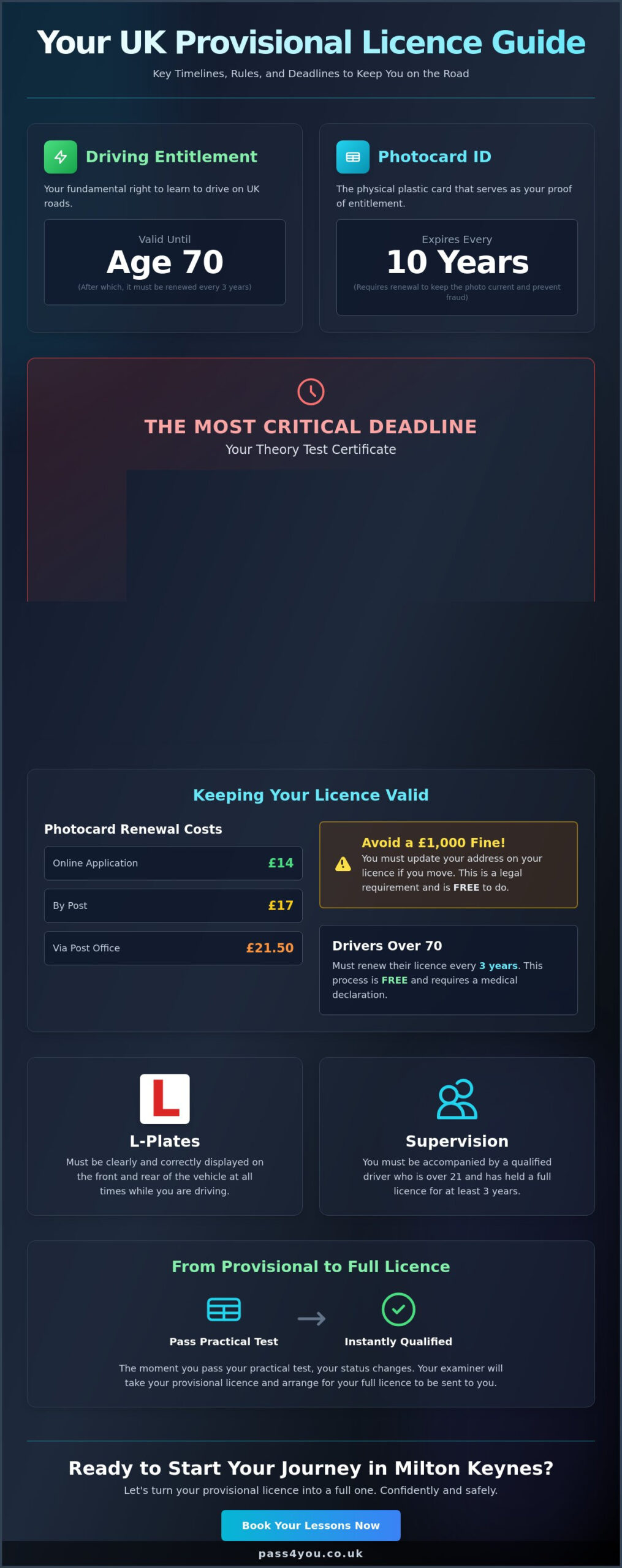
    Starting your driving journey is an exciting step toward independence, but it’s natural to feel a bit overwhelmed by the paperwork. One of the most frequent questions our students ask is how long does a provisional licence last. To put your mind at ease, your actual entitlement to learn to drive generally lasts until you reach the age of 70. This means you don’t need to worry about your progress “resetting” if you need to take a break from lessons for a few months or even a year. Your right to learn is a long-term commitment from the DVLA to you.

    However, there is a big difference between your permission to drive and the physical card in your wallet. While your entitlement is long-term, the plastic photocard itself has a shelf life. You can check this easily by looking at the front of your card. Section 4b shows the “Valid To” date, which is the day your current photocard expires. Staying aware of this date ensures you remain fully legal while practicing on the road. The Driving licence in the United Kingdom follows a strict security format to keep everyone safe, and your provisional is no exception. Understanding these dates helps you stay in control of your journey.

    The 10-Year Photocard Renewal

    The DVLA requires you to update your photocard every ten years. This isn’t because they want to test your driving again; it’s simply to ensure the photo remains a true likeness of you to prevent fraud. If you’re wondering how long does a provisional licence last in terms of the card itself, ten years is your limit. Renewing is a straightforward process. Doing it online costs £14, while applying by post is £17, or £21.50 if you use the Post Office service. We always encourage our learners to keep their documents current. Driving with an expired photocard is a serious matter, even if you’re under the supervision of a professional instructor or a family member. It can lead to fines and complications with your insurance, so it’s best to stay ahead of the deadline.

    Validity for Drivers Over 70

    The rules change slightly once you reach the age of 70. At this milestone, you must renew your licence every three years to keep your provisional status active. This renewal is completely free of charge. The process involves making a medical declaration to confirm you’re still fit to be behind the wheel. If you have specific health conditions, the DVLA might ask for more details to ensure you can drive safely. This system is designed to build confidence and ensure everyone on the road is supported. Whether you’re 17 or 70, we’re here to help you navigate these requirements so you can focus on the joy of learning to drive in a safe and supportive environment.

    The 2-Year Deadline: How Long Does a Theory Test Pass Last?

    While we’ve established that your entitlement to learn is long-term, the “working parts” of your journey have much tighter deadlines. A common source of confusion for learners is the difference between the photocard and the theory certificate. When people ask how long does a provisional licence last, they often don’t realise that their theory test pass is actually the most time-sensitive document they own. Your theory test pass certificate is valid for exactly two years from the date you passed the exam. If you don’t pass your practical driving test within those 24 months, your theory pass expires, and you’ll have to take the test again.

    The DVLA enforces this strict two-year limit to ensure that your knowledge of road signs and hazard perception remains fresh and current. Road safety laws and signage can change, so this rule guarantees that every new driver on the road has up-to-date knowledge. If your theory pass expires even a single day before your scheduled practical test, the DVSA system will automatically cancel your booking. This is why staying organised is so important for your peace of mind. If you need to check your details or renew your driving licence photocard during this time, make sure you keep your theory certificate safe as well.

    The Theory Test Expiry Countdown

    You can find the expiry date clearly printed on your theory test pass certificate. It’s a good idea to set a reminder on your phone or mark it on a calendar. We’ve seen many students feel a sense of “starting over” if they let this date slip, which can be quite discouraging. Retaking the test costs £23 and, with a national first-time pass rate of only 45%, it’s a hurdle most people prefer to clear just once. If you find yourself approaching the deadline, don’t panic. Taking a few extra driving lessons can help sharpen your skills so you’re ready to pass before the clock runs out.

    Booking Your Practical Test in Time

    Success often comes down to strategic planning. When you use the Milton Keynes Theory Test Centre, you should immediately start thinking about your practical test date. At Pass4you, we work closely with our students to align their lesson progress with their theory expiry date. This proactive approach helps you avoid the “two-year trap” where learners feel rushed or anxious as their certificate nears its end. If you are struggling to find a slot, knowing how to book a driving test efficiently is essential. Our instructors are experts at helping you build the confidence needed to meet your goals within your personal timeline, ensuring you feel supported every step of the way.
    How Long Does a Provisional Licence Last? The 2026 UK Learner’s Guide

    Renewing, Replacing, and Updating Your Provisional Licence

    Maintaining your driving documents doesn’t have to be a stressful task. Once you understand how long does a provisional licence last, the next step is knowing how to keep that information accurate. Life happens; you might move house, change your name, or even misplace your wallet. Keeping your licence current is a legal responsibility, but it’s also a simple way to ensure your journey toward a full licence remains smooth and uninterrupted. We’re here to guide you through these administrative steps with the same patience we bring to our driving lessons.

    The Online Renewal Process

    When your ten-year photocard expiry approaches, the quickest way to renew is through the DVLA’s online service. You’ll need your Government Gateway ID or a valid UK passport to verify your identity. Renewing your provisional licence online currently costs £14, which is significantly cheaper than the £21.50 fee charged at the Post Office. After you complete the application, your new licence usually arrives at your Milton Keynes address within a week. If you happen to lose your licence or it gets stolen, you can apply for a replacement online for a £20 fee. It’s a small price for the peace of mind that comes with having your documents in order.

    Keeping Your Details Current

    It’s a legal requirement to keep your address updated on your driving record. If you move to a new home, you must notify the DVLA immediately. Failing to do so can result in a fine of up to £1,000. Thankfully, you can update your address for free online, and a new licence will be sent to you. Keeping this information current is vital because your address on your licence must match your insurance records. Following the rules for learning to drive ensures you stay protected on the road. If your details are incorrect, your provisional licence uk insurance might be considered invalid in the event of a claim.

    You can also update other personal details, such as your name or gender, on your provisional record. These changes usually require you to send your physical licence back to the DVLA along with supporting documentation, such as a marriage certificate or a deed poll. There’s typically no fee for changing your name or gender unless you also want to update your photo at the same time. Taking these small steps to stay organised builds the discipline and responsibility you’ll need as a safe, independent driver. If you ever feel unsure about these requirements, your instructor is always happy to offer a reassuring word of advice during your lessons.

    While you now know how long does a provisional licence last, it’s equally important to understand the rules that keep you safe while you’re using it. Your licence is a permit to learn, and that comes with specific legal responsibilities. You must display ‘L’ plates (or ‘D’ plates in Wales) clearly on the front and rear of your vehicle whenever you’re driving. These plates aren’t just a requirement; they’re a signal to other drivers to be patient and giving as you build your skills. If you’re wondering how long does a provisional licence last in terms of its daily use, remember that the rules apply from the moment you start the engine until you pass your test.

    Supervision Standards

    The law is very specific about who can sit in the passenger seat. Your supervisor must be at least 21 years old and have held a full driving licence for at least three years. They must also sit in the front passenger seat to provide immediate support. While it’s tempting to learn with friends, a professional driving instructor in Milton Keynes provides a level of safety and structured feedback that informal practice often lacks. Remember, your supervisor must be legally fit to drive. This means they cannot be under the influence of alcohol or using a handheld mobile phone while they’re supervising you. In 2026, the government is even considering a “zero tolerance” drink-driving limit of 20mg for supervisors to ensure learner safety.

    Mastering Complex Roads

    As you progress, you’ll need to master the dual carriageway and other high-speed roads around Milton Keynes. In 2026, learners are permitted to drive on motorways in England, Scotland, and Wales, but only if they’re with an approved driving instructor in a car fitted with dual controls. This rule is designed to protect you while you gain experience in faster traffic. Practicing with family is a great way to get extra miles in, but professional tuition ensures you don’t pick up “bad habits” or outdated techniques that could lead to a test failure.

    Be aware that any penalty points you earn on your provisional licence will carry over to your full licence once you pass. Under the New Drivers Act, your licence will be revoked if you get six or more points within two years of passing your test. This would mean starting the entire process again, from your provisional application to both tests. Staying safe is about more than just passing; it’s about protecting your future freedom. Ready to start your journey with a mentor who prioritises your safety? You can book your first driving lessons with our expert team today.

    From Provisional to Full: Ending the Learner Journey in Milton Keynes

    The moment you pass your test, the question of how long does a provisional licence last becomes a memory of the past. Your green photocard has served its purpose, and it’s time for the “Pink Licence” transition. During the practical test, your examiner will ask if you’d like them to send your provisional licence away to be upgraded automatically. Most students say yes because it’s the easiest way to receive your full driving licence in the post. You’ll usually receive your new photocard within three weeks, but you don’t have to wait for it to arrive to start driving. Your examiner will give you a pass certificate, known as form DVSA 10, which acts as your temporary proof of entitlement.

    The Day of the Practical Test

    Walking into the test centre can feel nerve-wracking, but we prepare you for every detail of the process. You’ll need to hand over your provisional photocard to the examiner at the start of your practical driving test. If you pass, they will keep the green card and issue your pass certificate. This document is vital because it proves you’re a qualified driver while the DVLA processes your full licence. At Pass4you, we focus on building your confidence on the specific test routes around Milton Keynes. This local expertise ensures you feel familiar with the junctions and roundabouts you’ll face on the big day, helping you feel like you’re in safe, professional hands.

    Why Efficiency Matters

    Time management is the secret to a stress-free learning experience. As we’ve discussed throughout this guide, your theory pass only lasts for two years. If you face multiple test failures or long gaps between lessons, you risk that certificate expiring. This “theory expiry stress” is something we work hard to prevent. Our “Pass4you Method” focuses on calm, high-precision instruction that has helped us achieve an 83.33% first-time pass rate. By learning efficiently, you save yourself the time and cost of retaking tests. We believe that professional driving lessons in Milton Keynes are the best investment for your long-term freedom. Ready to swap your green licence for a pink one? Book your first lesson in Milton Keynes today!

    Take the Wheel with Confidence in Milton Keynes

    Navigating the rules of the road starts long before you turn the ignition. By understanding exactly how long does a provisional licence last, you’ve already taken a vital step toward protecting your progress and your future independence. Remember that while your entitlement is long-term, staying on top of your ten-year photocard renewal and that crucial two-year theory deadline is essential to keep your journey moving forward without any stressful resets. Staying organised means you can focus entirely on your driving skills rather than worrying about expiring paperwork.

    We’re here to make sure every mile you drive brings you closer to that pink licence. Our calm and patient instructors in Milton Keynes provide a supportive environment where you can learn at your own pace. You’ll practice in modern Volkswagen tuition vehicles, building the precise skills needed to succeed. With our proven approach, we’re proud to maintain an 83.33% first-time pass rate, ensuring you feel ready and capable on test day. Don’t let your theory certificate tick away. Your path to the open road is waiting, and we’d be honoured to guide you there. Join the 83% of students who pass first time in Milton Keynes; Book Now and start your journey with a team that truly cares about your safety. You’ve got this, and we’re with you every step of the way.

    Frequently Asked Questions

    How long is a provisional licence valid for in the UK?

    Your provisional driving entitlement is valid until you turn 70 years old. However, the plastic photocard itself must be renewed every 10 years to ensure your photo remains a true likeness. It’s important to understand this distinction when asking how long does a provisional licence last, as your right to learn doesn’t expire quickly, but your physical ID card does require regular updates.

    Do I need to renew my provisional licence if I haven’t passed my test after 10 years?

    Yes, you must renew the photocard even if you haven’t passed your driving test yet. The DVLA requires a fresh photo to prevent identity fraud and ensure your records are accurate. You don’t need to retake any tests or start your lessons over; you simply apply for a new card to keep your documents legal while you continue your journey toward a full licence.

    What happens if my theory test pass expires?

    If your theory test pass certificate reaches its two-year expiry date before you pass your practical test, you must retake and pass the theory exam again. The DVSA cannot extend this deadline under any circumstances. We recommend booking your practical test well in advance to ensure you don’t lose the progress you’ve worked so hard to achieve during your time as a learner.

    Can I still drive if I’ve lost my provisional licence photocard?

    You should not drive until you have applied for a replacement licence and have it in your possession. While your legal entitlement to drive still exists, you are required to produce your licence if asked by the police. You can order a replacement online for a £20 fee. It’s best to wait for the new card to arrive before heading out for your next lesson.

    Does a provisional licence expire at age 70?

    Your licence doesn’t automatically vanish at 70, but the renewal rules change to ensure continued safety. Once you reach this age, you must renew your licence every three years to remain a legal learner. This process is free and requires you to declare that you meet the necessary medical standards. This helps you continue learning safely with the support of your instructor.

    How much does it cost to renew an expired provisional photocard?

    Renewing an expired provisional photocard online costs £14 in 2026. If you prefer to use a paper application by post, the fee is £17, while the Post Office service costs £21.50. Keeping your licence current is a small investment that protects you from much larger fines. We always encourage our students to use the online service for the fastest and most cost-effective results.

    Can I change the address on my provisional licence for free?

    Yes, updating your address on your provisional licence is completely free when you do it through the official GOV.UK website. It is a legal requirement to keep this information current at all times. Failing to update your address could lead to a fine of up to £1,000, so it’s a simple task that’s well worth doing the moment you move to a new home.

    How long does it take for a new provisional licence to arrive?

    Most learners receive their new provisional licence within one week when applying online. Postal applications can take longer, often up to three weeks, depending on DVLA processing times. If you’ve just passed your test, your new full pink licence should arrive within three weeks. Having your documents arrive quickly helps you stay focused on your training and your goals with your mentor.
  • Puffin Crossing vs Pelican Crossing: The Ultimate Driver’s Guide for 2026

    Puffin Crossing vs Pelican Crossing: The Ultimate Driver’s Guide for 2026

    Last Tuesday, a learner in Milton Keynes slowed down for a crossing puffin, waiting anxiously for a flashing amber light that simply never appeared. If you feel a knot in your stomach every time you see a pedestrian near the kerb, you aren’t alone. It’s completely normal to feel confused by the “bird” names or worry that a simple signal error will cost you your licence. Many students find the transition from Pelican to Puffin crossings one of the trickiest parts of the practical syllabus.

    At Pass4you, Simon has helped hundreds of local students achieve our 83.33% first time pass rate by replacing that anxiety with genuine confidence. We’ll help you master the “intelligent” sensors of the Puffin crossing so you can approach every junction with a calm, focused mind. This 2026 guide explains the exact light sequences you’ll face on your Milton Keynes driving test and provides the specific visual cues to identify these crossings from over 50 yards away. You’ll move from second-guessing the signals to driving like a pro who is ready for anything the road throws at them.

    Key Takeaways

    • Understand why the modern crossing puffin is replacing older Pelican systems and how its “intelligent” sensors create a safer, more efficient environment for everyone on the road.
    • Learn how advanced kerb and crossing detectors manage traffic flow by automatically adjusting light timings based on real-time pedestrian movement.
    • Discover the crucial difference in light sequences—specifically the removal of the flashing amber phase—to ensure you react correctly and safely during your practical driving test.
    • Master the essential mirror checks and observation techniques needed to approach these crossings with the calm confidence required for a first-time pass.
    • Gain expert insights into navigating Milton Keynes’ unique grid system and complex crossings with the patient, professional guidance of Simon and the Pass4you team.

    What is a Puffin Crossing? The Modern Standard for UK Roads

    A Puffin crossing is the smart successor to the older Pelican style you might still see in some towns. It stands for Pedestrian User-Friendly Intelligent. This technology helps you stay calm and confident during your driving lessons. Since 2016, the Department for Transport has pushed for these to become the primary standard across the UK. Local councils are actively replacing older signals to reduce accidents and keep traffic moving. When you’re behind the wheel of a tuition car, seeing a crossing puffin ahead shouldn’t cause any stress; it’s there to help you.

    The Meaning Behind the Puffin Name

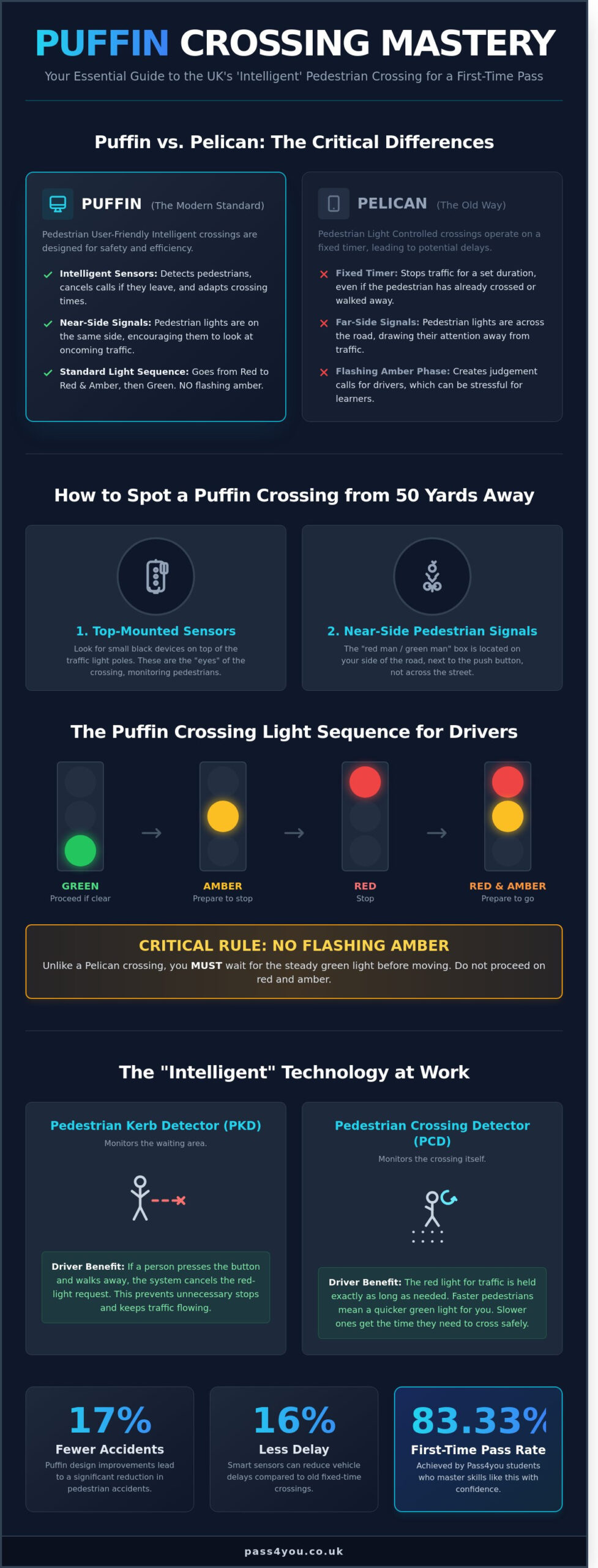
    The word “Intelligent” is the most important part for you to remember as a learner. Unlike older systems, a crossing puffin uses sophisticated infrared sensors and thermal mats to detect if someone is actually waiting. If a pedestrian presses the button but then decides to walk away or cross during a gap in traffic, the “intelligent” system cancels the request. This means you won’t be sat at a red light for no reason. It’s a system designed to respect your time and help you maintain a steady progress. Our instructors have found this predictability helps our students achieve that 83.33% first time pass rate by reducing unnecessary stops and anxiety.

    Visual Markers for Learner Drivers

    Identifying these crossings early allows you to plan your approach with ease. You can spot them by looking for two specific features:

    • Near-side signals: The “red man” and “green man” aren’t on the far side of the road. They’re located on the control box right next to the pedestrian.
    • Top-mounted sensors: You’ll see small black devices perched on top of the traffic light poles. These are the sensors that track pedestrian movement and speed.

    Because the green man is on the near side of the road, pedestrians have to look towards the oncoming traffic to see when it’s safe to cross. This design change has improved pedestrian safety significantly since its widespread rollout. As a driver, you’ll notice there’s no flashing amber phase. The lights move from red to red and amber, then green, just like a standard junction. This simplicity helps you focus on your mirrors and move off safely when the way is clear. You don’t have to worry about the tricky judgement call that comes with a flashing amber light, making your journey much smoother.

    The Technology Behind Puffin Crossings: Why Drivers Benefit

    A crossing puffin is far more advanced than the older Pelican systems you might have seen. These “Pedestrian User Friendly Intelligent” crossings use smart sensors to make decisions in real time. This technology isn’t just there for people on foot; it’s designed to keep you moving safely and reduce unnecessary stops during your driving test. Understanding how these sensors work will help you stay patient and focused on the road ahead.

    How Sensors Improve Traffic Flow

    The Pedestrian Kerb Detector (PKD) is a clever bit of kit that watches the waiting area. If a pedestrian presses the button but then decides to walk away or cross during a gap in traffic, the PKD cancels the request. You won’t have to stop at a red light for an empty pavement. This is a huge win for traffic flow in busy areas like Milton Keynes city centre, where unnecessary stops can quickly cause gridlock during peak hours.

    Once someone is actually in the road, the Pedestrian Crossing Detector (PCD) takes over. These sensors track how fast the person is moving. If an elderly person or someone with a pushchair needs extra time, the red light stays on for them. If a fast walker clears the road in three seconds, the lights change back to green much sooner. Research by the Transport Research Laboratory has shown that this intelligent timing can reduce vehicle delays by up to 16% compared to older fixed-timer crossings. It makes your journey more predictable and helps you maintain that confident driving style we help you develop in our lessons.

    Accessibility and Safety Features

    Puffin crossings are built with inclusivity in mind. Underneath the push-button box, there’s a small tactile cone. It spins when the green man appears, which is vital for visually impaired pedestrians who can’t see the signal. This feature ensures everyone stays safe without needing loud, distracting beepers that can confuse drivers at complex junctions. You’ll know the crossing is active even if you can’t hear a sound.

    You’ll also notice the signals are on the “near-side,” right next to where the person is standing. This encourages pedestrians to look towards the oncoming traffic while they wait for the signal. By keeping their eyes on the road rather than a light across the street, the risk of a pedestrian stepping out unexpectedly is significantly lower. These safety improvements contribute to the 17% reduction in pedestrian accidents often recorded when older crossings are upgraded to modern technology. This extra layer of safety gives you peace of mind as you approach a crossing puffin during your practical test.

    Puffin Crossing vs Pelican Crossing: The Ultimate Driver's Guide for 2026

    Puffin vs Pelican Crossing: Spotting the Key Differences

    When you are driving around Milton Keynes, especially near the Bletchley or Leighton Buzzard test centres, you will encounter both types of crossings. The biggest difference is how the lights communicate with you. A Pelican crossing uses a flashing amber light, while a crossing puffin uses the same sequence as a standard junction. It is much calmer for learners because you do not have to judge whether a pedestrian is still on the stripes. Our students often find this predictability helps them maintain a steady, confident pace during their practical test.

    The “Flashing Amber” Mystery Solved

    On a Pelican crossing, the flashing amber phase means you must give way to pedestrians on the crossing, but you can go if the road is clear. This often causes hesitation. Data from driving assessments suggests this phase leads to 15% more minor faults for learners who are unsure when to proceed. Puffin crossings remove this stress entirely. They follow the standard traffic light sequence: red, red and amber, then green. You simply stay stopped until the red and amber appears, which makes the crossing puffin much easier to handle when you are feeling nervous.

    Comparing the Pedestrian Experience

    You can spot the difference by looking at where the pedestrian signals are located. On a Pelican, the “green man” is on the opposite side of the road. On a Puffin, the signals are near-side, located right above the push button. This design is intentional. It encourages pedestrians to look towards the oncoming traffic while they wait for the signal.

    • Sensors: Puffins use infrared cameras to track pedestrian movement.
    • Safety: Department for Transport studies show that Puffin installations can reduce pedestrian accidents by 17% compared to older designs.
    • Efficiency: If a pedestrian presses the button but walks away, the sensor cancels the request so you do not stop for no reason.

    Milton Keynes Council has been modernising road layouts since 2016, replacing older Pelicans with smarter technology. On a typical 40 minute test route, you are 80% more likely to encounter a Puffin on modern grid roads like the V6 or H8. Understanding these sensors helps you stay patient and professional, ensuring you remain a safe driver for life.

    Approaching a Puffin Crossing: Practical Tips for Your Driving Test

    Approaching a crossing puffin requires more than just looking at the lights. It’s about anticipation and demonstrating that you’re a calm, confident driver. In Milton Keynes, where traffic can get busy around the Hub or the V6 Grafton Street, your timing must be spot on. You need to show the examiner you aren’t rattled by sudden changes in the road environment. We’ve helped hundreds of students master these situations, maintaining our 83.33% first time pass rate by focusing on these exact details.

    Observation and Mirror Work

    Check your interior and door mirrors the moment you spot the crossing ahead. This isn’t a tick-box exercise; it’s vital for safety. If you need to slow down, you must know how close the vehicle behind you is. Scan the pavement for pedestrians standing near the push-button. Since sensors control a crossing puffin, the lights stay red until the person has safely reached the other side. Don’t let a long red light make you impatient. Stay calm, keep your feet still, and wait for the green signal to appear.

    Common Practical Test Faults to Avoid

    DVSA data from the 2023/24 period shows that “response to traffic signals” remains a top 10 reason for test failure in the UK. To ensure you stay on the right side of the result sheet, watch out for these frequent errors:

    • Failing to stop on amber: if the light changes and you have enough distance to stop safely, you must do so. Don’t try to “beat” the light.
    • Creeping forward: wait for the green light. Don’t let the car roll or find the bite too early while pedestrians are still crossing.
    • Blocking the crossing: in heavy Milton Keynes traffic, only move forward if your exit is clear. Stopping on the white zigzag markings is a serious fault.

    If you’re feeling nervous about these technical parts of the test, remember that Simon is here to guide you. We focus on building your skills until these checks become second nature, making you a safe driver for life. Our patient approach ensures you won’t feel rushed or pressured during your lessons.

    Ready to build your confidence behind the wheel? Book your Milton Keynes driving lessons with Simon today and join our list of successful first-time passes.

    Mastering Milton Keynes Road Types with Pass4you

    Learning to drive in Milton Keynes presents unique challenges. From the famous H and V grid system to the high-speed roundabouts, it’s a lot to take in. At Pass4you, Simon and the team specialise in turning these complexities into second nature. We don’t just teach you how to pass. We focus on building your confidence so you feel ready for any crossing puffin or multi-lane junction you encounter. Our methods are tried and tested, resulting in an 83.33% first-time pass rate. This success comes from our patient, calm approach that prioritises safe driving for life over quick fixes. You’ll learn to anticipate traffic flow and manage the unique rhythm of MK roads with total ease.

    Patient Instruction for Nervous Learners

    Many students come to us after feeling rushed or shouted at elsewhere. Simon’s calm nature is the perfect antidote to driving anxiety. He takes the time to explain the logic behind road rules. He ensures you understand why a crossing puffin behaves differently than older systems, focusing on the sensors that keep you safe. One local student, Sarah from Bletchley, shared that she nearly gave up before finding Simon’s supportive style. We believe that when you truly understand the road, the nerves naturally fade away. We focus on value for money by teaching you correctly from day one, which often means fewer lessons in the long run.

    Local Experience Near the Milton Keynes Test Centre

    Our lessons are specifically tailored to the routes used by the Milton Keynes Test Centre. We spend time practising at the exact crossings and roundabouts you’ll face on your big day. This isn’t just about memorising routes. It’s about developing the skills to handle the specific challenges of MK driving, like the busy dual carriageways and pedestrian-heavy areas near the shopping centres. By familiarising yourself with these local hotspots, you’ll feel like a pro when the examiner asks you to follow the road ahead. You can book your first lesson with Pass4you today and start with confidence. We’ll help you master every grid road and crossing with ease, ensuring you’re a safe driver for life.

    Master Every Pedestrian Crossing With Confidence

    Understanding the smart technology behind a modern crossing puffin is a vital step toward becoming a safe, independent driver. These intelligent systems use infrared sensors to manage traffic flow, removing the confusion of the old-fashioned flashing amber lights found at Pelican crossings. When you’re on your driving test, reacting correctly to these signals shows the examiner you have the high-level observation skills required for UK roads in 2026.

    Learning to navigate busy Milton Keynes junctions doesn’t need to be a source of anxiety. We focus on building your skills through calm and patient instruction, ensuring you feel completely at ease behind the wheel of our modern Volkswagen tuition vehicles. Our proven methods have led to an 83.33% first-time pass rate, helping hundreds of local students trade their L-plates for total freedom. You’ve got the theory down; now it’s time to put it into practice with a mentor who actually listens and understands your concerns.

    Start your journey to a first-time pass with Simon at Pass4you

    We’re ready to help you gain the skills and confidence you need to stay safe on the road for life.

    Frequently Asked Questions

    Does a Puffin crossing have a flashing amber light?

    No, a Puffin crossing does not have a flashing amber light. It uses the standard traffic light sequence where red is followed by red and amber together. This is a key difference from the older Pelican crossing which many learners find confusing. Our students prefer the Puffin because it mirrors the traffic lights you see at every major junction in Milton Keynes, making it much more predictable for new drivers.

    How can I tell if I am at a Puffin or a Pelican crossing from a distance?

    You can identify a Puffin crossing from a distance by looking for where the “green man” signal is located. On a Pelican crossing, the lights are on the far side of the road. On a Puffin crossing, the pedestrian signal is located on the near-side control box right next to the person waiting. This design encourages pedestrians to look towards oncoming traffic while waiting for the signal to change, which is much safer for everyone.

    Can I drive through a Puffin crossing if the pedestrian has finished crossing but the light is still red?

    No, you must never drive through a red light even if the pedestrian has reached the pavement. A red light at a crossing puffin is a mandatory stop signal until it changes to green or red and amber. Driving through a red light is a serious offence that can lead to 3 penalty points and a fine of £100. Always wait for the lights to change to ensure you stay safe and keep your licence.

    Why are Puffin crossing lights on the near-side of the road?

    Puffin crossing lights are on the near-side to improve pedestrian safety by forcing users to look at oncoming traffic while they wait for the signal. This positioning also helps people with limited vision who might struggle to see lights across a wide road. Since their introduction in 1992, this layout has helped reduce pedestrian accidents by 17 percent according to Department for Transport studies. It keeps everyone focused on the road environment.

    What happens if the sensors on a Puffin crossing stop working?

    If the sensors on a Puffin crossing fail, the system is designed to revert to a fixed timing cycle similar to a standard traffic light. This ensures the crossing remains functional even if the infrared or pressure sensors stop detecting movement. If you notice a crossing is behaving strangely, it’s best to treat it with extra caution and stay patient. Our instructors often remind students that being observant is the best way to handle technical glitches.

    Is it an automatic fail to go through an amber light at a Puffin crossing?

    Going through an amber light is not always an automatic fail, but it depends on your speed and distance from the line. You must stop at amber unless you have already crossed the stop line or are so close that stopping might cause an accident. In a driving test, failing to stop when it was safe to do so will result in a serious fault. Over 45 percent of test failures are linked to junction and signal errors, so keep a calm approach.

    What is the difference between a Toucan crossing and a Puffin crossing?

    The main difference is that a Toucan crossing allows both pedestrians and cyclists to cross together without dismounting. You can remember this because “two-can” cross. A crossing puffin is designed specifically for pedestrians and uses smart sensors to manage the light timings. Toucan crossings are often wider to accommodate bicycles and are frequently found on designated cycle routes or near parks where people are more active.

    Are Puffin crossings safer for pedestrians than Zebra crossings?

    Puffin crossings are generally considered safer than Zebra crossings because they use traffic signals to stop vehicles. While a Zebra crossing relies on drivers spotting pedestrians and stopping, a Puffin crossing uses infrared sensors to ensure the lights stay red until the person has safely reached the other side. Statistics from 2023 show that signal-controlled crossings have lower accident rates on busy roads with speeds over 30mph. They provide a more confident experience for both drivers and walkers.