Tag: saving money

  • Black Box Insurance Explained for New Drivers in Milton Keynes (2026 Guide)

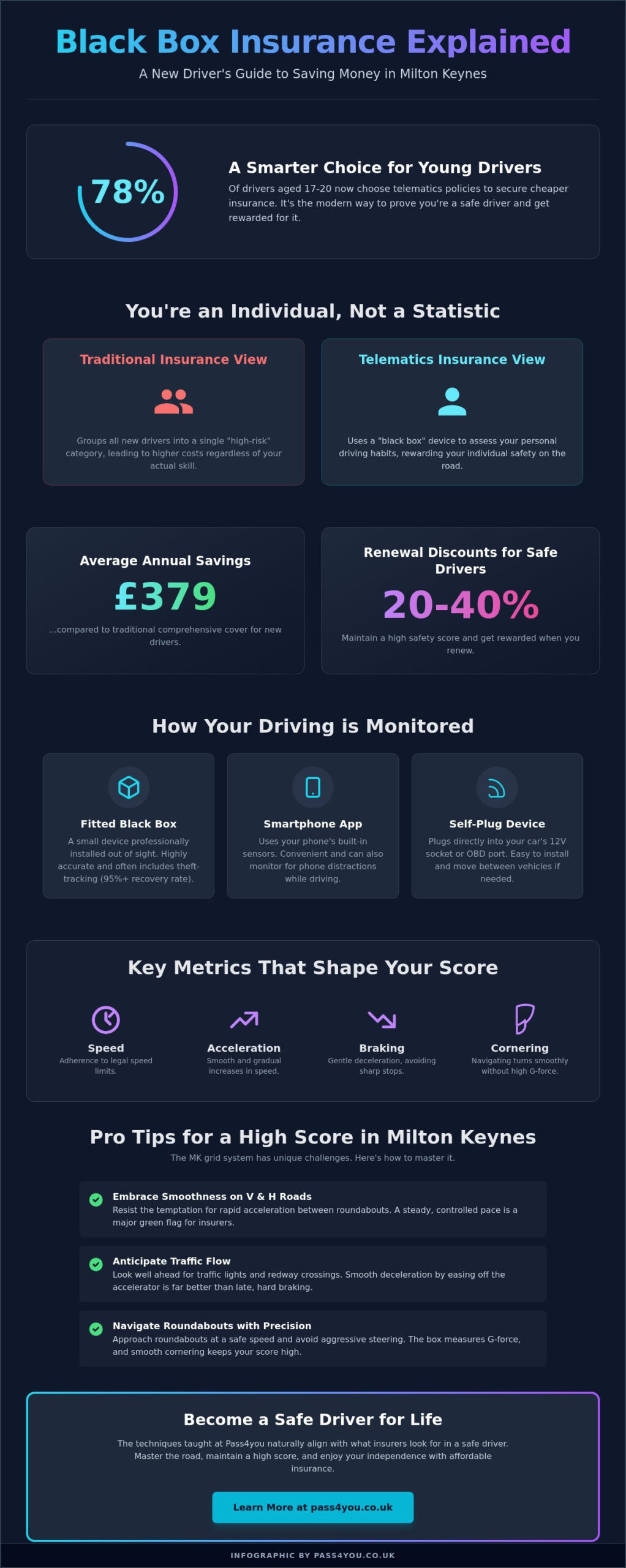
    Did you know that 78% of drivers aged 17 to 20 now secure cheaper insurance quotes by choosing a telematics policy? Getting black box insurance explained for new drivers is the first step toward saving an average of £379 a year. As of March 2026, young drivers using these devices pay an average of £1,313, which is significantly lower than traditional comprehensive cover. It’s completely normal to feel anxious about being “watched” or restricted while you’re navigating the Milton Keynes grid system. You’ve worked hard to earn your license, and you want to enjoy your new independence without the fear of technical confusion or exorbitant costs.

    We’re here to show you how telematics can actually be your best friend on the road. This guide breaks down how to maintain a high driving score on the H and V roads and explains the 20 to 40% renewal discounts available for safe road users. You’ll learn how to master your policy, understand the 2026 mileage rules, and gain the confidence to drive safely for life while keeping your hard-earned money in your pocket.

    Key Takeaways

    • Learn how telematics technology treats you as an individual driver rather than a risky statistic, rewarding your personal safety on the road.
    • Discover how navigating the Milton Keynes grid system with smooth acceleration and anticipation can protect your driving score and your wallet.
    • We have black box insurance explained for new drivers so you can confidently weigh significant premium savings against common concerns about being monitored.
    • Find out how the “safe driver for life” techniques taught at Pass4you naturally align with the data insurers use to lower your annual costs.
    • Master the specific habits that lead to impressive renewal discounts, helping you maintain affordable independence long after you pass your test.

    What is Black Box Insurance? A Simple Guide for Milton Keynes New Drivers

    Passing your driving test is a massive milestone. It’s the moment you finally trade your L-plates for total independence. But for many new drivers in Milton Keynes, that joy is often dampened by the reality of high insurance costs. This is why having black box insurance explained for new drivers is so important. It’s a practical, modern solution that helps you get on the road without breaking the bank while you’re still building your experience.

    At its heart, black box insurance uses GPS technology to monitor how you handle your car. Most traditional insurance companies look at you as a “high-risk” statistic simply because you’re young or newly qualified. Telematics changes that perspective. It treats you as an individual rather than a number. By opting for Usage-based insurance, you’re choosing a policy where your premium is adjusted based on real-world data. As of 2026, drivers who maintain a high safety score can expect renewal discounts between 20% and 40%. It’s a fair way to prove you’re a safe driver for life.

    How Telematics Technology Works in 2026

    The technology behind these policies has become incredibly sophisticated. You aren’t just limited to one type of device anymore. Most insurers now offer three main ways to track your driving habits. First, there are physical black boxes. These are small devices professionally fitted behind your dashboard where they stay out of sight. They’re excellent for accuracy and often include theft-tracking features, which helps recover over 95% of stolen vehicles equipped with them.

    Second, you might choose a smartphone app. These use your phone’s built-in sensors to detect movement, speed, and even phone distraction. Finally, there are self-plug devices. These units are designed to fit directly into your car’s 12V socket or OBD port. Whichever method you choose, the goal is the same. The device records your speed, how hard you brake, and how smoothly you take corners. This data is then used to calculate a safety score that directly impacts what you pay.

    Why Milton Keynes Drivers Benefit Most

    Driving in Milton Keynes presents specific challenges. Our unique grid system and high volume of roundabouts mean you’re constantly accelerating and braking. Because of the traffic levels on roads like the V8 or H6, local insurance premiums can be higher than in more rural areas. Having black box insurance explained for new drivers as a gateway to cheaper motoring gives you the chance to prove you’ve mastered these roads safely.

    Telematics acts as a tool for personalised risk assessment in 2026, allowing you to show insurers that you can navigate the MK grid with care. When you show you can handle the roundabouts with the same calm and patient approach you learned during your lessons, you’re rewarded with lower costs. It bridges the gap between passing your test and enjoying affordable car ownership. You get to keep your freedom while keeping your hard-earned money in your pocket.

    How Telematics Tracks Your Driving on the MK Grid System

    Milton Keynes presents a unique environment for any new driver. The grid system is efficient, but the constant cycle of accelerating to 60mph or 70mph and then slowing for a roundabout can be tricky for a telematics device to interpret. Having black box insurance explained for new drivers means understanding how every action on a V-road or H-road affects your profile. Insurers aren’t just looking at where you go; they’re looking at how you get there. They want to see that you’ve moved past the “learner” phase and are now a predictable, steady part of the traffic flow.

    Smoothness is the goal. When you’re driving on the V8 (Marlborough Street) or H9 (Groveway), the temptation to reach the speed limit quickly is high. However, rapid acceleration is a major red flag for telematics. Similarly, your braking needs to be controlled. Insurers prefer smooth deceleration rather than sharp, emergency stops. This is why the safe driving techniques we teach are so valuable. They help you anticipate traffic lights and redway crossings long before you need to hit the brakes, keeping your score high and your driving calm.

    Navigating MK Roundabouts Without Penalties

    Roundabouts like North Grafton or Oldbrook require precision. Your black box measures “G-force,” which is the physical force exerted on the car during a turn. If you take a roundabout too fast or steer aggressively, the box flags it as high-risk behavior. It’s best to maintain a steady speed through the exit and avoid “darting” between lanes in heavy traffic. A patient approach not only keeps you safe but ensures your black box car insurance provider sees you as a low-risk driver.

    Mileage and Night Driving in Buckinghamshire

    Many policies also track when and how much you drive. If you’re a commuter heading to the city centre, you might choose a “pay-as-you-go” mileage limit. Exceeding your agreed miles can result in extra charges, typically between 10p and 20p per mile. Time of day is another factor. Statistically, the window between 11 pm and 5 am is the most dangerous for new drivers. Some policies may apply a penalty or “curfew” during these hours. Balancing your social mileage with essential trips is key. By sticking to the speed limit, especially in 20mph residential zones like Fishermead, you prove you’re a responsible road user. This data-driven approach is exactly how 78% of young drivers manage to find cheaper quotes.
    Black Box Insurance Explained for New Drivers in Milton Keynes (2026 Guide)

    The Real Costs, Pros, and Cons of Black Box Policies in 2026

    Choosing your first insurance policy is often the most stressful part of passing your test. You’ve just gained your freedom, but the price tag can feel like a heavy weight. Having black box insurance explained for new drivers helps you see that these policies are essentially a financial reward for the safe habits you’ve already built. In March 2026, the average cost for a young driver with a black box is £1,313, compared to £1,561 without one. That’s a significant saving that makes car ownership much more accessible for everyone in Milton Keynes.

    Beyond the lower price, there’s the added security of theft tracking. If your car is stolen, telematics devices help insurers achieve a recovery rate of over 95%. It’s natural to have concerns about privacy; you might feel like someone is constantly looking over your shoulder. In reality, insurers only care about your driving data, like speed and braking force. They don’t track your personal life or listen to your conversations. They just want to ensure you’re maintaining the “safe driver for life” standard we promote at Pass4you.

    Telematics vs. Standard Car Insurance

    Standard insurance often treats every new driver the same, regardless of how careful they actually are. Telematics is different because it offers a “Safe Driver” bonus. If you consistently drive well, you can expect renewal discounts of 20% to 40% after your first year. In 2026, new drivers aged 17 to 20 save an average of £379 per year by opting for a telematics policy. This flexibility means your premium reflects your actual skill on the road rather than just your age or postcode. Getting black box insurance explained for new drivers shows that your good habits directly lead to better value for money.

    Common Black Box Myths Debunked

    Many people worry about strict penalties, but most of what you hear is just a myth. You won’t be fined for accidentally going one mile per hour over the limit once. Insurers look for patterns of behavior. If you consistently speed, you’ll likely receive a warning email or a “red flag” on your digital dashboard. Another common fear is that the box will cut your engine off if you drive after midnight. This isn’t true. While some policies have curfews that might lower your score for night driving, they will never disable your vehicle or leave you stranded. It’s all about providing a calm, transparent way to manage your costs while you gain experience on the road.

    How to Maintain a High Driver Score: Tips from Your MK Instructor

    Building a great driving score doesn’t happen by accident; it starts with the very first lesson you take. At Pass4you, we’ve helped hundreds of students achieve our 83.33% first-time pass rate by focusing on calm, patient techniques. When we provide black box insurance explained for new drivers, we always remind our students that the habits they learn in our Volkswagen tuition cars are exactly what telematics algorithms look for. Insurers love the defensive driving style we teach because telematics users have 20% to 30% fewer accidents in their first year on the road.

    Anticipation is your most valuable skill when navigating Milton Keynes. Instead of reacting to what’s happening directly in front of your bumper, you should look several junctions ahead. This allows you to ease off the accelerator early rather than braking sharply at a red light or a busy roundabout. Consistency is what builds a high score over time. One perfect trip won’t lower your premium, but weeks of steady, predictable driving will. Using the cruise control features in our modern tuition vehicles is a fantastic way to master speed management before you even have a black box installed.

    Mastering “Smoothness” on the Road

    We often use the “glass of water” analogy to help students understand smoothness. Imagine a full glass of water sitting on your dashboard. Your goal is to drive in a way that doesn’t spill a single drop. This means gentle pressure on the pedals and steady steering. During your lessons, we’ll practice lane discipline on the A5 to ensure your GPS tracking remains steady and professional. These safe habits ensure that when you finally get your own car, your book your first lesson experience translates directly into insurance savings.

    Using the App to Your Advantage

    Most 2026 telematics policies come with a smartphone app that acts as a digital coach. You should check your dashboard regularly to identify “weak spots” like cornering too quickly or harsh braking. If the GPS misinterprets a road layout, don’t be afraid to challenge a “false flag” with your insurer. Staying proactive helps you maintain your 20% to 40% renewal discount. You can also set up alerts to help you stay within your agreed mileage limits. Remember, exceeding your limit can result in extra charges of 10p to 20p per mile, so keeping a close eye on your app is a smart financial move.

    From Passing Your Test to Affordable Insurance in Milton Keynes

    Passing your driving test is a brilliant achievement. It’s the start of your journey as an independent driver on the MK grid. But staying safe on the road is what keeps your insurance costs low year after year. We’ve seen that students who learn in a calm, supportive environment are far more likely to maintain a high telematics score. When we have black box insurance explained for new drivers, we emphasize that the first year is critical. Our 83.33% first-time pass rate isn’t just about getting you through the test. It’s about ensuring you have the confidence and skill to handle your car without triggering “harsh event” alerts on your insurance app.

    Local knowledge of Milton Keynes test routes helps you avoid high-risk errors early on. We teach you how to handle the specific flow of the V-roads and H-roads so that your driving remains predictable to other road users and your black box. A calm learning environment leads directly to a calm telematics score. You’ll spend less on extra lessons and more time enjoying the freedom of your own vehicle. It’s a value-for-money approach that treats you as a responsible individual from day one.

    Why Pass4you Prepares You for the Black Box

    Simon’s patient teaching style is designed to eliminate the jerky driving habits that telematics boxes dislike. By mastering practical driving tests with a focus on smoothness, you’re setting yourself up for those 40% renewal discounts. Our modern Volkswagen tuition cars are equipped with the same advanced driver-assistance systems (ADAS) that insurers now analyze to determine your risk level. Learning with us means you’re already familiar with the technology that will be tracking your safety. You won’t feel intimidated by a device in your car because you’ve already mastered the skills it rewards.

    Ready to Start Your Journey in Milton Keynes?

    Getting black box insurance explained for new drivers is just the first step. The real work happens behind the wheel. Booking your first lesson with us allows you to build the foundational skills that save you money in the long run. We don’t just want you to pass; we want you to be a safe driver for life. This mindset is what keeps your premiums affordable and your driving record clean. You’ll have the confidence to navigate any roundabout or dual carriageway in Buckinghamshire with total ease. Book your driving lessons in Milton Keynes with Pass4you today!

    Take the Next Step Toward Your Driving Freedom

    You’ve seen how telematics isn’t about being restricted; it’s about being rewarded for the safe, calm habits you develop from your very first lesson. By having black box insurance explained for new drivers, you can take control of your costs and prove you’re a responsible road user on the MK grid. Remember that smooth braking and careful anticipation aren’t just for the test. They’re the secret to maintaining those 20% to 40% renewal discounts year after year.

    At Pass4you, we’re dedicated to helping you reach that goal. Our 83.33% first-time pass rate shows that our tried and tested methods work. Simon provides the patient, supportive environment you need to feel confident behind the wheel of our modern Volkswagen tuition vehicles. You won’t just learn to pass; you’ll learn to drive safely for life. Start your driving journey with Milton Keynes’ patient experts today and build the skills that keep your insurance affordable. Your independence is just around the corner, and we’re here to help you every step of the way.

    Frequently Asked Questions

    Is black box insurance cheaper for new drivers in 2026?

    Yes, it is typically much more affordable than standard policies. Data from March 2026 shows that 78% of drivers aged 17 to 20 receive a lower quote when choosing a telematics policy. On average, new drivers save £379 per year compared to traditional cover. This makes black box insurance explained for new drivers a vital topic for anyone looking to manage their budget while gaining independence.

    Will a black box record who is driving the car?

    No, the device does not identify the specific person behind the wheel. It uses GPS and sensors to track the car’s movement rather than the driver’s identity. If you have named drivers on your policy, their driving habits will also contribute to your overall score. It’s important to ensure everyone using the car follows the calm and safe techniques you learned during your lessons.

    What happens if I drive badly with a black box?

    You won’t be penalized for a single mistake. Insurers look for consistent patterns of risky behavior like speeding or harsh braking. If your score drops, you’ll usually receive a warning email or a red flag on your app. Persistent poor driving can lead to higher premiums or even policy cancellation. Staying patient and maintaining the habits taught by your instructor will keep your score high.

    Can I drive at night with black box insurance in Milton Keynes?

    Yes, you are free to drive at night. Most modern policies in 2026 have moved away from strict curfews that disable the vehicle. However, statistics show that driving between 11 pm and 5 am is higher risk. While you won’t be stopped from driving, your safety score might be slightly lower for trips made during these late hours. It’s all about balancing your essential trips with your score.

    Do black boxes drain your car battery?

    No, these devices do not drain your battery. They are designed to use a minimal amount of electricity, similar to your car’s digital clock. If your car is in regular use and the battery is healthy, you won’t experience any issues. If you’re using a smartphone app version, it will use your phone’s battery instead; keeping a charger in the car is a smart move for any new driver.

    How long does it take to get a black box fitted?

    A professional fitting usually takes between 45 and 60 minutes. An engineer will discreetly install the device behind your dashboard at a time that suits you. Many insurers now also offer self-plug units or app-based versions. These can be set up in under five minutes, allowing you to start your black box insurance explained for new drivers journey almost immediately after your policy begins.

    Can I get black box insurance on a provisional licence?

    Yes, you can absolutely get a telematics policy while you’re still a learner. Many providers offer specific products for those on a provisional license. It’s a fantastic way to prove you’re a safe driver before you even pass your test. Starting early can help you build a positive history that leads to even bigger discounts once you qualify and get your full license.

    Does a black box track my location at all times?

    Yes, the device uses GPS to monitor the vehicle’s location at all times. Insurers use this data to understand the types of roads you use and to provide theft recovery services. In fact, vehicles with telematics have a recovery rate of over 95%. Your data is protected by strict privacy laws and is only used to assess your driving safety or provide help if the car is stolen.
  • Cheapest Way to Learn to Drive UK: The Ultimate 2026 Efficiency Guide

    Cheapest Way to Learn to Drive UK: The Ultimate 2026 Efficiency Guide

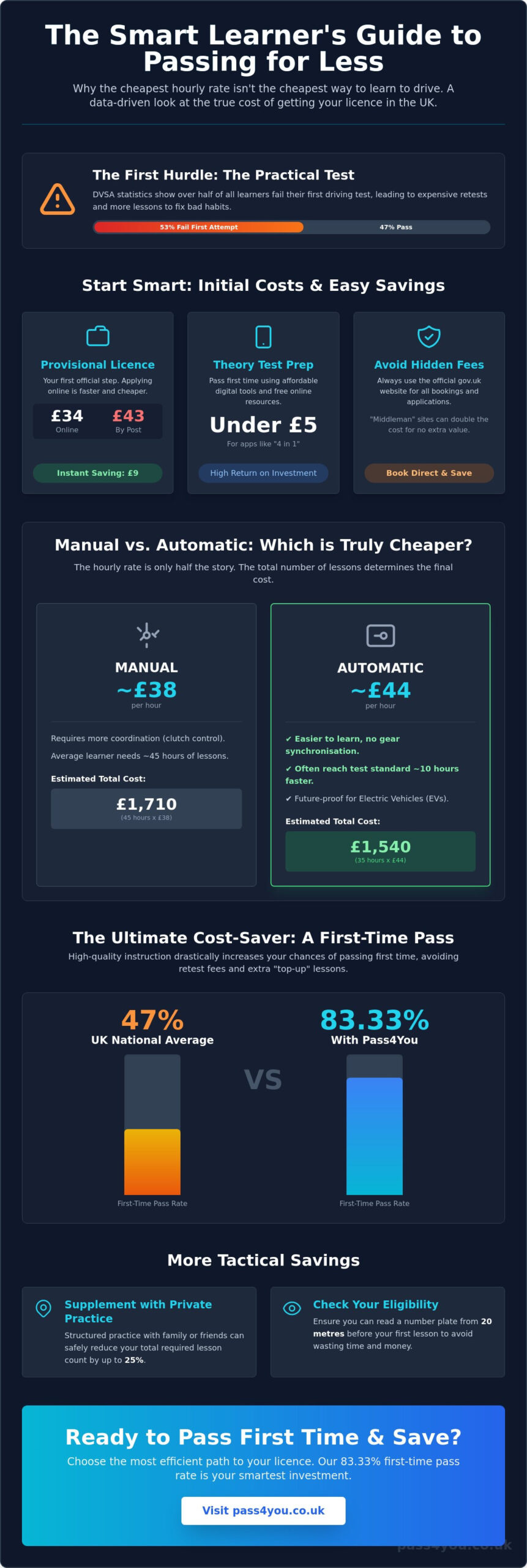
    Could the instructor offering the lowest hourly rate actually be the most expensive choice you make this year? It sounds backward, but many learners find that “budget” lessons often lead to more hours behind the wheel and multiple failed tests. Finding the cheapest way to learn to drive uk isn’t about chasing the smallest number on a flyer. It’s about maximizing every minute you spend in the car so you don’t become part of the 53% of learners who fail their first attempt according to recent DVSA statistics.

    We know how frustrating it is to face rising costs and test wait times that stretch for months. It’s natural to feel anxious about the total price of freedom, especially when you’re worried about skill fade between lessons. You deserve a path that respects your budget and your time. This guide will show you how to minimize your total spend by focusing on efficiency and achieving a first-time pass. We’ll explore how to avoid hidden fees, why quality instruction reduces your total lesson count, and the specific habits that lead to our 83.33% first-time pass rate.

    Key Takeaways

    • Start your journey with confidence by securing easy initial savings, such as applying for your provisional licence online to avoid unnecessary postal fees.
    • Navigate the price differences between manual and automatic lessons to choose the transmission that offers you the most efficient and stress-free path to qualified status.
    • Find out how supplementing your professional tuition with structured private practice can safely reduce your total required lesson count by up to 25%.
    • Discover the cheapest way to learn to drive uk by looking beyond the hourly rate and focusing on high-quality instruction that prevents the need for expensive retests.
    • Learn why aiming for a first-time pass with our 83.33% success rate is the ultimate strategy for minimizing your total investment and getting on the road sooner.

    Starting Your Journey: Navigating Initial Costs and Small Wins

    Taking your first steps toward getting behind the wheel can feel overwhelming, but it doesn’t have to break the bank. In 2026, the average UK learner spends approximately £1,600 to £2,000 to qualify, covering everything from the first application to the final certificate. Finding the cheapest way to learn to drive uk requires a strategic approach that starts long before you turn the ignition. By planning your budget and timeline early, you build the confidence needed to succeed without financial stress. A clear plan keeps you focused and prevents the anxiety that often comes with unexpected costs.

    The first win is simple. Applying for your provisional license uk online currently costs £34, which is £9 cheaper than the £43 postal application fee. It’s a small saving, but it sets the tone for your entire journey. You should always use the official gov.uk website for all bookings and applications. Many “middleman” websites charge hidden service fees, sometimes doubling the cost of a theory or practical test for no added value. Understanding the UK driving test process through official channels ensures you don’t fall for these traps and keeps your money where it belongs, in your lesson fund.

    Mastering the Theory Test on a Budget

    Success on a budget means passing the first time. In 2026, digital tools offer incredible value. Apps like the “Driving Theory Test 4 in 1” provide a massive return on investment for a small one-off fee, often under £5. Passing your theory early is vital for your wallet. It prevents expensive delays in your practical training, as you cannot book a driving test without a valid theory certificate. You can also find free, high-quality hazard perception tutorials on YouTube to sharpen your skills without spending extra cash. This proactive study approach makes you a more confident student during your actual lessons.

    Eye Tests and Physical Requirements

    You must ensure you’re legally fit to drive before paying for a single professional lesson. The law requires you to read a standard UK number plate from a distance of 20 meters. If you need glasses or contact lenses to do this, you must wear them every time you drive. Booking a test you’re legally ineligible to take is a total waste of money. Use this simple checklist for your first day behind the wheel:

    • Confirm you can read a number plate from 20 meters with or without corrective lenses.
    • Check that your provisional license is valid and the details are correct.
    • Wear comfortable, flat-soled shoes to help you feel the pedals clearly.
    • Bring a calm and positive mindset to help you absorb information quickly.

    By checking these boxes early, you avoid the risk of being turned away from a test or struggling during your first few hours of training. Being prepared is the cheapest way to learn to drive uk because it maximizes the value of every minute you spend with your instructor.

    Choosing the Right Gear: Manual, Automatic, or Intensive Courses?

    Your choice of vehicle and course structure determines the total price of your licence. While many people search for the lowest hourly rate, the cheapest way to learn to drive uk is actually found by reducing the total number of hours you need. It’s about efficiency rather than just the price per lesson. Before you book your first session, you must account for the official government licence fees, which currently stand at £34 for an online provisional application. This is your baseline cost before you even step into a car.

    Manual vs. Automatic: The Long-term Financial View

    In 2026, manual lessons typically cost around £38 per hour, while automatic lessons average £44. This £6 difference seems like a saving, but manual cars require more coordination. If you struggle with clutch control, you might end up taking 15 extra lessons compared to an automatic learner. Data from the DVSA suggests learners need an average of 45 hours of professional tuition. Automatic students often reach test standard 10 hours faster because they don’t have to master gear synchronisation.

    You should also consider future-proofing. With the UK’s transition toward Electric Vehicles (EVs), which are almost exclusively automatic, the manual gearbox is becoming a niche skill. Choosing automatic might feel more expensive now, but it’s often the fastest route to becoming a confident driver. While manual cars are currently cheaper to buy and insure for new drivers, that gap is narrowing as EV adoption increases and maintenance costs for older manual gearboxes rise.

    Weekly Lessons vs. Semi-Intensive Structures

    The biggest drain on your budget is “skill fade”. If you take one-hour lessons once a week, you’ll likely spend the first 15 minutes of every session just getting back up to speed. This wastes 25% of your paid time. Booking two-hour blocks is much more cost-effective. It gives you enough time to drive to different road types and settle into a calm, focused rhythm. Our 83.33% first-time pass rate shows that consistent, concentrated practice builds a safer foundation than fragmented learning.

    Intensive “crash courses” can work, but they don’t suit every learning style. If you feel nervous, a semi-intensive approach (6 to 10 hours a week) offers the best balance. It keeps the information fresh without causing mental exhaustion. You should also align your schedule with local test centre availability. There’s no point finishing an intensive course in June if the next available test isn’t until August. Simon and our team always aim to time your training so you’re at peak performance exactly when your test date arrives. This strategic planning prevents you from needing “refresher” lessons while you wait for a slot.

    Cheapest Way to Learn to Drive UK: The Ultimate 2026 Efficiency Guide

    Private Practice: How to Supplement Lessons Without Wasting Money

    Private practice is often the cheapest way to learn to drive uk because it lets you refine your skills without paying a professional hourly rate for every single minute behind the wheel. Data from the Driver and Vehicle Standards Agency (DVSA) indicates that learners who combine professional instruction with private practice are significantly more likely to pass. By putting in extra hours with a friend or family member, you can reduce your required professional lesson count by approximately 25%. This isn’t just about driving around; it’s about building muscle memory in a calm, low-pressure environment.

    To stay legal on UK roads, your supervising driver must be at least 21 years old and have held a full UK driving license for at least three years. The vehicle must be properly insured for a learner, have a valid MOT, and display clear L-plates on the front and rear. If you ignore these requirements, you risk a fine of up to £1,000 and six penalty points on your provisional license. Starting your driving career with points is an expensive mistake that will inflate your insurance premiums for years.

    Finding the Right Supervising Driver

    Don’t just pick the person who has been driving the longest. Your most experienced friend might have picked up “shortcuts” or lazy habits that lead to an immediate fail on the modern driving test. The best supervisor is someone patient who is willing to follow the specific syllabus set by your professional instructor. At Pass4you, we often suggest that supervisors sit in on a professional lesson. This ensures everyone stays on the same page and prevents the development of conflicting techniques. Keep your private sessions short, around 30 to 45 minutes, to keep stress levels low and concentration high.

    Learner Insurance and Vehicle Costs

    Finding the cheapest way to learn to drive uk in 2026 requires a smart approach to insurance. You generally have two main paths to consider:

    • Short-term policies: These are perfect if you’re practicing in a parent’s car occasionally. You can buy cover for specific windows, such as 30 or 60 days, which keeps costs down.
    • Annual learner policies: These are usually more cost-effective if you plan to practice over a period of six months or more.

    Many 2026 insurance providers offer “Black Box” or telematics options for learners. These devices monitor your braking and acceleration, often resulting in a 15% discount on premiums for safe driving. While using your own car for the practical test can save you the cost of hiring your instructor’s car, you must ensure it meets all DVSA requirements. This includes having an extra interior rear-view mirror for the examiner and ensuring your insurance policy specifically covers the test itself.

    Tactical Saving: How to Lower the Total Cost of Passing

    Many learners assume the cheapest way to learn to drive uk is simply finding the lowest hourly rate. This is often a trap. A “budget” instructor charging £25 per hour might lack the structured approach needed to progress quickly. If they require 60 hours of training to get you ready, you’ll spend £1,500. In contrast, a highly qualified instructor like Simon may charge more per hour but use a tried and tested technique to get you ready in 35 hours. That higher rate actually saves you hundreds of pounds and months of time. Value for money is about the total cost of the license, not the cost of the hour.

    The Power of Block Bookings

    How do you secure the best value? Booking in bulk is the standard answer. In Milton Keynes, learners who book 20 hours upfront often see savings of 5% to 10% compared to paying weekly. This commitment also ensures you have a consistent slot in the diary, which is vital for building muscle memory and maintaining momentum. Before you commit to a large block, we always recommend an initial assessment lesson. This lets you see if our calm and patient style matches your learning needs. Always check the school’s refund policy; a professional school will always offer a transparent refund for any unused hours if you pass earlier than expected.

    Avoiding the ‘Failed Test’ Money Trap

    The most expensive mistake you can make is taking a practical driving test before you’re truly ready. A failed test costs much more than just the £62 DVSA fee. When you add the cost of car hire for the test day and the average of 10 hours of remedial lessons needed while waiting for a new slot, a single failure can cost you over £300. We maintain an 83.33% first time pass rate because we use a strict “Test Ready” checklist. You shouldn’t book your test until you can:

    • Complete a full 40 minute mock test with zero serious or dangerous faults.
    • Drive independently for 20 minutes without any verbal prompts or interventions.
    • Perform all maneuvers, including the emergency stop, perfectly every time.
    • Handle complex roundabouts and dual carriageways with total confidence.
    • Manage your nerves so they don’t affect your physical control of the car.

    Using mock tests is a vital tactical saving. It’s much better to pay for a mock lesson than to pay for a failed real test. We focus on building your confidence so the actual test feels like just another drive with a friend. If you’re ready to learn with a mentor who values your success, book your lessons with Pass4you and let’s get you on the road as a safe driver for life.

    The Most Efficient Path: Why Pass4you Saves You More

    Finding the right driving instructors near me is the most critical decision you’ll make for your bank account. At Pass4you, our 83.33% first-time pass rate serves as a direct financial benefit to you. Every time a student passes on their first attempt, they save the £62 DVSA test fee and avoid the cost of weeks of additional remedial lessons. It is the cheapest way to learn to drive uk when you consider the total investment required to earn your pink license.

    We provide tuition in modern, reliable Volkswagen vehicles. These cars are chosen for their ease of use and excellent visibility, which helps you build confidence quickly. When you feel comfortable in the driver’s seat, you learn faster. Our “Safe Driver for Life” philosophy also prepares you for the years ahead. By teaching you to anticipate hazards properly, we help you maintain a clean driving record. This is the best way to secure lower insurance premiums in the future, saving you hundreds of pounds long after you’ve passed the test.

    Local Expertise in Milton Keynes

    Milton Keynes presents unique challenges for new drivers. The city’s extensive grid system and complex roundabouts can be intimidating if you aren’t prepared. Simon uses his deep local knowledge to guide you through these specific test routes from day one. You won’t spend your time driving aimlessly through quiet backstreets. Instead, you’ll gain experience on the exact dual carriageways and junctions used by examiners. This focused, local approach is why many consider our methods the cheapest way to learn to drive uk. You simply need fewer hours behind the wheel to reach test standard.

    Simon’s patient and calm approach is designed to reduce anxiety. We’ve seen many nervous learners who were ready to give up before joining us. By creating a supportive environment, we speed up the learning curve significantly. Our local expertise includes:

    • Mastering the H5 and V8 grid roads with confidence
    • Navigating the complex roundabouts and local test hubs efficiently
    • Reducing nerves through Simon’s proven, patient techniques
    • Learning the specific “problem spots” identified by local examiners

    Transparent Pricing and Value

    We believe in total honesty. When you book your driving lessons milton keynes, what you see is what you pay. There are no hidden administration fees or surprise charges. You’re paying for first-class instruction from a mentor who is genuinely invested in your success. While some schools might offer lower hourly rates, they often drag out the process over many months. Our goal is to get you on the road safely and quickly, ensuring you don’t pay for a single lesson more than you need.

    Ready to start your journey? Booking your first lesson is the first step toward your independence. You can join the hundreds of successful drivers who have found that quality instruction is the ultimate money saver. Contact us today to secure your slot and start learning the right way.

    Take Control of Your Future on the Road

    Mastering the road doesn’t have to be a financial burden if you approach it with a clear strategy. You’ve learned that the cheapest way to learn to drive uk involves more than just hunting for the lowest price per hour. It’s about combining smart private practice with professional guidance to ensure you don’t repeat lessons or fail multiple tests. By choosing the right vehicle type and staying consistent, you’ll reach the finish line much faster.

    Efficiency is the secret to saving money. When you learn in modern VW tuition vehicles with a calm mentor like Simon, you build the confidence needed to succeed. Our 83.33% first-time pass rate proves that quality instruction pays for itself by getting you on the road sooner. You’ll feel safe and supported. You’ll be ready to handle every junction without the stress of being rushed or shouted at during your sessions.

    Your freedom is just a few lessons away. Don’t let the fear of high costs or difficult instructors hold you back. Start your journey with a high-pass-rate expert—Book your first lesson with Pass4you today! You’ve got the tools and the plan. Now it’s time to get behind the wheel and become a safe driver for life.

    Frequently Asked Questions

    What is the absolute cheapest way to get a driving licence in the UK?

    The cheapest way to learn to drive uk is to combine professional lessons with extensive private practice. You’ll build a solid, safe foundation with a patient instructor like Simon, then reinforce those skills with a friend or family member. DVSA data shows that learners who complete 22 hours of private practice are significantly more prepared. This strategy reduces the total number of paid professional hours you need to reach test standard.

    Is it cheaper to learn in a manual or an automatic car in 2026?

    Manual lessons generally remain the more cost effective choice because hourly rates are typically £5 to £10 lower than automatic lessons. Manual cars are also cheaper to buy and insure once you pass your test. While automatic cars are becoming more common, the initial investment in lessons is higher. Choosing manual gives you the freedom to drive both vehicle types without needing a second practical test later.

    How many driving lessons does the average person need to pass?

    The DVSA reports that the average learner requires 45 hours of professional tuition alongside 22 hours of private practice. However, our students often pass in fewer hours because we focus on a calm, efficient teaching style. Our 83.33% first time pass rate demonstrates that quality instruction saves money by avoiding expensive retests. We focus on making you a confident, safe driver for life rather than just rushing to the finish line.

    Can I save money by booking my driving test myself?

    Yes, you should always book your tests directly through the official GOV.UK website to avoid unnecessary middleman management fees. A theory test currently costs £23, while a weekday practical test is £62. Some third party sites charge a premium of £20 or more just for the booking service. By handling the admin yourself, you keep your budget focused on actual car time and professional guidance from your mentor.

    Does private practice with parents really help save money?

    Private practice is a brilliant way to save money, provided it doesn’t introduce bad habits that Simon has to fix later. Practicing basic car control in a car park or quiet street helps you feel more confident during your professional lessons. You should wait until your instructor says you’re ready before heading out with parents. This ensures you’re safe and that your private sessions actually support the techniques we’ve taught you.

    Are intensive driving courses cheaper than weekly lessons?

    Intensive courses can seem cheaper upfront, but weekly lessons often provide better value for money because you have time to process what you’ve learned. Cramming everything into one week can be stressful and lead to a higher chance of failing if you aren’t naturally confident. Our patient, steady approach ensures you don’t feel rushed. We find that consistent, weekly practice builds the long term muscle memory needed for a first time pass.

    What are the hidden costs of learning to drive that I should budget for?

    You must budget for your provisional licence, which costs £34 online, and the cost of insurance if you plan to do private practice. Many learners forget to account for the price of theory test revision apps or books. It’s also important to remember that you’ll need to pay for your instructor’s time and car use on the day of your practical test. Planning for these 5 or 6 extra costs prevents financial stress.

    How can I find a driving instructor that offers the best value for money?

    The cheapest way to learn to drive uk is to find an instructor with a high success rate and fantastic student reviews. A slightly higher hourly rate is a better investment if the instructor helps you pass first time. Look for someone like Simon who is described as calm and supportive. Our 83.33% first time pass rate means our students spend less money overall because they rarely have to pay for multiple tests.