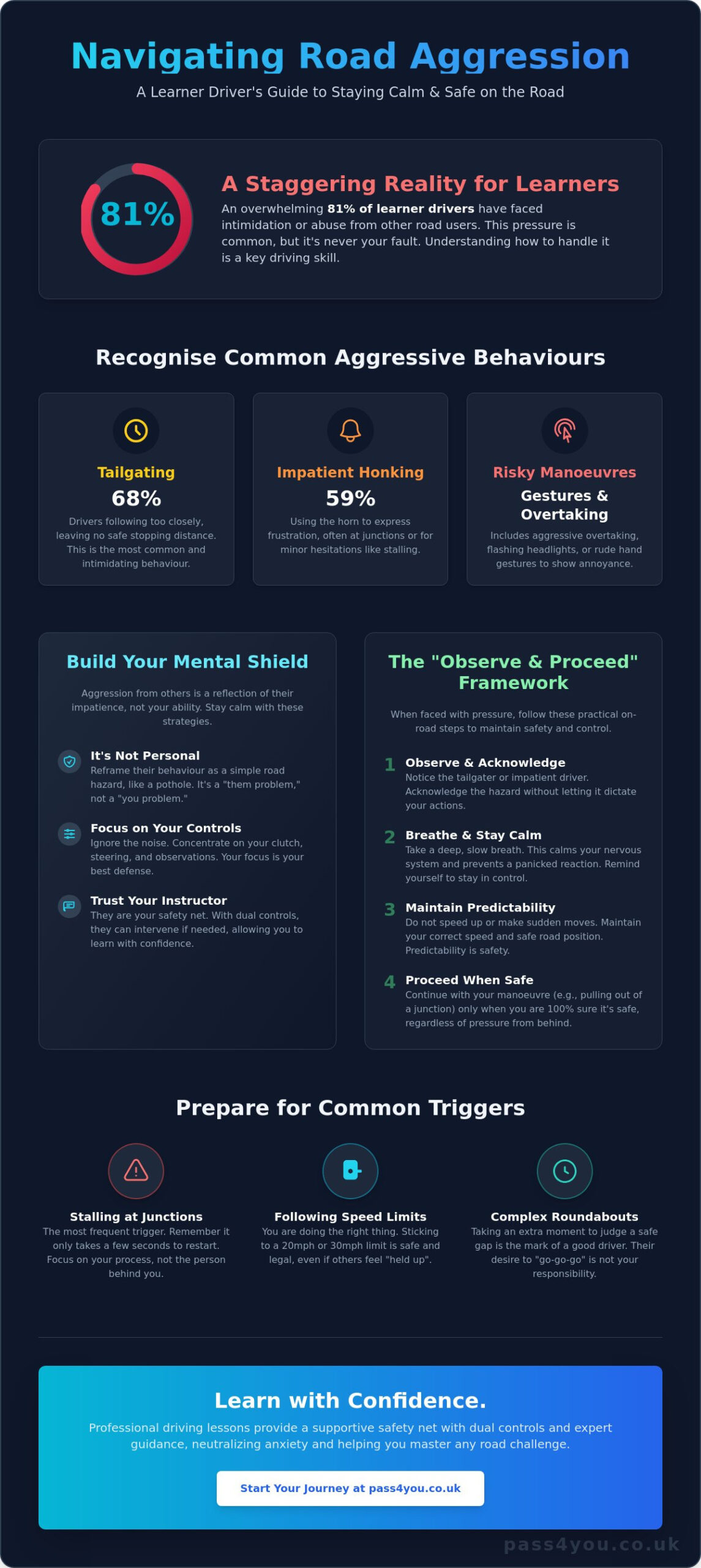
Did you know that a staggering 81% of learner drivers have experienced intimidation or abuse from other road users? It’s a frustrating reality that seeing those red L-plates can sometimes bring out the worst in others. You’re trying to focus on your clutch control, yet a driver behind you is tailgating or beeping their horn. It’s completely normal to feel your heart race or your confidence dip when you face that kind of pressure. Learning how to deal with aggressive drivers when learning is just as important as mastering your observations or road positioning.
We believe that learning to drive should be a positive, life-changing experience, not a source of anxiety. This guide will show you how to protect your safety and keep your composure, ensuring that one impatient driver doesn’t ruin your progress. We’ll walk through practical safety steps, mental strategies to block out the bullies, and ways to maintain the confidence you need to continue your journey toward passing your test. You’re in safe hands, and with the right mindset, you can handle any situation the road throws at you.
Key Takeaways
- Understand why certain drivers react poorly to L-plates and why their impatience is never a reflection of your actual skills.
- Master the “Observe and Proceed” framework to learn how to deal with aggressive drivers when learning while keeping your vehicle safe and predictable.
- Build a psychological “mental shield” to stay calm and reframe aggressive behavior as a simple hazard rather than a personal attack.
- Discover how professional driving lessons and dual controls provide a supportive safety net while you’re tackling the unique challenges of Milton Keynes’ grid system.
Why Learner Drivers Face Road Aggression (and Why It’s Not Your Fault)
It often feels like those red L-plates act as a magnet for impatience. You might notice drivers behind you leaning on their horns or trying to squeeze past in gaps that aren’t quite safe. This phenomenon is frequently called the “L-Plate Effect.” Some drivers see a learner and immediately assume they will be delayed, regardless of how well you are actually driving. It is vital to remember that road aggression is a projection of a driver’s external stress onto you; it’s rarely a reflection of your technical ability. Understanding this shift in perspective is the first step in mastering how to deal with aggressive drivers when learning.
Legally, you have exactly the same right to be on the road as a driver with thirty years of experience. The road is a shared space. While veterans might have more “muscle memory,” they are still bound by the same Highway Code that you are studying so hard to follow. Their poor time management or personal stress doesn’t grant them priority over your safety. When someone behaves poorly toward you, they are the ones failing the standards of the road, not you.
The Psychology of the Impatient Driver
Why do people become so frustrated? Many drivers experience a sense of “deindividuation” when they get behind the wheel. The car acts as a metal shell that makes them feel anonymous, which can embolden people to act like bullies in ways they never would face-to-face. To get a broader perspective on these behaviors, it helps to look at what is road rage? and how it manifests in modern traffic. Most of these drivers have simply forgotten what it felt like to be a beginner. They view their journey as a race against the clock, but their rush is never your emergency. Learning how to deal with aggressive drivers when learning involves recognizing that their behavior is a “them problem,” not a “you problem.”
Common Triggers for Aggression Toward Learners
Certain situations tend to provoke impatient reactions more than others. Recognizing these triggers can help you prepare mentally so you don’t feel caught off guard. Common triggers include:
- Stalling at junctions: This is the most frequent trigger. The few seconds it takes to restart the engine can feel like an eternity when a car is waiting behind you.
- Strictly following speed limits: In Milton Keynes, many residential areas now have 20mph limits. While you are doing the right thing by sticking to the law, some drivers will feel “held up” by your responsible pace.
- Complex roundabouts: Taking an extra second to ensure a gap is safe at a busy Milton Keynes roundabout is a sign of a good driver, yet it often draws frustration from those behind who want to “go-go-go.”
By identifying these moments in advance, you can keep your focus on your controls rather than the person in your rearview mirror. Your job is to stay safe; their job is to wait.
Identifying Common Aggressive Behaviours and Immediate Safety Steps
Recognizing the specific ways other drivers show frustration is the first step toward staying safe. When you know what to expect, the behavior becomes less of a personal attack and more of a predictable road hazard. For instance, a 2022 survey by Marmalade found that 68% of learners faced tailgating, while 59% dealt with unnecessary beeping. By categorizing these actions, you can apply a structured response rather than reacting out of fear. Understanding how to deal with aggressive drivers when learning starts with identifying these common “tantrums” and choosing safety over an emotional response.
You might encounter drivers who flash their headlights or honk their horns. It’s important to distinguish between a genuine warning and a display of impatience. If you’ve stalled, a beep is likely just a sign of the other driver’s frustration. However, if you’re driving safely and following the limit, these signals are often just noise. Similarly, if someone overtakes you aggressively, resist the urge to speed up to “help” them or get out of the way. Maintain your steady pace and predictable road position. This allows them to pass safely without you being forced into a mistake. Following expert tips to avoid aggressive driving can help you keep your cool when others lose theirs.
Dealing with Tailgaters Safely
Tailgating is perhaps the most intimidating behavior you’ll face. When a car is glued to your rear bumper, your natural instinct might be to speed up. Instead, apply the “Double the Gap” rule. By increasing the following distance between you and the car in front, you give yourself more time to brake gently. This prevents the tailgater from having to slam on their brakes if you need to slow down. Keep an eye on your mirrors, but don’t become obsessed with the driver behind. Focus on your own path. If the pressure feels like too much, taking professional driving lessons can help you build the resilience needed to manage these high-pressure moments with ease.
What to Do if You Are Being Shouted At
Verbal abuse or aggressive hand gestures can be deeply upsetting. If this happens, keep your windows up and your eyes firmly on the road ahead. Avoiding eye contact is a powerful way to de-escalate the situation; bullies often lose interest if they don’t get a reaction. Remember that your L-plates are a legal sign that you’re still practicing. Most people understand this, and those who don’t are simply showing their own lack of patience. Your priority is the car’s controls and the safety of your passengers. By keeping a “blinkered” focus, you ensure that another person’s bad day doesn’t become your bad driving experience. Learning how to deal with aggressive drivers when learning is a skill that will serve you well long after you’ve passed your test.
The “Observe and Proceed” Framework: Practical On-Road Responses
Once you identify that a driver is being aggressive, your primary duty is to keep your vehicle under control. It is easy to get distracted by someone else’s bad behavior, but your priority must remain your own steering, gears, and observations. This is the heart of how to deal with aggressive drivers when learning. You are the one in the driver’s seat. The person behind you cannot force you to move faster or make a decision that compromises your safety. The “Observe and Proceed” framework helps you acknowledge the aggressive driver as a hazard, similar to a pothole or a stray animal, and then move forward with your own safe driving plan.
If you are with a professional instructor, they act as your protective buffer. They have an extra set of eyes and an extra set of controls. They can handle any external communication, like explaining a situation to another road user, while you focus on the road ahead. This support allows you to maintain a calm environment inside the car, regardless of the chaos outside. Your instructor is there to manage the “big picture” so you can master the specific skills of your lesson. You don’t have to face the pressure alone.
Maintaining Your Speed and Position
Sticking to the speed limit is your legal shield. If you are in a 20mph zone in Milton Keynes, stay at 20mph. Speeding up under pressure makes you more likely to miss a hazard or lose control. A common mistake is “gutter driving,” where learners pull too far to the left to let people pass. This actually invites dangerous, narrow overtakes that put you at risk. Stay in your normal, safe road position. Being predictable is the best way to discourage others from taking risks around you.
The Safe Pull-Over Technique
Sometimes the best way to handle a stressful situation is to remove yourself from it entirely. If you feel your heart rate rising or your hands shaking, look for a safe, legal, and convenient place to stop. This isn’t giving up; it’s a professional management of a road hazard. Once you have parked safely, turn off the engine and take a few minutes to reset. Talk to your instructor about the incident. A five-minute break can be the difference between a lesson that feels like a failure and one that ends with a breakthrough in confidence. Mastering how to deal with aggressive drivers when learning involves knowing when to take that pause. It’s a sign of a mature, responsible driver.
Building Psychological Resilience: The Learner’s Mental Shield
Mastering the physical controls of a car is only half the battle. The other half takes place in your mind. When you are on the road, it is helpful to use the “Bubble” visualization. Imagine a thick, transparent shield surrounding your car. This shield lets you see everything around you for safety, but it blocks out the noise, the gestures, and the negative energy of others. By creating this mental barrier, you ensure that your cabin remains a calm space for learning. Understanding how to deal with aggressive drivers when learning involves recognizing that you don’t have to let their stress inside your vehicle.
Reframing the situation is equally powerful. Instead of seeing an angry person, see a “moving hazard.” You wouldn’t take it personally if a traffic light turned red or a pedestrian stepped out; you would simply manage the hazard. Treat an aggressive driver the same way. Your only responsibility is to the practical driving test standards, not the driver behind. If you are meeting those standards, you are doing your job perfectly. You might even find it helpful to repeat a simple phrase to yourself, such as “I am safe, I am in control, and I am learning.”
Processing the Event Mid-Lesson
If a specific incident, like a stall or a missed turning, triggers a reaction from someone else, you need a quick way to reset. Try the “Box Breathing” technique. Inhale for four seconds, hold for four, exhale for four, and hold for four. This physically lowers your heart rate and clears your head. It is also vital that you don’t apologize to the bully. A wave of apology often validates their rage and makes you feel “wrong” when you are simply practicing a new skill. Focus entirely on the next 100 yards of road. What happened in the last 100 yards is over and cannot be changed.
Post-Lesson De-briefing
Once the lesson ends, take time to talk through the encounter with your instructor. They can help you see that your response was safe and professional. You should even record these moments in your progress log as a “Hazard Management” success. Learning how to deal with aggressive drivers when learning is a key milestone. Successfully navigating a situation with a road bully proves you are becoming a competent driver who can handle real-world pressure. If you want to build this resilience in a supportive environment, our patient instructors are here to help. You can start your journey by booking your next set of driving lessons today.
How Professional Instruction in Milton Keynes Neutralises Driving Anxiety
Professional instruction is the final piece of the puzzle when figuring out how to deal with aggressive drivers when learning. While mental shields and breathing techniques are vital, having an expert by your side provides a physical safety net that no amount of theory can replace. At Pass4you, our instructors are trained to act as a protective barrier between you and the occasionally hostile road environment. We don’t just teach you to drive; we help you develop the calm, methodical mindset that contributes to our 83.33% high-precision success rate. This focus on emotional stability ensures you feel like you’re in safe, professional hands from your very first lesson.
A calm mentor makes a world of difference. When you’re faced with road rage, your instructor’s steady voice can prevent a minor incident from becoming a total loss of confidence. They’ve seen it all before and know exactly how to de-escalate a situation before it affects your steering. This support allows you to focus on your progress rather than the behavior of others. You’re not just learning to pass a test; you’re learning to remain a composed, responsible driver for life.
The Role of the Dual-Control Vehicle
One of the biggest advantages of professional driving lessons is the dual-control system. If an aggressive driver performs a dangerous maneuver, your instructor can intervene instantly to keep you safe. You are never truly out of control. This makes professional lessons significantly safer than private practice, especially in high-stress urban areas. The “Tuition” sign on our vehicles also serves as a legal notice to others. It warns them to expect the unexpected, shifting the legal and social responsibility onto them to maintain a safe distance. It acts as a shield, giving you the space you need to practice without constant harassment.
Mastering Milton Keynes Roundabouts with Confidence
Milton Keynes is famous for its unique grid system and high-speed roundabouts. These can be intimidating for anyone, especially when a driver behind is revving their engine or creeping forward at a junction. Our instructors specialize in these specific local challenges. We teach you how to time your entries perfectly so you don’t feel forced into a gap that isn’t there. You’ll learn the confidence to hold your lane and ignore the pressure from behind. Knowing exactly how to deal with aggressive drivers when learning on the MK grid makes the eventual practical test feel much more manageable. You’ll move from feeling intimidated to feeling completely in command of your journey, ready to enjoy the freedom that comes with your pink license.
Drive Forward with Confidence and Calm
You now have the tools to protect your safety and your peace of mind. By using the mental shield and the “Observe and Proceed” framework, you can ensure that other people’s impatience never dictates your actions. Your journey is about steady progress, not meeting the demands of a driver in a rush. Learning how to deal with aggressive drivers when learning is a vital skill that transforms you into a resilient, capable road user ready for any situation. These moments of pressure are simply hazards to manage, and every time you stay calm, you’re proving you’re ready for the road.
At Pass4you, we provide a supportive environment designed to help you succeed without the stress. Our first-class, patient instructors in Milton Keynes guide you through every challenge in modern Volkswagen tuition vehicles equipped with dual controls for your total peace of mind. This supportive approach is a key reason why we maintain an impressive 83.33% first-time pass rate. Don’t let road bullies hold you back from the freedom and opportunities that come with your license. Book your first lesson with a patient Pass4you instructor today. You have the right to feel safe and confident every time you get behind the wheel, and we are here to make sure you do.
Frequently Asked Questions
Is it illegal for drivers to be aggressive toward learners?
Yes, aggressive driving can be prosecuted as “careless and inconsiderate driving” or even “dangerous driving” under the Road Traffic Act. Intimidation, tailgating, and verbal abuse are all serious offenses that the police can investigate. You have a legal right to be on the road, and other drivers are required by the Highway Code to show extra patience toward those with L-plates.
Should I pull over if someone is tailgating me?
You should only pull over if you can find a safe, legal, and convenient place to do so. If the pressure from a tailgater is making you feel anxious or distracted, finding a quiet side road or a parking bay to reset is a smart move. Never feel forced to pull over in a dangerous spot or onto a soft verge just to let an impatient driver pass.
What should I do if I stall and someone starts honking their horn?
Focus entirely on your restart procedure and block out the noise. Take a deep breath, apply your handbrake, and go through your “prepare, observe, move” routine at your own pace. The driver behind is simply showing their own lack of composure. Your only priority is to secure the car and move off safely when you are ready.
Does having a “Learner Driver” sign actually make people more aggressive?
Statistics suggest that L-plates can unfortunately trigger impatience in a small minority of drivers. A 2022 survey found that 81% of learners experienced some form of intimidation. Learning how to deal with aggressive drivers when learning involves accepting that while the plates are a legal necessity, the reaction of others is a reflection of their stress, not your driving ability.
How can I stop my legs from shaking after a scary encounter on the road?
The best way to stop the shaking is to pull over safely and practice deep, rhythmic breathing. This shaking is a natural adrenaline response to a stressful situation. Take five minutes to turn off the engine, have a drink of water, and talk to your instructor about what happened. This physical reset helps your nervous system return to a calm state before you continue your lesson.
Can I fail my driving test if someone else is aggressive toward me?
You will not fail your test because of another person’s bad behavior. Examiners are highly experienced and can easily spot when another driver is being unreasonable. As long as you react calmly, maintain your safe road position, and don’t let their aggression force you into making a mistake, your result will be based solely on your own performance.
What is the best way to ignore a driver who is shouting at me?
Keep your windows firmly closed and avoid making any eye contact. Bullies often look for a reaction to fuel their anger, so refusing to look at them is a powerful way to de-escalate the situation. Keep your eyes on the road ahead and continue your observations as normal. Your silence and focus are your best defenses against verbal abuse.
How do Pass4you instructors help with nervous learners?
Our instructors use a reassuring and patient approach specifically designed to alleviate anxiety. We use modern, dual-controlled vehicles to ensure you always have a safety net while you practice. By teaching you how to deal with aggressive drivers when learning, we help you build the mental resilience and technical skills needed to join our many successful students who pass their tests with confidence.