Tag: practical driving test

  • Independent Driving Lesson Routes in Bletchley: The 2026 Learner’s Guide

    Imagine you’re approaching the Redmoor roundabout, the examiner has just gone quiet, and a Sat Nav screen is now your only guide. For many learners, this 20 minute independent driving section feels like the most daunting part of the entire practical test. It’s completely natural to feel a spike in anxiety when you’re asked to navigate Bletchley’s complex multi-lane junctions and high-speed dual carriageways on your own. You might worry about taking a wrong turn or getting lanes confused on Saxon Street, but you aren’t alone in those fears.

    We’re here to help you turn that uncertainty into focused confidence by exploring the common independent driving lesson routes bletchley examiners typically use. Mastering this section isn’t about memorizing every single turn; it’s about understanding the “Golden Triangle” of Watling Street, Saxon Street, and local landmarks. This guide provides the expert route insights and local knowledge you need to handle any instruction, whether it comes from a screen or a road sign. We will break down the essential roads you’ll encounter and share the practical strategies required to help you pass your test the first time.

    Key Takeaways

    • Understand the 20 minute independent driving section starting from Wilton Avenue to help calm your test day nerves.
    • Master the specific independent driving lesson routes bletchley examiners favor, including complex dual carriageways like Saxon Street and Watling Street.
    • Learn why 80% of candidates follow a Sat Nav and how to transition smoothly between digital prompts and physical road signs.
    • Gain the skills to navigate notorious trouble spots like the Redmoor Roundabout and narrow residential roads with total confidence.
    • Discover how professional guidance and tailored mock tests can help you join the 83.33% of our students who pass their test the first time.

    What is Independent Driving at Bletchley Test Centre?

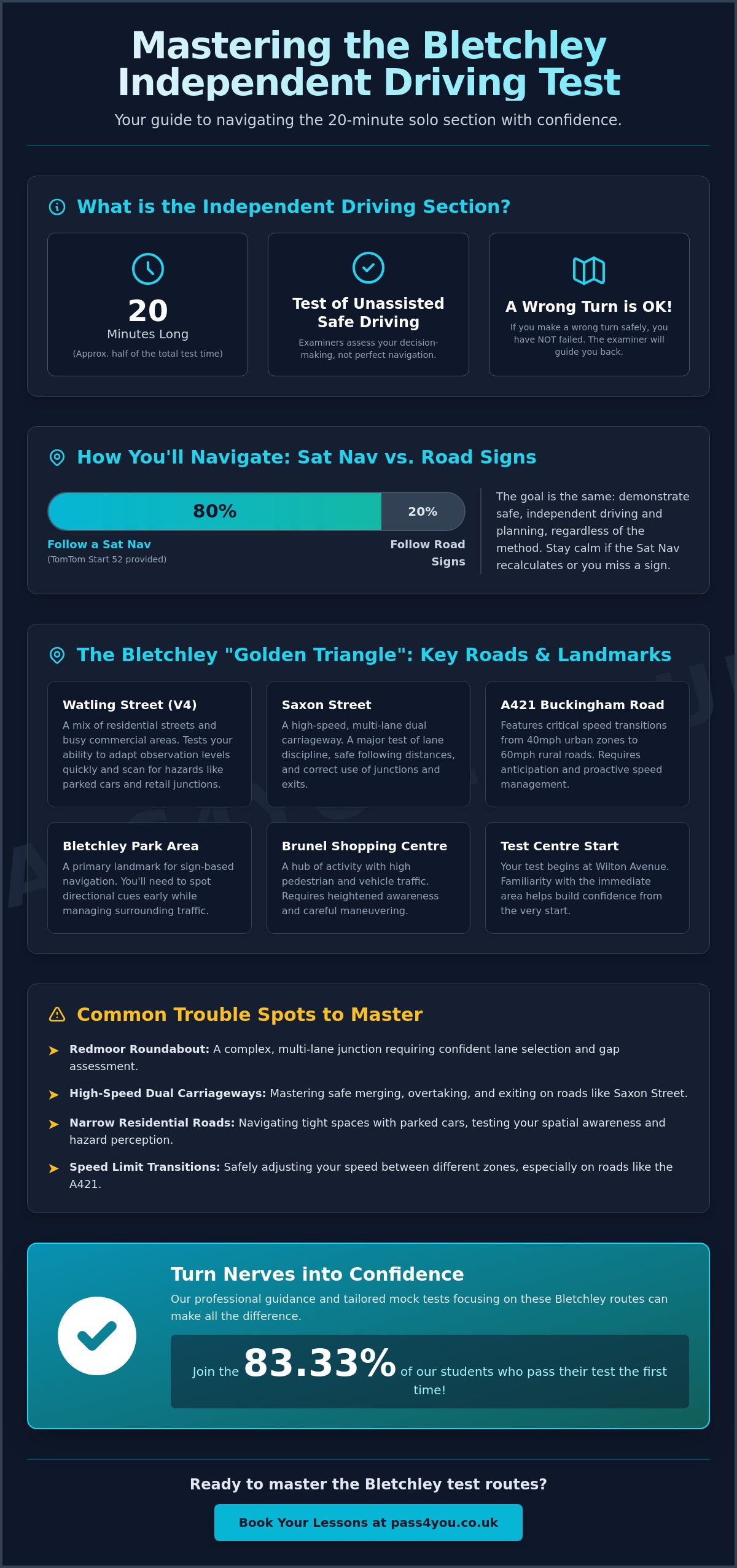
    The Bletchley Test Centre, located at Wilton Avenue, serves as the primary starting point for your practical journey. Once you leave the gates, you’ll eventually reach the independent driving section. This part of the UK driving test lasts for approximately 20 minutes, which is roughly half of your total time on the road. It’s designed to see how you handle real-world conditions without constant prompts from the examiner. We want you to feel prepared for this, as it’s often the part where students feel the most pressure.

    Many learners worry about getting lost while exploring various independent driving lesson routes bletchley examiners use. However, it’s vital to remember that “independent” doesn’t mean “perfect navigation.” The examiner is looking for safe driving and sound judgment, not your ability to act like a human GPS. If you take a wrong turn but do so safely, you haven’t failed. You simply continue driving safely, and the examiner will help you get back on track. This mindset shift often helps our students feel much more relaxed behind the wheel.

    In 2026, most candidates will follow a Sat Nav provided by the examiner. Current data shows this happens in four out of every five tests. The remaining 20% of learners will be asked to follow traffic signs to a specific destination. Both methods test your ability to plan ahead and stay calm under pressure. Whether you’re following a digital screen or a physical sign, the goal remains the same: staying safe and keeping the car under control.

    The Purpose of the Independent Phase

    The independent drive is a test of unassisted safe decision-making. During this phase, the examiner wants to see if you can manage your speed and positioning without being told when to change lanes or where to turn. This is particularly important on Bletchley’s dual carriageways, where lane discipline is a major focus. They’re checking to see if you can identify road markings and exit junctions correctly while maintaining a safe distance from other vehicles. It’s about proving you’re ready to drive alone once you have your license.

    Sat Nav vs. Traffic Signs in Bletchley

    If you’re in the 80% following a Sat Nav, the examiner will set up a TomTom Start 52 unit for you. You don’t need to touch the device; you just follow the visual and verbal prompts. If you’re asked to follow signs, you’ll likely see directions for Milton Keynes Central, Fenny Stratford, or Buckingham. These routes often involve navigating the Bletchley “grid” system. If you miss a sign or the Sat Nav recalculates, stay calm. Focus on your mirrors and signals. Your safety is always more important than the destination.

    Key Roads and Landmarks on Bletchley Independent Routes

    Familiarity with the local landscape is your best tool for staying calm during the independent phase. As you drive through Bletchley, you’ll encounter a variety of road types that test different skills. For example, Bletchley Park is more than just a historic site; it acts as a primary landmark for sign-based navigation. If your examiner asks you to follow signs towards the park, you’ll need to stay alert for early directional cues while managing the surrounding traffic. Keeping an eye out for these visual markers helps you stay oriented even if you feel a little nervous.

    Many independent driving lesson routes bletchley candidates face include the A421 Buckingham Road. This stretch requires sharp attention to your speedometer. You’ll often find yourself transitioning from a 40mph urban setting into a 60mph rural environment. Anticipating these changes before you reach the new speed limit sign shows the examiner you’re thinking ahead. According to the official government guidance on the driving test, managing these speed transitions safely is a core part of your assessment. If you’re feeling unsure about these changes, booking professional driving lessons can help you practice these specific road types until they feel like second nature.

    Watling Street (V4) offers a unique challenge by blending residential streets with bustling commercial areas. You might be navigating past rows of parked cars one moment and entering a busy retail junction the next. This road tests your ability to adapt your observation levels quickly. It’s about being proactive and scanning the road far ahead to spot potential hazards before they become problems.

    Navigating the Brunel Shopping Centre Area

    The area around the Brunel Shopping Centre is a hub of activity. You’ll need to account for high pedestrian traffic and dedicated bus lanes. When navigating the one-way systems nearby, your mirror work must be impeccable. The examiner will watch how you check your blind spots before changing lanes or turning. Most independent drives starting near Wilton Avenue will pass through these high-intensity zones to test your composure and awareness.

    Saxon Street and the V-Road Grid

    Saxon Street (V7) is the backbone of the Bletchley grid. Mastering this dual carriageway involves confident use of slip roads. Merging safely at the correct speed is a skill that takes patience and practice. While following Sat Nav directions, it’s easy to get distracted by the screen. Remember to keep your eyes on the road and use the audio prompts as a guide. Maintaining a consistent speed and choosing the correct lane early are the secrets to success on the V-road system.
    Independent Driving Lesson Routes in Bletchley: The 2026 Learner’s Guide

    Sat Nav vs. Road Signs: A Strategy for Bletchley

    Success on your test isn’t just about knowing where to go; it’s about how you process information under pressure. In Bletchley, roughly 80% of learners will use a Sat Nav during their independent drive. The remaining 20% will follow road signs. This split often causes a bit of worry, but we’ve found that both methods are perfectly manageable once you have a strategy in place. Practising various independent driving lesson routes bletchley examiners use will give you the exposure you need to feel comfortable with either scenario. It’s completely normal to prefer one over the other, but being ready for both is the mark of a confident driver.

    The psychological shift between these two methods is significant. Following a Sat Nav feels like having a passenger give you directions, while following signs requires you to scan the environment actively. If you ever find a sign is obscured by overgrown hedges or a high sided vehicle, don’t stay silent. Simply verbalise your thoughts to the examiner. Explaining that you’re looking for a specific destination shows you’re proactive and safe. For more details on the mechanics of this phase, the DVSA provides a great guide for understanding the independent drive. We always encourage our students to use their voice to clarify what they see, as it helps the examiner understand your decision making process.

    Mastering the Sat Nav Interface

    When you’re using the examiner’s Sat Nav, avoid the temptation to stare at the screen. We teach the “glance technique,” especially for the busy Saxon Street junctions. You should take a quick half second look at the map, then bring your eyes back to the road immediately. Listen closely to the audio cues while managing heavy traffic on the H8 Standing Way. If the Sat Nav happens to lose signal near the Blue Lagoon or other wooded areas, stay calm. The examiner will step in and give you verbal directions until the device catches up. You won’t be penalised for technical glitches beyond your control.

    Scanning for Signs in Bletchley

    If you’re asked to follow signs, your observation needs to start much earlier. At the Denbigh North roundabouts, you should be looking for the large directional boards well before you reach the junction. This gives you time to move into the correct lane for Fenny Stratford or Central MK without rushing. In residential areas like Wilton Avenue, signs can sometimes be hidden behind parked cars or vans. Keep your speed low and keep your eyes moving. Finding these signs early is the secret to a smooth, stress free independent drive.

    Bletchley’s Toughest Independent Driving “Trouble Spots”

    Every test area has its notorious corners, and Bletchley is no exception. While we’ve discussed the general flow of the independent drive, certain “trouble spots” require a much higher level of focus. These areas often appear on independent driving lesson routes bletchley examiners choose because they test your ability to maintain lane discipline while processing navigation instructions. Knowing where these pressure points are will help you stay calm and collected during your big day.

    Conquering Redmoor Roundabout Independently

    The Redmoor Roundabout (A5) is perhaps the most famous challenge for local learners. During the independent phase, the prompt to follow signs for the A5 or Milton Keynes Central often comes just as you are approaching this major junction. This timing is deliberate. It tests whether you can listen to an instruction while simultaneously preparing for a complex, multi-lane roundabout. One of the most common mistakes here is forgetting the “Life Saver” glance. You must check your blind spot before moving into your exit lane, especially when heading toward the A5. Lane markings at Redmoor are your primary guide, so trust what you see on the tarmac rather than guessing your position based on other cars.

    Residential Estate Hazards

    While the dual carriageways are fast, the narrow estate roads around Wilton Avenue and Rickley Lane present a different kind of difficulty. When you are following a Sat Nav in these tight streets, it is easy to become so focused on the screen that you forget about your surroundings. You need to manage your clearance from parked cars carefully. If there isn’t enough room for two cars to pass, you must be the one to find a safe gap and wait. We also see many learners miss “Stop” signs on these routes because they are busy scanning for their next turn. On roads like Whaddon Way, meeting oncoming traffic requires quick thinking and a steady hand. You should always prioritise safety over the Sat Nav’s instructions.

    Another area to watch is the “Double Roundabout” system near Bletchley train station. These small, back-to-back junctions require excellent clutch control and rapid observation. Finally, stay alert for speed limit traps. It is very common to transition from a 60mph national speed limit zone directly into a 30mph residential area. If you don’t start braking early, you’ll be over the limit before you even see the houses. If you’re feeling nervous about these specific locations, our team is here to support you. You can build your confidence and master these tricky spots by booking professional driving lessons with us today.

    How Pass4you Prepares You for Bletchley Success

    Passing your test on the first attempt is a goal we take very seriously. While some learners try to rely on apps or generic maps, nothing replaces the expertise of a professional mentor who knows the local area. Pass4you proudly maintains an 83.33% first-time pass rate, which is significantly higher than the local average of 44.6%. We achieve this by focusing on more than just the basics. We spend time exploring the specific independent driving lesson routes bletchley examiners prefer, ensuring you feel comfortable with every turn and junction before the big day arrives.

    Our approach is centered on building your confidence through experience. We use modern Volkswagen tuition vehicles because they offer superior visibility and ease of handling. This makes a huge difference when you’re navigating tight residential streets or busy roundabouts. During our custom mock tests, we simulate the exact conditions of the independent drive. We want you to feel like you’re simply driving with a friend, rather than being under the microscope of an examiner. This calm, patient instruction is why so many of our students feel ready to drive alone the moment they pass.

    Beyond the Routes: Real-World Confidence

    We believe that being a safe driver goes beyond memorising a few roads. If you’re looking for broader context, our guide on driving lessons Milton Keynes provides a complete overview of the local testing landscape. In every lesson, we integrate the independent phase to make it a natural part of your driving routine. By the time your test date arrives, following a Sat Nav or road signs will feel like second nature. We address test nerves by providing a supportive environment where it’s okay to make mistakes and learn from them. This first-class instruction ensures you’re prepared for any situation the road throws at you.

    Your Test Day at Bletchley

    When the day finally comes, you’ll arrive at the Bletchley Test Centre at Block 4, Government Buildings, Wilton Hostel. It’s a familiar spot for our students, which helps keep those early morning jitters at bay. Before you start the engine, the examiner will ask you a “tell me” vehicle safety question at the start of the test. Once you’re out on the road, you’ll be asked a “show me” question while driving. We cover all these details in our lessons so there are no surprises. Are you ready to start your journey? Book your first Bletchley driving lesson with Pass4you and let’s get you on the road to success.

    Take the Wheel with Confidence in Bletchley

    You’ve now explored the mechanics of the 20 minute independent drive and identified the specific trouble spots that often catch learners off guard. Success on the independent driving lesson routes bletchley uses comes down to your ability to stay calm and make safe decisions under pressure. Whether you’re following a Sat Nav toward Central MK or scanning for signs near Bletchley Park, your focus should always remain on the road ahead rather than the destination. Taking a wrong turn is never a fail as long as you keep the car under control and maintain your observations.

    Our expert local instructors use modern Volkswagen tuition vehicles to provide superior visibility and a smooth learning experience. We take pride in our 83.33% first-time pass rate, which is a testament to our patient, mentor-led approach. We don’t just teach you how to pass; we teach you how to be a safe, confident driver for life. You have the insights and the strategy to handle the Bletchley grid; now it’s time to put that knowledge into practice.

    Join the 83.33% who pass first time, book your Bletchley lessons today. We’re ready to help you gain your independence and start your new life on the road.

    Frequently Asked Questions

    Where is the Bletchley Driving Test Centre located?

    The Bletchley Driving Test Centre is situated at Block 4, Government Buildings, Wilton Hostel, Wilton Avenue, Bletchley, MK3 6DH. This location serves as the starting and ending point for all practical tests in the area. It’s tucked away within a residential zone, so you’ll need to be mindful of parked cars and local traffic as soon as you leave the car park.

    How long is the independent driving section in the Bletchley test?

    The independent driving phase lasts for approximately 20 minutes. This accounts for roughly half of your total 40 minute practical test. During this time, you’ll be expected to navigate without step by step directions from the examiner, either by following a Sat Nav or looking for road signs to a specific destination.

    Do I have to use my own Sat Nav for the Bletchley driving test?

    No, you don’t need to provide your own device. The examiner will bring and set up a TomTom Start 52 unit for you to use if your test involves Sat Nav navigation. They’ll handle the programming and positioning, so you can focus entirely on your driving and the road ahead.

    What happens if I take a wrong turn during the independent driving phase?

    Taking a wrong turn is not an automatic fail and won’t result in a fault as long as you do it safely. If you realise you’ve gone the wrong way, stay calm and continue driving safely. The examiner will help you get back on the correct path, or the Sat Nav will automatically recalculate a new route for you.

    Are the independent driving routes in Bletchley the same every time?

    No, the examiners use a variety of different paths to ensure you can drive safely in various conditions. While independent driving lesson routes bletchley candidates encounter follow certain patterns, they can include anything from busy dual carriageways to quiet residential estates. Practising a wide range of roads with a professional instructor is the best way to prepare for these variations.

    Which roundabouts are most common on Bletchley test routes?

    The Redmoor Roundabout near the A5 is one of the most frequent and challenging junctions you’ll face. You’re also very likely to encounter the Denbigh North roundabouts and the mini roundabouts near the Bletchley train station. Mastering lane discipline at these specific spots is a major part of feeling ready for your test.

    Can I ask the examiner for help during the independent driving section?

    Yes, you can ask the examiner for clarification if you’re unsure about a direction or if a road sign is obscured. While they won’t give you step by step instructions, they’ll confirm the destination or repeat the instruction to help you stay on track. They want to see that you’re a safe, proactive driver who communicates well.

    What is the pass rate for the Bletchley Driving Test Centre?

    The pass rate for the Bletchley test centre was 45.79% between April 2024 and March 2025. This is very close to the national average of 45.9%. At Pass4you, we’re proud to support our students in achieving an 83.33% first time pass rate through patient, expert instruction that builds genuine confidence behind the wheel.

  • Booking Your Practical Driving Test in 2026: A Step-by-Step Guide

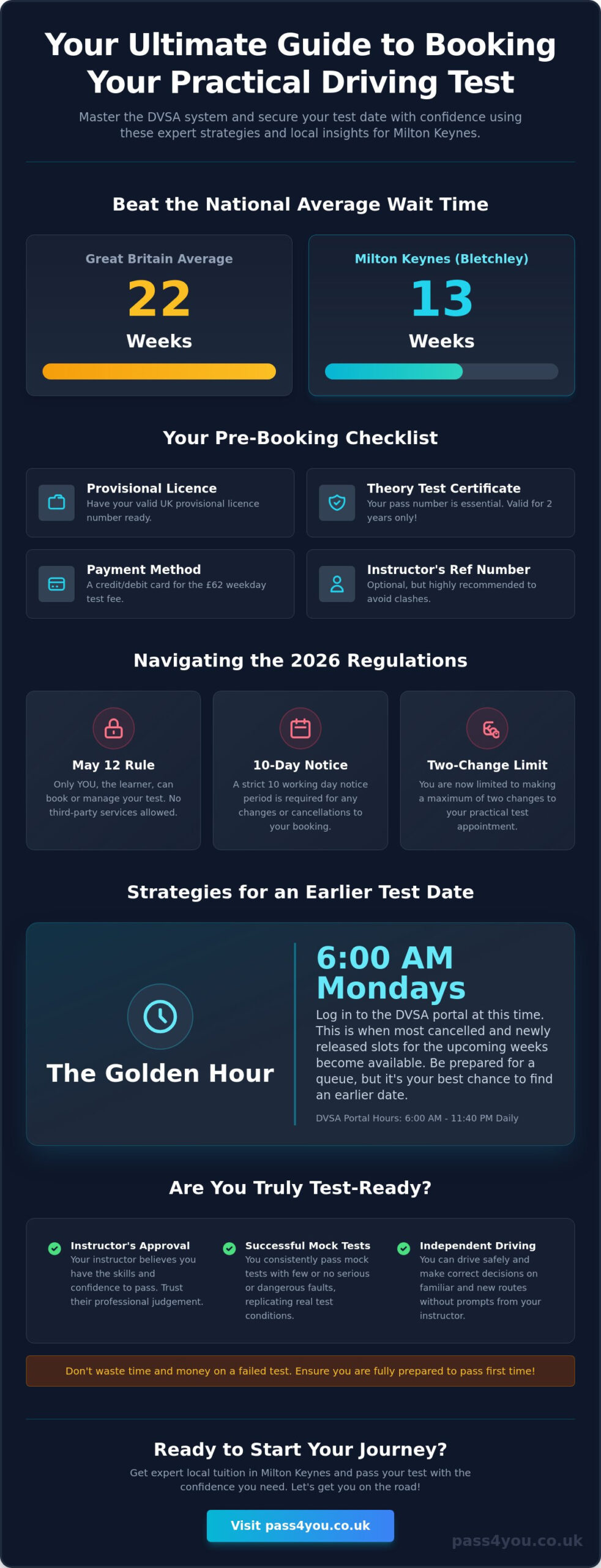
    Did you know that while the average learner in Great Britain waits 22 weeks for an appointment, learners in Milton Keynes can often secure a slot at the Bletchley test centre in just 13 weeks? Even with a shorter wait, the process of booking practical driving test dates can feel overwhelming with the new 2026 regulations now in full effect. We understand why you might feel anxious about the strict 10 working day notice period or the May 12 rule that prevents anyone but you from managing your booking. It’s a lot to keep track of when you just want to focus on being a safe, confident driver.

    Securing a date doesn’t have to be a source of stress. While national average waiting times reached 22 weeks in late 2025, there are several reliable ways to find a slot sooner without resorting to expensive or risky third-party services. Trusted experts like Wimbledon Driving School often emphasize that staying proactive with the official system is the most effective way to manage these delays. We understand how frustrating the wait can be. Our goal is to help you stay calm and focused while you navigate the system. When you are booking practical driving test appointments, knowing exactly how and when the system refreshes can save you months of waiting.

    You can take a deep breath because we’ve simplified everything to help you secure your date with total confidence. Our expert local guide will show you how to master the DVSA system and navigate the June 9 rule regarding nearby test centres. We will walk you through the official GOV.UK requirements, explain the latest cost changes, and share our proven strategy for finding cancellations so you can get on the road sooner.

    Key Takeaways

    • Prepare your provisional licence and theory test certificate number before you start to ensure a smooth, stress-free process.
    • Master the official DVSA portal to make booking practical driving test appointments straightforward while staying within the new two-change limit.
    • Learn why 6:00 am on Monday mornings is the “golden hour” for finding cancellations and securing an earlier slot at your preferred centre.
    • Gain a competitive edge at the Bletchley test centre by understanding how local expertise helps you navigate complex Milton Keynes roundabouts.
    • Use our “Test Ready” criteria and mock tests to build the confidence needed for a first-time pass, ensuring you don’t waste time or money.

    Essential Requirements Before Booking Your Practical Driving Test

    Getting ready for your test day is an exciting milestone on your journey to independence. Before you jump onto the official DVSA website, you need to gather a few specific items to ensure the process is smooth and stress-free. Having everything ready at your fingertips prevents the frustration of timed-out sessions or missing out on a prime slot because you had to search for a document. We want you to feel calm and prepared from the very first click.

    To begin the process of booking practical driving test appointments, you will need the following essentials:

    • Your valid UK provisional driving licence number.
    • A valid Theory Test pass certificate number.
    • A credit or debit card to pay the £62 fee for weekday tests.
    • Your driving instructor’s personal reference number, which helps coordinate car availability.

    The United Kingdom driving test is designed to ensure every new driver meets a high standard of safety, and these requirements are the first gatekeepers of that standard. Checking these details now saves you from unnecessary anxiety later.

    The Theory Test Prerequisite

    You cannot secure a practical date without first passing your theory test. It’s a firm rule that ensures you have the underlying knowledge to drive safely on your own. Keep in mind that your theory certificate is only valid for exactly two years from the date you passed. If you don’t pass your practical test within that window, you’ll need to retake the theory exam. If you are just starting out, our provisional licence guide explains how to get your documents in order before you even look at a theory book.

    Why Your Instructor’s Reference Number Matters

    While entering an instructor’s reference number is optional, we highly recommend it for all our students. When you use Simon’s specific reference number during the booking practical driving test process, it helps the system flag potential scheduling conflicts. There’s nothing more stressful than finding a perfect test date only to realise your instructor is already booked for another student’s exam at that exact time. By using this number, you ensure that Simon and the Pass4you car are actually available to support you. We always suggest a quick chat with your instructor to coordinate dates before you hit the final confirm button. This simple step protects your investment and keeps your path to a first-time pass clear and focused.

    Step-by-Step: How to Book Your Practical Driving Test Online

    Once you have your documents in order, the next step is to head to the computer. The process of booking practical driving test appointments is handled through the official DVSA practical driving test portal. This service is available daily from 6:00 am until 11:40 pm. While you can access it at any time during these hours, we recommend being ready right at the start of the day if you want the widest choice of dates. It’s a straightforward system, but it requires your full attention to ensure every detail is correct.

    The system will ask for your provisional licence number and your theory test pass certificate number. It’s also vital to remember that as of May 12, 2026, only the person taking the test is permitted to book or change the appointment. This rule was introduced to stop third parties from bulk-buying slots, ensuring that you have a fair chance at finding a date that works for you. Take your time, stay calm, and follow the prompts carefully.

    Navigating the DVSA Booking Portal

    If you log on at 6:00 am on a Monday morning, you will likely encounter a virtual queue. Don’t worry if you see a message saying there are thousands of people ahead of you. The queue moves steadily; just keep your browser window open and avoid refreshing the page. When it’s your turn, you’ll select “Car” as your vehicle type. You must also specify whether you’re taking the test in a manual or automatic vehicle. At this stage, enter Simon’s instructor code. This is a brilliant way to sync your booking with the Pass4you schedule, ensuring the car is ready and waiting for you on the big day.

    Choosing the Right Date and Time

    Selecting a time slot is about more than just convenience. In Milton Keynes, you should consider local traffic patterns. A slot at 8:00 am means you’ll be driving during the height of the morning rush, while a 3:00 pm slot might coincide with the school run near Bletchley. Some learners prefer these busier times because heavy traffic can actually mean you cover a shorter distance during the test. If you’re still feeling a bit nervous about handling these conditions, booking extra driving lessons can help build the confidence you need. Once you’ve picked a date, you’ll pay the fee of £62 for a weekday slot or £75 for weekends. Always wait for the confirmation email before closing your browser to be 100% sure your date is secured.

    Booking Your Practical Driving Test in 2026: A Step-by-Step Guide

    Securing a date doesn’t have to be a source of stress. While national average waiting times reached 22 weeks in late 2025, there are several reliable ways to find a slot sooner without resorting to expensive or risky third-party services. We understand how frustrating the wait can be. Our goal is to help you stay calm and focused while you navigate the system. When you are booking practical driving test appointments, knowing exactly how and when the system refreshes can save you months of waiting.

    Patience is your best tool here. The backlog is a reality, but it’s one you can manage with the right strategy. By staying persistent and using the official tools provided, you’ll find that dates do open up. We’ve seen many students successfully move their tests forward by several weeks just by being proactive.

    The 6:00 AM Booking Window

    Monday morning is the most important time for any learner looking to secure a date. The DVSA typically releases a fresh batch of test slots at 6:00 am every Monday. To make the most of this window, you should have your provisional licence and theory pass certificate details ready to go before you log on. Being prepared helps you avoid the anxiety of a timed-out session during the morning rush. A cancellation slot is a test date released by another learner who has decided they aren’t quite ready or have changed their plans. These slots appear instantly on the system, so being the first to see them is vital for success.

    Ethical Cancellation Hunting

    Once you have a date in the diary, you can use the “Change your test” tool on the official website to look for something sooner. You can Book your practical driving test and then check back regularly for these openings. We recommend checking a few times a day, but don’t overdo it. If you refresh the page too frequently, the system might temporarily block your IP address because it thinks you’re an automated bot. This is why a steady, patient approach works best.

    We strongly advise against using third-party cancellation apps or “booking bots.” The DVSA has actively cracked down on these services in 2026 to ensure the system remains fair for everyone. Some of these apps are unreliable, and there’s a real risk that the DVSA will cancel any booking made through them. Your personal data is also much safer when you stick to the official portal. At Pass4you, we help you stay “test ready” so that if a short-notice slot appears, you’ll have the confidence to grab it. Simon’s supportive teaching style ensures you’re prepared for any date, giving you the best chance at a first-time pass.

    Local Insight: Booking for the Milton Keynes Driving Test Centre

    Milton Keynes offers a unique advantage for those booking practical driving test dates. While the national average wait time is 22 weeks, the Bletchley test centre currently sits at 13 weeks. This shorter wait time is a relief, but it comes with a specific challenge. The local pass rate in Bletchley is 40.4%, which is lower than the national average. This tells us that while it’s easier to get a date, passing requires a deep understanding of our unique road network. You don’t just need to know how to drive; you need to know how to drive in Milton Keynes.

    We focus on building your confidence specifically for these roads. Our driving lessons in Milton Keynes are designed to familiarise you with every complex junction and multi-lane roundabout you might encounter. Simon has spent years helping students master these specific routes. He knows that the secret to success isn’t just about technical skill. It’s about feeling calm and prepared when you see a familiar landmark during your exam. We want you to feel like the test is just another drive with a friend.

    Milton Keynes Test Centre Specifics

    The local hub is located in Bletchley. It’s a busy area with a mix of residential streets and high-speed roads. When you arrive, you’ll find designated parking for test candidates. Simon always recommends arriving 10 minutes early to settle your nerves. The process of booking practical driving test slots at Bletchley is the same as elsewhere, but the preparation must be local. Simon often shares tips for this specific environment, such as being mindful of the speed limits that change quickly between residential blocks.

    Preparing for Local Road Types

    Your test will likely include a mix of dual carriageways and tight residential turns. We make sure to integrate plenty of dual carriageway practice into your sessions. Mastery of these high-speed roads is a core reason why Pass4you maintains an 83.33% first-time pass rate. We also use mock tests on actual Bletchley routes to ensure there are no surprises on the day. This tried and tested technique helps you feel like a safe driver for life, not just for the duration of the test. If you’re ready to start your journey with a patient mentor, you can book your driving lessons with Simon today.

    Are You Test Ready? Why Your Instructor’s Approval Matters

    It is natural to feel a rush of excitement once you have your theory certificate in hand. You might feel tempted to rush into booking practical driving test dates immediately to secure the earliest possible slot. However, taking the test before you are truly ready can be a costly mistake. Beyond the £62 booking fee, the emotional impact of a “fail” can set your confidence back significantly. We want your first experience at the test centre to be your only one, resulting in that coveted pink licence.

    The DVSA has strict rules regarding changes and rebooking. If you fail your test, you must wait at least 10 working days before you can take another one. With current wait times at the Bletchley centre sitting at 13 weeks, a single failed attempt could mean you don’t get another chance for months. This is why Simon’s professional assessment is so valuable. He doesn’t just teach you to pass; he ensures you are a safe driver who can handle any situation without prompts.

    The Value of the Mock Test

    One of the best ways to gauge your readiness is through a formal mock test. This session simulates the exact environment of the practical driving test, including the sat-nav or independent driving sections. During a mock test, Simon will identify whether your mistakes are “minor” driving faults or “serious” faults that would result in an immediate fail. Identifying these habits in a calm, supportive environment allows you to fix them before the examiner is sitting next to you. Our students find that these practice runs significantly reduce the anxiety often associated with the big day.

    Booking with Confidence

    At Pass4you, our “Safe Driver for Life” philosophy means we focus on quality over speed. While some learners try to save money by taking fewer lessons, this often leads to multiple failed tests and higher costs in the long run. By following a structured learning plan and listening to your instructor’s advice, you actually save money. You’ll arrive at the Bletchley centre feeling patient, focused, and fully prepared for those Milton Keynes roundabouts.

    Our impressive 83.33% first-time pass rate is a direct result of this honest, transparent approach. We won’t suggest booking practical driving test dates until we are both certain you can pass with flying colours. This partnership between learner and instructor is what makes our school stand out. If you are a nervous learner who has struggled with other instructors, you’ll find Simon’s calm and brilliant teaching style life-changing. When you feel ready to take that first step toward independence, book your first lesson with Pass4you and start your journey the right way.

    Take the Next Step Toward Your Driving Independence

    You now have the tools to navigate the DVSA system and secure your date. Remember that success depends on more than just booking practical driving test slots at the right time. It requires a solid foundation built on theory knowledge, local road mastery, and the calm guidance of a mentor who understands your anxiety. By focusing on being test ready rather than just test booked, you set yourself up for a lifetime of safe driving on the roads of Milton Keynes and beyond.

    We are here to support you every step of the way in our modern Volkswagen tuition vehicles. Simon’s patient approach has helped many nervous learners overcome their fears and achieve their goals. Join the 83.33% who pass first time and book with Pass4you today. You have worked incredibly hard to get this far; now it’s time to secure your date and enjoy the freedom that comes with your full UK licence.

    Frequently Asked Questions

    How much does it cost to book a practical driving test in 2026?

    A standard weekday practical test costs £62. If you choose to take your test during the evening, on a weekend, or during a bank holiday, the price increases to £75. These fees are paid directly to the DVSA through the official GOV.UK portal. Always ensure you’re using the legitimate government website to avoid extra administrative charges from unofficial booking services.

    Can I book my driving test before I pass my theory test?

    No, you cannot book your practical exam until you’ve successfully passed your theory test. The online system requires you to enter a valid theory test pass certificate number before it allows you to view any available dates. This ensures every learner has a basic understanding of road signs and safety before they attempt the final practical assessment.

    What is the earliest time I can book a driving test online?

    The official booking service opens at 6:00 am every morning and remains available until 11:40 pm. For the best chance of finding a slot, we recommend being online right at 6:00 am, especially on Monday mornings when new appointments are released. Staying patient while waiting in the virtual queue is the best way to manage the booking practical driving test process successfully.

    How long is the current wait for a driving test in Milton Keynes?

    As of May 2026, the average waiting time at the Bletchley driving test centre is 13 weeks. This is significantly shorter than the national average of 22 weeks, making Milton Keynes a great place to secure a date. While the wait is shorter, remember that the local pass rate is 40.4%, so being fully prepared for the local roundabouts is essential.

    Can I book a driving test without a driving instructor?

    Yes, you’re legally allowed to book and take your test without a professional instructor. However, you must provide a vehicle that meets all DVSA safety requirements, including extra mirrors and L-plates. Most of our students prefer using Simon’s modern Volkswagen because it’s familiar and reliable. Taking the test in a car you’ve used for your lessons helps you feel much more confident and calm.

    What happens if I need to change my driving test date?

    You can change your appointment through the GOV.UK website, but you must provide at least 10 working days’ notice to avoid losing your fee. This notice period was increased to help reduce the national backlog. If you’re feeling nervous and need more time to prepare, it’s better to reschedule early rather than rushing into a test you aren’t ready for.

    How many times can I reschedule my driving test for free?

    Under the new rules effective from March 31, 2026, you can only make a maximum of two changes to your booking practical driving test slot. If you need to change it a third time, you’ll have to cancel the appointment and pay for a new one. This policy encourages learners to only book when they’re truly confident in their ability to pass.

    What documents do I need to bring to the practical test?

    You must bring your UK photocard provisional driving licence to your appointment. If you have an old-style paper licence, you also need to bring a valid passport. While it isn’t strictly mandatory to bring your theory test pass certificate, it’s very helpful to have it with you just in case there are any issues with the digital records at the test centre.

  • How to Change My Driving Test: A Complete Guide for 2026

    How to Change My Driving Test: A Complete Guide for 2026

    Last Tuesday, a learner named Sarah in Milton Keynes realised she wasn’t quite ready for her upcoming practical, but she was terrified that trying to change my driving test would mean losing her £62 fee or waiting another six months. It’s a common worry that many of our students share. You want to feel 100% calm and prepared before you sit in that examiner’s car; however, the DVSA rules regarding the three clear working days notice often feel like a complicated puzzle. We understand that life happens and sometimes you just need a little more time to perfect those tricky parallel parks or gain more road confidence.

    At Pass4you, we believe your journey to becoming a safe driver for life should be as stress-free as possible. We’ll show you exactly how to manage your appointment, avoid the frustration of paying twice, and even find those elusive earlier slots using our proven methods. You don’t have to navigate the booking system alone or settle for a date that doesn’t work for your schedule. This guide breaks down the latest 2026 regulations and provides a simple, step-by-step plan to get your test date exactly where it needs to be.

    Key Takeaways

    • Master the official DVSA process to safely reschedule your appointment or switch to a more convenient test centre.
    • Avoid unnecessary costs by learning the 2026 notice rules, ensuring you can change my driving test without having to pay the booking fee again.
    • Uncover the most effective ways to spot earlier cancellation slots and understand the reality of using third-party apps versus manual searching.
    • Use our professional criteria and mock test results to decide if you are genuinely prepared for the road or if a postponement is the safer choice.
    • Find out how Pass4you’s patient instruction in Milton Keynes supports your journey toward an impressive 83.33% first-time pass rate.

    How to Change Your Driving Test Appointment Online

    Life doesn’t always go to plan. Perhaps you need more time to master your reverse park, or maybe your instructor suggests a few extra lessons to secure that 83.33% first-time pass rate we strive for. Deciding to change my driving test is a sensible move if it helps you feel calm and prepared. In 2026, the only secure way to manage your booking is through the official DVSA website. This service is free to use, so you should avoid third-party booking sites that often charge unnecessary administrative fees.

    The online portal is accessible daily from 6:00 am until 11:40 pm. This wide window allows you to check for new slots early in the morning when cancellations often appear. You can move your appointment to a later date or even switch to an entirely different test centre if you’ve moved house or found a location with better availability. Taking control of your booking helps reduce nerves and ensures you’re heading into the exam with total confidence.

    What You Need Before You Start

    Having your details ready makes the process much smoother. You’ll need your Great Britain or Northern Ireland driving licence number to log in. If you can’t find your test reference number, don’t worry. You can use your theory test pass certificate number instead. It’s also a great idea to have your driving instructor’s personal reference number on hand. This lets you check their availability within the portal, ensuring you don’t pick a time when they’re already helping another student. Always check your internet connection first. A drop in signal could cause you to lose your place in the digital queue during busy periods.

    Step-by-Step DVSA Portal Navigation

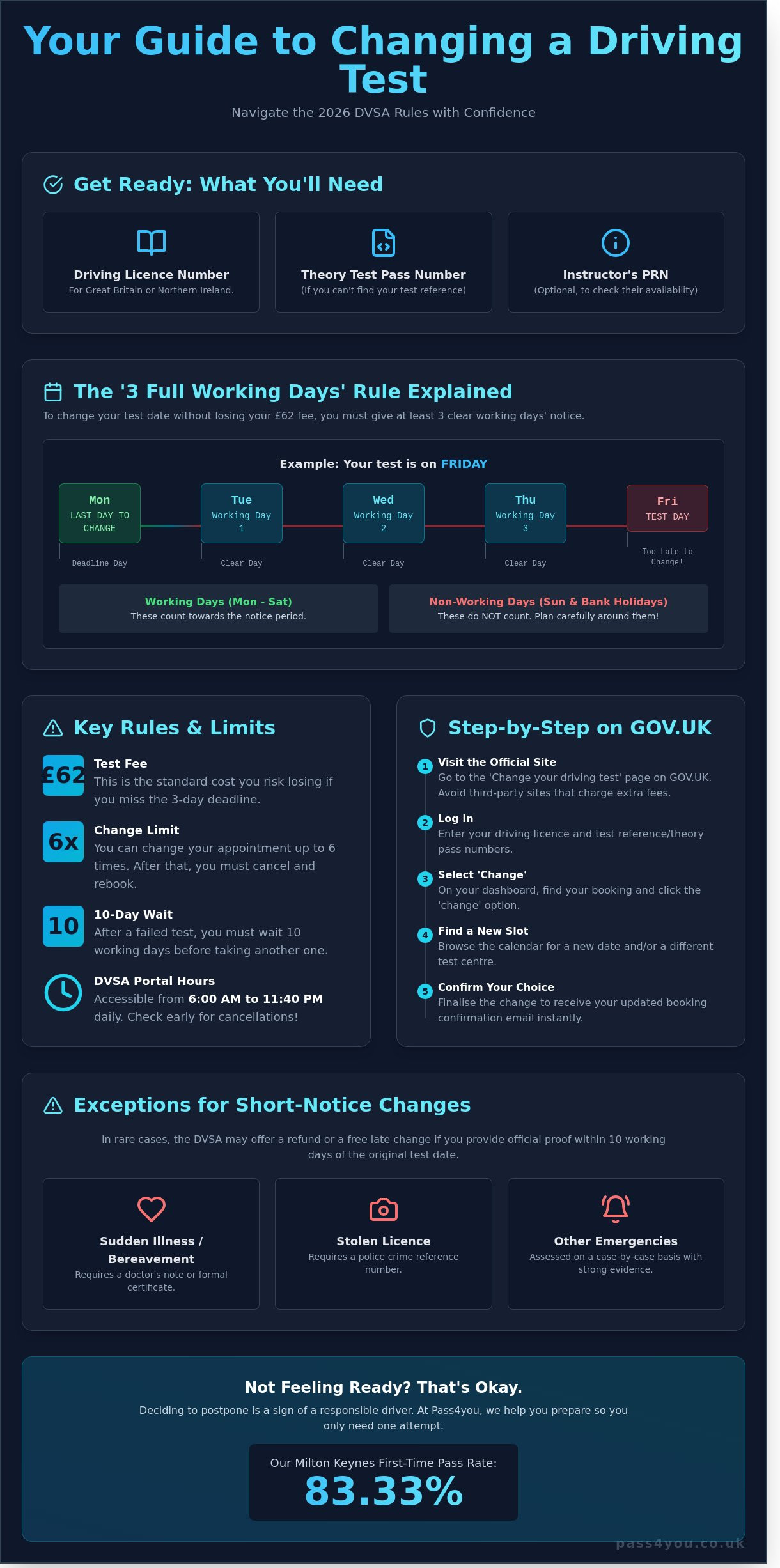
    To begin, visit the ‘Change your driving test appointment’ page on the GOV.UK website. Once you enter your details, you’ll reach a personal dashboard. From here, follow these steps:

    • Select the ‘change’ option next to your current test date.
    • Choose whether you want to change the date, the test centre, or both.
    • Browse the calendar for available slots in 2026.
    • Confirm your new selection to receive an immediate updated booking email.

    You can change your appointment up to six times. If you need to change my driving test more than that, you’ll have to cancel and rebook. Remember that you must provide at least three clear working days’ notice. If you change it later than this, you’ll lose your original fee and have to pay again. Staying organised helps you remain a safe driver for life without wasting money on lost bookings.

    Notice Periods and Fees: When Will You Have to Pay Again?

    Feeling nervous about your upcoming appointment is completely normal. However, if you realise you aren’t quite ready to sit the exam, you must act quickly to protect your money. A standard practical car test costs £62 in 2026. If you don’t follow the DVSA notice rules, you’ll lose that fee and have to pay the full amount again for a new slot. Understanding the calendar is the best way to stay in control of your budget and your nerves.

    The ‘3 Full Working Days’ Rule

    To change my driving test without paying another £62, you must give at least 3 clear working days’ notice. This doesn’t include the day you make the change or the day of the test itself. Monday to Saturday are considered working days by the DVSA. Sundays and Bank Holidays don’t count towards your notice period, so you need to plan ahead if your test falls early in the week. For example, if your test is booked for a Friday, you must complete your change by the previous Monday at the latest.

    The 10-day rule is also a vital part of the 2026 regulations. If you’ve recently taken a test and didn’t pass, the DVSA requires you to wait 10 working days before you can sit another one. This gap is designed to give you enough time to work with your instructor on any faults. Our team focuses on building your skills so you feel prepared the first time. You can learn more about how our patient teaching style helps students build lasting confidence.

    Exceptions for Short-Notice Changes

    Life can be unpredictable, and sometimes you might need to change my driving test at the very last minute. The DVSA may offer a refund or a free late change in very specific, unavoidable circumstances. You can claim your money back if you have a sudden illness or a bereavement in your immediate family. You’ll need to provide firm evidence, such as a doctor’s note or a formal certificate, within 10 working days of the original test date.

    If your driving licence is stolen just before the test, you must report it to the police immediately to obtain a crime reference number. Without this specific proof, the DVSA won’t waive the fee. They’re firm but fair, and having your paperwork in order makes the process much smoother. Always keep your instructor in the loop, as they can often provide the extra reassurance you need during a stressful situation.

    How to Change My Driving Test: A Complete Guide for 2026

    Finding an Earlier Slot: The Truth About Cancellation Appointments

    Finding a sooner date often feels like a full-time job. These “cancellation” slots appear when another learner decides to change my driving test date or when the DVSA releases new blocks of examiner capacity. While it’s tempting to grab the first date you see, you need a calm strategy to navigate the system effectively without becoming overwhelmed.

    Currently, the DVSA allows you to reschedule your appointment a maximum of 6 times. Once you hit this limit, you’ll have to cancel your booking entirely and start the process again from scratch. This is a strict rule designed to prevent people from “hoarding” slots or constantly shifting dates. Most successful learners find that manual checking is just as effective as paid apps. While third-party apps send notifications, they often lag by 120 seconds or more. By the time you log in, the slot has usually been taken by someone already on the portal. Checking the official government website yourself ensures you’re seeing real-time availability without spending extra money.

    Strategies for Finding Sooner Dates

    • The 6 am Rule: The DVSA booking system typically refreshes early in the morning. Logging on at 6:00 am on a Tuesday or Wednesday often reveals slots that were cancelled late the previous night.
    • Expand Your Search: If you’re prepared for different road types, look at centres within a 15-mile radius. Don’t book a rural centre if you’ve only ever driven in city traffic, as the different hazards can be startling.
    • The Instructor Check: Always message your instructor before you click ‘confirm’. If they’re already booked for another student’s test at that time, you’ll have wasted one of your 6 precious change attempts.

    The Risks of Rushing Your Test

    A “quick” test date is only a bargain if you’re actually ready to pass. If you grab a slot for next week but haven’t mastered your reverse bay park or independent driving sections, you’re likely to face a disappointing result. A weekday practical test costs £62. When you add the cost of car hire and a pre-test warm-up lesson, a fail can set you back over £150 in total.

    We’ve seen many nervous learners feel pressured to rush because they’re tired of waiting. However, taking an extra 21 days to polish your skills ensures you’re a safe driver for life. Moving your test back slightly is often the most cost-effective choice. It saves you the emotional toll of a “fail” result and the financial burden of rebooking and waiting another 18 weeks for a new slot. Patience now leads to confidence on the big day.

    Should I Change My Driving Test? 4 Signs You’re Not Quite Ready

    Deciding whether to go ahead with your booking or postpone can feel like a heavy burden. You might feel a rush to get your licence, but heading to the test centre before you’re prepared often leads to a cycle of failed attempts and lost confidence. At Pass4you, we’ve seen that students who wait until they’re truly “test-ready” are far more likely to join our 83.33% first-time pass rate group. If you’re doubting your skills, it’s usually a sign that you should change my driving test to a later date.

    Performance Indicators for Test Readiness

    Your driving should feel like a natural habit rather than a struggle. Consider these three markers of readiness:

    • Physical and Verbal Prompts: If your instructor still needs to use the dual controls or give you verbal reminders about mirrors or speed, you aren’t ready to drive independently.
    • Manoeuvre Consistency: You should be able to complete the parallel park, emergency stop, and reversing into a bay accurately 9 out of 10 times without any guidance.
    • Emotional Control: During the independent driving section, you should feel calm and in control of the vehicle. If your heart races or you feel panicked by simple SatNav directions, more practice is needed.

    The Mock Test Litmus Test

    A mock test is a realistic rehearsal of the DVSA exam conditions. At Pass4you, we use these sessions in Milton Keynes to simulate the exact pressure of the real exam. If you fail a mock test with several serious faults, it’s a clear signal to change my driving test. Failing a mock isn’t a setback; it’s a valuable tool that identifies exactly where your safety gaps are. We find that students who treat the mock test as the “real deal” develop the mental resilience needed to handle the actual examiner on the day.

    Trusting the Professional Over the Pressure

    You might face pressure from well-meaning family or friends who tell you to “just have a go” because the wait times are long. While they want the best for you, they don’t see your driving from a professional perspective. Simon and the team at Pass4you have spent years honing a tried and tested technique to ensure you’re a safe driver for life, not just for forty minutes. Your instructor’s advice is your most valuable asset. If they suggest you aren’t ready, they’re protecting your confidence and your wallet from an avoidable fail.

    Don’t risk your confidence on a “maybe.” If you want to ensure you’re truly prepared for the roads in Milton Keynes, book a professional assessment lesson with Pass4you today.

    How Pass4you Supports Your Test Journey in Milton Keynes

    Learning to drive in Milton Keynes presents unique challenges, from the iconic grid system to the high-speed roundabouts that can intimidate even the most prepared learners. At Pass4you, we don’t just teach you to pass; we build your confidence through patient, expert instruction. Our impressive 83.33% first-time pass rate is a testament to our methods. We focus on creating a calm environment where you can master the car at your own pace. If you feel you need more time to master the local roads, we provide the honest feedback you need to decide if you should change my driving test to a later date.

    Our approach is built on flexibility and local knowledge. We understand that life happens, and sometimes your original test date no longer fits your progress. We help you manage your lesson schedule to ensure you’re peaking at exactly the right moment. By focusing on safety and skill rather than just “passing the box,” we ensure you’re ready for the A5, the V-roads, and everything in between.

    Personalised Guidance from Simon

    Simon is a calm, experienced mentor who knows exactly when a student is ready for the real thing. He understands the anxiety that comes with the Milton Keynes road layout, especially the complex roundabouts that often trip up learners. When you work with Simon, you get a tailored plan. If you choose to change my driving test, he’ll help you organise your remaining lessons to stay sharp. You’ll gain direct experience on actual test routes, learning how to navigate tricky junctions and high-traffic areas with total composure.

    Booking Your Success with Pass4you

    Our “safe driver for life” philosophy is designed to reduce test-day nerves by replacing uncertainty with genuine skill. We don’t believe in shortcuts. Instead, we offer comprehensive mock tests to verify your abilities before the big day. These mocks simulate the exact conditions of the Milton Keynes test centre, giving you a clear picture of your readiness. This data-driven approach saves you money in the long run by ensuring you only take the test when your success is likely. Our students feel prepared because they’ve already proven they can handle the pressure.

    Take Control of Your Road to Success

    Deciding to change my driving test shouldn’t feel like a setback. It’s often the smartest move you can make to ensure you’re truly prepared for the DVSA examiners. Remember that you must provide at least three clear working days of notice to avoid losing your £62 booking fee. This window allows you to find a cancellation slot that fits your schedule or simply gives you the extra time needed to master those tricky roundabouts in Milton Keynes. Success on the road comes from feeling relaxed and capable behind the wheel.

    At Pass4you, Simon provides calm and patient instruction in modern Volkswagen tuition vehicles to help you build that essential confidence. Our students benefit from a proven approach that has resulted in an impressive 83.33% first-time pass rate. We don’t just teach you to pass; we help you become a safe driver for life through a structured, stress-free learning programme tailored to your specific needs. Don’t let nerves or a rushed timeline stand in your way. Book your calm and patient driving lessons in Milton Keynes today and start your journey with a mentor who genuinely cares about your progress. You’re closer to that full pink licence than you think.

    Frequently Asked Questions

    How many times can I change my driving test date?

    You can change your driving test appointment up to 6 times before the system requires you to cancel and start again. This limit is set by the DVSA to ensure the booking system remains fair for all learners. If you find you’ve reached this 6-change limit, you’ll need to cancel your current booking, wait for a refund, and then pay the £62 fee again for a brand-new slot.

    Can I change my driving test centre after I have booked?

    You can change your driving test centre location at any time through the official DVSA website. To change my driving test centre, log in using your 16-digit driving licence number and your booking reference. You’ll then see a list of alternative centres. Wait times can vary significantly, with some centres like Milton Keynes showing 18-week waits while others may have slots much sooner.

    What is the latest I can change my driving test without losing my fee?

    You must change your test date at least 3 clear working days before your appointment to keep your £62 fee. This 3-day window doesn’t include Sundays, public holidays, or the day of the test itself. If you try to reschedule with only 48 hours notice, you’ll lose your money and have to pay the full fee again. It’s best to decide at least 5 days in advance.

    Do I need my instructor’s permission to change my test date?

    You don’t need your instructor’s legal permission to change your date, but it’s highly recommended to consult them first. Your instructor needs to be available and their car must be free for the new time. At Pass4you, we help students achieve an 83.33% first-time pass rate by ensuring they only move their test when they feel calm and safe. Coordination with your mentor prevents unnecessary stress.

    How do I find a driving test cancellation for an earlier date?

    You can find an earlier driving test cancellation by checking the DVSA booking service regularly or using a dedicated notification app. New slots appear when other learners reschedule or cancel their appointments. Many of our students find an earlier date within 72 hours by logging on at 6:00 am when the system updates. This proactive approach helps you get on the road much faster than waiting months.

    Is there a charge for changing my driving test appointment online?

    There is no additional charge to change my driving test appointment online as long as you provide the required 3-day notice. Rescheduling is a free service provided by the DVSA to help learners find the most suitable time. You’ll only need to pay an extra £13 if you move a weekday booking to a weekend or evening slot, as these premium times carry a higher total cost.

    What happens if I change my test and then decide I want the original date back?

    You cannot get your original date back once you’ve confirmed a new appointment because the system releases it instantly. As soon as you click confirm, your old slot becomes available for any other learner in the UK to book. If you change your mind, you’ll have to manually search the live database again. There’s no guarantee that your previous time or any other nearby date will be available.

    Can I change my test if I haven’t passed my theory test yet?

    You cannot book or change a practical driving test until you have successfully passed your theory test and received your certificate. The DVSA booking system requires your valid theory pass number before it lets you access the practical test calendar. Remember that your theory certificate expires exactly 2 years after your pass date. If it expires, you’ll need to pass the theory exam again before booking a practical.

  • Mastering the Practical Driving Test in 2026: The Ultimate Guide to Passing First Time

    Mastering the Practical Driving Test in 2026: The Ultimate Guide to Passing First Time

    Last Tuesday, Sarah sat at the Milton Keynes test centre, her hands gripping the wheel as she looked toward the daunting H6 Childs Way roundabout. Like 51.1% of learners who didn’t pass their first time last year, she was terrified that one minor slip-up would mean wasting another £62 and waiting months for a new slot. It’s a heavy weight to carry, especially when you’re trying to memorise the 2026 DVSA requirements while managing busy local traffic.

    We understand that the practical driving test can feel overwhelming, and it’s natural to worry about complex independent driving rules or those tricky multi-lane junctions. This guide is designed to replace that anxiety with the same calm confidence that has helped our students achieve a 83.33% first-time pass rate. You’ll gain a clear mental map of the entire test day and learn the specific professional secrets to mastering Milton Keynes’ most challenging roads. We’re going to break down every step of the process to ensure you’re fully prepared to become a safe driver for life.

    Key Takeaways

    • Understand exactly what the DVSA expects during your 40-minute assessment to ensure you meet the national standard for safe, independent driving.
    • Learn how to navigate the unique challenges of the Milton Keynes grid system and the complex roundabouts frequently encountered near the Bletchley test centre.
    • Build your confidence by mastering the five essential stages of the practical driving test, from the initial eyesight check to the vehicle safety questions.
    • Discover why realistic mock tests and daily “Show Me, Tell Me” practice are vital for calming your nerves and securing a successful first-time pass.
    • Get expert advice on booking your appointment through official channels to avoid scams and a checklist of everything you must bring on the day.

    Understanding the Practical Driving Test in 2026

    The practical driving test is more than just a 40-minute drive with an official. It’s a structured assessment designed by the DVSA to confirm you can handle a car independently and safely across various road conditions. The primary goal is to verify you meet the National Standard for driving cars and light vans. This isn’t about being a perfect driver who never makes a mistake. It’s about showing you’re a responsible road user who doesn’t put others at risk. During the session, you’ll need to demonstrate competence in vehicle handling, hazard perception, and making independent decisions without constant prompts.

    The United Kingdom driving test has seen several updates over the years to keep pace with busier roads and new technology. In 2026, the psychological hurdle feels higher for many learners than it did for previous generations. With test waiting times at many local centres averaging 15 to 20 weeks, students often feel they’re under immense pressure to succeed on their first attempt. The rising cost of fuel and insurance adds another layer of stress to the process, making the stakes feel much higher than a simple skills check.

    At Pass4you Driving School, we simplify this mindset by focusing on our “safe driver for life” philosophy. We don’t just teach you to pass a 40-minute exam; we focus on building the habits that make you a confident motorist for years to come. Our instructors, like Simon, use a calm and patient method that has helped us achieve an 83.33% first-time pass rate. When you view the test as a simple demonstration of your daily driving habits rather than a high-stakes performance, the anxiety naturally lifts. We’ve honed a tried and tested technique that replaces panic with professional muscle memory.

    The Requirements: What You Need Before Booking

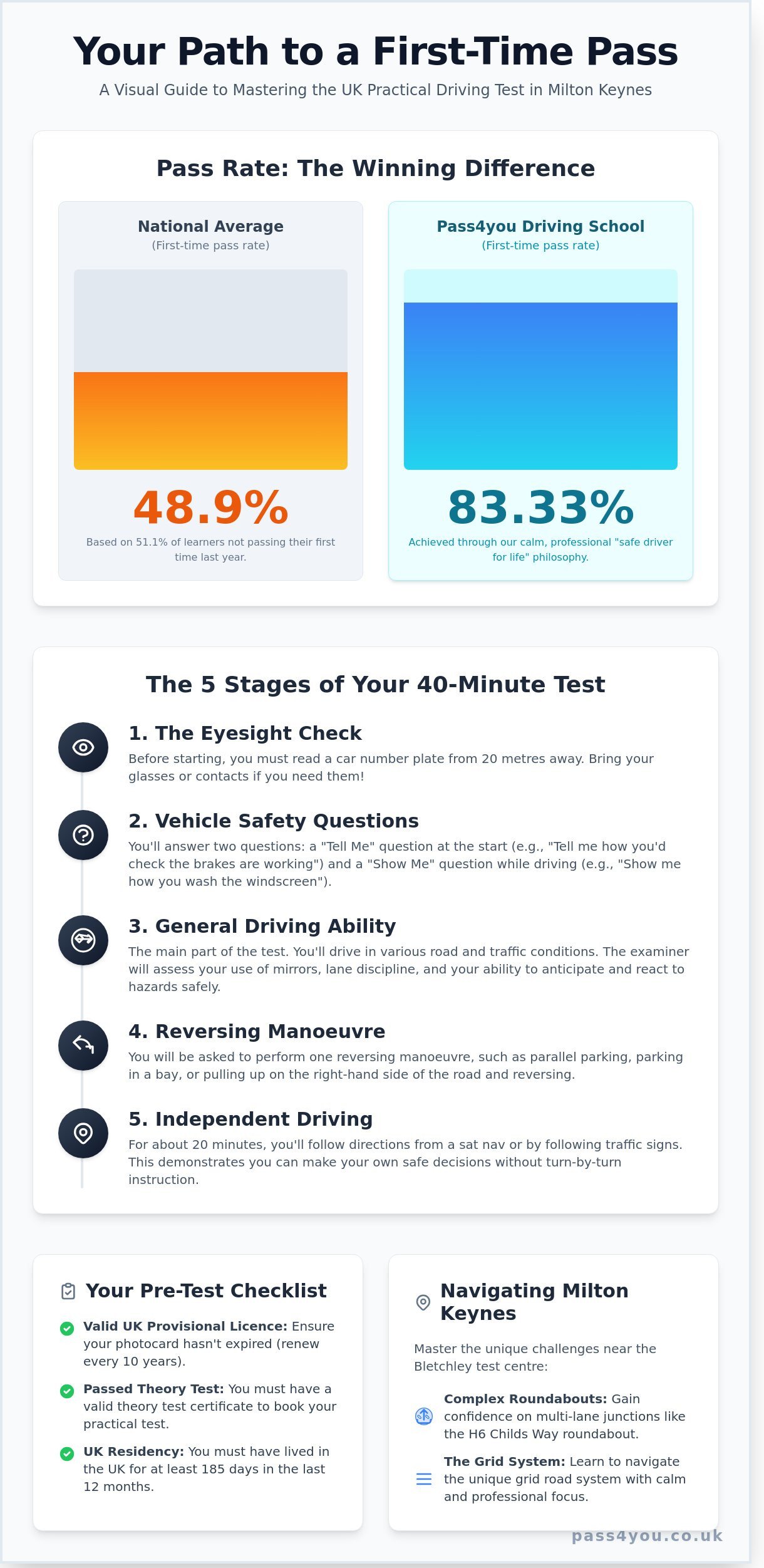
    You must hold a valid UK provisional driving licence before you can even think about the test centre. In 2026, ensure your photocard hasn’t expired, as the DVSA requires renewals every 10 years. Passing your theory test is mandatory before booking the practical driving test, and you’ll need that certificate number for the booking portal. Finally, residency rules state you must have lived in the UK for at least 185 days in the last 12 months to be eligible for a full licence.

    Managing Test Day Nerves

    Many learners struggle with “examiner anxiety” in the days leading up to their slot. It’s helpful to reframe the person in the high-vis vest as a professional observer whose only job is to ensure you’re safe. They aren’t looking for reasons to fail you; they’re looking for reasons to give you a licence. Working with a calm, patient instructor in the final three weeks helps build the resilience you need to stay steady. We find that students who have a friendly, understanding mentor are much more likely to stay focused during the independent driving section. Test readiness is a combination of technical skill and emotional regulation.

    The Five Essential Stages of Your Driving Test

    Feeling a bit of stage fright before your big day is completely normal. Most learners feel those butterflies, but understanding exactly what happens during the 40 minute exam can help you stay calm and focused. Your examiner isn’t looking for a perfect robot; they want to see a safe, confident driver who can handle everyday road situations without putting others at risk.

    Step 1: The Eyesight Check
    Before you even get behind the wheel, you must read a number plate from a distance of 20 metres. This is a non negotiable safety requirement. If you usually wear glasses or contact lenses for driving, make sure you have them with you. It is a quick task that sets a positive, professional tone for the rest of the session.

    Step 2: “Show Me, Tell Me” Questions
    You will be asked two vehicle safety questions. The “tell me” question happens at the start of the test, where you explain how to carry out a safety task. The “show me” question occurs while you are driving, such as demonstrating how to clear the windscreen. You can check the full list of potential questions in the official driving test requirements to ensure you feel prepared.

    Step 3: General Driving Ability
    This is the core of your practical driving test. You will navigate various road conditions, including quiet residential streets and busier main roads with higher traffic speeds. The examiner will observe your lane discipline, your use of mirrors, and how you react to other road users. At Pass4you, we’ve found that maintaining a steady, patient pace helps students achieve our 83.33% first time pass rate.

    Step 4: Reversing Your Vehicle
    You will be asked to complete one of three possible reversing manoeuvres. The goal here is to show you have total control over the car while keeping a keen eye on your surroundings. Whether you are backing into a bay or parking behind a parked car, accuracy and constant observation are your best friends.

    Step 5: Independent Driving
    For roughly 20 minutes, you will drive without step by step instructions. You will either follow a sat nav or follow traffic signs to a specific destination. This stage proves you can make your own decisions safely while managing the vehicle.

    Mastering the Manoeuvres

    You might be asked to parallel park at the side of the road, which requires excellent spatial awareness. Alternatively, you may face bay parking. This involves either driving in and reversing out, or reversing in and driving out. The final possibility is pulling up on the right hand side of the road, reversing two car lengths, and moving off again. If you feel nervous about these, practicing with a patient instructor like Simon can build the confidence you need to ace them.

    Independent Driving and Sat Nav Use

    The examiner will provide and set up the sat nav for you. You aren’t allowed to use your own device. If you take a wrong turning, don’t panic. It is not an automatic fail. The examiner will simply help you get back on track. Looking ahead to the 2026 update, the DVSA continues to emphasise that drivers must remain calm even if the technology glitches or the signal drops out. Just keep driving safely and wait for the next instruction.

    Mastering the Practical Driving Test in 2026: The Ultimate Guide to Passing First Time

    Milton Keynes is famous for its unique grid system. It feels very different from traditional British towns with their winding, narrow streets. For a learner, this means mastering a specific type of road layout that demands high-speed confidence and precise lane discipline. Most local tests start at the Milton Keynes (Bletchley) Test Centre on Cadman Square. From the moment you leave the car park, you’re likely to encounter the H and V roads. These horizontal and vertical grid lines define the city and form the backbone of your test route.

    Understanding these roads is vital for the independent driving part of your practical driving test. You’ll be asked to follow road signs or a sat-nav for roughly 20 minutes. If you know that ‘H’ roads run east-west and ‘V’ roads run north-south, you’ll feel much more in control when an examiner gives a direction. At Pass4you, we make sure you’re familiar with these specific routes. We use modern, reliable VW vehicles that are easy to handle, ensuring you feel calm and prepared. Our lead instructor, Simon, has helped many students achieve our 83.33% first-time pass rate by focusing on these local nuances and building your confidence on the grid.

    The Milton Keynes Roundabout Challenge

    Roundabouts are the defining feature of driving in this city. You’ll encounter everything from small mini-roundabouts in residential pockets to massive, multi-lane junctions like Abbey Hill or Old Stratford. The biggest challenge here is lane discipline. Many roundabouts in Milton Keynes use “spiral” markings. This means the lane you enter will naturally push you outwards toward your intended exit. Staying in the correct spiral is the top priority for examiners here. If you find yourself in the wrong lane, don’t panic or swerve. Stay safe, follow the lane you’re in, and let the examiner help you get back on track.

    Observation techniques are just as important at high-speed entries. You need to judge the speed of traffic approaching from the right on roads like the A5 or A421 very quickly. We teach you to look early as you approach the give-way line. This helps you keep your momentum where it’s safe to do so, which is exactly what an examiner wants to see. It shows you’re a confident, competent driver who isn’t hesitant.

    Rural Roads vs. Residential Streets in MK

    Your test won’t just be limited to the grid. You’ll likely head out towards the 60mph rural stretches on the outskirts of the city. These roads require a sharp focus on speed limit changes and hidden farm entrances. It’s a huge contrast to the narrow, parked-car-lined streets you’ll find in Bletchley or Wolverton. In these residential areas, your hazard perception is tested to the limit. You’ll need to manage your speed carefully and show plenty of clearance when passing oncoming cars in tight spaces.

    To help you prepare for these varied conditions, we recommend checking out the official Ready to Pass? preparation advice from GOV.UK. It’s an excellent resource for managing nerves and understanding test readiness. You should also read our guide on Common Mistakes That Cause People to Fail Their Test to see where others often struggle in these specific MK environments. Successfully balancing the high speed of the grid roads with the precision required in residential areas is the secret to passing your practical driving test first time. We’re here to guide you through every mile until you’re ready to drive away with your pink licence.

    How to Prepare Like a Pro: Beyond the Basics

    Preparing for your practical driving test requires more than just knowing how to steer. At Pass4you, we’ve developed what we call the 83.33% Secret based on our consistent first-time pass rate. This technique isn’t a shortcut; it’s a structured approach to preparation that actually saves you money. By focusing on precision from day one, our students typically require fewer hours of tuition to reach test standard. This reduces your total spend on lessons and avoids the £62 cost of booking a retest, alongside the long waiting times for a new slot.

    Many learners feel tempted to clock up extra hours with friends or family to save a few pounds. While the intention is good, this often introduces bad habits that are difficult to unlearn. A friend might not notice you’ve stopped checking your blind spot or that you’re “palming” the steering wheel. On the day of your exam, these small errors aggregate into serious faults. Professional lessons keep you aligned with current DVSA requirements, ensuring you don’t have to pay for a second test because of someone else’s outdated driving style.

    Don’t treat the “Show Me, Tell Me” questions as a last-minute revision task. You should use the checklist daily until the answers feel like muscle memory. Whether you’re explaining how to check the brake fluid or demonstrating the horn, these marks are the easiest ones to secure. Starting your test with a confident answer settles your nerves and sets a positive tone for the rest of the drive. If you can explain the technical aspects of the car while relaxed, the physical driving usually follows suit.

    The Role of the Mock Test

    Mock tests are the ultimate tool for building mental resilience. We recreate the “quiet examiner” environment, where the friendly chatter of a lesson stops and the formal assessment begins. This helps you identify the difference between a minor driving fault and a serious one before they actually count. It’s better to stall during a practice run than on the real day. You can prepare yourself properly by booking a Mock Test in Milton Keynes to experience the pressure in a safe, supportive setting. This simulation ensures that nothing on the day of your practical driving test feels like a surprise.

    Vehicle Familiarity

    We choose modern Volkswagen tuition vehicles for their exceptional reliability and user-friendly controls. You’ll become an expert on the specific clutch bite point and the nuances of electronic handbrakes. Consistency is your best friend when nerves are high. We focus on these cars because their feedback is clear, making it easier for you to feel what the vehicle is doing. Switching to a different car the week before your test is a high-risk strategy that often leads to avoidable stalls or control errors.

    Our goal is to make you a safe driver for life, not just for forty minutes. If you want to join the ranks of our successful students and benefit from our expert coaching, book your driving lessons today and start your journey with confidence.

    Booking and Passing: Your Path to Freedom

    You have put in the hours, mastered the manoeuvres, and built your confidence behind the wheel. Now it is time to turn that hard work into a full licence. The final hurdle is the practical driving test, a 40 minute assessment that marks the beginning of your life as an independent driver. This moment is about more than just following directions; it is about demonstrating that you can manage a vehicle safely and responsibly in real world conditions.

    Securing Your Test Date

    Booking your test requires a strategic approach. You should only use the official DVSA booking service, which is available daily from 6:00am until 11:40pm. Avoid third party “cancellation” websites that promise early slots for an extra fee. These services often overcharge and can be unreliable. In 2026, the cost for a weekday test is £62, while evening, weekend, and bank holiday appointments cost £75. Before you commit to a date, always check with Simon or your instructor. We want to ensure you are fully prepared so you don’t waste your time or money on a test you aren’t ready for yet.

    On the day of your exam, you must bring your provisional photocard driving licence. It is also wise to have your theory test pass certificate handy, though the examiner can usually verify this electronically. Beyond the paperwork, your most valuable asset is a positive mindset. Arrive at the test centre at least 15 minutes early to settle your nerves. Remember that the examiner isn’t looking for perfection; they are looking for a safe, competent driver who understands the rules of the road.

    When the test concludes, the examiner will ask you to pull over and turn off the engine before delivering the result. They will provide a summary of any driving faults. If you pass, you will receive a training certificate and your full licence will be sent in the post. If you don’t pass this time, don’t be discouraged. The feedback provided is a roadmap for your next few lessons. We will sit down together, look at the examiner’s report, and work specifically on those areas to ensure you’re ready for the next attempt.

    Why Pass4you is the Logical Choice

    Choosing the right instructor makes the difference between a stressful experience and a successful one. At Pass4you, we pride ourselves on a patient, calm environment. There is no shouting or pressure here, just professional guidance tailored to your pace. Our results speak for themselves. While the national average pass rate often sits below 50%, our students achieve an impressive 83.33% first time pass rate. We don’t just teach you how to pass a practical driving test; we help you become a safe driver for life. Our tried and tested techniques in Milton Keynes have helped hundreds of nervous learners find their confidence.

    Ready to start your journey toward independence with a team that genuinely cares about your success? Book your first lesson with Simon and the Pass4you team today and experience the difference that expert, patient instruction makes.

    Start Your Journey to Driving Independence Today

    Stepping into the driver’s seat for your practical driving test in 2026 doesn’t have to be a source of anxiety. By mastering the five essential stages and familiarising yourself with the unique layout of Milton Keynes, you’re already ahead of the curve. Success comes down to consistent preparation and finding an environment where you feel supported. You’ve seen how understanding local test centre insights and focusing on beyond-the-basics preparation can transform your confidence on the road.

    Simon provides the patient, expert guidance you need to navigate every complex roundabout and dual carriageway with total ease. You’ll enjoy learning in a modern VW tuition vehicle that makes every lesson comfortable and safe. Our proven methods focus on your individual needs, ensuring you don’t just get a licence but become a confident road user for life. We’ve helped hundreds of nervous learners overcome their fears through calm instruction and a tailored approach that saves you money by requiring fewer lessons overall.

    Join the 83.33% who pass first time; book your Milton Keynes lessons today. We’re ready to help you gain your freedom and start your new life on the road with confidence.

    Frequently Asked Questions

    How long is the practical driving test in 2026?

    Your practical driving test in 2026 lasts for approximately 40 minutes. This includes 20 minutes of independent driving where you’ll follow a sat nav or traffic signs. If you’re taking an extended test, the duration increases to 70 minutes. We’ll ensure you’re calm and ready for the full session, helping you feel confident from the moment you leave the test centre.

    What happens if I make a mistake during my driving test?

    Making a small mistake doesn’t mean you’ve failed immediately. You can make up to 15 driving faults, often called minors, and still pass. However, a single serious or dangerous fault results in a fail. If you do make a slip-up, stay patient and keep focused on driving safely. We’ve helped many nervous learners stay calm and recover after a minor error during their big day.

    Can I take my driving test in my own car?

    You can take the practical driving test in your own car as long as it meets specific DVSA requirements. Your vehicle must be taxed, insured, and have a current MOT. You’ll also need to fit an extra rear-view mirror for the examiner and display L-plates. Most of our students prefer using Simon’s car because they feel more confident in a familiar vehicle they’ve used for every lesson.

    How many minor faults are allowed on the driving test?

    You’re allowed a maximum of 15 driving faults during your test. If you earn 16 or more minors, you won’t pass. It’s important to remember that repeating the same minor fault can be upgraded to a serious fault. Our proven methods have helped us achieve an 83.33% first time pass rate, as we focus on building your confidence to keep these small errors to a minimum.

    What are the “Show Me, Tell Me” questions for 2026?

    The “Show Me, Tell Me” section consists of 2 safety questions designed to prove you know how to maintain your vehicle. You’ll answer one “tell me” question before you start driving and one “show me” question while you’re on the move. These might include showing how to wash the windscreen or telling the examiner how you’d check the tyre pressure. We’ll practice these together until you’re 100% confident.

    What is the best time of day to take a driving test in Milton Keynes?

    In Milton Keynes, booking your test for 10:14 am is often the best choice to avoid the heavy morning rush hour traffic. The roads around the Bletchley or Milton Keynes test centres are generally calmer during this mid-morning slot. This allows you to feel more relaxed and focused on your surroundings without the stress of peak-time congestion, helping you maintain a steady, safe rhythm.

    What happens if my driving test is cancelled due to bad weather?

    If the DVSA cancels your test because of snow, ice, or thick fog, they’ll automatically book a new appointment for you at no extra cost. You won’t have to pay the £62 fee again. They’ll usually send you the new date within 3 working days. We’ll stay in close contact during bad weather to ensure you’re supported and ready for your rescheduled date whenever it happens.

    Do I need to bring my theory test certificate to the practical test?

    You should bring your theory test pass certificate to your driving test appointment. While examiners can often check your details on their digital systems, having the physical certificate prevents any unnecessary delays. You must also bring your UK photocard driving licence, as the examiner cannot start the test without it. We’ll double-check you have all your documents ready before we head to the test centre together.