Tag: passing your test

  • Signs of a Good Driving Instructor: The 2026 Checklist for Learner Drivers

    Signs of a Good Driving Instructor: The 2026 Checklist for Learner Drivers

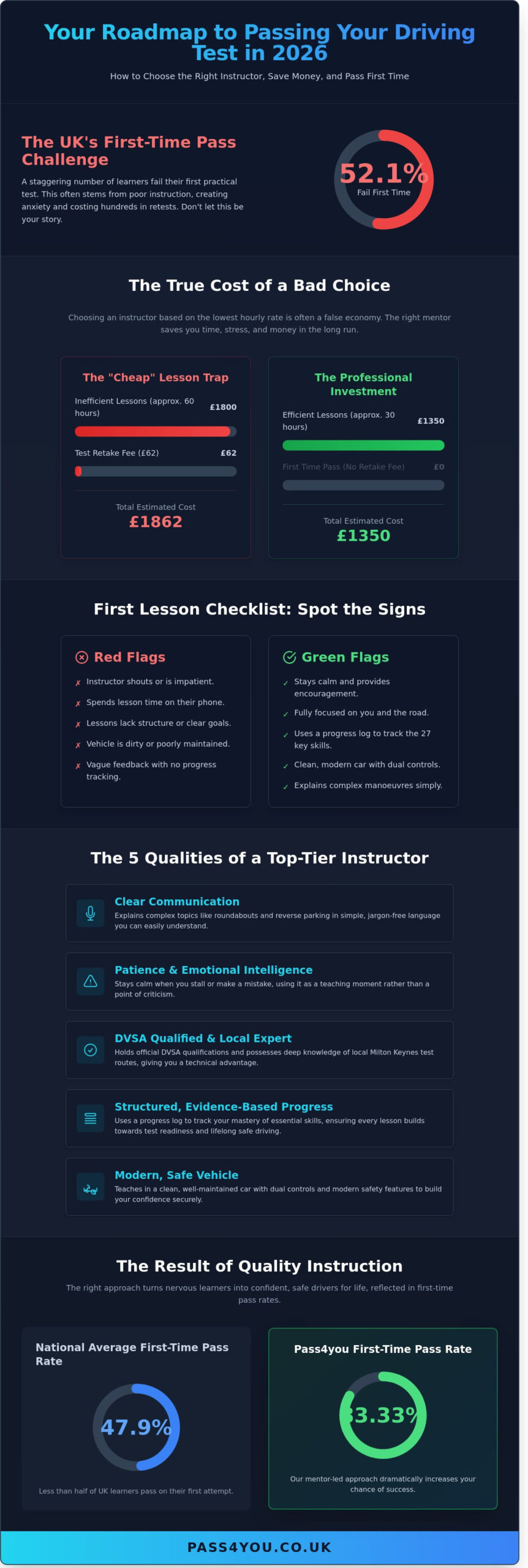
    Did you know that 52.1% of learner drivers in the UK fail their practical test on the first attempt? It’s a daunting figure that often stems from poor preparation or a lack of rapport with a teacher. When you’re paying for lessons, the last thing you want is an instructor who shouts or makes you feel small. Understanding the signs of a good driving instructor is the first step toward avoiding wasted money and building the confidence you need to handle busy British roads.

    We know how stressful it feels to balance the cost of lessons with the pressure of high failure rates. You deserve a mentor who stays calm when you stall at a junction and who actually wants you to succeed as quickly as possible. This article reveals the essential qualities and red flags you should look for to ensure you pass your test safely. We’ll walk you through our 2026 checklist so you can find a patient professional who turns your driving anxiety into genuine skill behind the wheel.

    Key Takeaways

    • Understand why your choice of instructor is a vital financial investment that can save you significant time and money on your journey to the driving test.
    • Learn to identify the primary signs of a good driving instructor, including high emotional intelligence and the ability to explain complex manoeuvres in simple terms.
    • Discover how to decode DVSA qualifications and why specific local knowledge of Milton Keynes test routes provides a massive technical advantage.
    • Use our first-lesson checklist to spot critical red flags, such as instructor phone use, versus green flags like structured, confidence-building feedback.
    • See how a patient, mentor-led approach has helped Pass4you achieve an 83.33% first-time pass rate, turning nervous learners into safe drivers for life.

    Why Finding the Right Driving Instructor is Your Most Important Decision in 2026

    Choosing who sits in the passenger seat during your first few miles on the road is the most significant hurdle you’ll face this year. It isn’t just about booking a block of hours to get a licence; it’s about finding a mentor who understands your nerves and builds your confidence from the first turn of the key. Identifying the signs of a good driving instructor early can save you hundreds of pounds and months of frustration. A poor choice often leads to more than just a failed test. It can result in long-term driving anxiety that lasts for years. At Pass4you, we’ve seen how a patient, professional approach leads to our 83.33% first-time pass rate, proving that the right environment makes all the legal and emotional difference.

    A mentor does more than watch you drive. They actively manage your progress and adapt to your learning style. If you feel like a passenger in your own lesson, or if your instructor spends more time on their phone than observing your mirrors, you’re likely wasting your time. You need someone who takes the duties and responsibilities of a driving instructor seriously, ensuring every minute of your lesson is focused on safety and skill acquisition.

    The Hidden Costs of ‘Cheap’ Lessons

    It’s tempting to choose the instructor with the lowest hourly rate, but this is often a false economy. A cheaper rate of £30 per hour might seem attractive compared to a professional school, but if that instructor lacks the expertise to get you test-ready efficiently, you might end up needing 60 hours instead of 30. You also risk the £62 cost of a retest and the long wait times for new slots. We define value for money in driving tuition as the total cost to pass, not just the price of a single hour. Expert tuition focuses on “first-time pass” techniques that streamline your learning and get you on the road sooner.

    • Low hourly rates often mask a lack of structured lesson plans.
    • Experienced instructors use modern coaching methods to reduce the total number of lessons needed.
    • High-quality tuition reduces the risk of expensive test failures.

    Driving for Life vs. Driving for the Test

    In 2026, the standards for road safety are higher than ever. A good instructor doesn’t just teach you how to pass a 40-minute exam; they prepare you for a lifetime of independent travel. This means hazard perception is treated as a core skill from day one, not just a theory test exercise. You’ll learn to anticipate the actions of others and manage complex junctions with a calm mind. When you’re properly prepared, you’ll find that you’re ready for the practical driving test naturally because your everyday driving already meets the required standard. This holistic approach ensures you don’t just get your pink licence, but you keep it by staying safe on Britain’s busy roads.

    5 Essential Signs of a Professional and Patient Driving Instructor

    Choosing the person who’ll guide you through your driving journey is a big decision. You aren’t just paying for time in a car; you’re investing in a life skill that keeps you safe for years to come. One of the most telling signs of a good driving instructor is how they handle the inevitable mistakes every learner makes. Before you commit your budget, it is vital to check if your instructor is registered with the DVSA to ensure they meet the latest 2026 professional standards.

    • Emotional Intelligence: They stay calm when you stall at a busy junction or miss a turning, keeping the atmosphere relaxed and focused.
    • Jargon-Free Communication: They explain complex manoeuvres, such as reverse bay parking, using simple language instead of confusing technical terms.
    • Punctuality: They respect your schedule by arriving promptly and providing the full duration of the lesson you’ve paid for.
    • Evidence-Based Progress: They use a digital or physical progress log to track exactly which of the 27 essential driving skills you’ve mastered.
    • Modern Vehicle: You’ll learn in a clean, well-maintained car equipped with dual controls and the latest safety tech to ensure you feel secure.

    The Power of a Calm Tuition Environment

    A shouting instructor is a definitive sign of poor professionalism that can set your progress back by weeks. Research into driver education shows that high stress levels inhibit the brain’s ability to retain new information. If you’re one of the many nervous learners who’ve felt overwhelmed in the past, a patient approach is vital. A mentor like Simon focuses on being a confidence builder rather than a critic. By maintaining a quiet, supportive cabin even in heavy traffic, they help you process hazards more effectively. This supportive style is exactly why many students find they can build driving confidence much faster than they ever expected.

    Organisation and Lesson Planning

    In 2026, a professional instructor never just tells you to “drive around” for an hour without a goal. Every session should begin with a clear objective, such as mastering spiral roundabouts or perfecting hill starts. You should see a structured plan that follows a logical path toward your test date. This level of organisation is a key sign of a good driving instructor because it ensures you aren’t wasting money on aimless lessons. When every minute has a specific purpose, you’re far more likely to join the 83.33% of students who achieve a first-time pass through focused, goal-oriented tuition.

    Signs of a Good Driving Instructor: The 2026 Checklist for Learner Drivers

    Qualifications and Local Expertise: The Technical Green Flags

    When you start your search, you’ll quickly realise that not all instructors have the same level of training or experience. Identifying the technical signs of a good driving instructor starts with looking at the badge in their windscreen. This isn’t just a piece of plastic; it’s a legal requirement that tells you exactly where they are in their professional journey. You want someone who has invested time into their own education so they can provide you with the best possible start on the road.

    Green Badge vs. Pink Badge: What You Need to Know

    An Approved Driving Instructor (ADI) displays a green octagonal badge. This signifies they’ve passed all three stages of the DVSA qualifying process, including a rigorous test of their instructional ability. A Potential Driving Instructor (PDI) carries a pink triangular badge. While PDIs are often enthusiastic and have completed much of their training, they haven’t yet passed their final exams. Choosing an ADI gives you the peace of mind that your mentor has met the highest national standards for safety and teaching. All Pass4you instructors are first-class professionals who hold full qualifications to help you succeed.

    The Milton Keynes Factor: Navigating Local Challenges

    Milton Keynes presents a unique challenge for any learner driver. The famous grid system and the sheer volume of roundabouts require a specific set of skills that you won’t find in a standard textbook. One of the most reliable signs of a good driving instructor is their deep familiarity with local landmarks and traffic patterns. They should know exactly how to guide you through the V6 Grafton Street or the complex lane markings on the H6 Childs Way without causing you unnecessary stress.

    Effective driving lessons Milton Keynes students rely on are those that focus on the specific quirks of the Bletchley test centre. A local expert knows which roads the examiners prefer and where the most common “trap” spots are located. This expertise allows them to tailor your lessons to your current skill level, choosing quieter residential streets for your first few hours before moving on to high-speed dual carriageways when you’re ready.

    Modern Fleets and Data-Driven Success

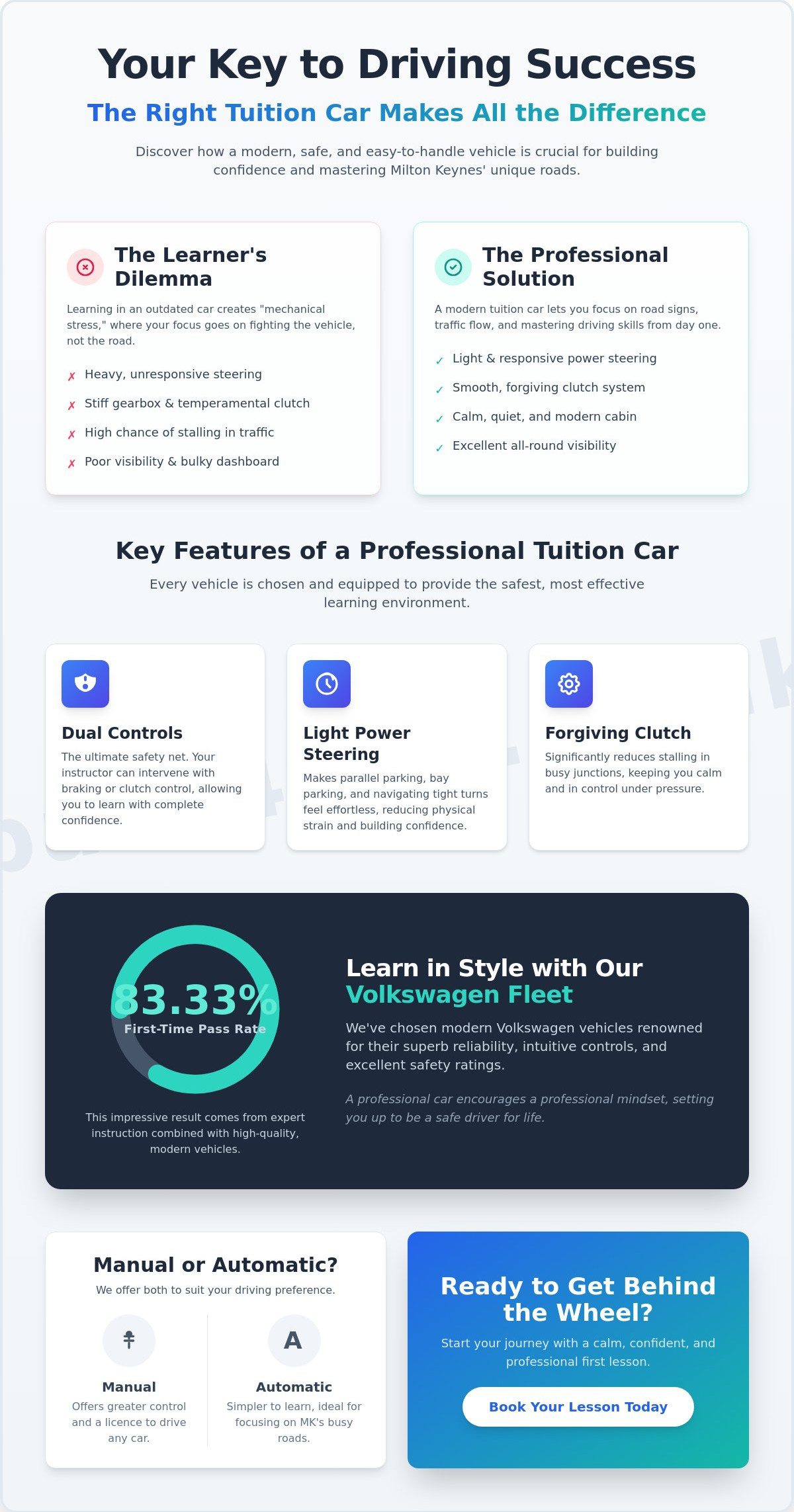
    The car you learn in matters just as much as the person sitting next to you. A good instructor maintains a modern fleet of vehicles, such as the Volkswagen Polo or Golf. These cars are chosen for their reliability, excellent visibility, and smooth controls. Learning in a vehicle that’s less than three years old reduces the risk of mechanical issues and ensures you’re using the latest safety technology.

    Always look at the data before you book. A high first-time pass rate is a strong indicator of a calm and effective teaching style. For instance, our 83.33% first-time pass rate reflects a proven technique that builds genuine confidence. Check five-star reviews to see if previous students mention a patient atmosphere. If the data shows consistent success and the reviews highlight a supportive environment, you’ve likely found a professional who will help you become a safe driver for life.

    The Red Flag vs. Green Flag Checklist for Your First Lesson

    Your first lesson is about more than just finding the biting point. It’s an audition for the person sitting in the passenger seat. You need to know you’re in safe, professional hands from the moment you click your seatbelt. Recognising the signs of a good driving instructor early on will save you time, money, and unnecessary stress.

    • Red Flag: Mobile phone use. If your instructor checks texts or takes personal calls while you’re driving, it’s a major safety breach. It’s actually illegal for a supervising driver to use a handheld mobile phone. They should be focused entirely on your progress and the road ahead.
    • Green Flag: Constructive feedback. A great mentor doesn’t just tell you what you did wrong. They spend the final five minutes of your hour reviewing your performance and setting clear “next steps” for your following lesson.
    • Red Flag: Poor punctuality. Everyone is late occasionally, but consistent lateness or last-minute cancellations show a lack of respect for your schedule. If they’re 10 minutes late every week, you’re losing valuable road time you’ve paid for.
    • Green Flag: Highway Code integration. Instead of just telling you what to do, a patient instructor asks questions. They might ask who has priority at a junction or what a specific road sign means to ensure you’re actually absorbing the rules of the road.

    Professional Boundaries and Behaviour

    Professional conduct is non-negotiable. Your instructor should be calm, patient, and respectful at all times. If you ever feel shouted at or belittled, that’s a clear sign the teaching style isn’t right for you. You should never feel “guilty” for wanting to change instructors. Research suggests that 72% of learners who switch to a more compatible teacher feel a significant boost in their confidence within just two lessons. Your safety and comfort are the priority.

    How to Interview a Potential Instructor

    Don’t be afraid to ask questions before you hand over any money. A professional will be happy to provide transparent answers. Before booking a full block, ask these three essential questions:

    • “Do you have a modern car with fully functioning dual controls and specialist tuition insurance?”
    • “What is your current first-time pass rate for students in 2026?”
    • “Can I book a single introductory trial lesson before committing to a larger package?”

    It’s often helpful to look for driving instructors near me who specialise in nervous learners or offer trial sessions. This lets you test the “vibe” of the car and the teaching style without a huge financial commitment. If it’s a bad fit, it’s better to find out on day one than day twenty.

    Ready to start your journey with a patient, expert mentor? Book your first lesson with Pass4you today and build your confidence behind the wheel.

    Why Pass4you Sets the Standard for Instruction in Milton Keynes

    Choosing where to learn is a major decision that impacts your safety and your bank balance. At Pass4you, we’ve built our reputation on what students call “The Simon Effect.” This refers to our lead instructor’s unique ability to provide personalised, patient tuition that delivers consistent results. One of the most vital signs of a good driving instructor is their capacity to remain calm when things get tricky, and that’s exactly what we offer every student who sits in our cars.

    Our results speak for themselves. We maintain an impressive 83.33% first-time pass rate, which is significantly higher than the national average. This isn’t just a proud statistic; it’s a way for you to save money. By using proven techniques that help you learn faster and more effectively, we ensure you don’t spend more than necessary on extra lessons or repeated test fees. You’ll learn in modern Volkswagen vehicles, chosen specifically because they’re easy to handle, reliable, and packed with the latest safety features to protect you while you learn.

    We believe driving is about more than just getting a plastic card. While passing the test is the immediate goal, our focus remains firmly on “Safe Driving for Life.” We want you to feel confident on the M1 or navigating the complex grid system and roundabouts of Milton Keynes long after your L-plates are gone. We don’t just teach you to pass a 40-minute exam; we teach you how to handle a lifetime on the road.

    Our Tried and Tested Teaching Techniques

    We know that many people come to us after a bad experience elsewhere. If you’ve been shouted at or felt rushed in the past, you’ll find our approach refreshing. We adapt our style for every individual, especially nervous learners who might feel overwhelmed by busy junctions. Our five-star testimonials highlight how we turn anxiety into genuine confidence. This local reputation is why so many of our students are referred to us by friends and family who passed with us years ago. We’ve honed our techniques over many years to ensure they work for everyone, regardless of their starting point.

    Ready to Start Your Journey?

    Your first hour behind the wheel is all about getting comfortable and building a foundation. We won’t throw you into the deep end of heavy traffic. You’ll learn the basic controls in a quiet, safe area, helping you build a bond of trust with your instructor. It’s a simple, stress-free introduction to the road. If you’re looking for the signs of a good driving instructor in a real-world setting, you’ll find them from the very first moment you sit in the driver’s seat.

    Don’t leave your freedom to chance. Book your first lesson with Pass4you today and start your journey toward becoming a safe, independent driver for life.

    Take the First Step Towards Your Driving Independence

    Choosing your mentor is the single most important factor in how quickly you’ll trade your L-plates for a full UK driving licence. You now know the vital signs of a good driving instructor, from their calm, patient demeanour to their expert understanding of local Milton Keynes test routes. It’s about finding someone who builds your confidence rather than knocking it down. Learning to drive should be an exciting milestone, not a source of stress.

    At Pass4you, we’ve refined a teaching method that genuinely works. Our impressive 83.33% first-time pass rate is a result of our professional, supportive approach. We don’t just teach you to pass; we ensure you’re a safe driver for life. With dozens of 5-star student testimonials and unrivalled local knowledge of the Milton Keynes road network, you’re in the best possible hands. Don’t settle for an instructor who makes you nervous when you can learn with a mentor who truly cares about your success.

    Start your driving journey with a patient, professional Pass4you instructor today

    The road ahead is waiting for you. We can’t wait to help you get there.

    Frequently Asked Questions

    How do I check if my driving instructor is fully qualified?

    You can verify an instructor’s status by looking for a green octagonal badge displayed in their windscreen. This badge proves they are an Approved Driving Instructor (ADI) who has passed all three DVSA qualifying exams. If the badge is a pink triangle, they are a trainee who is still gaining experience. You can also use the GOV.UK “Find driving schools, lessons and instructors” service to check their official registration.

    Is it okay for a driving instructor to shout at me if I make a mistake?

    No, it is never acceptable for an instructor to shout or make you feel intimidated. One of the most important signs of a good driving instructor is their ability to remain calm and patient, even during stressful situations. A professional mentor focuses on building your confidence and providing clear, constructive feedback. If your instructor loses their temper, it’s a clear signal that their teaching style isn’t right for you.

    What should I do if I don’t get on with my driving instructor?

    You should look for a new instructor as soon as you realise the partnership isn’t working. Learning to drive is a significant financial investment, and you’ll progress much faster with someone who makes you feel safe and understood. Don’t worry about hurting their feelings; it’s a professional service and your success is the priority. Most learners find that a quick change to a more patient teacher makes a massive difference to their progress.

    Can I take driving lessons before I pass my theory test?

    Yes, you can start your practical driving lessons as soon as you have a valid provisional licence. Many students find that experiencing the road first-hand makes the theory topics much easier to understand and memorise. According to DVSA statistics from 2023, learners who combine practical experience with theory study often feel more prepared. Just remember that you can’t book your practical driving test until the theory certificate is secured.

    How many lessons does the average person need to pass in 2026?

    The Driver and Vehicle Standards Agency reports that the average learner needs 45 hours of professional tuition combined with 22 hours of private practice. While everyone learns at a different pace, choosing a high-quality instructor can often reduce this total. Our students benefit from a structured approach that has led to an 83.33% first-time pass rate. Focusing on consistent weekly sessions helps retain skills and reduces the need for refresher lessons.

    Should I choose a local independent instructor or a national driving school?

    Local independent instructors often provide a more personalised experience and a consistent point of contact. While national schools have large call centres, an independent professional relies on their local reputation and word-of-mouth recommendations. You’ll usually keep the same car and the same calm mentor for every lesson, which is vital for building trust. This consistency is often why local instructors can offer better value for money over the long term.

    What are the most common signs of a bad driving instructor?

    Frequent lateness, using a mobile phone during your lesson, and a lack of a clear progress log are major red flags. If an instructor spends more time talking about their personal life than your driving, you aren’t getting the tuition you’ve paid for. Recognising these issues early helps you find the signs of a good driving instructor instead. A poor teacher will leave you feeling nervous, while a great one will leave you feeling confident.

    Is a high pass rate the only thing that matters when choosing an instructor?

    No, while a high pass rate is a strong indicator of success, it shouldn’t be your only consideration. You also need to ensure their teaching style matches your personality, especially if you’re a nervous learner. An instructor might have great stats but a blunt manner that doesn’t suit everyone. Look for a balance of proven results and a supportive, patient environment to ensure you become a safe driver for life.

  • How to Overcome Driving Anxiety in Milton Keynes: A Calm Guide for Nervous Learners

    How to Overcome Driving Anxiety in Milton Keynes: A Calm Guide for Nervous Learners

    Last Tuesday, a learner named Sarah sat at the edge of the H6 Childs Way, her hands gripping the wheel as she watched the fast-moving traffic flow toward the city centre. Like many nervous drivers, the thought of merging onto a 70mph grid road or navigating a complex multi-lane roundabout felt like a mountain she couldn’t climb. You probably know that feeling well. It’s completely normal to feel a surge of panic when you see those V and H signs, or to worry about holding up other drivers at a busy junction. Driving in Milton Keynes is a unique challenge, and the pressure to keep up can feel overwhelming when you are still building your confidence.

    The good news is that learning how to overcome driving anxiety Milton Keynes is simpler than you think with the right support. We’ve helped hundreds of students, many of whom nearly gave up before joining us, achieve our 83.33% first-time pass rate by breaking down the grid system into manageable, stress-free steps. This guide shares proven techniques to master large roundabouts and find an instructor who understands your nerves. You’ll discover how to transform those jitters into quiet confidence, ensuring you become a safe driver for life.

    Key Takeaways

    • Understand why the high-speed grid system triggers a natural ‘fight or flight’ response and how to manage these feelings effectively.
    • Discover how to overcome driving anxiety Milton Keynes learners often face by starting in specific ‘low-stake’ zones designed for confidence building.
    • Master a simple mental mapping technique to visualise lane discipline and navigate the ‘Roundabout Capital’ with quiet composure.
    • Learn why choosing a patient, calm mentor is the most important factor in avoiding the stress of aggressive teaching styles.
    • Realise how the permanent freedom of a driving licence outweighs temporary nerves, setting you up as a safe driver for life.

    What is Driving Anxiety and Why Does it Affect Milton Keynes Learners?

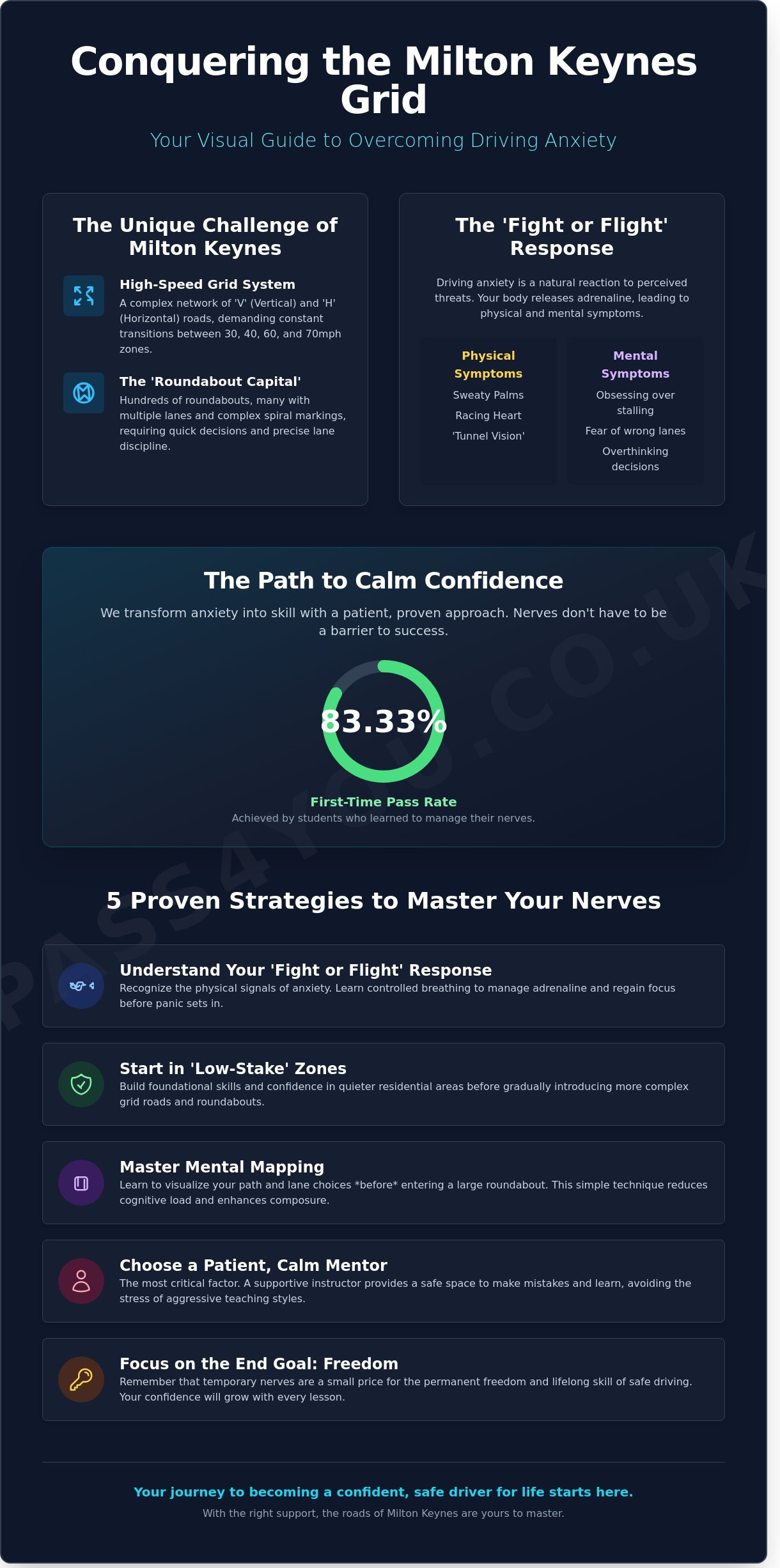
    Driving anxiety isn’t just a case of “the jitters.” It’s a natural, physiological “fight or flight” response triggered by your brain when it perceives a threat. For many learners, this manifests as What is Driving Anxiety, a very real condition that can make the prospect of getting behind the wheel feel like an impossible hurdle. When you’re in the driver’s seat, your mind is processing thousands of data points every minute. If you feel overwhelmed, your body reacts by pumping out adrenaline, which can lead to the very feelings you’re trying to avoid.

    Milton Keynes presents a uniquely challenging environment for those learning to drive. The town’s famous grid system, composed of H-roads (horizontal) and V-roads (vertical), means you’re constantly transitioning between 40mph, 60mph, and 70mph limits. This high-speed environment is punctuated by hundreds of roundabouts, some of which feature multiple lanes and complex spiral markings. For a new driver, the pressure to choose the correct lane while maintaining speed can be intense. It’s completely normal to feel a sense of dread when approaching a busy junction like the Abbey Hill or Oldbrook roundabouts.

    If you’re feeling nervous, please understand that this is actually a sign of a responsible driver. It shows you have a high regard for safety and a deep respect for the power of the vehicle you’re controlling. You aren’t reckless; you’re cautious. At Pass4you, we use a “Calm Mentor” approach to help you manage these feelings. Our lead instructor, Simon, has spent years developing techniques to de-escalate anxiety before it turns into panic. By providing a patient, supportive environment, we’ve helped our students achieve a 83.33% first-time pass rate, proving that nerves don’t have to stand in the way of success.

    Common Symptoms of Driving Nerves

    Physical symptoms are often the first thing you’ll notice. You might experience sweaty palms, a racing heart, or even “tunnel vision” on dual carriageways, where your peripheral awareness feels restricted. Mental symptoms are just as intrusive. You might find yourself obsessing over the possibility of stalling at a green light or “getting the lane wrong” at a large roundabout. We’ve seen these symptoms many times, and they’re manageable through controlled breathing and professional guidance. Understanding how to overcome driving anxiety milton keynes involves learning to recognise these signals early so you can reset your focus before they become overwhelming.

    The Difference Between ‘Test Nerves’ and General Anxiety

    It’s vital to distinguish between situational test nerves and general anxiety. Test nerves are situational; they usually appear in the days leading up to your practical exam or on the morning of the test itself. General anxiety is different because it can affect every single lesson, making it difficult to even start the engine. We believe in addressing the root cause of this fear before you ever book a test. Simon and the Pass4you team are experts at identifying which type of nerves you’re facing. We won’t rush you into a test if you’re not ready. Instead, we work at your pace to ensure you don’t just pass your test, but become a “safe driver for life.” This patient approach is why so many of our students feel confident and capable when they finally head to the test centre.

    Why the Milton Keynes Grid System Triggers Driving Anxiety

    Milton Keynes is unlike any other UK town. Built on a strict grid of ‘V’ (Vertical) and ‘H’ (Horizontal) roads, it can feel like a high-speed logic puzzle for those still finding their feet. If you are wondering how to overcome driving anxiety milton keynes provides a unique challenge because of how quickly the environment changes. Most traditional towns have slow, winding streets that naturally limit your speed. Here, you are often expected to transition from a 30mph residential zone onto a 70mph dual carriageway in a matter of seconds. This abrupt change in pace is a primary source of stress for nervous learners.

    The grid consists of 10 main horizontal roads (H1 to H10) and 11 vertical roads (V1 to V11). This layout means you are never more than a few minutes from a major junction. While this is efficient for commuters, it creates a constant cycle of high-speed acceleration and rapid braking. Many learners feel overwhelmed by the sheer volume of decisions they have to make at every intersection. Research into road psychology shows that structured preparation and understanding road layouts can help people manage their driving anxiety by reducing the ‘fear of the unknown’ during transit.

    Understanding the V and H Road Logic

    Navigational panic is a major trigger for nerves. It’s much easier to stay calm when you realise the logic behind the layout. Horizontal roads generally run east to west, while Vertical roads run north to south. Knowing that the H8 is Standing Way or that the V6 is Grafton Street helps you map the town in your mind before you even turn the key. When you understand your route, you can focus entirely on car control rather than worrying about getting lost. The clear signage in Milton Keynes is actually designed to help you, provided you know how to look for it early.

    The High-Speed Pressure of Dual Carriageways

    The 60mph and 70mph limits on roads like the H8 or V10 are often the biggest hurdle for nervous drivers. Merging into fast-moving traffic requires precise timing and confidence. It’s common to feel a ‘speed gap’ between your current ability and the flow of traffic around you. This is where having a patient instructor makes the difference. At Pass4you, we don’t rush you onto the V6 at rush hour; we build your confidence on quieter stretches first. This gradual exposure is why we maintain a verified 83.33% first-time pass rate for our students.

    The ‘Roundabout Capital’ label isn’t just a nickname. With over 130 roundabouts across the city, the frequency of lane changes and mirror checks is significantly higher than in places like Bedford or Luton. However, there is a hidden benefit to this system. The grid is incredibly consistent. Unlike older towns with unpredictable one-way systems or hidden junctions, every grid square in Milton Keynes follows the same basic rules. Once you master the technique for one roundabout, you have essentially mastered them all. If you are feeling stuck, booking calm driving lessons in Milton Keynes can help you see the grid as a helpful guide rather than a high-speed maze.

    Reframing the grid as a safety feature is the final step in conquering your fear. Because the roads are wide and the sightlines are clear, you actually have more time to react to hazards than you would on a narrow country lane. By breaking the grid down into manageable sections, the 70mph stretches become predictable paths rather than intimidating obstacles. Simon’s approach focuses on this logical breakdown, turning your anxiety into a structured routine that keeps you safe for life.

    How to Overcome Driving Anxiety in Milton Keynes: A Calm Guide for Nervous Learners

    5 Practical Strategies to Overcome Your Driving Fears

    Feeling nervous is a natural part of the learning process. However, when those nerves turn into a barrier, you need a structured plan to regain control. Understanding how to overcome driving anxiety milton keynes starts with breaking the environment down into manageable pieces. By using specific local knowledge and proven mental techniques, you can transform that dread into a sense of calm accomplishment.

    Where to Practise Safely in Milton Keynes

    Milton Keynes is famous for its grid system, but you don’t have to start on the V6 or H8. We recommend beginning your journey in quieter industrial estates like Kiln Farm or Tongwell. These areas provide wide, open roads with minimal traffic during weekends, making them perfect for early gear-change practice without the pressure of a queue behind you. Once you feel steady, move to residential areas to practise mini-roundabouts before attempting the larger Abbey Hill or North Overgate junctions. Avoid the 8:00 am and 5:00 pm rush hours; scheduling lessons at 10:30 am often provides the calmest road conditions.

    Visualisation Techniques for Roundabouts

    Roundabouts often cause the most stress for learners in MK. To combat this, we use the ‘Clock Face’ method. Imagine the roundabout as a giant clock. If your exit is between 6 and 12, stay left; if it’s past 12, stay right. Breaking a large junction into four simple quarters reduces the mental pressure significantly. The 12 o’clock rule states that you should use the left-hand lane for any exit at or before the 12 o’clock position unless signs or markings tell you otherwise. Visualising this before you even reach the give-way line allows your brain to focus on steering rather than searching for lanes.

    Your internal dialogue matters just as much as your technical skill. Scientific studies have shown that anxiety decreases driving ability by slowing your reaction times and narrowing your field of vision. Instead of thinking “I am going to crash,” tell yourself “I am in control of my speed and my steering.” Replace fear with facts. If you’ve successfully moved the car ten times today, that is a fact that proves you can do it an eleventh time. Simon focuses on building this factual confidence during every session, ensuring you feel safe and capable.

    A major source of fear is the unknown. This is why we prioritise the ‘Mock Lesson’ early in your training. By simulating the exact conditions of the driving test, we remove the mystery of the big day. Our students benefit from an 83.33% first-time pass rate because they’ve already “passed” the test multiple times in their heads and with their instructor. This reduces the ‘test day jitters’ because nothing on the day will be a surprise.

    Finally, the car you drive makes a significant difference to your stress levels. We use modern Volkswagens because they offer light steering, clear visibility, and helpful features like hill-start assist. These modern systems handle the “heavy lifting” of the physical driving. This leaves you free to focus on the road ahead and your surroundings, making the whole experience feel much more manageable. When the car is easy to handle, your mind can stay calm and focused.

    Finding a Patient Driving Instructor in Milton Keynes

    Your choice of teacher is the single most important factor when learning how to overcome driving anxiety milton keynes. A poor match can set your progress back by months. Many nervous students have experienced the ‘shouting instructor’ at least once. This aggressive teaching style fails because it triggers a ‘fight or flight’ response, making it impossible for your brain to process new information. When you’re stressed, your peripheral vision narrows and your coordination drops. An instructor who raises their voice only reinforces the idea that you’re in danger, which is the exact opposite of what a nervous learner needs.

    You should look for specific markers when browsing instructor profiles. Words like ‘calm’, ‘patient’, and ‘understanding’ aren’t just fluff; they are essential tools for your success. Don’t be afraid to prioritise these traits over the lowest price. While some schools offer budget rates, they often lack the emotional intelligence required to support an anxious driver. A high success metric, such as our 83.33% first-time pass rate, serves as a concrete indicator of an instructor’s ability to build genuine confidence. It shows they don’t just teach you to pass a test; they teach you to feel safe behind the wheel.

    Another non-negotiable factor is one-on-one tuition. You should never be expected to drive with another student sitting in the back of the car. This ‘piggybacking’ practice is common in some larger driving schools to save on fuel, but it adds unnecessary pressure. You need a private, safe space where you can make mistakes without feeling judged by a stranger. This focused environment allows you to develop your skills at your own pace without the audience.

    Questions to Ask a Potential Instructor

    Before you book, ask how they handle anxious learners. A good instructor will have a specific ‘failure recovery’ plan. Ask them: “How do we handle it if I stall at a busy Milton Keynes roundabout?” Their answer should focus on calm reassurance rather than blame. You should also check if they use modern vehicles. Learning in a car with up-to-date safety features and a smooth clutch makes the physical act of driving much less intimidating for beginners.

    The Pass4you Difference: Simon’s Calm Approach

    At Pass4you, we don’t just give lessons; we provide mentorship. Simon uses a tried and tested technique honed over years of navigating Milton Keynes’ unique road layout. This mentor-led style focuses on ‘Safe Driving for Life’ rather than just passing the 40-minute test. We’ve helped hundreds of students who described themselves as ‘terrified’ transform into relaxed, capable drivers. Our 5-star reviews reflect this commitment to patience and empathy. We understand that every mistake is a learning opportunity, not a reason for stress.

    Ready to start your journey with a mentor who understands your nerves? Book your first calm driving lesson today and see the difference a patient instructor makes.

    Your Path to Becoming a Confident Driver for Life

    The sweaty palms and racing heart you feel today are temporary. Your driving licence, however, is a lifetime asset that never expires. While the initial hurdle feels high, the freedom waiting on the other side is permanent. Once you secure that pink plastic card, the anxiety of the learning process fades into a distant memory, replaced by the ability to go wherever you want, whenever you want. You aren’t just learning to pass a test; you’re gaining a life skill that expands your world.

    Milton Keynes provides a training ground unlike anywhere else in the UK. By navigating the H and V grid system, you develop a level of lane discipline and spatial awareness that many drivers in older, more cramped cities never truly master. When you learn how to overcome driving anxiety milton keynes style, you’re preparing yourself for any road in the country. Our unique road layout demands focus, but it also rewards you with a logical, predictable driving environment once you understand the rhythm of the roundabouts.

    • Spatial Awareness: Mastering the wide MK dual carriageways builds your ability to judge distances at higher speeds.
    • Lane Discipline: The clear markings on our grid roads teach you exactly where your car needs to be, reducing the stress of multi-lane junctions.
    • Roundabout Expertise: If you can handle the “Magic Roundabout” or the busy intersections at the Hub, you can handle anything the UK road network throws at you.

    Passing your test here proves you are one of the most capable new drivers on the road. Our students benefit from a structured approach that prioritises safety and calm over rushing to the finish line. We focus on creating “safe drivers for life,” which is why our 83.33% first-time pass rate remains so consistent. We don’t just teach you the routes; we teach you how to feel at home behind the wheel.

    From ‘I Can’t’ to ‘I Just Did’

    Many of our most confident drivers started exactly where you are. One recent learner, Sarah, was so overwhelmed by the city centre traffic that she nearly gave up after her second lesson with a previous instructor who was prone to shouting. When she joined Pass4you, Simon used a patient, step-by-step technique to rebuild her confidence. She went from being unable to enter a roundabout to passing her test first time with only two minor faults. That first independent drive to Willen Lake was a moment of pure triumph she never thought possible.

    Book Your First Calm Lesson Today

    The journey to independence starts with a single, low-pressure step. We recommend booking an initial assessment lesson to meet Simon and see how our patient teaching style works for you. Don’t fall into the trap of looking for the cheapest hourly rate. Better technique actually saves you money because you’ll require fewer lessons to reach test standard. You deserve an instructor who listens and adapts to your pace. Book your first lesson with Pass4you and start driving with confidence. It’s time to stop wondering how to overcome driving anxiety milton keynes and start experiencing the freedom of the open road.

    Take Control of Your Future on the Milton Keynes Roads

    You’ve discovered that mastering the unique grid system and using proven relaxation techniques are the first steps toward independence. Learning how to overcome driving anxiety milton keynes is entirely possible when you have the right support in your corner. You don’t need to face the roundabouts alone or feel rushed by an impatient instructor who doesn’t understand your nerves.

    Our team at Pass4you focuses on building your confidence through patient, first-class instruction. We’ve helped dozens of nervous learners find their feet, which is reflected in our many 5-star reviews from happy students. With an 83.33% first-time pass rate, our methods are tried, tested, and proven to work. You’ll learn at your own pace in modern VW vehicles that make every lesson feel safe and controlled. We’re here to ensure you don’t just pass a test; we want you to become a safe driver for life. It’s time to stop letting fear hold you back and start enjoying the freedom of the open road.

    Start your journey to confident driving in Milton Keynes with Pass4you

    Frequently Asked Questions

    Is Milton Keynes harder to learn to drive in than other towns?

    Milton Keynes isn’t harder to navigate; it’s just unique due to the grid system. While the town has over 130 roundabouts, this layout actually makes your journeys more predictable and logical than the narrow, winding streets found in older towns. Once you understand how the H and V roads work, you’ll find it’s a very efficient place to build your confidence behind the wheel.

    What happens if I panic or stall at a busy Milton Keynes roundabout?

    If you stall, Simon will use his dual controls to keep the car stationary and safe while you take a breath. We teach a simple three-step recovery technique that helps you get the engine started and the car moving again in under five seconds. You’re never on your own in the car, and we’ll always ensure you’re protected from other traffic while you regain your composure.

    Can I take driving lessons in an automatic car if I’m too anxious for a manual?

    Yes, many students find that choosing an automatic car reduces their stress levels by about 40 per cent. By removing the need to manage a clutch and gear stick, you can focus all your mental energy on the road and the roundabouts. This is often the most effective way to learn how to overcome driving anxiety milton keynes because it simplifies the entire physical process of driving.

    How many driving lessons will I need if I’m a very nervous learner?

    Most nervous learners require between 35 and 45 hours of professional tuition to feel truly test-ready. While every student is different, our impressive 83.33 per cent first time pass rate shows that our patient methods work efficiently. We focus on providing value for money by ensuring you’re a safe driver for life, which often saves you money on retakes in the long run.

    Will my driving instructor get angry if I make a mistake?

    No, Simon is well known for being incredibly calm, patient, and friendly at all times. We believe that shouting is completely counterproductive and only serves to ruin a student’s confidence. Our 5-star reviews from 2024 consistently highlight Simon’s supportive nature, especially with students who were previously told they’d never be able to pass their test.

    Is it better to learn in the morning or evening to avoid traffic anxiety?

    We recommend booking your initial lessons between 10:00 am and 2:00 pm to avoid the peak rush hour traffic. During these quieter hours, the grid roads are much clearer, giving you the space you need to practice your lane discipline without feeling rushed. As your confidence grows, we’ll gradually introduce busier periods so you can handle any traffic situation with ease.

    Can I bring a friend or family member on my first driving lesson?

    We strongly advise against having friends or family in the car as it usually adds an unnecessary layer of pressure. Learning one-on-one with a professional mentor like Simon creates a private, safe environment where you can make mistakes without feeling judged. Our goal is to keep you focused on the lesson plan so you can make progress as quickly and calmly as possible.

    What is the best way to handle a 70mph dual carriageway for the first time?

    The best approach is to build your speed gradually on the 40mph and 60mph grid roads before attempting the faster dual carriageways. Simon will talk you through the merging process and lane positioning long before you reach the slip road. Learning how to overcome driving anxiety milton keynes means taking these small, controlled steps until driving at 70mph feels like a natural and safe progression.

  • Driving Lessons Milton Keynes: The Ultimate Guide to Passing Your Test

    Driving Lessons Milton Keynes: The Ultimate Guide to Passing Your Test

    Feeling that mix of excitement and nerves about learning to drive? You’re not alone. The thought of navigating Milton Keynes’ famous roundabouts, finding a patient instructor who won’t shout, and figuring out the entire process can feel overwhelming. Many learners worry about the total cost and whether they’ll ever feel truly confident behind the wheel. That’s precisely why we’ve created this guide: to help you find the right driving lessons Milton Keynes has to offer and turn that anxiety into calm confidence.

    This is your complete roadmap to success. We will walk you through everything you need to know, from choosing a supportive instructor who understands your needs to mastering the local test routes. Our goal is to equip you with the skills and self-assurance to not only pass your driving test – ideally on the first attempt – but to become a safe, capable driver for life. Let’s get you on the road to earning that freedom and independence you’ve been waiting for.

    Getting Started: Your First Steps to Driving in Milton Keynes

    The thought of getting behind the wheel for the first time is a powerful mix of pure excitement and understandable nerves. It’s the first step on your journey to freedom and independence, and we understand how important it is to start correctly. This guide will walk you through those initial stages, ensuring your path to becoming a safe, confident driver in Milton Keynes is as smooth and stress-free as possible.

    Why Professional Driving Lessons are a Must

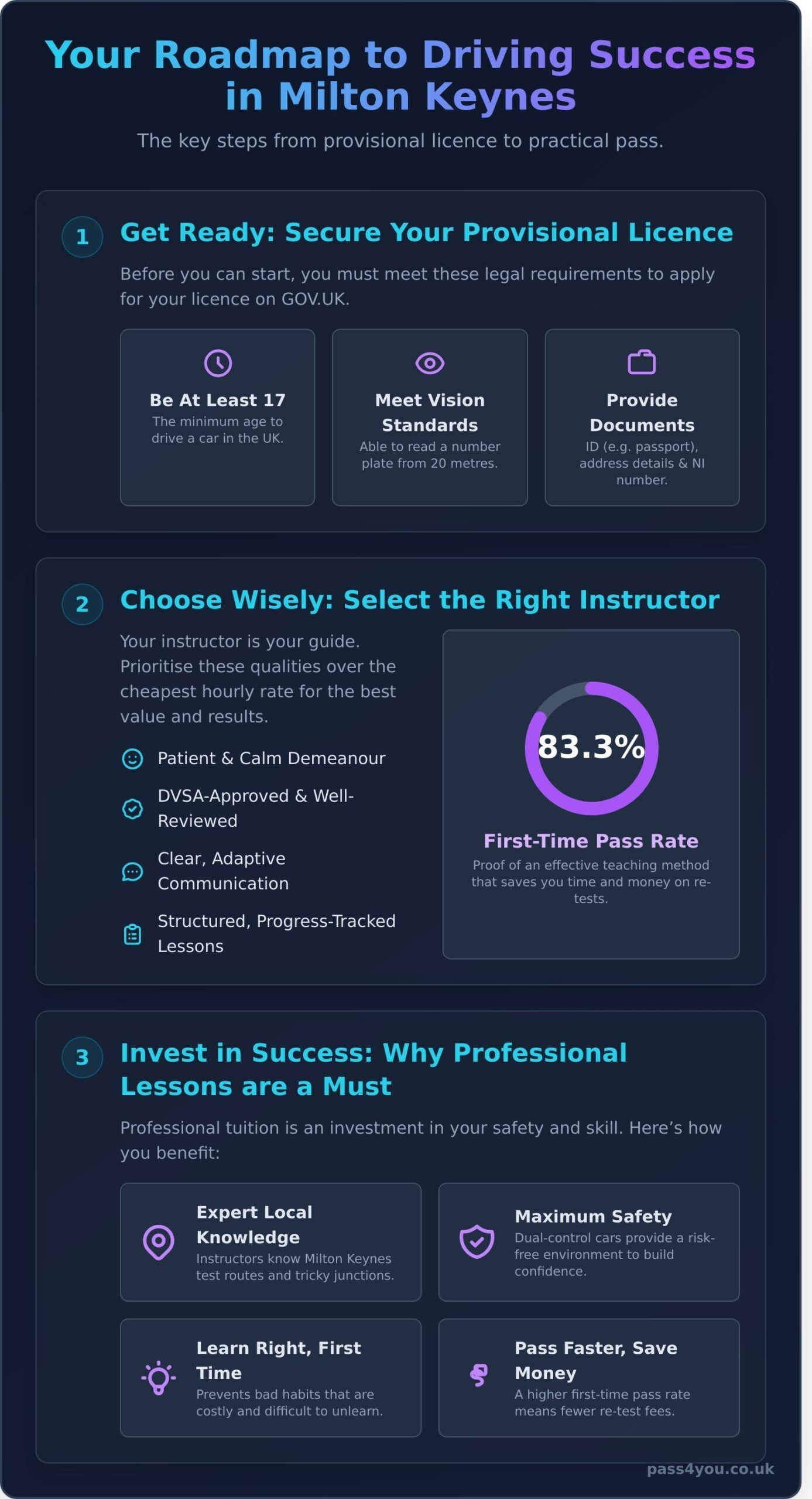
    While asking a family member for a few lessons might seem tempting, it’s often a false economy. Professional tuition is a direct investment in your safety and success. When you book professional driving lessons in Milton Keynes, you benefit from a structured, proven approach designed to help you pass your test efficiently.

    • Expert Local Knowledge: A professional instructor knows the Milton Keynes test routes, including the tricky roundabouts and junctions where learners often make mistakes.
    • Maximum Safety: Our dual-control cars mean your instructor can intervene if needed, providing a safe environment to build your confidence without risk.
    • Learn Right, First Time: We teach you the correct techniques from day one, preventing bad habits that can be difficult and costly to unlearn later.
    • Pass Faster, Save Money: A higher first-time pass rate means you spend less on re-tests and additional lessons in the long run. It’s true value for money.

    Securing Your Provisional Licence: The First Hurdle

    Before you can legally drive on any UK road, you must have a valid provisional driving licence. You can apply for yours online via the GOV.UK website as long as you meet the basic criteria: you must be at least 17 years old and able to read a number plate from 20 metres away. You will need an identity document (like a passport), your address details, and your National Insurance number. The licence typically arrives within two weeks, so it’s best to apply for it early.

    What to Expect on Your First Driving Lesson

    Your first lesson is not a test; it’s a calm introduction to the car and its controls. The focus is entirely on making you feel comfortable and confident. We’ll start with the ‘cockpit drill’-getting your seat and mirrors adjusted perfectly for you. Then, in a quiet, safe location, we’ll guide you through moving off and stopping for the very first time. A calm, patient instructor makes all the difference, ensuring you learn the correct procedures that form the foundation of safe driving and are essential for passing your test. For a comprehensive overview of the UK driving test and what it entails, this resource is an excellent starting point. Remember, this first step is about building confidence, not perfection.

    How to Choose the Best Driving School in Milton Keynes for You

    Choosing your driving instructor is the single most important decision you’ll make on your journey to getting a full licence. While it’s tempting to simply search for the cheapest hourly rate, this rarely translates to the best value. The right instructor will not only teach you to pass your test but will build your confidence and make you a safe driver for life. When looking for driving lessons Milton Keynes, it’s crucial to compare schools on the factors that truly matter: instructor quality, proven results, and a teaching style that fits you.

    Key Qualities of a Great Driving Instructor

    Your instructor will be your guide, so their personality and methods are key. Look for someone who embodies these non-negotiable qualities:

    • Patience and a calm demeanour: Learning to drive can be stressful. A calm, reassuring instructor who never shouts is essential for building your confidence behind the wheel.
    • DVSA-Approved with excellent reviews: Always ensure your instructor is an Approved Driving Instructor (ADI). This means they are fully qualified and regulated. Their qualification is just one part of the Official steps to learn to drive, so check for genuine, positive feedback from other learners.
    • Clear, adaptive communication: A great instructor can explain complex manoeuvres in a way you understand and adapts their teaching style to your unique learning pace.
    • A structured approach to lessons: Your lessons should follow a clear plan. A professional instructor will track your progress, helping you see how far you’ve come and what you need to focus on next.

    Decoding Pass Rates and Student Reviews

    A driving school’s results speak volumes. A high first-time pass rate isn’t just a number; it’s proof of an effective teaching method that saves you time and money. For example, Pass4you’s 83.33% first-time pass rate means our students are more likely to pass on their first attempt, avoiding the cost of re-sits. When reading reviews, look for recent, genuine comments that mention the instructor by name. Pay close attention to feedback about their patience, reliability, and ability to make nervous learners feel at ease. Be wary of any school that isn’t transparent with its reviews or pass rates.

    Understanding Lesson Pricing and Packages in MK

    While the initial hourly rate for driving lessons Milton Keynes is a factor, it doesn’t tell the whole story. Many schools offer block booking discounts, allowing you to purchase a set number of hours at a reduced rate, which provides excellent value. Remember, the cheapest lesson isn’t the best value if it takes you 20 extra hours to be test-ready. Think of your lessons as an investment in a life skill. Paying for a highly effective, patient instructor who gets you a first-time pass is the most cost-effective route to getting your licence. See our transparent pricing and high-value packages.

    The Learner’s Journey: From Theory Test to Practical Pass

    Embarking on your driving lessons in Milton Keynes is an exciting step towards freedom and independence. While it may seem daunting, the path to passing your test is a structured journey with clear milestones. With a patient instructor and a consistent approach, you can build the skills and confidence needed to become a safe driver for life. This roadmap breaks down the process, from mastering the theory to acing the practical exam.

    Mastering the Theory Test: More Than Just an App

    Before you can book your practical test, you must pass the DVSA Theory Test. This is a crucial first step that proves your understanding of the rules of the road. The test has two parts:

    • Multiple-Choice Questions: 50 questions based on The Highway Code, traffic signs, and essential driving skills.
    • Hazard Perception: A series of video clips where you must identify developing hazards as early as possible.

    While many apps are helpful, we strongly recommend using official DVSA resources to ensure you’re studying the correct material. Once you feel prepared, you can book your slot at the Milton Keynes Theory Test Centre on Midsummer Boulevard.

    Structuring Your Lessons for Consistent Progress

    Consistency is key to building confidence behind the wheel. We typically recommend one or two lessons per week to ensure you retain information and make steady progress without feeling overwhelmed. Your instructor will create a calm, supportive environment, starting you on quiet roads to master the basics like clutch control and steering. From there, each lesson builds upon the last, gradually introducing you to busier junctions, Milton Keynes’ famous roundabouts, and essential manoeuvres like parallel parking until they feel second nature.

    Booking Your Practical Driving Test in Bletchley

    Once your instructor agrees you are ‘test ready’, it’s time to book your practical test at the Bletchley Driving Test Centre via the official GOV.UK website. Waiting times can be long, so planning ahead is vital. To ensure you are fully prepared, we conduct realistic mock tests that replicate the exact conditions of the real thing. This is the best way to manage nerves and polish your skills, covering everything from independent driving to answering the official DVSA ‘show me, tell me’ questions. This approach is central to our successful driving lessons milton keynes programme and is why so many of our students pass first time.

    Driving Lessons Milton Keynes: The Ultimate Guide to Passing Your Test

    Mastering Milton Keynes Roads: A Learner’s Guide

    Milton Keynes presents a unique driving landscape that can feel daunting for new learners. From its complex roundabouts to the high-speed grid roads, building real confidence here is absolutely key. This is where local expertise truly makes a difference. Unlike generic national schools, our approach to driving lessons in Milton Keynes is tailored specifically to these roads, turning potential challenges into familiar territory. Knowing the test area inside and out is one of the most effective ways to reduce anxiety and feel fully prepared on test day.

    Tackling the Famous MK Roundabouts with Confidence

    The sheer number and variety of roundabouts in MK can be overwhelming at first. We calmly break down everything from simple mini-roundabouts to multi-lane spirals. The secret is mastering lane discipline-knowing exactly which lane to be in for your approach, on the roundabout, and for your exit. With patient, step-by-step guidance, even notorious junctions like the Stantonbury ‘Magic Roundabout’ will become second nature, building your confidence with every circuit.

    Navigating Dual Carriageways and National Speed Limits

    Thanks to the grid system, you’ll become very familiar with dual carriageways. Learning to safely join fast-moving traffic, change lanes with precision, and exit smoothly is a vital skill for any MK driver. We’ll ensure you understand national speed limit signs and how to adapt to changing road conditions. These higher-speed skills are introduced calmly and patiently, only when you feel completely ready, ensuring you remain safe and in control at all times.

    Common Routes and Manoeuvres for the Bletchley Driving Test

    An experienced local instructor knows the likely routes used for the Bletchley driving test. We focus our practice in key areas like Fenny Stratford, the Lakes Estate, and the residential streets around Bletchley itself. This means you’ll practise manoeuvres like parallel parking and bay parking in the very car parks and on the very roads you’re likely to see on your test. This familiarity is a huge confidence booster, making the real thing feel like just another lesson.

    This deep local knowledge is what transforms a nervous learner into a capable, confident driver. Our goal isn’t just to help you pass; it’s to equip you with the skills to handle any situation Milton Keynes roads can throw at you, making you a safe driver for life. Ready to master the roads with a calm, patient expert? Find out more about our tailored lessons.

    Investing in Success: Why Passing First Time Saves You Money

    Learning to drive is a significant investment, and it’s natural to focus on the hourly rate of lessons. However, the cheapest lesson isn’t always the best value. We encourage you to reframe the conversation from ‘cost per hour’ to the ‘total cost to pass’. Investing in high-quality, structured tuition from the start is the most effective way to become a safe, confident driver and pass your test first time, ultimately saving you money.

    How Many Lessons Does the Average Learner Need?

    The Driver and Vehicle Standards Agency (DVSA) suggests that most learners need around 45 hours of professional tuition combined with about 20 hours of private practice. This is just an average; some people learn faster, while others benefit from a more patient pace. A calm, experienced instructor will tailor a learning plan specifically for you, ensuring you are fully prepared for your test without unnecessary lessons.

    The Hidden Costs of Failing Your Driving Test

    Failing your practical test isn’t just disappointing; it’s expensive. The extra costs quickly add up and often exceed the initial savings from choosing cheaper, less effective lessons. These hidden costs include:

    • A new test booking fee: Currently £62 for a standard weekday test.
    • Corrective lessons: You’ll need several ‘top-up’ lessons to correct faults and stay sharp while waiting for a new test date, which can take weeks or even months.
    • The emotional cost: A failed test can be a major knock to your confidence, making it harder to feel relaxed and in control the next time around.

    Quality tuition is the best insurance against these extra expenses and stress.

    Our Commitment: Value for Money and a Skill for Life

    Our goal is simple: to help you become a safe and confident driver for life, not to drag out your lessons. We focus on building your skills efficiently and effectively. Our proven approach is reflected in our statistics; with an 83.33% first-time pass rate, our students are exceptionally well-prepared. When you choose our driving lessons in Milton Keynes, you are investing in a lifetime of freedom and safety on the road.

    Start your journey to a first-time pass with Pass4you.

    Your Journey to a Full Licence Starts Here

    Learning to drive is an exciting milestone, and passing your test in Milton Keynes is an achievement that unlocks true independence. As we’ve covered, your success hinges on choosing the right instructor to build your confidence and understanding that quality tuition is the smartest investment for a first-time pass. Finding the best driving lessons milton keynes has to offer is the most important decision you’ll make on this journey.

    At Pass4you, we are dedicated to making that journey calm, positive, and successful. Our DVSA-approved instructors provide the patient support nervous learners need, which is why we’re proud of our outstanding 83.33% first-time pass rate. You’ll learn the skills to be a safe driver for life in one of our modern, dual-control Volkswagen tuition cars, ensuring every moment behind the wheel is a step towards your goal.

    The freedom of the open road is waiting. Ready to get on the road? Book your calm and patient first lesson today!

    Frequently Asked Questions About Driving Lessons in Milton Keynes

    How long is each driving lesson with Pass4you?

    Our standard driving lessons are two hours long. We have found this is the perfect amount of time to learn and practise new skills without feeling rushed or overwhelmed. This longer session allows us to cover topics thoroughly, from mastering manoeuvres to building confidence on busier roads. It ensures you get the most value from every minute spent behind the wheel, helping you progress steadily towards your test and become a safe driver for life.

    Can you pick me up from my home, college, or work in Milton Keynes?

    Absolutely. We offer a flexible pick-up and drop-off service to make your driving lessons in Milton Keynes as convenient as possible. Whether you’re at home, Milton Keynes College, or your workplace within the MK area, Simon can meet you there. This means you can fit your lessons around your existing schedule without any added stress. Just let us know your preferred location when you book, and we will handle the rest.

    Do I need to have passed my theory test before starting my driving lessons?

    No, you do not need to have passed your theory test to start your lessons. In fact, many students find that learning practical driving skills alongside their theory revision is very helpful, as it brings the highway code to life. You will, however, need to pass your theory test before you can book your practical driving test. We can offer advice and support to help you prepare for it and ensure you are fully ready.

    What kind of car will I be learning to drive in?

    You will be learning in a modern, dual-controlled Ford Fiesta. This car is fantastic for learners as it is easy to handle, has great all-round visibility, and is very reliable. The dual controls provide an extra layer of safety, allowing your instructor, Simon, to provide support if needed. This helps you build confidence knowing you are in a safe, comfortable, and well-maintained vehicle, perfectly suited for mastering the roads of Milton Keynes.

    I’m a very nervous learner. Can you help me build my confidence?

    Yes, of course. We specialise in helping nervous and anxious learners become calm and confident drivers. Simon’s patient and reassuring teaching style is designed to put you at ease from the very first lesson. We progress at a pace that feels comfortable for you, never rushing or putting you under pressure. Our goal is to create a positive and supportive environment where you can build your skills and self-belief, turning anxiety into driving confidence.

    How do I book my first driving lesson in Milton Keynes?

    Booking your first lesson is simple and straightforward. The best way to get started on your journey to passing your test is to call or text Simon directly. This allows us to have a quick, friendly chat about your needs, answer any more questions you might have, and find a time that works for you. Taking that first step is the most important one, and we are here to make it an easy, stress-free experience from the start.