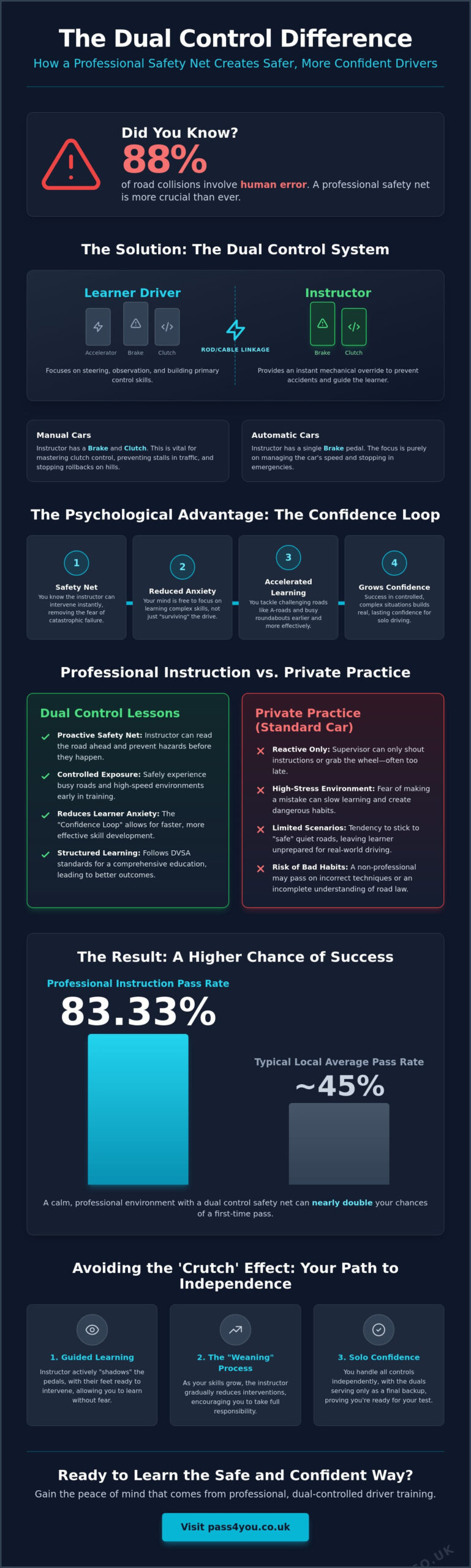
Imagine you are approaching a busy junction for the first time, and your heart starts to race at the thought of hitting the wrong pedal. It’s a common fear that keeps many potential drivers off the road. You might find yourself wondering, are dual control cars safer than the standard vehicle sitting in your driveway? Since human error is a contributing factor in 88% of road collisions, having a professional safety net is more important than ever for new learners in 2026.
We understand that the anxiety of causing an accident can be overwhelming. It’s difficult to focus on your steering when you’re worried about the car’s mechanics or whether your instructor might over-control your every move. You might even feel that private practice in a standard car is a dangerous way to start, and that’s a very valid concern for anyone prioritizing road safety.
This guide will show you how dual controls provide a vital safety net that actually accelerates your learning by removing the fear of failure. We will explore the mechanical advantages of these systems and why professional instruction is the most reliable path to success. You will also learn how to eventually transition your skills to a standard car so you can drive independently with total confidence.
Key Takeaways
- Understand how the mechanical override system creates a “confidence loop,” allowing you to attempt complex manoeuvres with a professional safety net.
- Discover why are dual control cars safer than private practice cars by comparing the instructor’s ability to read the road ahead.
- Learn the “weaning” process that ensures you don’t become over-reliant on your instructor’s pedals as you prepare for solo driving.
- Find out how modern tuition fleets, such as our Volkswagen vehicles, are specifically chosen to help you navigate challenging grid systems and roundabouts.
- Gain the peace of mind that comes from knowing exactly how your instructor prevents accidents while you focus on building your skills.
The Safety Net: What Are Dual Control Cars and How Do They Work?
When you sit in the driver’s seat for the first time, the responsibility can feel heavy. A dual control car is a vehicle modified with a secondary set of pedals in the passenger footwell, typically including a brake and a clutch. This setup creates a shared environment where your instructor can manage the car’s speed and stopping power while you focus on steering and observation. You might ask yourself, are dual control cars safer than the family car you have at home? The answer is a definitive yes. This mechanical override allows an instructor to intervene instantly without ever needing to touch the steering wheel, keeping the situation calm even if you make a mistake.
These systems have been a foundational part of any formal driver’s education program for many years. The DVSA requires professional instructors to maintain a high level of safety, and dual controls are the primary tool used to achieve this. In the UK, He-Man dual controls are the industry benchmark. These systems are precision-engineered for specific vehicle models, ensuring that the instructor’s pedals are just as responsive and reliable as the ones on the driver’s side. This standard of equipment is what allows us to offer a professional and secure learning experience.
The Mechanics of the Dual Pedal System
The system works through a physical linkage, usually made of high-strength cables or rods, that connects the instructor’s footwell to the driver’s side. In a manual car, the instructor has access to both the brake and the clutch. It’s rare to find an accelerator on the instructor’s side because the priority is always to slow down or stop the vehicle in an emergency. The design ensures that the instructor can override the learner’s input. If you hesitate at a junction or accidentally press the wrong pedal, the instructor can take over immediately. This mechanical priority means the car will always respond to the safest input provided.
Automatic vs. Manual Dual Controls
The pedal layout changes depending on the type of car you choose to learn in. In an automatic tuition vehicle, the instructor only has a single brake pedal to manage. In a manual car, the dual clutch is vital for mastering clutch control. It allows the instructor to prevent the car from stalling in traffic or rolling back on a steep hill. Our modern Volkswagen tuition fleet integrates these systems seamlessly into the cabin. The pedals are positioned so they don’t interfere with the passenger’s space, yet they remain perfectly placed for the instructor to provide a gentle nudge or a firm stop whenever necessary. This integration ensures that the car remains a stable and predictable environment for every lesson.
Mechanical vs. Psychological Safety: Why Dual Controls Matter in 2026
While the hardware of a dual control system is impressive, the psychological impact on a learner is even more significant. People often ask, are dual control cars safer because they can stop a crash, but the real benefit is how they change the way you feel behind the wheel. We call this the “Confidence Loop.” When you know a safety net exists, your brain is free to focus on learning rather than just surviving. This shift in mindset is one reason why a calm, professional environment can lead to a first-time pass rate as high as 83.33%, which is nearly double the local average in some areas.
At a busy junction, a learner might “freeze” or hesitate. An instructor can use a subtle nudge of the clutch or brake to help the car hold its position or move forward smoothly. This guidance makes the instructor a co-pilot rather than just an observer. It ensures the flow of traffic remains steady, which is vital in complex road systems. It’s a simple concept. If you feel safe, you learn faster. If you learn faster, you become a more competent driver in less time.
Building Confidence Through Controlled Exposure
Dual controls allow you to experience busy A-roads and high-speed environments much earlier in your training. Instead of sticking to quiet side streets for weeks, you can progress quickly because your instructor is “shadowing” the pedals. This means their feet are hovering just millimetres from the controls, ready to act in a split second. Meeting strict vehicle safety requirements is a global standard for professional schools because it protects the learner’s mental wellbeing as much as their physical safety. Psychological safety in driving tuition is the belief that you can make mistakes and learn from them without facing dangerous consequences.
Preventing “Negative Learning” Experiences
A single bad experience, like a heavy stall at a busy roundabout or a minor bump, can set a learner back for months. It creates a “negative learning” loop where fear replaces progress. Dual controls prevent these traumatic moments by allowing the instructor to smooth out your mistakes before they become problems. This is especially helpful when navigating the 130+ roundabouts in Milton Keynes. By choosing professional driving lessons, you ensure that every lesson is a positive step forward rather than a stressful ordeal. A patient, mentor-like approach combined with the right technology makes all the difference in your journey to independence.
Professional Instruction vs. Private Practice: A Safety Comparison
Learning to drive in a standard family car often feels like a rite of passage, but it carries risks that many families overlook. Without an instructor’s override, a simple mistake like mistaking the accelerator for the brake can lead to a collision in seconds. You might wonder, are dual control cars safer for these early stages? The reality is that professional tuition provides a layer of protection that private practice cannot match. Qualified instructors are specifically trained to “read” the road up to 10 seconds ahead of the learner, identifying hazards before you even notice them. This foresight, combined with the mechanical safety of dual pedals, creates a much more secure environment than a standard hatchback.
Insurance companies also recognize this difference. Vehicles equipped for professional tuition are often viewed as lower risk because the instructor can actively prevent accidents. This is one reason why professional lessons in a modern vehicle are a more efficient investment than informal learning. You aren’t just paying for the car; you’re paying for a sophisticated safety system and the expertise required to use it effectively. When you choose a professional school, you’re choosing a vehicle that is maintained to the highest safety standards, which is a far cry from the unpredictable nature of an older family car.
Why Parent-Led Practice Can Be Stressful
Many learners find that practicing with a parent leads to the “shouting factor.” When a supervising driver feels they have no control over the car’s speed or braking, their anxiety levels spike. This stress often transfers to the learner, leading to more mistakes and a loss of confidence. If you’re considering your options, our guide on Choosing a Driving School in Milton Keynes explains how to find the right environment for your needs. Using a professional tuition vehicle removes this tension, allowing for a calm and focused learning experience where the instructor remains a supportive mentor rather than a stressed passenger.
Safety Metrics: Professional Tuition vs. Informal Practice
Research suggests that intervention rates are significantly lower with qualified instructors compared to well-meaning friends or family members. Professionals know exactly when to step in and, more importantly, when to let you handle a situation yourself. We strongly recommend that at least the first 10 hours of your tuition take place in a dual-control vehicle. This ensures you master the basics of car control in a safe setting before attempting any independent practice. Professional ADI-led lessons in a dual-control car offer a level of risk management and expert oversight that informal private practice simply cannot replicate.
Avoiding the ‘Crutch’ Effect: Transitioning to Independent Driving
The safety net of dual controls is essential for beginners, but the ultimate goal of professional tuition is to prepare you for solo travel. As you gain experience, your instructor will begin a “weaning” process. This is a gradual reduction in the use of the secondary pedals to ensure you aren’t relying on them as a crutch. While people often ask are dual control cars safer for learners, they are actually most effective when they are helping you bridge the gap between being a student and becoming an independent driver. This transition ensures that when you finally pick up the keys to your first car, you have the muscle memory and decision-making skills to stay safe without a co-pilot.
Developing a genuine “pedal feel” is a major part of this journey. In the early stages, an instructor might help you find the biting point or smooth out your braking. However, as your lessons progress, they will keep their feet firmly on the floor. You need to feel the vibrations of the engine and the resistance of the brake pedal yourself. If the instructor intervenes too much, you might not realise you are making small errors that could lead to a stall or a jerky stop in a standard car. By the time you reach your final few lessons, the dual controls should essentially be dormant, existing only for absolute emergencies.
Signs You Are Ready for Independent Pedals
You will know you are ready to move away from the safety net when your driving becomes consistently smooth without any verbal or physical prompts. This includes starting the car without stalling and managing your speed through observation alone. In Milton Keynes, being able to handle hill starts on some of the steeper sections without the instructor “shadowing” the brake is a clear sign of progress. You should also be predicting hazards and adjusting your speed well before your instructor feels the need to intervene. When you can read the road as well as your mentor, you are ready for the next step.
The Role of Mock Tests in Building Independence
A vital part of our training involves removing the safety net entirely during a practice run. Taking a mock test in Milton Keynes proves to you that you don’t need the dual controls to succeed. It marks a psychological shift from “being taught” to “being assessed.” During these sessions, the instructor acts as an examiner, meaning they will not use the pedals unless a dangerous situation arises. This builds the mental toughness required for the actual test day. Our instructors prioritise this transition because we want you to be a safe driver for life, not just for the duration of your lesson. If you are ready to build your independence behind the wheel, you can book your first driving lesson today and start your journey with a professional mentor.
Safe Driving in Milton Keynes: Why Our VW Fleet is the Local Choice
Milton Keynes presents a unique challenge for any new driver. With its high-speed V and H roads and more than 130 roundabouts, the grid system requires a high level of concentration and precision. Local students often wonder, are dual control cars safer when navigating these complex multi-lane junctions for the first time? In an environment where traffic moves quickly and lane discipline is vital, the presence of an instructor with a secondary set of pedals is more than just a convenience. It is a fundamental part of staying safe while you build the skills needed to handle the MK roads independently.
Our fleet of modern Volkswagen tuition vehicles is chosen for its exceptional reliability and safety ratings. Learning in a VW means you are using a car designed for precision, which helps immensely when you are trying to master the pedal feel mentioned earlier. This commitment to quality, combined with our patient and supportive teaching style, is why we maintain a first-time pass rate of 83.33%. We don’t just teach you how to pass a test; we ensure you have the local knowledge and confidence to drive safely for years to come. Our instructors know the local test routes inside out, which makes your dual-control tuition even more effective.
Mastering MK Roundabouts Safely
Roundabouts are the heart of Milton Keynes, and they can be the most stressful part of a driving lesson. Your instructor will use the dual controls to help manage your speed and positioning as you learn to enter and exit these junctions correctly. This is particularly helpful during rush hour when the V and H roads are at their busiest. For more detailed advice on handling higher speeds, you can read our guide on Mastering the Dual Carriageway. By breaking down these complex manoeuvres into manageable steps, we help you overcome any anxiety you might feel about the local layout.
Your First Lesson with Pass4you
When you first sit in the driver’s seat of our dual-control VWs, your instructor will focus on making you feel at ease. You will meet a first-class mentor who understands that every student learns at a different pace. We start by establishing a calm, personalised learning plan that focuses on your specific needs and goals. There is no pressure to jump onto a busy roundabout before you are ready. Instead, we build your skills gradually in a supportive atmosphere. If you are ready to start your journey with a team that cares about your safety and success, book your first lesson with Pass4you today and experience the difference that professional, local tuition can make.
Take the Next Step Toward Your Independence
You now understand how dual controls act as more than just a set of pedals; they are the foundation of your confidence on the road. When asking are dual control cars safer, it’s clear that the combination of mechanical override and expert guidance creates the most secure learning environment possible. This setup allows you to master the complex Milton Keynes grid system without the fear of making a costly mistake. We’ve explored how these vehicles facilitate a “confidence loop” and how our instructors carefully manage the transition to ensure you’re ready for your first car.
With our modern Volkswagen tuition vehicles and a focus on calm, patient instruction, we help our students achieve an impressive 83.33% first-time pass rate. It’s about building a safe future and ensuring you feel empowered every time you get behind the wheel. The road to freedom is much smoother when you have a professional mentor by your side. Start your journey with a patient, expert instructor in Milton Keynes today. You have the potential to be a brilliant driver, and we’re here to help you prove it.
Frequently Asked Questions
Are dual control cars safer for absolute beginners?
Yes, they are significantly safer because they allow the instructor to prevent common mistakes from becoming dangerous accidents. For a beginner, the risk of hitting the wrong pedal or rolling back on a hill is high. Having a professional safety net ensures that these errors are corrected instantly, which builds your confidence and keeps everyone on the road safe during those first few hours.
Can a learner driver take their driving test in a dual control car?
Yes, you can absolutely take your test in a vehicle fitted with these controls. In fact, most learners choose to use their instructor’s dual-control car because they are familiar with its handling and dimensions. Using a car you trust helps to reduce test-day nerves and ensures you are driving a vehicle that meets all DVSA safety standards for the practical exam.
Does the driving examiner use the dual controls during the test?
The examiner will only use the pedals if it is absolutely necessary to prevent a collision or ensure road safety. Their role is to observe your independent driving, not to assist you. While they have access to the brake, they prefer to see that you can manage the vehicle’s speed and safety on your own without any physical intervention from the passenger seat.
Will I fail my driving test if the examiner touches the dual controls?
In almost all cases, physical intervention by the examiner results in a fail. If they have to use the brake or clutch to prevent a hazard, it is classified as a serious or dangerous fault. This is why our training focuses so heavily on the transition to independent driving, ensuring you are fully prepared to handle the car without any help by the time you reach the test centre.
Is it harder to drive a car that doesn’t have dual controls after my lessons?
It isn’t necessarily harder, but it does feel different because the psychological safety net is gone. You might notice that you are more cautious about your braking distances and hill starts. This is a natural part of becoming an independent driver. Your professional training ensures you have the technical skills and the “pedal feel” to handle any standard car safely and confidently.
Can I have dual controls fitted to my own car for private practice?
Yes, you can have them installed, but it is a specialist job that can be quite costly. Many families find that hiring a dual-control car for a few hours is a more practical option than modifying a personal vehicle. It’s important to remember that are dual control cars safer only when the person in the passenger seat is trained to read the road and use them effectively.
Do dual control cars have an alarm when the instructor uses the pedals?
Most modern tuition vehicles, including our Volkswagen fleet, are fitted with an audible buzzer or a visual light that activates when the instructor presses a pedal. This is a requirement for the driving test, as it informs the examiner if the instructor has assisted the learner. It ensures transparency and safety during every lesson, giving you an honest reflection of your driving progress.
Are automatic dual control cars safer than manual ones?
Both offer a high level of safety, but automatic vehicles are often simpler for learners to manage, which can reduce anxiety. In an automatic dual-control car, the instructor only has a brake pedal to oversee. This allows them to focus entirely on your observation and steering, making it a very supportive environment for those who find gear changes and clutch control overwhelming during their early training.