Last week, a learner named James sat at a busy junction, his left leg trembling as he tried to find the biting point while traffic built up behind him. That surge of heat in your cheeks when the engine dies is a feeling almost every new driver knows. It’s stressful and embarrassing, but it doesn’t have to be your reality every time you get behind the wheel.
We understand how frustrating it is when your foot won’t cooperate, especially when you’re dealing with a heavy clutch. Stalling isn’t a sign that you’re a bad driver; it’s just a sign that your muscle memory needs more training. To help you gain control, we’ve put together the most effective clutch control exercises for learner drivers to build your confidence and skill.
This guide reveals the exact drills our instructors use to help students reach the 2026 national average pass rate of 52.2% and beyond. We will walk you through seven essential exercises, from “micro-movements” to mastering steep hills, so you can pass your test without a single clutch-related fault.
Key Takeaways
- Visualize the “handshake” between your engine and wheels to finally understand what the biting point actually feels like.
- Master specific clutch control exercises for learner drivers that build muscle memory on flat ground before you tackle busier roads.
- Gain the confidence to handle steep hills and junctions using the handbrake balance method to prevent rolling back.
- Discover how to stop stalling by fixing common footwork mistakes that often cause frustration during the learning process.
- Apply these professional drills to stay calm and controlled while managing the unique roundabouts and grid roads across Milton Keynes.
The Mechanics of the Biting Point: Why It Feels So Tricky
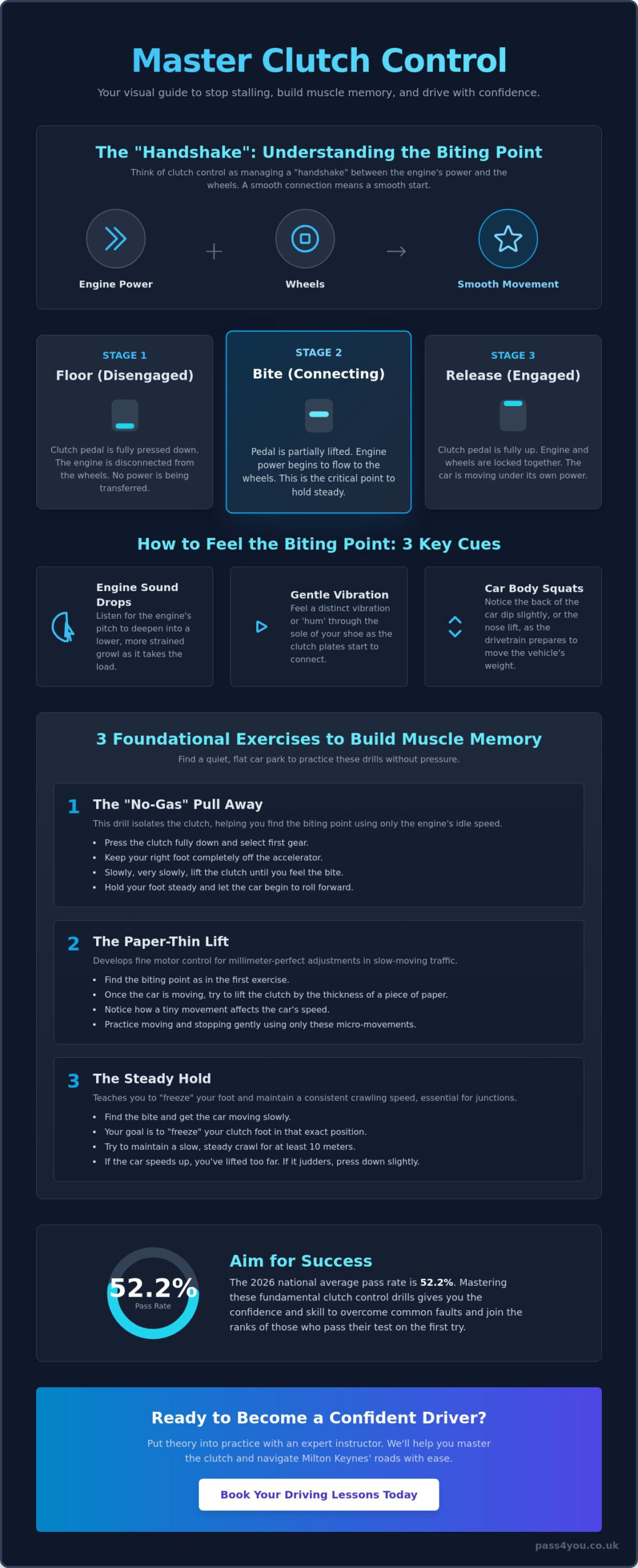
Understanding the biting point is the first hurdle for every new driver. Think of it as a “handshake” between the engine and the wheels. When the clutch pedal is pushed fully to the floor, the engine spins independently, and no power reaches the wheels. As you slowly lift your foot, you reach a specific zone where the engine’s power begins to flow into the gearbox. This is the biting point. There are three distinct stages to master: the floor (fully down), the bite (the connection), and the release (fully up). Most stalling happens because learners try to skip the middle stage. When you release the pedal too quickly, the engine can’t handle the sudden load and dies. It’s a common source of anxiety, but once you recognize the physical cues, you’ll feel much more in control.
You’ll notice specific signs when you hit that sweet spot. The car’s nose might dip slightly, or the back of the car might feel like it’s squatting. The engine sound will drop in pitch, becoming a deeper, more strained growl. Most importantly, a gentle vibration will travel through the sole of your shoe. These signals are the car telling you it’s ready to move.
The Science of the “Handshake”
At its core, Clutch control principles are about managing friction. Inside your car, two spinning discs are trying to sync up. One is connected to the engine, and the other leads to the wheels. As you lift your left foot, these plates meet. They don’t just “click” together; they slide against each other until they match speeds. This friction creates a distinct “hum” or vibration. Recognizing this physical feedback is vital before you start specific clutch control exercises for learner drivers. You aren’t just moving a pedal; you’re managing a delicate mechanical connection. Staying calm and listening to the car helps you feel exactly when those plates have gripped enough to move the vehicle forward without a jerk.
Why Your Left Foot Struggles (And How to Fix It)
Your left leg usually only has one job: walking or standing. It isn’t used to the delicate, millimetre-perfect movements required for a smooth pull-away. The pedal also has a strong spring tension that wants to push your foot back up. This resistance can make your leg feel heavy, shaky, or fatigued after a long lesson. Don’t worry if you stall during your first few attempts. Stalling is actually a helpful part of the calibration process. It teaches your brain exactly where that “connection” ends. With patience and the right clutch control exercises for learner drivers, your muscles will eventually memorize the pressure needed to hold the bite steady. It’s a physical skill that develops with time, much like learning to ride a bike or play an instrument. You’re simply training your leg to handle a new kind of pressure.
Foundational Clutch Control Exercises for Beginners
To begin your practice, find a flat and quiet area well away from the bustling Milton Keynes traffic. A deserted car park or a quiet cul-de-sac is perfect. This environment removes the pressure of other drivers, allowing you to focus entirely on your feet. When you feel safe and unhurried, you can begin the physical work of building muscle memory. These initial clutch control exercises for learner drivers are designed to be repeatable until the movement feels like second nature.
Exercise 1 is the “No-Gas” Pull Away. This drill helps you understand the raw power of the engine without the distraction of the accelerator. In a diesel car, you might find the car moves quite eagerly due to higher torque. Petrol cars are more sensitive and require a lighter, more patient touch. By slowly lifting the clutch without touching the accelerator, you’ll feel the car begin to roll. Understanding how manual transmissions work helps here, as you are seeing the engine’s idle speed take over the work of moving the vehicle.
Exercise 2 is the Paper-Thin Lift. Once you find the biting point, try to lift your foot by just one millimetre at a time. This teaches you the extreme precision needed for tight spaces. Exercise 3 is the Steady Hold. Your goal is to keep the car at a slow crawl for at least 10 metres. The secret here is “freezing” your foot. Once the car moves, don’t lift any further. If you keep lifting, the car will gain too much speed or stall. If you feel you need more personalized guidance to perfect these drills, booking driving lessons with an experienced instructor can help refine these movements quickly.
Mastering the Heel Pivot Technique
Many learners wonder whether to keep their heel on the floor or lift their whole leg. If the biting point is low, keeping your heel down provides better stability and reduces leg fatigue. However, for cars with a higher bite, you may need to “float” your heel to avoid straining your ankle at an awkward angle. The pivot point is the stable anchor where your heel meets the floor to act as a fulcrum for the pedal’s arc. Using this anchor allows for much smoother movements than trying to hover your entire leg in the air.
The “Creeping Crawl” Drill
This involves moving the car at a snail’s pace, often slower than a walking speed. You manage the speed entirely with the clutch; if the car goes too fast, dip the clutch slightly. If it slows too much, lift it a millimetre. Mastering this is the secret to success during driving lessons in Milton Keynes, especially when navigating the city’s complex roundabouts and stop-start grid roads. It gives you the time to look for gaps in traffic without the car surging forward unexpectedly.
Intermediate Drills: Mastering Hills and Junctions
Moving your practice from flat car parks to slight inclines is a significant milestone. It’s the moment you stop thinking about the pedal and start feeling the car’s weight. These intermediate clutch control exercises for learner drivers focus on balancing power against gravity. You’ll need more engine power here than you did on flat ground. We recommend “setting the gas” by gently pressing the accelerator until the rev counter sits between 1500 and 2000 RPM. This creates a stable foundation of power, ensuring the engine doesn’t struggle or stall when you reach the biting point.
Exercise 4 is the Handbrake Balance. While the handbrake is firmly on, find your biting point and add your gas. You’ll feel the car strain against the cable, almost like a dog pulling on a lead. This “tug” is your signal that the car is ready to climb. Exercise 5 is the “Feet Swap.” This drill involves moving your right foot quickly from the brake to the gas pedal while holding the clutch perfectly still at the bite. It’s a quick, decisive movement that prevents the car from rolling back in traffic. These clutch control exercises for learner drivers turn a stressful hill start into a routine part of your driving day.
Conquering the Dreaded Hill Start
To master hills, try the 3-second hold drill. Find a safe incline and bring the car to a stop. Find your biting point and hold the car perfectly still for exactly three seconds before moving off or reapplying the brake. You’ll feel that distinct “tug” as the nose of the car lifts. Be careful not to hold this position for too long. Holding the car on the bite for extended periods can cause the friction plates to overheat; this is commonly known as “burning the clutch.” Use this drill sparingly to build your confidence without putting unnecessary wear on the vehicle.
Junction Readiness: The “Slow-Look-Go” Exercise
Approaching junctions requires a delicate “Slow-Look-Go” technique. Practice approaching a line at a steady 2mph by using your clutch to regulate the speed. This gives you time to observe traffic without coming to a complete, jerky stop. As you scan for a gap, keep your foot at the biting point so you can move off instantly when it’s safe. This level of precision is essential for mastering the dual carriageway, where joining fast-moving traffic requires a confident and smooth pull-away every time.
Troubleshooting: Why You Are Still Stalling
Stalling is a rite of passage for almost every new driver. While it feels like a disaster in the moment, it’s actually just your car giving you feedback. If you experience a stall during your practical driving test, remember that it isn’t an automatic fail. The examiner is looking for a calm, safe recovery. Secure the car with the handbrake, restart the engine, and perform your observations again. Even with the national average pass rate sitting at 52.2% in 2026, many successful students have stalled once or twice during their exam. The difference between passing and failing often comes down to how you handle the pressure afterward.
There are three primary reasons why learners continue to stall even after practicing clutch control exercises for learner drivers. First, many students release the pedal too quickly the moment the car begins to roll. You must keep your foot still for a moment to let the car gain momentum. Second, a lack of “gas” on inclines will starve the engine of the power it needs to move the vehicle’s weight. Finally, panic is a major factor. When a driver behind you honks, the natural instinct is to rush. This usually leads to a “panic-release,” where your foot jumps off the pedal and the engine dies instantly. Stay focused on your own feet; the driver behind can wait a few extra seconds.
The “Six-Inch Rule” for Smoothness
A common mistake is thinking the job is done once the car moves. We teach our students the “Six-Inch Rule.” This means you should hold your left foot perfectly still at the biting point until the car has travelled at least six inches. This allows the friction plates to fully sync without a sudden jolt. “The secret to a smooth pull-away isn’t finding the bite, it’s what you do in the second after the car moves.” That final inch of pedal travel is the most sensitive; treat it with the most care. If you want to eliminate these jerky starts for good, our team can provide expert driving lessons tailored to your specific needs.
Footwear and Seat Position
Your physical setup in the car dictates how much “feel” you have through the pedal. Chunky boots with thick soles or high heels can mask the subtle vibrations of the biting point. We recommend wearing thin-soled trainers to maximize your sensitivity. Your seat position is equally vital. If you’re sitting too far back, you’ll end up “toe-stretching” to reach the floor. This makes your leg muscles tense and leads to shaky, jerky control. Adjust your seat so that your knee remains slightly bent even when the clutch is pushed fully to the floor. This posture gives you the range of motion needed for the millimetre-perfect adjustments required in clutch control exercises for learner drivers.
Putting It Into Practice on Milton Keynes Roads
Milton Keynes presents a unique challenge for new drivers. With its distinctive H and V grid roads and a roundabout at almost every intersection, smooth footwork isn’t just a bonus; it’s a necessity. Mastering clutch control exercises for learner drivers is your secret weapon for navigating this city with ease. When you can hold the bite while scanning for a gap on a busy V6 or H8 road, you’ll feel much more capable. The stop-start nature of MK traffic during rush hour can be exhausting for your left leg. However, instructors at Pass4you Driving School use modern Volkswagen vehicles specifically chosen for their forgiving biting points and responsive pedals. These cars often feature electronic assistance that makes the learning process significantly more comfortable, allowing you to focus on the road ahead rather than struggling with a stubborn, heavy gearbox.
Roundabout Confidence: The “Pause and Peek”
Mini-roundabouts in Milton Keynes require quick thinking and even quicker feet. We teach our students the “Pause and Peek” method. This involves using the clutch to slow the car to a crawl as you approach the line. While gear 2 is common for larger junctions, using gear 1 and precise clutch control is often safer for MK’s tighter mini-roundabouts. It gives you the time to observe and react without the car feeling like it’s running away from you. This technique is especially helpful when you’re preparing to merge onto a fast-moving dual carriageway. A smooth, confident pull-away ensures you join the flow of traffic safely without causing other drivers to brake.
Why Professional Instruction Saves Time and Money
Trying to learn these skills through informal practice can be a slow and frustrating process. It often leads to bad habits that are hard to break later on. Finding a qualified driving instructor near me ensures you receive structured, professional guidance from day one. At Pass4you Driving School, our focus on high-precision techniques has led to an 83.33% first-time pass rate. This is a powerful metric when compared to the 2026 national average of 52.2%. We consistently see that one hour of professional instruction is more valuable than five hours of struggling alone. It’s an investment that saves you time, reduces your long-term costs, and builds the safety-first mindset required for a lifetime of driving.
Building rock-solid confidence in your left foot is the fastest way to pass your test and enjoy the freedom of the road. If you’re ready to stop stalling and start driving, our patient mentors are here to help. Book your driving lessons today with Pass4you Driving School and take the first step toward a successful, stress-free test day.
Ready to Take Control of Your Driving Future?
Mastering the biting point is more than just a technical requirement for your test; it’s the key to feeling relaxed and safe every time you get behind the wheel. By consistently practicing these clutch control exercises for learner drivers, you’ve already taken a massive step toward eliminating stalling and building the muscle memory needed for those busy junctions. Every experienced driver once struggled with their left foot just like you. Patience and the right environment are all it takes to turn that initial anxiety into rock-solid confidence.
We believe that learning should be a positive, supportive experience. The patience-first teaching style and modern VW tuition vehicles at Pass4you Driving School are designed to help you succeed quickly and safely. With our impressive 83.33% first-time pass rate, you can trust that you’re in the most capable hands in the region. Don’t let the fear of stalling hold you back from the freedom of the road any longer. Master your clutch control with Milton Keynes’ top-rated instructors – Book your first lesson with Pass4you Driving School today!
You have the potential to be a smooth, confident driver. We can’t wait to help you thrive and enjoy the opportunities that come with your new licence.
Frequently Asked Questions
How long does it take to master clutch control?
It typically takes between five to ten hours of focused practice to stop thinking about your feet and start feeling the car naturally. Everyone learns at a different pace, so don’t feel discouraged if you need a little more time to build that muscle memory. Consistent practice during your lessons will soon make these movements feel like a natural reflex rather than a conscious effort.
Is it easier to learn clutch control in a diesel car?
Yes, diesel engines generally have more torque at low speeds, which makes the biting point more pronounced and harder to stall. This is why many instructors use diesel vehicles for initial clutch control exercises for learner drivers. Once you master the technique in a diesel, transitioning to a more sensitive petrol car becomes much easier because you already understand the physical sensations involved.
What happens if I “ride the clutch” for too long?
Riding the clutch means keeping the pedal partially depressed while driving, which causes the internal friction plates to slip and overheat. Over time, this leads to premature wear and a characteristic burning smell. It’s a habit that can result in costly mechanical repairs. Learning to rest your foot on the floor once you’ve changed gear or moved away will keep the car healthy and your control precise.
Can I fail my driving test for stalling once?
No, you won’t necessarily fail for a single stall as long as you recover safely and don’t create a hazard for other road users. The examiner looks for a calm response: securing the car, restarting the engine, and performing all necessary observations before moving off again. Stalling only becomes a serious fault if it happens repeatedly or in a dangerous situation, such as in the middle of a busy junction.
Why does my left leg ache after a driving lesson?
Your left leg is using muscles for fine motor control that aren’t typically used in daily life. Holding the clutch at the biting point requires you to fight against the pedal’s spring tension, which can lead to muscle fatigue. As you practice more clutch control exercises for learner drivers, your leg will become stronger and the movements will require less conscious effort, reducing that post-lesson ache.
Should I wear specific shoes for my driving lessons?
You should wear flat shoes with thin soles to maximize the feedback you get from the pedals. Thick-soled boots or high heels can make it very difficult to feel the subtle vibrations of the biting point. Lightweight trainers are usually the best choice for beginners. Having a dedicated pair of thin-soled shoes can help you stay consistent and build your confidence more quickly during your early lessons.
How do I stop the car from rolling back on a hill?
The most reliable way to prevent rolling back is to use your handbrake while you find the biting point. Keep the handbrake engaged until you feel the car “tug” forward and see the nose dip slightly. Once you’ve set the gas and found the bite, you can smoothly release the handbrake. This technique ensures the engine is already pulling the car forward before the brakes are released.
Is clutch control different in an automatic car?
Automatic cars do not have a clutch pedal, so the vehicle manages the internal connection between the engine and wheels for you. You only have to manage the accelerator and the brake. While this removes the risk of stalling, it means you have less direct control over the car’s slow-speed crawling. Many learners find automatics easier to drive in stop-start traffic, but they don’t offer the same mechanical engagement as a manual.