Did you know that the emergency stop is now only requested in about 1 in 7 UK driving tests? While the DVSA reduced the frequency to roughly 14% of tests in late 2025, the pressure to get it right hasn’t changed. It’s completely natural to feel a flutter of “brake panic” when you think about the examiner suddenly calling out for you to stop. You might worry about skidding, losing control, or the common confusion of exactly when to use the clutch. We understand those nerves, and we’re here to help you turn that anxiety into quiet confidence.
This guide will help you master the emergency stop procedure uk driving test by breaking down exactly what the examiner expects in 2026. You’ll learn the precise footwork needed for manual cars, how modern technology like ABS keeps you safe, and how to react instantly to the examiner’s signal. We’ll walk you through the process step by step, from the moment you hear the command to the final safety checks before moving off again. By the time you finish reading, you’ll have a clear roadmap to performing this maneuver smoothly, ensuring you feel prepared and professional on your test day.
Key Takeaways
- Understand the specific criteria DVSA examiners use to grade your performance, ensuring you meet the highest safety standards for 2026.
- Master the correct footwork for the emergency stop procedure uk driving test, including the vital timing of the clutch and brake pedals.
- Learn how to maintain a straight path and avoid common control issues that often cause anxiety for learner drivers.
- Gain peace of mind by knowing exactly what happens after the stop, including the essential safety observations needed before you continue your drive.
- Discover how expert guidance during your driving lessons can build the muscle memory required to handle sudden stops with complete confidence.
What is the Emergency Stop Procedure in the 2026 Driving Test?
The emergency stop is often the one part of the test that makes learner drivers feel most anxious. It’s a controlled maneuver designed to bring your car to a complete halt as quickly and safely as possible. While it might sound intimidating, it’s a vital skill that ensures you can handle unexpected hazards on the road. In the current UK driving test procedure, examiners use this exercise to assess two main things: how fast you react and how well you keep the car under control during heavy braking. We focus on helping you feel calm so that your feet do exactly what they’ve been trained to do without hesitation.
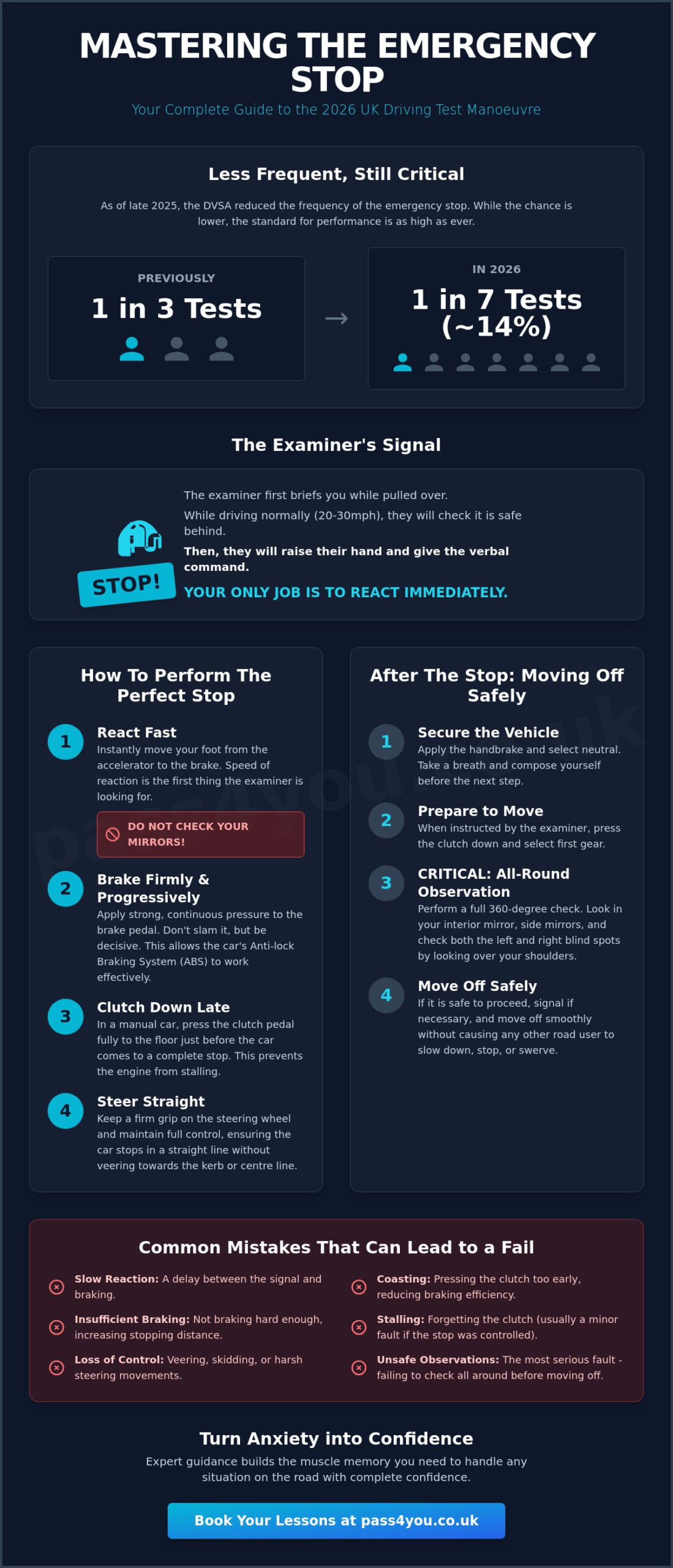
You might have heard from friends or older relatives that you’re almost certain to perform this during your test. However, as of late 2025, the DVSA updated the frequency of this exercise to better reflect modern road conditions. In 2026, you actually only have a 1 in 7 chance of being asked to perform an emergency stop. This means it happens in roughly 14% of practical tests, a significant drop from the old 1 in 3 frequency. Even though it’s less common, your instructor will still make sure you’ve mastered the emergency stop procedure uk driving test. It’s always conducted on a safe, straight stretch of road where there’s minimal risk to other road users.
When and How the Examiner Will Signal
Before the exercise begins, the examiner will ask you to pull over to the side of the road. They’ll explain exactly what’s about to happen so there are no surprises. They’ll tell you that they’ll give a specific signal and that you should stop the car as if an emergency has occurred. They’ll also specify that you shouldn’t check your mirrors before braking, as in a real emergency, every millisecond counts.
Once you move off and are driving normally, usually at a speed of 20 to 30mph, the examiner will look over their shoulder to ensure it’s safe behind you. Then, they’ll suddenly raise their hand and shout “STOP!” clearly. Your only job is to react immediately. You’ll need to apply the brakes firmly and progressively. During your driving lessons, we practice this until it becomes second nature, so you won’t feel startled when the shout finally comes.
Why Safety is the Priority
The main goal is to stop the car in the shortest distance possible while keeping it stable. This maneuver mimics a real-life situation, like a child stepping into the road or a car pulling out unexpectedly. If you take too long to hit the brakes or let the car veer toward the curb, it shows a lack of control. By using a firm, steady pressure, you allow the car’s safety systems to work effectively. The emergency stop is a test of your ability to provide a prompt, controlled reaction to a sudden hazard.
Step-by-Step: How to Perform a Test-Standard Emergency Stop
When the examiner gives the signal, your first priority is speed of reaction. You must move your right foot from the accelerator to the brake pedal instantly. Do not look in your mirrors. While this feels counterintuitive to everything you have learned in your driving lessons so far, a split second spent looking at the glass is a split second where the car is still moving at speed. Your goal is to stop the vehicle as quickly as possible while keeping it under full control.
The way you apply the brake is just as vital as how fast you reach it. You should apply firm, progressive pressure. This means you don’t “stab” or “slam” the brake suddenly, which can cause the car to pitch forward violently or lose grip. Instead, push the pedal hard and keep that pressure steady until the car has stopped. Modern braking systems are designed to handle this force, and your car will respond best to a deliberate, strong input. Practicing this during your driving lessons with a supportive instructor will help you find the right balance of strength and smoothness.
As the car slows down, you need to manage the clutch. If you’re driving a manual car, depress the clutch pedal fully just before the car comes to a complete standstill. This prevents the engine from stalling while ensuring you benefit from engine braking for as long as possible. If you press the clutch too early, the car might “coast,” which reduces your control. If you press it too late, the car might shudder or stall. Don’t worry if you do stall during the test; as long as the stop was safe and controlled, a stall is usually considered a minor fault rather than a fail.
The “No Mirror Rule” Explained
In almost every other driving situation, The Highway Code emphasizes the importance of checking your mirrors before changing speed or direction. However, the emergency stop procedure uk driving test is the one big exception. The examiner has already checked the road behind you to ensure it is clear and safe before giving the signal. In a real-world emergency, taking the time to check your mirrors could be the difference between a near-miss and a collision. Trust that the area is clear and focus entirely on stopping the car.
Post-Stop Safety Checks
Once the car has reached a total halt, keep your feet firmly on the pedals. Your first task is to secure the car by applying the handbrake and selecting neutral. This is a great moment to take a deep breath and settle your heart rate. The examiner will usually say, “Thank you, move off when you’re ready.” Before you put the car back into gear, you must perform a thorough, 360-degree observation. Check both blind spots and all mirrors. You are looking for pedestrians, cyclists, or other vehicles that may have approached while you were stopped. Only move off when you are 100% certain it is safe to rejoin the flow of traffic.
Modern Car Tech: ABS and Stopping Distances in 2026
Modern cars are equipped with sophisticated systems that take much of the guesswork out of sudden braking. In 2026, almost every tuition vehicle, including the modern Volkswagens we use for our driving lessons, comes fitted with an Anti-lock Braking System (ABS). This technology is a game changer for learner drivers. It works by monitoring the speed of each wheel and automatically releasing the brakes for a fraction of a second if it detects a wheel is about to lock up. This prevents the car from skidding and allows you to maintain steering control even under maximum braking pressure.
One of the most important things to prepare for is the physical feedback from the car. When you perform the emergency stop procedure uk driving test in an ABS-equipped vehicle, you might feel the brake pedal vibrate or pulse under your foot. You might also hear a mechanical grinding or thumping sound. Don’t let this alarm you. It’s simply the system working at high speed to keep you safe. Many students instinctively lift their foot when they feel this vibration, but you must keep the pressure firm and steady until the car has stopped completely.
Understanding your environment is just as critical as knowing the car’s tech. The Official Highway Code Emergency Stop Procedure highlights that stopping distances are heavily influenced by the road surface. In dry conditions, we follow the 2-second rule to maintain a safe gap from the vehicle in front. However, once the weather turns, those distances change dramatically. ABS is a safety aid that helps you maintain control, but it isn’t a replacement for good tires or sensible speed for the conditions.
How ABS Changes Your Reaction
Years ago, drivers were taught to “pump” the brakes to prevent a skid. With modern ABS, this is no longer necessary and can actually be dangerous. You should push the brake pedal hard and hold it there. The car’s computer will handle the “pumping” much faster than any human could. This technology also means that if a hazard moves, you can still steer the car while the brakes are fully applied, which is a life-saving advantage in real-world emergencies.
Weather Conditions and Stopping Distances
Rain doubles your stopping distance because the water reduces the friction between your tires and the road. If there’s ice, that distance can increase by up to ten times. Your examiner is trained to prioritize safety above all else. They won’t ask you to perform an emergency stop if the road is dangerously slippery or if visibility is too poor to conduct the exercise safely. We always teach our students to respect these limits, ensuring you’re a responsible driver long after you’ve passed your test.
Common Mistakes That Can Lead to a Test Fail
Even with the best preparation, the high pressure of a test environment can sometimes lead to simple errors. We want you to feel as relaxed as possible, so understanding where others often trip up is a great way to stay focused. One frequent issue is a delayed reaction time. If you hesitate even for a moment after the examiner gives the signal, it suggests you might not be ready for a real-world hazard. The emergency stop procedure uk driving test requires an immediate response to ensure the shortest possible stopping distance.
Vehicle control is another area where learners sometimes struggle. It’s common for students to accidentally pull the steering wheel toward the curb while they are braking hard. You must keep the car traveling in a straight line. Excessive skidding can also be a concern, although modern ABS technology makes this much less likely than it used to be. Another technical slip-up involves clutch timing. If you depress the clutch too early, you lose the benefit of engine braking, which is known as coasting. If you press it too late, you might stall the engine.
The mistake that surprises many learners happens after the car has actually stopped. Once you’ve successfully brought the car to a halt, the relief can be overwhelming. However, you must not forget your safety observations. Moving off without a full 360-degree blind-spot check is one of the most common reasons for a major fault during this exercise. If you want to refine these skills with a mentor who understands your nerves, you can book your driving lessons with our experienced team today.
Minor vs. Major Faults
It’s helpful to know that not every mistake results in an immediate fail. A slight stall, for instance, is often recorded as a minor fault if you handle it calmly and restart the car safely. However, failing to look around properly before moving off is almost always a major fault because it creates a direct safety risk. Similarly, if your braking is so harsh or poorly timed that you lose significant control of the car’s direction, the examiner may mark it as a major fault.
How to Recover from a Stall
If the car stalls during your emergency stop, don’t panic. Keep your feet firmly on the pedals and apply the handbrake immediately to secure the vehicle. Take a second to compose yourself, then restart the engine calmly. Examiners actually value your ability to stay composed and fix a problem without getting flustered. For more expert advice on navigating your big day, take a look at our guide on Mastering the Practical Driving Test in 2026. Staying calm is the best way to show you’re a safe, capable driver.
Mastering the Emergency Stop with Pass4you Milton Keynes
Learning to handle a vehicle during a sudden stop is about more than just fast feet. It’s about having the mental space to stay calm under pressure. The instructors at Pass4you Driving School specialize in this exact area, helping you build the confidence needed for high-pressure maneuvers. We use modern Volkswagen vehicles equipped with top-tier safety features, ensuring you feel secure while practicing. By training on local Milton Keynes roads, we prepare you for the specific conditions you’ll face during your actual test. This focused approach is a major reason why we maintain a high-precision success metric of an 83.33% first-time pass rate.
We believe every learner deserves a supportive environment. The emergency stop procedure uk driving test is a test of your reflexes, but those reflexes work best when you aren’t overwhelmed by anxiety. Our team at Pass4you Driving School is dedicated to turning your test nerves into a professional mindset. We focus on the small details, like the feel of the brake pedal and the timing of the clutch, until they become second nature. This level of preparation means that when the examiner finally gives the signal, you won’t be surprised. You’ll simply react with the skill we’ve helped you develop through consistent, patient practice.
Patient Instruction for Anxious Learners
We never rush the learning process. We move at your pace, ensuring you’re comfortable with the car before we ever simulate the maneuver at speed. Our mock tests always include the emergency stop to help desensitize you to the signal. This practice turns a scary moment into a routine reaction. Relying on informal practice with friends can sometimes lead to missed details that result in test failures. Our structured driving lessons provide the professional edge you need to master the emergency stop procedure uk driving test. For a deeper look at how we support our students, check out our Driving Lessons Milton Keynes: The Ultimate Guide.
Ready to Pass First Time?
Investing in professional instruction is the most effective way to save time and money in the long run. While it’s tempting to look for the cheapest option, the value of effective, high-quality coaching from Pass4you Driving School cannot be overstated. We focus on the precision and calm required to pass on your first attempt, helping you avoid the cost of retakes. Join the hundreds of successful drivers in Milton Keynes who’ve already gained their freedom with our help. We’re ready to help you reach your goals and drive safely for life. Book your first lesson with Pass4you Driving School today and take the first step toward your license.
Take the Next Step Toward Your Driving Freedom
You’ve now seen that the emergency stop isn’t something to fear; it’s a controlled response that keeps everyone safe. By understanding the mechanical feedback of your car and the importance of those final safety checks, you’re already ahead of the curve. Mastering the emergency stop procedure uk driving test is about more than just passing a single exercise. It’s about developing the instincts that will make you a safer driver for years to come.
We’re here to ensure those instincts become second nature in a calm, stress-free environment. Our Milton Keynes instructors are experts at helping you translate this knowledge into smooth, confident action on the road. Don’t let a single maneuver stand between you and your independence. Start your journey to a first-time pass with Pass4you Driving School and join our community of successful, confident drivers. Your full license is closer than you think, and we’re excited to help you get there.
Frequently Asked Questions
Do I need to check my mirrors during the emergency stop?
No, you should not check your mirrors before performing the stop. The examiner has already looked behind to ensure it is safe before giving the signal. Your priority is to react immediately to the command. Taking time to check mirrors in a real emergency would increase your stopping distance, so focusing entirely on the road ahead is the safest approach.
Will I fail my driving test if I stall during an emergency stop?
Stalling the engine isn’t an automatic fail. If you manage the stop safely and then restart the car calmly, the examiner will likely record it as a minor fault. The key is to stay composed, secure the car with the handbrake, and perform your safety checks before moving off again. Showing that you can handle a small mistake with confidence is a great way to impress.
How many times will the examiner ask me to do an emergency stop?
The examiner will only ask you to perform the emergency stop once during your test. It’s important to remember that as of late 2025, this exercise only occurs in 1 out of 7 tests. While you might not even be asked to do it, your driving lessons will ensure you’re fully prepared just in case it is your turn.
What happens if the car skids during the maneuver?
If the car skids, keep your feet firmly on the pedals and maintain a straight steering path. Most modern cars have ABS to prevent this, but if you do feel a loss of grip, don’t pump the brakes. Just keep the pressure steady and the car pointed forward. Your instructor will help you practice this until the emergency stop procedure uk driving test feels like second nature.
Is the emergency stop procedure different in an automatic car?
The procedure is simpler in an automatic car because there is no clutch pedal to manage. You simply use your right foot to apply firm, progressive pressure to the brake until the car stops. Since you don’t have to worry about stalling, you can focus entirely on your reaction time and keeping the steering wheel straight.
Can I use the footbrake and handbrake together to stop faster?
No, you should only use the footbrake to stop the car. Using the handbrake while the car is moving can cause the rear wheels to lock up and result in a dangerous skid. The handbrake should only be applied once the vehicle has come to a complete standstill to secure it safely and prevent it from rolling.
How do I know if the road is safe to practice an emergency stop in Milton Keynes?
When practicing in Milton Keynes, look for quiet, straight residential roads with clear visibility and no parked cars nearby. Your instructor will guide you to the best locations that mimic the areas used by examiners. Always ensure there are no pedestrians or other road users close by who might be startled by a sudden stop.
What is the most common reason for failing the emergency stop?
The most common reason for failing the emergency stop procedure uk driving test is failing to check blind spots before moving off. After the stop is finished, many learners feel so relieved that they forget to look around. You must perform a full 360-degree check to ensure it is safe to rejoin the traffic, as neglecting this is usually marked as a major fault.