Tag: DVLA

  • How Long Does a Provisional Licence Last? The 2026 UK Learner’s Guide

    Did you know that while your entitlement to learn to drive technically lasts until you turn 70, the plastic card in your wallet could actually expire much sooner? Many learners ask us exactly how long does a provisional licence last because they worry a short break from the wheel might mean starting their journey all over again. It’s completely normal to feel a bit anxious about balancing the 10 year photocard life with the ticking two year clock on your theory test pass. We understand these concerns, and we want you to feel calm and in control as you work toward your independence.

    In this guide, we’ll clear up the confusion and clarify the different deadlines you need to track. You’ll discover the specific 2026 rules, how to manage renewal requirements, and the simple steps to keep your documents valid without any hidden surprises. We’ll also show you how to move forward with confidence as you prepare for your practical test on the roads of Milton Keynes. By the end of this article, you’ll have a clear timeline and the reassurance that you’re in safe, professional hands.

    Key Takeaways

    • Understand the difference between your lifelong driving entitlement and your 10-year photocard expiry to ensure you always stay legal.
    • Discover exactly how long does a provisional licence last and why the two-year theory test expiration is the most important date to track for your success.
    • Learn the simple steps to renew your licence or update your address for free, protecting yourself from unexpected fines of up to £1,000.
    • Master the essential rules for L-plates and supervision so you can focus on building your confidence behind the wheel.
    • See how easily your provisional status transitions to a full licence the moment you pass your practical test with your instructor.

    The Lifespan of a UK Provisional Licence: Entitlement vs. Photocard

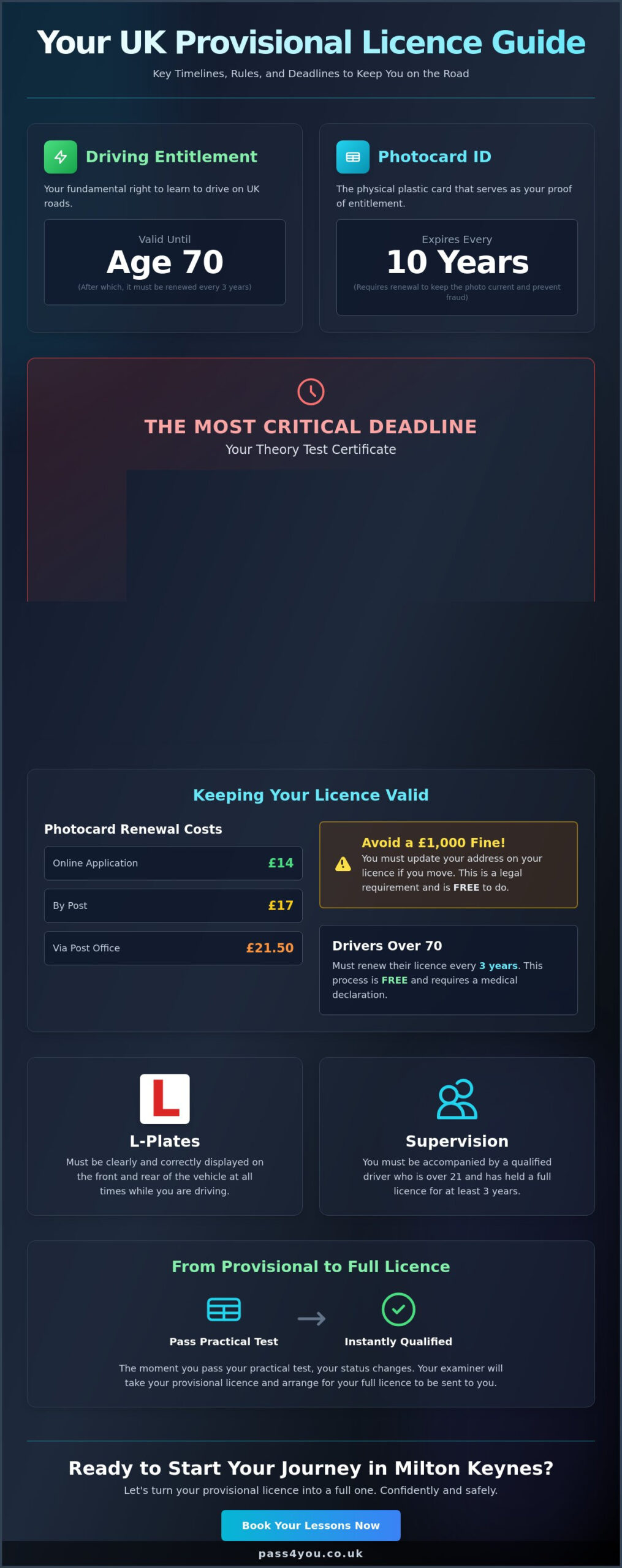
    Starting your driving journey is an exciting step toward independence, but it’s natural to feel a bit overwhelmed by the paperwork. One of the most frequent questions our students ask is how long does a provisional licence last. To put your mind at ease, your actual entitlement to learn to drive generally lasts until you reach the age of 70. This means you don’t need to worry about your progress “resetting” if you need to take a break from lessons for a few months or even a year. Your right to learn is a long-term commitment from the DVLA to you.

    However, there is a big difference between your permission to drive and the physical card in your wallet. While your entitlement is long-term, the plastic photocard itself has a shelf life. You can check this easily by looking at the front of your card. Section 4b shows the “Valid To” date, which is the day your current photocard expires. Staying aware of this date ensures you remain fully legal while practicing on the road. The Driving licence in the United Kingdom follows a strict security format to keep everyone safe, and your provisional is no exception. Understanding these dates helps you stay in control of your journey.

    The 10-Year Photocard Renewal

    The DVLA requires you to update your photocard every ten years. This isn’t because they want to test your driving again; it’s simply to ensure the photo remains a true likeness of you to prevent fraud. If you’re wondering how long does a provisional licence last in terms of the card itself, ten years is your limit. Renewing is a straightforward process. Doing it online costs £14, while applying by post is £17, or £21.50 if you use the Post Office service. We always encourage our learners to keep their documents current. Driving with an expired photocard is a serious matter, even if you’re under the supervision of a professional instructor or a family member. It can lead to fines and complications with your insurance, so it’s best to stay ahead of the deadline.

    Validity for Drivers Over 70

    The rules change slightly once you reach the age of 70. At this milestone, you must renew your licence every three years to keep your provisional status active. This renewal is completely free of charge. The process involves making a medical declaration to confirm you’re still fit to be behind the wheel. If you have specific health conditions, the DVLA might ask for more details to ensure you can drive safely. This system is designed to build confidence and ensure everyone on the road is supported. Whether you’re 17 or 70, we’re here to help you navigate these requirements so you can focus on the joy of learning to drive in a safe and supportive environment.

    The 2-Year Deadline: How Long Does a Theory Test Pass Last?

    While we’ve established that your entitlement to learn is long-term, the “working parts” of your journey have much tighter deadlines. A common source of confusion for learners is the difference between the photocard and the theory certificate. When people ask how long does a provisional licence last, they often don’t realise that their theory test pass is actually the most time-sensitive document they own. Your theory test pass certificate is valid for exactly two years from the date you passed the exam. If you don’t pass your practical driving test within those 24 months, your theory pass expires, and you’ll have to take the test again.

    The DVLA enforces this strict two-year limit to ensure that your knowledge of road signs and hazard perception remains fresh and current. Road safety laws and signage can change, so this rule guarantees that every new driver on the road has up-to-date knowledge. If your theory pass expires even a single day before your scheduled practical test, the DVSA system will automatically cancel your booking. This is why staying organised is so important for your peace of mind. If you need to check your details or renew your driving licence photocard during this time, make sure you keep your theory certificate safe as well.

    The Theory Test Expiry Countdown

    You can find the expiry date clearly printed on your theory test pass certificate. It’s a good idea to set a reminder on your phone or mark it on a calendar. We’ve seen many students feel a sense of “starting over” if they let this date slip, which can be quite discouraging. Retaking the test costs £23 and, with a national first-time pass rate of only 45%, it’s a hurdle most people prefer to clear just once. If you find yourself approaching the deadline, don’t panic. Taking a few extra driving lessons can help sharpen your skills so you’re ready to pass before the clock runs out.

    Booking Your Practical Test in Time

    Success often comes down to strategic planning. When you use the Milton Keynes Theory Test Centre, you should immediately start thinking about your practical test date. At Pass4you, we work closely with our students to align their lesson progress with their theory expiry date. This proactive approach helps you avoid the “two-year trap” where learners feel rushed or anxious as their certificate nears its end. If you are struggling to find a slot, knowing how to book a driving test efficiently is essential. Our instructors are experts at helping you build the confidence needed to meet your goals within your personal timeline, ensuring you feel supported every step of the way.
    How Long Does a Provisional Licence Last? The 2026 UK Learner’s Guide

    Renewing, Replacing, and Updating Your Provisional Licence

    Maintaining your driving documents doesn’t have to be a stressful task. Once you understand how long does a provisional licence last, the next step is knowing how to keep that information accurate. Life happens; you might move house, change your name, or even misplace your wallet. Keeping your licence current is a legal responsibility, but it’s also a simple way to ensure your journey toward a full licence remains smooth and uninterrupted. We’re here to guide you through these administrative steps with the same patience we bring to our driving lessons.

    The Online Renewal Process

    When your ten-year photocard expiry approaches, the quickest way to renew is through the DVLA’s online service. You’ll need your Government Gateway ID or a valid UK passport to verify your identity. Renewing your provisional licence online currently costs £14, which is significantly cheaper than the £21.50 fee charged at the Post Office. After you complete the application, your new licence usually arrives at your Milton Keynes address within a week. If you happen to lose your licence or it gets stolen, you can apply for a replacement online for a £20 fee. It’s a small price for the peace of mind that comes with having your documents in order.

    Keeping Your Details Current

    It’s a legal requirement to keep your address updated on your driving record. If you move to a new home, you must notify the DVLA immediately. Failing to do so can result in a fine of up to £1,000. Thankfully, you can update your address for free online, and a new licence will be sent to you. Keeping this information current is vital because your address on your licence must match your insurance records. Following the rules for learning to drive ensures you stay protected on the road. If your details are incorrect, your provisional licence uk insurance might be considered invalid in the event of a claim.

    You can also update other personal details, such as your name or gender, on your provisional record. These changes usually require you to send your physical licence back to the DVLA along with supporting documentation, such as a marriage certificate or a deed poll. There’s typically no fee for changing your name or gender unless you also want to update your photo at the same time. Taking these small steps to stay organised builds the discipline and responsibility you’ll need as a safe, independent driver. If you ever feel unsure about these requirements, your instructor is always happy to offer a reassuring word of advice during your lessons.

    While you now know how long does a provisional licence last, it’s equally important to understand the rules that keep you safe while you’re using it. Your licence is a permit to learn, and that comes with specific legal responsibilities. You must display ‘L’ plates (or ‘D’ plates in Wales) clearly on the front and rear of your vehicle whenever you’re driving. These plates aren’t just a requirement; they’re a signal to other drivers to be patient and giving as you build your skills. If you’re wondering how long does a provisional licence last in terms of its daily use, remember that the rules apply from the moment you start the engine until you pass your test.

    Supervision Standards

    The law is very specific about who can sit in the passenger seat. Your supervisor must be at least 21 years old and have held a full driving licence for at least three years. They must also sit in the front passenger seat to provide immediate support. While it’s tempting to learn with friends, a professional driving instructor in Milton Keynes provides a level of safety and structured feedback that informal practice often lacks. Remember, your supervisor must be legally fit to drive. This means they cannot be under the influence of alcohol or using a handheld mobile phone while they’re supervising you. In 2026, the government is even considering a “zero tolerance” drink-driving limit of 20mg for supervisors to ensure learner safety.

    Mastering Complex Roads

    As you progress, you’ll need to master the dual carriageway and other high-speed roads around Milton Keynes. In 2026, learners are permitted to drive on motorways in England, Scotland, and Wales, but only if they’re with an approved driving instructor in a car fitted with dual controls. This rule is designed to protect you while you gain experience in faster traffic. Practicing with family is a great way to get extra miles in, but professional tuition ensures you don’t pick up “bad habits” or outdated techniques that could lead to a test failure.

    Be aware that any penalty points you earn on your provisional licence will carry over to your full licence once you pass. Under the New Drivers Act, your licence will be revoked if you get six or more points within two years of passing your test. This would mean starting the entire process again, from your provisional application to both tests. Staying safe is about more than just passing; it’s about protecting your future freedom. Ready to start your journey with a mentor who prioritises your safety? You can book your first driving lessons with our expert team today.

    From Provisional to Full: Ending the Learner Journey in Milton Keynes

    The moment you pass your test, the question of how long does a provisional licence last becomes a memory of the past. Your green photocard has served its purpose, and it’s time for the “Pink Licence” transition. During the practical test, your examiner will ask if you’d like them to send your provisional licence away to be upgraded automatically. Most students say yes because it’s the easiest way to receive your full driving licence in the post. You’ll usually receive your new photocard within three weeks, but you don’t have to wait for it to arrive to start driving. Your examiner will give you a pass certificate, known as form DVSA 10, which acts as your temporary proof of entitlement.

    The Day of the Practical Test

    Walking into the test centre can feel nerve-wracking, but we prepare you for every detail of the process. You’ll need to hand over your provisional photocard to the examiner at the start of your practical driving test. If you pass, they will keep the green card and issue your pass certificate. This document is vital because it proves you’re a qualified driver while the DVLA processes your full licence. At Pass4you, we focus on building your confidence on the specific test routes around Milton Keynes. This local expertise ensures you feel familiar with the junctions and roundabouts you’ll face on the big day, helping you feel like you’re in safe, professional hands.

    Why Efficiency Matters

    Time management is the secret to a stress-free learning experience. As we’ve discussed throughout this guide, your theory pass only lasts for two years. If you face multiple test failures or long gaps between lessons, you risk that certificate expiring. This “theory expiry stress” is something we work hard to prevent. Our “Pass4you Method” focuses on calm, high-precision instruction that has helped us achieve an 83.33% first-time pass rate. By learning efficiently, you save yourself the time and cost of retaking tests. We believe that professional driving lessons in Milton Keynes are the best investment for your long-term freedom. Ready to swap your green licence for a pink one? Book your first lesson in Milton Keynes today!

    Take the Wheel with Confidence in Milton Keynes

    Navigating the rules of the road starts long before you turn the ignition. By understanding exactly how long does a provisional licence last, you’ve already taken a vital step toward protecting your progress and your future independence. Remember that while your entitlement is long-term, staying on top of your ten-year photocard renewal and that crucial two-year theory deadline is essential to keep your journey moving forward without any stressful resets. Staying organised means you can focus entirely on your driving skills rather than worrying about expiring paperwork.

    We’re here to make sure every mile you drive brings you closer to that pink licence. Our calm and patient instructors in Milton Keynes provide a supportive environment where you can learn at your own pace. You’ll practice in modern Volkswagen tuition vehicles, building the precise skills needed to succeed. With our proven approach, we’re proud to maintain an 83.33% first-time pass rate, ensuring you feel ready and capable on test day. Don’t let your theory certificate tick away. Your path to the open road is waiting, and we’d be honoured to guide you there. Join the 83% of students who pass first time in Milton Keynes; Book Now and start your journey with a team that truly cares about your safety. You’ve got this, and we’re with you every step of the way.

    Frequently Asked Questions

    How long is a provisional licence valid for in the UK?

    Your provisional driving entitlement is valid until you turn 70 years old. However, the plastic photocard itself must be renewed every 10 years to ensure your photo remains a true likeness. It’s important to understand this distinction when asking how long does a provisional licence last, as your right to learn doesn’t expire quickly, but your physical ID card does require regular updates.

    Do I need to renew my provisional licence if I haven’t passed my test after 10 years?

    Yes, you must renew the photocard even if you haven’t passed your driving test yet. The DVLA requires a fresh photo to prevent identity fraud and ensure your records are accurate. You don’t need to retake any tests or start your lessons over; you simply apply for a new card to keep your documents legal while you continue your journey toward a full licence.

    What happens if my theory test pass expires?

    If your theory test pass certificate reaches its two-year expiry date before you pass your practical test, you must retake and pass the theory exam again. The DVSA cannot extend this deadline under any circumstances. We recommend booking your practical test well in advance to ensure you don’t lose the progress you’ve worked so hard to achieve during your time as a learner.

    Can I still drive if I’ve lost my provisional licence photocard?

    You should not drive until you have applied for a replacement licence and have it in your possession. While your legal entitlement to drive still exists, you are required to produce your licence if asked by the police. You can order a replacement online for a £20 fee. It’s best to wait for the new card to arrive before heading out for your next lesson.

    Does a provisional licence expire at age 70?

    Your licence doesn’t automatically vanish at 70, but the renewal rules change to ensure continued safety. Once you reach this age, you must renew your licence every three years to remain a legal learner. This process is free and requires you to declare that you meet the necessary medical standards. This helps you continue learning safely with the support of your instructor.

    How much does it cost to renew an expired provisional photocard?

    Renewing an expired provisional photocard online costs £14 in 2026. If you prefer to use a paper application by post, the fee is £17, while the Post Office service costs £21.50. Keeping your licence current is a small investment that protects you from much larger fines. We always encourage our students to use the online service for the fastest and most cost-effective results.

    Can I change the address on my provisional licence for free?

    Yes, updating your address on your provisional licence is completely free when you do it through the official GOV.UK website. It is a legal requirement to keep this information current at all times. Failing to update your address could lead to a fine of up to £1,000, so it’s a simple task that’s well worth doing the moment you move to a new home.

    How long does it take for a new provisional licence to arrive?

    Most learners receive their new provisional licence within one week when applying online. Postal applications can take longer, often up to three weeks, depending on DVLA processing times. If you’ve just passed your test, your new full pink licence should arrive within three weeks. Having your documents arrive quickly helps you stay focused on your training and your goals with your mentor.

  • SORN My Car: The Complete Guide to Statutory Off Road Notifications in 2026

    SORN My Car: The Complete Guide to Statutory Off Road Notifications in 2026

    Last Tuesday, a driver in Milton Keynes realized their project car had been sitting on the driveway for 14 days without tax, and the fear of a £1,000 DVLA fine was becoming overwhelming. If you’ve been searching for the best way to sorn my car legally and quickly, you’re in the right place to find a calm, simple solution.

    We know that vehicle paperwork can feel confusing, and it’s frustrating to watch money drain away on tax and insurance for a car you aren’t even using. You deserve to feel confident that your vehicle is stored safely and legally without any hidden surprises. Our guide takes the pressure off by showing you exactly how to complete the process online, stop your tax payments, and trigger an automatic refund from the DVLA.

    We’ll walk you through the latest 2026 regulations for off-road storage, explain exactly where you can legally park, and show you how to get your car back on the road when you’re ready to drive again.

    Key Takeaways

    • Master the legal definition of a SORN and learn how this simple declaration can save you money on road tax while your vehicle is off the road.
    • Identify the “Learner Gap” and other common scenarios where declaring a SORN is the most responsible and calm choice for your car and your budget.
    • Navigate the DVLA process with confidence by using our quick guide on how to sorn my car using your V5C or V11 documents.
    • Avoid costly fines by understanding the specific rules for storing a SORN vehicle on private land, including specific advice for Milton Keynes residents.
    • Get back behind the wheel safely with our clear instructions on how to cancel your SORN and ensure your insurance is ready for the road.

    What Does SORN My Car Mean? Understanding the Statutory Off Road Notification

    SORN stands for Statutory Off Road Notification. It’s a formal declaration you make to the Driver and Vehicle Licensing Agency (DVLA). When you decide to sorn my car, you’re telling the government that your vehicle is staying on private land and won’t be driven or parked on public highways. This isn’t just a casual choice; it’s a legal requirement if you want to stop paying for tax and insurance without facing penalties. We want you to feel confident and safe when managing your vehicle, and understanding this process is the first step toward responsible ownership.

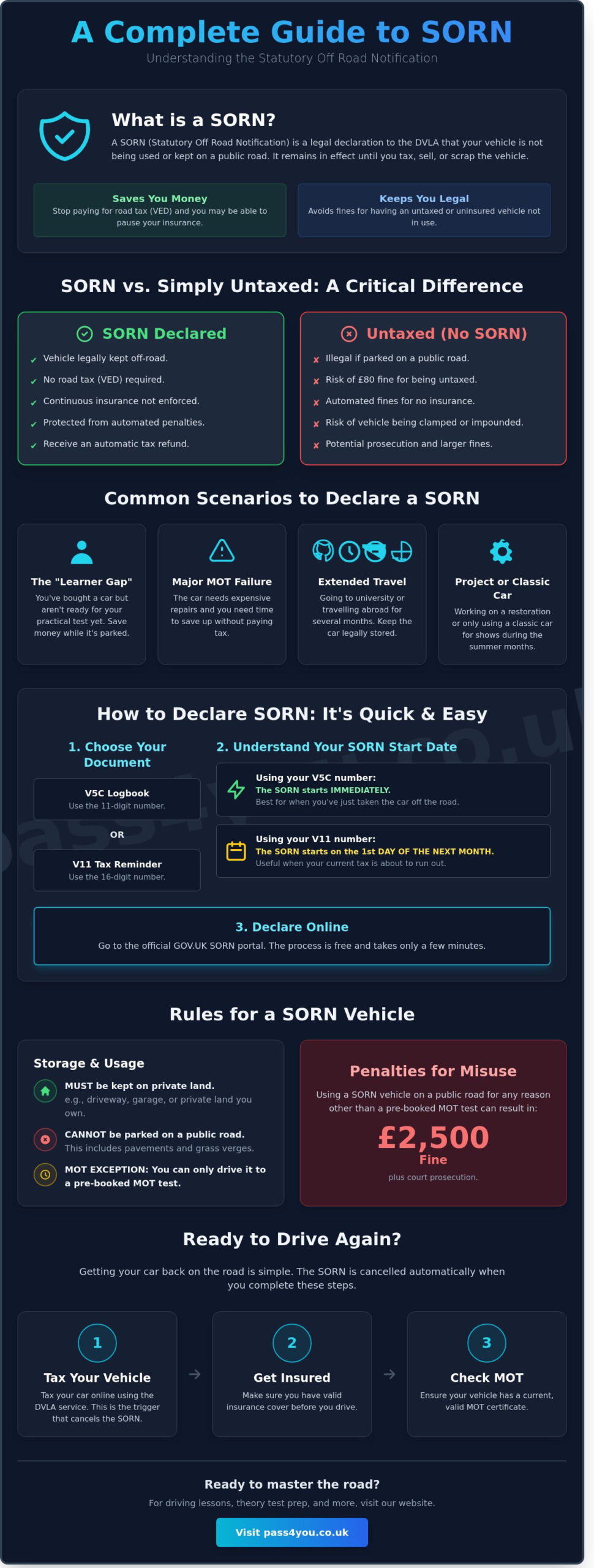
    Once your SORN is processed, you’re exempt from Vehicle Excise Duty (VED), which most of us know as car tax. You’re also exempt from Continuous Insurance Enforcement (CIE) rules. This is incredibly helpful for learners who might have bought a car but aren’t ready to drive it yet, or for drivers who are taking a break from the road. In 2026, a SORN stays in place indefinitely. You don’t need to worry about annual renewals; the status only ends if you sell the vehicle, scrap it, or decide to tax it again. SORN is the legal bridge between car ownership and non-use.

    The Difference Between SORN and ‘Untaxed’

    It’s vital to understand that “untaxed” and “SORN” are two very different things. An untaxed car found on a public road is a legal offence that can lead to an £80 fine or even vehicle impoundment. A SORN car is a protected legal status that keeps you on the right side of the law. You can’t simply stop your insurance or tax payments and hope for the best. The Motor Insurance Database (MID) shares data with the DVLA to spot vehicles that aren’t insured. If you haven’t declared a SORN, you’ll likely receive an automated Fixed Penalty Notice through the post. Taking two minutes to sorn my car online prevents these unnecessary costs and keeps your record clean.

    When Does a SORN Status Begin?

    The start date of your SORN depends on the document you use during the application. If you use the 11-digit reference number from your V5C logbook, the SORN begins immediately. This is the best option if you’ve just taken the car off the road. If you use the 16-digit reference number from your V11 tax renewal reminder, the status starts on the first day of the next month. If your tax has already expired, you should apply for the SORN right away. Our team always suggests being proactive with your paperwork. It’s a simple way to stay calm and organized while you’re not using your vehicle.

    • V5C Number: Starts the SORN immediately.
    • V11 Number: Starts the SORN on the first day of the next calendar month.
    • Duration: Valid until the vehicle is re-taxed or ownership changes.

    When Should You Declare Your Vehicle SORN? Common Scenarios for Learners

    Deciding when to sorn my car often comes down to timing and budget. For many learners, the most common scenario is the ‘Learner Gap’. This happens when you find a brilliant deal on a vehicle before you are actually ready for your practical driving test. If the car is sitting on a private driveway or in a garage, paying for road tax and full insurance is an unnecessary expense. Declaring SORN allows you to keep the car safely tucked away until you have that pink licence in hand.

    Unexpected MOT failures are another major reason to take a vehicle off the road. If a mechanic hands you a repair bill for £900 on a car worth £1,500, you might need a few months to save up. Instead of rushing into a stressful financial decision, you can use the official DVLA SORN portal to pause your tax obligations. This gives you the breathing room to fix the car properly and ensure it is safe for the road later on.

    Life changes often lead to extended breaks from driving. You might be heading off to university in a city where parking is impossible, or perhaps you are planning to travel for six months. Similarly, if you inherit a vehicle but don’t have your licence yet, SORN is the most responsible way to manage the asset. It keeps you compliant with the law while the car stays stationary on private land.

    Saving Money While You Learn to Drive

    The costs of getting on the road add up quickly. If you choose to sorn my car for six months while you study, the savings are significant. For a typical small hatchback, you could save over £90 in tax and potentially hundreds in insurance premiums. We always suggest that students invest these savings into high-quality driving lessons in Milton Keynes. Professional tuition is the fastest way to build confidence and secure a first time pass.

    Avoiding the temptation of ‘fronting’ is also vital. This is the illegal practice of naming an experienced driver as the main policyholder to lower costs. It is much safer and more honest to SORN the vehicle until you can afford your own policy. If you feel unsure about the process, booking a lesson with a patient instructor can help you understand all the responsibilities of car ownership.

    Restoring a Classic or Project Car

    If you are a car enthusiast working on a restoration project, the vehicle might be in pieces for years. Even if the car has no engine or wheels, the DVLA requires a SORN if it isn’t taxed and insured. You must keep your V5C logbook updated with your current address during this time. Statutory Off Road Notifications apply to all vehicle types, including motorbikes, vans, and even three-wheeled vehicles.

    SORN My Car: The Complete Guide to Statutory Off Road Notifications in 2026

    How to SORN a Vehicle: A Step-by-Step Guide to the DVLA Process

    Taking your car off the road shouldn’t feel like a stressful hurdle. It’s a simple administrative task designed to save you money when you aren’t using your vehicle. To sorn my car effectively, you first need to gather the right paperwork. You’ll require either the 11-digit reference number from your V5C log book or the 16-digit number found on your V11 tax reminder letter. If you use the V11 number, the SORN will officially start on the first day of the following month. Using the V5C allows the declaration to take effect immediately.

    While the process is straightforward, it’s vital to stay organized. For a deeper look at the practicalities of vehicle storage, this guide to SORN from AXA offers excellent insights into insurance implications. Once you have your documents ready, the fastest route is the official GOV.UK portal, which is available 24 hours a day.

    Applying Online: The 2026 Digital Process

    The GOV.UK digital service remains the most efficient way to notify the DVLA. In 2026, the interface is even more accessible for learners and experienced drivers alike. You simply enter your registration number followed by your document reference. If you’ve recently moved, you must update your address with the DVLA before you start. Using an outdated address can lead to complications with your confirmation. If you’ve misplaced your provisional licence UK or your V5C, you’ll need to order a replacement to get your reference numbers. The online system provides an instant email receipt, which acts as your initial proof of status.

    Applying Without a Log Book (V5C)

    New owners often find themselves in a position where they haven’t received their V5C yet. You can’t sorn my car online without that specific 11-digit code. In this case, you’ll need to apply by post using form V890. If the vehicle isn’t yet registered in your name, you should also include form V62 to apply for a new log book. As of March 2026, the fee for a replacement V5C is £25. This postal process can take up to four weeks to process, so don’t leave it until the last minute if your tax is about to expire.

    If you prefer a different method, you can use the DVLA’s automated phone service at 0300 123 4321. Regardless of the method you choose, look out for a formal confirmation letter or email. If you haven’t received anything within 28 days, it’s a good idea to contact the DVLA to double-check. Having this confirmation gives you peace of mind that you’re following the law and keeping your driving record clean.

    Rules for SORN Vehicles: Storage, Insurance, and the MOT Exception

    Once you decide to sorn my car, you must follow strict storage rules to avoid heavy fines. The law is clear: the vehicle cannot touch any part of the public highway. This includes the road outside your house, public car parks, and even grass verges maintained by the local council. Keeping your car on the road without tax or insurance is a risk that can lead to your vehicle being clamped or even crushed.

    Where is it Legal to Park?

    You can legally store your vehicle on a private driveway, inside a private garage, or on a piece of land that you own. For residents in Milton Keynes, this requires extra care. Many housing estates feature “adopted” roads and verges that belong to the council. If any part of your car hangs over onto a public pavement or sits on a council-owned verge, you risk a fine of up to £2,500. Rented plots or private gated areas are safe options, but residential permit zones are still considered public highway. Always ensure the entire vehicle is within the boundaries of your private property.

    Driving to an MOT Appointment

    There is only one legal way to drive a vehicle after you sorn my car, and that’s to a pre-booked MOT appointment. You can’t just decide to take it for a spin to “clear the pipes.” The appointment must be confirmed by the garage in advance. If the police stop you, they will use ANPR technology to check your status and then verify with the test centre immediately. You must take the most direct route possible. Stopping at a shop or a friend’s house on the way will result in a penalty.

    Safety is our priority at Pass4you, and we always remind our students that a SORN vehicle must still be roadworthy for this trip. Check your tyres, lights, and brakes before setting off. Even if the car doesn’t have a valid MOT yet, it shouldn’t be a danger to others. If you’re caught driving an unroadworthy vehicle, the SORN exception won’t protect you from points on your licence.

    Insurance and Protection

    While you don’t legally need insurance for a SORN car under Continuous Insurance Enforcement (CIE) rules, keeping “laid-up” cover is a wise choice. This specific type of policy protects you against fire, theft, or accidental damage while the car is stationary. If a tree falls on your garage during a storm, a standard SORN declaration won’t help you recover the costs. Most specialist providers offer these policies at a lower rate since the car isn’t being driven.

    Staying legal and safe on the road starts with the right guidance and a patient approach. If you’re ready to get back behind the wheel with a team that values your confidence, book your driving lessons in Milton Keynes today.

    Getting Back on the Road: How to Cancel SORN and Start Driving

    Ending a SORN is much easier than the initial declaration. You don’t need to fill out a cancellation form or call the DVLA to “undo” the status. The process is as simple as taxing your vehicle again. As soon as you pay your vehicle excise duty online or at a Post Office, the SORN is automatically cancelled. However, before you hit the “pay” button, you must ensure your car is legally ready for the road.

    Safety is the priority here. You must have active insurance in place before you attempt to tax the car. The DVLA database checks for valid insurance and a current MOT certificate instantly. If your MOT expired while the car was off the road, you can only drive it to a pre-booked MOT appointment. Driving for any other reason without a valid certificate is illegal and unsafe. Once the paperwork is sorted, perform these vital physical checks:

    • Battery Health: If the car sat for over three months, the battery might be flat. You may need a trickle charger or a jump start.
    • Tyre Pressure: Tyres lose air over time and can develop flat spots. Check the pressures against the manufacturer’s guide before your first trip.
    • Fluid Levels: Check your oil, coolant, and brake fluid. Look under the car for any fresh leaks that might have developed during storage.

    When you decide it’s time to stop saying “I’ll sorn my car” and get back behind the wheel, taking these steps ensures you’re doing it the right way.

    Preparing for Your First Lesson Back

    If your car has been off the road for a long time, your driving skills might feel a bit rusty. It’s completely natural to feel a little anxious about returning to busy traffic. Booking a refresher lesson with driving instructors near me is a brilliant way to regain your confidence in a calm environment. Our team at Pass4you specialises in helping nervous learners and returning drivers feel safe again.

    Simon’s tip: don’t jump straight back into a dual carriageway after your car has been SORNed. Start with quiet residential streets to get used to the clutch and brake biting points again. We’ve helped hundreds of drivers in Milton Keynes transition back to daily driving with patience and professional guidance.

    Selling a SORN Vehicle

    If you choose to sell your vehicle while it’s off the road, remember that SORN status does not transfer to the new owner. The buyer must either tax the car or declare a new SORN immediately upon purchase. You must notify the DVLA of the sale using the V5C logbook or the online portal to end your liability for the vehicle.

    Once the sale is processed, the DVLA will automatically send you a refund for any full months of remaining tax. This usually arrives as a cheque within six weeks. It’s a clean way to close the chapter on your vehicle while staying fully compliant with UK regulations. If you’re selling because you’re moving to a new car, we can help you get comfortable with your new controls so you stay a safe driver for life.

    Get Back on the Road with Confidence

    Managing a vehicle off the road shouldn’t be a source of stress. Whether you’re a learner waiting for the perfect moment to start or a car owner taking a temporary break, knowing when to sorn my car keeps you compliant with DVLA rules and avoids automatic fines. Just remember that once you’re ready to drive again, you must have your tax, insurance, and MOT in order before hitting the pavement. A SORN stays in place until you tax the vehicle, so there’s no need to renew it every year.

    If your car has been tucked away while you prepare for your test, now’s the time to turn that ambition into a reality. At Pass4you, we specialise in helping nervous learners find their feet. Simon offers calm and patient instruction, ensuring you feel safe and supported every step of the way. You’ll learn in modern Volkswagen tuition vehicles designed for comfort and ease of use. Our proven methods have helped us achieve an 83.33% first-time pass rate, giving you the best possible chance of success on your big day.

    Ready to get back on the road? Book your driving lessons in Milton Keynes with Pass4you today!

    We’re here to help you move from the driveway to the motorway as a safe and confident driver for life.

    Frequently Asked Questions

    Does a SORN expire or need to be renewed every year?

    Your SORN doesn’t expire and you don’t need to renew it every year. Once you’ve notified the DVLA, the status remains in place until you tax the vehicle again, sell it, or scrap it. This change was introduced in 2013 to make life much easier for vehicle owners. You can feel confident that your car is legally off the road without worrying about annual paperwork.

    Can I drive my SORN car to a garage for repairs?

    You can’t drive a SORN vehicle to a garage for general repairs. The only legal exception is driving to a pre-booked MOT appointment. If your car needs work to pass that MOT, you must use a trailer or recovery truck to move it. Driving on public roads for any other reason could lead to a court prosecution and a fine of up to £2,500.

    Do I get a refund on my car tax when I declare SORN?

    You’ll receive a refund for any full months of remaining car tax after you sorn my car. The DVLA processes this automatically once they receive your notification. They’ll send a cheque to the name and address on the V5C log book within 6 weeks. It’s a simple way to save money if you know you won’t be using your vehicle for a while.

    Can I keep a SORN car on a driveway if it’s visible from the road?

    You can keep your car on a private driveway even if passers-by can see it from the street. The law requires the vehicle to be off the public highway at all times. This includes private garages, driveways, or land you own. As long as no part of the car touches a public road or pavement, you’re following the rules and staying safe from penalties.

    What is the fine for driving a SORN vehicle on a public road?

    Driving a SORN vehicle on a public road can result in a fine of up to £2,500. You might also face an out-of-court settlement fine of £30 plus one and a half times the outstanding tax. Staying informed about these regulations helps you avoid unnecessary stress and keeps your driving record clean. It’s always best to stay on the right side of the law to remain a safe driver.

    Do I still need to insure my car if it is SORN?

    You don’t legally have to insure a vehicle that has a valid SORN under Continuous Insurance Enforcement rules. However, many owners choose to keep “laid-up” cover to protect against fire or theft while it’s stored. Without insurance, you’d have to pay the full cost of repairs or replacement if something happened. Keeping a basic policy provides peace of mind while your car is tucked away.

    Can I SORN my car if I don’t have the V5C log book?

    You can’t complete the process online without the 11-digit reference number from your V5C log book or the 16-digit number from a V11 reminder. If you’ve lost these, you’ll need to apply for a replacement V5C for £25. Being prepared with the right documents makes the process much smoother and less stressful. You can then sorn my car via the post using form V890.

    How long does it take for a SORN to show up on the DVLA system?

    An online notification shows up on the DVLA system almost instantly. If you choose to notify them by post using a V890 form, it can take up to 4 weeks to process and update. Checking the status on the GOV.UK website after 24 hours is a great way to confirm everything is correct. This quick confirmation helps you feel calm and sure that your records are up to date.

  • SORN a Vehicle: The Complete Guide to Statutory Off Road Notifications in 2026

    SORN a Vehicle: The Complete Guide to Statutory Off Road Notifications in 2026

    Last month, a driver in Milton Keynes discovered they’d paid over £180 in car tax for a Vauxhall Corsa that hadn’t left their driveway since October. It’s a stressful situation that many of us face when a car is no longer in use, and the fear of a £1,000 DVLA fine for an untaxed vehicle only adds to the pressure. You likely want to do the right thing and stop wasting money, but the confusion over what counts as a public road can make you feel stuck. It’s completely normal to feel a bit anxious about getting the paperwork wrong.

    We’re here to help you feel confident and in control of your vehicle’s status. In this guide, you’ll learn the simplest way to sorn a vehicle legally so you can stop those monthly payments immediately. We’ll show you how to navigate the online declaration process and ensure your car is stored safely on private land. We’re covering everything from 2026 tax refund rules to the exact steps you need to take to keep your bank balance healthy and your record clean.

    Key Takeaways

    • Understand exactly what a Statutory Off Road Notification is and why it is a vital legal step to protect yourself from costly DVLA fines.
    • Learn the specific situations where you should declare a car off the road, such as when buying your first vehicle before passing your driving test in Milton Keynes.
    • Discover the strict rules regarding where you can legally store your car to ensure you remain compliant with UK road regulations and avoid vehicle seizure.
    • Follow our simple, stress-free guide on how to sorn a vehicle using your V5C or V11 documents for immediate peace of mind and potential tax refunds.
    • Find out the essential “three pillars” you must have in place before you can safely and legally end your notification and get back behind the wheel.

    What is SORN? Understanding Statutory Off Road Notifications

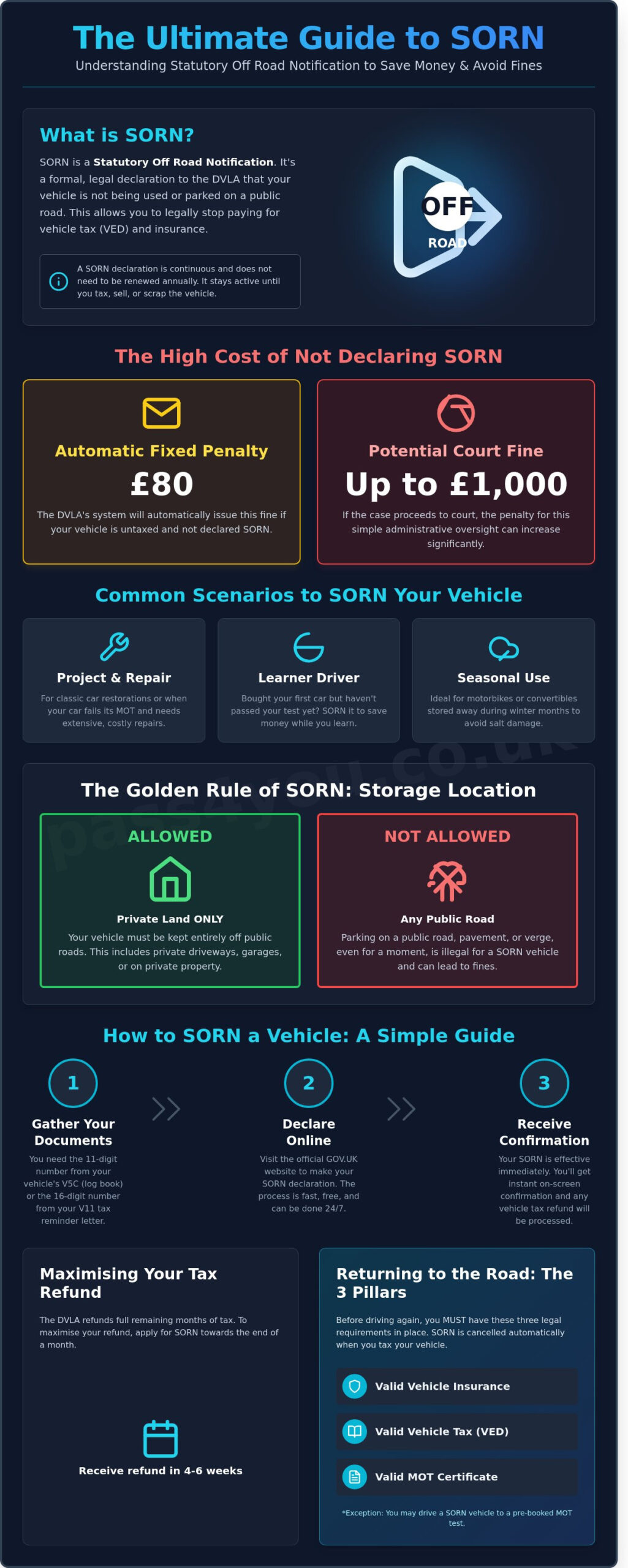
    If you’ve decided to take your car off the road, perhaps to save money while you’re at university or because a project car needs major repairs, you must inform the DVLA. This process is called making a Statutory Off-Road Notification (SORN). It’s a formal legal declaration that your vehicle isn’t being used or parked on public highways. While many drivers still refer to ‘Road Tax’, the official term is Vehicle Excise Duty (VED), and SORN is your way of pausing that financial commitment legally.

    Since 16 December 2013, the rules have become much simpler for owners. You no longer need to renew your declaration every year. By 2026, this continuous declaration system remains the standard, meaning once you sorn a vehicle, it stays in that state until you tax it, sell it, or scrap it. It’s a reassuring system that removes the worry of missing a renewal deadline while your car sits safely in a garage or on a private driveway.

    The Legal Framework: Why the DVLA Requires SORN

    The DVLA uses a system called Continuous Insurance Enforcement (CIE). This regulation requires every registered vehicle to be either taxed and insured, or declared SORN. SORN is the only legal way to stop paying VED without selling the vehicle. If you ignore this requirement, the DVLA’s computer systems will automatically flag the discrepancy. Failing to sorn a vehicle properly leads to an automatic £80 fixed penalty. If the case goes to court, you could face a fine of up to £1,000, which is a heavy price for a simple administrative oversight.

    SORN vs. Cancelled Insurance: Key Differences

    A common and expensive mistake is thinking that cancelling your insurance policy automatically tells the DVLA your car is off the road. It doesn’t. If you cancel your insurance without a SORN in place, you’re breaking CIE rules. When you declare SORN, your V5C log book status is updated, but you remain the registered keeper.

    You’ll also find that your MOT requirements change. While a car is SORNed, you don’t need a valid MOT certificate. However, you must ensure the vehicle is roadworthy and has a fresh MOT before you ever think about driving it on a public road again. Keeping these records straight ensures you stay on the right side of the law and maintain your confidence as a responsible owner.

    When Should You SORN a Vehicle? Common Scenarios for Drivers

    Deciding to sorn a vehicle is often a savvy financial move rather than a sign of a permanent mechanical failure. It’s a practical tool for drivers who want to pause their spending when a vehicle isn’t in active use. Common situations include keeping a classic car tucked away for a six-month restoration project or storing a motorbike during the icy months between October and March. If a car fails its MOT and requires repairs exceeding £550, declaring it off-road prevents you from paying for tax while the vehicle sits on your driveway awaiting parts.

    You must ensure the vehicle is kept entirely on private land, such as a garage or a private drive. When you need to make a SORN is the moment the car is no longer used on public highways. This simple step stops the automated DVLA systems from flagging you for being untaxed or uninsured, which can lead to fixed penalty notices of £80 or more.

    The Learner Driver Scenario: Protecting Your First Car

    Many students at Pass4you Driving School choose to buy their first car months before they’ve even booked their practical test in Milton Keynes. It’s a brilliant way to stay motivated. However, if you aren’t ready to drive it yet, keeping it taxed is an unnecessary drain on your savings. By using a SORN, you can keep your car safely on the drive while you focus on achieving our 83.33% first-time pass rate. This allows you to build up your confidence with Simon without worrying about monthly tax outgoings.

    Economic Benefits: Managing Your Vehicle Tax Refund

    The DVLA calculates refunds based on full months of remaining tax. If you apply for a SORN on the 3rd of the month, you won’t get a refund for those remaining days. It’s smarter to time your application towards the end of the month to maximise your return. Most drivers receive their refund cheque or bank transfer within 4 to 6 weeks.

    • Students: If you’re heading to university for a three-year degree and leaving your car at home, a SORN is essential.
    • Seasonal Drivers: Owners of soft-top convertibles often declare a SORN from November to April to avoid winter salt damage.
    • Project Cars: Long-term restorations that might take 12 months or more should always be declared off-road.

    It’s a straightforward process that puts you back in control of your motoring budget. Once you’re ready to get back behind the wheel, you can simply tax the vehicle again and hit the road with peace of mind.

    SORN a Vehicle: The Complete Guide to Statutory Off Road Notifications in 2026

    The Rules of the Road: Where Can a SORN Vehicle Be Kept?

    When you decide to sorn a vehicle, the law is very specific about where that car must stay. A Statutory Off Road Notification is only valid if the vehicle is kept entirely on private land. This includes your personal driveway, a private garage, or a garden. You cannot leave it on any road maintained at the public expense. Many drivers mistakenly believe a resident parking permit or a quiet cul-de-sac counts as being off-road, but if the council maintains the tarmac, your SORN is invalid. To stay on the right side of the law, you must Register your vehicle as off the road (SORN) before moving it to its designated storage spot.

    Public Roads and the DVLA Camera Network

    The DVLA uses a massive network of Automatic Number Plate Recognition (ANPR) cameras to spot untaxed cars instantly. In 2023, enforcement teams across the UK clamped or towed over 50,000 vehicles for tax and SORN violations. Driving a SORN vehicle on a public highway, even for a quick trip to the local shops, can result in a fine of up to £2,500. If your car is spotted on the street, it is likely to be clamped on the spot. You’ll then face a £100 release fee plus daily storage costs that quickly add up.

    Private Land Nuances for MK Residents

    Milton Keynes has unique layouts that can make SORN compliance a little tricky for local drivers. Our estates often feature shared parking courts or areas near redways that might feel private but are actually council-maintained land. If you live in an apartment block with shared resident parking, check your lease carefully. Unless the space is legally deeded to you and is not maintained by the local authority, it might not qualify as private land for SORN purposes. A SORN vehicle must be entirely off the public road, including any overhanging parts. This means if your bumper or tow bar sticks out over the public pavement, the vehicle is technically on the road and subject to fines. We want you to feel confident and safe, so always double-check your boundaries before you sorn a vehicle.

    • Legal: Private driveways, internal garages, and privately owned car parks.
    • Illegal: Council-owned estates, public lay-bys, and any road with a permit scheme.
    • The 100% Rule: Every inch of the car must be behind your property line.

    How to SORN a Vehicle: A Step-by-Step Practical Guide

    Taking your car off the road might feel like a big step, but the process is designed to be straightforward and stress-free. To sorn a vehicle successfully, you’ll first need to have your paperwork ready. Grab your 11-digit reference number from your V5C log book or the 16-digit number found on your V11 tax reminder letter. Having these digits to hand ensures you can complete the process in under five minutes without any fuss.

    Applying Online: The Fastest Method

    Using the official GOV.UK digital service is the most efficient way to manage your application. If you use the 11-digit V5C number, the SORN starts immediately. If you use the 16-digit V11 number, the SORN begins on the first day of the next month. If you’ve lost your V5C, you must apply for a replacement, which currently costs £25, before you can complete the declaration online. Once finished, you’ll receive a confirmation email. Save this document; it’s useful proof for your insurance provider if you’re switching to a “laid-up” policy. For those who prefer planning ahead, you can post a V890 form to the DVLA to register the status up to 60 days in advance.

    If you’re feeling unsure about any part of vehicle ownership or road safety, our calm and patient driving instructors are here to help you build lasting confidence.

    Maintaining a Vehicle While it is SORN

    Keeping your car in good condition while it’s stationary prevents expensive repairs when you’re ready to drive again. Batteries often lose charge if left for more than 14 days. Investing in a £35 to £50 trickle charger will keep the battery healthy without overcharging it. Tyre care is equally vital. To prevent flat spots, increase the tyre pressure by 10 or 15 PSI above the standard level, or move the car a few inches every few weeks. Because the UK sees an average of 156 days of rain each year, a high-quality, breathable car cover is a smart investment to protect the paintwork from damp and debris. You can check your vehicle’s status at any time using the DVLA’s vehicle enquiry service to ensure your sorn a vehicle declaration is active and your records are up to date.

    Returning to the Road: Ending Your SORN and Driving Again

    Getting your car back on the tarmac requires more than just turning the ignition key. To legally end the period where you sorn a vehicle, you must satisfy the “three pillars” of road legality: road tax, a valid MOT, and insurance. Missing just one of these can lead to a £1,000 fine or vehicle seizure. You must ensure all three are active before the wheels touch a public road.

    The easiest way to cancel your SORN is to pay your vehicle tax online via the DVLA website. Once the payment is processed, the SORN is cancelled automatically. You don’t need to send a separate letter or make a phone call. When you decide to no longer sorn a vehicle, the transition is instant. There is exactly one legal exception to driving a SORN car: you can drive it directly to a pre-booked MOT appointment. You must have insurance for this trip, and the test centre should have your registration on their schedule to prove your intent if you are stopped.

    The Checklist for Getting Back Behind the Wheel

    Before you head out, update your insurance policy. You need to tell your provider the car is no longer in “laid up” cover and is returning to active use. If your MOT expired while the car was off-road, book a slot at a local Milton Keynes test centre immediately. Mechanical health is just as vital as legal paperwork. Check your brake fluid levels and tyre pressures. Tyres often develop flat spots if left stationary for more than 90 days, which can cause dangerous vibrations at high speeds.

    Confidence on the Road with Pass4you

    If your car has been tucked away for several months, your own driving skills might feel a bit rusty. It’s perfectly normal to feel a flicker of anxiety after a long break from the driver’s seat. Simon and the team at Pass4you specialise in building that lost confidence through tailored refresher lessons. We understand that road layouts and traffic density in Milton Keynes can be daunting if you haven’t faced them lately.

    We apply the same patient, calm mentorship that earned us our 83.33% first-time pass rate to help experienced drivers get back into the swing of things. We’ll help you polish your observations and master those complex roundabouts again. Our goal is to ensure you feel like a safe driver for life every time you pull out of your driveway.

    Master Your Vehicle Admin and Get Road Ready

    Managing your car’s legal status shouldn’t be a headache. Whether you’re putting a car away for winter or waiting for repairs, you must sorn a vehicle correctly to avoid automatic fines of up to £1,000. Always ensure your car stays on private property, such as a driveway or garage, while the notification is active. When you’re ready to return to the tarmac, double check that your MOT is current and your insurance is fully updated before you start the engine.

    Understanding the rules is just as vital as mastering the wheel. If you’re looking to build your confidence behind the wheel, Book your driving lessons in Milton Keynes with Pass4you today. We’ve helped hundreds of students achieve an impressive 83.33% first-time pass rate. You’ll benefit from calm and patient instruction from Simon while learning in modern Volkswagen tuition vehicles. We don’t just teach you how to pass; we ensure you’re a safe, capable driver for the long term. We’re ready when you are.

    Frequently Asked Questions

    Can I drive my car if it is SORN to an MOT appointment?

    You can drive a SORN vehicle to a pre-booked MOT appointment. This is the only legal exception to the rule. You must have proof of your appointment ready if you are stopped by the police. It’s a sensible way to get your car back on the road safely. We always recommend checking your tyres and lights before the trip to help secure a first time pass.

    How long does a SORN last once I have declared it?

    Your SORN lasts indefinitely until you tax, sell, or scrap the vehicle. You no longer need to renew it every 12 months because the rules changed in 2013. This provides great peace of mind for owners who need a break from driving. It’s a simple, permanent solution that keeps you on the right side of the law while your car is safely tucked away.

    Do I get a refund on my car insurance if I SORN my car?

    You don’t get an automatic refund on your car insurance when you sorn a vehicle. SORN only alerts the DVLA that you aren’t using the road. To get money back, you must contact your insurer to cancel the policy. Many providers charge a cancellation fee of around £50. This might mean it’s better to keep the policy active for fire and theft protection.

    Can I SORN a vehicle if I don’t have the V5C log book?

    You can SORN your car using the 16 digit reference number on your V11 tax reminder letter. If you have lost both the V5C and the V11, you’ll need to apply for a replacement log book. This is done using a V62 form and costs £25. It’s a calm and manageable process that ensures your vehicle remains legally declared while you wait for your new paperwork.

    What happens if I sell a vehicle that is currently SORN?

    SORN status ends the moment you sell the vehicle. The notification doesn’t transfer to the new owner. They must either tax the car or make their own SORN declaration before they can keep it off-road. This ensures the DVLA records stay accurate. It’s a responsible way to handle the handover and helps the new owner start their journey as a safe, legal driver.

    Is it legal to keep a SORN car on a driveway without a cover?

    It’s completely legal to keep a SORN car on your driveway without a cover. The law only requires that the vehicle stays on private land and off public roads. While a cover can protect your car from the British weather, it isn’t a legal requirement. Just ensure no part of the vehicle, like the bumper, hangs over onto a public pavement or highway.

    How much does it cost to SORN a vehicle in 2026?

    It costs £0 to sorn a vehicle in 2026. The government has kept this service free to encourage drivers to register their cars correctly. You can complete the process in minutes online or by post without spending a penny. It’s a helpful, cost-effective way to manage your car’s status if you’re taking a break from the road to save on running costs.

    Can I SORN my car if it is parked in a rented garage?

    You can SORN your car if it’s parked in a rented garage. The main rule is that the vehicle must be off the public highway. A private rented garage qualifies as off-road storage. This is a brilliant way to keep your car safe and secure. Just make sure you don’t park it on the road outside the garage while you’re moving things around.