Tag: driving test uk

  • Are Intensive Driving Courses Worth It? A Honest Guide for 2026

    Are Intensive Driving Courses Worth It? A Honest Guide for 2026

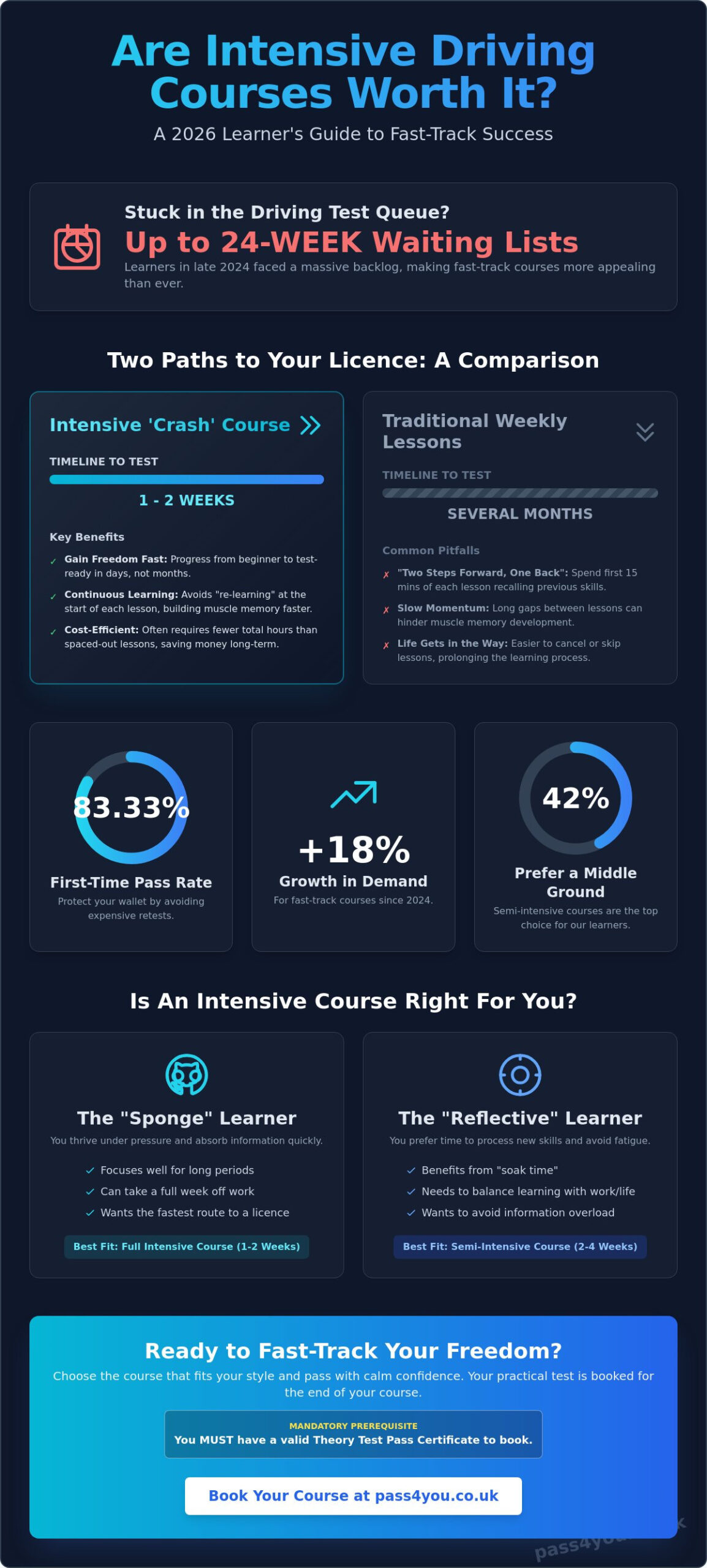
    Did you know that in late 2024, some UK learners faced driving test waiting lists of up to 24 weeks? This massive backlog has left thousands of students asking: are intensive driving courses worth it to jump the queue? It’s completely understandable to feel frustrated when you’re ready for the road but feel stuck in a loop of weekly lessons and distant test dates. You want the freedom of a license without the anxiety of a six-month wait or the fear of failing and starting the expensive process all over again.

    We believe learning should be a calm and positive experience, not a stressful race. This guide will help you discover if a “crash course” is the right investment for your goals or if a more patient approach offers better long-term value. You’ll get a clear look at realistic pass timelines for 2026 and the exact steps needed to reach the 83.33% first-time pass rate we’ve worked hard to achieve. We’ll explore how different learning styles impact your success, ensuring you feel safe and confident from your very first mile.

    Key Takeaways

    • Discover how a structured 20 to 40-hour course can help you gain your freedom in just 1–2 weeks compared to months of traditional lessons.
    • Understand the true cost efficiency of condensed learning and decide if are intensive driving courses worth it based on your personal budget and goals.
    • Learn how an 83.33% first-time pass rate protects your wallet by significantly reducing the need for expensive retests and extra tuition.
    • Use our self-assessment to identify if you are a “sponge” learner who thrives under focus or if you need more time to reflect between sessions.
    • Explore why prioritizing “safe driving for life” over a simple “crash course” builds the calm confidence you need to stay safe on UK roads.

    What is an Intensive Driving Course in 2026?

    In 2026, the path to getting your pink license has evolved. Many learners ask, are intensive driving courses worth it when compared to traditional weekly lessons? A modern intensive course, often called a “crash course,” involves 20 to 40 hours of professional tuition packed into just one or two weeks. This approach is designed for those who want to focus entirely on their skills without the distractions of daily life getting in the way. It’s a concentrated burst of learning that helps you stay in the “driving zone.”

    The demand for these fast-track options has grown by 18% since 2024, largely due to learners wanting to overcome the long waiting lists that have persisted across the UK. Before you start, you’ll need your Theory Test pass certificate in hand. This is a mandatory requirement because your practical test is usually booked for the final day of your course. Having the theory knowledge sorted allows you to focus purely on the physical mechanics of Driver’s education and road safety. It’s about being prepared and confident before you even turn the key on day one.

    The structure of a typical 2026 crash course

    Your days will be structured to build confidence quickly but safely. A typical schedule includes a three-hour morning block, a refreshing lunch break, and a three-hour afternoon session. We use modern, easy-to-drive vehicles like the latest Volkswagen Golfs. These cars feature advanced safety tech and smooth gearboxes that make mastering hill starts much less stressful for a nervous learner. By the end of the week, you’ll have covered everything from roundabouts to emergency stops, culminating in your practical test on Friday afternoon.

    Intensive vs. Semi-Intensive: Finding the middle ground

    While some love the one-week sprint, many students now find that semi-intensive courses spread over two to four weeks are intensive driving courses worth it for their specific lifestyle. This “middle ground” is becoming the preferred choice for 42% of our learners in 2026. It offers several benefits:

    • Better “soak time”: Your brain has more time to process new muscle memories between lessons.
    • Work-life balance: It’s easier to fit 10 hours a week around a 9-to-5 job than taking a full week of annual leave.
    • Reduced fatigue: You stay fresh and alert, which helps maintain our high 83.33% first-time pass rate.

    Simon and the team always suggest being honest about your learning style. If you feel overwhelmed by long days, the semi-intensive route provides the same expert tuition but with a bit more breathing room. We’re here to support you, whichever pace you choose, ensuring you become a safe driver for life.

    The Pros and Cons: Calculating the Real Value

    Deciding if are intensive driving courses worth it involves looking at more than just the calendar. It’s about weighing the speed of success against the depth of your experience. For many, the appeal lies in the rapid delivery of results. You can often progress from a complete beginner to a test candidate in just one or two weeks. This condensed schedule helps you avoid the common pitfalls of weekly lessons, where you might spend the first 15 minutes of every hour simply remembering what you did seven days ago.

    Cost efficiency is another major factor. While the upfront price seems higher, you often require fewer total hours of instruction. This happens because the learning is continuous. You don’t lose time on “refresher” periods at the start of every session. However, you must consider the risk of information overload. Driving for six hours a day is mentally exhausting. If your brain becomes too tired to absorb new rules, the value of those hours starts to drop. At Pass4you, we’ve seen our students achieve an 83.33% first time pass rate by balancing this intensity with calm, professional guidance that respects your mental limits.

    Why speed is the biggest selling point

    The primary reason learners choose this route is to break the “two steps forward, one step back” cycle. Weekly lessons can feel like a slow crawl, especially if life gets in the way and you have to skip a week. Intensive courses keep your focus sharp and your goals in sight. Momentum in learning is the consistent build up of skills that allows your brain to transition from conscious effort to natural habit without interruption. This steady flow helps build the muscle memory needed for smooth gear changes and clutch control much faster than sporadic practice.

    The hidden downsides of rushing the process

    Rushing can take an emotional toll, particularly on nervous learners. High pressure weeks aren’t for everyone. If you’re feeling anxious, the looming test date at the end of the week might feel more like a threat than a goal. There’s also the issue of variety. If you learn to drive in five days of sunshine, you might feel lost the first time you face a heavy rainstorm or night driving alone. While these courses are excellent for getting you test ready, research like A Fresh Look at the State of Driver Education suggests that passing a test and being a safe driver for life involve different stages of development. Some learners find the transition to independent driving harder because they haven’t experienced a wide range of traffic conditions over several months. If you want to ensure you’re fully prepared, you can book a consultation to see which pace suits your personality.
    Are Intensive Driving Courses Worth It? A Honest Guide for 2026

    Intensive vs. Weekly Lessons: Which Saves More Money?

    When you look at the price tag of an intensive course, the upfront figure can seem daunting compared to a single weekly lesson. However, the total cost of your journey to a pink licence is what really matters. Many learners find that weekly lessons actually drain their bank accounts slowly over a year or more. This happens because a large portion of each hour is spent refreshing what was forgotten since the previous week. You end up paying for the same information multiple times.

    Intensive courses eliminate this “knowledge fade.” Because you are behind the wheel every day, your muscle memory develops rapidly and your confidence stays high. When considering if are intensive driving courses worth it, you have to look at the total hours required. A student taking one hour a week might need 50 or 60 hours to be ready. An intensive student often reaches that same standard in 30 or 40 hours because the learning is continuous and focused.

    The true cost of failing your first test

    Failing a driving test isn’t just a blow to your confidence; it’s a major financial setback. If you don’t pass the first time, you have to pay for a new test booking and usually another six to ten hours of lessons to keep your skills sharp while you wait for a new slot. In 2026, these additional costs can easily exceed £400. Following the official government guide to learning to drive ensures you meet the legal standards, but professional instruction is what gets you over the finish line. For a detailed breakdown of current pricing, you can read our guide on How Much Do Driving Lessons Cost in 2026? to see how these expenses stack up.

    Success rates: The only metric that matters

    A low hourly rate is often a trap. If an instructor is cheap but has a low pass rate, you’ll likely spend more in the long run on retests and extra training. At Pass4you, we focus on value for money rather than just being the cheapest option. Our 83.33% first-time pass rate stands in stark contrast to the national average, which consistently hovers around 48%. When you weigh up those odds, the question of are intensive driving courses worth it becomes much clearer.

    Our tried and tested techniques, honed by Simon over many years, are designed to make you a safe driver for life, not just someone who can pass a test. We use a calm and patient approach to build your skills quickly. By investing in high-quality, concentrated tuition, you reduce the risk of failure and get on the road months sooner. Choosing the right course means paying for results, not just for time in a car.

    • Pass4you Pass Rate: 83.33%
    • National Average Pass Rate: Approximately 48%
    • Focus: Quality instruction and long-term safety

    Is an Intensive Course Right for You? A Self-Assessment

    Deciding whether to book a week-long block of lessons depends entirely on how your brain handles new information. Some students are like sponges, soaking up every instruction and applying it immediately. Others are reflectors who need a night of sleep to let muscle memory settle. If you find that your concentration slips after ninety minutes, a thirty-hour week might lead to burnout rather than a pink license. To determine if are intensive driving courses worth it for your specific situation, you must evaluate your own stress thresholds honestly.

    The “Nervous Learner” test is a great way to gauge your readiness. If a simple stall at a junction makes your heart race for ten minutes, the high-pressure environment of a crash course could be counterproductive. We’ve seen many students who felt rushed by other schools and arrived at our doors feeling defeated. You need to be in a headspace where you can accept constructive feedback quickly without feeling overwhelmed. A trial lesson is the most effective way to test this before you commit your hard-earned money to a full course.

    Learning to drive in Milton Keynes

    Milton Keynes presents a unique challenge for any learner, especially during an intensive week. Our famous grid system and the constant succession of roundabouts require a calm, patient approach to master safely. Navigating the H and V roads at 70mph while planning your next exit takes significant mental energy. Local expertise is vital here; you need to know which roundabouts have faded lane markings or unusual priority rules. For a deeper look at the local landscape, read our Driving Lessons Milton Keynes: The Ultimate Guide.

    The personality match: finding the right instructor

    The person in the passenger seat makes or breaks your experience. A patient, reassuring instructor is critical for intensive success because they act as your anchor when the pressure rises. Simon’s approach focuses on building confidence through a supportive environment, which is why we maintain an 83.33% first-time pass rate. We don’t believe in shouting or rushing our students. Instead, we focus on making you a safe driver for life. If you are unsure if you can handle the pace, we’ll help you identify your readiness during an initial assessment. This ensures you aren’t just chasing a fast pass, but actually gaining the skills to stay safe on the road.

    Ready to see if you have the “sponge” factor for a fast-track license? Contact us today to book a trial lesson with Simon and start your journey with confidence.

    The Pass4you Approach: Efficiency Without the Stress

    Many learners feel overwhelmed when they ask are intensive driving courses worth it, fearing the high-pressure environment of a traditional “crash course.” At Pass4you, we do things differently. We don’t just teach you how to pass a test; we focus on “safe driving for life.” Our philosophy is built on patience and confidence, ensuring you’re a responsible driver long after you’ve ditched the L-plates. This approach has led to our impressive 83.33% first-time pass rate. For you, this isn’t just a proud statistic. It means real savings for your wallet. Passing the first time eliminates the need for expensive retests and the additional weeks of lessons that follow a fail.

    You’ll spend your time behind the wheel of modern Volkswagen tuition vehicles. These cars are chosen for their reliability and ease of use, making them the perfect environment for building your skills. Before you can experience the comfort of a VW, you must start your journey by obtaining a Provisional Licence UK. Once you have that green card in hand, you’re ready to begin a structured programme that respects your pace while maintaining efficiency.

    Tailored lessons for Milton Keynes learners

    Milton Keynes presents a unique challenge for any new driver. The grid system and the sheer number of roundabouts require a specific set of skills. We adapt our teaching to these local road types, ensuring you’re comfortable with high-speed dual carriageways and complex junctions alike. We place a heavy emphasis on mock tests in the weeks leading up to your exam. These practice runs mirror the real conditions you’ll face, which is a vital part of Mastering the Practical Driving Test in 2026. By the time you meet your examiner, the route and the requirements will feel completely familiar.

    Booking your path to freedom

    Getting started with Pass4you is simple, even if you’ve never sat in the driver’s seat before. We welcome complete beginners and provide a supportive, calm atmosphere from the very first minute. There’s a certain peace of mind that comes with first-class, patient instruction. You won’t find any shouting or rushing here. Simon and the team are dedicated mentors who understand that everyone learns at a different speed.

    When you weigh up the options and wonder are intensive driving courses worth it, consider the value of expert guidance that prioritises your mental well-being. We’ve honed a tried and tested technique over many years that takes the anxiety out of the process. Your journey to independence is just a phone call away. Take the first step toward your full licence and book your first assessment lesson today.

    Take the Fast Track to Your Full Licence

    Deciding whether are intensive driving courses worth it usually depends on your learning style and your schedule for 2026. For most UK learners, condensing lessons into a shorter timeframe prevents the frustration of forgetting skills between weekly sessions. It’s a proven way to build momentum and reach test day with your knowledge fresh. We know that speed shouldn’t mean stress. That’s why we focus on a patient, reassuring environment that helps even the most nervous students feel at ease.

    Our approach combines efficiency with high-quality instruction in modern Volkswagen tuition vehicles. With an 83.33% first-time pass rate, our results speak for themselves. We’ve spent years honing techniques that turn anxious beginners into confident, safe drivers for life. You don’t have to settle for a shouting instructor or a rushed experience. Choosing the right support makes all the difference in your journey toward independence on the road.

    Start your journey to a first-time pass with Pass4you Milton Keynes

    Your freedom is closer than you think, and we’re here to help you every step of the way.

    Frequently Asked Questions

    Are intensive driving courses harder for nervous learners?

    Not necessarily, as a patient instructor helps you build momentum and confidence quickly. Nervous learners often find that consistent practice helps them overcome anxiety faster than spread-out weekly lessons. At Pass4you, Simon uses a tried and tested technique to keep you calm and supportive. This steady progress helps you feel safe and in control throughout your training, turning nerves into genuine driving skill.

    Can I take an intensive driving course before passing my theory test?

    You can start your practical training before passing your theory test, but you cannot book your driving test until you have your theory certificate number. It’s often better to pass your theory first so we can schedule your practical test for the final day of your course. This ensures your training is fresh in your mind when you head to the test centre for your first time pass.

    What is the average pass rate for intensive driving courses in the UK?

    The national average pass rate in the UK currently sits around 48% based on 2023 DVSA data. However, Pass4you maintains a much higher 83.33% first time pass rate through focused instruction. When asking are intensive driving courses worth it, these success rates suggest they provide excellent value for money. Our methods ensure you’re not just passing a test but becoming a safe driver for life.

    How many hours of driving a day is an intensive course?

    Most intensive courses involve between 4 and 6 hours of driving per day, with scheduled breaks to keep you fresh and alert. This structure helps you develop muscle memory and keeps the learning process efficient without becoming exhausting. We tailor the daily duration to your individual needs to ensure you stay focused. This professional approach helps you reach a high standard in a very short timeframe.

    Is an intensive course cheaper than regular driving lessons?

    Intensive courses often require fewer total hours than weekly lessons, making them better value for money in the long run. While the upfront cost is higher, you avoid the re-learning time that happens when you have a week-long break between sessions. This efficiency helps you reach a test-ready standard faster. You’ll likely save hundreds of pounds by reducing the total number of lessons needed to succeed.

    What happens if I fail my test after an intensive driving course?

    If you don’t pass on your first try, you’ll need to wait at least 10 working days before you can take another practical test. We’ll help you book a new test date and provide a few remedial lessons to polish any specific areas that caused the fail. Our goal is to get you back on the road quickly. We stay by your side until you feel confident and ready to pass.

    Are intensive driving courses worth it for older learners?

    Yes, intensive courses are highly effective for older learners because the concentrated format helps solidify new skills and habits quickly. Mature students often appreciate the structured, professional environment and the clear path to becoming a safe driver. When considering are intensive driving courses worth it, older learners often find the time saved is a major benefit. It allows them to gain independence without months of scheduling conflicts.

    How far in advance should I book an intensive course in Milton Keynes?

    You should aim to book your course at least 12 to 16 weeks in advance to secure your preferred dates in Milton Keynes. Current DVSA test waiting times mean that planning ahead is essential if you want your course to finish with a practical test. Booking early ensures Simon can fit you into our schedule. This preparation is the first step toward achieving your successful first time pass.
  • Cheapest Way to Learn to Drive UK: The Ultimate 2026 Efficiency Guide

    Cheapest Way to Learn to Drive UK: The Ultimate 2026 Efficiency Guide

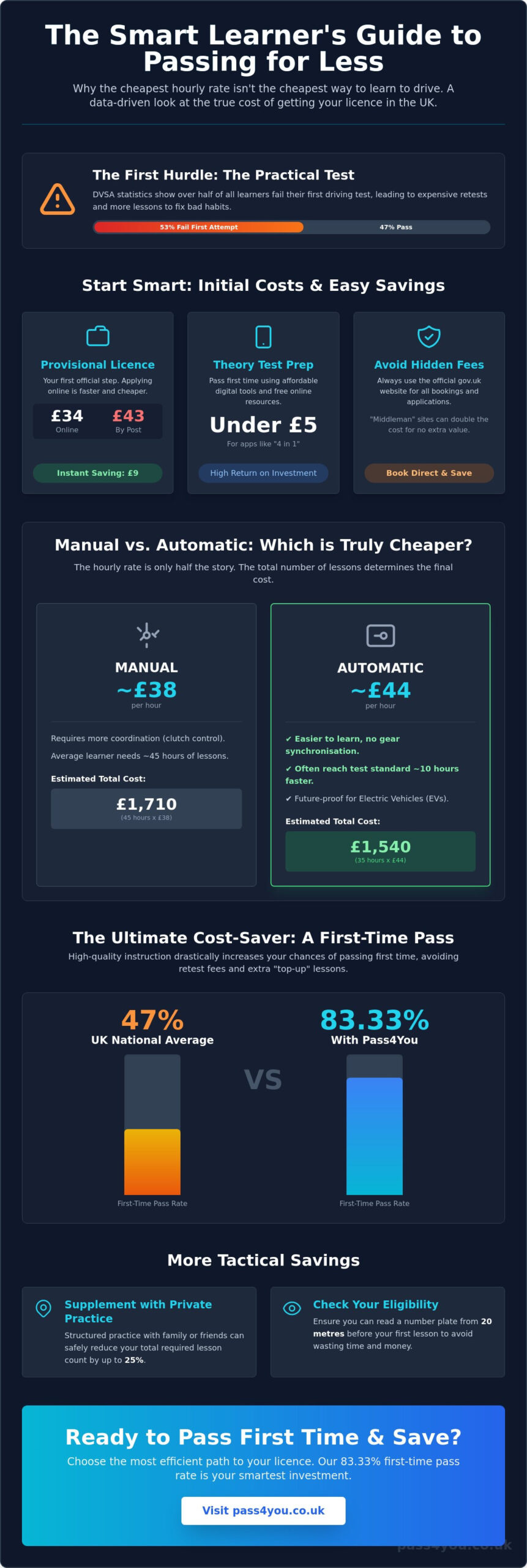
    Could the instructor offering the lowest hourly rate actually be the most expensive choice you make this year? It sounds backward, but many learners find that “budget” lessons often lead to more hours behind the wheel and multiple failed tests. Finding the cheapest way to learn to drive uk isn’t about chasing the smallest number on a flyer. It’s about maximizing every minute you spend in the car so you don’t become part of the 53% of learners who fail their first attempt according to recent DVSA statistics.

    We know how frustrating it is to face rising costs and test wait times that stretch for months. It’s natural to feel anxious about the total price of freedom, especially when you’re worried about skill fade between lessons. You deserve a path that respects your budget and your time. This guide will show you how to minimize your total spend by focusing on efficiency and achieving a first-time pass. We’ll explore how to avoid hidden fees, why quality instruction reduces your total lesson count, and the specific habits that lead to our 83.33% first-time pass rate.

    Key Takeaways

    • Start your journey with confidence by securing easy initial savings, such as applying for your provisional licence online to avoid unnecessary postal fees.
    • Navigate the price differences between manual and automatic lessons to choose the transmission that offers you the most efficient and stress-free path to qualified status.
    • Find out how supplementing your professional tuition with structured private practice can safely reduce your total required lesson count by up to 25%.
    • Discover the cheapest way to learn to drive uk by looking beyond the hourly rate and focusing on high-quality instruction that prevents the need for expensive retests.
    • Learn why aiming for a first-time pass with our 83.33% success rate is the ultimate strategy for minimizing your total investment and getting on the road sooner.

    Starting Your Journey: Navigating Initial Costs and Small Wins

    Taking your first steps toward getting behind the wheel can feel overwhelming, but it doesn’t have to break the bank. In 2026, the average UK learner spends approximately £1,600 to £2,000 to qualify, covering everything from the first application to the final certificate. Finding the cheapest way to learn to drive uk requires a strategic approach that starts long before you turn the ignition. By planning your budget and timeline early, you build the confidence needed to succeed without financial stress. A clear plan keeps you focused and prevents the anxiety that often comes with unexpected costs.

    The first win is simple. Applying for your provisional license uk online currently costs £34, which is £9 cheaper than the £43 postal application fee. It’s a small saving, but it sets the tone for your entire journey. You should always use the official gov.uk website for all bookings and applications. Many “middleman” websites charge hidden service fees, sometimes doubling the cost of a theory or practical test for no added value. Understanding the UK driving test process through official channels ensures you don’t fall for these traps and keeps your money where it belongs, in your lesson fund.

    Mastering the Theory Test on a Budget

    Success on a budget means passing the first time. In 2026, digital tools offer incredible value. Apps like the “Driving Theory Test 4 in 1” provide a massive return on investment for a small one-off fee, often under £5. Passing your theory early is vital for your wallet. It prevents expensive delays in your practical training, as you cannot book a driving test without a valid theory certificate. You can also find free, high-quality hazard perception tutorials on YouTube to sharpen your skills without spending extra cash. This proactive study approach makes you a more confident student during your actual lessons.

    Eye Tests and Physical Requirements

    You must ensure you’re legally fit to drive before paying for a single professional lesson. The law requires you to read a standard UK number plate from a distance of 20 meters. If you need glasses or contact lenses to do this, you must wear them every time you drive. Booking a test you’re legally ineligible to take is a total waste of money. Use this simple checklist for your first day behind the wheel:

    • Confirm you can read a number plate from 20 meters with or without corrective lenses.
    • Check that your provisional license is valid and the details are correct.
    • Wear comfortable, flat-soled shoes to help you feel the pedals clearly.
    • Bring a calm and positive mindset to help you absorb information quickly.

    By checking these boxes early, you avoid the risk of being turned away from a test or struggling during your first few hours of training. Being prepared is the cheapest way to learn to drive uk because it maximizes the value of every minute you spend with your instructor.

    Choosing the Right Gear: Manual, Automatic, or Intensive Courses?

    Your choice of vehicle and course structure determines the total price of your licence. While many people search for the lowest hourly rate, the cheapest way to learn to drive uk is actually found by reducing the total number of hours you need. It’s about efficiency rather than just the price per lesson. Before you book your first session, you must account for the official government licence fees, which currently stand at £34 for an online provisional application. This is your baseline cost before you even step into a car.

    Manual vs. Automatic: The Long-term Financial View

    In 2026, manual lessons typically cost around £38 per hour, while automatic lessons average £44. This £6 difference seems like a saving, but manual cars require more coordination. If you struggle with clutch control, you might end up taking 15 extra lessons compared to an automatic learner. Data from the DVSA suggests learners need an average of 45 hours of professional tuition. Automatic students often reach test standard 10 hours faster because they don’t have to master gear synchronisation.

    You should also consider future-proofing. With the UK’s transition toward Electric Vehicles (EVs), which are almost exclusively automatic, the manual gearbox is becoming a niche skill. Choosing automatic might feel more expensive now, but it’s often the fastest route to becoming a confident driver. While manual cars are currently cheaper to buy and insure for new drivers, that gap is narrowing as EV adoption increases and maintenance costs for older manual gearboxes rise.

    Weekly Lessons vs. Semi-Intensive Structures

    The biggest drain on your budget is “skill fade”. If you take one-hour lessons once a week, you’ll likely spend the first 15 minutes of every session just getting back up to speed. This wastes 25% of your paid time. Booking two-hour blocks is much more cost-effective. It gives you enough time to drive to different road types and settle into a calm, focused rhythm. Our 83.33% first-time pass rate shows that consistent, concentrated practice builds a safer foundation than fragmented learning.

    Intensive “crash courses” can work, but they don’t suit every learning style. If you feel nervous, a semi-intensive approach (6 to 10 hours a week) offers the best balance. It keeps the information fresh without causing mental exhaustion. You should also align your schedule with local test centre availability. There’s no point finishing an intensive course in June if the next available test isn’t until August. Simon and our team always aim to time your training so you’re at peak performance exactly when your test date arrives. This strategic planning prevents you from needing “refresher” lessons while you wait for a slot.

    Cheapest Way to Learn to Drive UK: The Ultimate 2026 Efficiency Guide

    Private Practice: How to Supplement Lessons Without Wasting Money

    Private practice is often the cheapest way to learn to drive uk because it lets you refine your skills without paying a professional hourly rate for every single minute behind the wheel. Data from the Driver and Vehicle Standards Agency (DVSA) indicates that learners who combine professional instruction with private practice are significantly more likely to pass. By putting in extra hours with a friend or family member, you can reduce your required professional lesson count by approximately 25%. This isn’t just about driving around; it’s about building muscle memory in a calm, low-pressure environment.

    To stay legal on UK roads, your supervising driver must be at least 21 years old and have held a full UK driving license for at least three years. The vehicle must be properly insured for a learner, have a valid MOT, and display clear L-plates on the front and rear. If you ignore these requirements, you risk a fine of up to £1,000 and six penalty points on your provisional license. Starting your driving career with points is an expensive mistake that will inflate your insurance premiums for years.

    Finding the Right Supervising Driver

    Don’t just pick the person who has been driving the longest. Your most experienced friend might have picked up “shortcuts” or lazy habits that lead to an immediate fail on the modern driving test. The best supervisor is someone patient who is willing to follow the specific syllabus set by your professional instructor. At Pass4you, we often suggest that supervisors sit in on a professional lesson. This ensures everyone stays on the same page and prevents the development of conflicting techniques. Keep your private sessions short, around 30 to 45 minutes, to keep stress levels low and concentration high.

    Learner Insurance and Vehicle Costs

    Finding the cheapest way to learn to drive uk in 2026 requires a smart approach to insurance. You generally have two main paths to consider:

    • Short-term policies: These are perfect if you’re practicing in a parent’s car occasionally. You can buy cover for specific windows, such as 30 or 60 days, which keeps costs down.
    • Annual learner policies: These are usually more cost-effective if you plan to practice over a period of six months or more.

    Many 2026 insurance providers offer “Black Box” or telematics options for learners. These devices monitor your braking and acceleration, often resulting in a 15% discount on premiums for safe driving. While using your own car for the practical test can save you the cost of hiring your instructor’s car, you must ensure it meets all DVSA requirements. This includes having an extra interior rear-view mirror for the examiner and ensuring your insurance policy specifically covers the test itself.

    Tactical Saving: How to Lower the Total Cost of Passing

    Many learners assume the cheapest way to learn to drive uk is simply finding the lowest hourly rate. This is often a trap. A “budget” instructor charging £25 per hour might lack the structured approach needed to progress quickly. If they require 60 hours of training to get you ready, you’ll spend £1,500. In contrast, a highly qualified instructor like Simon may charge more per hour but use a tried and tested technique to get you ready in 35 hours. That higher rate actually saves you hundreds of pounds and months of time. Value for money is about the total cost of the license, not the cost of the hour.

    The Power of Block Bookings

    How do you secure the best value? Booking in bulk is the standard answer. In Milton Keynes, learners who book 20 hours upfront often see savings of 5% to 10% compared to paying weekly. This commitment also ensures you have a consistent slot in the diary, which is vital for building muscle memory and maintaining momentum. Before you commit to a large block, we always recommend an initial assessment lesson. This lets you see if our calm and patient style matches your learning needs. Always check the school’s refund policy; a professional school will always offer a transparent refund for any unused hours if you pass earlier than expected.

    Avoiding the ‘Failed Test’ Money Trap

    The most expensive mistake you can make is taking a practical driving test before you’re truly ready. A failed test costs much more than just the £62 DVSA fee. When you add the cost of car hire for the test day and the average of 10 hours of remedial lessons needed while waiting for a new slot, a single failure can cost you over £300. We maintain an 83.33% first time pass rate because we use a strict “Test Ready” checklist. You shouldn’t book your test until you can:

    • Complete a full 40 minute mock test with zero serious or dangerous faults.
    • Drive independently for 20 minutes without any verbal prompts or interventions.
    • Perform all maneuvers, including the emergency stop, perfectly every time.
    • Handle complex roundabouts and dual carriageways with total confidence.
    • Manage your nerves so they don’t affect your physical control of the car.

    Using mock tests is a vital tactical saving. It’s much better to pay for a mock lesson than to pay for a failed real test. We focus on building your confidence so the actual test feels like just another drive with a friend. If you’re ready to learn with a mentor who values your success, book your lessons with Pass4you and let’s get you on the road as a safe driver for life.

    The Most Efficient Path: Why Pass4you Saves You More

    Finding the right driving instructors near me is the most critical decision you’ll make for your bank account. At Pass4you, our 83.33% first-time pass rate serves as a direct financial benefit to you. Every time a student passes on their first attempt, they save the £62 DVSA test fee and avoid the cost of weeks of additional remedial lessons. It is the cheapest way to learn to drive uk when you consider the total investment required to earn your pink license.

    We provide tuition in modern, reliable Volkswagen vehicles. These cars are chosen for their ease of use and excellent visibility, which helps you build confidence quickly. When you feel comfortable in the driver’s seat, you learn faster. Our “Safe Driver for Life” philosophy also prepares you for the years ahead. By teaching you to anticipate hazards properly, we help you maintain a clean driving record. This is the best way to secure lower insurance premiums in the future, saving you hundreds of pounds long after you’ve passed the test.

    Local Expertise in Milton Keynes

    Milton Keynes presents unique challenges for new drivers. The city’s extensive grid system and complex roundabouts can be intimidating if you aren’t prepared. Simon uses his deep local knowledge to guide you through these specific test routes from day one. You won’t spend your time driving aimlessly through quiet backstreets. Instead, you’ll gain experience on the exact dual carriageways and junctions used by examiners. This focused, local approach is why many consider our methods the cheapest way to learn to drive uk. You simply need fewer hours behind the wheel to reach test standard.

    Simon’s patient and calm approach is designed to reduce anxiety. We’ve seen many nervous learners who were ready to give up before joining us. By creating a supportive environment, we speed up the learning curve significantly. Our local expertise includes:

    • Mastering the H5 and V8 grid roads with confidence
    • Navigating the complex roundabouts and local test hubs efficiently
    • Reducing nerves through Simon’s proven, patient techniques
    • Learning the specific “problem spots” identified by local examiners

    Transparent Pricing and Value

    We believe in total honesty. When you book your driving lessons milton keynes, what you see is what you pay. There are no hidden administration fees or surprise charges. You’re paying for first-class instruction from a mentor who is genuinely invested in your success. While some schools might offer lower hourly rates, they often drag out the process over many months. Our goal is to get you on the road safely and quickly, ensuring you don’t pay for a single lesson more than you need.

    Ready to start your journey? Booking your first lesson is the first step toward your independence. You can join the hundreds of successful drivers who have found that quality instruction is the ultimate money saver. Contact us today to secure your slot and start learning the right way.

    Take Control of Your Future on the Road

    Mastering the road doesn’t have to be a financial burden if you approach it with a clear strategy. You’ve learned that the cheapest way to learn to drive uk involves more than just hunting for the lowest price per hour. It’s about combining smart private practice with professional guidance to ensure you don’t repeat lessons or fail multiple tests. By choosing the right vehicle type and staying consistent, you’ll reach the finish line much faster.

    Efficiency is the secret to saving money. When you learn in modern VW tuition vehicles with a calm mentor like Simon, you build the confidence needed to succeed. Our 83.33% first-time pass rate proves that quality instruction pays for itself by getting you on the road sooner. You’ll feel safe and supported. You’ll be ready to handle every junction without the stress of being rushed or shouted at during your sessions.

    Your freedom is just a few lessons away. Don’t let the fear of high costs or difficult instructors hold you back. Start your journey with a high-pass-rate expert—Book your first lesson with Pass4you today! You’ve got the tools and the plan. Now it’s time to get behind the wheel and become a safe driver for life.

    Frequently Asked Questions

    What is the absolute cheapest way to get a driving licence in the UK?

    The cheapest way to learn to drive uk is to combine professional lessons with extensive private practice. You’ll build a solid, safe foundation with a patient instructor like Simon, then reinforce those skills with a friend or family member. DVSA data shows that learners who complete 22 hours of private practice are significantly more prepared. This strategy reduces the total number of paid professional hours you need to reach test standard.

    Is it cheaper to learn in a manual or an automatic car in 2026?

    Manual lessons generally remain the more cost effective choice because hourly rates are typically £5 to £10 lower than automatic lessons. Manual cars are also cheaper to buy and insure once you pass your test. While automatic cars are becoming more common, the initial investment in lessons is higher. Choosing manual gives you the freedom to drive both vehicle types without needing a second practical test later.

    How many driving lessons does the average person need to pass?

    The DVSA reports that the average learner requires 45 hours of professional tuition alongside 22 hours of private practice. However, our students often pass in fewer hours because we focus on a calm, efficient teaching style. Our 83.33% first time pass rate demonstrates that quality instruction saves money by avoiding expensive retests. We focus on making you a confident, safe driver for life rather than just rushing to the finish line.

    Can I save money by booking my driving test myself?

    Yes, you should always book your tests directly through the official GOV.UK website to avoid unnecessary middleman management fees. A theory test currently costs £23, while a weekday practical test is £62. Some third party sites charge a premium of £20 or more just for the booking service. By handling the admin yourself, you keep your budget focused on actual car time and professional guidance from your mentor.

    Does private practice with parents really help save money?

    Private practice is a brilliant way to save money, provided it doesn’t introduce bad habits that Simon has to fix later. Practicing basic car control in a car park or quiet street helps you feel more confident during your professional lessons. You should wait until your instructor says you’re ready before heading out with parents. This ensures you’re safe and that your private sessions actually support the techniques we’ve taught you.

    Are intensive driving courses cheaper than weekly lessons?

    Intensive courses can seem cheaper upfront, but weekly lessons often provide better value for money because you have time to process what you’ve learned. Cramming everything into one week can be stressful and lead to a higher chance of failing if you aren’t naturally confident. Our patient, steady approach ensures you don’t feel rushed. We find that consistent, weekly practice builds the long term muscle memory needed for a first time pass.

    What are the hidden costs of learning to drive that I should budget for?

    You must budget for your provisional licence, which costs £34 online, and the cost of insurance if you plan to do private practice. Many learners forget to account for the price of theory test revision apps or books. It’s also important to remember that you’ll need to pay for your instructor’s time and car use on the day of your practical test. Planning for these 5 or 6 extra costs prevents financial stress.

    How can I find a driving instructor that offers the best value for money?

    The cheapest way to learn to drive uk is to find an instructor with a high success rate and fantastic student reviews. A slightly higher hourly rate is a better investment if the instructor helps you pass first time. Look for someone like Simon who is described as calm and supportive. Our 83.33% first time pass rate means our students spend less money overall because they rarely have to pay for multiple tests.