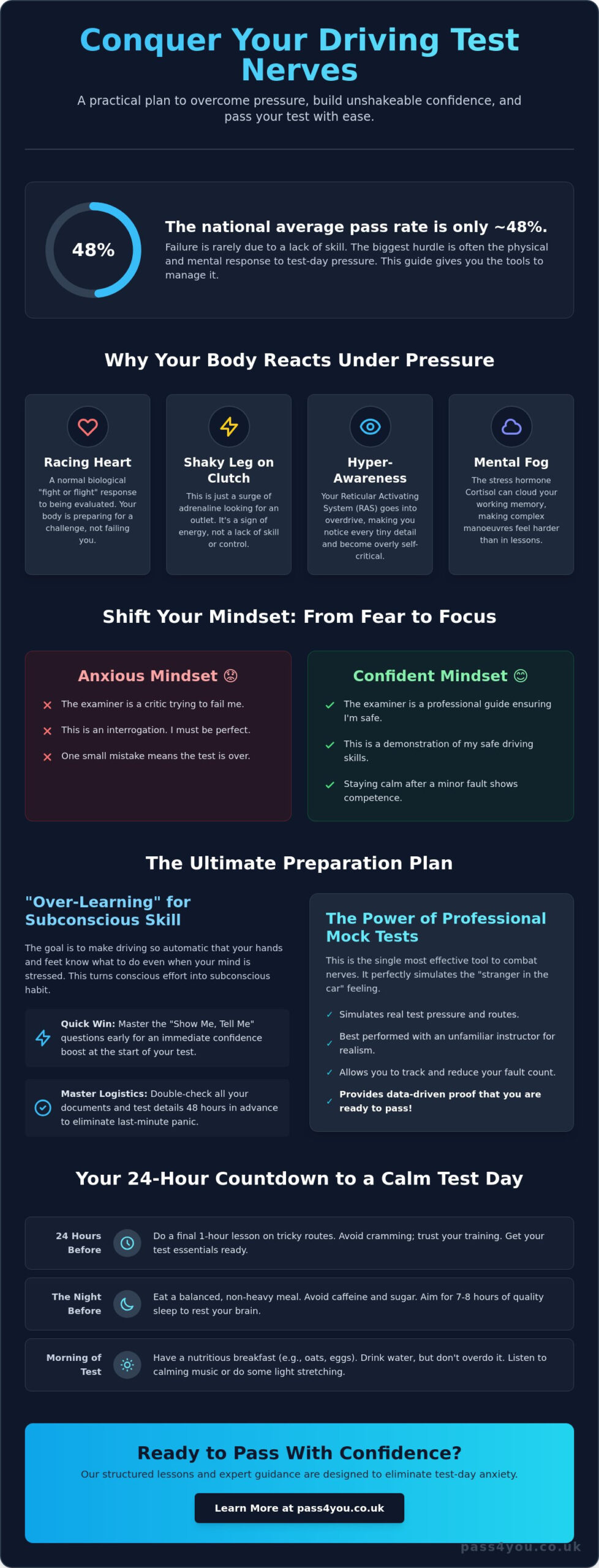
Did you know that the national average pass rate for the practical driving test is currently around 48%? It is rarely a lack of technical skill that causes a fail; instead, it is often the physical response to pressure that catches learners off guard. You might already be worried about your legs shaking on the clutch or the stress of the 2026 booking rules that make retesting a long, difficult process. It is completely normal to feel this weight on your shoulders, but these driving test day nerves tips will help you regain your calm and focus.
We understand that the pressure from friends and family can make the test feel like a mountain to climb. We promise to provide you with a structured plan and professional techniques to ensure your anxiety doesn’t stand in the way of your freedom. This guide explores how to use “Mock Test Habituation” and specific mental reframing to view your examiner as a helpful guide rather than a critic. You will discover practical tools to stop physical shaking and a 24 hour ritual that puts you firmly in control of your big day.
Key Takeaways
- Understand the biological roots of anxiety and how your brain’s “reticular activating system” impacts your performance during the test.
- Learn why “over-learning” and mock tests are the most powerful tools for turning conscious driving into a calm, subconscious habit.
- Follow a practical 24-hour countdown that uses rest and nutrition to settle your body and prevent physical shakes on the clutch.
- Master driving test day nerves tips like the “Safe Mistake” mindset to ensure a small error doesn’t lead to a fail.
- Discover how a calm, professional mentor helps you navigate specific local test routes far more effectively than informal practice ever could.
Understanding Driving Test Day Nerves: Why Your Body Reacts This Way
Feeling your heart race as you pull into the test centre is not a sign that you are a bad driver. It is a standard biological response to being evaluated. By Understanding Driving Test Day Nerves, you can begin to see these physical sensations for what they really are: your body preparing you for a challenge. This reaction is even more common in 2026. With current test backlogs and the new limit of just two booking changes, the “must-pass” pressure feels heavier than ever. We want you to know that this extra layer of anxiety is something we see every day, and it is entirely manageable.
Have you ever noticed how you suddenly spot every tiny crack in the road or a slightly late signal when you are stressed? That is your reticular activating system (RAS) going into overdrive. It heightens your awareness, which is meant to keep you safe, but it can make you feel hyper-critical of your own performance. Similarly, that “shaky leg” on the clutch is just a surge of adrenaline. It is not a lack of skill; it is just energy looking for a way out. These driving test day nerves tips are designed to help you channel that energy back into safe, controlled driving.
The Science of Test Anxiety
When you feel under threat, your body releases cortisol. This hormone can sometimes cloud your working memory, making complex manoeuvres like a reverse bay park feel harder than they did in your lessons. It is helpful to remember that examiners are not looking for a “nerveless” robot. They are trained professionals who expect a certain level of tension. They are looking for safe, competent decisions, even if your hands are a little damp on the wheel. Learning to distinguish between “helpful excitement”, which keeps you sharp, and “debilitating dread” is the first step toward a successful result.
Reframing the “Fail” Fear
Many learners believe that a single mistake means the test is over. This misconception is one of the biggest drivers of anxiety. Think of your test as a “driving demonstration” rather than an interrogation. You are simply showing a friendly professional that you can handle a car safely on your own. If you make a minor mistake, don’t let it spiral. You can check our guide on the practical driving test to see exactly what counts as a fail and what is just a minor fault. Staying calm after a small error is often what separates those who pass from those who don’t. Using these driving test day nerves tips will ensure you keep your focus where it belongs: on the road ahead.
Building a Foundation of Confidence Before the Big Day
Preparation is the most effective way to quiet a noisy mind. When you reach a stage of “over-learning,” your car control becomes subconscious. This means that even if your brain feels foggy due to pressure, your hands and feet still know exactly what to do. You want to move beyond being “lesson ready” and ensure you meet the full DVSA standards for safety and independence. Mastering the “Show Me, Tell Me” questions early is a great way to start. Getting these right as soon as you meet the examiner provides an immediate confidence win that sets a positive tone for the rest of the drive.
It is vital to understand that the examiner is looking for a safe, competent driver, not a perfect one. By focusing on your progress during every lesson, you build a mental library of successful moments to draw upon when you feel anxious. These driving test day nerves tips are not just about the day itself; they are about the weeks of consistent effort you have already put in. Trusting your training is the key to staying calm when the pressure mounts.
The Power of Professional Mock Tests
While practicing with a friend or family member is helpful, nothing beats a professional mock test. It simulates the specific “stranger in the car” feeling that often triggers anxiety. We recommend doing this with a different instructor to make the experience feel as real as possible. In Milton Keynes, this is especially valuable for navigating the complex H and V road grid system and the various roundabouts in Bletchley. By recording your mock test results, you can see a tangible reduction in your fault count over time. This data-driven proof of your progress is one of the best driving test day nerves tips because it shows you that you are truly ready.
Mastering the Logistics
A lot of test day stress comes from worrying about the small details. You can eliminate this by double-checking your essentials 48 hours before the big day. Ensure your provisional license uk and your theory certificate are in a safe, easy-to-find place. Confirm whether your test is at the Bletchley or Milton Keynes centre and verify the exact time. Preparing a “Test Day Kit” is another great way to feel in control. This should include:
- Comfortable shoes that you have worn during your lessons.
- Your glasses or contact lenses if you need them for the eyesight check.
- Your test appointment letter or email confirmation.
Being organised allows you to focus entirely on your driving. If you feel you need a little more practice on specific local routes, booking a few extra driving lessons can provide that final boost of certainty. When you know the logistics are handled, your mind is free to focus on the road.
The 24-Hour Countdown: A Practical Ritual for Calm
Success on your test day starts long before you turn the ignition key. Establishing a clear, chronological ritual helps you feel in control when your environment feels unpredictable. One of the most effective driving test day nerves tips is to observe a “No-Drive Zone” exactly 24 hours before your appointment. While it is tempting to cram in last-minute practice, your brain needs time to rest and process what you have already learned. Over-practicing at this stage often leads to fatigue and silly mistakes that only serve to dent your confidence.
The Night Before Strategy
Your mental environment is just as important as your physical one. Social media is often full of “test horror stories” that can trigger unnecessary dread. We suggest curating your feed or staying off social apps entirely the evening before. Instead, spend 10 minutes on a visualisation exercise. Close your eyes and imagine yourself confidently merging onto a dual carriageway; see yourself checking your mirrors, matching your speed, and joining the flow of traffic with ease. Finally, plan a post-test treat. Whether it is a favourite meal or a cinema trip, having something to look forward to regardless of the result lowers the psychological stakes.
Fueling for Focus
What you put into your body directly affects your ability to stay sharp. About 12 hours before your test, opt for a high-protein dinner to keep your energy levels stable. It is crucial to skip caffeine in the evening; you want your heart rate to remain steady, not spiked by stimulants. On the morning of the test, many learners swear by the “banana myth.” It is actually rooted in science, as potassium helps regulate your heart rate and can prevent those shaky leg jitters. Balance this with careful hydration. You need to be sharp and alert, but you don’t want to be distracted by needing a mid-test break. Another helpful rule is “No News is Good News.” By not telling every friend and family member your exact test date, you remove the external pressure of having to report back to a crowd.
On the day itself, use the final two hours wisely. A warm-up lesson with your instructor is perfect for settling into the car and getting your “driving brain” into gear. This is a time for gentle familiarisation, not for trying to learn new techniques. Aim to arrive at the test centre about 30 minutes before your slot. This gives you enough time to use the facilities and practice some calm breathing without sitting in the waiting room long enough to “stew” in your own thoughts. Following these driving test day nerves tips ensures you walk into that centre feeling like the capable driver you are.
Real-Time Strategies to Stay Calm During the Practical Test
Once you are in the driver’s seat, the dynamic shifts from preparation to performance. It is time to put your driving test day nerves tips into active use. One of the most effective mental shifts is the “Sat Nav” Reframe. Instead of seeing an authority figure judging your every move, view the examiner as a human GPS. Their job is simply to tell you where to go. They want you to see that you are a safe driver because safe drivers make the roads better for everyone. When you view them as a helpful guide rather than a critic, the pressure begins to lift.
Mistakes happen, even to the most experienced motorists. The “Safe Mistake” Mindset is your best defence against a panic spiral during the drive. If you stall the engine, remember that it is just a stall. It is not an automatic fail. Take a second to breathe, reset the car, perform your 360-degree observations, and move off safely. The examiner is looking for how you handle the situation. A calm, safe recovery actually demonstrates high-level control and a responsible attitude toward road safety.
You might also find that “commentary driving” helps you stay grounded. By quietly verbalising your thoughts, such as “I am checking my mirrors for that cyclist” or “I see the speed limit change ahead,” you keep your brain focused on the immediate task. This leaves less room for anxious thoughts to creep in. Use your hands as physical anchors too. Keeping them firmly at the 10 and 2 positions gives you a sense of stability and prevents nervous fidgeting or finger-tapping on the wheel.
Mental Grounding Techniques
Box breathing is a simple but powerful tool you can use whenever the car is stationary, such as at red lights. Inhale for four seconds, hold for four, exhale for four, and hold for four. If you feel your focus slipping, try the “Five Things” game. Mentally name five things you see on the road right now. This pulls your attention back to the present moment. It also helps to replace negative “what-if” thoughts with positive affirmations. Instead of thinking “I hope I don’t fail,” tell yourself “I am a safe and capable driver.”
Handling the “Silent Car” Dynamic
The silence in the car during a test can feel heavy, but it is actually for your benefit. The examiner stays quiet so you can concentrate fully on your driving decisions. You don’t need to feel pressured to fill the silence with small talk. It is perfectly okay to say a polite hello at the start, but your main focus should be the “Next Five Seconds.” Don’t dwell on a roundabout you left behind two minutes ago. Focus entirely on the road immediately in front of you. If you want to build this level of real-time confidence, booking professional driving lessons is the best way to prepare for the unique environment of the practical test.
How Pass4you Driving School Eliminates Test Day Anxiety
While the driving test day nerves tips we have shared are vital for your personal preparation, the person sitting next to you during your lessons has the biggest impact on your confidence. At Pass4you Driving School, we don’t just teach you how to operate a vehicle. We provide a supportive, patient environment that helps you manage your specific anxieties. Our instructors are experienced mentors who understand that every learner is different. This personalized approach is why we report an 83.33% first-time pass rate. When you compare this to the national average of around 48%, it is clear that professional instruction makes a massive difference to your success.
Our fleet consists of modern Volkswagen tuition vehicles. These cars are chosen for their reliability and ease of use. When you are on your test, the last thing you want to worry about is the car itself. Our Volkswagens offer smooth controls and clear visibility, which helps you feel in safe, professional hands from the moment you move off. Finding the right driving instructors near me is about more than just proximity. It is about finding a team at Pass4you Driving School that prioritizes your emotional stability, safety, and long-term savings through effective teaching methods.
Local Knowledge, Local Success
Milton Keynes has a unique road layout that can be intimidating for new drivers. The H and V grid system, combined with high-speed roundabouts, requires a specific kind of focus. Our instructors have deep local knowledge of the Bletchley and Milton Keynes test routes. We simulate exact test conditions in the weeks leading up to your date, so there are no surprises. This removes the “fear of the unknown” that often triggers a panic response. We have helped countless students who previously suffered from severe anxiety pass their tests by replacing their fear with genuine local expertise. Our calm teaching style ensures you feel ready for every junction and roundabout in the area.
Your Journey to Freedom Starts Here
Our goal at Pass4you Driving School is to help you pass as efficiently as possible. With the 2026 test booking limits in place, getting it right the first time is more important than ever. You can only make a maximum of two changes to your test booking, so you need to be certain of your skills before you head to the centre. We invite you to book a Test Readiness Assessment. This session gives you an honest, transparent look at your skills and shows exactly what is needed to reach the DVSA standard. Don’t let nerves hold you back from the freedom and opportunities that come with a full licence. Book your first lesson with Pass4you Driving School and build your confidence today. We are here to guide you every step of the way.
Your Path to a Full Licence in 2026
Mastering your anxiety is the final step toward earning your freedom on the road. By understanding your body’s natural response and sticking to a structured 24-hour ritual, you can approach the test centre with genuine confidence. These driving test day nerves tips are designed to help you stay calm and focused when it matters most. You’ve already put in the hard work; now it’s just about demonstrating those skills to your examiner.
Success is much easier when you have the right support system in place. We offer first-class Milton Keynes instructors and modern Volkswagen tuition vehicles to ensure you feel comfortable and prepared. Our proven methods have helped thousands of learners overcome their fears and build lasting confidence. Don’t let the pressure of the 2026 backlogs hold you back from your goals. Join the 83.33% who pass first time; Book your Milton Keynes driving lessons now. We believe in your ability to become a safe, independent driver. Your new life behind the wheel is just one calm drive away.
Frequently Asked Questions
How can I stop my legs from shaking during the driving test?
Rest your left heel firmly on the floor to provide a stable pivot point for the clutch pedal. If you feel a shake starting, consciously press your heel down to ground yourself. This physical connection to the car helps counteract the adrenaline surge. You can also try tensing and releasing your calf muscles while waiting in the test centre to burn off some of that restless energy before you get into the vehicle.
Is it true that eating a banana helps with driving test nerves?
Yes, bananas are a natural source of potassium and vitamin B6, which help regulate your heart rate and keep your nervous system steady. Many learners find that eating one about 30 minutes before their appointment provides a calm energy boost without the jitters of caffeine. It is one of the most popular driving test day nerves tips because it is a simple, healthy way to settle your stomach and your mind.
What happens if I make a mistake during my driving test?
If you make a mistake, the best thing you can do is assume it is only a minor fault and keep driving safely. You can pass your test with up to 15 minor faults, so a single slip-up doesn’t mean you have failed. The examiner is looking for a safe recovery. If you stall or take a wrong turn, stay calm, reset, and show them that you can handle the situation professionally.
Should I tell my friends and family when my driving test is?
Keeping your test date to yourself is often the best way to reduce the weight of external expectations. When fewer people know, you don’t feel the “must-pass” pressure of having to report back to a large group. This allows you to focus entirely on your own performance. You can always surprise everyone with the good news once you have that pass certificate in your hand.
How do I deal with a “grumpy” or silent driving examiner?
Try to view the examiner’s silence as a professional tool designed to help you concentrate. They aren’t being rude; they are focusing intensely on the road and your safety. If they seem distant, treat their voice like a sat-nav and focus on the instructions they give you. Their job is to ensure you are safe, and their quiet nature allows you the space to make your own driving decisions.
Can I take a rescue remedy or herbal calmers before my test?
You should always speak with a pharmacist before using any herbal remedies to ensure they won’t make you drowsy. If you decide to try a rescue remedy, use it during a regular lesson first to see how your body reacts. It is never a good idea to try something new on the actual day of your test. You want to feel sharp, alert, and exactly like your usual self behind the wheel.
What is the best way to breathe if I start to feel a panic attack coming on?
Use the “4-7-8” technique to quickly reset your nervous system. Inhale quietly through your nose for four seconds, hold your breath for seven seconds, and exhale forcefully through your mouth for eight seconds. If you are moving, focus on making your exhales longer than your inhales. This simple change in your breathing pattern signals to your brain that there is no immediate danger, helping you regain your focus on the road.
How do mock tests help with actual test day anxiety?
Mock tests are the most effective way to desensitise yourself to the formal environment of the exam. They help you get used to the “stranger in the car” dynamic and the specific way instructions are delivered. By practicing under these conditions, you learn how to apply driving test day nerves tips in a realistic setting. This ensures that when the real day arrives, the process feels familiar rather than frightening.