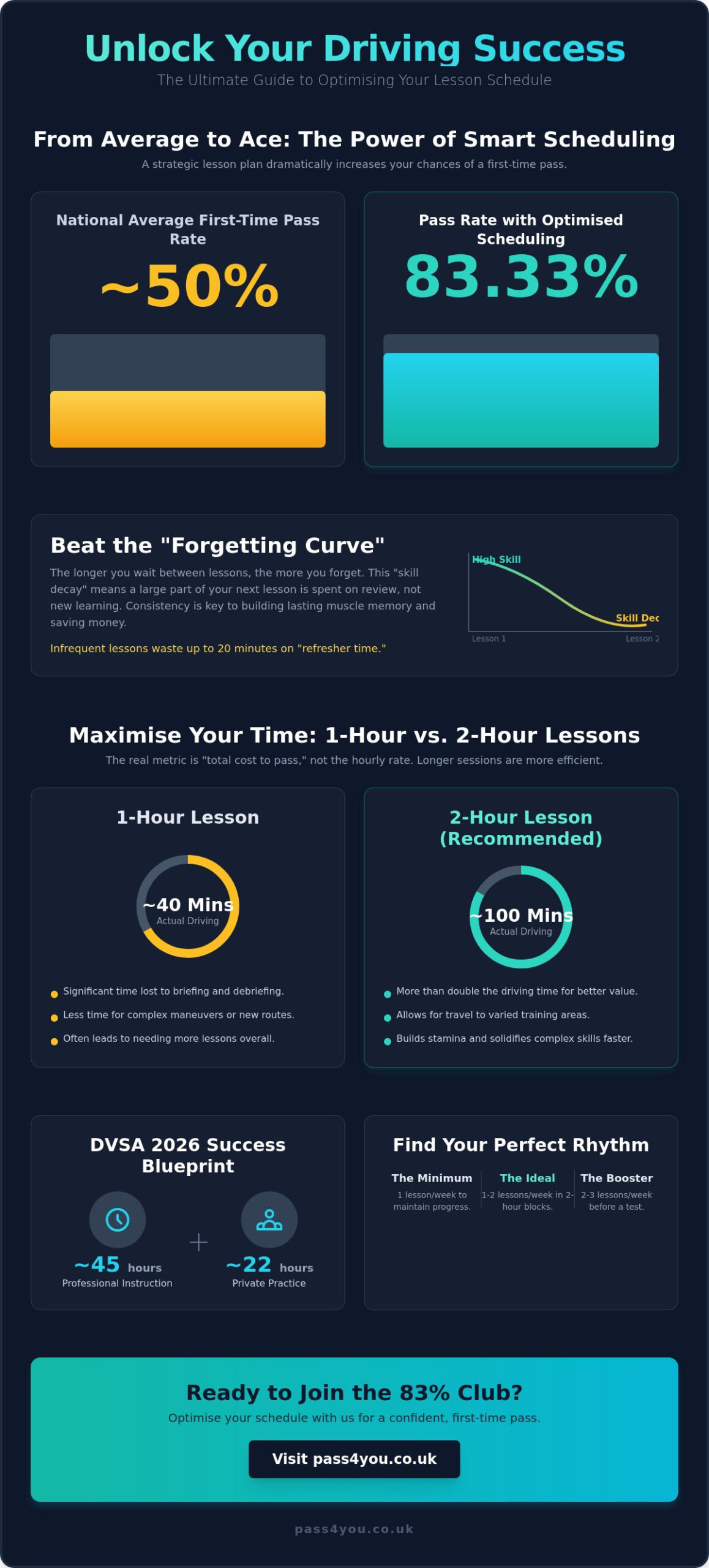
Did you know that while the national first-time pass rate sits at approximately 50%, some learners are achieving an 83.33% success rate simply by mastering their schedule? When you start your journey, the most important question you can ask is: how often should you have driving lessons to ensure you’re in that successful group? It’s natural to feel anxious about how long the process will take or whether you’ll forget everything you learned the moment you step out of the car. Budgeting for an unknown number of hours feels like a gamble, especially when you’re worried about the forgetting curve eating away at your hard-earned progress.
We understand these concerns and are here to help you feel calm, capable, and prepared. This guide will show you how the right lesson frequency builds vital muscle memory and actually reduces your total costs by getting you to the finish line faster. We’ll explore the latest DVSA recommendations for 2026, explain why consistency is your best tool for success, and provide a clear roadmap to help you join the ranks of our most confident and safe drivers.
Key Takeaways
- Learn how to fight the “forgetting curve” by using sleep cycles to consolidate new motor skills between your sessions.
- Discover how often should you have driving lessons to ensure you’re making steady progress without burning through your budget on refresher time.
- Explore why two-hour lessons often provide better value by increasing your actual driving time and reducing the total number of hours needed to pass.
- Find out how to combine professional instruction with private practice to meet the 2026 DVSA success benchmarks.
- Uncover how local expertise and modern tuition vehicles contribute to a success rate that’s significantly higher than the national average.
Determining the Ideal Frequency for Your Driving Lessons in 2026
When you stand at the start of your driving journey, it’s easy to focus on the total number of hours you’ll spend in the car. However, the real secret to success isn’t just the quantity of time; it’s the rhythm of your training. Deciding how often should you have driving lessons is a strategic choice that affects how quickly you build muscle memory and how much you’ll ultimately spend. If you leave too much time between sessions, you’ll spend the first twenty minutes of every lesson just remembering what you did last time. This “refresher time” adds up, often leading to a higher total cost and a longer wait for your license.
The DVSA Average vs. Your Personal Learning Curve
The Driver and Vehicle Standards Agency (DVSA) currently recommends around 45 hours of professional instruction supplemented by 22 hours of private practice. While this 45-hour benchmark is a helpful guide, every learner follows a unique path. Some students might feel test-ready in 30 hours, while others benefit from 60 or more to feel truly safe and prepared. This variation often comes down to your specific learning style. Visual learners might benefit from watching demonstrations, while kinaesthetic learners need to feel the car’s response repeatedly to understand clutch control. Understanding the broader context of Driver’s education helps you see that these hours are an investment in your lifelong safety, not just a box to tick for a test.
Why ‘Once a Week’ is the Minimum Standard for Progress
We’ve found that having at least one lesson per week is the absolute minimum standard for making steady progress. If you switch to fortnightly lessons, you risk a significant “regression” period where skills get rusty. A seven-day gap is the maximum timeframe for most people to retain complex motor skills without losing momentum. Consistent scheduling does more than just teach you how to drive; it manages the natural anxiety that comes with learning a new skill. When you know exactly when you’ll be back in the driver’s seat, your confidence grows because the process feels predictable and supportive. Regularity replaces fear with familiarity.
Your starting point also dictates your initial frequency. A complete beginner usually benefits from a consistent, weekly two-hour block to build a solid foundation from scratch. If you’re coming to us with previous experience, we might suggest increasing the frequency to two or three sessions a week. This “booster” approach helps polish specific skills and prepares you for a test date that might be approaching quickly. By tailoring the schedule to your “entry state,” we ensure you’re always moving forward without feeling overwhelmed or bored.
1-Hour vs. 2-Hour Lessons: Which Frequency Delivers Better Results?
Deciding on the length of your sessions is just as important as deciding how often should you have driving lessons. Many learners start by looking at the hourly rate, but the real metric for success is the “total cost to pass.” When you choose a one-hour lesson, a significant portion of that time is spent on the initial briefing and the final debrief. This often leaves you with only about 40 minutes of actual driving. By contrast, a two-hour session only requires one briefing and one debrief, meaning your actual time behind the wheel more than doubles. This efficiency is why many students find they need fewer total hours of instruction when they learn in longer blocks.
The Benefits of the 2-Hour Block for Complex Manoeuvres
Mastering complex road types, such as large roundabouts or high-speed dual carriageways, requires time to settle into a rhythm. A two-hour block allows for a supportive “Warm-up, Learn, Practice, Cool-down” structure. You have enough time to travel to specific training areas, practice a new skill multiple times until it feels natural, and still have time to drive back. This immersion is vital for building the stamina you’ll need for the 40-minute practical test. While the official government guidance notes there is no set minimum number of lessons, we’ve found that these longer sessions significantly accelerate the learning curve for most students.
When Shorter, Frequent Lessons Are More Effective
There are times when a shorter session is the better choice for your confidence. For a complete beginner, two hours behind the wheel can sometimes lead to sensory overload or “lesson fatigue.” If you feel your concentration dipping, a one-hour session can keep the experience positive and manageable. These shorter bursts are also excellent for “top-up” lessons. If you’ve already mastered the basics and just want to polish a specific manoeuvre or perform a quick mock test, an hour is often plenty. This “little and often” approach is also a great solution for learners with very busy professional schedules who can’t always commit to a full morning or afternoon.
It’s all about finding the rhythm that makes you feel most comfortable and secure. Whether you prefer the deep immersion of a long session or the quick focus of a shorter one, our goal is to help you book driving lessons that align with your personal learning style and goals. We’ll work with you to adjust your schedule as your skills grow, ensuring you’re always making the most of your time and investment.
The Role of Consistency in Building Muscle Memory and Confidence
Consistency is the quiet engine that drives your progress forward. When you consider how often should you have driving lessons, it’s helpful to think of driving as a physical discipline rather than just a set of rules to memorise. Your body needs to learn how to coordinate your feet on the pedals and your hands on the wheel without you having to think about every individual movement. This is known as muscle memory. Every time you finish a session, your brain continues to work in the background. During your sleep cycles, your mind consolidates these new motor skills, turning awkward movements into smooth, reliable habits.
Regularity also plays a massive role in managing your emotions. Anxiety often stems from the unfamiliar. If you only drive once every two weeks, the car remains a strange, slightly intimidating environment. By keeping your lessons frequent, the driver’s seat becomes a familiar space where you feel in control. This builds a deep sense of confidence that is vital for success. Learners who maintain a steady schedule generally report much lower levels of test-day nerves because they’ve spent enough consistent time in the car to feel that driving is a natural part of their day.
Overcoming the Forgetting Curve Between Lessons
The “forgetting curve” is a scientific concept that illustrates how quickly our brains lose new information if it isn’t reinforced. In the context of driving, this applies to the “feel” of the car, such as finding the biting point or judging steering angles. If the gap between your sessions is too long, your brain begins to prune those fresh neural pathways to make room for other information. Scientists suggest that a gap of two to three days is often the “Goldilocks” zone for rapid skill acquisition. Regularly repeating the same physical movements allows your subconscious mind to take over the mechanics of the car, leaving your conscious mind free to focus on the road ahead.
How Gaps in Training Increase Your Total Cost
Taking “gap weeks” might seem like a way to spread out your spending, but it often leads to a “re-learning tax” that increases your total investment. When you leave a significant gap, your instructor must spend the first twenty minutes of the next lesson recapping old material rather than teaching you something new. If you take a month off, you could easily set your progress back by two or three lessons. This doesn’t just cost you money; it costs you time and momentum. To stay sharp when you can’t be in the car, we recommend these strategies:
- Visualisation: Spend ten minutes a day imagining yourself performing a specific manoeuvre, like a parallel park.
- Observation: When you’re a passenger in a car, watch the driver’s feet and hands to keep the rhythm of driving fresh in your mind.
- Theory Review: Keeping your road knowledge sharp ensures you don’t have to hesitate when you’re back in the driver’s seat.
Maintaining this mental connection to driving ensures that when you do step back into our Volkswagen tuition vehicles, you’re ready to pick up exactly where you left off. Steady progress is always more affordable than starting and stopping.
Maximising Progress with Private Practice and Local Milton Keynes Factors
While professional instruction provides the essential foundation, private practice acts as the support structure that accelerates your journey. When you are deciding how often should you have driving lessons, it’s vital to consider how much time you can dedicate to practicing outside of those sessions. The 2026 DVSA recommendation suggests that learners benefit from roughly 22 hours of private practice. This extra time behind the wheel allows you to familiarise yourself with the car’s controls in a low-pressure environment. However, the quality of this practice is just as important as the quantity. You should choose a supervisor who is calm, patient, and willing to follow the instructional methods we use in your professional lessons.
Integrating Private Practice Without Picking Up Bad Habits
It’s best to wait until you’ve achieved basic vehicle control before you begin practicing with friends or family. Starting too early can lead to frustration for both you and your supervisor. Once you’re ready, we suggest focusing on repetitive drills that build confidence. Quiet car parks are perfect for practicing bay parking, while residential streets are ideal for mastering hill starts and junctions. We encourage you to talk to your instructor about what you plan to practice. This coordination ensures that your private sessions mirror your professional training, preventing the development of “bad habits” that could hinder your test performance.
Navigating Milton Keynes’ Unique Road Infrastructure
Milton Keynes offers a learning environment unlike any other in the UK. The driving lessons Milton Keynes students attend must specifically address the town’s famous grid system. Navigating the H (Horizontal) and V (Vertical) roads requires a high level of speed awareness and smooth gear transitions. The complexity of these roads, combined with our many high-speed roundabouts, often means that local learners benefit from a higher frequency of professional guidance. These roundabouts are the ultimate test of the confidence and muscle memory you’ve built through consistent training.
Because the local road layout is so specific, your private practice should be carefully planned. Use the grid roads to practice maintaining a steady speed and observing road signs, but save the most complex multi-lane roundabouts for your sessions with a professional. This balanced approach keeps you safe while you gain the experience necessary to handle MK’s unique traffic flow. If you feel ready to start your journey on these iconic roads, you can book your driving lessons with our experienced team today. We’ll help you navigate every grid road and roundabout with total peace of mind.
Optimising Your Schedule for a First-Time Pass with Pass4you
Choosing a driving school is about more than just finding an instructor; it’s about finding a mentor who understands your personal journey. At Pass4you, we’ve refined our teaching methods to achieve an 83.33% first-time pass rate. This figure reflects our commitment to high-quality, structured instruction that prioritises your safety and confidence. A major part of this success comes from helping you decide exactly how often should you have driving lessons based on your specific progress and learning style. Our instructors typically recommend a two-hour weekly block for learners in Milton Keynes. This structure allows you to settle into our modern Volkswagen tuition vehicles and focus on the road without feeling rushed or overwhelmed.
These vehicles are specifically chosen for their reliability and ease of use. When you learn in a car that feels intuitive, you can dedicate more of your mental energy to observing the road and mastering the MK grid system. We’ve found that this combination of consistent two-hour sessions and high-quality equipment creates the perfect environment for rapid skill acquisition. It’s not just about passing a test; it’s about becoming a safe, capable driver for life.
Personalised Lesson Planning for Milton Keynes Learners
We don’t believe in a one-size-fits-all schedule. Instead, we assess your skills during every session to ensure your training remains effective and engaging. As you approach the date for your practical driving test, we might suggest increasing your lesson frequency to twice a week. This “polishing phase” helps sharpen your reflexes and ensures your confidence is at its peak. Mock tests play a vital role in this process. They provide a realistic preview of the actual exam and help us determine if your current frequency is delivering the results you need. It’s a supportive way to identify any final areas for improvement before you head to the test centre.
Why Our Methodology Saves You Time and Money
Our goal is to get you on the road safely and efficiently. While unguided practice is a useful supplement, professional instruction is far more effective at building the high-precision skills required to pass in 2026. By following our structured curriculum, you’ll likely find that you need fewer total hours than if you were learning through trial and error. We pride ourselves on a patient, reassuring tone that contrasts sharply with more aggressive teaching styles. We know that a calm student is a successful student. By alleviating the anxiety of the learning process, we help you progress faster and join the ranks of our high-success learners.
Ready to start your journey toward independence? Book your first lesson with Pass4you today and experience a supportive, professional approach to driving. We look forward to helping you achieve your goals and welcoming you to the road.
Your Path to Driving Independence Starts Today
Achieving your license is about finding a rhythm that works for your life and your unique learning style. We’ve explored how consistent practice builds the vital muscle memory needed to handle complex roads with ease. By choosing two-hour blocks and maintaining a steady schedule, you avoid the hidden costs of refresher time and reach your goals much faster. Deciding how often should you have driving lessons is the first step toward a lifetime of safe and confident travel.
Our expert instructors specialize in navigating the Milton Keynes grid system and use modern Volkswagen tuition vehicles to ensure your training is as comfortable as it is effective. With our 83.33% first-time pass rate, you can feel confident that you are in safe, professional hands. We’re ready to help you overcome any anxiety and master the road at a pace that suits you perfectly. Start your journey to driving freedom with Pass4you – Book Now. We look forward to seeing you in the driver’s seat and helping you enjoy the incredible opportunities that come with success.
Frequently Asked Questions
How many driving lessons does the average person need in 2026?
The average learner needs approximately 45 hours of professional instruction to be test-ready according to the latest DVSA recommendations. This is most effective when supplemented by around 22 hours of private practice with a friend or family member. Every student is different, so some may feel confident after 30 hours while others benefit from 60 or more to feel truly safe behind the wheel.
Is one driving lesson a week enough to pass my test?
One lesson per week is the minimum standard we recommend to maintain steady progress and avoid the “forgetting curve.” It provides enough consistency to build muscle memory without feeling overwhelmed. While this pace works well for many, having two sessions a week can often help you reach test standard faster by reducing the amount of recap time needed at the start of each lesson.
Can I have two driving lessons in one day to speed up the process?
You can have multiple lessons in one day, but it’s important to consider how often should you have driving lessons to avoid mental fatigue. While intensive blocks work for some, most learners find that their concentration dips after two hours of focused driving. We usually suggest a two-hour block as the ideal limit for a single day to ensure you’re actually absorbing what you learn.
How long should a driving lesson be for a complete beginner?
Complete beginners often find that a one-hour session is a great way to start without feeling overwhelmed by new controls. This shorter duration allows you to focus on the basics like moving off and stopping in a low-pressure environment. As your confidence grows, moving to two-hour sessions will give you more time to practice complex junctions and settle into the rhythm of the road.
What happens if I have to take a long break between my driving lessons?
Taking a long break often leads to a “re-learning tax” where you spend your first few return sessions recapping skills you’ve already covered. This can increase the total number of hours you’ll need and the overall cost of your training. If a break is unavoidable, try to use visualization techniques or watch instructional videos to keep the mechanics of driving fresh in your mind.
Is it better to have intensive driving lessons or weekly sessions in Milton Keynes?
Weekly sessions are generally more effective for navigating the unique Milton Keynes grid system and high-speed roundabouts. These complex road layouts require a high level of confidence and decision-making that is best developed over several months. Steady instruction allows you to experience different traffic conditions and weather patterns, which prepares you more thoroughly for independent driving after your test.
How often should I do private practice alongside my professional lessons?
We recommend doing two to three hours of private practice between your professional lessons once you have basic vehicle control. This extra time helps turn manual tasks like gear changes into automatic habits. When deciding how often should you have driving lessons and practice sessions, ensure you aren’t overworking yourself, as staying calm and refreshed is key to safe learning.
Will having more frequent lessons help me pass my theory test faster?
Frequent driving lessons provide real-world context that can make theory topics much easier to understand and remember. Seeing road signs, markings, and hazard perceptions in person helps the information “click” during your revision. While you’ll still need to study your theory materials, being in the car regularly makes the rules of the road feel like second nature rather than just facts in a book.