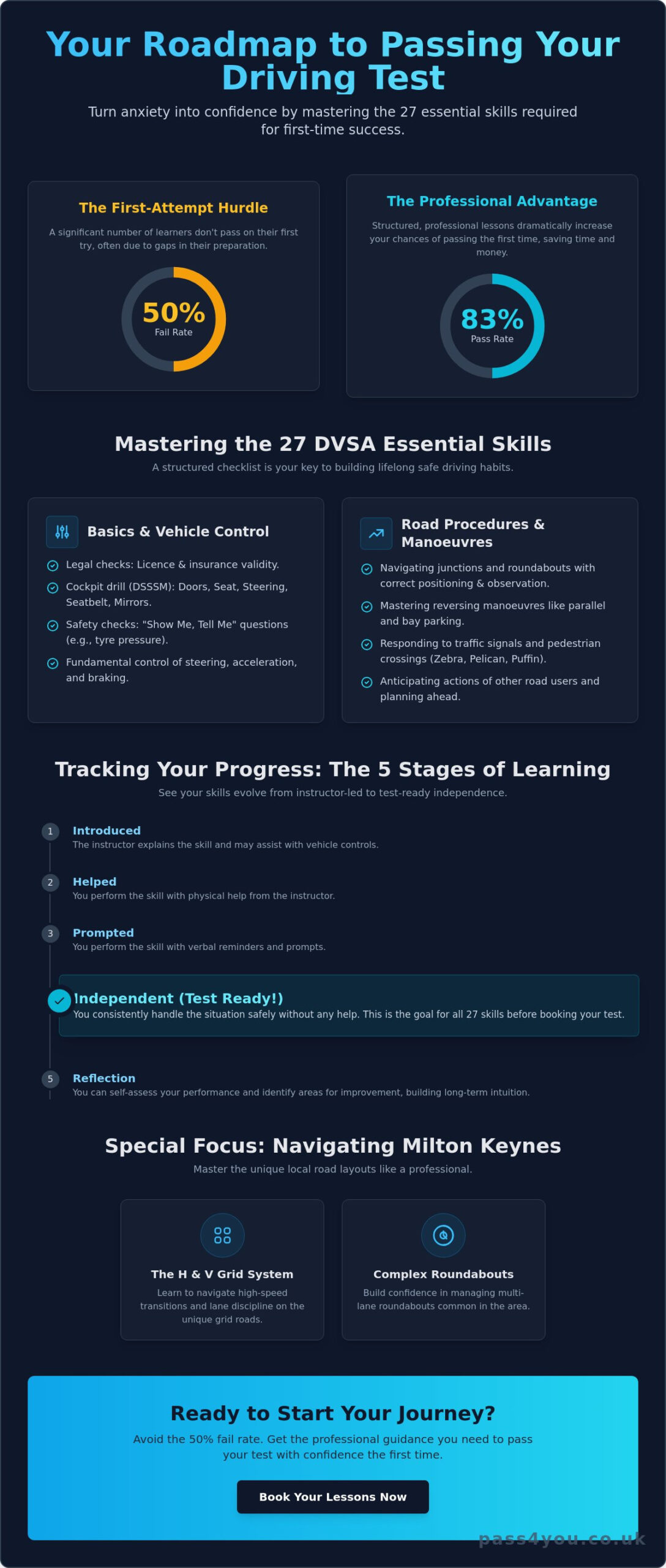
Did you know that nearly 50% of learner drivers fail their practical test on the first attempt? It’s a statistic that can feel heavy, especially when you’re already worried about complex junctions or those famous Milton Keynes roundabouts. We understand that feeling of uncertainty. It’s completely normal to feel overwhelmed by the sheer volume of skills you need to master before you’re ready for the big day.
Our comprehensive driving lesson checklist for learners is designed to turn that anxiety into quiet confidence. By following a structured path, you’ll master the 27 essential skills required by the DVSA and learn how to navigate local road layouts like a professional. We’ll show you exactly what to track so you aren’t left guessing about your progress. This structured approach helps you feel like you’re in safe, professional hands every step of the way.
This guide previews the exact roadmap you need to pass your test the first time, helping you avoid the frustration and extra expense of retakes. We’ll cover everything from core maneuvers to the latest 2026 booking rules. You’ll see how to manage your learning journey effectively, ensuring you feel safe, prepared, and ready for the freedom of the open road.
Key Takeaways
- Explore the 27 core DVSA skills that form the essential foundation for every safe and successful driver.
- Use a professional driving lesson checklist for learners to track your journey toward the “independent” proficiency level required for the test.
- Prepare for the unique road layouts of Milton Keynes by mastering the H and V grid system and complex high-speed transitions.
- Understand the legal essentials and mental readiness steps you must complete before even starting your modern tuition vehicle.
- Learn why professional guidance leads to an 83.33% first-time pass rate, saving you significant time and money.
Mastering the 27 Essential Driving Skills for 2026
Starting your driving journey can feel like standing at the base of a mountain. The DVSA syllabus provides the 27 essential skills you need to reach the summit safely. Instead of looking at a giant list and feeling overwhelmed, we break these down into manageable steps. This structured approach is the core of our driving lesson checklist for learners. It ensures you aren’t just memorizing moves to pass a test; you’re building habits that keep you safe for a lifetime.
Enrolling in a formal driver’s education program is the most efficient way to work through these categories. Our instructors use these 27 points to create a personalized plan that moves at your pace. If you feel nervous about a specific area, we spend more time there until you feel calm and capable. This method transforms a long list of requirements into a series of small, achievable victories.
Basics and Vehicle Control
Every journey begins with the fundamentals. Before you even turn the engine on, you must understand your legal responsibilities. This includes ensuring your provisional licence is valid and that the vehicle has the correct insurance coverage. Once inside, we teach you the “DSSSM” routine. This stands for Doors, Seat, Steering, Seatbelt, and Mirrors. It’s a simple sequence that ensures you are comfortable and have maximum visibility. We also cover basic safety checks, often called “Show Me, Tell Me” questions. Learning how to check your tyre pressure or identify the engine oil dipstick builds a sense of responsibility from day one.
Road Procedures and Manoeuvres
As your confidence grows, your driving lesson checklist for learners moves toward more complex road interactions. Junctions and roundabouts are often the biggest source of anxiety for new drivers. We focus on correct positioning, early observation, and clear signalling to make these transitions feel smooth. You’ll also master reversing manoeuvres, such as parallel parking and bay parking. These aren’t just test requirements; they are essential daily skills for any driver. Finally, we look at pedestrian crossings. Identifying the differences between Zebra, Pelican, and Puffin crossings is vital for keeping vulnerable road users safe. By categorising these skills, we help you transition from quiet backstreets to busier urban environments without feeling rushed or pressured.
Tracking Your Progress: From First Lesson to Test Ready
One of the most common questions learners ask is, “How much longer until I’m ready?” It’s a valid concern. Without a clear way to measure your growth, the journey can feel endless. Our driving lesson checklist for learners solves this by using a specific grading system. This doesn’t just track if you’ve “done” a skill; it tracks how well you can perform it under pressure. By understanding these levels, you’ll see your progress moving from hesitant beginnings to total independence.
Your instructor uses these levels to build your confidence steadily. We don’t just want you to pass; we want you to feel entirely comfortable behind the wheel. This structured feedback loop ensures you always know where you stand. If you are looking for a supportive environment to start this journey, our professional driving lessons are designed to guide you through every stage with patience.
The Five Stages of Learning
The DVSA uses five specific levels to track your proficiency. First is Introduced. At this stage, you understand the theory, but your instructor might still help you with the pedals or steering. Next are Helped and Prompted. Here, you are doing the physical work, but you might need a verbal reminder to check a mirror or adjust your speed. The goal for every skill on your checklist is Independent. This means you handle the situation safely without any help at all. Finally, Reflection occurs when you can critique your own driving. This self-awareness is what builds long-term driving intuition and keeps you safe long after the test is over.
When to Book Your Practical Test
You are ready for the practical test when you are consistently “Independent” across all 27 essential skills. Consistency is the key word here. Doing a perfect parallel park once isn’t enough; you need to do it safely every time, even when you’re tired or the roads are busy. We use mock tests to simulate the actual exam environment. These sessions identify any small gaps remaining in your driving lesson checklist for learners. They take the “fear of the unknown” out of the equation. If you and your instructor agree that you’ve reached this threshold, you can follow our guide on how to book your driving test to secure your slot. Remember, booking only when you are truly ready saves you money and prevents the disappointment of a fail.
The Hidden Checklist: Mental Readiness and Legal Requirements
Many people think the driving lesson checklist for learners only starts when the engine turns over. In reality, your preparation begins long before you sit in our modern Volkswagen tuition vehicle. Mastering the car’s mechanics is only half the battle. You also need to ensure you are legally compliant and mentally prepared for the responsibility of the road. This proactive approach saves you time and reduces the stress of last-minute realisations that could delay your progress.
Your mental state is just as important as your physical skills. Learning to drive is a significant life event, and it’s natural to feel a mix of excitement and apprehension. By ticking off the legal and mental boxes early, you create a calm environment where learning can happen naturally. This foundation of safety and responsibility is what makes you a professional driver in the making.
Paperwork and Legal Essentials
Before your first lesson, you must have your provisional licence. It isn’t just a piece of plastic; it’s your legal permission to be on the road. Ensure it is valid and that you have it with you for every single session. If you haven’t applied yet, our guide on provisional licence uk covers everything from the £34 online application fee to the documentation you’ll need.
Your physical readiness is also vital. Every instructor will perform an eyesight check during your first lesson. You must be able to read a standard number plate from a distance of 20 metres. If you need glasses or contact lenses to do this, you must wear them every time you drive. Additionally, you cannot book your practical test until you have cleared the theory test. This £23 requirement is a major milestone on your checklist that confirms you understand the rules of the road and hazard perception.
Building Driving Confidence
Building a calm driving mindset is a vital part of your journey. Early-stage nerves are completely normal. You might feel a flutter in your stomach when approaching a busy junction or worry about stalling in traffic. A patient, supportive instructor makes all the difference here. We focus on turning that anxiety into a “Freedom of the Road” mindset. Instead of fearing mistakes, we focus on the opportunities that come with success. Think about the independence of driving yourself to work or visiting friends without relying on bus schedules. This positive visualization helps replace fear with motivation.
Consistency is your best friend when it comes to mental readiness. The DVSA recommends approximately 45 hours of professional instruction before taking your test. Trying to “cram” lessons into a short period often leads to burnout and forgotten skills. Spreading your learning out allows your brain to process new information and build genuine intuition. When you approach your lessons with a steady, unhurried rhythm, you’ll find that your confidence grows naturally. This mental stability is what helps you stay calm during the actual test, ensuring you can demonstrate your skills effectively under pressure.
Milton Keynes Checklist: Navigating the Grid and Roundabouts
While the national DVSA syllabus covers the basics, Milton Keynes requires a specialized approach. This town is famous for its unique layout, and a standard driving lesson checklist for learners often misses the nuance of our local roads. You won’t just be driving on standard streets; you’ll be navigating a complex network of high-speed transitions and frequent intersections. We help you bridge the gap between basic vehicle control and the confidence needed for our fast-flowing traffic.
Our instructors specialize in the specific challenges found here. We know that moving from a 30mph residential zone onto a 70mph grid road can feel daunting at first. We use a patient, step-by-step method to ensure you feel in control. This regional expertise is a core part of why our students feel so prepared on test day. If you’re ready to start, you can book your Milton Keynes driving lessons with our experienced team.
Mastering the MK Roundabouts
Milton Keynes is the roundabout capital of the UK for a reason. You will encounter a massive variety of junctions, from tiny mini-roundabouts in Bletchley to huge, multi-lane systems near the city centre. The secret to success is early preparation. We focus on three main areas to keep you calm:
- Lane Choice: Identifying the correct lane using road markings and signs well before the junction.
- Observation: Mastering the timing of your “look” to identify safe gaps without stopping unnecessarily.
- Exit Signalling: Ensuring other drivers know exactly where you are going to prevent confusion.
Many learners find the sheer volume of roundabouts exhausting. We practice these until the “mirrors, signal, manoeuvre” routine becomes second nature. This builds the mental stamina you need for a 40-minute driving test. For more help with high-speed junctions, read our guide on mastering the dual carriageway.
The Grid System and High-Speed Roads
The MK grid system is organized into H (Horizontal) and V (Vertical) roads. These are the arteries of the town, and they require a different mindset than traditional urban driving. You’ll need to master high-speed merging and maintain safe following distances in fast traffic. We’ll teach you how to read the road ahead to anticipate speed changes before they happen. This foresight is what separates a nervous learner from a safe, independent driver.
We also spend time on the specific test route hotspots. Whether you are taking your test at the Bletchley or Milton Keynes centre, we know the tricky spots examiners prefer. We’ll guide you through the difficult lane changes and hidden junctions that often catch people out. By including these local details in your driving lesson checklist for learners, we turn “scary” roads into familiar territory. This familiarity is the ultimate tool for passing your test with confidence.
Why Professional Instruction is Your Final Checklist Item
Completing your driving lesson checklist for learners is a major achievement, but the quality of your training determines how safely you’ll use those skills. While practicing with family or friends is a great way to gain extra experience, it can’t replace the structured guidance of a professional. Informal practice often leads to “bad habits” that might go unnoticed until your test day. Professional instructors identify these small errors early, ensuring your technique remains precise and safe. This expert oversight is the final, essential piece of the puzzle that transforms a learner into a qualified driver.
You’ll also benefit from our modern Volkswagen tuition vehicles. These cars are specifically chosen for their reliability and ease of use, making them the perfect environment for mastering complex manoeuvres. When you learn in a high-quality vehicle with a dual-control system, you can focus entirely on your progress. You’ll know you’re in safe, professional hands from the moment you adjust your seat.
The Pass4you Method
Our approach is built on patience and efficiency. We understand that every student learns differently, so our first-class instructors specialize in calming anxious learners. We don’t believe in dragging out the process. Instead, we focus on helping you reach the “Independent” level as quickly and safely as possible. This efficiency is reflected in our 83.33% first-time pass rate. By passing the first time, you save significant money on retakes and extra lessons. For more information on how we structure our training, explore our guide to driving lessons milton keynes.
Ready to Start? Your Next Steps
The final item on your checklist is the most exciting: booking your first session. We take the time to match you with the best instructor for your specific learning style. Whether you prefer a very quiet environment or need extra encouragement on high-speed roads, we’ve got you covered. This personalized matching process is why so many of our students feel like they’re driving with a trusted mentor rather than a stranger. It makes the entire journey feel supportive and achievable.
Don’t let the number of skills to master hold you back. With the right support, you’ll find that each step on your checklist becomes a natural part of your driving ability. You’re closer to the freedom of the road than you think. Book your first lesson with Pass4you in Milton Keynes today and let’s start ticking off those 27 skills together.
Take the Wheel with Confidence in 2026
You now have the complete roadmap to your driving success. By following a structured driving lesson checklist for learners, you can transform from an anxious beginner into a safe, independent driver. Mastering the 27 essential skills isn’t just about passing a test; it’s about building the confidence to handle the Milton Keynes grid system and those famous roundabouts with ease. Your journey is about more than just mechanics. It’s about the freedom that comes with knowing you are truly ready for the road.
We are here to support you every step of the way. Our expert local instructors use modern Volkswagen tuition vehicles to ensure you feel safe and comfortable during every lesson. We focus on efficiency and patience, helping you build genuine intuition behind the wheel. Don’t leave your success to chance or informal practice that might lead to bad habits. This professional guidance is why our students achieve such high levels of proficiency.
Join the 83.33% who pass first time, book your MK lessons now. Your new life as a qualified driver is just a few lessons away. We can’t wait to help you achieve your goals and enjoy the freedom of the open road.
Frequently Asked Questions
What are the 27 skills I need to learn to pass my driving test?
The 27 skills are part of the official DVSA syllabus, categorized to help you build confidence steadily. They cover everything from basic cockpit checks and vehicle control to complex road procedures like junctions and roundabouts. Our driving lesson checklist for learners ensures you master every single one, including safety checks and reversing manoeuvres. We track these stages carefully so you always feel in safe, professional hands while moving through your training.
How many driving lessons does the average learner need in 2026?
On average, the DVSA recommends approximately 45 hours of professional driving lessons. This is often supplemented by around 22 hours of private practice. However, everyone learns at their own pace. Some students might feel ready sooner, while others benefit from more time to build their intuition. We focus on your individual progress rather than rushing you, ensuring you are truly independent before booking your practical test.
Do I need to carry my provisional licence for every driving lesson?
Yes, you must carry your provisional licence for every single driving lesson. It is your legal permission to be on the road, and your instructor cannot take you out without it. It’s a good habit to keep it in your wallet or bag so you never forget it. This simple step is the very first item on your checklist and ensures you are legally compliant from day one.
Can I practice with my parents instead of a driving instructor?
You can certainly practice with parents, provided they meet the legal requirements for supervising a learner. However, we strongly recommend prioritizing professional instruction. Instructors have dual controls and the expertise to prevent “bad habits” from forming. Private practice is excellent for building experience, but a professional ensures you are learning the correct, safe techniques required to pass your test the first time.
What happens if I fail one item on the driving test checklist?
Failing one item during your training just means you need more practice in that specific area. Our driving lesson checklist for learners is designed to highlight these gaps before you reach the test centre. On the actual practical test, you can make up to 15 minor mistakes. However, any “serious” or “dangerous” fault on a single item will result in an immediate fail. We work hard to ensure you are consistent across all skills.
How do I know when I am “Independent” enough for the test?
You are “Independent” when you can handle road situations safely without any verbal or physical help from your instructor. This means you are making your own decisions about speed, positioning, and observations. We use mock tests to verify this level of proficiency. When you can complete a full lesson without a single prompt, you’ll know you have the confidence and skill level required for the real exam.
Is the Milton Keynes driving test harder because of the roundabouts?
The Milton Keynes test isn’t necessarily harder, but it is unique. The high volume of roundabouts and the grid system require specific local knowledge. Some learners find these layouts intimidating, but our instructors specialize in navigating them calmly. With the right training, you’ll find that these roads become familiar and predictable. We focus on building your confidence so that MK roundabouts feel like a natural part of your driving routine.
What documents do I need to bring to my practical driving test?
You must bring your provisional driving licence to your practical test. It’s also a very good idea to bring your theory test pass certificate, although the examiner can usually check this digitally. If you don’t have your physical licence, the examiner will cancel the test and you’ll lose your fee. Double-checking your documents the night before helps alleviate any last-minute anxiety, letting you focus entirely on your driving.