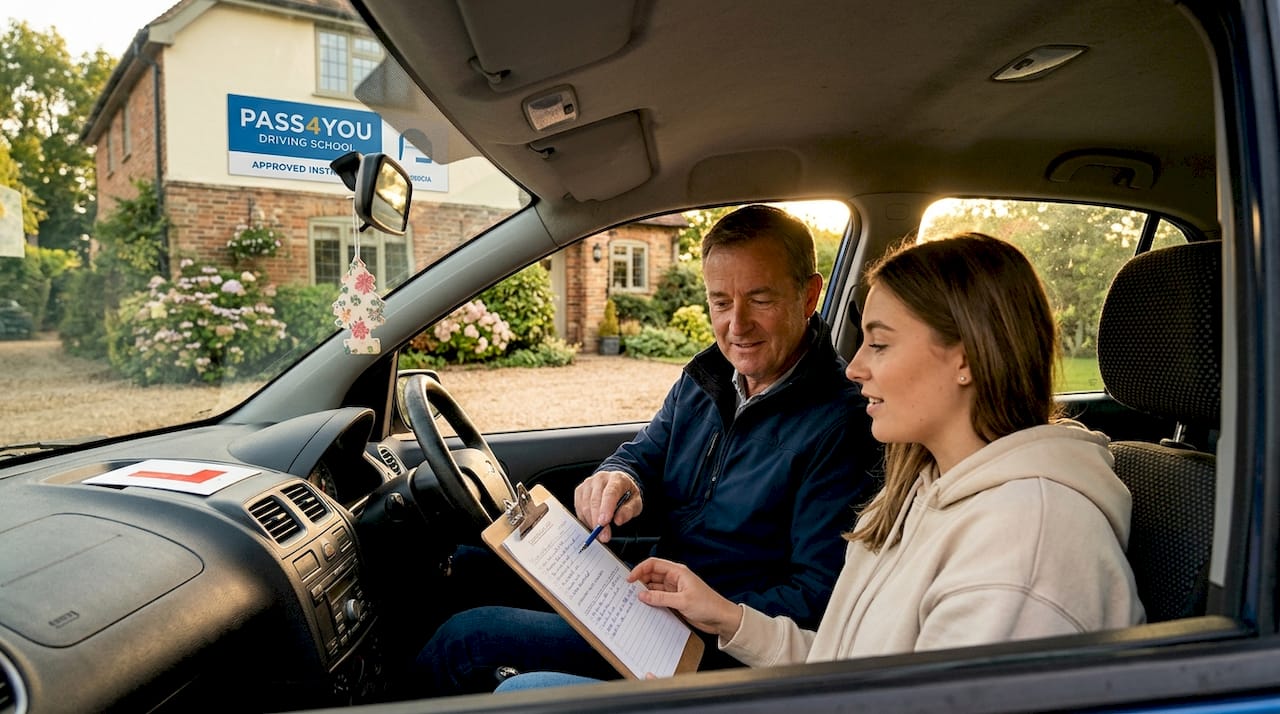
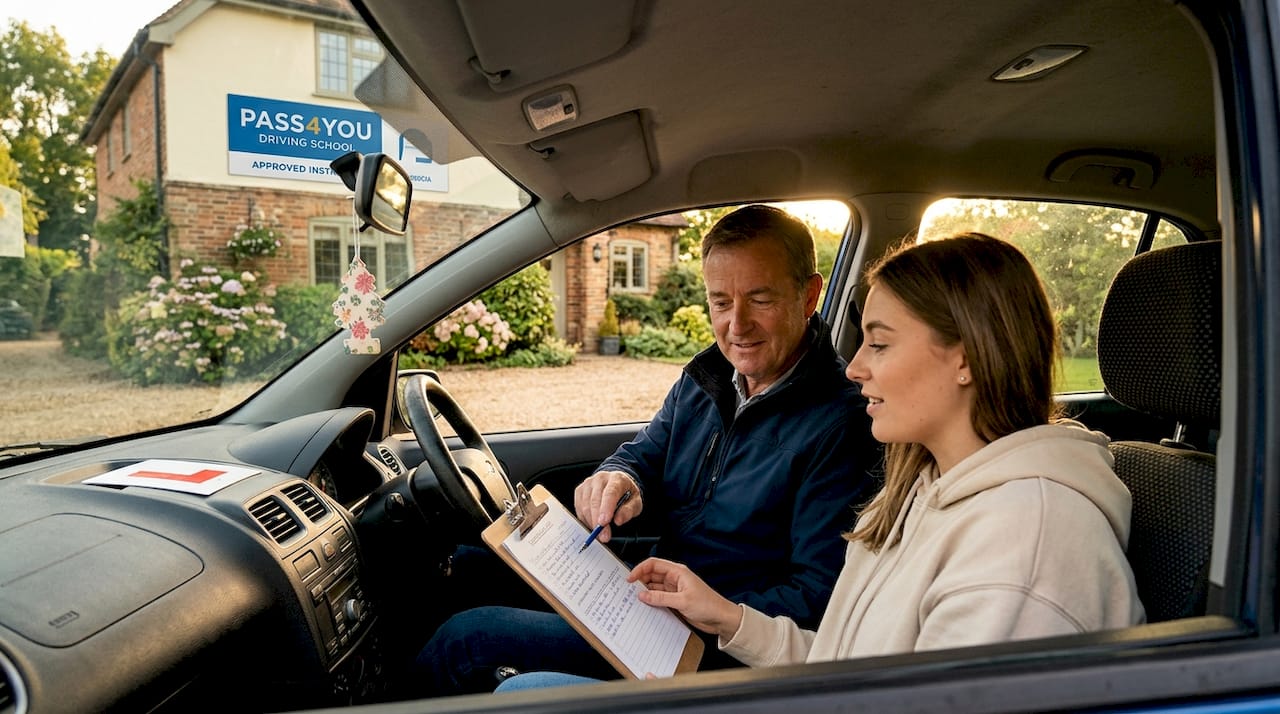
A driving lesson progress review is a structured evaluation of a learner driver’s current skills measured against the DVSA’s Ready to Pass framework, used to track improvement and determine readiness for the driving test. Most learners think of progress in terms of hours completed, but the DVSA framework covers 27 skills across 8 categories, giving both instructor and learner a far more precise picture of where they actually stand. At Pass4you, this kind of structured assessment sits at the heart of every training programme. Understanding what a progress review involves, and how to use it, is one of the most practical steps you can take to pass first time.
What is a driving lesson progress review?
A driving lesson progress review is the formal process by which your instructor assesses your performance against the DVSA’s standardised skill set and records where you are, what you did well, and what needs work before your next lesson. The industry term for this process is a learner progress assessment, though “progress review” is the phrase most learners and schools use day to day. Both terms refer to the same structured, lesson-by-lesson evaluation.
The DVSA’s Ready to Pass framework organises driving competence into 27 core skills spread across 8 categories. These categories cover everything from vehicle safety checks and moving off to independent driving and motorway awareness. Each skill is rated on a proficiency scale, so your instructor is not simply marking you pass or fail. They are recording whether a skill is at the “introduced,” “developing,” or “independent” stage, which tells you precisely how far along you are and what the next target should be.
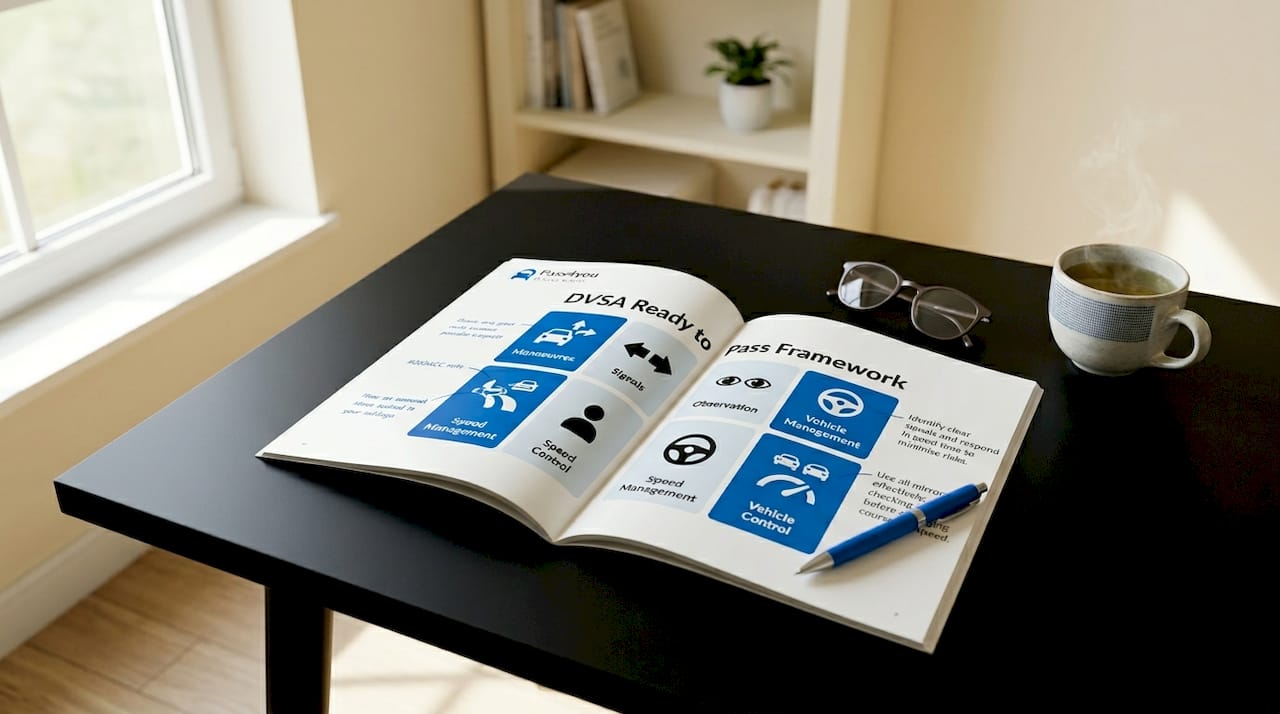
After each lesson, a well-structured review records four things: what was covered, what you did well, which areas need improvement, and what the plan is for the next session. This is not paperwork for its own sake. It creates continuity between lessons, so neither you nor your instructor wastes time re-establishing where you left off. It also gives you a written record of your own development, which is far more motivating than a vague sense that you are “getting better.”
Pro Tip: Ask your instructor to show you your skill ratings against the DVSA framework after each lesson, not just a general comment. Knowing that your “meeting and crossing traffic” is at the developing stage is far more useful than being told you need to work on junctions.
What the 8 DVSA skill categories cover
The eight categories in the DVSA framework are: vehicle safety, moving off and stopping, road positioning, junctions, roundabouts, meeting and crossing traffic, pedestrian crossings, and driving in different conditions. Each category contains multiple sub-skills, and detailed skill mapping is what separates a useful progress review from a generic percentage score. A number like “65% ready” tells you almost nothing. Knowing that you are independent on roundabouts but still developing on dual carriageways tells you exactly where to focus your private practice.
How do progress reviews influence readiness for the driving test?
Progress reviews do more than track skills. Research shows they directly influence learner behaviour and the quality of decisions made about when to book the driving test. Learners who are aware of the DVSA Ready to Pass campaign are 1.8 times more likely to use a driver’s record to track their progress. That is a significant behavioural difference, and it translates into better outcomes at the test centre.
The same research found that 80.1% of campaign-aware learners take mock tests before their practical, compared to 70.7% among those who are not aware. Mock tests are one of the most reliable indicators of readiness, and learners who engage with progress reviews are simply more likely to use them. This matters because a mock test conducted under realistic conditions gives your instructor the clearest possible evidence of whether you are ready.
“85.6% of learners aware of the Ready to Pass campaign agree to only take the test when their instructor confirms they are ready, compared to 79% among those who are not aware.” — DVSA Despatch Blog, 2025
That 6.6 percentage point gap may sound modest, but at scale it represents thousands of learners avoiding premature test attempts, wasted fees, and the knock to confidence that comes with an unnecessary failure. Progress reviews are the mechanism that makes instructor advice credible and specific. When your instructor says you are not ready, a detailed progress record explains exactly why, and what you need to do about it.
Schools that use systematic progress tracking report a 23% increase in first-time pass rates and 31% better learner retention. Those figures reflect the compounding effect of structured feedback. Learners who understand their own development stay engaged, practise more deliberately, and arrive at the test with genuine confidence rather than hope.
One common misconception is that hours behind the wheel are the best measure of readiness. The average learner needs around 45 hours with an instructor plus roughly 22 hours of private practice, but those averages mask enormous individual variation. A progress review cuts through that ambiguity by assessing actual skill levels rather than time logged.
How is driving progress tracked and communicated?
Instructors use two broad approaches to track and share progress: paper-based records and digital systems. Both can work, but they differ significantly in what they offer learners and parents.
| Method | Paper-based records | Digital tracking systems |
|---|---|---|
| Skill coverage | Often covers key skills but may lack DVSA alignment | Tracks all 27 DVSA skills lesson by lesson |
| Access for learners | Shared verbally or via a printed sheet | Available via student portal in real time |
| Parent visibility | Requires instructor to communicate separately | Parent portals provide direct access to reports |
| Lesson continuity | Relies on instructor memory or notes | Automated lesson briefings carry forward previous targets |
| Reminders and planning | Manual | Automated reminders and next-lesson focus built in |
Digital systems such as DriveSchoolPro generate lesson briefings that carry forward the previous session’s targets, so every lesson begins with a clear focus. For learners, this means you can review what your instructor planned for you before you even get in the car. For parents supporting younger learners, student and parent portals reduce the need for separate conversations and keep everyone aligned on progress.
Pro Tip: If your driving school uses a digital system, log in before each lesson and read the briefing notes from your last session. Arriving with that context in mind means you spend less of your lesson time re-establishing where you left off and more time actually improving.
Good communication between instructor and learner is not a nice-to-have. It is the mechanism by which progress reviews translate into better driving. When you understand what was assessed, why a skill was rated as it was, and what the specific target is for next time, you can practise with purpose rather than just accumulating miles.
How can learners use progress reviews to improve effectively?
Engaging actively with your progress review is one of the most direct ways to accelerate your learning. Most learners receive feedback passively, but the ones who improve fastest treat each review as a working document.
-
Ask for specific skill ratings. After each lesson, ask your instructor how each skill you practised is rated against the DVSA framework. “Good” is not a rating. “Developing, with one more session on left turns at busy junctions needed” is a rating you can act on.
-
Reflect between lessons. Spend five minutes after each lesson writing down what felt uncertain. Cross-reference that with your instructor’s notes. If your self-assessment and their assessment differ significantly, that gap is worth discussing at the start of your next lesson.
-
Use mock test results as a benchmark. A mock test conducted under real test conditions gives you and your instructor the clearest possible evidence of readiness. Treat the result as data, not judgement. Every fault recorded is a specific skill to address before the real thing.
-
Combine instructor feedback with private practice. Private practice reinforces what your instructor has introduced, but only if it targets the right skills. Use your progress review to direct your private sessions. If your instructor has flagged rural road positioning as developing, that is where your private practice should focus, not the routes you already feel comfortable on.
-
Set personal milestones. Work with your instructor to agree on what “independent” performance looks like for your three weakest skills, and set a target lesson by which you want to reach that level. Milestones give your training a structure that hours alone cannot provide.
Consistency matters more than any single good lesson. Sustained practice on weak points drives readiness far more reliably than a strong performance in your last session before the test. Progress reviews make that consistency visible and measurable.
Key takeaways
A driving lesson progress review is the single most reliable tool for turning lesson time into genuine test readiness, because it replaces vague impressions with specific, DVSA-aligned skill data.
| Point | Details |
|---|---|
| DVSA framework coverage | Reviews assess 27 skills across 8 categories, giving a precise picture of readiness rather than a general impression. |
| Behavioural impact | Learners aware of structured progress tools are 1.8 times more likely to track progress and more likely to follow instructor advice on test timing. |
| Digital vs paper tracking | Digital systems provide real-time access, lesson briefings, and parent portals that paper records cannot match. |
| Active learner engagement | Asking for specific skill ratings and using mock test results as benchmarks accelerates improvement more than hours alone. |
| Consistency over single sessions | Sustained practice on weak skills, guided by progress reviews, matters more than one strong lesson before the test. |
Why progress reviews deserve more attention than most learners give them
Most learners I speak with think of a progress review as something their instructor does to them, not something they participate in. That misunderstanding costs them time and money. A progress review is only as useful as the conversation it generates. If you sit in the car, hear “that was good, work on your mirrors,” and move on, you have received almost no useful information.
The DVSA framework exists precisely because driving competence is not a single thing. It is a collection of distinct, measurable skills, and each one can be at a different stage of development at any given point in your training. I have seen learners who are genuinely independent on roundabouts but still unreliable at pedestrian crossings book their test because they felt ready overall. The progress review, used properly, would have caught that gap before it became a test failure.
The other pitfall I see regularly is over-reliance on hours. Learners often tell me they have done 40 hours and should be ready. Hours are a rough proxy at best. The average of 45 hours with an instructor is a statistical mean, not a guarantee. Your progress review tells you what the hours have actually produced in terms of skill, and that is the only number that matters when you walk into the test centre.
My advice is straightforward. Treat your progress review as a conversation, not a report card. Ask questions. Challenge vague feedback. Use the DVSA skill categories as a shared language with your instructor. The learners who do this consistently are the ones who pass first time, and they tend to do it in fewer lessons than those who simply show up and hope for the best. You can find practical guidance on this approach in the Pass4you driving tips blog.
— Simon
How Pass4you supports your progress from first lesson to test day
Pass4you, based in Milton Keynes, builds structured progress tracking into every learner course from the outset. Instructors use DVSA-aligned assessments to record your skill development lesson by lesson, so you always know where you stand and what to focus on next. With an 83.33% first-time pass rate at Bletchley test centre, the approach works. If you want training that gives you clear feedback, honest readiness assessments, and a genuine plan for passing, explore the learner driver courses at Pass4you to see how structured progress reviews are built into every stage of your training. You can also find out more about intensive course options if you want to progress quickly with closely monitored skill development throughout.
FAQ
What is a driving lesson progress review?
A driving lesson progress review is a structured assessment of a learner’s driving skills against the DVSA Ready to Pass framework, covering 27 skills across 8 categories. It records what was covered, what went well, areas for improvement, and the plan for the next lesson.
How often should a progress review take place?
A progress review should take place at the end of every lesson, not just at set intervals. Lesson-by-lesson recording ensures continuity and gives both learner and instructor a clear, up-to-date picture of skill development.
Can a progress review tell me when I am ready for the driving test?
A progress review cannot set a test date on its own, but it provides the evidence your instructor needs to confirm readiness. Learners who follow instructor advice based on structured reviews are significantly more likely to pass first time.
What should I ask my instructor during a progress review?
Ask specifically how each skill you practised is rated against the DVSA framework, which skills are still at the developing stage, and what the concrete target is for your next session. Generic feedback is far less useful than skill-level detail.
Is a paper progress record as good as a digital one?
Paper records can cover the key skills but lack real-time access, automated lesson briefings, and parent visibility. Digital systems aligned with the DVSA framework offer a more complete and accessible record for learners and families.
Leave a Reply