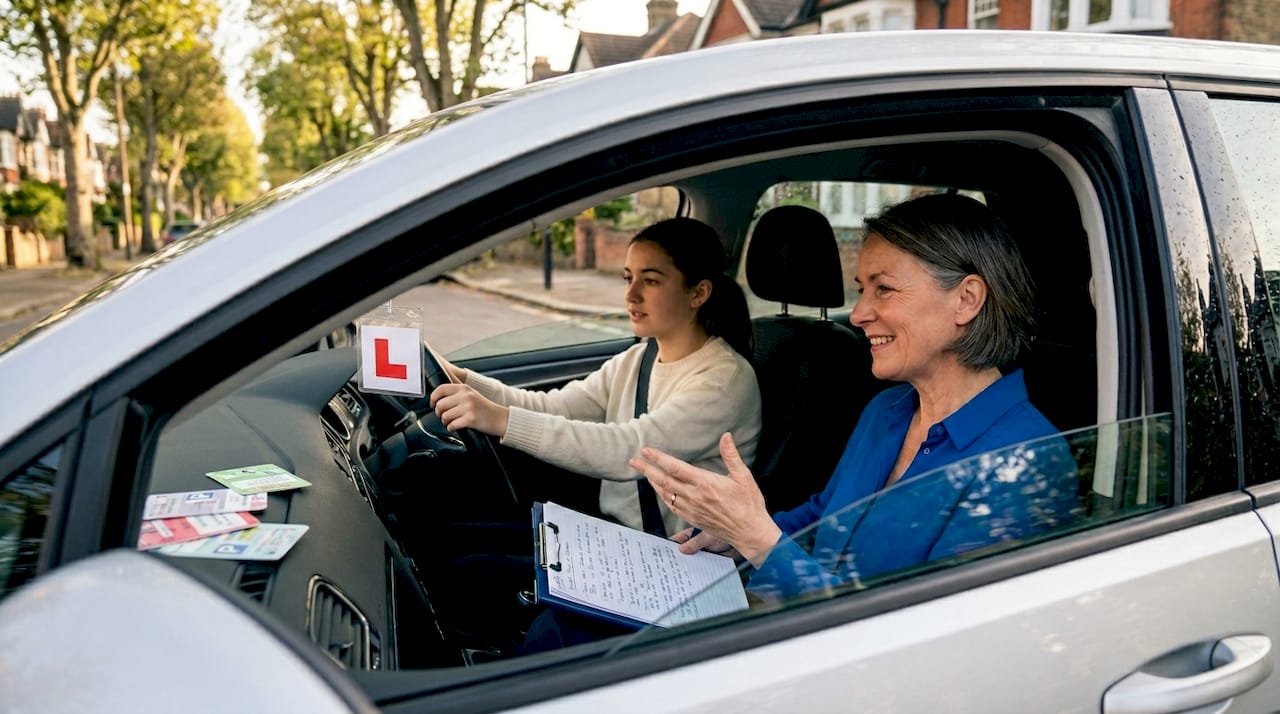
Learning to drive is one of the most anxiety-inducing things a young person can do. Many learners arrive at their first lesson already dreading the mistakes, the corrections, and the sharp intake of breath from the passenger seat. The role of positive reinforcement in driving lessons is far more significant than most people realise, and the research backs this up strongly. Rather than relying on criticism and correction alone, targeted praise and encouragement change the way your brain processes new skills. Get this right and you will build confidence faster, practise more willingly, and make fewer errors when it actually counts.
Table of Contents
- Key takeaways
- The role of positive reinforcement in driving lessons
- What research says about praise and driving behaviour
- When praise goes wrong
- Practical strategies that actually build confidence
- Long-term impact on safer driving
- My honest take on praise in driving lessons
- Learn to drive with confidence at Pass4you
- FAQ
Key takeaways
| Point | Details |
|---|---|
| Specific praise beats generic praise | Behaviour-focused feedback on skills like mirror checks builds more confidence than vague “well done” comments. |
| Self-efficacy drives practice hours | Learners who feel capable are significantly more likely to complete the supervised hours needed to pass. |
| Timing shapes effectiveness | Reinforcement works best when it follows the correct behaviour immediately and links to the next skill. |
| Parental support amplifies results | Structured communication from parents or guardians alongside instructor feedback reduces risky driving meaningfully. |
| Technology can reinforce safe habits | Telematics apps with gamified rewards support sustained behavioural improvement beyond the lesson itself. |
The role of positive reinforcement in driving lessons
Positive reinforcement is the formal term from behavioural psychology for adding something rewarding after a desired behaviour in order to make that behaviour more likely to happen again. In the context of driver education, this translates to acknowledging correct actions: smooth braking, a well-timed mirror check, a confident junction approach. When your instructor responds to those moments with clear, specific recognition, your brain encodes the action as something worth repeating.
This is different from generic praise. “Well done” after a manoeuvre tells you very little. “Good. You checked your right mirror before signalling. That’s exactly the sequence we need on test day” tells you precisely what worked and why it mattered. Behaviour-specific reinforcement targets the skill itself, not your identity as a driver.
Three principles make reinforcement effective in a lesson setting:
- Immediacy: Praise lands hardest when it follows the correct action within seconds. Delayed praise gets disconnected from the behaviour it was meant to reward.
- Consistency: Reinforcing the same behaviour reliably across multiple lessons helps you build procedural memory without second-guessing yourself.
- Specificity: Naming exactly what you did correctly gives you a repeatable mental model to draw on next time.
The contrast with traditional instruction is stark. A lesson driven by corrections and warnings can feel like a test you are constantly failing. One that balances correction with timely positive feedback feels like progress. That shift in atmosphere is not just more pleasant. It changes what you actually learn.
What research says about praise and driving behaviour
The evidence connecting reinforcement to driving outcomes has grown sharply in recent years. A 2025 randomised controlled trial found that persuasive messages boosted self-efficacy among 21 to 30 year old learner drivers in Victoria, Australia, increasing their willingness to complete at least 80 hours of supervised practice. The mechanism was not fear of consequences. It was a genuine increase in the learner’s belief that they could do it.
Self-efficacy, the belief in your own ability to succeed at a specific task, is the critical mediator here. When you feel competent, you practise more. When you practise more, you improve. The cycle is straightforward, but it only starts if someone helps you notice that you are already doing things right.

| Condition | Outcome |
|---|---|
| Feedback alone | Modest reduction in risky events; motivation variable |
| Feedback plus parent communication training | 32% reduction in risky driving events; significant speeding reduction |
| Gamified telematics with incentives | Speeding frequency fell from 4.8% to 3.7% in moderate-risk drivers |
| Generic praise during skill tasks | Reduced engagement; distraction from the learning task |
The parent communication data is particularly striking. A randomised clinical trial with 240 parent and teen pairs found that combining in-vehicle feedback with structured parental communication training produced nearly half the reduction in speeding miles compared to feedback alone. What parents say after the lesson matters as much as what happens during it.
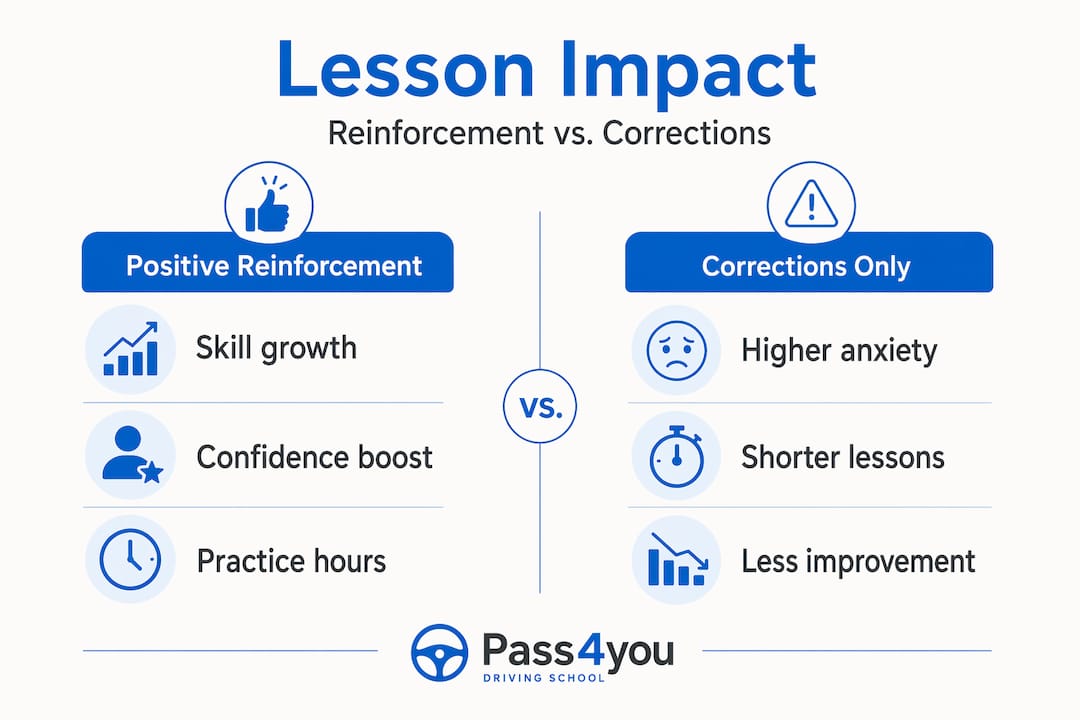
“Corrections alone increase learner anxiety and reduce learning effectiveness. Structured positive communication post-lesson supports sustained improvement.”
The research on gamified telematics adds another dimension. Incentive-linked telematics feedback tied to specific, measurable behaviours such as smooth braking and mirror use, reduced speeding frequency and intensity in moderate-risk drivers. The rewards only worked when they were clearly linked to the exact behaviour being reinforced, not given out broadly.
When praise goes wrong
Here is something counterintuitive that the research reveals. Praise is not always helpful. In fact, the wrong kind of praise at the wrong moment can actively reduce your performance and motivation.
A 2026 study found that person-level praise such as “You are such a natural driver” decreased engagement and performance when learners were in a task-focused learning environment. Telling someone they are talented shifts their attention from the skill to their self-image. If they then make a mistake, it threatens that identity rather than just being a useful data point.
The distinction to keep in mind:
- Ego-involving praise: “You are brilliant at this.” Focuses on what you are.
- Task-involving praise: “You handled that roundabout really smoothly, especially the early positioning.” Focuses on what you did.
Task-involving feedback keeps your attention on the driving, which is exactly where it needs to be during a lesson. Ego-involving praise might feel wonderful in the moment, but it creates fragility. One bad lesson and confidence collapses.
There are also timing pitfalls. Delivering praise mid-manoeuvre can split your attention at a critical moment. Instructors who interrupt a parallel park with “brilliant!” risk breaking the concentration needed to finish it cleanly. The most effective approach is to hold the positive feedback until the action is complete, then name it clearly.
Pro Tip: Ask your instructor to tell you specifically what you did right at the end of each exercise. If they tend toward brief “good” comments, it is entirely reasonable to ask for more detail. The conversation will reinforce your learning and give you clearer goals for next time.
Practical strategies that actually build confidence
Knowing the theory is useful. Having a concrete plan for your lessons is better. These approaches apply whether you are a learner driver, a parent doing accompanied practice, or an instructor looking to sharpen your methods.
- Start every lesson with a brief positive anchor. Before moving off, your instructor should reference something you did well last time. This primes your brain for learning rather than self-protection.
- Use the “what, why, next” formula. After a correct action, name what happened, explain why it matters, and link it to the next skill. “You checked your blind spot before moving off. That’s what prevents door accidents. Now let’s make sure we do the same before every lane change.”
- Practise in low-pressure environments first. A slow, deliberate approach builds competence without overwhelming anxiety. Quiet car parks and residential roads allow correct behaviours to be reinforced before you tackle roundabouts and dual carriageways.
- Record your wins. After each lesson, write down two or three specific things you did correctly. This is not about ignoring errors. It is about training yourself to register progress, which most learners drastically undercount.
- Use technology deliberately. If your parent or accompanying driver uses a telematics or dashcam app, review the positive data together after a session. Measurable safe driving behaviours tied to visible rewards create a feedback loop that extends reinforcement beyond the lesson.
- Manage mistakes constructively. When something goes wrong, the healthiest response is brief acknowledgement, a clear correction, and then reinforcement of the recovery. If you stalled and restarted calmly, your instructor should note the calm restart as a behaviour worth building on.
Pro Tip: If accompanied practice sessions with a parent feel tense, suggest agreeing on a simple rule beforehand: for every correction, there is one specific positive comment. This is not about false reassurance. It is about keeping the session balanced enough to actually learn from.
Long-term impact on safer driving
The benefits of positive reinforcement extend well past the driving test. Learners who build confidence through encouragement during lessons tend to approach post-test driving with better risk perception and fewer of the overconfidence errors that catch new drivers out in their first year.
The data on supervised practice hours is instructive here. Persuasive, self-efficacy focused messages increased planned practice hours among learners aged 21 to 30, a group that often struggles to find the motivation to log the hours needed. More practice hours directly correlate with lower crash risk. Reinforcement, in this sense, saves lives by keeping people engaged long enough to become genuinely skilled.
Consider what happens without it. Learners who experience predominantly critical feedback report higher anxiety, shorter practice sessions, and a tendency to avoid challenging situations rather than work through them. That avoidance does not disappear after passing the test. It follows them onto motorways and into night driving, exactly when confident, well-practised responses matter most.
| Behavioural outcome | With reinforcement | Without reinforcement |
|---|---|---|
| Voluntary practice hours | Higher, sustained | Lower, often stalled |
| Response to mistakes | Constructive, recovery-focused | Avoidant or anxious |
| Confidence on test day | Stable under pressure | Variable, easily shaken |
| Post-test risk behaviours | Reduced, better risk perception | Higher in first year |
The picture is consistent. Reinforcement builds not just individual skills but the disposition to keep developing them. That is the real return on what might look like simply saying “well done” more thoughtfully.
My honest take on praise in driving lessons
I have worked with hundreds of learner drivers, and the pattern I keep seeing is this: the learners who struggle most are rarely the ones lacking natural ability. They are the ones who have been made to feel every mistake is a near catastrophe.
The research on structured positive communication confirms what I have witnessed in practice. Corrections are necessary. No one argues otherwise. But corrections without regular, specific acknowledgement of what is working create a mental environment where the learner is waiting to be caught out rather than focused on driving.
What I have also found, and this is not in any textbook, is that learners can sense when praise is genuine. Empty “amazing!” comments every thirty seconds do not fool anyone. What builds real confidence is a calm instructor who says very little unless it is specific and true. One well-placed “that was a well-judged gap, you read the traffic early” does more for a learner’s long-term skill than ten generic reassurances.
My advice to anyone starting lessons: actively ask for specific feedback on what you are doing right. Do not wait for it. Make it part of the lesson. You deserve to know what you are getting correct, not just what needs work.
— Simon
Learn to drive with confidence at Pass4you
At Pass4you, the instructors in Milton Keynes understand that confidence is built through clear, specific encouragement as much as through correction. Every lesson is designed to give you structured, positive feedback that helps you understand exactly what you are doing well and why it matters. Whether you prefer a steady week-by-week approach or need to progress quickly, the learner driver courses are tailored to your pace and learning style. Pass4you holds an 83.33% first-time pass rate, significantly above the local average, because the teaching methods work. If you want to experience calm, effective, confidence-building lessons in Milton Keynes, get in touch to book your first session.
FAQ
What is positive reinforcement in a driving lesson?
Positive reinforcement in a driving lesson means acknowledging and rewarding correct driving behaviours immediately after they occur, such as praising a well-timed mirror check or smooth braking. This makes those behaviours more likely to be repeated and helps build genuine confidence over time.
Does praise actually improve driving skills?
Yes, but only when it is specific and behaviour-focused rather than generic. Task-involving feedback that names exactly what the learner did correctly has been shown to improve both motivation and performance, while vague praise can distract from the learning task.
How can parents support positive reinforcement?
Research shows that structured parental communication alongside in-vehicle feedback produces significantly better outcomes than feedback alone. Reviewing positive driving data after accompanied sessions and making specific, calm comments about correct behaviours reinforces what the instructor is teaching.
When should an instructor avoid praise?
Praise delivered mid-manoeuvre can break concentration at a critical moment. Instructors should hold positive feedback until an action is complete, then name the specific behaviour. Person-level praise such as “you are a natural” should also be avoided during skill-focused tasks, as it shifts attention away from the driving itself.
Can technology help reinforce good driving habits?
Yes. Gamified telematics apps that link rewards to measurable behaviours such as smooth braking and reduced speeding have shown statistically significant reductions in risky driving, particularly when the reward criteria are specific and clearly communicated to the driver.
Leave a Reply