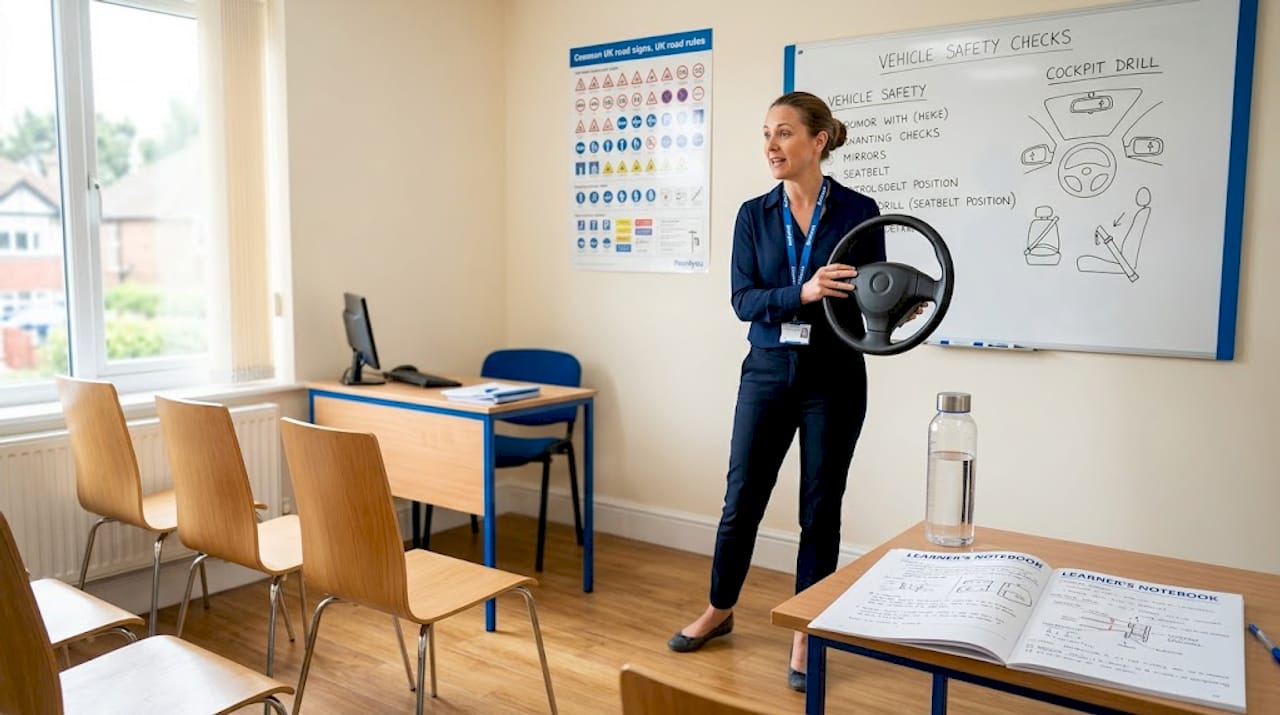
Starting driving lessons is exciting, but it can also feel overwhelming when you realise just how much there is to learn. The essential skills learned in driving lessons go far beyond simply steering and pressing the accelerator. They form a structured set of competencies that examiners look for on test day and that stay with you throughout your driving life. This article breaks down every major skill area in a clear, practical way so you know exactly what to focus on, what mistakes to avoid, and how to get the most from every hour you spend behind the wheel.
Table of Contents
- Key takeaways
- 1. Vehicle safety knowledge: Show Me, Tell Me
- 2. Steering, clutch control and gear changes
- 3. Observation, mirrors and signalling
- 4. Manoeuvres and parking skills
- 5. Road positioning, speed management and defensive driving
- My honest take on learning to drive well
- Start building your essential driving skills with Pass4you
- FAQ
Key takeaways
| Point | Details |
|---|---|
| Show Me, Tell Me matters | Vehicle safety knowledge is tested on the day and carries real marks. |
| Control comes before speed | Mastering clutch, steering and braking smoothly beats driving fast. |
| Observation is non-negotiable | Mirrors, blind spots and anticipation are the backbone of safe driving. |
| Manoeuvres need dedicated practice | Parking, reversing and hill starts require repetition in low-pressure settings. |
| Mindset shapes progress | Patience and focused micro-skill practice accelerate improvement faster than long, unstructured drives. |
1. Vehicle safety knowledge: Show Me, Tell Me
Before you touch the gearstick, you need to know what is going on under the bonnet. The UK practical driving test includes a Show Me, Tell Me section in which the examiner asks two vehicle safety questions. One question requires you to explain how to check something (“Tell Me”), while the other asks you to demonstrate a control safely whilst driving (“Show Me”).
This dual requirement is consistently underestimated by learners. Answering vaguely will lose you marks. Examiners expect specific answers on how to check oil levels, brake fluid, coolant, screen wash, tyre tread depth and lights. You need to know the exact process, not just point at the bonnet.
Key vehicle checks to understand and practise:
- Engine oil: Locate the dipstick, wipe it clean, reinsert and remove to read the level.
- Coolant and brake fluid: Check reservoir markings against min and max lines.
- Tyres: Check tread depth and pressure. Minimum tread depth is 1.6mm and the 20p coin is the simplest test method.
- Lights and indicators: Walk around the car and confirm every bulb works.
- Screen wash: Check the reservoir is topped up and the wipers function correctly.
Pro Tip: Practise saying your Tell Me answers out loud. Research shows that verbalising safety explanations improves both confidence and precision when the examiner asks the question on test day.
Form a consistent pre-drive checklist habit from your very first lesson. It takes two minutes, reduces risk, and signals to your instructor that you are serious about safety.
2. Steering, clutch control and gear changes
These are the physical foundations of every journey. Getting them right early makes everything else much easier.
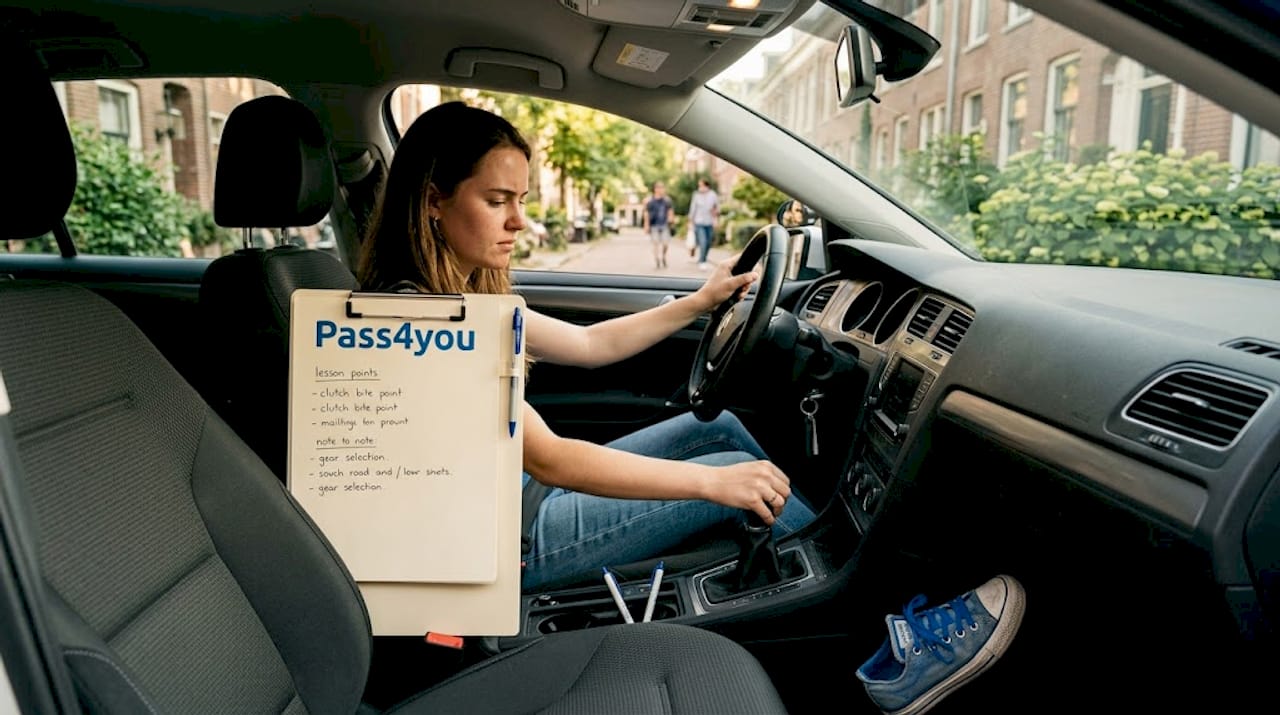
Smooth steering means using the pull-push method, keeping both hands on the wheel, and making deliberate, measured inputs. Jerky or overcorrected steering is a common fault that creates instability, especially at speed or in tight spaces.
Clutch control is arguably the trickiest skill for manual car learners. Finding the biting point consistently, moving away without stalling, and balancing clutch release with acceleration all require repetition. The gearbox should never be treated as an afterthought. Selecting the right gear for the right speed keeps the engine responsive and the drive smooth.
Key driving control skills to work on:
- Moving off smoothly from stationary
- Upshifting and downshifting at appropriate speeds
- Braking progressively rather than abruptly
- Coordinating clutch and accelerator on inclines
- Steering through bends without losing lane position
Pro Tip: Rather than treating every lesson as a general drive, focus on individual controls in isolation. Spend five minutes practising just clutch control, then five on gear changes. Targeted repetition removes errors faster than vague mileage.
Effective acceleration is often misunderstood. New drivers either accelerate too tentatively, blocking traffic, or too aggressively, unsettling passengers and other road users. Controlled, progressive acceleration is one of the key skills for new drivers that marks out confident, competent driving.
3. Observation, mirrors and signalling
Safe driving is largely about what you see and when you see it. Most accidents happen because a driver either missed a hazard or reacted too slowly. Developing strong observation habits early is one of the most important lessons for driving that will serve you for life.
Mirrors should be checked every five to eight seconds as a general rhythm, and specifically before signalling, changing speed, or changing direction. The interior mirror gives you the wide picture. Door mirrors give you lane-specific detail. Neither replaces a physical blind spot check before pulling out, changing lanes, or moving off from the kerb.
Good observation habits include:
- Scanning well ahead of your vehicle, not just at the car in front
- Checking mirrors in a sequence: interior, right, left
- Checking your blind spot before every manoeuvre
- Reading road markings, signs, and pedestrian behaviour ahead of time
- Anticipating what other drivers and cyclists might do at junctions
Signalling correctly is equally non-negotiable. Signal too early and you confuse other road users. Signal too late and you give no warning. The rule is simple: signal with enough time for others to react, but only when the signal accurately represents your next action.
A common learner error is signalling out of habit rather than necessity, or forgetting to cancel a signal after completing a turn. Both generate faults on your test. Make it a habit to confirm the indicator has cancelled after every manoeuvre.
4. Manoeuvres and parking skills
Manoeuvres are where many learners feel the most pressure, and understandably so. They require precision, slow-speed control, and the ability to keep observing while executing a physical task simultaneously.
| Manoeuvre | Main challenge | Key tip | Common error |
|---|---|---|---|
| Parallel parking | Judging distance from kerb | Use reference points on the car | Finishing too far from the kerb |
| Reverse bay parking | Steering angle while reversing | Count steering turns consistently | Straddling the bay line |
| Three-point turn | Speed control on a narrow road | Keep it slow, observations frequent | Moving too quickly and mounting the kerb |
| Hill start | Clutch control under pressure | Set handbrake, find bite before releasing | Rolling backwards |
| Straight-line reversing | Keeping within the lane | Small steering corrections only | Over-correcting and swerving |
Pro Tip: Starting practice in quiet areas such as empty car parks removes traffic pressure and lets you focus entirely on your control inputs. Once the mechanics feel automatic, introduce real road conditions.
Hill starts deserve special mention. The combination of clutch control, handbrake release and acceleration timing is tested under real stress during the test. Practice on genuine gradients, not flat roads, so the skill transfers correctly.
At roundabouts, the key is observation before entry, correct lane selection, and clear signalling on exit. Many learners hesitate too long or commit too early. Neither is safe. Build roundabout confidence by approaching them repeatedly on lessons until the decision-making feels calm and automatic.
5. Road positioning, speed management and defensive driving
Knowing where to position your car and how fast to travel for conditions is what separates a nervous learner from a competent driver. These skills sit at the heart of how to improve driving skills beyond just passing the test.
Lane discipline means keeping your vehicle appropriately centred in your lane, not drifting toward the centre line or the kerb. On single-track roads, it means leaving enough room for oncoming vehicles. On dual carriageways, it means staying in the left lane unless overtaking.
Speed management is not about keeping up with traffic. It is about matching your speed to the conditions: wet roads, poor visibility, pedestrian areas and sharp bends all require lower speeds than dry open roads. Critical driving errors such as exceeding the speed limit or misjudging stopping distances cause immediate test failure and real-world danger.
Here are the key defensive driving habits to build from day one:
- Keep at least a two-second gap from the vehicle in front, and double it in wet conditions.
- Look far ahead so you react to hazards early rather than braking sharply.
- Always have an exit plan: know where you would go if the car in front stopped suddenly.
- Slow down before corners and junctions rather than during them.
- Anticipate the behaviour of cyclists, pedestrians and other drivers rather than reacting to surprises.
- Stay calm when other drivers make mistakes. Frustration leads to poor decisions.
Defensive driving is as much a mindset as a technique. Learners who absorb this principle early progress more quickly through their driving skills checklist because they understand the why behind each rule, not just the what.
My honest take on learning to drive well
In my experience, the learners who progress fastest are not the ones who rack up the most hours behind the wheel. They are the ones who practise deliberately. There is a real difference between driving for an hour and actually working on something specific for an hour.
What I have found is that most learners treat early lessons like a preview of real driving, when they should be treating them like skills training. Clutch control on its own. Mirror checks on their own. Gear changes broken into steps. Training individual skills with feedback develops test-ready ability faster than undifferentiated practice drives.
The other thing I would push back on is the idea that speed matters. Many new drivers assume that driving confidently means driving at the same pace as experienced drivers. It does not. Confidence comes from smoothness, not pace. A driver who pulls away cleanly, shifts quietly, and checks mirrors regularly feels competent even at 20 mph.
I also think mindset is undervalued in driving instruction. Anxiety causes rushed decisions. Impatience causes missed observations. The learners I have seen struggle most are not the ones with poor coordination. They are the ones who cannot let a mistake go. One stall does not predict another. Reset, breathe, and focus on the next moment.
Mastering these essential driving techniques is not just about passing a test. It sets the standard for how you will drive for the rest of your life.
— Simon
Start building your essential driving skills with Pass4you
Pass4you is a Milton Keynes driving school with an 83.33% first-time pass rate, well above the local average, and every course is built around the exact skills covered in this article. Whether you are preparing for your first lesson or looking to accelerate your progress, their instructors cover everything from Show Me, Tell Me knowledge through to manoeuvres and defensive driving techniques.
Their learner driving courses are structured to build each skill progressively, using modern dual-control Volkswagen vehicles and calm, patient instructors who know the Bletchley test routes in detail. If you want to fast-track your learning, Pass4you also offers intensive driving courses designed to compress skill-building into a shorter timeframe without cutting corners. Book by phone or email and take the first step toward your licence with confidence.
FAQ
What are the essential skills learned in driving lessons?
The core skills include vehicle safety checks, clutch and steering control, gear changes, mirror use, blind spot observation, signalling, manoeuvres such as parking and hill starts, and defensive road positioning. These form the foundation of the UK practical driving test.
What is the Show Me, Tell Me test in the UK driving test?
The Show Me, Tell Me section asks learners two vehicle safety questions. One requires a verbal explanation of how to check a vehicle item, and the other asks the learner to demonstrate a control safely whilst driving.
How can I improve my driving skills faster?
Breaking practice into focused micro-skills with instructor feedback is more effective than general driving practice. Target specific weaknesses in each lesson rather than repeating the same routes without clear goals.
How often should I check my mirrors when driving?
As a general guide, check your mirrors every five to eight seconds and always before signalling, changing speed or changing direction. Making mirror checks a rhythm rather than a reaction is one of the most reliable habits for new drivers.
What vehicle checks must I do before a driving test?
Confirm that all required vehicle items are working, including headlights, brake lights, indicators, wipers, horn, mirrors and speedometer. Tyre tread must meet the legal minimum of 1.6mm. A vehicle that fails these checks can result in automatic test failure.
Leave a Reply